



Abstract
Objective
Do real-time strategy (RTS) video gamers have better attentional control? To examine this issue, we tested experienced versus inexperienced RTS video gamers on multi-object tracking tasks (MOT) and dual-MOT tasks with visual or auditory secondary tasks (dMOT). We employed a street-crossing task with a visual working memory task as a secondary task in a virtual reality (VR) environment to examine any generalized attentional advantage.
Background
Similar to action video games, RTS video games require players to switch attention between multiple visual objects and views. However, whether the attentional control advantage is limited by sensory modalities or generalizes to real-life tasks remains unclear.
Method
In study 1, 25 RTS video game players (SVGP) and 25 non-video game players (NVGP) completed the MOT task and two dMOT tasks. In study 2, a different sample with 25 SVGP and 25 NVGP completed a simulated street-crossing task with the visual dual task in a VR environment.
Results
After controlling the effects of the speed-accuracy trade-off, SVGP showed better performance than NVGP in the MOT task and the visual dMOT task, but SVGP did not perform better in either the auditory dMOT task or the street-crossing task.
Conclusion
RTS video gamers had better attentional control in visual computer tasks, but not in the auditory tasks and the VR tasks. Attentional control benefits associated with RTS video game experience may be limited by sensory modalities, and may not translate to performance benefits in real-life tasks.
Introduction
With the popularity of computer games growing in the world, the number of gamers has been consistently on the rise over the last two decades. Some avid gamers spend a lot of time on one or more games of a certain genre, such as action video games. This common experience might affect their cognitive or perceptual characteristics. Indeed, several cross-sectional and interventional studies suggest that action video gamers may have better perception and cognitive abilities (Basak et al., 2008; 2011; Bediou et al., 2018; Boot et al., 2011; Dobrowolski et al., 2015; Green & Bavelier, 2006a; 2006b; Irons et al., 2011). Action video games are defined as video games with multiple fast-moving objects, a high degree of perceptual and cognitive load, an emphasis on switching between distributed state (e.g., watching for enemies) and focused state (e.g., engaging enemies), and a high degree of clutter and distraction (Bavelier & Green, 2019; Bediou et al., 2018). While previous studies have shown different game genres are related to different cognitive abilities (Dale & Green, 2017; Dobrowolski et al., 2015), more recent studies suggest that game mechanics, not game genres, are associated with better cognitive abilities (e.g. attentional control) of action video game players (Bavelier & Green, 2019; Bediou et al., 2018; Cardoso-Leite & Bavelier, 2014; Dale & Green, 2017). These game mechanics also can be found in real-time strategy (RTS) video games (Dale et al., 2020). Then, do RTS video gamers have better attentional control than non-gamers?
Attentional Control
In daily life, individuals often need to focus on the task at hand and ignore sources of distraction or noise while at the same time constantly monitoring their environment to find new sources of information. Attentional control refers to the ability to quickly switch between distributed and focused attentional states according to task requirements (Bavelier & Green, 2019). The multi-object tracking (MOT) task is a classical paradigm for measuring attentional control, involving distribution and sustained attention (Bavelier & Green, 2019; Green & Bavelier, 2015). In a typical MOT task, participants start with several identical visual items (usually 7 to 10 items) on a screen. At the beginning of each trial, some of the items are cued as targets. Once the cues disappear, targets become visually indistinguishable from uncued items, and all items continue to move randomly and independently about the screen. Participants need to keep track of multiple targets. After several seconds of tracking, all items stop, and participants are asked to indicate each of the target items (Green & Bavelier, 2006b; Trick et al., 2005). As noted above, action video games require players to consistently monitor the entire visual scene to discover targets and to avoid distraction, and switch attention between distributed state and focused state. Several studies have shown action video gamers perform better at MOT tasks (Boot et al., 2008; Dobrowolski et al., 2015; Green & Bavelier, 2006b; Trick et al., 2005) and have better attentional control (Föcker et al., 2019; Green & Bavelier, 2012; Wu et al., 2012).
Transfer of Learning
While gamers perform better in studies with visual attentional control tasks, they do not always perform better than non-gamers in other studies with attentional control tasks involving visual and auditory modalities. During a dual-task trial, participants had to switch between distributing attention (focusing on both two tasks) and focused attention (focusing on only one of the two tasks) (Maclin et al., 2011; Mast et al., 2017). In most studies where auditory tasks were used as secondary tasks, gamers showed no better attentional control than non-gamers (e.g. Donohue et al., 2012; Gaspar et al., 2014; Rupp et al., 2016; Strobach et al., 2012). The limited transfer of the game training effects may account for these results. As a key domain of gaming training, transfer of learning occurs when the skills acquired in one task are generalized to other tasks. It is customary to distinguish near transfer that is, the transfer taking place across two tasks tightly related to each other and far transfer, where the training task and the target task are only loosely related (Sala et al., 2018). Numerous previous studies have found that far transfer is less unlike to occur than near transfer. Gamers switch visual attention between objects and views during gaming, while their auditory attention is used less in games. The sensory modalities of tasks may be a factor that limits the improvement of attentional control by video game training.
Researchers developed a dual-MOT (dMOT) task, which combined MOT tasks with visual or auditory secondary tasks (Alvarez et al., 2005; Donohue et al., 2012; Wei et al., 2014) to explore the effects of sensory modalities on attentional control. While tracking targets, participants were required to complete a secondary task in the dMOT task. In a study that used auditory tasks as the secondary tasks, action video gamers and non-gamers showed comparable costs to performance on the MOT task when they were distracted by answering a phone call task (Donohue et al., 2012). In that case, we wanted to ask the question about whether gamers have the advantage of attentional control and better task performance with visual secondary tasks.
Real-Time Strategy Video Games
Real-time strategy (RTS) video games, such as Civilization, StarCraft, and Halo Wars, are excellent candidates for testing whether gamers’ attentional control is limited by sensory modalities. On the one hand, similar to action video games, RTS video gamers need to process multiple sources of information simultaneously and switch attention constantly among different maneuvers (Dale et al., 2020). Although some recent studies show that RTS video games experience may lead to improvements in cognitive performance (Basak et al., 2008; 2011; Glass et al., 2013; Jakubowska et al., 2021), there have been mixed results on whether RTS video gamers have better attentional control (Dale & Green, 2017; Dobrowolski et al., 2015). These studies suggest that it is necessary to further explore the attentional control of RTS video gamers while controlling for the possible influencing factors. On the other hand, RTS video games require players to manage a host of units placed within a much wider environment during gaming (Dobrowolski et al., 2015; Gong et al., 2019; Kowalczyk et al., 2018), which may lead to improvements in visual-related cognitive abilities. Several studies suggest RTS video gamers have a greater level of neuronal activity and structural connectivity between visual (e.g., posterior parietal cortex) and cognitive areas (e.g., dorsolateral prefrontal cortex, anterior cingulate cortex) than non-gamers (Basak et al., 2011; Kim et al., 2015; Kowalczyk et al., 2018). There is still a lack of research to investigating whether the attentional control advantage of RTS video gamers exists in dual-task with visual or auditory sensory modality.
So far, the above questions have not been fully examined. To investigate them, we examined the attentional control of RTS video gamers by a pure MOT task and a dual-MOT task with a visual or an auditory secondary task (dMOT). This means that a series of visual or auditory number judgment tasks will appear as secondary tasks during target tracking in the dMOT task.
Study 1
Method
Participants
A total of 50 young adults from universities in Beijing, China were recruited in the current study (27 males, 20.48 ± 2.01 years of age). Before participating, potential participants completed a video game questionnaire, which was used to classify potential participants as real-time strategy video game players (SVGP) and non-video game players (NVGPs) (Dobrowolski et al., 2015). To ensure that players are adequately trained in RTS video games and avoid the influence of other games, participants who played RTS video games for 6–12 h per week but no more than 2 h per week of any other genre in the current 6 months were classified as SVGP. Overly long gaming time indicates that gamers may be addicted to games, which may lead to differences in their attentional control compared with occasional gamers. Thus, participants who played games more than 12 h per week were excluded. Participants who don’t play RTS video games and no more than 2 h per week of any kind of games in the current 6 months were classified as NVGP. Twenty-five participants (15 males) were classified as SVGP and 25 participants (12 males) were categorized as NVGP. Each participants’ major was recorded (science or humanities). All participants had normal or corrected-to-normal vision and normal hearing by passing a simple test. Participants completed the MOT task and two dMOT tasks. This research complied with the American Psychological Association Code of Ethics. Written informed consent was signed by all participants according to a protocol approved by the Research Ethics Committee of Beijing Normal University. Participants were paid for their participation.
MOT Paradigm
The MOT paradigm was adapted from an earlier study (Wei et al., 2014). The area of the stimulus presentation field was in the center of the screen in an 800 × 600-pixel white line box with black background (horizontal visual angle = 85°, vertical visual angle = 66°). At the beginning of each trial, participants were asked to focus on a fixation point (a white square at the center of a black background, 40 × 40 pixels, about 3.75°). They saw 10 white disks (r = 20 pixels, about 3.75°) appearing at the same time but at random initial places. A subset of five disks was cued as targets by flashing off for 1 second, with other disks being distractors. In the tracking phase, all disks moved in random directions for 5–6 seconds at a rate of 180 pixel/s. At the end of each trial, participants were asked to identify and click on the five targets using a mouse (Figure 1). Participants completed 5 training trials with feedback to familiarize themselves with the task. The experiment included 20 formal trials, followed by a one-minute break after 10 trials. MOT paradigm. (1) Cue targets: A subset of five disks was identified as targets by flashing off for 1 second. (2) Presentation: All disks were locally stationary for 1 second. (3) Track Targets: All objects move at a constant rate colliding with other objects and bouncing off the edges of the display. The arrows connected to the circles indicate the direction in which each object is moving. (4) Identify targets: Participants select the targets by clicking on them with the mouse pointer (as shown by the red box).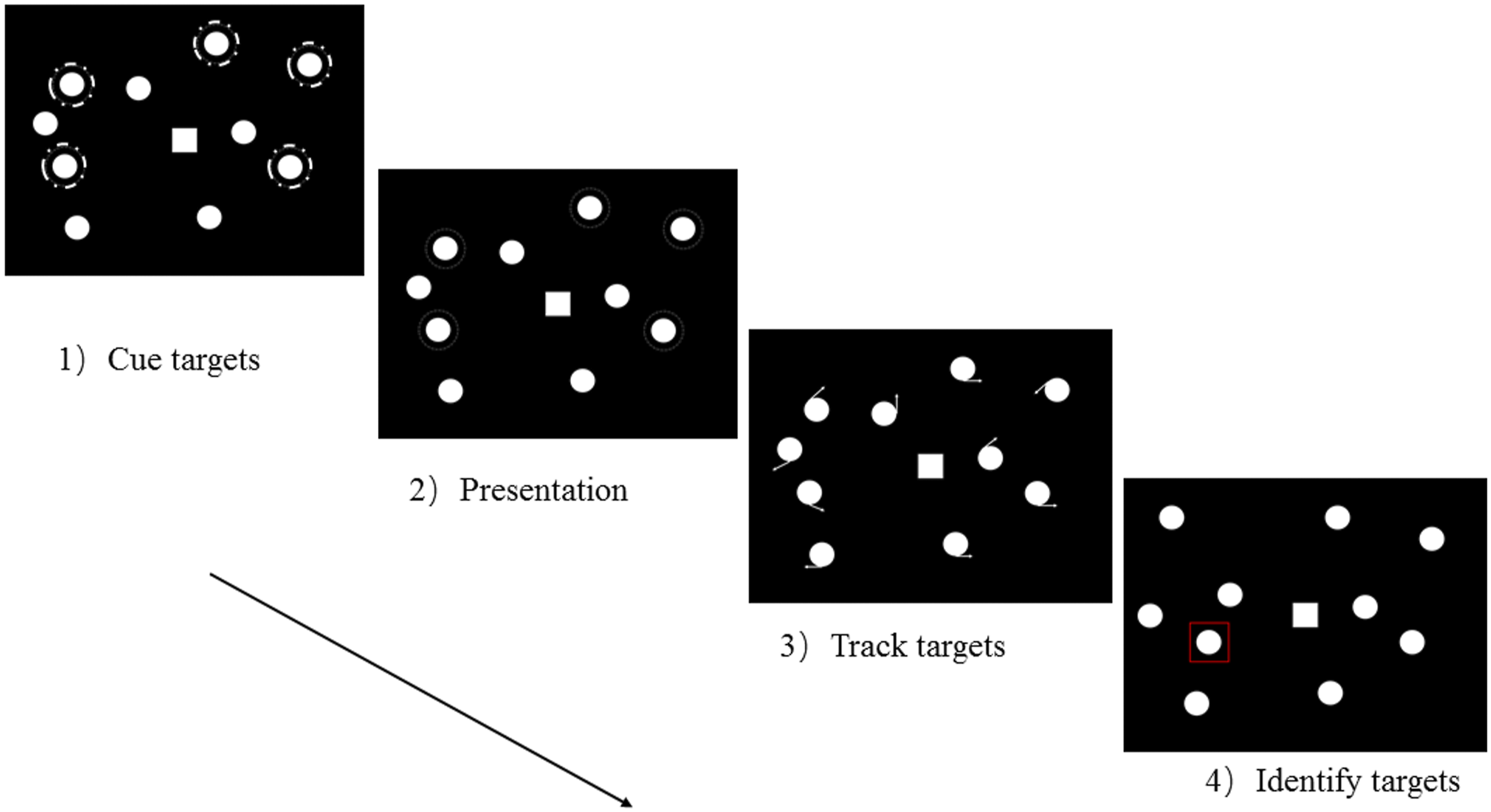
DMOT Paradigm
In the MOT task, observers can only track about four or five objects (Pylyshyn & Storm, 1988). As the dMOT paradigm was more demanding, we reduced the number of disks to eight (four of them are target disks) to avoid a floor effect. For each of the dual-task trials, three integers randomly selected from 1 to 9 were presented during the tracking phase separately. Participants needed to identify whether each integer was divisible by three. In visual dual-task trials, the integers were displayed on the central white square (Figure 2A). The first integer appears 1 s after the start of the tracking phase and lasted for 0.5 s. Participants were given one second to make a judgment before the next integer appeared. In auditory dual-task trials, the integers were spoken and presented to the participant through headphones (Figure 2B). The integers’ presentation time and response interval were the same as the visual dual-task. If the integer was divisible by three, the participants were required to press the “←” key on the keyboard; if the integer was not divisible by three, they were required to press the “→” key. After the disks stopped moving, the participants were asked to click on the four targets that had been identified at the beginning of each trial. Participants completed 5 training trials with feedback. Experiments include visual and auditory dual-tasks, with one block each and a total of 80 trials. To obtain more stable results, the number of trials of each dMOT task was increased relative to the MOT task. There was a one-minute break between the two blocks. The sequence of blocks was balanced among the subjects. The accuracy and reaction time of the dual-task were recorded. DMOT paradigm. (a) dMOT with the visual distractor. (b) dMOT with the auditory distractor.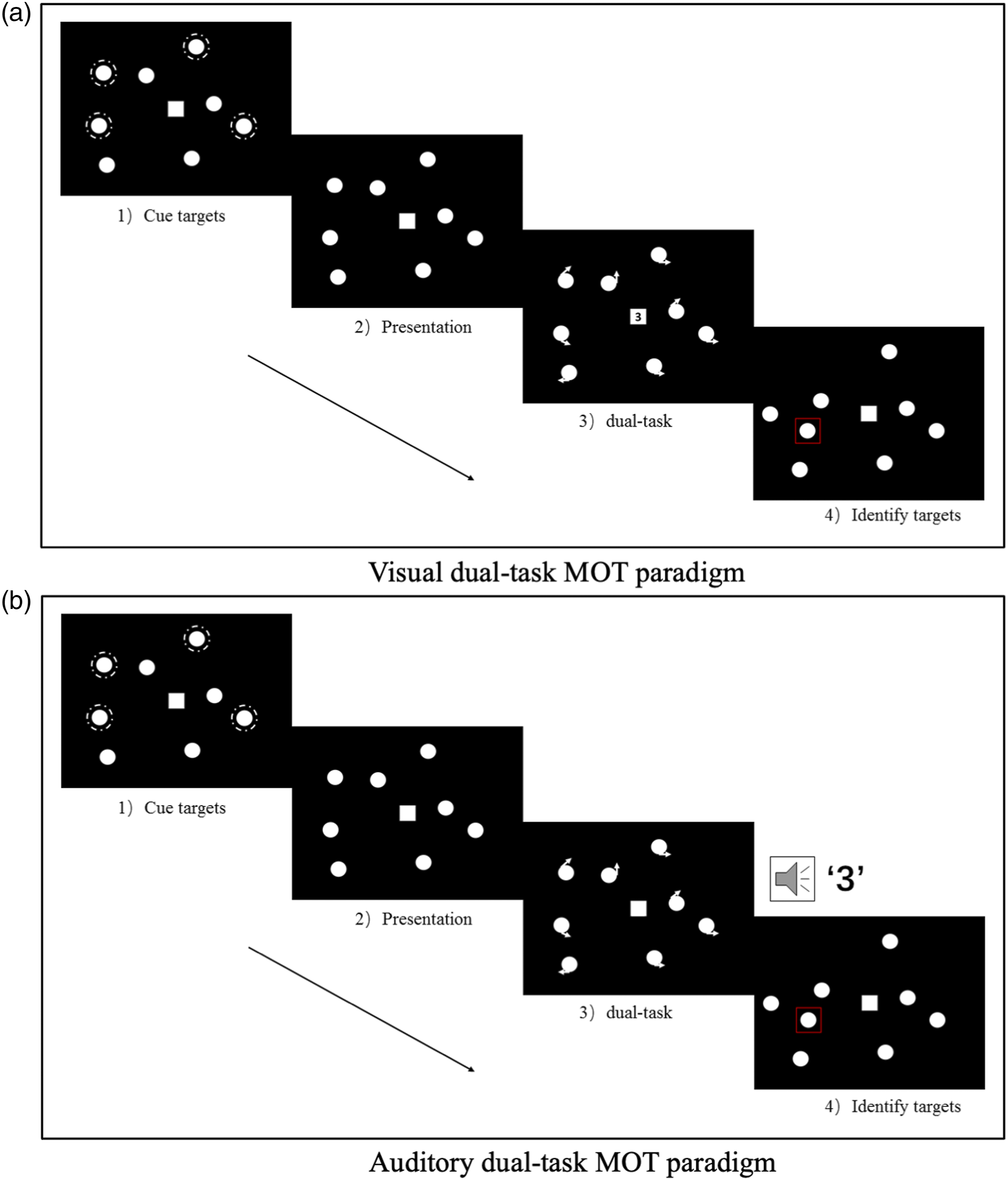
Both the MOT and two dMOT tasks were programmed using MATLAB 2012b (including some functions from PsychToolbox) and presented on a DELL computer. The computer’s screen had a display size of 17 inches, a resolution of 1024 × 768 pixels, and a vertical refresh rate of 85 Hz.
Results
The participant’s performance in the tracking of MOT and dMOT tasks was calculated as the accuracy rate of each trial. For instance, if four of the five disks identified as targets were the correct ones, the accuracy rate of this trial would be 80%. Analysis of Covariance (ANCOVA) was used to compare the accuracy rate and reaction time between the two groups, controlling for age, gender, and area of major. We analyzed the results of each task separately.
In the MOT task, the SVGPs showed significantly higher accuracy than the NVGPs (56.4 ± 4.2% vs. 52.9 ± 4.4%; F(1,45) = 5.521, p = 0.023, η2 = 0.109).
In the dMOT task, participants would press keys to respond to visual or auditory numerical judgment tasks three times and to click on targets at the ending of each trial. However, some participants pressed keys more or less than three times in some trials, suggesting that they did not follow the instructions. For each participant, 93.2 ± 5.6% visual dual-task trials and 95.1 ± 4.8% auditory dual-task trials were responded to three times. There was no significant difference in the completion rate of secondary tasks between SVGPs and NVGPs. The performance of the numerical judgment task in trials where participants correctly responded three times was analyzed. An ANCOVA on the reaction time of numerical judgement in two dMOT tasks showed a significant main effect of the type of dual-task (auditory: 1393.1 ± 121.5 ms vs. visual: 681.3 ± 99.0 ms; F(1,45) = 20.464, p < 0.001, η2 = 0.313), without a main effect of gaming experience (F(1,45) = 0.008, p = 0.928) or a significant interaction (F(1,45) = 0.295, p = 0.590). The accuracy of numerical judgment tasks did not show any significant main effect of the types of dual-task (auditory: 95.8 ± 3.4% vs. visual: 91.0 ± 6.8%; F(1,45) = 0.18, p = 0.895), gaming experience (F(1,45) = 0.336, p = 0.548) or a significant interaction (F(1,45) = 0.170, p = 0.682). Taken together, both the SVGPs and the NVGPs performed faster on the visual than auditory secondary tasks.
To ensure that task results were not influenced by the speed-accuracy trade-off, the analysis was carried out only on those trials where all three numerical judgment tasks were accurate. For target tracking accuracy, ANCOVA results showed that the interaction between gaming experience and the types of dual-task was also significant (F(1,45) = 7.37, p = 0.009, η2 = 0.141). Simple effect analysis showed that in the visual dual-task condition, the tracking performance of SVGPs (91.5 ± 1.4%) was significantly better than NVGPs (86.3 ± 1.4%; F(1,45) = 5.84, p = 0.020), whereas the tracking performance of the two groups did not differ in the auditory (88.1 ± 1.4% vs. 87.7 ± 1.7%; F(1,45) = 0.04, p = 0.843) (Figure 3). Results of the simple effect analysis. *p < 0.05. Bars represent the standard error of each mean.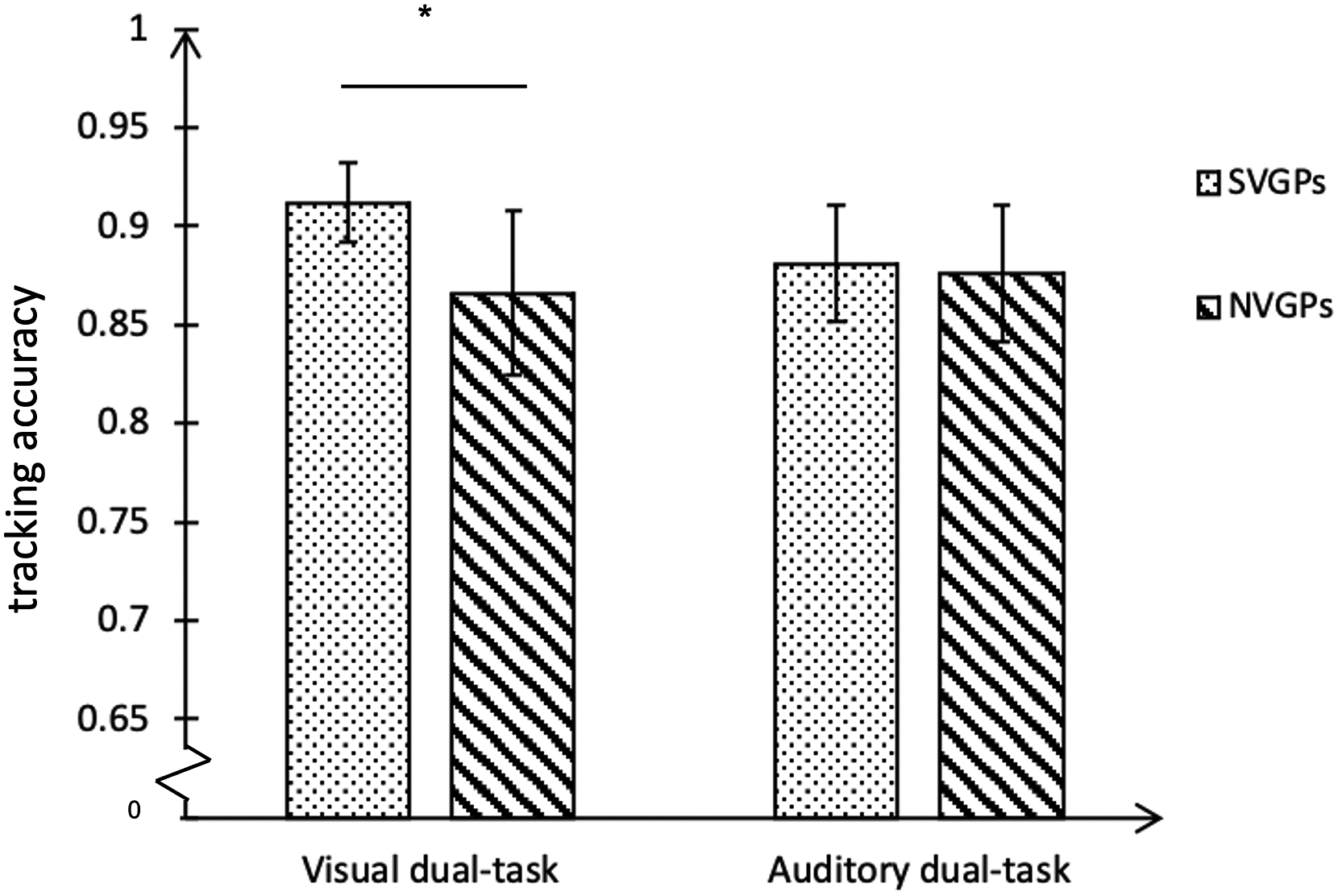
Discussion for Study 1
In study 1, SVGPs and NVGPs completed a single MOT task and dMOT task with the visual or auditory secondary task to determine whether there were differences between SVGPs and NVGPs on attentional control and whether such differences were influenced by sensory modalities.
The results of study 1 showed that SVGPs performed better on the MOT task. This suggests that SVGPs have better attentional control after controlling demographic factors. The results were consistent with those found in action video gamers and RTS video gamers (Dobrowolski et al., 2015). Game mechanics may have driven the observed cognitive changes. Given that most RTS video games require players to focus on a rapidly changing environment that contains critical information, it follows that avid gamers may have a better ability to attend to and track multiple objects and areas simultaneously. This may be the result of a long and extensive gaming experience, alternatively be one of the reasons why this group has been able to play RTS video games for so long.
As hypothesized, SVGPs showed better dMOT performance than NVGPs with visual but not auditory distractors. The results suggest that SVGPs only have better visual attentional control than NVGPs. That may be because the mechanics of RTS video games only effectively train the player’s visual attentional control. While games inspire a variety of cognitive skills, transfer of learning is an arduous task for learners (Donohue et al., 2012; Sala et al., 2018), which usually occurs between tasks with similar requirements.
However, how the task is tested could have had an impact on the final result. Consistent with previous visual dual-task studies (Strobach et al., 2012), the tasks in study 1 are similar to those of video games in terms of stimuli and responses, so the experience of video games may be transferred well to these tasks. Some studies employed paradigms that are not very similar to video game environments, and these studies failed to find evidence that gamers are better at attentional control than non-gamers (e.g., Gaspar et al., 2014; Rupp et al., 2016). For example, the performance of gamers and non-gamers on a simulated street-crossing task was similarly affected by the auditory working memory task (Gaspar et al., 2014). It is a crucial question whether the visual attentional control advantage of gamers can transfer to the task which is more closely related to daily life.
The simulated street-crossing task is considered a feasible way to measure attentional control, which has been widely used in studies of attention control in children, adults, and the elderly (Morrongiello et al., 2016; Nicholls et al., 2019), and one that simulates the real-world activity well (Nicholls et al., 2019). During the simulated street-crossing task, participants have to switch their attention between different tasks and stimuli. Participants were asked to avoid collisions with passing cars to safely cross a street with zebra crossings but without traffic lights while completing the secondary tasks. A study showed that the performance of gamers and non-gamers on simulated street-crossing tasks was affected by an auditory 2-back task. Gamers did not perform better in those tasks (Rupp et al., 2016).
Based on study 1 and extant studies, we used visual working memory tasks as secondary tasks to explore whether the visual attentional control advantage of RTS video game players can be generalized to real-life tasks. The street-crossing task was complete in the VR environment, and the visual 2-back task was shown on a simulated billboard at the same time.
Study 2
Method
Participants
Another fifty young adults were recruited from universities in Beijing (27 males; 20.5 ± 2.0 years of age). All participants completed the same questionnaires as in study 1 to evaluate their gaming experience. Of the 50 participants, 25 were in SVGP (15 males) and 25 in NVGP (13 males). Each participants’ major was recorded (science or humanities). All participants had normal or corrected-to-normal vision and normal hearing. This research complied with the American Psychological Association Code of Ethics. Written informed consent was signed by all participants according to a protocol approved by the Research Ethics Committee of Beijing Normal University.
Simulated Street-Crossing Task
The simulated street-crossing task was programmed using Python 2.7 and VR platform Vizard and run on a DELL computer. The computer had a display size of 23 inches, a screen resolution of 1920 × 1080 pixels, and a vertical refresh rate of 60Hz. An Oculus Rift DK2 was used to present the VR environment.
Participants were asked to cross a busy street at an unsigned T-junction on each trial (Figure 4). The roadway consisted of two “2-meter-wide” lanes, with six identical gray cars traveling in both directions. Cars coming from the east side of the junction turned right and then head north. Cars coming from the south side of the junction turned right and then head east, and coming from the north side went straight and continue south. Half of the cars’ speed was constant at 10 m/s, and the other half 8 m/s, without stopping under any circumstances. In each trial, each of the six cars appeared at a fixed interval of 12 s to avoid overlap. Between trials, two types of cars with different speeds were presented randomly and produce different gap sizes (i.e. the distance between the cars ahead and behind). No sound was made while cars were moving, and participants could only perceive cars visually. Before the study, participants were given no information about the cars’ trajectories. Details of the VR environment. (a) View of the street-crossing structure. (b) Real view of the street-crossing structure in a VR environment with texture. The black “A,” black “B,” direction, and arrows did not exist in the VR environment.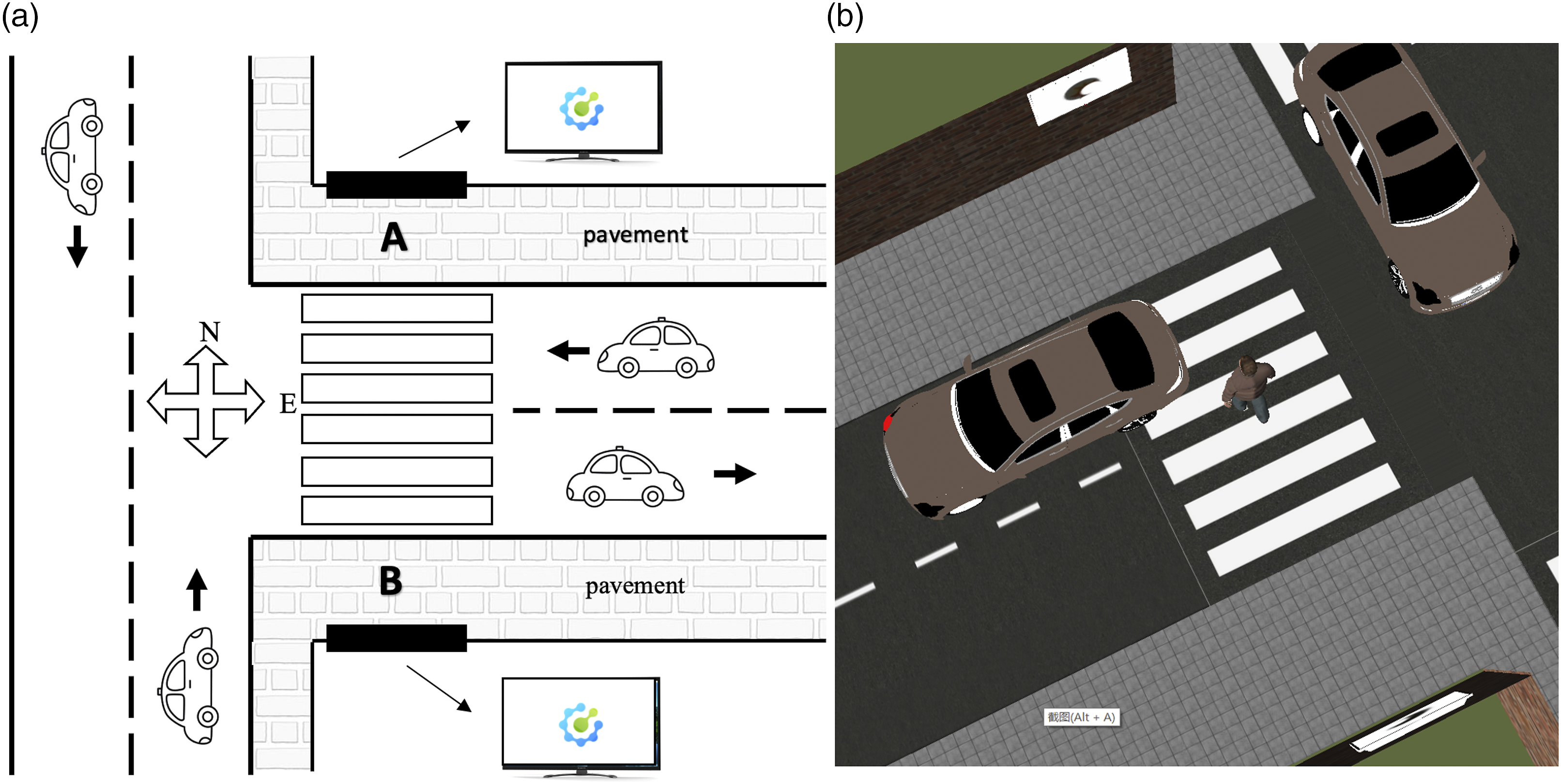
Two identical screens were presented on both sides of the sidewalks. The screens displayed a visual 2-back task. To make the environment more realistic, six brand logos were displayed on the screen. An independent sample of 30 university students rated the logos on a 7-point Likert-type according to the 4 dimensions complexity, familiarity, similarity, and emotional experience. We chose six logos whose color and shape was salient, with equal ratings on all subjective rating dimensions.
Participants were instructed to stand and wear the VR helmet during the entire experiment. They could move in the VR environment by pressing keys on a keyboard (“S” for going forward, “A” for turning back). Each trial began with the participant being located on the sidewalk facing the simulated street while looking at a screen on the other side. Participants were asked to cross the street at the zebra crossing. Cars were coming from different directions at the T-junction. Participants needed to avoid colliding with the cars. While the participants crossing the street, the screen on the other side of the street displayed the 2-back task (Figure 5). For each trial, logos were shown in random order for 1 s each. The logos were stopped at random points after the participants had reached the middle of the street. When participants reached the other side of the road, they needed to identify if the current logo was the same as the one from the third to the last by pressing “K” if yes and “L” if no. Participants then pressed the “A” key to turn back and to start the next trial. If participants collided with a car when they were crossing, they will hear a beep. They still had to walk to the other side of the street and respond to the visual 2-back to complete the current trial. To ensure that the task was completely visually assisted, the participants did not hear any other sound. The percentage of trials on which participants crossed the street without colliding with any cars was defined as the accuracy of the street-crossing task. Crossing time was defined as the time taken from one side of the street to the opposite side of the street on the safe trials. The reaction time of the 2-back task was calculated from the moment the participant reached the opposite side of the street. Visual 2-back task. (a) The schematic of a visual 2-back task. (b) Participants’ view in a VR environment. Because it was a 3D graphic, the picture showed the image for the left and the right eye at the same time.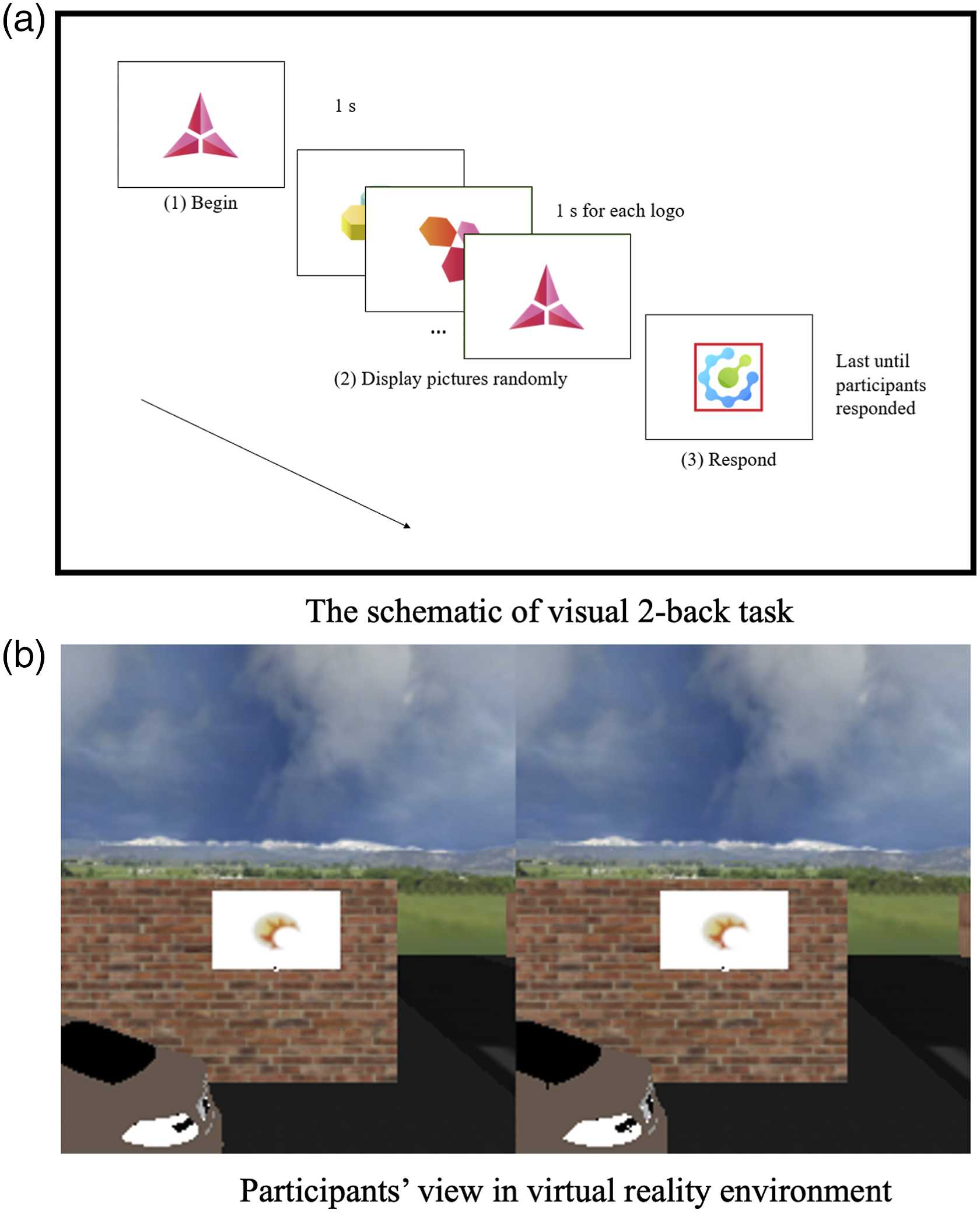
There were 48 trials, and participants were allowed to take a one-minute break after 24 trials. Before the formal experiments, participants completed 5 training trials to familiarize the task with the VR environment and the usage of keys.
Results
Those trials where participants failed to respond to the visual 2-back task (answered in advance or never answered) were removed. The remaining 88.7 ± 9.5% trials for each SVGPs and 86.6 ± 12.4% trials for each NVGPs were used for further ANCOVA analysis, controlling for age, gender, and major. There was no difference between the two groups for the proportion of trials that were not removed (F(1,45) = 0.132, p = 0.718).
In these trials, there was no significant difference between the SVGPs and the NVGPs for 2-back task accuracy (81.9 ± 7.7% vs. 77.1 ± 12.4%; F(1,45) = 1.753, p = 0.192) and reaction time (0.695 ± 0.225 s vs. 0.646 ± 0.215 s; F(1,45) = 0.688, p = 0.411). SVGPs had marginally higher crossing accuracy than NVGPs (83.9 ± 10.7% vs. 76.3 ± 12.9%; F(1,45) = 3.830, p = 0.057, η2 = 0.078). There was no difference between the two groups for crossing time (9.526 ± 2.810 s vs. 8.385 ± 2.274 s; F(1,45) = 2.797, p = 0.101). To account for potential speed-accuracy trade-offs, we calculated and analyzed the inverse efficiency score (IES) of each subject and condition, which is typically defined as mean correct reaction time divided by accuracy (Liesefeld & Janczyk, 2019). A similar ANCOVA showed that there was no significant difference in the performance of SVGPs and NVGPs in street-crossing for IESs (F(1,45) = 2.063, p = 0.654).
Considering that some participants’ performance might involve a trade-off between the street-crossing and the 2-back tasks, we selected the trials in which participants completed the 2-back task correctly for further analysis. There was no difference between the SVGPs and NVGPs for crossing accuracy (85.1 ± 10.1% vs. 79.0 ± 12.5%; F(1,45) = 2769, p = 0.103) or crossing time (9.443 ± 2.829 s vs. 8.326 ± 2.239 s; F(1,45) = 2.618, p = 0.113).
Discussion for Study 2
To further examine whether the visual attentional control advantages of RTS video gamers can transfer to situations more relevant to reality, we compared the performance of SVGPs and NVGPs on the simulated street-crossing task with visual working memory tasks. Controlled for secondary task performance, gamers took one second longer on average to cross the street than non-gamers, and also had higher crossing accuracy. This seems to be a trade-off between speed and accuracy. There was no significant difference in performance between SVGPs and NVGPs on the tasks after controlling for the effect of speed-accuracy trade-offs. On tasks without time pressure, participants in the SVGP group were inclined to accuracy over RT. This finding resonates with previous studies showing that gamers are better at adjusting their response times to increase accuracy in a vigilance task (Clark et al., 2011; Donohue et al., 2010; Irons et al., 2011). Game experience may help players adapt better strategies (Nelson & Strachan, 2009). Therefore, it is difficult to argue, based on the present data, that SVGPs have better attentional control than NVGPs in this real-life task.
Previous studies on attentional control of gamers in real-life tasks have focused primarily on action video games and employed auditory tasks as distractors (Donohue et al., 2012; Gaspar et al., 2014; Rupp et al., 2016; Telner et al., 2009); our study of RTS video game players have obtained similar results. This suggests that RTS video games may fail in the far transfer of attentional control. Combined with a previous meta-analysis of the training effects of action video games (Sala et al., 2018), this study further supports that the effect of game experience on players' cognitive ability may be limited.
General Discussion
Playing video games is a rich and complex experience, bound to have a variety of effects on human behavior and brain organization. The goal of the present studies was to explore the association between RTS video gaming experience and attentional control by comparing the performance of SVGPs with that of NVGPs on computer and VR tasks. We found that SVGPs performed better than NVGPs in the single MOT and visual dMOT. However, there was no significant difference in the auditory dMOT task and simulated street-crossing task between the performance of SVGPs and NVGPs. RTS video gamers showed better visual attentional control only in computer tasks. These outcomes suggest that the sensory modal of secondary tasks and how similar the task is to the game may indeed affect the performance of gamers.
The MOT paradigm and dual-task paradigm were used in some studies to suggest that gamers may have advantages in attentional control, but little research has considered the effect of secondary task attributes on player performance and how far it can be generalized (Dale & Green, 2017; Dobrowolski et al., 2015). The dMOT task and simulated street-crossing task provide appropriate solutions to these problems (Alvarez et al., 2005; Nicholls et al., 2019; Wei et al., 2014). In study 1, RTS video gamers showed better attentional control on both the single MOT task and the visual dMOT task. However, the advantage gamers had in the single MOT task decreased or disappeared in the auditory dMOT task. One possible explanation is that gamers only have better visual attentional control, but not better auditory attention control; this explanation is tightly related to game mechanics (Stewart et al., 2020). Compared with non-gamers, RTS video gamers performed better on visual tasks and showed higher levels of activation and functional connections in brain regions associated with cognitive control and visual attention (Basak et al., 2011; Kim et al., 2015; Kowalczyk et al., 2018). Another possible explanation is cross-modal attentional control impairs cognitive control more (Talsma et al., 2008). With high attention resource requirements in the cross-modal tasks (Mast et al., 2017), players are just as impaired as non-players and unable to show better multisensory attentional control. Heightened visual attention of gamers may come at the expense of the attentional resources available to other modalities (e.g., audition). In the VR task, results failed to find SVGPs advantage over NVGPs, suggesting that RTS video game experience may not be associated with better performance on at least this real-life task. The limited benefit after training may only mean that individuals are better at solving similar tasks, but do not show improvements in general cognitive ability (Shipstead et al., 2012). To sum up, while video gamers may have better performance in tasks (Bediou et al., 2018), there appear to be limited (Bavelier & Green, 2019), particularly when it comes to processing stimuli from different modalities and/or in contexts different from games.
Rich and colorful video games attract a large number of players. Due to their diverse cognitive demands, players, at least to some extent, have better cognitive abilities after games training. One type of cognitive ability is attentional control, which is the focus of this study. We confirmed the association between RTS video game experience and attentional control advantages while highlighting the difficulty in far transfer; we also suggested that small procedural and stimulus changes may reduce or eliminate the benefit of the video game experience. In terms of practical implications, the results suggest that it is important to consider the specific advantages gaming experience provides before using games as an intervention or for training. While gaming is an option for treating children with dyslexia (Bertoni et al., 2021) or ADHD (Franceschini et al., 2017) and older adults with cognitive decline (Kim et al., 2015), and those effects have been tentatively validated in some tasks, the effects may be limited. It might be difficult to obtain positive results on test tasks that are less similar to game training.
Limitations
The limitations of this work warrant attention. First, studies were conducted using a descriptive correlational research method. Participants with RTS video game experience and those with no game experience were selected for this cross-sectional study. The results only show the correlational relationship in nature between the RTS video game experience and better attentional control, not that playing RTS video games necessarily improves attentional control. The better performance of the gamer group may also be the factor that makes them gamers. Second, attentional control certainly involves cognitive flexibility, working memory, and inhibitory control (Bavelier & Green, 2019; Carlisle, 2019), so the better performance of gamers in this area could be due to several factors. Further research could look at why gamers perform better in visual tasks. Thirdly, it must be examined whether the better performance of the game player on the task is a manifestation of better ability or a result of strategic choice. To avoid the trade-off between primary and secondary tasks, we analyzed only the trials with the secondary task being completely correct. In study 2, we controlled the effect of the speed-accuracy trade-off. However, further research is needed to explore the potential contributions of strategy to observed differences between gamers and non-gamers.
Conclusions
In conclusion, we found that RTS video gamers have better performance in MOT tasks and dMOT tasks with a visual secondary task than non-gamers. This suggests that they may have better visual attentional control in computer tasks. However, the attentional control advantage of gamers is limited. This attentional control advantage may decrease or no longer exists in cross-modal tasks and real-life tasks. Our research provides new evidence for understanding the role of the gaming experience and the characteristics of attentional control.
Key Points
RTS video games showed better attentional control on visual tasks than non-gamers. There was no significant difference in attentional control between RTS video gamers and non-gamers in dMOT tasks with an auditory secondary task. RTS video gamers’ advantage in attentional control does not appear to transfer to the simulated street-crossing task with visual secondary task, which is similar to the real world.
Footnotes
Author Contributions
Mengxin He. Paper writing, data analysis and programing all the experiment programs in the present study.
Lin-Xuan Xu. Paper writing and data analysis. Zihan Liu. Paper writing and experimental design.
Chiang-shan R. Li. Paper writing.
Jiaqi Hu. Experimental design and data collecting Xiangyi Guo. Helping to revise the paper. Hongyun Liu. Tutoring paper writing and data analysis. Jin-Tao Zhang. Tutoring paper writing and data analysis.
Declaration of Conflicting Interests
The author(s) declared no potential conflicts of interest with respect to the research, authorship, and/or publication of this article.
Funding
The author(s) disclosed receipt of the following financial support for the research, authorship, and/or publication of this article: This research was support by the Beijing Normal University Research Fund for college students, the National Natural Science Foundation of China (grant 31871122, 32171083) and the Project from Beijing Key Lab of Applied Experimental Psychology, School of Psychology, Beijing Normal University.
Ethical Approval
This study is approved by the ethics committee of the Faculty of Psychology of Beijing Normal University. All participants gave informed consent.

Mengxin He, Faculty of Psychology, Beijing Normal University, Beijing 100875, China. Obtained her B.S. degree of Psychology from Beijing Normal University in 2018.
Linxuan Xu, State Key Laboratory of Cognitive Neuroscience and Learning and IDG/McGovern Institute for Brain Research, Beijing Normal University, Beijing 100875, China. Obtained her B.S. degree of Psychology from Beijing Normal University in 2019.
Zihan Liu, Department of Psychology, University of Houston, Houston, TX 77204, United States. Obtained her B.S. degree of Psychology from Beijing Normal University in 2018.
Chiang-shan R. Li, Department of Psychiatry, Yale University School of Medicine, New Haven, CT 06519, United States; Department of Neuroscience, Yale University School of Medicine, New Haven, CT 06520, United States. Obtained his PhD degree of Psychiatry from California Institute of Technology in 1996.
Jiaqi Hu, Faculty of Psychology, Beijing Normal University, Beijing 100875, China. Obtained her B.S. degree of Psychology from Beijing Normal University in 2018.
Xiangyi Guo, Wesleyan University, Middletown, CT, 06459, United States.
Hongyun Liu, Faculty of Psychology, Beijing Normal University, Beijing 100875, China. Obtained her PhD degree of Psychology from Beijing Normal University in 2003.
Jintao Zhang, State Key Laboratory of Cognitive Neuroscience and Learning and IDG/McGovern Institute for Brain Research, Beijing Normal University, Beijing 100875, China. Obtained his PhD degree of Psychology from Beijing Normal University in 2009.