




Abstract
Objective
We demonstrate that the diagram of work organization possibilities, a recent addition to cognitive work analysis, can be used to develop designs that promote adaptation in the workplace.
Background
Workers in sociotechnical systems adapt not just their individual behaviors but also their collective structures in dealing with instability, uncertainty, and unpredictability in their tasks. However, conventional design approaches are limited in supporting adaptations in both workers’ behaviors and structures, especially during unforeseen situations. The work organization possibilities diagram has the potential to meet these requirements, but its value for design has not been established.
Method
We present a case study of a future system for maritime surveillance that provides an analytical demonstration of the utility of the diagram for design and empirical validation of the impact, uniqueness, and feasibility of this approach in an industrial setting.
Results
This application results in a team design that is integrated with the career and training progression pathway of the crew in a way that maximizes the system’s behavioral and structural possibilities for adaptation. Further, the approach has impact on practice, makes a distinct contribution to design relative to other techniques, and is implemented feasibly in an industrial setting.
Conclusion
The work organization possibilities diagram can contribute to the development of an integrated system design that supports actors’ possibilities for behavioral and structural adaptation in a unified fashion.
Application
This research provides a basis for designing interfaces, teams, training, and automation that preserve a system’s inherent capacity for adaptation.
Introduction
Workers in sociotechnical systems operate in highly dynamic environments and experience considerable uncertainty and unpredictability in their task demands. In such complex problem spaces, prespecified or familiar courses of action are not always applicable, so that workers often need to improvise solutions to some extent (Hoffman & Woods, 2011; Rasmussen, 1969; Suchman, 1987; Vicente, 1999; Weick, 1998). Workers must perform ongoing minor adjustments in action to respond to situational details, which are not fully specifiable a priori. Moreover, workers may have to exercise significant ingenuity in dealing with novel or unforeseen events, which pose substantial threats to effectiveness (Leveson, 1995; Perrow, 1984; Rasmussen, 1969; Reason, 1990; Vicente, 1999). This paper is concerned with designing for adaptation (Hollnagel et al., 2006; Rasmussen et al., 1994; Vicente, 1999) so that workers have greater capacity to deal with instability, uncertainty, and unpredictability in their work environments.
Adaptation in Sociotechnical Systems
Field studies show that to manage situational variability, whether in routine or exceptional circumstances, workers adapt both their individual behaviors and collective structures in line with evolving task demands. For example, Bigley and Roberts (2001) observed that firefighters commonly adjust their behaviors to deal with local contingencies by improvising with tools, tailoring routines such as those for “hose laying” or “ladder throwing,” and even breaching procedures if necessary. Similarly, Rochlin et al. (1987) found that the work organization on naval aircraft carriers shifts flexibly between formal and informal structures, with the mapping between people and roles changing with the circumstances. These and other empirical studies in many domains, including transport (Heath & Luff, 1998), healthcare (Bogdanovic et al., 2015), and aviation (Hutchins & Klausen, 1998), provide ample evidence that, to support work as it occurs in natural contexts, designs must support workers in adapting both their behaviors and structures to accommodate change and ambiguity in their work demands. Designs that inhibit behavioral and structural flexibility could lead to unsafe or unproductive outcomes.
Existing Frameworks for Design
Design frameworks from sociotechnical systems theory (Clegg, 2000), computer-supported cooperative work (Schmidt & Bannon, 1992), resilience engineering (Hollnagel et al., 2006), and cognitive systems engineering (Hollnagel & Woods, 1983) recognize the need to support flexibility in the workplace. While these frameworks may differ in their specific goals or orientations, their design processes are all based fundamentally on an analysis or understanding of the work of the system. Consequently, irrespective of whether the intended application is function allocation or team, interface, or training design, for example, the extent to which the resulting solution can support flexibility is dependent on the approach for work analysis.
Work analysis approaches may be classified as normative, descriptive, or formative (Rasmussen, 1997; Vicente, 1999). Normative approaches, such as sequential flow and timeline task analyses (Meister, 1985), prescribe exactly how work should be carried out under specific conditions. Clearly, such analyses are not conducive to cultivating designs that promote improvisations by workers, whether in routine or unanticipated circumstances. Descriptive approaches, such as naturalistic (Zsambok & Klein, 1997) or ethnographic (Suchman, 1987) studies, describe how work is actually carried out in situ, and therefore can support documented improvisations by workers, which is important. However, such studies may result in designs that do not accommodate adaptations that have never been observed, including those that may be relevant in novel circumstances. Design frameworks from the research perspectives mentioned above tend to rely on descriptive analyses of work (Vicente, 1999).
Cognitive work analysis (CWA; Rasmussen et al., 1994; Vicente, 1999) is a formative framework that deals with some of the limitations of normative and descriptive techniques. This framework defines the constraints that must be respected by actors for effective performance in a variety of situations, including unforeseen circumstances (Table 1). Within these constraints, actors still have many degrees of freedom for action. Therefore, designs based on these constraints have the potential to support workers in adapting their work practices to a wide range of situations without crossing the boundaries of effective performance. Although CWA was developed in the nuclear power context (Rasmussen, 1986), it was subsequently extended to systems with more pronounced social interactions, such as hospitals and libraries (Rasmussen et al., 1994), and natural processes, such as a frigate’s natural environment (Burns et al., 2005).
CWA Dimensions, Constraints, and Modeling Tools
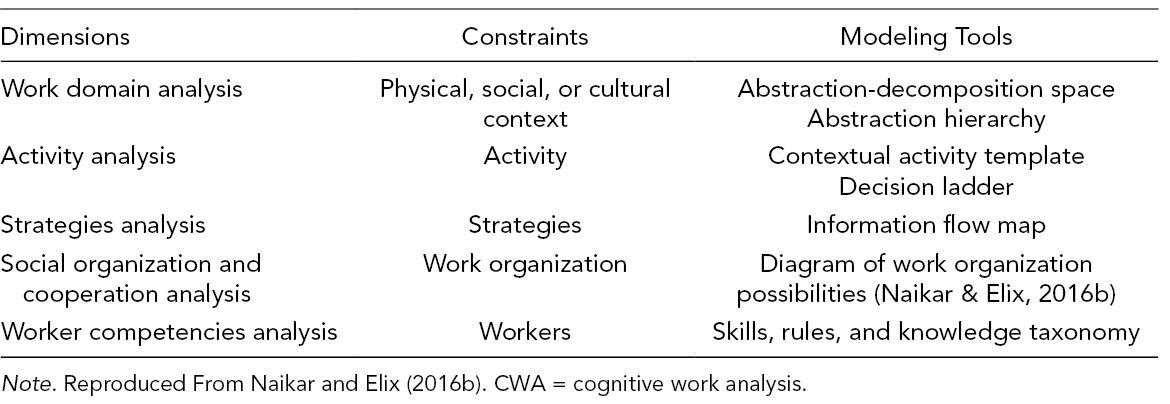
Note. Reproduced From Naikar and Elix (2016b). CWA = cognitive work analysis.
Experimental investigations (Vicente, 2002) and industrial case studies (Naikar, 2013) show that designs based on CWA can promote adaptation by workers. However, recently it has been argued that the standard framework (Rasmussen et al., 1994; Vicente, 1999) may result in designs that do not fully support a system’s inherent capacity for adaptation because the framework lacks a fully formative approach for the analysis of the work organization (Naikar & Elix, 2016a, 2016b). Social organization and cooperation analysis is limited to organizational structures that are relevant in recurring classes of situation and further to structures that have been observed or are judged to be reasonable. Accordingly, resulting designs may not accommodate structures that have not been observed; that are deemed unreasonable, despite being plausible; or that could emerge in novel circumstances. Moreover, as the disregarded structures are associated with distinct behaviors, the designs may restrict behavioral as well as structural adaptation. Further, approaches based on or motivated by CWA for examining team (Ashoori et al., 2014) or organizational (Xiao & Sanderson, 2014) practices, which have been applied to healthcare, incorporate many details of workers’ current practices and therefore are to some extent descriptive in orientation.
For such reasons, the diagram of work organization possibilities was proposed as a new modeling tool for social organization and cooperation analysis (Naikar & Elix, 2016b). As the conceptual and methodological nuances and potential benefits of the diagram are described in depth by Naikar and Elix (2016a, Naikar & Elix, 2016b, only a brief description is provided next.
Diagram of Work Organization Possibilities
The work organization possibilities diagram (Figure 1) demarcates the set of possibilities for work organization in a system irrespective of the situation. This model is created by defining the constraints on the possibilities for work organization, not by describing the possibilities themselves. The organizational constraints are limits on the distribution of the work demands of the environment across actors; for instance, Figure 1 shows that work demand 1 is limited to actors A and C, whereas work demand 3 is limited to actor B. The organizational constraints are established by identifying the limits placed on the distribution of the work demands of the environment across actors by criteria that govern shifts in work organization dynamically in sociotechnical systems (Rasmussen et al., 1994; Vicente, 1999), as these criteria also limit the structures that are possible in any situation, including unforeseen events (Naikar & Elix, 2016b). These criteria include compliance with policies or regulations, safety and reliability, access to information/controls, and feasible coordination, competencies, and workload. These ideas will be demonstrated in the next section.
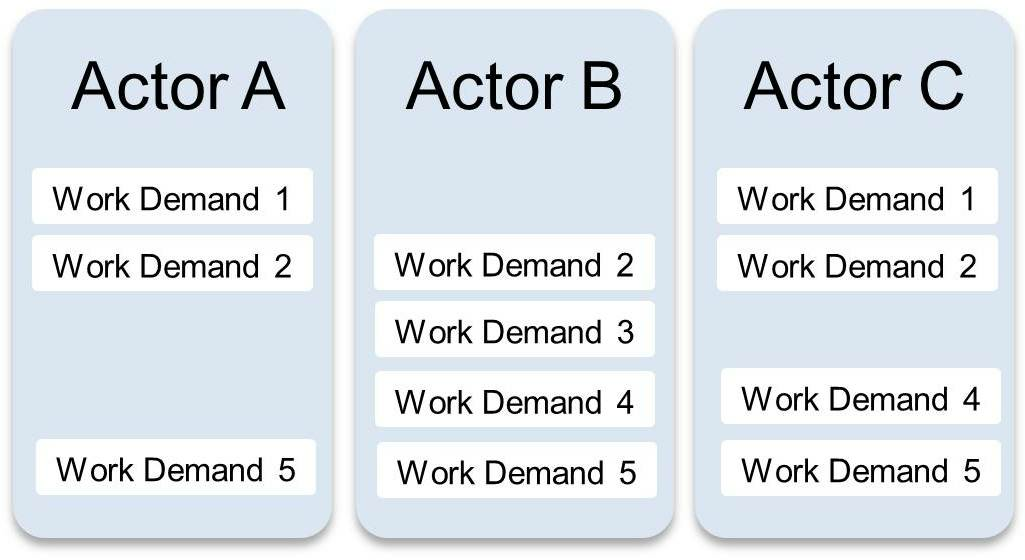
Basic form of the diagram of work organization possibilities. Reproduced from Naikar and Elix (2016b).
Although this paper is not concerned specifically with the allocation of functions between humans and machines, it is worth clarifying at the outset that the proposed analysis differs from traditional or dynamic function allocation approaches (Kaber, 2018a, 2018b; Parasuraman & Wickens, 2008; Waterson et al., 2002; Wright et al., 2000) in that it is not concerned with specifying “who should do what,” or prescribing optimal distributions of functions between actors, whether humans or machines, given assumptions about how work should be organized in relation to variations in situational parameters (Naikar & Elix, 2016b; Naikar, 2018). Rather, it is concerned with defining the limits on “who can do what,” or demarcating the possibilities for work organization, irrespective of the situation, given the system’s constraints. By delimiting the possibilities with a set of criteria that govern shifts in work organization in actual operations, the aim is to rule out behaviors and structures that cannot be manifested in situ, regardless of the circumstances, and to support the possible behaviors and structures in design. Therefore, while this analysis could be used for function allocation—to specify who should do what out of the set of possibilities—that is not its intent. Rather, the intent is to design system elements to support the space of possibilities, so that new or different structural forms can emerge from individual, interacting actors’ spontaneous behaviors in situ, thereby enhancing the system’s capacity to deal with instability, uncertainty, and unpredictability.
To explain, by defining a system’s organizational constraints, the work organization possibilities diagram simultaneously captures the behavioral opportunities of individual actors and the structural possibilities of multiple actors. As defined by Vicente (1999: p. 10), work demands are “constraints that govern work.” Constraints place demands on actors by delimiting boundaries that must be respected in their actions. Accordingly, the constraints demarcate a field of opportunities for effective behavior.
Whereas the first three CWA dimensions specify the work demands or constraints of the work environment independently of actors, the proposed diagram specifies the relationships between those work demands and the actors (Figure 2). Thus the diagram defines the limits on how the action possibilities demarcated by the environmental constraints can be distributed across actors. In this way, the diagram captures the behavioral opportunities, or action possibilities, of individual actors. The structural possibilities of multiple actors, which emerge from the behavioral opportunities of individual actors, are potential distributions of behaviors across the set of actors. Therefore, a structural form that emerges on any occasion is a particular distribution of behaviors across the set of actors.
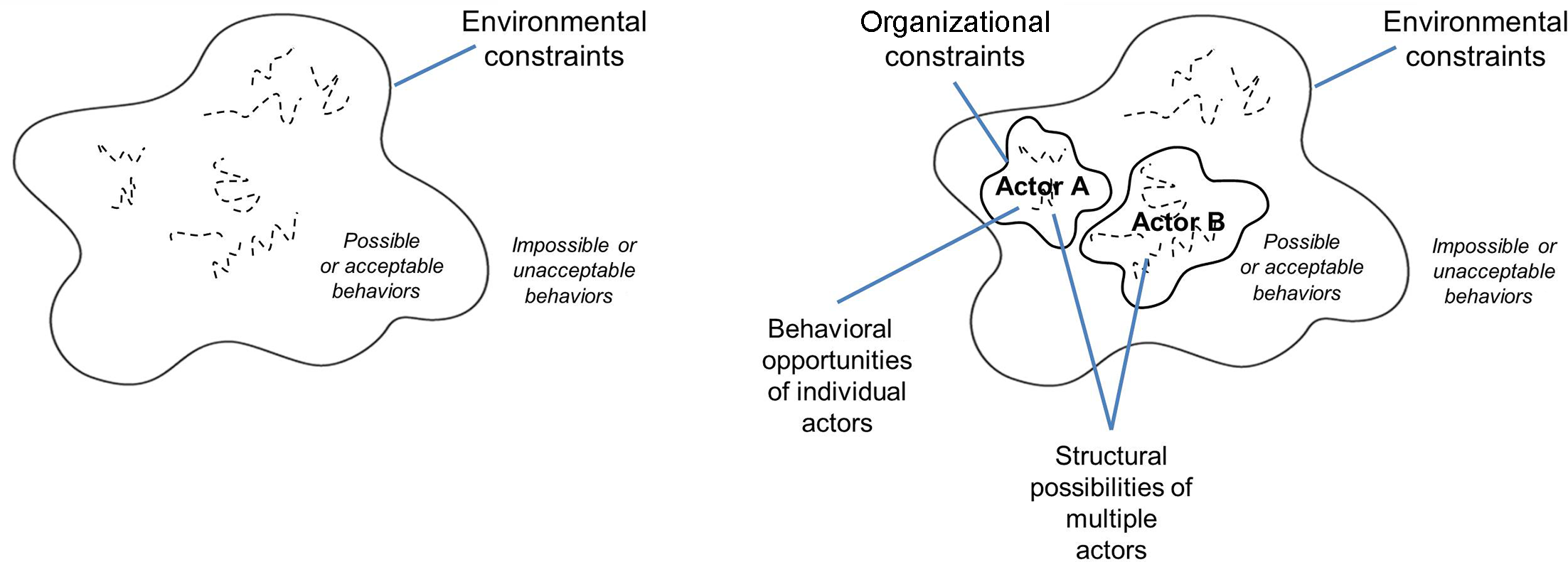
The first three CWA dimensions circumscribe the action possibilities of the work context without consideration of specific actors (left), whereas the work organization possibilities diagram reveals the relationships between those action possibilities and the actors (right). Reproduced from Naikar and Elix (2019).
As a simplified example, Figure 3 shows that the behavioral spaces or opportunities of both actors A and C, though not B, are demarcated by work demand 1; these are the organizational constraints. Given these constraints, some of the structural possibilities that can emerge from these individual actors’ spontaneous behaviors are as follows: actor A is engaged in behaviors accommodated by work demand 1, while actors B and C are occupied in other behaviors; actor C is engaged in behaviors accommodated by work demand 1, while actors A and B are occupied in other behaviors; or both actors A and C are engaged in behaviors accommodated by work demand 1, while actor B is involved in other behaviors. Which structural possibility emerges depends on the details of the situation, which cannot be predicted fully a priori.
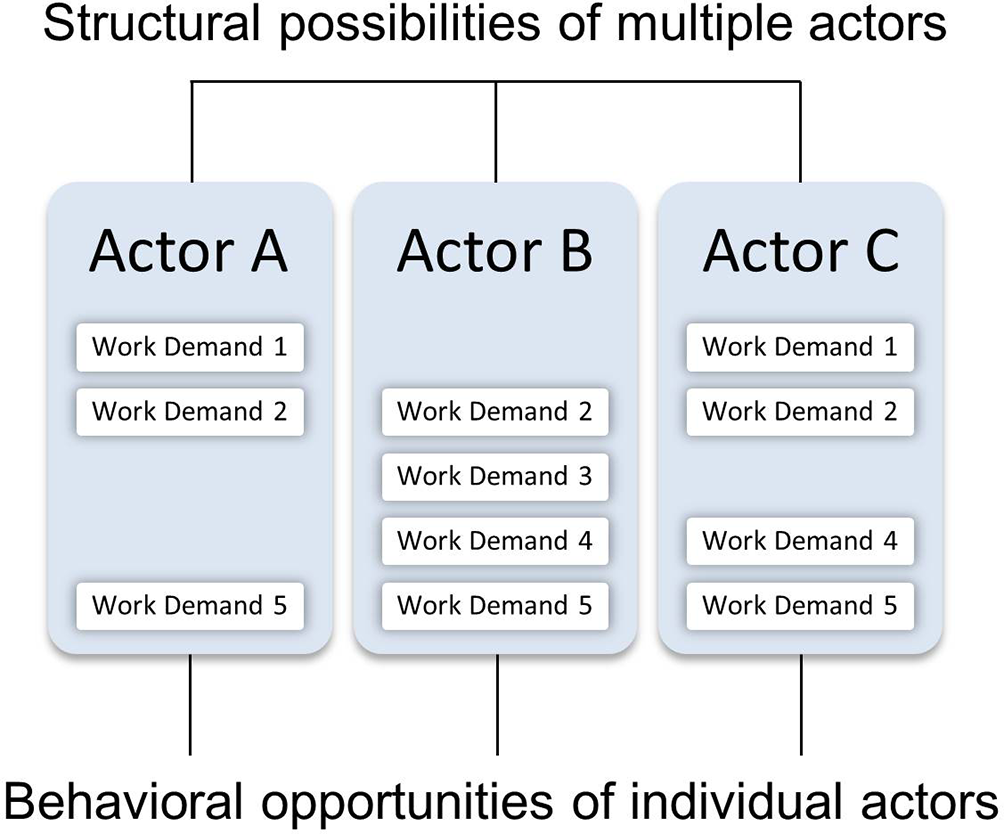
Diagram of work organization possibilities as a model of structural possibilities and behavioral opportunities of actors. Reproduced from Naikar et al. (2017).
In a future maritime surveillance aircraft (Naikar & Elix, 2016b), for instance, both of the flight deck actors are afforded behaviors demarcated by the work demands or constraints of flying and navigating the aircraft. Therefore, how the respective behaviors are distributed across these actors may change opportunistically as a function of the circumstances, so that the emergent structural forms may encompass any one or both of these actors. Moreover, actors at six workstations in the aircraft’s cabin are also afforded behaviors delimited by the work demands or constraints of navigation, so that the structural forms may comprise any one or more of these actors as well. That is, at any moment, any one or more of the six workstation actors could engage in behaviors that satisfy the constraints of navigation, perhaps alongside any one or both of the flight deck actors, so that the organizational structure varies with the circumstances.
Clearly, for a complex system, the possibilities for behavior and structure may be very large. Nevertheless, to support adaptation effectively, these possibilities must be accounted for systematically in the design of the interfaces, teams, training, and other system elements. To accommodate these possibilities in design, it is not necessary to describe or examine every possibility, which is likely infeasible. Rather, the designs need only consider the organizational constraints on the possibilities, as specified in the diagram, which accommodate the behavioral and structural possibilities for adaptation.
Naikar and Elix (2016b) emphasize developing an integrated system design, in which the designs of various elements are coordinated around the organizational constraints, so that the system design supports structural and behavioral adaptation in a coherent fashion. Further to that, this paper demonstrates that only by integrating the designs of the various elements can one preserve, rather than compromise, the system’s work organization possibilities.
In summary, in the work organization possibilities diagram, the work demands of individual actors collectively define a bounded space of possibilities for action for each actor, which remains applicable regardless of the specific circumstances a system may confront, including those that are unforeseen. Therefore, designs based on these bounded spaces may safely and productively support spontaneous actions from individual, interacting actors, such that new or different structural forms may emerge from the collective behaviors of multiple actors, in response to the challenges of a changeable, uncertain, and unpredictable work environment.
The viability of constructing a work organization possibilities diagram for a complex system has previously been demonstrated. Naikar and Elix (2016b) presented a proof-of-principle study of a future maritime surveillance system. However, the value of this diagram for design has not been established. The following case study provides an analytical demonstration of the utility of the diagram for design and empirical validation of the impact, uniqueness, and feasibility of this approach in an industrial setting.
Case Study
This case study concerns a novel operational concept for the future military system analyzed by Naikar and Elix (2016b). The Royal Australian Air Force is procuring next-generation aircraft for maritime surveillance. Initially, this aircraft will be deployed conventionally with the crew onboard operating sensors fitted to the aircraft to detect targets of interest. However, in the longer term, a novel concept may be considered that involves launching an Unmanned Aerial System (UAS) from the aircraft to localize targets submerged underwater. Therefore, in addition to their original responsibilities, the crew will be required to launch the UAS while the manned aircraft is in flight, control the UAS while it descends to its operational altitude and searches for and tracks targets, and recover or dispose of the UAS.
The design question we were asked to address was which crew member should operate the UAS. In the next sections, we discuss the analysis of work demands of the maritime surveillance system to produce a work organization possibilities diagram, the application of this diagram to the design question, and the value of this diagram for design in terms of its impact, uniqueness, and feasibility. Table 2 summarizes the general processes for constructing the diagram and applying it to design (see also Naikar & Elix, 2016a, 2016b) and notes how these steps were implemented in this case study.
Steps for Constructing and Applying a Work Organization Possibilities Diagram
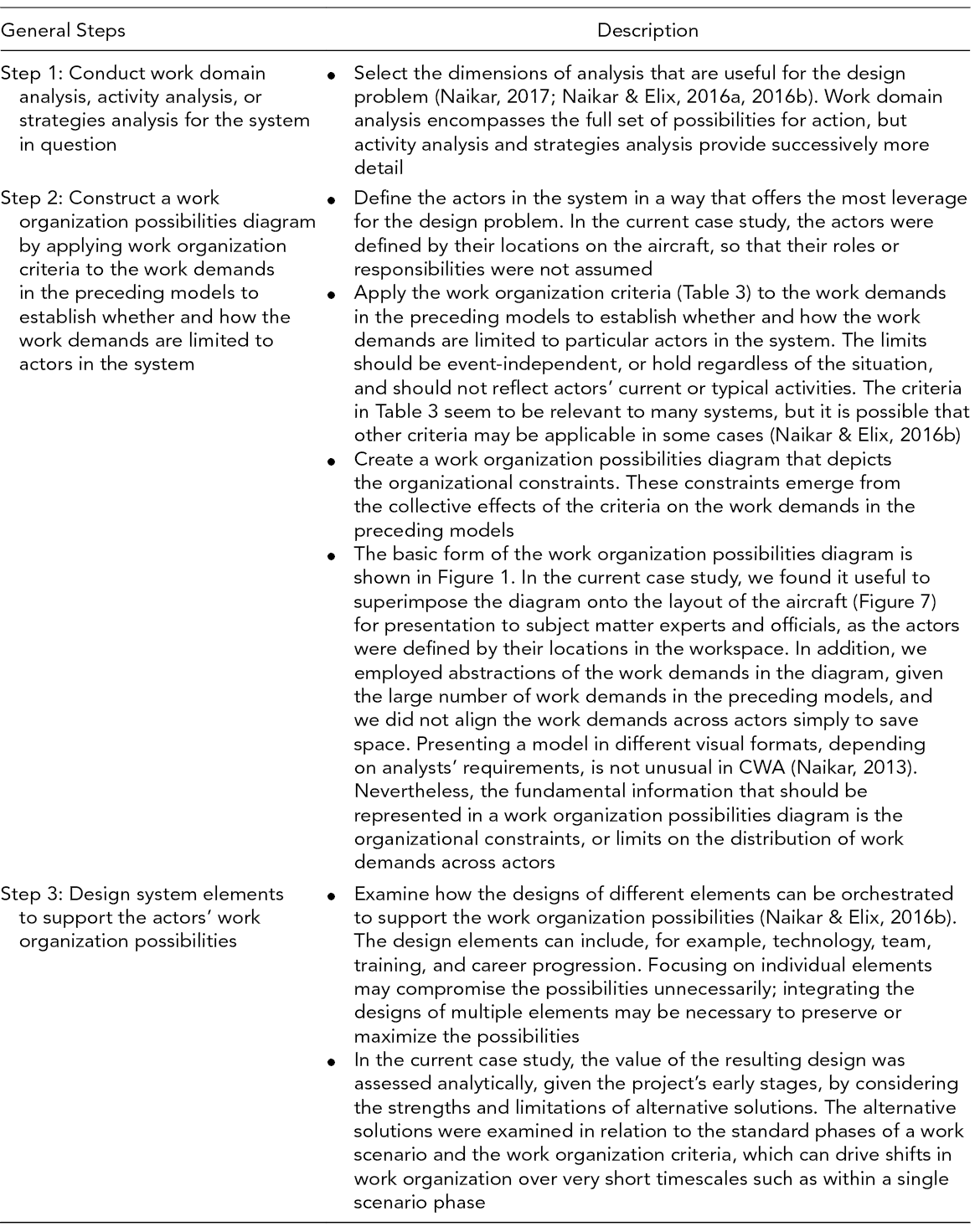
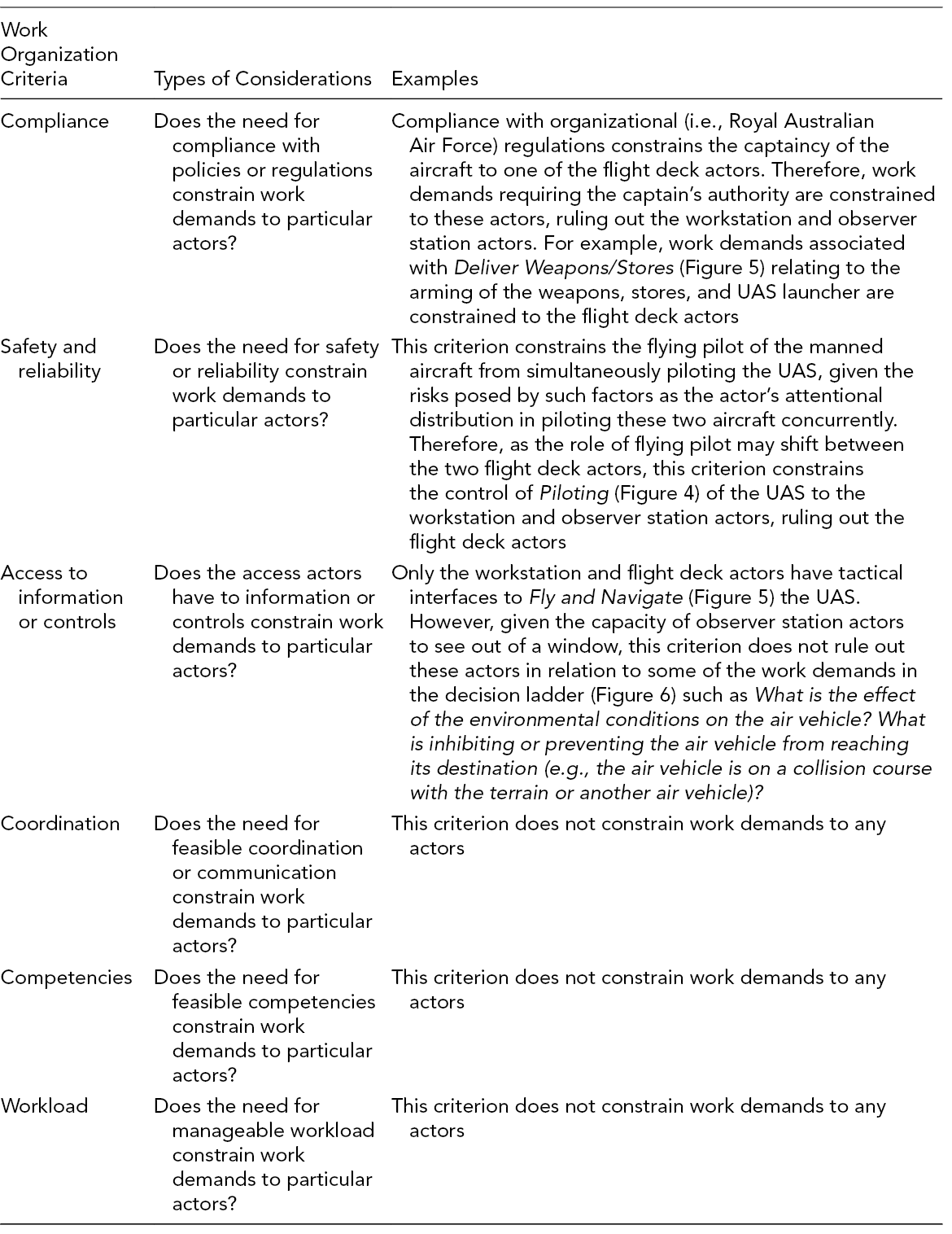
Work Organization Criteria and Examples of Their Application to the Maritime Surveillance System
Analysis
The models of work demands Naikar and Elix (2016b) developed of the future maritime surveillance system were expanded to incorporate the novel concept. The work demands were identified with work domain and activity analyses, so the models included an abstraction hierarchy, contextual activity template, and decision ladders. Subsequently, these models were used to create a work organization possibilities diagram. The following discussion places emphasis on this diagram as the other tools are well established. All of the models shown here are modified representations because of organizational restrictions.
Abstraction hierarchy
The abstraction hierarchy portrays the system’s work demands independently of specific situations. The work demands are described at five levels of abstraction, linked by means–ends relations. The maritime surveillance model (Figure 4) represents physical objects such as a Sensor that is fitted to the UAS. This sensor affords the Detection of Entity Characteristics, a process which enables the Identification of Entities to be established. Priorities and values such as Conservation of Resources reflect finite resources such as fuel, which can be preserved through the function of efficient Piloting. Finally, the system’s purposes include Battlespace Awareness. The full model comprises 3 purposes, 5 priorities and values, 7 functions, 73 processes, and 77 objects.
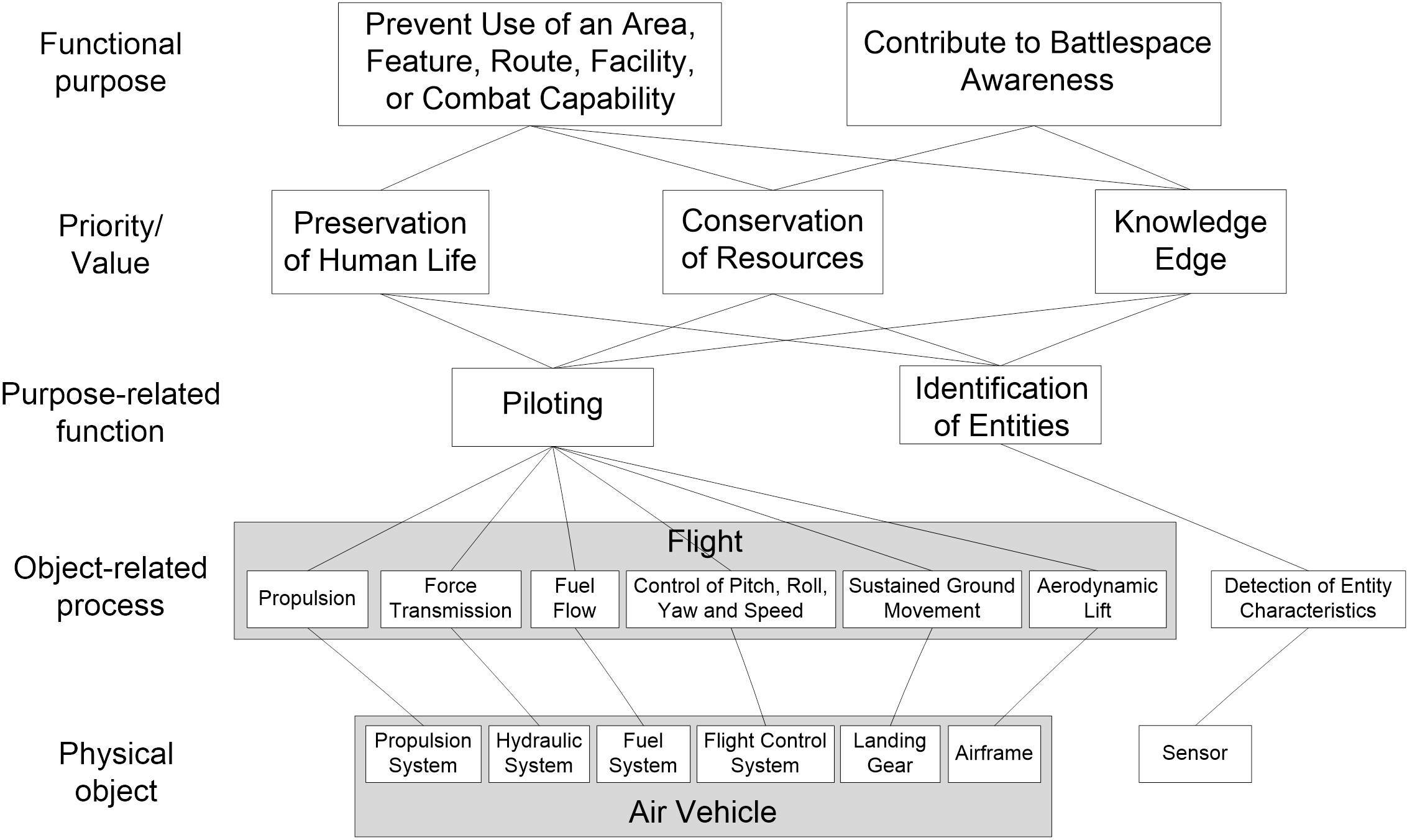
Sample of the abstraction hierarchy of the maritime surveillance system.
Contextual activity template
The contextual activity template represents the system’s work demands in the form of recurring work situations and work functions. In the maritime surveillance model (Figure 5), the situations signify mission phases, defined by the manned aircraft’s location, in which actors must participate. The functions denote recurring problems with which actors must be concerned. The operation of the UAS can involve any of the work situations and work functions. For example, when the manned aircraft is On Station, UAS operation could involve Fly and Navigate, Manage System (e.g., monitoring the UAS for faults), and Identify Targets (establishing the identity of targets detected by the UAS sensor).
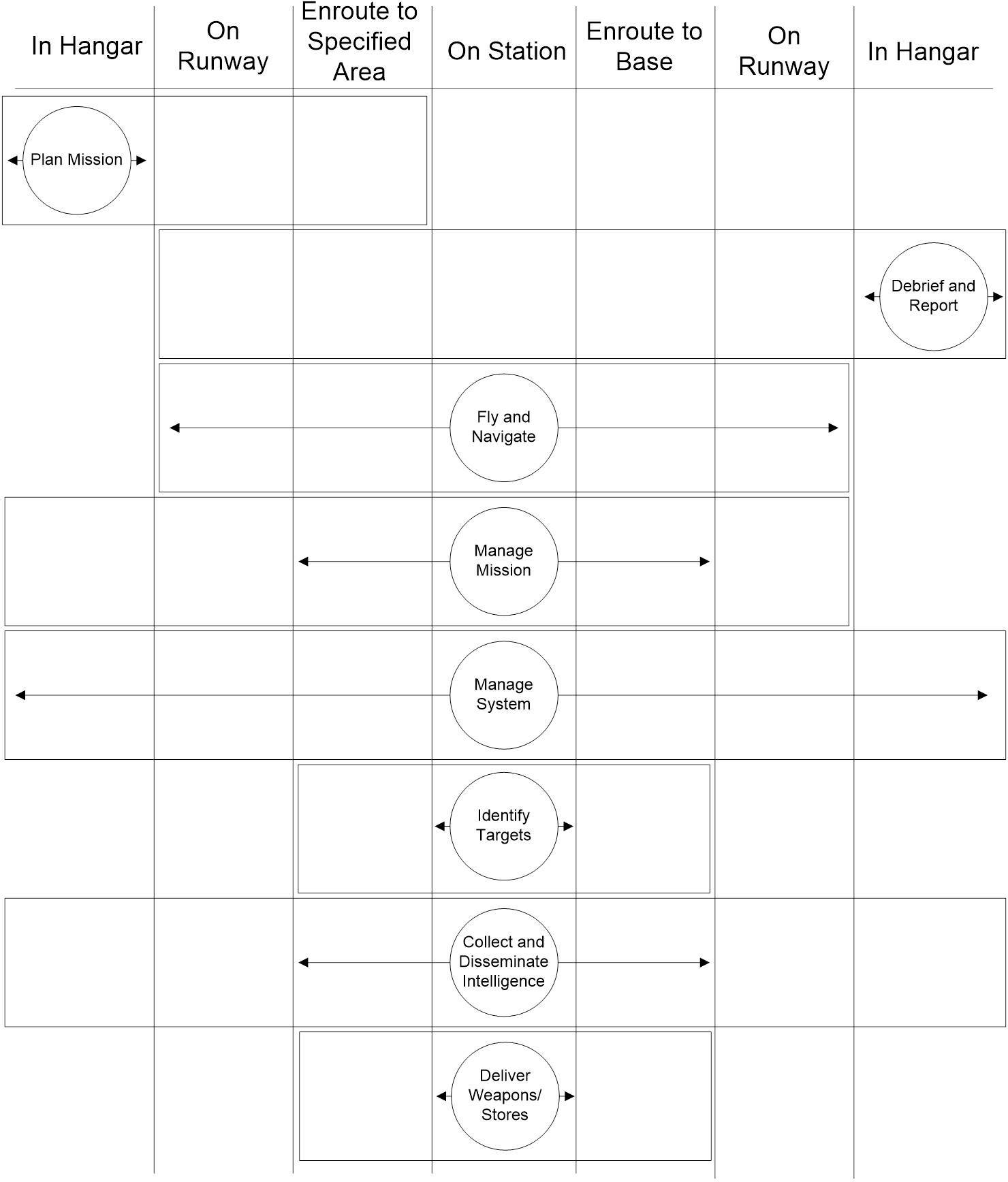
Contextual activity template of the maritime surveillance system. The work situations are depicted along the top and the work functions in the circles. The boxes surrounding each function indicate when a function can occur, whereas the arrows extending from each function indicate when a function typically occurs.
Decision ladder
Decision ladders are typically constructed for each work function in a contextual activity template (Naikar et al., 2006). The Fly and Navigate decision ladder (Figure 6), which depicts the work demands of flying and navigating the UAS in the form of decision questions (Elix & Naikar, 2008), shows that this function involves monitoring the position of the UAS and the location of any territorial boundaries; assessing the likelihood of the UAS breaching territorial boundaries given its behavior; considering whether it is necessary to alter its behavior; and establishing the characteristics of the required behavior.
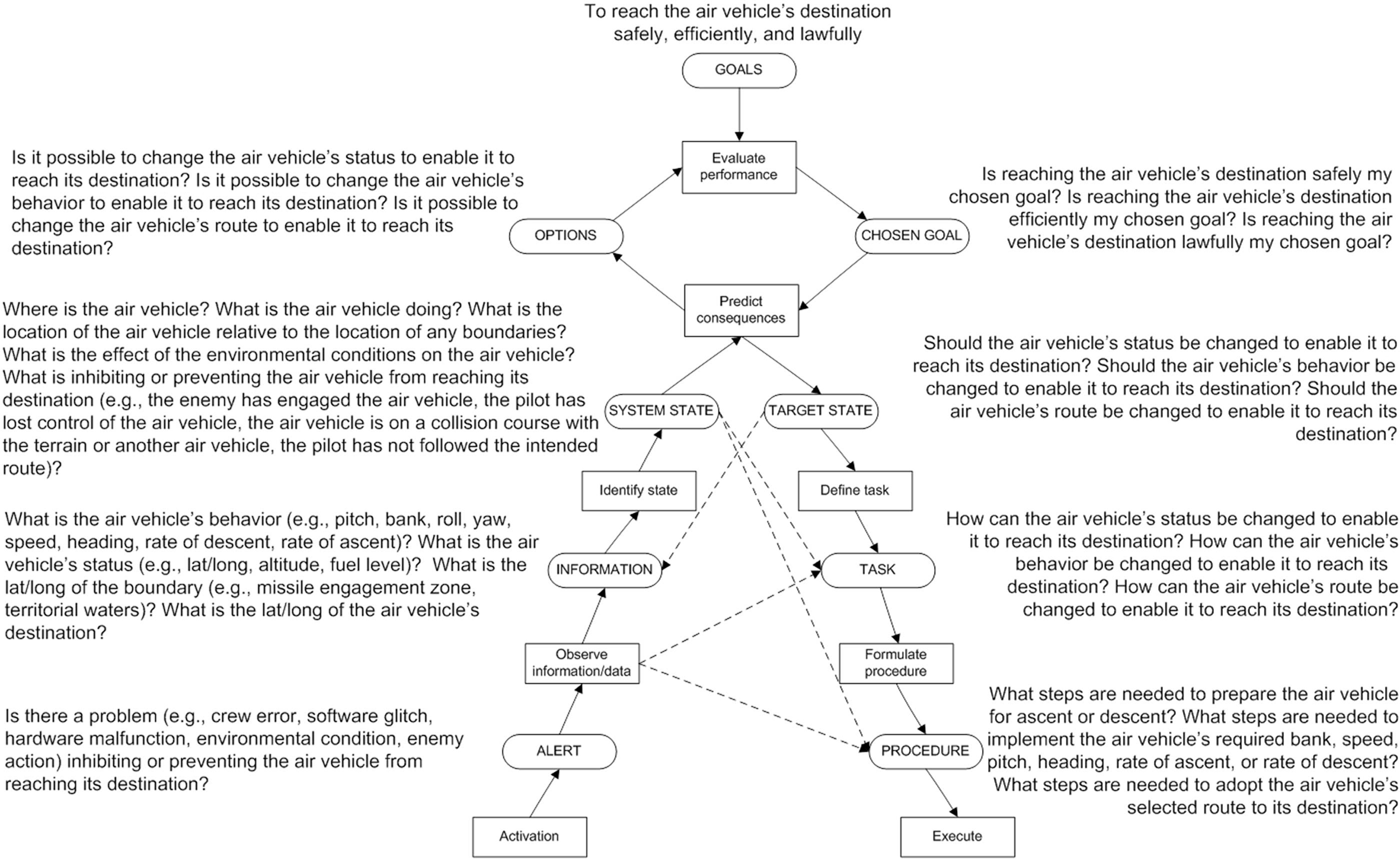
Modified decision ladder for the work function of Fly and Navigate.
Work organization possibilities diagram
This diagram models the organizational constraints. The maritime surveillance diagram was created by applying a set of work organization criteria (Table 3) to the work demands in the preceding models to demarcate the system’s possibilities for work organization, or behavioral and structural possibilities for adaptation, following the approach in Naikar and Elix (2016b). Specifically, the diagram was produced by applying each criterion to each abstraction hierarchy node, work function, and decision ladder question (the criteria were also applied to each work situation and combination of work situation and work function, but this analysis was not useful for the current design problem). The set of criteria was identified by Rasmussen et al. (1994) and Vicente (1999) as mechanisms that govern shifts in work organization dynamically in sociotechnical systems. The proposed approach recognizes that these criteria rule out behaviors and structures that are impossible or implausible in situ, thereby demarcating the system’s inherent work organization possibilities. Examples of the application of the criteria to the work demands of maritime surveillance to define the organizational constraints are provided in Table 3 and explained further below.
Figure 7 shows the work organization possibilities diagram of maritime surveillance, which is event-independent. In this case, the diagram was superimposed onto the layout of the aircraft for presentation to subject matter experts (SMEs) and officials. This form of the diagram emphasizes that actors were defined by their locations or stations on the aircraft, such that their roles or responsibilities were not assumed. In addition, it shows the number of stations and highlights that workers can alter their opportunities for action by changing their locations. For example, if there is an electrical failure so that some of the sensors available to actors at the six workstations can no longer be used for detecting targets, any one or more of these actors can move to the stations with a window (observer and flight deck stations) to increase the chances of finding the target. We did not assign dedicated lines to each work demand in this representation, such that the work demands are not aligned across actors, simply to save space. Nevertheless, the representation depicts the organizational constraints, or limits on the distribution of work demands across actors. Having different visual formats for a model, depending on analysts’ requirements, is not unusual in CWA (Naikar, 2013).
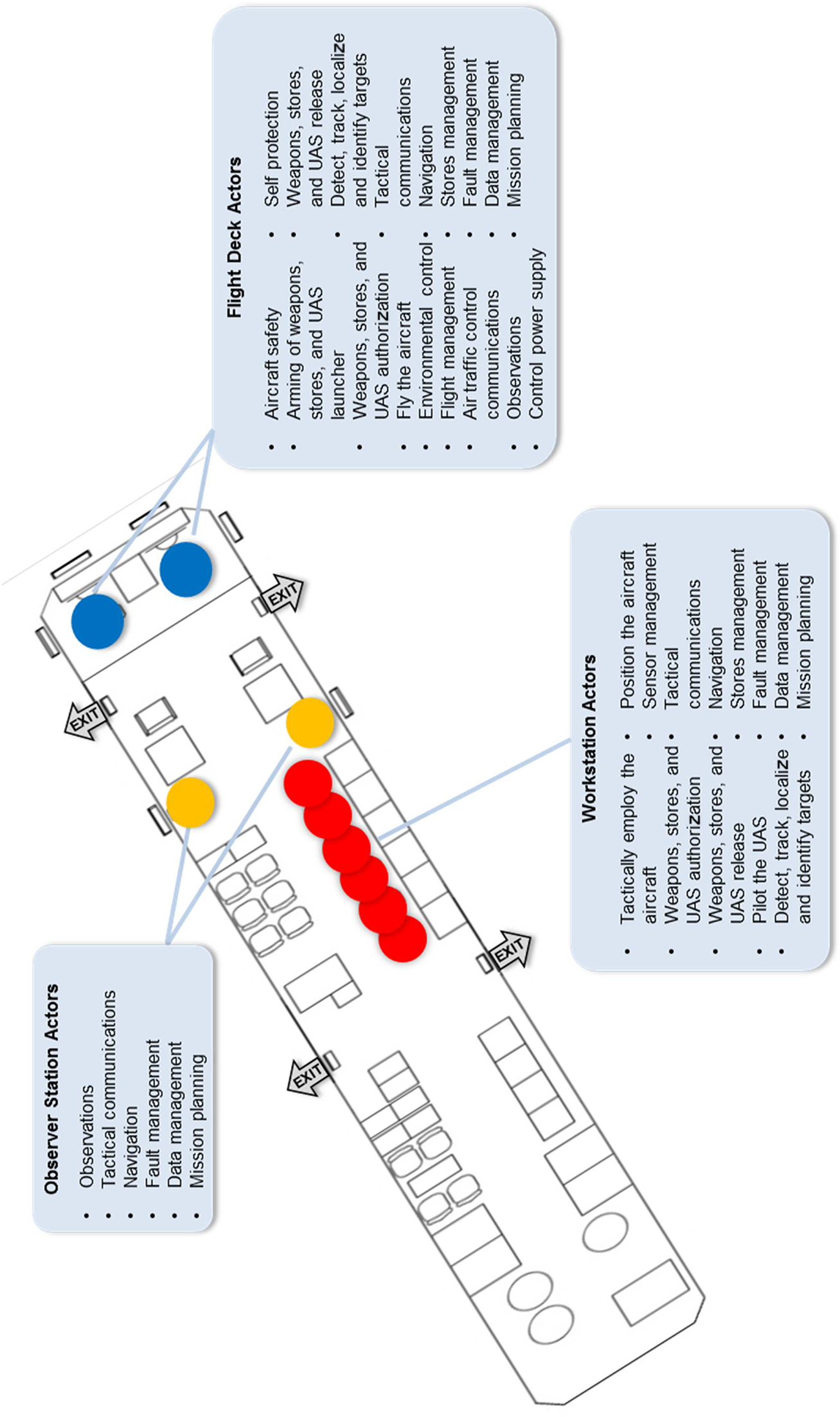
Modified work organization possibilities diagram of the maritime surveillance system.
The organizational constraints in the diagram emerge from the collective effects of the criteria on the work demands in the preceding models. For example, in the case of the maritime surveillance system, the criterion of access to information and controls constrains the control of Piloting (Figure 4) of the UAS to the workstation and flight deck actors, ruling out the observer station actors. However, the safety and reliability criterion rules out the flight deck actors as well (Table 3), which leaves only the workstation actors. This organizational constraint is represented as Pilot the UAS in the diagram.
The work demands in the maritime surveillance diagram are abstractions of the work demands in the preceding models, with labels that emphasize actors’ opportunities for action, as they are relevant to the system’s goals or purposes. In addition, the labels were chosen to enhance the meaningfulness of the diagram to SMEs and officials and to enhance distinctions between actors that were particularly pertinent to the design problem. For instance, the work demand Pilot the UAS in the diagram is an abstraction of a number of work demands in the preceding models including the process Flight, the function Piloting, the priority/value Conservation of Resources, the work function Fly and Navigate, and the associated decision ladder demands. In this case, the abstractions were useful, for both presentation and design, because the scale of the system and granularity of the analyses meant there were a very large number of work demands in the preceding models (e.g., 165 in the abstraction hierarchy alone). The abstractions were possible, and meaningful, because the work demands in the preceding models are interrelated and the criteria often have the same effects in constraining particular actors to different work demands. It is important to note that the abstractions were derived following the application of the criteria to the work demands in the preceding models.
As shown in Table 3, the organizational constraints in the diagram resulted predominantly from the criteria of compliance, safety and reliability, and access to information/controls, as these criteria revealed constraints that are relevant irrespective of the situation. The remaining three criteria, coordination, competencies, and workload, constrain the work organization in recurring classes of situation, but do not exclude any distribution outright, consistent with the discussions in Naikar and Elix (2016b). For instance, the coordination associated with one actor controlling the flight of the UAS and another its sensor is inefficient, but in a situation where no single actor has sufficient capacity to do both, such a structure could be adopted. Similarly, the workload associated with a single actor simultaneously operating the UAS and other sensors on the aircraft is generally high. However, this option could be feasible in circumstances when the UAS has already detected the target so that the other sensors require little attention. Finally, the competency criterion also does not exclude any work distribution outright because there may be situations in which actors undertake tasks they are not qualified to perform. For example, an actor may communicate the coordinates of the UAS to another air vehicle without possessing the necessary qualifications. This analytical decision is consistent with the results of field studies that demonstrate that, depending on situational demands, workers may perform tasks that fall outside their professional demarcations or for which they have no prior training or experience (e.g., Bogdanovic et al., 2015; Lundberg & Rankin, 2014).
Design
Having constructed the work organization possibilities diagram, the design process involved establishing how the possibilities for UAS operation could be supported. Specifically, the diagram identified the actors who could be involved in behaviors for operating the UAS at any moment, given the criteria for dynamic work organization. In particular, the six workstation actors could be involved in behaviors for both piloting the UAS and detecting and localizing targets with its sensor, the two flight deck actors could be involved in behaviors for detecting and localizing targets with the sensor, and the two observer station actors could be involved in behaviors for operating the UAS if tactical interfaces, such as those already available at the workstations and flight deck stations, were provided to them. In this section, we explain how we sought to support the work organization possibilities of these actors through design, while taking into account practical considerations such as cost.
The most obvious solution for supporting the system’s work organization possibilities is to create a design in which every crew member at the six workstations, two observer stations, and two flight deck stations is given the capacity for fulfilling the relevant work demands. Certainly, electronic technologies have made it feasible for the necessary interface functionality to be provided, relatively inexpensively, at all of these stations on the aircraft. However, considerably greater cost is associated with providing this functionality at the observer stations compared with the workstations and flight deck stations. In addition, providing all of the crew with specialized training for UAS operation is difficult to justify because of the amount of extra time each person would be required to spend in training rather than on operations, which has implications for the workforce numbers and financial investment required. Yet, the most obvious alternative of a design in which only one or two crew members can satisfy the work demands of UAS operation would significantly reduce the work organization possibilities and thus the flexibility of the system to adapt to changing requirements and unforeseen events.
One solution we identified for addressing some of these design challenges is to take advantage of the proposed training and career progression pathway of the crew, especially in relation to the six workstation actors, who could undertake behaviors for both piloting the UAS and detecting and localizing targets with its sensor. In this proposal, dry sensor operators are expected to progress to the role of wet sensor operators (Figure 8a) and junior tactical commanders are expected to progress to the role of senior tactical commanders (Figure 8b). Therefore, providing dry sensor operators and junior tactical commanders with the required training for operating the UAS (Figure 8c) is a practical means for giving all six actors the capacity for fulfilling the work demands (Figure 8d), thereby maximizing, to the extent feasible given practical considerations, the work organization possibilities of the crew.
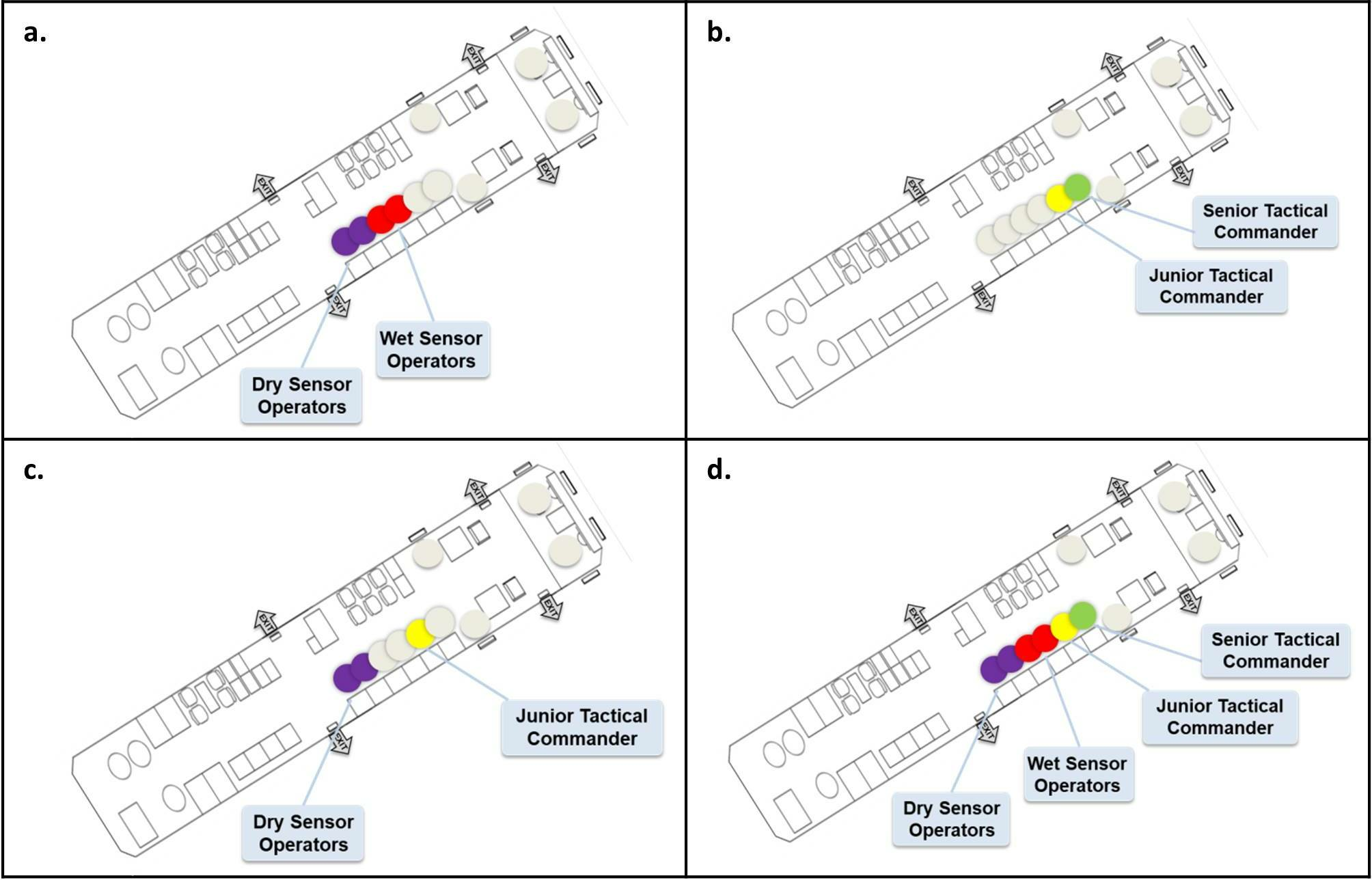
Mapping of dry and wet sensor operators and junior and senior tactical commanders to the six workstations illustrating the integration of the team, training, and career progression elements to maximize the work organization possibilities: (a) career progression in which dry sensor operators (purple) become wet sensor operators (red); (b) career progression in which junior tactical commanders (yellow) become senior tactical commanders (green); (c) training in which dry sensor operators and junior tactical commanders are prepared in UAS operations; (d) team in which all six workstation actors have the capacity for operating the UAS. UAS = unmanned aerial system.
This idea of integrating the team design with the training and career progression pathway to maximize the work organization possibilities is consistent with empirical observations of how work is accomplished in sociotechnical systems. In considering the division of labor among members of the navigation team on naval vessels, Hutchins (1990) observed that “The progress of various team members through the career cycle of navigation practitioners produces an overlapping distribution of expertise that makes it possible for the team to achieve training and job performance in a single activity” (p. 191). Hutchins also observed that the overlapping distribution of expertise allowed team members to take responsibility for all parts of the process to which they could contribute—not just for their own jobs—which enabled the system to adapt to changing circumstances.
Notably, in the present case, the integration of various elements of the system design was essential to maximizing the crew’s work organization possibilities. For example, by focusing on training design alone, it may have been decided that workforce numbers and cost considerations prohibited all six workstation actors from undertaking responsibility for the UAS. However, by integrating the training requirements with the team design and career progression pathway, this solution becomes feasible.
The value of developing an integrated system design to maximize the system’s work organization possibilities can be assessed analytically by considering the strengths and limitations of each of the six workstation actors undertaking responsibility for the UAS in the launch, control, and recovery phases. The assessment of strengths and limitations, or pros and cons, is a common approach for option comparison in a variety of settings, including in industry and in the military, especially when there is significant uncertainty (Heuer & Pherson, 2011; Lipshitz & Strauss, 1997). Table 4 shows that no single actor is uniquely well suited to operating the UAS across all phases. For example, during the launch phase, the senior tactical commander is well suited to operating the UAS because this crew member not only has the necessary authority to permit its release, but also has a “big picture” perspective of the mission, which is beneficial for formulating the release point. However, the need to maintain this big picture may interfere with the requirements for UAS operation during the control phase, when a “zoomed-in” view is necessary to ensure that the UAS’s positioning relative to the target is such that the sensor on the UAS can detect the target. Likewise, wet sensor operators are well suited to operating the UAS during the control phase because they already have a “zoomed-in” view of the target, which they would be tracking with another sensor. However, during the launch phase, the work demands associated with releasing the UAS could distract them from tracking the target with the other sensor, which would compromise the mission.
Strengths (Plus Signs) and Limitations (Minus Signs) of the Six Workstation Crew Operating the UAS in Relation to Launch, Control, and Recovery Phases
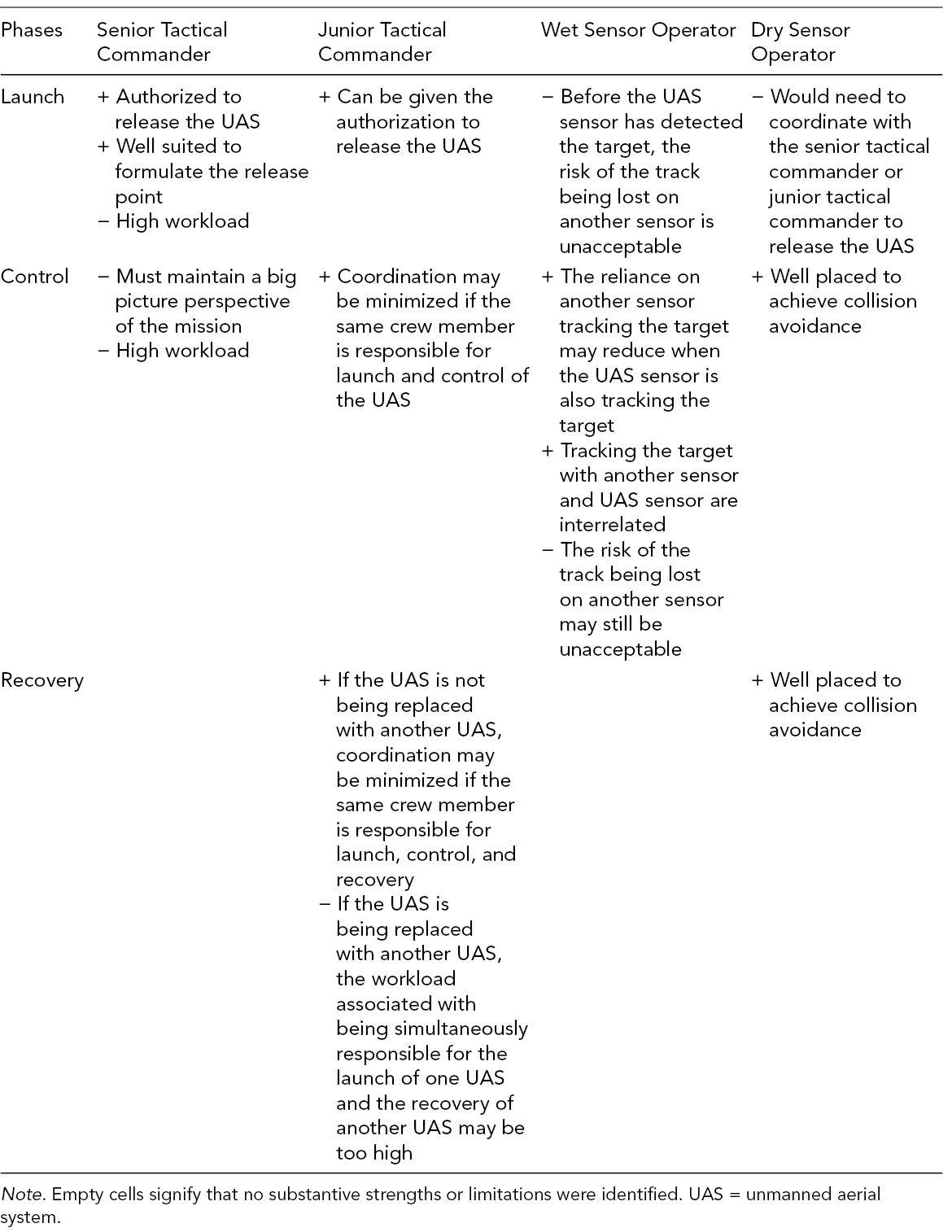
Note. Empty cells signify that no substantive strengths or limitations were identified. UAS = unmanned aerial system.
Similarly, when examining the strengths and limitations at the level of the work organization criteria, which govern shifts in work distribution from moment to moment, including within a single mission phase, it is evident that no single actor is uniquely well suited to operating the UAS (Table 5). Clearly, the best crew member for the job is dependent on local contingencies, so that ongoing fine-tuning of the work organization may be necessary. Accordingly, the proposed design accommodates a range of possibilities for managing the instability, uncertainty, and unpredictability of the tasking environment, including variability in workload, such as shifting responsibility for the UAS or combining some of the roles to allow for a dedicated UAS operator if necessary.
Strengths (Plus Signs) and Limitations (Minus Signs) of the Six Workstation Crew Operating the UAS in Relation to Work Organization Criteria
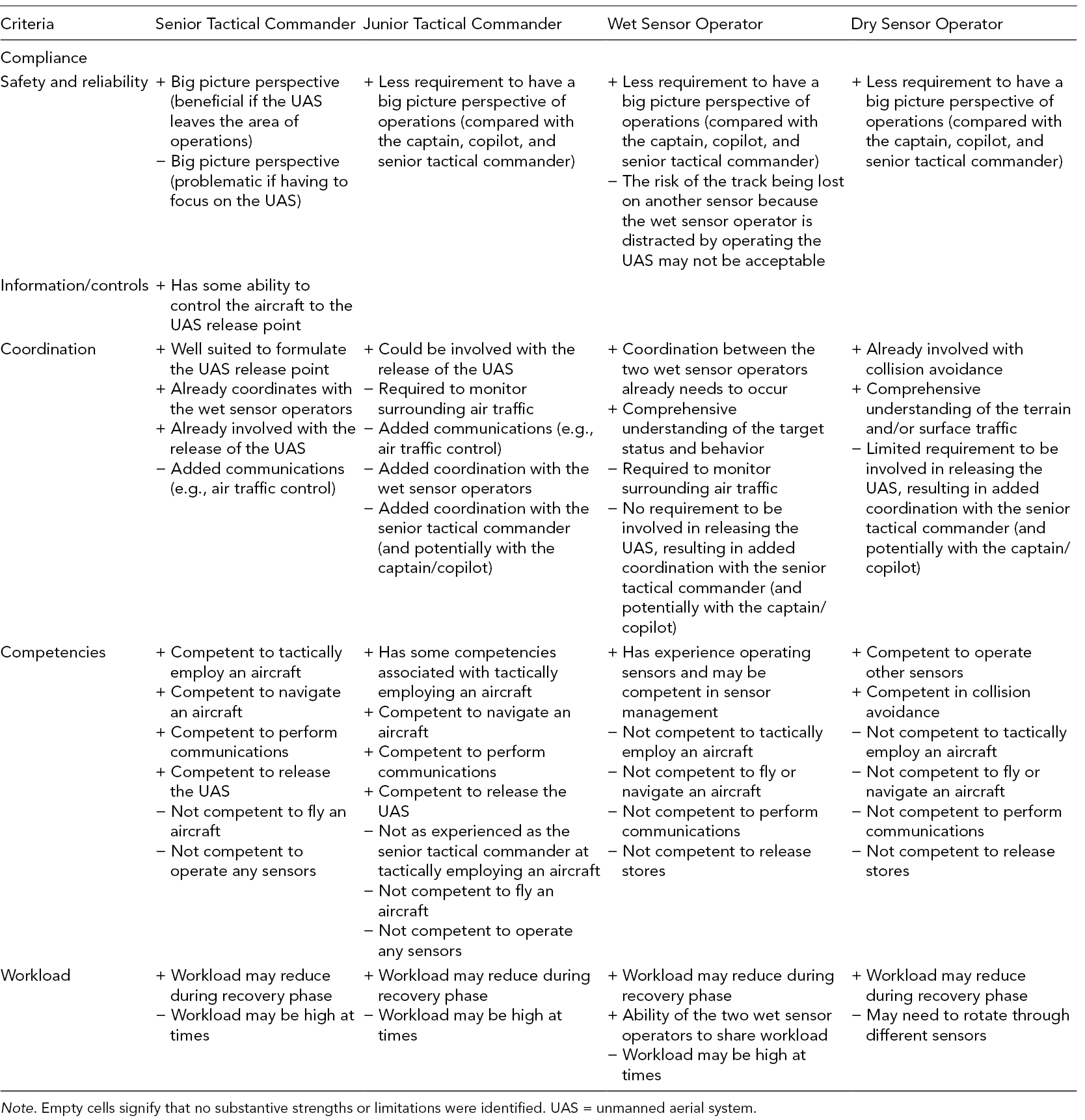
Note. Empty cells signify that no substantive strengths or limitations were identified. UAS = unmanned aerial system.
Value of Work Organization Possibilities Diagram for Design
In an industrial setting, the value of the diagram for design can be assessed in terms of three criteria: impact, uniqueness, and feasibility (Naikar, 2013; Vicente, 1999; Whitefield et al., 1991).
Impact
In the present case, the diagram had impact on practice. The proposed design was accepted by the Royal Australian Air Force for further development. This decision followed a validation exercise with SMEs, specifically three maritime surveillance operators, one aeronautical engineer, one sensor expert, one operations analyst, and two project officials with operational backgrounds in maritime surveillance. In the validation exercise, which was facilitated by a human factors analyst, each SME considered the strengths and limitations of each crew member taking responsibility for the UAS, which had been identified analytically earlier. Based on the profile of strengths and limitations, with which they largely concurred suggesting mainly minor clarifications, the proposed design was judged by each SME to be better than any of the alternative options of limiting the UAS responsibility to one or two crew members. The SMEs’ decisions recognized that no crew member was uniquely well suited to operating the UAS and that the flexibility afforded by the proposed design is consistent with how work on military platforms is generally accomplished in practice. Nevertheless, the SMEs also appreciated that the design may need to be refined as information about specific UAS capabilities and other aircraft technologies becomes available. Further, comprehensive evaluations of crew performance are necessary, when UAS prototypes and simulations become available.
Uniqueness
The value of the diagram can also be established with respect to its merits when compared with other design frameworks and conventional organizational protocols. In the case of the maritime surveillance system, normative and descriptive frameworks could not readily be applied at the concept stage of development. Prescribing workers’ behaviors is difficult when the details of the technical components are still undefined, and describing workers’ behaviors is difficult when the system cannot be observed. Regardless the use of normative or descriptive frameworks, if feasible, would have resulted in designs that are well suited for prespecified or observed situations. Further, these methods would likely have sought to pinpoint the best crew member for the job. However, the best crew member can only be identified in relation to specific conditions, and prespecified or observed situations are generally not repeated exactly and unforeseen events are possible (Hoffman & Woods, 2011; Rasmussen et al., 1994; Vicente, 1999). Therefore, such methods are likely to produce designs that are limited in changed or novel circumstances.
In contrast, given its formative orientation, the diagram focuses on defining the constraints on workers’ behaviors, which does not require an already designed or observable system (Naikar, 2013). A formative approach does require a high-level vision of the system, such as may be conveyed in an operational concept, which existed for the maritime surveillance system. However, at the early stages of development, many aspects of the concept, such as crewing if considered, are usually still undecided and open to change, and therefore need not be assumed in the diagram, as was the case for the maritime surveillance system. Moreover, the diagram demarcates the possibilities for work organization in a system, irrespective of the circumstances, thereby accommodating both routine and novel events. Consequently, designs based on this model are more likely to support effective performance in a variety of situations, including those that are unforeseen. In the case of the maritime surveillance system, the diagram resulted in a design that integrates the team, training, and career progression elements in a way that supports a range of possibilities for work organization. While this solution does not accommodate all of the possibilities, because of practical considerations, the approach supports a greater range of possibilities compared with normative or descriptive methods or the standard CWA framework. Furthermore, as Naikar and Elix (2016b) discuss, the diagram accommodates greater possibilities than the CWA approach used to design a team for an Airborne Early Warning and Control system (Naikar et al., 2003).
The diagram also makes a unique contribution when compared with conventional protocols for representing organizational structure in the Royal Australian Air Force, in other militaries (Rochlin et al., 1987), and in other kinds of workplaces such as healthcare (Klein et al., 2006). Although these systems exhibit, and require, significant flexibility in the work organization, in formal documentation, the organizational structure is typically depicted as rigid, hierarchical, and centralized. These descriptions may be applicable in ideal or routine situations, but accommodating the organizational variations that are possible, and that are necessary for responding to deviations from typical circumstances or to qualitatively different events, is required to support the development of designs that are compatible with how work is conducted in reality. Until recently, representational tools for capturing organizational flexibility have not been available, but the diagram provides a potential solution.
Finally, it is widely recognized that conventional design practices rely on relatively inflexible work specifications compared with what workers actually do in real settings (Dekker, 2003; Eason, 2014; Hollnagel et al., 2013; Klein et al., 2008; Norman, 2008). While resulting designs may support some adaptations by workers, the pertinent features of these solutions often appear to be unintended by-products of other system features, provided by default, or due to the insights of individual designers rather than the outputs of any well-established, systematic processes. Further, although some workplaces may exhibit “high-reliability” performance through effective adaptation (e.g., Rochlin et al., 1987), these outcomes appear to originate mainly in the bottom-up practices of workers rather than top-down practices of designers. Also, workers are resourceful and may undertake spontaneous actions in spite of, rather than because of, the system design, so that some adaptations may not be well supported and may be dangerous. Lundberg and Rankin (2014), for instance, found that role improvisations by workers in crisis response teams, which were not accounted for in training, meant that jobs were sometimes performed less effectively or efficiently than specialists performing the same work. In addition, Klein et al. (2008) observed that the Three Mile Island accident highlighted that nuclear power plant control rooms presented information to workers in ways that sometimes interfered with their ability to understand the situation and adapt to the circumstances.
Earlier it was discussed that the six workstation actors on the future maritime surveillance aircraft are afforded behaviors for navigation, such that they could assist the flight deck actors with these activities. However, although such flexibility may be provided by the software at all of the workstations by default, as it is inexpensive to do so, and the crew may take advantage of these opportunities, these possibilities must be accounted for in the team, interface, and training design of the system to support adaptation effectively. By deliberately seeking to enable adaptation within a set of boundary conditions on safe and productive performance, the diagram provides a means for systematically designing for constrained flexibility in the workplace.
Feasibility
A third criterion for establishing the value of the diagram in industry is its feasibility of implementation. In the current case, the development of the diagram and its application to design was achieved within the project’s schedule, financial constraints, and personnel constraints. We note that the manned component had been analyzed previously, so only extensions were required to incorporate the UAS capability.
Conclusion
This paper has provided an analytical demonstration and empirical validation of the use and value of the work organization possibilities diagram for design. Utilizing a case study of a future maritime surveillance system, it was shown that the diagram can be applied to a complex system to develop a design solution that maximizes the system’s possibilities for work organization. In addition, empirical validation of the impact, uniqueness, and feasibility of this approach in industry was provided.
The intent of the diagram is to provide a coherent approach for designing for adaptations in both actors’ behaviors and structures in a wide variety of situations, including novel events. By providing a potential means for shaping the design of systems early in the development cycle, workers can be supported in dealing with instability, uncertainty, and unpredictability in their work environments.
A key observation from this case study is the importance of developing an integrated system design, not only to ensure compatibility between the different elements in supporting behavioral and structural adaptation (Naikar & Elix, 2016b), but also to maximize a system’s work organization possibilities. Focusing on individual elements alone may have the result of restricting the possibilities unnecessarily, thereby compromising the system’s capacity to accommodate situational variability through adaptation. As this paper demonstrates, the integration of design elements may be achieved in ways that are consistent with empirical observations of how work is accomplished in complex settings.
The current case study was concerned with the design of a novel operational concept for a future maritime surveillance aircraft. As the aircraft was further into development than the novel concept, certain practical considerations influenced some of the specific ways in which the diagram for this system was created and applied. For example, the application of the access to information or controls criterion reflected that tactical interfaces were not already provided at the observer stations and, in the Section “Design,” we explain why introducing tactical interfaces at these stations, which would have involved making physical changes to the aircraft, could not be readily justified. That is, as is common in practice, a sensible “stop rule” or boundary for the analysis was employed. Indeed, it is rarely viable to adopt a “blank slate” in system design (Hopkins & Jenkins, 2008). Nevertheless, in this context, it is important to emphasize that limits on the work organization possibilities that can be feasibly changed through design should not be incorporated into the diagram.
We also emphasize that this case study was not concerned with examining which crew members with prespecified jobs could perform the new functions, as the roles or responsibilities of actors were not assumed in the diagram. Rather, the analysis was concerned with delimiting the possibilities for action at particular stations or locations on the aircraft. Accordingly, in the proposed design, the actual roles and responsibilities of actors on any occasion emerge from their bounded spaces of possibilities for action, as defined in the diagram.
Finally, we acknowledge that it has not yet been established conclusively that designs based on the diagram will lead to more effective performance in complex environments than those produced with other approaches. Such comparisons are difficult to achieve within the constraints of industrial projects, especially during the concept stage of development, when the system does not exist in a real or simulated form. In this case, the plausibility of the proposed design was established on the basis of analytical comparisons with alternative solutions and judgments by SMEs. At the early stages of system development, there appears to be no better alternative. Later during development, evaluations with prototypes or simulations become feasible but, because of practical considerations, such studies rarely involve controlled experiments. For these reasons, techniques used in industry are rarely evaluated formally (Czaja, 1997), but are typically evaluated against the criteria of impact, uniqueness, and feasibility (Naikar, 2013; Vicente, 1999; Whitefield et al., 1991). The diagram fulfilled these criteria in the present case, but more such studies are needed. Further, experimental evaluations, where these are feasible, would be beneficial. Nevertheless, evaluations are expensive (Eason, 2014) so that, prior to any testing, a plausible design concept must be developed. This paper demonstrates that a plausible design concept can be developed with the diagram.
Meanwhile, industries will proceed with developing systems regardless of experimental validation of any techniques. Given that the work organization possibilities diagram was formulated specifically to accommodate empirical observations of how work is performed in sociotechnical systems, it seems reasonable to expect that designs resulting from this approach can support effective performance by workers.
Key Points
To support work as it occurs in natural contexts, designs for sociotechnical systems must promote adaptations in both workers’ individual behaviors and collective structures.
Standard frameworks for design, including CWA, are limited in supporting behavioral and structural adaptation.
A case study of a future maritime surveillance system shows that the work organization possibilities diagram can be applied to a complex system to maximize its work organization, or behavioral and structural, possibilities for adaptation and that this approach satisfies the criteria of impact, uniqueness, and feasibility in an industrial setting.
Integrating the designs of different system elements, such as the team, training, and career progression elements, is essential to maximizing a system’s work organization possibilities.
Footnotes
Acknowledgments
We are grateful to Barry Goettl, Associate Editor, and four anonymous reviewers for their thorough and constructive comments, which helped us greatly in improving our original manuscript.

Author Biographies
Ben Elix was a research scientist at the Defence Science and Technology Group from 2006 to 2018. He graduated with a Bachelor of Psychology (Honours) from Flinders University of South Australia in 2004. He is currently at BAE Systems Australia.
Neelam Naikar is a research scientist at the Defence Science and Technology Group. She graduated with a PhD in Psychology from the University of Auckland in 1996.