




Abstract
Objective
This study investigated how children and young adults regulate their velocity when crossing roads under varying traffic conditions.
Background
To cross roads safely, pedestrians must adapt their movements to the moving vehicles around them while tightly coupling their movement to visual information.
Method
Using an Oculus Rift, 16 children and 16 young adults walked on a treadmill and intercepted gaps between two simulated moving vehicles in an immersive virtual environment. We varied the participants’ initial distance from the curb to the interception point, as well as gap characteristics, including gap size and vehicle size.
Results
Varying the initial distance led to systematic adjustments in participants’ approach velocities. The inter-vehicle gap and the vehicle size affected the crossing position induced by the initial distance. However, participants did not systematically scale their positions according to the initial distance in narrow gap. Notably, children did not finely tune their movements when they approached wide gap from a closer distance or when they approached the large vehicle from closer distance.
Conclusion
Children were less precise in coupling their movements to the moving vehicle in complex traffic environments. In particular, large moving vehicles approaching at closer distances can pose risks when children cross roads.
Application
These findings suggest the need for an intervention program to improve children’s skill in perceiving larger vehicles and timing their movements when crossing roads. We suggest using an interactive virtual reality system to practice this skill.
Korea has one of the highest child traffic death rates worldwide at 0.9 per 100,000 children under the age of 14 years (Traffic Accident Analysis System, 2016). Furthermore, 50.7% of child pedestrian deaths occur in traffic accidents while crossing a road (Traffic Accident Analysis System, 2016). These statistics highlight the importance of understanding children’s road-crossing behavior.
Gap crossing is an interceptive behavior that requires pedestrians to move in relation to the open space between two moving vehicles (Chihak et al., 2010; Louveton, Montagne, Berthelon, & Bootsma, 2012). Accordingly, gap crossing involves not only perceiving oncoming vehicles, but also controlling one’s movement in relation to moving traffic. To cross a road successfully, individuals must time their movements to those of moving vehicles; this requires precise coupling of actions with visual information.
Researchers investigating goal-directed behavior control found that children’s gap-crossing behavior was less finely tuned than that of adults (Chihak, Grechkin, Kearney, Cremer, & Plumert, 2014; Chihak et al., 2010; O’Neal et al., 2018; Plumert, Kearney, & Cremer, 2004; Plumert, Kearney, Cremer, Recker, & Strutt, 2011; Te Velde, Van der Kamp, & Savelsbergh, 2008). For example, Chihak et al. (2010) reported that when 10- and 12-year-old cyclists crossed 12 intersections, the children experienced difficulty timing their actions with the movement of car-sized blocks, and they have less time to spare after clearing approaching traffic blocks. This inefficiency is likely due to the children’s lack of skill in coordinating their locomotion with moving traffic. From late childhood through early adolescence, children undergo developmental changes in their skill to coordinate movements to match moving objects (Grechkin, Chihak, Cremer, Kearney, & Plumert, 2013; O’Neal et al., 2018; Savelsbergh, Rosengren, Van der Kamp, & Verheul, 2003). O’Neal et al. (2018) investigated how 6-, 8-, 10-, 12-, and 14-year-old children and adults pedestrians perceive and act on dynamic affordances when crossing roads. They found that 12-year-old children exhibited poorer timing of gap behind lead vehicle (LV) in the gap than 14-year-olds and adults. However, research has not yet explored how 12-year-old children regulate their velocities in various changing environments. Thus, we further examined the road-crossing behavior of 12-year-old children in various environments.
Given that children lack the skill to coordinate their movements with moving traffic, previous studies have extensively investigated velocity control during gap crossing. These studies characterized 10- to 12-year-old children’s velocity regulation as an overcorrection in speed when they moved (Chihak et al., 2010; Chihak et al., 2014) and found that children have less time to spare than adults (Grechkin et al., 2013; Plumert et al., 2004; Plumert et al., 2011). In a study of pedestrian behavior, Te Velde et al. (2008) investigated age-related differences in child pedestrian road-crossing behavior by moving a doll between two toy vehicles to simulate crossing a road. They found that 5- to 7-year-old children reached the required velocity to avoid colliding with the second vehicle later than preadolescent children and adults. However, this study did not involve actual walking. People who actually cross a road can better judge the time gap than people who only make a verbal decision to cross (Oudejans, Michaels, Van Dort, & Frissen, 1996). In total, these results indicated that children are less skillful than young adults in scaling their movements based on visual information.
We investigated children’s velocity regulation of children’s road crossing behaviors by incorporating an actual crossing in a virtual reality environment. Crossing the gap in a changing environment is a complex task in which it is necessary to scale locomotion in relation to the moving traffic. Studies on gap-crossing behavior in cyclists and drivers (Dewing, Duley, & Hancock, 1993; Louveton, Bootsma, Guerin, Berthelon, & Montagne, 2012; Louveton, Montagne et al., 2012) indicated that crossing environment influences crossing behaviors.
The gap, a moving object that must be intercepted, is an important feature of the traffic environment that should affect crossing behavior. Louveton, Montagne et al. (2012) studied global (gap-related) and local (vehicle-related) gap manipulation and found that the inter-vehicle gap between LVs and trailing vehicles (TVs) contributed to changes in drivers’ regulation of road-crossing speed, leading them to cross earlier in a wider traffic gap. Similarly, studies of locomotion indicated that people must adjust their walking speed to maintain a constant relationship with the moving objects to be intercepted, thereby yielding a successful interception (see Chardenon, Montagne, Laurent, & Bootsma, 2004). The information related by the spatial-temporal characteristics of the intercepted object specifies how the actor can move. In the gap-crossing context, changing the gap size should affect how pedestrians regulate their speed.
Another aspect of the traffic environment that may affect pedestrian crossing behavior is vehicle size. Hancock, Caird, Shekhar, and Vercruyssen (1991) found that drivers chose to turn left across traffic more frequently in front of smaller oncoming vehicles. Mathieu, Bootsma, Berthelon, and Montagne (2017) studied the effects of vehicle size and type on an intersection-crossing driving task and found that participants crossed the intersection slightly slower when they encountered a double-sized vehicle rather than a normal-sized vehicle at the final stage of the approach. Thus, these studies imply that dynamic gap characteristics may influence velocity adjustment and its effect on crossing position. Functionally appropriate gap-crossing behavior requires pedestrians to scale their movements based on dynamic information about moving vehicles. This demands a precise coupling of his or her action with the visual information. As such, vehicle size should affect his or her velocity regulation.
We compared how children and young adults regulate their velocities when crossing a street in a virtual reality environment. The participants’ task was to cross the gap between two moving vehicles on a virtual road. First, we systematically manipulated the participants’ initial distance from the curb to the interception point to create an offset within the gap. If participants maintained a constant walking speed, varying initial distance should have led to early, on time, or late arrival at the center of gap. This offset allowed us to determine participants’ velocity adjustments when approaching the interception point, similar to the paradigm used in previous research (Chihak et al., 2010; Louveton, Bootsma et al., 2012). Second, we manipulated gap characteristics by varying gap and vehicle size to investigate whether these changes affect children’s velocity control.
We hypothesized that changing the initial starting distance would affect children and young adults’ velocity adjustment when approaching the interception point, leading them to cross at different positions within the gap at the moment of interception and enter the gap at different times. More specifically, we expected that children would adjust their velocity less adeptly than young adults. In addition, we expected that manipulating gap and vehicle size would lead children to deviate more from the center of gap and take longer to enter the gap.
Methods
Participants
We recruited 16 children (mean age = 12.18 years, SD = 0.83) and 16 young adults (mean age = 22.75 years, SD = 2.56) with normal or corrected-to-normal vision. All participants volunteered. Two young adults experienced motion sickness during the experiment and were replaced to match the group. Participants signed written consent forms, and the Kunsan National University Research Board approved the experimental procedure. The minimum sample size to achieve power for our study was 24 within the given parameters (effect size = 0.2, α = 0.05, power = 0.9).
Apparatus and Virtual Environments
We conducted the experiment using a walking simulator consisting of a customized treadmill (0.67 m wide × 1.26 m long × 1.10 m high), an Oculus Rift (DK1, US), and a PC (3.30 GHz with 8.00 GB RAM, Figure 1). Participants walked on the treadmill using their own locomotive skill; the treadmill was equipped with a handrail for their safety. Participants also wore a hook and loop belt secured to the back of the treadmill to decrease vertical and lateral movements, and four magnetic counters on a spinning roller recorded the participants’ displacement.
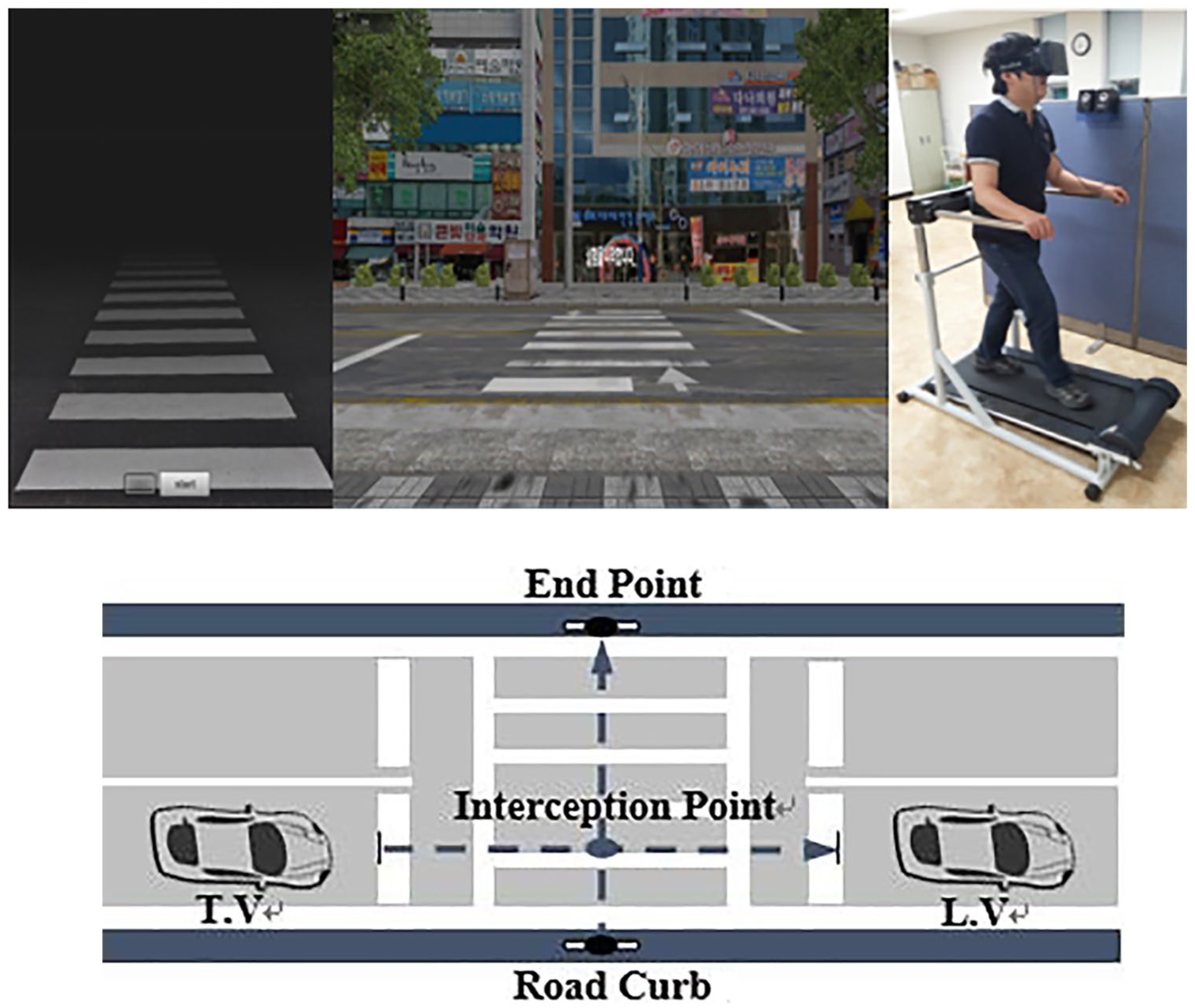
A black-and-white cartoon image of the crosswalk (top left), the street view (top middle), the walking simulator (top right), and a schematic view of the virtual road (bottom). TV represents the trailing vehicle, and LV represents the lead vehicle.
We presented the virtual environment using an Oculus Rift (1,280 × 800 pixels) that produced 3-D stereoscopic images. The visual scene changed in accordance with participants’ walking speed.
Experimental Setup and Procedure
The virtual street consisted of a two-lane road (3.5 m per lane), trees, and a building-lined skyline, as well as a general street view of the road (see Figure 1). We manipulated three experimental variables: participants’ initial distance, gap size, and vehicle size. Walking speed is approximately 1.0 to 1.67 m/s for most adults, 1.17 m/s for children aged 6 to 12 years, and 1.22 m/s for teenagers (Waters & Mulroy, 1999). Thus, we set the initial distance from the curb to the interception point assuming that participants would walk at an average speed of 1.1 m/s. Under such conditions, participants would successfully cross the gap further ahead of, near, and further away from the center of gap for near (3.5 m), intermediate (4.5 m), and far (5.5 m) initial distances, respectively.
The gap, treated as an entity (see Chihak et al., 2010; Louveton, Montagne et al., 2012), was defined as the space between the rear bumper of the LV and the front bumper of the TV. The arrival of the gap center was set to 4 s (around 33.2 m) from the interception point. We established the gap size using two vehicles moving at a constant speed of 8.33 m/s with an inter-vehicular distance of 24.9 m (temporal gap of 3 s) or 33.2 m (temporal gap of 4 s). These gap sizes were chosen because O’Neal et al.’s (2018) study of pedestrian road crossing in a virtual environment showed that a 4-s crossing gap is comfortable, whereas a 3-s gap is tight but crossable. We varied vehicle size based on previous research (Mathieu et al., 2017) indicating that vehicle size affects participants’ crossing behavior. The simulation presented either two white sedans (1.5 m wide, 3.5 m long) or two orange buses (2.4 m wide, 11 m long). The vehicles appeared on the left side of the road in the near lane. No vehicles occupied the far lane.
The participants’ task was to safely cross the gap between two vehicles traveling at a constant speed of 8.33 m/s (around 30 km/h) and walk until arriving on the other side of the virtual road. At the beginning of the trial, participants viewed a black-and-white cartoon image of the virtual crosswalk to calibrate the street view. At the verbal ready signal, participants prepared to cross; at the go signal, the experimenter pressed a button to start the vehicles’ motion and participants were required to look left immediately, visualize the oncoming vehicles, and cross the road if the gap was safe to cross. Participants completed six practice trials intended to familiarize them with the task and the virtual environment. These consisted of two free-walking trials without the head-mounted display, two trials without any vehicles, and two trials in which the vehicles moved at a constant speed of 25 km/h with a 5-s inter-vehicle gap. Following the practice trials, participants performed the task twice under each set of experimental conditions (3 initial distances × 2 gap sizes × 2 vehicle sizes), resulting in a total of 24 trials.
The word success, collision, or failure appeared at the end of each trial. The word success appeared if a participant successfully crossed the gap and reached the other side of the road. Collision and failure appeared if a participant collided with the vehicle or missed the gap, respectively. After each trial, the experimenter restarted the simulation by pushing a button. Presentation order was counter balanced across participants. We repeated the trial twice because Plumert et al. (2011) reported that short-term changes occurred after specific road-crossing experiences. If participants experienced motion sickness, we ceased data collection and excluded their data from the analysis.
Data Analysis
We evaluated participants’ crossing behavior via (a) each participant’s position and velocity profile while approaching the interception point, (b) gap entry time, and (c) position within the gap at the moment of interception.
To examine the participants’ velocity regulation changes in position and velocity as the participants approached the interception point were averaged into 1-s intervals (−3.5 s, −2.5 s, −1.5 s, and −.5 s) counting backward from the participants’ arrival at the interception point (e.g., Chihak et al., 2014; Louveton, Montagne et al., 2012). We examined participants’ positions and velocities to evaluate their speed adjustment and its instantaneous effect on position within the gap during approach.
We calculated mean gap entry time for each trial to evaluate how participants adjusted their movements within the available time. We examined gap entry time to evaluate participants’ temporal distance from the LV. Smaller values indicated that participants crossed the gap closer to the LV with more time to spare between them self and the TV.
We evaluated the participants’ deviation from the gap center at the moment of interception as the time of interception (TOI). TOI can be defined as the temporal distance between the time at which participants crossed the interception point and the time at which the center of gap arrived at the participants’ crossing line. We evaluated TOI as the instantaneous effect of speed adjustment on participants’ position within the gap, and we average TOI for each trial. Negative TOI indicates participants crossed before the center of gap, and positive TOI indicates participants crossed after the center of gap. Multiplying this value by vehicle speed (8.33 m/s) yields the actual position within the gap (in meters).
We analyzed position and velocity data using initial distance (near, intermediate, far) × gap size (3 s, 4 s) × vehicle size (car, bus) × time (3.5 s, 2.5 s, 1.5 s, 0.5 s) repeated measures analysis of variance (ANOVA), with initial distance, gap size, vehicle size, and time as within-factor variables. The timing data were analyzed using initial distance (near, intermediate, far) × gap size (3 s, 4 s) × vehicle size (car, bus) repeated measures ANOVA, with initial distance, gap size, and vehicle size as within-factor variables. The partial eta squared (ηp2) was used to estimate effect size. A least square mean was used for all pairwise post hoc comparisons, and p-values were adjusted using a Bonferroni correction to decrease type I errors. SAS software (version 9.4) was used for the data analysis.
Results
Across all participants, the success rate was 98.95% for children and 99.48% for young adults. We analyzed only the data for successful trials to access the participants’ crossing behaviors and time of crossing. We do not discuss the results of the frequency analysis here because it is beyond the scope of this paper.
We tested our hypothesis that changing the initial distance would affect the participants’ approach position and velocity, and that manipulating gap characteristics would affect children’s and young adults’ approach positions and the velocity profiles induced by the initial distance.
Approach Position
Young adults
Young adults adjusted their crossing positions according to initial distance while crossing the gap (see Figure 2 for an example of an individual young adult). As the initial distance became further away, young adults crossed the gap closer to the TV.
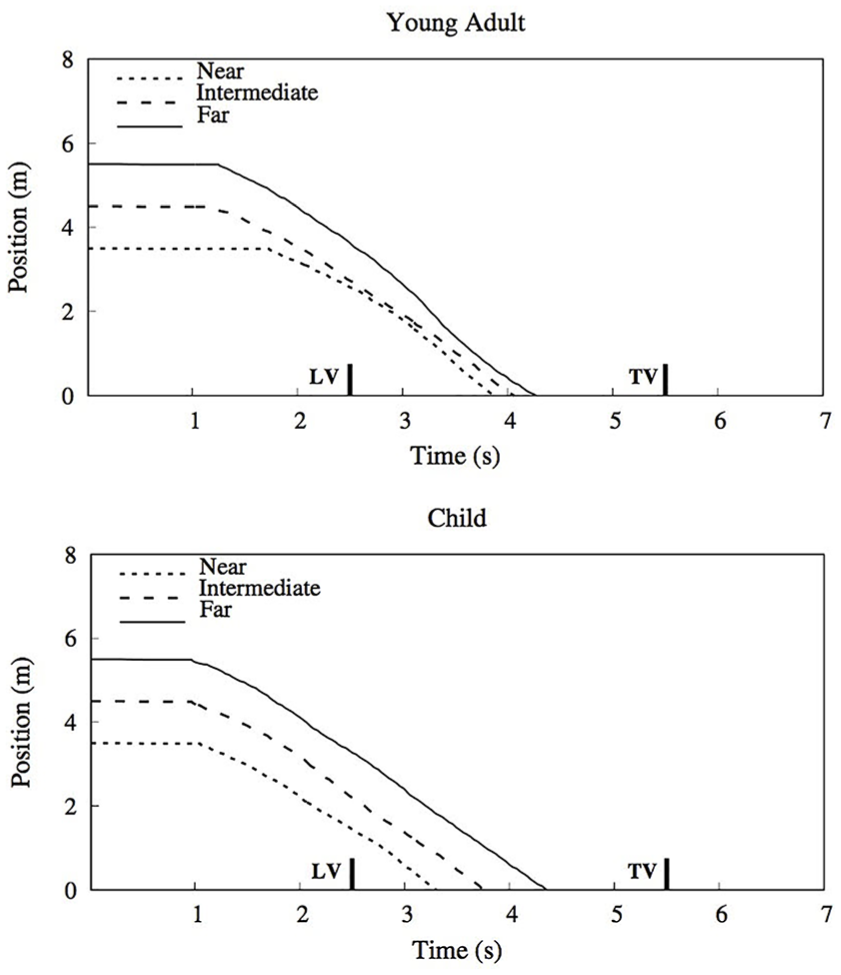
The sample trajectories of a young adult and a child in relation to the LV and TV during a successful gap crossing. TV represents the trailing vehicle and LV represents the lead vehicle.
A repeated measures ANOVA of approaching position showed significant main effects of initial distance, F(2,30) = 1,289.10, p < .0001, ηp2 = .99, and gap size, F(1,15) = 9.60, p < .007, ηp2 = .39. Young adults’ mean position to the interception point increased with the initial distance. In addition, young adults’ mean position to the interception point was greater for the 4-s gap than for the 3-s gap (Table 1).
Mean Position, Velocity, Gap Entry Time, and Time of Interception (SD) as a Function of Initial Distance, Gap Size, and Vehicle Size for Children and Young Adults
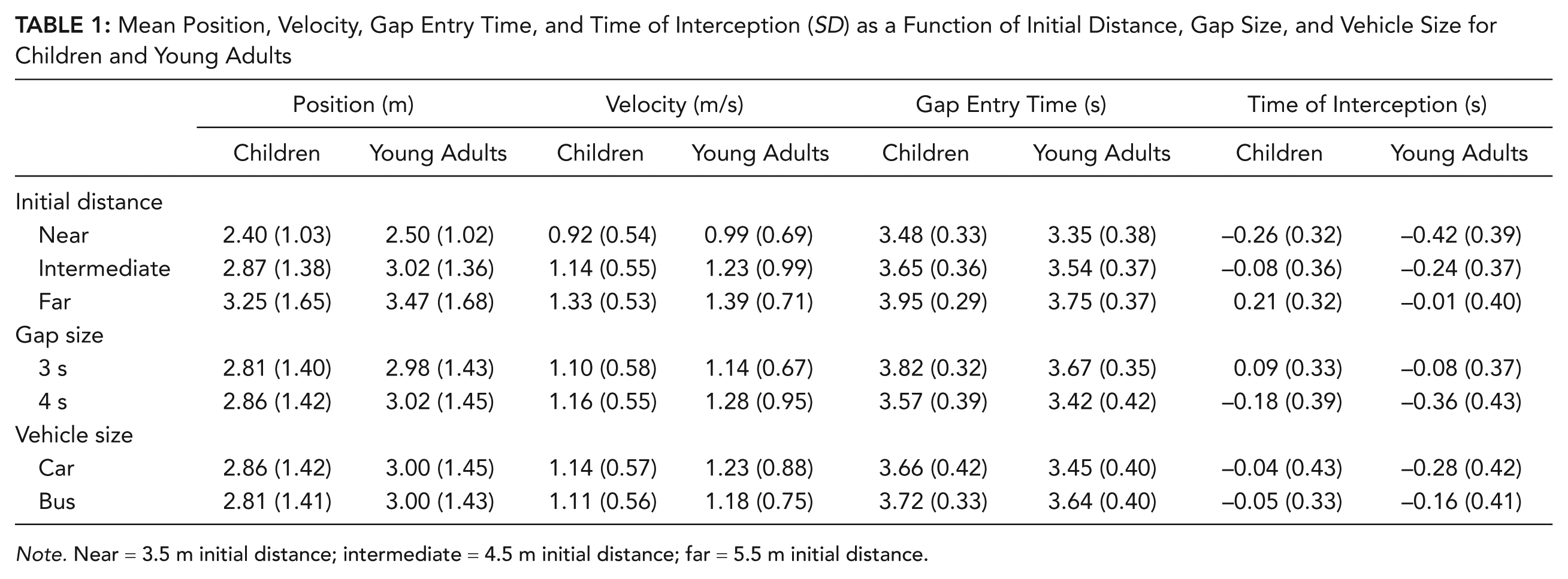
Note. Near = 3.5 m initial distance; intermediate = 4.5 m initial distance; far = 5.5 m initial distance.
The initial distance × time interaction was also significant, F(6, 90) = 230.26, p < .0001, ηp2 = .94. A simple effects test showed a significant effect of time for the near initial distance, F(3, 45) = 1,313.07, p < .0001, ηp2 = .99; the intermediate initial distance, F(3, 45) = 4,472.97, p < .0001, ηp2 = .99; and the far initial distance, F(3, 45) = 8,779.54, p < .0001, ηp2 = .99. Post hoc comparisons revealed that young adults’ crossing position as determined by initial distance significantly decreased from 3.5 to 0.5 s (all ps < .0001) before reaching the interception point (Figure 3). Young adults’ mean position to interception point decreased as they approached it. In addition, the mean position increased with initial distance.
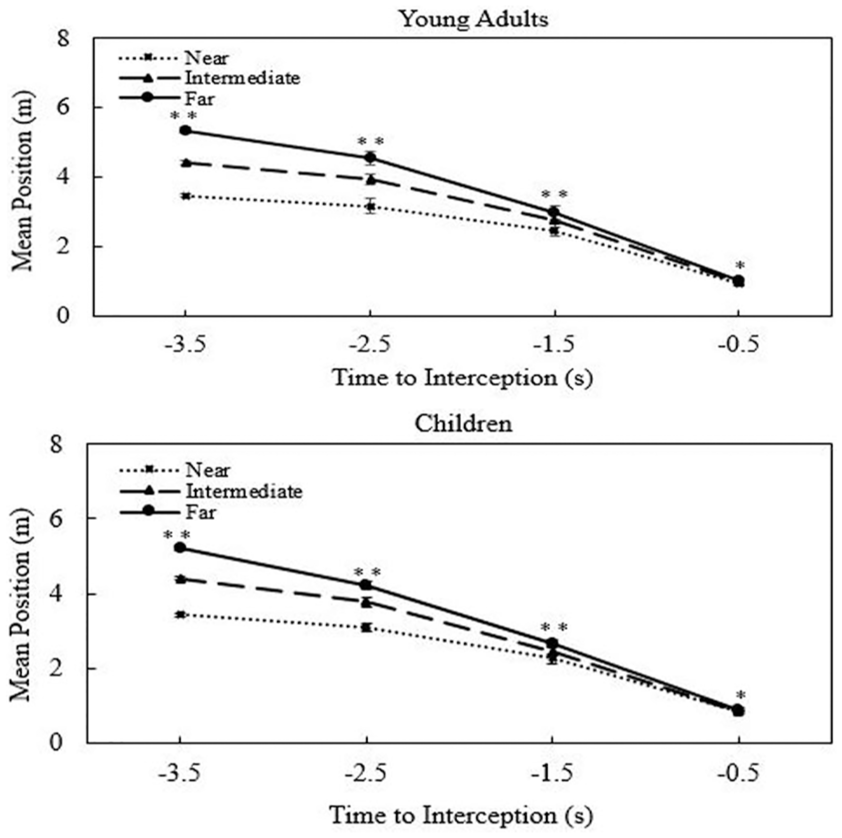
Young adults and children’s mean approach positions for each initial distance (near, intermediate, and far) as a function of time before reaching the interception point. The participants’ position while approaching the interception point was averaged into 1-s intervals (−3.5 s, −2.5 s, −1.5 s, and −.5 s), counting backward from the interception point. In the figure, asterisks represent statistically significant inter-mean differences for initial distances at each time point. One asterisk represents one inter-mean difference, and two asterisks represent two or more inter-mean differences. Error bars indicate standard deviations.
Children
Children adjusted their crossing positions according to the initial distance while crossing the gap (see Figure 2 for an example of an individual child). Similar to young adults, children crossed the gap closer to the TV as the initial distance increased.
A repeated measures ANOVA on approaching position showed significant main effects of initial distance, F(2,30) = 2,059.46, p < .0001, = .99; gap size, F(1,15) = 11.70, p < .004, ηp2 = .44; and vehicle size, F(1,15) = 10.60, p < .005, ηp2 = .41. The children’s mean position to the interception point was greater for the far initial distance compared with the near initial distance. In addition, the children’s mean position to the interception point was greater for the 4-s gap than for the 3-s gap. It was also greater when crossing between cars than when crossing between the buses (Table 1).
The initial distance × time interaction was also significant, F(6, 90) = 412.28, p < .0001, ηp2 = .96. A simple effects test showed a significant effect of time for near initial distance, F(3, 45) = 3,861.11, p < .0001, ηp2 = .99; intermediate initial distance, F(3, 45) = 7,115.29, p < .0001, ηp2 = .99; and far initial distance, F(3, 45) = 14,490.3, p < .0001, ηp2 = .99. Post hoc comparisons revealed that children’s crossing positions induced by initial distance decreased significantly from 3.5 to 0.5 s (all p < .0001) before reaching the interception point (Figure 3). Children’s mean position to interception point decreased as they approached it. In addition, the mean position increased with initial distance.
Velocity Profiles
As we expected, participants adjusted their velocities differently according to the initial distances while approaching the interception point. We observed that initial distance influenced participants’ velocity patterns when they encountered different gap and vehicle sizes.
Young adults
A repeated-measures ANOVA on velocity profiles showed significant main effects of initial distance, F(2, 30) = 29.62, p < .0001, ηp2 = .66, and gap size, F(1, 15) = 10.93, p < .005, ηp2 = .42. Young adults crossed the gap faster as the initial distance became further away. They also crossed the 4-s gap faster than the 3-s gap (Table 1).
The initial distance × time interaction was also significant, F(6, 90) = 11.88, p < .0001, ηp2 = .44. A simple effects test showed a significant effect of time for near initial distance, F(3, 45) = 140.34, p < .0001, ηp2 = .90; intermediate initial distance, F(3, 45) = 29.93, p < .0001, ηp2 = .67; and far initial distance, F(3, 45) = 184.46, p < .0001, ηp2 = .93. Post hoc comparisons showed that for the near initial distance, young adults’ velocity significantly decreased from 3.5 s to 2.5 s (p < .0001) and increased from 2.5 to 0.5 s (p < .0001) before reaching the interception point. For the intermediate initial distance, young adults’ velocity significantly increased from 2.5 to 1.5 s (p < .0001) and from 1.5 to 0.5 s (p < .02) before reaching the interception point. For the far initial distance, young adults’ velocity significantly increased from 3.5 to 1.5 s (p < .0001) and from 1.5 to 0.5 s (p < .03) before reaching the interception point (Figure 4). For the most part, young adults increased their speed throughout the approach, but for the near initial distance, they decreased their speed at the beginning of the approach.
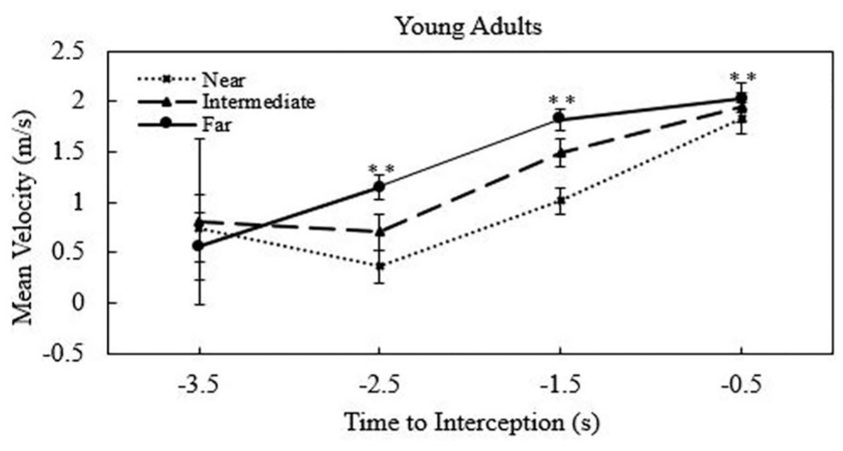
Young adults’ mean velocity for each initial distance (near, intermediate and far) as a function of time before reaching the interception point. The approaching velocity was averaged into 1-s intervals (−3.5 s, −2.5 s, −1.5 s, and −.5 s) counting backward from the interception point. In the figure, asterisks represent statistically significant inter-mean differences for initial distances at each time point. One asterisk represents one inter-mean difference, and two asterisks represent two or more inter-mean differences. Error bars indicate standard deviations. Error bars indicate standard deviations.
In addition, there was a significant interaction effect of gap size × time, F(3, 45) = 7.95, p < .0002, ηp2 = .35. A simple effects test showed a significant effect of time for the 3-s gap, F(3, 45) = 268.31, p < .0001, ηp2 = .95; and for the 4-s gap, F(3, 45) = 47.80, p < .0001, ηp2 = .76. Post hoc comparisons showed that for the 3-s gap, young adults’ velocity significantly increased from 3.5 to 0.5 s (p < .0001) before reaching the interception point. For the 4-s gap, young adults’ velocity significantly increased from 2.5 to 1.5 s (p < .0001) and from 1.5 to 0.5 s (p < .002) before reaching the interception point (Table 2). Young adults did not speed up at the beginning of approach (3.5–2.5 s) for the 4-s gap, but they increased their speed during the rest of approach to the interception point. In addition, young adults crossed the 4-s gap faster than the 3-s gap during the beginning (p < .003) and middle (2.5–1.5 s; p < .04) approach phases.
Mean Velocities (SD) of Young Adults and Children for Gap Size as a Function of Time Before Reaching the Interception Point
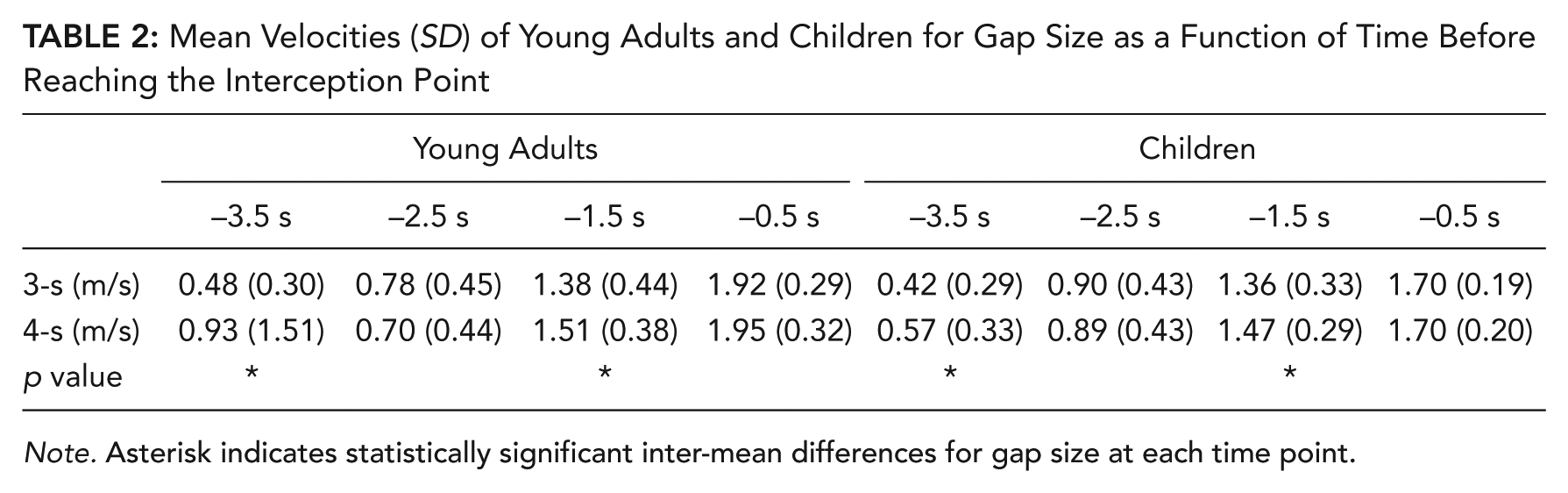
Note. Asterisk indicates statistically significant inter-mean differences for gap size at each time point.
Children
A repeated-measures ANOVA on velocity profile showed significant main effects of initial distance, F(2,30) = 207.32, p < .0001, ηp2 = .93, and gap size, F(1, 15) = 13.44, p < .002, ηp2 = .47. Children crossed the gap faster as the initial distance became further away. They also crossed the 4-s gap faster than the 3-s gap (see Table 1).
Initial distance × time interaction was also significant, F(6, 90) = 53.51, p < .0001, ηp2 = .78. This interaction effect was captured by the three-way interaction. In addition, the gap size × time interaction was significant, F(3, 45) = 5.98, p < .002, ηp2 = .29. A simple effects test showed a significant effect of time for the 3-s gap, F(3, 45) = 266.81, p < .0001, ηp2 = .95, and for the 4-s gap, F(3, 45) = 235.24, p < .0001, ηp2 = .94. Post hoc comparisons indicated that for both gaps, children’s velocity significantly increased from 3.5 to 0.5 s (all, p < .0001) before reaching the interception point (see Table 2). Children consistently increased their speed throughout the approach for both gap sizes. In addition, they crossed the 4-s gap faster than the 3-s gap during the beginning (p < .0006) and middle (p < .003) approach phases.
The vehicle size × initial distance × time interaction was significant, F(6, 90) = 2.12, p < .05, ηp2 = .12. Further analysis revealed that, between the cars, the initial distance × time interaction was significant, F(6, 90) = 33.55, p < .0001, ηp2 = .69. A simple effects test showed a significant effect of time for near initial distance, F(3, 45) = 132.54, p < .0001, ηp2 = .90; intermediate initial distance, F(3, 45) = 173.83, p < .0001, ηp2 = .92; and far initial distance, F(3, 45) = 272.78, p < .0001, ηp2 = .95. Post hoc comparisons showed that when participants crossed between the cars, for near initial distance, children’s velocity significantly decreased from 3.5 to 2.5 s (p < .0002), but it increased from 2.5 to 0.5 s (p < .0001) before reaching the interception point. For intermediate initial distance, children’s velocity significantly increased from 3.5 to 1.5 s (p < .0001) and from 1.5 to 0.5 s (p < .01) before reaching the interception point. For the far initial distance, children’s velocity significantly increased from 3.5 to 1.5 s (p < .0001) before reaching the interception point (Figure 5). For the most part, children increased their speed throughout their ap-proaches, but their speed decreased at the beginning of the approach for the near initial distance, when they crossed between the cars.
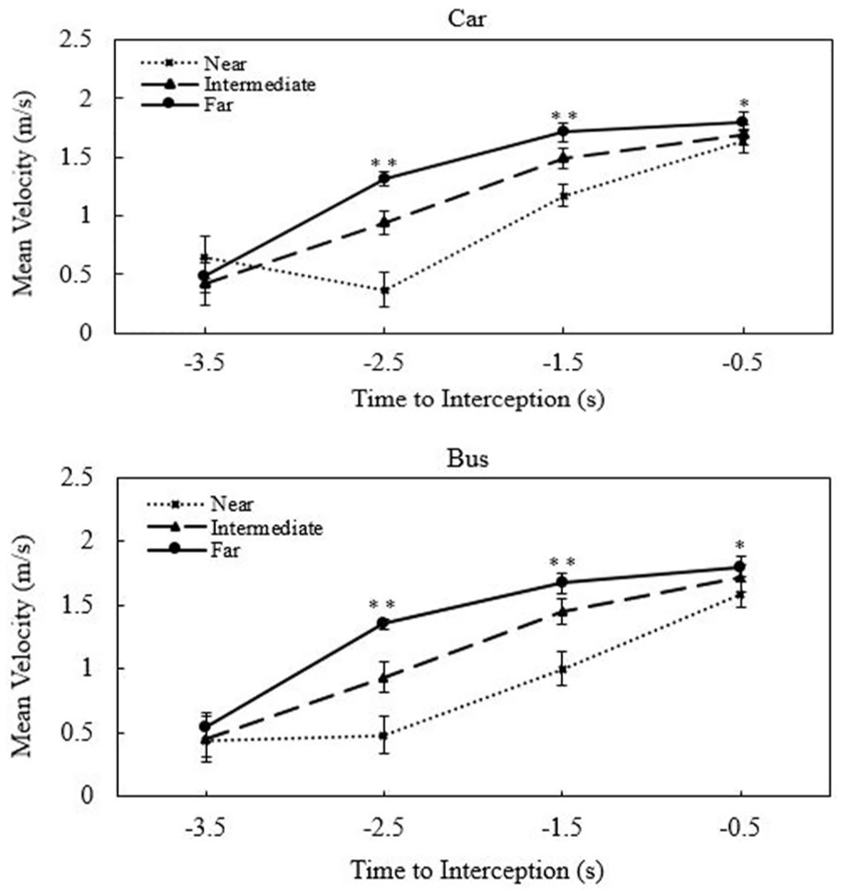
Children’s mean velocity profiles before reaching the interception point for each vehicle and for each initial distance (near, intermediate, or far) as a function of time. The approach velocity was averaged into 1-s intervals (−3.5 s, −2.5 s, −1.5 s, and −.5 s), counting backward from the interception point. In the figure, asterisks represent statistically significant inter-mean differences for initial distances at each time point. One asterisk represents one inter-mean difference, and two asterisks represent two or more inter-mean differences. Error bars indicate standard deviations.
When participants crossed between the buses, the initial distance × time interaction was also significant, F(6, 90) = 18.70, p < .0001, ηp2 =.55. A simple effects test showed a significant effect of time for the near initial distance, F(3, 45) = 124.41, p < .0001, ηp2 =.89; intermediate initial distance, F(3, 45) = 132.79, p < .0001, ηp2 = .90; and far initial distance, F(3, 45) = 331.16, p < .0001, ηp2 = .96. Post hoc comparisons showed that, for the near initial distance, children’s velocity significantly increased from 2.5 to 0.5 s (p < .0001) before reaching the interception point. For the intermediate initial distance, children’s velocity increased from 3.5 to 0.5 s (p < .0001) before reaching the interception point. For the far initial distance, children also crossed the gap significantly faster from 3.5 to 1.5 s (p < .0001) and from 1.5 to 0.5 s (p < .03) before reaching the interception point (Figure 5). When children crossed between the buses, their speed neither increased nor decreased at the beginning of their approach for the near initial distance.
Gap Entry Time
We tested our hypothesis that the initial distance and manipulated gap characteristics would affect participants’ gap entry time.
Young adults
A repeated-measures ANOVA on gap entry time showed significant main effects of initial distance, F(2,30) = 44.60, p < .0001, ηp2 = .75; gap size, F(1,15) = 57.80, p < .0001, ηp2 = .79; and vehicle size, F(1,15) = 27.63, p < .0001, ηp2 = .65. Young adults crossed the gap earlier and closer to the LV when initial distance decreased. They also crossed the gap earlier and closer to the LV for the 4-s gap compared with the 3-s gap, as well as when crossing between the cars compared with crossing between the buses (see Table 1).
The gap size × initial distance interaction was also significant, F(2, 30) = 5.53, p < .009, ηp2 = .27. A simple effects test showed a significant effect of initial distance for the 3-s gap, F(2,30) = 8.93, p < .0009, ηp2 = .37, and for the 4-s gap, F(2,30) = 37.13, p < .0001, ηp2 = .71. Post hoc comparisons showed that, for the 3-s gap, young adults crossed the gap later when the initial distance changed from intermediate to far (p < .01). For the 4-s gap, young adults crossed the gap later when the initial distance changed from near to intermediate (p < .0001) and from intermediate to far (p < .002, Table 3). Young adults crossed the gap later and closer to the TV as the initial distance increased for the 4-s gap, but for 3-s gap, they crossed the gap at similar times for near and intermediate initial distance.
Young Adults and Children’s Mean Gap Entry Time (SD) for Different Gap Sizes as a Function of Initial Distance
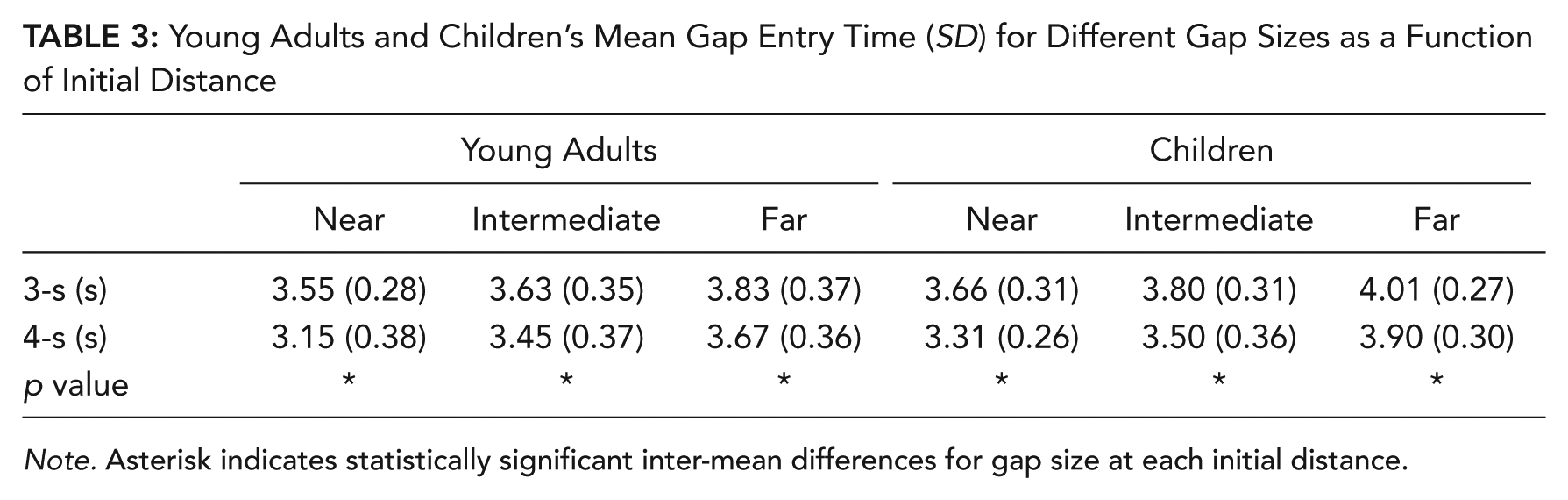
Note. Asterisk indicates statistically significant inter-mean differences for gap size at each initial distance.
Children
A repeated-measures ANOVA on gap entry time showed significant main effects of initial distance, F(2,30) = 67.94, p < .0001, ηp2 = .82, and gap size, F(1,15) = 68.26, p < .0001, ηp2 = .82. Children crossed the gap earlier and closer to the LV when initial distances decreased. They also crossed the gap earlier and closer to the LV for the 4-s gap than for the 3-s gap (Table 1).
The gap size × initial distance interaction was significant, F(2, 30) = 3.97, p < .03, ηp2 = .21. A simple effects test showed a significant effect of initial distance for the 3-s gap, F(2,30) = 12.81, p < .0001, ηp2 = .46, and for the 4-s gap, F(2,30) = 50.58, p < .0001, ηp2 = .77. Post hoc comparisons showed that, for the 3-s gap, children crossed the gap later for the far initial distance than for the intermediate initial distance (p < .01). For the 4-s gap, children crossed the gap later for the intermediate initial distance compared with the near initial distance (p < .007) and for the far initial distance compared with intermediate initial distance (p < .0001, Table 3). Similar to young adults, children crossed the gap later and closer to the TV as the initial distance increased for the 4-s gap, but for 3-s gap, they crossed the gap at similar times for near and intermediate initial distance.
The vehicle size × initial distance interaction was significant, F(2, 30) = 18.40, p < .0001, ηp2 = .55. A simple effects test showed a significant effect of initial distance between the cars, F(2, 30) = 64.81, p < .0001, ηp2 = .81, and between the buses, F(2, 30) = 6.63, p < .004, ηp2 = 31. Post hoc comparisons revealed that between the cars, children crossed the gap later when the initial distance increased from near to far (near: M = 3.32 s, SD = 0.29; intermediate: M = 3.67 s, SD = 0.36; far: M = 4.00 s, SD = 0.28; p < .0001). Between the buses, children’s gap entry time was not significantly different when comparing near and intermediate initial distances (p = 1), but it significantly increased for the far initial distance compared with the intermediate initial distance (intermediate: M = 3.63 s, SD = 0.36; far: M = 3.89 s, SD = .28; p < .008). Thus, when they crossed between the cars, children crossed the gap earlier and closer to the LV as the initial distance increased, but when they crossed between the buses, they crossed the gap at similar times for near and intermediate initial distance.
The vehicle size × gap size interaction was significant, F(1, 15) = 5.50, p < .03, ηp2 = .27. A simple effects test showed a significant effect of gap size between the cars, F(1, 15) = 5.67, p < .03, ηp2 = .27, and between the buses, F(1, 15) = 36.15, p < .0001, ηp2 = .71. Post hoc comparisons showed that, when crossing between the cars, children crossed the gap earlier and closer to the LV for the 4-s gap (M = 3.57 s, SD = 0.06) than for the 3-s gap (M = 3.75 s, SD = 0.06, p < .03). When crossing between the buses, children also crossed the gap earlier and closer to the LV for the 4-s gap (M = 3.55 s, SD = 0.04) than for the 3-s gap (M = 3.89 s, SD = 0.04, p < .0001). In addition, for both vehicle sizes, children crossed the gap earlier and closer to the LV when crossing 4-s gap than 3-s gap.
Time of Interception
We tested our hypothesis that changing the initial distance and manipulating the gap characteristics would cause deviation in participants’ crossing positions from the center of the gap at the moment of interception. Velocity adjustment while approaching the interception point led participants to cross the gap closer to either the LV or the TV even though participants crossed the gap near its center. Systematic velocity regulation led the participants to arrive at the gap early or late depending on their initial distances.
Young adults
A repeated measures ANOVA on TOI showed significant main effects of initial distance, F(2, 30) = 44.12, p < .0001, ηp2 = .75; gap size, F(1, 15) = 65.66, p < .0001, ηp2 = .81; and vehicle size, F(1, 15) = 12.5, p < .003, ηp2 = .45. Young adults crossed the gap furthest ahead of the gap center for the near initial distance, further ahead of the gap center for the intermediate initial distance, and near the gap center for the far initial distance. In addition, young adults crossed the gap further ahead of the gap center for the 4-s gap than for the 3-s gap (Table 1).
The gap size × initial distance interaction was significant, F(2, 30) = 5.39, p < .01, ηp2 = .26. A simple effects test showed a significant effect of initial distance for the 3-s gap, F(2, 30) = 11.07, p < .0003, ηp2 = .43, and for the 4-s gap, F(2, 30) = 37.98, p < .0001, ηp2 = 72. Post hoc comparisons showed that, for the 3-s gap, young adults crossed the gap closer to the gap center as the initial distance increased from intermediate to far (p < .002). For the 4-s gap, young adults crossed the gap significantly closer to the gap center as the initial distance increased from near to intermediate (p < .0001) and intermediate to far (p < .003, Figure 6). For the 4-s gap, young adults’ deviation from the gap center was significantly larger as the initial distance became further away, but for the 3-s gap, they crossed at similar positions relative to the gap center for near and intermediate initial distances.
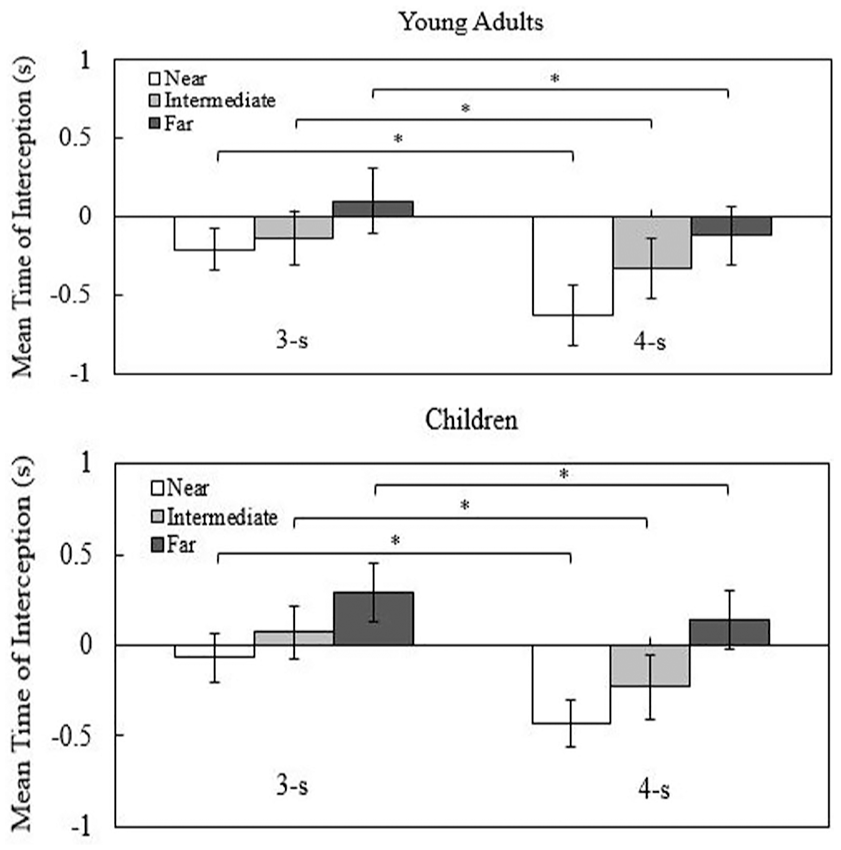
Young adults and children’s mean time of interception (TOI) for each initial distance (near, intermediate, or far) as a function of gap size (3-s, 4-s). TOI refers to the temporal distance relative to the gap center, such that 0.2 s would refer to around 1.6 m when vehicle speed is 30 km/h (8.3 m/s). In the figure, asterisks represent statistically significant inter-mean differences for gap size at each initial distance. One asterisk represents one inter-mean difference, and two asterisks represent two or more inter-mean differences. Error bars indicate standard deviations.
Children
A repeated measures ANOVA on TOI showed significant main effects of initial distance, F(2, 30) = 63.98, p < .0001, ηp2 = .81, and gap size, F(1, 15) = 69.81, p < .0001, ηp2 = .82. Children crossed the gap further ahead of the gap center at the near initial distance, near to the gap center at the intermediate initial distance, and further away from the gap center at the far initial distance. In addition, children crossed the gap further ahead of the gap center for the 4-s gap than for the 3-s gap (see Table 1).
The gap size × initial distance interaction was significant, F(2, 30) = 3.48, p < .04, ηp2 = .19. A simple effects test showed a significant effect of initial distance for the 3-s gap, F(2, 30) = 14.74, p < .0001, ηp2 = .50, and for the 4-s gap, F(2, 30) = 43.34, p < .0001, ηp2 = .74. Post hoc comparisons showed that, for the 3-s gap, children crossed the gap further away from the gap center as the initial distance increased from intermediate to far (p <.004). For the 4-s gap, children crossed the gap significantly further away from the gap center when comparing near to intermediate (p < .008) and intermediate to far initial distances (p < .0001, see Figure 6). For the 4-s gap, children crossed the gap systematically further away from the gap center as the initial distance increased. However, for the 3-s gap, children crossed at similar position relative to the gap center for the near and intermediate initial distances.
The vehicle size × initial distance interaction was significant, F(2, 30) = 18.13, p < .0001, ηp2 = .55. A simple effects test showed a significant effect of initial distance between cars, F(2, 30) = 62.30, p < .0001, ηp2 = .81, and between buses, F(2, 30) = 6.15, p < .005, ηp2 = .30. Post hoc comparisons showed that between the cars, children crossed the gap systematically further ahead of the center of the gap for near, the gap center for intermediate, and further away for far initial distances, respectively (all p < .0001). However, between the buses, children crossed the gap further ahead of the gap center as the initial distance increased from intermediate to far (p < .01, Figure 7). Thus, children crossed at similar positions relative to the gap center for near and intermediate initial distances when they crossed between the buses.
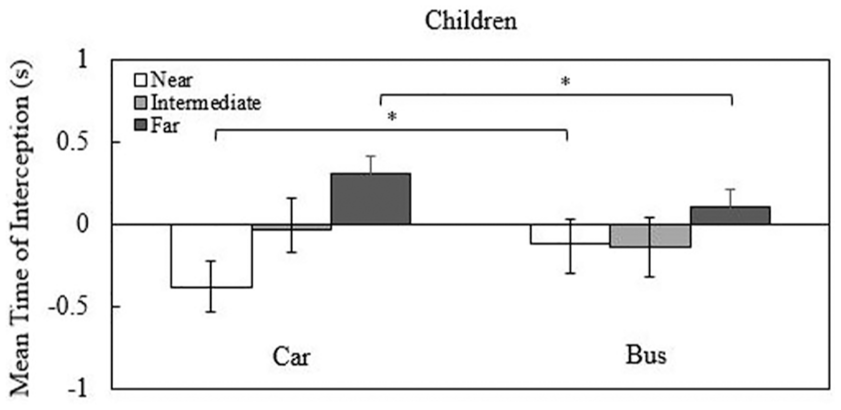
Children’s mean time of interception (TOI) for each initial distance (near, intermediate or far) as a function of vehicle size (car, bus). TOI refers to the temporal distance relative to the gap center, such that 0.2 s refers to around 1.6 m when vehicle speed is 30 km/h (8.3 m/s). In the figure, asterisks represent statistically significant inter-mean differences for gap size at each initial distance. One asterisk represents one inter-mean difference, and two asterisks represent two or more inter-mean differences. Error bars indicate standard deviations.
The vehicle size × gap size interaction was significant, F(1, 15) = 4.26, p < .05, ηp2 = .22. A simple effects test showed a significant effect of gap size between the cars, F(1, 15) = 7.42, p < .02, ηp2 = .33, and between the buses, F(1, 15) = 35.93, p < .001, ηp2 = .71. Post hoc comparisons showed that when crossing between the cars, children crossed the gap significantly further ahead of the gap center for the 4-s gap (M = −0.14, SD = 0.07) than for the 3-s gap (M = 0.06 s, SD = 0.07, p < .01). When crossing between the buses, children also crossed the gap significantly further ahead of the gap center for the 4-s gap (M = −0.12 s, SD = .04) than for the 3-s gap (M = 0.12 s, SD = .04, p < .0001). Children crossed the gap further ahead of the gap center for the 4-s gap than for the 3-s gap for both vehicles.
Discussion
We designed this study to evaluate how children and young adults adjust their crossing behaviors in response to moving traffic gaps in changing traffic environments. As expected, the participants’ systematic positions and velocity adjustments led them to cross at different positions within the gap. Varying gap and vehicle size affected children’s and young adults’ gap-crossing behavior differently. Young adults and children crossed the gap faster and closer to the LV for the wide (4-s gap) gap than for the narrow (3-s gap) gap. However, participants did not fine-tune their movements according to the initial distances when they crossed the narrow gap. In particular, children did not adjust their movements in relation to moving vehicles when they approached the wide gap from closer distances. Furthermore, children did not adjust their velocities relative to the initial distances when they approached the large vehicle from closer distances. We discuss these findings in more detail in terms of initial distance and gap characteristics below.
Effects of Initial Distance
A systematic change in the initial distances affected children’s and young adults’ velocity adjustments. The participants’ approach positions and velocity profiles while approaching the interception point varied according to the initial distances. Participants adjusted their velocities while approaching the interception point instead of making last-moment adjustments. The results confirmed previous findings about the crossing behaviors of drivers and cyclists (Chihak et al., 2010; Louveton, Montagne et al., 2012; Mathieu et al., 2017), which showed that the last moment of acceleration did not fully compensate for the initial offset. In our study, participants also sped up at the last moment of interception for all initial distances, but the crossing-point discrepancy resulting from the initial-distance variation persisted until the last moment of interception. Although deviations from the gap center in the gap-crossing times systematically varied (around a 0.2-s difference for each initial distance) depending on the initial distances, the participants crossed the gap near its center.
Children and young adults made functional adjustments to their velocities to achieve their goals. For example, participants decreased their velocities at the beginning of the trial in the near initial distance condition, but they maintained and increased their velocities while approaching the interception point in the intermediate initial distance condition, and they continuously increased their velocities in the far initial distance condition. This resulted in similar position profiles for young adults and children, although the children’s crossing positions within the gap shifted slightly at the last moment compared with those of the young adults. Evidently, the children and young adults regulated and timed their movements based on the initial distances according to their capabilities (Oudejans et al., 1996). Specifically, children passed near the center of the gap in the intermediate initial distance condition, but young adults passed near the center of the gap in the far initial distance condition. This systematically adaptive crossing behavior reflects the coupling of perception-action in road crossing (Gibson, 1979).
Effects of Gap Characteristics
Gap size manipulation affected participants’ gap-crossing behaviors. Young adults and children crossed the gap faster and closer to the LV when they crossed the wide gap than when crossing the narrow gap as shown in previous studies (Louveton, Bootsma et al., 2012; Louveton, Montagne et al., 2012). In our experimental setup, the LV in the 4-s gap was closer to the interception point compared with the LV in the 3-s gap. Thus, this result reflects safe crossing behavior as Louveton, Bootsma et al. (2012) suggested. Furthermore, gap size affected the crossing position induced by initial distance. For the wide gap, young adults and children adjusted their crossing positions systematically depending on the initial distances. However, participants’ crossing positions did not systemically vary according to the initial distances when they crossed the narrow gap (see Figure 6). When they crossed the narrow gap in the near initial distance condition, participants took longer to initiate movements and did not compensate for their longer initiation times with increased speed. Narrow gaps therefore appear to pose challenges for young adults and children. Participants did not adjust their movements according to the initial distances if they had less available time to cross.
Specifically, the children’s velocity profiles displayed continuous speeding up when they approached the interception point for both gap sizes. However, for the wide gap, young adults maintained and somewhat decreased their speeds at the beginning of the trial but sped up during the remainder of it. When young adults entered the wide gap, they realized they had more time available before arriving at the TV and thus lowered their speeds to adapt. However, children did not adjust their walking speeds according to the available crossing time (see Lee, Young, & McLaughlin, 1984). Children seemed to control their movements based on the LV movement without considering the TV when they approached the wide gap from closer distances. These results also aligned with previous findings regarding children’s poor coordination of movement with moving vehicles (Chihak et al., 2010; O’Neal et al., 2018), and they imply that 12-year-old children have not yet developed the skill of synchronizing their movements in relation to moving objects when they face time constraints.
Our results clearly showed the effect of vehicle size on participants’ timing and crossing behaviors. Noticeably, young adults crossed the gap further ahead of the gap center when facing a small vehicle than when facing a large vehicle. In addition, the children’s positions were farther away from the gap center between the buses than between the cars. The results are novel in that they reveal the effect of vehicle size on intercepting pedestrian gap-crossing behavior. Our results do not align with earlier studies’ findings on the effect of size-distance prediction on perceptual judgment—that is, that individuals perceive larger objects as closer when compared with smaller objects (Caird & Hancock, 1994; DeLucia, 1991; DeLucia & Warren, 1994). The effects of size on perceptual judgment are not compatible with our observed crossing behavior as Mathieu et al. (2017) suggested.
Vehicle size interacted with initial distance to influence children’s crossing behaviors. The children’s crossing positions did not deviate based on the initial distances when they crossed in front of the large vehicle. However, they displayed a systematic deviation from the gap center depending on the initial distances when they crossed in front of the small vehicle. The result supports Grechkin et al.’s (2013) findings that children did not coordinate their movements according to the visual information as skillfully as young adults did. In front of a large vehicle, children crossed the gap less far ahead from the gap center than expected for the near initial distance condition. The result reflected that children may overestimate the TV’s arrival time and may therefore attempt to cross more slowly in front of a large vehicle. The result indicates that children might ignore the speed-related information of large moving vehicles and rely exclusively on distance information. This can lead children to fail to estimate the TV’s arrival time. This interpretation was further supported by a longer than expected gap entry time for the near initial distance condition. This result indicates that children took longer to initiate their movements in front of a large vehicle in the near initial distance condition. Specifically, children did not adjust their velocities according to the initial distances at the beginning when they crossed between the buses (see Figure 6). Our velocity analysis revealed that children did not speed up at the beginning of trial in the near initial distance condition. This indicates that children did not compensate for their longer initiation times by increasing their velocities when they faced a large vehicle approaching at closer distances. The results imply that children face problems in controlling their velocities and in timing their movements in complex traffic environments as a previous study (O’Neal et al., 2018) suggested.
Limitations and Future Research
The safety margin referred to the difference between the time a pedestrian crossed the traffic and the time the TV’s front bumper arrived at the pedestrian’s crossing point (Chu & Baltes, 2001). The successes and failures reported in this study may not generalize to real-world situations due to the lack of a safety margin. In this study, we considered a trial to be successful if the participant crossed between the vehicles and made it to the other side of the road without colliding with a vehicle. Thus, we did not account for a safety margin. Narrow escapes can be important issues to consider for collision prediction. Although we did not set up safety margins, the TOIs of those participants who crossed the gap closest from the TV and LV were at 0.93 s and 1.3 s, respectively, equivalent to distances of around 8 m and 10 m, respectively. This suggests that participants who crossed successfully did so near the gap center. Although this did not lead to close calls, future research addressing safety margins remains important.
Another limitation of our study is that we did not control for participants’ heights and stride lengths. How fast an actor can move is specified by the perceived properties of the environment in relation to the perceiver’s biomechanical dimensions and action capability (Fajen, 2013; Warren, 1984). Our results revealed potential evidence of the effects of various body sizes on crossing positions. However, considering physical variables, such as height and stride length, might yield different results.
Conclusion
In conclusion, varying initial distance, manipulating gap and vehicle size strongly and systematically influenced young adults’ and children’s gap-crossing behaviors. In addition, our findings clearly showed that children may experience difficulty coordinating their movements with visual information when they approach a large vehicle from closer distances and if they have time constraints, such as crossing narrow gaps and approaching inter-vehicle gaps from closer distances. Our findings could provide the first evidence of the clear effect of vehicle size on the crossing behaviors of children and young adults in various traffic environments. In addition, our study contributes to the understanding of children’s crossing behaviors in relation to temporal and spatial gap characteristics in a paradigm that is highly ecologically valid. It is noteworthy that 12-year-old children are still undergoing developmental changes related to precisely coupling their movements in relation to moving objects in complex dynamic environments. Children must develop a tight link between perception and action to scale their movements in relation to moving objects in complex situations. Children need to learn the use of perceptual information and movement timing in interception actions as they physically grow and as their motor skills become refined.
Our results underscore the need for a training program that teaches children to synchronize themselves with moving vehicles in real-world traffic scenarios. An important practical application is the development of an intervention program that focuses on improving children’s skill to control their velocities in dynamic traffic environments. Experience with various environmental crossing actions, including various vehicle sizes with various initial crossing distances, should be considered to reduce risk behavior by improving children’s skill to link perception and action. An interactive virtual reality system is a promising tool for fine-tuning children’s perceptions and actions and for linking their actions to the time available for crossing while allowing them to walk actively in a virtual environment. Future research should focus on the mechanisms underlying the control of children’s crossing behaviors.
Key Points
We investigated children and young adults’ velocity regulation while intercepting moving gap.
Participants adjusted their approach to the interception based on initial distance.
Children did not precisely adjust their movements to the moving vehicles when children approached the inter-vehicle gap from the closer distance.
Children did not time their movement according to the initial distance when they approached large moving vehicles from closer distance.
Footnotes
Acknowledgments
The Korea Institute funded this work for Advancement of Technology and Ministry of Trade, Industry, and Energy [grant number 10044775].

Author Biographies
Hyun Chae Chung is the professor in the Department of Sport and Exercise Sciences at Kunsan National University, Republic of Korea. She earned her EdD in motor learning from the University of Georgia in 1995.
Gyoojae Choi is the professor in School of Mechanical and Automotive Engineering at Kunsan National University, Republic of Korea. He earned his PhD in mechanical engineering from the Korea Advanced Institute of Science and Technology in 2000.
Muhammad Azam is a PhD student in the Department of Sport and Exercise Sciences at Kunsan National University, Republic of Korea. He earned his MA in health and physical education from Sarhad University, Pakistan in 2013.