



Abstract
Background:
Participatory research with children has been long-standing and has provided a space for researchers to understand the everyday lives of children, but also, and more importantly, has emphasised the significance of doing research with, rather than on or about, children and keeping them in the centre of our thinking and research. While this is true in many places around the world, doing research with children experiencing violence, uncertainty and political conflict – although crucial – becomes more complex in such challenging contexts. The voices of children in these settings are often silenced, and children are rarely given opportunities to communicate their needs and have a say in decisions and interventions that affect their lives, well-being and childhoods.
Objective:
This reflective paper aims to explore ethical and methodological challenges in conducting research with children in contexts of violence, uncertainty and political conflict. In exploring these challenges, the paper offers reflections on both the benefits and challenges of using participatory research with children by exploring meanings of voice, listening and silence in these contexts.
Methods:
The paper draws on a qualitative research study conducted with minority-Christian and Muslim Arab children in Jerusalem to understand the meanings they attach to being well in a context of violence and conflict.
Findings:
By providing some reflections on doing research in contexts affected by violence, conflict and uncertainty, this paper emphasises the importance of listening to children and the ways in which creative but flexible, contextual and adaptable research methods can enable researchers to listen to, and engage with, children in complex contexts and provide spaces which support children not only to experience voice, but to find that voice.
Keywords
Introduction
Participatory research with children experiencing violence, uncertainty and conflict has grown in recent years (Denov, 2023). However, less is known about the challenges of using participatory research in these complex contexts (Bradbury-Jones et al., 2018).
This paper provides a reflective account of doing research with children in these contexts, and the complexity of voice and listening. It draws on a research study conducted with 44 children and young people aged 12–16 years, which aimed to understand what well-being means to them in the context of Jerusalem, a city affected by uncertainty, violence and the ongoing Israeli-Palestinian conflict. The study was granted ethical approval by the Research Ethics Committee of the University of Sussex (Ref: MW/GB/21719595).
The voices of children in contexts affected by conflict are largely missing from research studies conducted ‘on them’, particularly those assessing their well-being (Denov, 2023). Most research studies conducted to ‘assess’ children’s well-being in areas of conflict employ positivist methodologies and approaches, which do not allow children’s voices and experiences to come to the fore, resulting in lack of understanding of children’s support and well-being needs (Ayer et al., 2017). Many such studies are focused on the psychological impact of conflict and uncertainty including post-traumatic stress disorder (PTSD), shifting discourses on well-being to medical understandings which view experiences of suffering as medical conditions in need of treatment (Miller-Graff and Cummings, 2017; Summerfield, 2000). Well-being, however, is much more holistic (White, 2010) than this, and the experiences of children living in these complex contexts cannot be reduced to medical conditions that require treatment. Doing this could lead to silencing the voices of children and excluding their views and lived experiences (Miller and Rasmussen, 2009).
Through this study, I wanted to create new understandings of children’s experiences of well-being and the meanings they attach to being well, which go beyond the discourses of trauma and shed light on the everyday challenges children face. As a researcher and social work practitioner, I also wanted to find new ways in which children can be better supported, emphasising the importance of listening to children, their voices and experiences and what being well means to them. Through employing a psychosocial perspective, the study emphasised the everyday lived experiences of children from their own perspective (Alanen et al., 2005; Samuels and Evans, 2016) and shed light on what matters to them.
Understanding the experiences of children in these contexts is key to supporting their well-being. Findings from this study revealed that supporting well-being requires doing research ‘with’ children using methodologies and approaches that provide opportunities for children’s voices to be heard and represented, through sharing their lived experiences and what matters to their well-being. However, it is not enough to use participatory approaches for children’s voices to be listened to and heard. The methodological approach adopted is key to how we think about voice, listening and children’s experiences (Groundwater-Smith et al, 2015; Fargas-Malet, et al., 2010), particularly in research conducted to understand children’s well-being.
Participatory research with children experiencing conflict: ethical considerations
Living in a context affected by conflict, violence and uncertainty can have a negative impact on children’s mental, physical and emotional well-being (Muldoon, 2004; Piachaud, 2008). While participatory research offers a unique opportunity for children to ‘participate’ in research as co-producers and agents (Bradbury-Jones et al., 2018; Grover, 2004), in challenging and conflict-affected societies, the foundations of participatory approaches are fundamentally challenged by the ethical and methodological complexities due to ongoing violence, uncertainty and safety concerns (Nasrawy, 2021). This is partly the case due to the difficulties encountered by researchers in both accessing and representing children’s stories, gaining trust in contexts of fear and insecurity, and dealing with potential re-traumatisation of both the researcher and the researched (Boyden, 2004; Moss et al., 2019). Furthermore, the research design and methodology employed alongside a participatory approach will undoubtedly impact findings and knowledge generated on children’s well-being. Hence, using participatory approaches is not – at least on its own – a guarantee to ‘genuine’ participation nor to ‘giving children voice’. For example, participatory approaches are sometimes used to aid the researcher in contexts of conflict, but are less concerned about the involvement of children. Children in these contexts are sometimes only involved in the data collection but not the whole research process, while at other times participatory approaches are used to balance power, deal with ethical dilemmas and fit into predetermined agendas (Hart and Tyrer, 2006). My work with children highlighted how interventions to support children’s well-being tend to ‘create’ needs that fit into existing agendas by focusing on discourses of trauma rather than addressing real causes of suffering. By doing this, children are not given opportunities to engage in the design of interventions to support them because these would have already been designed based on adult perspectives and assumptions about children’s needs in these contexts. Therefore, children’s participation is not always authentic in these contexts and can be more of a ‘tickbox’ exercise. Being ‘invited to participate’ in research that has been pre-designed based on adults’ assumed needs of children, cannot be considered real participation and invites a critical view that would challenge these assumptions (Watters, 2008; Aldridge, 2015).
In addition, children are not always perceived as ‘active agents’ due to ethical challenges experienced by researchers in these contexts and the assumed vulnerability of children which risks the labelling, stigmatisation, exclusion and victimisation of the children involved in these encounters (Green & Denov, 2019: 1–2). This could often be a barrier to understanding how children cope with or navigate these complex realities and poses a risk to perceiving children as victims who do not have agency or voice. In my research with children, I was aware of the dominance of medical perspectives in researching children’s well-being in these contexts, and the impact this has on how children are perceived as traumatised and in need of treatment (Summerfield, 2000, 2001). This is not to say that children are not traumatised, but to emphasise that thinking about them predominantly through such a lens could mean overlooking their agency and the ways in which they experience the world. Participatory research needs to be contextualised in ways that do not allow this victimisation to prevail, by ensuring children who have no voice are not labelled as vulnerable or victims as doing so could potentially re-produce these ideas which have been dominant in these contexts. By listening to children, it is one way we can learn about their needs and what is important to them, but how we listen to children and what we do about what they tell us is equally crucial (Lefevre, 2018).
‘Giving voice’ in participatory research with children experiencing violence, uncertainty and conflict: a critical lens
While participatory approaches provide more grounded accounts of children’s lives (Walker et al., 2003), their focus on ‘giving voice’ can often be problematic in contexts affected by conflict and has at times neglected to recognise the limitations of voice in research with children in these contexts (Fairey, 2018). Much of what we know on and about participatory approaches comes from the West, where ideas about voice, agency and ways of knowing and being in the world are not necessarily the same as those in other cultures (Cochran et al., 2008). This knowledge is also often based on adult perceived ideas on, and assumptions about, what ‘giving voice’ to children means. Such assumptions are ethically and methodologically problematic as they come from a powerful stance (Western/adult) that also assumes we as adults and researchers know better and therefore are ‘able to give voice’ (Bradbury-Jones et al., 2018; Lenette et al., 2019; Montero-Sieburth, 2020).
Conducting research with children in a context of prolonged conflict, and having experienced living in a similar context as a child myself, I understand the complexity of finding voice as I struggled with finding my own. I also recognise that despite our desire to ‘give voice’ to those whose voices are silenced, I know that voice cannot be given. Voice is not fixed nor existing outside our social and political worlds (Cooper, 2023), it is not located in one place nor in separation from its context, but is rather relational and open to multiple interpretations including those of the researcher (Facca et al., 2020). Voice is shaped by the context in which it occurs (the social, political and cultural environment), but also the research environment, physical space (i.e. interview) and the relationship between the researcher and participant (i.e. adult and child) and their environments. In a sense, voice is not something to be found but something that is created and shaped in a transformative moment where listening to children occurs (Davies, 2014). It can also be argued that discourses around ‘giving voice’ could allude to another dangerous assumption that children ‘have no voice’. Hence, participatory approaches in contexts of violence and conflict require a more sensitive approach which recognises the complexity of structural inequality, oppression and violence, and the ways in which it shapes both children’s voices and silences.
When thinking about what voice means in contexts affected by conflict and uncertainty, it is important to recognise that having a voice or being a voice may put children at risk, for example, speaking up about their suffering, or demanding an end to it, could pose a risk to their lives and their families (Hart and Tyrer, 2006). From this perspective, using participatory approaches – which have been developed in Western societies characterised by peace – could put participants experiencing violence and conflict at risk due to its lack of sensitivity to different cultures, experiences and realities. In addition, the nature of participatory approaches tends to be group focused and involve coming together to express voice, which could pose multiple risks for the researcher, the researched and their communities in contexts of conflict (Hart and Tyrer, 2006: 15). In my work with children experiencing conflict, I have been conscious of the need to create individual and group spaces for them to share their experiences in ways they find meaningful and safe. There were stories children only felt safe sharing in individual encounters and ones they were happy to share in both individual and group discussions. Although this is sometimes the case in research spaces in non-conflict contexts, it is important to remember that in contexts of conflict, children might experience feelings of fear and lack of safety.
I was also aware of the challenge of voice and did not want participants to feel they had to talk about things that may trigger previous trauma or fear of the consequences of sharing their experiences, thoughts and emotions. Hence, although voice is a right, within these complex contexts, we often have to think of it as a privilege that many children cannot fully experience in their everyday lives due to fear, uncertainty and insecurity. This experience enabled me to think about how, even if we do establish safe spaces for voice to be heard and experienced in research, for some children, it will always be a challenge and may often be a risk to find or share their voice. Using art methods within my research helped overcome some of these fears for children, where they did not feel they had to verbalise their stories to have a voice or to be heard. It was more about what experiences they felt safe sharing and how and when they chose to share them. As one young person put it,
I just like painting and art . . . it helps me express myself and my feelings and feel better, especially that we live under so much pressure from school and the political situation. (Young boy, 16)
Importantly, research is about creating spaces that support children’s voices on their own terms, but researchers need to be realistic and transparent with children about the possibilities available for them to experience voice once the research concludes, to avoid disappointment and continue to encourage and support children’s voices (Hart and Tyrer, 2006; Sun et al., 2023).
Re-thinking child voice in contexts of conflict – why listening matters
In exploring the notion of listening I draw on (Davies, 2014: 21–23) concept of ‘emergent listening’, which is about opening the self up to many other ways of learning and knowing (Spyrou, 2011) and to the ‘possibility of coming to see life, and one’s relation to it, in new and surprising ways’ (Davies, 2014: 1). This requires constant engagement with one’s senses and being ‘open’ to oneself, others and the environment (Rinaldi, 2006: 114). In my own study, there was a moment when listening to children was more powerful than thinking about their voices or mine, because it allowed new ways of knowing, and not those I anticipated when I embarked on my research journey. But listening as emergent and embodied in our ways of doing and being with children enabled both myself and the children to be open to ‘the unknown’. Through our listening, interaction and being heard in the study, new and different ways of knowing were created which shaped a voice we collaboratively represented in the research.
Doing research with children in a context of conflict meant I had to be open to the possibility that both listening and voice might be triggering, as children might directly or indirectly share difficult stories with me. After all, I was conscious that our context shapes our experiences and voices and is a part of our everyday life. This was why I had a protocol in case the research encounter caused children any distress. This involved checking in on how children were feeling and whether they still wanted to take part. I also offered a space for reflection after each encounter, to ensure children left feeling positive. However, to my surprise, most children wanted to share with me what mattered to them, including things they were not directly asked about. They wanted to talk about what made them happy and safe and what was challenging to their well-being. They also talked about listening and what it means to them:
I love spending time with my family, it just makes me feel happy and safe. I feel that they would listen to me and support me. (Young girl, 13)
While others engaged in moments of silence which I embraced, encouraged and valued, without interrupting, together, we learned to sit with these moments of silence including when children paused before telling me a story, drawing it or showing me a photograph as part of the story they shared. Listening is not only about voice but silence as a form of voice (Lewis, 2010) and a part of children’s story that is as important as their words, drawings and photos (Spyrou, 2016). Voices can be silenced not only due to power imbalances (adult/child, researcher/participant) but also due to oppression or structural inequality (Graham et al., 2014; Harel-Shalev, 2020). Using different methods during a research encounter gave children multiple ways to experience voice. Although we agreed they would explain what was in their drawings or photos, it was on their terms. Through our research encounters, I wanted to listen to children not as an adult who understands or knows better, or who interprets their stories and voices in ways that fit into presumed ideas on and about children and childhood, but as a human who wants to be transformed by and through this listening, in ways that help create a new co-produced voice. Despite this, silence is still often neglected in research with children and more broadly in ‘qualitative’ enquiries and is often not considered to be data (Mazzei, 2007: 632).
Thinking about my positionality as someone with similar experiences and as an adult/a researcher also helped me become aware of my own assumptions, and to question these in light of the new understandings which emerged from the stories children shared with me. Contextualising the research design, methods and approach I used in researching children’s well-being through ensuring they speak to children’s experiences and culture allowed me to unpack my own experiences to better listen to and hear children’s stories (Denov and Shevell, 2019). Through this process of unpacking, there was a point at which I realised that I, too, was a part of my research, part of the voice and part of the silence we experienced in our research encounters.
Methodological considerations in research with children experiencing conflict: reflections and implications
To date, there have been limited discussions on ethical or methodological challenges in research with vulnerable children, particularly those living in contexts affected by conflict (Bradbury-Jones et al., 2018). Neither have there been explorations of the different ways in which participatory approaches, and the use of creative methods, can be employed to listen to and understand children’s lived experiences. By engaging with some ethical and methodological dilemmas I encountered in my research with children, I want to highlight some of the ways in which I navigated these complexities.
The use of visual and creative methods
To better understand what matters to children and their well-being (Nasrawy, 2021), I chose a qualitative phenomenological methodology led by creative methods, including drawings, photo-voice, timelines, well-being tree, safety maps and storytelling. I chose these methods not only because they might help me listen to children’s voices and experiences but also because such methods could create a safe space for children to share what matters to them, find meaning and make sense of their experiences. This space can be therapeutic, as some participants reported in my study, and can help children and young people ‘express their emotions, build relationships and find meaning’ (Akesson et al., 2014: 78).
In addition, using visual participatory approaches enabled me to listen ‘with all my senses’ to what children wanted me to know on their own terms and in ways they found meaningful (Davies, 2014: 1). For example, the use of creative methods allowed children to feel in control of what they shared, when they shared it and how. This helped not only address power imbalance between me as an adult researcher and children as research participants (Hunleth, 2011; Bagnoli, 2009) but also promoted children’s voices and perspectives and allowed children to experience both voice and silence:
Drawing with others made me feel good about myself. Even if I couldn’t do it very well, it made me feel important, like my story matters. (Young girl, 14)
Re-presentation of children’s voices and experiences
The use of children’s words to re-present their voices
Research with children invites us to think about the types of methods we need to employ to better listen to children, facilitate the communication of their experiences and make their voices heard (James, 2007). Despite involving children in the research process and representing their voices in the exact words they used, I was conscious research is in essence an adult controlled and constructed space, where voices of children are not only re-presented but also interpreted, selected and highlighted over other voices and given words that fit with our adult ideas and narratives about childhood – which in a way challenges the very idea of ‘giving voice’ (Dockett et al., 2009). In the end, research is about what we hear as researchers rather than what is being shared and unless we find ways to meaningfully share this power with children through engagement in all aspects of the research, including interpretation and representation, we cannot escape this adult constructed space, nor make children’s voices heard (Mayes, 2019: 1197).
Using a psychosocial approach (Goldstein, 2013) helped me think about voice as relational and multiple, as shaped by participants’ worlds and my own. Mazzei and Jackson (2017: 746) argue that researchers ‘are always already shaping participants’ exact words through the unequal power relationships present and by our own research agendas and timelines’. In recognising my powerful position, I became more open to the possibility that voice cannot be given because we all have a voice, but what can be ‘given’ and facilitated by researchers is a safe space in which to balance power within this relationship, to experience voice and find ways to make that voice heard. This is crucial for children who may rarely experience voice and who fear expressing that voice due to ongoing violence, uncertainty and conflict. Employing ‘the right’ methods here involves ensuring these are contextualised and sensitive to children’s experiences of fear and uncertainty. I was also conscious of the impact the context had on how I and children in my study perceived and used these methods. This reflexivity was crucial to making children’s voices heard (Ajodhia-Andrews, 2016: 276). It helped me understand that my role as a researcher was not to give children a voice but to make their voices matter, to make them heard so they can influence interventions and policies that respond to their real needs (Rodríguez and Brown, 2009). This realisation that I do not give voice made me aware of the importance of listening and being heard, that children in the research already had a voice, I just needed to engage them and be engaged with them not only in the process of gathering and interpreting their stories but also in listening to them in ways they wanted me to listen (Dockett et al., 2009).
The use of children’s drawings and photos to ‘re-present’ their voices
Another aspect of voice I found challenging was in the use of drawings and photos to enable me to listen to and understand children’s experiences, well-being and what mattered to them. I asked children to draw or take photos of things that were important to them and to their well-being, explaining they would then discuss these with me to describe and share what these were, why they drew or took these photos and what they mean to them. It was important that I listened to and saw what they wanted me to hear and see in these.
For example, one of the children drew their school building twice on opposite sides, but added dots to one side. When I asked what this meant, they said: ‘It is not a nice picture, it’s raining, and there is no light, it’s dark and scary, and that’s how we feel on many days at school’ (Child/young girl, 14). Initially, I did not see the light in the drawing, or lack of it, and the rain was something I perceived as positive and keeping things alive! But I would have got it wrong had I not asked the child about it, and had I used participatory methods simply as a way to facilitate discussion without offering children the opportunity to talk about how these drawings related to their lives and experiences. I would never have picked up on why school was experienced negatively, and how conflict and violence in the macro system affect experiences in the home, the school, and in relationships (Bronfenbrenner, 1979).
It is not good enough to use creative methods such as drawing and photo-voice, if we then interpret stories in traditional ways that only see them as tools for ‘giving voice’. There is need for ourselves as adults and researchers to unpack these sounds and images in ways that do not favour our narrative nor fit into our preconceived ideas and agendas, but are used to challenge these ideas and recognise that in a context of conflict it is vital that we offer opportunities for children to share the meanings they attach to health and well-being (Bradbury-Jones et al., 2018; Dockett et al., 2009).
Photographs and drawings in research with children should only be considered ‘data’ if we offer spaces for children to share the stories that accompany them (Fairey, 2018). Sometimes photos and drawings can be symbolic and interpreted in multiple ways. But, and this is the main point, they only mean what children want them to mean, they are not tools to facilitate discussion, they are ‘the discussion’, and the listening and the voice that matters. Figure 1 is a photo of what matters to one of the children/young people in the study I conducted. The picture of a toy (car) represents family, good times and the meanings these hold in the child’s life, and which promote their well-being: ‘This picture represents my love for taking pictures, I took this picture with the help of my dad so it kind of means a lot to me because it reminds me of him’ (Young girl, 14).
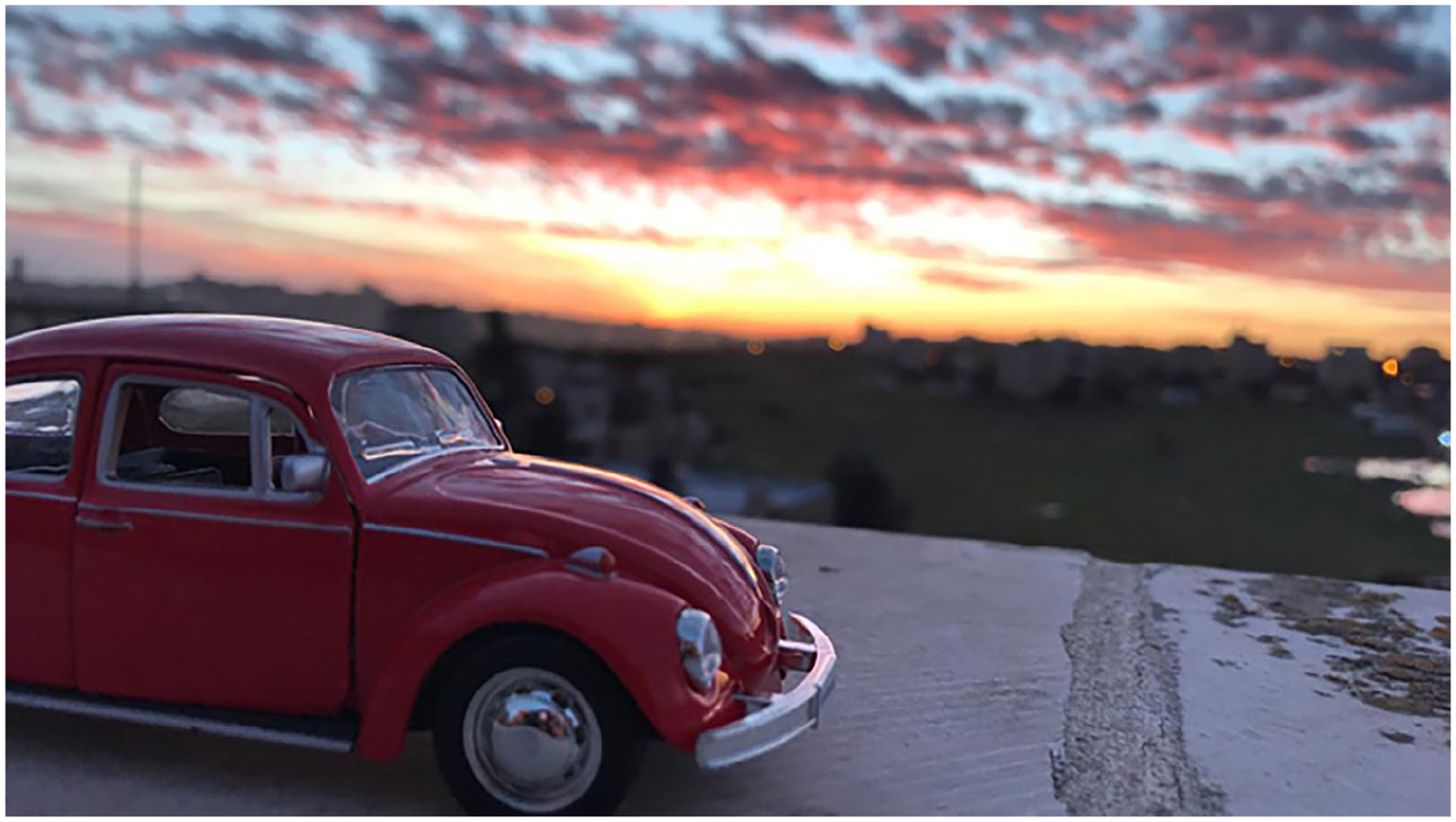
Photograph taken by a young person showing what matters to their well-being.
Another dilemma faced was in relation to the selection of children’s quotes from the interviews/discussions and their drawings or photos, as I could not include these for all 44 individuals who took part in the study (Nasrawy, 2021). The process of selection was uncomfortable as I felt I was highlighting some voices and silencing others. Fairey (2018: 114) suggests that visual materials including photos may be taken or produced by children and young people, but are often ‘appropriated and filtered’ to ensure they fit into researchers’ social and political agendas which do not challenge current views.
In the case of verbal or narrative stories, quotations were easier to select as many children described similar fears, concerns and things or people that mattered to them and to their well-being. However, in selecting drawings and photos, I was aware I might be excluding or indeed silencing some voices. It was crucial to be reflexive in this respect as being so helps researchers make such ethically complex decisions (Phelan and Kinsella, 2013). To ensure no voices were silenced, and as part of their engagement in the interpretation process, I invited children to a group discussion in which we discussed my interpretation of their stories. I also shared with them my ethical dilemma. Our discussions identified several ideas for me to consider, including creating a space (i.e. an exhibition) in which to share findings, art productions and key messages led by children and joined by relevant school staff and parents (providing anonymity and confidentiality was maintained). Beyond this, children felt it might be more realistic for me to include their collective art productions from our focus group discussions in the study, since they felt these would be inclusive of everyone’s account. Listening to children in this way, and engaging in yet another process of negotiating voice, was beyond transformative. It was connected to where the ‘power lies’ (Fairey; 2018: 116); to the type of listening these drawings and photos and their narratives made possible; and to the type of voice that emerged as a result.
What I have learned from listening to children who experience uncertainty and conflict is that ethical dilemmas can and do occur in most research with children but more so in challenging contexts (Akesson et al., 2014; Aluwihare-Samaranayake, 2012; Green and Denov, 2019). However, being aware of this can support the approaches we take and decisions we make to maintain ethical and robust research/practice. It is important to remember the purpose of doing research with children in contexts of conflict, particularly on subjects such as well-being. Ethical dilemmas should not blind us to what we could be creating with children – a new voice and new ways of exploring their experiences that may give them hope for a better future (Bennouna and Stark, 2021).
Concluding reflections: towards a reflexive understanding and representation of voice
In providing some reflections on doing research in contexts affected by violence, conflict and uncertainty, this paper has emphasised the importance of listening to children and the ways in which creative but flexible, contextual and adaptable research methods can enable researchers to listen to and engage with children in complex contexts.
Children experiencing conflict and uncertainty need to feel safe to find their voice and become a voice. There is a need to be more critically reflexive when we use participatory approaches to promote voice, as the aims of a particular research might still influence how voices are ‘re-produced’ analysed, re-presented, listened to or indeed silenced (Fairey, 2018: 111–113). As researchers and practitioners working to support children and promote their well-being, it is our responsibility to provide spaces to enable children not only to experience voice, but to find that voice. It is equally important to understand the meaning of voice in contexts of violence and conflict, so that voices of children can be and become with and for children (Cooper, 2023; Daelman et al., 2020):
We become-with certain people, at certain moments and within certain spaces. (Daelman et al., 2020: 491)
Conducting research with children is not just about outcomes. It is also a process, and about creating a space for children to have a say and experience voice (Tisdall et al., 2009). If we approach voice as changeable and relational, then we come to it from a place that does not assume ownership of something that already exists, but from a place that embraces the complexity of voice and recognises that in ‘capturing’ voice we are not capturing ‘all children’s voices’, nor the totality of their voices. Instead, what we may gain access to, and an appreciation of, is a part of their voices that is created and negotiated in that moment of listening and interaction with the researcher when both of their worlds intertwine, inter-connect and inter-relate.
Footnotes
Funding
The author(s) disclosed receipt of the following financial support for the research: the original study which this paper draws on received joint funding from Pears Foundation and the University of Sussex. However, this re-analysis, its authorship, and/or the publication of this article was not the subject to any additional funding.
