




Abstract
Objective:
While qualitative research suggests there may be detrimental effects of fitness testing in physical education (PE), little quantitative data have helped to understand how students experience fitness-testing lessons. This study aimed to examine whether the physical self-concept plays a role in how students experience fitness testing at school.
Methods:
A total of 143 secondary school students (M = 13.48 years) in Western Sydney, Australia, wore an accelerometer during one PE lesson (either a fitness-testing lesson or a ‘normal’ practice lesson), and self-reported physical self-concept, and positive and negative affect after the lesson. We used linear regression models to determine whether lesson type influenced students’ levels of moderate-to-vigorous physical activity (MVPA), and positive and negative affect, and to test whether self-concept moderated the role of lesson type.
Results:
Lesson type was a significant predictor of MVPA (β = .11, p = .001), with students being less active in fitness-testing lessons. Lesson type was not a significant predictor of positive (β = .08, p = .727) or negative (β = .08, p = .727) affect. However, physical self-concept moderated the effect of lesson type on positive affect (β = −.42, p = .005), such that those with lower physical self-concept reported lower levels of positive affect when engaging in fitness-testing lessons.
Conclusion:
While understanding and developing fitness are important elements of PE, group testing of fitness may be associated with poor affective experiences, among those most at risk of being inactive later in life. Therefore, if fitness is to be assessed, new approaches in which students self-assess individual improvement might need to be considered.
Introduction
The objective testing of students’ fitness first began to feature in physical education (PE) during the 1970s (López-Pastor et al., 2013) as a method of tracking fitness and motivating young people to maintain and enhance their level of fitness and health (Cale and Harris, 2009; Wiersma and Sherman, 2008). However, teachers immediately expressed concern over the appropriateness of the tests for adolescents who were not elite athletes (Cale and Harris, 2009; López-Pastor et al., 2013). Throughout the 1990s, the focus of PE moved away from health-related fitness, and the subject adopted a wider view of physical activity for health and wellbeing (Lynch and Soukup, 2016).
Despite PE now focusing on the development of lifelong physical activity, rather than fitness improvement (Bailey and Dismore, 2006), fitness testing remains common practice internationally, with 80% of PE teachers in the UK (Harte et al., 2023), and 83% of PE teachers in the USA (Keating and Silverman, 2004), implementing fitness testing. In fact, in the UK, 59% of teachers still believe that fitness testing should be part of the PE curriculum in all schools (Harte et al., 2023). Some teachers refer to the notion of ‘healthy, active lifestyles’ when justifying why they believed fitness testing should be included in PE (Harte et al., 2023). However, little evidence suggests that participating in fitness tests at school increases lifelong physical activity participation (Cale and Harris, 2009). Furthermore, when asked whether fitness test results motivate students, only 51% of teachers agreed (Harte et al., 2023).
Not only is it unclear if, or how, fitness testing improves students’ fitness, or motivates students to improve their fitness, but fitness-testing has, for some time, been described as ‘demeaning, embarrassing and uncomfortable’ for the very students that stand to benefit most from improved fitness (Rowland, 1995: 119). Despite changing curricula, students today still describe fitness testing making them feel fearful, insecure, anxious, scared, weak, stressed and overwhelmed (Alfrey, 2024). These terms predominantly reflect negative affect (Gray and Watson, 2001). This is important because positive affect is a key driver of future physical activity participation (Rhodes and Kates, 2015) as research has shown that positive affect during and after physical activity is associated with greater levels of physical activity 6 and 12 months later (Williams et al., 2008, 2012). This is because the human desire to maximise experiences of pleasure influences decision making about whether to repeat a behaviour (Kahneman et al., 1993). Therefore, if the objective of PE is to develop lifelong physical activity, PE lessons should aim to promote positive affective experiences.
In addition, research shows that negative affective experiences, including embarrassment, bullying and lack of enjoyment, are common in PE, and these negative affective experiences during PE are associated with lower levels of physical activity, and higher sedentary behaviour, during adulthood (Ladwig et al., 2018). In fact, in this same study, fitness testing was described as the least enjoyed activity. For example, one 30-year-old woman explained, ‘when we had to run a mile for time. It was such unnecessary stress on so many kids, as the athletic kids ran laps around those of us who weren’t athletic’ when reflecting on her time in PE (Ladwig et al., 2018).
While many studies have qualitatively explained a range of affective states in relation to fitness testing, students’ affect immediately following participation in fitness-testing has not been examined before. Therefore, it is unknown if the affective outcomes of fitness-testing lessons are particularly negative, or if they just reflect the breadth of positive and negative affective states that are possible across all PE lessons. If fitness-testing lessons are more commonly associated with negative affect, than other lessons, then the inclusion of fitness tests could be counterproductive to the very purpose of motivating students to be active (Corbin et al., 1995; Rowland, 1995; Ryan and Deci, 2017).
While fitness testing has been described negatively for decades, it is possible that this is not the case for all students. Harte et al. (2023) identified that some teachers were aware that some students responded less positively than others. For example, one teacher in their study stated, ‘I would be worried that for some key students it would negatively impact their self-esteem and lead to them not liking PE’. While qualitative research seems to suggest that the students who perform poorly are most likely to describe fitness testing negatively, little research has examined which key students are most at risk of experiencing negative affective outcomes.
Physical self-concept refers to an individual’s feelings of satisfaction towards their physical self (Morin et al., 2016), and many studies have examined self-concept in relation to sport, both in school and within communities. Evidence suggests that physical self-concept, or a sense of physical self-worth, acts as mechanism via which physical activity can lead to improved mental health (Joseph et al., 2014; Zhang et al., 2022). While it appears plausible that students’ levels of self-concept may influence the degree to which they experience positive or negative affect when participating in fitness testing, no quantitative studies have examined whether physical self-concept influences affect after fitness testing.
Self-concept is also a central determinant of physical activity participation (Annesi et al., 2008; Crocker et al., 2006) and may influence how active different students are in during PE lessons. Meta-analytic evidence shows that higher physical self-concept is associated with greater physical activity levels (r = 0.25, 95% confidence interval [CI] = 0.16–0.34, p < 0.001) (Babic et al., 2014). While lifelong physical activity and health may be common objectives of PE, Sallis and McKenzie (1991) stress that PE has two main physical activity objectives: namely, (1) to promote, and prepare students for, lifelong physical activity participation; and (2) to engage students in physical activity during PE at school. Research shows that students are more physically active on days they have PE (Kohl and Cook, 2013); however, little is known about how fitness-testing lessons contribute to within school physical activity levels.
While fitness testing may have been originally introduced into PE as a means of promoting fitness and activity, research on physical activity promotion has advanced since its inclusion in PE, and both researchers and teachers are now aware of the many factors that contribute to living an active lifestyle beyond simply having the physical skills and abilities to move. For example, physical literacy frameworks highlight that young people need to experience positive affect and enjoyment, and develop the necessary confidence and motivation, to be active (Cairney et al., 2019). In Australia, the core objective of PE is to develop the knowledge, understanding, skills, values and attitudes to lead an active lifestyle (Australian Curriculum Assessment and Reporting Authority, 2016). Furthermore, in Australia, there is no explicit rationale or requirement to include fitness testing in PE from a curricular perspective (Australian Curriculum Assessment and Reporting Authority, 2016), yet PE teachers still see fitness testing as a traditional and normal part of PE, noting they often conduct fitness tests twice a year from year 7 to year 10 (Alfrey and Gard, 2014).
Against this background, the first goal of this exploratory study was to determine whether behavioural (i.e. moderate-to-vigorous physical activity; MVPA) and psychological (i.e. affect) outcomes vary between PE lessons devoted to fitness testing, and other normal practice lessons that focus mostly on sports-based activities. The second purpose was to determine whether physical self-concept influences the association between type of lesson, and either MVPA or affect. The insights drawn from this study could help inform future large-scale trials, testing different approaches to fitness education among students with varying abilities, both physical and perceived.
Methods
Participants
We collected data from year 8 and 9 students (typically 13–15 years of age) attending a co-educational government-funded high school in Western Sydney, Australia. The Western Sydney University Human Research Ethics Committee and the NSW Department of Education ethics committees provided ethical approval for the study (H12937). We invited all students in both year groups to participate and 143 provided written parental consent and student assent.
Procedure
A researcher (R.L.W.) attended one PE practical lesson for each Year 8 and 9 class. Upon arrival, they demonstrated the correct positioning of an accelerometer and asked each student to wear one for the duration of their lesson. The researcher then recorded the time the teacher commenced and ended the lesson, to ensure that the MVPA measure was not influenced by other factors such as whether students changed before or after the lesson. At the conclusion of the lesson, students completed all self-report measures via a pen-and-paper questionnaire and returned their accelerometer.
PE lessons
Teachers were not instructed to adapt or modify their lesson content or teaching approach in any way, as we wanted to capture student experiences in relation to their normal PE lesson. We simply chose a time of the year at which teachers at the school were completing fitness-testing with many of their classes. Over a 1-week period, we attended all Year 8 and Year 9 PE lessons to collect data from each class. Of the students who provided consent, 60 of them participated in a fitness-testing lesson. These lessons largely featured the agility test, a 50-m sprint test, a shuttle run beep test, and a sit-and-reach test. No intervention or instruction influenced how the teachers organised these tests though. Eighty-three students participated in a PE lesson that was not devoted to fitness-testing. These lessons mostly featured sports-related games such as basketball, futsal, netball and volleyball. The intention was not to specifically compare fitness testing to sports, but rather measure MVPA and affect among students engaging in their normal lessons.
Outcome measures
Physical activity
We used ActiGraph accelerometers (wGT3X-BT, LLC, Fort Walton Beach, FL) to measure students’ MVPA during PE lessons. We then used ActiLife software (ActiGraph, LLC, Fort Walton Beach, FL) to specify the time of the lesson and categorise each epoch count-value representing raw acceleration into its corresponding intensity of physical activity (i.e. sedentary, light, moderate, or vigorous) based on Evenson and colleagues’ equations (Evenson et al., 2008). This process calculated the percentage of lesson time spent in MVPA.
Positive and negative affect
Affect is a general psychological construct referring to positive and negative mood states (Clark and Watson, 1991; Watson et al., 1988). Positive affect is characterised by feelings of enthusiasm and joy, while negative affect is associated with emotionally distressing experiences. We used the short version of the Positive and Negative Affect Schedule for Children (PANAS-C) to measure transient mood states after participation in PE (Ebesutani et al., 2012). The PANAS-C included the instruction ‘indicate to what extent you feel this way right now’ and was followed by 10 items; five designed to measure positive affect (e.g. happy) and five intended to measure negative affect (e.g. sad). Participants responded to each item on a 5-point Likert-type scale (very slightly = 1 to extremely = 5) immediately after completing their PE lesson, before changing. Evidence supports the validity of this measure in adolescents (Ebesutani et al., 2012).
Physical self-concept
To determine whether students’ physical self-concept influenced the effect of the lesson type on the outcome variables, students completed the physical self-worth subscale of the English version of the Physical Self-Inventory-Short Form (PSI-SF) (Morin et al., 2016). This subscale assessed participants’ global physical self-concept via three items and the students responded to each item on a 6-point Likert-type scale from not at all = 1 to entirely = 6. The PSI-SF has previously demonstrated robust psychometric properties among adolescents (Morin et al., 2016).
Covariates
In order to include gender and body mass index (BMI) as covariates, participants self-reported their gender, height and weight. Height and weight were self-reported by participants after they completed their PE lesson in order to prevent any intervention by the researchers from influencing their affective states, as measuring weight within a social context may have influenced affect and physical self-perception. However, self-reported height and weight derived BMI may not be entirely accurate, which may have limited how well the analysis truly adjusted for BMI.
Data analysis
All data analyses were conducted in STATA 14 (StataCorp, TX). First, we conducted descriptive statistics to provide demographic results and determine the percentage of lesson time spent in MVPA. Next, we used linear regression to determine whether lesson type was a significant predictor of the three outcomes of interest. Linear regression models were then repeated adjusting for age, gender, BMI and socioeconomic status. Next, we included an interaction term in the analyses, whereby lesson type and physical self-concept were allowed to interact. This enabled us to determine whether physical self-concept influenced the relationship between lesson type and the outcome variables. We fitted all regression models with cluster-robust standard errors to account for clustering within classes.
Results
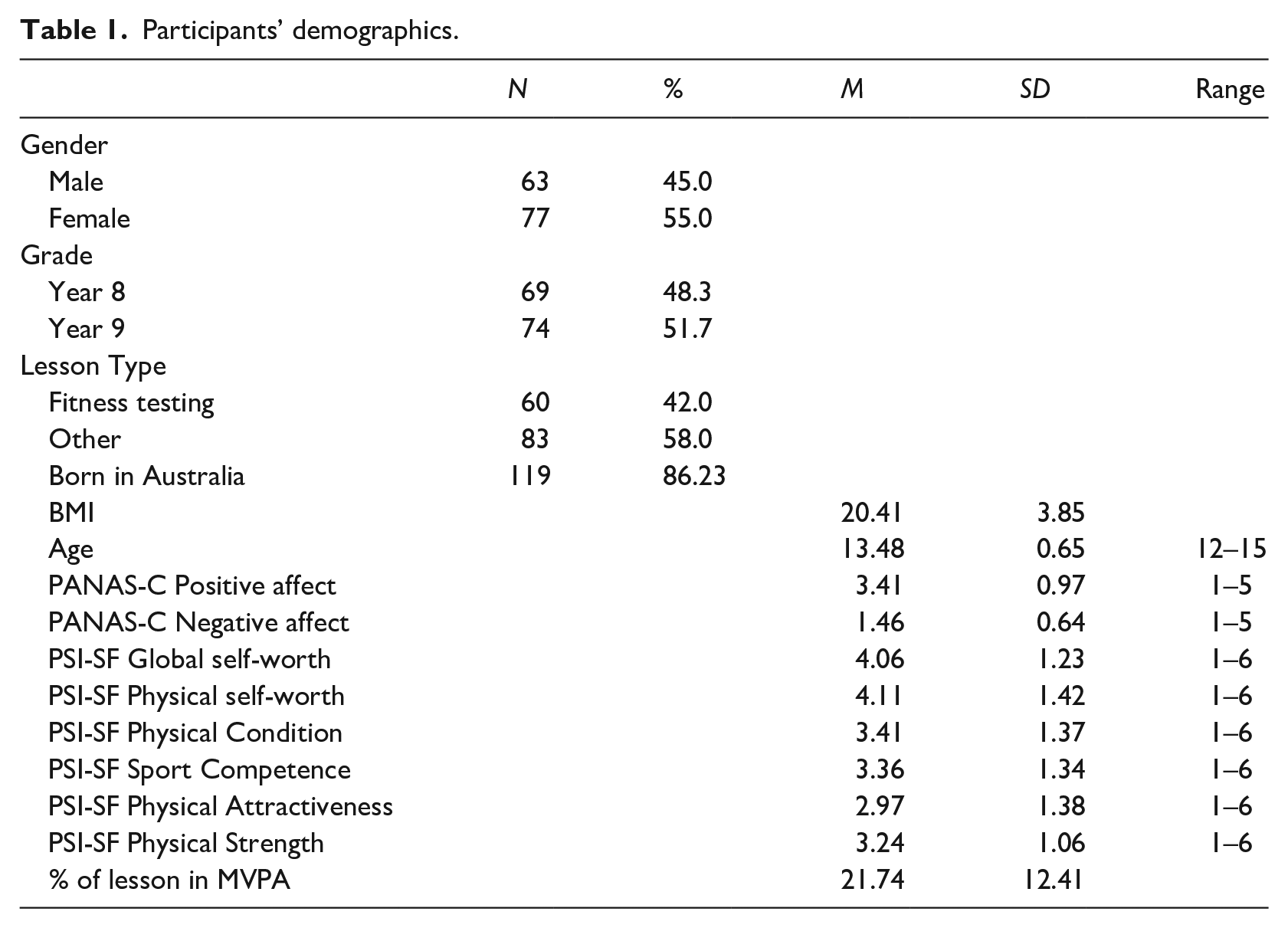
Participants (45% male and 55% female) were 12–15 years old (M = 13.48 years, SD = 0.65) and mostly born in Australia (86.23%), with 90.98% predominantly speaking English at home (see Table 1). The mean percentage of lesson time spent in MVPA across the whole sample was 21.74%.
Participants’ demographics.
Physical activity
The mean percentage of lesson time spent in MVPA was 15.31% (SD = 8.19%) for fitness-testing lessons, compared to 26.42% (SD = 12.90%) for other lessons. Regression analysis showed that lesson type was a significant predictor of MVPA (β = .11, p = .001), and this remained significant when adjusting for covariates (β = .07, p = .014). There was no significant interaction between physical self-concept and lesson type (β = −.01, p = .538) which demonstrates that physical self-concept did not moderate the association between lesson type and MVPA.
Positive affect
The mean positive affect score was 3.36 (SD = 1.05) for fitness-testing lessons and 3.44 (SD = 0.91) for other lessons. Regression analyses revealed that lesson type was not a significant predictor of positive affect (β = .08, p = .727). There was, however, a significant interaction between physical self-concept and lesson type (β = −.42, p = .005) suggesting that students’ levels of self-reported physical self-concept influenced the strength of the association between lesson type and positive affect, such that those with lower physical self-concept reported lower levels of positive affect when engaging in fitness-testing lessons, compared to other PE lessons, even when adjusting for age, gender, BMI and socioeconomic status.
Negative affect
The mean negative affect score was 1.51 (SD = 0.67) for fitness-testing lessons and 1.42 (SD = 0.62) for other lessons. Ssimilar to positive affect, regression analyses revealed that lesson type was not a significant predictor of positive affect (β = .08, p = .727). There was no significant interaction between physical self-concept and lesson type (β = .07, p = .657) suggesting that physical self-concept did not moderate the association between lesson type and negative affect.
Discussion
The results of this study showed that students were less active during fitness-testing lessons. While the difference in MVPA only represented 9.33% of lesson time, or 5.19 minutes on average, some teachers reportedly implemented fitness testing multiple times per school year, while others conducted fitness-testing multiple times per school term (with four terms per year in Australia) (Alfrey and Gard, 2014). Therefore, the decision to allocate lessons to fitness testing may be at the expense of a considerable amount of physical activity across the school year if teachers implement fitness testing over several weeks, multiple times per year. While MVPA is certainly not the only objective of PE, being insufficiently active during lessons is a missed opportunity for students to accumulate their recommended amount of weekly physical activity. Furthermore, evidence shows that students as young as 10 years of age actively avoid participating in PE on days when fitness testing takes place (Silverman, 1996). Therefore, the actual impact of fitness testing on in-class MVPA may be even larger when taking into account the number of students who do not participate and thereby accumulate no MVPA during a lesson that they may have otherwise participated. Furthermore, PE teachers have previously explained that the students who are most likely to avoid participation in fitness tests are those who typically perform poorly in them (Hopple and Graham, 1995). Therefore, it is likely that the students who did not participate in PE on the day of data collection for the present study, and were therefore not included in this study, may have in fact been the students with the lowest physical self-concept. If this was the case, then it is possible that self-concept may have influenced how active students were when participating in fitness-testing lessons. However, overall, lessons devoted to fitness testing were less active than lessons devoted to sport-based activities.
In this study, fitness-testing lessons were less active even when adjusting for students’ BMI, gender and physical self-concept. This result suggests that fitness testing lessons may be less active due to certain aspects of the lesson that can be common among typical fitness-testing lessons. These include the activities included, student management and organisation, teacher instruction, or time spent recording test scores, as opposed to, or in addition to, individual factors such as BMI or self-concept. Understandably, because fitness-testing lessons involve time spent instructing students and recording scores, these types of lessons present teachers with different challenges in respect of increasing physical activity levels when compared to sports-based lessons. Furthermore, teachers are likely more familiar with, and have more experience running, sports-based lessons given they dominate the weekly content of PE in many schools (Coulter and Ní Chróinín, 2011). In Australia, teachers have likely experienced little professional development regarding the implementation of fitness testing, because the curriculum does not require it (Australian Curriculum Assessment and Reporting Authority, 2016). Nevertheless, teachers continue to conduct fitness tests, and either poor practice (e.g. lengthy instructions, time spent recording scores, either having one student participate at a time, or requiring students to sit down and wait for others when they get out) or limited experience designing lessons of this nature may negatively impact students’ physical activity levels at school.
Although students may be less active within lessons allocated to fitness-testing compared to other PE lessons (e.g. sport-based lessons), developing health-related fitness among school aged youth is still an important endeavour. Health-related fitness during adolescence is associated with better quality of life (Bermejo-Cantarero et al., 2021) and a lower risk of psychological difficulties during adolescence (Åvitsland et al., 2020), as well as lower health risk during adulthood (García-Hermoso et al., 2020). While fitness testing as a practice has been criticised for not improving students’ fitness, it is possible that well-designed PE lessons that minimise peer comparisons and promote autonomy, can improve fitness. Some PE programmes integrate high-intensity fitness activities within normal PE lessons by using fitness-based content in the warm up, or by immersing fitness activities within common games (Wiersma and Sherman, 2008). This integration of fitness-related activities has significantly increased MVPA levels within PE (Lonsdale et al., 2013). One intervention implementing fitness activities within PE, and providing teacher training based on strategies to satisfy students’ psychological needs (e.g. providing informational feedback and a meaningful rationale, and acknowledging students’ difficulties) led to an increase in physical activity and autonomous motivation among girls (Ha et al., 2020). Another intervention, facilitating theoretical learning of fitness-related concepts alongside practical fitness activities and assessment (Eather et al., 2013), not only led to an increase in cardiorespiratory fitness, muscular fitness, flexibility and weekly physical activity levels, but also received a mean rating of 5.15 for enjoyment (range = 1–6), suggesting that fitness tests may be more enjoyable if undertaken as part of a larger educational approach to learning about fitness.
While lower levels of physical activity during PE are a potential unintended consequence of fitness testing, this study also showed that fitness-testing lessons were associated with lower positive affect for those with low self-concept. This is a more concerning finding given that affect drives future participation. While affect as a state-based measure is transient, and changes quickly, research shows that affective experiences during and after a behaviour are associated with the likelihood of that behaviour being adhered to 12 months later (Williams et al., 2008; Williams et al., 2012). Therefore, it is crucial for PE to aim to promote positive, rather than negative, affect. Furthermore, physical literacy frameworks guide the implementation of PE in many countries across the globe, including Australia. As an overarching concept, physical literacy describes the breadth of skills, abilities and experiences required to successfully engage in physically active behaviours and movements (Whitehead, 2007). Physical literacy emphasises the need to develop social and psychological competencies such as motivation, confidence and positive affect, in addition to physical abilities, to develop a broader value for movement beyond simply being able to complete movement tasks (Cairney et al., 2019). However, if students with the lowest levels of physical self-concept, who are likely the least motivated and least confident to be active, also experience lower positive affect when engaging in fitness testing, then fitness testing may not be well suited to developing the social and psychological skills and abilities embedded within physical literacy frameworks.
While standardised tests are common in all curriculum areas, testing in PE is fundamentally different due to the public nature of classes (Wiersma and Sherman, 2008). The public nature of fitness testing in particular provides a social platform for highlighting students’ competence or incompetence, and encouraging peer comparisons (Hilland et al., 2018; Kirk et al., 2018). Peer comparisons, and the associated peer teasing, are associated with lower positive affect following PE (Hilland et al., 2018; Kirk et al., 2018), and this could explain why those who engaged in fitness testing with poor self-concept experienced lower positive affect than those who engaged in sport-based lessons with low self-concept. Perhaps, sports-based lessons partially prevent low self-concept from resulting in low positive affect because students’ competence level is less on display. This raises the question as to whether fitness testing can be implemented within games, group activities, or sport-based activities, rather than formal one-at-a-time testing methods?
Another consideration that could reduce the impact of self-concept on affect during fitness testing lessons is to measure fitness-based concepts in a more individualised, goal-setting way, as opposed to the current controlling method where students feel judged and compared (Wiersma and Sherman, 2008). Nation-Grainger (2017) provided students with wrist-worn devices to track steps, calories and kilometres run, and found that students perceived the data as feedback based on effort, which facilitated individual goal setting, because the feedback was related to physical activity as opposed to fitness levels. The students also experienced a sense of accomplishment that resulted in positive affect and autonomous motivation. Moreover, fitness assessment in PE could be tailored towards preparing youth to record and understand their own health and fitness data, rather than mandating class-based assessment of students against norms. This approach may provide a sense of autonomy that could increase motivation and physical activity, as well as positive affective outcomes for students with all levels of self-concept. Perhaps if fitness-testing is to continue within PE in Australia, then intervention studies should determine the effect of implementing new approaches to fitness-testing that still assess fitness but provide students with the autonomy to, and the satisfaction from, assessing their own fitness.
Strengths and limitations
This study is the first to measure student levels of MVPA within PE lessons specifically allocated to fitness testing. Providing a comparison to more common sports-based lessons suggests that fitness-testing lessons may be less active. This finding demonstrates the need for more detailed assessment of the impact of fitness testing on student outcomes within PE lessons. Another strength is that this study provides quantitative evidence of students with poorer physical self-concept experiencing poorer affect after fitness-testing lessons than after participation in more common sport-based lessons. This finding supports previous qualitative research on student perceptions of fitness testing.
Despite these novel findings, a number of limitations exist. First, we were unable to adjust for affect before PE in this study. Second, while our one-school sample included both girls and boys, and children/young people from a variety of ethnic backgrounds, the results cannot be generalised to primary school students more generally, or to students who participate in fitness testing in different countries with different curricula and different approaches to implementing fitness testing. The study therefore requires replication with a larger sample size, and across a broader number of schools and geographic regions. Fitness-testing outcomes should also be compared to the full range of PE lesson types in the future, rather than only sports-based lessons.
Finally, while we assessed all lessons within the selected year groups, we only assessed each class once, and compared those engaging in fitness testing with those not engaging in fitness testing. We did not examine any within-person effects of the different types of lessons. Future studies could consider assessing multiple PE lessons for each student.
Conclusion
Overall, findings from this study showed that students appear to be less active during fitness-testing lessons than other normal practice lessons which in Australia are dominated by sports. This means that time allocated to fitness testing may be at the expense of student MVPA. This may be acceptable if fitness testing leads to benefits besides accumulating a certain amount of physical activity. However, in this study, students with low physical self-concept experienced lower positive affect after a fitness-testing lesson, compared to students with low self-concept engaging in other traditional PE lessons. This is important because positive affective experiences predict future physical activity participation, and the aim of fitness-testing is to motivate young people to enhance their level of physical activity and fitness (Cale and Harris, 2009; Wiersma and Sherman, 2008). However, this study suggests that fitness testing may be unlikely to achieve this purpose, at least not for those with low physical self-concept. Therefore, the findings, while initial and exploratory, provide a rationale for developing a deeper understanding of the fitness-testing experience of students with low self-concept. This may ultimately cause teachers and schools to reconsider their approach to fitness tests so that their inclusion in PE helps students to learn about fitness improvement, rather than exposes those with poor fitness to a negative affective experience which could inhibit future physical activity participation well beyond the school context.
Footnotes
Declaration of conflicting interests
The author(s) declared no potential conflicts of interest with respect to the research, authorship, and/or publication of this article.
Funding
The author(s) received no financial support for the research, authorship, and/or publication of this article.
