



Abstract
Objective:
Data demonstrate that children in the USA eat below the recommended amount of fruits and vegetables, which has been linked with increased risk of obesity and low weight. Previous school-based interventions promoting healthy eating and enjoyment of food have yielded outcomes such as improved weight and children’s willingness to try novel foods. Therefore, we explored whether interactive cooking lessons could be an effective means of food exposure to fruit and vegetables, and improve weight statuses among young children.
Design:
This study utilised a community-based intervention.
Setting:
Head Start classrooms in a southern state of the USA.
Methods:
Monthly lessons led by classroom teachers introduced students to novel foods and explained nutritional benefits and guiding children through snack preparation and mindful appreciation of the new food. Teachers completed the Food Fussiness and Food Enjoyment subscales of the Child Eating Behaviour Questionnaire and recorded body mass index (BMI) percentiles, which were collected by trained Family Engagement Specialists, for each student at the beginning and end of the school year.
Results:
Among 614 Head Start students, children demonstrated a significant decrease in food fussiness (p < .001) and increase in food enjoyment (p < .001). There were significant changes (p < .001) in BMI percentile. Children with high weight lost 16.9 percentile points over the year compared to those with healthy weight. Conversely, children with low weight gained 24.7 percentile points.
Conclusion:
Developmentally appropriate interactive cooking lessons that expose young children to fruit and vegetables in a social setting may be an effective strategy for improving attitudes towards food and weight statuses. Additional data are required to fully understand the mechanisms that cause beneficial weight changes in preschool age children.
Introduction
Nearly 20% of children in the USA have obesity, which is defined as having a body m% sex (BMI percentile) at or above the 95th percentile (Hampl et al., 2023; Skinner et al., 2015). Data support that the transition between early childhood (2–5 years) and middle childhood (6–11 years) is a critical period of vulnerability for the development of excess weight with an incidence increase of 12.9% to 22.8% during this time period (Hu and Staiano, 2022; Tsoi et al., 2022). There is a well-established link between childhood obesity and lifelong health conditions such as cardiovascular disease, hypertension and type 2 diabetes (Lloyd et al., 2010; Sahoo et al., 2015; Umer et al., 2017). Therefore, the identification of effective prevention strategies for the development of excess weight among children is needed.
The increase in obesity during the transition from early to middle/late childhood could be at least partially due to food neophobia, which is defined as a ‘reluctance to eat unfamiliar foods’ (Damsbo-Svendsen et al., 2017). Although food neophobia has been identified as adaptive, in that it protects children from consuming potentially harmful foods, it can lead to the development of a diet that lacks diversity (Dovey et al., 2008; Johnson et al., 2015). In contrast, studies have demonstrated positive associations between food enjoyment and higher food variety (Russell and Worsley, 2016; Vilela et al., 2018). Food neophobia is common among typically developing young children who reject trying new foods, particularly fruit and vegetables (Birch and Doub, 2014). Instead of fresh produce, those who are highly food neophobic tend to gravitate towards foods that are calorically dense and nutrient-poor (Mallan et al., 2016).
Food fussiness, a related construct, is characterised as the tendency to be highly selective about food preferences and is often associated with avoidance of foods based on certain food attributes such as appearance, texture and flavour (Smith et al., 2017). Both food neophobia and food fussiness are strongly associated with one another and have been linked to both high and low weight in children (de Barse et al., 2015; Faith and Hittner, 2010; Finistrella et al., 2012; Kininmonth et al., 2021). Although the relationship between food fussiness and low weight is better established, less is known about the relationship between food fussiness and high weight. Previous studies have hypothesised that caregivers of children who are picky eaters may compensate by providing preferred calorically dense foods, potentially increasing the risk of obesity in their child (Brown et al., 2016). Although these behaviours tend to decrease with age, some research suggests that childhood eating behaviours can have long-lasting impacts on diet and weight status in adulthood (Dubois et al., 2022). Therefore, it may be important to consider children’s attitudes, and consequently their behaviours, towards food when developing interventions for the prevention of obesity.
Preschool children at Head Start programmes 1 are particularly vulnerable to the risk of obesity because of the positive associations between socioeconomic adversity and high weight (Anekwe et al., 2020; Hemmingsson, 2018). As such, these children are an important target group for interventions aiming to reduce obesity risk. Data suggest that in higher income countries, such as the USA, lower socioeconomic status places children at risk for having overweight and obesity due to related factors such as food insecurity, decreased access to grocery stores offering fruits and vegetables, and lower cost of energy-dense foods (Lieb et al., 2009; Vazquez and Cubbin, 2020). For example, both food deserts (i.e. neighbourhoods with limited access to affordable and healthy food) and food swamps (i.e. neighbourhoods with increased access to nutrient-poor and calorically dense food) have been linked to socioeconomic adversity, as well as poor diets, higher z-scores for body mass index and obesity status (Cooksey-Stowers et al., 2017; Hager et al., 2017; Thomsen et al., 2016).
US federally funded programmes such as Head Start have been implemented with the goal of improving educational and health outcomes among children in under-resourced communities. Given that data support that the incidence of obesity is higher than the national average among children attending Head Start programmes (Imoisili et al., 2021), prevention and intervention strategies targeting this population may be particularly advantageous. One such intervention, ‘Dr. Yum’s Preschool Food Adventure’, was created in 2014 with the goal of increasing exposure and access to fruit and vegetables among young children. Previous cooking interventions had primarily targeted school-aged children and adolescents (Davis et al., 2011; Ensaff et al., 2017; Thorsteinsdottir et al., 2021). In addition, interventions developed for younger children have primarily engaged parents in educational lessons (Condrasky et al., 2006; Garcia et al., 2020; Izumi et al., 2016). With this in mind, Dr. Yum’s Preschool Food Adventure was designed to provide both educational and hands-on cooking experiences directly to preschool students with the aim of reducing food fussiness and increasing food enjoyment.
Against this background, the aim of this study was to collect pilot data to explore whether interactive cooking lessons presented through this novel programme could be an effective means of food exposure to fruits and vegetables and improve weight statuses among young children. To this end, our first aim was to describe Dr. Yum’s Preschool Food Adventure. A second aim was to assess preliminary effectiveness of Dr. Yum’s Preschool Food Adventure in reducing food fussiness and increasing food enjoyment. We hypothesised that children who participated in the programme would have decreased food fussiness and increased food enjoyment at end-of-year follow-up. The final aim of this study was to explore changes in weight status among children who participated in the programme. We hypothesised that among children with high weight at baseline, a decrease in BMI percentile would be observed. Conversely, among those with low weight at baseline, we hypothesised that an increase in BMI percentile would be observed. We also sought to explore the link between baseline weight status, change in food fussiness and food enjoyment, and change in weight status at end of year. We hypothesised that change in food fussiness and food enjoyment would mediate the relationship between baseline weight status and change in BMI percentile.
Methods
Participants
Head Start schools in Northern Alabama were contacted and offered to participate in Dr. Yum’s Preschool Food Adventure at no cost. Schools that agreed to participate provided programme evaluation teacher-reported data on a convenience sample of 2- to 5-year-old students. Students were eligible if they attended a participating head start programme and participated in at least one Dr. Yum’s Preschool Food Adventure session.
Dr. Yum’s Preschool Food Adventure intervention
Dr. Yum’s Preschool Food Adventure was developed as a community-based intervention to improve children’s attitudes towards novel fruit and vegetables through interactive cooking lessons with the goal of reducing incidences of high weight observed in under-resourced communities. The curriculum was designed by a non-profit multidisciplinary team, which included including a paediatrician, nutritionists and early education specialists. The programme initially conceptualised this curriculum after noticing high rates of picky eating and high weight among children in their rural community. Since 2014, Dr. Yum’s Preschool Food Adventure has been used in several early childhood settings and has relied heavily on parent and teacher feedback to ensure acceptability. The curriculum is offered at a low cost, and if schools identify financial need, the project team assists them in securing grant funding to cover the cost of curriculum and materials.
Dr. Yum’s Preschool Food Adventure consists of 24 monthly educational sessions conducted over 2 academic years. Each session begins with an approximately 10-minute-long circle time that includes mindful exploration of a novel fruit or vegetable (e.g. students are encouraged to ‘make friends’ with the new food) and a brief developmentally appropriate educational lesson on the novel fruit/vegetable (e.g. providing information such as where it grows and its nutritional benefits). Students then participate in creating a snack from the identified food using child-appropriate cooking tools, which takes approximately 45 minutes. All recipes have been previously tested and identified as acceptable to young children and fall into three broad categories: (1) chop and stir salsa or salad, (2) energy bites that are mixed and formed with the hands, or (3) smoothies that involve chopping and blending ingredients. Cooking tasks have been previously identified as developmentally appropriate for children 2.5 years and older by early education teachers and include a combination of individual (e.g. chopping vegetables with safe preparation tools) and group (e.g. teacher assisting students in utilising a blender) activities. Parents are provided with handouts describing the day’s lesson and recipe and encouraged to continue using the novel fruit/vegetable at home.
Procedure
Head Start teachers in Northern Alabama, a community identified as having high rates of paediatric obesity (Centers for Disease Control and Prevention, 2022), were trained in delivering the Dr. Yum’s Preschool Food Adventure curriculum by the project team. Teachers were required to complete a 3-hour video training that outlined the approaches of the curriculum and provided them with techniques to address picky eating behaviours. After viewing the videos, participants completed a quiz to test their knowledge of the curriculum content and were awarded a certificate of completion. The training and certificate were required of all teachers at a school before the curriculum was disseminated. Parents were also offered English or Spanish language versions of a training manual that contained the techniques teachers used in the classroom to create consistency in the approaches used across multiple settings. Although the original curriculum has the capacity to be delivered over 2 full years, to ascertain pilot data, the study was conducted during one Head Start academic year. Students participated in monthly teacher-led Dr. Yum’s Preschool Food Adventure sessions from September 2021 to May 2022 with some flexibility in start/end dates at teacher discretion. Teachers completed questionnaires and recorded demographic variables and BMI percentiles for each student at baseline and end-of-year follow-up.
Measures
Demographic variables such as age, race and ethnicity as well as anthropometric measures including height, weight and BMI percentiles were collected by trained Family Engagement Specialists (i.e. school administrative staff) at the beginning and end of school year per national Head Start protocol. Teachers also reported the number of lessons students participated in throughout the year.
The Child Eating Behaviour Questionnaire (CEBQ; Wardle et al., 2001) was used to assess children’s attitudes towards food. The CEBQ is a widely used questionnaire that measures a range of dimensions of children’s eating styles and has been validated for use among populations of Head Start preschool children (Domoff et al., 2015). The Food Fussiness (example item: ‘child refuses new foods at first’) and Food Enjoyment (example item: ‘child loves food’) subscales were used to assess positive and negative attitudes towards food. The Food Fussiness subscale was modified to take out ‘my child is difficult to please with meals’ due to teachers not directly experiencing attempting to please a child with a prepared meal in the same way a parent would. All other items were maintained. Higher scores on the Food Fussiness subscale indicate more negative attitudes towards food and higher scores on the Food Enjoyment subscale indicate more positive attitudes.
Statistical analysis
All analyses were performed with SPSS version 28 (IBM Corp., Armonk, NY, USA). Given these were pilot data, data were included in analyses if complete data were provided for baseline and end-of-year timepoints. Participants who did not provide end-of-year data or had missing data were excluded. Data were screened for normality using skewness and kurtosis. Outliers were recoded to be within 3 standard deviations of the mean (Osborne and Overbay, 2004). The Food Enjoyment and Food Fussiness subscales were summed. Three categories of baseline BMI percentiles were created based on established definitions (Hampl et al., 2023; Skinner et al., 2015) of low weight (⩽5th percentile), healthy weight (between the 6th and 84th percentiles) and high weight (⩾85th percentile). Change in BMI percentiles was calculated by subtracting baseline BMI percentile from end-of-year BMI percentile. Positive change scores indicate gain in BMI percentile and negative scores indicate loss. Pre–post food enjoyment and food fussiness were examined using paired-samples t-tests. Analysis of variance (ANOVA) analyses were used (predictor variables were baseline percentile categories; dependent variable was change in BMI percentiles) with contrasts to detect how baseline BMI percentile was linked with change in weight status over the year. Significance for all analyses was set at p < .05. Given the wide range of number of lessons attended, number of lessons was considered as a covariate. Age was also considered as a covariate. Neither number of lessons nor age significantly contributed to any model and were therefore removed from analyses. Finally, given data support a link between food fussiness and food enjoyment and weight in young children (Domoff et al., 2015), an exploratory mediation model was conducted to examine the link between baseline BMI percentile, changes in food fussiness and food enjoyment, and change in BMI percentile. The Preacher and Hayes Indirect Mediation macro for SPSS (Selig and Preacher, 2009), bootstrapping with 1,000 resamples was used to estimate the 95% confidence intervals (CI) for indirect effects. Mediations were considered significant if 95% CIs did not cross zero.
Results
Participants
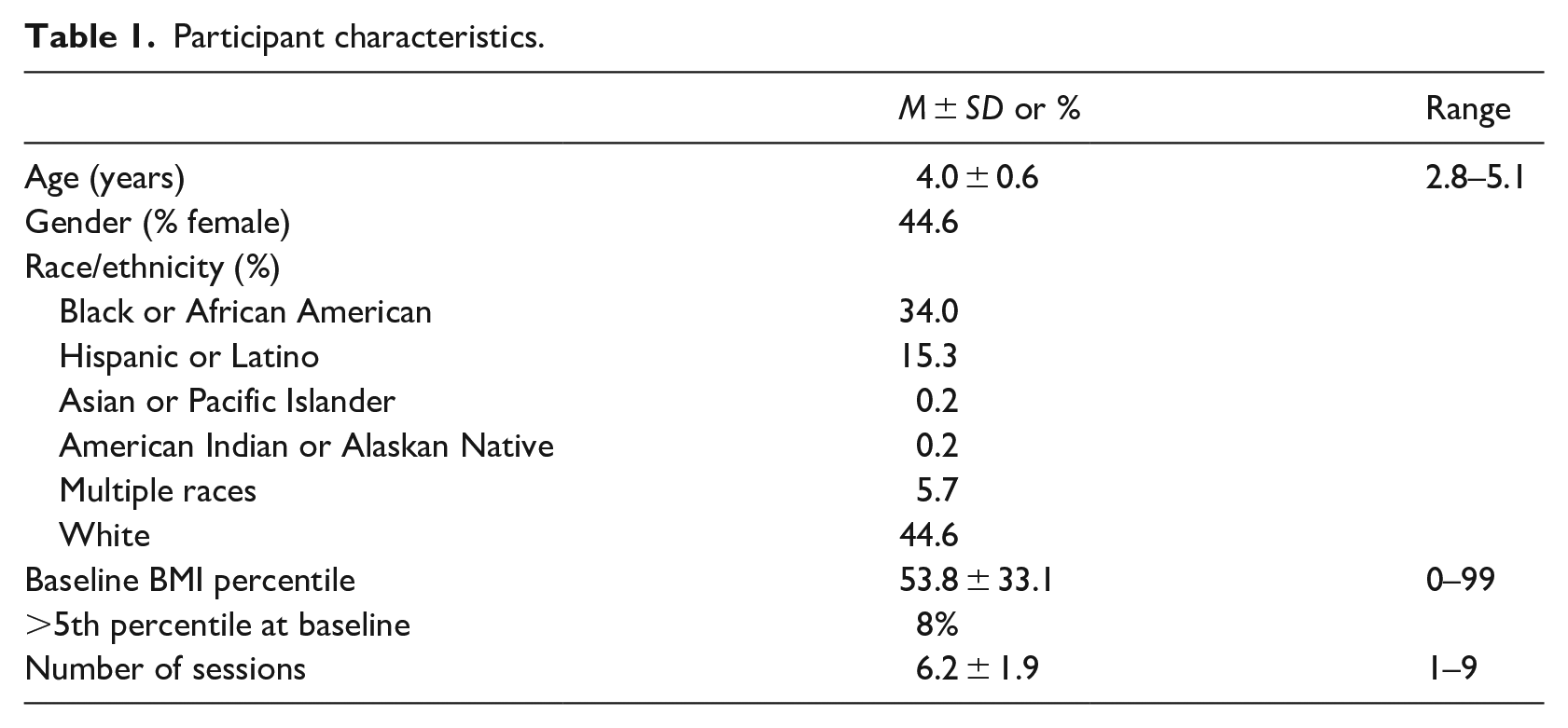
In total, 614 Head Start students in Alabama (2.8–5.1 years; M: 4.0 ± 0.6 years; 44.6% female; BMI percentile: 53.8 ± 33.1; 21.0% with high weight at baseline; 7.7% with underweight at baseline) participated in an average of 6.2 (±1.9) sessions of the programme. See Table 1 for participant characteristics.
Participant characteristics.
Food enjoyment and food fussiness
Comparing baseline to end-of-year data, students demonstrated a significant decrease in food fussiness (baseline M = 14.7 ± 3.9, end-of-year M = 13.6 ± 4.6; t(613) = 6.7; p < .001; d = 0.27) and a significant increase in food enjoyment (baseline M = 14.9 ± 3.3, end-of-year M = 15.4 ± 3.5; t(613) = 4.4; p < .001; d = 0.18).
Weight change
Students demonstrated significant changes in BMI percentile based on weight status at baseline, F (2,611) = 38.8, p < .001. Compared to children with healthy weight (BMI percentile between 5th and 84th; n = 437), those with high weight (BMI percentile ⩾ 85th; n = 130) lost 16.9 percentile points over the year. Conversely, children with low weight (<5th percentile; n = 47) gained 24.7 percentile points over the course of the school year. Among the reference group, those with healthy weight at baseline, BMI percentile increased by 3.2 (±29.4). Furthermore, among those with high weight at baseline, 44 were in the healthy weight range at end of year (33.8%), and among those with low weight at baseline, 27 had healthy weight at end of year (57.4%) (see Figure 1).
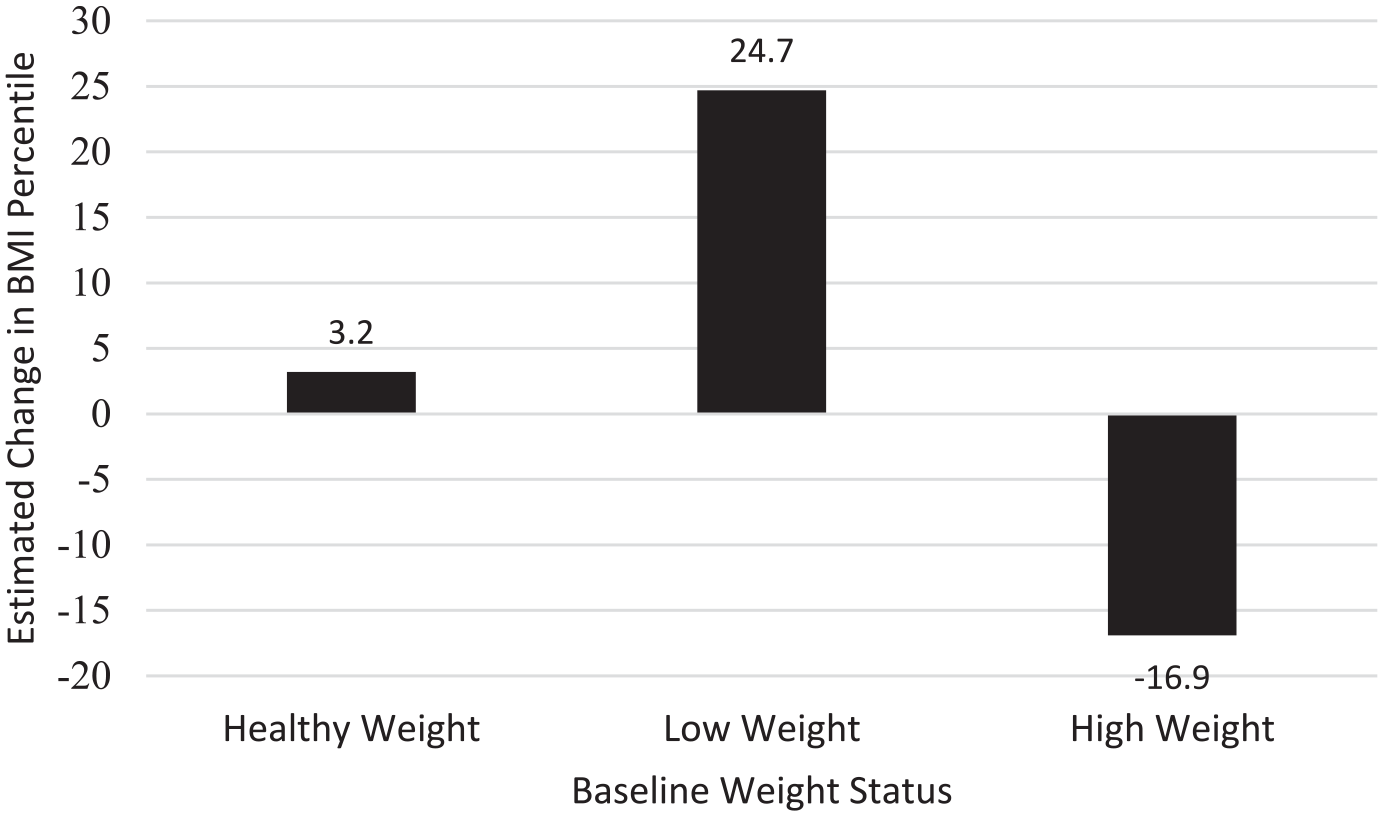
Change in weight status from baseline to end of year.
Exploratory mediation analyses
Neither change in food enjoyment (R2 = .0002; 95% bootstrap CI: [−.0037 to 0.002]; SE = 0.0015) nor change in food fussiness (R2 = .0000; 95% bootstrap CI: [−.0049 to 0.0039]; SE = 0.0021) mediated the relationship between baseline BMI percentile and change in BMI percentile.
Discussion
This study utilised pilot programme evaluation data to examine the impact of Dr. Yum’s Preschool Food Adventure on children’s attitudes towards food and weight statuses. Teacher reported child food fussiness significantly decreased and food enjoyment significantly increased after participation in the programme. Furthermore, there was an improvement in BMI percentiles such that, compared to those with healthy weight at baseline, among those with high weight at baseline, there was a significant decrease in BMI percentile, and among those with low weight at baseline, there was a significant increase in BMI percentile. Mediation analyses did not find change in food fussiness or food enjoyment to be linked with baseline BMI percentile and change in BMI percentile.
Results demonstrated that preschool students were perceived to be less fussy and enjoy food more after a yearlong intervention that exposed them to novel fruit and vegetables. This is consistent with previous studies that have found that introducing children to novel foods led to changes in their attitudes about these foods and increased their willingness to incorporate fruits and vegetables into their diets (Daniels et al., 2014; Sandvik et al., 2022; Thorsteinsdottir et al., 2021). It is possible that teachers observed these positive changes in children’s attitudes towards food due to the various approaches integrated into the programme that address picky eating. That is, the utilisation of mindful exploration, developmentally appropriate education and child-centred interactive snack preparation activities likely improved children’s sensory experiences with novel foods and helped them develop positive perceptions towards healthy foods that are associated with healthier food choices (Ng et al., 2022). Indeed, a recent review of interventions to address picky eating in children found that repeatedly exposing children to novel foods and providing education about healthy diets was effective in reducing picky eating in young children. In addition, it was suggested that interventions that incorporate these varied approaches, such as Dr. Yum’s Preschool Food Adventure, may be the most effective in helping children with picky eating due to the various factors that contribute to picky eating such as sensory sensitivities and authoritarian parenting (Kamarudin et al., 2023). Overall, this study bolstered previous findings that emphasise the importance of targeting children’s attitudes towards food when developing and disseminating interventions.
This study also demonstrated significant changes in weight status over the year with pilot data, such that among those with high weight at baseline, there was a decrease in BMI percentile observed, and among those with low weight at baseline, there was an increase in BMI percentiles. This finding is consistent with other studies that have found that cooking-based interventions are effective at improving weight statuses among children and adolescents (Castro et al., 2013; Davis et al., 2011; Dimple and Ramesh, 2023; Gatto et al., 2017). Indeed, a recent review found that school-based cooking interventions were associated with improved diet quality (i.e. increased consumption of fruits, vegetables and dietary fibre) and reduction in obesity in children (Dimple and Ramesh, 2023). Results from this review were particularly promising among younger students; however, only two studies included preschool age children. This review highlights the importance of continued examination of nutrition interventions that offer a hands-on cooking experience, particularly in young children, as a prevention strategy for the development of high weight.
Finally, our null results find that neither food fussiness nor food enjoyment mediated the relationship between baseline BMI percentile and change in BMI percentiles could be due to inadequately capturing participant’s attitudes towards fruit and vegetables specifically. Indeed, the CEBQ assesses overall attitudes towards eating and does not target specific food groups. Future studies should directly assess children’s approach and flexibility towards novel fruits and vegetables as well as actual consumption of fruits and vegetables to more fully understand the mechanisms underlying our findings.
Strengths and limitations
Study strengths include a large racially diverse sample size that allowed analyses to be adequately powered to detect significant associations. In addition, this study utilised a community-based intervention that relied on collaborating with members of the community to implement an intervention that was tailored to participants’ needs. Community-based interventions can increase participation in research and representation of under-resourced groups and improve the quality and reach of public health messaging. Finally, the approach used allowed for preliminary examination of acceptability and feasibility of preschool-based interactive cooking lessons in a real-world setting.
Limitations include the use of teacher-reported measures. The nature of this study was programme evaluation of a community-based intervention; therefore, to minimise burden on families, we used Head Start-collected weight and brief teacher-reported measures. Although validated for use in a Head Start preschool sample (Domoff et al., 2015), the CEBQ likely did not adequately capture children’s fussiness or enjoyment towards novel fruits and vegetables, but rather overall eating attitudes (Wardle et al., 2001). Given the remarkable changes in weight status observed, future studies should utilise more robust measurements including parent dietary recall, child-reported fruit and vegetable preference, child-reported flexibility and comfortability towards trying new foods and additional metrics of physiological health such as fat mass and blood pressure (Dimple and Ramesh, 2023) to better understand underlying mechanisms.
Finally, this study did not utilise a control group for comparison, as the overarching aim was to collect and analyse pilot data. Additional data from a study using a randomised controlled trial design are warranted to more fully understand the efficacy of this particular programme in improving attitudes towards novel fruit and vegetables and weights statuses in young children.
Conclusion
Results support the view that a developmentally appropriate interactive cooking lesson that exposes children to enjoyable and appetising fruits and vegetables preparation in a social setting, paired with teacher training, may be an effective strategy for improving young children’s attitudes towards food as well as weight statuses. However, additional data are required to more fully understand the mechanisms underlying beneficial weight changes in preschool age children.
Footnotes
Data availability statement
The data that support the findings of this study are available from the corresponding author upon reasonable request.
Declaration of conflicting interests
The author(s) declared the following potential conflicts of interest with respect to the research, authorship and/or publication of this article: the Dr. Yum Project and Dr. Yum Preschool Adventure were developed by N.F., H.D. and M.P. N.F. receives no funding from the Dr. Yum Project or Dr. Yum Preschool Adventure and works exclusively as a volunteer. H.D. is a founding board member of the Dr. Yum Project and receives a salary from the Dr. Yum Project to maintain operations. M.P. is a volunteer with the Dr. Yum Project and receives funding from the sale of Dr. Yum Preschool Adventure to feeding therapists. She receives no funding from the kits provided to classroom teachers. Given this conflict of interest and to ensure the integrity of findings, authors N.F., H.D. and M.P. were not involved in the analysis of data.
Funding
The author(s) disclosed receipt of the following financial support for the research, authorship and/or publication of this article: this project was funded philanthropically by public donations to the Dr. Yum Project and a grant from the Community Action Partnership.
Ethical approval and informed consent statement
This project was determined not to be considered human subjects research by the Duke University Institutional Review Board.
