




Abstract
Objectives:
The paper explores how students’ values and food choices change or adapt depending on the social environment and how students navigate the resulting tensions in food choices and practices when balancing nutrition against social and cultural preferences and sensory experiences.
Design:
The study analysed students’ discussions about food and health to explore how values and knowledges are expressed together within them, and shift these across different social environments.
Setting:
Community-based study in Zimbabwe in a context many students live in food poverty with long-term implications for physical development and learning.
Methods:
Through a re-analysis of group interviews with 120 upper secondary/high school students attending six schools in Zimbabwe, we explored how students create meanings around food and health in different social environments.
Results:
Students’ creation of different meanings around food and health depends on the context and the wider social environment. As students discuss food choices and practices within the family, at school and in peer groups, different values and knowledges come to the fore, shifting from responsibility to identity and/or convenience. Importantly, bio-medical, social-cultural and sensory values and knowledges are present in all of students’ discussions across these different social environments.
Conclusion:
The concept of value-mobilities is developed to describe students’ ability to navigate tensions between how food and health are understood and valued in different social and cultural settings, and to make food choices and health decisions.
Keywords
Introduction
Food is a central part of human life. However, due to the complex relationship between food and health, research approaches need to account for the multiple dimensions of sustainable food choices (Irazusta-Garmendia et al., 2023), which include social and cultural factors influencing food and health (Hauser et al., 2011). Furthermore, such approaches need to engage with the link between knowledge and how values are expressed as food-related attitudes as part of efforts to achieve sustainable diets (Cown et al., 2017).
Food and its impact on health through food security and food sovereignty (being able to choose what you eat) is a recurring challenge to sustainability in Southern Africa, affecting the quality of life of individuals and communities (Moyo and Thow, 2020). As the focus of this study, Zimbabwean children and students under 18 encounter on a daily basis food environments within and beyond the school setting that are characterised by food poverty and recurring risks of malnutrition (UNICEF, 2024). Food poverty is not only limited to students finding it difficult to access nutritious food but also includes long-term health effects of hunger and malnutrition on physical development and learning (Lukwa et al., 2020; Moyo, 2024). The intersection of climate change, social inequality, and political as well as economic instability in Zimbabwe exacerbates students’ food poverty and food insecurity (Mashizha and Tirivangasi, 2023; Muzerengi et al., 2023). Because of this, food choices and practices are key in promoting individual and community health and, as noted by Entrena-Durán et al. (2021), Ehlert (2021) are determined by social, political, and commercial factors but also knowledge and values regarding sustainable sources of food (Antwi, 2020). Closely connected to the social environment as communal practices, food practices carry profound cultural and social significance (Block et al., 2018; Hedegaard, 2016; Mingay et al., 2021).
As noted by Vidgen (2016), food and eating reach beyond the school setting, encompassing the everyday practices of individuals, households and communities. For education around food and health to be relevant, students’ experiences beyond the school need to be considered, along with the inclusion of pluralistic ways of ‘knowing’ about food and health through social and cultural values (Ogundele et al., 2023; Papadaki et al., 2007) and sensory values (Lupi et al., 2015). How food and health relate to students’ experiences depends on the social environment and explicitly acknowledging this dynamic can allow students to develop their agency in pursuit of health-related values and goals (Mickelsson et al., 2023). There is a research gap regarding the factors impacting students’ food choices and practices with more research needed regarding how students navigate their daily food environments and long-term health outcomes characterised by the risk of malnourishment. Previous research has not significantly explored the social and cultural aspects of student’s food practices as members of social communities, families and peer groups and how this membership impacts their health-related knowledges and values.
This paper re-analyses empirical materials and findings from a previously published paper (Oljans et al., 2024) which highlighted how in students’ discussions on food and health, values are expressed together with knowledge as ‘value-knowledges’. As students engaged in different social settings the findings reveal how they utilised bio-medical, social-cultural and sensory value-knowledges in food choices and practices. Students were shown to consider both nutritional value and taste along with how food might provide opportunities to connect with family, culture and peers (Oljans et al., 2024). Using a pragmatist analytical framework inspired by the work of Dewey (1916, 1938, 1958), (Bentley, 1949) this re-analysis builds on these results from) by further exploring how students create meanings around food and health with the social environments identified in the initial analysis and delves further into how they navigate tensions that emerge from differences in socially situated meanings across settings. Of special interest is how students come to navigate the emerging tensions in their food choices and practices. A better understanding of this can contribute to understanding of the ‘implementation gap’ in health education – between students knowing (what is nutritional correct to eat) and doing (eating in accordance with nutritional guidelines) (Ariew et al., 2002; Aslam et al., 2018; Boorse, 1997). What we prefer to eat, cook and consume in order to feel satisfied is far more complex than simply satisfying hunger and bodily needs.
Aims and research questions
The paper explores how students’ values and food choices change or adapt depending on the social environment, and how students come to navigate resulting tensions in food choices and practices, balancing nutrition against social and cultural preferences and sensory experiences. Specific research questions examined are:
What meanings do students create with their social environments in relation to food and health?
How do students navigate tensions emerging from differences in socially situated meanings surrounding food and health?
Methods and materials
Re-analysis as a research method can offer new perspectives and deeper knowledge on specific topics (Camfield and Palmer-Jones, 2013). The empirical materials focused on here included group interviews and data from semi-structured participant observation. This combination strengthened our assessment of students’ responses and discussions about food and health-related values and knowledges in terms of depth and clarity, with the observations used to contextualise and validate the what participants expressed in interview (Bryman, 2016; Musante and DeWalt, 2010).
The empirical material consisted of group interviews, lasting 60 minutes and moderated by two of the authors. One hundred and twenty (120) upper secondary/high school students, aged 16–18 years old were purposively sampled from six (6) schools in the Gweru district of the Midland region in Zimbabwe, (two urban schools, two peri-urban schools, and two high-density schools 1 ). Interviews were conducted in groups of 20 students in each school with a 40/60 gender split (male/female). The sample size was motivated by the desire to reach thematic saturation (Hennink et al., 2017), and to capture the depth and nuance of the topic at hand with a diverse group of students attending different schools (Hennink and Kaiser, 2022). In preparation for the interviews, the interview guide was piloted with young people during an initial visit to one of the schools, strengthening its contextual relevance. Audio recordings were made during the interviews which were conducted in English. The study was conceptualised and the interview guide prepared as a collaboration between a Swedish and a Zimbabwean team, with the Zimbabwean team strengthening the contextual relevance of the methods used. 2
Ethical considerations
Ethical approval for the project which sought to engage students under 18 years of age in discussions on food and health was provided by the Zimbabwean Ministry of Primary and Secondary Education (Reference: C/426/3, 5 March 2021). Information regarding the research aims and process, along with time for questions, was offered to interested students in each school and written consent was sought from both parents/guardians and the students themselves. Participants’ confidentiality was assured throughout the study by the means of participant codes rather than names, and researchers were careful to avoid discussions requiring the sharing OS sensitive personal information (TRUST, 2018).
Analytical framework
This study utilised a pragmatist analytical framework inspired by the work of Dewey (1916, 1938), which emphasises students’ ability to engage with societal values as active and responsible members of a family, a community and culture. Dewey (1938) argued that ‘every experience takes up something from those which have gone before and modifies in some way the quality of those which come after’ (p. 35). ‘Experience’ was thus used to ground the analysis in the experiential lives of students in a similar way to culturally relevant education, environmental education (EE) and education for sustainable development (ESD) (Kopnina, 2012). Experiences were seen as emerging from encounters with the world both spatially (throughout encounters with learners, social groups and contexts) and temporally (in relation to the past and future) connected together as an emerging whole (Bentley, 1949; Dewey, 1938). This paper stresses how students’ food choices and practices with different social groups in diverse social environments link to meaning-making, meaning as something practical that we do, and Dewey’s (1905) view of learning as a process of growth and development in context, and in preparation for future encounters (Dewey, 1938, 1958; Glassman, 2001; Öhman and Östman, 2007).
In this paper, we see students’ experiences and meaning-making occur as part of their engagements with social situations and contexts. This perspective aligns with Dewey’s (1938) description of the ongoing process of contextual meaning-making as ‘environing’ (Bentley, 1949). In the course of experiencing and learning, we interweave our practices with our environments as ongoing states of becoming (Glassman, 2001). In education, environing concerns students’ abilities to attend to aspects of the topic at hand (i.e. their experiences of food and health). Meaning-making is always situated in space and time and embedded in the practices, encounters and experiences of the students (Almqvist et al., 2008; Garrison, 1995; Östman and Öhman, 2010). Learning as environing offers a deeper and more nuanced perspective when it comes to mapping the meanings students create with their social environment (Dewey, 1916, 1938, 1958; Grande, 2015). Drawing on Mickelsson et al. (2023), meaning-making may be through the value-knowledges that emerge in ongoing construction as students move through different social settings (Bentley, 1949; Dewey, 1938). Based on this assertion that values and knowledges regarding food and health are expressed together as value-knowledges (Oljans et al., 2024), we use the concept of constellations of value-knowledges to highlight how in our everyday lives we encounter a plurality of interrelated value-knowledges which come together to inform our decisions and practices about food and health (R’boul, 2022; Redvers et al., 2024). The concept of value-knowledge constellations emphasises how decisions and practices draw on different, interconnected, perspectives as ways of knowing and valuing from science and the social and cultural environment, as well as embodied experiences that together form our overall approach to food and health within a particular setting (Miller and Wyborn, 2020; Turnhout et al., 2020).
Similar to van Gasse (2017), we approach students’ choices and practices as opportunities for learning, especially in relation to complex issues such as health and food, in ways that are contextually relevant to students’ experiences, communities and cultures. There is significant potential in considering students’ individual and cultural experiences and belongings when aiming to create meaningful learning (Oser et al., 2014; Pang et al., 2018).
Analytical steps
In this study, the three analytical concepts of meaning-making, experience and environing (Dewey, 1938) are operationalised together to explore how different meanings were created by students in relation to food and health, depending on the social environment (see Figure 1). Initially, we investigated how students express and discuss their experiences of value-knowledges of food and health and thus engage in meaning-making. By analysing this meaning-making, we were able to identify how value-knowledges are enacted together as constellations in students’ food choices and practices. Detailing how students establish specific relationships with their surrounding social environment in relation to food choices and practices through environing, enabled us to identify how constellations of value-knowledges shift with social situatedness.
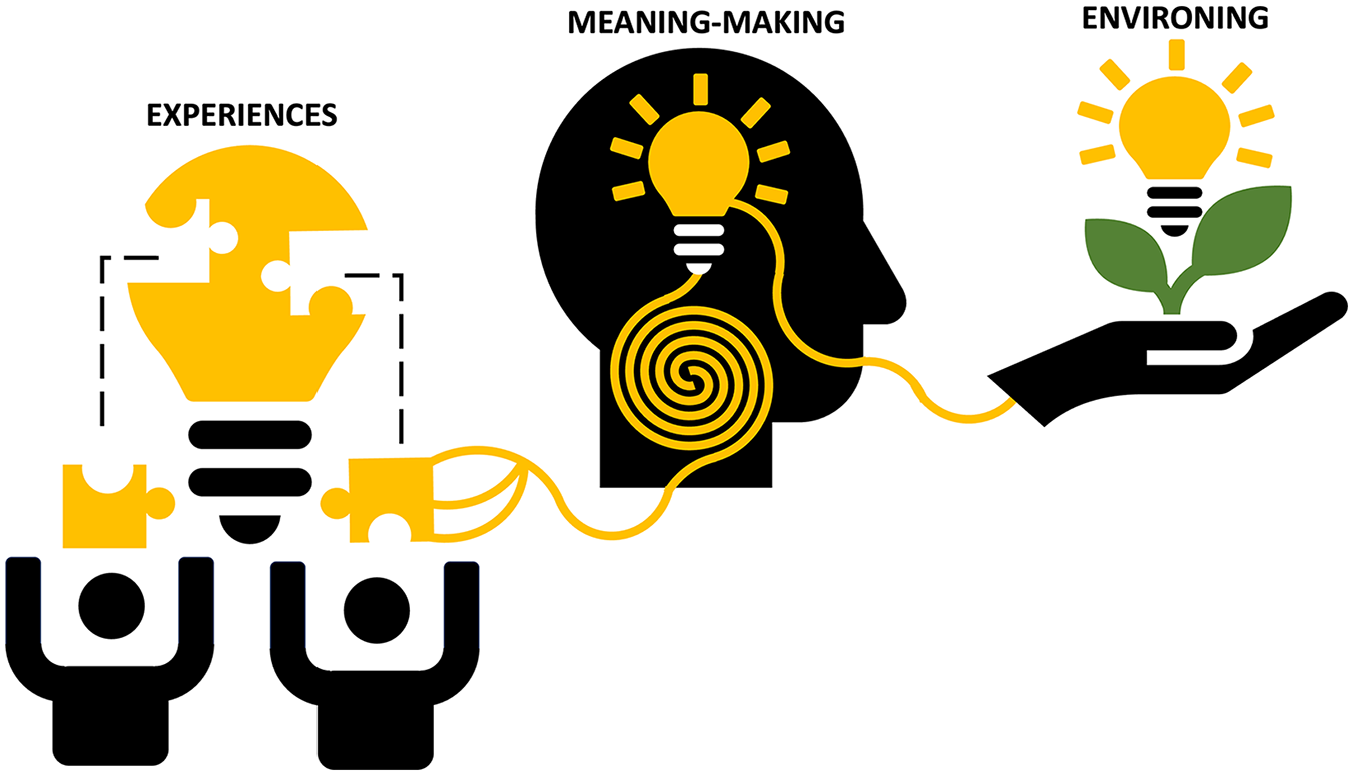
Experience as the basis for meaning-making around food choices and practices.
Next, these enacted constellations of value-knowledges were mapped onto a food triangle (Belasco, 2008) in relation to three goals of food choice and practice: namely, identity, responsibility and convenience. The food triangle was engaged as an open-ended model with each enacted constellation of value-knowledges understood as a combination of these concepts. Positioning the identified constellations of value-knowledge within the framework of the food triangle enabled us to see how value-knowledges became enacted within dynamic configurations of responsibility, identity and convenience as competing priorities. In the analysis, we studied how constellations of values-knowledges enacted in different social environments become expressions of the contextual trade-offs between identity, responsibility and convenience.
Findings
The findings outline how students expressed their experiences of food and health as three primary value-knowledges. These value-knowledges are shown to be enacted together as constellations. Finally, we show how students establish relationships with their surrounding social and cultural environments, through processes of environing (see Figure 2).
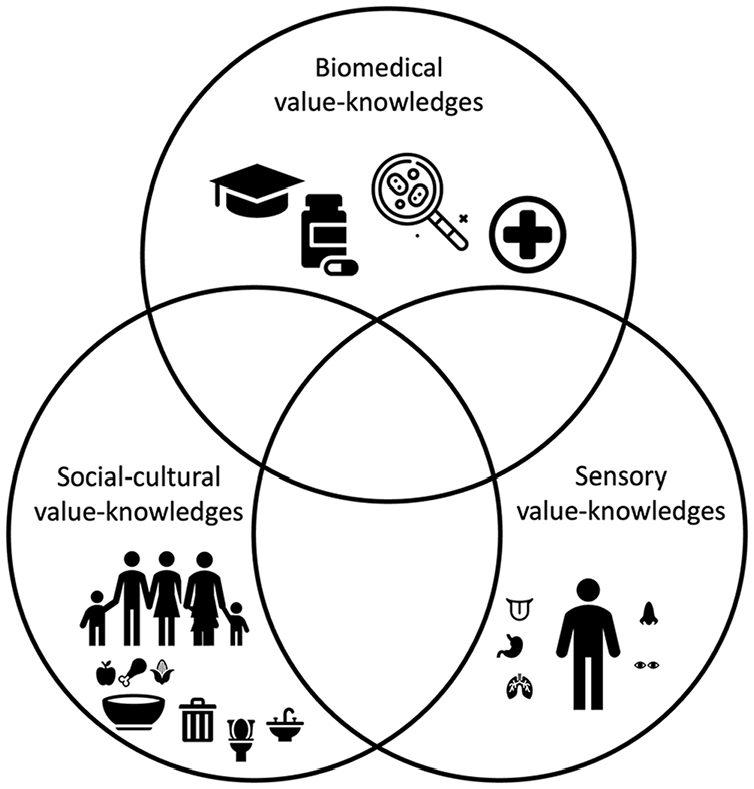
Overlapping value-knowledges.
Students express links between values and knowledge of food and health
In the discussions, students emphasised how knowledge about certain food practices and foods was linked to values of health, as illustrated by the following quotes.
‘For us to be healthy we should have good eating habits’. (Student 51) ‘I want to maintain my good figure so that my peers will accept me’. (Student 38) ‘We are what we eat, if you eat healthy you will be healthy and if you eat junk food you will get ill health’. (Student 74)
In the quotes above, food choices and practices are explicitly linked to values of being in good physical shape and the avoidance of ill health. Being healthy and having a good figure were expressed as valued health goals for which students used knowledge around good eating habits and healthy foods to achieve. Connections between knowing food choices and practices and associated values were also evident in students’ emphasis on good food and a balanced diet in order to have a long life, as seen in the quotes below:
‘Living long and healthy lives we need to have peace of mind, good food and exercise’. (Student 62) ‘I eat a balanced diet so that I don’t get sick, which will make me live long’. (Student 29) ‘Good personal hygiene, good food handling practices and good eating habits can make us healthy and free from diseases’. (Student 6)
The above quotes highlight how the values of longevity, being healthy and free from disease require, according to the students’ discussions, knowledge of how to handle food well, plan and prepare a balanced diet, and good food habits. Furthermore, the choice of certain foods is ascribed value in the discussions as can be seen in the following quotes.
‘Foods that are healthy are the Indigenous foods like fruits (matohwe, matamba, nyii, tsubvu etc.) and vegetables (nyeve, muboora, blackjack etc.), and unhealthy foods are fresh chips, burgers, fizzy drinks, processed foods etc’. (Student 104) ‘We consider food groups, for example, cereals and food groups, meat, fish, nuts which are the body building foods and protective foods which are the minerals’. (Student 5) ‘Refined foods are unhealthy because they do not have fibre which gives us a satiety feeling’. (Student 7)
As shown in the quotes, Indigenous fruits and vegetables were ascribed value and contrasted with other foods that were considered unhealthy, showing how values and knowledges are articulated together in the discussions as opposites of healthy/unhealthy. Meanwhile, students highlighted how having the knowledge to inform food choices does not always translate into practice:
‘At times even if we have knowledge of what to eat, and what not to eat, we have no freedom to do the right thing. As children you just eat what you have been given and what your parents believe in, since us as children have no voice’. (Student 85) ‘Our mothers don’t give us freedom to plan the meals; we just eat what has been cooked due to lack of resources’. (Student 108) ‘Some foods even if we need them most of the times, they are not available’. (Student 61)
As can be seen above, contextual factors beyond the control of students hinder them in realising what they know and value about food in practice. Being minors, students are dependent on the food choices made by parents and family. This limitation on student agency with respect to food is further exacerbated by a lack of resources and the limited availability of diverse foods.
Students enacting constellations of value-knowledges in relation to social environments
Throughout the discussions, students highlighted how their food choices and practices shifted significantly depending on the social setting, whether this be being home with family, taking part in celebrations, or joining peers in town, as exemplified in the following quotes.
‘We eat what is available at home’. (Student 16) ‘When celebrating something, I eat anything’. (Student 2) ‘As a day scholar I just bring my own food from home and buy sweets and chips after school on my way home’. (Student 67)
Together, these quotations highlight how students engage in diverse food practices as they move through different social environments, including geographical dimensions such as being in town or at home, and activity dimensions, that is, studying or celebrating something. This extended to how students viewed health knowledge and values being distributed throughout society, as shown in the following quotes:
‘Health knowledge is found in many places like churches, schools, clinics, etc’. (Student 71) ‘At school, we do topics like personal hygiene, meal planning, good grooming etc. Such knowledge will help us at personal level and as a community’. (Student 25)
Importantly, there was not any singular value-knowledge that came to dominate students’ food choices and practices, but rather multiple sources of knowledge and values were drawn on by students in moving through diverse social environments and encounters in their everyday lives.
Students highlight how relationships with their surrounding social and cultural environments, shift their value-knowledges
Students’ accounts signalled how the constellations of value-knowledges enacted in their food choices and practices shifted in line with their social environment.
‘When we meet out as friends we have fizzy drinks, fresh chips, sweets and chocolates because we rarely eat these at home’.(Student 78) ‘Due to their religious beliefs some [parents] don’t give their children foods like eggs because they believe that they will get sick’. (Student 86) ‘There are certain foods which are eaten by certain people depending on the geographical area. Like harurwa,
3
they are only found in Bikita. Hence only people in Bikita eat them because the rest don’t know them’. (Student 15)
From the quotes, we can show that where students are and with whom they spend time affects how they enact value-knowledges in their food choices and practices such as being with friends in town means having foods rarely eaten at home.
‘On Sunday after church I meet friends in town and have ice cream only and go back home’. (Student 60) ‘I only eat fruit when travelling’. (Student 11)
Discussion
Findings from this study highlight how, as students discuss moving between social groups (family, school, church and peer groups) different value-knowledges were enacted together in constellations influencing food choices (Antwi, 2020; Camfield and Palmer-Jones, 2013). These findings align with those of Cown et al. (2017) who argue for the impact of specific social environments on food choices and practices. Taking this argument further, we drew on Belasco (2008) to position these shifts within the food triangle, highlighting how students have to negotiate between identity, responsibility and convenience (Figure 3) in the choices they make – whether at home, in school, or out with friends.
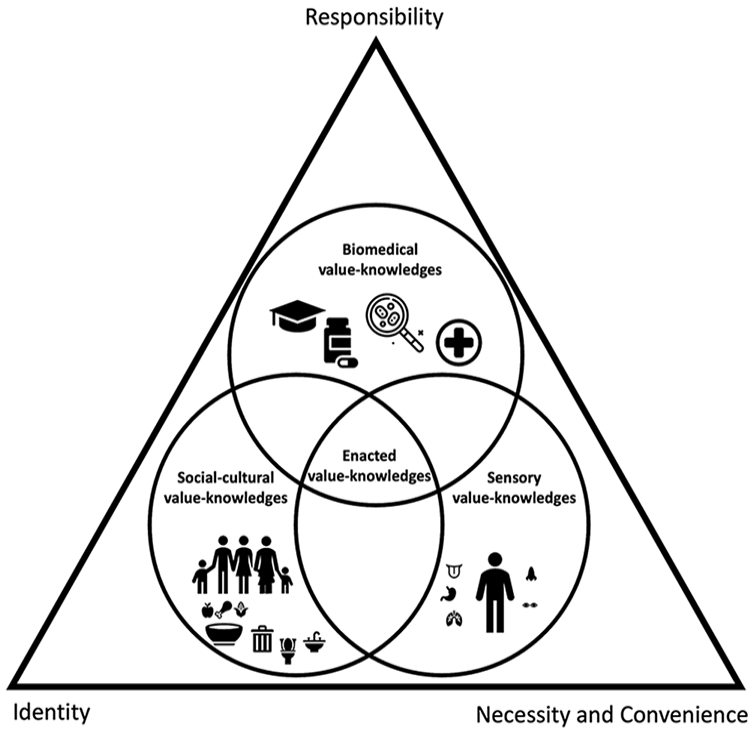
Value-knowledges positioned within the food triangle.
Regarding the social environment of the school, students’ ability to choose food is limited. Day scholars bring food from home, limiting their choice to what is eaten in the family, while boarders’ choices are similarly limited with variation dependent on additions brought from home. In line with Schumacher et al. (2021), Ogundele et al. (2023) and Papadaki et al. (2007)’s work on food practices as social events, what food is eaten where, when and by whom in different contexts is as much the result of social factors and social roles, as bio-medical considerations.
Emerging tensions and value-mobilities
Our findings shows how constellations of value-knowledges shift depending on the social environment, with identity, responsibility and convenience presenting contradictory goals for food and health in the students (Gay, 2018; Hasford et al., 2018). Crucially, these contradictory goals resulted in tensions between bio-medical value-knowledges and the importance of food choices for students’ social lives and social belonging (Irazusta-Garmendia et al., 2023; Moyo and Thow, 2020). The concept of value-mobilities (Figure 4) is helpful in making sense of how students negotiate these tensions, assisting them to live ‘healthy’ lives while moving between social groups and different contexts (Miller and Wyborn, 2020; Pang et al., 2018).
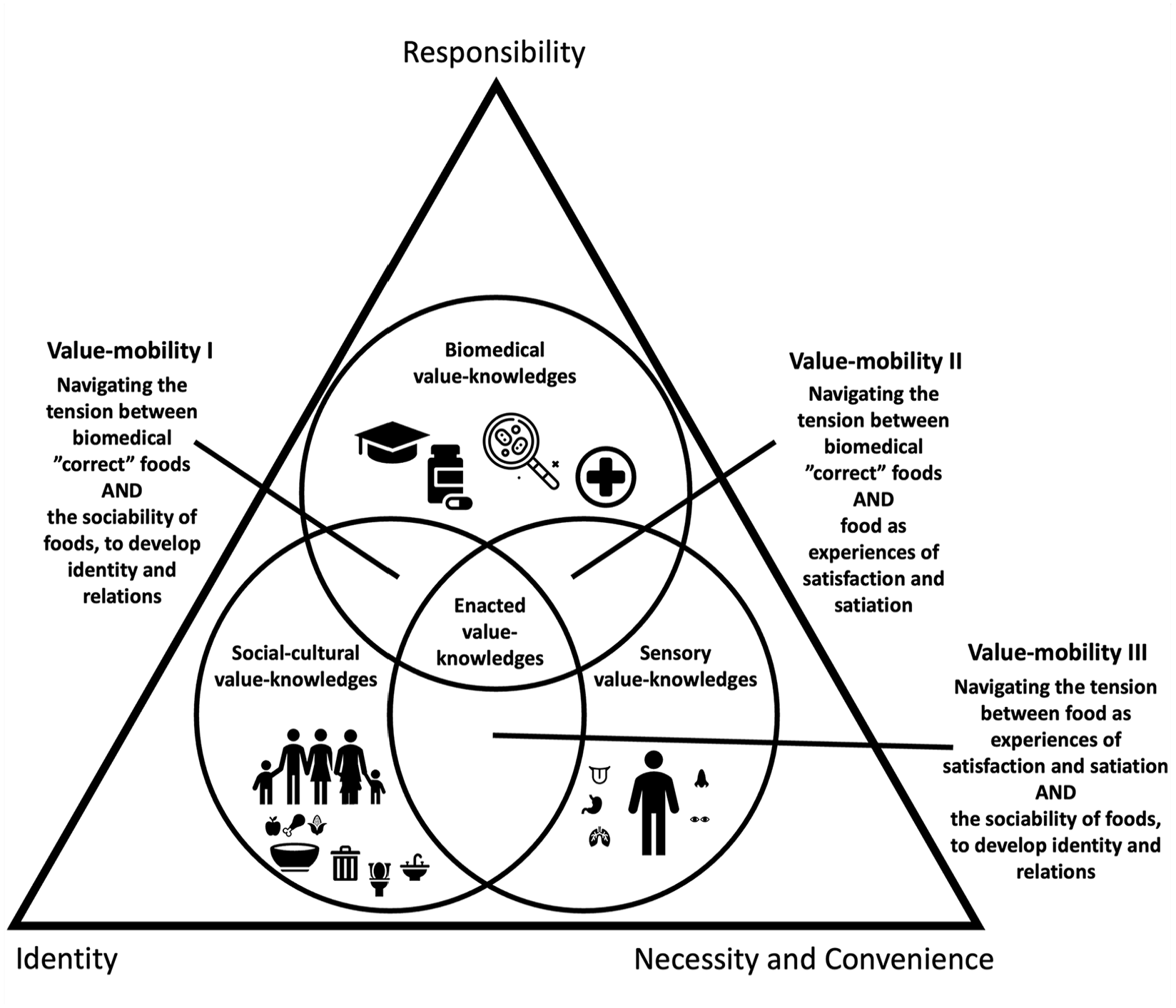
Value-mobilities as students’ ability to navigate tensions between value-knowledges.
Identified value-mobilities
Three value-mobilities were identified in relation to students’ contextual meaning-making and environing. Value-mobility 1 highlights students’ navigation of tensions between nutritional directives (bio-medical value-knowledge) to eat particular ‘correct’ foods and social relations with peer groups, family and community (social-cultural value-knowledges) (Boorse, 1997; Hedegaard, 2016). Value-mobility 2 centres on students navigating tensions between what should be eaten from an instrumentalist nutritional standpoint (bio-medical value-knowledge) and foods which provide a sense of satisfaction and satiation (sensory value-knowledge) (Hasford et al., 2018). Finally, value-mobility 3 shows students negotiating the tension between food satisfaction and satiation (sensory value-knowledge) and the role of food in mediating social relations with family, community and peers (social-cultural value-knowledge).
Food security, food sovereignty and sustainability
The above analysis highlights how value-mobilities provide a way of understanding how students navigate the complexities of food security and food sovereignty in their everyday lives (Kopnina, 2012; Leicht et al., 2018). Informed by the cultural and social significance of food shown in the findings, future educational efforts need to engage with values in relation to food choices and practices in diverse settings. Through the use of an education that acknowledges and engages with value-mobilities, students can be encouraged to engage with and address the cultural and social significance of food through discussion about ethics, social equity and sustainability (in line with SDG 4, Quality Education). Furthermore, by actively integrating topics of food security and sovereignty into the ongoing health education curriculum, schools can encourage students to critically reflect on the social, cultural and environmental implications of food choices and practices in relation to SDG 3 (Good Health and Well-Being).
Conclusion
This paper set out to explore how students’ values and food choices change depending on the social environment and how students come to navigate resulting tensions in food choices and practices, balancing nutrition with social and cultural preferences and sensory experiences. Building on the results of an earlier study (Oljans et al., 2024), the paper shows how constellations of value-knowledges shift across social settings, resulting in tensions between competing health and food goals including bio-medical and nutritional prescriptions, social values and sensory satisfaction. Students thus express health-related goals located in the tensions and trade-offs between responsibility, identity and convenience. To navigate these tensions, students develop value-mobilities, balancing different health and food values, including having enough to eat (food security) and choosing what to eat (food sovereignty). Students’ food choices and practices are thus reflective of the diverse social environments in which they live. The paper’s results encourage us to consider how different sources of knowledge can support young people in navigating the ‘choppy water’ between health and food choices and practices through the enactment of different contextual constellations of health-related value-knowledges.
Footnotes
Acknowledgements
The authors thank Tecklah Usai and Dorothy Chinofunga (Midland State University) for contributing to the design of the study and data collection and the school students for contributing to the research.
Data availability
Anonymised data from this study are available from the corresponding author on reasonable request.
Declaration of conflicting interests
The author(s) declared no potential conflicts of interest with respect to the research, authorship and/or publication of this article.
Funding
The author(s) disclosed receipt of the following financial support for the research, authorship and/or publication of this article: this research was funded as part of the Living with Microbial Roommates: Health literacy capability in antimicrobial resistance education research project, funded by the Swedish Research Council (grant no: 2020-04567).
