




Abstract
Background:
Outdoor play supports physical and psychological health among children and early adolescents (EA; ages 10–14). However, most research to date has focused on younger children (under 10), leaving a gap in understanding the specific barriers and facilitators of outdoor play for EA.
Objective:
This study investigated parental perspectives on the barriers and facilitators of outdoor neighbourhood play for EA in the UK.
Methods:
Eleven parents (ages 30–50, 82% women) from diverse socioeconomic backgrounds participated in semi-structured online interviews. A content thematic analysis, guided by the socioecological model, was used to identify key themes.
Results:
Six key themes were developed: autonomy and independence, social connectedness, the built environment, social development, technology and parental behaviours. While parents recognised the importance of outdoor play for EA, concerns about neighbourhood safety, traffic and inadequate play and recreational facilities were significant barriers. Technology played a dual role: facilitating safety through regular communication but also contributing to sedentary behaviour. Parents also drew attention to lack of community cohesion, which limited their comfort about unsupervised outdoor play.
Conclusion:
Parents valued outdoor play but imposed restrictions due to safety concerns at a time at which EA should be developing independence and autonomy. Addressing these concerns by improved play and recreational facilities, fostering community trust and utilising safe technological solutions such as GPS trackers and apps providing location sharing could enhance outdoor play opportunities for EA. Future programmes and interventions should be tailored to meet the unique developmental needs of members of this age group.
Introduction
Outdoor play can be defined as unstructured physical activity (PA) that occurs in a child’s local community during their free time (Lambert et al., 2019). It is associated with various benefits, including increased PA, improved mental health, socioemotional development, cognitive growth and enhanced motor competence (Dodd et al., 2023; Lambert et al., 2019; Lee et al., 2021). Public health professionals highlight the importance of facilitating outdoor play to promote positive health outcomes and well-being (Pan-Canadian Public Health Network, 2012; Yogman et al., 2018). Among early adolescents (aged 10–14), it has been reported that the greatest proportion of light- and moderate-to-vigorous-intensity movement takes place during outdoor play (Borghese and Janssen, 2019). Therefore, engagement in outdoor play can contribute towards meeting the World Health Organization’s (WHO) PA guidelines of an average of 60 minutes per day across a week of moderate to vigorous PA for maintaining good health (Borghese and Janssen, 2019; Physical Activity, 2019).
Early adolescents are a unique group, as this developmental stage marks a transition towards greater independent mobility and unsupervised outdoor play (Dodd et al., 2021a). Parental influence has a significant role to play in shaping opportunities for outdoor play, even as EAs gain more autonomy (Ferrao and Janssen, 2015; Veitch et al., 2010). However, despite the critical role of parents in facilitating or restricting these activities, there is limited research exploring the specific barriers and facilitators that parents perceive when it comes to EA outdoor play (Boxberger and Reimers, 2019; Oliver et al., 2022). Understanding parental perspectives may help identify factors influencing whether EAs engage in sufficient outdoor PA, which can significantly impact their health, well-being and socioemotional development.
Today’s EAs spend roughly half the time playing outdoors as their parents in the UK, signalling a generational shift (Scott et al., 2022). Similarly, 70% of mothers surveyed in the USA stated they played outdoors daily when they were children, whereas only 31% of their children reported doing so (Clements, 2004). This decline in outdoor play may be explained by parental concerns surrounding busy roads, perceived neighbourhood safety and lack of time and accessibility (Nesbit et al., 2023) leading to imposed restrictions on children to engage in outdoor play. However, recent studies suggest these concerns may be less relevant for older children, such as EAs, who enjoy greater autonomy and independence (Lambert et al., 2019; Sawyer and Azzopardi, 2018). This change in parental attitudes reflects the evolving dynamics of outdoor play as children grow older, highlighting inconsistencies in the literature and the need to address the role of parents in facilitating outdoor play in different ages and developmental stages (Boxberger and Reimers, 2019; Khozaei and Carbon, 2022).
Much previous work investigating factors affecting neighbourhood outdoor play (Lambert et al., 2019) is grounded in Sallis et al.’s (2006) socioecological model. The socioecological model emphasises the need to address all contributing factors simultaneously in order to influence outdoor play and PA. The socioecological approach seeks to analyse complex interactions between individual, interpersonal, organisational, community and policy-level factors that shape behaviours and health outcomes (Sallis et al., 2006, 2015). The model provides a basis for investigating parental perceptions of outdoor play (Mehtälä et al., 2014). Examining the multiple levels of influence identified through the model on parents’ choices may help explain EA outdoor play opportunities, offering valuable insights into the barriers and facilitators of outdoor play (Piggin, 2020).
While much existing research has focused on younger children, the EA stage remains relatively underexplored despite its significance as a time of developmental change and transition (Boxberger and Reimers, 2019; Dodd et al., 2021b; Oliver et al., 2022). This study addresses this gap by investigating the barriers, facilitators and perceived benefits of outdoor play from the parents’ perspective. Doing so seeks to enhance understanding of parents’ role in shaping outdoor play opportunities for EAs as they become more independent. The insights generated from this research may inform future interventions promoting outdoor play and PA among EAs, ultimately contributing to healthier individuals and communities.
Methodology
Recruitment
Recruitment to this study occurred in autumn 2023 through an online poster distributed to UK-based parenting groups, local schools in the Midlands and North West of England, social media platforms and the Wolverhampton University page. Inclusion criteria stated participants must understand English, care for and be legally responsible for an adolescent aged 10–14.
Interested participants (n = 22) were asked to use a QR code on the poster to obtain study details from the researcher – information sheets, consent forms and the lead researcher’s contact information. To ensure explicit and comprehensive reporting, the consolidated criteria for reporting qualitative research (COREQ, see online supplemental file) were used to guide the reporting process (Tong et al., 2007).
Conceptual/theoretical approach
To ensure the participants’ perspectives were captured, a relativist-interpretivist approach (Pope et al., 2000; Smith and Phoenix, 2019) was utilised. This allowed the researchers to explore the subjective experiences of parents, acknowledging that their perceptions of outdoor play and its associated barriers and facilitators may vary by their backgrounds, beliefs and contexts. By adopting this perspective, the study aimed to provide a deeper understanding of how parents interpreted and made sense of their children’s outdoor play in specific settings.
Interview questions, consent and ethics
Interview questions were developed, drawing inspiration from existing literature exploring parental perceptions of outdoor play in younger children (Boxberger and Reimers, 2019; Dodd et al., 2021b). Interviews followed a topic guide (available from the corresponding author on request) consisting of open-ended questions that aimed to explore parental perceptions of outdoor play in EA. Questions focused on examining changes in play habits, perceptions of neighbourhood safety, available resources (such as sports pitches and youth clubs) and the role of the community in supporting outdoor play, for example.
All consenting participants selected a convenient interview time and date, and invitations were sent to them via Microsoft Teams. No predetermined demographic criteria were utilised in sample selection, which worked on a first-come, first-served basis until saturation was achieved. The study protocol, including recruitment procedures and materials, interview guide and proposed analysis, was reviewed and approved by the University of Wolverhampton ethics committee (UoW 2301136 2023).
Data collection
Data were collected using Microsoft Teams, a recognised approach to ensure consistent outcomes compared to face-to-face interviews (Gray et al., 2020). The first author (L.J.C.) was trained in qualitative data collection and supervised by the second and third authors (A.C. and H.M.) who have published in similar areas. The first author is a female parent who had no relationship to participants. Interviews were conducted until data saturation was reached (n = 11). Saturation was determined when no new information or codes emerged, and redundancy of themes was observed (Braun and Clarke, 2021; Hennink and Kaiser, 2022; Saunders et al., 2018). Interviews began by the interviewer introducing themselves, emphasising participants’ ability to pause the recording and the voluntary nature of the interviews. The study’s purpose was reiterated, and participants were invited to ask questions; the open-ended nature of questions facilitated rapport (DiCicco-Bloom and Crabtree, 2006). Interview duration varied based on participant responses and availability (M = 18.12; SD = 5.88 minutes). Interviews were audio-recorded, transcribed verbatim by the first author, anonymised (participants were assigned a code, P1–P11) and crosschecked by the lead author. Demographic information, including age, date of birth and postcode, was gathered at the beginning of each interview.
Data analysis
Eleven semi-structured interviews provided three sources of data: frequency counts, coded data and verbatim quotes. These data were pooled to explore and expand upon emergent themes (Cox et al., 2021). Qualitative analyses were conducted using NVivo version 12. Open-ended responses were reviewed, aggregated and organised into recurring topics to enable systematic analysis. The analysis adopted a relativist-interpretivist approach (Pope et al., 2000; Smith and Phoenix, 2019), acknowledging that participants’ realities as subjective and shaped by their social contexts.
A thematic analysis was undertaken following the procedures outlined by Braun and Clarke (2006). Data were reviewed repeatedly, and a deductive approach was used to generate codes aligned with the socioecological model (Sallis et al., 2006). Codes were iteratively refined into themes through collaboration between the first and second authors, achieving a minimum 90% agreement level (McAlister et al., 2017; O’Connor and Joffe, 2020; Roberts et al., 2019).
Frequency counts were conducted to establish the consistency of themes. Higher- and lower-order themes and participant quotations were summarised visually using the pen profile approach, which highlights key patterns while avoiding over-representation of minority views. Verbatim quotations were included to validate participant responses and enhance interpretive depth. The transparent and iterative analysis process sought to ensure trustworthiness and provided a clear audit trail (Nowell et al., 2017).
Findings
Eleven parents (aged 40.63 ± 5.20 years) of EA (aged 10–14) participated. All participants were English-speaking UK residents. Their principal characteristics are shown in Table 1.
Participants’ characteristics.
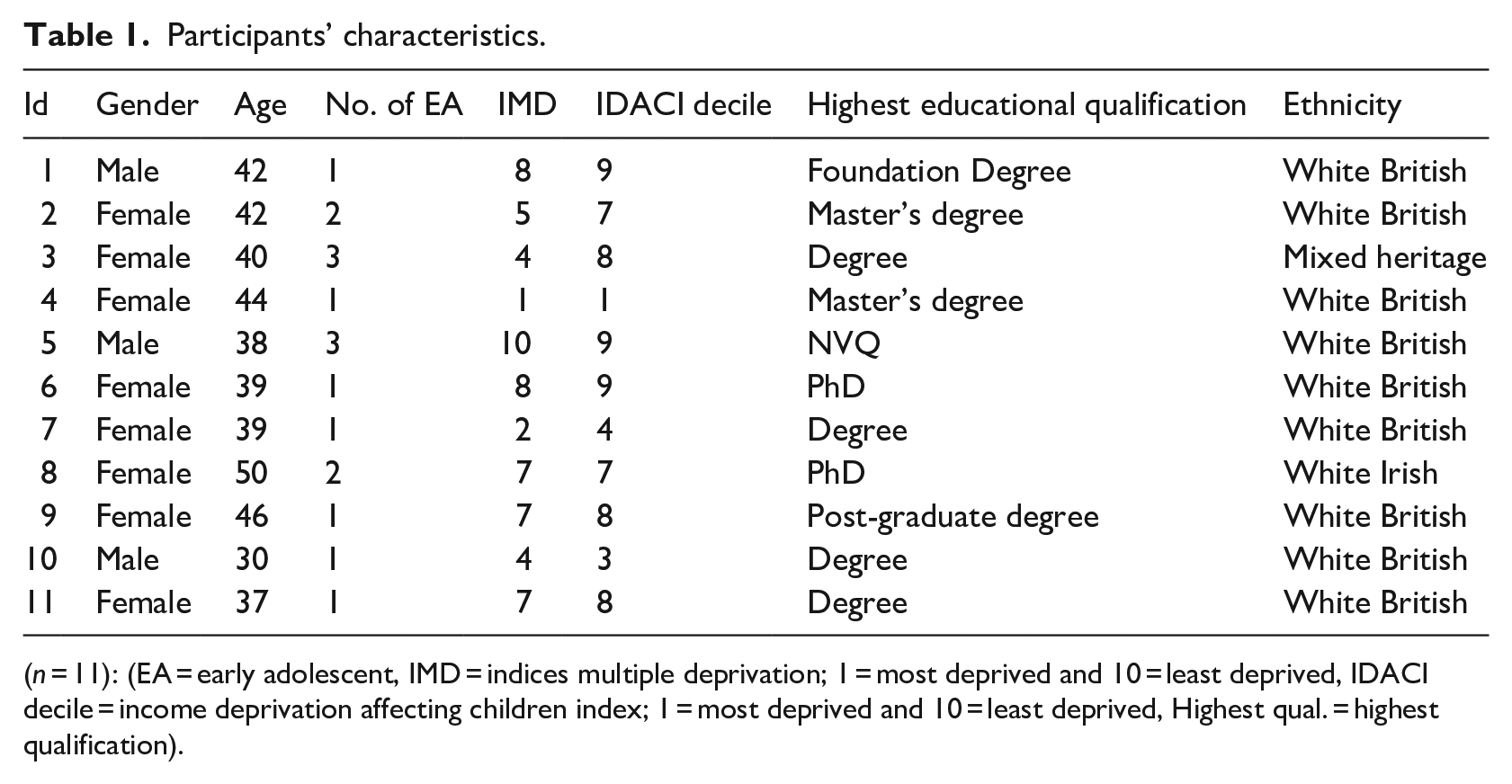
(n = 11): (EA = early adolescent, IMD = indices multiple deprivation; 1 = most deprived and 10 = least deprived, IDACI decile = income deprivation affecting children index; 1 = most deprived and 10 = least deprived, Highest qual. = highest qualification).
Six sub-themes were developed from participant’s responses to the question asked within the framework of the socioecological model (Sallis et al., 2006). They focused on autonomy and independence, social connectedness, built environment, social development, technology and parental behaviours. They are illustrated in Figures 1 and 2.
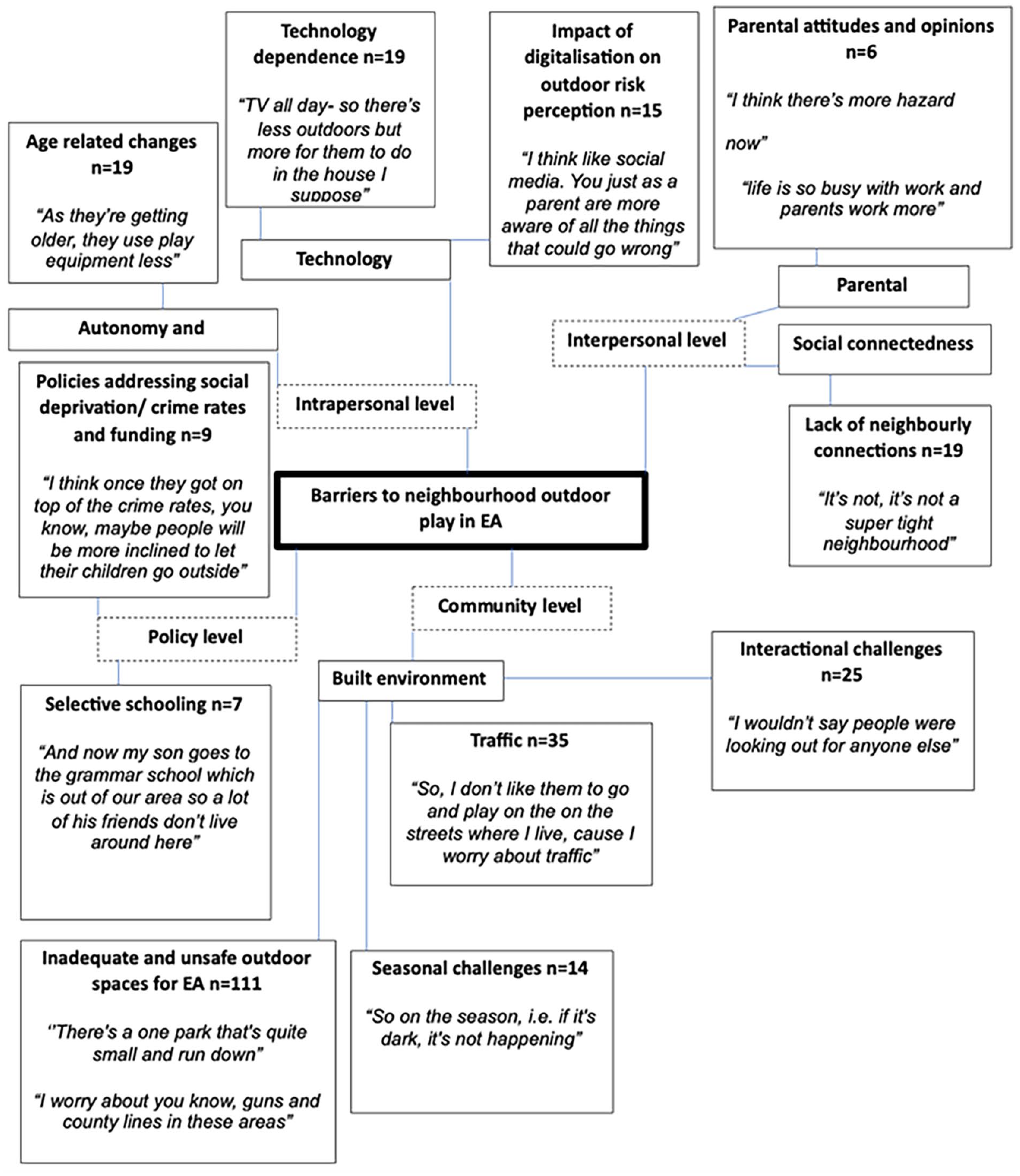
Barriers to neighbourhood outdoor play. Broken lines indicate the socioecological model levels.
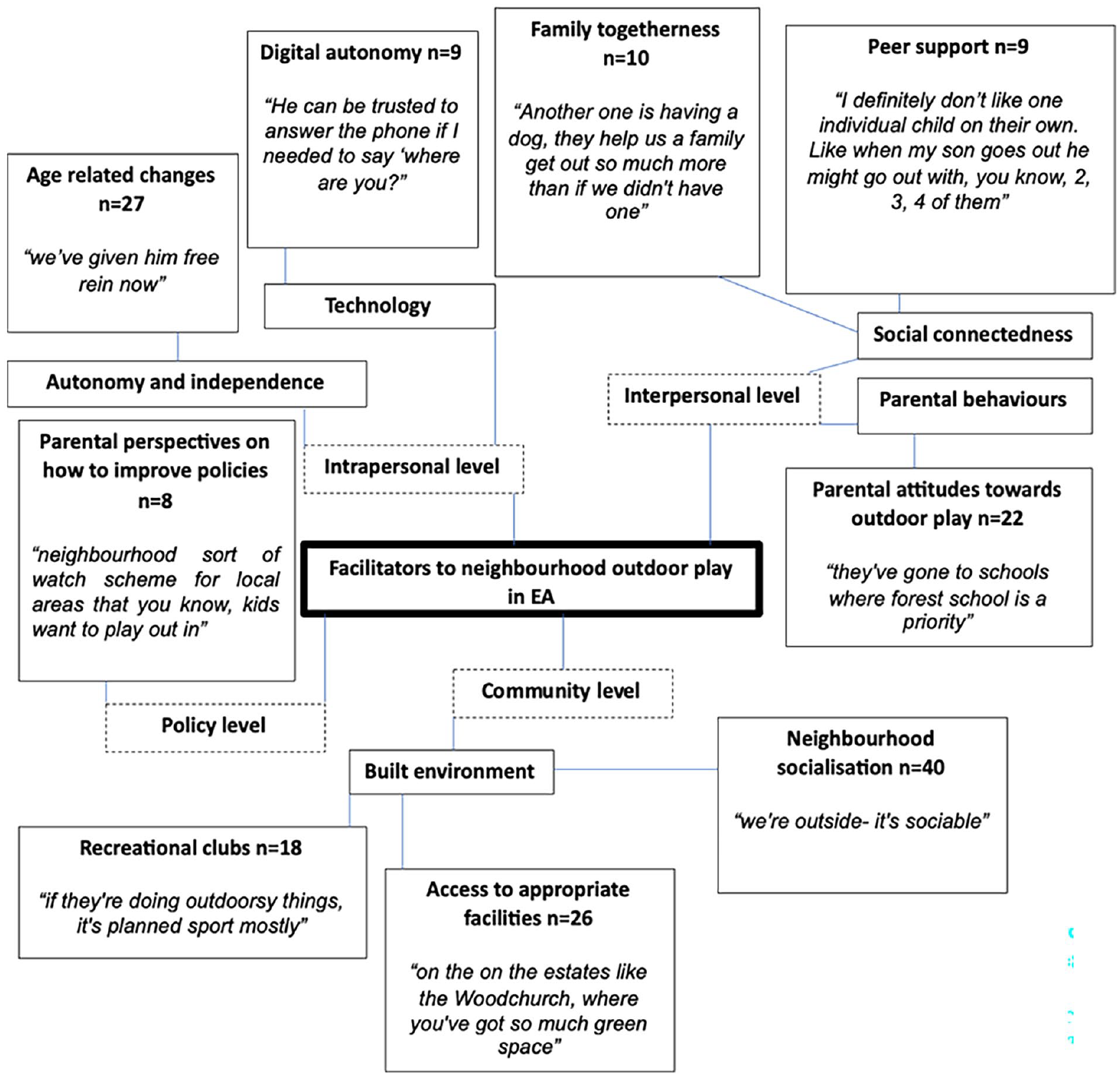
Facilitators of neighbourhood outdoor play. Broken lines indicate the socioecological model levels.
Intrapersonal level
A subtheme of autonomy and independence was developed from parents’ discussion on EA outdoor play. Participants described age-related changes as potential enablers of outdoor play, with 8 out of 11 (P3, 5, 6, 7, 8, 9, 10 and 11) supportive of more freedom for their EA children. However, some parents (P4, 6, 7, 11) also viewed age-related changes as obstacles. Although most parents recognised the importance of independence, they encountered challenges supporting it. One parent (P4) noted negative aspects, centred on trust and peer pressure, without recognising benefits of independence. Technology was seen as both a facilitator and a barrier, with over half of parents (P1, 3, 6, 7, 9, 11) seeing digital autonomy, such as phones, mobile applications and messaging as beneficial for adolescent independence. However, many parents (P1, 3, 4, 6, 7, 8, 9, 11) identified technology, particularly social media and online games, as hindering outdoor play. In addition, parents (P2, 3, 5, 6, 7, 8, 11) pointed to digitalisation’s role in heightening adults’ risk perceptions of outdoor play, influenced by local news and social media, which adversely affected parental decisions to allow independent play.
Interpersonal level
A subtheme of social connectedness was observable in some parents’ (P1, 3, 4, 7, 9) preference for family outings to promote outdoor play with supervised rather than independent activities. Other parents (P1, 5, 10) noted the positive role of peer connection in encouraging neighbourhood outdoor play, with children feeling more comfortable when accompanied by friends. However, parents (P2, 3, 4, 5, 7, 8, 9, 11) also reported their children feeling disconnected within their neighbourhood, attributing this to a lack of age-similar peers and perceived community division, often connected to generational gaps.
Most parents (P2, 3, 4, 5, 6, 7, 8, 10, 11) were uncomfortable with their children playing independently outdoors, often discouraging or preventing it due to safety concerns. One parent (P3) cited the rapid pace of modern life as a barrier to facilitating outdoor play. Over half of parents (P1, 6, 7, 8, 9, 11) actively encouraged community socialisation and PA by engaging in organised family activities or community-based club events, prioritising these over unsupervised neighbourhood play.
Community level
Perceived barriers to outdoor neighbourhood play included inadequate and unsafe spaces, traffic concerns, seasonal and interactional challenges. All parents cited these issues as deterrents to independent play, with specific safety concerns being expressed about strangers, traffic, antisocial behaviour and dog attacks. A perceived decline in community cohesion was noted as an interactional challenge, with one parent (P8) reminiscing about the time when neighbourhoods were more closely knit.
From a facilitative perspective, neighbourhood socialisation such as BBQs, sports events, group walks and community or street parties were viewed as opportunities to build connections and promote outdoor play. Many parents enrolled EAs in recreational clubs such as organised football to address safety issues. Despite this, most parents felt that affordable and age-appropriate recreational options were insufficient, often necessitating travel to different parts of the town or city for suitable activities.
Policy level
The theme of policy identified negative and positive aspects. All the parents interviewed offered suggestions for strengthening outdoor neighbourhood play policies such as creating more age-appropriate outdoor spaces for EA. Most parents also pointed to the effects of existing policies – or lack thereof – such as social deprivation, high crime rates and inadequate funding which they felt hindered outdoor play opportunities. Notably, the one parent who did not identify shortcomings of this nature had one of the highest IDACI scores (9). Conversations with parents also revealed that selective schools, cited as a barrier to outdoor neighbourhood play by some, may necessitate a local and national policy-level re-evaluation by Government and Department for Education.
Discussion
Outdoor play improves EA health and development (Bento and Dias, 2017). In Western societies, diminishing opportunities for EA to access and actively participate in outdoor play raises concern for their physical and mental well-being (Bento and Dias, 2017). Recognising the role of parents in shaping opportunities, this study used qualitative methods to investigate parental perspectives on barriers and facilitators of outdoor play for EA. The aim was to gather contextual information to inform the development of strategies to promote outdoor play among EA. While parents identified various barriers and facilitators across all levels of the socioecological model (Sallis et al., 2015), it was clear that community-level concerns, particularly about safety, traffic and inadequate outdoor spaces, played a predominant role. The concerns raised by parents often resulted in restrictions on the independence and autonomy of EA.
Intrapersonal barriers and facilitators
Parents in this study emphasised the importance of fostering autonomy and independence in their EA, noting that this developmental stage presents opportunities and challenges. As one parent expressed, ‘You’ve got to let them go some time’ (P6). This sentiment aligns with research examining the development of autonomy during adolescence alongside expanded social relationships and decreased dependence on parents (Aviezer et al., 2002; Murphy et al., 2008). However, parents in the study also expressed reluctance to fully embrace this shift, particularly in neighbourhoods perceived as unsafe. Indeed, many parents restricted the independence and autonomy of their EA regarding outdoor play, with potentially negative implications for their physical and social development. One of them commented, ‘I don’t want the kids to be out on their own unsupervised’ (P4). This insight extends previous research suggesting that in environments with elevated risks such as heavy traffic, it is right for parents to adopt a gradual approach to granting autonomy to EA (Allen and Loeb, 2015). The cautious approach detailed in previous research and found in this study may explain the decline in outdoor play among EA (Clements, 2004; Dodd et al., 2021a; Scott et al., 2022).
Technology was seen as a factor facilitating and hindering independence and autonomy. Some parents noted that mobile phones allow for enhanced communication, thereby supporting independence and autonomy. This finding is consistent with those of Blum et al. (2022), who found that mobile devices provide a sense of security for parents and EA, enabling more independent exploration (Blum et al., 2022). However, many parents also expressed concern about technology promoting sedentary behaviour (SB). ‘It’s very much they’re sitting there on the swings but they’re taking selfies’ (P11), highlighting how the overuse of technology may detract from PA (Tremblay et al., 2017). Future research is needed to investigate how to promote safety through technology while encouraging PA and active outdoor behaviour. While some studies, such as those leveraging augmented reality through games like Pokémon Go, show promise in using technology to improve PA and psychosocial outcomes in early adolescents, further work is needed to adapt these interventions to diverse cultural and age-specific contexts (Winand et al., 2022).
Interpersonal barriers and facilitators
Social connectedness in the neighbourhood was influential in shaping EA outdoor play opportunities. While parents acknowledged the benefits of outdoor play for their EA, some felt disconnected from their neighbours, which affected their willingness to allow unsupervised play. One parent remarked, ‘In my neighbourhood specifically? I don’t feel safe for [it], and I’m not one of those parents who is super worried’ (P3). This lack of neighbourhood trust mirrors earlier findings (Parent et al., 2021), showing that young children whose parents trust their neighbours are more likely to engage in daily outdoor play. Regardless of the children’s age, strengthening social ties and increasing trust between neighbours may foster a safer and more supportive environment for outdoor play.
Some parents saw the potential for technology to facilitate social connection within the community. For example, one participant suggested, ‘maybe they could link it to some kind of app they play with friends, where they get so many points to basically, you know, encourage physical behaviours’ (P11). Future studies could examine how digital tools can enhance social cohesion while promoting outdoor play and PA.
Community barriers and facilitators
The community level was seen as generating the most frequent barriers, with problems such as inadequate space, busy traffic and safety concerns repeatedly mentioned. One parent said, ‘I feel like when I grew up it just felt like it was safer’ (P11), reflecting the belief that communities were once more cohesive and supportive. Research has long documented decreased perceived community safety and social cohesion (Schiefer and van der Noll, 2017). Moreover, neighbourhoods perceived as unsafe may discourage parents from allowing their EA to play outside; this aligns with research suggesting adolescent’s low perceptions of neighbourhood safety are negatively associated with PA (Lenhart et al., 2017).
Parents in this study expressed particular concern about road traffic, echoing previous studies that have identified traffic as a significant barrier to children and young people’s participation outdoor play (Lambert et al., 2019). Some participants suggested that cul-de-sacs or other low-traffic areas provide safer spaces for their EA to play. While interventions such street closures have shown potential to facilitate safer outdoor environments (Umstattd Meyer et al., 2019), further research is needed to explore how these may be scaled up so as to influence parental attitudes towards safety. Future interventions should be age-appropriate, designed with input from EA and aligned with recognised models of PA promotion to ensure they perceive the activities as valuable and accessible within the context of outdoor play.
In addition, seasonal changes such as winter darkness further exacerbated parents’ concerns about safety. This finding aligns with research that suggested seasonal variations significantly affect outdoor play, leading to lower PA and reduced psychological well-being (Garriga et al., 2021). Future research should explore opportunities such as enhanced outdoor lighting to address safety concerns; this may mitigate these seasonal challenges leading to higher PA and enhanced psychological well-being.
Policy implications
At the policy level, parents highlighted the need for intervention to address social deprivation, crime and traffic safety. A parent who resided in one of the top 10% of least deprived areas in England stated, ‘I’ll let the children be children, and they can go out as much as they want within the local area’(P5). While other parents in more socially disadvantaged areas were more hesitant to allow their children the same level of freedom. This discrepancy highlights the impact of socioeconomic factors on parents’ decisions regarding outdoor play (Oliver et al., 2022). Policymakers should consider tailored interventions that address the unique challenges experienced in socioeconomically disadvantaged neighbourhoods. For example, community-driven solutions that increase access to safe play spaces, reduce traffic and enhance neighbourhood safety could improve outdoor play opportunities in these areas. In this study, all the parents suggested a need for a wider variety of age-appropriate activities and clubs that were either partially or fully funded to support outdoor play. Barriers documented could be addressed by increasing appropriate and safe outdoor space and through traffic calming measures. One parent (P7) indicated they would welcome street closures at certain times of the day to allow play that was not interrupted by heavy traffic.
Study strengths and limitations
This study’s key strength lies in its use of qualitative methods to gain a deep, contextualised understanding of parental perspectives on outdoor play for early adolescents. The systematic and comprehensive thematic analysis allowed for identifying nuanced patterns within the data, offering rich insights into the barriers and facilitators that parents perceive. To ensure rigour and transparency, the COREQ (Tong et al., 2007) was used as a standardised checklist for the reporting of this study.
However, some limitations should be acknowledged. The sample, although diverse in some respects, was small and the majority of participants lived in England. Self-selection bias likely occurred, as those who participated in the study were keen to share their views. Future research would benefit from a more geographically balanced sample to explore potential urban, peri-urban and rural variations in parental perceptions of outdoor play.
Data saturation was achieved during interviews, although engagement with a more socioeconomically and geographically diverse range of participants would have enhanced the richness and diversity of insights (Braun and Clarke, 2021; Saunders et al., 2018).
Conclusion
This study addressed a gap in the literature by focusing on barriers and facilitators of outdoor neighbourhood play for EAs, a group often overlooked in previous research. While parental perspectives on outdoor play have been explored, most prior studies have focused on younger children. Our findings showed that although EAs may be offered a degree of independence, parents’ concerns about safety, neighbourhood issues and community trust resulted in restrictions to outdoor play which may impact EA independence and negatively impact PA opportunities and socioemotional development.
Technology emerged in this study as both a facilitator of independence and a barrier to PA, with mobile devices offering security but also seen as contributing to SB. In addition, the local environment and social connectedness influenced outdoor play differently for EAs compared to younger children, with the threat (imagined or real) of antisocial behaviour and a lack of social connectedness leading to restrictions in EA outdoor play. To promote outdoor play for EAs, future programmes and interventions should address safety concerns, build on technology’s positive affordances and create age-appropriate environments that are supportive of independent play.
Footnotes
Declaration of conflicting interests
The author(s) declared the following potential conflicts of interest with respect to the research, authorship and/or publication of this article: Helen Morley was funded by a National Institute for Health Research (NIHR) Manchester Biomedical Centre (BRC) PhD studentship (NIHR203308).
Funding
The author(s) received no financial support for the research, authorship and/or publication of this article.
