



Abstract
Background:
The transition to adulthood may involve experiences of risk and harm – including, for some young people, abuse, violence or exploitation in peer and community contexts. In the UK, such extra-familial risks and harms have prompted safeguarding responses in policy and practice. However, safeguarding conceptualisations are significantly different for young people under 18 than for those over 18, leading to service and system gaps in transition. The concept of Transitional Safeguarding seeks to address this, advocating for more integrated approaches that centre the needs, voices and lived experiences of young people.
Objectives:
Based on findings from a study on early-stage innovation developments aligned with Transitional Safeguarding, this paper considers issues and dilemmas linked to reconceptualising ‘safeguarding’ so as to better protect young people experiencing extra-familial risks and harms during transition to adulthood.
Methods:
A 4-year study followed safeguarding innovation developments in selected local areas in England, based on a qualitative case study approach that involved ethnography, interviews and documentary analysis.
Findings:
The paper highlights gaps in safeguarding services and systems for young people around age 18, when support may either significantly decrease or stop altogether. The intersecting dynamics of risks, harms and unmet needs point to the importance of multi-agency collaboration, beyond service-centric threshold definitions. The need to systemically and systematically involve young people in support and innovation development is also emphasised.
Conclusions:
The boundary-spanning change which the Transitional Safeguarding approach advocates requires significant shifts to create conditions capable of addressing risks and harms during transition to adulthood, as well as their structural drivers. Navigating these shifts remains a key challenge for local services and systems engaged in Transitional Safeguarding innovation, and their efforts need to be supported by policy frameworks and adequate funding.
Keywords
Introduction
This paper considers issues and dilemmas involved in reconceptualising ‘safeguarding’ for young people experiencing risks and harms beyond the family home during transition to adulthood. The term ‘extra-familial risks and harms’ denotes a range of – often interconnected – issues that include sexual exploitation; criminal exploitation (particularly related to drug selling or trafficking, including through so-called urban-to-rural ‘county lines’ of distribution); serious physical violence among young people; and peer-on-peer abuse (Firmin et al., 2022; HM Government, 2018; Yeo et al., 2023).
In the UK, over the past 15 years, such risks and harms have been increasingly recognised as safeguarding and welfare concerns for young people under 18, thus extending the traditional remit of children’s safeguarding beyond intra-familial harm (Firmin et al., 2022; Hanson and Holmes, 2014). Recent decades have also seen significant changes in constructions of adolescence, with neuro-psycho-social developmental and role transitions associated with adulthood (e.g. leaving home, entering employment) recognised as continuing into the mid-twenties and beyond (Sawyer et al., 2018). Experiences and contexts of transition to adulthood are individually unique and influenced by intersecting structural inequalities within and across societies (Arnett, 2016). As such, young people’s experiences of risks and harms do not follow binarised notions of childhood and adulthood, often continuing beyond their 18th birthday. However, the UK landscapes of children’s and adults’ safeguarding and support policies, practices and systems remain largely separate (Holmes, 2022, Cocker et al., 2024).
This paper draws on findings from a 4-year research project (The Innovate Project, 2024) on social care innovations in systems and service responses to extra-familial risks and harms during adolescence and into young adulthood. Our qualitative research study followed early-stage innovation in selected localities in England based on Transitional Safeguarding, an emergent approach which advocates for more integrated and fluid approaches to safeguarding across adolescence and into adulthood (Holmes and Smale, 2018). This approach critiques the binary framing of UK statutory child and adult safeguarding systems, neither of which were designed to reflect young people’s needs. For young people experiencing extra-familial risks and harms, interventions offered (or mandated) by children’s social care services typically end at the age of 18. Transitional Safeguarding proposes multi-agency, whole-systems change which reframes safeguarding from service-centric, thresholds-based interventions towards collaborative action that responds to experiences of risks and harms with young people and their communities (Holmes, 2022). This perspective centres young people’s own definitions of safety and well-being.
This paper considers three key issues identified as part of this work: (1) the ‘transitional gap’ around 18 in safeguarding and support systems for young people experiencing extra-familial risks and harms; (2) the intersection of (unmet) needs, risks and harms, underlining the significance of ‘whole-system’ approaches; and (3) dilemmas related to locally negotiating and navigating Transitional Safeguarding systems change, responding to both acute risks-harms and well-being-prevention needs in resource-constrained contexts. The paper concludes by reinforcing the call for approaches that resist framing safeguarding through binary ‘child-versus-adult’ or ‘risks-versus-needs’ perspectives. It advocates for further work at local levels that engages a range of sectors and centres young people’s voices and expertise more systematically, along with collaborative efforts, beyond local levels, to address structural harms and provide adequate resourcing for young people, communities and public services.
Background
Safeguarding and extra-familial risks and harms: gaps and contradictions across policy and practice
In the UK, specifically England, the term ‘extra-familial risks and harms’ emerged in the 2010s within children’s safeguarding policy and practice, which hitherto had more exclusively focused on parental responsibility for intra-familial harms, often in respect of younger children (Cocker et al., 2024; Firmin et al., 2022). Public inquiries into service failures to safeguard young people who had been sexually exploited prompted reviews and innovations at systems, conceptual and practice levels (Firmin et al., 2022; Hanson and Holmes, 2014), with Contextual Safeguarding (Firmin et al., 2016) a notable innovative approach. Thus, the concept of ‘extra-familial’ harms (HM Government, 2018) responds to previous failures in children’s safeguarding policy and practice to recognise and address harms beyond the family home. In contrast, adult safeguarding, a much newer concept, roots back to concerns about abuse in institutional and community care settings – often extra-familial contexts. Guidance to the Care Act (2014) considers a non-exhaustive list of examples and patterns of abuse and neglect, acknowledging that these often involve exploitation, without describing these as ‘extra-familial’ harms (Department of Health and Social Care, 2024). However, statutory adult safeguarding duties focus exclusively on risks experienced by adults who need ‘care and support’ in connection with physical, cognitive or mental impairment or illness, thus limiting the range of young people over the age of 18 considered within the remit of statutory interventions (Cocker et al., 2024). These differences in how risks and harms are framed and responded to in policy and practice not only lead to terminological and conceptual issues for professionals working in different safeguarding contexts but also create significant systems and service gaps for young people in transition to adulthood.
Exploring these differences and systemic complexities provides potentialities for unsettling some of the binary conceptualisations and contradictions that have marginalised young people (under and over 18) and their experiences (Huegler and Ruch, 2022). Dichotomised constructions of agency and vulnerability can lead to young people being divided into passivised ‘perfect victims’ or responsibilised and blamed for their own abuse, ignoring the complex dynamics of extra-familial harms, whereby exploitation may intersect with what young people perceive as material or relational ‘gains’ (Beckett, 2019; Firmin et al., 2022; Yeo et al., 2023). Even for young people under 18, contradictory policy contexts may simultaneously mandate safeguarding and criminal punishment responses (Lloyd et al., 2023). Safeguarding responses that overemphasise risk avoidance may veer into control and surveillance, perpetuating rather than relieving harm and trauma (Billingham and Irwin-Rogers, 2022; Wroe, 2022). Factors such as gender, race and ethnicity, class, sexuality, disability and (significantly in transitional contexts) age influence whether young people are met with welfare-based responses or with stigmatisation and potential criminalisation (Billingham and Irwin-Rogers, 2022; Cocker et al., 2024; Firmin et al., 2022; Yeo et al., 2023). Black and minoritised young people are particularly at risk of adultification, based on misguided professional assumptions about their maturity, agency and responsibility (Davis, 2022). Such marginalising experiences are likely to erode young people’s trust in professionals. They also point towards tendencies, across policy and practice, to conceptualise young people’s vulnerability primarily as an embodied status (based on age or recognised ‘care and support needs’) rather than as (also) arising from specific contexts and situations (Huegler and Ruch, 2022).
Transitional Safeguarding: beyond eligibility thresholds
Transitional Safeguarding is ‘an approach to safeguarding adolescents and young adults fluidly across developmental stages which builds on the best available evidence, learns from both children’s and adult safeguarding practicem and prepares young people for their adult lives’ (Holmes and Smale, 2018: 3). Rather than using a fixed model, it proposes change based on local circumstances and needs, following a set of six key principles that envision: (1) contextual, (2) developmentally attuned and (3) relational safeguarding responses to promote well-being throughout the life course, which are (4) evidence-informed, (5) attending to issues of diversity, equity, equality and inclusion, through (6) participation and co-production, directly involving young people and their communities, as well as a variety of organisations and sectors (Cocker et al., 2024). These key principles are also well aligned with what evidence reviews in recent years (e.g. Firmin et al., 2022; Yeo et al., 2023) have identified as effective features of practice and system responses to extra-familial harms. Such features include a focus on collaboration and choice; partnership working with support and family networks; and creating safer spaces and places for young people.
Transitional Safeguarding draws on key rights-based and participatory principles inherent in both children’s and adult safeguarding policies (including, for example, empowerment and personalisation through the Making Safeguarding Personal approach for adults; Cocker et al., 2021, 2024). The term ‘transitional’ here refers both to life-course perspectives and to the collaborative work needed to span boundaries between (often siloed) services and systems – including social care, health, education, youth work, youth and criminal justice, housing as well as voluntary and grassroots organisations (Holmes, 2022). The approach has been taken up and begun to be applied in different local areas and sectors over recent years, involving diverse cohorts of young people (Cocker et al., 2024). For example, Winterbottom et al. (2023) outline the particular contributions which the health sector can make to preventive and well-being-focused perspectives as part of Transitional Safeguarding, given its universal and life-course spanning approach.
Transitional Safeguarding addresses conceptual, policy, systemic and practice level boundaries and contradictions not just in relation to child-adult divides, but also by transcending ‘traditional notions of both >transitions< and >safeguarding<’ (Department of Health and Social Care, 2021: 10). Holmes (2022: 8–9) notes that safeguarding has been considered predominantly through the lens of statutory duties, ‘as a noun – a threshold to be reached, a place that many people cannot access despite their safety being undermined’ and proposes that instead it should be thought of ‘as a verb – something to do with a person when their safety is undermined’. This call for reconceptualising safeguarding is highly significant and encapsulates how the proposed systems change is, simultaneously, based on compelling moral (and economic) arguments and requires work that is complex, challenging, as well as culturally and structurally disruptive (Holmes, 2022). Thus, developing Transitional Safeguarding innovations implies a decoding of what safeguarding-as-action might mean for individual young people, in specific contexts, and for local services and systems.
As outlined above, safeguarding is a concept with specific geo-historical policy and practice connotations in the United Kingdom and specifically, England. In principle, it denotes – both for children and adults – a duality of acute protection from harm as well as the positive and preventive promotion of welfare (Children Act, 1989) and well-being (Department of Health and Social Care, 2024). Billingham and Irwin-Rogers (2022) have considered this intersection of harm prevention and well-being through the concepts of ‘social harms’ and ‘human flourishing’. Human flourishing requires access to opportunities to fulfil needs and achieve a sense of subjective well-being. The absence of such means and capabilities, where human action could provide them, constitutes social harms – experienced at individual, relational, community or societal levels. Public attention (and thus intervention) is more prominent for some harms (e.g. interpersonal violence) than for others (e.g. living in chronically impoverished communities), but both may be equally corrosive for life chances and expectancies over time (Billingham and Irwin-Rogers, 2022). Thus, safeguarding young people in transition to adulthood needs to reconcile moral and legal protection concerns about acute harm with promoting well-being and flourishing to prevent future harms, while foregrounding their voices and concerns. Especially in current contexts of siloed services and diminished public resources, such system change involves significant cultural and structural shifts.
Methodology
The qualitative study on which this paper is based formed part of a larger UK-wide research project (Lefevre et al., 2024; The Innovate Project, 2024) exploring how social care and other safeguarding agencies innovate to address extra-familial risks and harms experienced by young people, focusing on three approaches: Contextual Safeguarding, Trauma-informed Practice and Transitional Safeguarding. The study was guided by a psycho-social methodology (Froggett and Briggs, 2012) to address the personal and professional influences in innovation and what may be happening ‘beneath the surface’ (Clarke and Hoggett, 2009). Institutional ethnography (Smith, 2005) provided a further foundation to consider implicit and explicit forms of control, power and discourse that organise local and everyday personal, professional and institutional practices as ‘ruling relations’ (p. 68) in safeguarding and innovation work.
The fieldwork for the project was based on longitudinal qualitative research across a total of six case study sites (two for each of the three approaches referred to above). The sites were identified through preliminary mapping work that included a practice survey, alongside reviews of policy, research and practice in relation to social care innovation and extra-familial risks and harms (Lefevre et al., 2024; The Innovate Project, 2024). Sampling and selection considerations included geographical and demographic factors (e.g. different locations within the UK; urban and rural settings; age range of young people supported by services; stage of innovation developments) but focused specifically on the intentions and commitment of key local area partners to work on innovations based on one of the three approaches. For Transitional Safeguarding, two sites were selected from around 20 localities which were actively seeking systems and service changes aligned with the approach. Both areas were urban settings, one a central London borough (Site A) and the other a Northern English local authority (Site B). Research ethics approval for the project as a whole and for specific research activities was received from the Social Sciences and Arts Research Ethics Committee at the University of Sussex 1 and both sites. Key contacts leading Transitional Safeguarding innovation work in each site were identified and assumed gatekeeper roles, providing the research team with information, access to professional contacts, meetings and documents related to innovation and development journeys during a 2.5-year period (2020–2023). In these sites, as well as at national levels across England, Transitional Safeguarding developments were at the very early stages of mobilising and beginning to consider and generate ideas as well as possible designs for change (Lefevre et al., 2024). A wider reference group was also established and comprised of a network of key informants leading Transitional Safeguarding developments nationally or in other localities.
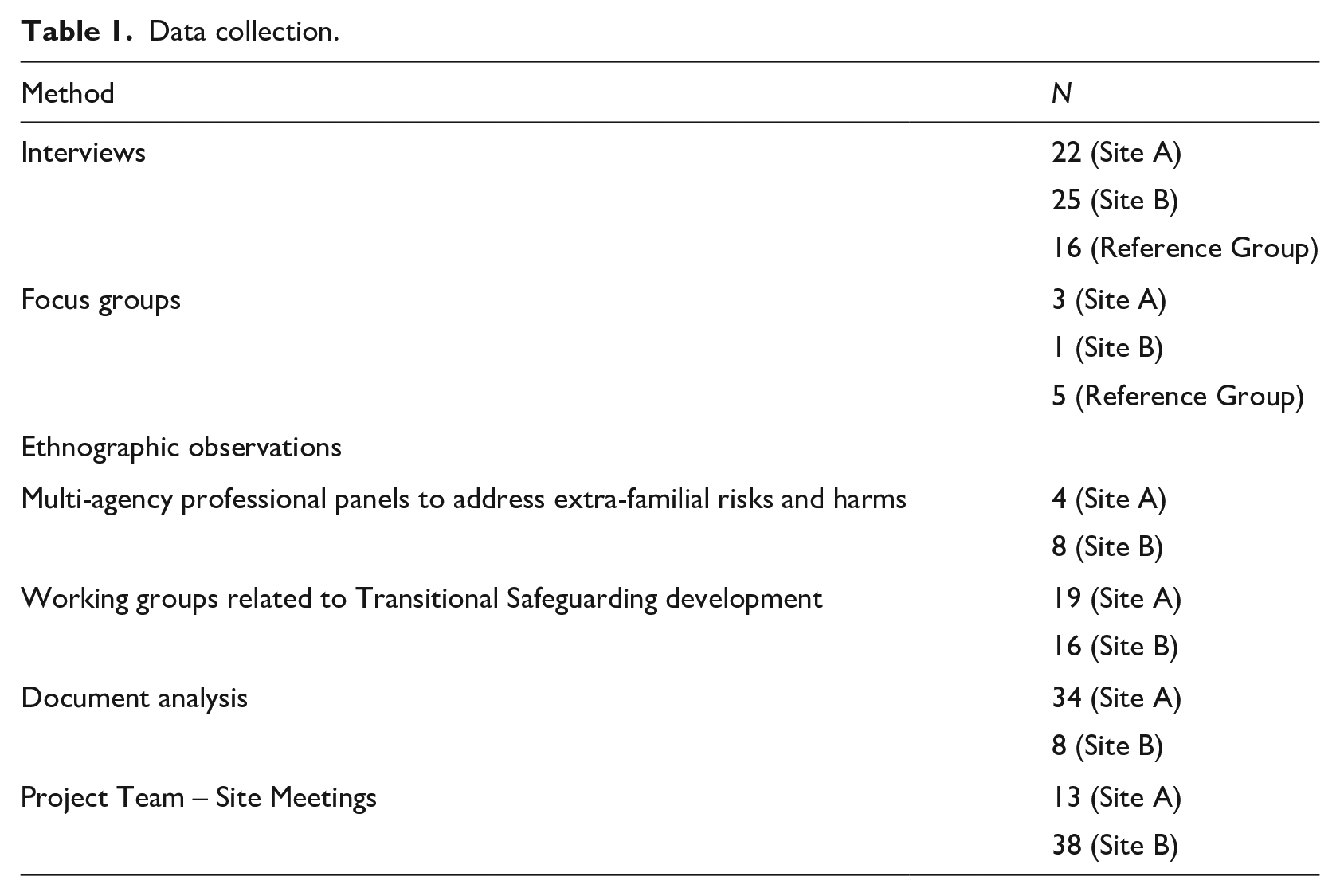
Data collection methods (see Table 1) included individual and focus group interviews, ethnographic observation, document analysis and site meetings. Data collection was impacted by the COVID-19 epidemic, with most professional meetings conducted online both during and after government-mandated restrictions. Similarly, individual and focus group interviews were predominantly conducted online.
Data collection.
Participants, with the exception of one parent, were professionals in leadership roles or practitioners in relevant areas of practice. Professionals represented children’s and adult social care, health, education, youth justice, youth work, housing and the voluntary sector. During the study period, sites had limited engagement with young people and their families as part of Transitional Safeguarding innovation work, although one site had undertaken previous youth and community engagement work. This also limited the study’s ability to explore the views of young people and their families about the Transitional Safeguarding innovation work.
Individual interviews with site participants were conducted using a semi-structured interview guide and lasted approximately 1 hour. In some circumstances, focus group interviews were conducted using the same interview guide. Additional individual and focus group interviews with reference group members provided wider Transitional Safeguarding development context. Interviews with reference group members explored either developments at national levels or innovation journeys in other localities. Focus groups with reference group members used reflective case discussion (Ruch, 2007) to explore feelings and actions associated with extra-familial risks and harms and Transitional Safeguarding innovation work. Ethnographic observations included professional inter-agency groups and panels related to: (1) supporting young people experiencing extra-familial risks and harms and (2) the development of local Transitional Safeguarding innovations. Regular meetings between the project team and site partners provided a further source of fieldwork and supported data analysis (Lefevre et al., 2024). Interview data was audio-recorded and transcribed by a professional service. Most meeting observations were not recorded but included detailed fieldnotes of both meeting content and process, as well as subsequent reflections and insights.
Data analysis included iterative processes of psycho-social reflection alongside ongoing narrative group data analysis (Elliott et al., 2013) among the research team and involving site partners to inform insights and further data collection activity. The research team reviewed transcriptions, meeting notes and other documents for key themes individually and collectively and analysed data contextually for each site and through cross-site analysis. Reflective in-depth discussions with site contacts and researchers from the wider project team helped generate further insights on the dynamics of innovation processes. Institutional ethnography, psycho-social perspectives and, as data analysis progressed, complexity theory provided intersecting and complementary lenses that supported the team’s emerging rich and nuanced understanding of unfolding Transitional Safeguarding innovation developments and of how key concepts are operationalised in specific contexts and situations (Human Learning Systems, 2024; Lefevre et al., 2024). Through the course of the 4-year research project, a wealth of data was generated. The present paper focuses specifically on issues that surfaced in relation to the reconceptualising of safeguarding which the Transitional Safeguarding approach proposes. Other findings from the study continue to be disseminated and shared through a variety of publications and materials (e.g. Firmin et al., 2022; Lefevre et al., 2024; The Innovate Project, 2024).
Key themes
The transitional gap: ‘I turn 18 and I get dropped off the surface of the world’
Both sites had specialised procedures and services for young people under 18 experiencing extra-familial risks and harms. These included multi-agency panels, usually led or co-led by children’s social care professionals alongside police units (dealing with exploitation, gangs, missing young people or community safety) as well as professionals representing health and mental health; education; and youth work, youth justice and probation. Meeting observations and interviews with professionals conveyed a volatile dynamic of acute risks and crisis work: young people who were reported ‘missing’ for days and weeks; young people who experienced threats and violence (e.g. after incurring ‘debts’ through confiscated drugs); serious concerns about young people’s lives; and at other times periods of relative calm that prompted a collective sense of relief. Professional feelings, palpable to observing researchers, seemed to oscillate between bleak pessimism and cautious hopefulness. At other times, meetings involved more stoic information – or ‘intelligence’ – sharing, for example, about a young person’s criminal offences or court cases, along with risk measurement systems. In one site, this included the numerical ‘rating’ of risk levels based on pre-set categories.
Significantly, young people and their parents or carers were absent from these professional exchanges. Panel discussions relied on the model of a ‘key worker’, responsible for presenting concerns and subsequently carrying out agreed tasks. Without such a professional in place, concerns about young adults were unlikely to reach the panel. During the main period of fieldwork for this study, professionals from adult social care services were also not regularly involved in these multi-agency panels. In site A, adult social care professionals attended on a limited number of occasions in an observing capacity. In principle, this panel’s remit was extended to include some young adults up to the age of 25. However, in practice, this was limited to young adults who had experienced out-of-home care as children and now continued to be supported by children’s social care services as care leavers. For young people whose support or safeguarding interventions had not involved out-of-home care, statutory social care involvement usually ended with ‘case closure’ at 18. This was a similar issue in site B, where both the panel’s remit and involvement from specialised services focused on extra-familial risks and harms ended at 18 years of age. Thus, detailed professional attention and monitoring of risks gave way to a cessation of work classified as ‘safeguarding’, or of services altogether.
The resulting ‘invisibility’ of young adults was illustrated in site A, when a detailed multi-agency panel discussion about concerns involving a peer group of young people aged 14 to 18 failed to mention the 18-year-old altogether, although his name had been listed on the meeting agenda. While this omission (when mentioned by the observing researcher during a de-briefing) surprised professionals, they also pointed to necessary preoccupations with acute crisis work involving the younger teenagers. In site B, researchers observed several panel discussions that reflected significant professional concerns regarding Amy,
2
a 17-year-old care experienced young woman. Once 18, Amy remained entitled to care leaving support. However, the frequency, focus and intensity of professional contact changed significantly at this point, reducing from several safeguarding-focused meetings a week to 6-weekly contact with a personal advisor, aimed more generally at preparation for independent living. Her social worker described how Amy felt about this significant change:
. . . her words were, [. . .] ‘I turn eighteen and get dropped off the surface of the world!’ . . . (Children’s services social worker, Site B)
By the end of the 2-year fieldwork period, Transitional Safeguarding approaches had not yet significantly influenced responses to extra-familial harms in either site, despite work under way to address systems gaps. This highlights both the early-stage and long-term nature of Transitional Safeguarding systems change. After the end of our fieldwork, we were informed that in site B, adult social care professionals had begun to join the multi-agency panel as regular members, and that initial experiences of this had been positive due to the mutual exchange of perspectives it provided to all professionals.
Intersecting needs, risks and harms
As outlined above, Transitional Safeguarding proposes a fundamental paradigm shift that seeks to reconceptualise safeguarding as focusing on human needs rather than service ‘eligibility’ thresholds. Addressing the full complexity of risks and harms alongside their underlying root causes requires collaboration between different services and sectors. Professionals interviewed for the study, from a range of services, recognised how unmet needs below thresholds for (both children’s and adult) social care interventions could intersect with, or be precursors to extra-familial harms. For example, a senior locality leader in a reference group site illustrated how structural and emotional barriers prevented young people from minoritised and marginalised communities to seek professional help for health needs such as depression:
. . . a young person told me that he . . . it’s easier for him to get to a drug dealer at the end of his road at two o’clock in the morning than it is for him to work up the courage to get to his GP to get help for how he’s feeling . . . (Senior leader, reference group)
Another professional referenced the intersection of unmet needs and harms more indirectly, considering how the lure of material ‘gains’ as ‘resources to [. . .] set yourself up for life and to do something positive’ (Service manager, Site A), could contribute to drawing young people into exploitative contexts if they felt this might help them fulfil future aspirations, such as starting a music or fashion business. This illustrates the complex dynamics of extra-familial harms and their intersections with a wider range of social harms, including educational exclusion, poverty, racism, as well as social, cultural and economic marginalisation (Child Safeguarding Practice Review Panel, 2020; Wroe, 2022). Thus, involving young people and their communities means that multi-agency collaboration aimed at preventing harm must also include supporting needs and aspirations that relate to broader well-being and human flourishing, for example, through offers in education, employment, culture and creativity. This would provide access to diverse and meaningful opportunities and resources and help tackle the structural hams underlying exploitation and abuse (Billingham and Irwin-Rogers, 2022).
Navigating cultural and structural shifts
As outlined above, Transitional Safeguarding does not propose a specific model for implementation. A common approach in research sites was the convening of time-limited working groups of professionals from different services and sectors (e.g. children’s and adult social care, youth work, youth justice and community safety, health, education and voluntary sector organisations). These groups often focused on structures, processes and methods of change, but also debated the more fundamental issue of how safeguarding should (and realistically could) be reconceptualised as part of Transitional Safeguarding approaches. In other words, which needs, risks and harms should be addressed, and by whom? Often, a starting point for navigating this early stage of systems innovation was the recognition that existing referrals-based systems excluded (and thus failed to safeguard) particular cohorts of young people in a locality:
. . . we repeatedly had referrals coming in for young people who had, I think in hindsight what I would say were Transitional Safeguarding needs, but we were not able to meet them, so we were persistently othering them out, because our eligibility, our thresholds didn’t recognise those needs as something that fit into [. . .] our service provision, there was a gap. (Innovation lead, Reference group)
Identifying service gaps also surfaced underlying structural problems. Austerity policy (and corresponding public sector spending cuts) and the ongoing (post-) pandemic crisis had hollowed out capacities particularly in statutory adult social care, such that working ‘beyond eligibility’ (i.e. supporting young people without recognised ‘care and support’ needs) seemed ‘improbable’ at the least:
. . . we’ve got duties to meet [and] [. . .] thresholds; we’ve got the powers to be flexible. But you know [. . .] being brutally honest [. . .], we’ve got some huge financial pressures [. . .]. So [. . .] we don’t often use powers, our discretionary powers, unless we absolutely have to. (Adult services senior leader, Site B)
These conditions of chronic crisis highlight the need for systems-based collaboration rather than purely service-based innovations. While adult safeguarding contributes key rights-based principles to counter-act the risks of professional paternalism, its statutory remit is formulated more exclusively (compared to the – in principle – more universalist reach of children’s safeguarding). From this perspective, many Transitional Safeguarding issues may seem
. . . not social care issues, [. . .] [but] a partnership set of issues about how vulnerable people’s needs are met in the community[. . .]. So to get a sustainable social care system, we have to be very clear what is and isn’t social care, and that means there’s an onus on the rest of the system, our partners, in housing and communities and corporately, health, etc, etc, to step up and fill the gap. (Adult services senior leader, Site B)
However, even for children’s social care professionals, conceptualising safeguarding beyond prioritising the most acute risks and harms, to include broader well-being needs, could seem challenging. In site A, young people consulted as part of Transitional Safeguarding development work had highlighted various concerns, such as hidden homelessness, mental health needs and access to relevant services, which were incorporated into a local area action plan. However, without additional resources or more established systems-level collaborations, there remained concerns that addressing such broader issues would compete with the acute crisis work of thresholds-defined safeguarding:
It feels like we’ve got a very broad approach thinking about need, risk and harm [. . .] but how do we make sure we retain a focus on Transitional Safeguarding for those young adults at the most acute risk of harm, i.e. death, rape, etc; and not just think about generic needs across the board. [. . .] I think there’s a benefit and a risk to broadening it out. (Children’s services senior leader, Site A)
Such fundamental life-or-death dilemmas and fears reflect the stark realities experienced by many young people and professionals alike. This makes reconceptualising safeguarding so as to focus on human needs rather than service-defined thresholds particularly complex. For safeguarding professionals, who are often responsibilised for service ‘failings’, such change may represent professional, or even personal, risks. Thus, the cultural and structural shifts required for systems change can seem costly (including, and beyond financial terms), especially when collaborative systems remain, as yet, underdeveloped.
At the time of writing, innovation efforts in different localities, including those who participated in our research, are ongoing. We observed various examples where professional groups shared creative ideas that started moving beyond acknowledging the limitations of existing systems and their inadequate resources, but these initiatives remained at the early stages of conceptualisation and were fragile to being de-prioritised based on internal and external circumstances (Lefevre et al., 2024). Also, as mentioned earlier, the voices of local young people featured less explicitly and prominently in the research sites than anticipated, especially given the centrality of co-productive participation in the Transitional Safeguarding concept. Apart from COVID-19 restrictions, barriers to reaching and involving young people also emerged from the very dynamics of experiencing risks and harms, including trauma and difficulties building trust. Thus, more work remains to done to systematically include young people, their voices and experiences, and genuinely achieve the co-production that Transitional Safeguarding envisions.
Discussion
A binary framing of acute risks and harms, on the one hand, and human needs, well-being and flourishing, on the other hand, neglects their complex intersections in young people’s lives. It also fails to capture the equally interconnected nature of underlying structural factors. Separating, ranking and compartmentalising needs follows a service-centric logic which segments and often fragments responses. A variety of factors, not least austerity public spending cuts, or the individualising and public blaming of professionals for ‘failures’ in safeguarding, explain the pervasiveness of such a logic, but it fails to meet the safety needs of young people and their communities, while also preventing more integrated and effective well-being-focused safeguarding systems (Holmes, 2022). The transitional gap experienced by young people around their 18th birthday can have severe consequences for their safety and well-being, as evidence from safeguarding reviews demonstrates (Preston-Shoot et al., 2022, Cocker et al., 2024). It is also symptomatic of deeply rooted tendencies to fragment and split responses to difficult realities, preventing us from having to deal with the full complexity of human lived experience (Huegler and Ruch, 2022).
The ‘chronic crisis’ states, workloads and financial pressures of social care and other public services in many areas of the country underline that reframing safeguarding beyond statutory ‘thresholds of eligibility’ (whether in children’s or adult social care) cannot be achieved through innovations in social care alone. Instead, the ongoing processes of reconceptualisation which Transitional Safeguarding proposes rely on boundary-spanning whole-systems change, based on the collaboration and integration of services from a range of agencies and sectors, and centring the voices and experiences of young people and their communities. For example, as Winterbottom et al. (2023) highlight, professionals from across the health sector, as part of a universal cross-lifespan system in the United Kingdom, bring expertise on a range of child-to-adult and cross-specialism transitions. Our fieldwork observations and interviews also emphasised the important role of low-threshold sexual health or drug advice services in reaching and successfully building relationships with young people. Similarly, youth work, housing, probation and grassroots community workers were often among the few services and professionals with ongoing contact with young people beyond the end of statutory social care and safeguarding interventions at 18.
The broad-ranging systems change proposed by Transitional Safeguarding strongly aligns with public health approaches to violence reduction (Fraser and Irwin-Rogers, 2021), which combine ‘upstreaming’ prevention and ‘down-streaming’ support and intervention, along with contextual, place-based and collaborative perspectives, for example, through the pooling of capacities and resources. Billingham and Irwin-Rogers (2022) highlight the potential for public health approaches to address the structural conditions of violence and harm by combining targeted and universal support to create fairer and more equitable conditions across society, moving beyond individualising interventions or blame.
A health analogy can remind us of the centrality of young people’s agency in safeguarding work, necessitating youth-centred and collaborative approaches (Firmin et al., 2022). The absence of young people’s voices in professional panels and Transitional Safeguarding working groups highlights that ‘safeguarding’ remains defined by professional perspectives and interventions. To centre young people’s own ideas about their safety and well-being needs, their capabilities for contributing to change, both in their own lives, and at systems level locally and beyond need to be taken seriously. Applying principles of adult safeguarding, in particular those from Making Safeguarding Personal, can support young people’s participation at individual and systems levels (Cocker et al., 2021). Professionals in this study rightfully raised concerns about merely tokenistic engagement with young people and highlighted barriers to reaching those with acute experiences of risks and harms. Thus, Transitional Safeguarding developments need to consider how participation barriers can be addressed, ensuring that young people’s contributions are supported, recognised and taken forward by professionals and that their work is recompensed. A growing wealth of resources and methods (e.g. Safer Young Lives Research Centre, 2024), including through collaboration with the arts and culture sectors (see Warrington et al., 2025), can further support such work. Importantly, young people’s ideas and perspectives are less likely to be constrained by the limitations of service-centric thinking than those of professionals (or researchers!) whose livelihoods are enmeshed with the very systems they seek to change.
Similarly, achieving broader and deeper levels of multi-agency participation in Transitional Safeguarding innovation initiatives, and how to address barriers, conflicts, dilemmas and deal with complexity as part of this, remains a key task and challenge in local systems (Lefevre et al., 2024). Fraser and Irwin-Rogers (2021) outline helpful principles and strategies for collaboration in the context of public health frameworks, while complexity perspectives and their practical implications in public service development are considered in-depth through the resources of the Human Learning Systems (2024) network. Significantly, locally configured systems change as proposed through Transitional Safeguarding also needs to intersect with and be accompanied by collaborative and collective work to continuously highlight, and tackle at national levels, the structural issues which are significant in shaping both the damaging contexts of extra-familial risks and harms and the capacity of local safeguarding systems to address them. This includes, for example, addressing the chronic underfunding of public services and critically considering how societal views of marginalised young people may perpetuate their vulnerabilities (Fraser and Irwin-Rogers, 2021; Lefevre et al., 2024).
Conclusion
Transitional Safeguarding offers a disruptive framework for reconceptualising safeguarding approaches to better meet the safety and well-being needs of young people experiencing extra-familial risks and harms, both at individual and systemic levels. The boundary-spanning, whole-systems level change it proposes, based on multi-agency collaboration and co-production with young people and their communities, has the potential to support conditions of transition that not only prevent acute risks and harms but also allow young people to flourish. However, putting its key principles into practice to achieve systems change is complex and often challenging. Reconceptualising what ‘safeguarding’ means during transition to adulthood, both for individual young people and from the perspective of different agencies, services and systems, requires ongoing collaborative and deliberative processes that engage system partners across sectors at local levels, as well as centring the voices and lived experiences of young people and the communities they live in. Safeguarding, in this conceptualisation, is not a compartmentalised responsibility or specialism of selected professionals or services; rather, in an inclusive (not intrusive) sense, it is ‘everyone’s business’. Such an approach enables professionals to work with complexity and curiosity, rather than through manualised procedures, avoiding iatrogenic harms through surveillance and control, and resisting the ‘Othering out’ of needs or people who do not fit into service-centric thresholds. For such approaches to work, local systems and the professionals, services, young people and communities they encompass need to be supported by policy and funding frameworks committed to addressing not just acute harms and their symptoms, but also the underlying structural issues – such as poverty, racism, marginalisation and precarity – that perpetuate harmful conditions. While advocating for funding that supports systems change may seem unrealistic in contexts of chronic underinvestment and crisis, we need to consider the significant costs of maintaining the status quo, both at an individual and a societal level, and to rethink how ‘value’ is defined in relation to young people’s lives and for society (see Holmes and Lefevre, 2025).
Footnotes
Funding
The author(s) disclosed receipt of the following financial support for the research, authorship, and/or publication of this article: the research reported in this paper was made possible by grant (Reference: ES/T00133X/1) from the Economic and Social Research Council in the UK, but the views expressed are those of the authors.

Data availability
The interview data collected in this study has not been archived for re-use, as the individuals involved in this study wished the recordings and transcripts to remain confidential. This was due to the sensitive nature of their social care services and the possibility that they and their organisations could be potentially identifiable should full transcripts be accessed by others.