




Abstract
Objective:
This paper offers methodological reflections on the ethical challenges of researching children’s everyday lives in a digital context, drawing on two studies conducted in different international contexts: the United Kingdom (Everyday Childhoods) and Türkiye (Children’s Individual Privacy at Home and in Digital Environments).
Method:
Both studies were qualitative and ethnographic in character, concerned with understanding how we can study the digital lives of children in situ – within family relationships, educational settings and the social/leisure worlds of young people.
Results and Conclusion:
In exploring children’s digital lives across these different spaces, we encountered numerous challenges and tensions that shaped the possibilities of making children’s digital lives researchable. In particular, our work involved navigating moral concerns of what might be considered ‘healthy’, ‘educational’ and ‘appropriate’ digital practices by adults in children’s lives, and children’s concerns of having their digital lives researched by adults. By bringing findings from these studies into conversation with each other, we seek to draw out some of the key learnings about the challenges of researching this increasingly prominent aspect of children’s everyday lives as a moral landscape. By taking two studies from different international contexts, we also consider how dialogues between the studies can generate insights into the particular politics of researching children’s digital lives within particular places and cultures.
Introduction
Children’s digital lives have become a focus of significant moral debate in many countries – prompting discussions about what ‘good’ (e.g. healthy, educational) or ‘bad’ (e.g. harmful, distracting) digital childhoods might look like. In recent decades, digital risks, from cyberbullying to data footprints, have become the dominant frame for public discourse on children’s digital lives (Buchanan et al., 2017). In the United Kingdom, these concerns are exemplified by child experts such as Sue Palmer (2007), who have been influential in positioning new technology as a risk to children’s development and well-being. Likewise, in Türkiye, public scholars such as Kemal Sayar (2020) have raised concerns about the risks of new technology’s ‘addictiveness’ and the need for parents to bring children back into the ‘real world’. Such interventions have played a significant role in shaping public debates in both countries, with the risks of technology in childhood regularly featuring in media and policy (e.g. gov.uk, 2023; Republic of Türkiye, 2021).
A counterpoint to the risk discourse has been the growth of a tech-positive view within education. EdTech events, such as Bett UK in the United Kingdom and the Educational Technologies Summit in Türkiye, have become focal points for more optimistic visions of technology’s role in children’s education. In both countries, education policies have also increasingly positioned technology as the future of schooling. These tensions between more optimistic and pessimistic views have created a complex moral landscape, where what is beneficial for children is not clear cut. Instead, an uneasy co-existence prevails, with children and their carers at the epicentre of the risks and benefits of technological innovation.
This paper explores how public discourses play a fundamental role in shaping how children’s digital lives are researched. As social scientists, we are interested in how societies make sense of technology in childhood. Studying children’s digital lives inevitably involves being drawn into the debates about what a ‘good/bad’ digital childhood might look like within specific social and cultural contexts. However, there are two ways in which the study of children’s digital lives is – we feel – in need of further interrogation. First, it is important to recognise that research into children’s digital lives takes place almost always in response to wider public debates, whether in affirming or challenging the claims they make. As childhood researchers, we aim to develop practices that centre children’s lived experiences that are given less recognition in public discourses (Hope, 2015). However, wider public discourses inevitably provide the backdrop to research, particularly when parents or other concerned adults are involved in the research. This can be challenging when our work with children is engaged with by parents, journalists or policy makers whose dominant paradigm of technology is a moral binary and raises questions of how we can avoid entrenching or unintentionally reproducing prevailing moral landscapes.
Second, our experiences of research have often involved us engaging with this moral landscape in our interactions with participants. Undertaking research with children and families inevitably involves navigating, and becoming attuned to, the inter-personal and cultural dynamics of family lives. Within homes, the child’s life is not separable from wider family dynamics. Research with children is often carefully orchestrated with parents (e.g. in deciding what room interviews will take place in). Within these interactions, children’s participation is negotiated and often involves different assumptions about what ‘participation’ looks like. Research on children’s digital lives can also involve having to bridge potentially quite disparate expectations and understandings of how children’s technologies are viewed. Children and their carers may hold differing views about what is good, healthy and beneficial about technology. In our respective studies, we have experienced moments where we were drawn into these debates in interactions with families. The moral landscape of a digital childhood was not just a phenomenon to be observed from ‘the outside’, but rather something we were pulled into through our interactions with family members.
This methodologically focused paper explores how these debates can present challenges when researching children’s digital lives within family contexts, focusing on two studies conducted in Türkiye and the United Kingdom. Both studies employed a relational lens (Spyrou, 2018) to examine how families negotiate the moral landscape of technology, engaging with family members through ethnographic fieldwork. Specifically, our respective studies explored children’s experiences of time and transition with technology (in the United Kingdom) and issues of digital and intrafamilial privacy in the negotiation of child–parent relationships (in Türkiye). In this paper, we reflect on how moral debates about children and technology frequently arose in our studies and were instrumental in shaping how participants interacted with and understood the studies they were taking part in. This paper explores how moral views on ‘good/bad’ relationships with digital technologies were relationally negotiated between study participants, including the researchers. We also reflect on how we navigated these moral views in different cultural contexts, and the insights that can be gained from bringing the two studies into dialogue with each.
This paper focuses on the research dilemmas that arise in researching children’s digital lives against an evolving backdrop of debates about ‘good/bad’ digital childhoods, and how these dilemmas manifested within different cultural locations. Looking at the trilateral relationship between children, parents/carers and researchers, we reflect on how moral landscapes were an ever-present feature of our research interactions – whether shaping how participants interpreted the studies or our role as researchers, or in the way that it involved sensitively navigating differing views that children and parents/carers held about technology.
Children’s digital lives in moral landscapes: concepts and literature
This paper draws on the concept of ‘moral landscapes’ to describe the concerns and debates that surround children’s use of digital media. The term moral landscapes was originally used by geographer Gill Valentine (1996) to describe how children’s use of public spaces (e.g. parks) provokes moral concern around issues of safety and risk. Thomson et al. (2018) later adapted this concept for a digital context, to describe how social media has become a contemporary ‘moral landscape’ in which children are forced to simultaneously navigate adult concerns about the ‘risks’ of the digital world, alongside their own interests, such as peer surveillance (Jaynes, 2020). While Thomson et al. (2018) focused on a moral landscape primarily contained within young people’s social media networks, in this paper we expand the concept to include the domestic spaces of children’s lives, and to explore how debates about what is healthy, safe and so on manifest in the relationships between children and their parents/carers within different cultural contexts. We then extend this, by considering how moral landscapes have ramifications for researcher’s children’s digital lives.
Parents and concerned adults navigating moral landscapes
In both the United Kingdom and Türkiye, parenting is subject to neoliberal forms of governance that seek to optimise how parents support children as future assets (Gillies, 2020). Parents who cannot ‘adequately’ achieve their responsibilities are seen as social problems (Brannen, 2020). Societal and governmental expectations have led to a cultural paradigm of intensive parenting (Faircloth, 2014) in which parents are treated as the main determinants of their child’s successful development. In both the United Kingdom and Türkiye, a neoliberal shift in the late 20th century has led to interventions focused on parental responsibility (Arzuk, 2020; Gillies, 2020).
Regulation of children’s digital lives has become a growing focal point for policies of ‘responsibilised’ parenting. However, research often highlights the challenges parents experience in supporting children in their digital lives, often due to different generational expectations and understandings of digital technology, such as in relation to privacy (Berriman and Jaynes, 2022). Facing pressure to develop digital competencies, parents are often exposed to moral panic in mass media that overrepresents the risks and dangers associated with digital media (Riva, 2018). It has therefore become increasingly important for researchers to develop a contextual understanding of how digital moral landscapes become entangled with contemporary parenting cultures.
Challenges of researching children and families in moral landscapes
We are especially interested in how moral landscapes shape the relational dynamics between researchers, children, and parents/carers. Past research on children’s digital lives has tended not to consider how researchers encounter and negotiate moral landscapes, despite their increasing prevalence in family practices in the Global North (Livingstone and Blum-Ross, 2020). There are many helpful discussions of how to research with children in a digital context (e.g. Ergler et al., 2016), and this paper seeks to add to these by exploring the significance of moral landscapes that occur within and around research activity, and reflecting on how researchers might navigate these in relationships with participants.
In doing this, we are particularly concerned with two key challenges of researching children’s digital lives: first, the tension between seeing children as individuals versus members of a relational family unit. The growth of the children’s rights agenda since the late 20th century precipitated a growing focus in childhood studies on the rights and perspectives of children as agents distinct from the family (Lee, 2001). However, this trend has come at the expense of more relational perspectives of children as embedded in interdependent relationships within families. Our paper therefore draws inspiration from work that seeks to understand children as relational actors (Spyrou, 2018), whose lives cannot be meaningfully extracted from their familial relationships.
Second, we are particularly concerned by how moral anxieties surrounding childhood inform family engagement with research, and the role that parents/carers play as gatekeepers to children as research subjects. Past research has shown that parents/carers face significant challenges as mediators of their children’s access to digital media (Livingstone et al., 2017). Furthermore, social and cultural contexts also play a significant role in shaping how digital media is perceived and regulated within families (Kalmus et al., 2024). This paper is a contribution to approaches that seek to understand how children have become figures of moral anxiety, but with a view to understanding how this may be significant in shaping the possibilities of research into children’s digital lives within family contexts.
Looking across two studies
Rather than developing a comparative analysis, our bringing together of two studies stems from a desire to reflect on how we navigated the moral landscapes of digital childhoods, in ways that were simultaneously similar and different. We take inspiration from diffractive analysis as outlined by Lisa Mazzei (2014), that draws on Karen Barad’s notion of diffraction as ‘reading insights through one another’ (Barad, 2007: 25). For Mazzei (2014), diffractive analysis can be a means of approaching research entanglements of ‘bodies, texts, relationships, language, and theory’ (p. 745). This suited our approach to synthesising our data in two respects. First, it did so by enabling us to study our data in dialogues, where data from one study helped generate new perspectives on data from another study. Rather than compare or look for ‘difference’, we explored how our data may be juxtaposed and put in conversation. Second, a diffractive approach involves a recognition of the data as part of an entanglement – generated through research within the context of moral, cultural and political landscapes. We have sought to understand how our data offer not just reflections (mirrors) of the social worlds we undertook our research in, but rather are products of our entanglement in those social worlds. In Table 1, we briefly outline the two studies to provide some context to the questions of ‘when’, ‘where’, ‘how’ and ‘who with’.
Research designs for the two studies.
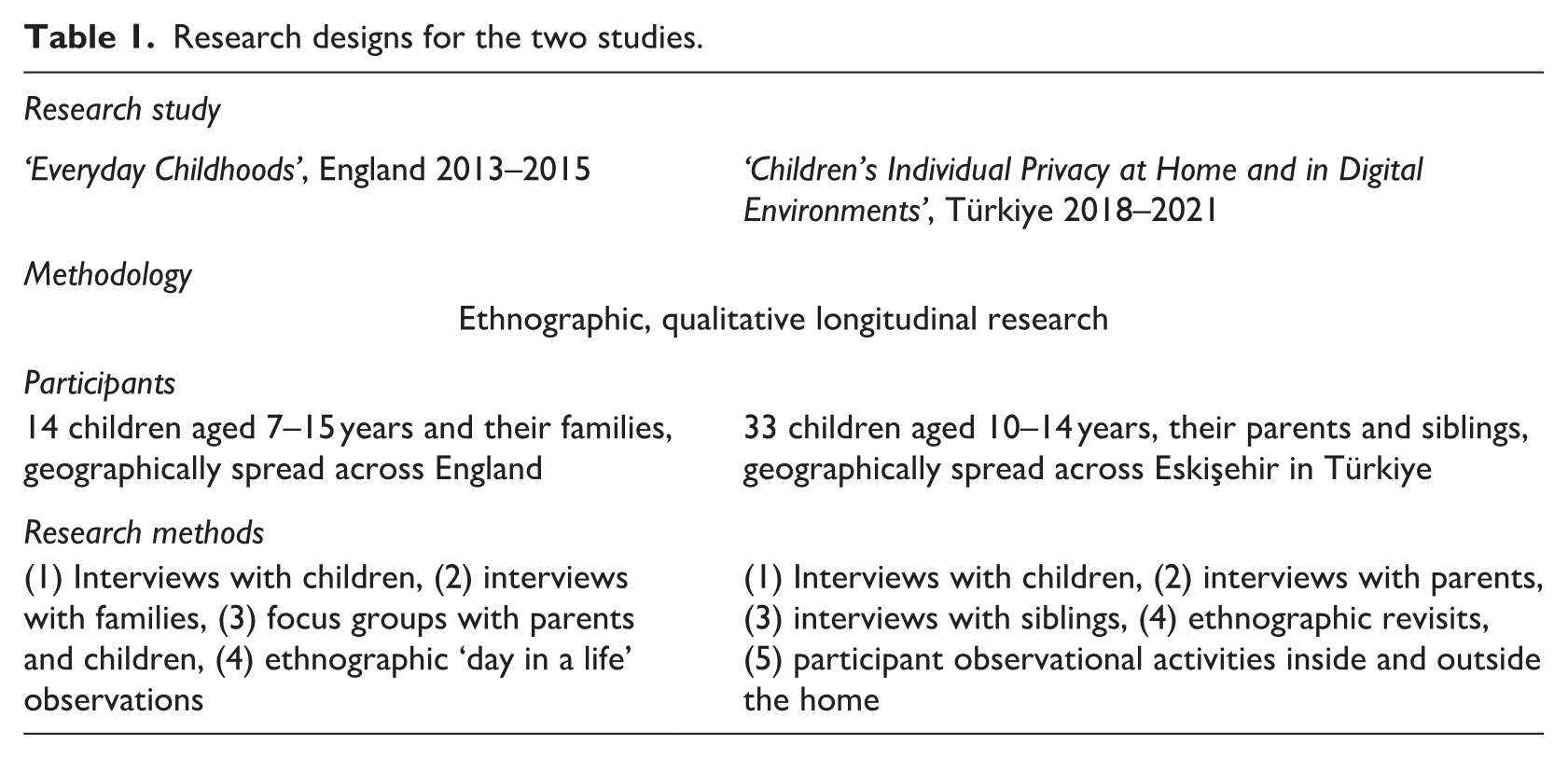
Both studies received ethical approval from their respective institutions: (1) the Social Sciences and Arts Cross-School Research Ethics Committee at the University of Sussex and (2) the Social Sciences and Humanities Scientific Research and Publication Ethics Committee at Anadolu University. Both studies involved collaborative work with families, and informed consent was an ongoing process involving both children and their parents/carers (see Üzümcü (2022) and Thomson et al. (2018) for more detail).
Navigating moral landscapes in research
Discourse surrounding ‘good/bad’ digital childhoods has gained momentum in recent decades, creating challenges for researchers working with children and parents. Our discussion begins by exploring parents’ expectations about the purpose of our studies. We will then explore the position of researchers in child–parent negotiations of their everyday digital lives. And finally, we discuss instances where children’s voices contradicted parents’ perspectives.
Parental digital anxieties in research
Our observational and interview data captured parental anxiety and guilt around digital parenting, with some parents seeking validation or guidance from the researcher to support their role as a ‘good’ digital parent. Some parents found themselves navigating uncharted territory, attempting to balance between enabling their child’s digital explorations while also safeguarding them from harm. The researcher’s request to interview them about digital childhoods was sometimes interpreted as an act of inspection on their parenting style, and at other times the researcher was seen as an ‘expert’ to provide advice and tips on digital media uses. In the Türkiye study, HEÜ, after having interviewed a boy (16) and girl (10), was approached by their parents for digital media guidance. The mother expressed her expectation that the researcher should speak about ‘healthy’ use of the Internet to the children:
I just wanted to specifically tell you. We are very glad that you are doing an interview about the Internet and technological devices. You will tell us for sure, – I was curious about something: Let me ask the question in my mind. For example, did you give information about the harms of the Internet and advise the children to use it less often?
The mother’s question represents one of the key challenges in researching children’s digital lives: the prevalence of parental anxiety about children’s Internet safety. In another instance, a mother sought to engage the researcher as an English ‘teacher’ equipped with digital skills. The field notes reflect how the mother introduced the researcher to her daughter:
She [the mother] said ‘Your sister [researcher’s name] will come here once or twice a week to make you study English through your school’s software’. Melis [her daughter] got struck. She refused it out aloud: ‘No. Mum, it does not work, won’t you understand?’ The mother said, ‘Ok, she will help you make it work’.
Here, HEÜ was considered both an expert of ‘digital safety’ and an ‘educator’. They were tasked with teaching the child how to use the Internet safely and giving lessons on how to navigate the school software. Similarly, other parents asked HEÜ to recommend books on good digital parenting for their 12-year-old son, who they felt played too many video games unless threatened with the confiscation of his phone. Turning to the researcher as a source of expertise and reassurance, parents assumed that the researcher should speak from a place of authority. This automatically implied constructing a power relation between parents and researcher, which, from a hierarchical perspective, contradicted the relationality sought in an ethnographic approach to researching (Hall, 2014).
Parents’ discourse often implied there was a ‘right’ way to use digital technology (e.g. that children should use it less often or ‘correctly’). While looking for advice from the researcher, parents also sometimes steered what the researcher should be telling their children. This seemed to reflect their conviction of what ‘good’ and ‘healthy’ is and their ideal to have the researcher on board with them to support this view in front of the children. This dynamic was challenging for the researcher as it implied creating a sort of parent–researcher alliance against children. In these instances, children were viewed as objects of concern, whose perspectives were often invisible. They were not endowed with agency to have a say and to relationally negotiate their desires, competencies or perspectives. On the parents’ side, there seemed to be a lack of confidence or belief in children’s own ability to safely and properly navigate the online world. This put the researcher in a difficult position, contradicting their methodological approach to engaging with children’s agency and voice in research (Christensen, 2004).
Parental anxiety around uncertainty about how to keep children safe also appeared to contribute to a ‘pathologising’ of the digital in their children’s life. The emphasis on ‘harm’ appeared to mask the potential positive aspects of children’s digital engagement. The parents’ requests communicated an expectation of ‘getting something’ out of the research process. This added another layer of challenge to the researcher’s commitment to methodological and theoretical values of conducting a childhood and family study, as well as the merit of building socially good relationships with research participants.
In the UK study, there were no explicit attempts by parents to frame the researchers as experts of a ‘good’ digital childhood. However, parents did sometimes share their concerns about keeping their child safe. For example, in a postcard activity where participants (both children and parents/carers) wrote to future users of the project’s data, one mother wrote,
I hope this generation makes good use of technology, but still remembers there is a world out there.
However, this is not to say that in the UK study parents did not express concerns about technology in their children’s lives and the challenges of managing this. For example, one mother expressed dismay at the lengths her children would sometimes go to hide their technology use, such as at bedtime:
He did it to me once, he pretended to be asleep, yeah he was pretending to be asleep and so I stood still, and he wasn’t sure if I’d gone [. . .] And then he moved, and I could see that he had the iPad under his pillow.
Although the research team were not explicitly asking parents about their perspectives on children’s use of technology, their views often came across in conversations ‘around the edges’ of the project. Although this paper does not offer a comparative account of our studies, our analysis did bring into relief the different ways that parental concerns were expressed about children within our research. In the Türkiye study, HEÜ found much more explicit concerns about technology, whereas in the UK study these were often expressed more implicitly through comments on what parents felt was ‘good’ or ‘bad’ about their children’s media use.
Displaying the ‘good’ digital family
During the interviews and the time spent with families, both LB and HEÜ noticed that the rules around children’s digital media use became a means for parents/carers to communicate and show the researchers their ‘good parenting’ in a digital context. How rules were negotiated with the children were often raised by parents as part of a wider narrative on child–parent interactions around digital practices. Some children seemed to be actively involved in these negotiations and others encountered a more restrictive parental approach where rules were imposed from a position of (parental) authority. However, in many cases, the researchers got the impression that the children were expressing these rules as part of a pre-agreed ‘family voice’.
The following two extracts from the UK study shed some light on how the families talked about rules and what were ‘healthy’ media practices. In the first example, 13-year-old Aliyah and her older sister (Masruba) talk about family rules for Facebook, and in the second example, 11-year-old Joseph talks about the family’s rules around video games and mealtimes:
On Facebook we’re all friends with one another, so-
Just within the family. I don’t have any of my offline family like-
Oh yeah, I don’t have, yeah, just within the family we’re all sort of friends with one another, so it’s, I would say it’s quite good in a sense, we’ve got quite strong relationships with one another and we can talk about things rather than hide it away, so we have the ground rules like, okay, if you, whoever’s got a Facebook not to add strangers on and all that stuff, so that’s been quite (erm) and your account can’t be public, it has to be private, stuff like that.
like tomorrow is Thursday, that means no Wii or PS3 (PlayStation 3) and [from] 7:05pm to 8:00pm we eat dinner and usually while we eat dinner it’s best to keep interactive.
Aliyah’s narrative around the Facebook rule reflected a family display of ‘closeknit’ relationships as well as showing how the family enacted ‘good digital parenting’. It portrayed how she knew what the rules were, and that this was a household where there were clear rules on ‘healthy/responsible’ use of digital devices. Aliyah’s positive articulation gave an impression of the rules as an outcome of a negotiation between the child and parents, while also giving a feeling that it was rehearsed, or at least pre-negotiated within the family. The discussion seemed to seek to reassure the researcher, as an audience for this presentation of rules, that the children had a ‘healthy’ relationship with social media. Similarly, Joseph and his siblings took the lead in the interview on the family’s technology rules, by talking through a typical day or week. Taking the form of a pre-prepared presentation initially, the children gave very specific information about the days and times they were allowed to use technology, and the importance of having time away from technology (e.g. at mealtimes).
The rule-setting, negotiations and discourses around digital media use served as a lens through which to examine how families negotiated their digital landscapes, shedding light on the multifaceted ways children’s voices were expressed and heard. Similarly, in the Türkiye study, HEÜ noticed that some children repeated phrases used by adults. For instance, the parents of Kenan, an 11-year-old boy, referred to him as a ‘tech addict’ several times during their interview. Kenan used similar language during an interview:
I turned 11 years old. I started school at an age one year earlier. My birthday is May 4th. And also, I’m a bit of a tech-addict.
Kenan explained he would spend most of his time on his phone or PC due to his chronic illness. The parents sounded agitated and heated while they were complaining about Kenan’s ‘addiction’. It was clear that this issue created tension in the family. While Kenan did not seem to fully agree it was a problem, he still called himself ‘tech-addict’. In the midst of the tension, the researcher could sense that this was not his voice, but the presentation of himself through his parents’ eyes, conveying their anxiety of the digital context.
HEÜ also observed that some parents asked children to represent a ‘family voice’. As she was about to interview Orhan, a boy aged 14, his father looked into his eyes and told him how he should answer the questions, as detailed in this excerpt from the fieldwork diary:
As the parents were leaving us in the living room for the interview, the father told Orhan: ‘Son, give your answers thoughtfully. Think well, and then respond. Don’t make me ashamed’. I did not fully grasp if that was a joke, but hoped it was. The father seemed serious, when I smiled at his ‘joke’.
With these words, the father encouraged his son to represent the family in a positive light and warned him to be careful in his responses to the researcher. His intervention was a way of recognising Orhan’s agency (as an interviewee), but also holding him accountable for family honour. This was possibly because the father wanted to avoid creating a negative judgement on their parenting. Furthermore, it seemed to serve as a reminder to Orhan about the privacy of the family and a warning to not share ‘private’ details. It was important for the father that Orhan set a boundary about what would be divulged to the researcher.
In these examples, we can see that children’s voices partly came through a parental filter. In contrast to Kenan and Orhan’s cases, Aliyah seemed to have rather more room to express herself. In Aliyah’s case, there was possibly less focus on family display and ‘getting along’, but rather an emphasis on a recognition of the tensions between children and parents in relation to the use of digital devices. In Kenan and Orhan’s cases, however, the children agreed, or were expected to agree, to represent the family display that the parents depicted. These findings may show how essential for parents the idea of ‘healthy’ use of media is, and how it can impact the negotiations about it with children, to the extent that it can temper and modulate children’s voices. As observers, the researchers in this setting were in a position in which they had difficulty hearing children’s direct reflections.
Children’s digital imaginaries
So far, we have seen how parents’ concerns about what constitutes ‘healthy’ digital practices played a prominent role in both studies. In some final examples, we share occasions where children’s voices came to the fore, but how attending to these voices still required a relational frame of the child within wider familial relationships. The examples selected specifically relate to when the child’s perspective did not always directly align with their parent/s, giving rise to dissonance or contradiction between their perspectives.
During the ethnographic fieldwork in the UK study, LB spent time after school with 10-year-old Megan and her mother. The mother had agreed that Megan could spend some time on the home computer playing Minecraft, which she explained to LB was a game she approved of for its ‘educational’ gameplay. Later, Megan explained to LB that she enjoyed playing Minecraft with friends online and that one of her favourite ways to play was online where she could compete with other players for resources and weapons. During the observation, Megan played a game involving fighting other players to steal their resources. LB’s impression was that Megan’s mother did not know about the competitive multiplayer games.
In the Türkiye study, HEÜ similarly observed differences between children’s and parents’ views of digital media as entertainment or educational. In one household, HEÜ separately interviewed 11-year-old Bulut and his mother. The boy described how he was sometimes allowed to watch English and French cartoons after doing homework:
I love [watching] Astérix after school, I watch new episodes online with English or French subtitles. Sometimes it can be without subtitles.
His parents viewed the cartoons as educational and encouraged him to watch with or without the subtitles to help his language learning. HEÜ observed how the online videos were a treat, and that Bulut knew he could watch them without getting into trouble due to his parents’ viewing them as educational. During the interview with Bulut’s parents, his mother also alluded to having an awareness that Bulut played up the educational benefits in order to get extra time watching the cartoons:
Sometimes when he feels he stayed too long [on the internet], he turns to me and says, ‘Mom, I’m watching it in English!’ [we laugh] ‘Okay, son’, I say, ‘keep on’.
In this instance, the child and parent held different perspectives about the value of the media, but in a way that did not conflict. In another instance, however, the child and parent held conflicting perspectives on the child’s reasons for using digital media. Sevgi, an 11-year-old girl, was prohibited from using social media because her parents believe she chatted with her friends incessantly. However, her parents discovered that she was playing online games instead, using them as a means to chat with her friends, as conveyed by her father:
She was playing an online game, but she was using that game more for communication – kids are so smart nowadays. [. . .] So, it’s an online game, but the main purpose is still to chat with friends there.
These examples show how engagement with children’s experiences of digital media was not easily separable from the discourses of ‘healthy’ and ‘educational’ digital media that their parents were navigating. In Megan’s case, the researcher encountered an awkward divergence between the parents’ perspective of Minecraft as educational building tool, and the child’s engagement with it as a social competitive game that included some violence. For the researcher, there was a dilemma in discovering this divergence and of potentially betraying Megan’s game to her mother, or of exposing the mother’s misconception of her child’s play. This position was reversed in a family in the UK study, where the child had ‘lost’ their phone and the mother divulged to the researcher that it was in fact hidden in her car to give the child time away from their screen. In both instances, the researcher inadvertently became entangled in the moral interplay between children and parents views of ‘healthy’ and ‘educational’ technology use.
Similarly, in Bulut’s case, both child and parent confided different perspectives on the value of the digital media. Although in Megan’s and Sevgi’s cases the perspectives diverged quite significantly, in Bulut’s case they were much more closely aligned. Both the child and parent indicated they were aware of each other’s conceptions of the media as either entertainment or educational, and each used this knowledge to their own end: enabling Bulut to watch more cartoons and providing his parents with an opportunity to encourage language learning. The distinction by adults of certain media as ‘educational’ is a category Bulut had become aware of and which provided a currency for negotiating extra screen time.
In Sevgi’s case, however, her parents were okay with her playing games as a social and healthy activity, while they did not consider chatting to be healthy at all. As evidenced in earlier examples, the rule setting around digital media often reflected what parents felt ‘good parenting’ should look like in a digital context where it was important to cultivate ‘healthy’ and ‘safe’ relationships with digital media. In Bulut’s and Sevgi’s examples, we can see how acceptance of such rules, and understanding of the parents’ categorisation of digital media (e.g. as healthy or unhealthy), provided opportunities for enacting agency and developing strategies of negotiation and resistance.
In these examples, we can see varying ways in which children consciously and unconsciously engaged with discourses of ‘good’ digital practices. Both studies sought to centre children’s engagement with digital media, but the moral spaces constructed by parents often permeated the children’s practices. Researching children’s digital practices required an understanding of how children’s agency and engagement with digital media were relationally embedded within wider family practices of enacting ‘healthy’ relationships with digital media. It also provided insight into children’s awareness of these wider discourses, and how significant categories of healthy and educational media practices were in their understanding of the possibilities and constraints these posed to their media use.
Conclusion
In both the United Kingdom and Türkiye, children’s digital lives have become growing sites of concern, placing responsibility on parents/carers to navigate moral discourses of what is ‘safe’, ‘healthy’ and ‘educational’. In this paper, we have considered the implications of this moral landscape for research into children’s experiences of their digital worlds and have sought to add new insights to the existing methodological on conducting research on children’s digital lives within families. Our focus has been specifically on how moral landscapes can significantly shape research with families within different cultural/political spaces.
Reflecting on our experiences across two studies in different cultural settings, we found two common threads: first, that a focus on children’s digital practices necessitates a relational and contextual approach to their digital lives that recognises the significant role of parental engagement with moral discourses in shaping children’s possibilities for action. One of the recurring themes in our studies was parents’ sense of responsibility for keeping their children safe in a digital world and of how family practices were shaped by a sense of what was ‘healthy’ technology engagement. How this happened in practice varied considerably, however, with different cultures of parenting practice either striving to balance the ‘good’ and ‘bad’ or enacting rules that limited children’s digital access. Likewise, what this moral landscape looked like varied depending on the cultural setting and specific family engagement with these discourses. We found variations in what was considered ‘healthy’ and ‘educational’ between and within our studies, for example, depending on socio-economic and religious background. This in turn had implications for children’s agency and digital engagement, and so researching their digital lives required a relational understanding of their digital lives within the context of family practices.
Second, we propose that studies of children’s digital lives need to consider the relational dynamics between researchers and families. Many parents were keen to impress upon us their responsible approach to digital parenting. A desire to be seen as a ‘good parent’ in research situations is not new, but in the context of research into children’s digital lives, it is important to consider how these shaped the dynamics of research relationships. In this respect, the moral discourses played a role not only in the lives of the families we were researching but also in our relationships with participants. Our entry into families’ homes often prompted discussion about how technology might be problematic for children, even when this was not our explicit focus. Sometimes parents sought reassurance or advice from us about how to handle technology in their children’s lives. Where parents had strong concerns, this sometimes impacted our relationships with children who were not always confident to express different views to their parents. We also rarely found a straightforward alignment between children and parents’ views. In some instances, children’s accounts contradicted those of their parents, leading to dilemmas for the researchers around disclosing these differences in discussions about the research.
What each of these common threads indicate is that centring children’s perspectives on their digital lives is a strongly relational undertaking, and one which involves recognising how moral discourses of children’s ‘healthy’ and ‘educational’ use of technology play a significant role in family lives.
Footnotes
Funding
The author(s) disclosed receipt of the following financial support for the research, authorship, and/or publication of this article: this work was funded by UK Arts and Humanities Research Council (Reference: AH/M002160/1), UK Economic and Social Research Council (Reference: DU/512589109), Università degli Studi di Padova (Reference: 1172292) and University of Sussex.
