




Abstract
Objective:
By looking at the school-based sexuality education experiences of migrant mothers in Tiohtià:ke-Montréal (Canada), this article aims to shed light on the diverse and often invisible ways in which parents become involved in their child’s sexuality education.
Method:
Qualitative virtual asynchronous focus groups.
Results:
The findings shed light on the different ways in which migrant mothers become engaged in their children’s sexuality education. The results showed that participants engaged with cultural perspectives by discussing sexuality education topics with their child, thereby mitigating the power imbalance between themselves and the school by building on the parent–child relationship. Mothers also made their voices heard by actively becoming involved in change.
Conclusion:
Aligned with the principles of culturally responsive education and school–family partnership, the analysis and discussion raise awareness about the limitations of existing school-based sexuality education curricula, particularly when it comes to recognising and empowering parents as primary educators. Moving forward, the research urges educational institutions and actors to learn from the challenges faced by migrant parents and the strategies they employ. This learning can then be used to inform the development of school-based sexuality education curricula and policies so as to ensure that they are more responsive to the needs of migrant students and families.
Introduction
School-based sexuality education is a sensitive topic that is known to have contributed to division and tension in Canada (Bialystok and Wright, 2019; Davies and Kenneally, 2020). Between 2015 and 2020, the introduction of sexuality education as a mandatory subject in the Canadian province of Québec led to tensions between schools and migrant families. Indeed, when the Ministry of Education (MoE) publicly announced a new provincial curriculum for the 2018 school year (Ministère de l’Éducation et de l’Enseignement Supérieur, 2018), many migrant parents were reported as threatening to withdraw their children from school-based sexuality education classes, especially in primary school (Daoust, 2019; Dion-Viens, 2018). In response to the threats, many schools distanced themselves from migrant families. Information meetings were cancelled, few or no communications were sent home to families, and in some cases, parents were only notified after their child had been encountered sexuality education content in class. Migrant parents complained about what they perceived as a lack of communication and collaboration with schools (Morin, 2023).
Despite this response, not all migrant groups were opposed to the provision of sexuality education at school, and some mothers in particular were keen to ensure that their children received appropriate input, guidance and support. This article explores how migrant mothers engaged in their child’s school-based sexuality education despite the perceived distance between themselves and the school. It focuses on mothers’ experiences of school-based sexuality education and how they used emotion work to be(come) involved in their children’s sexuality education. Findings shed light on avenues for a degree of rapprochement and a culturally responsive partnership between families and schools with respect to current and future school-based sexuality education.
School-based sexuality education in Québec
In 1985, in Québec, elements of school-based sexuality education was introduced into the curriculum province wide as part of an effort to prevent teenage pregnancy and HIV (St-Cerny, 2007). However, the curriculum was abandoned as part of the Ministry of Education’s reform in the early 2000s. This reform aimed to modernise education within the province. In particular, it sought to address major concerns about the effectiveness of the existing system, including high dropout rates and the need for students to develop competencies rather than just acquire knowledge. Key changes included the introduction of a competency-based curriculum, emphasising skills such as critical thinking, problem-solving and collaboration, over rote memorisation (Marois, 1996).
This reform significantly impacted sexuality education by changing from being a standalone subject to one that was integrated into other subjects such as science, ethics and social studies. This change was accompanied by the development of a decentralised approach in which teachers were responsible for addressing sexuality-related topics within the broader context of the particular subjects they taught. The idea here was to incorporate discussion about sexuality in a more integrated manner, reflecting its relevance across various aspects of life and learning (Ministère de la Santé et des Services Sociaux, 2003).
However, this effort towards ‘integration’ led to inconsistent delivery of sexuality education, as not all teachers felt adequately prepared or comfortable to address the topics. As a result, the quality and depth of sexuality education varied widely across schools, leading to concerns that important aspects of sexual health and relationships were not being sufficiently covered. This shift prompted ongoing debate and eventual efforts to reintroduce more structured sexuality education programmes. In the 2010s, with the increasing prevalence of sexual violence highlighted by social movements like #MeToo and the rising incidence of HIV infection among younger generations, the Ministry of Education initiated the development of a new school-based sexuality education pilot curriculum, which was implemented across the province between 2018 and 2020.
The current curriculum consists of provincial guidelines identifying six mandatory topics (emotions and love; sexual violence; sexual development and body image; identity, gender roles and social norms; sexual behaviours; HIV and AIDS, and pregnancy) alongside a focus on the psychosexual development of children (Ministère de l’Éducation et de l’Enseignement Supérieur, 2018). The guidelines cover primary and high school and advance a holistic and positive vision of sexuality, aiming to promote students’ development and reduce their vulnerability to particular problems (Ministère de l’Éducation et de l’Enseignement Supérieur, 2024a; UNESCO, 2018). Cultural and religious factors are presented as ‘complementary content’ or additions to the mainstream content.
The curriculum describes the mandatory content and the minimum number of hours to be dedicated each year to school-based sexuality education (5 hours in primary schools and 15 hours in secondary schools) but gives schools the liberty to choose how and when to teach the content (Ministère de l’Éducation et de l’Enseignement Supérieur, 2024a). Regarding the division of responsibilities between school and parents, the MoE states that
Parents can continue to reflect on the various subjects covered at school with their child. This complementarity between school and family strengthens and optimises the work done with young people. (Ministère de l’Éducation et de l’Enseignement Supérieur, 2024b)
However, the curriculum does not provide any guidelines as to how this ‘complementarity’ might manifest itself in the context of school responsibilities and practices. In the following section, we discuss migrant parents’ experience of these reflections with their children and of navigating their relationships with schools.
Migrant parents and school-based sexuality education in Quebec
While school-based sexuality education has a history of being mandatory both in Québec and in other Canadian provinces (Davies and Kenneally, 2020; Garcia, 2015), there has been little research examining the experiences of migrant families within these contexts. Research conducted in Tiohtià:ke-Montréal in 2020 documented how migrant mothers characterised their experiences of school-based sexuality education as largely negative. Study participants felt they were abandoned by their child’s school and that their migrant, cultural and religious backgrounds were not considered by the school (Morin, 2023). Despite this, in other North American contexts, mothers have been supportive of sexuality education, despite facing certain challenges due to their cultural, religious and migratory setting (Heller and Johnson, 2013).
In other studies, migrant parents in Québec (Morin, 2023) and internationally (Metusela et al., 2017) have reported feeling disoriented and even misunderstood by the novelty that school-based sexuality education can represent. For some, sexuality and relationships are not topics they themselves were taught about in schools or if they were, they were taught using a biological lens. In addition, some parents come from a sociocultural context where sexuality is taboo topic and cannot be openly discussed. Furthermore, it is common for people (migrant or not) to believe that discussing sexuality-related topics encourages young people to engage in sexual activity at a young age (Herzig van Wees et al., 2021).
Such perceptions of school-based sexuality education may justify why at the time of the reintroduction of school-based sexuality education in Québec some migrant parents felt that the content presented in primary schools was introduced too early in their children’s education (Benoit et al., 2008). Despite this, many migrant parents recognise the need for culturally relevant school-based sexuality education resources and education for their children (Metusela et al., 2017). However, school-based sexuality education materials are rarely tailored to meet the needs of migrant parents (Fluckiger, 2023).
Context and objectives
This study was carried out from 2019 to 2020, coinciding with the national curriculum implementation and the public discussion resulting from media coverage. The research objectives were developed from the first author’s interactions and relationships with migrant parents during this period. The second author was involved in data analysis, and to ensure that the research maintained the anonymity of participants, the second author became involved after data coding and transcription. While, on one hand, the research aimed to make migrant parents’ experiences and perspectives visible, on the other hand, it sought to identify what could be learned from parent’s experiences to encourage school–family partnerships and culturally responsive school-based sexuality education in Québec. To achieve these objectives, attention was paid during data collection and analysis to the positive attributes, resources and capabilities of participants. This, we hoped, would reveal how participants overcome challenges and how their strengths in doing so can be built upon or learned from within the school context (Green et al., 2004).
School–migrant family relationships
While much of Québec’s immigration is economic (66%) in nature, the province is highly diverse in terms of ethno-cultural background (Africa 38.2%, Asia 30.8%, Europe 16.5%, Other 14.5%) and religion (Catholic 45.9%, Muslim 10.6%, Jewish 4.1%, Buddhist 4.2%, Hindu 0.8%) (Ministère de l’Immigration, de la Francisation et de l’Intégration du Québec, 2015, 2020). Over the last 20 years, Québec’s educational policies have aimed to build collaboration between educational settings and migrant families (Ministère de l’Éducation du Québec, 1998; Ministère de l’Enseignement, des Sports et Loisir, 2014).
Québec’s collaborative model assumes a degree of equality between family and school (Vatz Laaroussi et al., 2008). However, research points to the hierarchical nature of these relationships (Conus, 2018). Schools often claim to advance equal relationships with parents without direct engagement (Vatz Laaroussi et al., 2008). In such a situation, parental involvement is often defined by school needs (Audet et al., 2023). School actors not infrequently lack an understanding of the migratory process and its challenges (Vatz Laaroussi et al., 2008), leading to misinterpretations of migrant parents’ motivations and experiences (Guo, 2011). Structural barriers (such as racism and poverty) affect migrant parents’ involvement with schools and other educational institutions (Charette and Kalubi 2016). Despite these barriers, migrant parents engage in their children’s education in often creative ways (Charette et al., 2019; Guo, 2011).
Misinterpretations of migrant parents’ engagement may lead schools to underestimate parents (Audet et al., 2023) and attribute the issues faced by migrant students narrowly to their culture. Migrant parents frequently report community prejudice against their identity and ethnicity (Lafortune, 2012; Morin, 2023), which contributes to a deficit perspective on families (Free and Križ, 2016). As a result, migrant parents are often not recognised as legitimate partners by schools (Audet et al., 2023). However, some education practitioners can develop equitable relationships with migrant families by acknowledging their expertise and adopting a strengths-based approach (Kettle, 2021; Szecsi and Spillman, 2012).
Emotion work
Informed by the feminist concept of ‘emotional labour’ (James, 1989), emotion work can be understood as the resources deployed to manage one’s and others’ feelings and emotions, in a sense enhancing others’ emotional well-being and managing the emotional climate within a relationship (Erickson, 1993, 2005). The concept of emotion work is often used to add to understanding of the kind of investment parents make in their children’s (sexuality) education. Crozier’s (2005) chapter on emotion work discusses parental involvement, and the dynamics of race, ethnicity and social class in education. Informed by the insights from this chapter, this article examines the complexities migrant parents face in relation to various aspects of their children’s education, including sexuality education.
Our focus here is on how migrant parents engage with their children’s schools and the educational system more generally in the context of sexuality education. This engagement often requires a significant amount of emotion work, as parents manage their feelings and expression to effectively communicate with teachers and school administrators, often in the face of systemic biases or misunderstandings (Crozier, 2005). In so doing, they need to balance respect for their cultural values with the norms of their new environment, while providing their children with accurate and supportive information about sex, sexuality and relationships (Morin, 2023). Compared to paid work, emotion work is less tangible and is, therefore, harder to measure and recognise. It requires negotiating a delicate balance between personal discomfort and prioritising the well-being and education of their children. By applying the concept of emotion work in this project, we highlight some of the nuanced ways in which mothers navigate this, seeking to support their children’s sexuality education and well-being in a context that may be unfamiliar.
Methods
The research adopted a qualitative approach with data being collected by means of online asynchronous focus group discussions (Reisner et al., 2018). By emphasising collectivity, focus group methodology facilitates an understanding of the issues and concerns that make sense for participants. Moreover, when a target population consists of marginalised individuals, being among peers can be reassuring for participants and help to mitigate the power inequalities between participants and the researcher (Kook et al., 2019). In the same Way, the semi-structured format aims to strengthen participants’ ownership over the direction and focus of the discussion (Fa’afoi et al., 2006). Online asynchronous communication platforms such as Telegram have been found to facilitate communication with migrant families, especially those who may face language barriers (Audet et al., 2023). In addition, online methodologies enable flexibility in self-presentation and self-disclosure, which is advantageous given the sensitive nature of the topics under discussion (Reisner et al., 2018).
Recruitment and sample
Recruitment for this study targeted the parents of elementary school-aged children who identified themselves as migrants and who could express themselves in French. Recruitment began in 2020 after approval for the study had been received from the Research Ethics Committee for Student Projects involving Human Beings of the Université du Québec à Montréal (Reference No. 4299). Recruitment took place exclusively through Facebook and included contact via the pages and groups for parents in multi-ethnic neighbourhoods in Tiohtià:ke-Montréal.
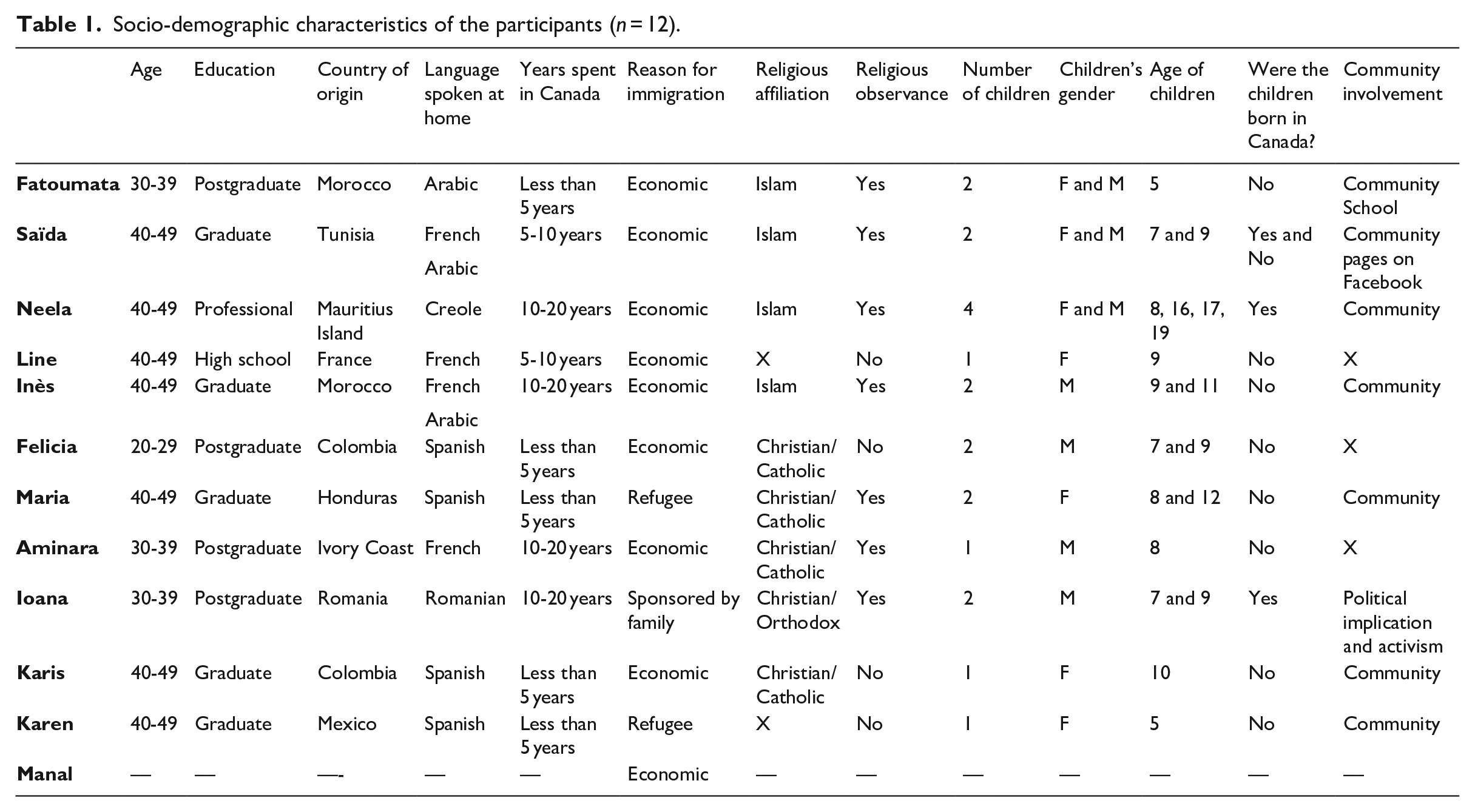
Recruitment proved challenging due to the impact of the COVID-19 pandemic (Cleveland et al., 2020) and led to the recruitment of 11 participants. Although the call for participation was not aimed solely at mothers but parents more generally, the final sample consisted only of female participants. While the gender homogeneity of the sample had not been planned, it reflects a trend documented in the literature indicating that mothers are primarily involved not only in school-based sexuality education but also in children’s school support in general (Al-deen et al., 2015). While this homogeneity allowed us to shed light on an important aspect of migrant parents’ engagement in their child’s sexuality education, the gender homogeneity of the sample re/produces the invisibilisation of fathers’ role and contribution within this space. Sociodemographic information on the participants is presented in Table 1.
Socio-demographic characteristics of the participants (n = 12).
Data collection
Two online asynchronous focus groups were conducted, comprising four and six participants each. The focus groups spanned 7 days, with one question asked each day by the main researcher. The discussion questions investigated participants’ perceptions of the following topics: (a) the reintroduction of mandatory school-based sexuality education in Québec in 2018; (b) the mandatory school-based sexuality education content for primary schools; and (c) possible improvements that participants perceived could be made to meet their needs. Participants had the entire day to answer the question after it had been posed and engage in exchanges with each other. During this time, the researcher monitored the discussions, ensuring that the exchanges were respectful, the conversation flowed and asking clarifying questions when necessary.
Analysis
An inductive thematic analysis was conducted on the data (Guest et al., 2011). The first step involved coding aided by the use of NVivo software. During this initial step, descriptive themes were identified, which were subsequently grouped together based on their similarity, recurring ideas and the potential for association. This iterative process led to the identification of the strategies employed by the mothers to engage in their child’s sexuality education. More information about the method, the data collection and the analysis process is available elsewhere (Morin, 2023).
Results
We now turn to discuss the findings of the study, highlighting the diverse ways in which migrant mothers engaged with their children’s sexuality education. The identified strategies were categorised into three conceptual themes as detailed below. All the names used are pseudonyms to protect participants’ anonymity. The findings contribute to a growing body of research that highlights the diverse strategies used by migrant parents to support their children in school (Vatz Laaroussi et al., 2008).
Balancing cultural perspectives by discussing sexuality education topics with the child
Several mothers described talking with their children about topics related to sexuality education. While some mothers, like Saïda, were already engaging in such discussion prior to the reintroduction of mandatory school-based sexuality education, for others, these conversations became an opportunity to share their family, cultural and religious values. For instance, Lina decided that she would like to discuss the concepts covered in class with her children in a manner consistent with her family values. This reflected a conscious effort to align formal education with personal and cultural beliefs, indicating a nuanced approach to sexuality education that balances educational content with individual family values, interests and needs.
In focus group discussion, Saïda shared her experience of the curriculum’s mandatory topics, which included reference to body parts, personal hygiene and self-acceptance. She noted that these subjects arose naturally in conversations with her child, suggesting that in these respects the curriculum aligned with common parental practices. Saïda explained how children naturally ask questions about these things with their parents, highlighting the organic nature of these discussions. In this way, parents were able to bridge the gap between formal education and everyday life. More generally, our findings suggest that for many families, these aspects of sexuality education were not only seen as a school responsibility but were interwoven into daily interactions in the home.
That said, conversation at home allowed for an exploration of potential differences in perception between the home and the school, as shown in the following quotation:
I know that in schools, they tell children it’s normal if you feel desire towards someone of the same sex as you. [. . .] I know this minority has rights in Canada. I will ensure my children respect others’ choices. I already do that. But I don’t want them to think it’s normal. It’s like eating pork. They know very well they shouldn’t consume pork, but I taught them not to comment on their friends’ food that contains pork. (Inès)
During focus group discussions, some mothers acknowledged the existence of different sexual orientations and emphasise the importance of teaching their children to respect these differences. However, they drew a line when it came to normalising these relationships within their family’s cultural framework. In her account, Inès engaged in a discussion to ensure her children were aware and respectful of diverse sexual orientations. She also expressed a desire for her children to understand these relationships without necessarily endorsing them as part of her own value system.
Something that also emerged in mothers’ discussions was the recognition that conducting sexuality education with their children involved considering not only family values but also their migrant background and experiences. This dimension added another layer of complexity to how sexuality education was approached within the family unit. In the following extract, Neela shares her views on school-based sexuality education and how they were shaped by the fact that her children had grown up in a different sociocultural context:
Sexuality can be a sensitive topic for children coming from a society like mine where this subject is hidden, silenced, and is a taboo. (Neela)
Neela’s perspective highlights how cultural differences can influence how sexuality education is perceived and discussed. For her, conversations about sex, sexuality and relationships require a great deal of sensitivity, both at home and in school. She navigates a complex landscape in which she must balance the values and norms of the family’s previous sociocultural context with the situation in Québec. The experiences of migrant mothers like Neela show the importance of schools adopting a culturally sensitive approach to school-based sexuality education. They reflect the need for educational systems and families to work together to acknowledge and address the diverse backgrounds of children. This approach ensures that school-based sexuality education is not only informative but also respectful and inclusive of the varied experiences and values that students bring with them to school.
The previous accounts highlight how migrant mothers navigated the intersection between school-based teaching and their family’s cultural, religious and migrant background. In what follows, we extend this discussion to how differences in perspective between the school and the family were understood by migrant mothers. Some mothers, such as Felicia and Saïda, viewed the role of the school and the family in sexuality education as complementary. They perceived schools as providers of information, often influenced by Québec’s values, while parents play a crucial role in shaping their children’s values and beliefs within this framework. Felicia expressed this idea in the following account:
[. . .] sexuality education has cultural elements and every classroom is multicultural. The school could teach according to Québec’s culture and ask migrant parents to teach their children their point of view according to their own culture and principles. We already teach our children, but it might be a good idea to work together and at the same time to avoid confusing the children. (Felicia)
Saïda echoed this sentiment, highlighting the positive outcomes of these conversations, such as developing new communication and teaching skills and enhancing knowledge. Saïda emphasised the importance of guiding her children while respecting her own values. In the following extract, she shares her experience of actively seeking the right information and techniques to communicate sexuality education effectively based on her children’s age:
[I searched] the right information to provide and techniques on how to convey it based on the child’s age. [. . .] I talk to them, discuss many topics with them while respecting their maturity. I seek to guide them while respecting my values. (Saïda)
While some mothers felt confident and equipped to open channels of dialogue and exchange, others felt they were on a learning curve. Karen described her initial discomfort and hesitation when discussing sexuality education with her eldest child, feeling that he might not be mature enough:
The first time I broached the subject with my eldest [I] was embarrassed . . . I thought, he’s not ready . . . not mature enough . . . But I was surprised. Instead of discussing a small point for 10-15 minutes, the discussion was very interesting, lasting 2 hours (!) (Karen)
In their discussion of SE, some mothers expressed concern and criticism regarding the school’s effect on their role as primary educators of their children. They felt a sense of powerlessness, feeling deprived of their ‘right to educate their children according to their values’ (Neela). This concern was particularly pronounced when schools introduced topics at an age the mothers deemed inappropriate. In addition, some mothers were worried about the potential influence of teachers on their children, fearing that the teacher’s ideas might contradict their own teachings. This fear extended to the possibility that children might find the teacher’s perspective more credible, potentially leading them to question their parents’ and their family’s cultural/religious beliefs. This power imbalance within the school–family partnership presents a significant challenge since it complicates the possibility of finding middle ground, as schools’ formal authority and standardised curricula may not always accommodate the more nuanced, cultural/religious values and beliefs of families:
I feel powerless to help [my child] answer or complete what he is learning in this course because I don’t know the date or the theme he is currently dealing with. Despite talking about this subject with my child, I don’t know if it could create doubts in his mind because he might hear two different versions. I talk to him a lot, but he stays silent, but we hope they will make good decisions in the end . . . (Neela)
While the mothers’ accounts do not explicitly mention this concern, they reveal the underlying issue of a lack of communication between parents and schools regarding the school-based sexuality education curriculum content. This gap in information contributes to a situation in which schools may unintentionally undermine the family’s role in sexuality education. In the following extract, Karen highlights her concerns about not being prepared with an answer and of schools ensuring that families’ values are respected and incorporated into their children’s education:
My fears are about concepts that will be covered at school without my having been warned and that my child will come to me with questions to which I won’t have the appropriate answers. I’m also afraid that at a young age, everything the teacher says is taken as ‘gospel’ and that my words/my contribution will have less impact on my child. (Karis)
Mitigating the power imbalance by building on the parent–child relationship
To mitigate the power imbalance between school and family in SE, several mothers in the research emphasised the importance of actively engaging in the parent–child relationship. They recognised that beyond merely transmitting information, their role involved investing in a loving and caring relationship with their children so as to better understand their experiences of sexuality education. This investment was not just about relaying facts, it concerned fostering a trust-based relationship that encouraged open discussion and created a safe environment for dialogue on sensitive topics.
For these mothers, effectively ‘playing their role’ extended beyond simply providing the ‘correct information’. It involved equipping their children with essential resources, including accurate information, guidance and values, to support their psychosexual development. A key feature of this process that became evident during the study was the importance of not shielding their children from reality. Mothers highlighted the need to answer their children’s questions ‘honestly’ while staying true to their cultural and religious values, aiming to facilitate an open and honest dialogue about sexuality that respected the family’s core values.
Overall, mothers viewed their role not only as educators but also as supportive guides and moral anchors for their children navigating the complexities of sexuality education. In the following extract, Aminara reflected on building and nurturing the parent–child relationship, rather than merely conveying information:
Surely, when they are teenagers, maybe they will try things, but at least I will have a clear conscience that I have done my duty . . . (Aminara)
Inès elaborated on this approach, emphasising the importance of being a reliable source of information and support. She believed that this approach not only helped her child feels comfortable discussing sensitive topics but also ensures that her child is grounded in the family’s values and principles:
I provide the right information even if it’s not complete [. . .]. If I don’t know, I say I will look it up and build friendships to gain trust. The trust I will build with [my child] [talking to him about SE] will serve to give him the reflex to come and validate with me what he has learned from his surroundings. (Inès)
In this way, mothers seek to play (and to a degree reclaim) a significant role in their children’s education. They counterbalance the voice of the school by reinforcing their presence as trusted guides and mentors. This not only helped to mitigate the potential power imbalance between school and family but also empowered the child to make informed decisions rooted in a well-rounded understanding of the world around them. This approach of mothers striving to strike a balance between providing essential knowledge and nurturing their children’s emotional well-being is fully in line with school-based sexuality education goals and underscores the complex blend of responsibilities when it comes to discussing sensitive topics.
Making their voices heard by becoming involved in change
For some mothers, participating in this research became a means of actively engaging in their child’s sexuality education and advocating for change. They viewed their involvement in the study as contributing to the development of a strengthened collaboration between schools and parents in the context of sexuality education. During one of the focus group discussions, a lively exchange occurred when one participant, Line, expressed her disagreement with other participants’ calls for schools to acknowledge and consider migrants’ cultural and religious backgrounds. While some participants emphasised the importance of having their identities respected, others, like Inès, refocused the conversation on the objective of evolving school-based sexuality education practices in a positive direction:
[. . .] let’s be active in evolving things in the right direction, especially for the generations to come. (Inès) That’s what we are doing right now, getting involved in sexuality education. (Saïda)
For such mothers, participating in the research offered an opportunity to restore the ‘truth’ to what migrant parents think and want from school-based sexuality education. Some of them discussed the often damaging stereotypes and misconceptions held by schools about migrant parents and their families when it comes to sex and sexuality. By engaging in the study, they aimed to counter these stereotypes and provide a more nuanced understanding of their perspectives, ultimately influencing the direction of school-based sexuality education to become more inclusive and informed:
Yes, there are a lot of prejudices about migrants and they are even stereotyped. They’re even classified according to their ethnic origin [. . .] But in reality, and within the same ethnic group, there are differences [. . .] (Saïda) The school must accept the diversity of families [. . .] Diversity is an asset. Everyone can bring a bit of knowledge and a contribution that can benefit our children. (Fatoumata)
These findings reveal that by actively participating in the research, the mothers sought to dispel misunderstandings and foster a more accurate understanding of their desires and concerns related to school-based sexuality education. By so doing, they sought to challenge existing power relationship between school and home and contribute to a more inclusive and respectful approach to school-based sexuality education, in which the diverse backgrounds and values of all families are acknowledged and valued.
Discussion
Our study reveals how migrant mothers in Québec actively participated in their child’s sexuality education by engaging in both ‘emotion’ and ‘cultural’ work. If the term emotion work refers to the resources deployed to manage feelings and emotions to enhance others’ emotional well-being and manage the emotional climate (Erickson, 1993, 2005), cultural work refers to the resources deployed to manage feelings and emotions to enhance one’s cultural well-being and manage the overall cultural climate.
By caring for their child’s feelings, engaging in dialogue, and including cultural and religious ideas and values in their teaching, mothers helped their child navigate school-based sexuality education. In particular, the emotion work that mothers invest in, such as empathetic listening and validating their children’s feelings, is crucial. This involves recognising and addressing their children’s emotional needs and guiding them through confusion or distress. Similarly, mothers’ involvement in schools and school life bridges cultural expectations and norms, balancing between their culture and their new cultural context. This balancing act includes managing discomfort around sensitive topics, providing reassurance and supporting their children in a culturally and religiously congruent manner that respects both the educational framework and the family’s heritage. This intricate interplay between emotional and cultural work often goes unnoticed, as these intangible efforts primarily occur within the private space of the family (Vatz Laaroussi et al., 2008).
As discussed earlier, participants in this study emphasised that partnership between educational institutions and parents is crucial for the effective development and implementation of school-based sexuality education curricula. Such a relationship not only recognises the essential role that both schools and parents play in the comprehensive education of a child, including aspects of SE, but also acknowledges the emotion and cultural work mothers put in to support the beliefs and values across families, highlighting the need for curricula and teaching methods that are inclusive and sensitive to these differences. Acknowledging the work of parents is central to the success of this partnership, as it highlights the often-unseen contributions they make to their child’s overall development.
In this study, the migrant mother participants often found themselves compelled to undertake a culturally responsive approach at home with their children. Indeed, mothers ensured that their child received culturally responsive sexuality education by having discussions with them at home. These mothers pointed out that their significant investment of time and energy stemmed from a perceived lack of communication from schools and Ministry of Education. Notably, the absence of shared information regarding the school-based sexuality education timetable and class content left parents uninformed about when and how to approach these topics with their children. Participants suggested that clearer communication regarding curriculum content, teaching methods and consideration of students’ and their families’ backgrounds could significantly alleviate the burden placed on migrant mothers. More open communication would also demonstrate that educational stakeholders respect and acknowledge the diverse cultural and religious backgrounds of both students and their families.
Limitations
It is important to recognise that this study was conducted in a specific context – Francophone Canada, with French-speaking migrant mothers in the province of Québec. The sample size was small and homogeneous, consisting only of female participants. This limits the generalisability of the findings to other regions or populations. The recruitment challenges posed by the COVID-19 pandemic may also have influenced diversity in the sample, leading to a somewhat adventitious group of participants. In addition, the focus on mothers may inadvertently reproduce the invisibility of fathers’ role in sexuality education, despite the study’s intention to explore parental involvement more broadly. Finally, personal and procedural reactivity also represent potential limitations as participants’ responses may have been influenced by the researcher’s prompts and the format of the focus groups. The findings should therefore be understood as relevant to the cultural context of Québec at the time of the study.
Conclusion
Findings from this study point to the significant role that migrant mothers play in their children’s sexuality education when viewed through the lenses provided by emotion and cultural work. Despite challenges such as inadequate communication and support from educational institutions, mothers in the study demonstrated a commitment to ensuring that their children received a comprehensive, well-rounded and culturally sensitive sexuality education. Moving forward, research findings highlight the critical need for strengthened school–family partnerships that acknowledge and integrate the diverse cultural and religious perspectives of families into school-based sexuality education curricula and practice.
