




Abstract
Objective:
Listening to children has been frequently adopted by researchers working within a child’s rights paradigm, as an uncontested method that veritably represents children’s ‘voices’. Whether children can be understood to participate, and their voices represented veritably, when their lives are culturally situated and co-constructed with significant adults is debatable. The data this paper engages with were created by adopting Barad’s posthumanist methodology of diffraction to listen with children to the more-than-human world.
Design/Method:
Diffraction was deployed as both a creative knowledge-making practice and an analytical framework that sought insight into the ways in which children are affected by, and affect, ideologies of sustainability. Art-making was adopted as a method to enable children a medium for communication and expression. As children make sense of their social and material worlds through play, I considered it to be a form of performance art during the research. The art-making took place within a ‘wild’ park space in the UK with children age 18 months to 9 years old.
Results:
This paper engages with a sense-making story created during the research analysis to highlight one way in which children’s possibilities to know become foreclosed when they are filtered through societal constructions of the child as ‘vulnerable’ and how ideas of food production become framed as ‘taboo’ when talking to children.
Conclusion:
Children’s possibilities to contribute to discussion on issues that create sustainability dissonance seem to become limited. The agency attributed to children tasked with bringing about sustainability change seems questionable and implications for their health and well-being need to be considered.
Keywords
Introduction
This paper explores the use of a methodology that employs Karen Barad’s (2007: 72) notion of diffraction for thinking about how data are created and analysed. Barad (2007) proposes diffraction as a methodology for decentring the human as the only one who can know, thus opening up the practice of knowledge production to a more-than-human world. Puig de la Bellacasa (2017: 1) describes the more-than-human world as ‘nonhumans and other than humans such as things, objects, other animals, living beings, organisms, physical forces, spiritual entities, and humans’. Barad (2007: 33: 178) proposes that agency ‘is not restricted to the possibilities for human action... but is a matter of intra-acting’. It is the intra-acting of bodies and the way in which they become entangled that then produces phenomena and possibilites for agency (Barad, 2007: 33). Scholars advance posthumanism as a new and emerging paradigm, open to creation and ideas of difference (Ulmer, 2017). In this paper, I took advantage of this flexibility to push the limits of the Reggio Emilia concept of listening to children to include the more-than-human world in the research methodology (Davies, 2014).
Listening to children is an influential concept within Early Childhood Education and Care that proposes that children express themselves in multiple diverse ways beyond vocal communication (Thornton and Brunton, 2014). Equally, it is an approach frequently adopted by qualitative researchers working within a child’s rights paradigm, when conducting participatory research and representing children’s voices. Mannion (2007: 407) questions whether children can truly be understood to participate, and their voices be represented veritably, when their lives are culturally situated and co-constructed with significant adults. Therefore, children’s ‘voices’ are so often read through the ontological and epistemological lens of the adult researcher (Lane et al., 2019). To engage with posthumanist ideas of decentring the human, in this paper I reconceptualised listening as an ethical approach for listening with the child, so that together we might listen to the ‘voice’ of the more-than-human world (Taylor and Pacini-Ketchabaw, 2015). To demonstrate the possibilities that diffraction might offer this form of listening I draw on data developed by my research.
The aim of this research was to gain a better understanding of the way in which young children construct their ideas about nature and how these then relate to the kinds of skills and attributes they might need for the present and also for uncertain futures in terms of environmental sustainability. I was interested in how ideas about sustainability affect children, and children affect the more-than-human world in relation to sustainability. It occurred to me that the need for sustainability arises when needs to address global warming, climate change, bio-diversity loss, plastic pollution and so on are at odds with demands for individuals to engage with and sustain a Global Economic Market (GEM). I have come to think of the GEM as practices (such as consumption), processes (such as those that produce food) and infrastructures (transport, factories, farms, corporations, governments, etc.) that interact to maintain a GEM (Newell, 2012). I see this framework as underpinned by a normalised understanding that economic growth provides the cornerstone of societal cohesion and human survival, that then works to encourage and augment these practices, processes and infrastructures. Conceptualising the GEM in this way enabled me to think about the dissonances that arise for individuals when seeking to comply with demands to act sustainably while they are part of the GEM. According to Festinger (2001), cognitive dissonance, caused by opposing or inconsistent beliefs, values or behaviours, compels humans as individuals and collectives to seek a psychological equilibrium or consonance, and occurs for example when individuals justify certain consumption practices in ways that enable them to ignore the consequences that their participation might cause for achieving sustainability. How then might dissonance be made visible when children intra-act with the more-than-human world. To guide me in answering this, I deployed the questions: In what ways do children intra-act with the more-than-human world? And what possibilities are created during intra-actions in a more-than-human world?
I begin this paper by describing the research that informs it. Below, I explain my use of Barad’s (2007) concept of diffraction. I then describe how and why I used art and play as methods to capture diffraction in action. In the latter part of the paper, I turn my attention to the analytical process where I deploy the story of ‘the chicken and the egg’ to elucidate my approach, including reflections on listening to children and more-than-human voices. In conclusion, I return to dissonance to clarify the importance of the inclusion of children’s voices in relation to that of the more-than-human world in which children not only live but are tasked with making decisions intended to bring about change to GEM practices, processes and infrastructures.
The research
As an Early Childhood Practitioner working in the UK, I observed that children seem to construct their ideas about nature through their relations with others – human and non-human. Therefore, if I consider sustainability to be an ideological desire to preserve a certain kind of nature conducive to the ongoing survival of humanity, children’s ideas about nature matter, as how humans think about nature relates to their environmental attitudes (Guha, 2006). Latour (2017) proposes that nature is a human construct that divides what is human or culture from nature. A legacy of enlightenment philosophising has worked to place the human as outside of, and superior to, the rest of the world, thus objectifying the more-than-human world (Latour, 2017). Individuals’ ideas on what nature is therefore create a divide between what they consider to be nature and what is culture, for example a football field or a shell bracelet. Therefore, what is understood to be nature or culture varies, which is important in a context where children have become subject to a global responsibilisation discourse (Walker, 2017) whereby they are viewed collectively (despite their location and context) as those whom are most affected, both physically and mentally, by sustainability-related phenomena, and therefore those with the greatest interest in bringing about sustainable behaviour change and attitudes (Phoenix et al., 2017). Yet decisions that might impact sustainability take place in a context where a GEM not only contributes to the dynamics of climate change but is also related to children’s socioeconomic potential to act. Making informed choices is further compounded by powerful global players casting doubts on the reliability of the scientific evidence so as to question the need for sustainability agendas and even suggesting that climate change may be desirable (Latour, 2017: 24–26; Paliewicz and McHendry, 2017). Therefore, whether children can succeed where powerful institutions have thus far failed to bring about meaningful change seems questionable (Walker, 2017).
As an Early Childhood Practitioner, I am aware that many young children spend more time in Early Childhood Education and Care than their parents spend at work (Solvason and Webb, 2023). Yet the notion of sustainability remains largely absent from the Early Years Foundation Stage curriculum and accompanying guidance despite it being explicitly addressed in other minority world curricula (GOV.UK, 2024; Weldemariam et al., 2017). The predominantly privatised model of Early Childhood Education and Care on the other hand seems to have facilitated the increasing number of ‘nature as good’ practices and pedagogies within Early Childhood Education and Care (Bailey, 2020; McDowell-Clark, 2023). I suggest that this phenomenon is unpinned by the way in which society and Early Childhood Education and Care continue to be influenced by Rousseau’s conceptualisation of ‘Nature’s Child’, a child pure like nature, that should be educated in nature by nature (Taylor, 2013: 10). In today’s context of planetary degradation, the notion of the child in nature (i.e. outside of corrupt culture) has become synonymous with nurturing pro-environmental attitudes (Bailey, 2020; Louv, 2010). Located within nature, the child then becomes constructed as vulnerable and in need of protection (Taylor, 2013). Therefore, how children intra-act with the more-than-human world and significant adults in their lives to formulate ideas that enable them to bring about the sustainable change they are tasked with is important.
A diffractive methodology
Barad (2007: 185) proposes that ‘we know because we are of the world’, suggesting that knowing through being entails a responsibility – ‘the ability to respond’, as every decision affects what comes to be known (Anzaldua cited Barad, 2014: 183). Barad (2007), therefore, draws metaphorically on the scientific concept of diffraction. Barad (2014: 176) describes this as the coming together or ‘entanglement of (seemingly) disparate parts’ and the moment of encounter where ‘intra-action’ occurs. Methodologically, in this study I sought to create the conditions for intra-action to take place between the child, myself and the more-than-human world (Barad, 2007: 74).
Practically, I deployed art-making as part of an ethnographic approach, to provoke play and to enable communication and expression. Because James and James (2011) suggest that children make sense of their social worlds through play, I surmised that aspects of the GEM might feature. For research purposes, I considered play as performance and artistic expression. With art framed in this way, children were at liberty to play with other children, adults and resources within the environment in any way they wanted. Five 1.5-hour long sessions, with six to seven participants in each, took place in a wild space in a local park. I supported children with their art-making when they requested my help, and in four sessions I had the support of at least one other adult with educational experience of children.
Participants were aged between 18 months and 9 years and were recruited from those who used the park and café, where I also ran a Forest School once a week. As part of the consent process, I gave each child a book which I designed to explain the research, saying that I wanted their help in answering my question: What is nature? The book included a consent form for children which could be signed by them with a picture. Caregivers could accompany their children or sit in the café. In this way, children were able to come and go as they pleased. The majority of the children were known to me as either an Early Childhood Practitioner, through the Forest School, or from the park/café area. This familiarity between myself and the children perhaps also reassured those who were new to me. In terms of resources, I provided six white reusable canvases (122 × 81 cm). I asked the children to bring recycling from home and provided masking tape for ‘junk modelling’, various-sized paint brushes, natural paints and water. I took photographs and wore an audio recorder. While the children tended to come to me for help, I also moved around showing interest and asking questions during our intra-acting I began and ended each session by gathering everyone together and asking the question: What is nature?
Capturing diffraction
The reading and translation of diffractive patterns are itself an act of diffraction, which engages with questions of why and how some knowledges are made possible, and others are not (Barad, 2007: 74; 2014). Finding the traditional qualitative practices of coding and theming limiting in their ability to adequately critique the complexity of social life, Jackson and Mazzei (2013) adopt the concept of ‘plugging’ one (literary) machine into another to produce something new. They advise the researcher to insert themselves, and their thoughts, into the data, to draw on their knowledge of theory, or specific theorists’ concepts, and ‘plug these in’ so as to provoke a response to, and make connections with, the data (Jackson and Mazzei, 2013). Barad (2007: 30, 90) suggests that the researcher should engage in ‘thinking, measuring, theorising, and observing’ in a process that involves ‘reading important insights and approaches through one another’. I think of ‘approaches’ as recognising and acknowledging ‘different kinds of knowledge making practices’ guided by my prior knowledge, experiences and positionality (Barad, 2007: 90). To ‘plug in’, I included Internet searches, turning frequently to Google Scholar, in search of ‘knowledges’ that might provide a more-than-human perspective. Mayes (2019: 1194) argues that this is not a case of seeking to position ways of thinking in opposition, as analogous or reconcilable, but as a constructive practice in which diverse paradigms for explanation might be brought into friction to see what is produced and what might be excluded.
To help me define what Barad (2007) describes as insights, I turned to MacLure’s (2013) notion of data that ‘glows’, or the wonder of data. MacLure (2013: 228) describes ‘glow’ as the way something small and seemingly insignificant, such as a ‘fragment of a field note’, might attract a researcher’s attention and a moment that teeters on the brink between unknowing and knowing. MacLure (2013: 229) suggests that the researcher may experience emotions of ‘curiosity, horror, fascination, disgust, and monstrosity’. Framing data as agentic, MacLure (2013) suggests that the researcher should be open and ready for the call of the glowing data by being willing to embrace the encounter to see where it might lead. Initially, I was drawn to ideas of categorisation, yet when left to dwell, I itched to return to specific moments. I named one such moment, the ‘chicken and the egg’. As Barad (2014) demonstrates in her own recounting, diffraction is a continuous process and takes place within the text. To capture this, I switch to the present tense for the most part in what follows.
The chicken and the egg
The chain of intra-actions that I think of as the chicken and the egg was prompted by my picking up of an egg box as it happened to be the nearest thing to hand at a certain moment in time. Thus, I came to be modelling making an egg with clay. Steve (aged 4) who I am modelling for tells me that he wants to make ‘Heavenly Foods eggs. That means eggs from the Heavenly Foods shop!’. I am intrigued and ask ‘Eggs from Heavenly Foods eggs. Where do eggs come from before they end up in Heavenly Foods?’ Steve initially replies that he does not know, yet subsequently reveals that he does know that ‘birds lay eggs’. I wonder why he does not make the connection between the eggs in boxes that he eats and birds who lay eggs. I ask: ‘who else makes eggs?’. Steve pauses and then replies ‘The, the egg factory, the egg factory!’. This is not the answer I am expecting, as I continue to pursue Steve’s logic I discover that ‘pretend birds’ lay the eggs in factories. Moreover, our intra-acting is drawing others into it. By the time I ask Steve ‘if eggs are made in factories, are chickens made in factories?’, Mike (aged 3) has joined us, and I discover that chickens live ‘In the farm!’. By this point, Milo (aged 9) has arrived on the scene and suggests ‘In some ways eggs are made in farms and a bit also in factories . . .’. Yet this insightful view appears to go unheard as my adult helper is asking Mike ‘Who makes the chickens?’. As the conversation proceeds, Mike is adamant that ‘chickens are in the farm’ repeating himself animatedly and raising his voice. My artist adult helper reassures Mike that ‘chickens are in the farm’ and Steve’s mother reaffirms this view ‘Yeah, chickens are in the farm aren’t they’. I try one more time to locate the chicken and the egg in the same place ‘Should chickens live in farms or should chickens live in factories?’. I am answered by my helper who states: ‘Chickens should live on farms’. Steve therefore brings this particular intra-action to a close by announcing ‘No they don’t they live in a bee’s house’.
When I return to this intra-action, I am surprised by its brevity in relation to my remembered feelings for it. Simultaneously, I find myself deploying Hultman and Lenz Taguchi’s (2010: 530) ‘relational materialist approach’ to reading photos. If we consider the material world to be ‘active’ and ‘playing with [children]’, we might look past what the child does and ask what does the material do in their joint becoming. Engaging with photographs from her own research, Mayes (2019: 1195) suggests that they memorialise beyond the subject and material backdrop to provoke effects, feelings, words, memories and questions, making connections with their human observers. Reading the audio through the photograph (Figure 1), the children’s wet shiny suits remind me of the difficulties caused by the cold wet weather that day. Yet, I am also reminded of the warmth of the camaraderie between those of us connected to this photo. As I set about transcribing the dialogue, I find myself bringing in images (see Figure, 2) and giving each speaker a different colour font, as if I am trying to reanimate the moment.
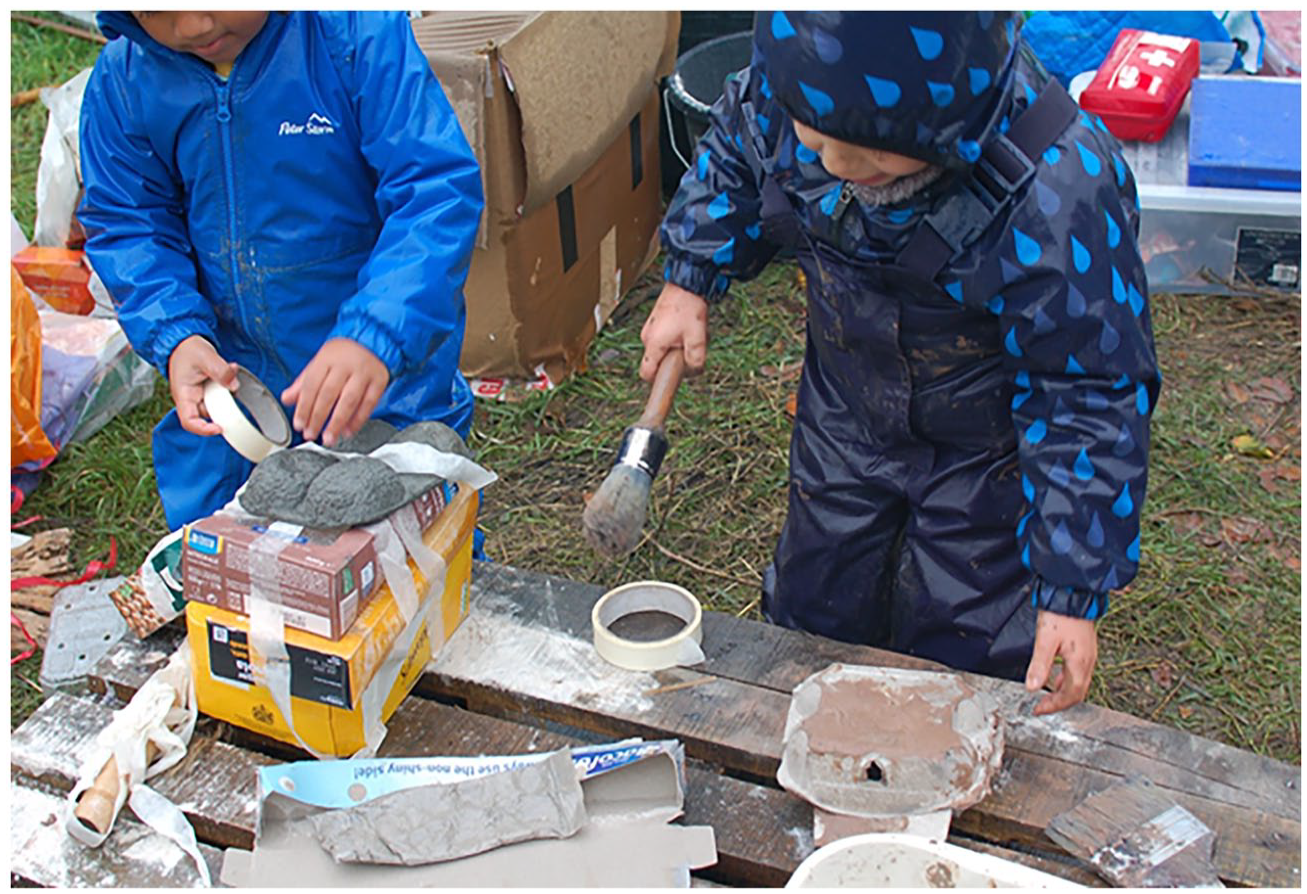
Shiny wet suits.
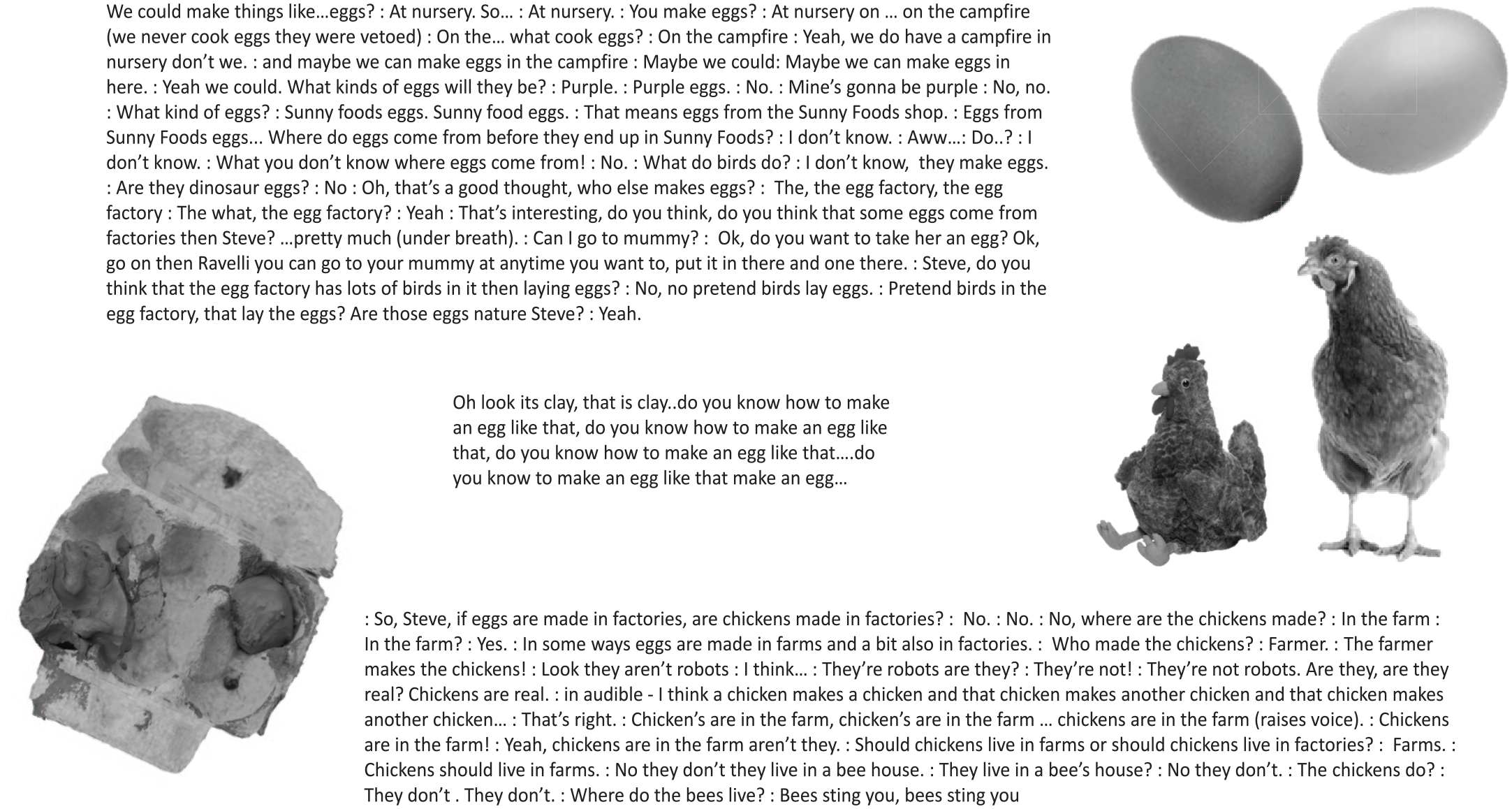
Initial visualisation.
I feel somehow constrained by the space. However, by isolating key moments and spreading out the dialogue, I am able to create a zone to think and allow possibilities to emerge. Somehow intuitively, I am drawn to my Early Childhood Practitioner’s experience of having made children’s picture books, and so I begin to translate the text in this way. It is a process where I freeze the dialogue on the page and then build around it with images, colour, font and its size. I am playing with the dialogue, reconstructing it and opening up the past in the present, so I can scrutinise it, and play with its multiple meanings (see Figure 3).
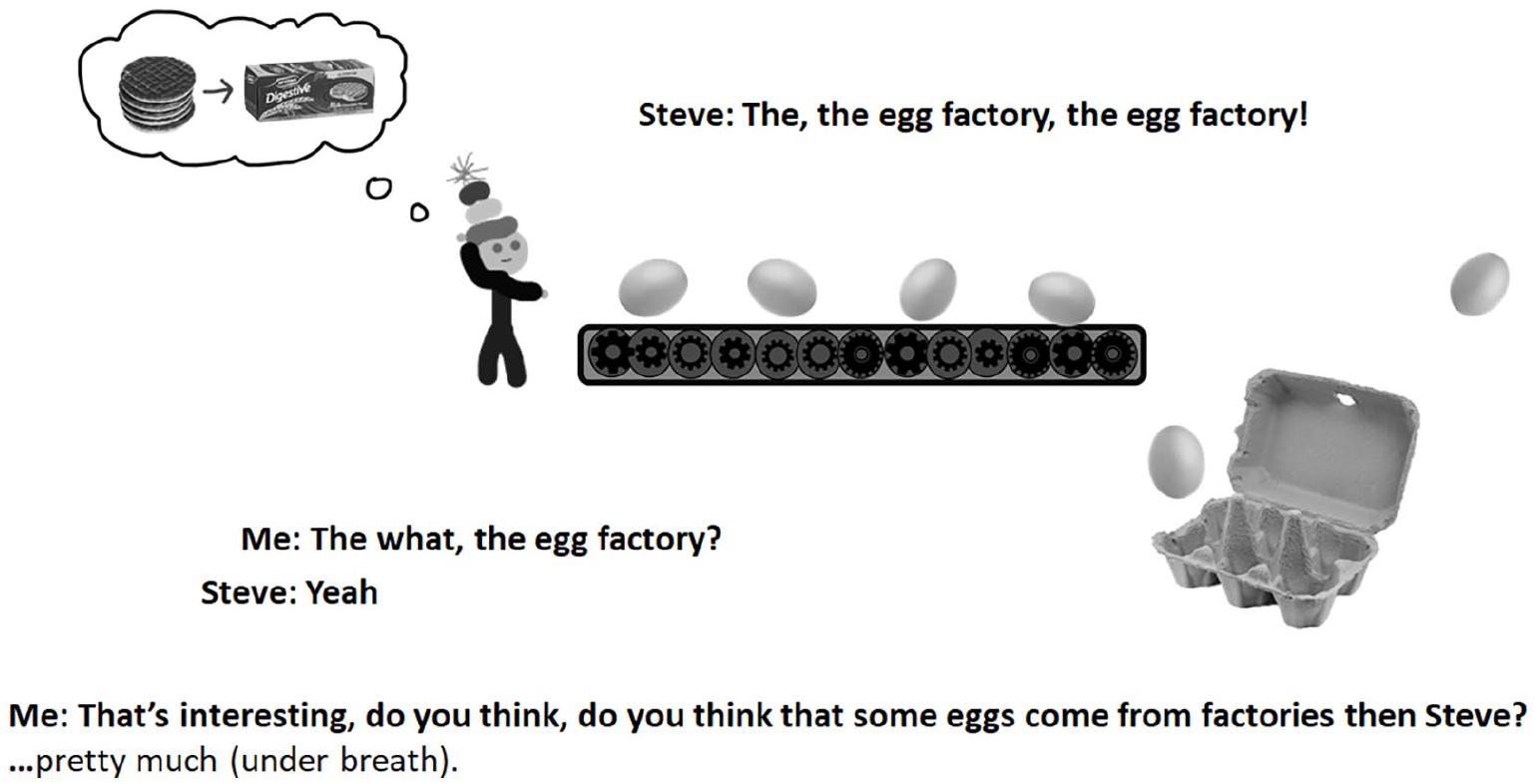
Eggs are made in factories.
In Figure 3, I am assuming Steve has probably never seen footage of a battery farm. I wonder if Steve has seen footage of biscuit production and is drawing on his past knowledge to imagine supermarket eggs as made in factories (Hill and Wood, 2019).
In Figure 4, I am contemplating why chickens are ‘in the farm’ when eggs are made in factories. I conclude that this is the image that is presented in children’s literature and other media. Baker and Davies (1992) suggest children’s literature moulds the way children perceive the world and their place in it. In this case, the chicken lives on an idyllic rural farm. My playful approach enabled me to create picture books and other visual formats, which I deployed like maps to guide me as I engage with theory so as to produce a more academic text (Barnacle and Dall’Alba, 2014).
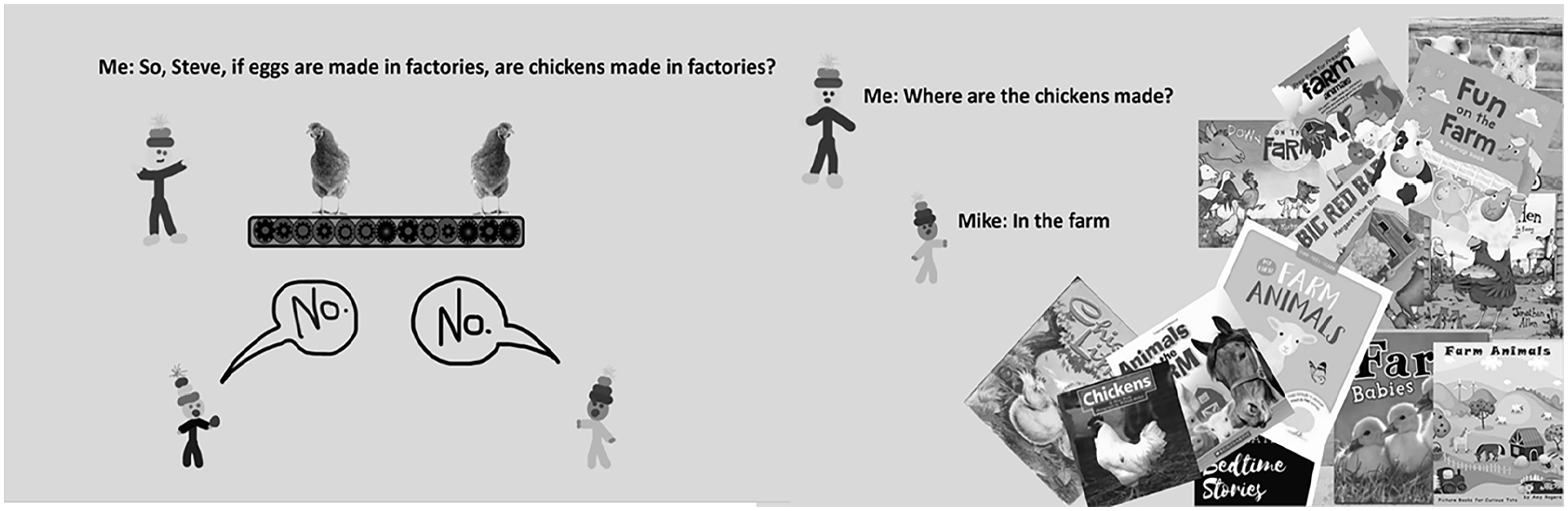
Chickens are in the farm.
Diffractive sense-making
My text or ‘storying’ approach was inspired by Taylor and Pacini-Ketchabaw’s (2015: 516) use of vignettes, in which they bring together ‘a range of fragmented elements, including: fieldwork photographs; observational field notes; reflections on ant and worm sciences and biographies; and ethical ponderings prompted by the work of feminist scholars working in the environmental humanities’, to demonstrate how worms and ants might be thought of differently. Similarly, Blaise et al. (2017) draw on Van Dooren’s (2016) notion of ‘lively stories’ in which he seeks to draw attention to the agency of other species and the material world, to bring them ‘alive’ on the page. In both approaches, worms, ants and wasps change from creatures for which humans have little empathy to beings with a ‘face’, thus highlighting their inter-relational and inter-species significance (Taylor and Pacini-Ketchabaw, 2015). Van Dooren (2016: 10) suggests that stories ‘are part of the world, and so participate in its becoming’. Stories therefore have consequences and ‘with them [come] new accountabilities and obligations’ (Van Dooren, 2016: 10). My intention in creating stories was to reposition the more-than-human world alongside the child to provide insights into their relationship and provoke thought in the reader.
The chickens’ perspective
The health benefits of eggs have earned them the common term ‘superfood’, making them ‘essential’ for children’s biological maturation (Gunnars, 2023; Younkin, 2018). They are a nutritious and cost-effective commodity (Marino, 2017). Donna Haraway (2016: 2) would describe chickens as ‘kin’ and a species with whom we must share ‘kinship’ if we are to achieve ‘multispecies flourishing on earth’. Chickens empathise with other chickens, mothers mourn when their young are taken away, and chicks learn to count within days of hatching (Marion, 2017). There are some 25.8 billion chicken ‘kin’ in the world (Shahbandeh, 2021). Yet chickens that are not female are macerated on hatching, and their (economic) value is realised in pet food (Davis, 2017; RSPCA Knowledgebase, 2024). Artificial light forces chickens to produce some 300 eggs a year depleting their mineral sources, their economic value and their lives (Scrinis et al., 2017). Beak trimming removes the tip of the beak, a sensitive organ containing multiple nerve endings, with physical and psychological negative impacts (Marino, 2017). I think of this as chicken beak mutilation (CBM). CBM enables large amounts of birds to live in confined spaces without damaging each other, yet Scrinis et al. (2017) note that overstocking of barn and free-range systems makes their actual realised welfare benefits questionable.
Feeding the chicken population requires UK producers to source 3 million tonnes of soya annually, grown in South American plantations (Woolley, 2019). Human consumption of chicken eggs increases annually, promoted as environmentally friendly alternatives to beef, meaning more forest becomes exchanged for plantations, contributing to global warming and the loss of species (Ritchie et al., 2021). At the same time, a ‘corporate-driven sustainability or welfare standards’, paradoxically backed by animal welfare and rights organisations, unwittingly promote the consumption of eggs, enabling corporations to tap into public desires to be ‘green’ through their packaging and advertising (Scrinis et al., 2017: 803). In the wild, chickens roost in trees and eat a varied diet that includes berries, insects and small invertebrates (Marino, 2017: 129).
Of course, the chicken was not present in the research field and therefore ‘listening’ to her is entirely a matter of my own interpretation. Using the concept of storying and by diffracting knowledges such as that from animal welfare websites, through research I have tried to provoke thought and give the chicken a ‘face’ (Taylor and Pacini-Ketchabaw, 2015). In doing so, I have anthropomorphised her, including casting her as a victim of humans. I am aware that many posthumanists are sceptical of this humanist behaviour (Taylor and Pacini-Ketchabaw, 2015). I do it to emphasise that chickens are sentient. It is hard to de-centre the human when the human interprets. Yet, I feel that diffraction as a practice of knowing has endowed me with a responsibility to provide an insight into the lives of those chickens hatched into industrial farming (Barad, 2007: 390). Thus I have come to reveal the way in which the practices, processes and infrastructures of the GEM that harm the chicken also damage the planet for the sake of an abundant supply of eggs that are needed to satisfy human appetites (Haraway, 2016). If I could ask the chicken whether she would prefer a year fed on soy, protected by captivity or take her chances in the wild, I wonder what she would choose. She is a chicken and I am a human, I can only attempt to listen to her languages. Therefore, the chicken’s voice is mine, meaning representing the voice of another in diffractive analysis, as with any analysis perhaps, remains biased and limited (Lane et al., 2019).
The nature/culture divide and creating consonance
Foucault (Mills, 2003) suggests that the ‘taboo’ subject silences certain knowledges. As societally constructed understandings, taboos dictate what can and cannot be said and what truths are socially acceptable. A taboo shapes, and is held in place, by societal discourses and is maintained by tacit agreement with the status quo (Mills, 2003). ‘Bodies’ such as institutions are then permitted to exercise power through hidden strategies such as surveillance over other bodies or individual subjects dictating what can be known (Mills, 2003). As death is a taboo subject (Mills, 2003), children are often excluded from ‘exploration[s] of pain, suffering loss, death and grief’ (Nxumalo and Pacini-Ketchaw, 2017: 1422). Yet, Taylor (2020) found that young children were able to reflect and form their own opinions on the justice or injustice of animal killing.
When I tried to provoke notions of ‘pretend birds’ and ‘chickens in the farm’ and not in factories, my questioning was (subtly perhaps unconsciously) redirected by adults, for example by affirming that the chicken exists only in the farm (Figure 5). By preventing Steve and Mike from discussing egg production, adults were arguably guided by and maintain egg production as taboo, enabling a partial truth to exist. It seems that as part of this process, the nature/culture divide becomes deployed in relation to a view of the child as vulnerable (Latour, 2017). The divide operated in this way seems to objectify and de-animate the chicken and the egg, positioning them within ‘corrupt’ society while leaving the imaginary chicken in ‘pure’ nature (Latour, 2017: 18). Protected by the status quo, the image of the chicken in nature, such as in children’s literature and in corporate imagery, enables the real chicken to become a justifiable vehicle for manufacture (Baker and Davies, 1992; Scrinis et al., 2017). Egg eating remains unaffected and egg producers continue to make profits unfettered by societal concerns (Scrinis et al., 2017).
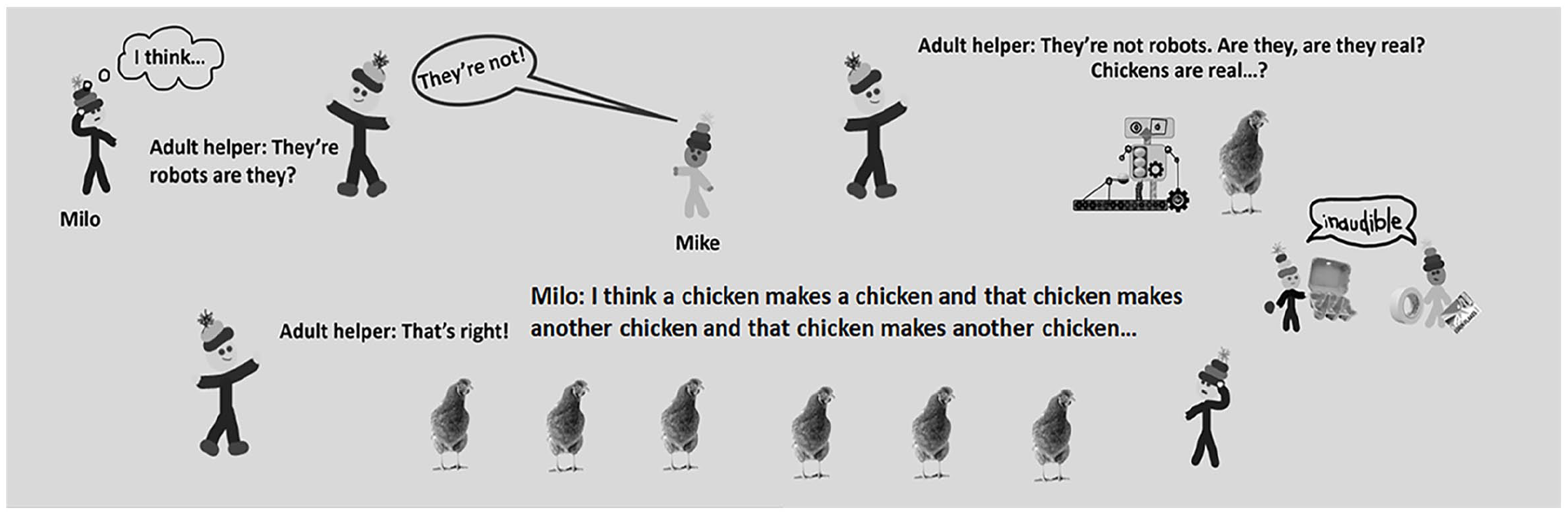
Deflecting the ‘taboo’.
For Steve and Mike, the imaginary ‘chicken on the farm’ becomes incommensurate with the factory egg. This is an understanding that enables (minority) world children to eat. As Mike goes on to suggest, the dissonance caused between the ‘need’ to eat eggs as an essential source of nutrition and a knowledge of the brutal methods deployed to achieve a cost-effective commodity silences adults on knowledge concerning chicken’s welfare affecting chickens (and arguably humanity) detrimentally. Consonance seems to be achieved through the pretend bird in the factory and the imaginary chicken on the farm, supported by corporate advertising, both of which suggest that the chicken’s welfare is attended to (Scrinis et al., 2017). Hence, children become schooled in the practice of achieving consonance, a skill that seems to be carried into adulthood, as the challenges surrounding sustainability goals might indicate (Festinger, 2001). Simultaneously, children are arguably prevented from creating their own knowledge that might enable them to question GEM practices, processes and infrastructures, and to construct their own ethical positions on subjects such as what kind of egg they might want on their plate, if at all. When information is withheld, children are maintained in a position of vulnerability that is arguably at odds with that of an agentic child able to bring about sustainability (Walker, 2017).
On reflection, art-making enabled me to witness children’s 100 languages in their more-than-human intra-actions. In the diffractive analysis offered here, I seem to have adopted a child-like approach by playing with the data so as to translate it into a pictorial language. By so doing, in a sense I have made use of the 100 languages. As a process, it seemed to provide a space for thinking and connecting with the data which raised questions, provoked wonder and created more ‘glowing’ moments on which to theorise why and how the children arrived at the convictions that they held. At the same time, I was reading theory through other ‘voices’ (in the sense of multiple knowledges), and through a picture of the chicken that was formulating alongside the child’s voice I was creating. As with the chicken, I can only seek to represent children’s voices. The child’s and the chicken’s voices are both interpretations that make use of 100 languages and voices of knowledge to create one possible representation of those voices in a specific context in relation to my research questions.
Conclusion
Van Dooren (2016) suggests that stories have consequences, and my approach of pictorially storying the children’s ideas provided me with a metaphorical space to be with the data and to listen ‘with’ children (Davies, 2014). I searched for knowledges that might provide me with insights into the lives and experiences of chickens in industrialised agriculture and plug them into theory (Jackson and Mazzei, 2013). This process provided me with a knowledge base with which I was able to pay detailed attention to the diffractive patterns created by ideas of egg factories, pretend birds, buckets of eggs and chickens as existing only in the farm. Reflecting on the children’s ideas in this way enabled me to construct their voice: A voice that intimates that egg production within a GEM framing comes at the expense of chicken welfare, so as to create a dissonance that threatens sustainability agendas. Steve’s pretend chicken suggests that children perhaps have some awareness of this dissonance. A construction of the child as vulnerable led to the adults engaging with the taboo surrounding death and eating animals; therefore, information that might lead to discussion with the children on egg production practices, processes and infrastructures and its effects on chicken welfare became suppressed. This voice of the child that I have constructed conflicted with notions of children as agentic, as on this occasion children were prevented from forming their own opinions on what it means to eat abundant eggs.
While adults arguably work to protect children, their engagement with the taboo also works to uphold the status quo and prevent their own reflection on the details underpinning the dissonance. The taboo that seemingly protects children and adults from discussing the complexity of food expectations, food production and the welfare of animals involved also works in the favour of powerful corporations who remain unquestioned in their pursuit of maximum profit. As controversy around Greta Thunberg highlights, powerful actors work to protect their interests and discredit children when they draw attention to the ways in which governments and corporations are implicated in planetary degradation (Rajan, 2022). While children globally continue to be those whose health and well-being are affected most by the consequences of unsustainable practices, they are also tasked as those who must respond (Gallagher, 2020; Phoenix et al., 2017; Walker, 2017). Yet my analysis suggests that children’s possibilities to do so are limited; therefore, the inclusion of their voices matters in any analysis that concerns them. As the children’s sense-making of the chicken and egg dissonance in this study revealed, children will use their imaginations to achieve consonance when knowledge that might empower them to form their own opinions that might then lead to any possibility towards their action to contribute towards change is denied.
