



Abstract
Objective:
Physical activity (PA) is essential to promote both optimal physical and emotional health in preschool children. Hence, well-founded PA guidelines are essential. 24-hour Movement Guidelines (which include PA, recreational screen time and sleep) have been established. Thus, this study aimed to explore preschool-aged children’s adherence to the 24-hour PA guidelines assessed using microelectromechanical systems, and whether sex was a determining factor for meeting the guidelines.
Method:
A systematic review of relevant published articles was carried out using four databases (PubMed, ProQuest, SCOPUS, FECYT) up until April, 2023.
Results:
From a total of 519 studies initially located, 48 were included in our synthesis. Of the studies analysed for this review, 7 showed results below 30% compliance with the PA guidelines, 19 below 70%, and 22 from 70% to 100%. In terms of sex differences, the studies analysed in the review suggested that boys are more likely to meet PA guidelines than girls. There exists controversy about adherence to PA levels as age increases. Several studies have shown an increase in the early years (1–5) while others, although to a lesser extent, have found that total PA remained stable or decreased from 3 to 5 years.
Conclusion:
In the light of these findings, more research is needed to better understand trends in PA during the preschool years and the factors that influence them. In the meantime, promoting regular PA and reducing recreational screen time remain key priorities for the health and development of preschool-aged children.
Introduction
Physical activity (PA) is essential for promoting optimal physical and emotional health in children (Gil-Moreno and Rico-González, 2023; Rico-González, 2023). It is associated with better motor and cognitive development, and improved psychosocial and cardiometabolic health in preschool-aged children (Carson et al., 2017). In addition, according to the type, amount, and intensity of PA, it may have a favourable impact on other health indicators (Carson et al., 2017). Therefore, it is important to have good-quality PA guidelines that are based on high-quality evidence to provide clear guidance to practitioners, policy-makers and the general public. These guidelines help to avoid confusion and misinterpretation of the underlying scientific evidence and should provide a solid basis for promoting health and active lifestyles (Parrish et al., 2020).
In recent years, emphasis has been placed on a holistic approach to promoting healthy movement-related behaviours. As a result of this, new evidence-based guidelines have been established to promote 24-hour movement behaviours, including PA, sedentary time and sleep (Tremblay et al., 2016). For preschool children, there are several guidelines recommended by different organisations. They include the Canadian (Tremblay et al., 2016) and Australian (Okely et al., 2017) 24-Hour Movement Guidelines, the NASPE (Now SHAPE America) Guidelines, the World Health Organization (WHO) Guidelines (Bull et al., 2020), the United Kingdom PA Guidelines (Department of Health, 2011), and those published by WHO in 2019 (Sommer et al., 2021). These guidelines all agree on the importance of regular PA, limiting recreational screen time, and ensuring adequate sleep for preschool-aged children. They focus on three main behaviours; (1) PA, at least 180 minutes of PA throughout the day, of which at least 60 minutes is moderate to vigorous intensity physical activity (MVPA); (2) sedentary behaviour, screen time should be no more than 1 hour; less is better; and (3) sleep, 10–13 hours of good-quality sleep, which may include a daytime nap.
In preschool-aged children, a recent meta-analysis (Tapia-Serrano et al., 2022) found that overall adherence to the 24-Hour Movement Guidelines was quite low at 11.26%. This is in line with the findings of Chaput et al.’s (2017) earlier study, which found that only 12.7% of Canadian preschool children adhered to the general 24-Hour Movement Guidelines, and other research reporting similarly low adherence percentages in Australian (14.9%) (Cliff et al., 2017), Belgian (10.1 %) (De Craemer et al., 2018), and the United States (11.3%) (Kracht et al., 2019) children.
In some research, it is the PA guidelines present in generic health guidelines that are most often not complied with (Berglind et al., 2018; Carson et al., 2019; De Craemer et al., 2018; Feng et al., 2021). However, several researchers report that screen time guidelines are the most non-compliant behaviour, with overall PA guidelines being the second most non-compliant behaviour (Chaput et al., 2017; Cliff et al., 2017; Guan et al., 2020; Vale and Mota, 2020). In contrast to adherence to general health guidelines, quite different results are reported for adherence to PA guidelines at a preschool age in different countries: from 91.6% adherence to PA in guidelines among Japanese (Kim et al., 2020), 61.8% among Canadian (Chaput et al., 2017), 28.6% among Portuguese (Vale and Mota, 2020), to only 11% among Belgian (De Craemer et al., 2018) preschool-aged children. Adherence to PA guidelines at preschool children also differs between different investigations within the same country (China 65.4% (Guan et al., 2020) vs 14.5% (Feng et al., 2021)].
Thus, research indicates that compliance with PA guidelines varies greatly (Downing et al., 2021; Draper et al., 2020; Feng et al., 2021). Factors influencing such adherence include the measurement methods used in the study (e.g. parental report vs objective measures such as the use of accelerometers); the specific PA guidelines referenced; and the characteristics of the population studied (by age, socioeconomic status, and geographical location). One of the key factors that have shown differences in several aspects is sex (Tapia-Serrano et al., 2022). Specifically, a recent meta-analysis (Tapia-Serrano et al., 2022) showed that compliance with 24-Hour Movement Guidelines was significantly lower in girls than boys, although no differences were found by sex in terms of compliance to any of the three individual recommendations (PA, sedentary time and sleep). However, if we focus only on preschool children, typically it has been shown that boys are more active than girls (Hinkley et al., 2008). Some studies have found higher compliance among boys than girls to 24-hour PA guidelines (Lucena Martins et al., 2021; Tanaka et al., 2020; Vale and Mota, 2020). However, other research has reported similar compliance rates for both sexes (Kim et al., 2020; Vanderloo et al., 2021).
The difference in adherence to the 24-hour PA guidelines between different countries, between different studies within a country, and between different sexes may arise from the use of different measurement instruments and/or cut-off points (De Craemer et al., 2018), as several different measures, both subjective (e.g. self-reported measurement) and objective, can be found in the scientific literature used to assess compliance with these PA behaviours. The main difference might be that objective measures compared to self-report approaches provide more reliable data about PA levels on a specific day or over a prolonged period (Trost et al., 2000).
Focusing on objective measures, accelerometers have been one of the most commonly used tools to assess PA and levels of recreational screen time (Lynch et al., 2019). However, technological advances are offering new approaches to the same end, with other tools such as wearable monitoring and activity wristbands, software applications and smartphones, global positioning systems (GPS), and inertial sensor devices (Jurado-Castro et al., 2022) proving valuable in PA research.
Thus, due to the importance of measuring PA objectively in preschool-aged children [because of its association with adiposity, health biomarkers, and fitness and bone health (Poitras et al., 2016)], and given the heterogeneity of the PA-level results and the diversity of systems for its assessment, a more detailed understanding of the degree of compliance with existing 24-hour PA guidelines, as well as the main technologies to assess it objectively, is needed. This study therefore aimed to explore whether there is evidence that preschool-aged children comply with the 24-hour PA guidelines when assessed using microelectromechanical systems, and whether sex is a determining factor in meeting 24-hour PA guidelines.
Method
Approach to the problem
A systematic review was performed in accordance with PRISMA (Preferred Reporting Items for Systematic Reviews and Meta-Analyses) guidelines (Page et al., 2021) and guidelines for conducting systematic reviews in the sports sciences (Rico-González et al., 2022).
Information sources
A systematic search of four databases (PubMed, ProQuest, SCOPUS, FECYT) was performed to identify articles published prior to April 21, 2023.
Search strategy
The PICO (Patient, Problem, or Population – Intervention or Exposure – Comparison, Control, or Comparator – Outcome[s]) design was used to provide an explicit statement of the research question to be explored. Where possible, the search was limited to scientific articles/journals and language (criterion 5: peer-reviewed, original, full-text studies written in English or Spanish). The author was not blinded to journal names or manuscript authors. The following search terms were used: (Preschool OR kindergarten OR ‘early childhood’) AND ( ‘meet*’) AND (guidelines) AND (‘physical activity’)
Eligibility criteria
To identify information from the articles, the first author downloaded the information (title, authors, date, and database) from each identified paper and transferred it into an Excel spreadsheet (Microsoft Corporation, Redmond, WA, USA), where duplicated were removed. The remaining articles were screened for meeting inclusion and exclusion criteria (see Online Supplemental Material Table 1). Moreover, relevant articles not previously identified and identified from external sources (e.g. in articles’ bibliographies) were also screened in an identical manner and further studies that complied with the inclusion-exclusion criteria were included and labelled as ‘included from external sources’ (see Online Supplemental Material Table 1).
Data extraction
Data extraction led to the creation of an Excel spreadsheet styled in accordance with the Cochrane Consumers and Communication Review Group’s data extraction template (2016). The spreadsheet was used to assess inclusion and exclusion requirements for all selected studies. Full-text articles that were excluded from the analysis were recorded with reasons for exclusion. All records were stored in the spreadsheet.
Data items
A full list of the articles included in the data sheet and qualitative synthesis can be found in Online Supplemental Material Table 2. The table includes information about sample; duration of data collection; type of technology used to assess PA; the guidelines that was used; and compliance with the PA guidelines considering the total sample; and other factors such as different years or different periods within a week assessed.
Quality of studies
Methodological quality was assessed using the methodological index for non-randomised studies (MINORS) (Slim et al., 2003). The MINORS scale is a list of eight essential points that need to be considered when assessing quality and which can be expanded to 12 points when dealing with comparative studies. In the case of comparative studies, nine items were used because the remainder were not applicable. The MINORS checklist assesses methods from 0 to 2 points (2 = High quality; 1 = Medium quality; 0 = Low quality).
Results
Identification and selection of studies
A total of 519 articles from Web of Science (81), PubMed (97), ProQuest (76), and SCOPUS (265) were found, of which 247 were duplicates. Thus, a total of 272 unique articles were therefore identified. After checking titles and abstracts, 33 articles were excluded because they did not meet inclusion criterion number five. The full text of the remaining 239 articles was then analysed and a further 76, 27 and 88 articles were excluded because they did not meet exclusion criteria numbers 1, 2 and 4, respectively. Thus, a total of 48 articles met all the inclusion criteria and were included in the final qualitative analysis (Figure 1).
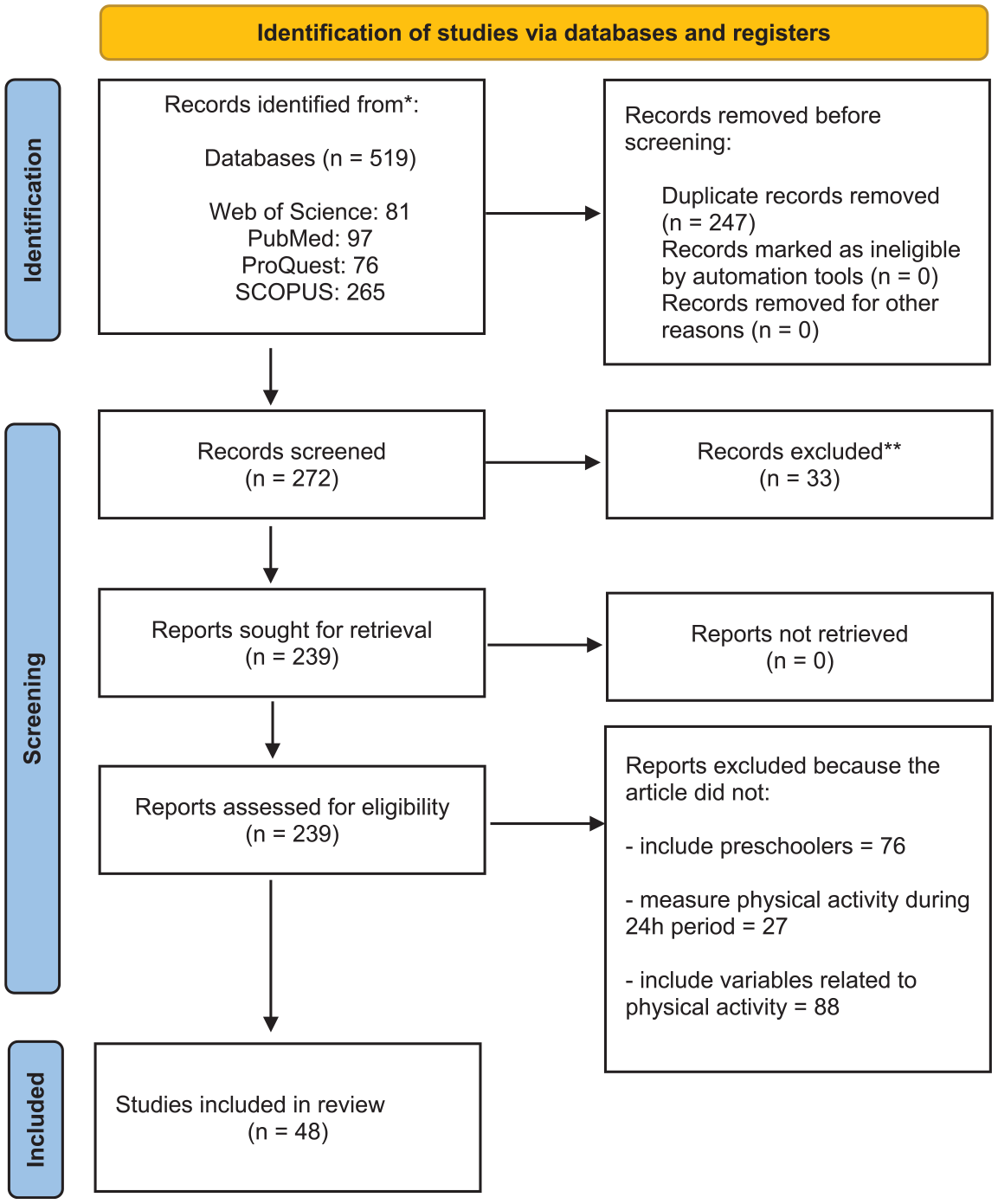
Flow diagram for the study.
Quality assessment
Details of the quality assessment can be found in Online Supplemental Material Table 2.
Study characteristics
The characteristics of studies were extracted and are detailed in Online Supplemental Material Table 3. The guidelines mentioned in this table are the Canadian guidelines, the NASPE, the WHO guidelines, the Australian guidelines, the South African guidelines, the UK guidelines, and the ‘10,000 steps/day’, and ‘5-2-1-0’ recommendations. The largest number of included studies took as a reference point the WHO (18 studies) or the Canadian (17 studies) guidelines. Seven and four studies, respectively, analysed their outcomes in relation to the Australian and NASPE guidelines, respectively. Other studies applied the United Kingdom, South African, ‘10,000 steps/day’, or ‘5-2-1-0’ recommendation guidelines. Five examined their outcomes using two different guidelines.
The degree of adherence to PA guidelines was variable depending on which guidelines were used as a reference and on other variables such as age or sex. Specifically, depending on the PA guidelines taken as reference, the degree of adherence ranged from 12.4% to 100% for the WHO guidelines; from 17.5% to 100% for the Canadian guidelines; from 11% to 96.5% for the Australian guidelines; and from 0.5% to 99.5% for the NASPE guidelines. In terms of age, adherence to the PA guidelines increased with age. In terms of sex, the degree of adherence ranged from 0.5% and 99.5% for both boys and girls; although the majority of studies that stratified the information collected by sex showed a higher percentage of compliance among boys than girls. The percentage adherence also seemed to vary depending on the days of the week. Overall, the degree of compliance was greater during weekdays than at weekends.
Discussion
The aim of this study was to explore whether there was evidence of preschool-aged children complying with the 24-hour PA guidelines as assessed using microelectromechanical systems. We also sought to explore whether sex was a determining factor in meeting the 24-hour PA guidelines.
In this review, all the studies included data from microelectromechanical systems. In all the studies analysed, seven showed results below 30% compliance with the chosen PA guidelines, 19 showed below 70% compliance, and 22 showed between 70% and 100% of participants complying with the PA standards. Multiple studies have shown that many preschool-aged children do not meet the recommended PA guidelines (Carson et al., 2020; De Craemer et al., 2018; Li et al., 2022; Lucena Martins et al., 2021; Vale and Mota, 2020). The rates can vary greatly depending on the specific population studied, the methods used to measure PA, and the specific guidelines used as a reference. Accelerometers have been traditionally used in studies to objectively measure PA levels (Adolph et al., 2012; Borkhoff et al., 2015; Breau et al., 2021). These devices are reliable enough for PA monitoring. However, some issues remain related to their effectiveness (Pedišić and Bauman, 2015). In particular, accelerometers lack the sensitivity to detect and record non-moving motion, so not all forms of motion can be captured (Dewar et al., 2014). These limitations may have contributed to the lack of consistency in reported intervention effects.
With respect to sex differences, the studies analysed here suggest that boys may be more likely to meet PA guidelines than girls (Delisle Nyström et al., 2020; Kim et al., 2020; Nicolai Ré et al., 2020; Vale and Mota, 2020). These data are in agreement with those found by Farooq et al. (2020) and Böhm et al. (2019). Only one study in this review found, marginally higher MVPA and Total physical education (TPA) levels in girls compared to boys (Hall et al., 2018). This could be due to a variety of factors, including cultural, social, and possibly biological factors. It is clear then that, in line with Duffey et al. (2021), whose study with more than 1.9 million young people showed that, regardless of the economic income, regions of the world and in many countries analysed, girls are less active than boys. The most prominent barriers to PA among girls are sex bias in sport, low motivation, perceived competition (girls do not enjoy competitive activities as much as boys) and/or conflicting priorities in childhood. Furthermore, sedentary time as measured by accelerometry is greater in girls than in boys, which may have an effect on sleep duration (LeBlanc et al., 2015; Steene-Johannessen et al., 2020). All these reasons could explain the findings found.
It is important to stress that at the preschool stage, an increase in levels of PA has been observed between 1 to 5 years of age (Larouche et al., 2016; Lucena Martins et al., 2021; Meredith-Jones et al., 2019; Taylor et al., 2009) but from 5 years of age it begins to decrease. However, a recent study in Australia has found a slight decline in total PA and moderate to vigorous intensity PA from ages 3 to 5 (Downing et al., 2021). Accelerometry data throughout childhood and adolescence (mostly from high-income countries) has revealed cross-sectional differences in PA and MVPA throughout childhood and adolescence starting at around age 5 years (with a clear decline). In line with Corder et al. (2016), the findings from this review show that MVPA declines in early childhood (for both sexes), and remains low during adolescence. The preschool years are a period of rapid growth and development, with significant changes in motor skills, personal autonomy, and social behaviour (Cliff et al., 2017). These changes can influence PA patterns in different ways. As children grow older, they often face increasing academic pressure which encouraged greater screen time use (Byrd-Williams et al., 2019), changes in social dynamics (Christian et al., 2022), and shifting interests (Corder et al., 2016), all of which may contribute to less time spent on PA. In addition, opportunities for physical education and active playtime during school often decrease as children progress upwards through the education system (Errisuriz et al., 2018).
Conclusion and practical applications
There remains controversy about PA levels as age increases. Several studies show an increase in PA in the earliest years (1–5) while others, although to a lesser extent, have found that total PA remains stable or decreases from ages 3 to 5. Research on sex differences in meeting PA guidelines among preschool-aged children often reveals that boys are generally more active than girls. Most studies show how as age advances from 1 to 5 years, preschoolers engage in higher levels of PA. It is when 5 years passes that a decrease in daily PA levels occurs again, representing an age for improvement. If the different guidelines are taken into account, the percentage of achievement of the minimum levels of PA carried out daily by preschool children would appear to be around 58% with respect to WHO guidelines, 75% with respect to Canadian guidelines, 70% with respect to NASPE guidelines, and 65% with respect to Australian ones. In one sense, therefore, preschoolers seem to be exceeding the TPA recommendation of 180 min/day, and the majority of studies also reported MVPA estimates over the 60 min/day recommendation for this cohort. However, barriers contributing to lack of PA should be identified and addressed so as to further increase the activity percentages.
Supplemental Material
sj-docx-1-hej-10.1177_00178969241269569 – Supplemental material for Preschool children’s adherence to the 24-hour physical activity guidelines: A systematic review comparing sexes
Supplemental material, sj-docx-1-hej-10.1177_00178969241269569 for Preschool children’s adherence to the 24-hour physical activity guidelines: A systematic review comparing sexes by Markel Rico-González, Ricardo Martín-Moya, María Mendoza-Muñoz and Jorge Carlos-Vivas in Health Education Journal
Footnotes
Declaration of conflicting interests
The author(s) declared no potential conflicts of interest with respect to the research, authorship, and/or publication of this article.
Funding
The author(s) received no financial support for the research, authorship, and/or publication of this article.

Supplemental material
Supplemental material for this article is available online.
References
Supplementary Material
Please find the following supplemental material available below.
For Open Access articles published under a Creative Commons License, all supplemental material carries the same license as the article it is associated with.
For non-Open Access articles published, all supplemental material carries a non-exclusive license, and permission requests for re-use of supplemental material or any part of supplemental material shall be sent directly to the copyright owner as specified in the copyright notice associated with the article.
