



Abstract
Objectives:
Overweight and obesity among school-aged children pose a threat to both their academic performance and public health. The Healthy Primary School of the Future (HPSF) initiative was established to address this issue. Our objective was to explore the conditions that make HPSF sustainable based on the perspectives of relevant stakeholders.
Design:
The study utilised Group Concept Mapping, a structured methodology for conducting mixed-methods participative research, combining qualitative data collection with quantitative data analysis measures.
Method:
Participants included parents, teachers, school directors, politicians, labour unions, educational, nutrition and health scientists and policymakers. They were asked to respond to the prompt, ‘A necessary condition to make the HPSF sustainable is . . .’. The statements generated were then assessed for their importance and feasibility. Using multidimensional scaling and hierarchical cluster analyses, we identified the shared vision among the stakeholders.
Results:
A total of 106 unique statements were generated and grouped statistically into 10 clusters. The most significant clusters were identified as Financing; Accessibility for everyone; and Content/Lifestyle/School Programme. The clusters that were deemed most feasible included Content/Lifestyle/School Programme; Accessibility for everyone; and Evaluation.
Conclusion:
Achieving sustainability for the HPSF requires a comprehensive approach that addresses the conditions outlined in all 10 clusters. Based on the ratings of feasibility and importance, our recommendation is to prioritise implementation of Content/Lifestyle/School Programme and Accessibility for everyone. Subsequently, efforts should be directed towards realising the less feasible but crucial conditions, such as Financing and Evaluation, followed by the remaining six clusters of conditions as identified.
Introduction
The rise of overweight and obesity poses a significant threat to public health worldwide. This issue is escalating and proving challenging to address (Obesity Collaborators et al., 2017). The consequences include a growing number of individuals facing chronic illnesses, leading to an increased burden on healthcare systems (Wang et al., 2008). Children are becoming a significant part of the overweight and obese population (Obesity Collaborators et al., 2017). The physical and psychological problems caused by obesity in children are similar to those experienced by adults, and may even impede cognitive development (Guh et al., 2009; Hayes et al., 2016; McElroy et al., 2004; Tandon et al., 2016). Given this early onset of the problem, early intervention becomes crucial to combat and reverse the rising trend of childhood overweight and obesity (Willeboordse et al., 2016). The need and usefulness of undertaking interventions to prevent and reduce childhood obesity are endorsed in the systematic review and meta-analysis of (Gonzalez-Suarez et al., 2009; Lavelle et al., 2012).
Several promising interventions have been identified (Field et al., 2003; Johns et al., 2014; Waters and de Silva-Sanigorski, 2012) such as physical activity, healthy eating, dieting, and parental training or support. However, these interventions often have one or more limitations. Most studies to date have analysed the effects of single interventions (Field et al., 2003; Waters and de Silva-Sanigorski, 2012) or interventions with a small group of participants over a short period of time (Wilfley et al., 2007; Wu et al., 2009), whereas Field et al. (2003), Johns et al. (2014) and Wilfley et al. (2007) indicate that they expect significant health improvements to best arise from multiple, concurrent interventions that address different aspects of the onset of overweight and obesity. In some of this work, there seems to have been more focus on diagnosing and treating obesity than on prevention (Daniels et al., 2005; Field et al., 2003; Lobstein, 2004a). In addition, Johns et al. (2014) and Lobstein et al. (2004b) claim that the sustainability of long-term effects is often not taken into account, causing participants to quickly revert to old behaviours.
Furthermore, the lack of priority given to health in comparison to academic performance poses a challenge to the successful implementation of change, as highlighted by Whelan et al. (2018). The reason for this could be that a definitive correlation between physical health and academic progress has not yet been established. Although some studies suggest a connection, there is a need for more extensive research on the relationship between health and academic development, as pointed out by Lee (2015). The need for this is also highlighted in the systematic review by Singh et al. (2012).
When someone becomes overweight or obese, it can be difficult to reverse the condition. Research has shown that obesity interventions tend to result in quick weight loss, but maintaining that weight loss over the long term is a significant challenge. This is due to a variety of factors including biological, behavioural and environmental influences that can impact long-term weight control (Greenway, 2015; Hall and Kahan, 2018). Consequently, primary prevention is essential (Waters and de Silva-Sanigorski, 2012). Waters et al. (2012) argue that prevention of overweight involves creating an environment and culture in which children can engage in daily physical activity and consume healthy food, ensuring consistent healthy behaviours are performed. Other researchers emphasise the importance of creating sustainable environments that yield desired results over extended periods of time (Forman et al., 2008; Pedersen et al., 2022; Whelan et al., 2018). Combining home-based and school-related programmes is one way to provide a comprehensive approach to reducing overweight and obesity, thereby improving overall health and wellness (American Dietetic Association (ADA), 2006; Centers for Disease Control and Prevention (CDC), 2011; Story et al., 2008).
To address these issues, the Healthy Primary School of the Future (HPSF) project was developed (Willeboordse et al., 2016). Its primary objective was to prevent overweight and obesity in children, with the broader goal of reducing the occurrence of acute and chronic diseases throughout life (CDC, 2011). The project targets schoolchildren, including those already overweight, and applies multiple interventions in a structured environment where children naturally spend their time. Rather than attempting to change existing lifestyles, the HPSF project focuses on encouraging healthy habits from a young age (CDC, 2011; Story et al., 2008).
The HPSF is informed by the Health Promoting School (HPS) approach developed by the World Health Organisation (Heijkant van den et al., 2005). It aims to incorporate health and wellness into the school system. Starting points include the provision of a healthy lunch, structured exercise and cultural offerings and an extension of school hours. The HPSF method has been implemented in four elementary schools located in the Parkstad region in South Limburg, the Netherlands. The interventions were compared with four control schools, and the results showed that they led to improvements in the children’s nutrition and physical activity behaviour, resulting in a healthier weight status (Bartelink et al., 2019, 2020; Willeboordse et al., 2016). The challenge now is to determine how to make the initiative a permanent part of the school system, which is why this research was conducted. The HPSF utilises a new lifestyle programme that spans from daycare/preschool to secondary education, incorporating various aspects such as social, physical, psychological, cognitive and educational elements. The programme helps children to develop better psychosocial and physical health through activities like promoting healthy eating habits; engaging in physical exercise and playtime; cooperation, communication, empathy; self-confidence; emotional expression; conflict resolution; and education about healthy living. Because these interventions impact children’s development and support, parental involvement is essential and thus is also part of the programme.
Assuming that the multiple intervention approach of the HPSF project is successful in achieving lifestyle changes, the focus shifts to creating a sustainable environment that can support these interventions beyond the research phase. Because sustainability changes over the years do not appear to be self-evident and are often seen as a problem, we used this research to explore stakeholders’ perspectives regarding the conditions necessary for achieving sustainability in the HPSF. Conducting sustainability research is crucial for achieving and ensuring lasting solutions to overweight and obesity in schools (McIsaac et al., 2017; Moir, 2018). This study seeks to determine the perceived importance and feasibility of these different conditions in promoting sustainability. Stakeholders, encompassing individuals and groups impacted by or involved in shaping the content, implementation and funding of the HPSF programme, were invited to participate in a Group Concept Mapping (GCM) study. This approach allowed stakeholders to express their opinions freely in a standardised, non-invasive manner, with subsequent statistical analysis conducted to extract meaningful insights. By engaging stakeholders and considering their perspectives, it becomes possible to ascertain perceived requirements for long-term change in a school context.
GCM was first developed over 30 years ago (Trochim, 1989). Since then, the approach has gained popularity and has been utilised in various fields and contexts including as public and community health, healthcare, education, social work, biomedical research and evaluation, and software engineering, among others (Kane and Trochim, 2007; Trochim, 2017). According to a pooled study synthesising 69 GCM projects, the method produces strong internal validity measures and reliability estimates (Rosas and Kane, 2012).
The research questions addressed in this study were as follows:
Research Question 1 (RQ1). What are the conditions that make the HPSF sustainable according to the stakeholders?
Research Question 2 (RQ2). In terms of sustainability, how important and feasible are these conditions according to the HPSF stakeholders?
Methods
To answer the research questions, the study utilised GCM as a structured methodology for conducting mixed-methods participative research (Howard, 2019; Kane and Trochim, 2007). GCM combines quantitative and qualitative measures through nonmetric multidimensional scaling (MDS) with two-dimensional solution of the unstructured sort data and hierarchical cluster analyses (HCA) to produce shared understanding group concept maps (Bartholomew et al., 2002; Everitt, 1980; Kane and Trochim, 2007; Kruskal and Wish, 1978; Trochim, 1989). In addition, the analysis aims to highlight the relative importance and feasibility of specific ideas and groups of ideas measured through rating scales (details are given below). The study described in this paper was performed as part of the larger HPSF project (Willeboordse et al., 2016).
Participants
We held an initial session to identify stakeholder groups and potential contributors to structural solutions in a school environment. We aimed to find those who could influence the success of these changes. The list of stakeholder groups approached for inclusion consisted of parents, teachers, school directors, politicians (local, provincial and national), relevant labour unions, educational, nutrition and health scientists, and policy makers. We obtained the names and email addresses of relevant participants from the management of the HPSF project and wrote to them requesting their cooperation in this study. For more information, see Table 1.
Age and background of registered participants.
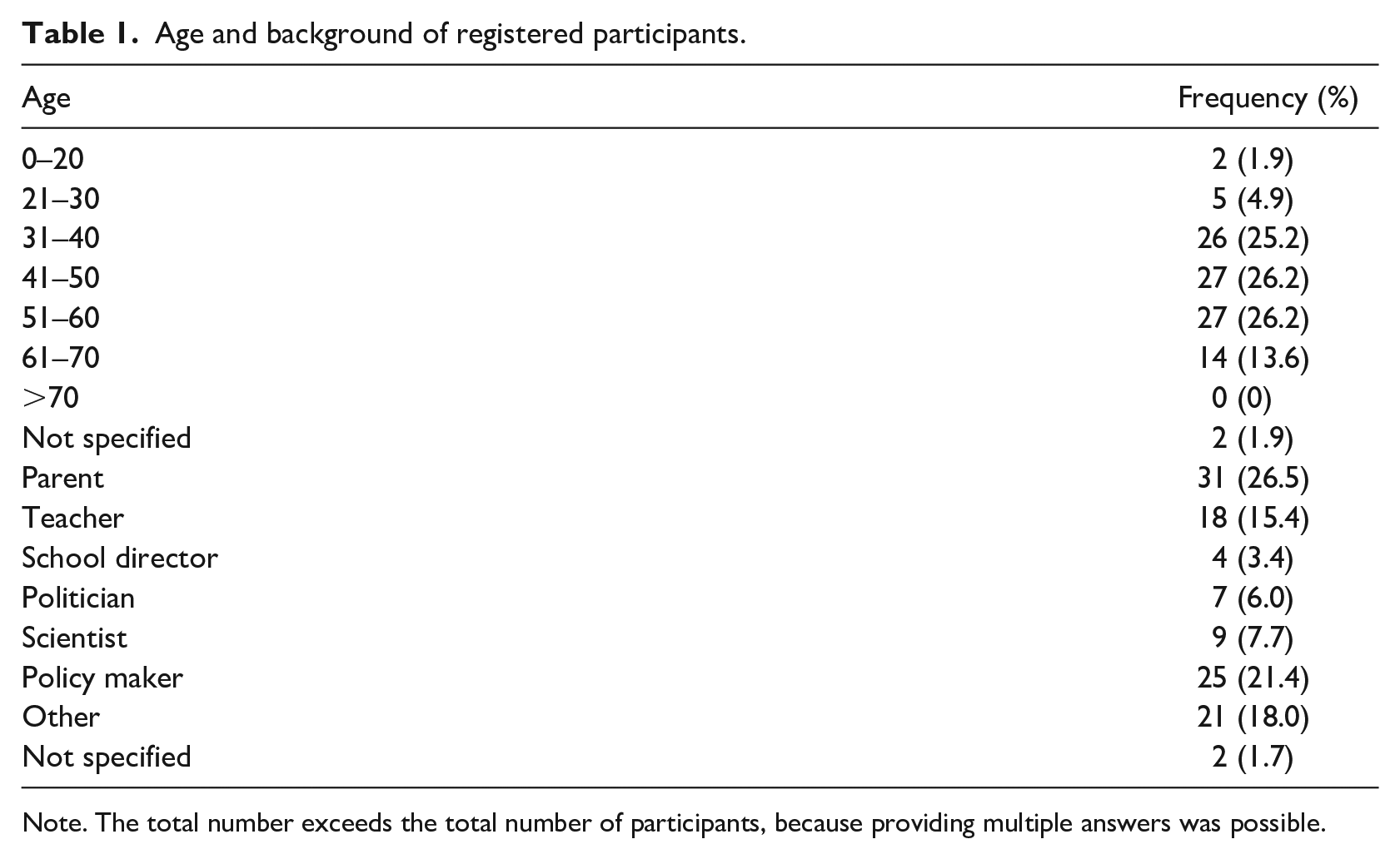
Note. The total number exceeds the total number of participants, because providing multiple answers was possible.
Procedure
The study’s stakeholders received invitations to participate via email. Once confirmed, they were given a secure link to access the web-based application (The Concept System® Global MAX™), which remained active for 4 weeks. Participants were asked for informed consent upon first use of the application. They were informed that the project was web-based and explaining the purpose and duration of the study. Participants were given the opportunity to ask questions and reflect on their participation in the study, including the benefits and risks of participation. They were also informed that they could withdraw from the study at any time without giving a reason. Participants consented to the use of the data collected for scientific research, with the assurance that the data would be collected anonymously and stored securely.
They were then asked three demographic questions regarding their gender, age and professional background (e.g. parent, teacher, policy maker, politician and health scientist), which were considered most relevant for the study’s purposes. Following this, they were prompted to provide as many statements as possible in response to the trigger statement: ‘A necessary condition to make the HPSF sustainable is . . .’. The resulting statements were reviewed by five independent researchers to prevent redundancy and ensure relevance and clarity while preserving the original wording. The researchers split the statements that contained more than one idea and assigned a code word to each statement. Then, they grouped the statements into code words. The selection process involved checking if the statement addressed the focus prompt, avoiding duplication with other similar statements, ensuring the statement was clear, concise and understandable, and reducing the statements to a manageable number for sorting and rating (to 100 or fewer as suggested by Kane and Trochim, 2007).
Participants were later invited to participate in a second phase of the study, which involved two activities: thematic sorting and rating. For the sorting activity, participants were asked to individually and independently of each other group the generated statements in any way they saw fit and label these groups using their own descriptive names. For the rating activity, participants were also asked to individually score each unique statement using a Likert-type scale of 1 to 5 on two values: importance (1 = not important at all; 5 = very important) and feasibility (1 = not feasible at all; 5 = very feasible).
The project received Institutional Review Board approval from the Open University of the Netherlands (U2017/02785/HVM, 26 April 2017).
Data analysis
To define clusters of conditions, the Concept Systems software utilises MDS and HCA. MDS (Bartholomew et al., 2002; Kruskal and Wish, 1978) reveals the relationships between generated ideas based on individual participants’ sorting. The basis for MDS is an N × N binary, symmetric matrix of similarities, Xij. For each participant and any two statements i and j, a 1 is entered in Xij if the participant placed both items in the same pile. Otherwise, a 0 is entered. By adding up individual participants’ Xij matrices, the total N × N similarity matrix, Tij is obtained. The analysis produces a two-dimensional (x, y) configuration of statements. Statements that are grouped more frequently together are closer in space, while those that are piled less frequently appear further apart.
In addition, two measures were generated to help interpretation of the results: a goodness-of-fit index and a bridging value. The goodness-of-fit index is a measure routinely generated by MDS to indicate how closely the participants’ raw sorting in total similarity matrix as input aligns with the final MDS configuration in the concept map. The bridging value ranges from 0 to 1 and indicates the frequency with which a statement has been grouped with others. A lower bridging value indicates that a statement was sorted with nearby statements on the map, while a higher bridging value suggests that it was sorted with statements that were further apart. Utilising the Ward algorithm an agglomerative HCA on the statements’ two-dimensional coordinates in the point map identifies more general thematic categories (a cluster map). To determine the number of clusters, a group of five researchers utilised the practical heuristics method known as ‘15-to-5’ (Kane and Trochim, 2007), which has also been supported by research (Rosas and Kane, 2012). They began by creating a 15-cluster solution and then proceeded to evaluate the relevance of the hierarchical clustering algorithm recommendations for merging clusters at each subsequent step.
In addition, for each cluster, the means of rating values for importance and feasibility were calculated. The rating values of clusters can be compared in a graphical representation known as pattern match. A pattern match provides a visual representation of two vertical axes for each rating variable that are set side-by-side in parallel. The cluster labels are arranged in rank order from top to bottom along each axis, based on the average cluster rating value. A line is drawn between the axes for each cluster, indicating its average value on each variable. The pattern match also indicates the degree of relationship between the rating values through Pearson product-moment correlation.
It is important to understand that the MDS and HCA techniques applied to the sorting data are fundamental to the GCM analysis. The rating analysis is an additional type of analysis that involves averaging rating data, expressed by means. A cluster map, which is a result of MDS and HCA, is a crucial component of the GCM, as all other analyses are based on it.
Results
Participant characteristics
The study invited 257 individuals to participate, of which 103 registered on the web-based system. Of the registered participants, 42 were men (40.8%), 59 were women (57.3%) and two undisclosed (1.9%). Table 1 displays the age and background of the registered participants.
Out of the registered participants, 83 completed the focus prompt, which asked them to identify a necessary condition to make the HPSF sustainable. Of these, 49 responded to the second invitation for the sorting and rating phases. Among them, 47 started the sorting phase, and 26 completed it; 38 started rating for importance, and 27 completed it; and 32 started rating for feasibility, and 23 completed it (For more details see Figure 1).
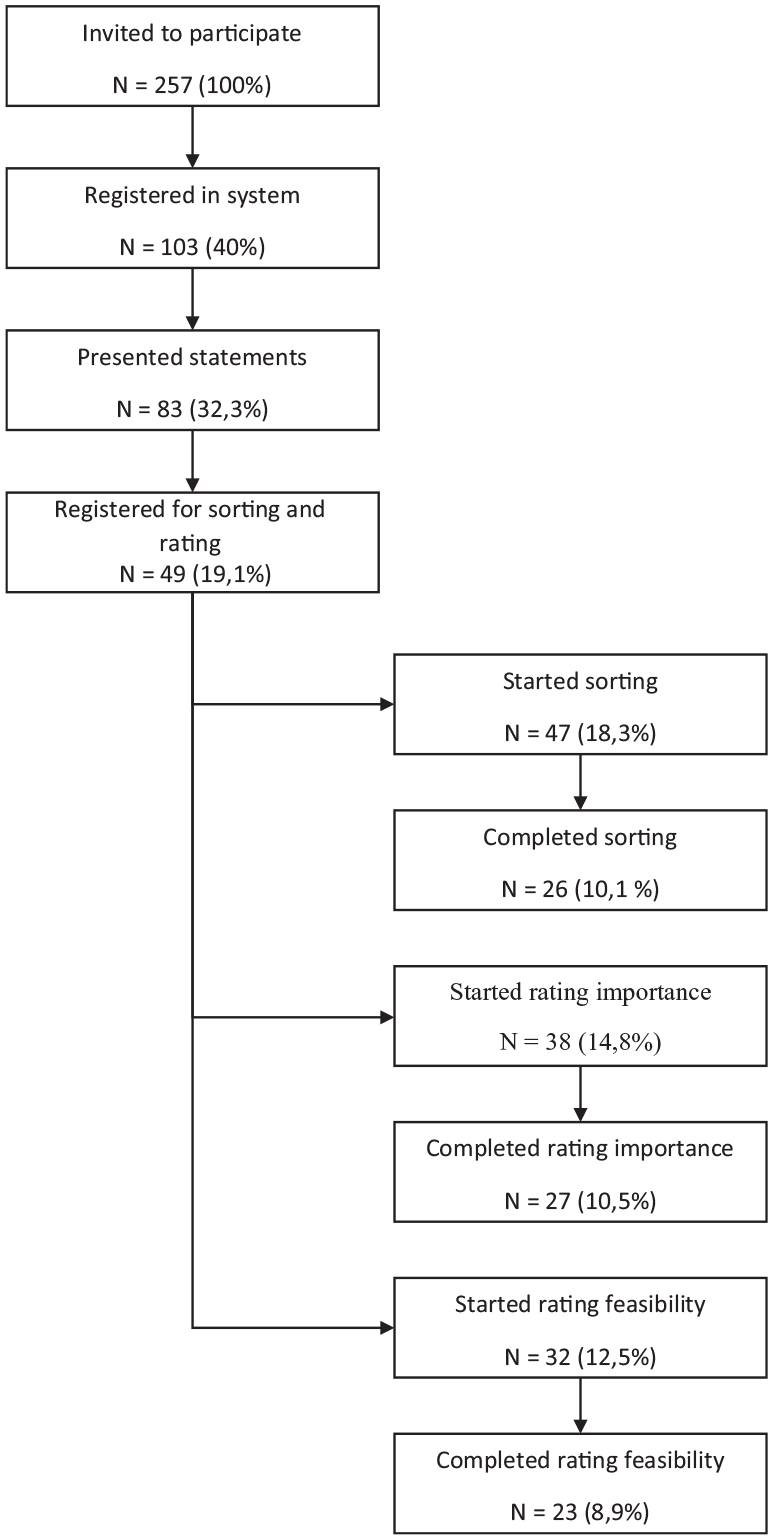
Number of participants in each phase and activity.
Conditions for a sustainable HPSF
During the brainstorming phase, 255 statements were generated in response to the focus prompt. Statements containing multiple ideas were split, resulting in 343 individual ideas. After editing, as described in the methods section, 106 unique conditions remained for sorting and rating. Multidimensional scaling (MDS) identified the relationships between the ideas/conditions in a two-dimensional space as points.
The closeness between ideas/conditions indicated that most participants thought these ideas/conditions belonged together. The ideas/conditions located far from each other suggested a weak thematic relationship. The goodness-of-fit index was 0.30 after 19 iterations, which is within the accepted range (Rosas and Kane, 2012).
HCA resulted in a 10-cluster solution that best reflected the data and study purpose. After adding meaningful labels to the clusters, the following clusters, indicating the conditions for a sustainable HPSF, were identified: ‘Content/Lifestyle/School Programme’; ‘Connection between home and school’; ‘Full parental participation’; ‘Cooperation’; ‘Acceptance by educational field’; ‘Political support’; ‘Financing’; ‘Evaluation’; ‘Insight into added value’; and ‘Accessibility for everyone’.
The average bridging value of most of the clusters was relatively low. This indicates that these clusters were coherent regarding the participants’ agreement on which ideas/conditions belonged to the clusters. Table 2 provides examples of statements per cluster indicating conditions to make the HPSF sustainable.
Examples of statements indicating conditions to make the HPSF sustainable.
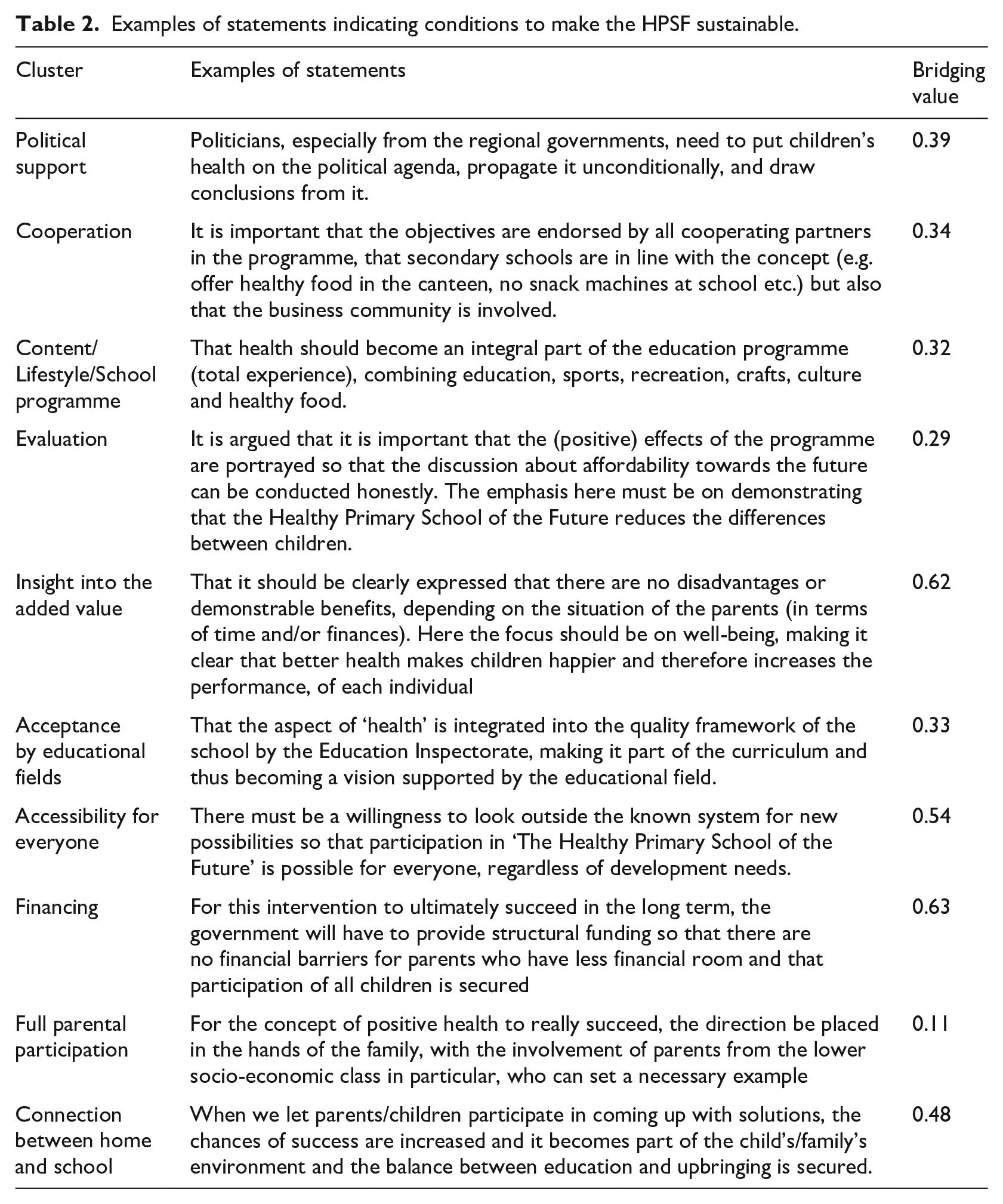
The clusters Accessibility for everyone; Insight into added value; and Financing had the highest bridging values among the clusters (0.54, 0.62, and 0.63, respectively). This means that the ideas/conditions in these clusters were frequently grouped together within their respective clusters but also with statements from other clusters.
Rating of importance and feasibility of the identified clusters of ideas/conditions
The three clusters with the highest mean score on importance were Financing, M = 4.14, Rating variation (RV) = 0.10,; Accessibility for everyone (M = 4.13, RV = 0.08); and Content/Lifestyle/School Programme (M = 3.99, RV = 0.11). The three most feasible clusters of conditions to make the HPSF sustainable were Content/Lifestyle/School Programme (M = 3.74, RV = 0.13); Accessibility for everyone (M = 3.45, RV = 0.07); and Evaluation (M = 3.36, RV = 0.16). The three least important clusters were Evaluation (M = 3.77, RV = 0.07); Political support, M = 3.77, rating variance (RV) = 0.10,; and Cooperation (M = 3.57, RV = 0.09). The least feasible clusters were Political support (M = 2.74, RV = 0.10) and Financing (M = 2.51, RV = 0.09). See an online supplemental file for more detailed information.
The GCM produces also a pattern match, which compares and contrasts the scoring on the rating scales importance and feasibility at cluster level. The pattern match, displayed in Figure 2, shows that all clusters of conditions, scored higher on importance than feasibility.
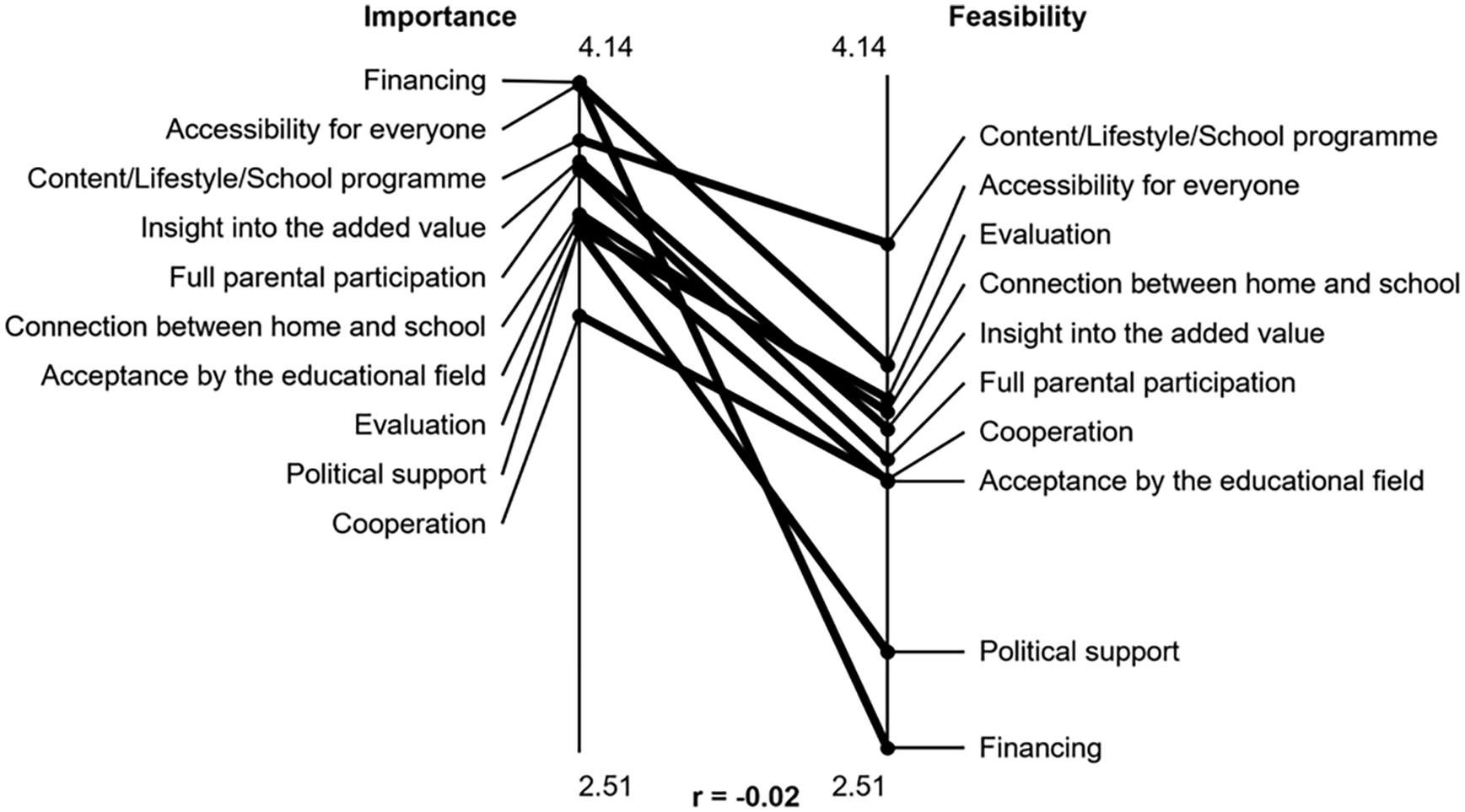
Comparing clusters on importance and feasibility (Pattern Matching).
The correlation between the rating values was very low and negative (r = −0.02), indicating that while the scores on the rating value of importance increased, the scores on the feasibility decreased. The two data patterns, importance and feasibility, moved in opposite directions but not with an equal magnitude as the most significant margin was observed in Financing.
The clusters with statements; a table with the ratings of the statements and clusters on importance and feasibility; the raw sorting and rating data; and the total similarity matrix for MDS can be found at https://bit.ly/HPSGCM.
Discussion of findings
This study utilised GCM as a structural stepwise participatory approach to identify and prioritise the conditions that contribute to the sustainability of the HPSF. The GCM involved capturing, statistically aggregating, and visually representing the ideas of a diverse range of stakeholder groups to develop a consensually agreed conceptual framework of sustainability conditions. GCM can help maintain the continuity of efforts throughout the project’s lifecycle. It covers actions from initial conceptualisation to action development, implementation, evaluation, and improvement. Using this approach, stakeholders can link sustainability measures to their original expectations to see if they have achieved what they intended to achieve.
This study addressed two research questions: (a) what are the conditions that make the HPSF sustainable according to the stakeholders; and (b) in terms of sustainability, how important and feasible are these conditions according to the HPSF stakeholders?
Conditions for HPSF sustainability
Ten clusters of conditions were identified: Content/Lifestyle/School Programme; Connection between school and home; Full parental participation; Cooperation; Acceptance by educational field; Political support; Financing; Evaluation; Insight into added value; and Accessibility for everyone.
The stakeholders agreed that the HPSF’s sustainability depended on all clusters of conditions. While each cluster of conditions was felt to be necessary, it was not sufficient to achieve the HPSF’s sustainability on its own. The direct HPSF ecosystem comprises clusters such as Content/Lifestyle/School Programme; Connection between home and school; and Full parental participation.
To broaden the school’s ecosystem, the Cooperation cluster suggests forming partnerships with outside organisations. There is also a need for recognition by the formal education ecosystem by including a healthy lifestyle in the official curriculum (the cluster Acceptance by educational fields).
Political backing for initiatives such as HPSF, encapsulated in the Political Support cluster, is deemed essential. This includes government’s role in endorsing the HPSF concept, local government integration of the HPSF concept into health and policy frameworks, and regulatory support for schools. Long-term project financing, addressed in the Financing cluster, is equally crucial, encompassing the concept’s long-term financial feasibility, prioritising children’s benefits over costs, and providing detailed cost–benefit analyses. Stakeholders strongly support scientifically measuring HPSF’s impact on children’s physical and cognitive development, as outlined in the Evaluation cluster.
The Insight into added value cluster emphasises the benefits of the HPSF concept, aiming to enlighten parents and children about the broader societal implications of healthcare costs and the concept’s role in reducing these. It also focuses on fostering positive peer influence and awareness of how a healthy lifestyle boosts academic performance. The Accessibility for everyone cluster stresses the importance of inclusive participation in initiatives such as HPSF project.
The clusters Accessibility for everyone; Insight into added value; and Financing demonstrated the highest bridging values, indicating their cross-thematic roles. The physical distance between clusters shown in Figure 3, which can be interpreted as an empirical estimate of their semantic distance indicates a close relationship between those representing the immediate HPSF ecosystem (the clusters Content/Lifestyle/School Programme; Full parental participation; and Connection between home and school), suggesting direct control over these conditions. Cooperation and Acceptance by the educational field, although not part of the direct ecosystem, are closely linked to it. In contrast, Financing and Evaluation are more distanced, indicating weaker relationships and lower control. The clusters Accessibility for everyone and Insight into added value could potentially bridge thematic gaps, particularly between areas like Content/Lifestyle/School Programme and Financing providing a persuasive rationale for financial support of initiatives like the HPSF programme.
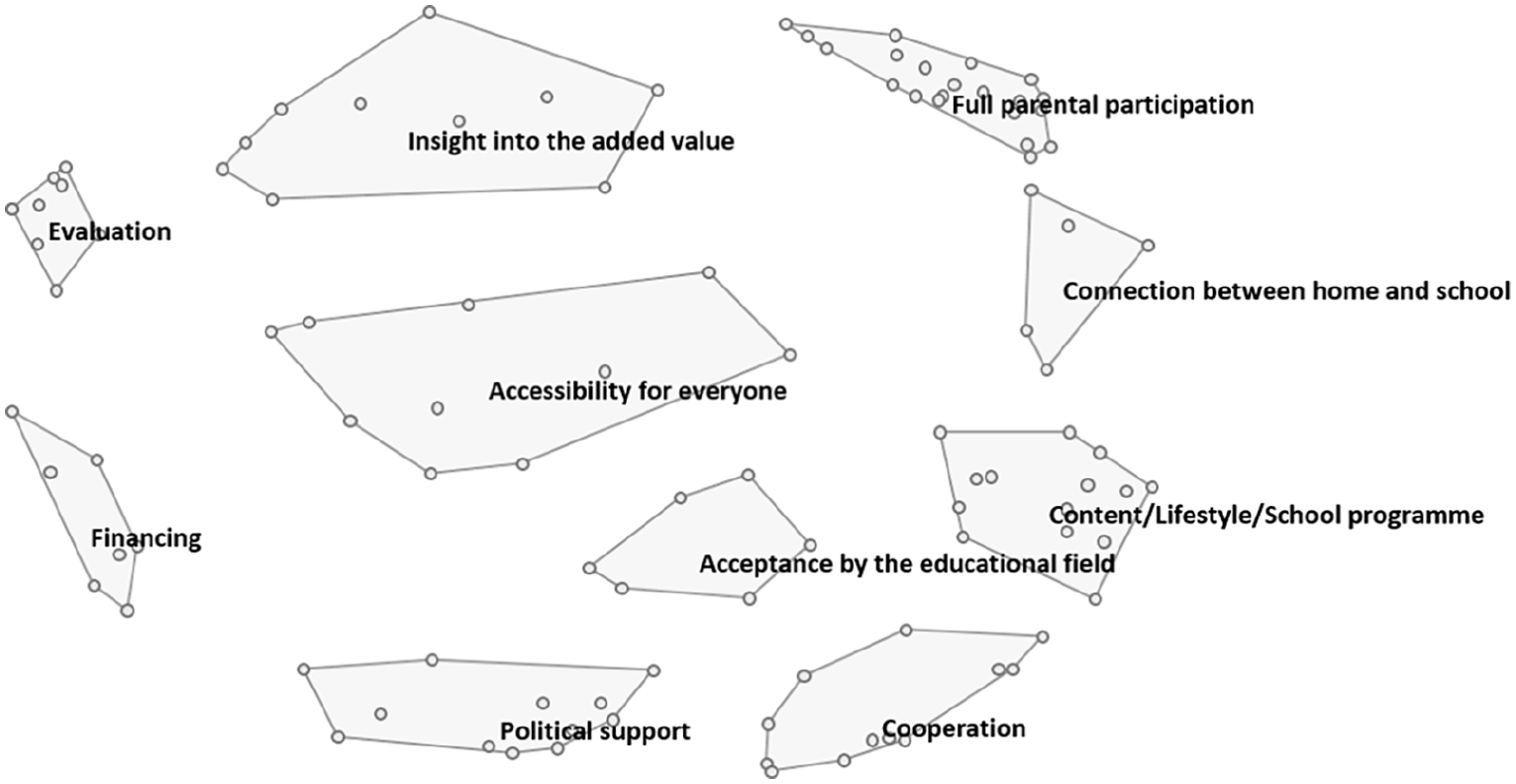
Clusters of sustainability conditions (cluster map).
Importance and feasibility of the sustainability conditions
The analysis of the rating data complemented the sorting data analysis. Content/Lifestyle/School Programme and Accessibility for everyone scored relatively high on importance (second and third place) and were considered the most feasible (first and second place) conditions, which implies that they should be acted upon immediately. Conditions related to Evaluation; Connection between home and school; Insight into the added value; Full parental participation; and Cooperation were less prioritised but not seen as problematic to manage. However, long-term efforts are required to obtain financing and political support, with financing being of utmost importance but the most challenging to realise.
Reflecting the field
To the best of our knowledge, only a few studies are available in which the sustainability of measures to reduce obesity has been investigated. One comparable analysis focusing on the sustainability of community-based interventions to improve obesity-related behaviours is that of Whelan et al. (2018). In their narrative synthesis review, the authors identify 10 factors contributing to sustainability: resourcing, leadership, workforce development, community engagement, partnerships, policy, communications, adaptability, evaluation and governance. Some similarities with this study can be observed by comparing Resources and Financing; Community engagement and Parental participation; Communication and Insight into added value; Governance and Political support; Adaptability and Acceptance by educational field; Partnerships and Cooperation; and Evaluation and Evaluation. However, unlike our more holistic approach, the study by Whelan et al. (2018) focused on a few sustainability conditions without considering the entire set of sustainability factors.
Forman et al. (2008) used structured interviews to identify potential facilitators and barriers to effective implementation and sustainability of evidence-based interventions in school settings. They identified the following seven thematic areas: development of school principal support and support from other administrators; development of teacher support; development of financial resources to sustain practice; provision of high-quality training and consultation strategies to ensure fidelity to the model; alignment of the intervention with school philosophy, goals, policies, and programmes; ensuring that programme outcomes and impact are visible to key stakeholders; and development of methods to deal with turnover in school staff and administrators. These findings correspond to conditions in two of the clusters in our study–Content/Lifestyle/School Programme and Financing, which score highest on importance
Limitations of the study
Although GCM includes measures that could potentially cope with threats for validity and reliability, we acknowledge some possible limitations in this respect. We observed a drop out of participants from the brainstorming to the sorting and rating phases. The pooled study by Rosas and Kane (2012) found that there were 25 sorters on average. In our study, 47 participants started the sorting, and 26 completed it, which is in line with the findings of the aforementioned study, indicating that over half of those who initially agreed to complete the task did so. The number of participants in the rating phase was comparable to that in the sorting phase, which is consistent with most GCM studies and shows good compliance.
Another similar finding with Rosas and Kane’s (2012) study was the fact that the second rating included fewer participants. This could be attributed to fatigue, as GCM is an intensive process involving idea generation, sorting, and two ratings, which requires significant time and cognitive effort. Although there was some dropout from one activity to the other, the participants who took part in the sorting and rating still represented the original sample profile.
Although there is a well-established procedure for defining the final set of statements and statistical support for determining the number of clusters, there was still a possibility that a few statements might have been overlooked for the final set. In hindsight, however, given the number and content of the clusters, we believe that the set of statements was sufficiently broad and targeted to the focus prompt.
We requested stakeholders to indicate their gender, age and professional role, which we considered to be the most relevant for the study and could directly affect the outcomes. We used ‘age’ as a proxy for professional experience, but it would have been better to ask about experience directly. We did not ask questions about the number of children and location, which might have indirectly impacted the participants’ contributions. Finally, we avoided a lengthy section of demographic questions as our experience shows that this can hinder participation in idea generation, sorting and rating, which are essential for GCM.
Conclusion
According to stakeholders, achieving sustainability for the HPSF is possible by considering all 10 identified clusters. The clusters Content/Lifestyle/School Programme and Accessibility for everyone should however receive primary attention due to their feasibility and importance. Once sustainability has been achieved for these clusters, efforts can be directed towards the other clusters in order of importance. Further research is recommended to address the challenges associated with implementing and realising the most important but difficult-to-achieve clusters of conditions.
Supplemental Material
sj-docx-1-hej-10.1177_00178969241254189 – Supplemental material for Ensuring a sustainable and healthy primary school of the future: Finding answers through group concept mapping
Supplemental material, sj-docx-1-hej-10.1177_00178969241254189 for Ensuring a sustainable and healthy primary school of the future: Finding answers through group concept mapping by Martien Conjaerts, Slavi Stoyanov, Eric Edelman, Paul Kirschner and Renate de Groot in Health Education Journal
Footnotes
Acknowledgements
The authors thank the institutions and the individuals for their participation in this study.
Funding
The author(s) received no financial support for the research, authorship, and/or publication of this article.

Supplemental material
Supplemental material for this article is available online.
References
Supplementary Material
Please find the following supplemental material available below.
For Open Access articles published under a Creative Commons License, all supplemental material carries the same license as the article it is associated with.
For non-Open Access articles published, all supplemental material carries a non-exclusive license, and permission requests for re-use of supplemental material or any part of supplemental material shall be sent directly to the copyright owner as specified in the copyright notice associated with the article.
