




Abstract
Aim:
This study sought to investigate the relationship between knowledge and the practical application (including grocery lists, meal plans and food-related pedagogical plans) of Norwegian national guidelines for food and meals in kindergartens, together with the quality of food served in adherence to these guidelines. The study also examined the frequency of daily meals provided and the quality of food served. Moreover, it explored whether pedagogical staff’s knowledge of these guidelines was linked to their practical application.
Method:
Data were collected from 324 kindergarten staff members by means of a web-based questionnaire distributed to both public and private kindergartens in Norway between 2018 and 2020. Univariate and multivariate linear regression analyses were employed to explore associations between pedagogical staff knowledge of the content of national guidelines and food quality in line with national guidelines.
Results:
Of the 324 participating kindergartens, two-thirds were private providers and one-third were public. A total of 155 kindergartens were in eastern Norway, 41 in mid-Norway, 50 in the west, 48 in the south and 26 in northern Norway. The study found that pedagogical staff’s knowledge and the use of national guidelines were positively associated with better food quality and adherence to guidelines for food and meals in kindergartens. In addition, the frequency of daily meals provided by kindergartens was associated with food quality.
Conclusions:
An association was found between pedagogical staff’s knowledge and application of national guidelines for food and meals, and the quality of food served in adherence to these guidelines. In addition, a correlation was observed between the frequency of meals provided by a kindergarten and food quality. These findings suggest that stressing the development of a better understanding of the content of national guidelines for food and meals could potentially enhance food and meal practices in kindergartens, but further research to explore this possibility is warranted.
Introduction
Healthy eating habits established early in life can prevent non-infectious diseases and obesity later (Afshin et al., 2019). Eating habits established in childhood frequently extend into adulthood (Craigie et al., 2011), making it essential to establish healthy dietary habits early in life. In many countries, including Norway, children’s diets do not meet dietary recommendations (Folkehelseinstituttet, 2016; Fox et al., 2016).
Currently, most children under school age in European countries attend kindergartens (OECD, 2017). The World Health Organization (WHO) sees kindergartens as important settings in which to foster healthy eating habits among children irrespective of socioeconomic status (WHO, 2016). Children often consume several meals a day in such settings, including lunch and afternoon snacks (Radcliffe et al., 2002). As a result, the quality of food provided in these settings plays a key role in shaping children’s dietary habits and improving their overall health (Norwegian Directorate of Health, 2018).
In Norway, 94% of children aged 1–5 years attend kindergarten, with most spending over 40 hours there weekly (Statistics Norway, 2020). The practice of providing daily meals in Norwegian kindergartens varies widely. Kindergartens can decide whether children should bring food from home, if the kindergarten will provide meals, or if there is to be a mix. Since kindergartens can decide whether they provide meals, they can also require extra payment for the food. Based on recent statistics in Norway, the additional payment now ranges from 70 NOK (6.15 EUR) to 1200 NOK (105.39 EUR) per month. According to the latest nationwide survey regarding food and meal practices in Norwegian kindergartens conducted in 2011, 67% of the children brought their own breakfast, while lunch and afternoon meals were provided by 84% and 53% of kindergartens, respectively (Norwegian Directorate of Health, 2012). Whether the kindergartens provide the meals or the children bring their own, provision must be made for three daily meal times. The survey also assessed the types of food provided in Norwegian kindergartens, highlighting a general trend of limited servings of vegetables, fish and whole grains (Norwegian Directorate of Health, 2012). These findings are consistent with a recent small scale study on food and meal practices in Norwegian kindergartens (Eng et al., 2021), which indicated a particularly low number of servings of vegetables, fish and whole grains.
Other studies have reported that most kindergartens do not adhere to dietary guidelines, often offering high-energy and sodium-rich food (Dixon et al., 2016; Erinosho et al., 2013; Gubbels et al., 2014). Furthermore, a study by Gerritsen et al. (2017) found that only 3 out of 57 assessed kindergartens met half of a preschooler’s nutritional needs in quantity, variety and quality of food (Gerritsen et al., 2017). Such findings suggest the need to improve the quality of food provided in kindergartens nationally and internationally (Gerritsen et al., 2017).
Since 2014, the establishment and implementation of policies and national guidelines for food and meals in kindergartens and schools, with the specific goal of improving diet, have been integral to the EU’s Action Plan on Childhood Obesity 2014–2020 (European Commission, 2014; WHO, 2020). Several countries have developed specific guidelines to enhance food and meal practices and food quality in kindergartens (Kovacs et al., 2020). The content of these guidelines differs across countries. For instance, some countries focus only on making dietary recommendations but others adopt a pedagogic meal approach (Fødevarestyrelsen, 2018; Lucas et al., 2017). Despite varying terms used, which can complicate comparison between the different countries, the goal remains one of improving food and meal practices in kindergartens. Even though there exist a few studies of policy implementation in kindergartens, these are generally of variable quality (Wolfenden et al., 2020). There has also been some uncertainty regarding the long-term effect of healthy eating interventions such as these in real-world settings (Grady et al., 2023).
In Norway, both public and private kindergartens are regulated by the Kindergarten Law and the Kindergarten Framework (The Norwegian Directorate of Education and Training, 2017). The framework outlines the content and responsibilities of kindergartens to promote equitable access to high-quality services. Kindergartens must create annual plans based on this framework, covering various subject areas for consideration in planning, executing and evaluating activities.
The Kindergarten Framework stresses the importance of children’s holistic development, with a focus on play, care, learning, the body, movement and health. Within the subject area of Body, Movement, Food and Health, the framework requires staff to adhere to national health promotion and preventive measures, such as the national guidelines for food and meals in kindergartens. These guidelines detail the kindergarten’s responsibility to plan and provide food in line with the National Norwegian Directorate of Health’s dietary recommendations, emphasising the daily consumption of fruit, vegetables, fish and whole grains and limiting sugar-rich food (defined as food quality in this study).
The guidelines also necessitate pedagogical planning and a practical focus on food and meals. Adherence seeks to ensure that food promotion in kindergartens promotes health, well-being, development and learning (Norwegian Directorate of Health, 2018).
Although national governments (Norwegian Directorate of Health, 2018) recommend that kindergartens provide food in line with dietary recommendations, the extent to which kindergartens make use of the national guidelines varies (e.g. in terms of meal routines, grocery lists and pedagogical plans regarding food and meals) (Eng et al., 2021; Hogset et al., 2022; Norwegian Directorate of Health, 2012). The fact that there are such variations may indicate that the implementation of the national guidelines needs to be strengthened. Identifying key compliance factors is crucial for effectively incorporating evidence-based recommendations (Bauer and Kirchner, 2020; Finch et al., 2019).
Research highlights the importance of staff knowledge and skills for successful guideline implementation in healthcare (Flottorp et al., 2013; Wang et al., 2023) and school contexts (Ronto et al., 2020). Previous studies show that written food and meal policies seem to be associated with greater availability of healthy food in primary schools (Grigsby-Duffy et al., 2022) and the food provided in kindergartens (Lehto et al., 2019). Equivalent findings were present in a Norwegian intervention study which included 90 kindergartens. Kindergartens with written guidelines for food and beverages served more vegetables (Himberg-Sundet et al., 2019). Similarly, the Norwegian national survey of kindergartens for 2011 revealed a greater serving of vegetables in kindergartens if they had written internal plans that reflected the national guidelines focused on in this study (Norwegian Directorate of Health, 2012).
Taken together, this evidence points to the importance of having written policy guidelines to promote healthy servings in schools and kindergartens. However, to the best of our knowledge, no studies have explored how kindergarten staff’s knowledge and use of national guidelines relates to the quality of food provided. The primary aim of this study was to examine the potential association between kindergarten pedagogical staff knowledge and application of national guidelines and the quality of food provided in adherence to these guidelines. In addition, we assessed the possible association between knowledge of the content of national guidelines and its practical application.
Methods
Data collection
Healthier Kids is an ongoing, free, web-based programme organised by GreeNudge Health 1 and sponsored by volunteers. It is designed as a tool for use by kindergartens to enhance their adherence to national guidelines for food and meals. The programme uses e-learning to increase staff knowledge and engage children. In this study, pedagogical staff members in kindergartens completed a web-based questionnaire about their food and meal practices. The responses collected before the start of the programme (baseline data) were used for analysis.
Kindergartens employ a range of staff, including pedagogical staff, child and youth workers and early years teachers, as well as non-qualified members of staff. The authorities require a minimum of 1 member of pedagogical staff per 7 children under 3 years of age and a minimum of 1 member of staff per 14 children over 3 years of age. In addition, there is a requirement for there to be at least one other staff member per three children under 3 years of age, and one staff member per six children over 3 years of age. Pedagogical staff members play a key role in creating an educational environment in which to implement the Norwegian Framework for Kindergartens, which guides institutions’ pedagogical practices.
Data collection occurred between March 2018 and April 2020. During this period, 374 kindergartens participated in the Healthier Kids programme. Of them, 324 agreed to their answers being used for research, resulting in an 86% response rate.
Questionnaire
A web-based questionnaire was designed to evaluate food and meal practices in kindergartens, including food quality, mealtime pedagogy and the application of national guidelines. Since the questionnaire was initially designed as a tool for use in kindergartens to annually assess their food and meal practices rather than for research purposes, the web-based questionnaire was not formally validated. Variables focused on in the study included food quality (as defined by national guidelines and dietary recommendations); established routines for menu creation and grocery lists; and pedagogical plans aligned with national guidelines. The questionnaire was developed in cooperation with researchers specialising in nutrition and health science. The questions it included were based on national guidelines for food and meals in kindergartens, dietary recommendations from the Norwegian Directorate of Health and recent surveys conducted in Norwegian kindergartens (Norwegian Directorate of Health, 2014, 2018).
Measurement
Kindergarten characteristics
The questionnaire asked about kindergartens’ geographical location, public/private status, daily meal provision and monthly parental food budget per child.
Food quality
The study’s definition of food quality was based on national guidelines and Norwegian Directorate of Health dietary recommendations (Table 1). Four questions (about fruit, vegetables, sweetened beverages and sweets) were answered by indicating the number of days per week these items are offered (0–5), while the responses to the remainder of the questions were scored on a Likert-type scale from a (1) low to (5) high degree.
Questionnaire to measure food quality in adherence to national guidelines.
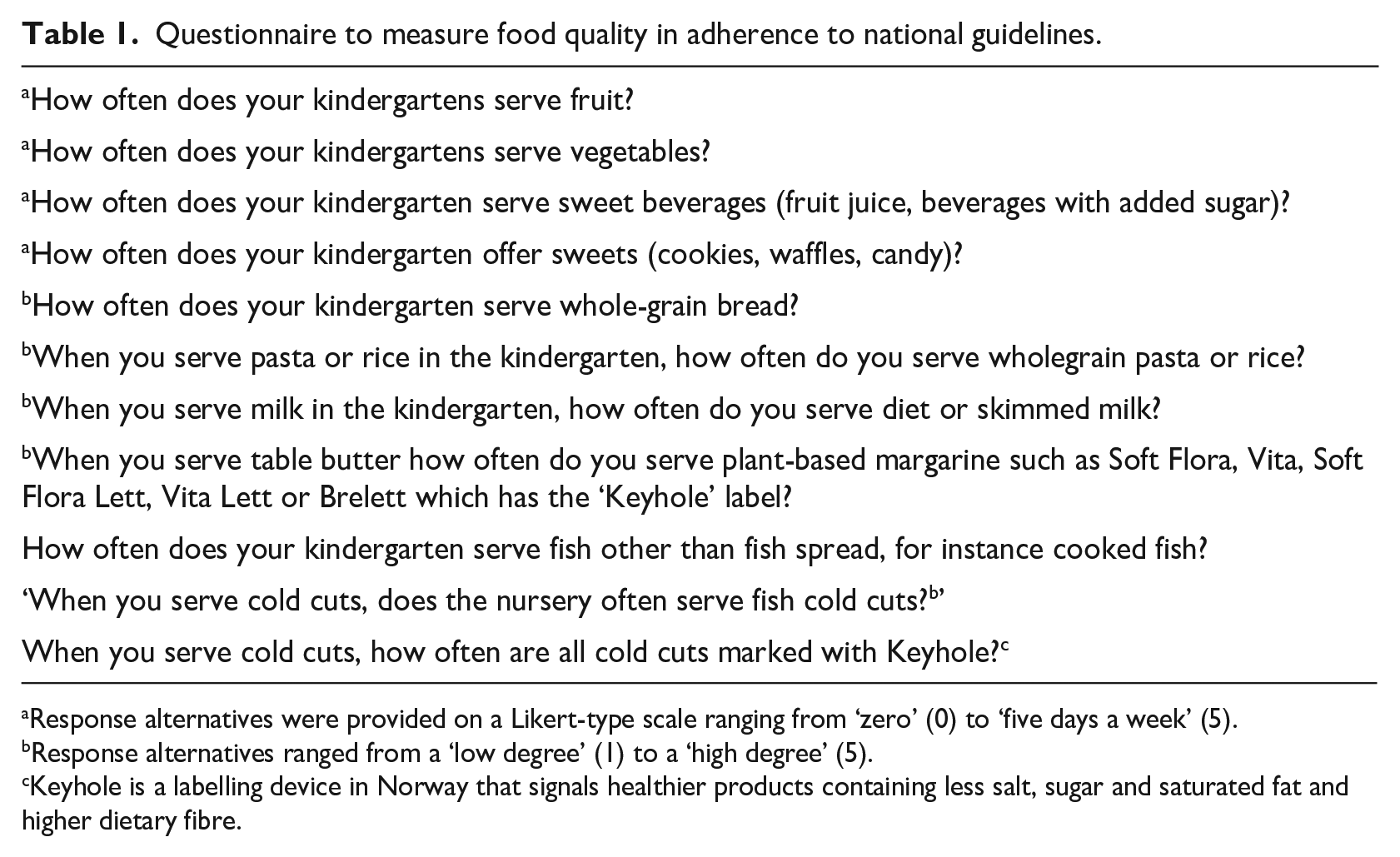
Response alternatives were provided on a Likert-type scale ranging from ‘zero’ (0) to ‘five days a week’ (5).
Response alternatives ranged from a ‘low degree’ (1) to a ‘high degree’ (5).
Keyhole is a labelling device in Norway that signals healthier products containing less salt, sugar and saturated fat and higher dietary fibre.
The scores for the sweets questions were reversed: the lower the frequency of offering, the higher the score. All items were summed to create a single continuous variable – denoting food quality in accordance with national guidelines, which was rated on a scale from 0 to 55 points. The lower the score (e.g. 0), the lower the quality of the food served by the kindergarten and the less compliant it was with the national guidelines. Conversely, a high score (e.g. 55) implied that the kindergarten served food of a higher quality, demonstrating greater adherence to the national guidelines.
The internal consistency of the scale as assessed by Cronbach’s α was .68. In exploratory analysis, Cronbach’s α between .6 and .7 is generally regarded as acceptable (Tavakol and Dennick, 2011).
Knowledge of the content of national guidelines
Two questions were used to measure pedagogical staffs’ knowledge of the content of national guidelines: ‘Is the kindergarten leader familiar with the content of the national guidelines for food and meals in kindergarten’ and ‘Do the other staff know the content of the national guidelines for food and meals in kindergarten?’
Participants were instructed to use a five-point Likert-type scale, ranging from a low degree (1) to a high degree (5), to rate their knowledge of the content of national guidelines.
The variable ‘Knowledge of content in national guidelines’ indicates whether the pedagogical staff said they were familiar with the guidelines, but it does not probe the extent of their understanding of the content.
Responses to two questions were used to create one continuous variable: Knowledge of the content of the national guidelines, in which a high score (maximum 10) indicated a better degree of familiarity with the national guidelines. Cronbach’s α was .77, which was acceptable (Field, 2013).
Practical application of national guidelines
The practical application of national guidelines was derived from responses to three questions in the web-based questionnaire: ‘Does the kindergarten have pedagogical plans that include food and meals?’; ‘Does the kindergarten plan the food offerings in accordance with the national guidelines for Food and Meals in Kindergartens?’; and ‘Does the kindergarten use regular shopping lists in accordance with the national guidelines for Food and Meals in Kindergartens?’
Participants were instructed to provide their responses on a 5-point Likert-type scale, ranging from a low degree (1) to a high degree (5), regarding the extent of their use of pedagogical plans, the planning of food offerings and the use of regular shopping lists. Responses to these three elements were consolidated into a single continuous variable termed Practical application of national guidelines. A high score (maximum 15) suggested the effective application of national guidelines in the planning of kindergarten meals and pedagogical strategies. The scale’s Cronbach’s α was .70, which was deemed acceptable (Field, 2013).
We chose to include responses to questions concerning ‘pedagogical plans’, ‘regular shopping lists’ and ‘planning food servings according to national guidelines’ in the variable because consistent practice in these areas likely indicates staff adherence to national guidelines for kindergarten food. Staff members are expected to integrate pedagogical approaches into planning processes, and less integration might suggest the inadequate use of guidelines. The use of a pedagogic approach forms part of the national guidelines.
Statistical analyses
We conducted an exploratory factor analysis (FA) on responses to the questionnaire to assess the level of coverage of the underlying construct (food quality). Internal consistency was measured using Cronbach’s α. The FA revealed a four-cluster structure, explaining about two-thirds of the variation in our data (the cumulative explained variance was 62.8%). The first cluster accounted for 28% of the variation. The addition of a second cluster only explained an extra 14% of the original variation in our data. The third and fourth clusters were limited in size, covering only two and one item, respectively. Based on the afore mentioned results, we chose to use only a single domain to assess overall food quality, in line with our research objectives. In addition, the internal consistency of the questionnaire as a whole (single domain) was α = .68 and thus deemed acceptable.
Statistical analyses were performed using SPSS® Statistics Version 27.0. Variables with skewed distribution were presented as medians and ranges, while normally distributed continuous data were described using means and standard deviations. Public and private kindergartens’ frequency of meals and geographical locations were considered categorical data and measured on a nominal scale. The item ‘How often food being served’ was considered ordinal, with lower values indicating lower frequencies of given food items being served. Categorical variables (frequency of meals) were entered into regression models as explanatory variables. The food budget was considered an ordinal variable.
Using univariate and multiple linear regression models, we analysed the strength of possible association between staff knowledge, adherence to national guidelines, frequency of meal provisions and food quality in kindergartens. In addition, we examined the link between staff knowledge of the guidelines and their application. Multiple models were adjusted for the parental monthly food budget per child to account for its potential influence on food quality. Results are presented as regression coefficients (b) with confidence intervals (CIs) derived using bootstrapping (1,000 repetitions) for increased precision and to reduce biases. All analyses were considered exploratory; thus, no correction for multiple testing was applied, and values of p < .05 were considered statistically significant.
Ethical considerations
This study was conducted in line with the guidelines in the Declaration of Helsinki. All participants provided written consent, and all data collection and analyses adhered to relevant guidelines. Oslo Metropolitan University and the Research Council of Norway approved the project protocol (Project 31168). Participants representing institutions provided de-identified data.
Results
Descriptive results
In total, we included 324 kindergartens in the sample, two-thirds were privately owned and one-third were public institutions. They were located across Norway as follows: 155 in eastern Norway, 41 in mid-Norway, 50 in the west, 48 in the south and 26 in northern Norway.
The average number of daily meals provided per kindergarten was 2.3 (SD: 0.77), and the median monthly food budget per child was 315 NOK (range: 120–1,000 NOK or 10.52–87.66 EUR) (Table 2).
Mean and median values and Cronbach’s αs of variables included in the analysis (N = 324).
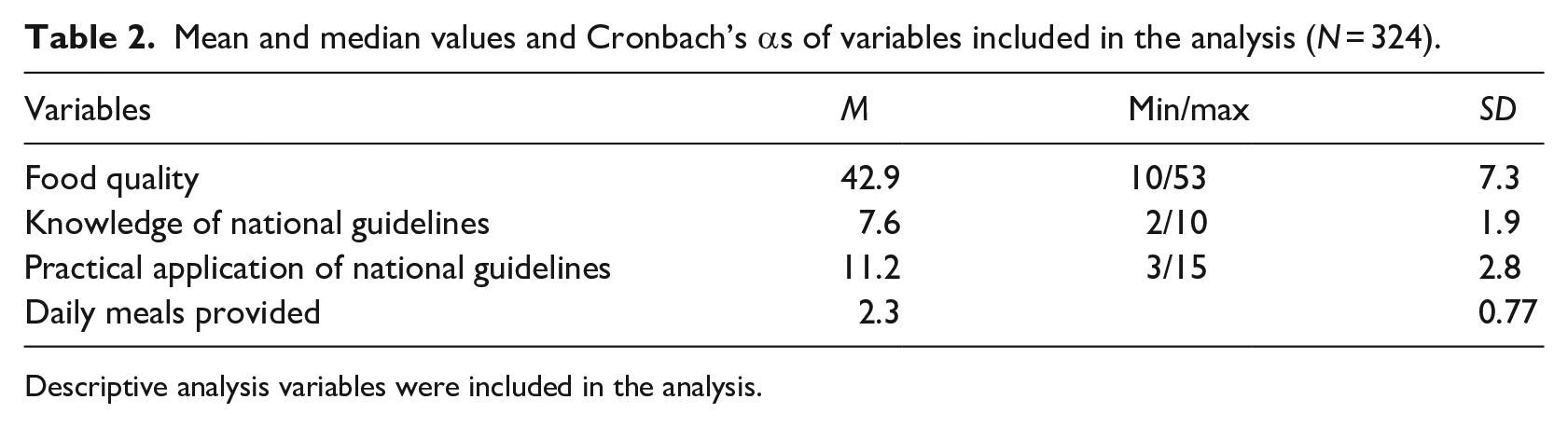
Descriptive analysis variables were included in the analysis.
Univariate and multivariate linear regression analyses assessed possible associations between kindergarten staff’s knowledge of national guidelines and food quality. The strength of the associations is shown in Table 3. Unadjusted results revealed that knowledge of national guidelines was positively associated with food quality (B = 1.52, 95% CI = [1.0; 1.9], p = .001). In the univariate model, level of staff knowledge explained 16.7% of the variation in food quality.
Results of univariate and multiple linear regression analyses with key variables and their association with food quality (N = 324).
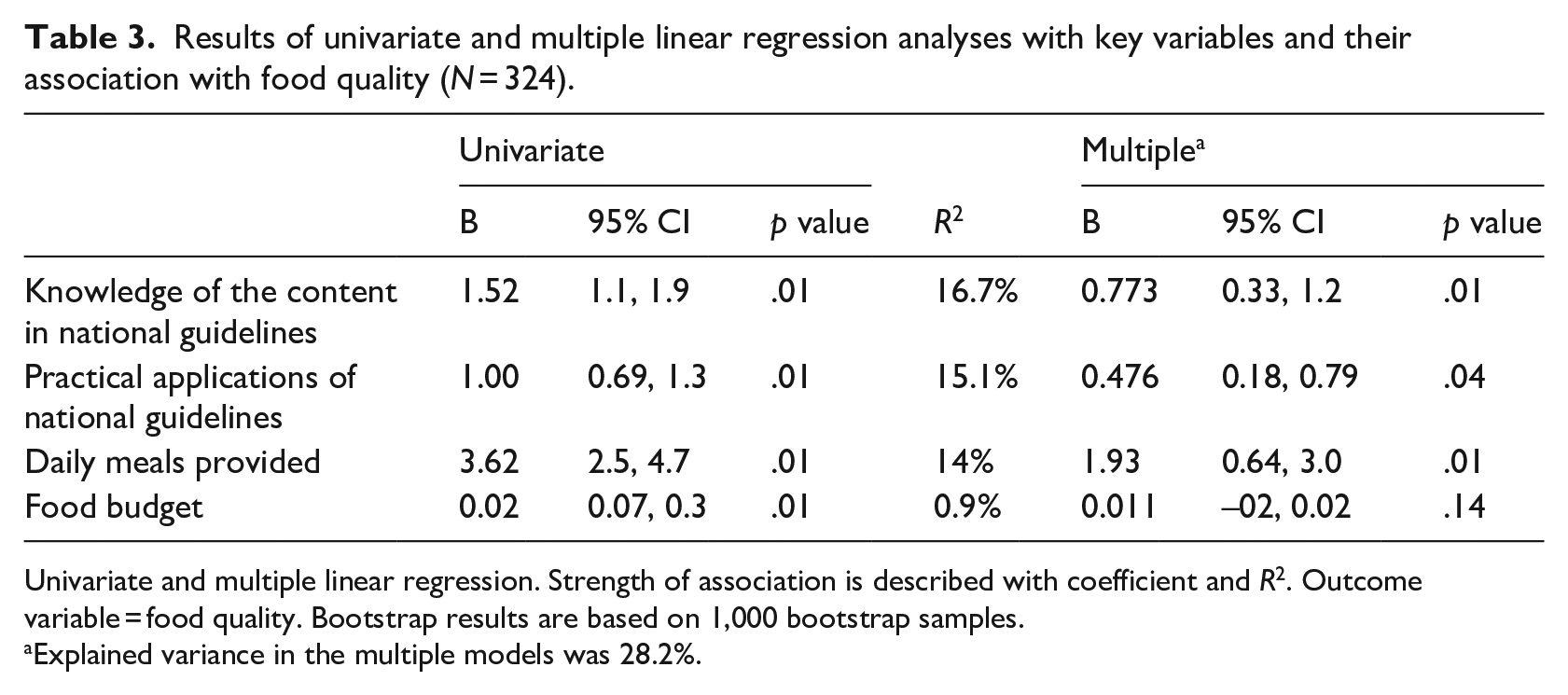
Univariate and multiple linear regression. Strength of association is described with coefficient and R2. Outcome variable = food quality. Bootstrap results are based on 1,000 bootstrap samples.
Explained variance in the multiple models was 28.2%.
Finally, the association between the practical application of national guidelines and food quality was explored. The strength of this association is also shown in Table 3. Application of national guidelines explained 15.1% of the variance in the univariate model and was positively associated with food quality (B = 1.01, 95% CI = [0.69; 1.3], p = .01). In addition, the number of daily meals provided by kindergartens was statistically significantly associated with food quality and explained 14% of the variance in the univariate model.
In the multivariate model, adjusted for food budget, the variables knowledge of the content in national guidelines, practical application of the national guidelines and the number of meals being served all remained significantly associated with food quality. Every unit increase in knowledge was associated with about a 0.8 point increase in food quality (B = 0.77, 95% CI = [0.33; 1.2], p = .001) (Table 3). Each unit of practical application of national guidelines was significantly associated with a half point increase in food quality in the multivariate model (B = 0.47, 95% CI = [0.18,0.79], p = .004). Finally, for each meal served in a kindergarten, the average score on food quality was almost two points higher (B = 1.93, 95%CI = [0.64,3.0], p = .01).
Overall, we found no differences between public versus private kindergartens regarding food quality (p = .60) or geographical location (p = .74), neither in knowledge nor the practical application of national guidelines (p ⩾ .2) (not shown in tables). The abovementioned variables explained close to one-third of the variation in food quality in our sample.
Our analysis revealed a statistically significant association between knowledge of the content in national guidelines and their practical application. For each unit increase in the level of knowledge, the score on the practical application of national guidelines increased by 0.8 points (B = 0.82, 95% CI = [0.69, 0.95], p = .01) (Table 4).
The relationship between knowledge and the practical application of the national guidelines (N = 324).
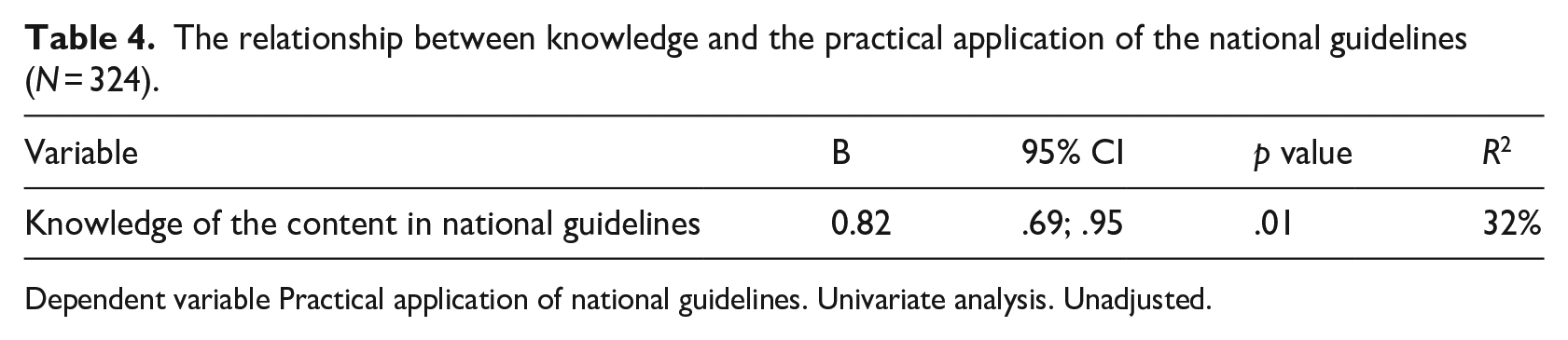
Dependent variable Practical application of national guidelines. Univariate analysis. Unadjusted.
Discussion
This study explored the significance of pedagogical staff’s knowledge and use of national guidelines on food and meals in enhancing food quality in Norwegian kindergartens. In it, staff’s knowledge of national guidelines correlated with their practical application, aligning with the findings in Seward et al.’s (2017) systematic review of factors influencing the implementation of dietary guidelines regarding food provision in centre-based childcare services, which found a noticeable connection between staff knowledge and the provision of healthy food.
While knowing the content of the dietary guidelines is important, their practical application is equally important, as revealed in this study. A Swedish study of school meals demonstrated that when food and meals were incorporated into a quality assurance system, head teachers familiar with the guidelines were more likely to utilise them, potentially amplifying school health promotion efforts, including adherence to national guidelines (Olsson and Waling, 2016).
A part of practical application could involve menu planning in adherence to national guidelines which could ensure the availability of healthy food and thereby increase food quality, as demonstrated both in a Norwegian case study (Aadland et al., 2014) and by other research (Romaine et al., 2007; Seward et al., 2017). National guidelines for food and meals can assist staff to plan diverse and balanced menus in line with dietary recommendations and ensure healthier purchases. Yoong et al.’s (2020) study utilised a resource pack, including a menu planning guide and a checklist, to enhance healthy food availability in kindergartens. There was an observed improvement in adherence to nutritional guidelines concerning vegetables, cereals and meat alternatives.
Another important factor relevant to the implementation of national guidelines pertains to the introduction of pedagogical meals. Kindergartens have immense social and educational importance, and their structure and the work that takes place within them exert a strong influence on children’s health and well-being (Norwegian Directorate of Health, 2018; The Norwegian Directorate of Education and Training, 2017). To build on this feature, it is recommended that kindergartens consider implementing pedagogical plans related to this area. By employing pedagogical plans that utilise the meal setting as a platform for social and sensory learning and position staff as role models, kindergartens can effectively integrate food and nutrition education into mealtime activities. A lack of pedagogical plans that include food and meals may explain the deficient application of national guidelines in kindergartens.
Considering the findings in this study and the fact that not all kindergarten staff may be aware of these guidelines as demonstrated in previous research (Norwegian Directorate of Health, 2012), further exploration of factors within kindergartens that influence the implementation of guidelines is warranted. We recommend future research studies focus on how kindergartens can more systematically facilitate the application of the guidelines in meal planning, integrating food and meals into pedagogical plans and ensuring the provision of food servings in line with dietary guidelines.
Strengths and limitations
The study’s primary strength lay in examining how knowledge and the practical application of national guidelines influenced food quality adherence in kindergartens. However, comparing our findings with those of prior research is challenging due to the varied use of terminology such as ‘guidelines’, ‘policy’ and recommendations. While comparing experience in the Norwegian context to that in other settings is problematic, our findings may be relevant internationally due to their focus on food practices and food quality in kindergartens.
According to Statistics Norway, the proportions of public and private kindergartens nationally are very similar, with public kindergartens making up 47% of all kindergartens in the country and private kindergartens constituting 53%. However, in this study, of the participating kindergartens, 68.5% were privately owned and 31.5% were public institutions. Consequently, our sample may be biased. It is also reasonable to assume that those participating in this study were more interested in food and meals since they planned to participate in the Healthier Kids programme. Our study also involved only 5.8% of Norway’s kindergartens, further restricting generalisability.
Finally, the questionnaire was further completed by pedagogical staff as representatives of their kindergartens. However, individual staff responses may reflect personal attitudes and different responses may have been obtained had other staff members been asked to complete the survey. That said, Norwegian kindergartens often have a flat management structure, and food practices are usually discussed collectively.
Conclusion
Evidence from this study suggests that knowledge and application of national food and meal guidelines in kindergartens in Norway influence the quality of the food provided. From a public health perspective, understanding how best to promote knowledge, understanding and using the guidelines is important. We advocate for further research to comprehend the kindergarten-specific factors that could improve awareness and implementation of the guidelines.
Footnotes
Acknowledgements
The authors thank the kindergartens that participated and the staff who answered the questionnaire.
Declaration of conflicting interests
The author(s) declared the following potential conflicts of interest with respect to the research, authorship and/or publication of this article: KEF and SL are affiliated with GreeNudge Health, which organised the delivery of Healthier Kids programme. KEF analysed the data but otherwise had no responsibility for the programme. SL was involved in the developing of the Healthier Kids programme.
Funding
The author(s) disclosed receipt of the following financial support for the research, authorship and/or publication of this article: the Norwegian Research Council supported this work under Grant Number 31168 under the working title, Evaluering av tiltak for å fremme bedre kosthold og økt matglede i barnehager (Evaluation of measures aimed at promoting improved dietary habits and increasing the enjoyment of food in kindergartens).
