Abstract
Background:
The transition from primary to secondary school is a pivotal period in young people’s lives and can significantly impact their mental health. However, the experiences of young people from ethnically diverse groups during this crucial period of physical, social and emotional development are under-researched, limiting the evidence base for meaningful support.
Objectives:
This study explored the experiences of young people from ethnically diverse groups during primary-secondary school transition and co-designed ideas for culturally sensitive support. It explicitly focused on the intersection between ethnic and cultural identity, primary-secondary transition and mental health.
Methods:
The study employed participatory design to collaborate with seven young people from ethnically diverse groups and a peer researcher. Four online workshops mapped participant experiences and ideas concerning the primary-secondary transition, identity and mental health. These were developed into implications for practice, policy and research.
Results:
Participants highlighted feeling unprepared for the transition, with some experiencing poor mental health and difficulty navigating their ethnic and cultural identity during this time. Participants’ ideas for future transition experiences included: supporting a longer transition period, schools promoting diversity among students and staff, enabling education on ethnicity and culture, breaking stereotypes, enabling mutual learning among staff and students and enabling an open and caring environment to support mental health.
Conclusions:
The study provides an in-depth understanding of experiences of young people from ethnically diverse groups during primary-secondary transition and suggests ways of supporting multi-faceted transitions and mental health, with a key focus on ethnic and cultural identity formation.
Keywords
Introduction
The transition from primary to secondary school is an important educational, social and emotional milestone for young people and an emerging area of interest in the United Kingdom. In addition to becoming accustomed to the new secondary school environment and systems, young people experience multiple concurrent transitions during this period (Bagnall and Jindal-Snape, 2023; Jindal-Snape et al., 2020; Spernes, 2022), including self-exploration around identity and coming to terms with new emotional experiences (Caskey and Anfara, 2007). There is limited recent literature looking at young people’s experiences of primary-secondary transition in the United Kingdom (Bagnall et al., 2019) and even less exploring their emotional wellbeing and mental health during this transition (Bagnall and Jindal-Snape, 2023). The importance of identity exploration during early adolescence and its impact on the social functioning, wellbeing and self-esteem of young people from ethnically diverse groups and the role schools and peers can play in identity development is evident from US-based studies (Rivas-Drake et al., 2014; Santos et al., 2017; Verhoeven et al., 2019). There is, however, a dearth of literature exploring ethnic and cultural identity formation of young people in the United Kingdom.
This study explores the experiences of young people from ethnically diverse groups during primary to secondary school transition and develops ideas for future culturally sensitive support. It fills a gap in current knowledge that builds on the lived experiences of young people from these groups, explicitly focusing on the intersection between ethnic and cultural identity, primary-secondary transition and mental health.
Our understanding of ethnic and cultural identity was guided by a social identity perspective and operationally defined as young people’s personal feelings of belonging to a particular ethnic group(s) and/or culture(s). Mental health was understood as a state that covers both mental wellbeing and illness. The transition period was broadly defined as beginning in the final year of primary school and lasting until either the end of the first term or the end of the first year in secondary school (Evangelou et al., 2008; Rice et al., 2015).
During the start of this transition, pupils in England (where our participants were based) are generally aged 10–11 years. Participants were invited to further explore and define these concepts from a lived experience perspective.
Mental health during primary to secondary school transition
Pupils in secondary school aspire to a multi-faceted vision of wellbeing, encompassing emotional, social, mental and physical wellbeing towards the goal of general self-acceptance and authenticity (Brown and Shay, 2021). ‘Successful’ transition largely encompasses social, academic and emotional adaptations, involving social integration, academic attainment, adaptation to new routines, positive peer and teacher relationships and the maintenance of emotional wellbeing (Evangelou et al., 2008; Evans et al., 2018; Jindal-Snape et al., 2019; Mumford and Birchwood, 2021; Rice et al., 2015; Spernes, 2022). The wider literature highlights a high prevalence of young people developing mental health problems during this developmental stage. Using data from four tranches of the Millennium Cohort Study, Gutman et al. (2015) suggested that the incidence of severe mental health problems in childhood is ‘roughly twice as high’ as the prevalence of these problems at any other age (p. 4). Similarly, the World Health Organization (WHO) reports that one in seven 10- to 19-year olds experiences a mental health problem, with the consequences of failing to address such conditions extending to adulthood (World Health Organization, 2021). There is evidence that a difficult primary-secondary transition can have a negative impact on wellbeing, feelings of school belongingness and connectedness, social and emotional health and depression and anxiety (Jindal-Snape et al., 2019). West et al. (2010) further argue that a poor primary-secondary transition can predict poorer wellbeing and attainment outcomes in later adolescence.
Mental health of young people from ethnically diverse groups during this transition
Building a comprehensive picture of the mental health experiences of young people from ethnically diverse groups in this context is extremely challenging. National datasets frequently inadequately sample individuals from these groups, which is a widespread and ongoing problem in mental health research (Bains and Gutman, 2021; Bignall et al., 2019; Dogra et al., 2012; Grimm et al., 2022; Hanson and Grewal, 2019; Lavis, 2014). Studies frequently amalgamate ethnic groups into categories such as binary ‘Ethnic Minority’ 1 and ‘White’ groups, and as a result, little can be discerned about the experiences of individual ethnic groups. Some studies conclude that ‘minority ethnic’ young people experience overall better mental health outcomes than their ‘White’ peers (Grimm et al., 2022; Hanson and Grewal, 2019). This is borne out by NHS data when comparing mean SDQ (Strengths and Difficulties Questionnaire) scores, although the same data shows that both groups experience worsening mental health as they move through adolescence (NHS Digital, 2021, Table 1.3b). It has also been suggested that children and young people from ethnically diverse groups may experience poor mental health in younger years which goes undetected until they reach adulthood (Bains and Gutman, 2021; Hanson and Grewal, 2019). Cultural ignorance within the mental health field has also been cited as a reason for poor understanding of the mental health experiences of these groups (Bignall et al., 2019; Hanson and Grewal, 2019).
There is little to no literature specifically exploring the experiences of young people from ethnically diverse groups during their transition from primary to secondary school in the United Kingdom. Some notable exceptions are Graham and Hill (2003) and Caulfield et al. (2005), which discuss this topic in a Scottish context. Caulfield et al. (2005) found that ‘black and minority ethnic’ young people adjusted well to secondary education; however, participants said they experienced more racism at secondary compared with primary from peers, and that teachers’ responses were inadequate. An earlier study comparing the experiences of ‘black and minority ethnic’ and ‘white’ children found that the former group experienced a more difficult transition and were more likely to report trouble fitting in (Graham and Hill, 2003).
Methodology
This study used participatory design methods (Björgvinsson et al., 2012), enabling collaboration among a multidisciplinary research team and young people from ethnically diverse groups – in line with an increasing recognition of the need for participatory approaches involving people with lived experience in researching and co-designing health and wellbeing experiences (Oertzen et al., 2022). It was underpinned by principles of mutual learning and collective decision-making and foregrounded lived experience and the perspectives of young people at every stage (Raman and French, 2022).
Research team and participants
The research team included expertise from design, psychology and children and young people’s mental health, including a peer researcher (young person with lived experience). The peer researcher (a co-author on this paper) was involved in all stages of research – developing the proposal, research design, workshops, analysis and outputs. Seven young people with lived experience participated and informed decision-making in all the workshops. The peer researcher (17 years) and participants (14–16 years) self-identified as ‘Black British’, ‘British Asian’, ‘British Indian’, ‘Caribbean’, ‘dual heritage’ and ‘Pakistani’. All participants lived in the East Midlands and North East regions of England. Participants were given the opportunity to select pseudonyms, which are used throughout this paper. They were recruited through an organisation that works with young people and underrepresented groups to empower and amplify their voices. They were paid for their time via the recruiting organisation following institutional guidance and good practice in the field.
Framing language and key concepts
Throughout the study the team used language that avoided (a) the minoritisation of ethnic groups that centres white experience and (b) amalgamation or exclusion of ethnic and cultural groups through blanket terms such as ‘BAME’ (Black, Asian and Minority Ethnic) and ‘PoC’ (People of Colour) (Centre for Mental Health, 2021). No one term can encompass the experiences of navigating complex ethnic and cultural identities and/or discrimination that specific groups/individuals encounter. This tendency was discussed with participants, who highlighted a need to focus on diversity. Consequently, the language adopted for the project is young people from ethnically diverse groups.
Similarly, acknowledging the diversity of individual experiences and perspectives on ethnic and cultural identity, the primary-secondary transition and mental health, the team invited participants to reflect on these concepts. Recognising the limitations of prescribed demographic categories and the complex personal, social and relational aspects of the identity process, we invited participants to reflect on their sense of belonging within ethnic and cultural groups that were relevant to them and other key factors that shaped their sense of belonging. Participants also reflected on the aspects of their mental health and wellbeing that support them to thrive in their personal, social and educational domains as well as aspects that might challenge those processes. To overcome the limitations of time-based definitions of transition, for example via an implied homogeneity when the ease and speed of transition can vary widely among individuals, participants were guided to be open with their interpretation of ‘transition’.
The study was approved by the Glasgow School of Art research ethics committee. Written informed consent was gained from participants’ parents/guardians before workshops and oral informed consent was received and recorded from participants at the beginning of workshops, including consent to use images of workshop outputs.
Co-design workshops
A series of four 3-hour workshops with participants took place in 2021, using video conferencing (https://zoom.us/) to enable remote engagement due to COVID-19 restrictions. Participatory methods and tools were created specifically for the study. A virtual whiteboard (https://miro.com/) was used to collaborate and visualise participants’ experiences. During these workshops, the research team worked with participants to: visually represent and explore mental health experiences; reflect on participants’ ethnic and cultural identity; create a timeline of their experiences during the primary-secondary transition indicating correlations with identity formation and mental health and identify opportunities where young people from ethnically diverse groups could be better supported during this transition in the future.
Thematic analysis and collaborative reviews
The workshops were recorded and transcribed, and data were thematically analysed (Braun and Clarke, 2019). The first author undertook a process of initial open coding – sorting participant responses into categories – followed by the synthesis of these categories into core findings aided by NVivo 12 (www.lumivero.com/products/nvivo/). These findings were sense-checked and refined with the multidisciplinary research team following each workshop through collaborative reviews attended by all members of the research team (including the peer researcher), each lasting 2.5–3 hours. Emerging themes were reviewed with participants during each subsequent workshop to ensure these accurately represented young people’s lived experiences. Outputs included detailed maps of each participant’s transition experience and a future transitions map synthesising participants’ ideas for positive primary-secondary school transitions. Together, these sources of information informed the development of implications for future practice, policy and research.
Dissemination event
An online dissemination event was held to share the research findings and implications, attended by policymakers, practitioners and researchers. The event included the presentation of our findings, reflections on the study by research team members and participants and a multidisciplinary external expert panel. The expert panel comprised a lead representative from a national children’s advocacy organisation specialising in education policy; a representative from the Children and Young People’s Mental Health Improvement Team at the Scottish Government, and a Senior Policy and Campaigns Officer at Mind (https://www.mind.org.uk/).
Results
The results are organised into two sections. The first explores the transition from primary to secondary school through the lens of mental health experiences and ethnic and cultural identity. The other considers what can be done to improve this transition for young people from ethnically diverse groups.
Experiences of transition from primary to secondary school
Lack of preparedness
Participants reflected on the primary-secondary transition in three stages: final years of primary school; preparing for primary-secondary transition and after joining secondary school.
The final years of primary school were generally a positive experience associated with strong friendships and social networks:
‘I went to a small primary school . . . everybody knew each other really well . . . I was head girl in year 6, I starred in this musical, I was doing great, I was top of the class, I had a great group of friends’ (Persephone).
Participants often felt comfortable and settled around peers, and being the eldest in the school afforded some feelings of strength and being ‘a big fish in a small pond’ (Arjybajy). Some participants suggested they felt closer to their ethnic and cultural identity in primary school, while others reflected that a degree of self-consciousness began to emerge which intersected with their ethnic, cultural or religious identity.
Most participants felt they were not adequately prepared to begin secondary school:
‘I think we weren’t prepared to mature or realise how different life is compared to primary. In primary, you’re kind of baby-fied and spoon fed. Whereas [in] secondary, you’re kind of like independent’ (S).
Participants felt the social jump was the most challenging, with making friends, increased academic pressure, exam stress and bullying recounted as negative experiences. Losing friendships from primary school was frequently mentioned as particularly painful, while some found the challenge of adapting to being more independent both exciting and nerve-wracking. Participants felt that making friends could have been better supported by the school and that they would have benefitted from being better informed about the academic and environmental differences in secondary school.
Experiencing and articulating poor mental health
Participants’ experiences of poor mental health appeared to coincide with the transition phase and early years of secondary school – anxiety, eating disorders, panic attacks, depression and poor body image were highlighted in individual transition stories. Participants reported feeling anxious about who they could trust. Some mentioned bottling up their feelings – exacerbating feelings of isolation and loneliness. When discussing coping mechanisms for poor mental health, many described self-soothing. ‘Wanting space’ was a strong subtheme, and while social networks were acknowledged to support good mental health, participants highlighted the importance of adults in their lives respecting their wishes for space and privacy:
Some people say . . . oh no, you need to watch your child, need to see what they’re doing. Do not give them space. They have to earn it. . . . I’m glad my mum’s like a mature person that will give me that space (Chicken Noodle).
Participants also identified that young people needed the language to talk about mental health. Participants found it helpful to use metaphors and visualisations of their mental health during the first workshop – for example the film Inside Out (2015) was seen as a useful tool for explaining mental health experiences, personifying emotions to explore the nuanced relationship between ‘positive’ and ‘negative’ emotions. Participants also stated that language about mental health is frequently misused by peers, contributing to a lack of sensitivity with respect to poor mental health. Schools’ efforts to raise awareness around mental health were often felt to be ‘one-off’ and ‘tokenistic’.
Navigating ethnic and cultural identity at school
Participants described presenting their ethnic and cultural identity in predominantly white school spaces as particularly difficult upon entering secondary school:
I fit into British culture like on paper because I know how social customs work and stuff. But I thought there will always be a kind of divide because I’m not really British, but like, I go to Zimbabwe, and I look like everyone else and stuff. But then I’m not really comfortable with all of the cultural norms because I only ever lived here (Persephone).
Conversely, Pipedream who identified as ‘dual heritage’, did not recognise ethnic and cultural identity as relevant to their experiences – ‘White and Black, I don’t think it really matters’.
Participants frequently gave examples of ‘code-switching’ (changing one’s use of language and/or behaviour when around white people) to avoid unwanted attention around their ethnicity or culture, or in settings where they anticipated discomfort or discrimination if they expressed their true selves:
Like, while I’m in school, I’ll speak a certain way, I will act a certain way that makes the people around me feel comfortable . . . And you kind of just learn to do that to accommodate the people around (Persephone).
Participants noted that ‘code-switching’ brought up feelings of guilt and sadness at losing connection with one’s identity. Some participants felt more connected to their ethnic identity at the end of primary school:
as I went into secondary school, I had a massive like, disconnect with my culture . . . going to mosque and like reading the Quran, and like celebrating Eid and stuff, it kind of just slowly slipped away. And I was really sad. I think part of it was the like, massive need to prove myself and fit in. So, I kind of like blocked that stuff off my mind and focused more on like, how am I going to make these white people like me (Zayne Malik’s Wife).
For others, self-consciousness around their ethnic identity emerged at the end of primary school. Some participants mentioned having a ‘dual’ identity – one for people of the same ethnic and/or cultural background and one for school. Persephone reflected that it made them ‘resent’ their culture because ‘your ethnicity and your culture is the reason that you’re different’. Participants reported experiencing racism at school, mostly from peers. For example, Arjybajy, who identified as Sikh, was bullied for growing out their hair, and Persephone lied about their ethnic heritage ‘because it just ended a lot of questions’ and ‘it’s not a great feeling to always be different’. They also experienced racism and stereotyping around their ethnicity and mental health, stating that they are seen as emotionally ‘strong’ by peers because of being Black.
Most participants began to feel much more comfortable with their ethnic and cultural identity as they moved through secondary school. This tended to be associated with finding a group of friends who they could trust or who shared identities. There was an overall sense of self-acceptance and a feeling that other people’s ignorance or prejudice was their own responsibility to solve, as well as the school’s responsibility. Participants strongly felt that they went through the process of becoming comfortable with their identity independently, rather than being supported by any initiative at school. However, Pipedream felt their school had a strong ‘non tolerance in like prejudice and stuff, and like, racism’, but also reported being told they couldn’t sit at a ‘white table’ when they first joined secondary school.
Most participants felt that there was insufficient education in school about different ethnicities, religions and cultures and that attempts to promote equality and diversity (e.g. annual assemblies) were ‘one-off’ and tokenistic. They also felt that schools should improve education and awareness in a way that does not reinforce differences or inadvertently promote stereotypes.
Opportunities for enhancing support
Workshops involved mapping individual transition experiences to identify key points in participants’ journeys at which they would have benefitted from support (Figure 1). Ideas for future transition were synthesised visually and participants were asked to identify who needed to be involved in delivering this support – themselves and/or their peers, the school/teachers or their families (Figure 2). Participants’ ideas were discussed by the expert panel at the dissemination event, commenting on their feasibility and practical implications.
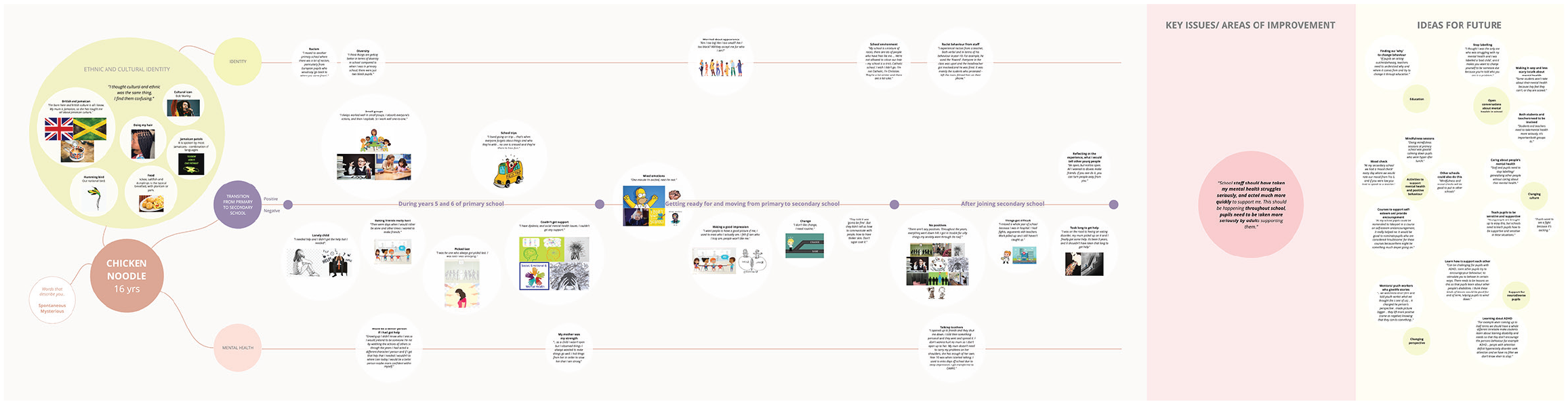
An example of a participant’s map showing experiences of primary-secondary school transition and opportunities for improvement. High-resolution image available at: www.futurehealthandwellbeing.org/s/Chicken-noodle_final-visual-story-map.jpg.
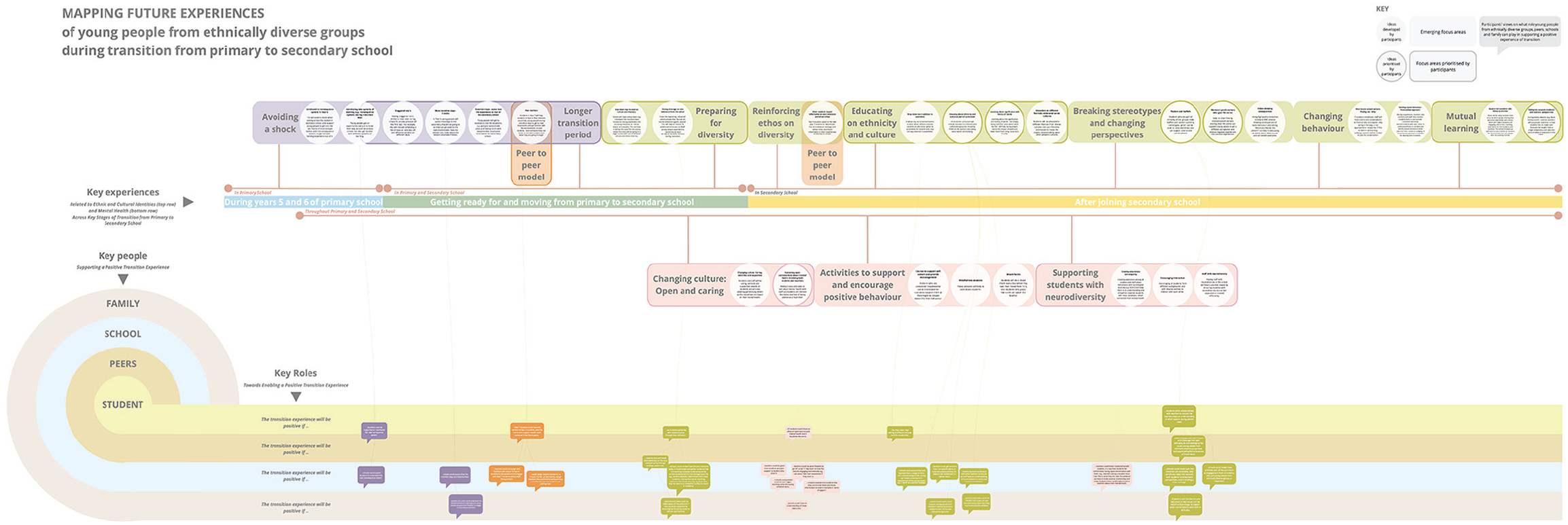
A future experiences map synthesising ideas for primary-secondary school transition. High-resolution image available at: www.futurehealthandwellbeing.org/s/CESAME-future-transition-visualisation-ape6.pdf.
Figures 1 and 2 were created as large-scale maps used during workshops, and are available as high-resolution images online (Raman et al., 2022).
Avoiding a shock through a longer transition period
From the end of primary to the beginning of secondary school, participants suggested there should be academic and social activities preparing pupils for secondary school. These should include more ‘transition days’, when pupils in their final year of primary school can be in the secondary school for a few hours or days, and transition days focused on non-academic activities to help reduce anxiety and to support socialisation. A more staggered start to secondary school was also suggested, with more half-days and a separate lunchtime for new pupils. Participants said that peer-to-peer support models should be encouraged, with older pupils mentoring new pupils–a suggestion echoed by panellists at the dissemination event. It was recognised that school and family have an important role to play in supporting this transition and should be aware of the challenges young people face during transition academically, socially and emotionally.
I feel like education is key . . . educating kids on like . . . the privileges they might have . . . because I know some people can be like really defensive when they are told that they are privileged in some things . . . But I feel like parents might help and be able to drive the fact (Mali).
Educating on ethnicity and culture with mutual learning
Discussion also focused on how schools could embed an anti-racist ethos across all year groups. Participants felt it important to move away from one-off approaches (e.g. assemblies) towards an ongoing commitment to not only tackling racism but educating about and celebrating ethnic, cultural and religious diversity – ‘everyone . . . deserves to be celebrated’ (Zayn Malik’s wife). It was acknowledged that this could contribute towards improved mental health for pupils from diverse groups. Strong policies on anti-racism – disseminated to new pupils but also reinforced for and by existing pupils – were highlighted, but these also needed to be backed up by staff taking a responsive approach to dealing with incidents of racism. Participants felt it important teachers took the time to speak to perpetrators to identify their motivations and respond accordingly. They could do this by explaining the racist history of stereotyping, or challenging ‘just a joke’ attitudes using real-life examples and materials co-developed with young people:
The young people could make leaflets and posters that outline stereotypes . . . that teachers can use when having this conversation with the individual that it concerns . . . because it’s not only going to raise awareness, but it’s also going to help the individuals that did engage to know what’s acceptable and what isn’t (Mali).
Participants felt that pupils would respond better if anti-racist education was personalised and contextualised, for example delivered by community representatives who had experienced racism and/or discrimination, and by sensitively embedding discussion about racism and racist language during history lessons since ‘it would lead to people using slurs less trivially’ (Arjybajy). It was also suggested that families and community members could co-design/deliver events celebrating different ethnic, cultural and religious practices to make them engaging for pupils. Ensuring that schools employ staff from diverse backgrounds was also suggested as creating an equitable environment, contributing to wellbeing of pupils from diverse groups. Dissemination event experts also expressed support for a whole-school approach to mental health education that recognises the importance of ethnic and cultural sensitivity.
Creating an open and caring culture to support mental health and neurodiversity
Overall, a culture of openness and caring around mental health was highlighted as important – ‘like caring what all the students have to say’ (Persephone). However, it was recognised that the normalisation of talking about mental health needs to be balanced with an understanding of the realities of poor mental health. Participants also suggested that activities for creating a caring culture could include teachers leading pupils in mindfulness sessions:
Before they start a lesson, it’s like a breathe in and breathe out, imagine you’re somewhere . . . also do mood checks to keep track on everyone’s mental health, so one to five, how are you? (Chicken Noodle).
Participants said school staff should be supported to deliver education about mental health and make themselves available to pupils needing support on an ongoing basis. Dissemination event experts added that mental health services were mostly accessed by white young people, and that the sector needs to co-develop services with young people from ethnically diverse groups to ensure these services are meeting their needs. Participants further noted that pupils with neurodiversity from ethnically diverse groups could find the social and emotional transition particularly challenging, so empathy and understanding towards neurodiversity should be taught and encouraged by teachers.
Discussion
This study is significant in a number of ways. It utilised a participatory design approach to explore the experiences of young people from ethnically diverse groups, amplifying the views of young people from these groups on topics which are under-researched from this perspective (Bagnall and Jindal-Snape, 2023). It also fills a gap in the literature by considering the intersections of primary-secondary school transition, identity and mental health for young people from ethnically diverse groups. Overall, findings highlight how participants found primary-secondary transition challenging particularly from a social perspective. The transition often intersected with an at times tumultuous and complex relationship with ethnic and cultural identity, experiences of racism and poor mental health. The findings also highlight several ways in which schools could adopt culturally sensitive approaches to support young people from ethnically diverse groups during primary-secondary transition.
Findings from this study need to be considered alongside the major challenges already facing schools in meeting pupil needs in the current UK policy context, including spending cuts (Drayton et al., 2022), high levels of inflation and energy costs, low school staff morale, teacher and other school staff retention crises (National Education Union, 2023) and overstretched UK child and adolescent mental health services (NHS Confederation, 2021).
Supporting holistic experiences of transition from primary to secondary school
Our findings show the need for schools to support pupils through social and emotional transitions as well as educational transitions from primary to secondary school. Primarily, there is a need for a whole-school approach, which involves all parts of the school and the wider community working together, to create an environment that values diversity and promotes mental health for and with all pupils.
The correlation between social difficulties and poor experiences of transition, and suggestions on extending the period of transition through more induction days and staggered starts echo findings from previous research (Evangelou et al., 2008; Rice et al., 2015) and also highlight the important role of primary schools in preparing young people for secondary school. Our findings also support Bagnall et al.’s (2019) findings on ‘peer affiliation’ as a dominant concern for pupils, further suggesting the value of peer-to-peer support and mentoring models, as well as recognising the role that families have in supporting emotional and social transition during this period.
Our findings suggest that schools are often perceived as taking a ‘tokenistic’ and ‘one-off’ approach to mental health education, whereas young people aspire to a whole-school, ongoing approach. This reflects Brown and Shay’s (2021) depiction of school mental health interventions in England as ‘poorly defined and weakly integrated’. Our findings build on this and offer a multi-faceted view of mental health education, encompassing the importance of ethnic and cultural identity, as well as peer groups, family and community. Garside et al.’s (2021) study on mental health provision also found inconsistent policy implementation with schools appearing to have different interpretations of what ‘whole-school approach’ means. Combined with our findings, this suggests that schools’ difficulties implementing whole-school approaches are palpable to pupils, and possibly, there is a disconnect between policy guidance and the capacity and resources of many schools to deliver.
Supporting positive identity formation during the primary-secondary transition
Our findings highlight difficult experiences for participants settling into new social groups and a strong intersection between these experiences and challenges with expressing their ethnic and cultural identities. Participants recognised they adapted by masking their identities through ‘code-switching’ and creating a ‘dual identity’, which echo findings in Graham and Hill (2003). Our study further highlights a link between identity formation and primary-secondary transition, suggesting schools need to consider this for supporting social and emotional transitions.
Participants wanted schools to embed anti-racist teaching in their lessons and to educate the whole school on the history of racism. Teaching about the history of racism in schools has come under renewed scrutiny in England, with controversial guidance for anti-racism to be taught in a ‘politically impartial’ way (Department for Education, 2022). This has been criticised as shutting down more open conversations about race in schools (Begum, 2022). This could limit the implementation of participant suggestions around inviting community representatives to share personal experiences, as the guidance suggests that school staff remind speakers of rules around ‘impartiality’ before they give speeches or interact with pupils.
The feelings of discomfort participants felt about their ethnic and cultural identity on entering secondary began to dissipate as participants got older and found strong peer support (often from those with shared identities). This supports developmental models of identity formation as articulated by Phinney (1993), who suggests that young people often go through a period of self-reflection and evaluation of their ethnic identity when confronted with a situation that triggers this process before settling into comfort and acceptance. Participants expressed this process occurred independent of school intervention but suggested that schools should support pupils to feel more comfortable with their ethnic and cultural identity expression.
Limitations
The four nations of the United Kingdom have separate education systems. One limitation of the study was that all the participants attended schools in England. The multidisciplinary research team included members from English and Scottish institutions and the online dissemination event included experts from UK-wide organisations, providing insights into the wider context; however, this did not include lived experiences. A further limitation is that the study did not include school staff to better understand how schools can be supported to deliver these ideas. Future work should involve schools to address these gaps. We acknowledge the small sample size cannot capture the variation in experiences that exist across settings. However, our focus was on capturing lived experiences in-depth and a small group size was necessary to create the appropriate conditions for exploration of personal lived experiences. Participants retrospectively reflected on their experiences of transition and impact over time as they progressed through secondary school and there may be gaps or distortions in some participants’ recollections. This was mitigated by providing participants time to iteratively refine the individual transition maps throughout the engagement. Future research should involve young people currently experiencing the transition. We also note that we did not ask participants to self-describe their gender and so are not able to provide information on gender. Finally, the peer researcher was known to one of the participants in a limited capacity, but we sought to mitigate potential biases resulting from this through our collaborative approach to data collection and analysis.
Conclusion
This study used participatory methods to explore the complex social and emotional experiences of young people as they navigate the primary-secondary transition and their own relationship with their ethnic and cultural identity. The rich findings and recommendations from this research were facilitated by the participatory method, multidisciplinary collaboration and the crucial role of the peer researcher who helped navigate the spaces and vulnerabilities of the participant group, a practice that should be embedded across all research with young people. Future efforts to support the mental health of young people from ethnically diverse groups will benefit from the use of contextualised and identity-focused lenses to develop solutions that are meaningful and relevant to young people’s lived experience.
Footnotes
Acknowledgements
The authors are deeply grateful to the young people who participated in this project for sharing their experiences and ideas. Thanks go to Rose Dowling and Anna Crump from Leaders Unlocked for supporting the recruitment of and engagement with the young people, Androulla Harris and Thea Joshi from Centre for Mental Health and Jo Inchley and Christina McMellon from the TRIUMPH Network, for their valuable contributions to the project. We are also grateful to David Leitch (Scottish Government) and David Stephenson (Mind) for reviewing the research findings and implications and sharing their reflections at the dissemination event.
Funding
The author(s) disclosed receipt of the following financial support for the research, authorship and/or publication of this article: this research was supported by the TRIUMPH (Transdisciplinary Research for the Improvement of Youth Mental Public Health) Network, which is funded by the Cross-Disciplinary Mental Health Network Plus initiative supported by UKRI (grant no. ES/S004351/1).