



Abstract
Objective:
Photovoice as a participatory research method seeks to capture and share participants’ perspectives and experiences. It has been widely used in school settings to prioritise student voice in health research. Photovoice also presents opportunities for health education. There is limited synthesis on school-based Photovoice focused on nutrition and physical activity (PA). This systematic review examined the use of school-based Photovoice in relation to nutrition and PA for 10- to 18-year-olds. The research questions explored were twofold: what Photovoice approaches and implementation processes have been used in schools with respect to nutrition and PA; and what were the student learning outcomes?
Methods:
Six electronic databases were searched: MedLine, PsycInfo, EMBASE, ProQuest Education Journal, Cochrane Central and ERIC. The Participant, Intervention, Comparison, Outcome and Study (PICOS) framework was used to specify inclusion/exclusion criteria. Nineteen articles were selected from the search results of 2,305 articles based on fit with the established criteria. Iterative inductive thematic analysis was used to analyse the data with a focus on (1) approaches and implementation, and (2) student learning outcomes.
Results:
Nineteen studies were included in the review. Themes related to approaches and implementation were the importance in introductory sessions; processes for meaning-making; student-led community engagement and health promotion; and learning from challenges and limitations. Themes related to student learning outcomes included critical awareness of nutrition and PA environmental influences; capability development; and agency and empowerment.
Conclusion:
School-based Photovoice benefits health research by generating data with a focus on student voice. An under-valued and under-reported benefit relates to student learning outcomes, supporting the potential for healthy behaviour change. Multisectoral education and health research should value both types of goals. Photovoice can be used as a curriculum-linked pedagogical tool to add value to the pursuit of educational goals in school.
Photovoice as a research method encourages people to take and then discuss photographs to represent their experiences and perspectives on a selected topic or theme. The use of Photovoice as a participatory research approach was first attributed to Wang and Burris in the 1990s (Wang and Burris, 1994, 1997) but since then has been widely applied in community-based health research (Adekeye et al., 2014; Goodman et al., 2018). The photographs themselves and data generated from participant meaning-making using prompts and photo-elicitation techniques can generate insight into key issues impacting participants and their communities, identify potential actions and facilitate beneficial social change (Abma and Schrijver, 2020; Cooper et al., 2017; Hill, 2015a).
Various approaches can be used to explore and elicit participant insights from their photographs. These include questioning strategies such as the SHOWeD (What do we see?; What happened or is happening in the image?; How does this relate to our lives?; Why does this happen?; How could this image educate others?; What can we do about it?) (Wallerstein and Bernstein, 1988) and PHOTO acronyms (Describe your photo?; What is happening in your image?; Why did you take a picture of this?; What does this picture tell us about life in your community?; How can this picture provide opportunities for us to improve life?) (Petteway et al., 2018). Photovoice research can be empowering for participants, enhancing awareness and knowledge of the issue, and increasing self-confidence (Chonody et al., 2013; Warne et al., 2013; Wilson et al., 2016). Cooper et al. (2017) also found that Photovoice when used as an experiential pedagogical tool provided educative value for tertiary-level health students investigating community health issues. These benefits included promoting critical thinking and agency, and enhancing understanding of key factors influencing socioenvironmental issues. In social work education, Malka (2022) stresses the potential of Photovoice methodology as a creative tool and learning strategy, supporting social work students to articulate, explore and internalise course principles and objectives.
School-based Photovoice projects can provide the context and opportunities for researchers and stakeholders including community leaders and policymakers to engage with child and youth perspectives about issues that affect them (Brännström et al., 2020; Carnahan, 2006; Chonody et al., 2013; Joyce, 2018; McKernan et al., 2020; Spencer et al., 2019; Warne et al., 2013). Importantly, school-based Photovoice research presents learning opportunities for the students themselves, as through the ‘eye’ of the camera, they can discover and make connections between social issues, social policy and actions, and their immediate environment (Chio and Fandt, 2007). Williams et al. (2020) have documented how Photovoice can serve as a powerful tool for school counsellors, enabling students to capture shared concerns through photography, discuss issues and formulate collective action. Chio and Fandt (2007) suggest that Photovoice can foster greater engagement with subject matter learning. Warne et al. (2013) demonstrate how the use of Photovoice method in a school setting can foster an environment conducive to health promotion and meaningful student participation. These potential learning opportunities are especially relevant to school-aged adolescents and support the exploration of complex health-related issues, with the potential to influence health attitudes and behaviours across a range of domains (Overby et al., 2018; Wilson et al., 2016).
Adolescence is a critical developmental period in which health attitudes and behaviours are formed that can track into adulthood. It is marked by physical, cognitive and psychosocial development, with a significant shift in responsibilities for decision-making and life choices transferred from parents to the children and young people themselves (Sawyer et al., 2018). During these formative years, adolescents are typically engaged in formal school-based education. The role schools play in health education is underscored by their central position in communities and their societal reach, presenting the potential for direct and indirect influence on the well-being of the communities they serve (Baltag et al., 2022). From a very young age, targeted initiatives have been shown to be effective in supporting families and encouraging the development of lifelong healthy habits and disease prevention behaviours (Corepal et al., 2018). As learners grow towards independence, schools can support capability development towards understanding the complexity of structural, social and environmental influences on health behaviours and healthy decision-making (Van Sluijs et al., 2021).
Health education in schools has been shown to enhance understanding and knowledge of the non-communicable diseases (NCD) epidemic within adolescence being a period central to reducing NCD risk in later life (Bay et al., 2017; Patton et al., 2018). The importance of mitigating NCD risk at an early stage is highlighted by the rising rates of childhood obesity, contributing to chronic health conditions in adulthood (Di Cesare et al., 2019; Goran et al., 2003; Pulgaron and Delamater, 2014). Thus, school-based learning opportunities centred on lifelong health and well-being offer an important opportunity to ‘nudge’ and promote change (Bay and Trask, 2022). This learning should include exploration of facilitators and barriers to physical activity (PA) and good nutrition (Jacob et al., 2021; Martin et al., 2018; Van Sluijs et al., 2021). By recognising the importance of using students’ lived experience as a starting point for health-related teaching and learning, and as part of efforts to foster young people’s active engagement, Photovoice presents a promising avenue for exploration. However, there remains limited research explaining how Photovoice has been used in teaching and learning with adolescents in school settings, and to what effect, particularly concerning its impact on PA and nutrition-focused health education. With a view to assessing and developing strategies for targeted health education interventions, this systematic review examines the published literature on the application of school-based Photovoice research to PA and nutrition.
Methods
The research questions guiding this review were as follows. In areas of PA and nutrition, what school-based Photovoice approaches and implementation processes have been used, and what were the student learning outcomes?
Data sources
The review took place in accordance with the Preferred Reporting Items for Systematic Reviews and Meta-Analyses (PRISMA) 2009 statement using the most up-to-date version available at the time (Moher et al., 2009). A search was conducted of six electronic databases: MedLine, EMBASE, PsycInfo, Cochrane Central, ProQuest Education Journal and ERIC Education. The search strategy enabled a broad focus using keywords related to Photovoice as a method and schools as the setting.
Inclusion and exclusion criteria
The Participant, Intervention, Comparison, Outcome and Study design (PICOS) strategy was used to define inclusion and exclusion criteria. A keyword search was conducted for published articles describing Photovoice projects for children and young people aged 10–18 related to nutrition or PA. To be included, Photovoice projects needed to have been conducted in a school setting during school time and administered by researchers or teachers. Studies needed to discuss the Photovoice process related to implementation in schools and/or student learning outcomes. Only articles published in the English language were eligible for inclusion. The scope was limited to primary research studies published from the year 2000 onwards to ensure findings were based on the most up-to-date methodologies while including sufficient studies to answer the research question and draw meaningful conclusions (Supplementary Online Appendix 1 provides details of search terms and inclusion/exclusion criteria).
Data extraction
Database results were exported to Endnote 20 and internal and external duplicates were removed. An eligibility screening process was conducted independently by authors E.N.D., S.P. and Si.T. based on titles and abstracts. E.N.D. and S.P. then independently conducted a full-text review of the remaining articles, reaching 83% initial agreement. Selection conflicts were discussed to reach consensus, and inaccessible full-text articles were excluded. From the final included studies, data were extracted about the research question, setting, participant demographics, data analysis, duration of the Photovoice programme or research, and student learning outcomes.
Quality Assessment
The final included studies were assessed by two researchers (E.N.D. and S.P.) for quality and validity using the 10-question framework of the Critical Appraisal Skills Programme (CASP) framework (Critical Appraisal Skills Programme, 2023; Long et al., 2020). This assessment framework evaluates the recruitment, study design, methodology, data collection, data analysis and ethical considerations of each study. The framework is commonly cited in Cochrane and the World Health Organization review guidelines as a criterion-based tool to support the critical appraisal of studies in health-based qualitative evidence synthesis (Noyes et al., 2018). Each item was rated ‘yes’ (Y), ‘no’ (N) or cannot tell (CT) with a ‘yes’ statement indicating a clear answer relating to the CASP question. Queries were discussed with a third researcher (J.L.B.) to reach a consensus (Supplementary Online Appendix 2 contains details of the CASP questions and appraisal).
Data synthesis and analysis
The full text of each included study was scanned by S.P. and E.N.D. and checked by J.L.B. using selective data extraction processes to populate an Excel table including context and participant details. E.N.D., S.P., and Si.T., and Su.T. independently analysed the studies to generate themes associated with each of two a priori determined categories: (1) Photovoice approaches and implementation and (2) student learning outcomes (Braun and Clarke, 2006). This involved iteratively becoming familiar with the final articles, and inductively identifying patterns and themes that were not initially anticipated. These were then discussed with, and reviewed by, J.L.B. and Su.T. The final step involved crosschecking and combining analyses and data extracts together in a development document that formed the basis for this article.
Results
A total of 2,305 records were identified across the 6 databases (Figure 1). After removing duplicates, 1,581 records remained. Following the independent screening and eligibility checking process, a final set of 19 studies were identified and included in this review. The primary reason for exclusion was a focus on issues unrelated to nutrition and PA. All the studies satisfied at least 6 of the 10 questions based on CASP framework eligibility.
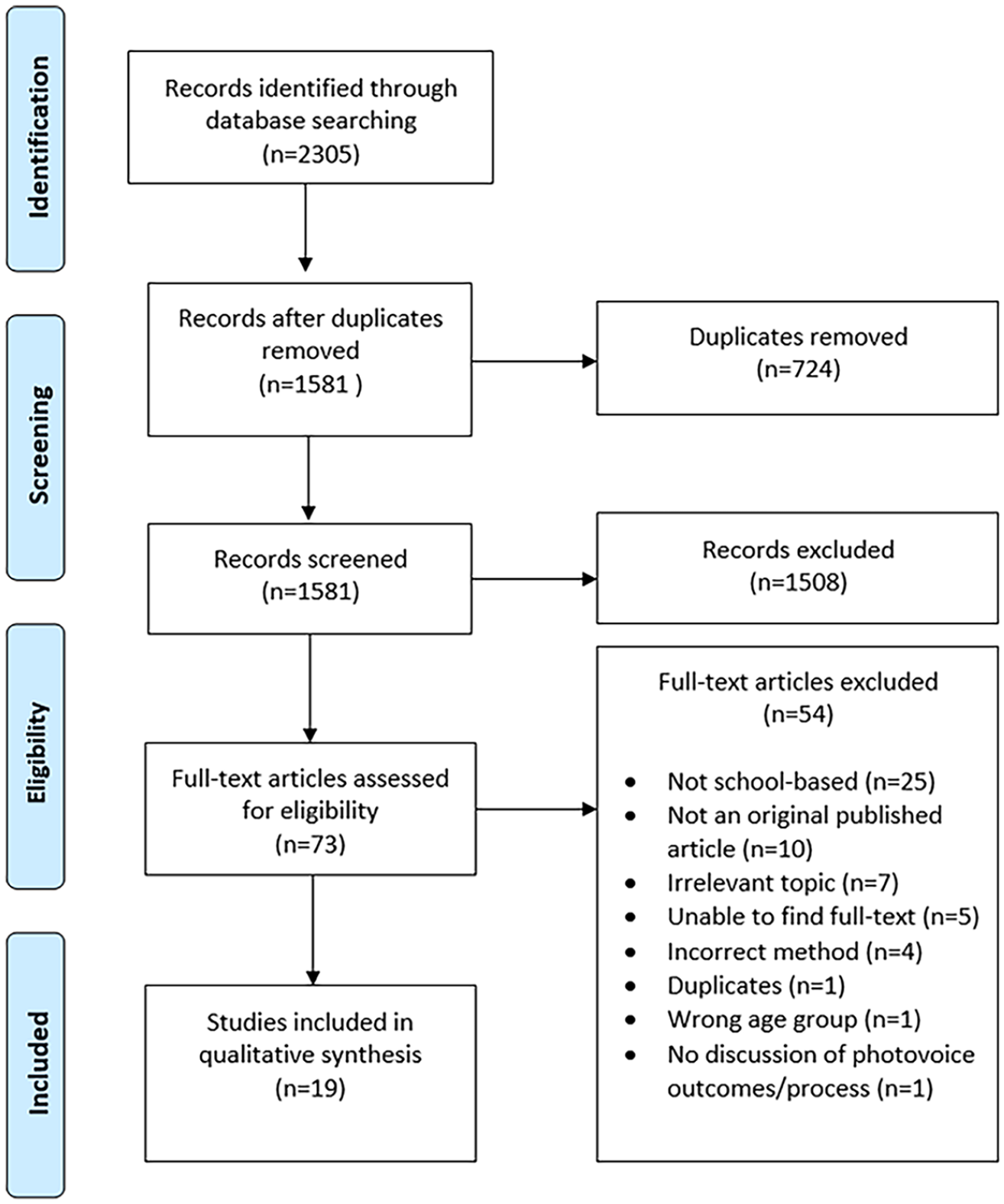
PRISMA flow diagram.
The characteristics of the 19 studies included in the review are summarised in Supplementary Appendix 3. Multiple studies were found in the UK (n = 4), the USA (n = 3), Ireland (n = 3) and Canada (n = 2). Single studies were included from the Netherlands, Australia, Denmark, India, China, Ethiopia and El Salvador. Participant sample size varied from 5–10 (n = 3) to 11–20 (n = 8), and more than 20 (n = 7). Student focus group discussions following the Photovoice process occurred in 58% of studies (n = 11) and aided in contextualising the photographs. The remaining studies used individual interviews.
All articles included in this review described a basic backbone of standard practice. Typically, this began with an introduction/discussion of the aims of the work followed by students taking photographs based on a prompt related to nutrition or PA. Photographs were then contextualised and interpreted by students via focus group discussions or interviews facilitated by researchers or teachers.
A range of challenges and limitations encountered were described by 13 studies, providing the potential for refining approaches to Photovoice use in schools in order to enhance effectiveness. Four themes were developed related to the first analytic category – Photovoice Approaches and Implementation in Schools:
The importance of introductory Photovoice sessions;
Processes for meaning-making and contextualisation of photographs;
Student-led community engagement and health promotion;
Learning from challenges and limitations.
Surprisingly, only 9 out of the 19 studies examined included any form of discussion regarding the learning and capability development experienced by student participants, revealing an unexpected gap in the literature. In cases where this aspect was addressed, evidence suggested that student participation in school-based Photovoice facilitated the development of a diverse range of skills and knowledge. Three themes were therefore related to Student Learning Outcomes:
Critical awareness of nutrition and PA environmental influences;
Development of critical capabilities;
Agency and empowerment.
The theme ‘Critical Awareness of Nutrition and PA Environmental Influences’ could potentially be subsumed under the second theme related to ‘Critical Capabilities’. However, given the focus of the review, a separate theme was identified to stress the potential for enriching students’ understanding of factors influencing their ability to access and consume healthy food and participate in healthy levels of PA.
Discussion
This section discusses each of the themes associated with the two a priori categories of Approaches and Implementation in Schools, and Student Learning Outcomes.
Photovoice approaches and implementation in schools
Photovoice can be creatively adapted to fit a variety of purposes. Nonetheless, the articles examined in this review described fairly standard processes for organising (1) introductory sessions and participant initiation; (2) meaning-making; and (3) the communication of findings. Analyses of implementation led to the identification of (4) key challenges and limitations for Photovoice approaches.
Introductory Photovoice sessions
All the studies discussed the importance of conducting an introductory session with students, creating an opportunity to build knowledge and develop trust between the researcher(s) and participants. These sessions explained the process and purpose of Photovoice, defined important concepts, covered the basics of using a camera and photograph composition, and discussed the ethics of taking photographs.
A key goal of these introductory sessions was the need to build trusting relationships between researchers and participants. Researchers needed to establish an open and comfortable dialogue at this stage of the process. Kelly (2017), for example, used the introductory session to ‘create a healthy group dynamic and comfortable environment among participants’ (p. 69). The participatory nature of Photovoice requires trust between researchers and participants, with careful attention paid to creating an equal power balance. As researchers are outsiders attempting to gain an intimate glimpse into the lives of project participants, trust is essential to create a safe space in which to share photographs and stories. Enright and O’Sullivan (2012) found that student participants were willing to share more when researchers gained their trust, allowing researchers to ‘access knowledge which students are often unwilling to share through other methods’ (p. 45). Researchers and teachers need to listen and engage to build a comfortable, positive environment that encourages participants to share ideas and thoughts.
The studies included in the review stressed that clear Photovoice prompts must be given to participants. For example, Kelly (2017) used Photovoice to explore dietary behaviours and perceptions among American Indian youth living on or near reservations, and used two prompts to guide the study: ‘What environmental opportunities exist for American Indian youth to improve their dietary intake’ and ‘What are the environmental obstacles American Indian youth face concerning eating healthy’? (p. 68). These prompts helped participants understand the project objectives and guided the capturing of images. Martin Romero et al. (2019) asked the participants to define concepts such as ‘healthy’ and ‘healthy eating’ in a group discussion prior to taking photographs. This assisted participants to generate photographs that aligned with the prompts, reducing the potential for misconceptions to influence the quality and relevance of the photographs taken.
Studies showed that teaching participants to compose a photograph can stimulate productive dialogue on how to effectively capture images aligned with the aims of a project (Abma and Schrijver, 2020; Enright and O’Sullivan, 2012; Leung et al., 2017). These informational sessions increase the potential for clear and evocative photographs that answer the research question. For example, when exploring the use of Photovoice in participatory health research with primary school children in The Netherlands, Abma and Schrijver (2020) trained the children in visual thinking and pattern-seeking. These techniques enabled students to think more critically about how they framed their perspectives and produce less stereotypical images. While teaching advanced photography techniques can enhance student experience and strengthen their skill set, teaching basic camera functions (e.g. flash, focus, delete and review options) was sufficient for most adolescents to independently produce photographs (Martin Romero et al., 2019).
Contextualisation of photographs
The next stage of the implementation process requires participants to take photographs to demonstrate their perspective on a particular issue and to contextualise the images. When used in the classroom, this step provides opportunities for students to explain the context and intention behind their photographs, creating a space for their voices to be heard.
In the reviewed literature, researchers used various photo-elicitation techniques, with only 4 of the 19 studies utilising a formal process such as the SHOWeD technique (Wang, 1999). Generally speaking, researchers worked alongside students at this stage in the process. Some conducted one-on-one interviews to gather important contextual information. For instance, Walia and Leipert (2012) used interviews to contextualise photographs representing participants’ perspectives on barriers and facilitators to PA. This approach enabled the authors to develop trust and spend quality time with individual students without disruption or distraction. Such an approach may be particularly helpful when working with those with autism spectrum disorder (ASD) (Lamb et al., 2016). Lamb et al. used Photovoice to understand physical education experiences of participants who had been diagnosed with ASD (n = 5, aged between 11 and 16 years). They noted that this group of participants, who had more difficulty communicating in social spaces, felt safer when interviewed individually.
In contrast, focus group discussions provided a space for student participants to share their thoughts and reflections with researchers, teachers and peers, promoting dialogue and opportunities for further analysis. In this way, students could be supported to identify issues and explore solutions by listening to others’ stories. Interaction between peers also helped address the power dynamic between researchers and students. Hill (2015b) noted that focus groups helped ‘assuage some of the researcher’s authority and put the young people more at ease’ (p. 766). Participants felt more comfortable sharing their thoughts with peers of similar social standing and experience (Enright and O’Sullivan, 2012). The environment provided by group discussions can help enhance the Photovoice process, with open dialogue taking place between participants through peer-to-peer interactions and consensus-building.
The participatory aspect of focus groups can be strengthened further when students themselves plan Photovoice projects as peers in the research design process. Two studies in the review described how participants were trained to work alongside researchers to help facilitate photography lessons, interviews, focus groups and data analysis (Browne et al., 2020; Genuis et al., 2015). Co-designed projects such as these can contribute to the development and improvement of Photovoice technique, as peer researchers were able to give feedback. For example, peer researchers in Browne et al. (2020) suggested that a more diverse group composition would lead to more productive and valuable discussion. Experienced researchers and teachers can use feedback from student researchers to improve the use of Photovoice process as an effective teaching and research tool.
Student-led community engagement and health promotion
The images generated in Photovoice projects can offer powerful narratives of the place and lived experiences of young people in communities. Of the 19 studies included in the review, 5 ended the Photovoice process with student-led dissemination. For example, Genuis et al. (2015) developed a photobook containing a selection of photographs and stories that were distributed across the school and neighbourhood. As ‘experts in their own lives’, the young participants contributed to a deeper understanding of food-related experiences and the issue of food security within their communities. Another strategy involved the use of student photography exhibitions to influence action planning or policy change within a community. Amba and Schrijver (2020) demonstrated how the attendance of community stakeholders and parents at a student Photovoice exhibition led to the development of health promotion action plans in two primary schools in the local community.
Learning from challenges and limitations
While the use of Photovoice can result in clear benefits for participants and communities, several studies outlined challenges and limitations of the Photovoice process. These present opportunities for learning, both to enhance the quality and rigour of studies and to refine approaches to focus on learning outcomes for students.
In some cases, the photographs generated by Photovoice may focus on subject matter that was easy to photograph but which does not consistently or accurately represent issues valued by the participant (Enright and O’Sullivan, 2012; Genuis et al., 2015; Hill, 2015b). For example, seasons and climate were commonly discussed barriers and facilitators to being physically active, but could be difficult to portray at certain times of the year (Leung et al., 2017). Also, it may be difficult to convey abstract or structural concerns photographically (Browne et al., 2020; Chróinín et al., 2019). Findings such as these underscore the importance of considering the temporal and contextual aspects of project planning. They also highlight the need to support students as learners and as participants to critically think about, and select and photograph, images that effectively capture their intended messages. For example, when investigating environmental barriers and enablers, it may be useful for students to first understand the differences between personal- and systems-level or structural influences on these barriers and enablers.
Ethical challenges can arise when participants capture inappropriate or negative events. This might include photographs that negatively stereotype neighbourhoods and/or are of a voyeuristic nature (Abma and Schrijver, 2020; Enright and O’Sullivan, 2012). In the study by Enright and O’Sullivan, there was tension between what the researchers felt was appropriate to share for group discussion and what the participants wanted to include. It is important to note that the generalisability of Photovoice results is limited, as they are subjective narratives from small participant groups and cannot be considered typical of a wider population (Fitzgerald, 2004; Fitzgerald et al., 2009; Martin Romero et al., 2019).
While the results of individual Photovoice studies may not be generalisable to other contexts, the approaches used and the broader findings regarding the nature and potential of student awareness and learning about health-focused issues are applicable to a wide range of school settings. Staab et al.’s (2016) use of fillable photo journals complete with prompts and instructions, and Walia and Leipert’s (2012) use of logbooks to record titles of images and comments provide means of scaffolding student actions and responses outside of formal class time. Kelly’s (2017) observations suggest that while young people might struggle to explain why one type of food is healthy, they are able to assess relative healthfulness between foods. This reinforces the importance of learning strategies, for example, in which students rank food images based on their perceived nutritional benefits and then engage in self-directed inquiries to validate and understand their initial judgements.
In a different study, Leung et al. (2017) reported that young people were able to view differently aspects of their environmental landscape, leading some young people to state an intention to change their behaviours. While intention is not action, it can be the first step towards the motivation and efficacy required for personal change (Schwarzer, 2008).
Student learning outcomes
Three themes related to learning outcomes for students who participated in Photovoice research. Photovoice approaches supported students to observe and interact with their environment using a critical lens, giving voice to their experiences. A third theme discusses how participation in Photovoice helped support student agency and empowerment.
Critical awareness of nutrition and PA environmental influences
Critical awareness involves questioning assumptions, recognising biases and considering multiple perspectives on an event or situation. Capturing, selecting, reflecting on and writing about their own images; and viewing, critiquing and discussing other people’s images, involve active and shared meaning-making and appreciation of different perspectives (Chróinín et al., 2019). In many cases, students’ developing awareness of, for example, barriers and facilitators to healthy nutrition (Martin Romero et al., 2019) prompted them to reflect on ways in which they could intervene within their communities and imagine solutions that might enable people to live healthier lives.
In a study by Trübswasser et al. (2021), student participants photographed food vendors to illustrate challenges and opportunities related to healthy eating and the food environment. Researchers noted that ‘taking photographs of specific outlets that participants frequented made [students] further aware of how their food was actually prepared’ (p. 3617). As a result, they suggested that government intervention could serve to enforce food safety regulations and provide larger and cleaner spaces for vendors. Similarly, in a study by Genuis et al. (2015) which involved Indigenous Canadian students, reflections on the images taken increased awareness of the lack of traditional foods, leading participants to suggest that this issue need to be voiced to the community. Both examples demonstrate how Photovoice can be used to develop critical awareness of social and environmental factors influencing health in relation to nutrition and PA, and subsequently evoke ideas on how to improve it.
Development of critical capabilities
A wide range of improved capabilities among students were reported on in the studies reviewed. They included critical analysis, sense-making and reflection, along with improved social and listening skills and the development of photography skills. Student participant-photographers in Hill’s study were able to identify and critically analyse factors that influenced their behaviour during physical education class, such as ideal body types, aspects of masculinity/femininity, and sports performance and stereotypes, for example, ‘trampolining is something that boys are not supposed to be interested in’ (Hill, 2015a: 674). Student peer researchers who facilitated the group discussions in Browne et al.’s (2020) study reported ‘learning new skills that included research, facilitation, listening and social skills and many felt they gained confidence through the process’ (p. 6).
Peer-to-peer interactions in a group setting have been shown to expand students’ interpersonal skills. Such interactions can stress the value of listening to and understanding what people feel passionate about. In addition to these interpersonal skills, student participants in Abma and Schrijver’s (2020) research developed technical expertise in photography, such as how to effectively use a camera for enhanced visual sensitivity. For example, when researchers encouraged students to take unique photographs that included special patterns and colours, one participant exclaimed, ‘Miss! I suddenly see patterns everywhere!’ (p. 414).
Agency and empowerment
Across the studies included, evidence indicated that participants appreciated the opportunity to freely express their opinions and be heard. By enabling students to tell their stories by capturing, sharing and discussing photographs, the Photovoice process offers students autonomy (Enright and O’Sullivan, 2012) and increases the self-confidence of many young people (Browne et al., 2020).
Abma and Schrijver (2020) noted positive outcomes at the community photography exhibitions where participants ‘expressed pride that their opinions were being listened to and their work was seen’ (p. 240). When adolescents feel valued and supported by parents, teachers and peers, they are also more comfortable and willing to explore their role in the community as positive change agents.
Recognising agency and the capacity to make a positive difference, one student in Enright and O’Sullivan’s (2012) study stated, ‘we learned that we can change things, make a difference’ (p. 48). Empowerment, self-realisation and increased knowledge about healthy environments can provide a strong foundation for student-led action and advocacy. Migrant adolescents in Leung et al.’s (2017) study viewed environmental influences on their health and behaviours differently following participation in Photovoice, with some young people indicating the desire to change their behaviour as a way of contributing to community betterment.
Implications for the future use of Photovoice
This review investigated school-based Photovoice approaches and implementation processes in contexts of nutrition and PA, and the student learning outcomes that developed. Although typically used in schools for the purpose of generating research data on the perspectives and experiences of school students, this review illustrates how and why Photovoice also has value as a pedagogical (teaching and learning) tool. These results are consistent with those of Cooper et al. (2017), who argue that Photovoice provides educational benefits. Chio and Fandt (2007) refer to the ‘eye and the I’ of the camera; the cultivation of critical awareness as students become agents and authors of their own perspectives through the cognitive processes involved in selecting, framing and reflecting on their own and classmates’ images. Photovoice processes support participants to feel valued and listened to and, as Lamb et al. (2016) point out, can alter researcher–teacher–student power dynamics (see also Hill, 2015a; Hill and Azzarito, 2012). However, in some studies reviewed, the participatory nature of the Photovoice research ended following the data collection stage. A stronger focus on learning gains would prioritise continued student involvement through collaborative analysis and dissemination of findings, for instance, via exhibitions for information-sharing and outreach to parents and community as in the study by Trübswasser et al. (2021).
When asking students as participants to give of their time and energy, and when partnering with busy teachers and schools with crowded curricula, we agree with Leung et al. (2017) that ‘while Photovoice was originally designed to better understand community issues and advocate for change, the method may also hold promise as an intervention approach for youth to identify and promote modifiable behaviours’ (p. 10). The exploration of nutrition and PA environments and influences are key learning contexts for increasing knowledge and supporting positive behaviour change within the adolescent window to reduce the risk of NCD in later life. For these reasons, we recommend that researchers accord greater weight to the benefits of Photovoice as pedagogy at the design and participant recruitment stages of research, preferably consulting with partner schools and teachers to co-develop Photovoice approaches. This ensures that intended learning gains arising from the inclusion of students as researchers are relevant and appropriate, aligned with curriculum goals and learner needs. A key ethical research principle is beneficence, and focusing on learning gains and making these explicit is a way of ‘giving back’ to schools and participants (Brear and Gordon, 2021). Depending on application and use, research and learning can be integrated. One possibility could be to position students as ‘health researchers’ or ‘social scientists’ who are partnering with researchers. While tasks will vary depending on age and learner needs, research questions could focus on barriers and enablers to PA participation (Duck et al., 2020; Joseph, 2023) or on the complexity of structural and environmental influences on the foods that people can access and consume. Positioned as such, students can investigate and report on a health issue of importance to their community, at the same time gaining a deeper understanding of social science research processes.
None of the articles in this review canvassed the short- or long-term sustainability of reported changes in attitudes towards healthy eating or PA participation among students. This is an area for further research to better understand the potential for applying Photovoice-linked learning as a health promotion tool.
Limitations and strengths
This review has both strengths and limitations that should be considered. The review was conducted according to principles ensuring transparency, replicability and updateability, providing a degree of confidence in the findings. However, the reliance on a select group of databases for identifying eligible studies risks missing other relevant studies not indexed in these sources. Furthermore, the restriction to articles published in English and from the year 2000 onwards may have excluded relevant studies in other languages or earlier work in the field.
Conclusion
This review offers insight into the approaches, implementation processes and student learning outcomes of Photovoice in schools related to nutrition and PA. The review has highlighted the potential of Photovoice as a pedagogical tool, emphasising the educational value and the importance of continued student involvement through collaborative analysis and dissemination of findings. The findings of this review point to the value of Photovoice as a tool in health education to enhance students’ critical awareness and empower them to actively engage with factors that influence their nutritional and physical activity environments. However, there remains a need for the exploration of the longer-term impacts of such approaches on student attitudes and health behaviours.
Supplemental Material
sj-docx-1-hej-10.1177_00178969231222542 – Supplemental material for Promoting school-based learning about nutrition and physical activity using Photovoice: A systematic review
Supplemental material, sj-docx-1-hej-10.1177_00178969231222542 for Promoting school-based learning about nutrition and physical activity using Photovoice: A systematic review by Suzanne Trask, Erica N D’Souza, Sophia Pi, Siobhan Tu’akoi and Jacquie L Bay in Health Education Journal
Supplemental Material
sj-docx-2-hej-10.1177_00178969231222542 – Supplemental material for Promoting school-based learning about nutrition and physical activity using Photovoice: A systematic review
Supplemental material, sj-docx-2-hej-10.1177_00178969231222542 for Promoting school-based learning about nutrition and physical activity using Photovoice: A systematic review by Suzanne Trask, Erica N D’Souza, Sophia Pi, Siobhan Tu’akoi and Jacquie L Bay in Health Education Journal
Supplemental Material
sj-docx-3-hej-10.1177_00178969231222542 – Supplemental material for Promoting school-based learning about nutrition and physical activity using Photovoice: A systematic review
Supplemental material, sj-docx-3-hej-10.1177_00178969231222542 for Promoting school-based learning about nutrition and physical activity using Photovoice: A systematic review by Suzanne Trask, Erica N D’Souza, Sophia Pi, Siobhan Tu’akoi and Jacquie L Bay in Health Education Journal
Footnotes
Funding
The author(s) disclosed receipt of the following financial support for the research, authorship and/or publication of this article: This work was supported by grants from the Norman F Barry Foundation; the New Zealand Ministry of Foreign Affairs and Trade Partnerships for International Development Fund PF11-613; SP was supported by a University of Auckland Summer Research Scholarship.

Supplemental material
Supplemental material for this article is available online.
References
Supplementary Material
Please find the following supplemental material available below.
For Open Access articles published under a Creative Commons License, all supplemental material carries the same license as the article it is associated with.
For non-Open Access articles published, all supplemental material carries a non-exclusive license, and permission requests for re-use of supplemental material or any part of supplemental material shall be sent directly to the copyright owner as specified in the copyright notice associated with the article.
