



Abstract
Objective:
School Health Profiles (Profiles) is a national surveillance system operated by the US Centers for Disease Control and Prevention. A school-based system of surveys, Profiles monitors school health policies and practices in US states and other jurisdictions through questionnaires completed by school principals and lead health education teachers. This study used the Profiles principal survey to identify trends in US schools’ implementation of diversity-related learning opportunities (i.e. opportunities to learn about people who are different from themselves) in secondary school classrooms and extracurricular settings.
Methods:
Logistic regression models using data from three cycles of School Health Profiles from 35 US states examined trends in the percentages of secondary schools offering students diversity-related learning opportunities in the following settings, each measured by using dichotomous yes/no response options: (a) clubs; (b) lessons in class and (c) special events (e.g. multicultural week, family night) sponsored by the school or community organisations.
Results:
Between 2014–2018, no states experienced decreases in opportunities for students to learn about people who are different from themselves; most states demonstrated no significant change.
Conclusion:
Findings suggest efforts are needed to strengthen capacity for and prioritisation of policies, programmes and practices promoting diversity and culturally relevant education in schools, and in turn, promote positive health and educational outcomes for youth.
Keywords
In alignment with trends for the overall US population, the US public school system is growing increasingly diverse (Hussar and Bailey, 2018); U.S. Department of Education, 2019, 2021). Data from the National Centre for Education Statistics show that between 2009 and 2018, the percentage of public school students identifying as a racial or ethnic minority increased from 46% to 53%, representing a new majority of the overall student population (U.S. Department of Education, 2021). As of 2018, 31% of all public school students attended schools where racial or ethnic minority students comprised at least 75% of the student population – a 27% increase from 2009 (U.S. Department of Education, 2021). Beyond racial and ethnic diversity, US public schools show consistent increases in the percentage of enrolled students from low-income backgrounds, students with disabilities and students who are English language learners (U.S. Department of Education, 2019). Furthermore, an increased percentage of students at middle and high school levels identify as lesbian, gay, bisexual or non-heterosexual identity (LGB+) (Centers for Disease Control and Prevention [CDC], 2023).
As student diversity steadily increases, so too do calls for school environments and learning opportunities that reflect demographic changes and are culturally relevant to students’ lives (Hoover and de Bettencourt, 2018; Muniz, 2019; National PTA, 2020). It is well-supported that when students feel a sense of belonging, engagement and connection to school, they are less likely to engage in substance use, sexual risk behaviours and violent behaviours or experience emotional distress or suicidal thoughts or attempts (Steiner et al., 2019; Wilkins et al., 2023). Connected students are also more likely to succeed academically, including improved school attendance, test scores and graduation rates (National Research Council and Institute of Medicine, 2004; Niehaus et al., 2012; Schapps, 2003).
Unfortunately, growing evidence suggests that current US educational programmes and practices are insufficient in creating safe and supportive environments for a large portion of school-aged youth, with implications for school connectedness and related education and health outcomes (Johns et al., 2019; Kosciw et al., 2013; Office for Civil Rights [OCR], 2014, 2016, 2021; Schafer, 2022). For example, a 2021 online survey of US high school students found that approximately one-third reported perceived racism in school (i.e. being treated badly or unfairly because of their race) (Mpofu et al., 2022). Compared with their peers, these students were less likely to feel close to persons at school and experienced higher prevalence of poor mental health (Mpofu et al., 2022). Research demonstrates similar findings among students with disabilities and those with LGBT identities, where perceived identity-related discrimination or victimisation in school is associated with reduced connectedness and poorer mental health and academic outcomes (Day et al., 2018; Diaz et al., 2010; Forber et al., 2021; Krause et al., 2022). With as many as 15% to 40% of US students reporting chronic disengagement or disconnection from school by the time they reach high school (Klem and Connell, 2004; Lewis, 2021), schools face both challenges and opportunities in creating relevant learning opportunities and environments which engage and connect students of all backgrounds and students who have been historically excluded or marginalised (e.g. Black and Indigenous People of Colour, English language learners, sexual and gender minority youth, students with disabilities) in particular (Lewis, 2021).
Because of this, a number of educational approaches (e.g. multicultural education, culturally responsive pedagogy, trauma-informed approaches, inclusive teaching strategies) place an emphasis on creating learning opportunities that reflect the diverse cultures, identities and lived experiences within classrooms and broader society (Banks, 2004; Bottiani et al., 2018; Ladson-Billings, 1995). These approaches are also reflected in standards, recommendations and guidance for school health education curricula and instructional competencies (CDC, 2019, 2021; Dixon et al., 2021; Szucs et al., 2021). For students who have been historically excluded or marginalised, increasing the range and diversity of materials that students are exposed to in school (i.e. content integration; Banks, 2004) has been shown to have a positive influence on measures of school connectedness, identity development and academic outcomes (e.g. test scores, educational aspirations and academic self-confidence) (Altschul et al., 2006; Chavous et al., 2003; Ginwright, 2000; Tatum, 2004; Zirkel, 2004). There is also consistent evidence that diversity-related content (e.g. content that is representative of and responsive to multiple experiences and identities) improves the learning and engagement of all students and builds key skills (e.g. empathy, self-awareness) that help prepare young people for citizenship and employment in a diverse, pluralistic society (Aboud and Fenwick, 1999; Kugler, 2002; Parker, 2003).
Despite evidence pointing to both academic and psychosocial benefits for historically marginalised and whole student populations (Aboud and Fenwick, 1999; Byrd, 2016; Kaczkowski et al., 2022; Kugler, 2002; Larson et al., 2018; Parker, 2003; Piazza et al., 2015), persistent and emerging challenges create barriers for schools’ implementation of such learning opportunities in a variety of classroom and extracurricular settings, including health and sexual health education (Guttmacher Institute, 2023). However, research to date has yet to investigate schools’ implementation of diversity-related learning opportunities across the USA. Moreover, it is unclear how the implementation of such learning opportunities has changed over time. This study begins to address such gaps by investigating the implementation of diversity-related learning during 2014–2018, providing much needed context for future research that seeks to understand how emergent barriers and challenges may influence present and future implementation of such opportunities. As such, this study assessed trends from 2014 to 2018 to determine school-level implementation of opportunities for students to learn about people who are different from them in US secondary schools (grades 6–8 and 9–12).
Methods
We used data from three cycles (2014–2018) of the School Health Profiles (hereafter called Profiles), a national surveillance system operated by the US Centers for Disease Control and Prevention (CDC). Profiles has assessed school health policies and practices in US states, school districts and territories since 1996. In each jurisdiction, CDC funds health or education agencies to conduct the surveys biennially by using standardised questionnaires, sampling methods, data collection procedures and data analysis (CDC, 2022).
Profiles uses a repeated cross-sectional design, and each cycle’s sample is independent of previous samples. Most jurisdictions draw samples of schools from sampling frames that include all secondary public schools; however, some conduct a census by inviting all secondary schools in the jurisdiction to participate. Although Profiles collects data from representative samples of schools in states, school districts, territories and tribes, this analysis is limited to state data. Data for each state are representative of secondary schools that enrol students in any of grades 6–12. Each state administers surveys using paper-and-pencil scannable booklets or web-based questionnaires. These questionnaires are completed by school principals and lead health education teachers (e.g. school personnel designated as most knowledgeable about health education). In states conducting paper-and-pencil surveys, two self-administered questionnaires (principal and teacher) are mailed to each sampled school. In states conducting web-based surveys, a unique survey link is e-mailed directly to respondents. Participation is both confidential and voluntary. All questions of interest for this analysis were asked only of school principals. As such, this study includes data from the principals’ survey only.
Study measures
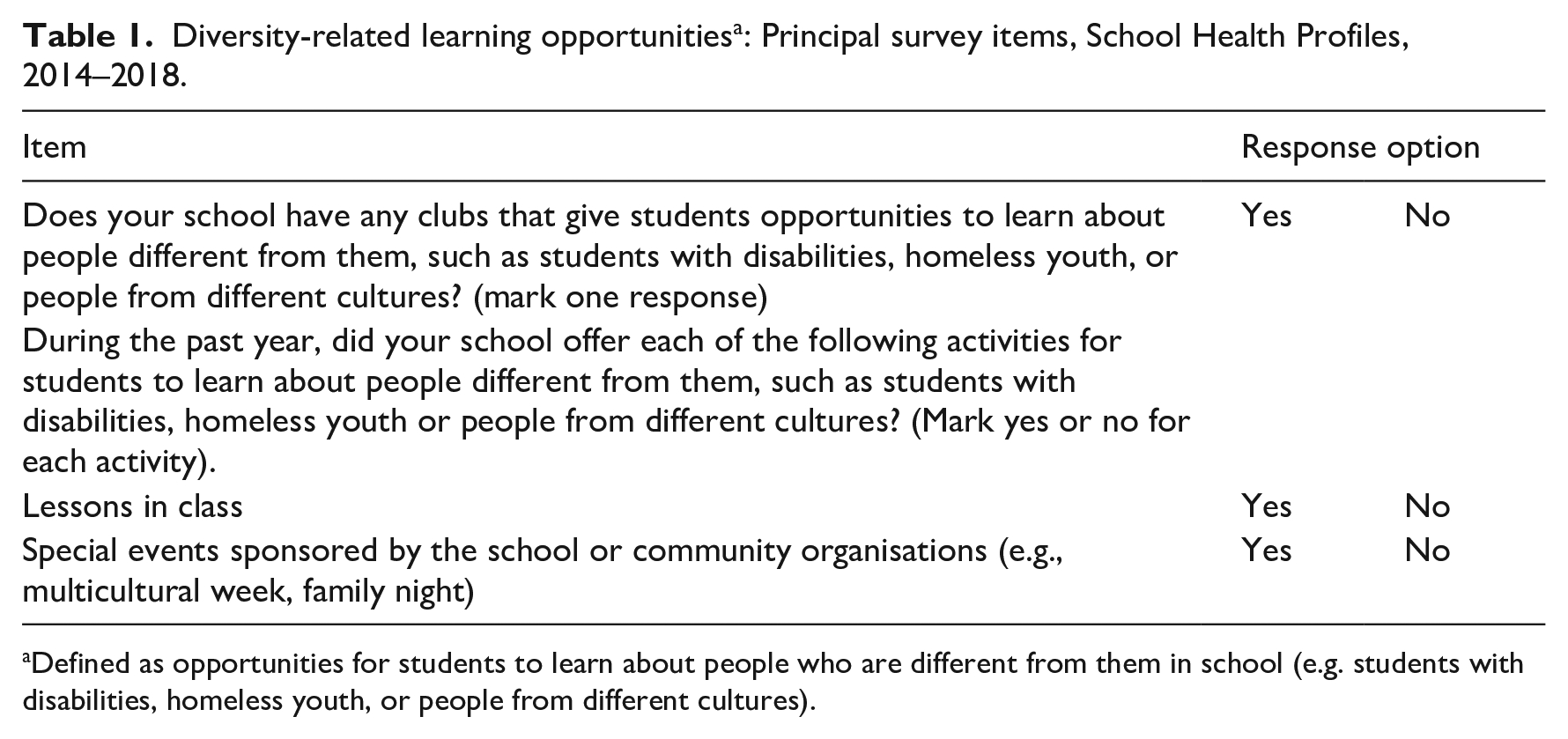
The Profiles principals’ survey collects data regarding diversity-related learning opportunities within US secondary schools. For the purposes of this study, diversity-related learning is defined as a school providing students with opportunities to learn about people who are different from them (e.g. students with disabilities, homeless youth or people from different cultures). Using dichotomous yes/no response options, diversity-related learning was measured in the following settings: (a) clubs; (b) lessons in class and (c) special events (e.g. multicultural week, family night) sponsored by the school or community organisations. The latter two questions referred to activities conducted during the previous year. The question on clubs asked about current presence of such clubs at the time of survey administration (Table 1). These items were assessed on the Profiles principal survey in 2014, 2016 and 2018.
Diversity-related learning opportunities a : Principal survey items, School Health Profiles, 2014–2018.
Defined as opportunities for students to learn about people who are different from them in school (e.g. students with disabilities, homeless youth, or people from different cultures).
Data analysis
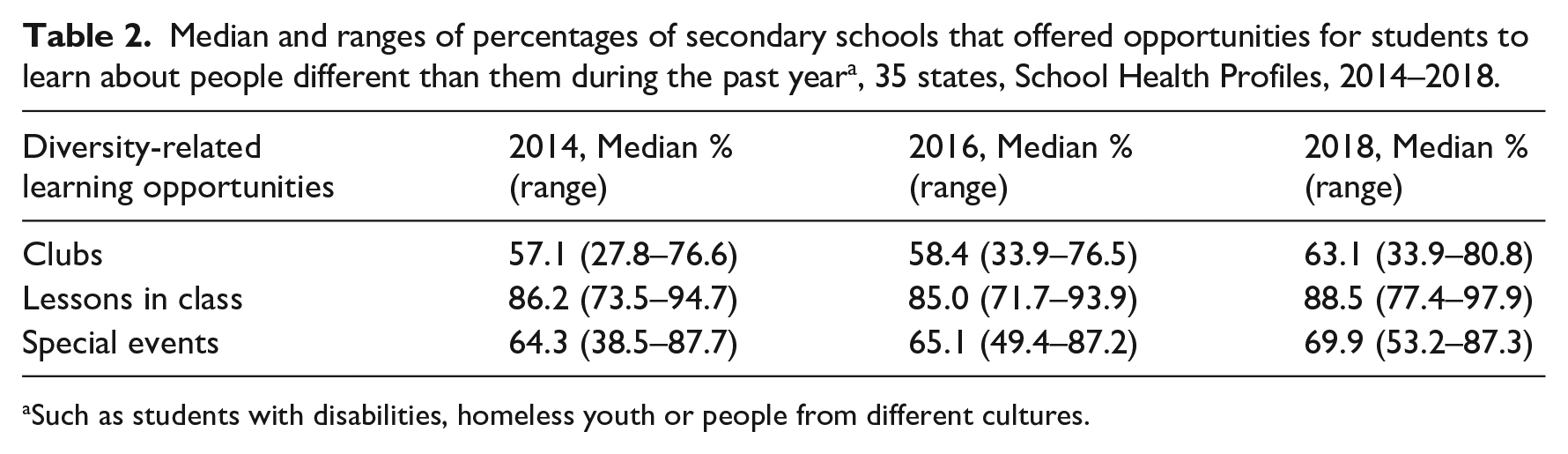
Following standard practice for Profiles (CDC, 2022), data from participating states with response rates of ⩾ 70% for each survey year were weighted so as to be representative of that state. For states that utilised sampling, data were weighted to account for likelihood of school selection and nonresponse. For states that used a census, results were weighted to account for nonresponse. States needed all 3 years of weighted data to be included in the analysis so that linear trends could be calculated through unadjusted logistic regression modelling. Furthermore, the state’s sampling methodology must have remained the same throughout the three cycles. Analysis included a total of 35 states; sample sizes and response rates for the principals’ survey varied across states and years (Table 2). For example, in 2018, the sample size ranged from 72 to 558 and response rates ranged from 71% to 90% for the principal questionnaire. For each state, the median percentage of schools with diversity-related learning opportunities was calculated for each cycle. Models were run separately for learning opportunities in each setting to examine linear trends in the percentage of secondary schools in each state that reported opportunities for students to learn about people different than them. Diversity-related learning opportunities served as the dependent variable, and a linear time component was the independent variable. Trends were considered statistically significant if the P value for β was <0.05.
Median and ranges of percentages of secondary schools that offered opportunities for students to learn about people different than them during the past year a , 35 states, School Health Profiles, 2014–2018.
Such as students with disabilities, homeless youth or people from different cultures.
Results
Table 2 presents overall medians and ranges for the percentage of secondary schools across states that offered diversity-related learning opportunities for each year. Beginning in 2014, the opportunity offered in the highest median percentage of schools was lessons in class (85.0%–88.5%), while clubs were the least offered learning opportunity (57.1%–63.1%).
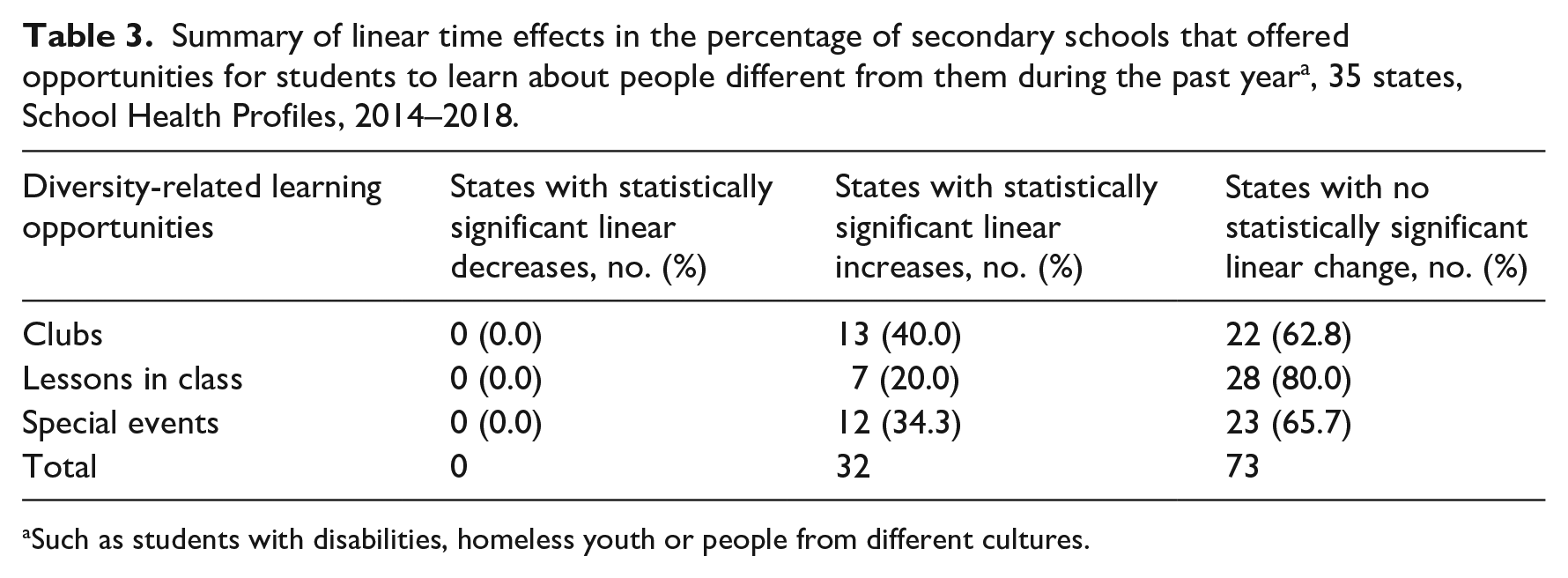
The summary of linear time effects in the percentage of schools that offered diversity-related learning opportunities is presented in Table 3. Overall, no states experienced statistically significant decreases in offering any of the three learning opportunities of interest; however, more than 60% of states showed no linear change. The learning opportunities with the greatest linear increases were clubs and special events, with more than 30% of states showing significant increases in these two offerings during 2014–2018. Only 20% of states experienced significant increases in offering lessons in class, but a higher median percentage of schools reported offering lessons in class compared with clubs or special events during this same period.
Summary of linear time effects in the percentage of secondary schools that offered opportunities for students to learn about people different from them during the past year a , 35 states, School Health Profiles, 2014–2018.
Such as students with disabilities, homeless youth or people from different cultures.
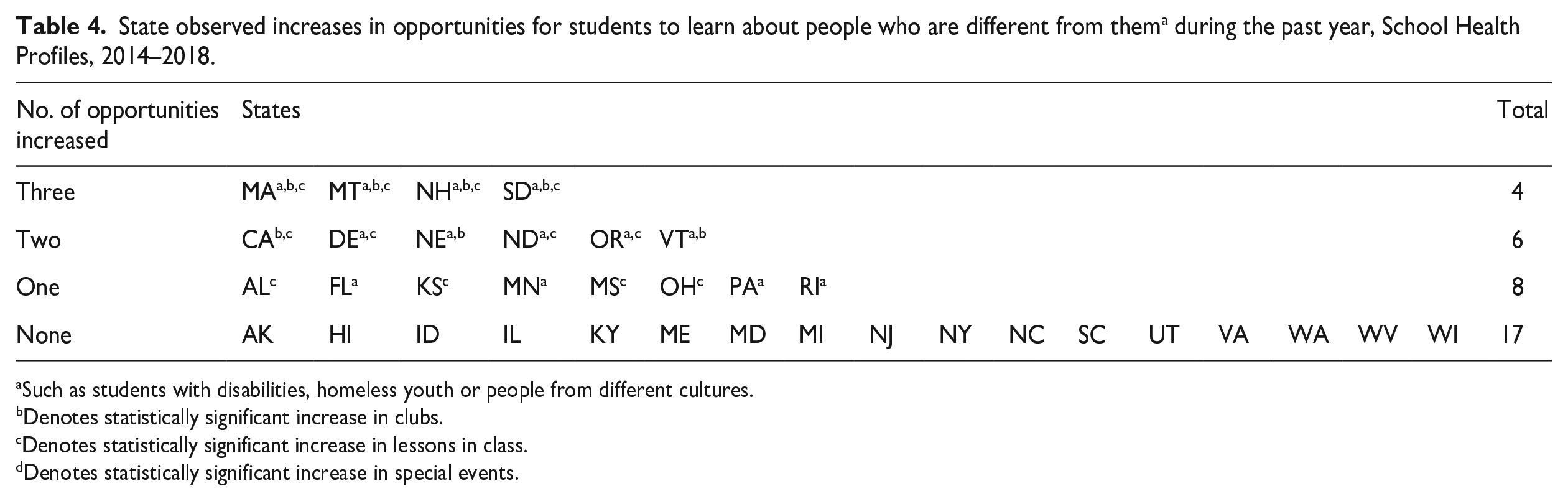
State-by-state comparisons in overall increases in offering each of the three diversity-related learning opportunities are presented in Table 4. While no states experienced decreases in any of the three learning opportunities, increases did not consistently occur across states or by learning opportunity type. Among the states that showed any increase in diversity-related learning opportunities, nine (AL, FL, KS, MN, MS, OH, PA, RI) showed increases in one of the three offerings. Within this group, no states reported increases in lessons in class, only increases in offering clubs or special events. Among states showing increases for two of the three opportunities (CA, DE, NE, ND, OR, VT), increases were more evenly distributed across all three types of learning opportunities. Only four states (MA, MT, NH, SD) showed increases across all three types of diversity-related learning opportunities.
State observed increases in opportunities for students to learn about people who are different from them a during the past year, School Health Profiles, 2014–2018.
Such as students with disabilities, homeless youth or people from different cultures.
Denotes statistically significant increase in clubs.
Denotes statistically significant increase in lessons in class.
Denotes statistically significant increase in special events.
Discussion
We examined state-level trends in diversity-related learning opportunities (i.e. opportunities for students to learn about people who are different from them) offered to students in US secondary schools from 2014 to 2018. Across states, we observed no decreases in schoolwide offerings of diversity-related lessons in class, clubs or special events. Most states showed no linear change in offering diversity-related learning opportunities, and significant increases did not consistently occur across states or opportunity type. Trends suggest that although student diversity increased between 2014 and 2018, most states maintained, rather than increased, opportunities for middle- and high-school students to learn about diversity and people who are different from them. Although limited to the 2014–2018 period, these findings may help contextualise future research investigating more recent barriers to the implementation of diversity-related learning in schools that have emerged since 2018.
Although states reported fewer increases in lessons in class than clubs and special events, lessons in class had the highest median percentage (2018 median, 87.9%) of all learning opportunities examined. This indicates that schools largely provided classroom-based opportunities that integrate and illustrate content for students to learn about people who are different from them. It also highlights that the implementation of such opportunities was most reported during planned instructional time rather than during clubs or special events. Given that diverse and culturally relevant content is already integrated into core educational standards and curricula (e.g. social studies, geography, language arts) across many states (Muniz, 2019), these findings are not surprising yet raise several implementation questions. For example, we do not know the extent or ‘dosage’ of diversity content integrated into instruction – were classroom-based opportunities to learn about others sequential, limited to one lesson or unit, or repeated throughout an entire school year? Was content added to an existing curriculum for a special event or occasion or was the structure of the curriculum changed to integrate different concepts, issues and themes from the perspectives of diverse groups? Whether the content is simply added versus integrated into curricula may influence the degree to which students feel connected to their school and learning (Banks, 2005; CDC, 2021, 2023).
Recent increases in both pre-service and in-service teacher training and professional development (PD) offerings related to diverse, culturally relevant teaching and curricula may also support the implementation of classroom-based opportunities for students to learn about people who are different from them (Bottiani et al., 2018; Brown et al., 2019; McKenney et al., 2017). When teachers receive PD related to teaching students from various cultural backgrounds and identities, not only does teacher-self efficacy related to meeting the needs of diverse students increase (Choi and Mao, 2021; Christ and Sharma, 2018; Jarpe-Ratner et al., 2022; Johnson, 2011; McAllister and Irvine, 2002; Payne and Smith, 2011), but students are more likely to perceive supportive instructional environments and student-centred practices and experience confidence and comfort within the school community (Jarpe-Ratner et al., 2022; McAllister and Irvine, 2002; Payne and Smith, 2011).
For health and physical education teachers, specifically, training on trauma-sensitive practices, racial justice and equity and cultural responsiveness are well-documented gaps (Dixon et al., 2021; Ellerbrock et al., 2016; Wrench and Garrett, 2021). Data from a nationally representative sample of school districts in 2016 (CDC, 2016) highlight that while a majority of school districts report provision or funding of health education teacher PD to improve knowledge and skills related to teaching students from various cultural backgrounds (62% of school districts), with limited English proficiency (62% of school districts), and who experience long-term physical, medical or cognitive disabilities (66% of school districts), there is still room for improvement (CDC, 2016). Without good-quality training and preparation, there is evidence that attempts to implement differentiated or culturally relevant instruction may not reach full fidelity and may even prove harmful for students and the broader school community (Parkhouse et al., 2019; Pollock et al., 2010). At both teacher and administrator levels, lack of awareness about one’s own biases or failure to apply an intersectional lens to diversity-related learning opportunities may perpetuate oppression of students who have been historically excluded or marginalised, rather than facilitate connectedness (Blanchett, 2006; Carter et al., 2016; Tenenbaum and Ruck, 2007).
Research points to some of these unintended consequences, such as disproportionate isolation of English language learners and students with disabilities from general education settings to make learning opportunities more ‘accessible’ to their individual learning needs (Ayscue, 2016). Similarly the development of school or classroom policies intended to improve school climate or safety for all students (e.g. removal of students who violate classroom or school rules) may disproportionately exclude racial and ethnic minority students and families (Ayscue, 2016). As US secondary schools integrate diversity-related content into curricula or facilitate conversations about identity and identity development in classrooms, it is critical that school administrators and teachers are adequately prepared to do so in a way that does not cause unintended trauma or harm.
Beyond classroom-based content integration of opportunities for students to learn about people who are different from them, education research and theory also recommends the implementation of complementary schoolwide practices to celebrate differences and facilitate connectedness for diverse groups of students (Banks, 2005; Brown- Jeffy and Cooper, 2011). Although not measured by Profiles, of equal or greater importance to content integration are approaches such as teacher-, administrator- and student-led activities to reduce prejudice and stereotyping in the school, as well as school structures, policies and processes that are empowering for all students (Banks, 1996, 2004, 2005). A promising finding from this study is that US states increasingly invested in opportunities outside of the classroom for students to learn about people who are different from them. However, the median percentage of states implementing diversity-related learning opportunities in clubs and during special events was notably lower than lessons in class, signalling that schools may still struggle to move beyond content integration to promote diverse learning experiences. Partnerships with community and health organisations may help schools develop or strengthen schoolwide approaches, as well as leverage factors and assets within a school population such as language and cultural backgrounds of students and families, or relevant cultural beliefs, norms and practices. Given new challenges related to diversity-related learning in schools that have emerged in recent years, such partnerships may prove even more critical. Recommendations from the field emphasise that the more diverse a school’s population, the more factors should be considered in developing diverse and culturally relevant school programming (Lopez et al., 2017; Simpkins et al., 2017).
Comprehensive frameworks that integrate both classroom-based and schoolwide approaches to support diversity-related learning are another possible source of guidance and support for schools (Banks, 2004; Blitz and Lee, 2015; Brown-Jeffy and Cooper, 2011; Dryfoos, 2005; Ellerbrock et al., 2016). However, there is wide variation in definitions operationalising approaches to diversity-related learning (e.g. culturally-related, relevant and responsive pedagogy), and the complexity of student-, teacher- and school-level measurement requires attention (Bottiani et al., 2018; Brown-Jeffy and Cooper, 2011). Further consensus is needed on measures that capture the complexity of both diversity-related classroom practices and broader schoolwide strategies. Work by Bottiani et al. (2018) suggests clarity on a set of indicators, as well as using multi-informant forms of assessments for culturally responsive pedagogy, can help address work being undertaken by schools (Bottiani et al., 2018). One such approach may utilise teacher-level indicators to examine culturally responsive pedagogy and behaviours between educators and students (Debnam et al., 2015). Youth and family perspectives on appropriate indicators may also enhance measurement of student- and school-level outcomes associated with diversity-related policies and practices (Powell and High, 2007).
Furthermore, given evidence of school connectedness and connections to adolescents’ learning and health (Steiner et al., 2019; Wilkins et al., 2023), future studies are needed to examine how diversity education and schoolwide strategies impact student health knowledge, skills, behaviours and experiences. Questions to consider include the following: do the positive benefits for student academics supported by diversity-related learning opportunities and practices in schools transfer to protective student health behaviours and experiences (Altschul et al., 2006; Chavous et al., 2003; Ginwright, 2000; Tatum, 2004; Zirkel, 2004); and given that healthier students are better learners (Basch, 2011; Rasberry et al., 2017), how can schools use diversity-related practices to combat health disparities and harmful stereotypes, as well as facilitate protective health outcomes among students served?
Limitations
This study is not without its limitations. Profiles data represent public secondary schools from states included in the analysis (n = 35). Because only three years of data were available at the time of analysis, only linear trends were able to be conducted. In addition, Profiles discontinued this set of questions after 2018, so more recent data were not available to include in analysis. Potential bias is also a limitation of this study. Data are based on self-report by principals and lead teachers at the secondary school level; both over- and under-reporting is possible. More robust data that represent the perspectives of students, teachers, family members and other school personnel are needed to improve reporting and understanding of diversity-related learning opportunities in schools. Relatedly, although Profiles data report the learning opportunities offered, they do not assess the extent or quality of implementation. We cannot determine how such activities were implemented, how often and in what context. Furthermore, we did not consider whether teachers and other school staff received essential preparation and ongoing support to facilitate such learning opportunities, or whether these offerings were bolstered by broader schoolwide policies and practices to create an equitable and inclusive school environment for students with diverse identities, backgrounds and experiences. Although we equated opportunities for students to learn about people who are different from them with diversity-related learning opportunities for the purposes of this study, there is likely wide variation in how opportunities were interpreted or implemented in practice. Finally, there are many ways to operationalise and measure school connectedness concepts and practices (Hodges et al., 2018), with varying consensus among public health and education scholars, and most commonly related to student academic outcomes (Chung-Do et al., 2015). Profiles measurements include only a limited set of practices that advance diversity-related learning and further work to examine their relationships with school connectedness outcomes if needed.
Conclusion
Our findings improve understanding of state-level trends in the implementation of opportunities for students to learn about people who are different to themselves in US secondary schools. Given ongoing national dialogue regarding the appropriateness of diversity-related learning in US schools, analyses may help contextualise future trends and patterns in the implementation of such opportunities over time. Existing research shows that diversity-related learning opportunities have the potential to improve school performance and connectedness, particularly among students who have been historically excluded or marginalised (Aboud and Fenwick, 1999; Byrd, 2016; Kugler, 2002; Larson et al., 2018; Parker, 2003; Piazza et al., 2015). Furthermore, they prepare students to fully engage in a diverse, pluralistic US society. Paired with an increasingly diverse US student population, the limited improvements in diversity-related learning opportunities observed between 2014 and 2018 warrant additional consideration. Future research that establishes measures and indicators for diversity-related approaches and practices, as well their relationship to health and academic outcomes like school connectedness, may increase prioritisation of such practices in state and local policy. Furthermore, studies that supplement principals’ reports with student, teacher and/or family experiences of diversity-related learning are needed to reduce bias and over- or under-reporting – a key limitation of the present study. At the school level, frameworks to support the integration of both classroom-based and schoolwide approaches to support diversity-related learning opportunities may further enhance understanding of how they are implemented, highlight barriers to implementation and help guide teacher and school administrator training to ensure that such opportunities further connect, rather than exclude, students with their school communities.
Footnotes
Funding
The author(s) received no financial support for the research, authorship, and/or publication of this article.
Disclaimer
The findings and conclusions in the manuscript are those of the authors and do not necessarily represent the official position of the US Centers for Disease Control and Prevention.
