



Abstract
Background:
National school curriculum statements detail what it is important to learn and are highly context- and discipline-specific. The health and physical education (H&PE) learning areas have multiple learning purposes, and facilitating this in curriculum design is a significant and challenging task.
Objective:
There is little reporting on ‘behind-the-scenes’ practices of H&PE curriculum writing, despite this being a key mechanism by which the shaping of curricula occurs. This article offers a descriptive case study of curriculum development for the Tokelau National Curriculum H&PE learning area for Years 0–13. Prior to 2021, this learning area did not formally exist in the Tokelau National Curriculum Framework.
Design, Setting and Methods:
The case reports on the processes and decisions of a multi-national transdisciplinary writing team from Tokelau, New Zealand and New Caledonia. We explore the questions: ‘Why the need for an H&PE curriculum, and who is it for?’ Document collection and team-based interviews formed the basis for deductive descriptive analysis of the writing processes.
Results:
Three key themes were developed. Related to ‘why’, findings illustrate the importance of formalising H&PE learning, representing knowledge, skills and capabilities useful for present and future generations of young people in Tokelau. Considering ‘for whom’, findings emphasise the involvement of the community in curriculum decisions, and the inclusion of distinctive features aligned with community values, needs and aspirations.
Conclusion:
The case study illustrates the requisite coming together of different groups and expertise in the creation of a curriculum, a synthesis of pre-existing and new knowledge and experiences. The focus on health promotion and health and physical literacies exemplifies the everyday use of school curriculum goals to support community health.
Introduction
This article illustrates the development of health and physical education (H&PE) as a new national curriculum learning area in the Southern Pacific Island nation of Tokelau. A national school curriculum is an organised statement of what is considered important for Year 0–13 learners to know, understand and do in terms of skills and competencies and conceptual knowledge for life and future learning (Young, 2014). Learning area statements for subjects such as mathematics, English, science and H&PE evolve from the selection and specification of complex knowledge and capabilities, reflecting educational priorities relevant to the time and place (Vreuls et al., 2022). These processes are highly context-specific, involving the integration of high-level educational philosophies and values, and the negotiation of cultural, social and political contexts and parameters.
Significantly, the formation of curricular elements is influenced by the curriculum design and writing team. This formation represents synthesis and consensus, taking account of information from consultations, government directives and research and expert knowledge (Kilborn et al., 2016). Globally, discussion of school-sector curriculum development at the state or national level tends to centre on the design and implementation or curriculum reform (Gouëdard et al., 2020). The nuances of decision-making regarding the ‘what’ and ‘how’, and importantly, the ‘why’ and the ‘for whom’, within writing teams often remain unseen. There is currently little reporting on the processes and experiences of curriculum writing teams, despite their work being a key mechanism by which the shaping of curricula occurs (Penney, 2006). Opportunities for such reporting are limited, as national school curricula have commonly been embedded over generations with periodic refresh cycles based on those foundational documents (Gouëdard et al., 2020).
Development of the Tokelau H&PE learning area took place during 2021 with implementation ongoing from 2022. This case study focuses on the consultative processes and experiences of the multi-national, transdisciplinary curriculum design team and on design decisions leading to the formation of the final curriculum document.
Tokelau
Tokelau is located 500 km northwest of Samoa, mid-way between New Zealand and Hawaii. The population of 1,600 is distributed over three atolls (a total land area of 12 km2). The southernmost atoll is Fakaofo (population 570). Nukunonu (population 450) is 64 km north of Fakaofo. Atafu (population 550) is the northernmost atoll (92 km north of Nukunonu). Travel to Tokelau and between the three atolls is by boat as there is no air access. From Apia, Samoa, it is a 24-hour boat trip to Fakaofo, dependent on weather conditions. The trip from Apia to the northernmost atoll of Atafu takes 30 hours (Government of Tokelau, n.d.-a).
Tokelau is a largely self-governing territory of New Zealand (New Zealand Government, n.d.). There are high levels of emigration, with more Tokelauans living in New Zealand and Samoa than on the atolls. Tokelauan is the main language used, but Samoan and Tuvaluan are also spoken. English is taught in schools as a second language and is widely understood. Faka-Tokelau, the Tokelauan way of life, revolves around community and family, with strong values of sharing and care. The Council of Elders (Taupulega) conducts village affairs. Agriculture is limited due to a lack of natural fertile soil; however, gardening and food production play an important part in village life. Other essentials are imported from Samoa and New Zealand. Seafood is a major part of the diet with fishing activities a necessary and key feature of daily life in Tokelau.
Each of the three atolls has its own school with classes from Years 0–13 (ages 5–18). The Tokelau Department of Education oversees the school curriculum, the school and staffing. Students learn using the Tokelau curriculum, and until 2021, Year 12 and 13 students gained senior secondary qualifications through the University of the South Pacific (Tokelau Department of Education, n.d.). Internet access has been recently upgraded with the placement of a submarine cable.
In Tokelau as in other Pacific nations, there is concern about rising rates of health issues. Health and wellbeing concerns include the increasing prevalence of non-communicable diseases and concerns for youth mental health. The Government of Tokelau’s national development strategy includes a focus on improved health and education outcomes and the social wellbeing of communities (Government of Tokelau, n.d.-b).
H&PE as a new curriculum learning area
In 2019, the Tokelau Education Summit took place in Atafu to identify and discuss effective strategies for lifting the quality of Tokelau early childhood education and schooling. The summit was attended by education and ministry officials from New Zealand and from across the Tokelau atolls. At the summit, the people of Tokelau articulated a desire for shared ownership of a Tokelau vision for education. Recurring themes from discussions centred on the importance of nurturing relationships (tauhi te va fealoaki) and building vibrant communities that can thrive in adversity. Key concepts included resilience, perseverance and socio-economic and environmental sustainability (Education Review Office, 2019).
The development of the new Tokelau H&PE learning area took place during a wider curriculum review and refresh of the current Tokelau National Curriculum Policy Framework (NCPF) beginning in late 2020. This process was led by the Tokelau Department of Education. The curriculum areas being reviewed were Tokelau Language, English, Mathematics, Science and Social Science. At that time, the H&PE learning area did not formally exist within the NCPF; however, health and wellbeing principles featured prominently in the curriculum front matter. The new H&PE curriculum learning area aimed to uphold the unique traditions, values, beliefs, language and contexts that shape Tokelau culture and incorporate outcomes appropriate to Tokelauan bilingual learners. Its goal was to support learning in a coherent progression across five curriculum levels and incorporate knowledge and competencies needed for success in 21st-century Tokelau and the wider world.
An important requirement was to align curriculum and assessment to the New Zealand secondary school exit qualification the National Certificate of Educational Achievement (NCEA). Tokelauans are New Zealand citizens. As of 2018, around 8,500 people who identify as Tokelauan live in New Zealand, far greater than the population of Tokelau itself (Stats NZ, 2018). Alignment with NCEA provided an opportunity for consistency and continuity for Tokelauans who migrated to New Zealand, enhancing potential opportunities for employment and higher education.
H&PE in curriculum
Internationally and in the Pacific, H&PE curricula prioritise health promotion inclusive of engagement in recommended levels of physical activity, and a holistic approach to wellbeing over the life course, often with specific reference to behaviour change (Herold, 2020; Kilborn et al., 2016; Penney, 2006, 2013; Renwick, 2017). For example, curriculum strands in the Cook Islands and Australian curricula promote and educate for personal, social and community health (Australian Curriculum, Assessment and Reporting Authority [ACARA], n.d.; Cook Islands Ministry of Education, n.d.). Various frameworks for health promotion exist. For instance, the New Zealand Action Competence model supports an inquiry cycle which involves identifying an issue, instigating an investigation to develop knowledge of the issue, planning solution-focused actions and evaluating those actions (New Zealand Ministry of Education, 2021).
Importantly, complex social, environmental and economic factors affect health issues that may or may not be within an individual’s or community’s power to address (Whitehead and Dahlgren, 1991). The focus and orientation of H&PE curricula must account for this complexity to avoid deficit positionings of learners in issues-based approaches, while achieving a range of learning objectives to enhance individual and societal wellbeing in the short and long term. These objectives include building capacity for individual and community action, enhancing foundational and high-level movement skills and capabilities and ensuring competency development in knowledge, perspective-taking and decision-making for complex health concerns (Bopp et al., 2022). All must be accomplished in contexts and with learning experiences that are relevant and meaningful to students. This can be a difficult balance to achieve. For instance, Kilborn et al.’s (2016) analysis of physical education curricula in 10 Canadian provinces revealed a strong vision for healthy living but learning outcomes more connected to a performance-oriented focus on skills and movement.
In some Pacific nations, a model is used to represent the many dimensions of health and wellbeing, highlighting the interdependent nature of mental, emotional, spiritual and physical wellbeing states, connected to community and environment (Cook Islands Ministry of Education, n.d.). For example, in the Aotearoa New Zealand curriculum, the term hauora describes the Māori philosophy of wellbeing based on Durie’s Te Whare Tapa Wha (Durie, 1984). The model represents the four cornerstones of the traditional Māori meeting house: taha tinana (physical wellbeing), taha hinengaro (mental and emotional wellbeing), taha whānau (social wellbeing) and taha wairua (spiritual wellbeing) (New Zealand Ministry of Education, 2014). This holistic vision is integrated down through other curriculum layers.
Other contemporary curricula utilise salutogenic, strengths-based approaches to identify and appreciate the abilities, actions and strategies that individuals and organisations already possess and undertake in support of positive wellbeing (ACARA, n.d.). These approaches focus attention on acknowledging and mitigating issues while avoiding a deficit framing of ‘preventable’ disease (McCuaig et al., 2013). There is also a growing interest in harnessing the notion of physical and health literacies (Alfrey and Brown, 2013; Renwick, 2017). Examples include the Australian Health and Physical Education curriculum and American National Standards and grade-level outcomes (ACARA, n.d.; SHAPE America, 2013). Used in this context, health literacy is seen as the ability to locate, understand and use knowledge to decide on or pursue positive action/contributions for oneself and others (Centers for Disease Control and Prevention, 2023; UNESCO, n.d.). Physical literacy is the ability to recognise the value of being physically active for improved short- and long-term physical and mental health, and having the confidence, competence and motivation to find or take opportunities to engage in regular physical activity (International Physical Literacy Association, 2022).
In sum, the health and wellbeing of a population rely on the development of health and physical literacies by way of holistic and whole-of-community action. Schools are a key setting for health promotion (Bay et al., 2017), and school-based H&PE that is contextually and culturally appropriate serves as part of this comprehensive and integrated approach.
Research context and methods
Framing the case study research
The idea for a case study of curriculum creation evolved from conversations and reflections within the writing team during the design process. Discussing the creation of the curriculum, Young (2014: 7) poses the question: ‘What is a curriculum and what can it do?’. Young points out that there is little consensus on this and goes on to explain that curricula are designed for a particular purpose, having a role to play in the transfer of knowledge from generation to generation. Curricula prescribe structures enabling possibilities for what students could learn while adding constraints aligned with internal and external policies and priorities. Existing knowledge and skills that teachers, learners and other community members possess also connect and contribute to possibilities for what might be learned and known.
The premise that guided our exploration of H&PE curriculum development was that H&PE curricula are designed to support overall wellbeing and health needs within a particular society by promoting physical wellbeing and cultivating lifelong healthy habits and behaviours (Gray et al., 2022; Lynch, 2014; Sinkinson and Burrows, 2011). Moreover, an H&PE curriculum can play a vital role in initial development and pathways for future health professionals (Benes et al., 2021; Sallis et al., 2012).
Connecting to the notion of curriculum purpose, our framing question for this case study was: ‘Why the need for an H&PE curriculum and who is it for?’ This question allows for an exploration of the impact of the distinctive Tokelau context on curriculum development and reflection on implications for collaborative design processes and final features of the curriculum document.
Research design
Case study research aims to achieve for holistic and in-depth consideration of an event and the context(s) in which the event took place. Our focus here was on understanding and reporting on collaborative writing processes and contextual factors that influenced this (Yin, 2018). Case study reporting is compatible with the need for descriptive summaries ordered by theme-based experiences and over time and thus supports our research approach.
Formal, written and informed consent was obtained from the Tokelau Department of Education and those responsible for oversight of the wider curriculum refresh. Participation in the research was voluntary and formal, written and informed consent was obtained from each H&PE curriculum writing team member. It was not possible to promise anonymity as all team members were co-investigators and named authors in the study. However, confidentiality was prioritised. In reporting data and findings, we refer to the group as ‘the team’. No individuals are directly named but are referred to by randomly assigned codes [TM1-6] with their role in the team not tied to this code. Ethical approval for the study was granted by the University of Auckland Human Participants Ethics Committee (Reference number 22834–Approved 21 July 2021).
Data collection was from multiple sources including field notes, meeting notes, consultative documents and presentations and curriculum drafts. Semi-structured interviews conducted with each team member by one of the New Zealand-based coordinators were important data sources. Interview questions focused on roles and responsibilities, reflections on key stages and decision points in the design process, and aspects of curriculum related to:
H&PE curriculum structure and organising principles;
What is most important to learn in H&PE;
How H&PE learning happens;
Tokelau students’ learning needs;
Tokelau social, cultural and environmental contexts;
Tokelau school context.
Qualitative analysis
Audio recordings of interviews were transcribed and returned to participants for checking. Deductive descriptive analysis of interview transcripts and other data sources including meeting notes and development drafts was guided by the framing question. Analysis involved interpreting and assigning individual data items to codes and aggregating codes to form themes related to the why (overall curriculum goals) and who (whose voices and needs were represented, and how). Initial interpretations by the first researcher (S.T.) were discussed with a co-researcher on the team and reviewed by the team to reach a consensus (Braun and Clarke, 2008). Taken together, these data yielded key categories incorporating our thinking and development during the design stages.
Curriculum writing team
The H&PE curriculum writing team consisted of two on-island coordinators (Nukunonu) with expertise in health promotion and curriculum development; two New Zealand collaborators with expertise in health literacy, curriculum and assessment and knowledge translation in adolescent populations and a New Caledonia-based collaborator with expertise in physical activity and lifestyle education. All H&PE team members, if not currently teaching, had been teachers and/ or curriculum leaders in schools. All H&PE team members had worked with and/or lived in other Pacific Island nations prior to being involved in the H&PE curriculum writing. One New Zealand-based team member coordinated the wider curriculum refresh and writing teams across all learning areas.
Curriculum development process
Curriculum development took place in 2021 during the COVID-19 pandemic. The original plan had been for international collaborators to travel to Tokelau, to be immersed in village life. Instead, the New Zealand-based H&PE writers met together with other learning area teams involved in the curriculum refresh and Zealand-based members of the Tokelauan community for two workshop days to support beginning understandings of Tokelauan cultural life and values. Thereafter, development was conducted by remote collaboration via Zoom meetings and a secure online document-sharing site.
The on-island curriculum coordinators led community consultations and oversaw the integration of the Tokelauan language and selection of learning contexts appropriate to Tokelauan learners. The on-island coordinators lived in Nukunonu but travelled to the other atolls of Fakaofo and Atafu. Consultations were held at each of the three schools with students Years 9 and upwards, parents, school principals and senior management, women’s groups, Taupulega (Council of Elders and Chiefs), men’s working groups and health teams.
Findings
Three key themes are highlighted in the findings below. First, related to why, findings illustrate the importance of (1) formalising H&PE learning within the Tokelau National Curriculum. Second, considering for whom, findings emphasise (2) community involvement in curriculum decisions and (3) the process of conceiving the curriculum with the inclusion of distinctive features that align with community values, needs and aspirations.
Formalising H&PE learning
Prior to this work, H&PE did not formally exist as a learning area within the Tokelau NCPF. One team member commented on the commitment and drive from the Tokelau Director of Education (TDE) to formalise H&PE learning. The development was
Driven by champions within the TDE who saw the value of integrating health-related contexts into learning across the curriculum. (TM3)
TM1’s reading of health research and survey data from the Tokelau population highlighted for them, the need for health education in schools to support positive change:
[My reading and research] highlighted for me what problems and issues are there. I see that there is not much change – still the same issues. The data demonstrate that the health issues discussed in [the reports] are still evident and increasing rather than decreasing. Where are the awareness programmes?
Connecting to and supporting the health promotion initiatives of health workers on the islands was seen as important. Health promotion teams in Tokelau, who work closely with schools in health education, were focused on decreasing the incidence of non-communicable disease, supporting positive mental health and providing education about risk behaviours such as smoking and alcohol or drug abuse.
As noted, health and wellbeing were valued and featured in the introductory section of the NCPF describing foundational curriculum principles (Tokelau Department of Education, n.d.). Games and sports are part of everyday activities in Tokelau schools. However, as explained by TM2; ‘None of the three schools planned for PE and sports’. TM5 described PE as being, ‘a game on a Friday’. TM2 noted the addition of Health as a focus with PE, and the importance of understanding PE pedagogies and principles for teachers in terms of theory and practice:
We put in Health and PE, and we explain sports is part of PE, and [teachers] need to understand that there is a theory side and a practical side. Not just practical. So, teachers have to step back and plan. We just can’t just take kids outside; there needs to be a purpose as to why. [Teachers] need to understand what it is [they’re] doing before [they] go and put it into action. And that’s where we are at the moment in helping our teachers. And it’s exciting.
One way the team conceptualised the writing task was to make the health-related principles featured in the introductory section of the NCPF explicit as curriculum objectives and learning goals. An additional goal was to support teachers to learn and understand H&PE pedagogies and principles behind the learning activities they already led.
In summary, these findings underscore the importance of formalising H&PE learning within the Tokelau NCPF, driven by the recognition of the value of integrating health-related contexts into the curriculum. The focus was on addressing health issues, supporting health promotion and physical education and providing teachers with a clear understanding of H&PE pedagogies and principles.
Curriculum decisions by and for community
Community consultations were framed using appreciative inquiry, avoiding a problem-based or deficit view. TM4 explained,
We felt it was very important that we didn’t start from a deficit view. All these health problems – what can we do? That kind of thing can feel really overwhelming. We wanted to acknowledge the expertise, health initiatives and community programmes that already exist in Tokelau.
As noted by TM2, the consultations helped the team to understand the health initiatives already in place and identify community vision for the new curriculum:
[The consultations] helped us with what the people of Tokelau already have in place. They are the people, they are the Community, they know more about it, what is happening, what they think is better for them. All who were participating in the consultation gave a lot of feedback about how they wanted the curriculum to be in terms of health needs and what they want their children to learn.
TM2 also reinforced the importance of asking, not telling. Consultations were started early in the writing process and guided decision-making:
It was about hearing voices and not asking them, you know not telling them that this is what we need, [but asking] how do you want to do it.
During consultations, community members communicated primarily in Tokelauan but also in English. Ensuring that the right groups of people were consulted, and contributions were correctly translated was key:
TM2: I’d go to the appropriate people that I needed to talk to. I’d go to the health people, and say, ‘How can we cater to the needs for this area?’ I’d talk to some of the elders for the proverbs, making sure I had the correct translations. I’d talk to the fatupaepae, the women’s group, making sure that girls’ needs are met in the curriculum. I talked to the sports group, making sure that the physical activity strand meets our needs.
Members of the team were adamant that the focus remained on the students and teachers who would use the document. TM2 reminded us that
It’s our students, they’re the ones that we were trying to cater for, making sure their needs are met.
TM6 reflected the fact that the curriculum needed to prioritise cultural practices while offering other sporting opportunities:
[We wanted to] strengthen their cultural practices, but discover other sports disciplines in other cultures and in other countries, build new motor skills, ecological and social skills.
TM1 pointed out that the curriculum document must not add to stress or teacher workloads but must support them as they become familiar with new materials:
The curriculum should be user-friendly and a smooth transition for teachers – the document must not create stress for teacher but rather support them to teach. [It must be] something that will assist them with their teaching and not add more work for them.
In sum, as well as connecting to health promotion goals, the curriculum needed to meet student learning needs and support student achievement in an external assessment system. Also, the curriculum needed to provide meaningful guidance for teachers working in the Tokelau context.
Conceiving curriculum
The curriculum is structured around three high-level organising strands: Healthy body, Healthy mind and Being healthily active. These strands and their names were agreed upon by the TDE and teachers. While represented as three separate strands in the curriculum, strands are integrated into learning. Significant learning statements provided a summary description of conceptual and procedural/skill-based knowledge supporting the development of H&PE disciplinary capabilities across the curriculum. For example, if students are learning about ‘Food for celebrations’ at curriculum level 2, teachers might seek to address learning outcomes from: Food and nutrition, Relationships, respect and belonging and Spiritual, social, mental and emotional development. If students are learning about ‘Diabetes prevention’ at curriculum level 4, teachers might address learning outcomes from Human body structure and systems and development, Physical activity and movement and Food and nutrition.
Kanava tree model
A distinctive feature of the H&PE curriculum is the Kanava tree (Cordis subcordata) model (Figure 1).
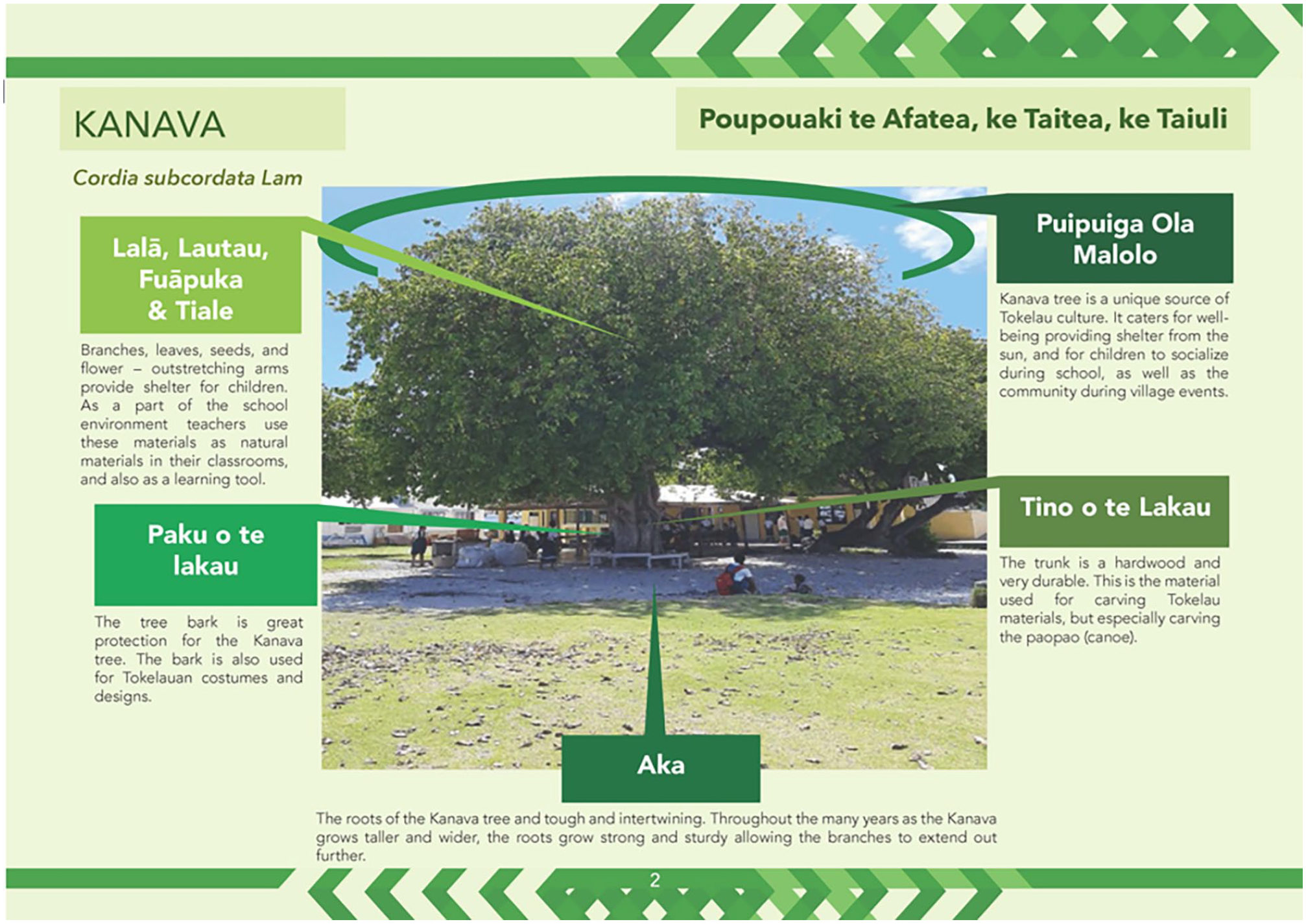
The Kanava tree.
Reflecting on different options, TM2 was proud of the inspiration and selection of the Kanava:
The part that I’m really proud of was the Kanava. We started off with the fisherman, the three atolls, the warrior, the paopao (canoe) – those are common. The picture that I took of the Kanava is outside our senior [classroom] block. I was just sitting, looking around, and just watching the kids, and then it just hits you, it’s right in front of you.
The curriculum document includes an image and description of the Kanava model, developed from community consultation: the roots symbolise culture and heritage, and the foundation supports young people who will grow to be strong and confident. The tree exists in and gains nourishment from its climate and environment, symbolising connections between people and their environment. The trunk symbolises ancestry, the generations of wisdom and knowledge about healthy living that has developed and sustained the Tokelau nation and village. The bark symbolises influences of and connections with the wider world. The branches and leaves provide shade, shelter and protection under which the community can meet and socialise, representing the past and current Tokelau nation and families; great-grandparents, grandparents, parents and children.
Tokelauan proverbs
Proverbs were selected by the community to guide and teach Tokelauan culture, community wisdom and values for healthy living. For example, under the Healthy body strand, in significant learning about Food and nutrition at curriculum level 1, students learn about what we eat, why we eat and why a healthy diet is important for overall health and wellbeing. Learning includes where our food comes from; food choices and planning a healthy diet; food preparation and safety; types of food found in Tokelau; growing vegetables and fruit in Tokelau and Tokelauan cooking methods. The selected proverb reinforces the reality for Tokelau of reliance on the natural environment and the need for learning about and respecting its provision:
Niā ni au mea ke kai, ko au kata ke mua mai.
Translated, the extended meaning of this proverb is
Tokelau lives by providing for themselves, with what they can find from the sea and land. The Tokelau traditional diet consists of fish, coconut products, breadfruit, poultry, and pork. Water is very dependent on rainfall, therefore during the drought season elders will advise the young to preserve and care for the water we receive.
This proverb reinforces the reality of reliance on the natural environment and the need for learning about and respecting its provision.
Faith and spirituality
A distinctive curriculum feature was the integration of an explicitly Christian biblical worldview. Under the Healthy mind strand, significant learning focusing on spiritual, social, mental and emotional development is guided by the proverb:
Mataku i te Atua ko te Kamataga o te Poto
When translated, an extended meaning for this proverb is
Faith and spirituality are important aspects for Tokelau, regardless of religion, Catholic or Protestant. ‘Fear in the Lord is the beginning of knowledge’. Whatever the context, God is guiding and supporting us in all our ventures, events, and learning. Learning to identify and respond to unique characteristics of personal and social situations.
Knowledge of cultural and religious beliefs and understanding of the importance of spiritual life in family and community wellbeing is integral to students’ exploration of social and cultural values, beliefs and practices in this strand. For example, at level 4, a learning outcome was that students understand and can demonstrate how aspects of faith and spirituality impact community culture and wellbeing.
An orientation to strengths-based inquiry
For each significant learning statement and each level, focusing questions are framed by strengths-based appreciative inquiry. These draw teachers’ attention and focus student learning on knowledge and practices that are positive and pre-existing in Tokelau. For example, in significant learning about Safety, First Aid and risk prevention (Healthy Body strand) at level 3, students learn to identify risks in different contexts (e.g. fire safety, fishing beyond the reef in the open sea) and respond appropriately in risk situations. The questions are as follows:
How do we identify, manage, and eliminate risk? (examine evidence)
What Tokelau community knowledge and systems exist to keep the community safe? (explore what is good)
What new health and safety skills can I learn and practise? (plan next steps)
How should I act in a risk or emergency situation? (take action)
At every curriculum level, the questions are designed to support the development of various abilities; from functional abilities such as reading and understanding age-appropriate health information to interactive abilities where students are able to make decisions and apply information, to the development of critical health literacy, where learners can use their skills to support their own health and support community action and development (Nutbeam, 2000).
Assessment of learning at senior secondary level
Designing a curriculum to support the assessment of learning in senior school under the New Zealand NCEA required careful thought. For instance, learning contexts or tasks based on cafes or food outlets were incompatible as there are no cafes in Tokelau and only a few shops with a limited range of supplies. TM2 described attempts to accommodate an NCEA assessment that involved going trekking in the woods:
The [learning and assessment programme] can be put into action, but not in the same context. We would have to adapt it to Tokelau. You can’t go trekking in the woods. I mean, you can, but it takes you two minutes to walk from the lagoon side to the ocean side. So, what else can we do in between, for Outdoor Education?
Ultimately, the team had to ‘pick and choose what was relevant’, (TM1) and innovate to think of alternatives. TM2 provided an example of decision-making in light of what is customary for Tokelau:
Working with suggestions from the [team], [we were] getting the wider world perspective and saying ‘No it’s not customary for Tokelau to do this, this and this, maybe we can just adapt’. For example, internet communications, our young ones are not into that scene until they get into years five and six.
Although collaborating at a distance during the COVID-19 pandemic presented challenges, the process was both enjoyable and rewarding for the writing team. TM5 summed up the joy of teamwork and the purpose of curriculum as a starting point for change:
The joy of it really was working with people. It was a very human exercise. The joy was that it was about people and it is for people in the long run. You know I’m very proud of the final product. Seeing teachers pick [the curriculum document] up and start to look at it and start to understand how it’s changed from what they were used to.
Discussion
Curriculum reform provides an opportunity to align educational objectives with societal goals and emerging social and environmental issues (Fitzpatrick et al., 2022; Rosenmund, 2007). This study of Tokelau H&PE curriculum development explored the questions of why the need for an H&PE curriculum learning area in Tokelau, and who is it for?’ First, considering the why, we draw attention to the intersection of educational, social and health-related goals, supporting community health and wellbeing within the isolated and distinctive Tokelauan context. Second, an important conclusion reflecting and revealing the who is that context and culture informed design decisions across all curriculum layers, working within constraints arising from internal and external policies and priorities (Vreuls et al., 2022; Young, 2014).
Why the need for H&PE curricula? supporting community health on Tokelau
School-based education can be a key context for health promotion and a key lever supporting broader generational change towards better wellbeing futures, thus creating the impetus to formalise health-related learning within the Tokelau National Curriculum. School-based education provides crucial opportunities for early intervention and education for disease prevention, supporting the development of health and physical literacy (Bay et al., 2017, 2019; World Health Organization, 2023). High health literacy translates to people being less at risk of becoming unwell, less likely to need hospital-level care, and overall, less likely to find themselves living with life-limiting health issues. Furthermore, a high level of physical literacy equips individuals with the skills and knowledge to effectively manage their physical health and engage in active lifestyles, reducing the risk of injury, chronic health conditions and the need for medical intervention (Cornish et al., 2020). In Tokelau, where advanced health care necessitates a 500-km boat journey to Samoa, and possible medical evacuation to New Zealand, fostering health and physical literacy is imperative. Developing these competencies through school-based education can potentially enhance community capacity to maintain optimal wellbeing, decreasing reliance on external medical resources.
In contrast to an issues-based focus, the strengths-based appreciative inquiry approach used in the Tokelau curriculum identifies, draws on and extends existing health-related knowledge and capabilities. The approach acknowledges the resilience and depth of health and wellbeing expertise in Tokelau while seeking to structure and formalise the required capabilities and knowledge. Furthermore, a strengths-based starting point appreciates and accounts for complex, interconnected and intergenerational determinants of health and wellbeing (Gray et al., 2022; McCuaig et al., 2013). Shifting the emphasis to explore evidence and opportunities for building on positive aspects of a context was intended to support students to use their learning to see possibilities, take action and drive change in their communities. Internationally, other contemporary curricula similarly prioritise strengths-based approaches (ACARA, 2016; Gray et al., 2023).
Who is it for: designing with and for Tokelau
Curricula are highly context-specific. The creation of curricula involves integrating insights from school and community consultations, policy information and research and expert knowledge (Kilborn et al., 2016; Penney, 2006). Vreuls et al. (2022) identify stakeholder input and facilitation as important in responsive curriculum development. The stakeholders involved in curriculum consultations are commonly drawn from education communities, but expanding the scope of consultations can provide valuable insight. Throughout the Tokelau H&PE development, the extensive consultations with community leaders and members outside of education across the three atolls was a key point of difference and reflected the need for whole-community ownership of what was taught and learned. The small population and dedicated work and travel on the part of the Tokelau curriculum coordinators meant this was feasible.
Internationally, curricula vary in the extent to which they prescribe or suggest specific content and pedagogies (Trask and Cowie, 2022). Less prescriptive curricula are more amenable to adaptation and teacher autonomy but can present challenges if teachers are not confident in interpreting and translating curriculum objectives into classroom learning and teaching. It was noteworthy that, in the Tokelau context, the national curriculum was needed to provide and scaffold classroom-level support (Gouëdard et al., 2020). With one school on each island and small numbers of students at each year level, teachers need to navigate the document independently in a setting where they may not be an expert but are nevertheless responsible for the provision of H&PE across a wide age range. Thus, the document needed to be accessible striking a balance between guidance and direction (Davis and Krajcik, 2005).
Distinctive curriculum features included the Kanava tree model, Biblical teaching and Tokelauan proverbs. The Kanava tree model has parallels in other international health-based curricula such as the New Zealand Te Whare Tapa Wha model (Cook Islands Ministry of Education, n.d.; New Zealand Ministry of Education, 2007). The Kanava thrives in challenging environmental conditions. Due to its strength, resilience and provision, it holds cultural, practical and symbolic significance in Tokelau. Thus, its choice as a means of representing community and environmental connectedness and offering a holistic vision for wellbeing was significant (Atafu Tokelau Community Group Inc., 2022; Huntsman, 2017). In the Tokelau H&PE curriculum, the Biblical teachings were a distinctive and important dimension. While school health curricula commonly support spiritual and moral development, it is less common to promote one faith (Brunsdon and Walker, 2022). Developed in consultation with the community, direct reference to Biblical principles represented and respected the wishes of the Tokelauan community for whom the Christian faith is an integral part of life (Pilato and Michaelson, 2022). Similarly, the selection and inclusion of proverbs served to bridge curriculum learning with pre-existing community wisdom developed and retained over generations (Mutonyi, 2016).
The facilitation of curriculum development was by necessity distributed across time and space. The uniqueness of the Tokelau context jolted the external team members to want to know and learn more. As the on-island team members reported on consultations that informed design decisions, the collaborators outside of Tokelau began to develop an understanding of ‘where is here?’ (Norquay, 2000). This fledgling understanding of geographical, cultural, social and community Tokelauan identity was crucial to beginning to know what it might mean to be a learner and teacher in Tokelau and therefore shaping the advice that informed, for example, curriculum tracking towards NCEA standards. Dhillon and Thomas (2019) usefully draw attention to the notion that there can be different dimensions of insider–outsiderness and that project partners tend to be differently located in these. Their work emphasises that binary insider–outsider distinctions can be unhelpful. Instead, and appropriate for our study, they argue for a more complex view accounting for different positionalities between context, personal and professional relationships and professional knowledge.
Like Vreuls et al. (2022), the curriculum development team experienced pressure and tensions when attempting to draw all the elements together. In our different roles and contributions, we needed each other as insiders and outsiders in relation to everyday and professional knowledge (Dhillon and Thomas, 2019). Our differences meant that we could not and did not assume similarity of views or experiences; we had to listen, get to know each other and respect the skills and knowledge that each brought to the task. The small size of our team and tight working relationships that developed, even over Zoom, meant that we focused together to enable the process. On reflection, the team external to Tokelau wondered, had they been able to visit Tokelau as initially intended, if and how this might have influenced the outcomes of consultations. How might the process have been enriched, compromised, or constrained if the outside team had arrived on Tokelau to consult and collaborate for 2 weeks, as originally planned? How would the consultation have been received and perceived? How might voice and ownership of process and product have been differently shaped?
Conclusion
This case study provides something of a ‘behind-the-scenes’ look at the development of a new curriculum area. It illustrates the requisite coming together of different groups and expertise as part of the process of curriculum creation, involving the synthesis of pre-existing and new knowledge and experiences. It also illustrates the profound significance of Tokelauan culture and way of life in design decisions. The case study draws attention to the intersection of social and educational goals, exemplified by a focus on health promotion and health and physical literacies. In these ways, it demonstrates the role that curriculum goals can play in supporting community health.
Footnotes
Acknowledgements
The authors acknowledge and thank Matāeke o Akoakoga (the Tokelau Department of Education), Tokelau school staff and students, and community members whose input guided the development of the Tokelau Health and Physical Education curriculum learning area.
Funding
The author(s) disclosed receipt of the following financial support for the research, authorship and/or publication of this article: the development of the Tokelau National Curriculum Health and Physical Education curriculum learning area was funded by the Mataeke o Akoakoga (Tokelau Department of Education).
