



Abstract
Background:
The mental health od school-age children is of growing concern in many countries. School professionals require the competences and methods to intervene effectively to promote mental health in schools.
Objective:
The objective of this study was to describe school professionals’ perceptions of the competences needed and effective methods to promote mental health in primary schools.
Design and setting:
Qualitative study conducted in five European countries.
Method:
Multidisciplinary focus group interviews were conducted with teachers, school nurses, psychologists and social workers in Greece (n = 2), Lithuania (n = 3), Slovenia (n = 2), Bulgaria (n = 2) and Finland (n = 2). Data were analysed using qualitative content analysis.
Results:
Competences perceived as required for mental health promotion in primary schools were related to (1) knowledge of child development and mental health among primary school age children, (2) skills such as communication and empathy and (3) teachers’ self perception as health promoters. Insufficient attention is currently given to the development of these competences in basic teacher education and ongoing professional development. Providing a safe and inclusive school environment for children and families, early intervention and the use of structured models of support were viewed as effective approaches to use. Digital tools, online materials, and online support were seen as having a valuable role to play in children’s mental health promotion.
Conclusion:
School professionals require multiple competences to undertake mental health promotion in primary schools. The development of these competences is best supported by basic and ongoing education. Teachers, school nurses, psychologists and social workers see mixed methods as likely to be most effective in promoting mental health in primary schools.
Introduction
The school-age years are a key period for emotional, social and physical development (World Health Organization [WHO], 2021b). Children nowadays are called upon to cope with stressful situations related to academic performance, climate change, digitalisation, social inclusion (friends, family, and other communities), rapid physical change, body image and self-esteem, among other things (Cherry et al., 2017). At the same time, poor mental health among children poses a public challenge worldwide (WHO, 2021a).
According to recent estimates, between 10% and 20% of children worldwide suffer from mental health problems (WHO, 2021b). Depression and anxiety disorders are among the five leading causes of disease burden among children and adolescents (WHO, 2021a). In addition, aggression and violence between children are increasingly prevalent concerns in schools (Downes and Cefai, 2016; Petrova et al., 2020; Salimi et al. 2019). In Iran, for example, it has been suggested that around 30% and 10% of students display moderate and high levels of aggression, respectively (Salimi et al., 2019). More generally, there is a serious failure in early detection and treatment of mental health problems, and a huge gap exists between those needing mental health services and those receiving them (Cairns and Rossetto, 2019; Purgato, 2020).
Homes and schools are key settings in which to promote mental health and well-being during childhood (WHO, 2021a). Schools in particular are viewed as providing ideal settings for enhancing and protecting children’s physical and mental well-being (Notara and Sakellari, 2013; O’Reilly et al., 2018; Sakellari et al., 2021), since in European countries schools reach nearly all children and their parents/caregivers and families regardless of background (United Nations International Children’s Emergency Fund [UNICEF] Data, 2021). The effectiveness of school-based mental health promotion relies on several factors such as an intervention’s multidimensionality, its evidence-based character, the facilitator’s competence, the commitment of all stakeholders and cooperation between professionals (e.g. teachers, school nurses, psychologists and social workers) (Hung et al., 2014; Shackleton et al., 2016).
Recently, published review papers have raised two main issues regarding the success of mental health interventions at schools signalling (1) the potential value of digital approaches and interventions (Sakellari et al., 2021), and (2) the importance of a collaborative, holistic approach to delivery (O’Reilly et al., 2018). Appropriate teacher education and training to support collaboration with professionals from other disciplines can enable the adoption of a ‘whole school approach’. Using such as approach, teachers’ experience and qualifications related to mental health promotion, their ability to recognise behavioural diversity and their potential to act as an interface between children, parents, and professionals have been highlighted (Morgado et al., 2021; O’Reilly et al., 2018).
The WHO (2018) has identified a number of specific ways of promoting mental health in schools. However, school communities, including pupils, parents, teachers and other school professionals, need support to develop the relevant competences (knowledge, skills and attitudes) to promote their own mental health and that of others (WHO, 2018). A systematic review exploring teachers’ involvement in school mental health concluded that with support both teachers and mental health professionals can deliver effective mental health interventions in school settings (Franklin et al., 2012). Previous research, however, has suggested that teachers not only feel unprepared when it comes to supporting children with behavioural, emotional and social difficulties but may also feel vulnerable and psychologically distressed when they encounter children with mental health problems (Rothì et al., 2008). School professionals also report insufficient competence, time, well-being and general support to undertake mental health promotion activities in schools (Askell-Williams and Lawson, 2013; Ekornes, 2017; WHO, 2018).
Against this background, this study set out to explore the competences teachers and other professionals need in order to deliver mental health promotion activities and programmes in primary schools. It did so in recognition of the fact that school professionals require support to undertake such work, particularly in a context where government policies, lack of resources and curriculum overload pose challenges (Higgins and Booker, 2022).
Research is lacking on school professionals’ perceptions of the specific competences needed for mental health promotion in today’s schools. Research is also lacking on the most appropriate strategies and methods for mental health promotion in primary school settings. This study aimed to describe school professionals’ perceptions of the competences needed and effective methods for promoting mental health in primary schools. The work was undertaken as part of the Erasmus + Strategic Partnership Well@School Project.
Methods
Participants
In early Spring 2021, multidisciplinary focus group interviews (Gray and Grove, 2020) were conducted with a range of professionals involved in promoting health in primary schools. Nine focus groups (2 in Finland, 3 in Lithuania, 2 in Greece, 2 in Slovenia and 2 in Bulgaria) took place bringing together 67 participants. The participants included teachers, school nurses, health visitors, social workers and psychologists working in primary schools in Finland, Lithuania, Greece, Slovenia and Bulgaria. We used purposive sampling (Palinkas et al., 2015) to select focus group members because we were interested in ensuring the inclusion of individuals with specific educational backgrounds as well as work experience in primary schools. A diverse group of participants ensured a wide range of perspectives were present in the focus group discussions.
Data collection and procedure
Well@School project team members conducted and moderated the focus group interviews. Two interviewers were present in each focus group discussion. One acted as the interviewer, and the other was the moderator for the group discussion. The interviewers had educational qualifications and experience conducting focus group interviews. Team members were of both sexes and had been involved in developing the project and the focus group interview protocol. There was no relationship (professional or personal) between the interviewers and the participants.
Because of COVID-19 pandemic restrictions at the time of the study, the interviews were conducted online using Microsoft Teams. The focus group interviews were semi-structured in character and took place in national languages. The key research questions explored were as follows: (1) what are the key competences required for mental health promotion in primary schools; (2) what qualities do you find lacking in the higher education among professionals undertaking health promotion in schools; (3) what do you think needs to be included in the curricula for school professionals’ postgraduate education to support mental health promotion; (4) in your experience, what are the most effective ways of positively influencing mental health promotion in schools; and (5) and what do you think are the most effective digital methods for reaching primary school aged children to promote mental health?
Focus groups were facilitated in a way that ensured all participants had an opportunity to express their views and ideas. The facilitators worked hard to ensure that all participants were actively engaged in the discussion, and that everyone had an equal opportunity to contribute. The focus group interviews lasted 2 hours each. The interviewers helped ensure the discussions stayed focused on the study’s aim and encouraged participants to freely share their views. The interviews were audio recorded with the participants’ previous consent, and the participants’ (anonymised) statements were transcribed.
Data analysis
We analysed the data using qualitative content analysis as described by Graneheim and Lundman (2004). Initial analysis took place in each of the national languages. To enhance validity, two researchers independently analysed the data from each country, deriving national meaning units, condensed meaning units and developing sub-themes and themes with corresponding quotations (Table 1).
Examples of themes and subthemes derived from the data, together with illustrative quotations.
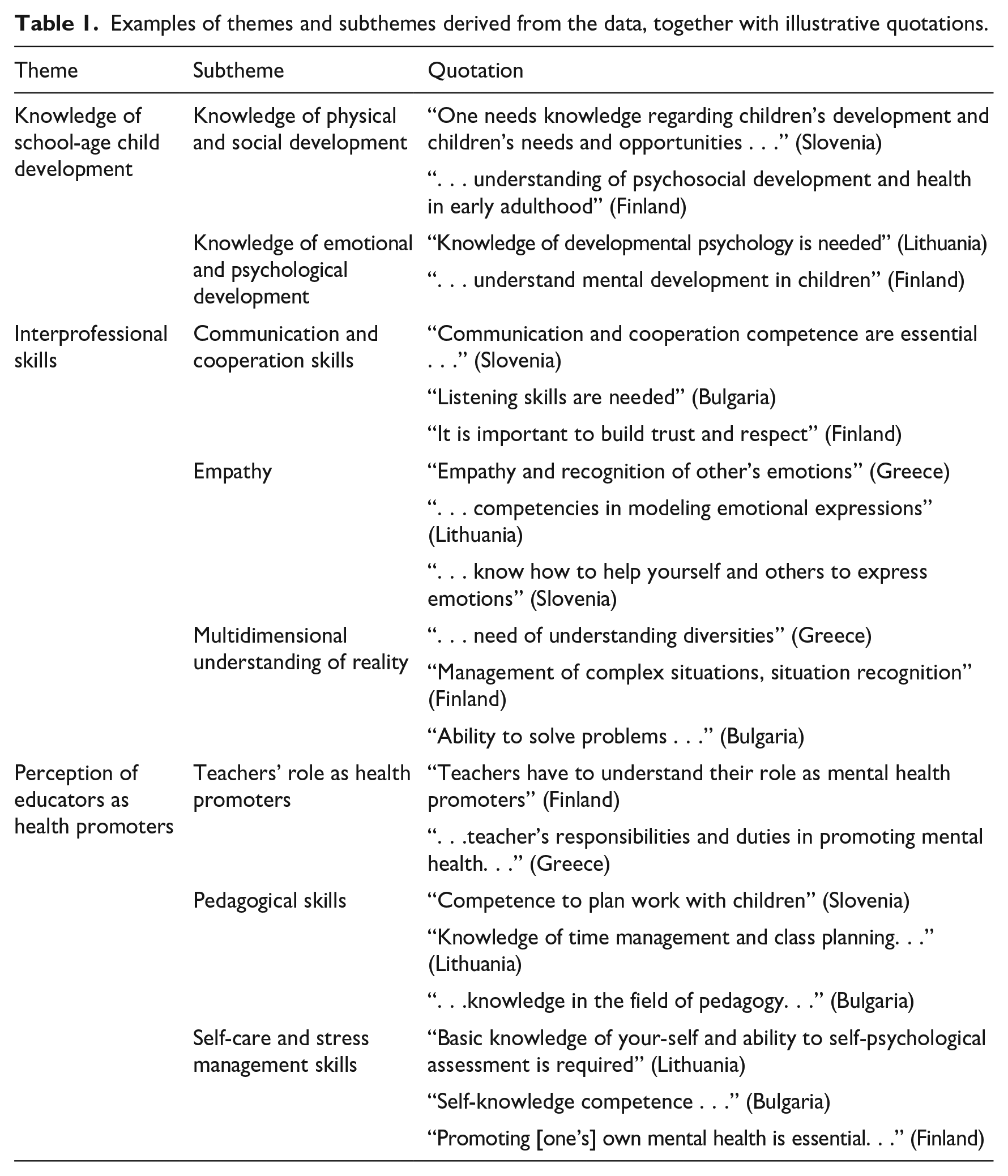
Following content analysis within each national language, we translated the themes and sub-themes into English. Discussion between the national research teams then enabled us to merge the sub-themes and themes together with a focus on contextual specificities and national context. The Consolidated Criteria for Reporting Qualitative Research were followed (Tong et al., 2007) in reporting the results.
Ethical approvals
The study was approved by Turku University of Applied Science [LP2_2021] as well as by research ethics committees in each participating university. Participants’ informed consent was acquired before their participation in the focus groups. Potential participants were informed in writing about the study’s aim, the interview procedures, and the fact that data would be reported anonymously. They were informed that the audio recordings were being made only for the study’s purposes and that they were free to agree or refuse to participate and/or to withdraw from the study at any point with no consequences.
Results
Competences required for mental health promotion in primary schools
Participants described four factors as key to the success of mental health promotion in primary schools: (1) knowledge about primary school-age child development, (2) knowledge related to the mental health of primary school-age children, (3) interpersonal skills and (4) teachers seeing themselves as having a role to play in health promotion (Table 2).
Summary of the main results.
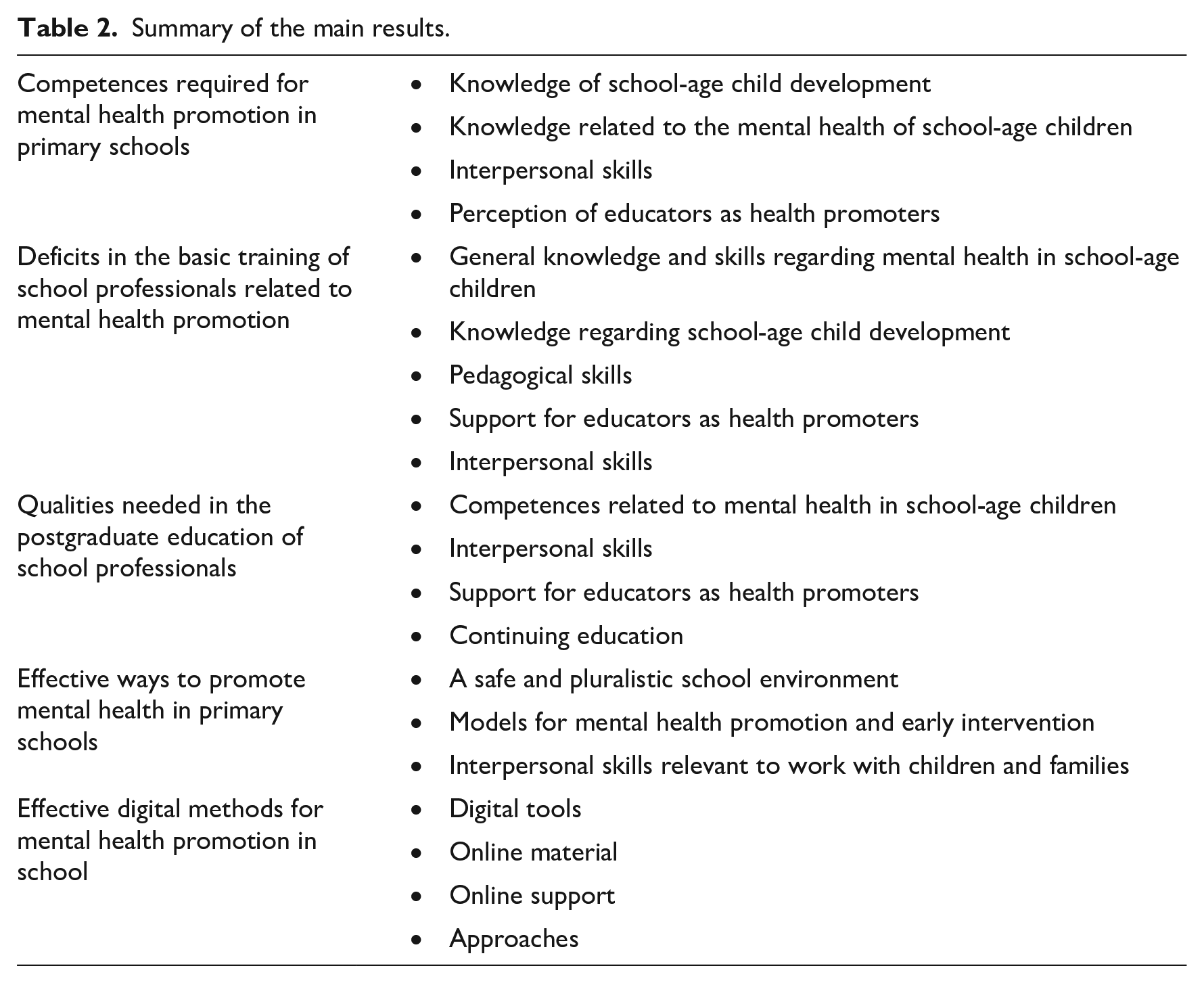
Knowledge of school-age child development included knowledge about physical and social development as well as emotional and psychological development. It included knowledge of current issues for students as well as children’s needs and opportunities at certain ages. Knowledge relevant to promoting schoolchildren’s mental health included that relating to general mental health, an understanding of specific mental health problems, and knowledge relevant to early intervention and treatment: Awareness that you don’t know all the phenomena related to mental health (Bulgaria) Information on what is needed to support it (Slovenia) Knowledge helps foresight and preventive action when you learn to recognise phenomena and keep your senses up (Finland)
Interpersonal skills needed included communication and cooperation skills, empathy, and having a multidimensional understanding of reality. Communication and cooperation skills include listening skills, counselling skills, and the ability to build trust and show respect. Empathy involves recognising others’ emotions, while encouraging others to do the same. Having a multidimensional understanding of reality can aid in the management of complex situations. It includes the ability to understand diversity, situational recognition and resolve challenges: In order to promote mental health, we should focus on basic everyday life: on the good things. (Bulgaria) Knowledge about prevention and the skills for that teacher how to deal with these issues. (Lithuania) You need the skills to get close to the child and possibly the parents as well. (Greece)
Teachers vary in their commitment to, and understanding of, their role in health promotion. To promote the mental health of primary school children, teachers need relevant pedagogical skills, a commitment to self-care, and skills in stress management. Relevant pedagogical skills include those relating to the use of different teaching methods, class planning and working with children, as well as skills for analysing situations causing particular stress for pupils at school. Self-care and stress management skills are important to promote an understanding of oneself. They include the ability to assess emotional well-being, the ability to promote one’s own mental health and well-being, and the ability to analyse and solve situations causing particular stress: It is important to go to the teachers as well to understand on [stress] how important it is for a teacher to be psychologically good and safe place too. (Slovenia) You should also know yourself first and understand yourself better. (Lithuania)
Deficits in school professionals’ basic mental health promotion training
Areas often lacking in school professionals’ basic education regarding mental health promotion include (1) general knowledge and skills regarding mental health in primary school-age children; (2) knowledge about school-age children’s development; (3) pedagogic skills for working on mental health issues; (4) support for educators to see themselves as health promoters; and (5) relevant interpersonal skills
General knowledge and skills relevant to mental health in primary school-age children include an understanding of methods for promoting mental health as well as other health issues; skills relevant to the prevention of mental health problems, and a good understanding of issues such as abnormal sexual behaviour, depression and child abuse. Teachers also need to know how to provide students and carers with access to counselling and support, as well as mental health care pathways to children, as well as approaches to early intervention and treatment.
With respect to school-age child development, teachers need to know about physical, social, emotional and psychological development. Practical training is needed in the use of interactive learning methods, and the linking of theory to practice. Beyond general pedagogical knowledge and skills, competence in teaching children with special needs is important to be addressed.
Supporting educators to develop a sense of themselves as health promoters includes a focus on teachers’ roles and responsibilities as well as the time to take on a health promotion role. Skills in self-reflection, people skills and a commitment to continuing professional development skills, are also important. Too often, not enough attention is given to developing personal sustainability, strategies to cope with stress at work and leisure management skills as part of basic teacher education and training.
Interpersonal skills that it is valuable to acquire as part of basic mental health promotion training include those related to communication, cooperation, empathy and developing a multidimensional understanding of reality. Skills to gain trust, listening skills and skills to communicate well, not only with children but also with parents and other professionals, are important.
Basic information about mental health and on the other hand what is related to it. (Slovenia) You have to have the ability to understand things taking into account the child’s age level. (Greece) The counselling side of the work, that when you are sometimes in really deep water with those mental health issues . . . how do you keep yourself afloat so that you can do the work . . . this kind of information should be brought up at the basic education level. (Finland)
Qualities needed in school professionals’ postgraduate education regarding mental health promotion
Four main themes regarding postgraduate mental health promotion education needs were identified. They included the need (1) for continuing education, (2) to develop specific competences related to mental health promotion among primary school-age children, (3) to support educators in their role as health promoters and (4) for teachers and other professionals to further develop their interpersonal skills.
Continuing education supports knowledge updating, skills development and lifelong learning for individuals and work teams. Strengthening competences related to mental health in primary school-age children includes a focus on knowledge and skills to promote general mental health, an understanding of specific mental health problems and the acquisition of skills for early intervention and care. Practical skills and methods for mental health promotion in the school environment and practical training by means of simulation have a role to play in achieving these goals.
Beyond the above, it is important for postgraduate education to provide knowledge about the symptoms of mental health problems, approaches to early intervention and treatment and referral pathways. As above, skills of communication, cooperation and empathy, and an understanding of the multidimensionality of reality are important for a range of professionals working in school to acquire.
Supporting educators in their role as health promoters requires a focus on roles, responsibilities and tasks. An understanding of the managers’ role was felt to be important, and school leadership training on mental health promotion was recommended. New skills it is valuable to acquire include those relevant to self-reflection and development, work supervision, self-care, strengthening teachers’ self-esteem, professional identity, work-time management and self-regulation: Mandatory continuing education and training for everyone is needed. (Greece) Some knowledge and also knowledge that makes you think about your own professional identity. (Lithuania) That in schools today, however, as students are directed a lot, you shouldn’t teach emotional skills and should teach mental health skills and coping skills, so this applies to all school staff; even if you are a subject teacher, you can still be a class instructor, in which case you should probably be able to do something like this in your class. (Finland)
Effective ways to promote mental health in schools
Effective ways to promote mental health in primary schools include (1) meeting with children and families, (2) providing a safe and inclusive school environment and (3) using evidence based approaches to early intervention and mental health promotion.
Competences and skills relevant to working with children and families include those related to communication, cooperation, developing a sense of safety, listening and giving time to others. Multi-professional and community-focused work can provide opportunities for this kind of skills acquisition. The importance of training and support for parents was highlighted, alongside information and support on how to listen to and communicate with young children.
You are with your child, listen [to them], have time to be there, and stop for a moment is perhaps the most effective many times in everyday life. Somehow the time and the encounter and generally giving the child and young person the feeling that someone has time, time to meet and time to listen, time to be.
A safe and inclusive school environment has social, emotional and physical dimensions. Permanent staff, healthy staff and a sense of communality, positivity, trust and value for others, as well as clear structures and specially designed spaces for work were suggested.
Recommended models for early intervention and mental health promotion include focused workshops or activity days, and one-to-one approaches in the form of conversations and discussion of personal experience. The integration of a focus on mental health across the whole curriculum while also having separate mental health-related lessons was suggested as a good way forward. Clear operating procedures for mental health promotion and referral, particularly in the case of excessive child absences from school, were seen as essential: To do something nice and support the thinking process: to raise emotional and positive interaction skills. (Greece) A concrete method [could be] to use the Instrumental Enrichment tool to support thinking and learning. (Bulgaria)
Effective digital methods for reaching children and promoting mental health in schools
Four themes were identified relating to the effective use of digital methods for mental health promotion in primary schools: (1) effective approaches, (2) useful digital tools, (3) relevant online materials, and (4) online support.
Mentioned digital approaches included those designed to enhance parental involvement as well as meet individual and group needs. Digital tools seen as effective included apps, specific communication and networking channels, virtual environments, the use of virtual reality digital learning and teaching environments and digital games.
Many schools have digital learning platforms. In our school, the theme this year is school well-being. That’s why it’s been added to the digital learning platform as well. It details a lot of activities related to health or mental health that can be implemented. (Finland) In the WhatsApp group, it is easy for [pupils] to talk, and everyone felt able to express their own opinions. (Greece)
Videos, films, written materials and assessment tools were identified as effective online ways of promoting mental health. Animated films, cartoon films and recordings of workshops run virtually by key figures in the world of mental health were specifically mentioned. Online information regarding mental health issues, indicators and assessment tools were also seen as useful and effective as part of mental health promotion: We have watched material that appears on YouTube, related to health information, such as short videos. Then they [the pupils] have written an essay about what we have been through and how it is reflected in the actions of these young people. (Slovenia)
Online counselling was seen as an effective means of early intervention and mental health promotion. Online counselling could include direct at a distance support; online relaxation exercises; online meetings between school professionals, children, and parents; and multi-professional meetings: I’m also thinking that, for example, the psychiatric nurse at our school, remotely meets these students. They come into contact. The same [happens] when we have student or parent meetings like this. (Finland) If there is for parents really difficult to get on site, remote reception is better. I don’t know if it’s the most efficient way, but at least [it’s] one way.
Discussion
To our knowledge, this is the first study to identify the competences and methods valued by different professional groups working on mental health promotion in primary schools in different parts of Europe. The findings from this study are badly needed. In a recent report, UNICEF (2020) highlighted the need for a focus on mental health promotion in schools after lockdowns during the COVID-19 epidemic.
School professionals highlighted four main competences required for promoting mental health in primary schools: knowledge of school-age child development, knowledge of mental health among primary school-age children, interpersonal skills, and the perception of oneself as a health promoter. These results align with those identified in previous research (e.g. Ekornes, 2017). Sub-themes within our analysis highlight the importance of self-care and stress management to enhance school professionals’ emotional well-being. A recent study by Kim et al. (2021) revealed that teachers were badly impacted by the COVID-19 pandemic. As a result, their mental health and well-being has decreased, especially in primary schools. Uncertainty, substantial workloads, negative perceptions of the profession, and multiple role requirements have had a deleterious effect on teachers’ mental health (Kim et al., 2021).
Perceived deficits in school professionals’ basic education signal the need for continuing education that includes knowledge and skills relevant to child development, primary school children’s mental health pedagogy and practice in the classroom, support for educators as health promoters, and the development of their interpersonal skills. Importantly, our findings align with those of other studies demonstrating how teachers often feel unprepared, vulnerable, distressed and lacking in competence and support when it comes to mental health promotion in school settings (Ekornes, 2017; O’Reilly, et al., 2018; Rothì et al., 2008). Findings also highlight how a focus on mental health promotion should be made a compulsory aspect of the future education of a wide variety of primary school professionals.
This study also confirms some of the features of effective methods documented in the literature (Langford et al., 2014; Shackleton et al., 2016), including the use of digital technology (Sakellari et al., 2021), for mental health promotion. These include a commitment to inclusivity and the multidimensionality in interventions, and a focus on facilitators’ competence (Shackleton et al., 2016). They also stress the importance of cooperation between multi-professionals, and the provision of continuing as well as basic education (Hung et al., 2014). In these respects, mental health promotion intervention effectiveness relies on the same elements as health promotion intervention in general.
Although education systems differ across countries (European Union, 2020), the challenges related to promoting primary school-age children’s mental health and well-being are similar. Despite differences between professional groups, cultural backgrounds and professional qualifications, this study demonstrates common competence needs and common perceptions of effective methods for mental health promotion intervention across Europe.
Limitations and strengths
Like all studies, this one had its limitations. Because of the COVID-19 pandemic, the focus group interviews had to be conducted online, which may have imposed limitations on group discussion. These limitations include technical barriers, discomfort and a sense of ‘distance’ for participants alongside the challenges of ensuring Internet connectivity.
That being said, conducting focus groups online has advantages because being in a virtual environment gives participants a degree of control and flexibility. Moreover, being in a familiar space may have allowed some participants to feel more relaxed than they might have done in a research facility (Dos Santos Marques et al., 2021). Because we used a qualitative approach, our study produced exploratory results that describe do not signal causal connections. Moreover, since we sampled participants purposively and at opportunity, findings cannot be generalised within participating countries or beyond.
Future quantitative research is highly recommended, especially to describe and explain connections between, for example, further education, continuing education and competence development. Future research is also needed to clarify the needs and perceptions of children and parents or guardians regarding mental health promotion in primary schools.
Conclusion
The school professionals who participated in this study identified multiple competences related to mental health promotion that require further support in basic and future education. They viewed multi-component methods as being particularly effective for mental health promotion in primary schools. There is a need for mental health promotion learning opportunities to ensure competence development among multiple professionals working in primary schools as well as the use of effective mental health promotion methods. Future quantitative research is also recommended to examine the links between the development of school professionals’ competences and the perceived effectiveness of school-based mental health promotion.
Footnotes
Acknowledgements
The European Commission’s support for the production for this publication does not constitute endorsement of its contents, which reflect the views of the authors alone. The European Commission cannot be held responsible for any use that may be made of the information contained herein.
Declaration of Conflicting Interests
The author(s) declared no potential conflicts of interest with respect to the research, authorship, and/or publication of this article.
Funding
The author(s) disclosed receipt of the following financial support for the research, authorship, and/or publication of this article: this study was funded by an Erasmus + Strategic Partnership (2020-1-FI01-KA203-066521).
