



Abstract
Keywords
Introduction
In 2020, the New Zealand Ministry of Education (MOE) updated the national curriculum policy for sexuality education, 1 broadening the focus to ‘relationships and sexuality education’ (RSE) and strengthening guidance for both primary (Years 1–8) and secondary (Years 9–13) schools by publishing separate guides for each sector. The resulting two curriculum policy documents (entitled Relationships and Sexuality Education: A Guide for Teachers, Leaders and Boards of Trustees – Years 1–8 and Relationships and Sexuality Education: A Guide for Teachers, Leaders and Boards of Trustees – Years 9–13, MOE, 2020b, 2020c; hereafter referred to as the ‘RSE policies’) detail how schools might take a ‘whole school approach’ to this area, including the allocation of dedicated curriculum time at all levels of compulsory schooling (New Zealand Council for Education Research [NZCER], 2012).
These documents are official curriculum policy 2 in the sense that they communicate a mandated position from the New Zealand MOE, which all State schools must engage with. All the authors of this article were part of the writing team who worked on the 2015 and/or 2020 RSE policies. Here, we discuss and summarise the key thinking of the team and some of the research that informs this latest curriculum policy update, as well as the policy context in Aotearoa New Zealand that precedes these changes. It is helpful to read this article alongside the actual RSE policies (https://health.tki.org.nz/Teaching-in-Heath-and-Physical-Education-HPE/Policy-Guidelines/Relationships-and-Sexuality-Education, which also include information about who was involved in the writing and consultation process.
This article aims to discuss how the RSE policies as written reflect tensions of the wider policyscape (Mundy et al., 2016, see below) and related literatures; the policyscape requiring attention being that of Aotearoa 3 New Zealand’s unique colonial heritage as well as human rights and issues of diversity. We acknowledge the tensions and difficulties inherent in such an undertaking and attempt to provide insight into the articulation of research and context within the policy product. We begin by providing some background to the policy update and its rationale using a conceptual framework that we draw on throughout the paper. We then provide detail on the policyscape, which includes Te Tiriti o Waitangi/The Treaty of Waitangi, concern for Indigenous knowledges, and attention to human rights. We then discuss how the policy specifically responds to issues and concerns that are important to children and young people, while a final section outlines the structure of the RSE policy in terms of a whole school approach and curriculum learning.
Rationale for the policy update
There have been two prior official curriculum policy ‘guides’ for teaching sexuality education in Aotearoa New Zealand schools: Sexuality Education: A guide for principals, boards of trustees and teachers, published in two editions (MOE, 2002, 2015). The original (2002) RSE policy was written to support the implementation of the Health and Physical Education in the New Zealand Curriculum (MOE, 1999). The 2015 version of the RSE policy developed this work to engage more explicitly with issues of inclusion, especially related to lesbian, gay, bisexual, trans, queer, and gender and sexually diverse (LGBTQ+) students, in a manner informed by the international research literature. Riggs and Bartholomaeus (2018), for example, noted that the policy recognised gender issues beyond the limitations of binaries. Fenaughty (2019) described the New Zealand policy as ‘among the few worldwide that explicitly address issues of gender-identity, diversity, and expression from an early age’ (Fenaughty, 2019: 637), and Graham et al. (2017) noted that ‘[t]he New Zealand sexuality education curriculum draws on holistic meanings of sexual health with objectives that aim to teach young people to critically examine gender and sexuality within society’ (Graham et al., 2017: 5, see also Ellis and Bentham, 2021; Fitzpatrick, 2018; Garland-Levett, 2017).
While the 2015 RSE policy (MOE, 2015) was officially mandated curriculum, uptake and translation into practice proved somewhat uneven. In 2018, the Education Review Office (ERO)–the body responsible for auditing schools in Aotearoa New Zealand–released a report into the state of sexuality education nationally: ero.govt.nz/publications/promoting-wellbeing-through-sexuality-education/ (ERO, 2018). The report was not positive in its assessment of how Aotearoa New Zealand schools were implementing sexuality education. While it concluded that ‘some schools are not meeting minimum standards of compliance with current requirements’ (ERO, 2018: 5), it noted that: ‘many have significant gaps in curriculum coverage’ (ERO, 2018: 5) and ‘more in-depth coverage is needed for aspects like consent, digital technologies and relationships’. (ERO, 2018: 5). Notably, the ERO evaluation did not include any examples of ideal practice in primary schools. This signalled the lack of uptake of the guide and a perception among primary teachers that RSE policy (MOE, 2015) was primarily for secondary school contexts. Internationally, research has confirmed the benefits of relationships, gender, sexuality and puberty education in primary schools (e.g. Blaise, 2009; Kirby et al., 2007; Robinson, 2016; Sex Information and Education Council of Canada [SIECCAN), 2009) along with the need for learning about gender diversity (Office of the Children’s Commissioner, 2017a; Robinson, 2013). During the most recent update, which this paper focuses on, the decision therefore was made to provide specific guidance for schools with students in Years 1–8 (primary and intermediate schools] separately to that provided for schools with students in Years 9–13 (secondary schools).
The 2020 RSE policy update was also broadly informed by international evidence and ongoing national concerns about child and youth health. International technical guidance on sexuality education (UNESCO, 2018) was considered in terms of its insistence that good quality sexuality education programmes be informed by evidence, adapted to the local context, and designed to address factors such as beliefs, attitudes, values and skills, and related effects on well-being. In addition, the advice contained in the New Zealand Health Select Committee report, Inquiry into Improving Child Health Outcomes and Preventing Child Abuse with a Focus from Preconception until Three Years of Age (Hutchison, 2013) was noted. That report highlighted the urgent need for good quality sexuality education and recommended that the New Zealand government ‘require all schools to deliver sexuality and reproductive health programmes’ (Hutchison, 2013: 34–35). Further international and national evidence about RSE was taken into account. This included evidence that lack of access to RSE in the curriculum can result in student ignorance, fear, lack of understanding, and poor decision-making (Bearinger et al., 2007; Goldman, 2008; Halstead and Reiss, 2003; UNESCO, 2018), while the provision of good-quality RSE is known to support the development of young people to become responsible, healthy and productive citizens (Goldman, 2008). It is also clear that young people are increasingly calling for chances to talk, listen, and learn about their own and other’s gender and sexual identities, relationships and sexual cultures (Coll et al., 2018; Johnson et al., 2016; Ollis et al., 2019; Quinlivan, 2018) and that a focus on media literacies in school can enable this to occur (Rothman et al., 2020).
It is internationally recognised that a holistic and comprehensive approach to RSE curriculum is ideal. Rasmussen (2012) notes that ‘Educational research that underpins CSE [comprehensive sexuality education] embraces sexual diversity, interrogates heteronormativity and focuses on reducing unplanned pregnancy and exploring young people’s understandings of pleasure and desire’ (Rasmussen, 2012: 470). Good quality pedagogies in sexuality education are inclusive of culture, sexuality, sex and gender diversity; are learner centred (Allen, 2008); address desire and pleasure (Allen et al., 2013); and teach a holistic curriculum that goes beyond human biology to address identity, relationships and emotions, as well as social and cultural issues (Gilbert, 2007; Kirby, 2008).
RSE then, as a part of health education, remains ‘vital for young people’s development, learning, and overall well-being. Learning within this area also contributes to academic success and positive mental, emotional, physical, and spiritual health’ (MOE, 2015: 4). Research shows that when relationships and sexuality education programmes are linked to health services, when they are taught by well-supported and informed teachers, and when they are planned and embedded into long-term curriculum programmes, then outcomes are likely to be better (Byers et al., 2013; Poobalan et al., 2009).
Policyscapes
While there is a complex relationship between policy documents and practice in schools (Ball et al., 2012), such documents at least hold a place for, and represent the potential for, changed practices. Mundy et al. (2016) note that [t]here is an important distinction between policies as meta-discourses that shape what can be thought (policyscapes); policies as formalized rules and regulations; and policies as socially constructed enactments that span text and practice. Policy involves all three layers of action, including processes both before and after text production, and sometimes including formal evaluation processes. (p. 8, emphases added)
The RSE policies under discussion here (like all policies) are products of particular policyscapes, which frame what is possible at any given social and historical time. In that sense, these RSE policies offer a response to contemporary wider social concerns and health research (e.g. Classification Office, 2020; ERO, 2018; Hutchison, 2013; Office of Film and Literature Classification [OFLC), 2018, 2019], as well as to other state-sector policy moves. Education policy documents inevitably emerge at the intersection of tensions between global policy levers, localised concerns and cultural histories. While many of the elements contained in these documents are recognisable in the global policyscape of relationships and sexuality education, the Aotearoa New Zealand context is also unique.
Educational policy-making is increasingly global (Mundy et al., 2016), but specific factors make policy decisions more or less possible in nation-states at any given historical moment (Rizvi and Lingard, 2010). This article thus includes aspects of the global context and international research, but focuses strongly on how the social, political and historical context of Aotearoa New Zealand, and local research, are reflected in the curriculum policy documents. We explore here the wider policyscapes at play in the RSE policies but also understand that, in practice, schools are likely to engage with these both as ‘formalized rules and regulations’ and as ‘socially constructed enactments that span text and practice’ (Mundy et al., 2016: 8). This is because while the official curriculum in Aotearoa New Zealand (in all subject or learning areas) is communicated in policy documents at a high level, detailed implementation is intended to occur at school level in line with local and community needs (MOE, 2007). So, schools are likely to see these RSE guides as regulatory in a broad sense but with significant scope for local interpretation.
There are potentially a great number of factors at play in policy making, and a significant body of international research evidence in the field of sexuality education that these RSE policies reflect. It is, however, outside the scope of this article to trace the detailed history of sexuality education discourses in Aotearoa New Zealand (for a useful overview see Gunn and Smith, 2016), or to discuss in full how each sub-field has contributed to the particular articulation of policy at this socio-political-historical moment. Instead, our goal is to discuss some of the key research evidence informing the conceptual framing of the RSE policies as a whole and provide justification for the major policy foci as well as the key changes evident in the 2020 update of these RSE policies.
Te Tiriti o Waitangi, Indigenous knowledge and human rights
The policyscape of Aotearoa New Zealand reflected in the framework that underpins this policy update includes three over-arching concerns: New Zealand’s founding document post-colonisation, Te Tiriti o Waitangi/Treaty of Waitangi; the importance of human rights and New Zealand’s commitment to upholding the rights of gender and sexually diverse people; and a move towards the school curriculum explicitly connecting with Indigenous knowledges (mātauranga Māori), including the contextual knowledge of local Māori iwi [tribes], hapū [subtribes] and whānau [families] (drawing on knowledge relevant to each area) and, given Aotearoa New Zealand’s geographical positioning and population, knowledge from the Pacific.
Te Tiriti o Waitangi/The Treaty of Waitangi is a founding document of New Zealand. It was written in two versions, English and Māori (the Māori version takes precedence in international law), and was an agreement signed in 1840 between the British Crown and Māori rangatira (chiefs). It assured tino rangatiratanga (Māori sovereignty), and the protection of Māori taonga (precious and treasured ways and things, including wellbeing) (Came et al., 2019). Te Tiriti o Waitangi marks the bicultural foundation of New Zealand post-colonisation, and upholds the rights of the indigenous Māori population to sovereignty and self-determination.
In relationships and sexuality education’ (RSE), honouring Te Tiriti o Waitangi means upholding the principles therein within the context of curriculum policy and practice. The principles of Te Tiriti o Waitangi ensure partnership, participation and protection, and ‘the rights expected to flow from the Treaty of Waitangi underpin the principles’ (Tawhai and Gray-Sharp, 2013: 31) so that ‘the principle of participation implies Māori will participate in all aspects of education and schooling [and] the principle of protection refers to Māori interests being protected’ (Tawhai and Gray-Sharp, 2013: 31).
A Te Tiriti o Waitangi-informed RSE is conceptualised in the policies via the above principles so that schools ‘form partnerships as part of engaging and building relationships with Māori students and communities’ to ensure that ‘health education will be culturally appropriate and tikanga Māori [Māori protocols] will be respected, incorporated, and practised within it’. The RSE policies note that ‘Māori, iwi[tribes], hapū [subtribes], and whānau [families] have their own ways of expressing and enacting their notions of relationships and sexuality. These ways should be included and, where possible, used as the foundation of programmes’. The RSE policies furthermore note that ‘The principle of equity guarantees that Māori will be free from discrimination and obliges the Crown to promote equity positively. In the context of RSE, programmes should focus on reducing discrimination and enabling equity’ (MOE, 2020b: 13, 2020c: 14; Waitangi Tribunal, 2019). Green (2011: 7) observes that Policymaking is more than a reflection of power relations . . . [but] is a site that is productive of the power relationship between the State and Māori through the generation of discursive knowledges about Māori.
Health policy in Aotearoa New Zealand has tended to target Māori as a problem to be solved. Importantly, ‘One of the problems from the perspective of Indigenous peoples is that policies advance the values and aspirations of governments and their non-Indigenous populations’ (Green, 2018: 46). Green (2018) argues that ‘government policy that incorporates Māori knowledge is more likely to convey values and aspirations that resonate for Māori communities’ (p. 47). The inclusion of the concept of hauora – a Māori holistic philosophy of wellbeing – remains significant. Hauora has been included in curriculum since 1999 (MOE, 1999) and is represented by Tā Mason Durie’s Te whare tapa wha (the four-sided house) model (Durie, 1994). This model of wellbeing is not only a context and a tool for learning but connects the fields of health and education in important bicultural ways that are consistent with Te Tiriti o Waitangi. Te whare tapa wha is now a commonly known model in Aotearoa New Zealand among both Māori and Pākehā, especially in health and education contexts. While schools are also referred to other Māori models in the RSE policies (e.g. ‘Te Wheke’ (Pere, 1997), the Wayfinding [Waka] approach (Spiller et al., 2015); ‘Kia uruuru mai a hauora’ (Ratima, 2001)), te whare tapa wha is justifiably centralised because of its significant impact across the fields of health and education, and its place within the New Zealand Curriculum (MOE, 2007). Hetaraka (2019) argues that Mātauranga, knowledge based on Māori philosophy, determines that full consciousness can be achieved through complete balance of the conscious and unconscious, between the spiritual and physical, between feminine and masculine energies, and the equal engagement of both hemispheres of the brain. According to Māori philosophy, a full education requires not compartmentalisation but rather deep connection and connectedness. (p. 163)
This is an important reminder that the representation of Māori concepts in policy needs to be done with great caution when the education system is based on colonising epistemologies, and there is risk in translation into practice. Came et al. (2019) suggest that A much wider inclusion of [. . .] Māori approaches is needed in order to redress the decades of marginalisation of Māori knowledges, which are vital to the restoration and maintenance of hauora and thus necessary to approach the broad goal of health equity. (p. 8)
While the RSE policies tread with care in this respect, they highlight the importance of partnerships with Māori iwi, hapū and whanau, and strongly stress the importance of meaningful collaboration in the planning of curriculum, programmes and school policy. Indeed, in the writing of the RSE policy documents there was ongoing meaningful collaboration with Māori iwi, hapū and whānau alongside Māori scholars and teachers in the field of relationships and sexuality education. This was achieved through numerous hui (meetings) in the planning stages of the 2015 Sexuality Education Guidelines (MOE, 2015). The writing team included members of Māori sexual health organisation, Te Whāriki Takapou (for a full list of contributors see MOE, 2020b: 57, 2020c: 65). During these hui there were authentic partnerships made (or enhanced), and Māori scholars then contributed to the 2020 revision document. 4
The work of Le Grice and Braun (2018) is also central to the RSE policy for Years 9–13 (secondary schools; MOE, 2020c: 16). Their work mapping Māori sexual health psychologies with mātauranga Māori demonstrates that ‘school-based sexuality education holds potential [for] decolonising notions of Māori sexuality, relationships and reproduction’ (Le Grice and Braun, 2018: 175). Research in Māori education is clear that Māori students are more successful at school when ‘being Māori’ is affirmed and Māori epistemologies and practices are visible and embedded in the work undertaken (Aspin and Hutchings, 2007; Bishop et al., 2003; Kerekere, 2017; Tuuta et al., 2004; Webber, 2015; Webber and Macfarlane, 2018). The RSE policies suggest that schools partner ‘with Māori communities (whānau, hapū, iwi) to develop and evaluate RSE programmes’, and that they include ‘Māori models of health, philosophies of education, and concepts of sexuality as part of the foundation for RSE programmes’ (MOE, 2020b: 13, 2020c: 15). Specific advice in the RSE policies includes a section on ‘approaches to RSE for ākonga Māori [Māori students]’ (MOE, 2020b: 35, 2020c: 41). This suggests that schools explore whakapapa (ancestry), pūrākau (ancient stories and narratives 5 ), discuss contemporary issues using kaupapa Māori, and learn about the history of the word takatāpui. The latter is a traditional Māori term meaning ‘intimate companion of the same sex’. It has since been broadened to include all Māori who identify as sexually and gender diverse. A specific example of how this could be enacted in a learning context could include the exploration and discussion of pūrākau, such as the stories of Ranginui and Papatūānuku and of their children. As stated in the RSE policies (MOE, 2020b: 35, 2020c: 41) ‘Māori narratives can be used to highlight the idea of collectivity as compared to individualism; the roles of men, women, and other genders; and the relationships between people and the environment’.
Te Tiriti o Waitangi, and mātauranga Maori (Māori knowledge) thus make up the first dimension of the framework for the RSE policies. This leads onto recognition of other Indigenous knowledges, in particular those from the Pacific. 6 Pacific peoples comprise 8.1 percent (381,642) of the total population, almost half of whom are Sāmoan (182,721), followed by Tongan (82,389) and Cook Islands Māori (80,532) (Statistics New Zealand, 2019). Pacific peoples are the fourth-largest ethnic group in Aotearoa and are a fast-growing population (Ministry of Social Development, 2016; Statistics New Zealand, 2016).
Pacific knowledge frameworks have been increasingly recognised in public policy in Aotearoa New Zealand in response to health concerns and the overwhelming Western-centric nature of the health (Heath Research Council of New Zealand, 2005; Ministry of Health (MOH), 2018, 2020; Tiatia, 2008) and education systems (MOE, 2018, 2020a; see also Suaalii-Sauni and Fulu-Aiolupotea, 2014). The RSE policies therefore include a section on Pacific world views in the context of RSE, and the fonofale (Pulotu-Endemann, 2001) model of wellbeing is included (other Pacific models are also referenced e.g. the Kakala model, Thaman, 1992; Tivaevae model, Maua-Hodges, 2001). The RSE policies discuss the importance of concepts of gender and sexuality in Pacific cultures and note that sexuality is often considered sacred or taboo (MOE, 2015). Veukiso-Ulugia (2016) argues that family relationships are central to Pacific cultures and talking about sex and sexual matters between siblings or with parents can be considered inappropriate and a violation of respect. She argues that schools play an important role in addressing the questions and issues of Pacific young people, but states that schools also need to be culturally responsive and involve communities in programme planning.
Many Pacific cultures recognise non-binary gender identities such as fa’afafine (Samoa) and fakaleiti (Tonga). These terms define people who are assigned male at birth but ‘have the spirits of women’ or ‘behave in the fashion of a woman’ (Pulotu-Endemann and Peteru, 2001). The acronym, ‘MVPFAFF’ is used in the RSE policies to acknowledge the identities of:
The final aspect of the policyscape concerns human rights and the RSE policies’ alignment with the New Zealand Human Rights Commission (n.d.) statement that All people have the same rights and freedoms, regardless of their sexual orientation, gender identity and expression, and sex characteristics (SOGIESC). SOGIESC is an umbrella term like Rainbow, LGBTQI+,
7
and MVPFAFF. It includes people who are takatāpui, lesbian, gay, bisexual, queer, intersex, transgender, transsexual, whakawāhine,
8
tangata ira tāne
9
. . .
These rights are acknowledged in the RSE guides in a range of ways, including instructions to ensure that schools are ‘inclusive environments for all young people’. The RSE guides also request that schools allow students ‘freedom of expression in relation to their gender identities and sexual orientation, including the right to determine their own identity and name’. It states that programmes need to ‘include content on the diversity of sex characteristics, sexuality, and gender identities in their curriculum programmes’ (MOE, 2020b: 8, 2020c: 8) and provides specific advice on structural elements (inclusive toilets, uniforms etc.) as well as school culture, leadership, policies, curriculum and connections with the community.
A policy that responds to youth health issues and concerns
Between 2017 and 2021, young people presented three different petitions (Abbassian, 2018; Hemmings, 2021; NZ Herald, 2017) to the New Zealand parliament asking education programmes in schools to address sexuality and relationships. Research clearly shows that young people are looking for opportunities to discuss, question and debate issues of sex and sexuality in spaces that are open, safe and non-judgemental (Allen, 2005; Classification Office, 2020).
Research exploring what young people want to learn suggests that they prioritise issues of belonging and wellbeing for LGBTQI + youth; factual, detailed information concerning sex, gender and sexual diversity, pleasure, intimacy, love, pornography and spirituality; and relationship issues such as consent, violence and communication (Allen, 2007a, 2008; Classification Office, 2020; ERO, 2018; Jackson and Weatherall, 2010; Johnson et al., 2016; Landi, 2019; New Zealand Family Planning Association, 2019; O’Neill, 2017; Quinlivan, 2018). Ellis and Bentham (2021) note that young people report that current school-based programmes are overly focused on biological notions of sex and sexuality and heteronormative approaches to issues of consent, contraception and relationships. They argue that ‘Delivering sexuality education that centres on conventional heterosexuality . . . is incongruent with the lived experiences of young people today; many of whom are sexually fluid’ (Ellis and Bentham, 2021: 10). According to the Family Planning Youth Survey Report (New Zealand Family Planning Association, 2019), the topics least likely to be taught in sexuality education in New Zealand relate to online experiences, such as sexting; most young people (80%) said that they seek information online because school programmes are lacking.
Schools need to address RSE in responsive ways because children and young people are navigating increasingly complex social, cultural, environmental and political contexts. Pubertal change begins earlier for some children and digital environments are ubiquitous (Collier-Harris and Goldman, 2017; UNESCO, 2018). Communication is changing, and children and young people are spending more time online (Pacheco and Melhuish, 2018). The Internet, popular culture, and social media contain a wide range of messages about sex, sexuality, gender and bodies. Not all of these are positive or helpful, and teenagers are increasingly looking online for answers to questions they are curious about (Albury and Byron, 2016; Classification Office, 2020; OFLC, 2018, 2019).
While digital platforms can be sites of inclusion and connection for young people, exclusion and bullying are also common (Office of the Children’s Commissioner, 2017a). Friendships and peer relationships remain of central importance for young people (Office of the Children’s Commissioner, 2017b) and dating apps, social media and sharing platforms are changing how young people form and sustain both friendships and intimate relationships (McCosker et al., 2019). Learning how to develop healthy relationships – in both offline and online contexts – is thus crucially important as are strategies for dealing with sexualised content (including sexually explicit material and pornography), and online bullying. Many young people also engage with contemporary social and political issues via social media and other forms of digital communication (Netsafe, 2018).
At the same time, families are more diverse than ever, and gender and sexuality norms are shifting. For example, 1 in 12 high school students in Aotearoa New Zealand identify as other than heterosexual, and 4 in 100 identify as transgender or are unsure of their gender (Clark et al., 2013–Youth’12; also see Veale et al., 2019). Increasingly, children in primary schools are asking questions about gender and resisting gender binaries (Office of the Children’s Commissioner, 2017b).
In terms of sexual behaviour, findings of the New Zealand Youth’19 survey (n = 7891; Clark et al., 2020) indicated that 24% of male students and 18% of female students (13–18 years old) reported ever having had sexual intercourse. Just over half (52%) of all the students who reported being heterosexually active said they always used contraception to prevent pregnancy. Under half (42%) of the heterosexually active students reported always using condoms to prevent sexually transmitted infections (STIs). According to the findings from the New Zealand Health Survey (2014–2015) (MOH, 2019a, 2019b), with over 10,000 participants, half of New Zealand adults had had sex by the time they were 17 years old, and 2.3% of men and 3.7% women identified themselves as lesbian, gay or bisexual. In another survey of youth and social media (Graeme Dingle Foundation, 2019) (N = 494 young people), 61% of respondents aged 13–24 reported having received sexually explicit content such as photos, videos or links to explicit content via social media, and 42% had sent/passed on such material.
Although pornography is rarely addressed in school programmes in Aotearoa New Zealand, and teachers often avoid questions about it (New Zealand Family Planning Association, 2019; Quinlivan, 2018), young people (like many adults) use pornography to learn about sex (OFLC, 2019). The New Zealand Classification Office has conducted a series of surveys to understand how and why young people consume pornography and findings showed that one in four had viewed pornography by the age of 12, as had two thirds of teenagers aged 17 and under (Classification Office, 2020; OFLC, 2018, 2019). Young people in the study were clear that they wanted more and better information on sex and sexuality at school, including opportunities to discuss issues related to pornography (Classification Office, 2020; OFLC, 2018; see also ERO, 2018).
Research in Aotearoa New Zealand suggests that young people’s experiences and views are rarely considered in the planning and delivery of RSE programmes in schools (Allen, 2011; Allen and Rasmussen, 2017; Quinlivan, 2018). Allen (2005) observes that adults usually decide what content is covered and how it is to be taught, a situation that leads to programmes often focusing on the concerns of adults and not young people. Likewise, many programmes ignore recent research on youth health behaviours and the social contexts of decision-making in connection to relationships and sexuality (Allen, 2007a, 2007b; Classification Office, 2020; see also ERO, 2018; New Zealand Family Planning Association, 2019).
A whole school and curriculum approach
The RSE policies recommend a whole school approach that engages with school ethos and environment, teaching and learning (curriculum), and connections to community (Leahy et al., 2015; NZCER, 2012; Restad, 2020). Research suggests that a whole-school approach is most effective for learning in RSE (Bartholomaeus and Riggs, 2017; ERO, 2018; NZCER, 2012; UNESCO, 2018), especially when it is embedded in school policy, taken up by school leaders and addresses school ethos and environment (Dyson, 2007).
Whole school approach: ethos and environment
Drawing on the framework provided by Te Tiriti o Waitangi, concern for Indigenous knowledges and human rights, and evidence-based practice, the RSE policies promote a whole school approach (see Figure 1 and Table 1). This approach is reflected in the RSE policies in the following way (MOE, 2020b: 16–17).
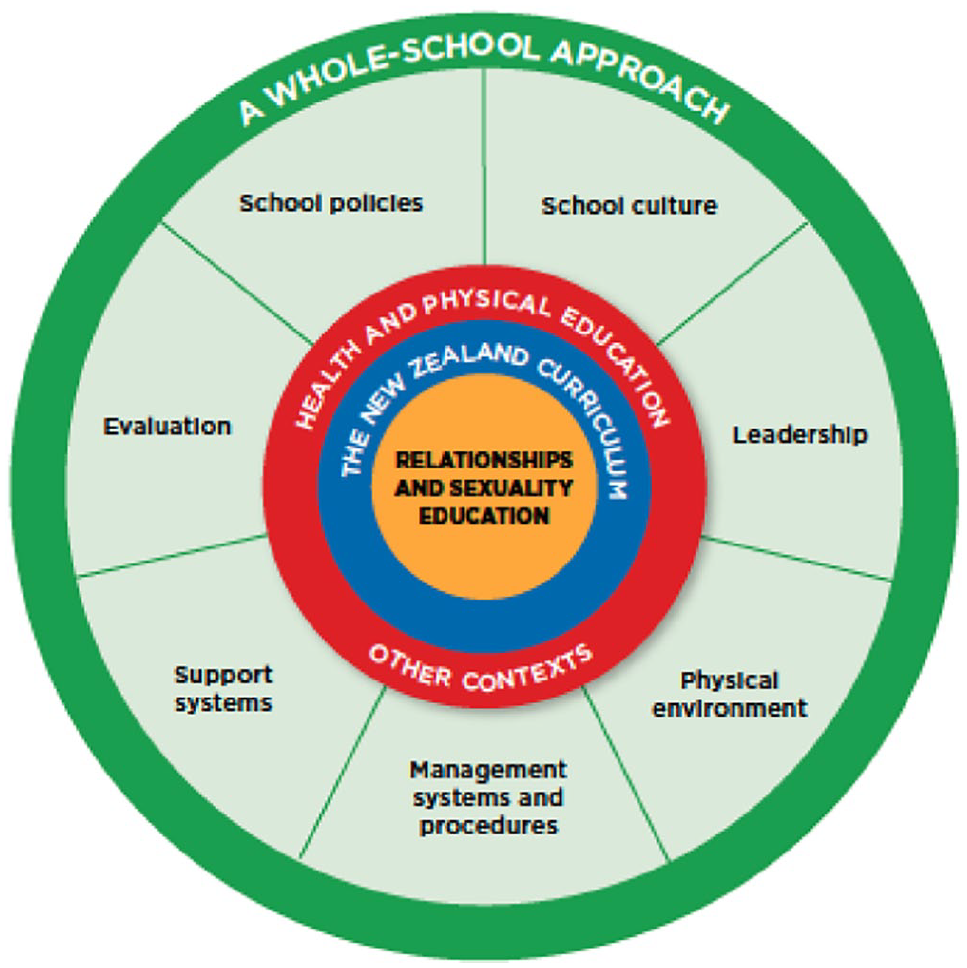
A whole school approach (MOE 2020a, p. 16).
A whole-school approach and a localised curriculum (see, MOE, 2020a, p. 17).
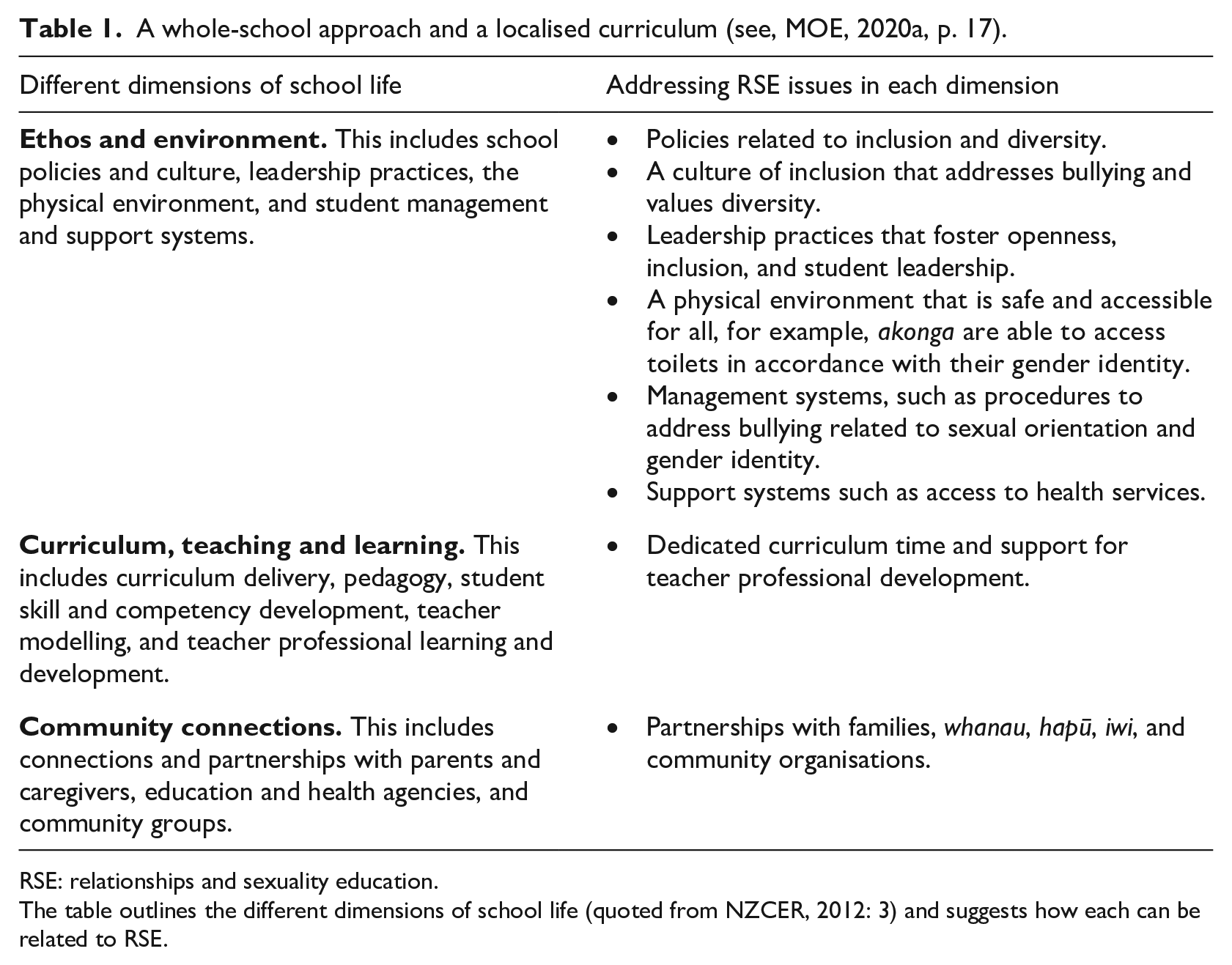
RSE: relationships and sexuality education.
The table outlines the different dimensions of school life (quoted from NZCER, 2012: 3) and suggests how each can be related to RSE.
The intention here is to encourage schools to make RSE part of a whole school approach to promoting wellbeing, that is evaluated at multiple levels including the physical environment (e.g. toilets, safe spaces, access), school culture (inclusion, leadership practices, policies) and systems (e.g. names on the school role, uniform regulations etc.). The ultimate goal is for schools to be inclusive, welcoming and positive spaces for learning for all students and staff, regardless of gender identity, sexual orientation, cultural background and beliefs, individual health needs or abilities. A whole school approach engages students and communities in the planning and delivery of curriculum programmes (Fenaughty, 2016; Restad, 2020) and impacts all aspects of the school environment including school ethos and curriculum, and is consistent with wider educational sector moves towards advocating for a whole school approach to wellbeing (NZCER, 2012; Quinlan and Hone, 2020). Advice contained with the RSE policies includes whole-school engagement with a range of issues such as inclusion and safety, digital and online contexts (Netsafe, 2017), as well as discrimination and bullying.
A whole school approach to addressing bullying
A recent PISA report on wellbeing (OECD, 2017) revealed that Aotearoa New Zealand has the second highest rate of reported school bullying in the OECD. A disproportionately high proportion of students who report bullying identify as LGBTQI+ (see also, Fenaughty, 2016; McBride, 2020; Nairn and Smith, 2003). The Youth2000 survey series, gathered local and representative data from over 34,000 secondary school students between 2001 and 2019. Findings from the 2019 wave of the survey (N = 7,721) (Clark et al., 2020) reveal that 9.4% of participants reported sexual attraction to the same sex or both sexes, with a further 5.6% reporting that they were not sure of their sexual attraction or were not sexually attracted to other people. In all, 1.0% identified as transgender, non-binary or with a cultural identity that is more gender expansive than being cisgender, 10 and 0.6% reported being unsure of their gender identity. The proportions of Aotearoa New Zealand young people who reported belonging at school differed, depending on their sexuality and gender (Clark et al., 2020). Previous research from the 2012 cohort of the Youth2000 survey series (Clark et al., 2013) found that transgender students and those uncertain of their gender identity, were more likely to have been bullied and harmed physically at school. A second study from that cohort (Clark et al., 2014) showed that, of the students who were transgender or unsure of their gender, 53.5% were afraid of being hurt or bothered by someone at school, 49.9% had been hit or physically harmed at school and 17.6% reported having been bullied at school at least weekly.
Māori youth who do not identify as heterosexual have a significantly greater chance of being bullied, receiving unwanted sexual attention, and experiencing sexual and mental health problems compared with their heterosexual peers or Pākehā youth. This results in negative body image beliefs and increased participation in self-harming behaviour and suicide risk (Kerekere, 2017). International research suggests that sports contexts and physical education classes are often not inclusive of diverse youth and can reinforce rather than question gender and sexuality stereotypes (Denison and Kitchen, 2015; Landi, 2019; McGlashan, 2013; Sykes, 2011; Wright, 2004). For example, grouping students according to sex assigned at birth can exclude those who do not conform to dominant gender norms (Sykes, 2011).
These statistics signal the diversity of gender and sexuality among New Zealand youth, along with the urgent need for RSE to address topics related to sexuality and gender diversity. They also suggest that schools have the added responsibility to ensure school cultures and environments are inclusive and safe spaces for all children and young people, regardless of their gender or sexual identity. This aligns with the requirements placed on schools in New Zealand law by the Education and Training Act 2020, which requires that school governance boards take steps ‘to eliminate racism, stigma, bullying, and any other forms of discrimination’ (clause 127). McBride (2020) argues that clear frameworks and policies can be protective of trans students. Having supportive staff, creating specific LGBTQI + school policies and curriculum, and enabling students to access peer support groups have been found to increase the likelihood of achieving an inclusive school culture for these (and other) students (McBride, 2020). School policy to protect LGBTQI+ students can positively influence the experiences of these students at school. Reduced bullying at school increases feelings of safety and can lead to reduced risks of self-harm or suicide of LGBTQ+ students (Jones and Hillier, 2012). Other positive benefits include improved mental health and educational outcomes.
Significant international research suggests that a whole school approach is especially well suited to addressing bullying, discrimination and inclusion (Fenaughty, 2019; Valle et al., 2020), encouraging recognition that responsibility for tackling these issues is a whole school responsibility (Allen, 2020; Brömdal et al., 2017; Rasmussen et al., 2017). In relation to the serious and important issues of bullying and discrimination, the RSE policies provide specific guidance for schools to create inclusive policies, practices and programmes. For example, the RSE policies include the statements contained in Table 2. 11
Policy examples.
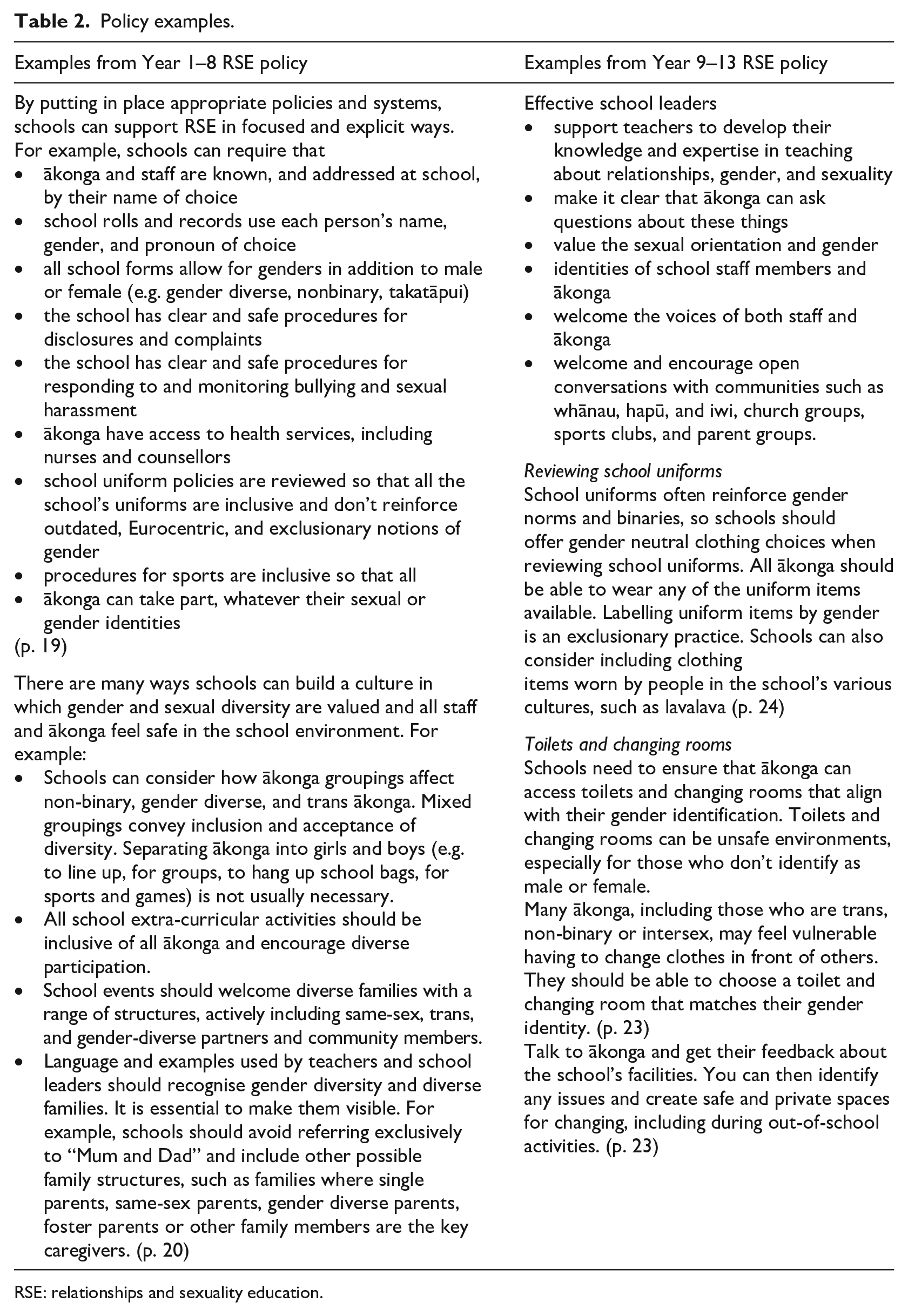
RSE: relationships and sexuality education.
Valuing student leadership and activism
A final way in which the RSE policies value a whole school approach and are responsive to children and youth is through explicit reference to how schools can value student leadership and activism. International movements, including feminism #metoo, Black lives matter, and LGBTQI+ pride are impacting young people globally and being taken up by them online and in school (Retallack et al., 2016; Ringrose and Renold, 2016). There is increasing evidence that young people in Aotearoa New Zealand view themselves as active members of their schools and communities, and feel a responsibility to make change. The ERO (2015) recommends that schools increase the involvement of students in decision-making concerning wellbeing and opportunities for leadership, while offering diverse learning contexts.
It is clear that when schools have active and well-supported student-led groups, students feel a greater sense of belonging. In addition to feminist groups, peer-support groups and peer mentoring programmes, some schools have peer sexuality support leaders and others have diversity groups. Some of the latter are variously referred to as ‘rainbow groups’, ‘queer-straight alliances’ ‘gay-straight alliances’ or ‘gender and sexuality diversity groups’. Some schools also have active youth health councils, and other kinds of student-led activist groups (McGlashan and Fitzpatrick, 2018; Quinlivan, 2013, 2015; see also, (Clarke and MacDougall, 2012; Fetner et al., 2012; Sadowski, 2016). The RSE policies encourage schools to value these groups, provide support to them, and ensure schools engage students in school wide and curriculum decisions. An essential element of a whole school approach is the presence of a dedicated and meaningful curriculum (Leahy et al., 2015; NZCER, 2012; Restad, 2020).
The RSE curriculum
Health education is frequently confused with health promotion in schools (Fitzpatrick and Tinning, 2013; Gard and Pluim, 2014; Leahy et al., 2015). The former encourages the use of an educative approach to health-related issues and concerns, while the latter is more concerned with addressing health outcomes, often in response to epidemiological trends. Health promotion in schools includes policy change initiatives, the use of settings-based approaches to promoting well-being and health, and communication for behavioural change. Health education and health promotion approaches overlap in practice and in public policy, and health pedagogies intersect across and between the two (Leahy, 2012; Leahy et al., 2015).
In developing the RSE policies, the writing team aimed for an explicitly educative approach that conceptualises RSE as an area of learning and study, with a focus on developing knowledge and skills (learning). While this intention remains, the policy documents necessarily also reflect the broader picture in which health promotion concerns enter the policyscape and impact practice. In order to provide sure foundations for an educative approach, the RSE policies are informed by international and local research on learning, youth cultures, and social change. All of these are reflected in the learning foci at each curriculum level, which are also closely linked to the health and physical education achievement objectives in the New Zealand Curriculum (MOE, 2007). As a result, the learning statements in the guides are necessarily broad in scope, build up progressively from levels 1–8 (ages 5–18), and require significant learning time to achieve. The definition of RSE within these RSE policies is informed by this commitment to learning and is firmly in line with international evidence about gender, sexuality and sexuality education. It also reflects international and national calls for sexual health issues to be addressed in schools in ways that make a difference for children and young people. The World Health Organisation’s (WHO, 2006) working definition of sexuality is influential in this respect: a central aspect of being human throughout life [which] encompasses sex, gender identities and roles, sexual orientation, eroticism, pleasure, intimacy and reproduction. Sexuality is experienced and expressed in thoughts, fantasies, desires, beliefs, attitudes, values, behaviours, practices, roles and relationships. While sexuality can include all of these dimensions, not all of them are always experienced or expressed. Sexuality is influenced by the interaction of biological, psychological, social, economic, political, cultural, legal, historical, religious and spiritual factors. (p. 5)
Defining relationships and sexuality education
The RSE policies take a deliberately broad approach to defining content, one that combines biophysical with sociocultural and historical knowledge, and which insists that RSE is studied in relation to power relations and social context (Table 2). RSE being named as an area of study (Fitzpatrick and Tinning, 2013) is consistent with the articulation of Sexuality Education (within Health and Physical Education) in the New Zealand Curriculum (MOE, 2007). The RSE policies state that Learning in the area of relationships and sexuality education (RSE) aims to enable ākonga (students) to understand themselves and to develop the knowledge, skills, and attitudes to think about and engage in positive and healthy relationships. It includes the following: • “learning about the self (physically, socially, emotionally, and spiritually)” • “gaining knowledge and skills for meaningful and supportive relationships with others” • “learning about social, political, cultural, and environmental contexts, and taking action within these contexts:” These guidelines, then, cover learning about relationships as well as about gender and about sex and sexualities. They discuss social and emotional learning and look at how young people can come to understand the physical and social contexts of gender, bodies, and sexuality. This enables ākonga to enhance their interpersonal relationships, now and in the future. The formation of young people’s personal and gender identities is viewed as an ongoing lifelong process. (MOE, 2020b: 10, 2020c: 12; Robinson, 2013)
In line with the New Zealand Curriculum (MOE, 2007), the RSE policies are informed by critical inquiry and principles of social justice. Such a focus is directly reflected in the stated four ‘underlying concepts’ of Health and Physical Education in the New Zealand national curriculum. These are the concepts of hauora, health promotion, the adoption of a socio-ecological perspective, and exploration of attitudes and values. They are explained as follows:
In learning about hauora, ākonga will consider how the four dimensions of taha tinana, taha whānau, taha hinengaro, and taha wairua relate to and affect people’s wellbeing in terms of relationships, gender and sexuality.
In health promotion, ākonga could help to develop or evaluate school policies for positive action in terms of relationships, gender and sexuality.
Through the socio-ecological perspective, ākonga will critically examine the social, economic, political and cultural influences that shape the ways in which people learn about relationships and express their gender and sexuality.
Attitudes and values that ākonga will develop include respect for others’ rights and a sense of social justice (MOE, 2020b: 10, 2020c: 12).
The overall aims of RSE include a commitment to social change, but this is not seen just at the level of the individual. Rather, the social and contextual determinants of health are attended to, so that individual health concerns in RSE are positioned within a social, cultural and historical context. The outcomes of RSE then are aspirational so that “[good] quality programmes aim to enable young people to
challenge homophobia, transphobia, sexism and gender-based violence
interrogate the ongoing effects of colonisation
study the environmental impacts of changes in population growth and of related issues such as people’s use and disposal of menstrual products
engage with mātauranga Māori
gain knowledge about the diversity of cultures in Aotearoa New Zealand- including their religious diversity
gain understandings about the strengths of sexual and gender diversity” (MOE, 2020b: 12)
The RSE policies also encourage schools to explicitly value students’ views and suggest that students are an integral part of programme planning and evaluation. This recommendation is based on strong research evidence that students do not feel their voices and ideas are currently included in planning processes in schools and that programmes, as a result, often lack personal and social relevance (Fenaughty, 2019; Leahy et al., 2009; New Zealand Family Planning Association, 2019).
Conclusion and summary
In a press release about the newly revised New Zealand sexuality guidelines, the then New Zealand Associate Education Minister Tracey Martin (2020) stated that The new resource . . . call[s] on schools to take more action against bullying, violence and child abuse, for schools to be more inclusive, and for schools to help students recognise the importance of diversity and respect in relationships. They also respond to a recent Education Review Office (ERO) report noting that our curriculum would benefit from more information around sexuality issues such as consent, the use of digital technologies and relationships.
New Zealand’s updated RSE policies are designed to help schools strengthen their RSE programmes and, relatedly, to adopt a whole-school approach to relationship, gender and sexuality education. The recent policy update broadens the focus to ‘relationships and sexuality education’ and strengthens guidance in two separate documents for primary schools (Years 1–8) and secondary (Years 9–13). Significant aspects of these new policies include a framework based on Te Tiriti o Waitangi, Indigenous knowledges and human rights, attention to issues of bullying and inclusion, and the responsibility of schools to address gender and sexual diversity in programmes and the whole school.
The resulting RSE policies (MOE, 2020b, 2020c) detail how schools might take a ‘whole school approach’ to this area, including the provision of dedicated curriculum time at all levels of compulsory schooling. Crucially, the RSE policies reflect the wider policyscape of education and health in Aotearoa New Zealand. Ultimately, however, the success of these policies will depend on schools valuing learning time for RSE and helping teachers access meaningful and ongoing professional learning (Goldman and Coleman, 2013). Future monitoring and evaluation will reveal the extent to which these goals are achieved.
Footnotes
Acknowledgements
The update of the RSE policies relied on significant input from a wide range of experts. Members of the writing group included the authors of this article as well as: Alison Green (Te Whāriki Takapou), Ruth Lemon (University of Auckland), Robert Muller (The Village Collective), Darren Powell (University of Auckland) and Joeliee Seed-Pihama (Te Whāriki Takapou). The international academic advisory group comprised Peter Aggleton (UNSW Sydney, Australia), Louisa Allen (University of Auckland), Deana Leahy (Monash University, Australia) and Mary-Lou Rasmussen (The Australian National University, Australia). For a full list of other individuals and groups consulted see Ministry of Education (2015, 2020b, 2020c).
Funding
The author(s) disclosed receipt of the following financial support for the research, authorship, and/or publication of this article: The update of the RSE policies was funded by the New Zealand Ministry of Education.
