




Abstract
Background:
Schools are ideal environments in which to conduct child and adolescent physical activity (PA) research. Despite this, PA-specific practical guidance for school-based research is lacking, which may present unique challenges to researchers. Based on reflections from our own experiences, this paper seeks to provide practical guidance on how best to approach school-based PA data collection.
Discussion:
This paper focuses on the practicalities of quantitative and qualitative data collection in English primary (4–11 years) and secondary (11–16 years) schools. Recruitment and consent are discussed, and practical guidance provided with respect to engagement with parent/carer(s) and ethical considerations. The importance of good communication with schools, together with its importance in facilitating efficient data collection (through planning, data collection and resource utilisation), is described. Finally, the importance of giving back to the school and participants once a research project has been completed is stressed.
Summary:
Improved understanding of data collection procedures for school-based PA research is key to helping research become more systematic and efficient. Findings in this paper will be particularly useful to undergraduate and postgraduate students and early career researchers.
Introduction
Children and young people often engage in low levels of physical activity (PA) (Cooper et al., 2015), and a drop in PA engagement is evident as children cross the primary (4–11 years) to secondary (11–16 years) school transition (Lau et al., 2017). Recent worldwide surveillance data reveal that 81% of youth (11–17 years old) do not meet the 60 minutes of moderate to vigorous PA (MVPA) per day guidelines (Guthold et al., 2020).
Often, child and adolescent PA research includes data collection which takes place through and within the school setting. Schools are ideal environments in which to recruit participants and also to intervene with respect to PA behaviour. The majority of children and adolescents attend and spend a large proportion of waking hours at school (40%–45%; up to 8 hours). This is reinforced by suggestions contained in Global Advocacy for Physical Activity’s (GAPA, 2012) ‘Seven Best Investments’. Based on the best available evidence, GAPA identified and recommended actions aimed at increasing population levels of PA, one of which was whole of school PA programmes (Owen et al., 2017). Despite this, recent systematic reviews have concluded that school-based PA interventions have had little to no effect on daily PA levels of participating children (Owen et al., 2017; Love et al., 2019). In order to improve understanding on how best to impact the PA levels of children and young people, more school-based intervention research is needed with both effectiveness (Van Sluijs et al., 2007) and implementation in mind (Durlak and DuPre, 2008). Improving understanding of health-related behaviours, such as PA, can also occur when analytic and descriptive research is conducted (Sallis and Saelens, 2000).
Research to help decide which methods to use within PA studies is easily accessible. A mixed-methods approach, collecting both quantitative and qualitative data, is recommended to obtain a comprehensive understanding of PA behaviour (Thomas et al., 2015). For qualitative data, both focus groups and interviews have been used to provide contextual information in school-based PA studies with children and teachers. Personal accounts from children can reveal the meanings behind their PA behaviours, while accounts from teachers can provide insight into the practicalities of implementing PA in schools (Jago et al., 2012; Malden and Doi, 2019; Pawlowski et al., 2014). Commonly employed quantitative methods include the use of accelerometers (Cain et al., 2013), questionnaires (Sallis and Saelens, 2000) and fitness testing such as the 20-m shuttle run test (Committee on Fitness Measures and Health Outcomes in Youth FaNB, Institute of Medicine, 2012; Léger et al., 1988). A rapid increase in the use of accelerometers is apparent, with accelerometer-based studies of pre-schoolers, children and adolescents more than doubling between 2005 and 2010 (Cain et al., 2013).
Once methods have been selected and researchers enter the school environment to collect data, they can be presented with various challenges within this dynamic and unpredictable setting. Unlike laboratory experimental studies in which conditions can be controlled to ensure the collection of high-quality data, various challenges can arise which consequently influence the quality of data collected in field-based studies. Importantly, schools are unique settings for field-based studies in which the physical social conditions within each individual participating school are not under exclusive control of the researcher (Plummer et al., 2014).
For researchers embarking upon exploratory or intervention research with children and young people, commentary papers are now more commonly available to draw upon. These provide advice and guidance on how to increase the quality of research outside of the well-studied research area of methods selection. These papers, which share practical guidance informed by previous experience, can be particularly beneficial for doctoral students and early career researchers who find themselves ‘thrown in at the deep end’ when embarking upon PA research. Van Sluijs and Kriemler (2016), for example, have published their reflections on PA intervention research in young people. In this paper, key issues relating to intervention development are discussed, including recruitment and retention, measurement protocols, economic evaluation and process evaluation (Van Sluijs and Kriemler, 2016). More practically focused commentary pieces offering advice to help school-based research proceed smoothly are also available (Alibali and Nathan, 2010; Rachele et al., 2013). That said, some of these publications may adopt a generic non-PA focus and others may be country-specific. PA-specific practical guidance for school-based data collection is currently lacking in the UK context, which may present unique challenges to researchers.
Based on our own experience, this commentary piece seeks to provide fellow researchers with practical guidance on how best to approach school-based PA data collection in the UK.
Discussion
Recruitment and informed consent
The recruitment and informed consent process can be difficult and time-consuming in any research project. This is especially pertinent in a school setting when an external researcher can face many hurdles to obtain access to schools and subsequent parent/carer(s) consent (Bergstrom et al., 2009).
At the school level, getting gatekeeper consent and/or commitment to participate in a research project from management/teachers can be the first stumbling block for researchers. Staff may be wary of researchers who they have never met before and have no connection with. In research with a focus on PA, it can be helpful for researchers to first build relationships with school sport partnerships (SSP) or similar working bodies. Since 2006, all schools in England have been part of an SSP (Department for Education, 2010). An introduction to the proposed research coming from familiar and trusted SSP staff members as opposed to an unfamiliar university staff member may lead to increased receptiveness. If this option is not available, offering to present a research project to school management/staff either at the school site or at the university campus is a worthy consideration.
Once schools have been recruited, the next challenge is participant recruitment. For parent/carer(s) consent to be obtained, commonly the parent or carer will need to receive a letter from the researchers sent via the school. Letters should outline the study and procedures, with a requirement of signed written permission for a child to participate to be returned. There are numerous opportunities for breakdowns to occur in this ‘school-to-home-to-school’ consent form process (Blom-Hoffman et al., 2009). It has been noted that consent documents may not be returned because parents have not received them or have forgotten to sign them (Jones et al., 2014). Other reasons include general inconvenience, parents assuming their child is not interested, and parents thinking the study is not relevant or could potentially distract their child from academic pursuits (Jones et al., 2014).
Each school is different and will likely have its individual approach to parent communication. It may be beneficial to first liaise with teachers to gain their perspective on how to obtain informed consent as they best understand the school culture. This co-involvement of school staff can be beneficial at each stage of the research process. From our experience in primary school settings, project meetings between the researcher or research team and parents at the end of the school day can be useful to gain informed consent, which can be very informative for attending parents. Such meetings can provide parents with the opportunity to ask the researcher(s) questions (Cline et al., 2005; Wolfenden et al., 2009). On such occasions, uncertainty can be resolved quickly, ensuring contentment and genuine informed consent. Moreover, informed consent forms can be signed within such project meetings, ensuring that they are not lost in the school-to-home-to-school process. However, these meetings are not without their limitations. Meetings after school not aligned to scheduled parent and teacher meetings generally only work for pre-adolescent children who commute to and from school with parental supervision. Moreover, attendance at these meetings can be poor. Parents may not have the time to stay behind at school, and many children may attend after-school clubs and be collected at a later time.
Alternatively, a project meeting can be incorporated into scheduled parent and teacher meeting in both primary and secondary schools. Seeking informed consent from parents as they wait to speak to a teacher provides similar opportunities for questions to be asked and removes the school-to-home-to-school process. Support from teachers at such meetings is important. For example, leaving information sheets with teachers and asking them to end the meeting with parents by stressing their support for the research project and encouraging parents to speak to the researcher can be helpful. Be conscious, though, of burdening school staff during an event which could be both busy and stressful for them. It may be that the only feasible option at these evenings is for members of the research team to speak to parents in passing and perhaps set up a stall in the entrance to the school.
If the decision is made that the traditional school-to-home-to-school consent process is more feasible, a number of techniques can be used to improve return rate – for example, ensuring messages regarding the project and the consent forms are placed in school newsletters or advertised via school text services with parents (if available) and school website (Corder et al., 2016). Because the large amount of project information required to satisfy ethics review boards can result in large, text-heavy information sheets that are off-putting to read, researchers should aim to keep participant information sheets to a maximum of one page. Figure 1 provides an example of a one-page parent/carer(s) information sheet. In this example, further content is indicated as being available online (either on a website or in an open-access online folder), helping avoid and overload of information, yet ensuring ethical requirements are fulfilled. An online folder could include a project letter, an additional more detailed information sheet and example questionnaires.
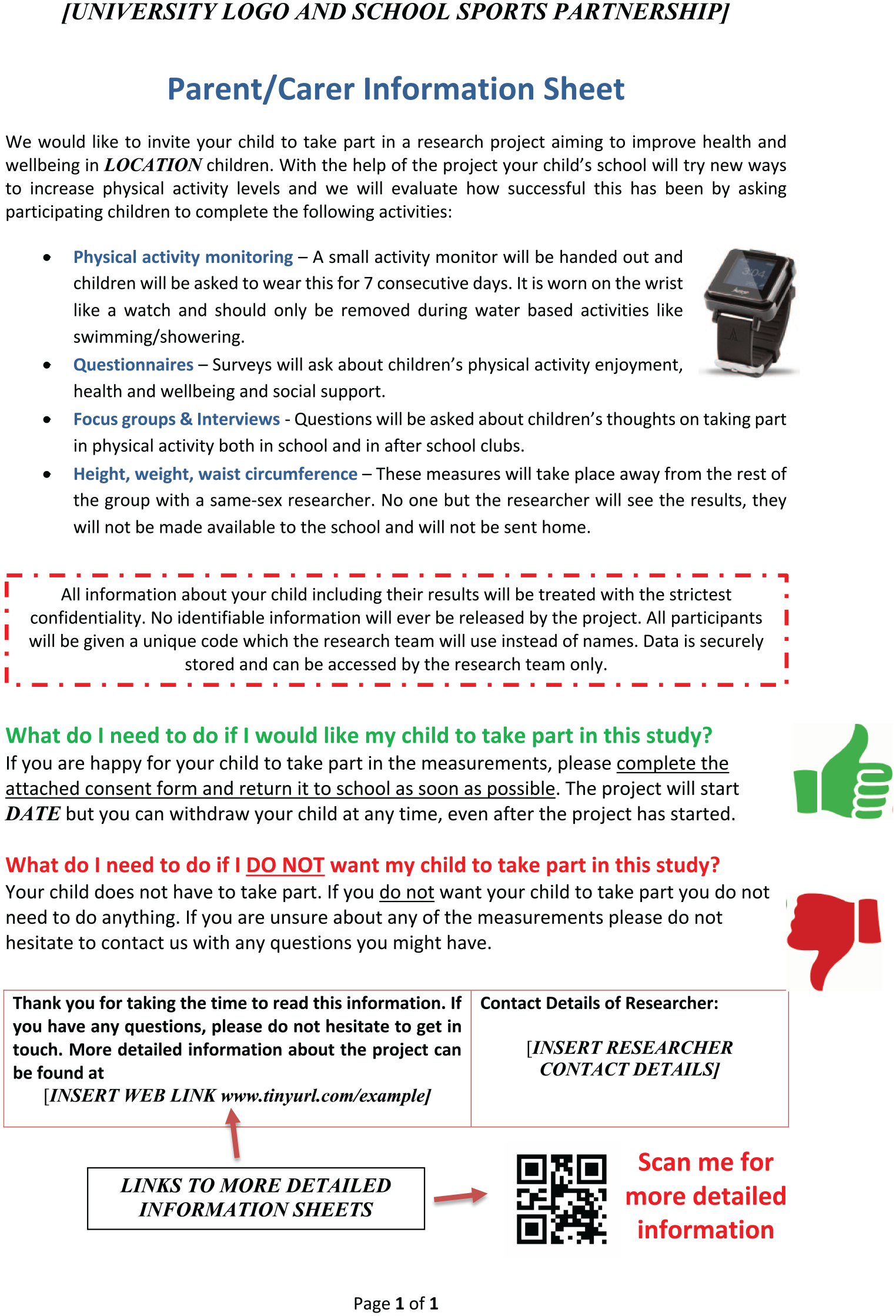
An example one-sided parent/carer(s) information sheet.
Consulting guidelines such as the British Educational Research Association (BERA) Ethical Guidelines for Educational Research can be useful to ensure that all the relevant information has been provided (British Educational Research Association, 2018). The use of online platforms provides researchers with the opportunity to be as innovative as possible and create video content showing anticipated data collection procedures in the project: for example, a child having his or her height and weight taken, or a child receiving an accelerometer with verbal instructions. Researchers may also want to consider giving parents the option of providing written consent electronically. Various secure online platforms now enable researchers to get parents to sign documents online using a desktop computer, tablet or mobile phone – thus removing the problem of lost or forgotten paper consent forms.
In addition to parent/carer(s) consent, children and adolescents should always provide their own verbal and/or written assent before participating. Gaining participant assent can be problematic when sensitive data such as height and weight are being collected. In English primary schools, children participate in the national child measurement programme (NCMP), in which height and weight are measured twice unless parents withdraw their child (Public Health England, 2019). Participation can mean that younger children are more used to having these measurements taken and fewer issues arise compared to older groups. However, the NCMP has been met with mixed reactions from parents. The NCMP shares information about a child’s weight status with parents once measurements are complete via a parent results letter. It has been reported that some parents can feel angry and distressed as a result of being informed about their child’s weight status; this has led to complaints against the programme involving media outlets in the UK (Kovacs et al., 2018). Reinforcing that your own research has no relation to the NCMP and that no weight classifications will be given to the child, parent/carer(s) or school is advisable. Also, in terms of verbal or written assent, it can be useful to allow participants to ‘self-select’ the individual measures which they do/do not wish to complete. This provides true autonomy as participants can withdraw from certain aspects of data collection, for example, weight or waist circumference measurements. While this approach can lead to an increase in missing data, it can prevent loss of participants, with the alternative being withdrawal from the whole project.
Communication with schools
The impact that communication with participating schools can have on a project, either positively or negatively, should not be underestimated by researchers. Clear and efficient communication with school staff can make the difference between data being collected without any problems and no data being collected.
Researchers should be aware that although school staff such as head teachers, class teachers and office staff do have school email addresses, they may not be used regularly throughout the day due to the busy nature of school life and teaching workloads. Therefore, it is important to recognise that emails may take up to a week or longer to gain a response. Alternative communication techniques to speed up the process can include telephone calls or visiting the school and speaking to staff in person outside of teaching hours. Meeting in person frequently and maintaining candid and transparent communication both when the project is going well and when, inevitably, obstacles are encountered have value in school-based research (Plummer et al., 2014). This can help build rapport and positive relationships characterised by trust and respect (Plummer et al., 2014).
In a previous school-based PA intervention, a member of staff within each participating school was given a ‘Champion’ role (Naylor et al., 2008). The role of the champion or facilitator was to help implement PA components by encouraging and supporting their colleagues (Naylor et al., 2006). While the goal of this approach was to facilitate implementation, it is a technique that can also be used to facilitate participant recruitment and data collection. It can be helpful to identify a member of staff in each participating school to build rapport with and who is willing to engage with the research. This could potentially be a Physical Education (PE) specialist with an interest in PA, or it could simply be the member of staff who has welcomed you into the school. Formally appointing or assigning this member of staff as a research ‘champion’ within the project can make it clear that they are your point of contact within the school.
Know your participants
Commencing data collection with an understanding of how many participants there will be in a study and who they are is central to smooth data collection. Figure 2 illustrates the steps we have found useful to track participants and streamline large-scale quantitative data collection, including accelerometer distribution.
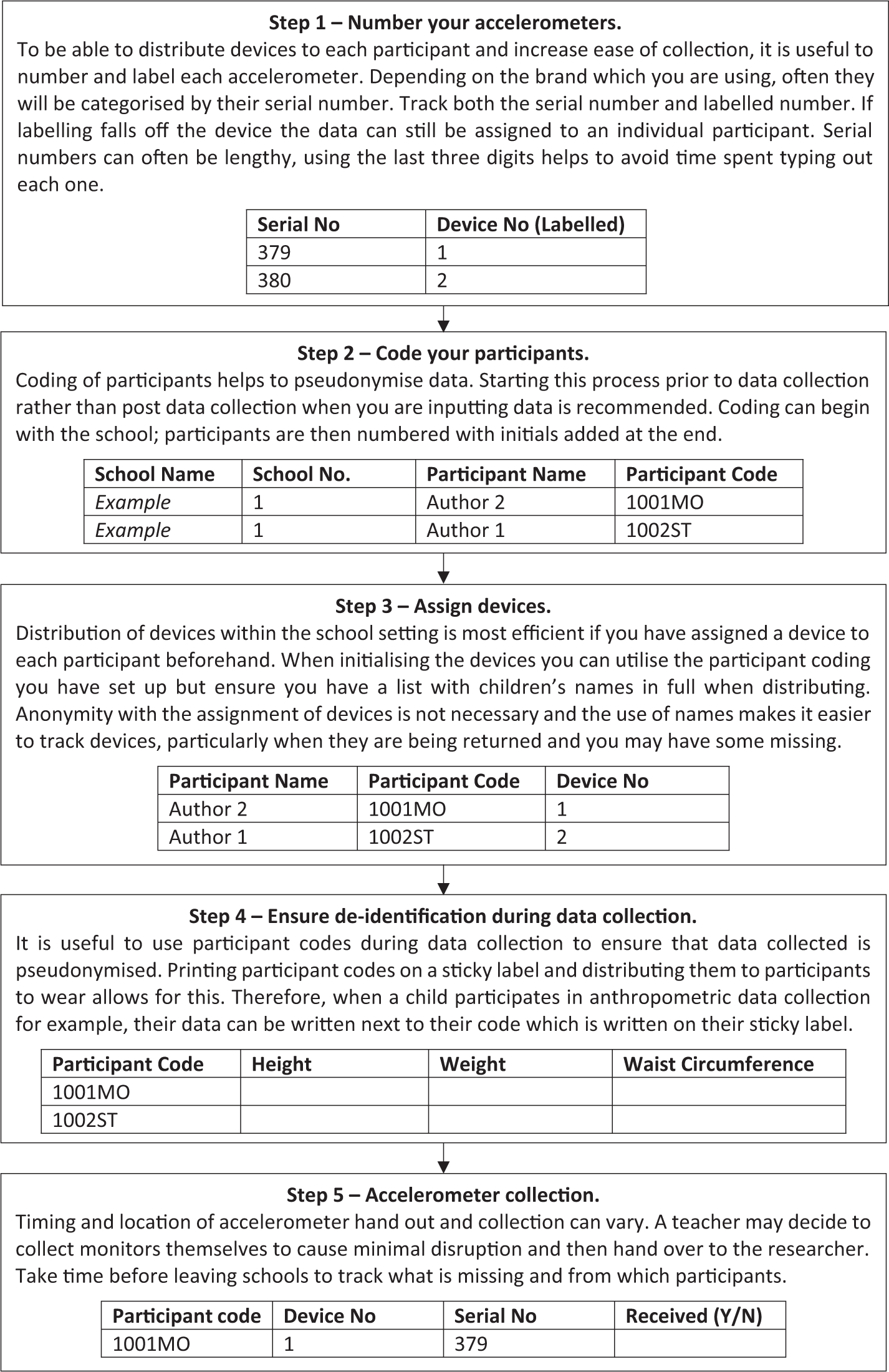
Practical guidance for school-based data collection sessions.
Time and space
For PA research, schools may offer PE lesson time to accommodate data collection. While this may seem to contradict research goals such as increasing children’s PA levels and while researchers may wish to seek alternative opportunities to collect data, PE lessons are often the only opportunity within the school day to collect the information required. From our experience, you are more likely to receive a PE lesson (1–2 hours) within secondary schools. In this situation, student timetable requirements reinforce the importance of completing data collection in a timely manner and within the allocated lesson period you have received. Conversely, within primary schools there is increased flexibility in terms of timetabling. However, this increased flexibility enhances the chance of unexpected changes. Therefore, when collecting data in primary schools, personal flexibility, patience and understanding are required.
Generally, private space is of a premium in both primary and secondary schools. It can therefore be challenging to find a suitable space for conducting anthropometric measurements in a private manner. Teachers may suggest setting aside the corner of the classroom, for example, but this would not ensure confidentiality. The alternative is likely to be shared space outside the classroom. In these situations, extra research staff can help to facilitate the process by keeping waiting participants a suitable distance away to prevent crowding. If working alone, asking a teacher or teaching assistant for assistance in organising this process may be helpful.
Fitness testing can also be challenging to conduct, if, for example, you plan to use the 20-m shuttle test (Léger et al., 1988); identifying a suitable space prior to the data collection date and ensuring this is free for your use are important. Often outdoor spaces provide a more conducive environment for these tests since indoor rooms may not offer enough space. The indoor hall/gym area in UK schools, particularly primary schools, is often multipurpose and used for activities such as assemblies and large group meetings. It may also double as the dining room area at lunch time, meaning that access can be difficult. The use of outdoor spaces may be subject to weather conditions and school break and lunch schedules. Unsuitable weather and lack of indoor space can lead to postponing data collection; thus, if you know that outdoor space is essential, consider planning a backup date with the school at the start to minimise disruption.
Qualitative data
A common problem when conducting school-based interviews and focus groups can be finding a suitable location. This needs to enable confidential discussion, but also ensure that participants feel comfortable in a natural environment. One approach to use in a primary school setting may be to conduct focus groups in shared space between classrooms. This allows teachers to still see the sessions, while participants feel that their accounts are confidential. If children and/or staff are moving around the school, this can cause distraction and background noise, but it is unlikely to last long enough to cause significant disruption. In a secondary school setting, finding appropriate space can be more challenging, but asking for access to the dining hall area or a spare classroom if possible is an option to consider. If there is a team of data collectors, each corner of the sports hall can also be used for focus groups. Focus groups or interviews with school staff can be conducted before or after school, or during non-teaching hours; it is important to be flexible to teachers’ working day.
Qualitative data collection can be time-intensive, but it is important to not rush the process (Gibbs, 2018; Harris et al., 2013). Building rapport with participants at the start of an interview/focus group is important to gain a deeper insight (Harris et al., 2013). Post-it notes, for example, have been suggested to build rapport during an ice-breaker task (Noonan et al., 2016). They provide participants with a non-verbal option to respond to an ice-breaker question; this may help to build confidence when speaking to the group for the first time, in comparison with having to verbalise an answer right away (Noonan et al., 2016). Post-it notes may also provide a way of eliciting honest opinions from quieter group members in focus group discussions (Peterson and Barron, 2007).
Should study design allow, a semi-structured interview schedule should help keep discussions on task. With younger children, a series of prompts can be useful to allow them to express their thoughts. For example, asking a child to express what their friends think about an issue, stimulating conversation before moving on to ask about their personal thoughts, can be a good approach to take. It may also be beneficial to explore alternatives to traditional focus group format with younger participants. Innovative methods such as ‘draw and write’ or ‘write, draw, show and tell’ (Angell et al., 2014; Noonan et al., 2016) allow children creative ways to express their thoughts and feelings (Noonan et al., 2016).
Undergraduate students
School-based PA research often requires a team of researchers and assistants to be able to collect the required data within the allotted time frame. As the lead researcher, securing this kind of support can be a challenge, but the use of suitable undergraduate students may help. In a recent study, final year undergraduate students were used in a peer-led mentoring PA intervention in which some were involved in the intervention implementation and others in data collection (Owen et al., 2018). Training should be provided before any data collection occurs to equip students with the skills required. Often, students will have basic knowledge of the methods being used, thus enabling training to focus on consistency of the measurement processes. Problems which may arise when using undergraduate students include poor attendance, low reliability and various practical issues (study, sport or part-time job commitments). Therefore, aligning research projects to final year dissertations can increase student interest and commitment, encouraging attendance at data collection to fulfil study obligations.
Giving back
There is substantial organisational input from school staff required for PA data collection, and participating teachers give up curriculum time for data collection, which has previously been reported to be limited within a crowded curriculum (Riley et al., 2015; Taylor et al., 2018; Weatherson et al., 2017). It is important that schools believe the time they have given up is recognised and worthwhile. In order to ensure this, researchers should continue to engage schools after data collection is complete. Cutting ties with schools after data have been collected and participants are no longer needed risks damaging relationships. School-based research should be a two-way process, and providing feedback to schools can be informative for school staff, helping them see output for their time and effort.
Unlike publishing data within scientific journals, this form of research dissemination gives researchers the freedom to be as creative and engaging as possible. Using infographics or similar eye-catching devices can help get sometimes complex messages across. Figure 3 provides an example of an infographic produced for schools participating in the Active Schools: Skelmersdale research project (Taylor et al., 2017). Based on each area of data collected, schools were provided with percentage scores, as well as an overall average score.
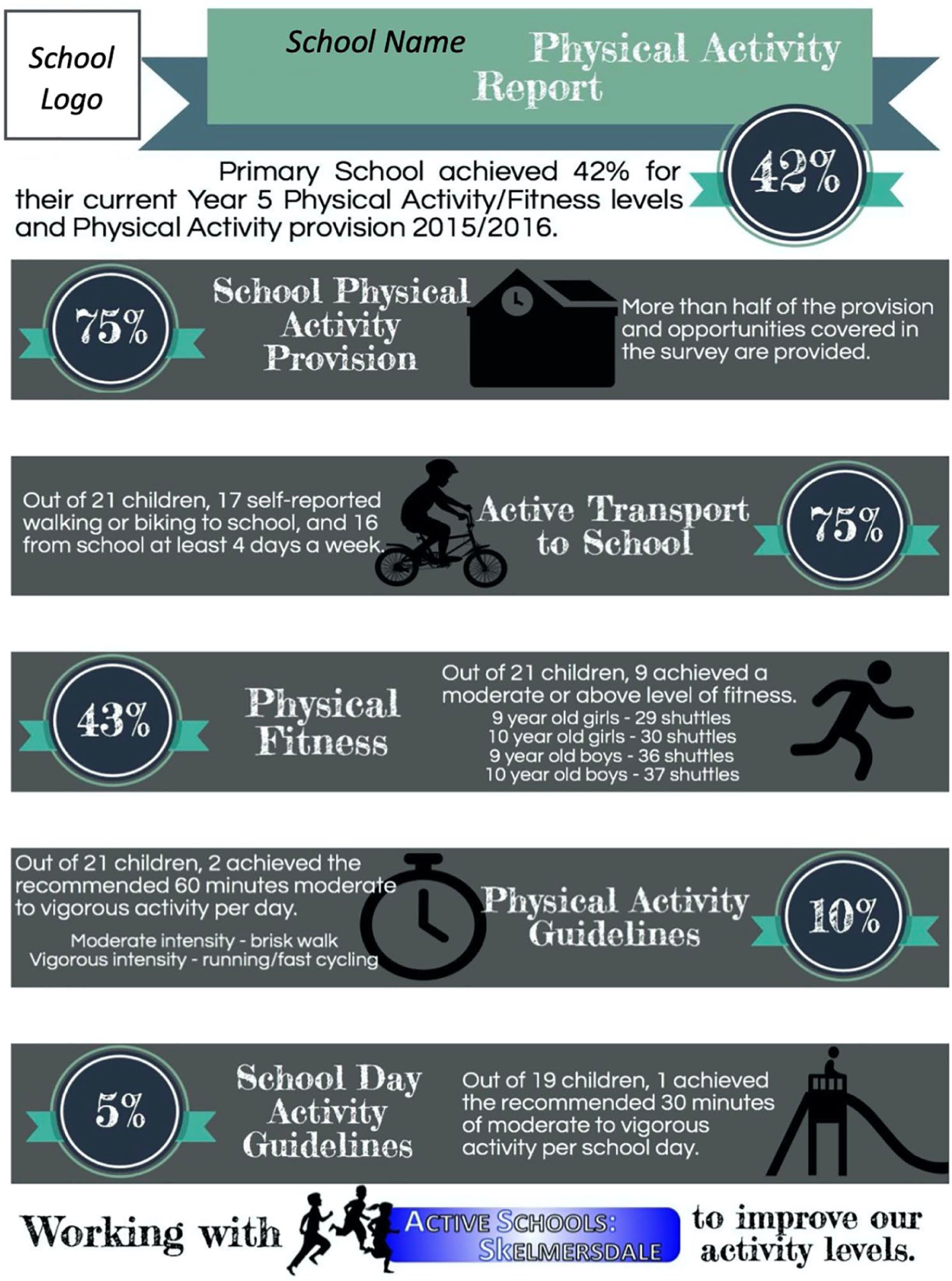
Example of school feedback in the form of an infographic.
Research data may help to identify areas in which student PA levels and health and well-being could be improved. Consequently, schools have an opportunity to introduce new initiatives or policies which demonstrate how they have addressed the implications of research data. In the UK, data may also be useful for schools engaging in voluntary assessments such as the Healthy School Rating survey (Department for Education, 2019) and also in compulsory Ofsted (Office for Standards in Education, Children’s Services and Skills) inspections (Ofsted, 2019). Ofsted inspections explore the quality of education, training and care. In the inspection area of personal development, learners should know how to keep physically and mentally healthy, something which could be demonstrated from engagement in PA research and PA data collected (Ofsted, 2019). Overall, this can increase the worthiness of the data and the research process as a whole to school management.
Conclusion
This paper outlines some of the key issues that are important in order to collect PA-related data from children and young people in the school setting. A range of different types of PA data and experiences have been discussed. The reflections offered will be particularly useful to undergraduate and postgraduate students and early career researchers. There are various additional aspects of PA data collection that could be mentioned. Thus, it is hoped that this discussion paper will encourage the sharing of good practice and experiences, particularly when it comes to PA data collection in field-based studies with children and young people in school settings. The documentation of detailed data collection procedures can contribute towards increasing researcher understanding and efficiency, and ultimately closer and stronger relationships with schools.
