




Abstract
Background:
Health message design plays an important role in knowledge acquisition and changes in attitudes towards a nutrient or substance, such as caffeine. To foster the effectiveness of health education, greater attention should be paid to the gist-based design of health messages that include visual representations. Fuzzy-trace theory indicates that gist knowledge can be influential in decision-making about health and medical problems.
Objectives:
The purpose of this study was to investigate the influence of different graphic types (i.e. gist, verbatim and decoration) on knowledge of gist and verbatim messages, which may in turn influence attitudes and intentions towards caffeine control.
Method:
Middle school students (n = 315) in South Korea individually studied reading materials on caffeine under three research conditions with respect to graphic types.
Results:
This study found an interaction effect between sex and graphic types when it came to student perceptions of gist representation and the visual design of graphics. Graphic types also significantly influenced gist knowledge but not verbatim knowledge. Gist and verbatim graphics were more effective in acquiring gist knowledge about caffeine control than decorative graphics. In addition, gist knowledge significantly influenced attitudes and intentions towards caffeine control.
Conclusion:
The main finding of this study is the importance of acquiring gist knowledge from health messages, which can be enhanced through the effective use of visual representations.
Introduction
Research literature has shown the beneficial influence of caffeine in reducing cardiovascular disease risk and preventing cognitive decline (Arab et al., 2013; Ding et al., 2014). In addition, low doses of caffeine have a positive influence on vigilance in the absence of side effects (Hughes and Hale, 1998). Nevertheless, caffeine overdose has a detrimental effect on the physical, psychological and social development of adolescents (Ludden and Wolfson, 2010). Young people who consume high doses of caffeine are more likely to have emotional difficulties such as anxiety, jitteriness, nervousness and depression, as well as sleep problems, which are negatively associated with academic performance (Hughes and Hale, 1998). Thus, educators should help young people control their caffeine consumption within recommended daily allowances.
Concern about high caffeine consumption is growing, as new caffeinated products such as energy drinks are actively marketed to young people in a variety of ways. Kristjansson et al. (2011) found that 76.3% of 13- to 14-year-old students used caffeinated products daily; boys on average consumed more caffeine than girls, particularly cola (1.56 vs 0.98 cans/glasses) and energy drinks (0.76 vs 0.39 cans/glasses). Although the average daily amount of caffeine consumption was not high in the survey, the side effects of caffeine were substantial for adolescents who used caffeine beyond the daily allowances. The amount of caffeine consumption was strongly related to that of other substance use (e.g. cigarettes and alcohol), and both caffeine and substance use were related to violent behaviours and behavioural disorders among adolescents (Kristjansson et al., 2011). In the light of this kind of evidence, efforts have been made to reduce adolescents’ consumption of caffeine by restricting the sale of highly caffeinated drinks in schools and strengthening health education campaigns about caffeine consumption. Despite these actions, many adolescents still use caffeine regularly in the expectation that caffeinated drinks will enhance their concentration, energy, mood or performance.
In health education, it is crucial to design health messages that aid in the understanding of the risks of caffeine consumption beyond daily allowances. When compared with adults, adolescents who lack background knowledge and experience have greater difficulty understanding the meanings behind numerical information and statistical charts. It is a legitimate concern that adolescents may be receiving information about the risks of caffeine consumption without grasping the essential meaning of the messages (Wilhelms and Reyna, 2013a). Thus, this study intends to explore one way of improving the design of risk communication messages about caffeine consumption, particularly focusing on the design of graphics.
Gist-based design of health messages
Educators should provide well-designed health messages that can help adolescents to effectively understand health risks and make a decision regarding health problems. Unclear or difficult messages about health risks are not helpful because laypeople are likely to ignore them without making an effort to understand them. Health messages should meet the needs and preferences of individuals while not exceeding their comprehension ability (Brundage et al., 2005; Neuhauser and Paul, 2011). Particularly for people with low health literacy, it is important to increase the readability of health messages.
However, readability alone does not ensure effective health communication. Even adolescents who are capable of reading and understanding every sentence in a health message may fail to make a sound decision unless they get the gist of the message. According to Fuzzy-trace theory (FTT), people ‘encode, store, retrieve, and forget verbatim and gist memories separately and roughly in parallel’ (Reyna, 2012a: 333). Verbatim memory includes exact numbers, words and pictures, whereas gist memory involves the essential meaning of messages. Gist memory is more stable and less subject to interference than verbatim memory (Lloyd and Reyna, 2001). People are likely to rely on gist memory to make a decision if it does not require verbatim-based analysis, which involves processing exact messages in a rote way (Blalock and Reyna, 2016; Reyna, 2012b). For instance, patients in studies by Blalock and Reyna (2016) and Reyna (2012b) prefer the gist of health messages (e.g. low risk) to verbatim quantities (e.g. 5% chance of side effects) in deciding whether or not to undergo a new treatment.
Compared with adults, adolescents are more likely to focus on verbatim rather than gist representations when making a decision, which may lead to unhealthy behaviours when short-term benefits outweigh uncertain long-term risks (Blalock and Reyna, 2016; Wilhelms and Reyna, 2013b). Reyna and Mills (2014) found that a gist-based curriculum that emphasised the bottom-line message of every lesson was more effective in reducing the sexual health risks of adolescents than a traditional curriculum. Adolescents receiving the gist-based curriculum were more likely to acquire and retain gist knowledge and categorical risk perceptions (e.g. ‘every low risk happens to someone’), which may in turn reduce risk-taking behaviours. Gist-based approaches can be more effective for adolescents, who are likely to overestimate health risks and feel vulnerable, than traditional interventions to increase the accuracy of risk perceptions (Reyna and Farley, 2006). Thus, greater attention should be paid to help adolescents understand the gist of health information and apply it when making a health-related decision (Reyna and Adam, 2003).
With respect to gist-based message design, Wilhelms and Reyna (2013a) suggested explaining the reasons behind the messages, translating numerical information into meaningful explanations and using graphs to represent the gist of the message. Blalock and Reyna (2016) emphasised designing a health message to facilitate gist-based reasoning by cutting-out or reducing trivial facts, organising information to convey the bottom-line gist and providing retrieval cues for gist memory. Wolfe et al. (2015) found that a web-based tutoring system (BRCA Gist), which highlighted the meaning of important messages concerning BRCA genetic testing and presented graphics and videos to convey the gist meaning, was more helpful in conveying breast cancer knowledge, understanding the gist information and making decisions than the National Cancer Institute website. Fraenkel et al. (2012) identified the effectiveness of a decision support tool that highlighted the qualitative messages of the risks and benefits of biological therapy for rheumatoid arthritis with graphics such as bar graphs, pie charts and pictographs. The tool was helpful in increasing knowledge of biological factors, clarity of values, patient willingness to try biological therapy and the likelihood of making value-concordant decisions. Together, these findings highlight the importance of gist-enhanced design of health messages.
With respect to the gist-based design of health messages, greater attention should be paid to the role of graphics in improving knowledge and changing attitudes towards a nutrient or substance such as caffeine. Although a number of health magazines and websites include graphics for decoration, the function of decorative graphics is questionable (Cho et al., 2014). Clark and Mayer (2011) suggested that graphics should not be incorporated for the sole reason of decorating a page without supporting the message. Decorative graphics can be interesting but they are not helpful for knowledge acquisition, as graphics may detract attention from the essential meaning of messages, disrupt the creation of links among the messages and seduce people into recalling irrelevant existing knowledge (Harp and Mayer, 1998). Compared with decorative graphics, graphics representing gist information can be more beneficial for effectively communicating health risks and benefits (Brust-Renck et al., 2013; Reyna, 2008; Wilhelms and Reyna, 2013a). In addition, the literature shows that simple graphics are more helpful than detailed ones for deeper understanding (Brewer et al., 2012; Brundage et al., 2005). Brundage et al. (2005) found that a simple line graph was more preferred and accurately interpreted than complex graphs such as side-by-side change bars, stacked change bars and stacked raw data. The line graph was effective in visually representing the influence of a treatment over time (e.g. health benefits increased over time). Similarly, Brewer et al. (2012) found that a simple risk continuum graphic was more effective in reducing gist and verbatim errors in interpreting breast cancer recurrence risk tests than a standard Oncotype DX report including a complex graphic. Simple graphics representing the bottom-line gist of health messages may be more effective in knowledge acquisition and gist comprehension than complex graphics focusing on verbatim facts. The effectiveness of graphics is likely to depend on how well they visually represent the gist message (Brust-Renck et al., 2013; Reyna, 2008).
The effects of graphics can be moderated by sex, which may influence how adolescents interpret and respond to health messages. For example, ChanLin (2001) found that visual formats (animation and still graphics) positively influenced mathematics and science knowledge acquisition among female students, but not male students. The visual formats may not be helpful for male students because they were able to use internal visualisation strategies to understand text. It was also possible that male students did not pay sufficient attention to visual information when it was given along with text. Cho and Hong (2013) found that women were more likely to consider visual design quality as an important factor to determine their satisfaction with a blog. In addition, women were more influenced by colour aesthetics than men, whereas men were more influenced by layout aesthetics in judging the visual design quality of a blog. These findings suggest that women may process visual information in a different way from men. According to the selectivity model (Darley and Smith, 1995; Meyers-Levy and Sternthal, 1991), women tend to comprehensively analyse and use all available information, but men tend to selectively focus on highly available and salient information for judgement. The difference in visual information processing can influence how adolescents perceive and learn from graphics in health messages.
In addition, sex can influence how well adolescents understand the gist of health messages. In a variety of reading achievement tests, female students constantly outperformed male students regardless of their age and language (Lietz, 2006). Sheorey and Mokhtari (2001) found that women more frequently used reading strategies such as setting goals for reading, previewing text before reading and taking notes while reading than men. In addition, Gamino et al. (2014) found that a cognitive training programme was more beneficial for female secondary school students in poverty than male counterparts when it came to gist reasoning. In the gist-reasoning test, women outperformed men in summarising abstracted deeper meanings of text. However, the sex difference disappeared when it came to students who did not live in poverty. Similarly, Reyna and Mills (2014) did not find that the gist-based curriculum of sexual risks was more beneficial for women than men with regard to gist-knowledge acquisition and the change of attitudes. More research is necessary to investigate the role of sex in understanding the gist of health messages.
In this study, the roles of sex and graphics were examined in relation to the health message aiming to reduce caffeine consumption in secondary school students. Specifically, the research questions were as follows:
What are the perceptions of male and female students on gist, verbatim and decorative graphics regarding gist representation, helpfulness, intuitiveness and visual design?
What are the influences of sex and graphic types on gist and verbatim knowledge of caffeine control?
What are the influences of sex and graphic types on students’ attitudes and intentions towards caffeine control?
What are the influences of gist and verbatim knowledge on students’ attitudes and intentions towards caffeine control?
Method
Participants
Middle school students from four schools in Seoul, South Korea, participated in this study. Students in 12 classes of the different schools were randomly assigned to one of three groups: Gist (Experimental group 1, n = 104), Verbatim (Experimental group 2, n = 104) and Decoration (Control group, n = 107) groups. A total of 315 students (87.5%) and their parents agreed to participate in the study, and they completed all tasks of this study. Participants’ age ranged from 13 to 15 years (M = 13.94, standard deviation [SD] = .28) and their perceived knowledge of caffeine was not high (M = 3.10, SD = .72). They consumed an average of 2.21 carbonated drinks (SD = 3.72), .75 coffee beverages (SD = 1.69) and .3 cans of energy drinks (SD = .81) per week. Most students consumed caffeinated beverages within the recommended amount of caffeine (i.e. less than 100 mg/day), except two students.
Materials
The reading material consisted of four sections: caffeine in everyday life, the negative effects of high caffeine consumption, policies of regulating caffeinated beverages and caffeine consumption control methods (see Supplemental Material 1). Although the reading material focused on the risk of high caffeine consumption, it included reference to the benefits of healthy caffeine consumption, as well as detrimental effects of caffeine overdose in children and adolescents. The content of the reading material was derived from articles and websites made by the Korean Ministry of Food and Drug Safety (KFDI).
Each section was presented in a single page that consisted of four paragraphs. For example, the section on caffeine consumption control methods included four paragraphs: the necessity of identifying the amount of caffeine in food, daily recommended amounts of caffeine, methods to reduce caffeine consumption and the conclusion that included the gist of the section. The gist knowledge took the form of ‘‘Everyone can control his or her own caffeine intake’’. Every section had a concluding paragraph, which included gist knowledge at the end of the page. Each page included one graphic with a size (8 cm × 9 cm) that was the same across three conditions.
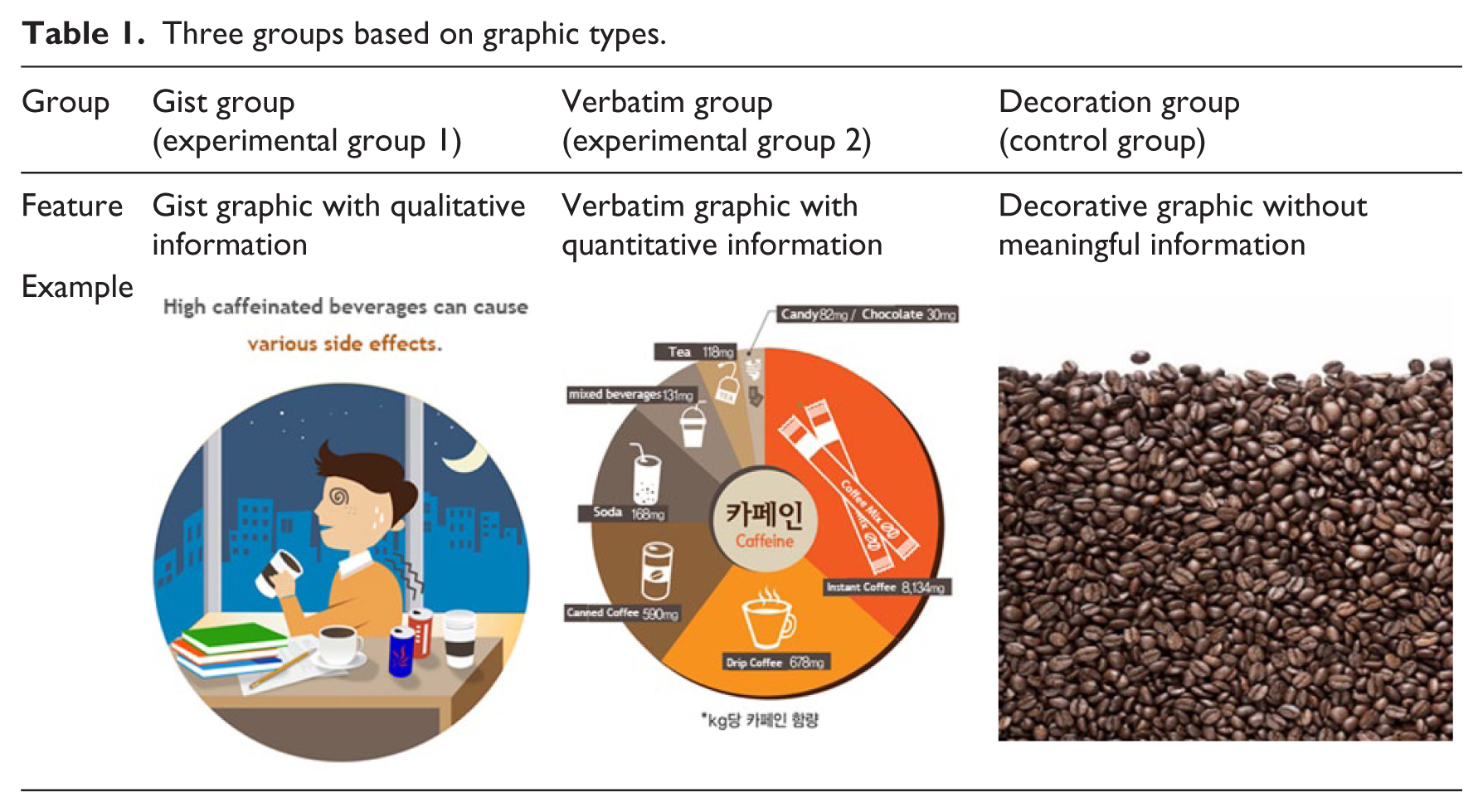
Gist graphics visually presented the essences of health messages along with qualitative information, whereas verbatim graphics included specific and quantitative information, highlighting the details of caffeine risks and control (see Table 1). Decorative graphics visually presented objects (e.g. coffee beans, caffeinated beverages and fresh fruits) related to the health messages but did not include any specific or meaningful messages. The reading materials and graphics were reviewed and validated by four practitioners of KFDI, two experts on health communication and five instructional designers.
Three groups based on graphic types.
In the pre-test (see Supplemental Material 2), we collected the demographic information of students (i.e. sex and birth year) and information about their caffeine consumption. In addition, the pre-test included six items (e.g. ‘I know the side effects caused by drinking too many caffeinated beverages’) about perceived knowledge of caffeine risks with a 5-point Likert-type scale (1 = strongly disagree, 5 = strongly agree). The reliability of the items was high (Cronbach’s α = .81). In both pre- and post-tests, students took the survey on attitude and intention regarding caffeine control. The survey items were modified from previous studies based on the theory of planned behaviour (Ajzen, 2012; Eleni et al., 2006). A total of 10 items were used to measure attitudes (e.g. ‘I think caffeinated drinks harm my health’) and intention (e.g. ‘I will try to have less than one caffeinated drink can per day’) with 5-point Likert-type scales. The reliability of survey items (Cronbach’s α) were .67 and .85 for attitudes and intentions of caffeine control, respectively. In the pre-test, there were no significant differences among the conditions with regard to caffeine intake, F(2, 277) = .44, p = .642, perceived knowledge of caffeine, F(2, 309) = .89, p = .410, students’ attitudes, F(2, 312) = .47, p = .629, and intention of caffeine control, F(2, 312) = 2.13, p = .121.
In the post-test (see Supplemental Material 3), the perceptions of graphics were measured in terms of gist representation, helpfulness, intuitiveness and visual design. A total of 12 survey items were developed based on previous studies (Choi et al., 2014; Mayer and Moreno, 2003; Wilhelms and Reyna, 2013a), using a 5-point Likert-type scale. The gist representation items (e.g. ‘The pictures conveyed the key idea of the reading material’) measured how well graphics represented the essence and meanings of the health message. The helpfulness items (e.g. ‘The pictures offered helpful information’) measured how helpful graphics were in acquiring knowledge or changing beliefs, and the intuitiveness items (e.g. ‘I recognised the meanings of the pictures with one look’) measured how easily students understood the meaning of graphics at a glance. The survey of visual design (e.g. The colour combinations of the pictures were harmonious) measured how well graphics were created with regard to the size, shape, position and colour. The reliability of survey items (Cronbach’s α) ranged from .86 to .90.
In the post-test, we assessed the gist and verbatim knowledge that students acquired from the reading materials. Four multiple-choice questions were closely related to specific information (e.g. ‘What food does not contain caffeine?’) in the reading materials. In addition, the gist knowledge was assessed with four multiple-choice questions such as ‘What is true about the side effects of caffeinated drinks?’ For this question, a correct answer was ‘Caffeinated drinks can cause various side effects’. Students received one point for each correct response to multiple-choice questions; thus, the test scores ranged from 0 to 4 points for each of the gist and verbatim knowledge. Data collection and study protocols were approved by the institutional review board of Seoul National University.
Procedure
An experimental study was conducted to address the research questions, using sex and graphic types as predictors. This experiment was conducted for 35 minutes. First, students in all conditions took the pre-test for 5 minutes. Students responded to the items concerning age, sex, caffeine intake per week, perceived knowledge of caffeine risks and attitudes and intentions towards caffeine control. Then, students read four pages of health messages about caffeine for 15 minutes. Within the given time, students were allowed to read the materials repeatedly. Immediately after finishing the reading activity, students completed the post-test for 15 minutes. The post-test measured gist and verbatim knowledge, as well as the attitude and intention towards caffeine control. In the post-test, students also took the survey on their perception about graphics used in the reading materials.
Data analysis
Statistical analyses were conducted for each research question. First, 2 × 3 analyses of variance (ANOVAs) were conducted to investigate the influence of sex and graphic types on students’ perceptions of graphics (gist representation, helpfulness, intuitiveness and visual design). Second, 2 × 3 ANOVAs were carried out to investigate the influence of sex and graphic types on gist and verbatim knowledge. Third, repeated-measures ANOVAs were conducted to investigate the influence of sex and graphic types on attitudes and intentions towards caffeine control. Finally, a multiple regression analysis was applied to investigate the influence of pre-attitudes, gist knowledge and verbatim knowledge on attitudes towards caffeine control. A multiple regression analysis was also conducted with regard to the intention towards caffeine control, using pre-intentions, gist knowledge and verbatim knowledge as predictors.
Results
Students’ perceptions of gist, verbatim and decorative graphics
For students’ perceptions of gist representation, the 2 × 3 ANOVA indicated that there were no significant influences of sex, F(1, .53) = .90, p = .345, and graphic types, F(2, 1.08) = 1.83, p = .162 (see Table 2). However, there was a significant interaction effect of sex and graphic types on students’ perceptions of gist representation, F(2, 1.89) = 3.21, p = .042. Male students in the Gist (M = 3.98, SD = .78) and Verbatim (M = 3.98, SD = .72) groups more positively perceived graphics with regard to gist representation than those in the Decoration group (M = 3.59, SD = .89), but this difference was not found when it came to female students.
Mean (standard deviation) of variables.
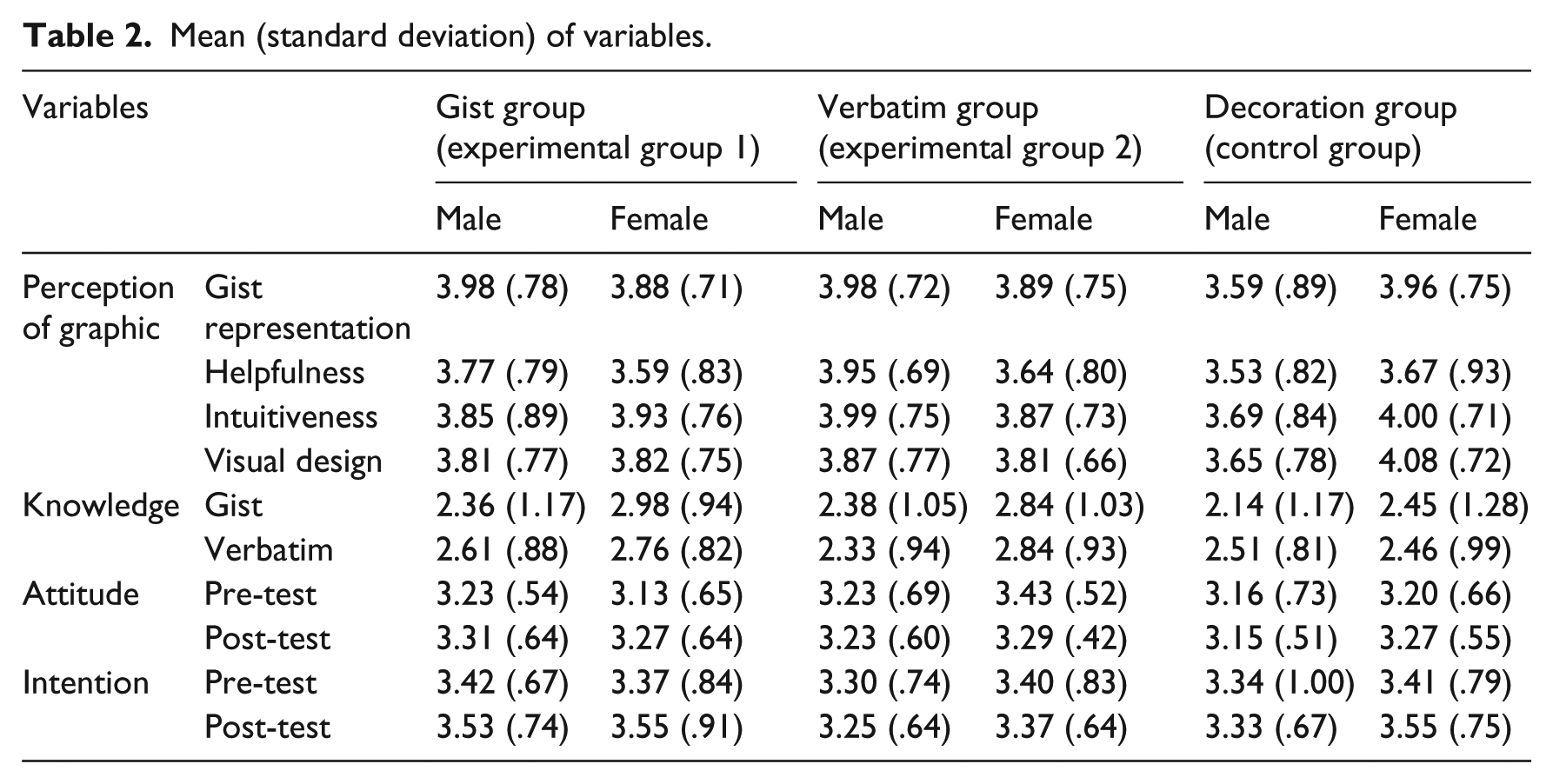
The 2 × 3 ANOVA revealed that there were no significant influences of sex, F(1, .62) = .92, p = .338, and graphic types, F(2, 1.24) = 1.86, p = .158, on students’ perceptions of helpfulness. This study also found no significant influences of sex, F(1, .89) = 1.47, p = .227, and graphic types, F(2, .23) = .38, p = .685, on students’ perceptions of intuitiveness. There were no significant interaction effects of sex and graphic types on students’ perceptions of helpfulness, F(2, 1.29) = 1.93, p = .147, and intuitiveness, F(2, 1.30) = 2.16, p = .117.
Finally, for students’ perceptions of visual design, the 2 × 3 ANOVA indicated that there were no significant influences of sex, F(1, 1.79) = 3.35, p = .068, and graphic types, F(2, .03) = .05, p = .954. However, there was a significant interaction effect of sex and graphic types on students’ perceptions of visual design, F(2, 1.92) = 3.60, p = .029. Male students in the Gist (M = 3.81, SD = .77) and Verbatim (M = 3.87, SD = .66) groups had more positive perceptions of graphics with regard to visual design than those in the Decoration group (M = 3.65, SD = .78). On the other hand, female students in the Decoration (M = 4.08, SD = .72) group more positively perceived the visual design of graphics than those in the Gist (M = 3.82, SD = .75) and Verbatim (M = 3.81, SD = .66) groups.
Influences of sex and graphic types on gist and verbatim knowledge
The 2 × 3 ANOVA revealed the significant influence of sex on gist knowledge, F(1, 16.76) = 13.51, p < .001. Female students (M = 2.75, SD = 1.11) acquired higher gist-knowledge scores than male students (M = 2.28, SD = 1.13). The analysis also indicated that there was a significant influence of graphic types on gist knowledge, F (2, 4.25) = 3.43, p = .034. The post hoc analysis showed that the Gist (M = 2.65, SD = 1.10, p = .015) and Verbatim (M = 2.66, SD = 1.06, p = .045) groups acquired more gist knowledge than the Decoration group (M = 2.30, SD = 1.23). However, there was no significant difference in gist knowledge between Gist and Verbatim groups, p = .707, and there was no significant interaction effect of sex and graphic types on gist knowledge, F(2, .67) = .54, p = .584.
For verbatim knowledge, the 2 × 3 ANOVA indicated a significant influence of sex, F(1, 3.25) = 4.03, p = .046. Female students (M = 2.69, SD = .93) acquired higher verbatim-knowledge scores than male students (M = 2.50, SD = .87). However, there was no significant influence of graphic types on verbatim knowledge, F(2, 1.04) = 1.29, p = .278, and there was no significant interaction effect of sex and graphic types on verbatim knowledge, F(2, 2.03) = 2.52, p = .082.
Influence of sex and graphic types on attitudes and intentions towards caffeine control
The repeated-measures ANOVA indicated that there was no significant difference between pre- and post-attitudes, Wilks’ Λ = 1.00, F(1, 314) = 1.11, p = .292. There was no significant difference in the attitude towards caffeine control between male and female students, Wilks’ Λ = 1.00, F(1, 307) = .05, p = .831. There was also no significant difference among the graphic types, Wilks’ Λ = .99, F(2, 307) = .99, p = .098. There was no interaction effect between sex and graphic types in the attitude towards caffeine control, Wilks’ Λ = 1.00, F(2, 307) = .82, p = .442.
The repeated-measures ANOVA indicated that there was no significant difference between pre- and post-intention, Wilks’ Λ = .99, F(1, 314) = 1.98, p = .161. Moreover, for intention towards caffeine control, the repeated-measures ANOVA indicated that there was no significant influence of sex, Wilks’ Λ = 1.00, F(1, 307) = .97, p = .327 and graphic types; Wilks’ Λ = .99, F(2, 307) = 1.24, p = .291. There was no interaction effect between sex and graphic types in the intention towards caffeine control, Wilks’ Λ = 1.00, F(2, 307) = .13, p = .883.
Influences of gist and verbatim knowledge on attitudes and intentions towards caffeine control
A multiple regression analysis was conducted to investigate the influence of gist and verbatim knowledge on attitudes towards caffeine control (see Table 3). The results showed that the model including pre-attitude and gist and verbatim knowledge as predictors significantly influenced students’ attitudes towards caffeine control, F(3, 311) = 34.41, p < .001. The predictors explained 24.2% of the variance in students’ attitudes towards caffeine control. There were significant influences of pre-attitude, β = .45, p < .001, and gist knowledge, β = .18, p = .001 on the attitude, whereas there was no significant influence of verbatim knowledge, β = −.01, p = .897.
Multiple regressions for attitudes and intentions towards caffeine control.
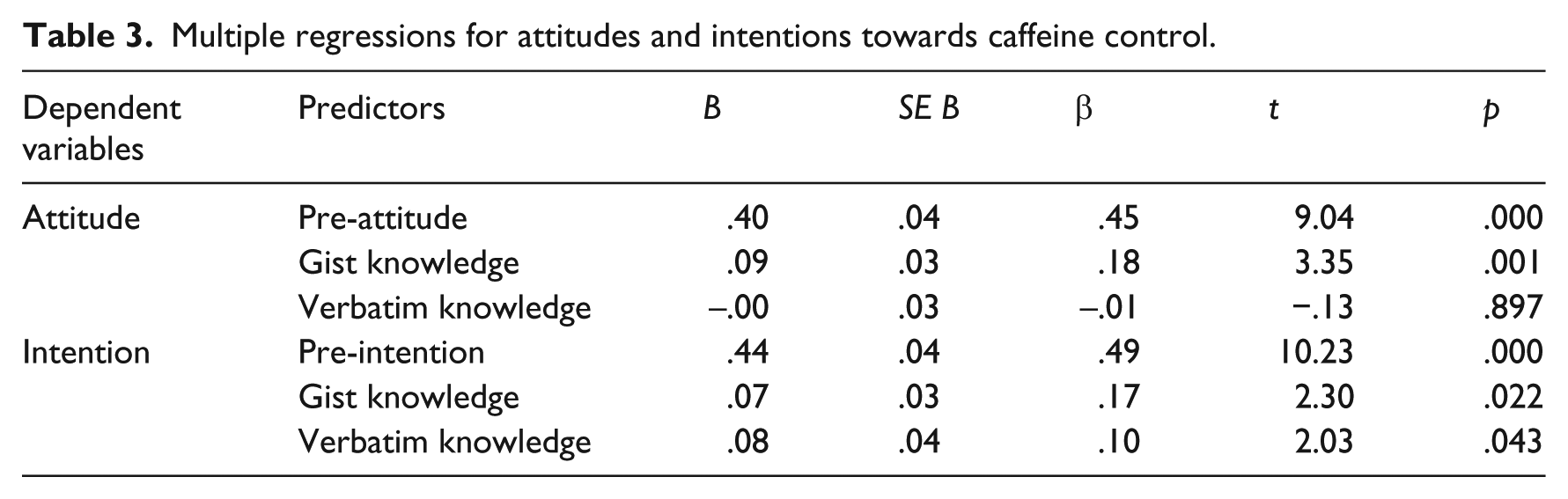
In addition, a multiple regression analysis showed that pre-intention and gist and verbatim knowledge explained 30.7% of variance in the intention of caffeine control, F(3, 311) = 45.87, p < .001. There were significant influences of pre-intention, β = .49, p < .001, gist knowledge, β = .17, p = .022, and verbatim knowledge, β = .10, p = .043, on the intention of caffeine control.
Discussion
This study explored the gist-based design of health messages, focusing particularly on graphics that facilitate an intuitive understanding of information and knowledge. This study assumed that gist-based design of graphics would be helpful in gist-knowledge acquisition, which might lead to changes in young people’s attitudes and intentions towards caffeine control. This assumption was partially supported in the study. The gist graphics were more effective in acquiring gist knowledge than decorative graphics, but there was no difference between gist and verbatim graphics. In addition, male students perceived the strengths of gist graphics, whereas female students did not perceive that gist graphics were better than decorative graphics. Although there was no direct effect of gist graphics on attitudes and intentions towards caffeine control, this study found an indirect effect of gist graphics; gist graphics positively influenced the acquisition of gist knowledge, which in turn significantly influenced both attitudes and intentions towards caffeine control.
Compared with decorative graphics, gist and verbatim graphics were more beneficial in gist-knowledge acquisition. This result is consistent with findings from previous studies showing that graphic types or formats influenced the understanding of health messages and effective decision-making (Blalock and Reyna, 2016; Feldman-Stewart et al., 2007; Hawley et al., 2008). Although health publications and web pages frequently include decorative graphics (Cho et al., 2014), this study suggests that health educators use graphics that include health messages. Decorative graphics may attract the attention of readers in the short term, but they have limitations in facilitating a deep understanding of health messages.
Nevertheless, female students perceived decorative graphics as positively as gist and verbatim graphics with regard to gist representation. In contrast, male students perceived that gist and verbatim graphics better represented the gist of messages than decorative graphics. In this study, female students might consider the aesthetic aspect of decorative graphics important in representing the gist of the health messages about caffeine consumption. In addition, female students might judge how well the graphics represented the gist of messages through considering both graphics and texts comprehensively, whereas male students might concentrate on graphics. According to the selectivity model (Darley and Smith, 1995; Meyers-Levy and Sternthal, 1991), women are likely to comprehensively analyse and use all available information, while men tend to selectively focus on highly available and salient information for judgement. Although decorative graphics themselves did not include the gist message, the graphics might be perceived to represent the gist when they were processed along with the text.
Study findings did not support the prediction that gist graphics would be more effective for gist knowledge acquisition than verbatim graphics. There was no significant difference in memorising the gist of health messages between Gist and Verbatim groups. This result is not consistent with those of previous studies that support the effectiveness of simple graphics representing the bottom line of health messages (Brewer et al., 2012; Brundage et al., 2005). However, it should be noted that the graphics were given with texts in this study. Participants might construct their knowledge based on both graphics and texts (Mayer and Gallini, 1990). Thus, the understanding of text messages might offset the influence of graphic types. In addition, students might easily encode both gist and verbatim representations from the verbatim graphics in this study. According to FTT, people usually encode the gist representation in parallel with the verbatim of the same message (Reyna, 2012b). Literature on FTT shows that intuitive graphics, such as line graphs, pictographs and bar graphs, can be helpful in acquiring gist knowledge (Brewer et al., 2012; Brust-Renck et al., 2013; Fraenkel et al., 2012; Wolfe et al., 2015). Even when a graphic represents verbatim messages (e.g. numeric information), a well-designed graphic can encourage people to automatically grasp the bottom-line gist of the message (Reyna, 2008).
In addition, this study found no significant influence of graphic types on verbatim knowledge gains. Similarly, Tzeng (2010) found that both comprehensive and thematic concept maps, which visually represent knowledge with nodes and links, were not helpful in memorising a text verbatim but significantly enhanced gist comprehension. Hannus and Hyönä (1999) found that students paid little attention to graphics, even when three to six graphics were included per page in a textbook. These studies imply that students may rely on texts more than graphics when acquiring verbatim knowledge. In addition to the efforts to encourage students to pay more attention to graphics (Cho and Jonassen, 2012), more research is necessary to investigate how students process information when a text is given with different types of graphics.
According to FTT, people use both verbatim and gist representations when a task does not require a particular representation (e.g. rote memory of information). However, people prefer using simple gist knowledge when making a decision whenever the task allows (Reyna, 2012b). For example, when making a decision on drinking a caffeinated beverage, students may rely on the knowledge that caffeine consumption is harmful to health rather than the probability of health problems caused by caffeine (e.g. 65% chance of becoming obese). Similarly, this study found that gist knowledge played an important role in determining students’ attitudes and intentions towards caffeine control. Although the study did not find direct effects of graphic types on the attitude and intention, graphic types had indirect effects through first affecting gist knowledge. These findings imply that graphics should be carefully designed to help adolescents acquire the gist knowledge of a health message, which influences their attitude and intention regarding health-related issues like caffeine consumption.
Limitations
This study had a few limitations that should be considered when applying the findings to other contexts or future research. Although the study developed the reading material based on the articles of KFDI, the material had limitations in changing secondary school students’ attitudes and intentions towards caffeine control. More attention should be paid to the contents of health messages, which should be developed on the basis of research findings and help young people distinguish healthy from unhealthy caffeine consumption. In addition, future research should consider previous caffeine consumption levels of adolescents, which may moderate the influence of health messages on changes in attitudes and intentions. Regardless of what health messages are given, adolescents who have already used caffeine within the recommended daily allowances may not feel the need to change their intention towards caffeine consumption. For a more accurate analysis, it is also necessary to examine the change of gist and verbatim knowledge on caffeine control by measuring the knowledge at both pre- and post-test. This study confirmed that there was no significant difference among the research groups in perceived knowledge of caffeine risks at the pre-test but did not measure prior gist and verbatim knowledge. Finally, more research is necessary to investigate the interaction between individual characteristics (e.g. visual literacy, prior knowledge and motivation) and the design of health messages. The effect of graphics will be enhanced when they are designed through a consideration of different abilities and characteristics of young people themselves.
Supplementary Material
Supplementary Material, Supplementary_materials_0041FINAL – Gist-based design of graphics to reduce caffeine consumption among adolescents
Supplementary Material, Supplementary_materials_0041FINAL for Gist-based design of graphics to reduce caffeine consumption among adolescents by Young Hoan Cho, Myoungsoon You and Hyoseon Choi in Health Education Journal
Footnotes
Authors’ Note
Hyoseon Choi is now affiliated with College of Medicine, Chosun University, Gwangju, Korea.
Funding
The author(s) disclosed receipt of the following financial support for the research, authorship, and/or publication of this article: This study was supported by the Ministry of Food and Drug Safety (MFDS, 13162-830) in South Korea.
Supplemental Material
Supplemental material for this article is available online.
References
Supplementary Material
Please find the following supplemental material available below.
For Open Access articles published under a Creative Commons License, all supplemental material carries the same license as the article it is associated with.
For non-Open Access articles published, all supplemental material carries a non-exclusive license, and permission requests for re-use of supplemental material or any part of supplemental material shall be sent directly to the copyright owner as specified in the copyright notice associated with the article.
