




Abstract
This study aims to reveal the need to reformulate new forms of Bilateral Trade Balances (BTBs) for a country rather than a traditional BTB. This is because the traditional BTB ratio, based on total exports and defined as the total exports/total imports ratio, cannot classify and quantify a BTB based on its economic impact content. It fails to classify because countries also export goods already imported (denotes re-export) besides exporting their domestic goods produced within the country (denotes domestic export). It also fails to quantify because, while domestic goods undergo a value-added process within a country, re-exported goods do not. In this context, for the first time, this study attempts to reformulate/reinvestigate new forms of BTBs as production-related BTB, based on domestic export and non-production-related BTB, based on re-export for the USA with Japan. Empirical findings confirm the necessity and cruciality of the proposed methodology in this study.
Keywords
Introduction
The USA has been experiencing the most enormous and persistent trade deficits with other countries since 1992, reaching a total of $16 trillion. On the other hand, Japan, with a $1.99 trillion trade surplus with the USA, is one of these countries in the same period (CB, 2021). Accordingly, periodic trade conflicts between the USA and Japan were partly a consequence of Japanʼs high-level import penetration into the US markets (Cohen et al., 2002; Marlin‐Bennett et al., 1992; Sato, 1988; Thorbecke, 2008; Wickes, 2021). Therefore, these large trade deficits periodically deteriorated the US-Japan economic relationships (Cimino-Isaacs & Williams, 2020; Urata, 2020).
On the other hand, according to a survey conducted by Harvard University, while 47% of Americans believe that free trade leads to lower goods prices for US consumers, 53% think that this causes job losses in the country (CAPS, 2018). These close percentages clearly show that bilateral trade deficits and surpluses resulting from free trade should eventually be based on economic impact contents for the countries concerned. This means that the economic impact of a negative or a positive Bilateral Trade Balance (henceforth, BTB) might become more important than solely a countryʼs negative or positive BTB ratios. For instance, the final economic contribution of a production-related BTB, based on domestic export, 1 might become lower for a country than the final economic contribution of a non-production-related BTB, based on re-export. 2 In other words, for some goods, a non-production-related BTB might contribute to a countryʼs economy more than a production-related BTB even though the former does not undergo any value-added process in this country (Banerjee, 2019). Therefore, this complex structure requires creating new forms of BTBs rather than using a traditional aggregated BTB ratio, based on total export only, since total export includes domestic export and re-export. However, the lack of re-export data for many countries does not allow policymakers-scholars to make more accurate estimations in their trade policies-models. In this context, the USA is one of few countries that collect this data separately since the share of US re-exports to other countries came to 19.7% of total exports in 2020. As the fourth largest trade partner of the USA, Japan is one of the countries involved, with a share of 11.5% (CB, 2021).
Therefore, in this study, we, for the first time, propose to reformulate and re-investigate the BTBs of the USA with Japan in the forms of production-related BTB and non-production-related BTB, based, respectively, on domestic export and re-export separately. With these two forms of BTBs proposed, this methodology will be capable of quantifying BTBs based on economic impact content as opposed to total-export BTB. In this context, the main contribution of this study is to discover concealed but potentially existing, actual impacts of independent variables on the above-mentioned forms of BTBs since total-export BTB is not capable of detecting them. Hence, this methodology might allow policymakers to compare such impacts on negative-positive BTBs for the USA based on economic impact contents. This is so because a BTB can be positive (trade surplus) but in the form of non-production-related BTB, or a BTB can be negative (trade deficit) but in the form of production-related BTB. It is obvious that the contribution of production-related BTB to the economy will be larger than non-production-related BTB. Hence, this methodology will answer a crucial question of what kind of trade deficit the USA has, rather than a trade deficit only as a single value. This information can provide more efficient and sustainable trade policies to USA policymakers. Therefore, this study, using the methodology mentioned above, differs from all previous empirical studies that use the concept of BTB as a ratio of total export (x)/total imports (m) or m/x (Arize, 1994; Baek & Choi, 2020; Bahmani-Oskooee & Alse, 1994; Bahmani-Oskooee & Artatrana, 2004; Bahmani-Oskooee & Hegerty, 2009; Bahmani-Oskooee & Karamelikli, 2021; Gupta-Kapoor & Ramakrishnan, 1999; Hacker & Abdulnasser, 2003; Magee, 1973; Ongan & Gocer, 2021).
Empirical Model
The empirical model of this study originates from the following most used form equation between a dependent variable and traditional independent variables for the USA. Additionally, as the second contribution of this study is that, in this model, we add trade policy uncertainty (TPU) indexes for US

Following Equation (1), we re-construct the model above based on the methodology proposed in this study by adding the new version forms of BTBs (dependent variables) BTBs as production-related BTB and non-production-related BTB. To show this proposed methodological approach clearly, we present the following model in a non-logarithmic form; however, we estimate the model with logarithmic variables:
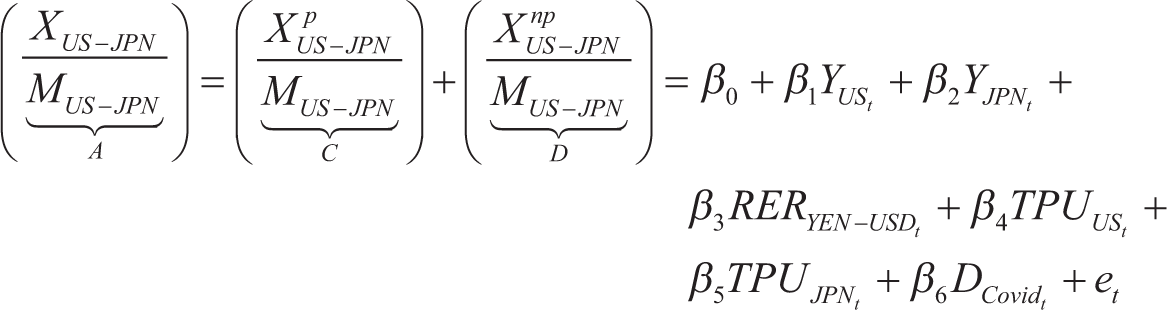
since
Empirical Methodology
To reveal the separate impacts of increases (+) and decreases (–) in US’s

where


Since the error term can be defined as

so, we can define the positive and negative shocks of TPU as:
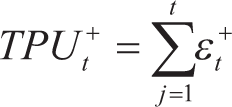
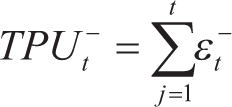
if we set the equation based on ft in Equation (3):

we obtain the following equations when we add


where
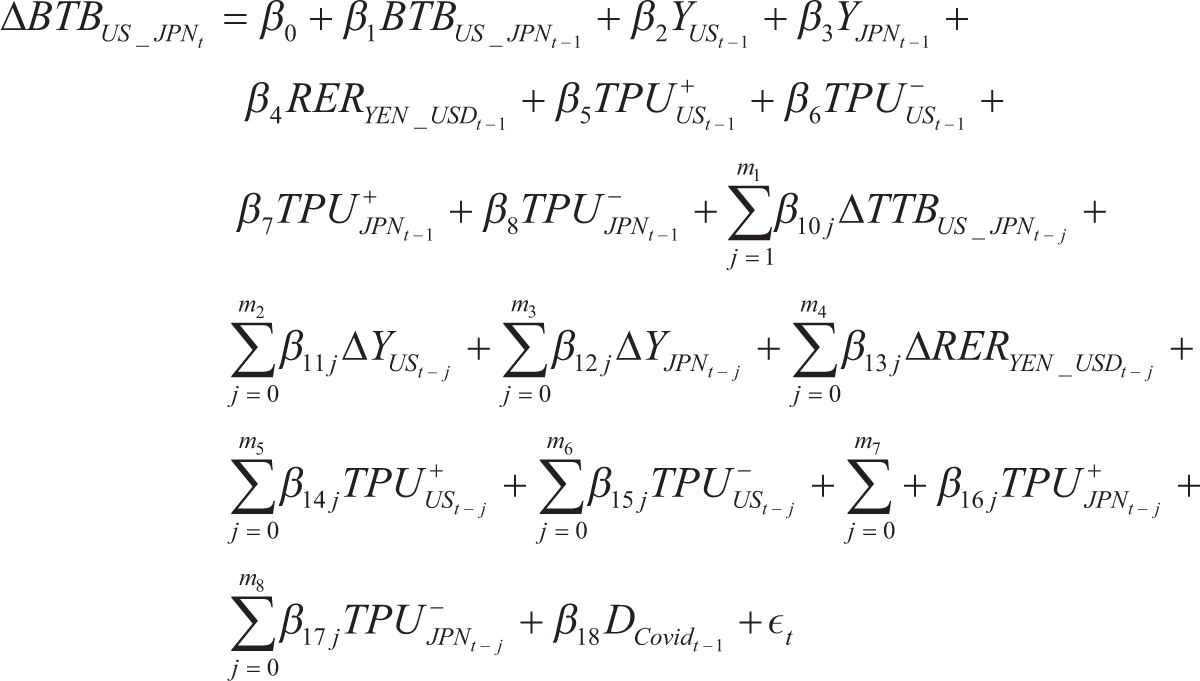
In Equation (12), the long-run impacts of US and Japan’s
Empirical Findings
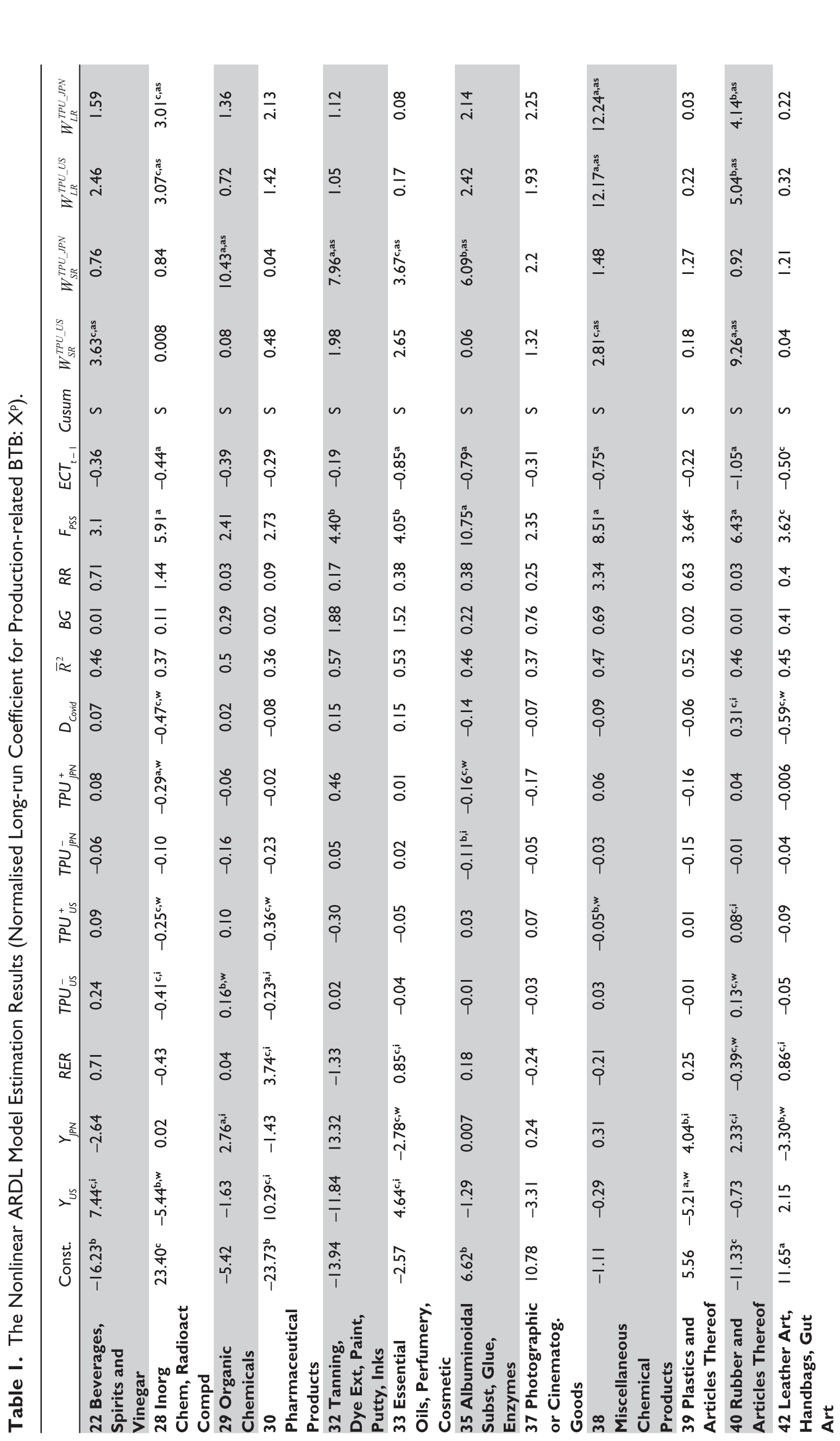
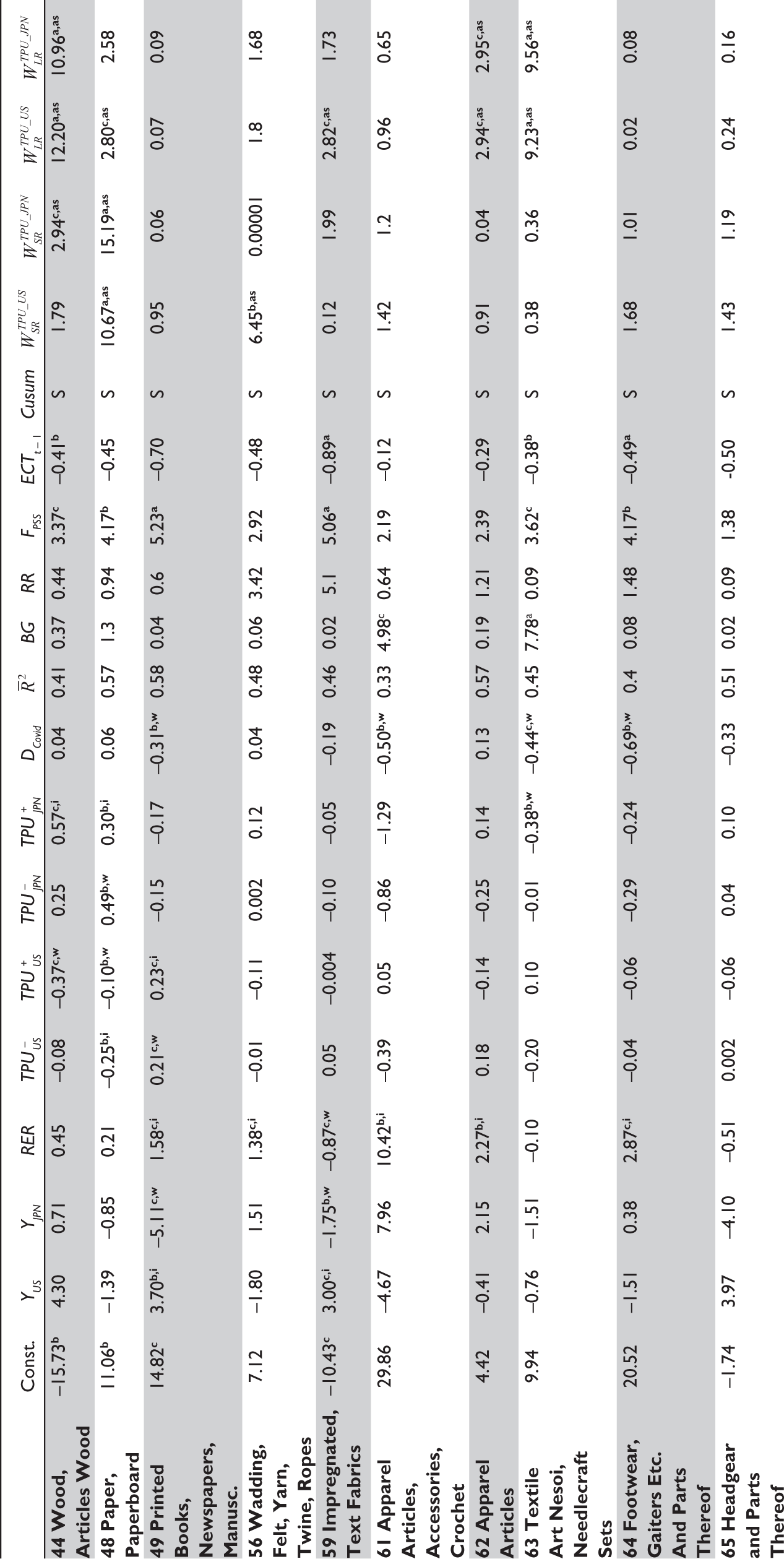
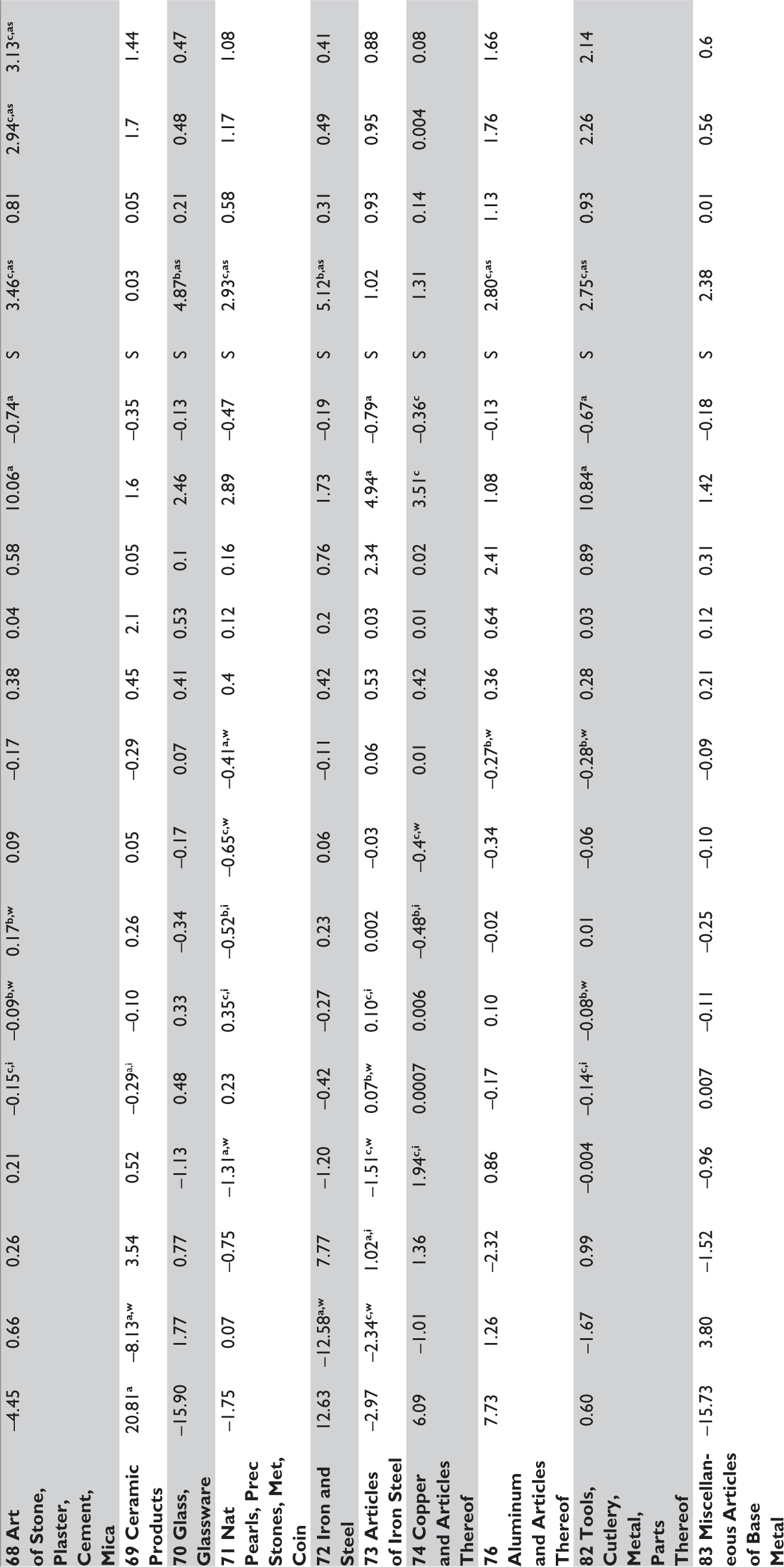
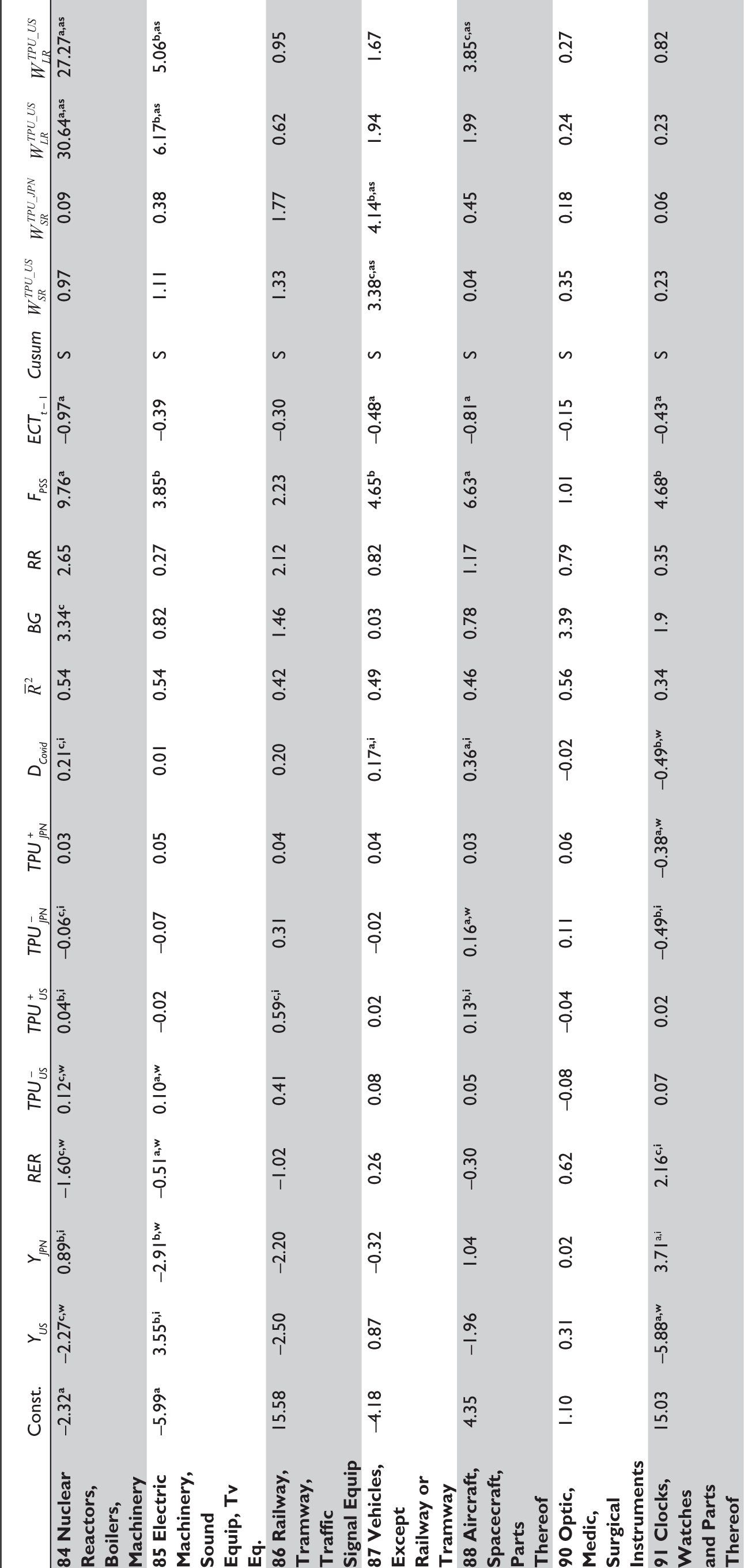
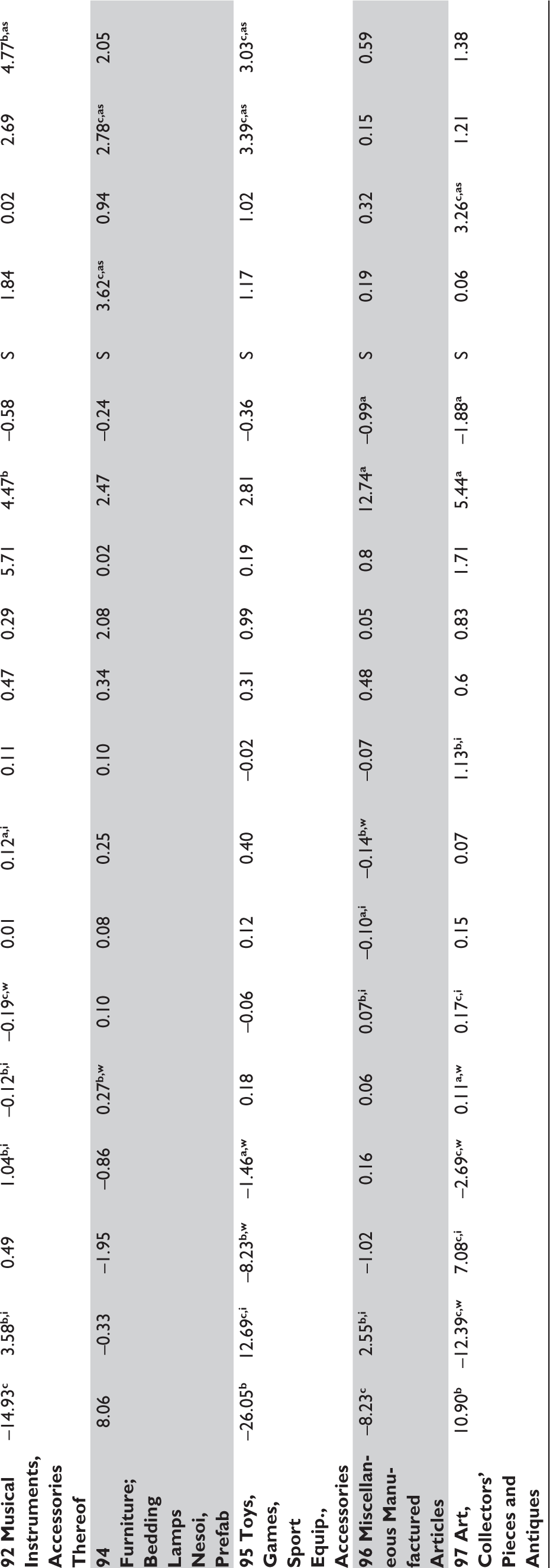
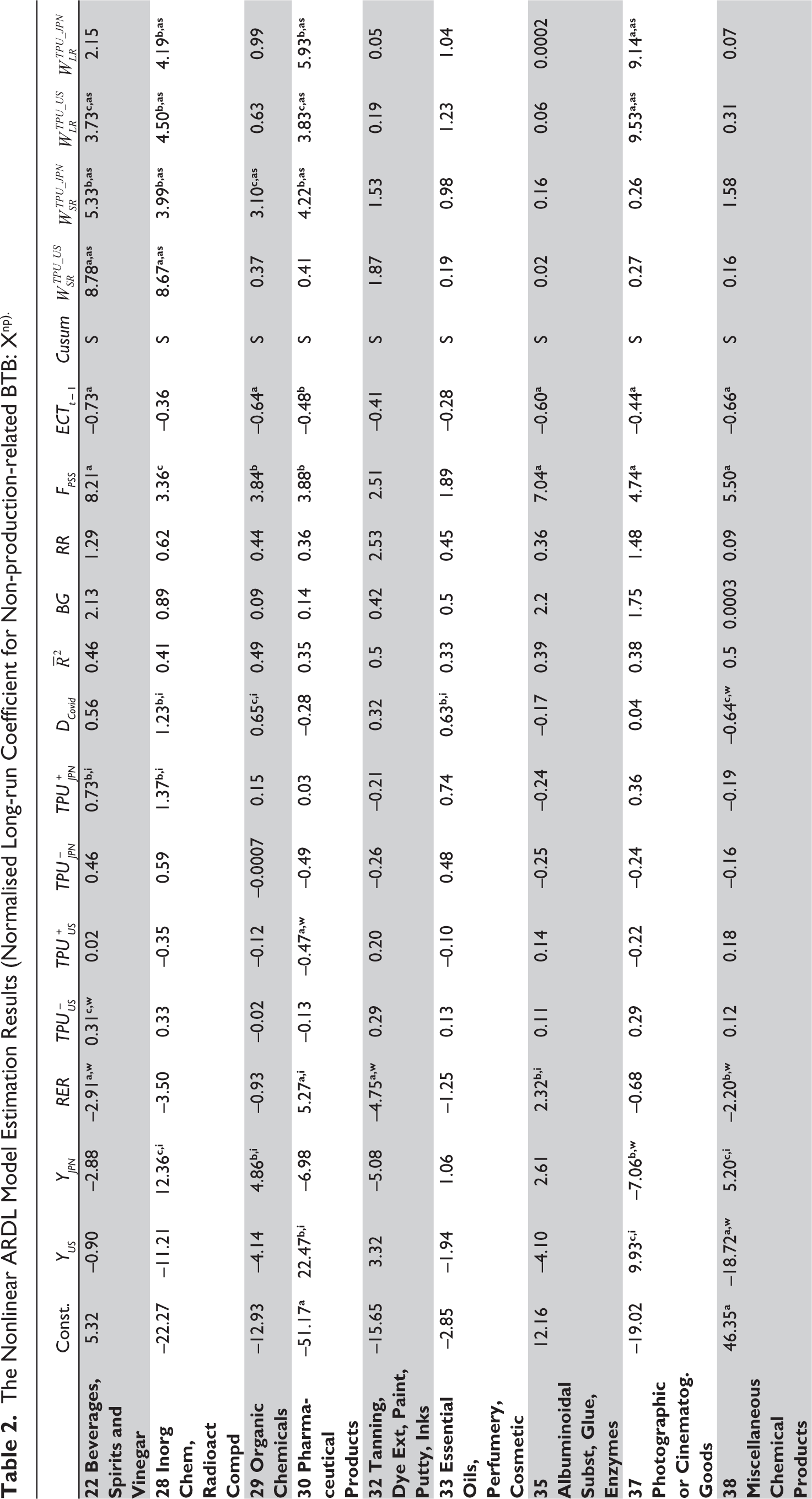
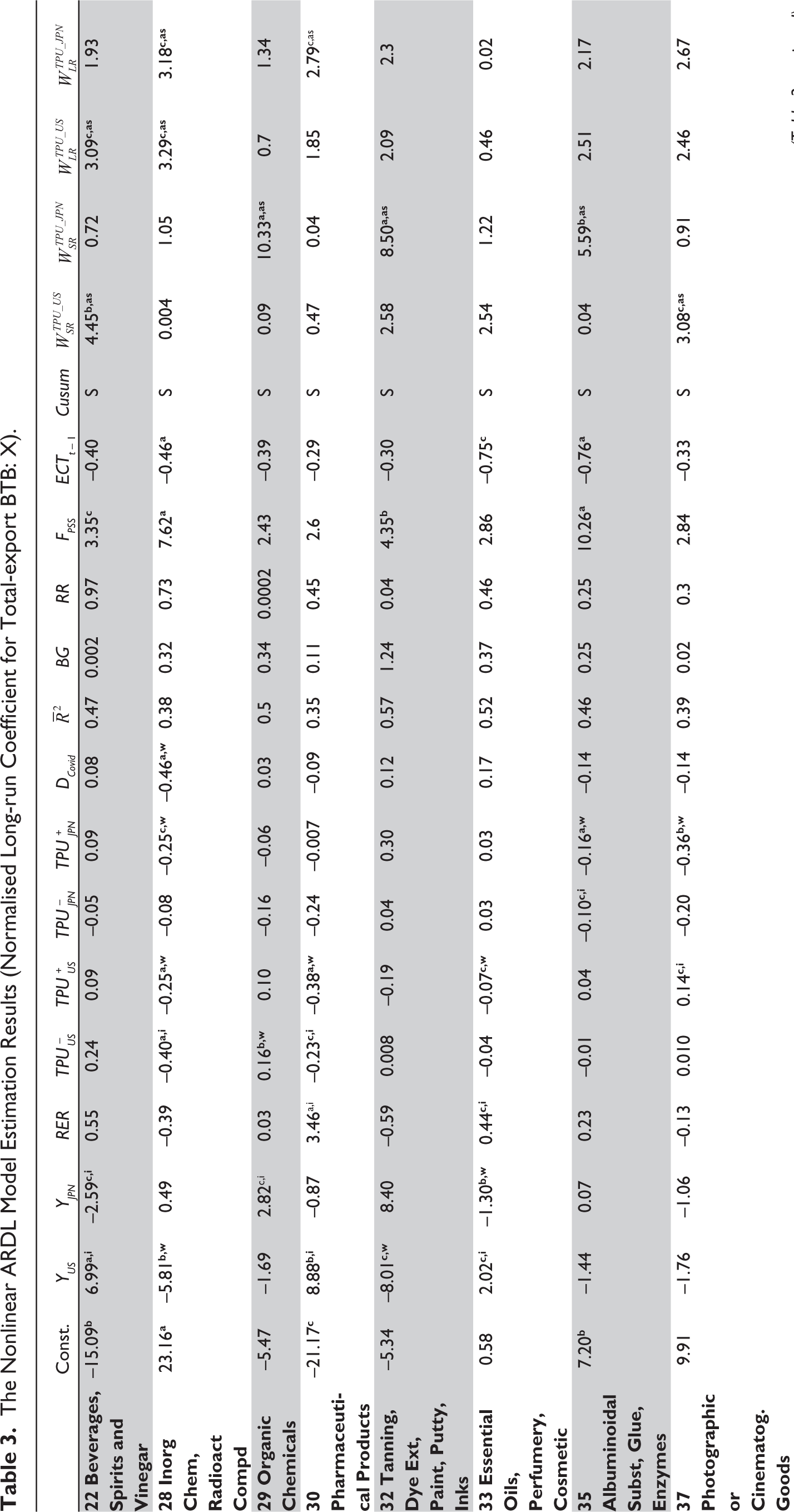
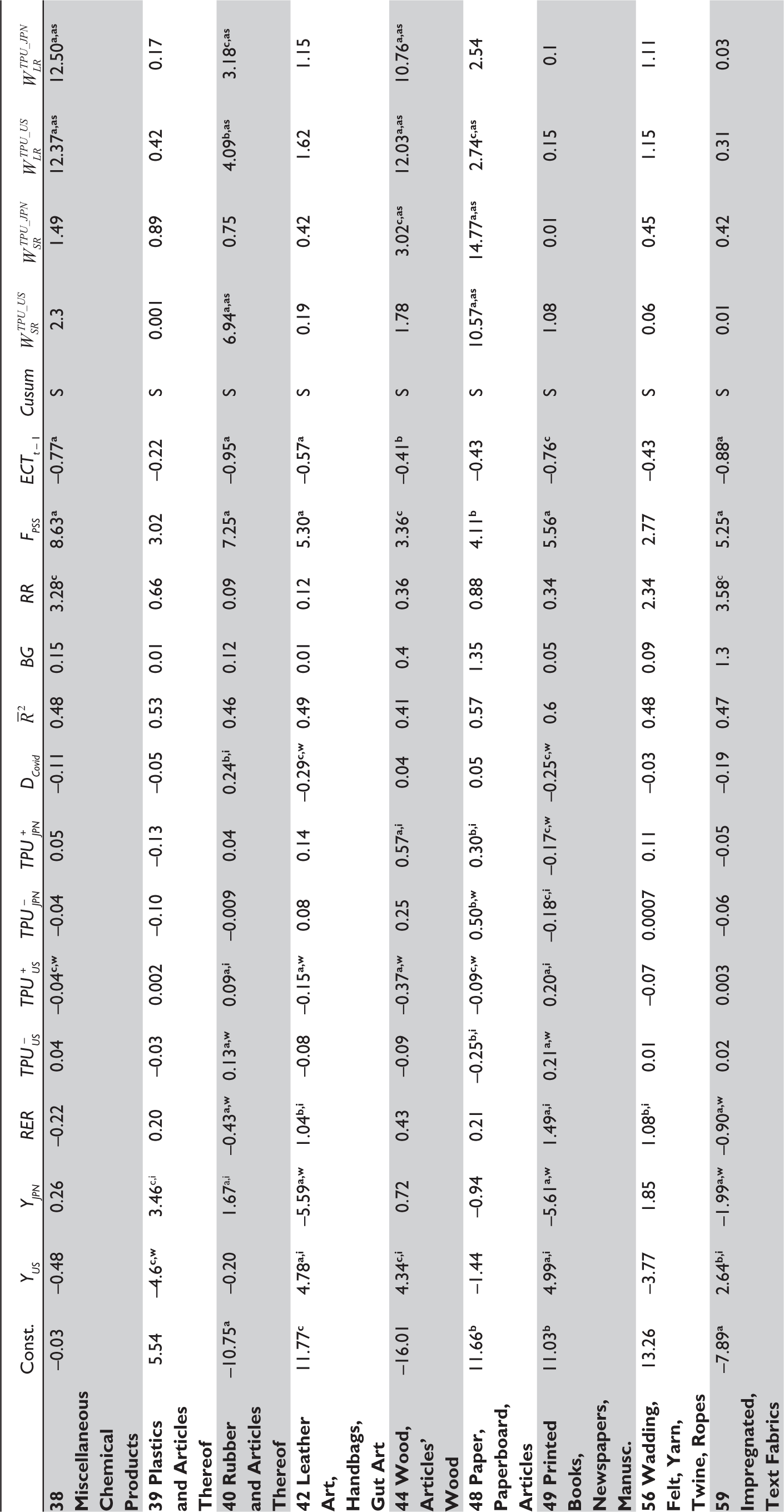
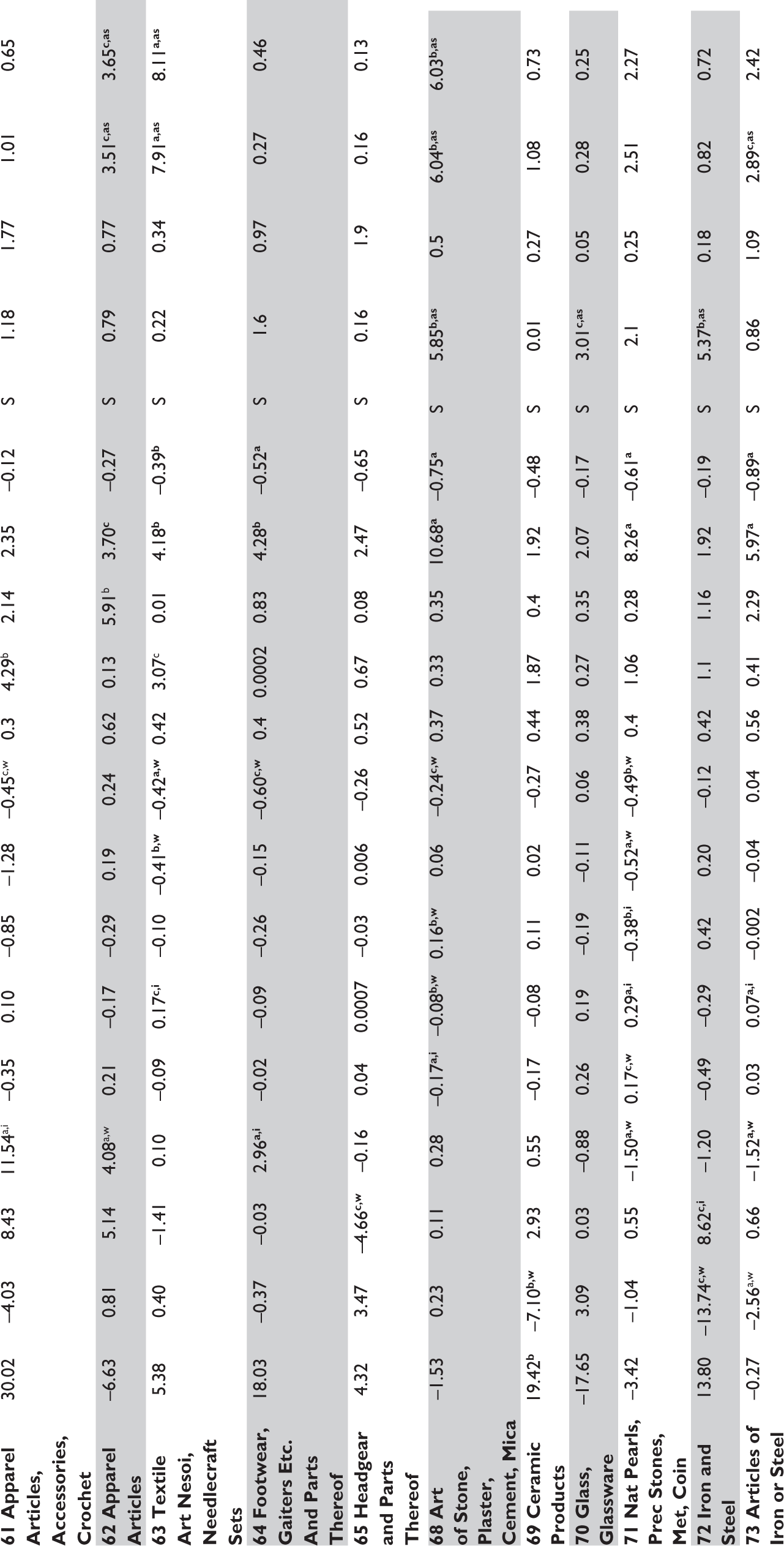
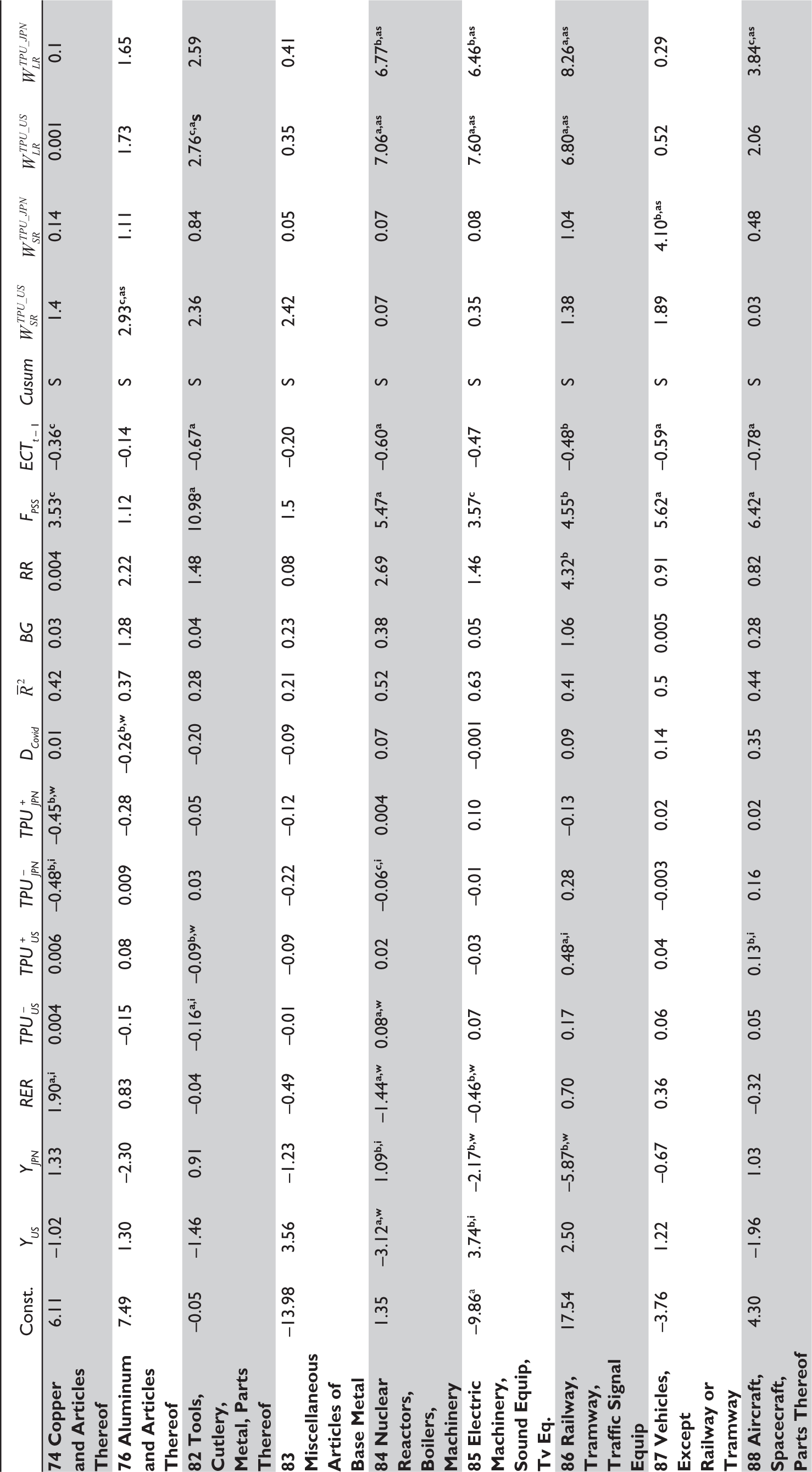
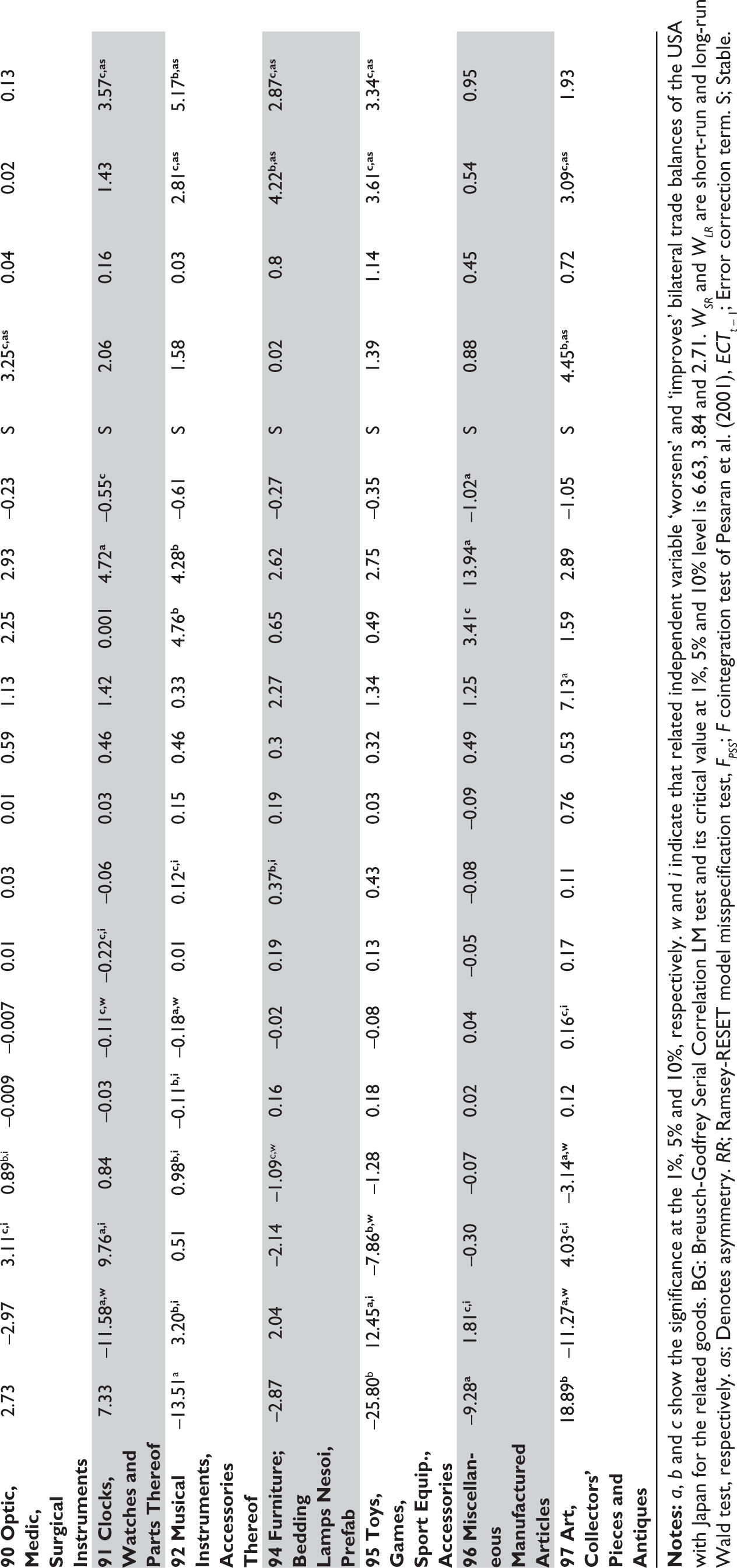
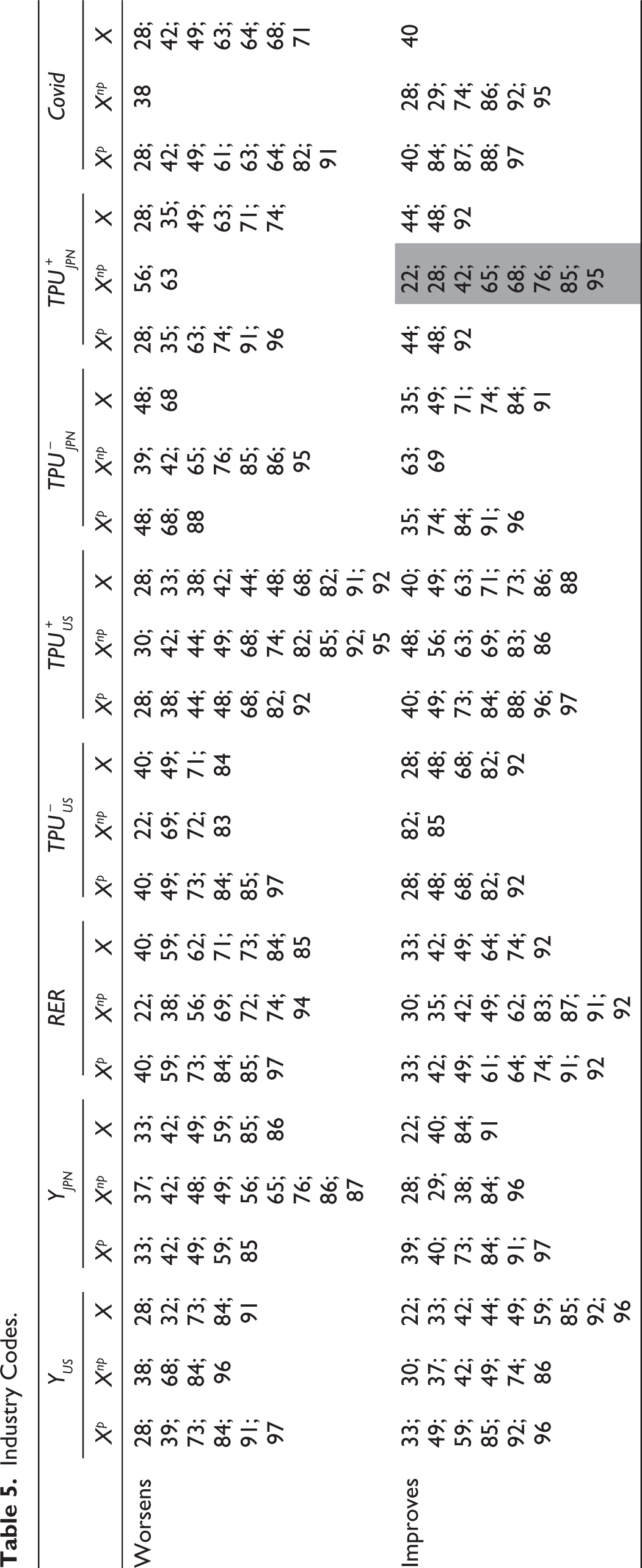
We provide the estimations of normalised long-run coefficients and diagnostics of the NARDL model in the following Tables 1–3 for production-related BTB, non-production-related BTB and total-export BTB, respectively. Additionally, we present a summary Table 4 (derived from Tables 1–3) that clearly shows whether changes in independent variables worsen or improve BTBs above, separately. The letters ʻw’ and ʻi’, in Tables 1–3. Furthermore, worsening and improvement numbers in Table 4 and their code numbers in Table 5 are only the BTBs of the industries that have long run cointegration by either the F test of Pesaran et al. (2001) or ECT test. We report the model estimations and diagnostic test results in the following tables only for the long-run since this study is a long-run analysis.
The Nonlinear ARDL Model Estimation Results (Normalised Long-run Coefficient for Production-related BTB: Xp).
The Nonlinear ARDL Model Estimation Results (Normalised Long-run Coefficient for Non-production-related BTB: Xnp).
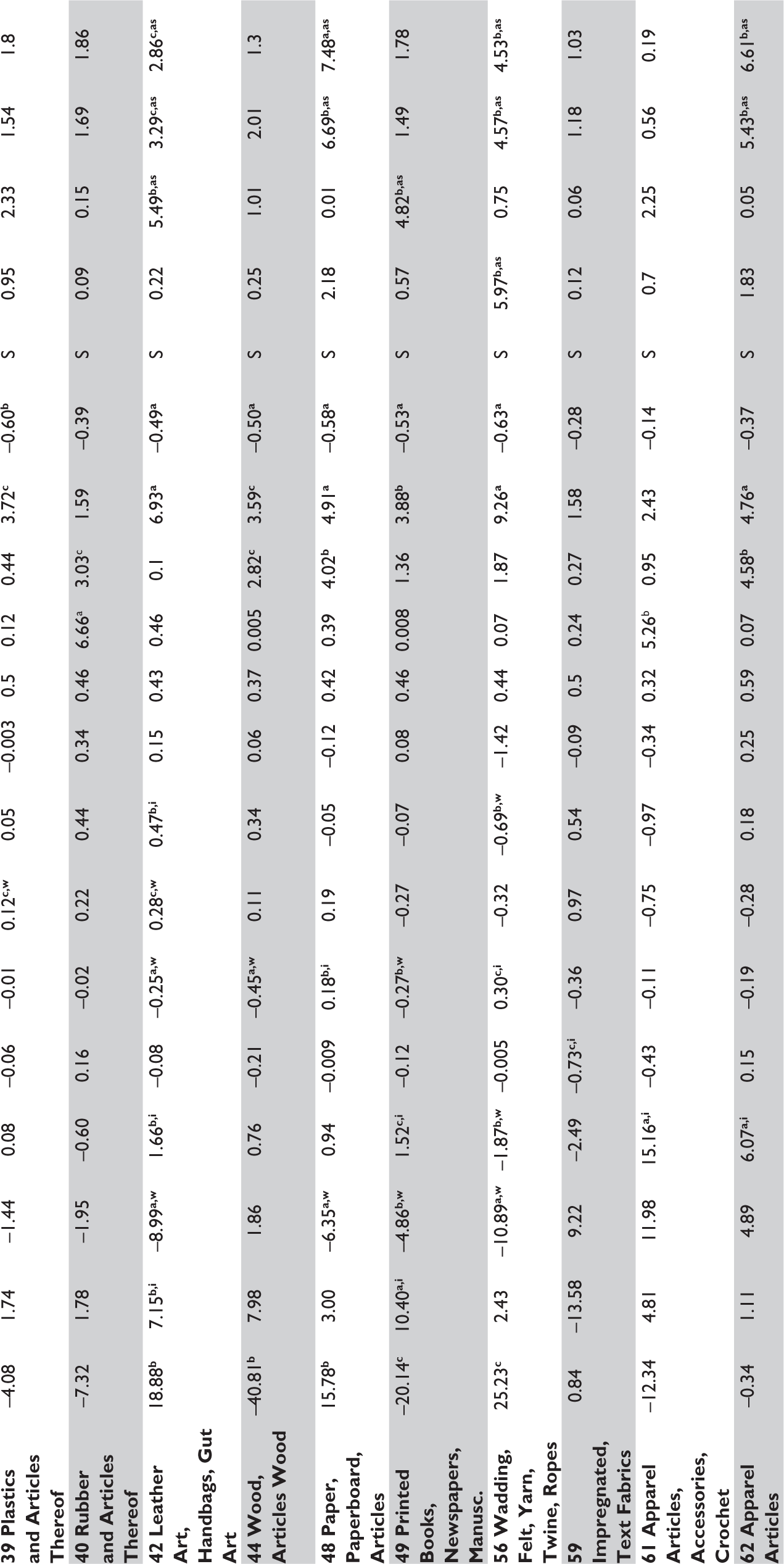
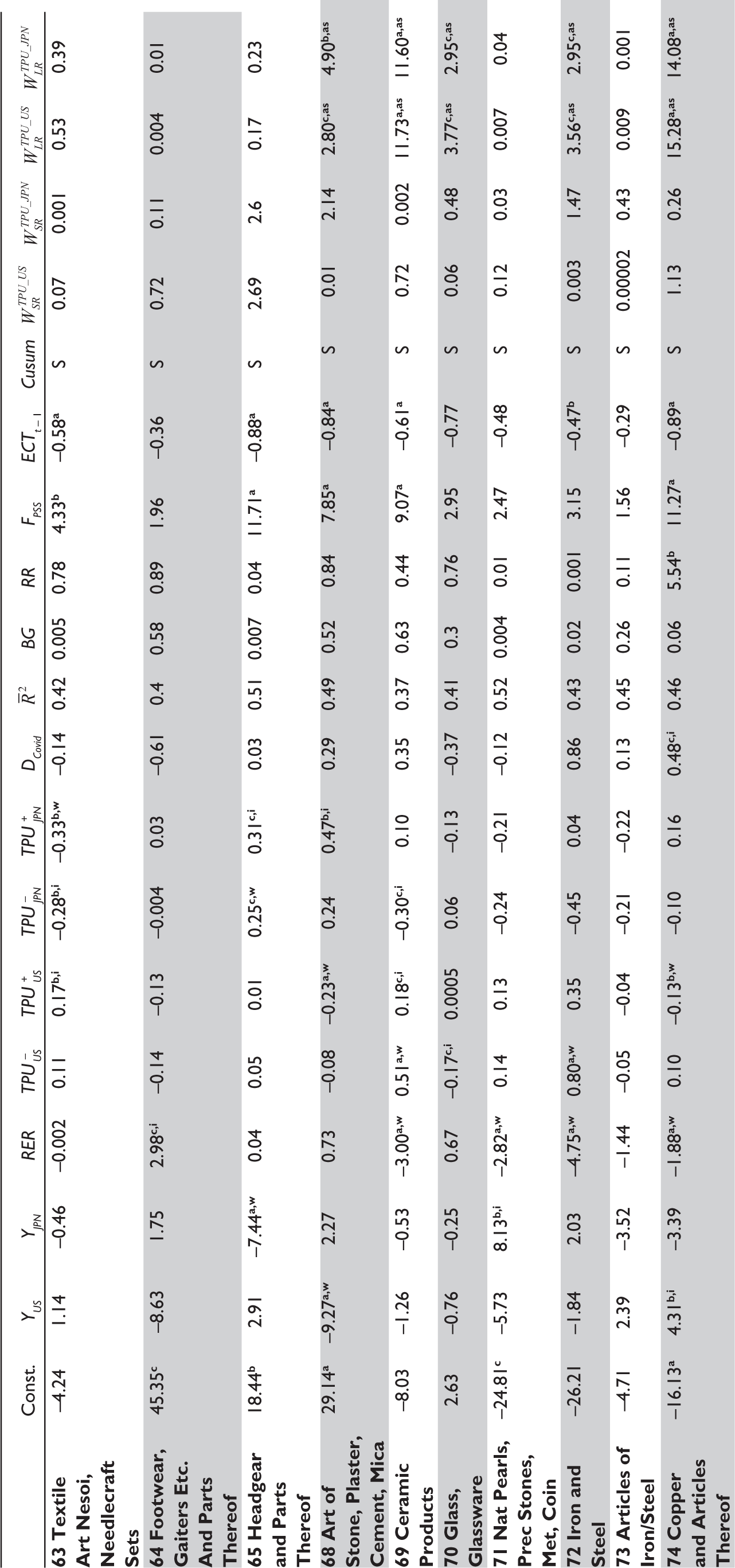
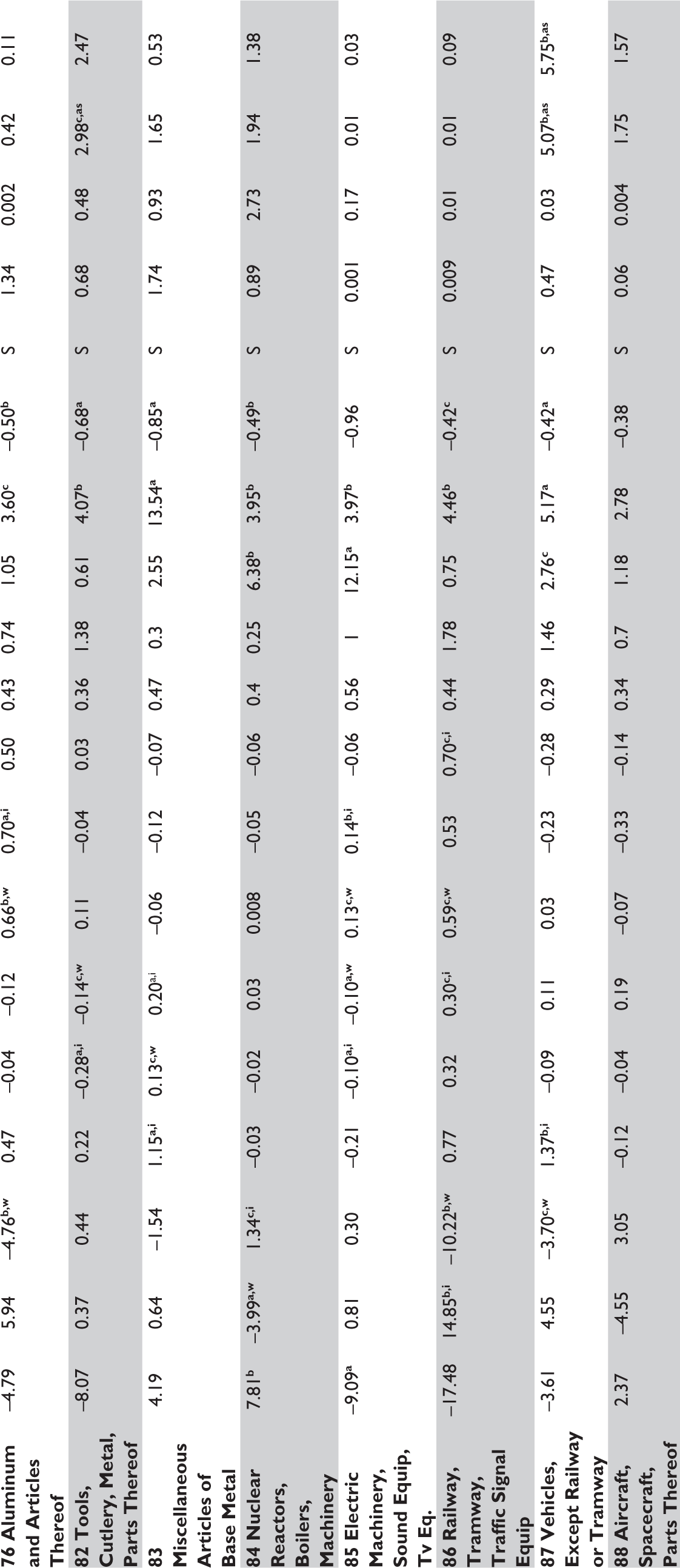
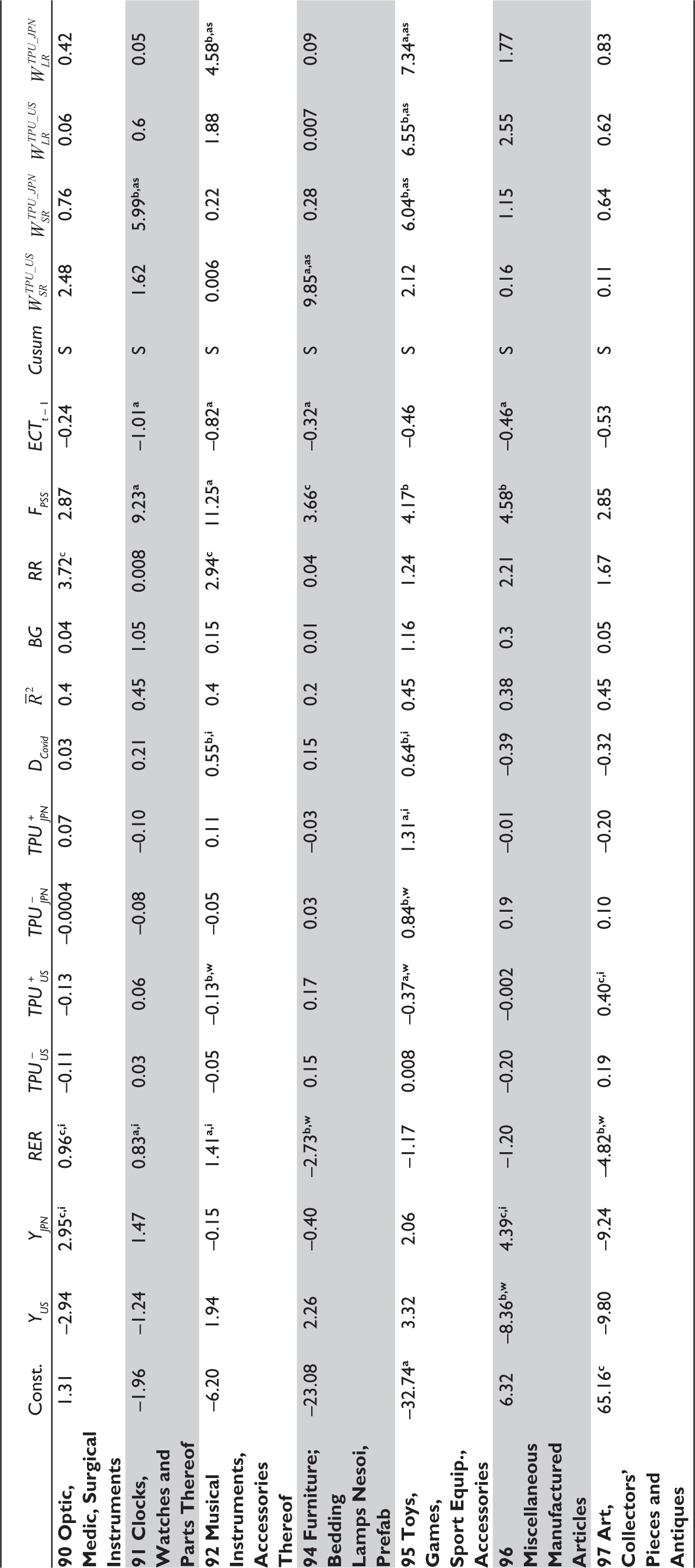
The Nonlinear ARDL Model Estimation Results (Normalised Long-run Coefficient for Total-export BTB: X).
Total Numbers of Improvement and Worsening Impacts on BTBs and Industry Codes.

Industry Codes.
Before examining the impacts of independent variables on different forms of US BTBs with Japan, we re-explain the definitions of the abbreviations used in Tables 1–5 and the paragraphs below for easy reading. Xp: production-related BTB (based on US domestic goods), Xnp: non-production-related BTB (based on US re-eorted goods), and X: total-export BTB (based on US total export). Test results in the tables above clearly reveal that a bilateral trade model of the USA with Japan should be constructed and analysed on the proposed forms of BTBs separately rather than a traditional BTB, constructed on total export/total import. Because the impacts of independent variables on production-related BTB (Xp), non-production-related BTB (Xnp) and total-export BTB (X) are entirely different. For example, while a rise in Japan’s TPU index (
However, while a fall in Japan’s TPU index (
On the other hand, rises and falls in total in the US TPU index have more impacts on Xp and Xnp than the impacts of rises and falls of Japan’s TPU index. This may stem from the fact that the US economy is much larger than Japan’s; thereby, US imports from Japan are more than Japan’s imports from the USA. Therefore, changes in TPU in the USA play a more determining role than changes in Japan on bilateral trade volumes between two countries. This result can also be explained from the Japanese consumers’ side only since Hofstede (1980) states that the Japanese are one of the highest uncertainty avoidance people.
Furthermore, Japanese consumers purchase (import) fewer re-exported goods (Xnp) from the USA than US domestic goods (Xp) when their income rises (nine and five). Regarding the impact of the exchange rate, the improvement impact of real depreciated USD on Xp and Xnp is more than its worsening impact. Japanese consumers with stronger YEN purchase (import) slightly more US re-exported goods (Xnp) than US domestic product goods (Xp). Lastly, test results in the tables above indicate that the worsening impact of the COVID-19 pandemic on US domestic product goods (Xp) is much higher than on re-exported goods (Xnp). This can be interpreted to mean that the COVID-19 pandemic negatively affects US domestic goods more than re-exported goods. If we relied only on traditional trade balance (X), we would not see that the COVID-19 pandemic improved production-related BTB for five industries and non-production-related BTB for six industries.
Additionally, Table 5 reports the BTBs based on industries (with their codes) and how they are affected (improved or worsened) by changes in both countries exchange rates, incomes and TPU indexes. For instance, a rise in Japan’s TPU index (
Conclusion
This study’s main aim is to reveal the need to analyse BTB models with new forms of BTBs for two reasons. The first reason is that the traditional form of BTB, based on a total export/total import ratio, assumes that countries export only their domestic goods produced within their countries (denotes domestic export). However, countries also export some goods already imported from other countries (denotes re-export). Therefore, we should redefine and reformulate new forms of BTBs constructed on domestic goods and re-exported goods separately to achieve more accurate results. In this context, we, for the first time, attempted to reformulate two new forms of BTBs as the production-related BTB and non-production-related BTB. The second reason is that the economic impacts of these two new forms of BTBs will be in different magnitudes because, while the production-related BTB undergoes a value-added process in a country (domestic export), the non-production-related BTB does not (re-exported). Therefore, the methodology proposed in this study will enable policymakers to examine BTBs of countries based on economic impact contents. Hence, the USA seems to be a unique sample country requiring this methodological analysis since the country re-exports to Japan and collects its export data separately, as domestic export and re-export. Although many countries re-export, they cannot/do not collect such data separately. The main empirical finding supports the need to redefine/reformulate US BTBs since the impacts of income, real exchange rate, TPU, and the COVID-19 pandemic on these two new forms of BTBs are entirely different. We strongly believe that the future new forms of BTBs, defined on the basis of different related macroeconomic variables, will enable policymakers to implement more sustainable and manageable trade policies at a lower cost. Today, hundreds of countries have been experiencing large trade deficits. However, with the methodology proposed in this study, these countries will, to some degree, be able to identify what kind of deficits they have, rather than knowing their trade deficit volumes only as single values. What it means for these countries is that a trade deficit in domestic goods will be economically more crucial than a trade deficit in re-exported goods.
Footnotes
Acknowledgements
I would like to thank my esteemed colleagues and co-authors (Dr Serdar Ongan, Dr Huseyin Karamelikli, and Dr Charles A. Rarick) who have worked tirelessly with me throughout the development of this article. The numerical calculations reported in this article were partially performed at TUBITAK ULAKBIM, High Performance and Grid Computing Center (TRUBA resources).
Authors’ Contribution
Dr Ismet Gocer and Dr Serdar Ongan chosen set the subject and theoretical background of it. Dr Serdar Ongan wrote the Introduction, Dr Ismet Gocer wrote the econometric methodology. Dr Huseyin Karamelikli did econometric analyses. Dr Ismet Gocer reported results. Dr Ismet Gocer and Dr Serdar Ongan interpreted findings. Dr Charles A. Rarick wrote policy implications.
Data Availability Statement
No special/confidential data set was used during the preparation of this study. The sources from which the data used are taken are specified in the relevant sections of the study and the details are presented in the references section.
Declaration of Conflicting Interests
The authors declared no potential conflicts of interest with respect to the research, authorship and/or publication of this article.
Ethical Consent
During the preparation of this study, scientific ethical rules were meticulously followed.
Funding
The authors received no financial support for the research, authorship and/or publication of this article.
Appendix
The technical construction of the TPU index:
The TPU index,
3
as a news-based index, is constructed on the frequency of articles on leading US
4
and Japanese
5
newspapers. It counts some terms which may reflect the uncertainties in trade policies such as import tariffs, import duty, import barrier, government subsidies, government subsidy, WTO, World Trade Organization, trade treaty, trade agreement, trade policy, trade act, Doha round, Uruguay round, GATT, dumping, Federal Reserve, legislation and White House. The construction of this index can be presented in the following summary steps and formulas (Baker et al., 2016; Čižmešija et al., 2017; Davis et al., 2019):
Counting the (aforementioned) words and get the series of scaled TPU frequency (Xit) for a newspaper i = 1, 2, …, N in month t. N is a number of newspapers. Calculating the times-series variance (vit) of Xit for the interval from the first to the last year for each newspaper. Getting the relative frequencies with Finally, calculating the mean (M) of