



Abstract
Growing evidence suggests that the framework of moral disengagement is key to understanding individual behaviors in relation to the environmental crisis. We developed and validated the multi-dimensional Moral Disengagement mechanisms in Environmentally unfriendly Behaviors Scale (MD-EBS) using an exploratory sequential mixed-methods design. Study 1 highlighted a set of specific moral disengagement mechanisms. Study 2 revealed an eight-factor structure (N = 613), which was subsequently confirmed in Study 3 (N = 560). Across our tests of validity, six moral disengagement mechanisms were significantly lower in women and respondents with an environmentalist political orientation, and negatively associated with empathy and self-reported eco-friendly behaviors, both concurrent and 1 month later. In contrast, one mechanism repeatedly showed links in the opposite direction, while another was shared by all respondents, consistent with our previous qualitative findings and underscoring the need for a multi-dimensional measure of moral disengagement in the context of the climate crisis.
Introduction
The environmental crisis is undeniably one of the biggest challenges of our time. Its devastating consequences for a myriad of natural systems and species, including humankind, can no longer be ignored. Nowadays the scientific community has reached a strong consensus about both the unequivocal responsibility of human activity in climate change and the urgency of action (Intergovernmental Panel on Climate Change [IPCC], 2023). Climate change threatens food security, health, infrastructures, livelihoods, and natural resources of not only present populations, but also future generations. Moreover, environmental harm is not equally distributed among nations and disproportionately affects minority and low-income populations (IPCC, 2023). For these reasons, the climate crisis has increasingly been framed as a moral issue (Leviston & Walker, 2021; X. Wang, 2016), and linked to questions of human rights, justice, and ethics (e.g., Adger et al., 2017; Aminzadeh, 2007; Gardiner, 2006; Parncutt, 2019).
While the general inaction of the wealthy nations of the world over the past decades (Peeters et al., 2015) is appalling, the moral issue extends beyond the collective level and also concerns individual ethical responsibilities. It has been estimated that the harm done by average Western individuals over their lifetime through greenhouse gas emissions will be equivalent to the suffering or premature death of 0.5 to 2 persons (Nolt, 2011; Parncutt, 2019). With the obligation of not harming or killing others at the core of the Western moral tradition (Rachels, 2019), how do individuals not feel morally compelled to massively adopt environmentally friendly behaviors?
Different rationales have been proposed in the literature to explain this moral paradox. For example, the human moral judgment system is ill-equipped to recognize climate change as a moral issue due to its abstractness, complexity, uncertainty, large-scale and unintentional nature, and various cognitive biases (Markowitz & Shariff, 2012). Moreover, humans are vulnerable to “moral corruption” through strategies such as selective attention, delusion or unreasonable doubt (Gardiner, 2006), or else moral licensing and cleansing (Meijers et al., 2019). They are also guided by a “common-sense morality” that includes an attenuated sense of responsibility toward omissions (as opposed to actions), strangers, and distal and collective outcomes (Peeters et al., 2015). In addition, humans may lack perceived self- (and collective) efficacy in individual action (Heald, 2017). Lastly, Gifford (2011) has proposed a heuristic taxonomy of the “dragons of inaction,” such as, for example, conflicting values and aspirations, mistrust, social comparison, and optimism bias.
Bandura’s Theory of Moral Disengagement
Although it initially received less attention, Bandura’s (1991) social-cognitive theory of moral disengagement has been increasingly suggested as highly relevant to the climate change issue (Heald, 2017; Leviston & Walker, 2021; Peeters et al., 2015; Woods et al., 2018). In fact, several of the aforementioned frameworks partly overlap or include concepts that match up with mechanisms of moral disengagement (e.g., Gifford, 2011; Markowitz & Shariff, 2012; Peeters et al., 2015).
As part of socialization, people progressively internalize moral standards that guide their conduct. Behaving in accordance with these standards leads to self-satisfaction and a sense of self-worth, whereas transgressing them leads to moral self-sanctions such as guilt, shame, and remorse (Bandura, 1991). However, Bandura’s (1991) theory posits that individuals can use moral disengagement mechanisms to prevent the automatic activation of their self-sanction system when they transgress moral standards in favor of competing self-interests. Bandura identified eight moral disengagement mechanisms, which he organized around four domains or “loci” of moral disengagement (see Figure 1). Individuals may use moral disengagement by framing reprehensible behavior as serving higher moral purposes (“moral justification”), using softer or more neutral language to describe it (“euphemistic labeling”), or contrasting it with worse actions (“advantageous comparison”). They may also attribute their behavior to external factors such as authority or circumstances (“displacement of responsibility”) or spread accountability across a group (“diffusion of responsibility”). Additionally, they may minimize or ignore the harm caused by their behavior (“disregarding or distorting the consequences”). Lastly, individuals may strip victims of their humanity (“dehumanization”) or hold them responsible for their own suffering (“blaming the victims”).
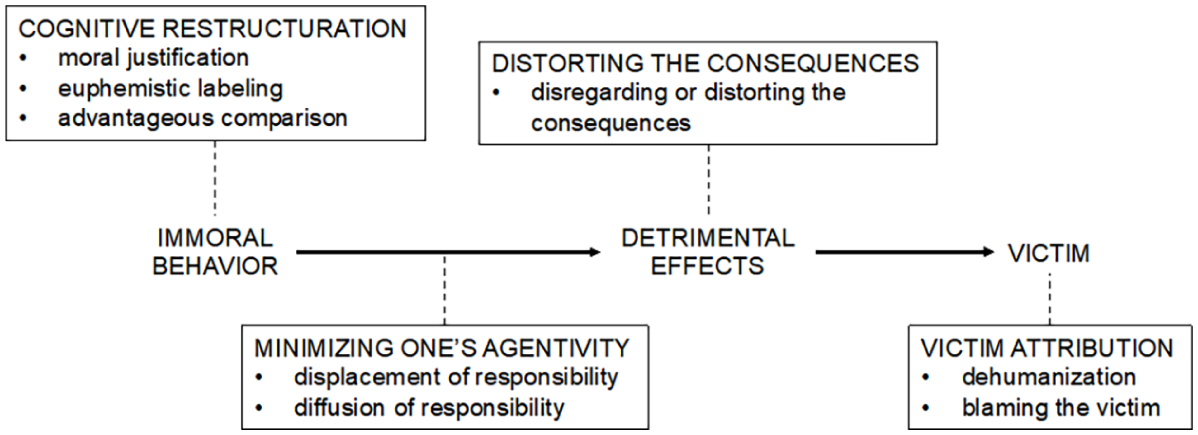
Bandura’s model of moral disengagement.
Bandura’s framework has been applied to various social phenomena, from everyday moral dilemmas to atrocities committed in extreme circumstances (Heald, 2017). In addition, moral disengagement is conceptualized as a gradual and reciprocal process, in which immoral behavior both predicts and is reinforced by moral disengagement over time (Bandura, 1991).
Moral Disengagement and Environmentally (Un)Friendly Behaviors
Various studies have shown that morality in general (e.g., moral identity, moral attitudes, sense of moral responsibility) was a particularly relevant predictor of environmentally friendly behavior (e.g., Gatersleben et al., 2019; Leviston & Walker, 2012; X. Wang, 2016). Although growing evidence suggests that the framework of moral disengagement is key to understanding individual behaviors in relation to climate change (Leviston & Walker, 2021), few studies have empirically tested this possibility (Di Santo et al., 2023; Woods et al., 2018; Wu et al., 2021).
One study highlighted the mediating role of moral disengagement between different predictors (i.e., opinions about the causes of climate change; self-efficacy; responsibility) and pro-environmental behaviors (Leviston & Walker, 2021). In that study, however, moral disengagement was not measured directly, but was instead operationalized as a low level of moral engagement (e.g., “I feel it is my ethical responsibility to change my individual behavior to combat climate change”). Two other recent studies found that moral disengagement significantly and negatively predicted pro-environmental behavior intentions (Di Santo et al., 2023; Wu et al., 2021). Both studies adapted eight original items (Bandura et al., 1996) and used a global score of moral disengagement.
Overall, the existing studies to date have been more interested in the outcomes of moral disengagement than in the nature and role of its specific mechanisms (Leviston & Walker, 2021). To our knowledge, only one study has examined the specific moral disengagement mechanisms related to climate change, in online comments reacting to newspaper articles (Woods et al., 2018). While the findings of that study supported the relevance of Bandura’s framework to understanding the “moral landscape” around the climate crisis, they also highlighted that the original model (see Figure 1) should be extended to encompass a broader set of mechanisms relevant to that specific sphere.
The Need for a Scale of Moral Disengagement in Environmentally Unfriendly Behaviors
As moral disengagement mechanisms are manifested differently depending on the specific context or behavior under study, tailored measures of moral disengagement are required: “Moral disengagement is not a dispositional trait that can be assessed by a one-size-fits-all measure.” (Bandura, 2016, p. 26). Yet no scale of moral disengagement in the context of climate change had been specifically developed until very recently (Stoll-Kleemann et al., 2023). However, although moral disengagement is a multidimensional construct (Bandura, 1991), Stoll-Kleemann et al. (2023) designed and validated a unidimensional 9-item scale of moral disengagement in high carbon behavior. While this single-factor structure has the advantage of parsimony, it precludes researchers from examining the specific mechanisms at play or variations in their use by various subgroups such as individuals with different levels of environmental awareness, attitudes or beliefs regarding climate change, ideological and political orientations, or demographic characteristics. Moreover, these authors generated items exclusively in a theory-driven, top-down fashion. A limitation of this design is the risk of low empirical validity, meaning that the scale and findings might overlook significant aspects of the construct and be less relevant to the people and the phenomenon under study (Blumer, 1969). Considering that moral disengagement in environmentally unfriendly behaviors is an understudied and still rather unknown phenomenon, it would be reasonable to combine top-down and bottom-up approaches. This would enable researchers to identify potential new context-specific mechanisms and ensure that the generated items are not only grounded in a strong theoretical foundation, but also relevant and meaningful to individuals (Boateng et al., 2018). This is even more true in this case, where no previous scale exists and we lack knowledge about how moral disengagement mechanisms are manifested in relation to this specific issue.
As moral disengagement may be a relevant target for promoting individual change toward pro-environmental behaviors, a valid measurement tool is also required to inform future interventions and their evaluations. Overall, the lack of a validated comprehensive instrument limits our knowledge and understanding of the mechanisms at play and their role in environmentally destructive behavior patterns. This was the main goal of our study, which aimed to identify the moral disengagement mechanisms in relation to environmentally unfriendly behaviors, and validate a measurement tool for future research. It should be noted that our study was not intended to make judgements about individuals’ choices or to establish whether greener alternatives would be feasible, as adopting more environmentally friendly behaviors is sometimes beyond people’s reasonable control (e.g., because they are restricted by structural barriers such as low income or specific living conditions; Gifford, 2011). Rather, we aimed to extend our understanding of the psychological processes underlying individual behavioral choices in the context of climate change.
The Present Study
This article presents three studies corresponding to the successive steps of scale development and validation. We adopted an exploratory sequential mixed-methods research design (Creswell & Plano Clark, 2011) by starting with a qualitative study (Study 1) and then validating, testing, and generalizing the concepts that emerged from the first study in the two subsequent quantitative studies (Study 2 and Study 3) to generate and validate the scale. An exploratory sequential mixed-methods research design is particularly useful to develop and test an instrument, especially when constructs are not fully known in advance (Creswell & Plano Clark, 2011). The whole procedure was in compliance with APA ethical standards and was approved by the ethics committee of the psychological sciences research institute of the University of Louvain.
Study 1: Identification of the Mechanisms and Item Generation
Method
This first study aimed to gain a thorough understanding of how moral disengagement mechanisms are manifested in the sphere of environmentally unfriendly behaviors to generate a relevant set of items. Combining deductive and inductive approaches, we used Bandura’s original model of moral disengagement (see Figure 1) as a theoretical lens, and collected qualitative data from two different sources and methods for triangulation purposes: on the one hand, data from a research situation involving the researchers (semi-structured interviews; Study 1.2), and on the other hand, available data that were not generated in a research context (online public comments; Study 1.1). Such a combination of so-called reactive and non-reactive procedures allowed us to go beyond the limits of both methodological approaches, deepen the analysis, and capture different aspects of the construct.
Data Collection and Participants
Study 1.1
We collected and examined public comments posted on social media in reaction to online press articles about diverse topics related to the environmental crisis. We selected two mainstream media outlets at the center of the political and public arenas in Belgium, which regularly publish press articles about topics related to environmental issues: the French-speaking radio and television broadcaster RTBF and the daily newspaper Le Soir, which both have an online component. We used the search engine of these two media outlets’ public Facebook pages to filter the publications and find relevant press articles. We used the following keywords to cover a variety of possibly controversial topics: climate, zero-waste, ecology, sustainable energies, plastic bottles, vegetarianism, greenhouse gas. Many social media users interact in the public comment sections accompanying news articles, especially on contentious topics, often contesting recommended actions, rationalizing conflicting behaviors, and defending their lifestyle choices (e.g., “I’m 72, and I’ve always found tap water disgusting”; “Honestly, I don’t feel guilty. We elected people to take care of this, so why didn’t they do their job?”; “Maybe the younger generation should ditch their iPhones and designer clothes before telling us how to live”). The second author of this paper browsed the public comments posted below the articles and selected any comments that could reflect a justification for why the commenter behaved in environmental unfriendly ways or disregarded some environmentally friendly alternatives. A total of 150 comments from 30 articles published between 2018 and 2020 were collected in February 2020 and anonymized in an Excel spreadsheet.
Study 1.2
The first and second authors conducted semi-structured interviews with participants with various degrees of environmental concerns. In Study 1.1, individuals opposed to changing their behaviors or even holding climate-skeptic views were overrepresented in the selected comments. To address this selection bias, we adopted a strategic sampling approach in the interview study to make sure to include and represent individuals with high, moderate, and low environmental concerns in the interviews. The participants with high environmental concerns were recruited from several pro-environment groups to which the authors were connected (e.g., an informal association to promote eco-friendly behaviors in their research center). Participants with moderate environmental concerns were recruited among colleagues and acquaintances (with no particular involvement in pro-environment groups or actions). Participants with no or very low environmental concerns were found through snowball sampling, that is, by asking our contacts if they knew people with this profile. Participants were not informed that their recruitment was based on their environmental views.
Given the important contrast between the two extremes among the participants (high versus no environmental concerns), we created two slightly different interview guides to investigate the moral disengagement mechanisms in a way that would best fit the participants’ profiles. The two interview guides are provided as Supplementary Materials. Both interview guides contained two main questions: the first question introduced the topic and invited the participants to elaborate freely on environmentally friendly/unfriendly behaviors, and the second question explored their moral disengagement mechanisms through more in-depth introspection. In the high environmental concerns interview guide, we first asked if the participants sometimes engaged in behaviors that they saw as environmentally unfriendly (Question 1), and then used both the examples they provided in Question 1 and additional typical examples to look into their moral disengagement mechanisms (Question 2). For example, “So, you mentioned earlier about buying cans of soda from a brand that’s not exactly carbon-neutral, right? Can you walk me through what you’re thinking in that moment, when you’re faced with that kind of dilemma? What do you tell yourself?” In the low environmental concerns interview guide, the eco-friendly behaviors were presented in a more neutral and external way, by asking the participants what they thought about “the eco-friendly behaviors we are hearing about currently” (Question 1). Then, we asked these participants what their train of thought was when they were told (by the media or an acquaintance, for example) that they should engage in such behaviors or when they saw other people adopt them (Question 2). For example, “Alright, so when some people say that we should take the train instead of flying for vacations, what’s your take on that?,” or “Have you noticed some people using reusable containers for grocery shopping? How do you feel about that?” In both interview guides, we also used flexible follow-up questions such as asking for clarification, elaboration, or specific examples to gain a more in-depth understanding of the participants’ experience and help them verbalize their disengagement mechanisms (e.g., “And what do you usually tell yourself in that situation?,” “And what if you were told that you had to [. . .]? How would you react then?”).
A total of 11 interviews of approximatively 30 to 40 min were conducted with three women and eight men (Mage = 30.5 years; SD = 8.47) between May and August 2020. Seven participants expressed high or moderate environmental concerns. Four participants expressed low or ambivalent environmental concerns (e.g., although acknowledging the climate crisis, they did not feel directly concerned by the problem or were not interested in that topic). All participants were born and raised in Belgium. Four of them had a Bachelor’s degree, six had a Master’s degree, and one had a PhD. Table S1 presents the participants’ basic characteristics (see Supplementary Materials). Each participant signed a free and informed consent form and allowed us to record the interview for (anonymized) transcription purposes. Because of the pandemic, seven of the interviews were conducted remotely.
Data Analysis
Study 1.1
The first, second, and third authors independently reviewed the initial 100 comments to determine the nature of the mechanism behind each comment or comment fragment. We combined deductive and inductive approaches. On the one hand, we used Bandura’s original model of moral disengagement as a tentative deductive framework. On the other hand, we used an inductive open coding strategy, in which all sufficiently developed categories are identified and codified in a dynamic, nonlinear, and iterative process (Strauss & Corbin, 1998). Some of Bandura’s original mechanisms (see Figure 1) were identified in the data, while other novel categories specific to environmentally unfriendly behaviors emerged inductively (Bandura, 2016). Preliminary codes were clustered together based on similarities and further developed into more abstract and comprehensive higher-order categories through an iterative analysis and code comparison process. We triangulated our classifications and discussed discrepancies until consensus was reached. As new categories continued to emerge after analyzing the initial set of comments, an additional 50 comments were collected and analyzed to reach data saturation and ensure all relevant categories were adequately represented.
Study 1.2
Likewise, the three researchers independently sifted through each interview transcription, extracted the potential mechanisms that surfaced in the interview (both deductively and inductively), and classified them. Given the exploratory and evolving nature of our coding process, inter-rater agreement was reached through analytic dialogue and consensus, in line with best practices in qualitative research (Braun & Clarke, 2013). After analyzing the first four interviews conducted by the second author (two participants with high and two with low environmental concerns), the first author conducted seven more interviews as new categories continued to emerge, and we repeated the analysis to reach data saturation.
Results
A final set of 18 mechanisms was identified and organized into five domains. Unlike Bandura’s original model, the revised model does not include a victim domain. Instead, we included a messenger domain. In addition, we added a fifth domain related to eco-friendly behavior, which encompasses justifications aimed at discrediting environmentally friendly alternatives and solutions. Figure 2 presents the revised domains and tentative mechanisms. Table 1 lists the 18 mechanisms identified at this stage of the research with examples from the corpus. Conceptual definitions, based on our previous qualitative findings from Studies 1.1 and 1.2, as well as moral disengagement literature in general, are provided as Supplementary Materials.
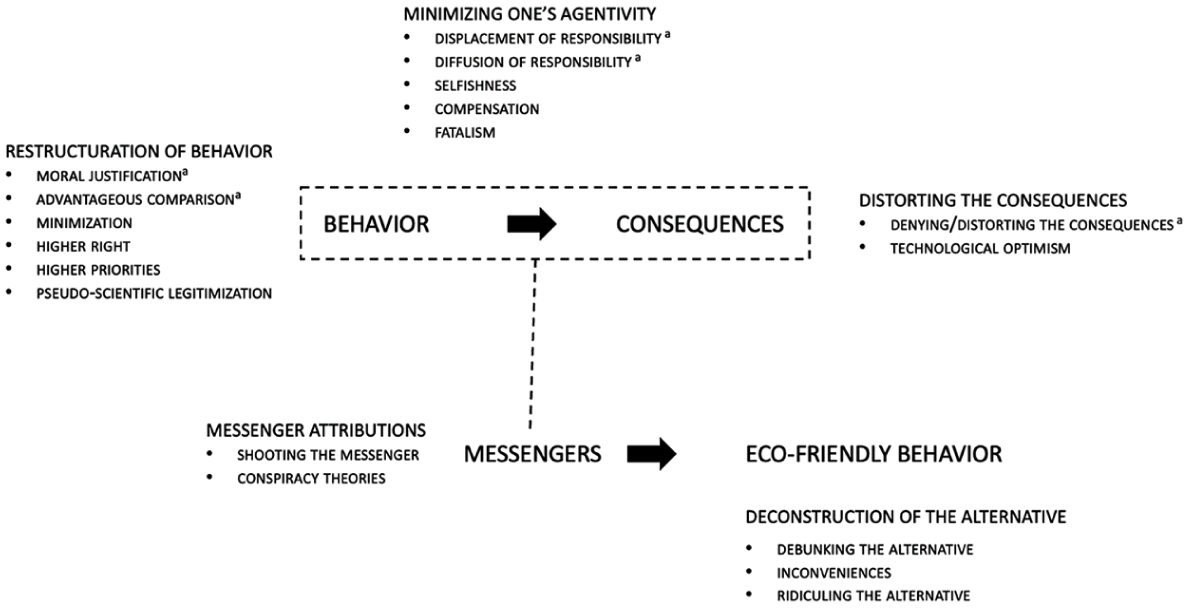
Diagram of the 18 provisional moral disengagement mechanisms.
Provisional Moral Disengagement Mechanisms and Examples from the Corpus.
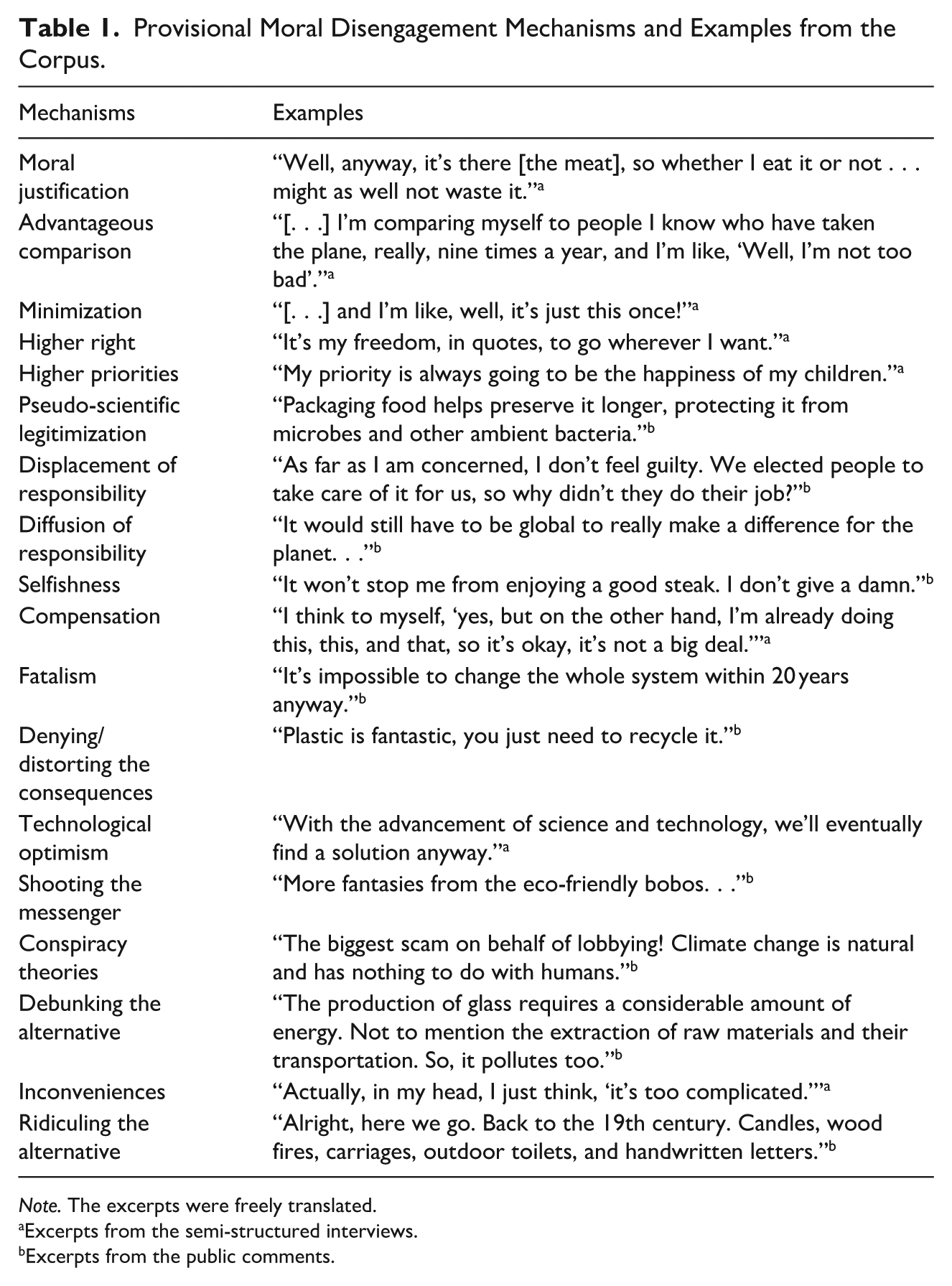
Note. The excerpts were freely translated.
Excerpts from the semi-structured interviews.
Excerpts from the public comments.
Importantly, we noticed that some of the mechanisms were predominantly reported by specific profiles of participants. For example, the “compensation” and “minimization” mechanisms were mostly used by participants with high environmental concerns. On the other hand, “selfishness,” “shooting the messenger,” “conspiracy theories,” “debunking the alternative,” and “ridiculing the alternative” were overrepresented among participants with low or no environmental concerns. Other mechanisms, however, were reported by all types of participant profiles, regardless of their degree of environmental concerns, such as “advantageous comparison,” “higher priorities,” “diffusion of responsibility,” “displacement of responsibility,” and “inconveniences.” In addition, we were aware that some of the 18 potential mechanisms were very close conceptually and likely to belong to a common overarching dimension, which would be revealed in the subsequent factor analysis (see Study 2).
Study 2: Extraction of Factors and Item Reduction
In the second study, we developed a self-reported scale on moral disengagement in environmentally unfriendly behaviors based on the qualitative findings from Study 1 and guided by Bandura’s (1991, 2016) social cognitive theory of moral disengagement. For each of the 18 mechanisms from Study 1, several items were independently generated by the first and second authors. The first author, who had most expertise in the field of moral disengagement, selected four final items per mechanism. The 72 items were then reviewed by the third author to ensure that they targeted the right construct and were worded unambiguously (Boateng et al., 2018). The final set of items was approved by the first three authors. The items were based on the numerous examples provided by the participants to capture our target population’s lived experiences of the phenomenon (Boateng et al., 2018). However, they were also phrased in a straightforward and broad way, that is, not in relation to a specific environmentally (un)friendly behavior. The Supplementary Materials include the resulting pool of 72 items (see Table S2). This second study aimed to identify the number of relevant dimensions in our construct and subsequently retain the best items for each dimension.
Method
Data Collection and Participants
Respondents voluntarily filled in an online Qualtrics survey that was shared through Facebook (in various groups both related and unrelated to environmental questions and interests), and among colleagues and psychology students. There was no incentive or compensation provided for their participation in the study. The survey was available online for 4 weeks from September to October 2020, then closed after a total of 720 respondents had been reached. We used the rule of thumb of approximately 10 respondents per item to conduct factor analysis (Shanmugam & Marsh, 2015). After data cleaning (duplicates and empty questionnaires), we had a total of 613 usable respondents’ answers (83.7% women), ranging from 17 to 77 years (M = 31.97 years, SD = 12.15). Half of the respondents reported an environmentalist political orientation (53.4%). The other half of respondents reported a left-wing (16.2%), centrist (18.8%), or right-wing (11.5%) political orientation.
Measures
Respondents were first asked to indicate their age, gender, and political orientation from four options corresponding to the main political parties in French-speaking Belgium (socialist, environmentalist, centrist, conservative-liberal). Next, we presented an introductory text (provided in the Appendix A1) to them, followed by the moral disengagement items on a 7-point Likert scale with the following general instruction: “Please indicate, on a scale from ‘never’ to ‘always’, how often each of the reasons listed below come to mind when you engage in environmentally unfriendly behaviors.” Because of a human error during the survey creation, one of the 72 items was replaced by a duplicate of another item, which had to be removed from the analysis, thus leaving a total of 71 items.
Analytical Strategy
We ran an exploratory factor analysis (EFA) using parallel analysis (default geomin rotation) with Mplus version 8.4 to determine the number of factors to retain. It is recommended to use 95% parallel analysis when the interpretation of the scree plot is not straightforward (i.e., there is no clear “elbow”; Hayton et al., 2004). Next, examination of the factor loading matrix allowed us to identify the dimensions conceptually, that is, to determine the underlying psychological mechanism for each factor. To be functional, items should ideally meet the following criteria: target factor loading should not be lower than .30 and should ideally be greater than .50; cross-loadings should be lower than the target loading by at least .200; and cross-loadings should have an absolute magnitude lower than .30 (Morin et al., 2016). Among the satisfactory items, we then retained the top three items for each dimension to reduce the length of the scale.
Results
Results of the 95% parallel analysis indicated that an 8-factor solution best represented the factor structure (see Figure S1 in the Supplementary Materials). Examination of the factor loading matrix (see Table 2) provided insights about the nature of the different dimensions. Four dimensions corresponded to four of the previously identified mechanisms: “technological optimism” (F1), “debunking the alternative” (F2), “conspiracy theories” (F5), and “higher right” (F6). The four other dimensions each combined two of the potential mechanisms: “inconveniences and priorities” (F3); “displacement and diffusion of responsibility” (F4); “minimization and compensation” (F7); and “selfishness and distorting the consequences” (F8).
Standardized Factor Loadings of the Final 24 Items of the Moral Disengagement Mechanisms in Environmentally Unfriendly Behaviors Scale (MD-EBS).
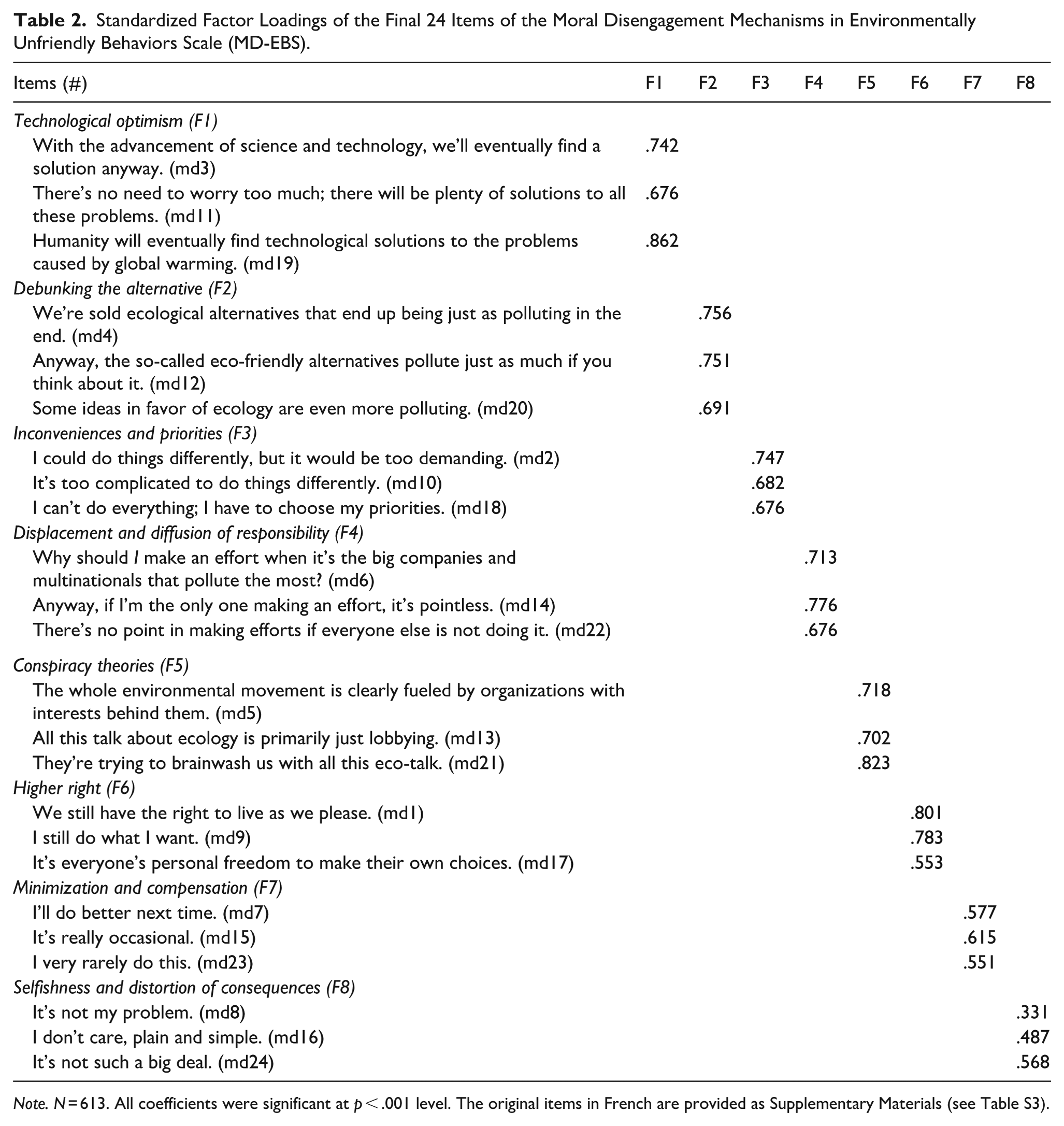
Note. N = 613. All coefficients were significant at p < .001 level. The original items in French are provided as Supplementary Materials (see Table S3).
Although we could observe logical clustering of the remaining potential mechanisms between the dimensions (i.e., “ fatalism” with displacement and diffusion of responsibility [F4]; “moral justification” and “advantageous comparison” with minimization and compensation [F7]; and “shooting the messenger,” “pseudo-scientific legitimization” and “ridiculing the alternative” with conspiracy theories [F5]), they were less representative of the factors and had lower loadings. Table 2 presents the factor loading matrix with the selected items for each dimension in bold. All top three items met the selection criteria.
Based on the items’ organization and loadings, their content, as well as moral disengagement literature in general and our previous qualitative findings (Study 1), we conceptualized and defined eight mechanisms of moral disengagement in environmentally unfriendly behaviors as follows: Technological optimism (F1): relying on the idea that science and technology will provide solutions, thereby diminishing the need for immediate behavior change; Debunking the alternative (F2): claiming that eco-friendly alternatives are misleading or ineffective to justify maintaining the environmentally unfriendly behavior; Inconveniences and priorities (F3): emphasizing practical constraints (e.g., financial, time) or competing and higher priorities in life that prevent behavior change; Displacement and diffusion of responsibility (F4): emphasizing insignificance of individual efforts by attributing responsibility to external factors or the collective; Conspiracy theories (F5): attributing any pro-environment discourse or action to hidden agendas or manipulation by powerful entities; Higher right (F6): asserting higher rights (e.g., individual autonomy or freedom) to justify maintaining the behavior; Minimization and compensation (F7): emphasizing the infrequency of the environmentally unfriendly behavior or balancing it against past or future eco-friendly behavior; Selfishness and distortion of consequences (F8): blatantly refusing personal accountability or downplaying the consequences of the environmentally unfriendly behavior.
Study 3: Confirmation of the Factor Structure and Validation
The aim of this study was threefold. First, we aimed to test the scale’s dimensionality, which involved confirming the latent constructs and testing if the hypothesized structure was consistent across groups (Boateng et al., 2018). In particular, we wanted to test measurement invariance across gender and across environmentalist political orientation. Second, we aimed to test the internal consistency of the scale factors. Third, we aimed to test the construct and criterion (concurrent and predictive) validity of the scale.
We tested construct validity through comparison between known groups (Boateng et al., 2018), both across gender and across environmentalist political orientation. As women have been shown to present less moral disengagement than men in general (Kennedy et al., 2017; Maftei et al., 2022) and in relation to meat consumption (Weber & Kollmayer, 2022), we expected lower mean scores in this context as well. We expected respondents with a moderate to high environmentalist political orientation to report lower mean scores of moral disengagement than respondents with no environmentalist orientation (Markowitz & Shariff, 2012).
For concurrent criterion validity, we examined the association with (self-reported) concurrent eco-friendly behaviors. As moral disengagement facilitates reprehensible conduct, we expected a negative link with eco-friendly behaviors. In addition, we examined the association with empathy. Because higher moral disengagement is known to be associated with less empathy (Bayram Özdemir et al., 2020; Berenguer, 2010; Eilts & Bäker, 2023; Inmaculada & Isabel, 2021; Wachs et al., 2022), we expected a negative association between them in the current study. For predictive criterion validity, we examined if our measure predicted respondents’ future (self-reported) eco-friendly behaviors 1 month later.
Method
Data Collection and Participants
The online Qualtrics survey was distributed by email, and via Instagram and Facebook. Again, we targeted various groups, both related and unrelated to environmental questions and interests, to try and reach a heterogeneous sample of profiles. Unfortunately, all administrators of the overtly climate-skeptical groups that we contacted refused to share our survey, which they perceived as implicitly advocating pro-environmental standards. The survey was also disseminated through the researchers’ own networks, as well as sent to all psychology students of the third author’s faculty. At the end of the study, the respondents had the opportunity to take part in a draw to win 200 euros as a reward for their voluntary participation. In order to match responses from Time 1 to Time 2 (follow-up) while preserving anonymity, we asked respondents to create an anonymous identification code by combining the first two letters of their parents’ first names and the last two digits of their phone number.
The main survey was available online for 7 weeks from November to December 2020, then closed after a sufficient number of respondents had been reached (N = 664). We included two distinct studies addressing different research questions in our data collection to maximize efficiency and leverage our resources and efforts. As such, the questionnaire included other measures, which were not examined in the present study (e.g., cognitive reappraisal, emotions, anxiety, self-efficacy, coping strategies, values). The other study focused on cognitive reappraisal and emotion regulation in the context of the climate crisis, and sought to recruit 500 respondents (see power calculation details in Rolland, 2022)—which would also provide sufficient power for our own analyses according to widely accepted rules of thumb of 10 cases per observed variable and a minimum sample size of N = 200 for SEM models, and 100 observations per group in multi-group modeling (Kline, 2023).
We included three attention checks within the questionnaire to check respondents’ attentiveness and the validity of their answers (e.g., “Please answer ‘true’ for this question”). Three respondents failed more than one attention check and were removed from the analyses. After data cleaning (duplicates and empty questionnaires), we had a total of 560 usable respondents’ answers, with the respondents’ ages ranging from 17 to 78 years (M = 33.67 years, SD = 16.74). Sixty-one percent of the respondents identified as female, 38% as male, and 0.7% as non-binary. The respondents’ highest education level was primary school (1.3%), lower secondary school (2.9%), upper secondary school (40.5%), undergraduate (23.6%), or graduate (Master’s degree; 23.4%). Eight percent of the participants had a doctorate or complementary Master’s degree (8.4%). Thirty-one percent of the respondents reported a left-wing political orientation, 23.8% a centrist orientation, 23% a right-wing orientation, and 22% preferred not to answer. In parallel, 74.7% of the left-wing participants, 62.8% of the centrist participants, and 30.8% of the right-wing participants also reported an environmentalist political orientation (62.5% of the total sample).
All respondents who agreed to take part in a follow-up and provided their email address received the follow-up survey 4 weeks after they completed the main survey. The follow-up survey was closed on the first week of February 2021. We included two attention checks within the follow-up questionnaire. None of the respondents failed both attention checks, except for the three respondents who had been removed in the first part of the survey. Twenty-seven respondents’ follow-up answers could not be merged with the main survey’s answers due to identification code mismatches. After data cleaning (duplicates and empty questionnaires), we had a total of 153 usable sets of answers.
Measures
Respondents were first asked to indicate their age, their highest level of education, and gender (female, male, or non-binary).
Environmentalist Political Orientation
We created five statements that included both past voting behavior and future political intentions to include the youngest respondents who had not yet had the opportunity to vote (N = 81). It should be noted that voting is compulsory in Belgium. The statements distinguished between respondents who expressed moderate to high orientation (e.g., “I have often voted for the environmentalist party over the past three years”) and those who expressed no orientation toward the environmentalist party (e.g., “I have not yet voted, and I would not vote for the environmentalist party”) at any level of government. Respondents were asked to select the statement that best described their situation.
Empathy
We translated the 10-item empathy scale of the Jackson Personality Inventory (JPI-R; Jackson, 1994) into French. Respondents were asked to indicate if each statement was true or false for them (e.g., “I can feel other people’s emotions”). McDonald’s omega was .78.
Eco-Friendly Behaviors
We translated and adapted the Recurring Pro-environmental Behavior Scale (RPBS; Brick, 2017). We merged two pairs of redundant items (e.g., sorting trash into the recycling in public and in private), and adapted four other items to better fit our context and target population (e.g., “turning one’s personal electronics off or in low-power mode when not in use” was replaced by “making an effort to reduce one’s online environmental impact (e.g., using dedicated apps, reducing streaming, etc.”).
The behaviors included single-use plastics, zero-waste practices, recycling and composting, mainstream and alternative transport use, electricity consumption, water conservation, local and organic food choices, dairy product and meat consumption, online environmental impact efforts, fast fashion practices, and engagement in environmental discussions, education, and actions. Respondents were asked to indicate how often they adopted the 19 listed behaviors on an 8-point frequency scale (1 = “never or less than once a year,” 2 = “less than once a month,” 3 = “about once a month,” 4 = “several times a month,” 5 = “about once a week,” 6 = “several times a week,” 7 = “about once a day,” 8 = “several times a day”). Three items were removed from the analysis because they were highly skewed (i.e., taking the plane, eating dairy products, purchasing single-use plastic products). McDonald’s omegas were .79 and .75 (follow-up at 1 month).
Moral Disengagement toward Environmentally Unfriendly Behaviors
Respondents were presented with the same introductory text as in Study 2 (see Appendix A1), followed by the 24 items measured on a 7-point Likert scale with the following general instruction: “Please indicate, on a scale from ‘never’ to ‘always’, how often each of the reasons listed below comes to mind when you engage in environmentally unfriendly behaviors.” See psychometric properties of the scale in the Results section.
Analytical Strategy
Chi-square tests conducted on SPSS showed no significant difference in terms of gender, highest diploma, political orientation, and environmentalist political orientation between missing respondents (who did not complete the questionnaire beyond the demographic questions) and the others. (For gender, we also checked the Fisher’s exact test.)
The rest of the analyses were conducted in Mplus 8.4. We used MLR (maximum likelihood robust) estimation which is robust to non-normality of observations, and a leading technique for handling missing data, using full-information maximum likelihood (FIML) (Geiser, 2013). To obtain the 95% confidence intervals (CI), we repeated the analysis using 1,000 bootstraps with ML estimation. Data were missing for all moral disengagement indicators in 91 cases, which Mplus automatically excluded from the analysis.
We first conducted confirmatory factor analysis (CFA). We reported the root mean square error of approximation (RMSEA), the standardized root mean square residual (SRMR), the comparative fit index (CFI), and the Tucker–Lewis index (TLI) as goodness-of-fit indices. RMSEA and SRMR values are considered acceptable when they are equal to or lower than 0.08 and good when they are equal to or lower than 0.05. CFI and TLI values are considered acceptable when they are equal to or higher than 0.90 and good when they are equal to or higher than 0.95 (Little, 2013). We then computed McDonald’s omegas for the eight factors, which should be above 0.70.
Next, we used stepwise multi-group CFA analysis (MGCFA) to test the measurement invariance of our scale across gender and across environmentalist orientation. We imposed progressive equality constraints on factor loadings and intercepts, and tested the fit of each nested model against the previous (less restrictive) one. Weak non-invariance is indicated by a CFI difference greater than 0.01 in combination with a difference in the RMSEA greater than 0.015 or a difference in SRMR greater than 0.03. The same applies to strong non-invariance, with the exception that the difference in SRMR should be greater than 0.01 (Chen, 2007). The strong measurement invariance models also provided latent mean difference tests between groups for the eight factors.
Finally, we conducted regression analyses using SEM to test the associations between each moral disengagement mechanisms and both (self-reported) empathy and concurrent eco-friendly behaviors. Using the follow-up data, we conducted regression analyses to test whether each moral disengagement mechanism predicted future (self-reported) eco-friendly behaviors. The covariance coverage of data was 100% for all the indicators for the CFA and MGCFA analyses, and above 88.8% for the regression analyses.
Results
Dimensionality and Internal Consistency
The result of the CFA indicated an acceptable fit of the eight-factor model. Based on modification indices, we allowed three pairs of items to correlate because of content similarity and parallel wording (see Items 3–19 [F1]; 2–10 [F3]; 15–23 [F7]). The final model demonstrated a good fit: χ2(221, N = 469) = 448.23, p < .001, CFI = 0.96, TLI = 0.95, RMSEA = 0.047, 95% CI: [0.041, 0.053], and SRMR = 0.052. McDonald’s omegas for the eight factors were .89 (F1), .92 (F2), .76 (F3), .84 (F4), .93 (F5), .85 (F6), .71 (F7), and .80 (F8). The factor intercorrelations are provided as Supplementary Materials (see Table S4).
Strong measurement invariance was reached both across gender and across environmentalist political orientation, which allows for a meaningful interpretation of latent mean differences between groups (Geiser, 2013). Tables 3 and 4 contain the details of the measurement invariance testing.
Testing for Measurement Invariance Across Gender.
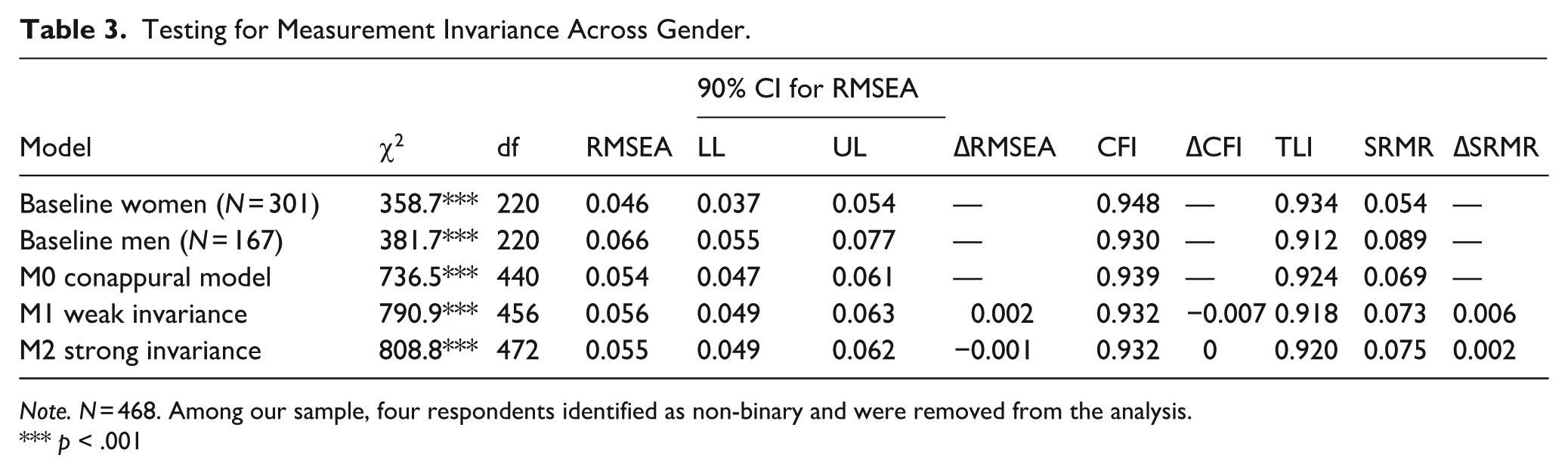
Note. N = 468. Among our sample, four respondents identified as non-binary and were removed from the analysis.
*** p < .001
Testing for Measurement Invariance Across Environmentalist Orientation.
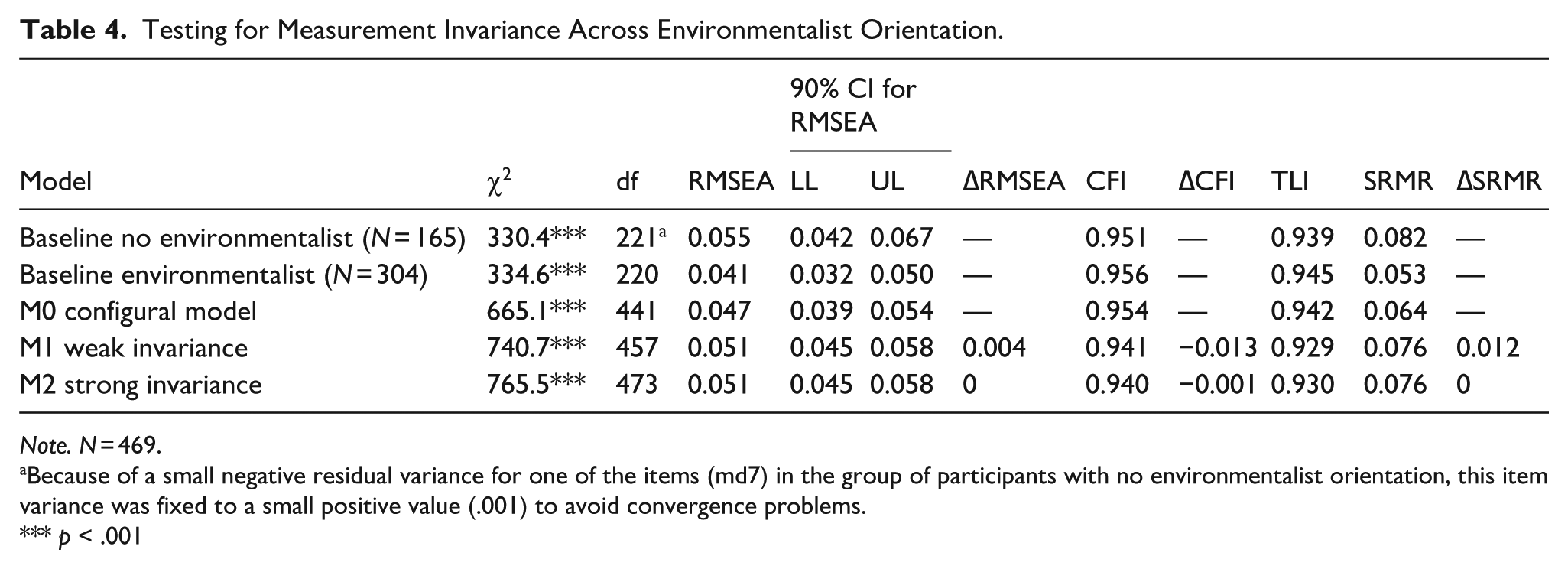
Note. N = 469.
Because of a small negative residual variance for one of the items (md7) in the group of participants with no environmentalist orientation, this item variance was fixed to a small positive value (.001) to avoid convergence problems.
*** p < .001
Construct Validity: Differentiation by Known Groups
Women reported significantly lower levels of moral disengagement than men for all mechanisms, except two: there was no significant difference between groups for inconveniences and priorities (F3), and men reported significantly less reliance on minimization and compensation (F7) than women. Table 5 presents the descriptive statistics and significant latent mean differences between men and women.
Descriptive Statistics and Latent Differences across Gender and Environmentalist Political Orientation.
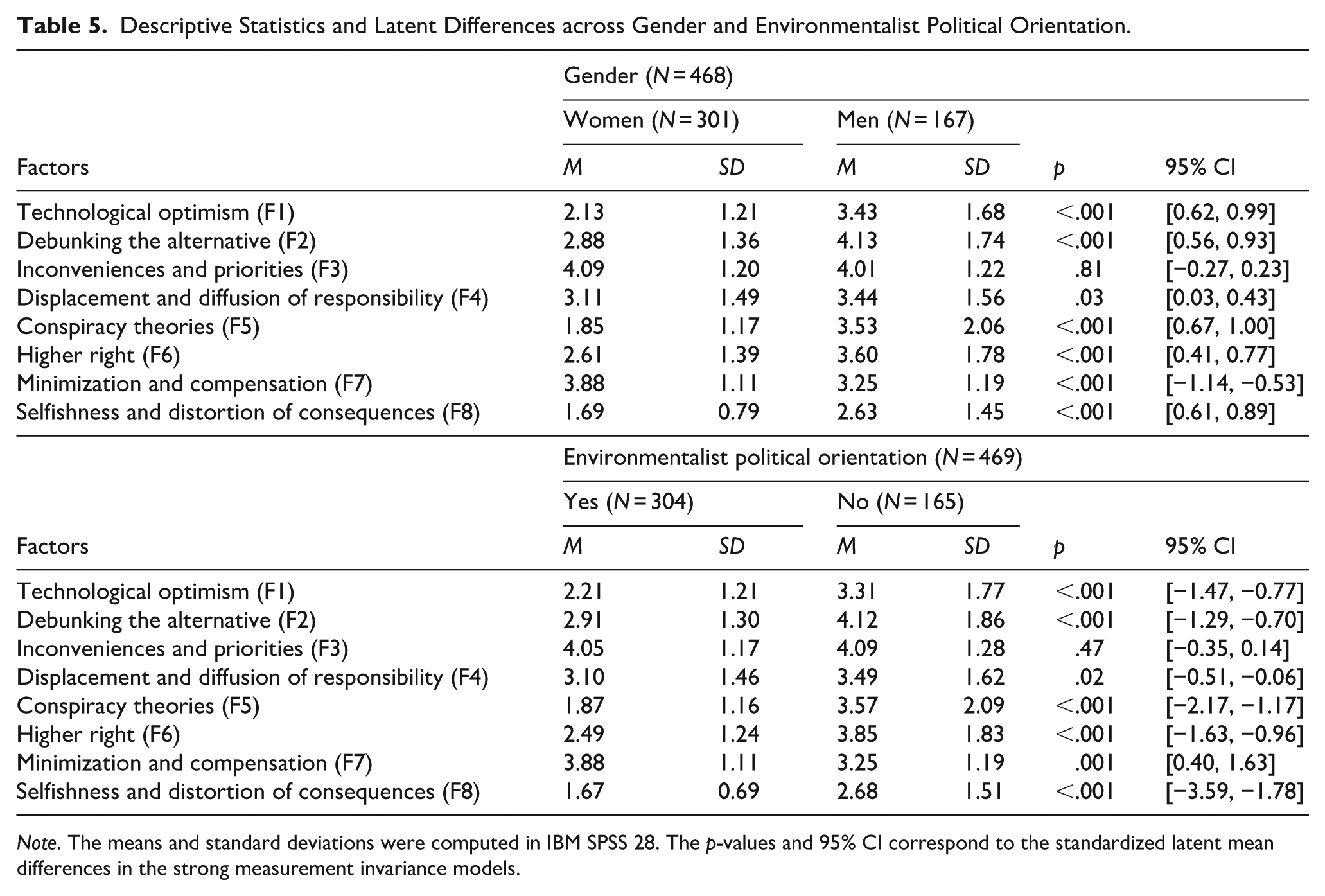
Note. The means and standard deviations were computed in IBM SPSS 28. The p-values and 95% CI correspond to the standardized latent mean differences in the strong measurement invariance models.
Respondents with an environmentalist political orientation reported significantly lower levels of moral disengagement than respondents with no such orientation for all mechanisms, except two: there was no significant difference between groups for inconveniences and priorities (F3), and pro-environmentalist participants reported significantly more reliance on minimization and compensation (F7) than the other group. Table 5 presents the descriptive statistics and significant latent differences between respondents with and without an environmentalist political orientation.
Concurrent and Predictive Criterion Validity
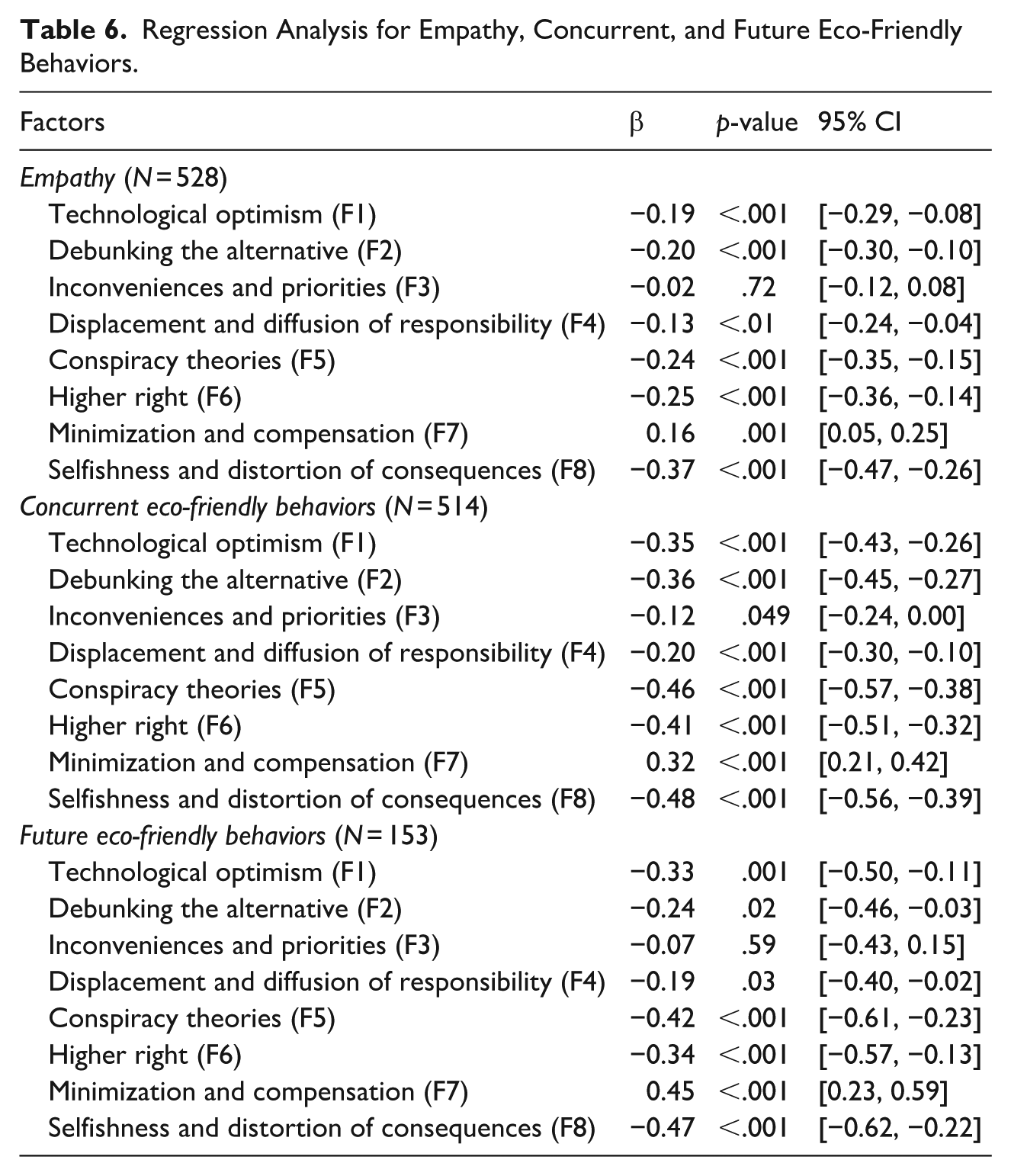
Empathy was significantly and negatively associated with six of the moral disengagement factors. The association was non-significant for inconveniences and priorities (F3), and significant and positive for minimization and compensation (F7). We found the same pattern of results for both concurrent and future eco-friendly behaviors, except that the association between inconveniences and priorities (F3) and concurrent behaviors was just significant at the α < .05 level. Table 6 presents the standardized regression coefficients and p-values for all three dependent variables.
Regression Analysis for Empathy, Concurrent, and Future Eco-Friendly Behaviors.
General Discussion
Our study aimed to identify moral disengagement mechanisms in relation to environmentally unfriendly behaviors, and validate a tailored measurement tool for future research. Study 1 highlighted a set of various mechanisms, and resulted in an adapted version of Bandura’s original model. The adapted model no longer included a “victim” domain, which encompasses mechanisms of dehumanizing and blaming the victims of one’s immoral conduct (Bandura, 1991). It is not surprising that these mechanisms did not emerge in our qualitative studies, as blaming the victims of the climate crisis—such as climate migrants, future generations, or even the environment itself—for one’s own environmentally unfriendly behaviors would hardly constitute a reasonable or convincing argument in this context. Instead, domains related to the messengers and eco-friendly alternative behavior were included. Most of the mechanisms identified were specific to environmentally unfriendly behaviors, confirming the need to tailor measures as moral disengagement manifests differently depending on the context (Bandura, 2016).
Importantly, because of their particular nature, some mechanisms were overrepresented among specific profiles of participants. For instance, “minimization” (e.g., “I don’t do this often.”) and “compensation” (e.g., “I already make an effort for many things.”) implied past or future environmentally friendly efforts, while “selfishness” (e.g., “I don’t care, plain and simple.”), “conspiracy theories” (e.g., “All this talk about ecology is primarily just lobbying.”), or else “debunking the alternative” (e.g., “Anyway, the so-called eco-friendly alternatives pollute just as much if you think about it.”) were predominantly used by participants with low or no environmental concerns. This result underlines that individuals with different profiles (e.g., in terms of environmental awareness or ideological orientations) likely use distinct mechanisms, which cannot be captured with a global dimension of moral disengagement.
Study 2 revealed an eight-factor structure, which was subsequently confirmed in Study 3. Interestingly, we found a consistent pattern of results across our various tests of validity. In line with previous studies on moral disengagement as a global construct, six of the eight mechanisms (higher right, technological optimism, conspiracy theories, debunking the alternative, diffusion and displacement of responsibility, selfishness and distorting the consequences) in the present study were significantly lower in women (Kennedy et al., 2017; Maftei et al., 2022) and respondents with an environmentalist political orientation (Markowitz & Shariff, 2012), and were negatively associated with empathy (Bayram Özdemir et al., 2020; Eilts & Bäker, 2023; Inmaculada & Isabel, 2021; Wachs et al., 2022), and both concurrent and future (self-reported) eco-friendly behaviors (Leviston & Walker, 2021; Nicolai et al., 2022).
Inconveniences and priorities (F3) was negatively, but not significantly related to either empathy or future eco-friendly behaviors, and just below the significancy threshold for concurrent eco-friendly behaviors. This is in line with our previous observation in Study 1 that this type of justification was used by respondents with various environmental profiles. In other words, regardless of their degree of environmental concerns, respondents shared justifications related to the constraints of eco-friendly behaviors (e.g., time, financial) and to the prioritization of other things in their lives such as personal goals and their families’ or their own well-being.
In contrast, minimization and compensation (F7) repeatedly showed links in the opposite direction. Specifically, a more frequent use of this moral disengagement mechanism was significantly higher in women and respondents with an environmentalist political orientation, and was positively associated with empathy, and both concurrent and future (self-reported) eco-friendly behaviors. This is consistent with our qualitative finding in Study 1 that these justifications were reported by participants with high environmental concerns as they necessarily implied environmentally friendly efforts (i.e., “I’ll do better next time”; “It’s really occasional”; “I very rarely do this”). This is also in line with prior research showing that women tend to report greater pro-environmental attitudes and behaviors than men, particularly in the private sphere (Dietz et al., 2002; McCright, 2010; Xiao & McCright, 2012; Zelezny et al., 2000). Socialization theory suggests that these differences may be linked to gender roles, as women are typically socialized into nurturing and caregiving roles, which align with protective attitudes toward the environment (Blocker & Eckberg, 1997). Moreover, domestic responsibilities remain disproportionately carried out by women in most societies (Sullivan, 2018; Xiao & Hong, 2018), and many pro-environmental actions are closely tied to household chores (e.g., recycling, buying environmentally friendly cleaning products, choosing local and seasonal food, etc.). This could also result in women making more daily environmental efforts than men, which is consistent with a greater reliance on minimization and compensation mechanisms to justify occasional environmentally unfriendly behaviors.
Importantly, this unique pattern of results suggests that in contrast to the other mechanisms, minimization and compensation (F7) predicts pro-environmental endeavors. Yet, this mechanism falls under moral disengagement, both conceptually and empirically (as supported by our findings in Study 1). Overall, this underlines the diversity and complex nature of moral disengagement mechanisms in the context of the climate crisis, highlighting the need for a comprehensive, multidimensional measure such as the MD-EBS.
It seems important to emphasize that even individuals who make substantial efforts to reduce their carbon footprint in their daily life rely on moral disengagement mechanisms. Achieving a completely sustainable lifestyle would be extremely challenging for most people in our modern and complex societies. Most individuals routinely face conflicting situations in which they have to compromise their moral standards to obtain or preserve personal benefits (Bandura, 1991), which may include safeguarding their mental health and overall well-being. Using moral disengagement mechanisms is necessary to preserve one’s self-esteem and a sense of self-determination, continuity, and purpose in one’s lives. It is therefore important to remember that moral disengagement mechanisms are used in everyday life and belong to normal functioning (Bandura, 1991).
Strengths and Limitations
Strengths of this study are the unique insights provided by adopting an exploratory sequential mixed-methods research design, also referred to as “the instrument development design” (Creswell & Plano Clark, 2011, p. 86), a combination of deductive and inductive approaches and triangulation of different sources of data to generate relevant and meaningful context-specific items, the use of large independent samples for the different steps of scale validation, and the use of follow-up data to test predictive validity. However, this study also has some limitations.
First, our study was primarily driven by a consequentialist ethics, whereas alternative normative ethics and meta-ethical assumptions are possible (e.g., ethics of care, social contract theory, and moral relativism). We have emphasized in the Introduction that causing suffering or the death of others through individual greenhouse gas emissions was morally reprehensible from the perspective of most ethical theories (Rachels, 2019). However, as our progressive internalization of moral standards proceeds from socialization (Bandura, 1991), it could also be argued that environmentally unfriendly behaviors may not be immoral for people, for instance, who endorse climate skepticism views as a result of socialization (e.g., through parenting; Collado et al., 2019; Leviston & Walker, 2021). In such a relativist moral perspective, the framework of moral disengagement would thus not necessarily apply.
Second, we used non-probability sampling procedures, which limits the generalizability of the findings. This limitation was partly mitigated in Study 1.2 through purposive sampling, which ensured the inclusion of participants with both high and low levels of environmental concerns in the interviews (Galloway, 2005), and in Study 3, which included a diverse sample in terms of age, gender, education level, and political orientation. Nonetheless, despite being widely used in psychological research, convenience sampling may lead to limited representativeness of the general population. This was the case in Study 2, where a majority of respondents identified as women. The survey was disseminated through Facebook groups, approximately half of which were dedicated to environmental interests and often discussed topics related to household management such as home-made cleaning products, zero-waste lifestyle, or food. As these tasks are still predominantly managed by women in our societies (Sullivan, 2018; Xiao & Hong, 2018), it is likely that they were overrepresented in these Facebook groups. Similarly, respondents with an environmentalist political orientation were also overrepresented in Study 2, likely due to the same dissemination channels. However, this imbalance was partly compensated by a more balanced representation across both gender and political orientations in Study 3, and by the inclusion of a majority of male participants and a diverse range of environmental concerns in the interviews (Study 1.2).
Nevertheless, to prevent potential biases and enhance generalizability, future research should include more heterogeneous samples across gender and sociopolitical backgrounds, as well as countries and cultures. Notably, our research was conducted in Belgium, which belongs to the so-called WEIRD—Western, educated, industrialized, rich, and democratic—countries, which represent only a small percentage of the world population (Henrich et al., 2010). It is possible that cultural and societal differences influence the nature and manifestations of moral disengagement mechanisms (Qiao et al., 2021; Sverdik & Rachter, 2020; Takacs Haynes & Rašković, 2021), and cross-cultural replications are warranted. However, as WEIRD countries also happen to be responsible for most of the greenhouse gas emissions, they certainly represent a relevant context for our topic of study.
Third, in Study 3, we tested measurement invariance across groups based on political orientation. However, individuals with strong pro-environmental attitudes may not necessarily support the national environmentalist party. While political orientation may be a proxy for respondents’ environmental attitudes to some extent, a more suitable grouping for future studies could be directly based on respondents’ environmental attitudes.
Fourth, in the interview study, we adopted a strategic recruitment approach to ensure a diversity of environmental concern profiles by categorizing participants a priori (e.g., participants recruited from pro-environment groups were categorized as having a “high environmental concern” profile). Although the qualitative nature of the interviews allowed us to informally verify the participants’ profiles, a more neutral and systematic approach would involve assessing participants’ level of environmental concern beforehand, either through preliminary interview questions or a standardized scale.
Finally, using similar eco-friendly behavior items to assess both concurrent and predictive (i.e., 1 month later) validity may be considered a limitation. However, this was partly mitigated by the inclusion of empathy as an additional, distinct construct in our assessment of concurrent criterion validity. Nonetheless, future research should examine associations with additional, conceptually distinct constructs to further support the scale’s validity. Alternatively, as eco-friendly behavior arguably represents one of the most relevant external criteria in this context, future studies could vary its operationalization. For instance, concurrent criterion validity could be tested using a behavioral proxy such as offering respondents the option to support an environmental protection organization at the end of the survey (e.g., by making a modest donation or agreeing to share awareness posts on social media).
Implications and Future Perspectives
This study extended our understanding of the psychological processes underlying individual behavior in relation to climate change and provided a valid and comprehensive measurement tool of moral disengagement in this context. Importantly, our statistical results indicated that the eight factors should not be combined into a global dimension (see also the factor intercorrelations in table S4). However, in future studies aiming to use global moral disengagement as a predictor of environmentally unfriendly behaviors, a second-order factor model (or bifactor; Morin et al., 2016) encompassing only six of the mechanisms (F1, F2, F4, F5, F6, F8) may be used (see Supplementary Materials for the CFA results). In sum, researchers should use the eight-factor structure to study the nature and role of the specific mechanisms (Leviston & Walker, 2021), but may use a second-order factor (or bifactor) model with the relevant six first-order factors if their interest lies in the predictors or outcomes of global moral disengagement in environmentally unfriendly behaviors.
Our findings provided valuable insights into the moral disengagement mechanisms that prevent or limit the adoption of environmentally friendly behaviors, which may inform the development of future interventions. In the field of education, moral disengagement has been successfully targeted to promote individual change in other instances of immoral behavior, such as school bullying. For instance, interventions using children’s stories to illustrate and debunk bullies’ moral disengagement mechanisms have shown promising results (Tolmatcheff et al., 2022; C. Wang & Goldberg, 2017) and might represent a promising avenue for addressing environmentally unfriendly behaviors as well. This story-based approach has the added advantage of being familiar to school teachers and easily integrated into existing curricula (C. Wang & Goldberg, 2017).
For adults, interventions may take the form of communication campaigns, with a similar goal: increasing awareness of moral disengagement strategies and challenging the validity or acceptability of these justifications. Norm-based messages may be particularly effective to this end. Social norms refer to what is typical or desirable in a group or situation, and shape and maintain behaviors over and above individual attitudes (Prentice & Miller, 1996). At the intersection between the social norms and moral disengagement frameworks, the concept of collective moral disengagement refers to individuals’ perceptions of the extent to which moral disengagement mechanisms are shared within their social group (Bandura, 2016), and has been shown to predict immoral behavior beyond individual moral disengagement in other domains (e.g., school bullying; Bjärehed et al., 2019; Thornberg et al., 2021). According to social norms theory, norm-based messages that highlight how others within a relevant social group view certain moral disengagement mechanisms as flawed can alter individuals’ perceptions of these excuses’ acceptability, making them less desirable and thereby reducing their use (Miller & Prentice, 2016). In turn, according to Bandura’s (1991) framework, this reduced use of moral disengagement may expose individuals to internal sanctions such as guilt, which can ultimately discourage environmentally unfriendly behaviors.
As our findings suggest that different profiles of individuals rely on different mechanisms, we recommend tailoring future interventions to the targeted population. Future studies using person-oriented approaches could provide further insights into distinct subgroups within the population that use different moral disengagement mechanisms, and further inform the design of tailored interventions.
However, interventions targeting moral disengagement in this context are still uncharted territory, and some caution is warranted. Such interventions might have unintended effects on some people, for instance, those suffering from eco-anxiety (i.e., anxiety experienced in response to the ecological crisis: Coffey et al., 2021) by exacerbating their feelings of guilt, helplessness, or distress. Any intervention aiming at preventing people from using moral disengagement mechanisms should not be used lightly and should carefully consider the potential impact for their recipients’ emotional well-being.
Supplemental Material
sj-docx-1-eab-10.1177_00139165251366056 – Supplemental material for Unveiling the Moral Disengagement Mechanisms in Environmentally Unfriendly Behaviors: A Mixed-Method Approach to Scale Development
Supplemental material, sj-docx-1-eab-10.1177_00139165251366056 for Unveiling the Moral Disengagement Mechanisms in Environmentally Unfriendly Behaviors: A Mixed-Method Approach to Scale Development by Chloé Tolmatcheff, Lydie Cleaver, Moïra Mikolajczak and Robert Thornberg in Environment and Behavior
Footnotes
Appendix A1
“Every day, whether we are actively concerned about the environment or not, we all make choices that are considered ‘environmentally-unfriendly’. For instance, buying single-use plastic bottles, purchasing products that are overpackaged or imported from distant countries, using single-use coffee pods or filters, taking the car instead of public transport, taking long showers, etc. When we engage in these behaviors, each of us spontaneously invokes some reasons that justify our decision. We have compiled a list of some of these reasons, based on input from various people (both concerned and not concerned with environmental issues).
Regardless of whether you often engage in environmentally unfriendly behaviors or not, when it happens, you probably have certain reasons that come to mind more frequently than others. Please indicate, on a scale of ‘never’ to ‘always’, how often each of these reasons listed below comes to mind when you engage in environmentally unfriendly behaviors.”
Ethical Considerations
This study was approved by the Ethics Committee of the Psychological Sciences Research Institute at the University of Louvain-la-Neuve (Project No. 20.29) on June 10, 2020.
Consent to Participate
In Study 1.2, respondents gave written consent and signature before starting the interviews. In the other (quantitative) studies, respondents provided their informed consent by checking a box prior to beginning the questionnaire, confirming that they had read and understood the information about the study and voluntarily agreed to participate.
Author Contributions
Chloé Tolmatcheff played a lead role in conceptualization, data curation, formal analysis and methodology for Studies 2 and 3, writing–original draft & writing–review and editing, and an equal role in formal analysis and methodology for Study 1, investigation, and supervision. Lydie Cleaver played an equal role in formal analysis for Study 1 and investigation, and a supporting role in writing–original draft. Moïra Mikolajczak played an equal role in conceptualization, formal analysis and methodology for Study 1, supervision, writing–review and editing, and a supporting role in methodology for Study 3. Robert Thornberg played an equal role in writing–review and editing and a supporting role in conceptualization.
Funding
The authors received no financial support for the research, authorship, and/or publication of this article.
Declaration of Conflicting Interest
The authors declared no potential conflicts of interest with respect to the research, authorship, and/or publication of this article.
Data Availability Statement
This study was not preregistered. All data and analysis code for this study are available at https://osf.io/utbm2/?view_only=da84347b88be4137ad3392fc5e5b9c15. The data and part of the analyses were used in Lydie Cleaver’s Master’s thesis, which was supervised by Moïra Mikolajczak and Chloé Tolmatcheff and received a Belgian HERA sustainable behavior award in April 2023 (Higher Education & Research Awards for Future Generations;  ).
).
Supplemental Material
Supplemental material for this article is available online.
Author Biographies
References
Supplementary Material
Please find the following supplemental material available below.
For Open Access articles published under a Creative Commons License, all supplemental material carries the same license as the article it is associated with.
For non-Open Access articles published, all supplemental material carries a non-exclusive license, and permission requests for re-use of supplemental material or any part of supplemental material shall be sent directly to the copyright owner as specified in the copyright notice associated with the article.
