



Abstract
We aimed to investigate the role of moral value in influencing cooperative behavior in environmental conservation. Our research involved two studies examining whether attributing moral value to non-sentient resources (the environment) impacts participants’ resource preservation actions. Results revealed that associating an environmental consequence with resource consumption led to increased cooperative behavior, driven by a desire to protect trees and nature’s intrinsic value. Further, participants demonstrated higher conservation efforts when the environmental consequence was paired with a beautiful image of a tree. These findings suggest that the beauty of nature may be a significant driver of cooperation. The results of these studies shed light on the non-monetary value that people place on resources. Beauty and the inherent value of nature may be critical for our understanding of environmental conservation, emphasizing the potential of moral and aesthetic appreciation as key drivers of pro-environmental actions.
One of the more pertinent challenges of the 21st century is managing a fair allocation of limited resources, from the sustainable use of the environment to the distribution of vaccines in a pandemic (Abedrabboh et al., 2023; IPCC, 2023; Weber, 2018). In these contexts, decisions about how to allocate resources among different stakeholders involve trade-offs between competing values, such as efficiency, equity, sustainability, and trust. To understand how people make resource allocation decisions, researchers have used game theory models that simulate resource dilemmas, where individuals must choose between consuming a resource for themselves or sustaining a common pool that benefits all participants. These models have provided insights into many fundamental dynamics that guide human decision-making processes, such as reciprocity, punishment, and social reputation (Balliet et al., 2011; Rand & Nowak, 2013; Van Lange et al., 2013).
These models have some limitations, however, when it comes to modeling real-life dilemmas; they typically focus on the use of money, points, or other abstract proxies for resources (Fehr & Gächter, 2002; Feinberg et al., 2012, 2014; Rapp et al., 2017; Romano et al., 2017; Wu et al., 2016b, 2016a; Yamagishi, 1988), and may not fully capture the non-monetary value people attach to the resources themselves (Bastian et al., 2019, 2023). Consider the example of meat consumption. Meat is a valuable resource, desired by many for its nutritional value and taste. However, popular arguments for reducing meat consumption rarely center on equitable distribution among humans. Rather, they often emphasize ethical concerns about animal welfare and the environmental impact of meat production.
These considerations go beyond mere utility and scarcity, pointing to the need to recognize and incorporate these non-monetary values into our understanding of consumption behavior. Therefore, understanding the non-monetary value that people place on resources can enhance our knowledge of the factors that drive human cooperation and conservation behavior. Our study explores how the moral value attached to non-sentient resources, like the environment, can uniquely influence cooperative behavior, leading to better outcomes for both the environment and human interactions.
The Non-Monetary Value of Resources
Resources are typically considered to provide benefit to humans, with monetary value being the most common way to understand the worth of a resource in a market economy. However, this view of value is limited and does not consider other forms of worth people may associate with resources. For instance, people often have a desire to connect with nature and animals (Amiot & Bastian, 2017; Mayer & Frantz, 2004; Yang et al., 2018) and this connection cannot be quantified or turned into a tradeable commodity. Moreover, when people expend effort to acquire a resource, it increases its personal value (Inzlicht et al., 2018; Kahneman et al., 2019), and people typically invest greater effort to preserve that resource (Muehlbacher & Kirchler, 2009). Increasing research is also beginning to demonstrate that the moral value people place upon resources may also be a strong motivator to protect and preserve (Bastian et al., 2019, 2023).
The value of a resource can be heavily influenced by its moral significance. Research has shown that when people are made aware of an animal’s mental capacity, they experience a moral conflict that can lead to a reduction in personal meat consumption (Bastian, Loughnan, et al., 2012). This suggests that the moral significance of an animal is a type of value that cannot be traded or consumed, yet still increases motivation to protect or preserve the animal. Similarly, people report feeling a moral obligation to protect non-sentient objects, such as the environment, from harm (Crimston et al., 2016), and this moral value appears to transcend a personal desire for ongoing access to, and therefore the use of, the natural resource (Bastian et al., 2023). In this way, the moral value people attach to a resource appears to enhance our motivation to protect and preserve it.
When resources are limited, cooperation is crucial to ensure the preservation of those resources. However, in resource dilemma games, the desire to have personal access to the valued resource in question can override behaviors that lead to collective benefits. To combat this, highlighting the moral value of a resource may shift the focus toward an additional cost of personal consumption, prompting individuals to limit their usage to protect the resource (Bastian et al., 2019, 2023). Bastian et al. (2019) demonstrated that the moral significance of a resource can affect consumption across two behavioral experiments. When participants were led to believe that taking points in a resource dilemma may lead to the death of live crickets, they took fewer points on average in an attempt to preserve the resource and protect the insects. However, it is so far unclear whether people also place moral value on non-sentient objects, and if this source of value may promote cooperation in resource dilemmas. This study seeks to clarify whether adding moral value to non-sentient objects, like the environment, can foster cooperation among individuals in resource dilemmas, and if this can lead to better collective outcomes.
Moral Properties for Non-Sentient Objects
To date, much of moral psychology and philosophy has underscored the pivotal role of sentience in the application of moral principles (Bentham, 1789; Gray et al., 2007; Kant, 1785; Mill, 1998; Schein & Gray, 2018; Sidgwick, 1907; Singer, 1995). In other words, the capacity to have subjective experiences has been regarded as crucial when determining whether moral considerations are relevant in a given context. This recognition led to the distinction between moral agents (those who are capable of enacting moral rights or wrongs) and moral patients (those who are capable of experiencing moral rights or wrongs; Gray et al., 2023; Schein & Gray, 2018). Defining the basis for considering an entity as a moral patient, and thus having interests that can be affected or harmed, has been shown to be important for moral consideration (Bastian, Costello, et al., 2012; Bastian, Loughnan, et al., 2012). In particular, the perceived capacity for hedonic experience (i.e., the ability to feel pain or pleasure; e.g., Gray et al., 2007) and agency (i.e., the ability to control actions autonomously; e.g., Bastian et al., 2011) is strongly associated with the belief that harming people or animals is morally wrong. However, this psychological model of moral judgment does not fully explain why people also feel compelled to protect that which is non-sentient, such as environmental and cultural objects (Bastian et al., 2023).
There are multiple motivations behind people’s desire to protect non-sentient objects. One reason is preserving these resources may benefit the lives of sentient beings, including humans and animals (Frimer et al., 2015; Ginges et al., 2007; Graham et al., 2009; Tetlock, 2003). For instance, protecting the environment may stem from the intention to shield present and future generations from the detrimental impacts of climate change. This perspective reflects the extrinsic or monetary value attributed to the non-sentient entity (e.g., the environment), which is based on their utility and ability to achieve desired outcomes. However, individuals also assign intrinsic value to objects, which reflects the object’s inherent worth rather than its usefulness. Recent research by Bastian et al. (2023) suggests that the intrinsic value attributed to non-sentient objects depends on various moral properties, including mind-like capacities, sentimentality (e.g., a family photo), age (e.g., an antique car), rarity (e.g., a rare Pokémon card), sacredness (e.g., a cemetery), and beauty (e.g., a piece of art). Importantly, the extent to which people believe objects possess these properties correlates with how wrong they perceive destroying those objects to be, as well as the efforts they are willing to make to protect them. Despite these advancements in understanding the role of moral properties in fostering moral concern for non-sentient objects, it remains unclear whether highlighting the moral value of a non-sentient resource (such as nature) can lead to increased cooperative behavior in resource dilemma games. This study aims to fill that gap by examining if moral value can enhance cooperation.
The Current Study
The current work aimed to explore the effect of increasing the moral value of the environment, as well as amplifying the moral properties of nature, on cooperation in a resource dilemma game. In Study 1, participants were told they would be playing a resource dilemma game with multiple people. Additionally, they were instructed that they could take points from a collective pool, and these would be converted to a monetary reward at the end of the game. The game consisted of 10 rounds, and participants decided how many points to take per round. Crucially, they were informed that there was an unknown critical threshold, and if participants took too many points, the pool would become depleted, and no money would be awarded to any of the participants. Participants either experienced one of three scenarios: (1) the basic resource dilemma where resource consumption had a consequence for personal financial return (control condition), (2) a variation of the resource dilemma game where there is also a tangible consequence for a potentially intrinsically valued non-sentient entity, the environment (environmental consequence condition), and (3) an identical manipulation to the environmental consequence condition and the humanlike characteristics of trees were highlighted (anthropomorphizing plants condition). Ultimately, Study 1 aimed to uncover whether adding moral value to resources (e.g., by including a consequence for the environment) affected cooperative behavior, as well as whether cooperation could be further enhanced by amplifying the humanlike characteristics of trees.
Study 2 then aimed to replicate and extend upon the findings of Study 1. Here we replicated the role of adding moral value to a resource via creating an environmental consequence (vs. no consequence) and extended upon this to explore whether amplifying the beauty of plants and trees may promote greater cooperative behavior for the environment. Following a similar design to the previous study, Study 2 exposed participants to either (1) the basic resource dilemma game (control condition), (2) a variation of the resource dilemma game where there was also a tangible consequence for the environment and participants were exposed to a high beauty image of a tree (high beauty condition), or (3) an identical manipulation to the prior condition except participants were exposed to a low beauty image of a tree (low beauty condition). As with Study 1, here we were interested in how these conditions impacted decisions to take points away from a common pool of resources. Together, these studies may help establish whether the moral value attached to a non-sentient resource may affect decisions to protect that resource. 1
Study 1
Bastian et al. (2019) suggested that perceiving an entity as possessing heightened moral qualities may trigger an obligation to protect the entity from harm, and anthropomorphism may be one route to achieve this. Anthropomorphism refers to the tendency to assign humanlike characteristics—including emotions, cognitions, abilities, and experiences—to non-human entities (Horowitz & Bekoff, 2007; Waytz et al., 2014). Portraying animals as humanlike promotes concern and may motivate people to protect their welfare (Bastian, Loughnan, et al., 2012; Clayton et al., 2011; Horowitz & Bekoff, 2007; Serpell, 1996). These findings support the idea that the perceived capacity for experience is key to moral concern (Schein & Gray, 2018; Waytz et al., 2014).
Literature on anthropomorphizing non-sentient objects is limited. However, anthropomorphizing natural entities (e.g., trees, wind) is linked to increased pro-environmental behavior (Tam, 2013, 2014, 2015, 2019). Differences in people’s tendency to attribute humanlike characteristics to non-human entities also predict the degree to which individuals afford moral concern to an agent (Waytz et al., 2014). In particular, those with an increased proclivity to anthropomorphize non-human entities are more likely to report having concern for plants and forests. Finally, perceiving objects as having some sort of mind-like capacity appears to be related to moral concern as well as actions taken to protect those objects (Bastian et al., 2023). However, it is unclear if seeing the environment as having mind-like traits affects resource protection decisions in resource dilemma games. This study explores if adding moral significance to a resource and highlighting the mind-like capacities of trees affect cooperation in a resource dilemma game.
Past research found that participants who believed the depletion of points in a resource dilemma game would lead to the immediate death of live crickets took significantly fewer points compared to those who believed their actions could only affect other players’ earnings (Bastian et al., 2019). Moreover, people are similarly concerned for low sentient animals (e.g., crickets) as they are about trees/plants (Crimston et al., 2016). We thus hypothesized that participants would take fewer points after experiencing a consequence for nature compared to no consequence for nature. Research also suggests that individuals who anthropomorphize nature are more likely to report having concern for those resources (Waytz et al., 2014). Consequently, we hypothesized that participants would take fewer points after experiencing a consequence for nature and information highlighting the humanlike abilities of nature, compared to participants who only experience a consequence for nature. We had no specific hypotheses regarding the effect of potential mediating factors of cooperation or the role of moral property variables and examined these in exploratory analyses.
Method
All studies were approved by the Human Ethics Committee of the University of Melbourne (ID: 21499). The aim, hypotheses, and analytical plan were preregistered on the Open Science Framework (OSF). All data and R scripts can be accessed via the following link: https://osf.io/49zma/?view_only=f4f0883a054e49c38705b407689a9773.
Participants
Bastian et al. (2019) found participants took fewer points from a collective pool when associating the points with the survival of crickets and this yielded a medium effect size. People also typically believe trees have similar moral worth compared to low sentient animals (Crimston et al., 2016). According to G*Power, we required a minimum sample size of 156 participants to detect a medium effect size of η2 = .06 at 80% probability. In total, 195 participants from the United Kingdom were sourced through the online participant recruitment service, Prolific (paid £1.20 for participation, with an additional £0.50 bonus). Ten participants were excluded from the analyses because they failed to complete the experiment. This resulted in a final sample of 185 participants aged between 18 and 75 years (M = 32.41, SD = 12.01; 134 females). 2
Participants indicated their political beliefs from left/liberal to right/conservative on economic (e.g., social welfare, government spending, tax cuts) and social issues (e.g., immigration, homosexual marriage, abortion) using 7-point Likert scales, with higher scores indicating more conservative/right-wing attitudes. Participants were moderately liberal regarding economic (M = 2.88, SD = 1.47) and social issues (M = 2.49, SD = 1.52) on average. Participants also noted how important religion was to their daily life on a 7-point Likert scale with higher values suggesting that religion was very important in their daily life (M = 1.70, SD = 1.22). Following this, participants completed the MacArthur Scale of Subjective Social Status, a subjective measure of social status that captures an individuals’ sense of their place in the social “ladder” on a 10-point scale (Adler et al., 2008), and participants reported being mid-ladder on average (M = 5.23, SD = 1.63).
Procedure
Participants first completed demographic and individual difference surveys, then were randomly assigned to a control condition (n = 62), environmental consequence condition (n = 62), or anthropomorphizing plants condition (n = 61). Each participant listened to a 100-s podcast (focused on either anthropomorphizing plants or a control topic), with instructions to increase their volume and wait until the podcast ended to proceed. They were then told they would complete a collective decision-making task with nine non-existent participants, sharing a pool of 1,000 points, each worth 1 pence (convertible to money). The game had 10 rounds, with participants allowed to take up to 10 points per round. They were warned that taking too many points could deplete the pool and that reaching an unknown critical threshold around 600 points would empty the pool, resulting in no monetary reward.
After reading the game instructions, participants saw a loading screen indicating they were waiting for other participants, which lasted 10 s before the game started. After the second and seventh rounds, another loading screen appeared for 3 s, reinforcing the impression of playing with others. At the end of the fifth round, a bold warning appeared for 5 s, alerting participants that the pool was in danger of reaching the threshold. The task concluded after the tenth round, followed by a range of questions that explored motivations and moral properties.
Participants in the control and environmental consequence conditions listened to a podcast on erosion (transcripts in Supplementary Materials). In the environmental consequence condition, they were told remaining points in the public pool would be donated to a tree and plant preservation charity, but if the critical threshold was reached, the pool would empty, and no money would be awarded to participants or the charity. When indicating points to take, they were instructed that the pool was linked to the charity. At the end of the fifth round, a warning text appeared for 5 s, stating the charity pool was in danger of reaching the threshold. Participants in the anthropomorphizing plants condition listened to a podcast on the humanlike abilities of plants and trees and received instructions identical to those in the environmental consequence condition.
Measures
Individual Difference Surveys
To assess if various individual difference variables influenced participants’ behavior in the economic resource game (Bastian et al., 2019), we used the reduced Moral Expansiveness Scale (MESx) to measure felt moral obligation toward 10 human and non-human entities, including plants (Crimston et al., 2018). Higher MESx scores indicate a more expansive sense of moral obligation and predict increased prioritization of environmental concerns over personal and national self-interest (α = .81; Crimston et al., 2016). Participants also completed the connectedness to nature index, measuring affective attitudes toward the natural environment, aligning with findings that connectedness to nature can partially explain pro-environmental actions (α = .87; (Mackay & Schmitt, 2019; Mayer & Frantz, 2004). See Supplementary Materials for scales.
Cooperation
During each round in the resource dilemma game, participants were instructed to indicate how many points (0–10) they wanted to take from the “public pool” using a slider. Cooperation was coded as the total number of points taken from the pool across 10 rounds, with fewer points indicating greater cooperation.
Exploratory Questions
Motivations
At the end of the resource dilemma game, participants answered questions which aimed to explain motivational differences between conditions consistent with past work (Bastian et al., 2019). These questions explored the extent to which decisions were motivated by (a) concerns about financial gain, (b) what other players were doing, and (c) the preservation of trees. Participants responded to each question on a 9-point Likert scale (1 = Not at all, 5 = To some extent, 9 = Very much).
Moral Properties
Following this, participants answered exploratory questions to uncover differences in their assignment of various moral properties to plants/trees. Participants answered the following questions regarding perceptions of plants/trees as capable of experiencing harm and possessing mind: “To what extent can trees/plants be harmed?” and “To what extent do plants/trees have mind?” Participants responded using 9-point Likert scales (1 = Not at all, 5 = To some extent, 9 = Very much). Further, participants were asked “How beautiful are plants/trees?” and responded on a 9-point Likert scale (1 = Not at all beautiful, 5 = Somewhat beautiful, 9 = Very much beautiful).
Intrinsic and Extrinsic Value
We provided participants with formal definitions of intrinsic and extrinsic value and asked them to rate the extent to which they believed plants/trees possessed intrinsic and extrinsic value (Bastian et al., 2023). Responses were recorded using 9-point Likert scales (1 = Not at all, 5 = To some extent, 9 = Very much so). See Supplementary Materials for definitions.
Results
See Supplementary Materials for relationships between demographics and cooperation for both studies.
Condition Differences in Cooperation
Kruskal–Wallis tests were used (due to non-normally distributed data) to determine whether highlighting an environmental consequence or the anthropomorphic characteristics of plants influenced cooperation in the resource dilemma game. Large significant differences in points taken between conditions were found, H(2) = 43.92, p < .001, ε2 = .24. Post hoc Dunn’s test showed the control group took significantly more points (M = 40.48, SD = 25.93) than both the environmental consequence (M = 18.74, SD = 26.58; p < .001) and anthropomorphizing plants (M = 16.44, SD = 22.38; p < .001) conditions. The difference between the latter two was not significant (p = .788). Notably, points taken in these two conditions were near floor level. Consumption patterns across conditions were similar (see Figure 1). After a warning in the fifth round, consumption dropped but then gradually increased, indicating participants’ sensitivity to resource depletion.
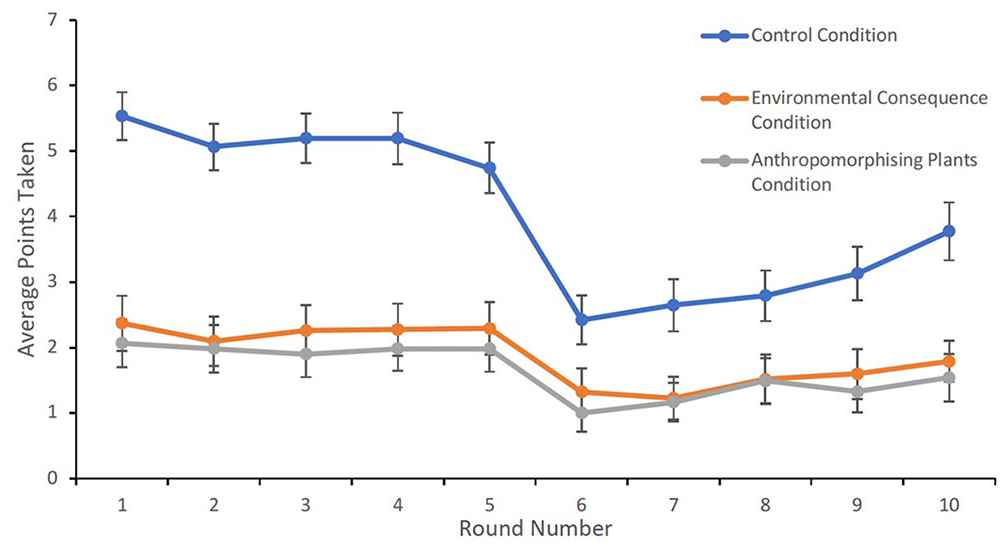
Mean number of points taken by participants in each condition over 10 rounds.
As with past work (Bastian et al., 2019), we examined if connectedness to nature (M = 3.48, SD = 0.65) and moral expansiveness (M = 17.36, SD = 4.53) influenced cooperation by interacting with condition allocation. Using a negative binomial generalized linear model (due to over-dispersion), we found no significant interaction effect on cooperation, p = .317. Similarly, there was no significant interaction between condition allocation and connectedness to nature on cooperation, p = .675.
Condition Differences in Exploratory Variables
Kruskal–Wallis rank-sum tests (due to non-normality) revealed no significant differences between conditions in the extent to which participants believed trees/plants could be harmed, H(2) = 3.20, p = .202, ε2 = .02, possessed intrinsic value, H(2) = 1.00, p = .606, ε2 = .01, possessed extrinsic value, H(2) = 1.17, p = .557, ε2 = .01, or were beautiful, H(2) = 0.65, p = .724, ε2 = .00. However, a one-way ANOVA revealed significant differences between conditions in the extent to which participants believed that trees/plants had mind, F(2, 182) = 16.32, p < .001, η2 = .15. Post hoc Tukey tests indicated that participants in the anthropomorphizing plants condition rated plants/trees as having a mind (M = 6.16, SD = 2.34) more so than those in the control condition (M = 3.89, SD = 2.23; p < .001) and environmental consequence condition (M = 4.40, SD = 2.37; p < .001). The difference between the control condition and environmental consequence condition was not significant, p = .430.
A Kruskal–Wallis test revealed large significant differences between conditions in participants’ motivation for financial gain, H(2) = 27.54, p < .001, ε2 = .15. Post hoc Dunn’s test showed that the control condition (M = 5.35, SD = 2.19) was significantly more motivated by financial concern than the environmental consequence (M = 3.45, SD = 2.63, p < .001) and anthropomorphizing plants (M = 3.07, SD = 2.32, p < .001) conditions, with no significant difference between the latter two (p = .490).
Large significant differences were also found in motivation by concerns about other players’ actions, H(2) = 28.05, p < .001, ε2 = .15. The control condition (M = 5.74, SD = 2.10) was significantly more motivated by others’ actions than the environmental consequence (M = 3.77, SD = 2.56, p < .001) and anthropomorphizing plants (M = 3.49, SD = 2.43, p < .001) conditions, with no significant difference between the latter two (p = .547).
A Kruskal–Wallis test revealed large significant differences in participants’ motivation by concerns for tree preservation, H(2) = 81.74, p < .001, ε2 = .44. Post hoc Dunn’s test showed that the control condition (M = 2.39, SD = 1.95) was significantly less motivated by tree preservation than the environmental consequence (M = 6.87, SD = 2.43, p < .001) and anthropomorphizing plants (M = 6.66, SD = 2.46, p < .001) conditions. The difference between the latter two conditions was not significant (p = .600).
This suggests that differences in cooperation between the control and the two other conditions containing an environmental consequence, may have been related to concerns about personal financial gain, others’ behavior, and the preservation of trees. Consequently, these variables were selected as mediators in exploratory mediation analyses. To achieve this, we dummy coded the conditions (0 = control, 1 = environmental consequence and anthropomorphizing plants condition).
To examine if concern for financial gain mediated the effect of condition on cooperation, we used mediation analysis in R. The indirect effect of condition (control vs. environmental consequence) via concern for financial gain on cooperation was significant, b = −11.95, 95% CI [−16.97, −7.30], as was the direct effect, b = −11.10, 95% CI [−17.85, −4.18]. This indicates that reduced concern for financial gain mediated the relationship between the environmental consequence condition and cooperation. We also explored if concern for other players’ actions mediated the effect of condition on cooperation. The indirect effect via concern for other players’ actions was not significant, b = −1.80, 95% CI [−5.22, 1.29], whereas the direct effect was significant, b = −21.25, 95% CI [−29.51, −12.50].
Following this, we investigated whether concern for the preservation of trees mediated the effect of condition (control condition or environmental consequence conditions) on cooperation. The indirect effect of condition via concern for the preservation of trees on cooperation was significant, b = −18.65, 95% CI [−25.97, −11.64], whereas the direct effect was non-significant, b = −4.24, 95% CI [−12.67, 5.17]. That is, those in the environmental consequence conditions (compared to the control condition) cooperated more, and this was mediated by increased concern for the preservation of trees.
Predictors of Cooperation
We further explored predictors of cooperation in conditions where there was an environmental consequence (environmental consequence and anthropomorphizing plants conditions), with a focus on the role of moral properties on cooperative outcomes. Multiple regression analyses were conducted to determine the relative importance of property variables (trees can be harmed, trees are beautiful, trees are pure, trees are useful, intrinsic value and extrinsic value) on cooperative behavior and concern for the preservation of trees. Results indicated that a belief that trees are beautiful, β = −0.33, p < .001, was the only significant predictor of cooperation in the economic game. Additionally, only belief that trees are beautiful, β = 0.30, p < .001, can be harmed, β = 0.22, p = .007, and possess intrinsic value, β = 0.20, p = .022, were significant predictors of motivation to preserve trees.
A moderated mediation analysis (model 7) using the PROCESS macro for R (Hayes, 2022) revealed that condition significantly interacted with perceptions of beauty on motivations to preserve trees, F(1, 181) = 4.77, p = .030. The indirect effect of condition on the number of points taken in the game via a desire to preserve trees was significantly moderated by perceptions of beauty, b = −3.29, SE = 1.50, 95% CI [−6.51, −0.62]. This suggests the indirect effect of condition on cooperation through concern for tree preservation was stronger with greater perceptions of nature’s beauty (see Figure 2).
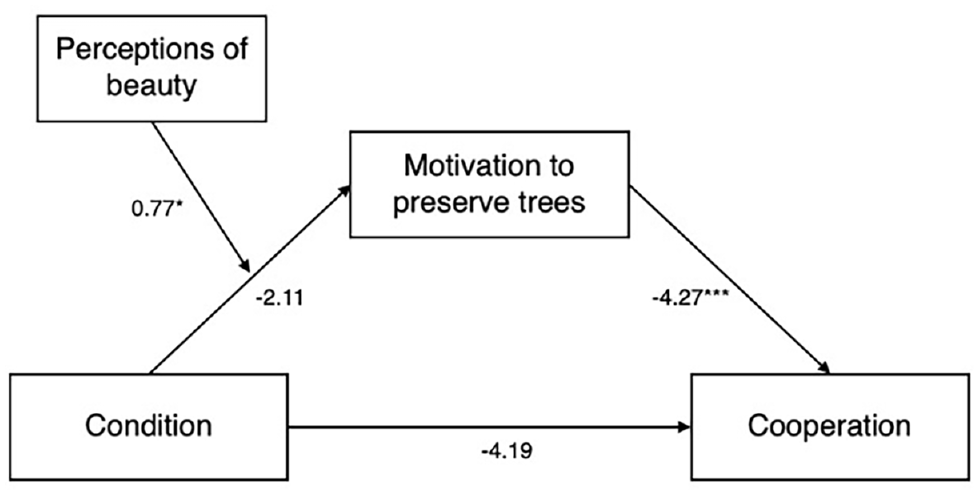
Moderated meditation model of condition on cooperation, via motivation to preserve trees, moderated by perceptions of beauty.
A second moderated mediation analysis showed a significant interaction between condition and perceptions of intrinsic value on motivations to preserve trees, F(1, 181) = 4.21, p = .042. The indirect effect of condition on the number of points taken in the game via a desire to preserve trees was significantly moderated by perceptions of intrinsic value, b = −1.36, SE = 0.71, 95% CI [−2.88, −0.10]. This suggests the indirect effect on cooperation was stronger as perceptions of intrinsic value increased. Perceptions of extrinsic value, harm, and mind did not moderate the mediation effect (see Supplementary Materials for full results).
Discussion
Study 1 explored whether adding moral significance to a resource (by including a consequence for the environment) and amplifying the mind-like capacities of trees affect cooperative action in a resource dilemma game. Partially supporting our hypotheses, participants who believed their actions could only affect their own and other players’ earnings cooperated significantly less than participants who believed their actions could also lead to an environmental consequence. This increased cooperation in the environmental consequence conditions and was driven by a motivation to preserve trees and reduced concern for financial gain, suggesting that making environmental consequences immediate and tangible promotes greater resource conservation.
Contrary to predictions, enhancing the humanlike characteristics of trees did not affect cooperation compared to the environmental consequence condition, although it did increase the perception that trees have a mind. This may be because believing trees have mind-like qualities may not lead to a strong motivation to protect them, or because the environmental consequence resulted in a floor effect where participants were reluctant to take points from the shared pool.
Exploratory analyses revealed that greater concern for the preservation of trees was related to greater perceptions of plants having intrinsic value and moral properties (e.g., harm, beauty, and mind). However, only perceptions of beauty were related to actual cooperative behavior. Indeed, the mediation effect for condition on cooperation via a motivation to preserve trees was moderated by both perceptions of beauty and the intrinsic value of plants/trees. That is, being assigned to a condition with an environmental consequence promoted a motivation to preserve trees more so for those who believed trees were beautiful and intrinsically valued, and this was subsequently related to increased cooperative behavior.
Study 1 suggests that a strong motivator to sustain a resource may be the non-monetary value individuals place on the resource itself. While enhancing the humanlike characteristics of plants/trees did not appear to promote further cooperation, exploratory analyses suggested that enhancing the beauty of nature may be a viable route to protection of a non-sentient resource.
Study 2
Beauty is an additional moral property that may play a significant role in moral concern for non-sentient objects (Bastian et al., 2023; Goodwin, 2015; Klebl et al., 2022). Beauty is thought to evoke a sense of cleanliness or absence of contamination, and beautiful people or things are thus often thought of as pure. Consequently, when beauty stimulates a sense of purity, it implicitly activates our moral intuition to preserve and protect, impelling us to maintain the purity of the beautiful entity and avert any potential harm. For example, physically attractive individuals are perceived as having more moral character traits (Klebl et al., 2022). Conversely, unattractive individuals are more likely to be associated with morally reprehensible or disgusting acts. Purity perceptions have also been considered a possible causative factor for people’s moral concern for the environment (Rottman et al., 2015) and framing pro-environmental rhetoric in terms of purity has been found to increase pro-environmental attitudes (Feinberg & Willer, 2013). Importantly, it has been shown that people consider it to be “wrong” to cause harm to things that are considered beautiful regardless of whether or not that object has any extrinsic value (Bastian et al., 2023).
Study 1 showed a link between perceiving trees as beautiful and cooperative decisions in a resource dilemma game. This study aimed to replicate and extend these findings by testing whether attaching moral significance to a non-sentient resource promotes cooperation and if manipulating the beauty of plants enhances environmental cooperation. We hypothesized that participants would cooperate more in conditions with environmental consequences (high beauty and low beauty) compared to the control condition, mediated by reduced financial concern and greater tree preservation concern. We also hypothesized greater cooperation in the high beauty condition compared to the low beauty condition, mediated by notions of purity and the moral standing of trees.
Method
The aim, hypotheses, and analytical plan were preregistered on the Open Science Framework (OSF). All data and R scripts can be accessed via the following link: https://osf.io/k9ena/?view_only=0bc24931de8e4247b4298ff058888de4.
Participants
We took a conservative approach to sample size and aimed to detect a small to medium effect size. Using G*power, it was determined that 246 participants were required to detect a small to medium effect size (f = 0.20) with 80% power. In total, 253 participants from the United Kingdom were sourced through Prolific (paid £1.40 for participation, with an additional £0.50 bonus), and seven of these were excluded from analyses due to failing to complete the experiment (four participants) or for failing attention checks (three participants). This resulted in a final sample of 246 participants aged between 19 and 79 years (Mage = 42.52, SDage = 13.91; 123 female). Participants responded to identical demographic questions as specified in Study 1. Those included in the study were moderately liberal to centrist regarding economic (M = 3.35, SD = 1.38) and social issues (M = 3.13, SD = 1.56) on average, and reported low levels of importance of religion (M = 1.59, SD = 1.07). Participants additionally reported being mid-ladder on average in terms of Subjective Social Status (M = 5.23, SD = 1.53).
Procedure
The current study followed a similar procedure to Study 1, except where deviations are noted below. Participants first filled out the demographic and individual difference surveys prior to beginning the experiment, which contained all variables compared to the previous study, however the MESx scale was omitted due to financial constraints. Participants were then randomly allocated into one of three conditions: the control condition (n = 83), the high beauty condition (n = 82), or the low beauty condition (n = 81). The control condition was identical to that described in Study 1. Participants in the high beauty and low beauty conditions were also advised that any points left over in the collective pool would be donated to charity, as described in the environmental consequence condition in Study 1. In the high beauty condition, this message was accompanied by a picture of a beautiful tree. In the low beauty condition, this message was accompanied by a picture of a less beautiful tree. These images were chosen based on data from a pilot study suggesting the images were sufficiently different in beauty ratings (see Supplementary Materials).
The resource dilemma games then followed an identical procedure to that outlined in Study 1, with one exception. In the high beauty and low beauty conditions, participants were repeatedly shown the images of the high and low beauty tree, respectively, alongside the instructions for participants to take points from the pool of resources.
Measures
All measures were similar to Study 1, except the intrinsic and extrinsic value questions were omitted due to financial constraints on the study duration. The variables measuring motivations for participant behavior were identical to the previous study. The moral property variables had slightly altered wording, and were only included in the high and low beauty conditions. We asked participants to indicate the extent to which they agreed with the following statements: “Trees/plants can be harmed,” “Trees make me think of something pure,” and “I find trees beautiful.” Additionally, in order to consider the possible extrinsic value people place on trees, we also asked participants the extent to which they agreed with the statement: “I find trees useful.” Finally, we asked participants two questions to gauge their assessment of the moral worth of trees: “Trees deserve to be protected” and “It is morally wrong to harm trees.” All responses were recorded on a scale of 1 (Strongly Disagree) to 9 (Strongly Agree).
Results
Condition Differences in Cooperation
Kruskal–Wallis tests (due to non-normality) were used to determine if highlighting an environmental consequence or the beauty of plants influenced cooperation in a resource dilemma game. Results showed small significant differences in points taken between conditions, H(2) = 8.03, p = .018, ε2 = .03. Post hoc Dunn’s tests provided mixed support for our hypotheses. Participants in the control condition took significantly more points (M = 45.87, SD = 28.83) than those in the high beauty condition (M = 33.46, SD = 27.46; p = .019). However, there was no significant difference between the control and low beauty conditions (M = 38.46, SD = 31.95; p = .084), or between the high and low beauty conditions (p = .499).
The consumption of points followed a similar pattern across conditions (see Figure 3). After a warning in the fifth round, consumption dropped in all conditions, indicating participants’ sensitivity to resource depletion. However, points taken remained lower in the high beauty condition after the warning, whereas they increased more steeply in the control and low beauty conditions. We also explored whether connectedness to nature (M = 5.64, SD = 1.18) interacts with condition allocation on cooperation. A negative binomial generalized linear model (due to over-dispersion) revealed no statistically significant interaction, p = .409.
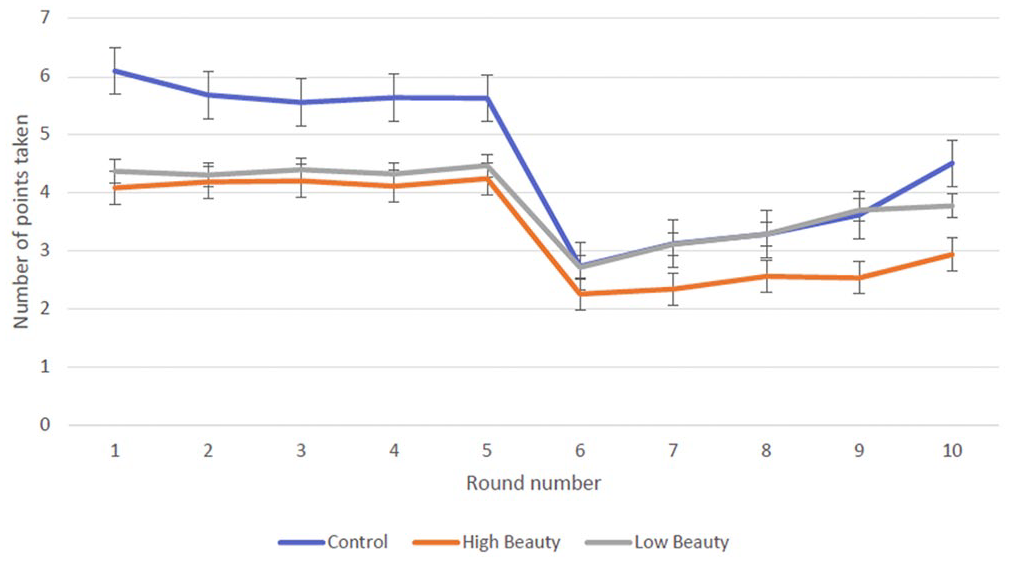
Mean number of points taken by participants in each condition over 10 rounds.
Condition Differences in Motivations
A Kruskal–Wallis rank-sum test revealed small significant differences between conditions in concerns about financial gain, H(2) = 7.58, p = .023, ε2 = .03. Post hoc Dunn’s test showed that the control group (M = 5.75, SD = 2.21) was more financially motivated than the high beauty condition (M = 4.60, SD = 2.70; p = .020). No difference was found between control and low beauty (M = 4.95, SD = 2.76; p = .151) or between high and low beauty conditions, p = .358.
Moderate significant differences were also found in motivations concerning other players’ actions, H(2) = 16.27, p < .001, ε2 = .07. Post hoc comparisons showed the control group (M = 5.66, SD = 2.23) was more concerned about others’ actions than the high beauty (M = 4.21, SD = 2.60; p = .001) and low beauty conditions (M = 4.33, SD = 2.64; p = .001). No significant difference was found between high and low beauty conditions, p = .908.
There were large significant differences between conditions in concerns for the preservations of trees, H(2) = 72.65, p < .001, ε2 = .30. Post hoc tests indicated that the control group (M = 2.42, SD = 2.05) was less motivated by tree preservation than the high beauty (M = 5.82, SD = 2.68; p < .001) and low beauty conditions (M = 5.68, SD = 2.73; p < .001). No significant difference was found between high and low beauty conditions, p = .706. This suggests that differences in cooperation between the conditions may have been related to concerns about personal financial gain, others’ behavior, and/or the preservation of trees. Consequently, these variables were selected as mediators in mediation analyses (conditions recoded to 0 = control condition, 1 = low beauty condition, and 2 = high beauty condition).
A mediation analysis using the mediation package in R investigated whether concern for financial gain mediated the effect of condition on cooperation. The indirect effect of condition via concern for financial gain on cooperation was significant, b = −3.77, 95% CI [−6.73, −1.26], while the direct effect was not, b = −2.51, 95% CI [−6.17, 1.47]. Concern for other players’ actions did not significantly mediate the effect between condition and cooperation, b = −0.56, 95% CI [−1.81, 0.60], whereas the direct effect was significant, b = −5.66, 95% CI [−10.13, −1.34]. Lastly, concern for tree preservation significantly mediated the effect between condition and cooperation, b = −9.09, 95% CI [−12.34, −6.18], whereas the direct effect was non-significant, b = 2.91, 95% CI [−1.20, 7.59].
Predictors of Cooperation
We aimed to identify predictors of cooperation in environmental contexts, focusing on the role of moral properties. Multiple regression analyses were conducted to determine the relative importance of property variables (trees can be harmed, trees are beautiful, trees are pure, trees are useful) 3 on cooperative behavior and motivations. Results indicated that belief that trees can be harmed, β = −0.20, p = .006, and beliefs that trees are beautiful, β = −0.30, p = .001, were significant independent predictors of cooperation in the economic game. Additionally, belief that trees are pure, β = 0.21, p = .010, and beautiful, β = 0.34, p < .001, were significant predictors of motivation to preserve trees. Belief that trees can be harmed, β = 0.21, p < .001, are pure, β = 0.57, p < .001, and are beautiful, β = 0.22, p = .001, significantly predicted belief that trees deserve protection. No significant link was found between belief that trees are useful and cooperative behaviors or motivations.
Finally, we ran an exploratory multiple regression analysis to assess which properties independently relate to a moral concern for trees (“It is morally wrong to harm trees”). Despite the explicit use of the word “harm” in the statement, it is intriguing that perceptions of purity were a stronger predictor, β = 0.45, p < .001, than perceptions that trees can be harmed, β = 0.27, p < .001, of the belief that it is morally wrong to harm trees, yielding large and medium effect sizes, respectively.
Discussion
Study 2 found mixed support for our hypotheses. Participants in the control condition (financial consequence) cooperated less than those in the high beauty environmental condition. There was no difference in cooperation between the control condition and the low beauty environmental condition. The effect of condition on cooperation was explained by lower concern for personal financial gain and greater concern for tree preservation. These findings, replicating Study 1, highlight that tangible environmental consequences enhance the value of a resource and promote cooperation. In our exploratory analyses, the belief that trees are beautiful and can be harmed significantly predicted cooperative behavior, while perceptions of purity and beauty, but not beliefs about harm, predicted both motivations to preserve trees in the game and the belief that trees deserve protection. Interestingly, perceptions of purity were a stronger predictor than beliefs about the capacity for trees to experience harm in predicting perceptions that it is wrong to damage trees, suggesting that aesthetic and symbolic properties may play a more central role in moral concern for environmental protection.
General Discussion
Understanding human cooperation is crucial for determining the best ways to manage modern resource dilemmas, such as overconsumption from the environment. Economic games have been traditionally used to model cooperation and explore what might increase or decrease cooperative actions within groups. However, these models, often using monetary or abstract proxies for resources, may not capture the non-monetary value people assign to the resources themselves (Fehr & Gächter, 2002; Feinberg et al., 2012, 2014; Rapp et al., 2017; Romano et al., 2017; Wu et al., 2016b, 2016a; Yamagishi, 1988). Across two studies, we explored if people attach moral value to non-sentient resources in resource dilemma games. We additionally explored how this affected their choices to conserve these resources.
We found consistent evidence that adding value to a resource (by including a consequence for the environment) increased cooperative action in a resource dilemma game. This finding extends upon prior work, which established that attaching moral significance to a minimally sentient resource, crickets, led to greater protection of that resource (Bastian et al., 2019). Here we demonstrated that people also attach value to non-sentient resources such as the environment. This shift in behavior, observed across both studies, was explained by differences in motivation. When the resource was just represented as points, and thus a tradable commodity, participant behavior was more motivated by a desire for personal financial gain. On the other hand, motivations shifted when consumption of the resource had a clear environmental consequence; participant actions were instead dominated by a desire to preserve and protect trees. As with crickets, it appears that people attach an additional source of value to environmental resources, and this may increase cooperation. These results highlight that typical resource dilemma games aimed at modeling environmental conservation behavior may not fully account for the additional sources of value that people may place on the resources themselves. This work goes beyond merely demonstrating the role of concern for nature or modeling increased cooperation; it shows that leveraging the moral value placed on resources can lead to better cooperative outcomes.
Importantly, our studies probed the nature of the value that people attached to non-sentient resources. When the consumption of resources clearly and tangibly affected the environment, participants appeared to limit their consumption due to the intrinsic value they attributed to nature itself, rather than any potential extrinsic benefits that nature could provide to humans. Put differently, it appears that individuals appreciate nature for its own sake, not just for the potential benefits it offers them, and this intrinsic value may have influenced their actions to safeguard the environment. These findings are in line with other work, which suggests that people place intrinsic value upon non-sentient objects, and this intrinsic value is a strong motivator to protect (Bastian et al., 2023).
An additional question of the current research was to understand what traits people assign to nature that in turn increase its moral and intrinsic value. Theories in moral psychology emphasize that moral concern is more likely to occur when an intentional agent harms a vulnerable patient (e.g., Schein & Gray, 2018), and that victimhood is more often assigned to those that have the capacity to suffer (Gray & Kubin, 2024). Our work instead suggests that sentience and the experience of harm may not always be a requisite component for moral consideration. In the current studies, when we manipulated the humanlike characteristics of trees, we subsequently increased perceptions that nature possessed mind. However, this did not affect participants’ beliefs that trees could experience harm, the intrinsic value that participants imbued upon nature, or cooperative actions taken to protect and preserve nature. Importantly, the effect of condition (e.g., whether an environmental consequence was attached to resource consumption or not) on motivations to protect trees was not moderated by perceptions of mind or the capacity for nature to be harmed. Instead, decisions to protect trees was moderated by how beautiful people believed nature to be.
In a second study, we delved into this finding in greater detail and manipulated the level of beauty associated with the environmental consequence. That is, when participants’ consumption of the resource was associated with a consequence for the environment, this was also paired with an image of tree that was either high or low in beauty. Participants took greater actions to preserve the resource when the resource was attached to an environmental consequence and this was paired with a beautiful image of a tree, compared to a condition where there was no additional value attached to the resources (control condition). However, there was no difference between cooperative behavior in the control condition compared to a condition where the resource was attached to an environmental consequence, and this was paired with a low-beauty image of a tree. These findings suggest that the beauty of nature may be an important driver of cooperative action to protect the resource. Indeed, perceptions that trees are beautiful and pure was clearly related to cooperative behavior, motivations to preserve trees, and beliefs that it is wrong to damage trees. Perceptions of purity and beauty were generally larger predictors of cooperative outcomes compared to perceptions that trees can be harmed.
The current work is additive to our understanding of the factors that enhance cooperation for large-scale problems. Through the use of experimental designs, we can have greater confidence that pairing resources with an additional source of moral value and enhancing beauty cause greater resource preservation behavior. Moreover, we assessed actual cooperative behavior with real (rather than hypothetical) consequences for the environment. Countless studies highlight that there is often a gap between intentions to act and actual behavior, and neither intentions to behave in a certain way or values are reliable pathways to action (Blake et al., 2014; Courtenay-Hall & Rogers, 2002; Essiz et al., 2023; Redondo & Puelles, 2017).
The findings from these studies also have important practical implications. First, highlighting the tangible and immediate consequences that actions have on the environment may assist in promoting positive action. This reduces the psychological distance between action and outcome, and reorienting people to focus on the concrete, short-term and immediate consequences of their behavior may be more effective than the more abstract consequences people imagine to happen in the future (Maiella et al., 2020; Van Lange & Huckelba, 2021; Wang et al., 2019). It is possible that beauty in particular is an especially salient and concrete feature that quickly grabs our attention (Diessner & Niemiec, 2023; Manesi et al., 2015). Second, moral concern for nature appears to be clearly related to positive action for the environment and interventions may wish to leverage upon this facet of our psychology. In particular, it appears that believing the environment to be pure and beautiful may be an important route to activating moral concern for nature, and, critically, inspiring eco-friendly action (Bastian et al., 2023; Diessner & Niemiec, 2023; Klebl et al., 2022).
The current work also lays the foundation for several future lines of research. First, we assessed actions to protect the environment in artificial economic games. Although our work mimicked environmental resource dilemmas to a greater extent than many other economic games (e.g., by including an environmental consequence), it is nonetheless important that future work replicate our conclusions in more realistic settings. Moreover, Study 2 demonstrated an effect for one set of stimuli (one image of high and low beauty trees, respectively), and more research is needed to showcase a general effect across multiple stimuli. Our results also showcased short-term and immediate effects, but environmental protection is a long-term goal that needs to be sustained. Activating moral concern for the environment itself (rather than for what it can offer us) may be one route to achieve this long-term action, and future work is needed to assess whether this can indeed lead to sustained behavior.
We also assessed actions to protect a resource (the environment) when participant behavior may lead to withholding a positive outcome (withholding charity money to preserve trees). However, participants may cooperate more for the environment if their actions instead were to have a negative effect on nature (e.g., some part of nature gets destroyed). Additionally, while we probed the role of some moral properties in protective behaviors for the environment, there are many other morally-relevant traits that require further exploration, such as sentimentality, rarity and scarcity (Bastian et al., 2023). Future work should uncover the roles of each of these properties for environmental protection behavior. Finally, we asked for demographic information at the onset of the study. While it is possible that this may have raised awareness of group categories and influenced responses, we are not aware of any direct and replicable evidence supporting this effect on cooperation.
The results of the current studies underscore the role of intrinsic value and beauty in motivating cooperative behavior to protect non-sentient resources, specifically the environment. By demonstrating that participants’ actions were driven by the inherent moral value they attributed to nature and its perceived beauty, we broaden our understanding of the properties that can influence moral concern for the environment. As we navigate our way through pressing environmental crises, insights from these studies offer valuable perspectives on how we can foster cooperation and stimulate pro-environmental actions, potentially paving the way toward a more sustainable future.
Supplemental Material
sj-docx-1-eab-10.1177_00139165241291700 – Supplemental material for Beauty Builds Cooperation by Increasing Moral Concern for the Environment
Supplemental material, sj-docx-1-eab-10.1177_00139165241291700 for Beauty Builds Cooperation by Increasing Moral Concern for the Environment by Kelly Kirkland, Paul A. M. Van Lange, Noah Charalambous, Calypso Strauss and Brock Bastian in Environment and Behavior
Footnotes
Acknowledgements
Not applicable.
Declaration of Conflicting Interests
The author(s) declared no potential conflicts of interest with respect to the research, authorship, and/or publication of this article.
Funding
The author(s) disclosed receipt of the following financial support for the research, authorship, and/or publication of this article: This work was supported by an Australian Research Council (ARC) Discovery Project [grant number: DP200101446].
Ethical Approval
All studies were approved by the Human Ethics Committee from the University of Melbourne (ID: 21499).
Consent to Participate
All participants provided full written consent.
Consent for Publication
Not applicable.
Data Availability
Data and code are available on the Open Science Framework (OSF) on the following linkes: https://osf.io/49zma/?view_only=f4f0883a054e49c38705b407689a9773 and 
Supplemental Material
Supplemental material for this article is available online.
Notes
Author Biographies
References
Supplementary Material
Please find the following supplemental material available below.
For Open Access articles published under a Creative Commons License, all supplemental material carries the same license as the article it is associated with.
For non-Open Access articles published, all supplemental material carries a non-exclusive license, and permission requests for re-use of supplemental material or any part of supplemental material shall be sent directly to the copyright owner as specified in the copyright notice associated with the article.
