




Abstract
Public space lighting (PSL), if adequately designed, may significantly enhance pedestrians’ sense of safety and comfort. Yet, the accumulated knowledge about subjective evaluation of PSL is still insufficient. This paper presents a systematic literature review, carried out according to the PRISMA guidelines, of factors affecting pedestrians’ perceptions of safety, comfort, and pleasantness induced by PSL. The screening process, which focused on studies combining technical- and observer-based environmental assessments, yielded 53 eligible papers, which were then synthesized according to an adapted model for outdoor place-human relationship. This framework-based review comprehensively highlights a few common findings and practical implications, as well as multiple gaps in research coverage, many inconsistencies, and significant generalization and transferability constraints. As the review indicates, one size does not fit all, and much further research is needed to improve the tailoring of PSL to a range of contextual conditions, such as different climates, cultures, and city characteristics.
Introduction
Outdoor public space lighting (PSL) has been extensively explored during the past two decades (e.g., S. Fotios et al., 2015a, 2015b, 2015c; Johansson et al., 2014; Portnov et al., 2020; Svechkina et al., 2020). The continuous advancements in light technologies, together with the accumulating evidence on their economic, environmental, and health-related pros and cons, as well as the increasing role given to social sustainability and users’ perspectives, have been pushing the search for PSL solutions that will be optimal regarding both the objective and subjective quality parameters. Yet, knowledge regarding pedestrians’ perceptions of PSL is still insufficient and hinders our ability to make progress toward such optimization.
If adequately designed, PSL can support urban sustainability by enhancing residents’ perceived safety, comfort, satisfaction, and wellbeing while improving energy efficiency and defining spaces and neighborhood identities (S. Fotios et al., 2015b; Johansson et al., 2014; D. Kim & Park, 2017; Portnov et al., 2020; Svechkina et al., 2020; Wu, 2014). However, if excessive or misdirected, PSL might lead to unnecessary energy waste (Gallaway et al., 2010; Kyba et al., 2014; Saad et al., 2021), pose a non-negligible threat to the nocturnal environment (Chang et al., 2013; Gaston et al., 2013, 2015; Hölker et al., 2010; Kraus, 2016; Lim et al., 2011; Rybnikova & Portnov, 2016; Silva et al., 2017; Svechkina et al., 2020), and become a potential health hazard (Bauer et al., 2013; Cho et al., 2015; Haim & Portnov, 2013; Haim & Zubidat, 2015; Keshet-Sitton et al., 2017; Martin et al., 2012; Obayashi et al., 2014; Shane et al., 2012; Stevens et al., 2013; Svechkina et al., 2020).
At present, PSL is designed according to various technical standards, such as EN 13201-2: 2015 and EN 12464-2, accepted by EU members, ANSI/IES RP-8-180, which consolidates best practice in North America, or the newer AS/NZS 1158.3.1:2020 used in Australia. Additionally, large municipalities, such as Los Angeles, U.S.A, design their own PSL standards (BSL, 2007). Most standards address the physical properties of lighting, such as intensity, uniformity (the ratio of lowest to the average road surface luminance), or glare (S. Fotios & Gibbons, 2018). However, recent publications call for also incorporating considerations of spatial distribution and spectral power (wavelength) distribution (SPD) (e.g., CIE 236:2019, see S. Fotios et al., 2019a). A few standards, such as the North American ANSI/IES RP-8-18, also address energy efficiency and health. Yet, it remains questionable whether these standards adequately reflect how different pedestrians in different contexts perceive and assess the properties and quality of PSL, as so far, knowledge regarding such perceptions, their associated factors, and their practical implications for PSL design is insufficient and needs further investigation.
According to Bernstein (2019), perception is shaped by the recipient’s learning, memory, expectation, and attention. In this respect, perception, as a conscious interpretation and elaboration of sensory data, may consequently lead to preferences and adaptation to particular settings or environments (de Kort & Veitch, 2014; Knez et al., 2009; Lichtenstein & Slovic, 2006). Hence, assessing the perceptions of PSL is particularly important, as lighting constitutes an essential feature of the experienced general quality of the built environment (Johansson et al., 2014), and as users’ cognition and perception of their physical environment, including PSL, affect their attitudes, emotions, and well-being, and may inhibit or promote certain behaviors, such as walking outdoors after dark (Knez et al., 2009; Knight, 2010).
The literature indicates that PSL can be assessed in one or both of the following ways: the “place/environment centered” Technical Environmental Assessment (TEA), which is considered “objective” as it involves instruments and measurement metrics to produce a reading of environmental quality, or the “person-centered” and “subjective” Observer-Based Environmental Assessment (OBEA), which relies on self-report tools through which people express perceptions, observations, and impressions (Craik & Feimer, 1987; Gifford, 2007; Johansson et al., 2014). In other words, OBEA employs human perception to define the environmental quality. Gifford (2012) claims that each approach has its place; neither is necessarily more reliable or valid. Hence, according to Johansson et al. (2014), they should be regarded as complementary. Gifford (2012) also emphasizes that OBEA, complemented by TEA, may assist in the development of physical measures of PSL quality, provide data on PSL quality from the human perspective, and provide assessments of PSL quality along dimensions with particular human relevance.
TEA and OBEA were used extensively for indoor lighting assessments, specifically in offices (e.g., Stokkermans et al., 2018; Veitch & Newsham, 1998), Yet, despite various attempts, assessing the perceived outdoor lighting remains challenging.
Many studies have shown that human perspectives on various attributes of the physical environment, including PSL, are potentially associated with environmental, contextual, and personal factors (Knight, 2010; Moser & Uzzell, 2003; Nasar & Bokharaei, 2017a). However, most of these studies do not provide a comprehensive outlook on the various effecting factors. A more methodical approach is suggested by Knez et al. (2009), who proposed a comprehensive conceptual model of the outdoor place-human relationship designed to study perceptions of thermal comfort. The model consists of three main organizing entities: place, moderator/mediator, and human response. It demonstrates that peoples’ perceptual and emotional estimations of outdoor urban places are influence by place related attributes, such as physical base (e.g., form and location), weather (e.g., temperature), and function (intended physical/social activity), thus extending space definition to include social aspects (Canter, 1997; Graumann, 2002). According to this model, three types of potential moderators/mediators might interact with place parameters affecting human responses: culture (rules, norms, values); person (psychological parameters, such as experience or expectation, demographic variables, biological base, physical and social activity [these parameters define the function of the place, as well as the person-related activities]); and situation (length of exposure, etc.). In line with this model, in the domain of thermal comfort, participants’ perceptual and emotional estimations of outdoor urban places were found to be influenced by weather, environmental attitude, and age (Knez et al., 2009), as well as by climate differences between cold and warm humid climates (Baruti et al., 2019). This comprehensive model can be easily adapted across various research domains, including perceptions of PSL.
Although recent critical reviews explored specific themes of PSL perception, such as reassurance (S. Fotios et al., 2015b, 2015c; Unwing & Fotios; 2011), or safety-related intention recognition (S. Fotios & Johansson, 2019), to the best of our knowledge, there have been no systematic studies that comprehensively covered perceptions of PSL and especially their environmental (including actual lighting conditions), contextual, and personal affecting factors. Moreover, no previous studies have been conducted to date to shed light on the confounding effects of these factors, as they may have possible multiple synergetic effects and different impacts in different circumstances.
This study aims at bridging this knowledge gap by performing a systematic review and synthesis of studies on pedestrians’ perceptions of PSL, focusing mainly on concepts such safety, comfort, reassurance, environmental appraisals, and related cognitions and emotions, instead of the more typical research on visual performance. The systematic review is undertaken to assess the current state of the art, to establish the quality of the evidence, to identify gaps, deficiencies, and trends in the current evidence, and to outline challenges and opportunities, in order to pave the way for future research activities in this field and guide PSL decision-making and policy development.
Using an adapted version of the conceptual model for outdoor place-human relationship suggested by Knez et al. (2009) as a guiding framework, the review focuses on identifying the PSL properties examined, the affecting factors considered, and the research methods employed. As the actual lighting conditions are part of the place-related parameters affecting human perceptions according to the adapted model, the review focuses on studies that combined OBEA and TEA. Such studies allow better assessment of the link between perceptions and actual properties of PSL, better support comparative review, and thus may provide the generalization required for tailoring of lighting standards to pedestrians’ needs.
To clarify the ambiguity of the term “perception,” in this study we limit ourselves to conscious interpretation and elaboration of sensory data reflected by expressions that convey qualities, emotions, and mood. 1 Such investigation becomes especially timely, as PSL undergoes a rapid technological transformation toward greater efficiency, cost saving, and sophistication, which is manifested in a widespread replacement of traditional PSL sources and systems with smart, adaptive, and more efficient ones (Beccali et al., 2019; Pedersen & Johansson, 2018). Hence, the overview reported in this paper may be instrumental in directing future research toward areas where knowledge gaps still exist, and it may also contribute to the contextual design of PSL and improvement of both PSL efficiency and quality.
Methodology
The current study uses the scoping variant of the Preferred Reporting Items for Systematic Reviews and Meta-Analyses (PRISMA) methodology (Moher et al., 2009). The PRISMA is extensively applied in a wide range of disciplines, including environmental and health sciences (Clune et al., 2017; Merlo et al., 2023; Schanes et al., 2018; Zhang et al., 2023), while the scoping variant (PRISMA-ScR) is used as a type of knowledge synthesis, following a systematic approach to map evidence on a topic and identify main concepts, theories, sources, and knowledge gaps (Tricco et al., 2018). Where traditional literature surveys, based on random search or snowballing, may be insufficiently comprehensive or biased in terms of their thematic coverage, the PRISMA-ScR approach enables achieving more holistic and replicable results (Atkinson & Cipriani, 2018).
The review methodology thus consists of the following main stages: (a) formulating search string and identifying initial records; (b) screening search results and selecting eligible articles; and (c) analyzing and synthesizing eligible articles. Figure 1 in the next subsection presents the PRISMA-ScR flow diagram, containing the number of records found at each stage. Three researchers were involved in the review process and disagreements were resolved by discussion and coming up with solutions that are mutually agreeable.
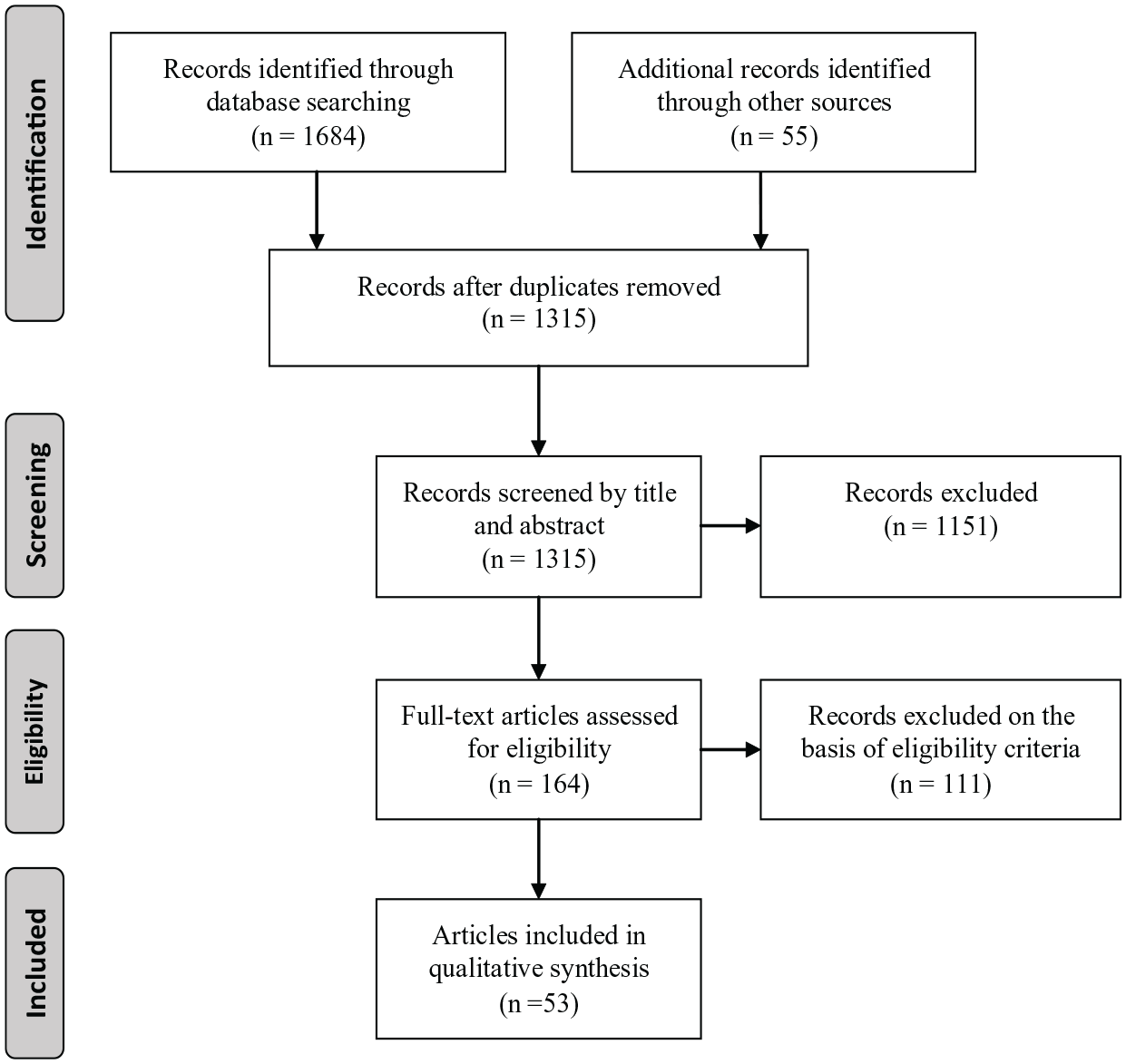
Articles’ screening process and number of relevant records at each stage.
Formulating a Search String and Identifying Initial Records
The selection of eligibility criteria and formulation of the search string was based on a structured brainstorming process (Coyne & Coyne, 2011) comprised of two steps. First, based on our research goal and on the key concepts included in the conceptual model proposed by Knez et al. (2009) for exploring outdoor place-human relationship, we defined the main comprehensive search terms and accordingly phrased the following general survey question: “How do different users (specifically pedestrians) in various outdoor urban places, lit by different artificial light sources and exposed to different nighttime light conditions and properties, perceive their lit environment, while performing, or intending to perform, different activities, and what are the factors (place-related and mediators/moderators) that affect these perceptions.”
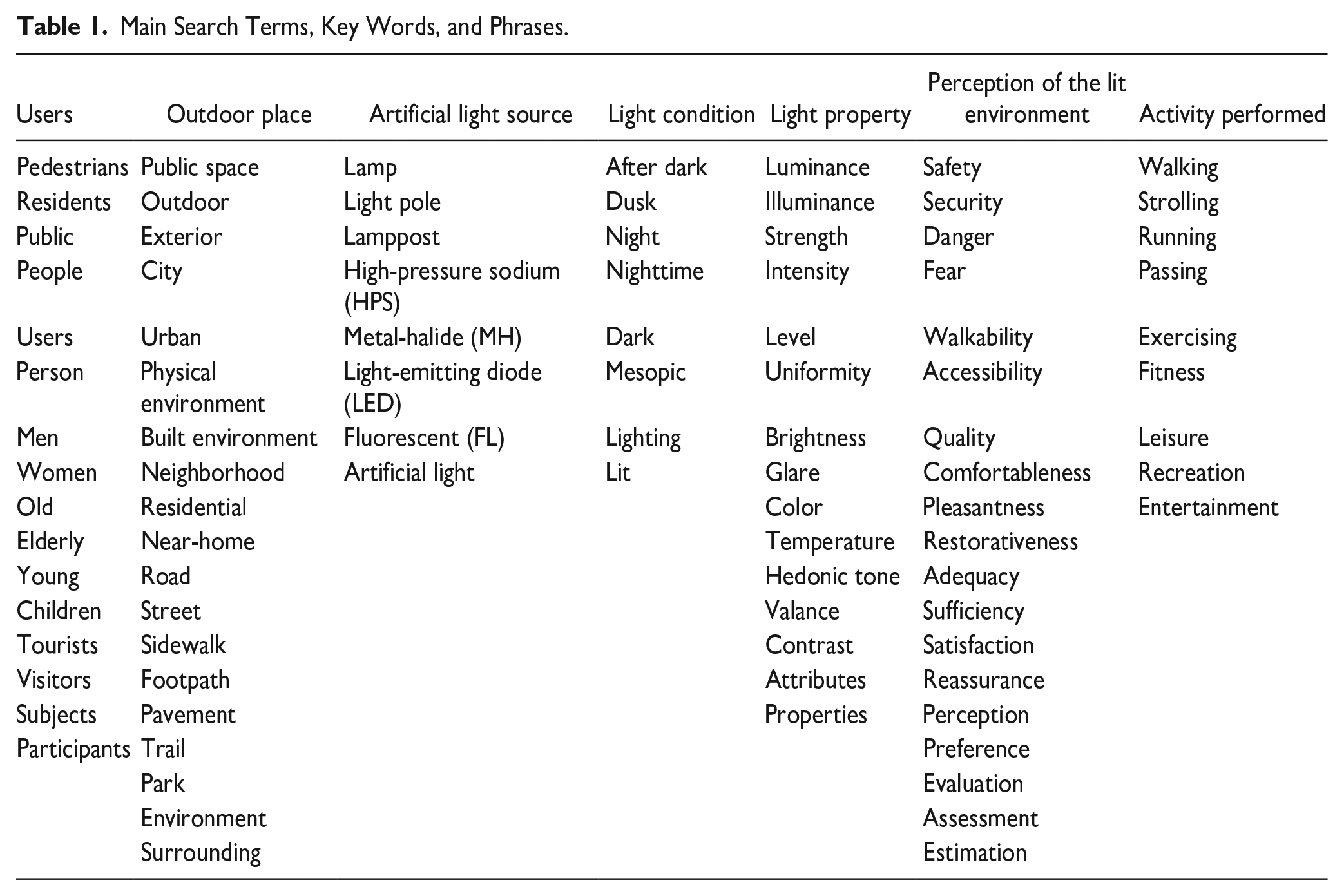
The formulated survey question effectively defined the main search categories, which were next expanded to encompass specific key words and phrases (Table 1), while enabling word variation and incorporation of associated terms so as not to omit any relevant research articles.
Main Search Terms, Key Words, and Phrases.
As lighting research covers multiple knowledge domains, exclusion criteria were needed to restrict search results to the intended focus on PSL in outdoor urban areas, mainly catering to pedestrians’ needs, assessed by both TEA and OBEA, and relates to concepts such as perceptions of safety, comfort, reassurance, environmental appraisals, and related cognitions and emotions. Therefore, we customized our search to exclude the following knowledge domains: (a) PSL effects on visual performance (b) indoor lighting (containing terms such as: indoor, interior, room, office, residential, building); (c) decorative exterior lighting (spotlights, wall, garden, backyard, landscape); (d) driving conditions (driver, accidents); (e) health effects (health, sleep, circadian rhythm, cancer, obesity, eye, phototoxicity, vision, morbidity); (f) ecological influences (species, ecology, biology); (g) light technology and design (systems, algorithms, production, robotic); and (h) non-urban environment (open landscape, natural, semi-urban, rural). Studies were also excluded if they were lacking relevant information.
To optimize the search and formulate a stable and effective search string, the abovementioned terms were used iteratively, while assessing their filtering efficiency. The resulting search string was as follows (*denotes a wild card search, enabling word variations, where the iterative search found it necessary):
(pedestrian* OR elder* OR women OR resident* OR tourist* OR child* OR people OR public OR person* OR visitor* OR user* OR particip*) AND (outdoor OR exterior OR urban OR city OR “built environment” OR “public space*” OR neighborhood* OR “near-home” OR park OR “residential road*” OR “pedestrian road*” OR street* OR sidewalk* OR footpath* OR pavement* OR trail* OR “pedestrian pathway*” OR pedestrian*) AND (lighting OR illuminance OR “high pressure sodium” OR “metal halide” OR “light-emitting diode”) AND (safe* OR secure* OR danger* OR fear* OR walk* OR accessib* OR mobil* OR quality* OR comfort* OR pleasant* OR brightness* OR “hedonic tone*” OR strength* OR reassurance OR valence OR restorativeness OR glare OR evaluat* OR percept* OR prefer* OR stroll* OR run* OR exercise* OR fitness OR leisure OR residen* OR entertainment OR recreation)
We limited the search to electronically available articles published in scholarly peer-reviewed journals, as applied in similar reviews in various research areas (e.g., Carre et al., 2017; Jugend et al., 2020 ; Li et al., 2020; Merlo et al., 2023; Schanes et al., 2018), based on the assumption that academic dialog grants higher credibility and wider critical exposure. Additionally, our search referred only to original studies published in English and reporting combined OBEA and TEA research results. Furthermore, since most studies in the field were performed in the past two decades and our search was conducted during 2022, the search referred only to those published between January 1st 2000 and October-2022.
To maintain the search rigor, gray literature items (Farace & Schopfel, 2010), such as conference proceedings, research reports, dissertations, and industry journals, were omitted. Yet, it should be mentioned that there is a substantial body of high-quality gray literature on outdoor lighting design (e.g., CIE reports by the International Committee for Illumination), as well as dissertations on pedestrians’ lighting perceptions (e.g., Rahm, 2019; van Rijswijk, 2016).
The search was performed in the following four databases: Web of Science, Scopus, SocINDEX, and PsycINFO. These were selected for their comprehensive coverage of scientific, social, and psychological aspects, as appropriate for the multi-domain complexity of the subject. It should be mentioned that the Google-Scholar search engine played only a supplementary role (Anderson, 2013) in the present survey and its use was limited to an initial search of emerging topics and exploration of alternative queries. As each search engine provides different capabilities, we conducted a full-text assessment, or abstracts analysis otherwise when available.
Screening Search Results and Selecting Eligible Articles
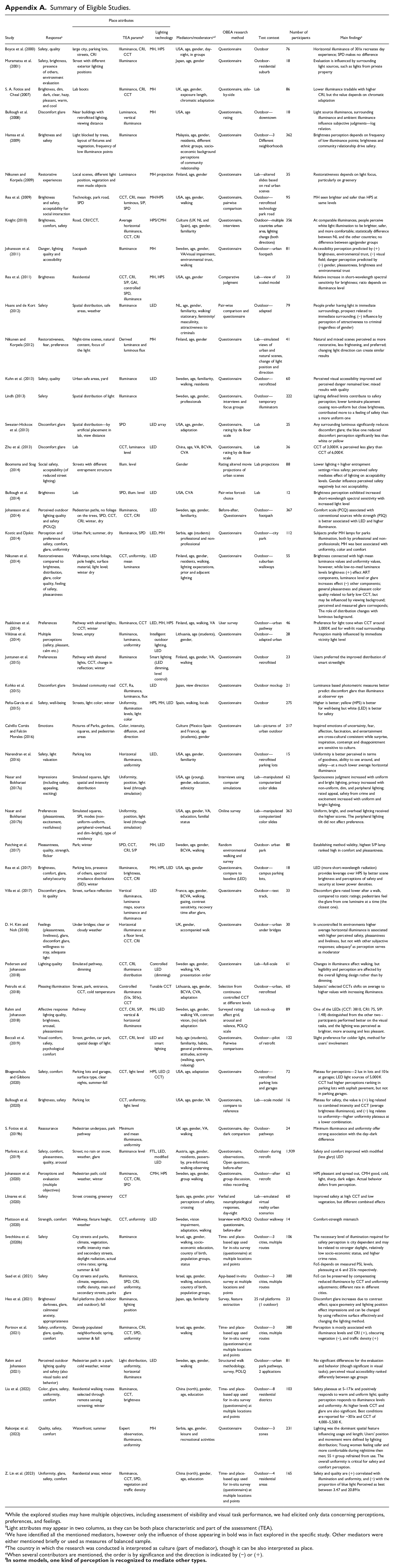
The initial search in all selected sources yielded 1,739 items altogether (Figure 1). After removing duplicates, 1,315 relevant records were identified. Next, we evaluated the titles and abstracts and excluded the documents that did not contain the basic necessary information to perform a descriptive analysis, resulting in 164 articles. Finally, the full texts of these articles were critically read, basically applying the same criteria as those used for screening. This process yielded 53 eligible articles for inclusion in the review. The eligible articles are summarized in Appendix A, which briefly presents the following information pertinent to the review: publication year; evaluated response; considered place-related attributes, including lighting technology and measured light properties (TEA); considered mediators/moderators; research methods used for eliciting perception; test context; number of participants; and main findings. Figure 1 displays the search flow and exclusion statistics of the current review.
Analyzing and Synthesizing Eligible Articles
We have conducted a thematic analysis of the 53 eligible studies to assess coverage and strength of evidence. Coverage analysis was approached in a deductive way, according to which, coding and theme development is directed by existing concepts or ideas. For this purpose, we used the conceptual model suggested by Knez et al. (2009), with several domain adaptations, as a guiding framework for the thematic analysis, providing the key themes, topics, and subtopics. Since the model was originally intended to evaluate perceptions of thermal comfort, some slight adjustments were necessary to the domain of PSL and also to better reflect our goal and survey question. As demonstrated in Figure 2, we adopted the key themes: Place, Mediators, and Response, as well as most of the topics and subtopics proposed in the original model, but added another place-specific topic—PSL properties, which includes: light parameters (intensity, spectral characteristics, such as SPD, CRI, CCT, S/P), light technology (HPS, MH, LED, dimming, smart control), and spatial distribution (position, distribution, direction, focus, uniformity). We also limited the topics of Response to Perception, Cognition, and Emotion, when the latter specifically addresses the subtopics Safety, Comfortableness, Pleasantness, and Discomfort.
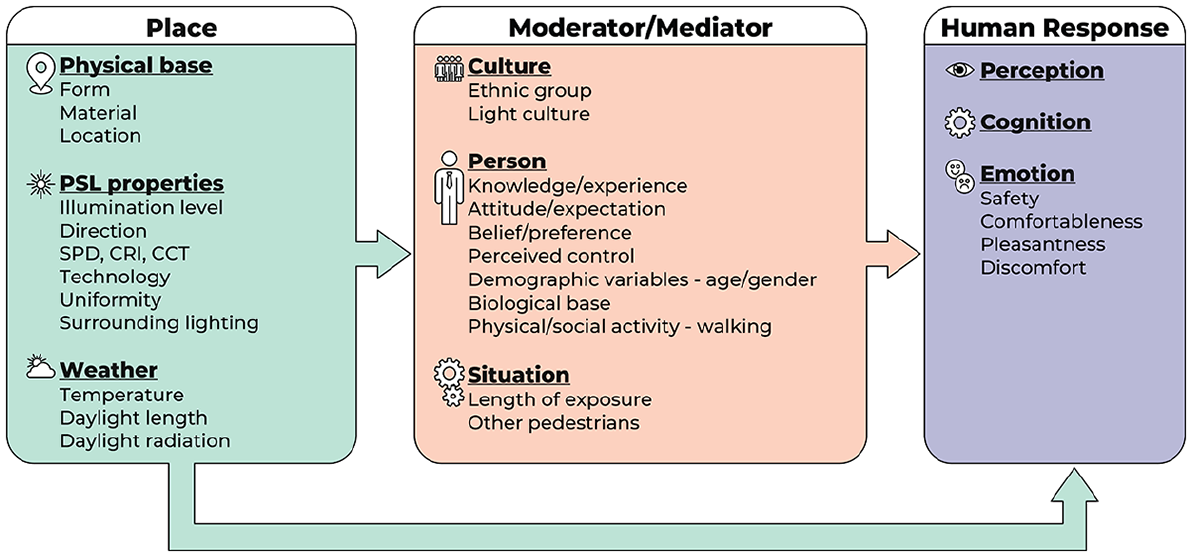
Adjusted* conceptual model of outdoor place-human relationship. *Adapted from Knez et al. (2009).
Results
The results section contains the four following parts: first, the temporal trends in selected publications on the subject are analyzed; next, the emerging themes are examined according to the adapted conceptual model to establish coverage and strength of evidence; then, representation and research methods are explored; and finally, potential biases, limits of generalization, and areas for further research are identified.
Temporal Trends
Figure 3 exhibits the temporal trends in relevant publications since the year 2000. The chart shows that since the turn of the century, very few relevant articles were published. It also illustrates that since 2009, there has been a clear upward trend until 2014, with apparently random yearly fluctuations, from one to seven annual publications. This trend can be attributed to the general increase in scientific publications, but also to the rise of new technological opportunities and health, ecosystem, and energy-saving concerns. However, it has been flattened since 2015, and from 2017 and onward, the annual number of relevant publications has stabilized at around four, presumably showing the prevailing interest.
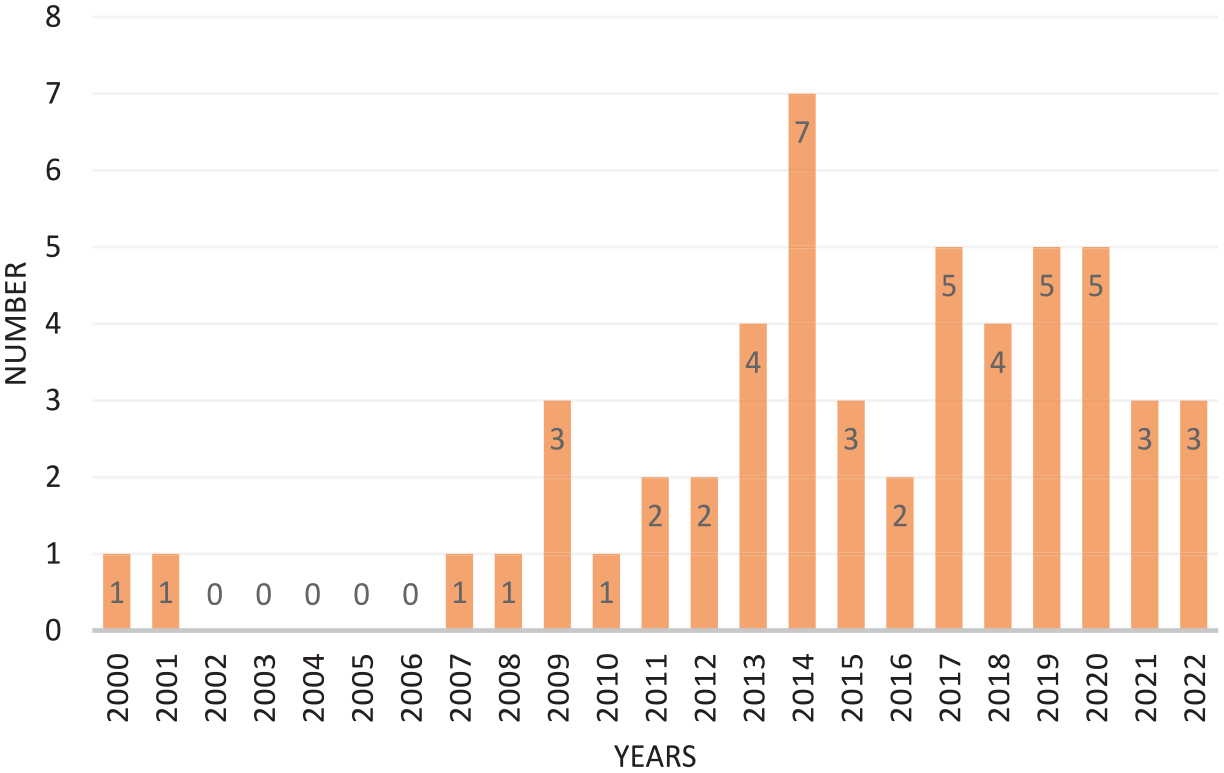
Number of eligible studies (out of 53) by publication year.
Thematic Analysis
Based on the information summarized in Appendix A, the following sub-sections analyze the selected studies according to the key themes of the adapted model: Place, Mediators, and Response, while establishing the relevant topics and subtopics, as well as their coverage, as illustrated in Figure 4. The analysis reveals the complex and inconsistent effects of many place-related and mediating factors on pedestrians’ perceptions of PSL. It also indicates that while each factor may contribute individually, their intermix may create different perceptions.
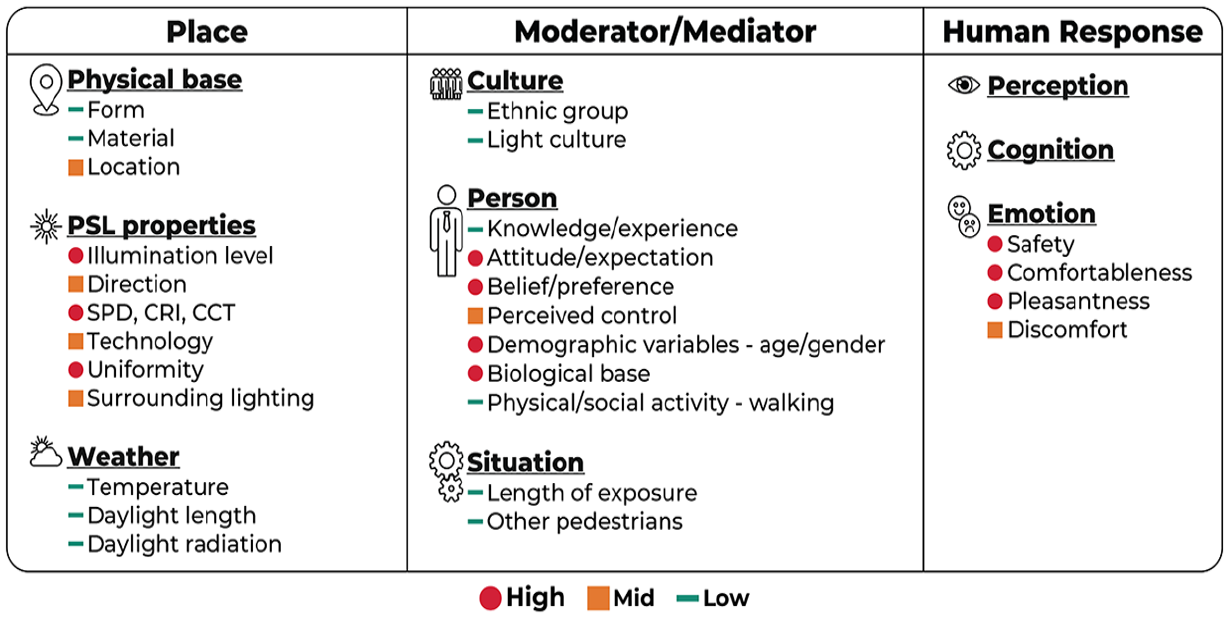
Research coverage according to the adapted model.
Place Attributes
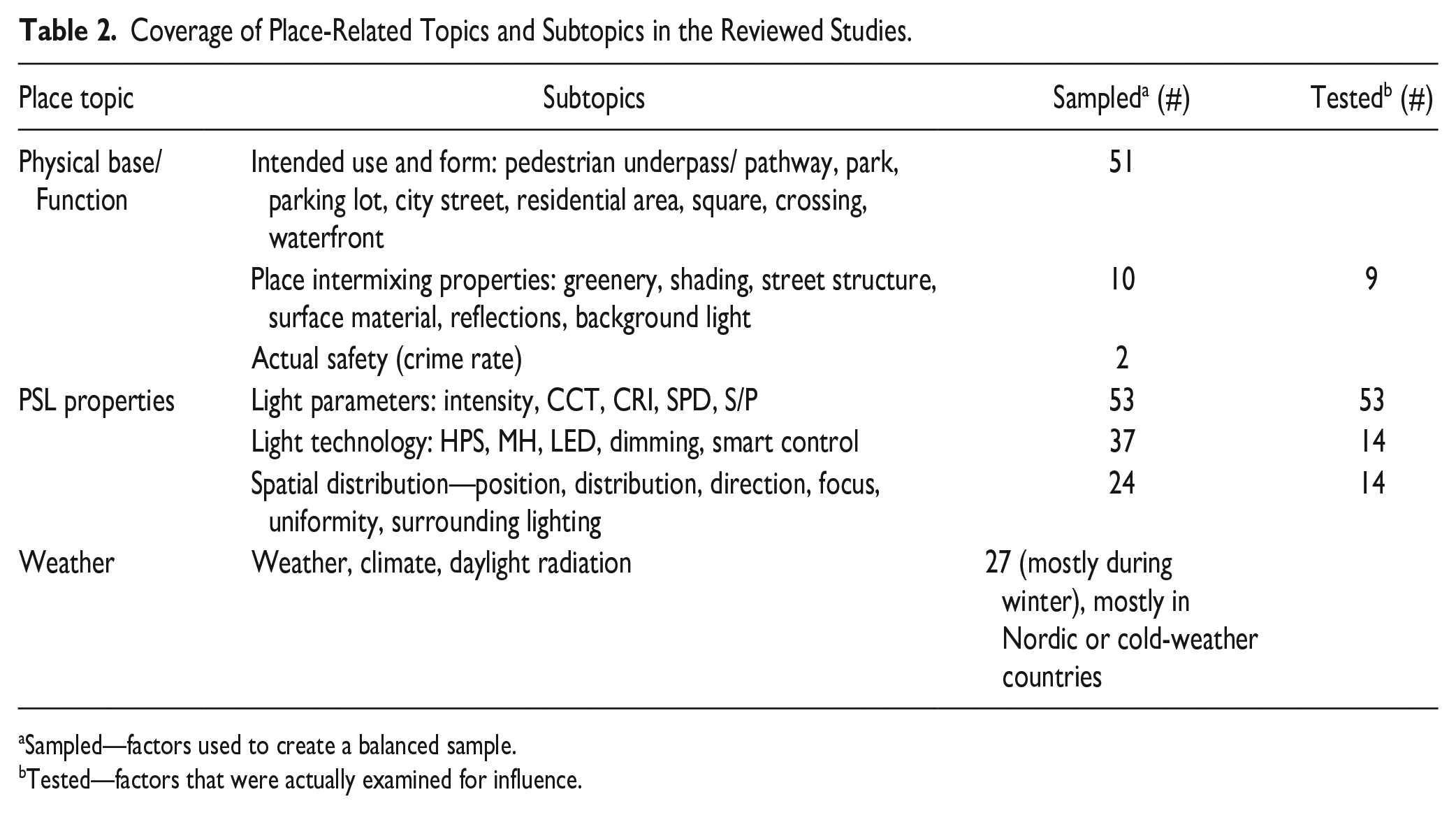
Users’ response, according to the adjusted model, is related to the following place attributes: Physical base, PSL properties, and Weather. As to Function (included in the original model as a place-related topic), the analysis of the selected studies revealed that it can be combined with the Physical base. The analysis also enabled the extraction of potential characteristics (subtopics) associated with place, as listed in Table 2. The subtopics were then aggregated by analyzing the experiment setting (sampled) and tested relationship (tested). Thus, for example, when the experiment area is a footpath (Johansson et al., 2011), we defined it as a sampled subtopic, but when the influence of light uniformity was evaluated (Nikunen et al., 2014), we defined it as a tested subtopic (columns 3 and 4 in Table 2, respectively). Such distinction allowed to elicit the potential factors which were actually tested for their influence on PSL perceptions.
Coverage of Place-Related Topics and Subtopics in the Reviewed Studies.
Sampled—factors used to create a balanced sample.
Tested—factors that were actually examined for influence.
As pertinent to PSL-induced response, subtopics of PSL attributes and distribution are used both as potential contributors and as tested contributors (Table 2). While many place-related characteristics are sampled, only a few are actually- or sufficiently tested for their distinct influence on response. Thus, for example, while weather may directly influence light expectations and indirectly produce vegetation shading that competes with PSL, most experiments are conducted during wintertime, after deciduous street trees lose their leaves.
Since PSL properties are both place attributes and targeted TEA parameters, they merit further elaboration. We found that studies examining the correlation between PSL perception and PSL performance commonly referred to the following light parameters (Appendix A, column 4): all 53 explored the lighting intensity influence (either as illuminance or luminance); 24 referred to CCT (e.g., Liu et al., 2022; Zhu et al., 2013; 14 measured CRI (e.g., Boyce et al., 2000; Portnov et al., 2021; nine explored SPD (e.g., S. A. Fotios & Cheal, 2007; Z. Lin et al., 2023; four addressed Scotopic/Photopic (S/P) ratio (light source’s performance under the scotopic and photopic vision conditions) (e.g., Patching et al., 2017 ); and one referred to measured glare (Saad et al., 2021). These themes, together with the pre-established research trend, correspond mainly to energy-saving concerns, as reflected in the exploration of intensity and uniformity, but also to technology development mirrored by the multiple spectral measurements.
Lighting technology is also changing the spectral appearance of a place. Most reviewed studies (37) indicated the type of light sources under which the study was performed. Almost all of them addressed one of the following light technologies: the newer light-emitting diodes (LED), and/or the more traditional high-intensity discharge (HID) lamps, which include mercury vapor (MV), low- and high-pressure sodium (LPS and HPS), and metal halide (MH). As indicated in Appendix A, most studies (25)—all conducted since 2012—referred to LED lights (e.g., Haans & de Kort, 2012; Markvica et al., 2019; Nikunen et al., 2014; nine addressed HPS lamps (e.g., Boyce et al., 2000; Peña-García et al., 2015; Rea et al., 2009); and eight studies—most of them performed during the 2000s—addressed MH sources (e.g., Boyce et al., 2000; S. A. Fotios & Cheal, 2007; Hamsa et al., 2009; Rakonjac et al., 2022). In additional, latest smart-technologies may change place perception by introducing variable light- and temporal distribution, for example by dimming according to pedestrians’ locations or by the time of night. While tested in only five of the reviewed studies (Beccali et al., 2019; Haans & de Kort, 2012; Juntunen et al., 2015; Pedersen & Johansson, 2018; Viliūnas et al., 2014), it is expected to become the next research trend, as energy efficiency and health concerns are being pursued.
As to lighting distribution, 2 which was found to contribute to better assessment of danger ahead, finding escape routes from adversaries, and staying away from hiding places where danger might lark, the review shows that out of 24 studies that referred to this PSL property, only 14 tested its influence, most of which (12) referred to uniformity (e.g., Bullough et al., 2020; Narendran et al., 2016).
Mediators/Moderators
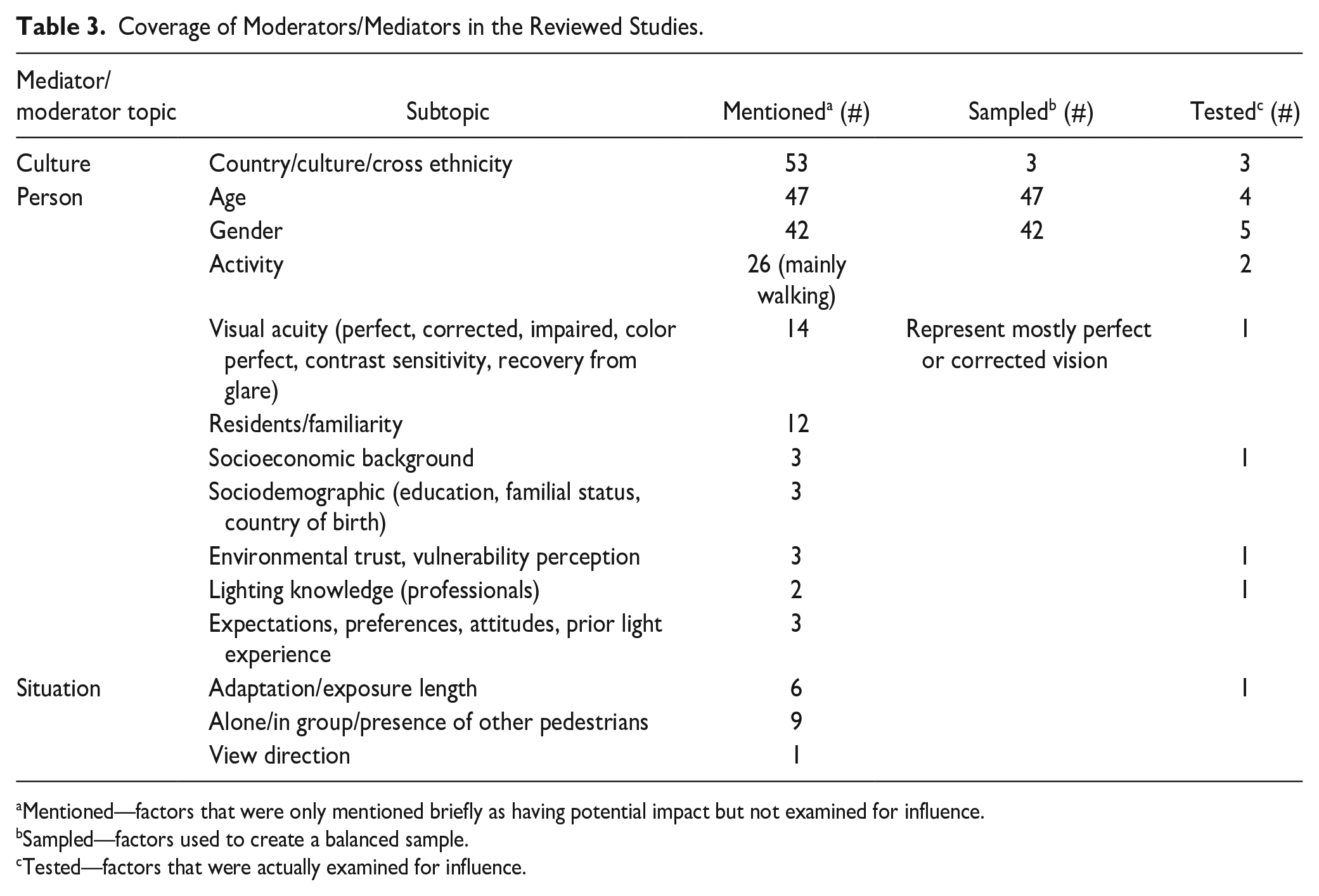
Response, according to the conceptual model, is related to the following mediators/moderators: Culture, Person, and Situation. Through the analysis of the selected studies, we extracted 14 potential mediators/moderators as subtopics corresponding to these topics and relevant to PSL. The process differentiated between subtopics that were only mentioned briefly as having potential impact (e.g., familiarity in Narendran et al., 2016), those used to create a balanced sample (e.g., age and gender in most of the studies), and those whose influence was empirically tested (e.g., gender in Boomsma & Steg, 2014). The different subtopics are presented in Table 3 according to the topic and the number of reviewed studies in which they were mentioned, sampled, or tested accordingly.
Coverage of Moderators/Mediators in the Reviewed Studies.
Mentioned—factors that were only mentioned briefly as having potential impact but not examined for influence.
Sampled—factors used to create a balanced sample.
Tested—factors that were actually examined for influence.
As Table 3 shows, age and gender were the most mentioned, as well as sampled, subtopics in the reviewed studies. However, the influence of gender on PSL perception was actually tested only in five studies (Boomsma & Steg, 2014; Haans & de Kort, 2012; Johansson et al., 2011; Knight, 2010; Rakonjac et al., 2022). Most reviewed studies also tried to represent age variability—10 of which specifically controlled for elders (e.g., Rahm & Johansson, 2018; Svechkina et al., 2020). Additionally, adequate vision was required from participants in most studies (e.g., Zhu et al., 2013), but only Johansson et al. (2011) explicitly included visually impaired subjects. Eleven studies used local residents as a research group (e.g., Knight, 2010), while in other studies varying degrees of subjects’ familiarity with the tested environment was implied. Other mediators/moderators were undertested and undersampled for their influence on the response to PSL.
Responses
The analysis focuses on the following types (subtopics) of response to PSL: safety, comfortableness, pleasantness, and discomfort. Safety, which encompasses danger, reassurance, and brightness (used as a safety proxy), was addressed in 36 of the publications (e.g., Boyce et al., 2000; Liu et al., 2022; Portnov et al., 2021); comfortableness, encompassing satisfaction, preference, willingness to stay, and adequacy was explored in 28 studies (e.g., Nikunen & Korpela, 2012; Portnov et al., 2020; Rakonjac et al., 2022); (c) pleasantness, including quality, attractiveness, and restorativeness, was explored in 25 studies (e.g., Nikunen & Korpela, 2009; Rahm & Johansson, 2021; Rakonjac et al., 2022); and (d) discomfort, corresponding to glare or flicker perceptions, was explored in 13 studies (e.g., Heo et al., 2021; Zhu et al., 2013).
Explored Associations and Reported Results
Results were analyzed by type of response (perceived safety, comfortableness, pleasantness, and discomfort) and their associated place-related- and mediating factors. It is important to note, however, that real-life situations combine the effects of several factors, hence the results might differ from those derived from the analysis of a targeted individual factor.
Perceived Safety
Safety perception is the most systematically explored response, as it was referred to in 36 studies (as mentioned in the previous subsection), all of which focused on light intensity and/or light spectral content (namely SPD, CCT, CRI, or S/P) as place-related influencing factors. Compared to the mixed results found in many studies concerning lighting and actual crime prevention (e.g., Steinbach et al., 2015; Welsh & Farrington, 2008), the review reveals clear positive correlation between pedestrians’ feeling of safety and PSL intensity (e.g., Z. Lin et al., 2023; Rea et al., 2011; Svechkina et al., 2020). Apparently, better intensity and better brightness (associated with more blue-wave content) may improve visibility, which creates the opportunity to assess other upcoming pedestrians. Nevertheless, several studies established a dose-response relationship, where increasing light intensity beyond a specific level does not yield higher safety perception (e.g., Bhagavathula & Gibbons, 2020; Z. Lin et al., 2023; Svechkina et al., 2020). The illumination level at which this phenomenon occurs is spectral-dependent, as a higher short-wave content (produced, e.g., by higher CCT LED) was shown to increase perceived safety at lower intensity and plateau at a lower level (e.g., Bullough et al., 2020).
Additionally, recent studies imply that the plateau threshold is also climate/weather-dependent. Yet, most real scene experiments (27) were performed during wintertime in cold-climate zones, such as in the UK (e.g., S. Fotios et al., 2019), Scandinavian countries (e.g., Patching et al., 2017; Rahm & Johansson, 2021), or northern China (e.g., Z. Lin et al., 2023; Liu et al., 2022); while only a handful were performed in warmer climates, such as in Malaysia (Hamsa et al., 2009) or Israel (Svechkina et al., 2020), in which a higher plateau threshold for safety was reported. Plateau threshold was also found to vary with location, or more specifically—with city characteristics, as observed by Svechkina et al. (2020) and Liu et al. (2022). Furthermore, while standards commonly refer to average intensity, the minimum intensity level was found to predict perceived safety better (S. Fotios et al., 2019b).
Perceived safety is also shown to be influenced by lighting distribution: low frequency of low-illuminated spots (Hamsa et al., 2009; Lindh, 2013) and better uniformity (Bullough et al., 2020) allowed perceptions to be established at lower intensity. Lindh (2013) found that illuminated walls, trees, and visual limits, define spaces more clearly and contribute best to the sense of safety. The study further revealed that lower luminaires contribute more to a safety feeling than higher ones, highlighting the surrounding and making the space appear smaller. Similarly, in other studies, safety was positively correlated with light-induced sense of prospect (Haans & de Kort, 2012) and light in the vicinity of the user (Viliūnas et al., 2014), and negatively correlated with light-induced sense of entrapment (Boomsma & Steg, 2014).
As to the influence of moderators on perceived safety, the main personal factors examined in the reviewed items are age, gender, and visual performance, none of which was consistently established as an affecting factor. Regarding age, Knight (2010), Johansson et al. (2011), and Rahm and Johansson (2021) found no correlation with perceived safety. As to the influence of gender, the reviewed studies show inconsistent results, where Knight (2010) reported no influence on perceived safety, Haans and de Kort (2012) discovered that perceived safety depends on the perception of attractiveness-to-criminal activity rather than on gender; Rakonjac et al. (2022) found that young women felt safer and more comfortable than men, and Loewen et al. (1993) found that women tend to fear dark more than men.
Another moderator—culture—was tested only twice. Hamsa et al. (2009) reported that community relationship mediates the effect, while Calvillo Cortés and Falcón Morales (2016) pointed-out similar cross-cultural emotions with regard to perceived safety.
Perceived Comfortableness
While safety perceptions attract ample research, other responses to PSL draw less attention and provide even less conclusive results. As to place-related influencing factors, studies have focused mainly on PSL attributes indicating that pedestrians feel more comfortable in yellow streetlights (Johansson et al., 2014; Peña-García et al., 2015), CCT of 3,000 K (Paakkinen et al., 2014), and higher S/P lamp (Patching et al., 2017). It was also found that higher CCT (3,800 K) is perceived as safer but less comfortable (Rahm & Johansson, 2018). On the other hand, when asked about parking lot comfortableness, participants were shown to prefer CCT of 5,000 K (Bhagavathula & Gibbons, 2020). As to light distribution, Markvica et al. (2019) established that uniformity (and reduced glare) increases comfort.
Concerning the effect of CCT on comfortableness, the incorporation of mediators/moderators provides inconsistent results. Thus, for instance, Knight (2010) cross-cultural study revealed that at comparable illuminances, people in UK and Spain perceive white light to be more comfortable, while the effect was less noted in Netherland. Similar findings to those reported from the UK and Spain were found in China (Liu et al., 2022). As to person-attributes, in Mattsson et al. (2020), visually impaired participants showed safety-comfort mismatch for lower CCT than observed in previous studies, where the sample was comprised of normal acuity or corrected acuity. Visually impaired were also found to have reduced accessibility perception (Johansson et al., 2011).
Perceived Pleasantness
Pleasantness perceptions were also found to be associated with PSL attributes. Thus, for instance, Boyce et al. (2000) claimed that daylight quality is reproduced in light intensity of 30 lx; S. A. Fotios and Cheal (2007) argued that higher CRI recreates similar pleasantness at lower intensity; and Patching et al. (2017) pointed out that higher S/P lamp are ranked higher in pleasantness.
Studies on the influence of CCT on perceived pleasantness show inconsistent results. Thus, Nikunen et al. (2014), Paakkinen et al. (2014), and Rahm and Johansson (2018) suggested that higher pleasantness is associated with fairly low CCT (around 3,000 K), while Petrulis et al. (2018) claimed that when allowed, users tend to select higher values of CCT.
Light distribution was also found to influence perceptions of pleasantness through structuring the surrounding and enhancing its attractiveness. Thus, restorativeness was associated with focus on greenery, as opposed to parking lots and roads (e.g., Nikunen & Korpela, 2009, 2012), while excitement and restfulness were associated with overhead lighting brightness and uniformity (Nasar & Bokharaei, 2017a).
Very few mediating/moderating parameters were explored with relation to perceived pleasantness—aside from using a balanced sample of age/gender. One such parameter is culture. Thus, for example, Calvillo Cortés and Falcón Morales (2016) pointed-out significant differences in PSL-induced emotional reactions between participants from European-based cultures and participants from Mexico when exposed to pictures.
Perceived Discomfort
Studies have found that the two place-related factors: higher CCT and focused light are positively correlated with perceived discomfort. Thus, for instance, Zhu et al. (2013) showed that CCT of 3,000 K is perceived less glary than 6,000 K. However, Sweater-Hickcox et al. (2013) and Villa et al. (2017) showed that the surrounding lighting might cause a diminishing effect to higher CCT. As to moderating factors, Villa et al. (2017) showed that while engaged in walking, participants tend to rank discomfort lower than when standing and gazing.
Exploration and Representation Methods: Limitations and Biases
The previous sections were concerned with which place-related- and mediating/moderating factors were examined and what was their effect on responses to PSL, while this section focuses on how these factors were examined and the ways in which biases may be introduced during the design and/or conduct of the exploration. As the reviewed studies reveal, the place-human relationship with regard to PSL is quite complex. Hence, the generalization and transferability of research findings to other contexts or situations require a systematic protocol, to avoid biases. As things stand, empirical studies of PSL perceptions need to face three major representation and elicitation challenges: (a) representing place related attributes—mainly physical features (e.g., weather, vegetation), and PSL properties and quality; (b) representing moderating/mediating parameters, such as personal characteristics (e.g., demographic variables or culture), activity performed (e.g., standing, walking, cycling), and other pedestrians sharing the same space; and (c) reducing and controlling elicitation biases. These concerns are briefly discussed in the following subsections.
Representing Place-Related Variables
Representing Physical Features of the Lit Environment
As Appendix A reveals, the following methods for representing the lit space were used in the reviewed literature: (a) 38 studies were conducted in real-life complex scenes, while controlling for variables such as weather conditions, vegetation (e.g., Johansson et al., 2011), and traffic intensity (e.g., Svechkina et al., 2020); (b) three studies used subjects’ recollection of past experience in real-life scenes (e.g., Markvica et al., 2019); (c) eight studies emulated real scenes in lab conditions, ranging from observation boots (e.g., S. A. Fotios & Cheal, 2007), through scaled models (e.g., Rea et al., 2011), to full mock-up walkways (e.g., Rahm & Johansson, 2018); (d) three studies applied assessment of projections or pictures of controlled scenes (e.g., Boomsma & Steg, 2014); and (e) four studies used computer simulations (e.g., Nasar & Bokharaei, 2017a). Each of these methods has its own limitations and potential biases. The most notable of which are discussed below.
One of the insufficiently represented physical features is vegetation. In an attempt to minimize interferences and complexity induced by vegetation and increase uniformity, some researchers tend to choose the time of year when trees are without foliage (e.g., Johansson et al., 2011). However, such complexity reduction limits the applicability of the findings to other seasons and climates, or to places where shading by trees (or other elements) is preferred all year round.
Representing PSL Properties and Quality
While laboratory experiments allow researchers to control lighting effects by accounting for fixtures’ positions, types, illuminance, scene contrast, SPD, uniformity, glare, etc., real-world experiments face much more complex representation challenges. To address some of these hurdles, empirical studies applied the following approaches: (a) 24 studies used preexisting light fixtures in their true positions (e.g., Peña-García et al., 2015); (b) 11 studies replaced light fixtures to manipulate and control light properties (e.g., Juntunen et al., 2015); and (c) three studies took the before-after approach (e.g., Markvica et al., 2019). The first approach allows for a true state representation, as it encompasses the actual implementation of the local light standards, as well as the influence of maintenance and life-cycle dynamics; the second approach allows full control over light properties, but uses only the static features of the explored space in its true form; and the third approach can be applied to both manipulated and un-manipulated light fixtures, where preplanned adaptation is applied for ex-ante and ex-post comparison.
While the challenge of representing the properties and positioning of lighting fixtures is relatively easy to tackle, the representation of the surrounding lighting, which was found as influencing user’s perception of the main tested source (Bullough et al., 2008; D. H. Kim & Noh, 2018; Muramatsu et al., 2001; Sweater-Hickcox et al., 2013), is much more difficult. Another challenging factor is dimming, especially according to pedestrian’s location (Pedersen & Johansson, 2018).
Representing Mediating/Moderating Variables
Representing Culture
The user’s cultural background may also influence PSL perception, as pointed-out by Johansson et al. (2014). The few studies that attempted to perform cross-cultural exploration faced place-culture intermixing issues, as the respondents live in different countries. To mitigate this concern, pictures, rather than real places, were used by Calvillo Cortés and Falcón Morales (2016), and controlled PSL attributes in the real environment by Knight (2010). The first method allows more comparable results, yet these are obtained in an unrealistic environment.
Representing Personal Characteristics
Personal characteristics might influence pedestrians’ perceptions of lighted scenes. Yet, most studies have significant sampling biases. Due to the complexity and length of PSL studies in general, and in particular those conducted outdoors, many of them used a small number of participants (e.g., only 12 in Bullough et al., 2014). Even the average of 163 participants, calculated across the 38 studies performed outdoors (12 of which with less than 40 participants and another 11 with 41–100 participants), is fairly low. Another sampling bias may result from using convenience samples, based on relatively young student cohorts, as found in many of the reviewed studies (e.g., Calvillo Cortés & Falcón Morales, 2016; Viliūnas et al., 2014).
While the more common demographic attributes, such as age and gender, are relatively well-represented in some of the samples, the mixed effects of psychological factors, specifically those related to environmental trust, previous lighting memory, expectations, and activity, are harder to test. Furthermore, there is no agreed-upon protocol for such examination. In the specific case of familiarity (previous experience), researchers used bias mitigation techniques, such as (a) accompanying the participant (either by other participants or by a research assistant); (b) recalling a known space from users’ previous encounters, such as their own neighborhoods (e.g., Markvica et al., 2019); and (c) pre-exposing users to the experimental environment during daytime (day vs. dark) (e.g., S. Fotios et al., 2019b).
Representing the Situation
Differences in situation representation may explain some of the conflicting results regarding pedestrians’ perceptions of PSL found in real-world scene research, as there is no consistent method for capturing the tested scenes or comparing different sceneries. A few studied attempted to address the short-term exposure to the lit scene, which is needed to allow chromatic adaptation (e.g., S. A. Fotios & Cheal, 2007). However, although it is reasonable to expect that the length of exposure time to a current situation, as well as the light memory (daylight exposure, home/office exposure), influence PSL perceptions, these considerations are currently not addressed or reported.
The presence of other pedestrians might also influence the perception of lighted spaces. While the presence of multiple or familiar pedestrians may reduce fear of others, meeting a stranger, or a group of strangers, in a dark alley might elevate fear levels (Alfonzo, 2005). Currently, there appears to be no agreed-upon way to account or control for the other pedestrians’ factor in real-world scenarios. Moreover, there appear to be no clear reporting procedures or protocols for performing this task, and we learn about the situation roundaboutly through reports of subjects walking together (e.g., Rea et al., 2017).
Elicitation Biases
Different perception-capturing techniques might introduce different biases. The review reveals that survey questionnaires were used as the main OBEA tool (43 studies). However, it should be taken into consideration that questionnaire-based studies of perceived PSL have various limitations relating to their temporal administration method and intrusiveness. We found that three administration methods had been used in the reviewed studies: (a) post-activity administration (e.g., Boyce et al., 2000), which might introduce recall biases potentially caused by differences in the accuracy or completeness of perceptions recollected at the end of the experience; (b) interview during the activity (e.g., Mattsson et al., 2020), which might cause many biases, including those associated with accompanying the study participants during the experience; and (c) a time- and place-based app used along the route for self-reporting of site-specific perceptions in real time (Z. Lin et al., 2023; Svechkina et al., 2020).
Another bias may result from using different measurement scales. While the de Boer rating scale for quantifying glare (de Boer, 1967) is widely accepted, scales for other responses, as, for example, the Perceived Outdoor Lighting Quality (POLQ) scale for capturing comfort and quality (Johansson et al., 2014), had not yet gained such acceptance
Biases associated with experiment design can also limit generalization potential. Thus, for example, S. A. Fotios and Houser (2009) associated bias in brightness perception with stimulus presentation sequence, response range, and response range anchors. They also associated grouping bias with the number of stimuli and response categories. To mitigate these biases, several techniques were introduced in the explored studies, including before-after study (e.g., Johansson et al., 2014), day-dark (e.g., S. Fotios et al., 2019b), or pairwise comparisons (e.g., Rea et al., 2009), as they allow for controlling some of the place-related attributes.
Summary of Research Coverage
To summarize, the generalization of the reviewed results might be hindered by the under-coverage and misrepresentation of many place-related and mediating factors, and some of the covered responses to PSL (Figure 4), as well as by biases associated with the research methods applied. As Figure 4 illustrates, while some results are repeated consistently in many studies, the review reveals an overall inconsistent, unsystematic, and insufficient exploration of the main themes and topics included in the adjusted conceptual model (as will be further elaborated on in the next section).
The under-coverage might limit the generality of results in a complex and cumulative manner; hence it has significant implications for optimizing PSL. Thus, for instance, since no consistent exploration of factors affecting safety perceptions was performed, the exact influences of place-related attributes, such as climate/weather (through temperature, daylight length, radiation, etc.), as well as those of the accompanying culture mediators (through cultural norms and expectations), are inconclusive.
Discussion and Conclusions
Through a comprehensive systematic literature review, this study selected and analyzed peer-reviewed scholarly articles published since the year 2000, addressing perceptions of outdoor PSL through combined TEA and OBEA methods. Such a holistic overview is called for due to technology advances, the widespread change of outdoor lighting, the growing evidence regarding the adverse health effects of artificial light on humans and ecosystems, increased attention paid to environmental and social sustainability, and the expanding incorporation of user-centered design approach.
The review was conducted in accordance with PRISMA-ScR guidelines and yielded 53 eligible studies. For methodical analysis and synthesis of the characteristics and findings of these studies, we used a conceptual model, suggested by Knez et al. (2009) for exploring outdoor place-human relationship, after adapting it to the domain of PSL. The review allowed to identify the existing knowledge on users’ perceptions of and preferences for PSL, the associated place- and moderating affecting factors, the recurring or conflicting findings, and the trends in the studied topics. It also highlighted understudied areas, potential biases associated with the representation and elicitation methods used, generalization constraints, considerations that should be factored in, and opportunities that should be exhausted to increase PSL optimization.
A temporal analysis of the relevant articles indicates that research into perceived outdoor PSL is expanding, reflecting the ongoing discussion of what light attributes are required to support users’ needs and concerns, which technology should provide it, where to install it, and to what purpose. The underlying trend is driven by the following factors: (a) the increasing awareness to PSL environmental externalities (such as energy waste and potential health and environmental hazards); (b) the new technological opportunities of SPD control, spatial distribution, and temporal changes, which may better solve the unbalanced equation of higher users’ satisfaction at reduced negative externalities; (c) efforts to establish a common research methodology that allows for recurrent results; (d) improved research-supporting technology; and (e) a slow convergence of results. Concurrently, studies that explored more specific responses, such as performance of visual tasks (e.g., obstacle detection or face recognition) in particular contexts, are also becoming prevalent for the same reasons (e.g., S. Fotios & Uttley, 2018; S. Fotios et al., 2020; Rahm & Johansson, 2018; Yang & Fotios, 2015; Yao et al., 2009). However, such studies were not included in the scope of our research.
Several findings appear to be recurring in the literature. First, while higher intensity is usually associated with better safety perception, some studies (e.g., Bhagavathula & Gibbons, 2020; Boyce et al., 2000; Bullough et al., 2020; Liu et al., 2022; Svechkina et al., 2020) point out the diminishing returns or plateau-escarpment of illumination levels above 10 lx. Second, mismatch between perception of safety and perception of other qualities of PSL is also apparent (Rahm & Johansson, 2018), indicating that place intended functionality should be considered (e.g., parking lot comfort associated with higher CCT, as found by Bhagavathula & Gibbons, 2020). Third, light distribution has multiple implications. For example, more uniformity and less patchy light is associated with better safety and comfort (e.g., Markvica et al., 2019); light in user’s vicinity influences perception more than light from the surrounding area (Viliūnas et al., 2014); and complex scenes and background light may mitigate discomfort (Bullough et al., 2008).
Findings regarding the effects of various PSL properties on users’ responses offer opportunities for energy savings (e.g., Portnov et al., 2021) and lower externalities through more contextual-dependent layout, as well as more controlled experiments of distinctive characteristics of the outdoor space, such as urban settings, background light, hidden spots, visibility, and shaded areas. Additionally, these findings should be reflected in the upcoming updates of lightings standards. It should be mentioned that such preliminary influences can be already detected in the new AS/NZ 1158.3.1:2020, which calls for more optimized and stringent lighting design solutions enabled by LED lighting. This standard also amends the lighting sub-categories to better match potential uses of the outdoor area. However, as recent studies suggest (e.g., Z. Lin et al., 2023; Liu et al., 2022; Svechkina et al., 2020), one size does not fit all, and better contextual reasoning should be incorporated into the upcoming standards and their local adaptations.
While repeated findings were extracted through studies’ integration, systematic search for research gaps is a much more challenging task. To tackle this challenge, we used, with several adaptations to the specific context, the conceptual model suggested by Knez et al. (2009), which was originally intended for thermal perception. The model has proven to be a valuable and comprehensive tool for studying place-related attributes associated with perceived PSL, as well as for mediating factors—leading to PSL-specific responses. Hence, the use of this model is recommended as a guiding framework for future research.
Through this methodical coverage analysis, we identified several research gaps. First and foremost, specific geographies seem to be under-researched in empirical studies, especially warm-climate countries, where a longer and much brighter daylight is typical even in winter. Long-term habituation to these conditions may generate different outdoor use patterns, resulting in different PSL perspectives and preferences (Svechkina et al., 2020). Furthermore, different perspectives on PSL may result from one climatic factor or from the combined effects of several factors. Thus, for instance, light may compete with foliage in warm climates for natural day shading, creating uneven uniformity. On the other hand, due to relatively high thermal comfort, street use at night may be more common, reducing fear of meeting strangers alone. Furthermore, in warm climates, pedestrians’ preferences may be more toward “cooler” light sources of higher correlated color temperatures (CCT), as indicated by studies on interior lighting preferences (e.g., van Bommel, 2019). These differences in habits and long-term memory may influence expectations, leading to different perceptions across regions and cultures. Similar results may also be associated with habitual home and office radiation, leading to differences between individuals.
The second important knowledge gap is related to the insufficient representation of cultural or ethnic groups, as very few relevant studies were conducted in non-western counties (e.g., Hamsa et al., 2009; Liu et al., 2022). This factor was found in interior light studies to significantly effect color preferences (Takahashi et al., 2013; Yaodong et al., 2014), and was also highlighted in environmental psychology as a possible effecting factor (Alfonzo, 2005; Moser & Uzzell, 2003).
Given the multitude of potential geographic and cultural influences on PSL perspectives, further investigation of variability in lighting conditions is needed to establish whether better tailoring of lighting standards is required to fit specific contexts, or if convergence of existing standards can be envisioned.
The third prominent gap is associated with perceptions during activity. While there are indications that perceptions during gazing differ from those during walking (Villa et al., 2017), logistic considerations lead to performing most experiments in stationary conditions. As PSL perception is shown to be a holistic experience (e.g., as implied by the influence of surrounding light), it presents a significant gap to be considered in field studies.
Additional major gaps are those related to safety assessments. The review reveals that the effect of early perception of the examined outdoor environment, as well as that of previous acquaintance, are still insufficiently considered. Similarly, the influence of the presence of other pedestrians (including the accompanying team) in the explored space is also under-examined. Furthermore, there are still no agreed-upon methods to best represent, or to clearly report, such presence. An adapted methodology should address systematic representation methods and concise reporting to reduce potential biases.
As the review demonstrates, the methods of laboratory experiments are maturing and becoming more diversified, ranging from single lighted boot, through photographs or projection, to mock-up labs. However, while systematic in application, the popular survey method based on photographs may oversimplify and underrepresent the complex 3D environment. More realistic forms of representation are the 3D figures and the emerging virtual-reality-based (VR) research technology, as suggested by S. Fotios and Johansson (2019). VR can also allow for consistent and portable simulated environment, which in turn can support wider scope cross-experiments and help bridge some of the above gaps.
More realistic outdoor scenarios are challenging and are still being developed, as lighting influence intermix with place attributes and the presence of other pedestrians. However, it is still an emerging research trend, and better and agreed upon reporting protocols and in-situ elicitation techniques are needed to reduce biases. Currently, surveys are the method of choice for exploring PSL perceptions. Yet, while they are easy to administer, concerns arise about potential biases resulting from small sample sizes, lack of generality, ubiquity of questionnaire design, post-activity administration, intrusiveness, stationary implications, and more. To offset some of these biases, interactive real-time- and location-based technologies can be employed, involving large cohorts of users and time- and place-based inputs from assessors. Supporting technologies such as portable sensor pack used, for example, in air-pollution walks (European project CITI-SENSE), combined with less intrusive real-time perception-reporting apps (e.g., Z. Lin et al., 2023; Liu et al., 2022; Svechkina et al., 2020), can improve consistent capturing of complex scene perceptions and in-action understanding, while allowing larger samples and larger spatial scopes. These tools may also support cross-cultural experiments, allowing better contextual comparison.
While the above discussion is OBEA-oriented, more should be said about TEA exploration in the various studies to establish objective-subjective relationship. Lighting attributes, instrumentally measured through the use of field equipment or remote sensing (e.g., Liu et al., 2022), are explored considering their differential effects on the perceptions of PSL quality in different urban settings. However, as the review shows, no single objective measure stands-out as a consistent representative of light perception, specifically in complex real-world environments, thus more research is due.
Finally, exploring the effects of technological developments on PSL perceptions has become a prevailing topic in light research driven by both energy conservation and health concerns, as shown by the number of studies examining HID and LED technologies. Technology innovation is expected to further drive future research into the influence of different light parameters, such as SPD and its derivatives, but also that of smart lighting. These research areas need more studies to substantiate design guidelines and assessment criteria.
Footnotes
Appendix
Summary of Eligible Studies.
| Study | Response a | Place attributes | Mediators/moderatorsc,d | OBEA research method | Test context | Number of participants | Main findings e | ||
|---|---|---|---|---|---|---|---|---|---|
| TEA params b | Lighting technology | ||||||||
| Boyce et al. (2000) | Safety, quality | large city, parking lots, streets, CRI | Illuminance, CRI, CCT | MH, HPS | USA, age, gender, day-night, in groups | Questionnaire | Outdoor | 76 | Horizontal illuminance of 30 lx recreates day experience; SPD makes no difference |
| Muramatsu et al. (2001) | Safety, brightness, presence of others, environment evaluation | Street with different exterior lighting positions | Illuminance | Japan, age, gender | Questionnaire | Outdoor-residential suburb | 18 | Evaluation is influenced by surrounding light sources, such as lights from private property | |
| S. A. Fotios and Cheal (2007) | Brightness, dim, dark, clear, hazy, pleasant, warm, and cool | Lab boots | Illuminance, CRI, CCT | MH | UK, age, gender, exposure length, chromatic adaptation | Questionnaire, side-by-side | Lab | 86 | Lower illuminance tradable with higher CRI, but the value depends on chromatic adaptation |
| Bullough et al. (2008) | Discomfort glare | Near buildings with retrofitted lighting, viewing distance | Luminance, vertical illuminance | MH | USA, age | Questionnaire, rating | Outdoor—downtown | 18 | Light source illuminance, surrounding illuminance and ambient illuminance influence subjective judgments—log relation. |
| Hamsa et al. (2009) | Brightness and safety | Light blocked by trees, layout of fixtures and vegetation, frequency of low illuminance points | Illuminance | Malaysia, age, gender, residents, different ethnic groups, socio-economic background perceptions of community relationship | Questionnaire | Outdoor—3 Different neighborhoods | 362 | Brightness perception depends on frequency of low illuminance points; brightness and community relationship drive safety. | |
| Nikunen and Korpela (2009) | Restorative experiences | Local scenes, different light position, vegetation and men made objects | Luminance | MH projection | Finland, age, gender | Questionnaire | Lab—altered slides based on real urban scenes | 35 | Restorativeness depends on light focus, particularly on greenery |
| Rea et al. (2009) | Brightness and safety, acceptability for social interaction | Technology, park road, SPD | CCT, CRI, mean luminous, S/P, SPD | MH/HPS | USA, age, gender, walking | Questionnaire, pairwise comparison | Outdoor—retrofitted technology park road | 95 | MH seen brighter and safer than HPS at same levels |
| Knight (2010) | Brightness, comfort, safety | Road, CRI/CCT, | Average horizontal illuminance, CCT, CRI | HPS/CMH | Culture (UK NL and Spain), age, gender, familiarity | Questionnaire, interviews | Outdoor—multiple countries urban area, lighting change (both directions) | 356 | At comparable illuminances, people perceive white light illumination to be brighter, safer, and more comfortable; statistically difference between NL and the other countries; no difference between age/gender groups |
| Johansson et al. (2011) | Danger, lighting quality and accessibility | Footpath | Illuminance | MH | Sweden, age, gender, VA/visual impairment, environmental trust, walking | Questionnaire | Outdoor—urban footpath | 81 | Accessibility perception predicted by (+) brightness, environmental trust, (−) visual field; danger perception predicted by (−) gender, pleasantness, brightness and environmental trust |
| Rea et al. (2011) | Brightness | Residential | CCT, CRI, S/P, GAI, controlled SPD, illuminance | MH, HPS | USA, age, gender | Comparative judgment | Lab—view of scaled model | 33 | Relative increase in short-wavelength spectral sensitivity for brightness; ratio depends on illuminance level |
| Haans and de Kort (2012) | Safety | Spatial distribution, safe areas, weather | Illuminance | LED | NL, age, gender, familiarity, walking/stationary, femininity/masculinity, attractiveness to criminals | Pair-wise comparison and questionnaire | Outdoor—adapted | 79 | People prefer having light in immediate surroundings, prospect related to immediate surrounding; (−) influence by perception of attractiveness to criminal (regardless of gender) |
| Nikunen and Korpela (2012) | Restorativeness, fear, preference | Night-time scenes, natural content, focus of the light | Derived luminance and luminous flux | MH | Finland, age, gender | Questionnaire | Lab—simulated views of urban and natural scenes, change of light position and direction | 41 | Natural and mixed scenes perceived as more restorative, less frightening, and preferred; changing light direction can create similar results |
| Kuhn et al. (2013) | Safety, quality | Urban safe areas, yard | Illuminance | LED | Sweden, age, familiarity, walking, residents | Questionnaire | Outdoor—retrofitted | 60 | Perceived visual accessibility improved and perceived danger remained low; mixed results with quality |
| Lindh (2013) | Safety | Spatial distribution of light | Illuminance | Sweden, age, gender, professionals | Questionnaire, interviews and focus groups | Outdoor—temporary illuminators | 222 | Lighting defined limits contribute to safety perception; lower luminaire placement causing non-uniform but close brightness, contributed more to a feeling of safety than a more uniform one | |
| Sweater-Hickcox et al. (2013) | Discomfort glare | Spatial distribution—by artificial placement in lab, view distance | SPD | LED array | USA, age, gender, adaptation | Questionnaire, rating by de Boer scale | Lab | 25 | Any surrounding luminous significantly reduces discomfort glare; the blue one reduced discomfort perception significantly less than white or yellow |
| Zhu et al. (2013) | Discomfort glare | Lab | CCT, luminance level | LED | China, age, VA, BCVA, CVA | Questionnaire, rating by de Boer scale | Lab | 36 | CCT of 3,000 K is perceived less glary than CCT of 6,000 K |
| Boomsma and Steg (2014) | Social safety, acceptability (of reduced street lighting) | Streets with different entrapment structure | Illum. level | Gender | Rating altered movie projections of urban scenes | Lab projections | 88 | Lower lighting + higher entrapment settings = less safety; perceived safety mediates effect of lighting on acceptability levels. Gender influence perceived safety negatively but not acceptability. | |
| Bullough et al. (2014) | Brightness | Lab | SPD, illum. level | LED | USA, CVA | Pair-wise forced-choice | Lab | 12 | Brightness perception exhibited increased short-wavelength spectral sensitivity with increased light level |
| Johansson et al. (2014) | Perceived outdoor lighting quality and safety (POLQ) | Pedestrian paths, no foliage on the trees, SPD, CCT, CRI; winter, dry | Illuminance, CCT, CRI | LED | Sweden, age, gender, familiarity, | Before-after, Questionnaire | Outdoor—footpath | 367 | Comfort scale (PCQ) associated with conventional sources while strength (PSQ) is better associated with LED and higher illuminance. |
| Kostic and Djokic (2014) | Perception and preference of safety, comfort, glare, uniformity | Urban Park; summer, dry | Illuminance, SPD | LED, MH | Serbia, age (students) professional and non-professional | Questionnaire | Outdoor—city park | 112 | Subjects prefer MH lamps for parks illumination, both by professional and non-professionals; MH was best associated with uniformity, color and comfort |
| Nikunen et al. (2014) | Restorativeness compared to brightness, distribution, glare, color quality, feeling of safety, pleasantness | Walkways, some foliage, pole height, surface material, light level; winter dry | CCT, uniformity, mean luminance | LED | Finland, age, gender, residents, walking, lighting expectations, prior and adjacent lighting | Questionnaire | Outdoor—suburban walkways | 55 | Brightness connected with high mean luminance values and uniformity values, however, while low-to-med luminance levels brightness (+) effect ART components, luminance level or glare increases effect (−) other components; general pleasantness and pleasant color quality related to fairly low CCT, but may be influenced by viewing background; perceived and measured glare corresponds; The role of distribution changes with luminous background. |
| Paakkinen et al. (2014) | Preferences | Pathway with altered lights, CCT; winter | Illuminance, CCT | LED, MH, HPS | Finland, age, walking, VA | User survey | Outdoor—urban pathway | 46 | Preference for light tone when CCT around 3,000 K and for well-lit road surroundings |
| Viliūnas et al. (2014) | Multiple perceptions (safety, pleasant, calm etc.) | Street, empty | Illuminance, luminance, uniformity | Intelligent outdoor lighting, LED | Lithuania, age (students), gender, | Questionnaire | Outdoor—adapted urban | 28 | Perception mainly influenced by immediate vicinity light level |
| Juntunen et al. (2015) | Preferences | Pathway with altered lights, CCT, change in reflection; winter | Illuminance | Smart lighting (LED dimming, level control) | Finland, age, gender, VA, walking | Questionnaire | Outdoor retrofitted | 23 | Users preferred the improved distribution of smart streetlight |
| Kohko et al. (2015) | Discomfort glare | Simulated community road | CCT, Ra, illuminance, luminance, flux | LED | Japan, view direction | Questionnaire | Outdoor mockup | 21 | Luminance based photometric measures better predict discomfort glare than illuminance at observer eye |
| Peña-García et al. (2015) | Safety, well-being | Streets, light color; winter | Uniformity, illumination levels, light color | HPS, MH, LED | Spain, walking, locals | Questionnaire | Outdoor | 275 | Higher is better; yellow (HPS) is better for well-being but white (LED) is better for safety |
| Calvillo Cortés and Falcón Morales (2016) | Emotions | Pictures of Parks, gardens, squares, and pedestrian areas | Color, intensity, diffusion, and direction | Culture (Mexico Spain and France), age (students), gender | Questionnaire | Lab—pictures of urban outdoor | 217 | Inspired emotions of uncertainty, fear, affection, fascination, and entertainment are cross-cultural consistent while surprise, inspiration, contempt and disappointment are sensitive to culture. | |
| Narendran et al. (2016) | Safety, light valuation | Parking lots | Horizontal illuminance, uniformity | LED, | USA, age, gender, familiarity | Questionnaire | Outdoor—retrofitted parking lots | 15 | Uniformity is better perceived in terms of goodness, ability to see around, and safety—at a much lower average horizontal illuminance |
| Nasar and Bokharaei (2017a) | Impressions (including safety, appealing, exciting) | Simulated squares, light spatial and intensity distribution | Uniformity, position, light level (through simulation) | USA, age (young), gender, education, ethnicity | Interviews using computer simulations | Lab—manipulated computerized color slides | 62 | Spaciousness judgment increased with uniform and bright lighting, privacy increased with non-uniform, dim, and peripheral lighting; rated appeal, safety from crime and excitement increased with uniform and bright lighting. | |
| Nasar and Bokharaei (2017b) | Preferences (pleasantness, excitement, restfulness) | Simulated squares, SPL modes (non-uniform–uniform, peripheral–overhead, and dim–bright), type of residency | Uniformity, position, light level (through simulation) | USA, age, gender, VA, education, familial status | Online survey | Lab—manipulated computerized color slides | 363 | Uniform, bright, and overhead lighting received the higher scores. The peripheral lighting tilt did not affect preference. | |
| Patching et al. (2017) | Pleasantness, quality, strength, flicker | Park; winter | SPD, CCT, CRI, S/P | MH, LED | Sweden, age. gender, BCVA, walking | Random environmental walking and survey | Outdoor- urban park | 80 | Establishing method validity, highest S/P lamp ranked high in comfort and pleasantness. |
| Rea et al. (2017) | Brightness, comfort, glare, safety/security | Parking lots, presence of others, spectral irradiance distributions (SID); winter | Illuminance, brightness, CCT, CRI | MH, HPS, LED | USA, age, gender | Questionnaire, compare to baseline (LED) | Outdoor—campus parking lots, | 18 | LED (more short-wavelength radiation) provides leverage over HPS by better scene brightness and perceptions of safety and security at lower power densities. |
| Villa et al. (2017) | Discomfort glare, lit quality | Street, surface reflection | Vertical illuminance, luminance maps, source luminance and illuminance | LED | France, age, gender, BCVA, walking, gazing, contrast sensitivity, recovery time after glare, | Questionnaire | Outdoor—test track, | 33 | Discomfort glare rated lower after a walk, compared to static ratings; pedestrians feel the glare from one luminaire at a time (the closest one). |
| D. H. Kim and Noh (2018) | Feelings (pleasantness, liveliness), glare, discomfort glare, willingness to stay, adequate light | Under bridges; clear or cloudy weather | Horizontal illuminance at a floor level, CCT, CRI | UK, gender, accompanied walk | Questionnaire | Outdoor—urban under bridges | 30 | In uncontrolled lit environments higher average horizontal illuminance is associated with higher perceived safety, pleasantness and liveliness, but not with other subjective responses; adequacy f as perception serves as moderator | |
| Pedersen and Johansson (2018) | Lighting quality | Emulated pathway, dimming | CCT, CRI, illuminance distribution | Controlled LED (dimming) | Sweden age, gender, walking, VA, presentation order | Questionnaire | Lab—full-scale | 61 | Changes in illuminance affect walking, but legibility and perception are affected by the overall lighting design rather than by dimming. |
| Petrulis et al. (2018) | Pleasing illumination | Street, park, entrance, CCT, cold temperature | Controlled illuminance (5 lx, 50 lx), CCT | Tunable CCT | Lithuania, age, gender, BCVA, CVA, adaptation | Selection from continuous controlled CCT at different levels | Outdoor—urban, retrofitted | 60 | Subjects’ selected CCTs shifts on average to higher values with increasing illuminance. |
| Rahm and Johansson (2018) | Affective response lighting quality, brightness, arousal, pleasantness | Pathway | CCT, CRI, S/P, vertical & horizontal illuminance | MH, LED | Sweden, age, gender, walking VA, contrast vision, (no) dark adaptation | Surveyed rating: affect grid, arousal and valence, POLQ scale | Lab mock-up | 89 | One of the LEDs (CCT: 3810, CRI: 75, S/P: 1.48) distinguished from the other two - participants performed better on the visual tasks, and the lighting was perceived as brighter, more arousing and less pleasant. |
| Beccali et al. (2019) | Visual comfort, safety, psychological comfort | Street, garden, car park, spatial design of light | CCT, CRI, level | LED and smart lighting | Italy, age (students), familiarity, habits, general preferences, attitudes, activity (walking, sport, relaxing) | Questionnaire, Pairwise comparisons | Outdoor—pilot of retrofit | 122 | Slight preference for colder light, method for users’ involvement |
| Bhagavathula and Gibbons (2020) | Safety, comfort | Parking lots and garages, surface type, clear nights, summer-fall | CCT, light level | HPS, LED (2 CCT) | USA, age, adaptation | Questionnaire | Outdoor—retrofitted parking lots and garages | 72 | Plateau for perceptions—2 lux in lots and 10 lx at garages; LED light sources of 5,000 K CCT had higher perceptions ranking in parking lots with asphalt pavement, but not in parking garages. |
| Bullough et al. (2020) | Brightness, safety | Parking lot | CCT, uniformity, light level | USA, age, gender, VA | Questionnaire, compare to reference | Lab—scale model | 16 | Plateau for safety, the value is (+) log related to combined intensity and CCT (average brightness illuminance), and (−) log relates to uniformity—higher uniformity plateaus at a lower combination. | |
| S. Fotios et al. (2019b) | Reassurance | Pedestrian underpass, park pathway | Minimum and mean illuminance, uniformity | UK age, gender, VA, walking | Questionnaire, day-dark comparison | Outdoor-pathways | 24 | Minimum illuminance and uniformity offer strong association with the day–dark difference | |
| Markvica et al. (2019) | Safety, comfort, pleasantness, quality, arousal | Street; no rain or snow, weather, glare | Illuminance level | FTL, LED, modified LED | Austria, age, gender, residents, passers-by, pre-informed, walking-observing | Questionnaire, observations, Open questions, before-after | Outdoor- during retrofit | 1,939 | Safety and comfort improved with modified (less glary) LED |
| Johansson et al. (2020) | Perceptions and evaluation (multiple objectives) | Pedestrian path; cold weather, winter | Illuminance, CCT, CRI, SPD | CMH, HPS | Sweden, age, gender, group walking | Questionnaire, group discussion, video recording | Outdoor—after retrofit | 62 | HPS pleasant and spread out, CMH good, cold, light, sharp, dark edges. Actual behavior defers from perception. |
| Llinares et al. (2020) | Safety | Street crossing, greenery | CCT | Spain, age, gender, prior perceptions of safety, crossing | Verbal and neurophysiological responses, day-night | Lab—emulated virtual reality urban scenarios | 60 | Improved safety at high CCT and low vegetation, but different combined effects | |
| Mattsson et al. (2020) | Strength, comfort | Walkway, fixture height, weather | CCT, uniformity | LED | Sweden, vision impairment, adaptation, walking | Interview with POLQ questionnaire, before-after | Outdoor walkway | 14 | Comfort-strength mismatch |
| Svechkina et al. (2020b) | Safety | City streets and parks, climate, vegetation, traffic intensity main and secondary streets, daylight radiation, actual crime rates; spring, summer & fall | Illuminance | Israel, age, gender, walking, socio-economic education, country of birth, population groups, status | Time- and place-based app used for in-situ survey (questionnaire) at multiple locations and points | Outdoor—3 cities, multiple routes | 106 | The necessary level of illumination required for safety perception is city dependent and may be related to stronger daylight, relatively low socio-economic status, and higher crime rates. |
|
| Saad et al. (2021) | Safety | City streets and parks, climate, vegetation, traffic density, main and secondary streets, parks | Illuminance, SPD, CRI, uniformity, glare | Israel, age, gender, walking, education, country of birth, population groups, | App-based in-situ survey at multiple locations and points | Outdoor—3 cities, multiple routes | 380 | FoS can be preserved by compensating reduced illuminance by CCT and uniformity adjustments; different rate in different cities. | |
| Heo et al. (2021) | Brightness/darkness, glare, calmness/anxiety, appropriateness | Rail platforms (both indoor and outdoor); fall | Illuminance, lighting position | Japan, age, familiarity | Survey, feature extraction | 25 rail platforms (1 outdoor) | 23 | Discomfort glare increases due to contrast effect; space geometry and lighting position effect impressions and can be changed by using reflective surface effectively and changing the lighting method. | |
| Portnov et al. (2021) | Safety, uniformity, glare, quality, comfort | Densely populated neighborhoods; spring, summer & fall | Illuminance, CRI, CCT, SPD, uniformity | Israel, age, gender, walking | Time- and place-based app used for in-situ survey (questionnaire) at multiple locations and points | Outdoor—3 cities, multiple routes | 380 | Perception is mostly associated with illuminance levels and CRI (+), obscuring vegetation (−), and traffic density (+) | |
| Rahm and Johansson (2021) | Perceived outdoor lighting quality and safety (also visual tasks and behavior) | Pedestrian path in a park; cold weather, winter | Light distribution, uniformity, horizontal illuminance | LED | Sweden, age, gender, walking | Structured walk methodology, survey, POLQ | Outdoor—urban park pathways, 2 applications | 81 | No significant differences for the evaluation and behavior (though significant in visual tasks); perceived visual accessibility ranked differently between age groups |
| Liu et al. (2022) | Color, glare, safety, uniformity, comfort | Residential walking routes selected through remote sensing screening; winter | Illuminance, CCT, brightness | China (north), gender, age, education | Time- and place-based app used for in-situ survey (questionnaire) at multiple locations and points | Outdoor—8 residential districts | 103 | Safety plateaus at 5–17 lx and positively responds to warm and uniform light; quality perception responds to illuminance levels and uniformity. At higher levels CCT and glare are also significant. Best conditions are reported for ~30 lx and CCT of 4,000–5,500 K. | |
| Rakonjac et al. (2022) | Quality, safety, comfort | Waterfront; summer | Expert observation, illuminance, uniformity | MH | Serbia, age, gender, leisure and recreational activities | Questionnaire | Outdoor—3 zones | 231 | Lighting was the dominant spatial feature influencing usage and length; Users’ position and movement were defined by lighting distribution; Young women feeling safer and more comfortable during nighttime then men; 55 + group refrained from use. The overall uniformity is critical for safety and comfort perception. |
| Z. Lin et al. (2023) | Uniformity, glare, safety, comfort | Residential areas; winter | Illuminance, CCT, SPD, vegetation and traffic density | China (north), gender, age, education | Time- and place-based app used for in-situ survey (questionnaire) at multiple locations and points | Outdoor—4 residential areas | 165 | Safety and quality are (+) correlated with illumination and uniformity, and (−) with the proportion of blue light Perceived as best between 3.47 and 20.89 lx | |
While the explored studies may have multiple objectives, including assessment of visibility and visual task performance, we had elicited only data concerning perceptions, preferences, and feelings.
Light attributes may appear in two columns, as they can be both place characteristic and part of the assessment (TEA).
We have identified all the mentioned mediators, however only the influence of those appearing in bold was in fact explored in the specific study. Other mediators were either mentioned briefly or used as measures of balanced sample.
The country in which the research was conducted is interpreted as culture (part of mediator), though it can be also interpreted as place.
When several contributors are mentioned, the order is by significance and the direction is indicated by (−) or (+).
In some models, one kind of perception is recognized to mediate other types.
Declaration of Conflicting Interests
The author(s) declared no potential conflicts of interest with respect to the research, authorship, and/or publication of this article.
Funding
The author(s) disclosed receipt of the following financial support for the research, authorship, and/or publication of this article: This research was funded by the Israeli Ministry of Science & Technology, grant no. 3-15740.
