




Abstract
This study examines whether transitioning from cellular offices to an activity-based flexible office (A-FO) impacts employee absenteeism over time. Based on privacy theory, we hypothesized that changing from cell offices to an A-FO setting would lead to increased employee absenteeism. We further assumed that longer-tenured and female employees would experience greater difficulty with the transition, leading to more absenteeism among these groups. Using a sample of 2,017 white-collar workers tracked over 8 years, we quasi-experimentally investigated if absenteeism in the group with the office design intervention (1,035 individuals) differed from the control group (982 individuals). In the difference-in-difference (DiD) framework, nested negative binomial regression showed no difference in absenteeism between the intervention and control groups. However, a three-way interaction revealed that long-term employees showed higher absenteeism when switching to an A-FO. We discuss our contributions and the implications for corporate leadership, human resources, and change management.
By introducing non-personalized, flexible desk arrangements that are re-booked each morning, companies can reduce the office space required by up to 30% (De Croon et al., 2005; Duffy, 1997). According to a German study, 1 m2 of office space, including rent and utilities, costs 18 to 25 euros per year. Assuming that one employee occupies approximately 30 m2 of space, a single office workstation entails annual real estate costs of 6,500 to 9,000 euros (Lange, 2020). Accordingly, immense cost savings, especially for large firms, are possible by transitioning from 100% personalized to 70% flexible desk arrangements. Hence, it is no surprise that companies are increasingly aiming to restructure their offices from personalized, conventional offices to large-scale shared ones. Of 180 surveyed companies in Europe and North America, 25% currently offer shared workplaces, and 45% expect to have implemented flexible offices by 2022 (Ellzey et al., 2019). The current Covid-19 situation might intensify this trend, as increasing work-from-home arrangements further reduce each employee’s need for permanent office space.
Innovative office solutions may include changes in location, layout, and the use of workplaces (Bodin Danielsson et al., 2014; De Croon et al., 2005; Vos & van der Voordt, 2002). As most office workers are engaged in varying tasks during the workday (e.g., individual work, meetings, filing) (Morrison & Macky, 2017; Vos & van der Voordt, 2002), activity-based flexible offices (A-FOs) might serve as an appropriate solution. A-FOs contain a main open office environment with flexible desk arrangements and additional common-use activity-related working locations (Been et al., 2015; Wohlers & Hertel, 2017). Typical activity-based working features include individual workstations, team desks, break-out areas, telephone and meeting rooms, and informal lounge areas (Engelen et al., 2019).
Although the direct cost-saving potentials of A-FO transformations due to a 0.7 instead of 1 to 1 desk per employee ratio seem obvious, how these changes affect employees’ behavior is less clear. An organization’s intention to implement A-FO designs is often positive, as they want to increase their employees’ satisfaction and interaction (Gerdenitsch et al., 2017). However, there is also the potential of a toll on employees’ stress perceptions stemming from such an office design. Many office designs are introduced without a preliminary analysis of employee needs regarding privacy, concentration, and interaction (Kaarlela-Tuomaala et al., 2009), which is surprising as employees’ well-being is an essential element in an office transition (Steiner, 2006). A higher level of perceived job stress can result in more absence (Elstad & Vabø, 2008).
Based on the theory of psychological and architectural privacy (Sundstrom et al., 1980), defined as isolation supplied by an office environment, employees might prefer a separated workplace that allows them to decide when to switch between focused work in isolation and social interaction with colleagues. Privacy theory states that privacy is a physical feature of the environment but also a psychological state, where architectural privacy positively influences the perceived psychological privacy (Laurence et al., 2013; Oldham & Rotchford, 1983; Sundstrom et al., 1980). Individuals in high-privacy environments can maintain their personal and psychological boundaries because they can control and regulate information flow and interaction (Ashkanasy et al., 2014; Sundstrom et al., 1980). Employees might experience privacy as both a desire for control and regulation of information cues and a desire for withdrawal (Sundstrom & Sundstrom, 1986). As the perception of a psychologically safe workplace where one’s decisions about focus and interaction are made, we see privacy as a relevant mechanism for absenteeism. Therefore, we argue that the spatial experience of privacy in an office design might influence employees’ absence behavior.
Intensive workplace transitions may be a long-term and substantial adjustment that puts employees under great stress. In particular, long-tenured employees, who are used to the conventional office design, might find it challenging to give up their privacy mindset and territorial status. van Dam et al. (2008) found an unexpected positive relationship between organizational tenure and resistance to change, implying that companies should pay special attention to their higher-tenured employees, who might be more prone to resist change than their lower-tenured counterparts. In addition, some evidence points to women being more aware of and critical of their work environment, especially regarding visual and sound privacy (Kim et al., 2013; Yildirim et al., 2007). Moreover, women might be more sensitive toward socio-psychological conflict potential in low-privacy environments (Danielsson et al., 2015). Therefore, longer-tenured and female employees might experience the A-FO transition as more stressful and thereby show higher absenteeism behavior in the new office setting.
In this study, we use absence days to measure employees’ concrete behavior and action to withdraw from work. In a pre-pandemic context, being absent means calling in sick and not engaging in work tasks. Understanding the consequences of office design for absenteeism seems critical because absenteeism disturbs work processes, distributes the workload unequally between coworkers, impairs worker productivity, and, thus, may lead to a high burden for employees and employers (Mason & Griffin, 2003; van der Voordt, 2004; Ybema et al., 2010).
Extant empirical evidence is scarce about the effects of innovative offices on absenteeism. In a cross-sectional study of 2,403 Danish employees, individuals in shared open-plan offices reported twice the number of absence days as their peers in cell offices (Pejtersen et al., 2011). However, that study does not explicitly address an A-FO setting but rather the number of persons per office space. Moreover, in their two-wave survey, Bodin Danielsson et al. (2014) reported a significant increase in absence in open-plan offices but not in flexible, activity-based settings for their general sample. However, work environments might be perceived as satisfactory by a particular employee group but not by others. Examining only the male subgroup showed a significant increase in absenteeism when transitioning to an A-FO (Bodin Danielsson et al., 2014). This calls for a more thorough inspection of the effects of office transformations on employee absenteeism, considering the different reactions of employee subgroups. In particular, studies that compare employees in cell offices to A-FOs are needed to delve deeper into the interplay of the open and desk-sharing features (Wohlers & Hertel, 2017). This paper will address this call by inspecting the effect of an A-FO transformation on employee absenteeism through a natural experiment.
In sum, we propose a conceptual model using privacy theory as our theoretical framework to research the effect of an A-FO transformation on employee absenteeism behaviors depending on employee tenure and gender. As a methodological innovation for the field, we use a difference-in-difference (DiD) research design to track individual absenteeism based on objective human resource (HR) process data over eight years in a treatment group affected by the A-FO transformation compared to a control group not receiving the treatment. This research approach allows us to provide evidence if new office designs affect employee withdrawal, thus substantially moving forward the theoretical and practical debate on new work designs.
Theory and Hypotheses
To develop our arguments below, we build our reasoning on the broader literature on flexible open-space designs, including the A-FO literature.
Positive and Negative Aspects of an A-FO
Companies use A-FOs as a signal that they are open, innovative, modern, and future-oriented (McElroy & Morrow, 2010), which might lead to a positive view of the organization by applicants and customers (Ellzey et al., 2019; Vos & van der Voordt, 2002). In an ideal setting, employees can choose their workstations independently based on their needs and preferences (McElroy & Morrow, 2010; Skogland, 2017). Supporting this assumption, a large-scale Swedish study showed that after relocation from a mixed cell and open office design to an A-FO, employee satisfaction, perceived performance, communication, teamwork, cohesion, and autonomy increased (Rolfö, 2018). One reason for this could be that individuals have the autonomy to choose the appropriate setting for a specific task independently, thereby combining the advantages of individual silent workplaces and open, collaborative work settings (Gerdenitsch et al., 2017; Kim et al., 2016; Wohlers & Hertel, 2017).
However, such an ideal scenario might only sometimes be the case. First, all workspaces for concentration could be already booked, which leads to more pressure to be in early in the morning, disadvantaging, for example, parents with childcare responsibilities. Second, privacy can be seen as a functional distance, meaning how likely employees are to encounter each other (Kupritz, 2000). In an A-FO, the likelihood of frequently being exposed to your coworkers’ actions is relatively high. A Dutch case study reported more concentration issues and decreased perceived productivity after introducing an A-FO (van der Voordt, 2004). Upcoming distractions can cause more distress, irritation, fatigue, headache, and concentration difficulties, leading to mental overload (Kim & de Dear, 2013; Morrison & Macky, 2017; Seddigh et al., 2014). In addition, non-personalized flexible desk arrangements with fewer storage possibilities can result in the loss of a sense of control over one’s workspace and take away the ability to express one’s identity and personality (Bennett et al., 2010; Brown & Robinson, 2011; Elsbach, 2003; Gorgievski et al., 2010; Hirst, 2011). Distress and a perceived lack of personalization could lead to increased withdrawal for all employee groups.
Office Designs and Absenteeism
Delving into the direct link between office design and absenteeism, Pejtersen et al. (2011) examine whether shared and open-plan offices are associated with more absence days than cellular offices. Their cross-sectional Danish survey showed that absence days were significantly related to larger open areas with clusters of more desks; the strongest effect was for open-plan offices with more than six persons (Pejtersen et al., 2011).
Specifically assessing an A-FO setting, Bodin Danielsson et al. (2014) examined the impact of a flexible desk-sharing and activity-based environment and other office types on absence days. Their Swedish two-wave survey did not find significant associations between the A-FO and absence days for the general sample but a significant relationship for the male-only subgroup. Thus, it is still unclear whether there is a causal relationship between office design and absenteeism and to what employee groups this applies. Further, we aim to improve the theorizing behind office design and absenteeism by building our arguments on privacy theory.
Privacy in Offices and Absenteeism
The positive effect of an A-FO introduction on employee absenteeism might dominate in light of the conceptual framework of privacy theory. Having the feeling of privacy is a primary concern for all employee groups when assessing their work environment (Been et al., 2015; Kupritz, 2001). Privacy is based on physical features but also a psychological state (Laurence et al., 2013; Oldham & Rotchford, 1983) that protects against emotional exhaustion (Laurence et al., 2013) and affects psychological well-being at work (Klitzman & Stellman, 1989). Being visually and acoustically isolated in a cell office might allow more privacy, enabling employees to control their access to others and act depending on their desire for either confidence and concentration or interaction and discussion (Duvall-Early & Benedict, 1992; Sundstrom et al., 1980).
In contrast, working in a flexible open office, such as an A-FO, is associated with lower privacy ratings (Maher & von Hippel, 2005; Sundstrom et al., 1980). In particular, a possible lack of visual and sound privacy is essential to consider (Appel-Meulenbroek et al., 2011; Kaarlela-Tuomaala et al., 2009; Klitzman & Stellman, 1989). Although in one case (Appel-Meulenbroek et al., 2011), the visual privacy of the employees was not violated after the transition to an A-FO, colleagues can easily intrude on employees’ privacy (e.g., by catching a glimpse of the screen or listening in on telephone calls). Hearing relevant or irrelevant speech of colleagues or seeing what they are doing might provoke intense mental demands (Appel-Meulenbroek et al., 2011; Danielsson & Bodin, 2008; Rolfö, 2018; Smith-Jackson & Klein, 2009).
Although open offices and A-FOs differ in some aspects, agile A-FOs are often based on open-plan arrangements (Keeling et al., 2015; Wohlers & Hertel, 2017). According to the study by Seddigh et al. (2014), there was no difference in cognitive stress levels between employees in a flexible office space and open-plan offices. Disadvantages of open offices might thus also be occurring in A-FOs (Rolfö, 2018). In their systematic literature review, de Croon et al. (2005) found strong evidence of the reduced perception of privacy when employees work in an open-plan office. In addition, a recent review indicated that activity-based working might be positive for interaction, communication, and autonomy but less suitable for concentration and privacy (Engelen et al., 2019). Current research also found a direct link between privacy and office design, as employees who relocated to an A-FO experienced a more substantial lack of privacy than their counterparts in cell offices (Öhrn et al., 2021). Changing from a conventional office to an A-FO might violate employees’ psychological privacy perceptions, resulting in increased absenteeism behaviors.
Wohlers and Hertel (2017) proposed that employees in A-FOs with lower privacy levels have less well-being than employees in cellular offices, mainly due to employees’ feelings of strain. As soon as auditory and visual distractions permeate a workplace, the perceived level of privacy of the person working there might decrease. Building on the assumption that an attractive high-privacy working environment might lead to reduced sick leave (Vos & van der Voordt, 2002), an environment with impaired privacy might increase sick leave. We suspect that an A-FO’s negative aspects arising from restricted privacy have consequences on employees’ absenteeism, leading to the following hypothesis:
Hypothesis 1: Transitioning from cell offices to an A-FO leads to more employee absenteeism.
Moderating Role of Employee Tenure
Within the framework of privacy theory, the transition from a cell office to an A-FO might be particularly challenging for employees with longer tenure. We propose several reasons for the increased absenteeism of experienced employees.
First, short-term employees have experiences and mindsets different from long-term employees. Long-tenured employees might be used to a high level of privacy as they have spent most of their careers in cell offices (McElroy & Morrow, 2010), which is also the standard in our field setting with the company examined. This path dependency is less critical for newer employees recently moving to the company. Most offices also had personalized desks for decades before transitioning to other designs. Perceiving a lack of personalization at work might be particularly hard for long-tenured employees who showed their commitment over the years or even decades but now feel undervalued (Iverson, 1996). In addition, the proper implementation of an A-FO also includes an appropriate mindset re-evaluation regarding location independence, flexibility, and self-efficacy (Becker, 2000; Skogland, 2017). The change to such a new work mindset might be easier for short-term employees who may be used to working in changing workspaces and with many different colleagues (Morrison & Macky, 2017) than for those in their comfort zone with the previous mindset. Third, employees who are content with their existing work position and those who see fewer employment alternatives will be less enthusiastic about altering their work circumstances and may consequently demonstrate higher resistance to the organizational change (van Dam et al., 2008). Finally, when people advance in their careers, their investments in the workplace, such as retirement plans and skill acquisition, rise (Rusbult & Farrell, 1983). Long-tenured personnel may oppose change more than short-tenured employees because organizational change may jeopardize their investments (van Dam et al., 2008).
Indeed, a Dutch case study showed that the high expectations following an office transition were not entirely met by experienced employees (Selser & van der Heijden, 2002). Further, in a survey study by Fried et al. (2001), high-tenured employees working in complex jobs reacted more negatively to higher workspace density than their lower-tenured counterparts. Accordingly, long-tenured employees may display greater dissatisfaction and lower acceptance of the office transition. With this, absenteeism could be displayed as a reactionary defense (Brown & Robinson, 2011) due to dissatisfaction with the introduction of any office design, particularly in a high-density and low-level privacy environment. Therefore, we assume that:
Hypothesis 2: Organizational tenure moderates the relationship between the transition to an A-FO and absenteeism in that, when tenure is high, the positive effect of the introduction of an A-FO on absenteeism should be stronger.
Moderating Role of Employee Gender
Privacy might be experienced differently by gender subgroups, and we argue that the transition from a cell office to an A-FO stresses a more inconvenient work environment among female employees, leading to more absenteeism. First, female employees might be more aware of their work environment, having a sensitivity toward perceived psychological privacy. In the study by Kim et al. (2013), female occupants’ satisfaction levels with their office environment were consistently lower than those of the male occupants. In particular, visual and sound privacy but also adjustability of furniture satisfaction were found to be lower for female employees (Kim et al., 2013; Yildirim et al., 2007). Earlier research also points to differently perceived conditions per office type. When assessing desk-sharing environments, women and men reported the same harmful conditions. In contrast, worse noise conditions were reported among women in combi-offices in which desk-sharing and open office environments coexisted (Bodin Danielsson & Theorell, 2019). Therefore, we could assume that women might also experience an A-FO more as an environment connected with noise and other disturbances.
Second, psychosocial factors like conflict avoidance or confrontation might play a role. Privacy in the workplace can also be seen as protection against random disturbances and contact with other employees. While unplanned disturbances and contact are rare in a cell office, the probability of encountering them increases in an A-FO. Some evidence indicates that the level of workplace conflict in specific office types differs per se and among genders. Danielsson et al. (2015) showed a significant impact of office design on workplace conflict for women, whereas this does not hold for men. Even small work-related psychosocial events may strongly trigger decisions to report as sick (Hultin et al., 2011).
So far, only in one study has absenteeism among women and men been found to differ related to several office types. Bodin Danielsson et al. (2014) found that the correlation between absenteeism and office type is stronger among women than men when working in open-plan settings. Conducting separate gender analyses, the authors state an increased risk for absenteeism in desk-sharing environments for men while the risk was increased for women in open-plan offices. This paper will examine whether we also see gender differences when examining the flexible and open-plan settings combined in a transition from cell offices to an A-FO.
We suppose that after transitioning to an A-FO, female employees show more absenteeism due to their higher sensitivity toward office design and their avoidance preference for upcoming workplace conflicts. In this setting, the probability of using absenteeism as a reactionary defense might be stronger among female employees. This leads to the following hypothesis:
Hypothesis 3: Gender moderates the relationship between the transition to an A-FO and absenteeism in that, when employees are female, the positive effect of introducing an A-FO on absenteeism should be stronger.
Method
Background
The data collection took place at a large Swiss service company. The company has a headquarters as well as various decentralized locations. The decentralized branch locations have office environments with classic one- to two-person cell offices; meanwhile, the headquarters moved in 2015 to a new building with an open-plan architecture, activity-based spaces, and flexible desk allocation. The open-plan design means that several people (in open spaces and separate rooms for meetings) work in a room simultaneously. The activity-based spaces include meeting rooms, private cell boxes, and coffee spaces. Flexible desk allocation can be understood as no employee having a personalized workstation and employees booking new workstations every morning. The new workspace was designed to host 1,800 employees with 1,600 workstations. It also included 400 seats in the restaurant and 150 in the cafeteria. Characterized by openness, desk sharing, and various working areas, the headquarters’ new workspaces mirror an A-FO (Wohlers & Hertel, 2017). This setting allowed us to examine a natural experiment with a nonequivalent pre- and post-control group design (Cook & Campbell, 1979).
Data
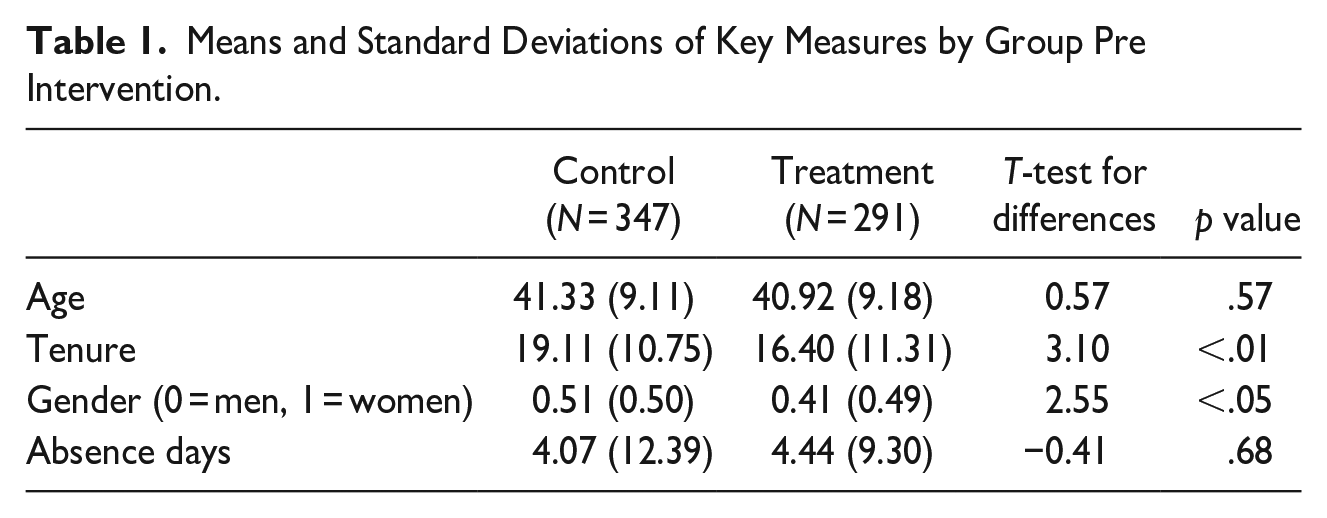
We received all data from archival HR records. The measurement of the data at eight time points between 2012 and 2019 allows a pre- and post-treatment comparison. We used two groups based on their office design exposure. Group 1 is the treatment group, which worked in the headquarters during the transformation in 2015. Group 2 is the control group, the branch office counterparts who continued working in the traditional cell office design and did not receive the treatment. The treatment and control group allocation resulted in 1,035 and 982 employees, respectively. Both groups were comparable based on their task and job structure as white-collar workers and in similar departments. The study population covered various occupational groups, including administrative personnel, IT specialists, and customer service workers. In our sample (intervention group and control group), 58% identified as men, the mean age was 42.51 years (SD = 10.15), ranging from 19 to 65 years, and the mean tenure was 17.69 years (SD = 12.26), ranging from 0 to 48 years. Table 1 shows the demographics and the outcome measure (absenteeism) in the pre-intervention period. Neither group showed a difference in absenteeism, supporting the parallel trends assumption for DiD designs. Relevant gender, age, and tenure differences were present that warranted the inclusion of these demographic factors in our model.
Means and Standard Deviations of Key Measures by Group Pre Intervention.
Measures
Absenteeism
Absence data were measured annually by the number of workdays lost per year for any reason other than approved days absent from work, such as due to training or maternity leave. Therefore, we used approved sickness absences without (until 4 days) or with a medical certificate. The objective recording of accurate absences by HR records overcomes the bias that individuals tend to underreport absences (Johns & Miraglia, 2015). Furthermore, the reference category of absence days per year rather than absence frequency is popular in the organizational behavior (OB) research (Bacharach et al., 2010; Nguyen et al., 2016). Days absent per year is a count variable; thus, the measure was highly skewed to the right (skewness = 6.80, p < .001; kurtosis = 64.63, p < .001). Furthermore, a significant Shapiro-Wilk test (W = 0.45, V = 651.87; p < .001) indicated a non-normal data distribution.
Office Design
We determined which employee works in which office design based on the respective work location. In 2015, the new open office design with flexible workstation assignments was introduced at the headquarters, while the traditional one- to two-person office design remained in the decentralized work locations.
Tenure
Evidence suggests an association between tenure and absence-taking (Farrell & Stamm, 1988). How long an employee has worked for the company is measured using the exact length of service (in years), from organizational entry to the cut-off date each year, as provided by the official HR records.
Gender
Gender was recorded as identifying as either a man (0) or a woman (1). Previous research showed gender differences in absenteeism worth exploring (Harrison & Martocchio, 1998), particularly in various office concepts (Bodin Danielsson et al., 2014).
Controls
In our quasi-experimental approach, the groups were not randomly assigned to a treatment or control condition. We included the demographic variable age in our model to eliminate other observable differences between the treatment and control groups. Evidence shows that age and tenure are strongly associated and related to absenteeism (Thomson et al., 2000). Age was recorded as the exact age (in years) from birth date to cut-off date.
Analyses
We performed all analyses using Stata/SE 16. Individual employee IDs were matched with their work locations, indicating their office design. We identified and removed 684 observations as duplicates, such as when an employee changed departments or office locations within the same year. We excluded all employee absence days’ observations above the 99th percentile (Hammer & Landau, 1981; Reinwald & Kunze, 2020) 1 to control for extensive outliers. This concerned only one extreme case with 269 absence days over 8 years. Ultimately, 2,017 individuals remained in the analysis. We used hierarchical linear modeling to consider the nested data structure (employees working in teams). This was necessary as individuals within a particular team may have more similar absence rates than individuals in randomly assigned groups (Aiken et al., 2015). Following Aguinis et al. (2013), we also group-mean centered the continuous predictors of tenure and age.
Descriptive analyses indicated that the variance of absence days exceeded its mean (M = 3.93, Var = 10.50), leading to the conclusion that our dependent variable was over-dispersed. To account for our over-dispersed count data variable absence days and the clustered data structure, Poisson or negative binomial regression in multilevel general linear models (MGLM) are particularly suitable (Aiken et al., 2015). In order to determine whether a Poisson or negative binomial model was more appropriate, we ran a likelihood-ratio test to determine which model better fit the data. The results showed, via a likelihood-ratio test (LR = 11,019.17, p < .000), −2 log-likelihood, and the Akaike Information Criterion (AIC), that the multilevel negative binomial model (−2 LL = 8,760, AIC = 8,776) represented a better fit than the multilevel Poisson model (−2 LL = 19,780, AIC = 19,794) and was thus used as our estimation approach.
To establish a causal linkage between office design and absenteeism and to take advantage of the given two-group situation, we applied a DiD design. A DiD design is typically used for changes with intervention or treatment and compares the difference in means in treated and untreated groups before and after the intervention (Lechner, 2010). In a DiD, it is assumed that confounders across the groups are time-invariant and time-varying confounders are group-invariant. This strengthens the causal assumption and statistically eliminates unmeasured confounders (Angrist & Pischke, 2008). Based on the parallel trend assumption, the reversed causality problem and the omitted variable bias are reduced (Angrist & Pischke, 2008). To verify this assumption, we followed the proceeding described by Autor (2003). We performed a formal test by interacting the treatment variable with time dummies for the first two pre-treatment periods and the three post-treatment periods. The non-significant finding of the interaction terms in the pre-treatment periods supports the parallel trend assumption. A pre- and post-treatment (cut-off point 2015, when the office design change occurred) time variable was created, including 2012 to 2015 as the first period and 2016 to 2019 as the second period. In the first period, none of the groups experienced the intervention. Then, in the second period, the treatment group experienced the intervention (new A-FO design), whereas the control group did not. This allowed for distinguishing between a constant, counterfactual difference in the outcome level and an intervention effect on the outcome level (Angrist & Pischke, 2014; Lechner, 2010). Therefore, we base our analysis on the following formula:

where Yi refers to estimated absence days for one individual (subscript i). β1Oi indicates the office design, which is coded as 0 (conventional cell office) and 1 (innovative A-FO). Tenure is displayed as β2TEi, and the dichotomous time variable T indicates whether absence days are estimated before the intervention (T = 0) or after the intervention (T = 1). The interaction term β3 (Ti × Ot) refers to the interplay of time and office design, thereby indicating if the change in the mean of absenteeism from pre- to post-intervention is associated with office design. Lastly, ϵi displays the error term.
Results
Table 2 displays the results of a three-step multilevel negative binomial DiD regression for discussing the relationship between the change in office design over time and employees’ tenure. First, the direct effects of office design, time, and tenure on absence days, including the control variables age and gender, are examined in Model 1. In a second step, we added the interaction effect office design × time (Model 2), showing no significant difference between the intervention and control group regarding the office transformation effect over time (β = .02, p = .95). Accordingly, our Hypothesis 1, that the change to the new office design in the intervention group leads to an increase in absenteeism, was rejected. In a third step, we added a three-way interaction with tenure to test whether the effect of office design and time on absenteeism depends on the employee’s years working in the company (see Model 3). The regression coefficients of the three-way interaction provide support for Hypothesis 2 (β = .04, p < .05).
Regression Analysis.
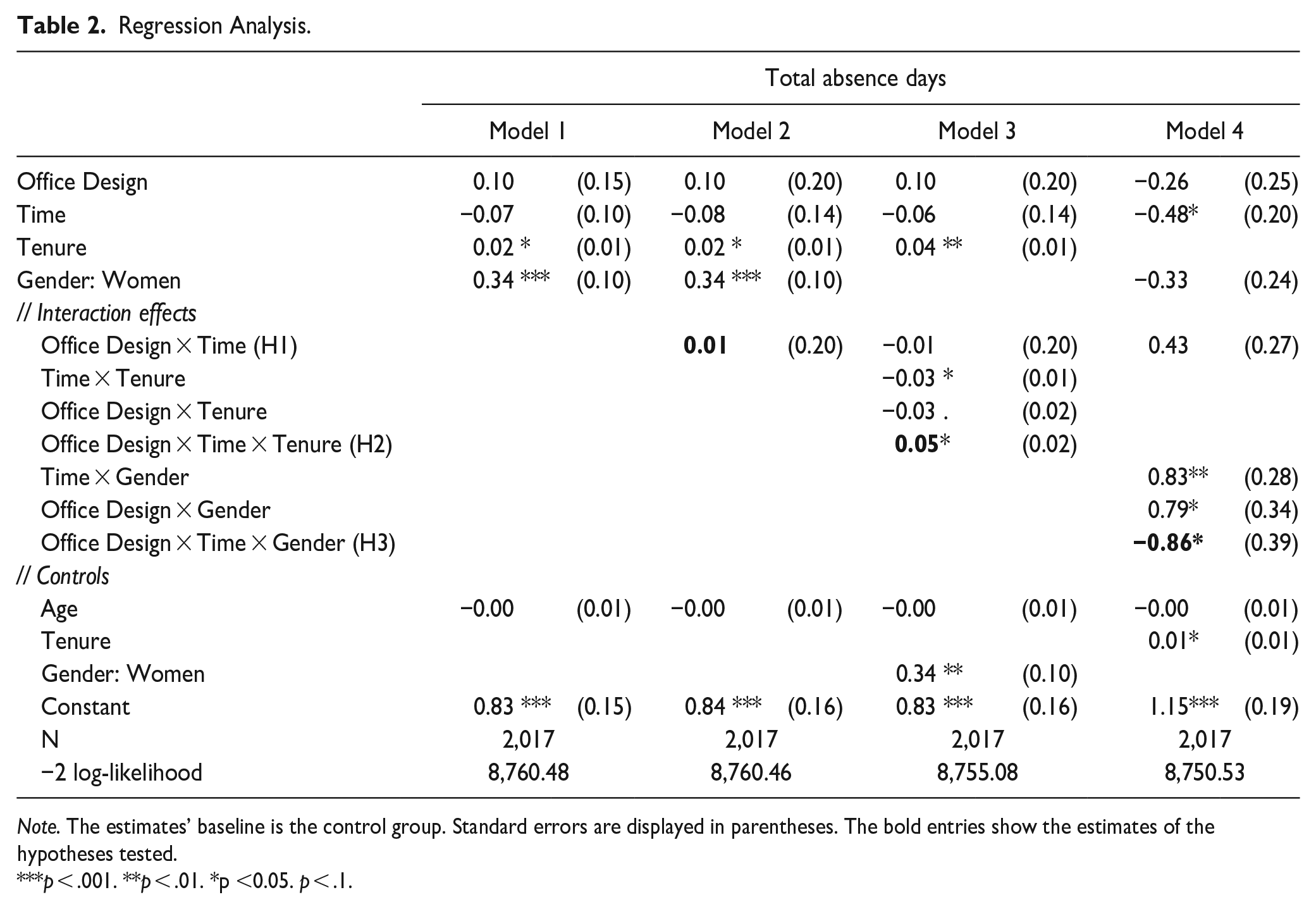
Note. The estimates’ baseline is the control group. Standard errors are displayed in parentheses. The bold entries show the estimates of the hypotheses tested.
p < .001. **p < .01. *p <0.05. p < .1.
To further inspect this relationship’s nature, we graphically plotted it with the Johnson-Neyman regions of significance separately for the pre- and post-intervention periods (Figure 1). The black line depicts the office design’s conditional effect on total absence days at the given time points. The dark gray lines represent the 95% confidence intervals around the conditional effect. Highlighted by the dashed lines, the region of significance defines the specific values of time and tenure at which the regression of absence days on office design moves from non-significance to significance. In the left graph (pre-intervention), no significant effect for any tenure group is present. In contrast, in the right graph for the post-treatment period, the dashed line indicates that, after the intervention groups’ change to the new office design in 2015, the office design slope is significant, p < .05, when tenure is outside the interval between 0 and 29.17 years. This is in line with our prediction in Hypothesis 2 that longer-tenured employees show more absenteeism in the treatment condition.
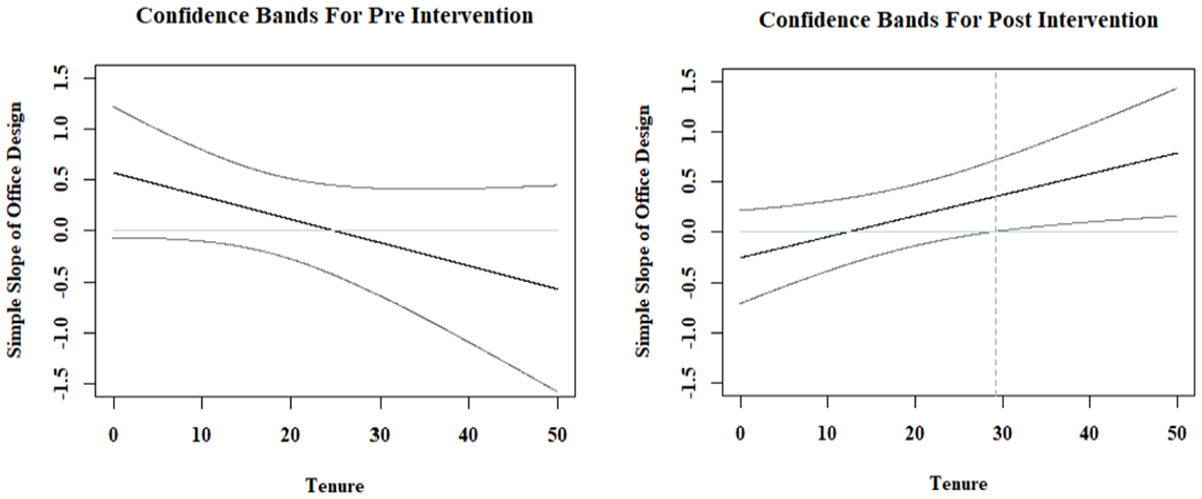
Johnson-Neyman plot (95% confidence bands) of office design and tenure by time on absenteeism (Hypothesis 2).
We conducted the second three-way interaction with gender to test whether the effect of office design and time on absenteeism depends on the employee’s gender (see Model 4). The regression coefficients of the gender three-way interaction (β = −.86, p < .05) oppose our prediction in Hypothesis 3 that female employees show more absenteeism in the treatment condition. To facilitate the interpretation of the significant three-way interaction, we calculated the simple slopes for all possible values of the binary moderator variables gender and time pre-and post-transition per office design. In contrast to the continuous Johnson Neyman plot for tenure, a simple slopes plot (Figure 2) was created for gender as a bivariate variable. Our hypothesis concerns the change in absenteeism in the new A-FO design, so the focus here is on the right plot of Figure 2. As illustrated in Figure 2, there is no significant interaction effect between male and female employees in the A-FO setting. To further inspect these slopes, we executed a simple slopes test that indicated neither the male (β = −.15, p = .813) nor the female (β = −.46, p = .696) slope was significant. In addition, the simple slopes of the transition over time by office design and gender did not significantly differ from each other (β = −.31, p = .813). The pattern of results remained similar and insignificant without controls. Therefore, Hypothesis 3 was rejected.
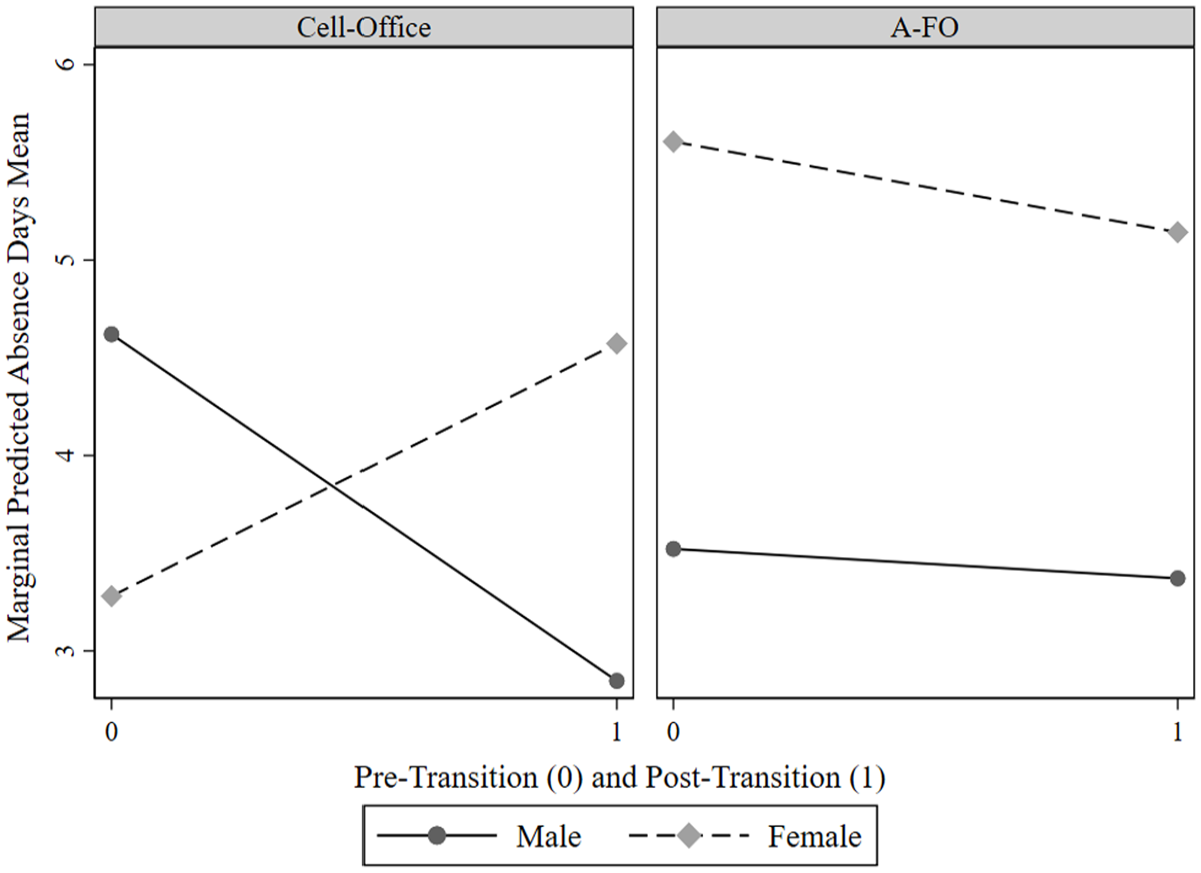
Simple slopes of cell-office versus A-FO pre-and post-treatment group transition by gender on absenteeism (Hypothesis 3).
Discussion
This study aimed to clarify the effect of an office redesign from conventional cell offices to an A-FO on employee absenteeism. Our research extends the implications of innovative office design implementations in multiple ways.
First, we help shed light on the contradictory results in the literature related to changing office designs and employee absenteeism by providing evidence through a quasi-experimental design with objective measures. Second, we address actual employee behavior. Over the last few years, a discourse has emerged on today’s research, too often theorizing about behavior without measuring actual behavior (Banks et al., 2021; Baumeister et al., 2007). Instead of measuring subjective intentions, we can show direct absenteeism behavior. In addition, our more fine-grained analyses indicate that, beyond the main effect, individual subgroup characteristics (e.g., tenure) are crucial to understanding the behavioral consequences of changing office designs. Finally, we combine the topic of A-FO design, which has so far been intensely discussed in the disciplines of facility management, architecture, and built environment, with applied psychology, thus approaching a holistic examination of office changes.
Theoretical Implications
Our results do not support studies that found a significant increase in absenteeism among (some groups of) employees in more open-plan and flexible office designs (Bodin Danielsson et al., 2014; Pejtersen et al., 2011). We found no average treatment effect of an office design change on employee absenteeism. This null finding might be due to several psychological mechanisms activated when transitioning to an A-FO. On the one hand, the feeling of decreased privacy (Brunia et al., 2016; Candido et al., 2021; Gorgievski et al., 2010) might lead to more robust withdrawal behavior. On the other hand, in the seventies, Altman (1975) suggested that autonomy, or the ability to control or regulate to maintain self-identity, would be a function of privacy. A-FOs design flexibility might increase the perception of space and time control (Appel-Meulenbroek et al., 2011; Keeling et al., 2015; Kim et al., 2016), providing the employee with more autonomy. Therefore, the perceptions of less privacy but more autonomy might balance each other and lead to our null effect by looking at absenteeism behavior. In addition, being continuously exposed to lower privacy levels, employees could have readjusted their psychological standard of reference (Kupritz, 2000; Sundstrom, 1985), resulting in adapted acceptance levels over our assessed time span.
In addition, we found an interesting moderating effect of tenure. Our results could support earlier studies indicating that acceptance of organizational change is decreased by tenure (Iverson, 1996; van Dam et al., 2008). Further, our tenure subgroup effect narrows the discussion from general organizational change to specific office transitions, as subjective privacy violations seem more likely for longer-tenured employees with long-standing experiences in conventional cell offices.
The results also showed a three-way interaction gender effect. However, it is essential to mention that the simple slope effects for the treatment condition were not significant; thus, the results show no difference in absenteeism between female and male employees after the transition from cell offices to the A-FO. This null finding could suggest that although we assumed that women might experience more sensitivity and conflict potential in the A-FO, other mechanisms might buffer this. For example, women might show better adaptivity toward change (van Den Heuvel et al., 2014), use different emotion-regulation strategies from men (McRae et al., 2008), or get into fewer conflicts as their level of agreeableness is higher (Furnham & Cheng, 2015). Nevertheless, our findings might be a valuable starting point for inspecting the demographic and occupational differences in employee consequences of office transitions in more detail.
Practical Implications
This study also has important implications for companies, corporate leadership, and HR managers. Our findings indicate that the introduction of an innovative office design has little impact on a large proportion of employees. Thus, we might assume that adverse effects on employee absenteeism do not offset the potential cost-reducing effects of an A-FO. More and more companies could decide to adopt A-FO designs. Structured and purpose-oriented communication and employee participation in the planning and implementation of the change process (Appel-Meulenbroek et al., 2011; Pitt & Bennett, 2008; Rolfö, 2018; van der Voordt, 2004) might be helpful here. In addition, it is essential to pay attention to the different needs of knowledge workers; some might need a more concentrated, private workspace, and others might need more workspace that fosters interaction and collaboration (Greene & Myerson, 2011; Öhrn et al., 2021; Seddigh et al., 2014). Such a comprehensive office change should not focus solely on a measurable outcome such as absenteeism. Instead, companies should make an effort to track the change holistically to draw measurable conclusions about productivity, satisfaction, and health factors besides absenteeism.
Further, although most employees might cope well with the office transition, specific attention should be paid to long-tenured employees. This might be an important subgroup, especially in established companies, such as the service company in our study that has many experienced employees. In fact, 22% of the employees in our sample were above that cut-off value of 29 years of tenure, at which point we observed the positive absenteeism effect of the new office design. HR and change management should consider the needs of different organizational groups during the transition and constantly monitor privacy perceptions and other adverse consequences (e.g., perceptions of negative emotions) of changing office designs to potentially intervene before they translate into actual absenteeism.
Limitations and Future Research
Despite its methodological strengths, some limitations of this paper should be mentioned. First, we cannot fully disentangle which features of the A-FO design are responsible for the study findings. It may be that effects arose because of the open office or the flexible desk arrangements. Future research could more sharply differentiate between the specific office design features and their outcomes and investigate if there is an optimal ratio of quiet and collaborative areas. However, office transitions are often holistic changes in the physical environment, and our study examines a more popular transition from cell offices to an A-FO.
Second, the applied DiD design with objective outcome measures limited us from testing the specific theoretical mechanism. To conclude that altered privacy perceptions cause changing absenteeism involves making an inductive leap from the results. Previous research mentioned other possible reasons for absences, for example, a lack of personalization (Haapakangas et al., 2018; Laurence et al., 2013; Wells, 2000), change resistance attitude toward management (Newsham et al., 2009), and environmental stressors like potential infection exposures in the more open-plan A-FO that disproportionately affected the more tenured and older employees (Newsham et al., 2022). Future research could thus directly measure how changing office designs affect employees’ privacy and environmental stressor perceptions. Furthermore, contingency factors, such as the communication around the transition, might be worth exploring. In addition, beyond employee tenure and gender, personality traits (e.g., introvert vs. extrovert) or specific job functions and types (e.g., task complexity or independent vs. interdependent tasks) might affect the perceptions of privacy violations in A-FOs or other work environments. Future research could also address in more detail whether there are differences in transitioning from a cell office or open office to an A-FO, as the previous work environment has significant implications for employees’ perceptions and behaviors in a new A-FO (Keeling et al., 2015; Öhrn et al., 2021).
Third, we need to address the limited generalizability of our specific sample. We examine a Swiss company that offers excellent health management and strategic human resource management with many benefits for its employees. This could explain the comparatively low absence incidences (e.g., 4.3 days lost per person per year compared to representative data from the OECD with 9.1 days lost per person per year (OECD Statistics, 2017). Given this specific environment, we would assume that our effects on absenteeism behaviors are rather conservative estimates. We would expect to see even more pronounced findings in companies with less proactive workforce management that should have higher average and variance levels of absenteeism behaviors.
Finally, randomization was not possible in the given quasi-experimental situation, and both groups’ comparison was imperfect (Nijp et al., 2016). Future research might aim for a completely randomized experiment while implementing an A-FO. However, large companies with multiple geographically dispersed sites are highly recommended for group-field-level experimentation (Eden, 2017), and our groups showed similar demographic conditions and pursued comparable tasks. Therefore, this study represents a carefully-conducted naturalistic experiment (Cook & Campbell, 1979).
Conclusion
Most of today’s service companies plan office concepts as space- and cost-saving efforts while also aiming to adopt a modern and attractive new work concept. Therefore, office transitions often include changes from conventional cell offices to A-FOs. The consequences of such a change, especially on employees’ absenteeism behavior, have not been thoroughly explored. Although we found no general difference in the level of absenteeism between the group with the office transition and the control group, a three-way interaction revealed that employees with longer tenure were potentially adversely affected by innovative office designs. This paper cannot ultimately resolve the controversy about whether A-FOs are beneficial or harmful. Still, it shows that companies should not redesign their offices without considering that employee subgroups might react differently to the change.
Footnotes
Declaration of Conflicting Interests
The author(s) declared no potential conflicts of interest with respect to the research, authorship, and/or publication of this article.
Funding
The author(s) disclosed receipt of the following financial support for the research, authorship, and/or publication of this article: Funded by the Deutsche Forschungsgemeinschaft (DFG – German Research Foundation) under Germany‘s Excellence Strategy – EXC-2035/1 – 390681379.
