




Abstract
This paper demonstrates for the first time that prisons with a higher proportion of natural vegetation within their perimeter have lower levels of staff sickness absence. It makes three significant contributions. First, it extends studies of workplace nature contact into the un-researched carceral context. Second, whereas previous workplace nature contact studies have largely utilized single-site surveys, it presents national-level, statistically robust analysis. Third, it brings a novel new perspective to studies of sickness absence within correctional workforces, by considering the effect of the physical environment. Econometric estimations presented in the paper confirm lower levels of staff sick-leave in prisons with more greenspace. This relationship persists when we control for prison size, security level, age, level of crowding, levels of self-harm and violence among prisoners, and assaults against staff. The findings are significant in demonstrating the benefits of nature contact in workplaces in general, and carceral environments in particular. Importantly, this has the potential to influence future prison design.
Introduction
Although nature contact in the workplace is recognized to offer significant health-promoting benefits, the extant literature is rather limited; studies tend to be small-scale, based on self-reported wellbeing indicators and limited mainly to analyzing office-based workers. Among the many overlooked workplaces are carceral environments such as prisons, which are acknowledged to be highly stressful places, with high levels of job stress and burnout among prison officers. Not only does this affect their own health, it also results in their absence from the workforce through sick-leave, reducing their ability to support the rehabilitation of incarcerated populations.
Through a statistical study of the relationship between nature contact and prison staff sickness absence for over 80 public sector prisons in England and Wales, this paper makes three critical research contributions. First, through its focus on the custodial sector, it extends literatures on workplace wellbeing into this un-researched context. Second, in deploying Geographical Information Systems (GIS) and statistical methodologies, it goes beyond the single-site survey-based approach which has characterized much prior workplace research, providing statistically robust analysis of the relationship between nature contact and sickness absence. Third, it introduces to research into correctional workforces a concern for the effect of the physical environment on sickness absence.
We first review the literature on nature contact in the workplace, before discussing prison officer wellbeing in general, and sickness absence specifically, outlining the methodology deployed in the study, and presenting the results of our analysis.
Literature Review
Nature Contact and Wellbeing in the Workplace
Since Ulrich (1984) observed the effects of nature views on patients’ recovery from surgery, subsequent work has demonstrated the effects of a variety of built environment features on health and wellbeing (Frumkin et al., 2017; Huisman et al., 2012). Studies of the effects of built environments commonly operate at the city or regional scale, deploying “exposure science” to explore the wellbeing of populations living in areas characterized by differing amounts of greenspace whilst controlling for other potentially confounding characteristics (e.g., Mitchell & Popham, 2008). A limitation characteristic of these studies is that they define exposure based on the residential environment, an approach which Frumkin et al. (2017) describe as “limited by spatial resolution and subject to misclassification if people spend highly variable amounts of time at home” (p. 5). In other words, these studies assume that populations are influenced by the characteristics of their areas of residence, without knowing with certainty how much time people actually spend in those areas. Since many people spend a large proportion of their day in their workplace, this environment is also highly likely to influence their wellbeing. In much of this work, access to or views of nature are considered to affect wellbeing through mechanisms considered within Attention Restoration Theory (ART) or Stress Reduction Theory (SRT). Attention Restoration Theory is concerned with the propensity for nature contact to facilitate recovery from directed attention fatigue (Kaplan, 1995; Kaplan & Kaplan, 1989), and Stress Reduction Theory posits that exposure to nature promotes stress recovery, based on positive psychophysiological responses rooted in evolutionary processes (Ulrich, 1981; Ulrich et al., 1991). Both consider that natural landscapes facilitate restoration from mental fatigue, stress, and negative mood.
A small but growing body of scholarship suggests that nature contact experienced at work may be health-promoting. For example, previous research finds that taking a break outdoors, provision of indoor plants, and providing green views from office windows is related to lower levels of stress (Frumkin, 2001; Larson et al., 1998; Trenberth et al., 1999). A range of studies of office workers in the US (Largo-Wight et al., 2011), Norway (Bjornstad et al., 2016), Finland (Korpela et al., 2015, 2017), and the UK (Colley et al., 2016; Hähn et al., 2020) have found that workplace nature contact lowers stress levels.
Office workers are the most frequently-researched cohort in studies of nature contact, with very few projects examining less sedentary workers for whom the immediate surroundings of desk-based workspaces are less important. Nurses’ stress levels have been found to fall with views of nature through windows (Pati et al., 2008). Faris et al. (2012) found that healthcare workers who spent short breaks during their shifts in an outdoor garden in their work facility reported significant stress-relieving effects. Nejati et al. (2016) compared the effects of a variety of factors related to nature contact (indoor plants, nature artwork, window views and access to outdoor areas) and found that all these factors generated positive effects, with the greatest effects being felt from green views and outdoor green spaces.
These healthcare-based studies, and indeed the studies of office-based workplaces, are individually informative and provide critical insights into experiences in those specific contexts. However, the methodologies deployed—predominantly capturing self-reported wellbeing via interviews or small-scale surveys of individuals at a small number of workplaces—mean that their findings are limited both in their transferability and in their capacity to offer robust, statistically significant evidence that nature contact has a measurable impact on wellbeing.
Prisons have been considered to a limited extent within the literature on the benefits of nature contact, but studies have primarily focused on incarcerated populations rather than prison staff. In an early, heavily cited study, Moore (1981) found that prisoners with a view of nature from their cell made fewer sickness calls. More recently, Nadkarni et al. (2017) reported that solitary-confined prisoners in a US facility viewing nature videos had reduced levels of stress, anxiety, irritability, and aggression. In studies of the self-reported effects of nature contact in prisons in the UK and Norway, Moran and Turner (2019) and Moran (2019) found restorative effects such as increased feelings of calm, and the ability to reflect. Moran et al. (2021) have also identified lower levels of self-harm and violence in prisons with more vegetation. Moran and Turner (2019) briefly reflected on the beneficial effects of nature contact for prison staff in one Norwegian prison facility—suggesting both that prison staff may share the beneficial effects of nature contact reported for prisoners, and that this issue merits further attention. There are, however, no published studies which identify whether the effects of nature contact previously identified for office workers and nurses (and indeed prisoners) are also experienced by prison officers.
Prison Officer Wellbeing and Sickness Absence
Studies of prison officers’ sickness absence have tended to focus on the interrelated issues of wellbeing and sick-leave practices—considering both the issues which contribute to ill health (and therefore sickness absence) and those which engender a greater likelihood of workers taking sickness absence even if not in poor health. These issues pertain both to the workplace (such as the stressful nature of prison work, and particular management practices) and to prison officers’ personal characteristics (such as their level of identification with prison work, their age and gender). Within this literature there is very little consideration of the physical environment of the prison itself as a factor in sickness absence, and to the best of our knowledge, no published work at all on the effects of nature contact and its possible impacts on wellbeing more generally. This oversight is notable, given the extensive research into nature contact and wellbeing in a range of other workplace and considering that prison work is acknowledged to be highly stressful—suggesting that insights into potentially ameliorating factors would be both informative and operationally useful.
Studies have shown that stresses of prison work include those intrinsic to the job (such as dealings with prisoners in general) as well as more generic workplace issues, such as unclear work priorities (Armstrong & Griffin, 2004) and inconsistent leadership (Summerlin et al., 2010). Studies which focus on the stresses intrinsic to the job consider the safety risks to which prison officers are exposed. These include the real or perceived risk of personal assault to self or colleagues, the stress inherent in balancing the need to keep order with the desire to fulfill the needs of the incarcerated, the stress of using discretion to manage imprisoned populations using interpersonal skills, and the stress of dealing with traumatic events such as deaths in custody (Cassidy & Bruce, 2019). In their study in Spain, Ghaddar et al. (2008) found that occupational stress in the form of such psychological demands and a low level of perceived control, had negative effects on prison officers’ mental health.
Sick-leave is a significant operational challenge for prison systems (Lambert, 2001), and prior studies note that the relationship between levels of sickness absence and the physical and/or mental health of prison officers is not straightforward. There is likely to be some underutilization of sick leave. In the UK, for example, there a strong culture of “presenteeism” within this sector, where prison officers continue to attend work even though feeling unwell (Kinman et al., 2019). In the US, organizational policies such as adding unused sick leave to length of service at retirement incentivize prison officers to not take sick-leave (e.g., Camp & Lambert, 2006). In a study of correctional staff absenteeism, Lambert et al. (2005) found that among the causal factors were job satisfaction, commitment, and job stress, as well as certain personal characteristics such as being overweight, being female, and age. These factors were thought to influence levels of sick-leave both in terms of general health and “wellness,” (i.e., not being ill enough to need sick-leave) and the likelihood of taking sick-leave even when still relatively “well.” Higher levels of “job involvement”—defined as a generalized cognitive state of psychological identification with the job, where a job plays an important role in an individual’s life and the individual identifies with the job identity—were also found to reduce prison officer absenteeism (Lambert et al., 2011). Prison officers in Bulgaria suffering professional “burnout” were found by Stoyanova and Harizanova (2016) to have taken a larger amount of sick-leave than others. Similarly, Lambert et al. (2010) found that in one US prison, burnout had significant consequences for individuals’ mental health, and also for the management of the establishment itself, even if affected employees remained at work.
Behind prison officer sick leave statistics, therefore, stand a wide range of factors and circumstances. High levels of stress may make absence more likely. Stress may also erode prison officers’ job involvement, leading them to question their commitment to the service, perhaps rendering them less likely to internalize a culture of presenteeism. Prison officers are often at risk of assault, with resulting physical injuries and psychological stress sometimes necessitating absence from work. It is important to note, though, that although it is clear from the prison staff sickness absence literature that such absence is likely to reflect more than simply ill health, we cannot conflate (lack of) sickness absence and “wellbeing” more generally. “Wellbeing” is a complex and contested notion, comprising much more than simply the absence of disease (Dodge et al., 2012). Staff sickness absence therefore offers only a partial insight into a broader sense of “wellbeing,” and one that emphasizes ill-health rather than well-ness. Although our study would ideally have addressed wellbeing more comprehensively, for reasons of data availability we limit ourselves here to consideration of sickness absence. Therefore, although our findings may be indicative of prison officers’ wellbeing more generally, we formulate our conclusions only in relation to sickness absence.
In our study context of England and Wales, prison self-harm and violence have reached record levels (HMIP, 2020). There were 64,552 incidents of self-harm in the 12 months to June 2020, up 11% from the previous 12 months. Not only do these numbers represent incarcerated individuals in deep crisis—they also entail prison staff witnessing their distress (Walker et al., 2017). The number of prisoner self-harm incidents requiring hospital attendance stood at 3,429 in the 12 months to March 2020, and since any prisoner attending hospital requires a staff escort, this means a significant number of prison staff are on hospital bedwatch, bearing witness to medical procedures. Over the same period there were over thirty-one thousand incidents of prisoner-on-prisoner assault—many of which would have required de-escalation by prison staff—and almost ten thousand direct assaults against prison staff. Both of these statistics have seen substantial increases over recent years, causing stress and/or physical injury for prison staff. The wider literature on prison staff turnover (e.g., Lambert, 2006; Lin, 2017; Tewksbury & Higgins, 2006) frequently cites the dangerousness of prison work as an important contributing factor for staff attrition. These high levels of violence are, unsurprisingly, also thought to be an important factor affecting prison staff turnover levels in England and Wales. In the last 5 years, more than 1,700 new officers joined the prison service only to resign within their first year of employment. Overall levels of staff attrition are also high.
As noted earlier, there have been very few studies of prison officer wellbeing and/or sickness absence which consider the physical properties of the carceral environment. Where “environmental factors” are considered, this term is generally used to convey factors such as perception of personal safety (e.g., Armstrong & Griffin, 2004) rather than to refer to the design of buildings and other landscape elements which comprise the prison itself.
Nadel and Mears (2020) note that there is scant research into the effect of prison design on outcomes for incarcerated populations, and there has also been very little investigation of its potential effects on prison officers. Morris and Worrall (2014) who observed that campus style prisons perhaps enabled more effective supervision, possibly reducing violence in general, whereas linear designs may create “blind spots” that present opportunities for incidents. Building on this, Steiner and Wooldredge’s (2017) study found that US prisons with a linear architectural design and celled housing had higher rates of assaults on prison officers, and that officers who worked in such prisons were also more likely to perceive themselves to be at risk.
Data and Methodologies
In this paper we begin to address the knowledge gap around the influence of physical environments on prison staff sickness absence. The case study we present below explores one aspect of the carceral built environment—namely the proportion of the prison “envelope” enclosed by the outer perimeter which is given over to natural vegetation.
Our aim was to determine whether nature contact influences sickness absence for prison officers in England and Wales. We assembled publicly-available data pertaining to days lost to staff sickness absence per FTE (full-time equivalent, i.e., approximately per employee) for all prisons housing over-18s in England and Wales (Immigration Removal Centers and facilities for under-18s were not included). Due to limited data availability for privately-run prisons in this jurisdiction, our dataset comprises only those establishments which are part of the public sector—these represent the vast majority of prisons in our study context.
In order to ensure that any statistically significant relationships identified in our analysis could be tested for robustness with consideration of confounding variables, we compiled prison-level data for a series of indicators, including the type of establishment, their age and whether they were purpose-built as prisons or converted from other uses such as military bases, orphanages or stately homes. 1 Prison type took account of their predominant function at the time of data compilation. For male prisoners this comprises: Local (holding both short-sentenced prisoners and those awaiting trial or sentencing); High Security/Category A; Category B (medium-high security); Category C (medium-low security); Open/Category D; and Young Offenders’ Institutes (YOI) for men aged 18 to 20. 2 Prison type also includes female prisons, and those specializing in accommodating sex offenders. 3 These data were compiled for all establishments operational at the time of data compilation and analysis. Given the multiple changes in type (e.g., from Cat B to Cat C prison), mergers and other changes to these establishments, especially since 2012, 4 trends in dependent variables were considered as averages for the period from 2014 (or later for prisons which opened after this date) to 2018. Given the complexity of the prison estate, the data were cleaned for analysis. Where establishments are jointly managed, but physically distinct, they were treated separately. This procedure resulted in an initial dataset with 93 establishments for which we have information on prison type and staff sickness absence. Due to some missing observations on the other variables, the initial number of prisons that we can use in the multivariate regression analysis amounted to 84.
The sickness absence dataset represents days lost to staff sickness absence per FTE for the 12 months to the end of March 2019. Figure 1 shows the histogram of this variable. Staff absence as a percentage of FTE ranges between a low of 3.5% to a high of 15.5%, with a sample average of 9.3%. To examine whether prison types are characterized by different degrees of staff absence, we regressed the variable on a set of dummies that distinguish between the various prison types, taking Local prisons as reference category:

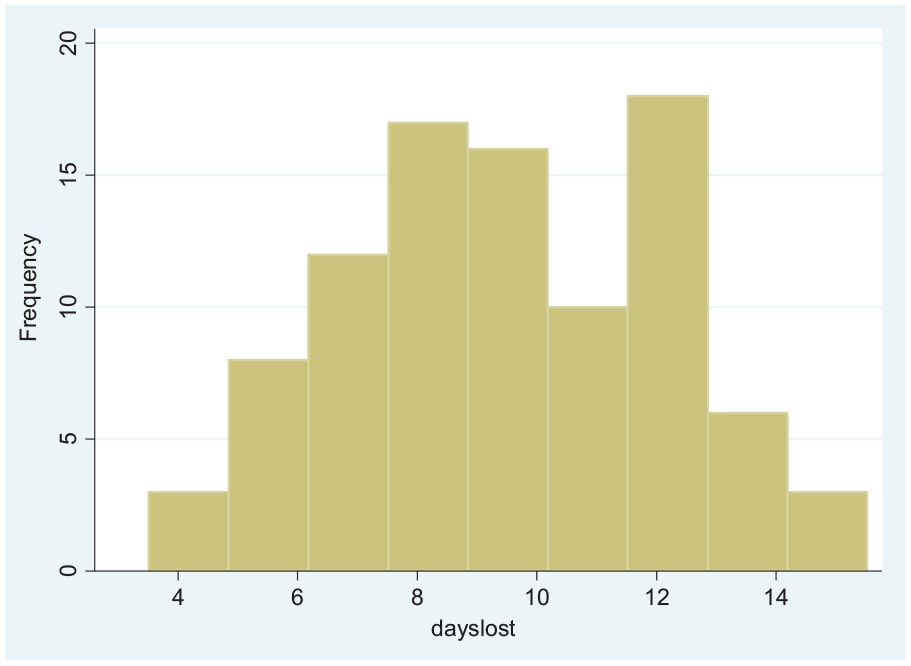
Histogram staff absence/FTE.
This model posits staff sickness absence Y in prison i as a function of the various prison types and an idiosyncratic error term. The findings from estimating the full regression model (1), and from estimating the model including only the three prison type dummy variables with the largest t-statistic are presented in Table 1.
Staff Sickness Absence and Prison Type.
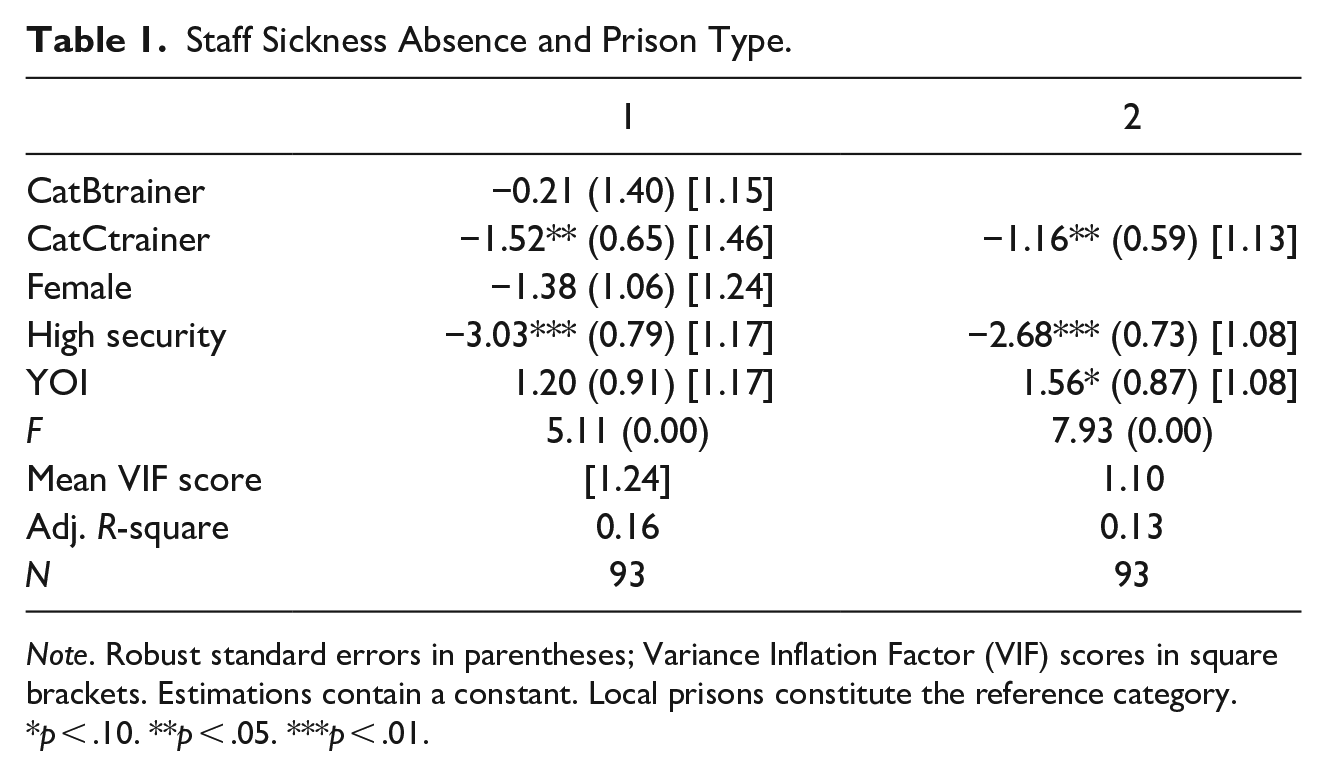
Note. Robust standard errors in parentheses; Variance Inflation Factor (VIF) scores in square brackets. Estimations contain a constant. Local prisons constitute the reference category.
p < .10. **p < .05. ***p < .01.
Table 1 shows that Catctrainer and High security prisons have significantly lower levels of sickness absence, whereas there is a significantly higher level of sickness absence in YOIs (YOIs at 10%, exact p-value 0.08). 5
Measuring Greenspace
We required a dataset which would act as a proxy for nature contact and that could be used to compare prison establishments in a meaningful way. In the absence of any pre-existing dataset, we devised a GIS methodology to calculate the percentage of each prison “envelope”—the area enclosed by the outer perimeter—which was covered with vegetation. We call this the “greenspace” dataset. It is important to clarify that, unlike prior studies of office workers and healthcare staff which have collected data about the time spent by study participants looking out of windows onto green views, and taking breaks in green spaces (e.g., Faris et al., 2012; Pati et al., 2008), our methodology is based only on the presence of green spaces within prisons. We cannot say with any certainty whether or how often prison staff actually look at or use these spaces, or whether they are able to see them during the course of their duties. Without specific and detailed information from each establishment about the location of staff working areas, the views from their windows, and the spaces occupied or passed-through by staff while on breaks, we are unable to account for such variation within our analysis. However, we do know that if green spaces are not present, there is no possibility that they could be utilized in this way. Our analysis also lacks demographic data for the prison staff employed in the establishments included in the study. Ideally, we would have included data pertaining to their age, gender, ethnicity, time in service, etc., but since this data is not publicly available, it could not be included. Our analysis also assumes that prison staff work only in one establishment, and this assumption may be inaccurate in a small number of individual cases. Again, no publicly available dataset enables us to verify this assumption. In our view, these potential data limitations are counterbalanced by the potential for this research to offer key insights, at a level beyond that of the individual establishment, and indeed to provide an evidential basis for further, more granular research incorporating these type of detailed local-level data.
To generate the greenspace dataset, the Ordnance Survey Mastermap Topography Layer was used as the main source of GIS data. This is a vector map layer with polygons at the building scale (1:1250) that allows for highly accurate analysis of land-use. Polygons labeled as either “multiple” or “natural” in the layer’s “make” category were designated as greenspace for the purpose of our analysis. The Mastermap data was sense-checked using 25 cm aerial photographs which revealed that the “multiple” category is used for what might be described as non-natural greenspaces such as back gardens and playing fields. (These types of green areas are mostly excluded from the OS Mastermap Greenspace Layer, which is why that dataset—despite its name—was not used in this analysis).
Mastermap data and georectified aerial photographs were downloaded for all prisons in England and Wales and imported into ArcGIS. These data are supplied in the British National Grid projection which allows ArcGIS to automatically calculate the number of hectares represented by each polygon within the dataset. To examine greenspace, the outer wall or fence were identified for each prison, using Mastermap data checked against the aerial photographs. This allowed the total area within the outer perimeter (the prison “envelope”) to be calculated and compared against the total area of polygons labeled “natural” or “multiple”—thus generating the percentage greenspace data for each prison (Figure 2).
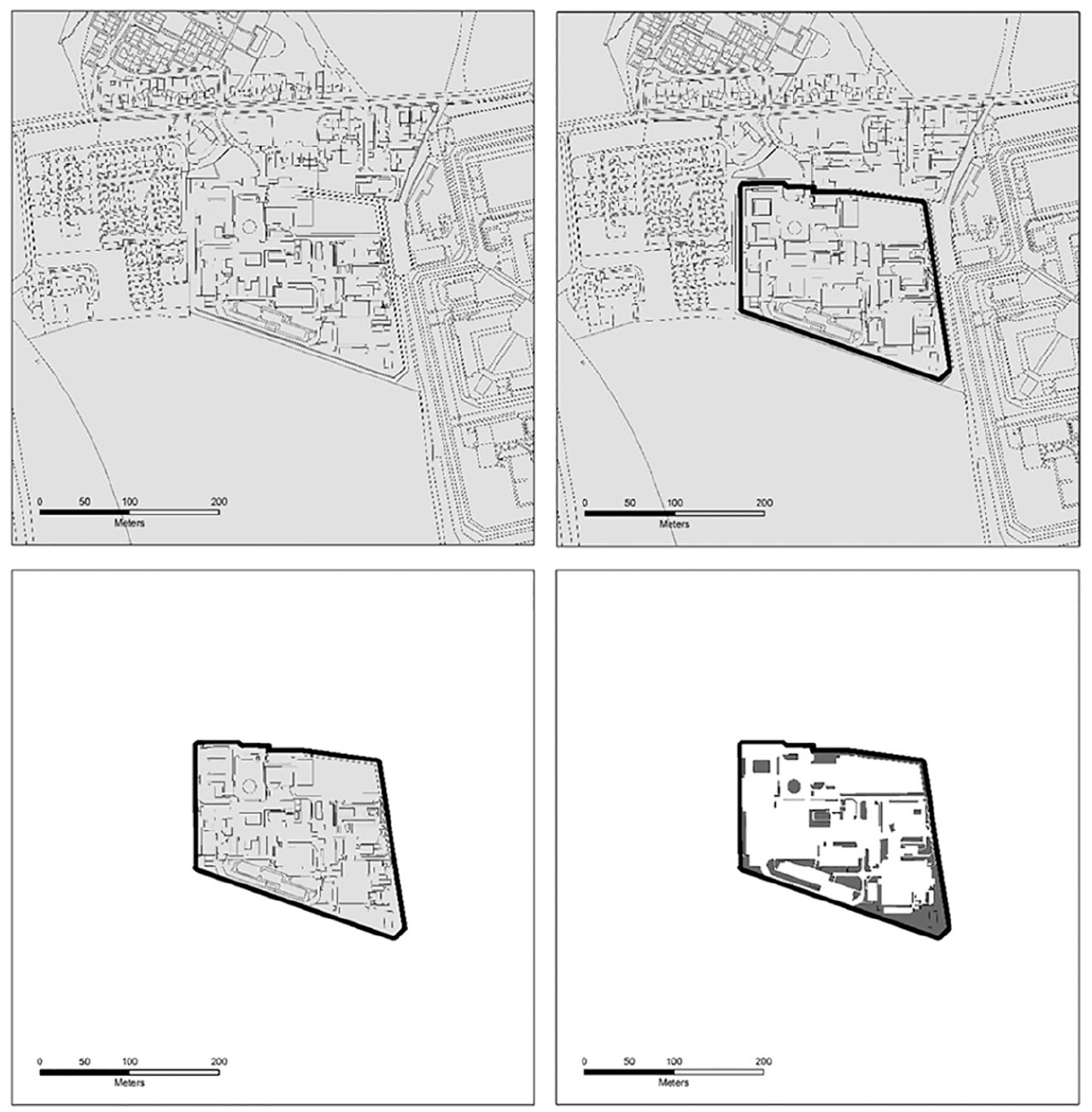
Mastermap Topographic layer showing a prison (upper left); prison perimeter highlighted, with boundary exaggerated for clarity (upper right); polygons within the prison envelope isolated (lower left); all areas of “natural” and “multiple” surfaces within the prison wall identified (lower right).
Comparing the Mastermap data against aerial photographs enabled us to check the accuracy of the “make” categorization, and confirm, for example, that artificial sports pitches had not been categorized as “multiple” or “natural,” and therefore ensure that they had not been erroneously designated as greenspace. A small number of additions were made to the greenspace dataset based on a detailed examination of land-use at each prison site. The Mastermap and aerial photograph data occasionally diverged, indicating that some features visible in the constantly and incrementally updated Mastermap layers had appeared since the older aerial photographs were taken. The most recent data were used in any such cases, but these divergences suggest that there may unavoidably be minor discrepancies between the exact composition of some prison envelopes during the data span of the dependent variable (2014–2018), and at the date of accessing the Mastermap layers (July 2019). However, it is unlikely that any such variations in prison land-use are widespread or significant enough to affect our analysis.
The dataset is characterized by substantial variation in greenspace percentages across the prisons, from one prison envelope having no greenspace at all, to 67% of another being vegetated, the sample average being 37% greenspace.
Greenspace and Staff Sickness Absence
In order to assess whether geographical characteristics are associated with sickness absence for prison staff, we created an added variable plot between the variable “dayslost_FTE” and the greenspace variable which we obtained from adding the greenspace variable to regression model (1). The result is presented in Figure 3. As the added variable plot shows, greenspace is significantly and negatively associated with the days lost variable (coefficient −4.05; t 2.5), suggesting that greenspace within prisons reduces sickness absence among prison staff.
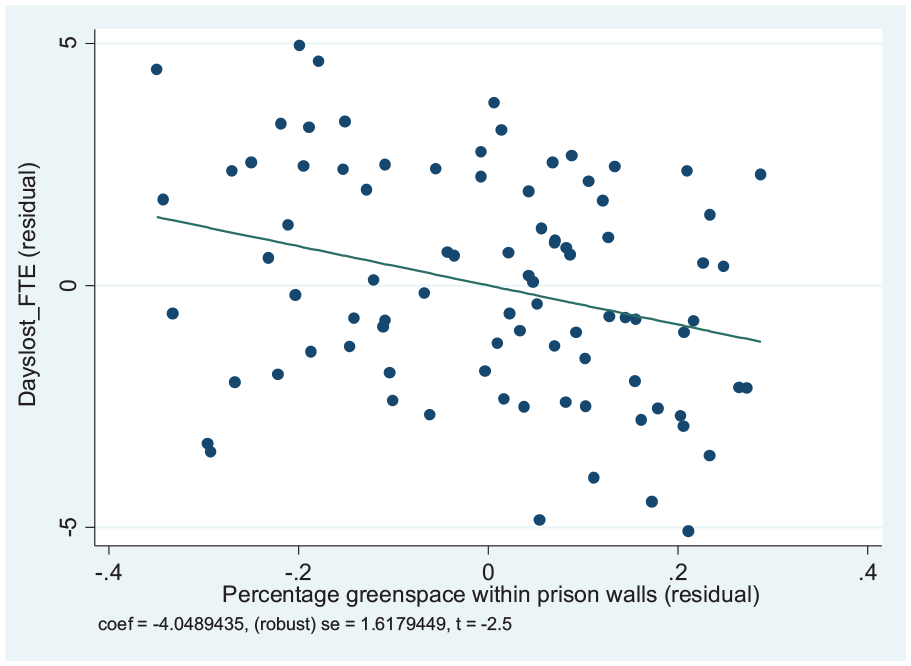
Added variable plot greenspace and dayslost_FTE.
Multivariate regression analysis
To further examine the effect of greenspace within the prison envelope, we proceeded by augmenting the regression model with a set of prison characteristics that we hypothesized also affect staff sickness absence. We estimated several specifications of the following regression model:

where Y is dayslost_FTE. Greenspace is the percentage of greenspace within the prison envelope. Population is the log of the number of prisoners in 2018, to control for the possibility that prison size influences sickness absence. The model contains two variables capturing dimensions of overcrowding. Opcap_pop is an indicator of the overall degree of overcrowding of a prison, calculated for 2014 as the ratio of the operational capacity of a prison over its actual number of prisoners. Crowded is measured as the percentage of prisoners held in crowded accommodation (held in a cell where the number of occupants exceeds the uncrowded capacity of the cell). Centuryold is a dummy variable taking the value of 1 for prisons that first opened in the 19th century. Sexoffenders is a dummy variable identifying those prisons that specialize in accommodating sex offenders. The variable Purposebuilt is a dummy variable identifying prisons that were purpose-built, as opposed to prisons that were converted from a different previous use.
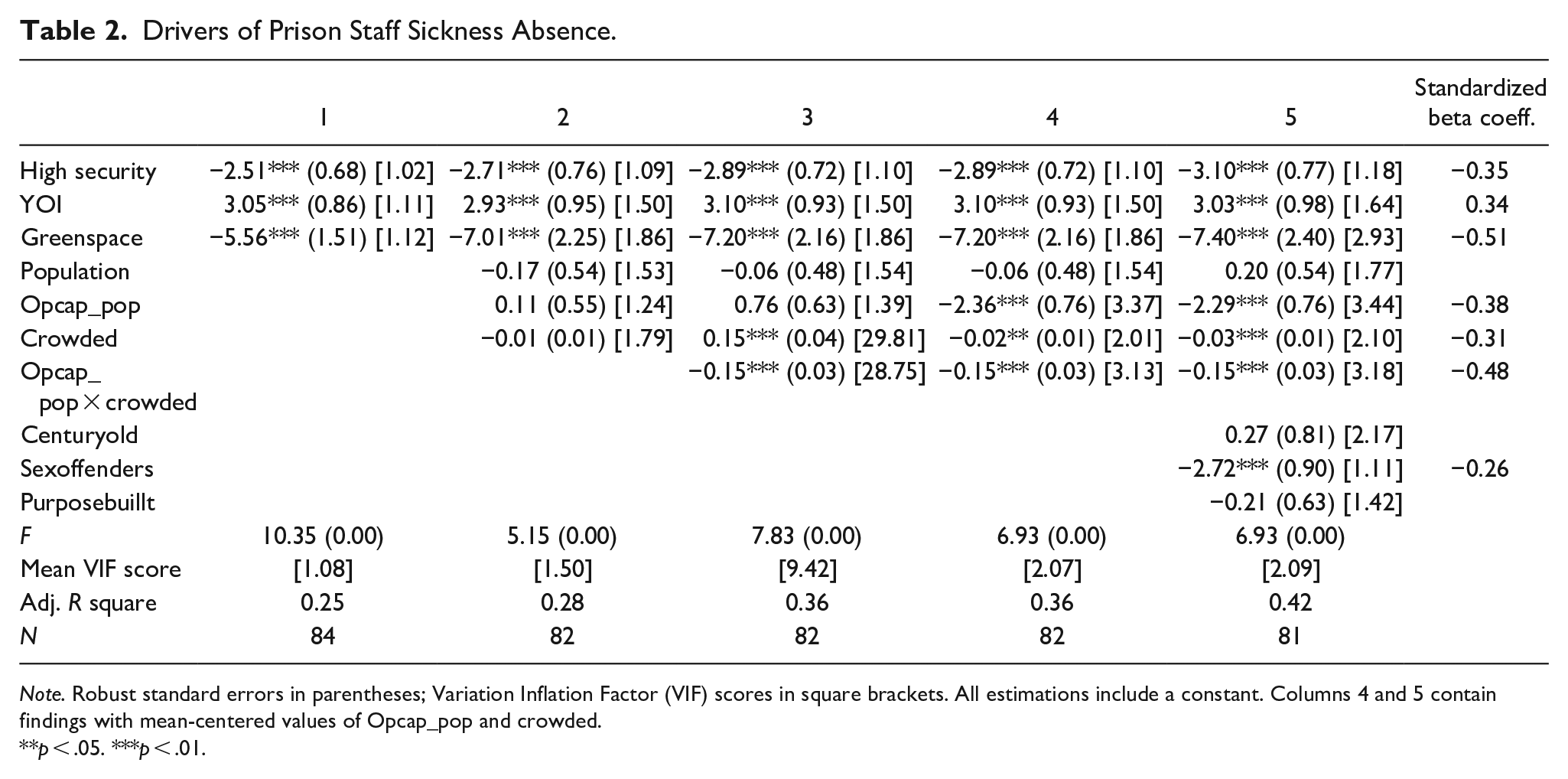
The findings from estimating model (2) are presented in Table 2. The estimated effect of greenspace is significant and negative in all the estimations, indicating that, after controlling for other factors that affect staff sickness absence, prisons with a higher percentage of greenspace exhibit a lower level of absence. Columns (2) and (3) contain the results from including the control variable capturing prison size and the two variables related to overcrowding.
Drivers of Prison Staff Sickness Absence.
Note. Robust standard errors in parentheses; Variation Inflation Factor (VIF) scores in square brackets. All estimations include a constant. Columns 4 and 5 contain findings with mean-centered values of Opcap_pop and crowded.
**p < .05. ***p < .01.
Besides the effects of the two prison category variables and greenspace, none of the estimated effects of the variables in column (2) are significant. In column (3) we add an interaction term between the overall level of overcrowding and the indicator of prison cell overcrowding. The inclusion of this interaction variable turns the estimated effect of prison cell overcrowding significant and positive, suggesting that prisons with a high level of cell-overcrowding are characterized by a higher level of staff absence. The estimated effect of the interaction variable is significant and negative, indicating that the positive effect of cell overcrowding on staff absence weakens when the level of overcrowding of a prison in terms of use of overall capacity decreases. However, the VIF scores of these two variables lie well above acceptable levels.
To address this, we mean centered the variables capturing overall prison overcrowding (Opcap_pop) and prison-cell overcrowding (Crowded) and also used these transformed variables to calculate a new interaction term. The findings of re-estimating the model with the mean-centered variables and their interaction term are shown in column (4). The use of the transformed variables results in acceptable VIF scores. The estimated effect of Opcap_pop has turned negative and significant, indicating that staff absence is lower in prisons where the operational capacity is large relative to the actual number of prisoners. Unexpectedly, the effect of prison cell crowding decreases in size and turns negative, suggesting that prisons where a relative large number of prisoners are housed in cells exceeding their capacity have lower levels of staff absence. A possible explanation for this estimated negative effect may be that prison cell overcrowding occurs especially in prisons that house prisoners convicted of less serious crimes, serving shorter sentences and who are perhaps less prone to generate tensions, causing a lower degree of absence among prison staff. The estimated effect of the interaction term indicates that the negative effect on staff absence is strengthened in those prisons characterized by populations that are more easily housed under conditions of prison cell overcrowding and by low degrees of overall prison level overcrowding.
The results in column (5) show that neither the estimated effect of the age of a prison, nor whether a prison was purpose-built are significant. The estimated effect of the dummy variable identifying sex offender institutes is significant and negative, indicating that this type of prison is characterized by a lower level of staff absence.
The last column presents the standardized beta coefficients of the significant variables from the regression of column (5). As the independent variables are measured in different ways, it is difficult to compare the size of their estimated effects. Standardized beta coefficients make this easier, indicating by how many standard deviations the dependent variable changes with a one standard deviation change of the independent variables. The reported standardized beta coefficients indicate that greenspace has the largest effect upon staff sickness absence, followed by the variable capturing prison level overcrowding the High Security and YOI prison category variables.
Prisoner wellbeing and prison staff sickness absence
As noted earlier, the key characteristic of prison work is that it involves interacting with incarcerated persons. As prior research shows, the nature of this interaction and the tensions and risks that it can bring can render prison work highly stressful, potentially leading to staff sickness absence. We have also noted that in our study context, recent high levels of assaults against prison staff may also have contributed to instances of staff sickness absence. In related research (Moran et al., 2021), we examined the impact of the presence of greenspace on the wellbeing of prisoners, using the level of prisoner self-harm and the levels of violence both between prisoners and against prison staff as indicators of negative prisoner wellbeing. It is likely that this also impacts on staff absences, in that we might expect staff sickness absence to be higher in establishments which have high levels of prisoner self-harm, and violence between prisoners and towards staff. To identify any such effects, we augment the model with indicators of self-harm and violence:
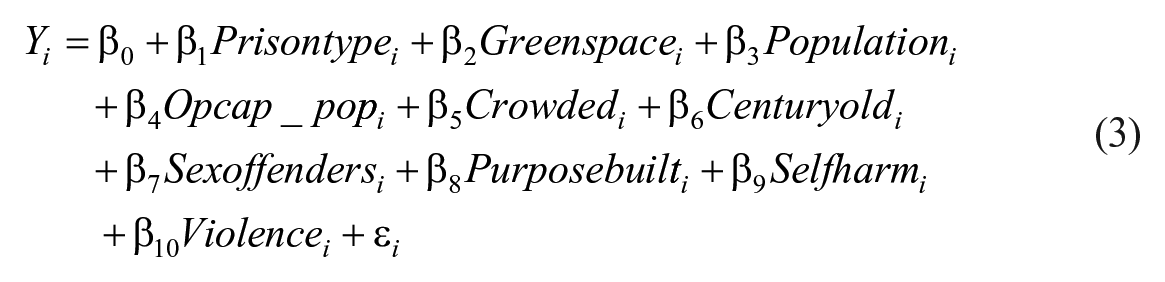
“Selfharm” is the prisoner-averaged number of self-harm occurrences in 2018, and “Violence” is either the prisoner-averaged number of assaults between prisoners or towards staff members in 2018.
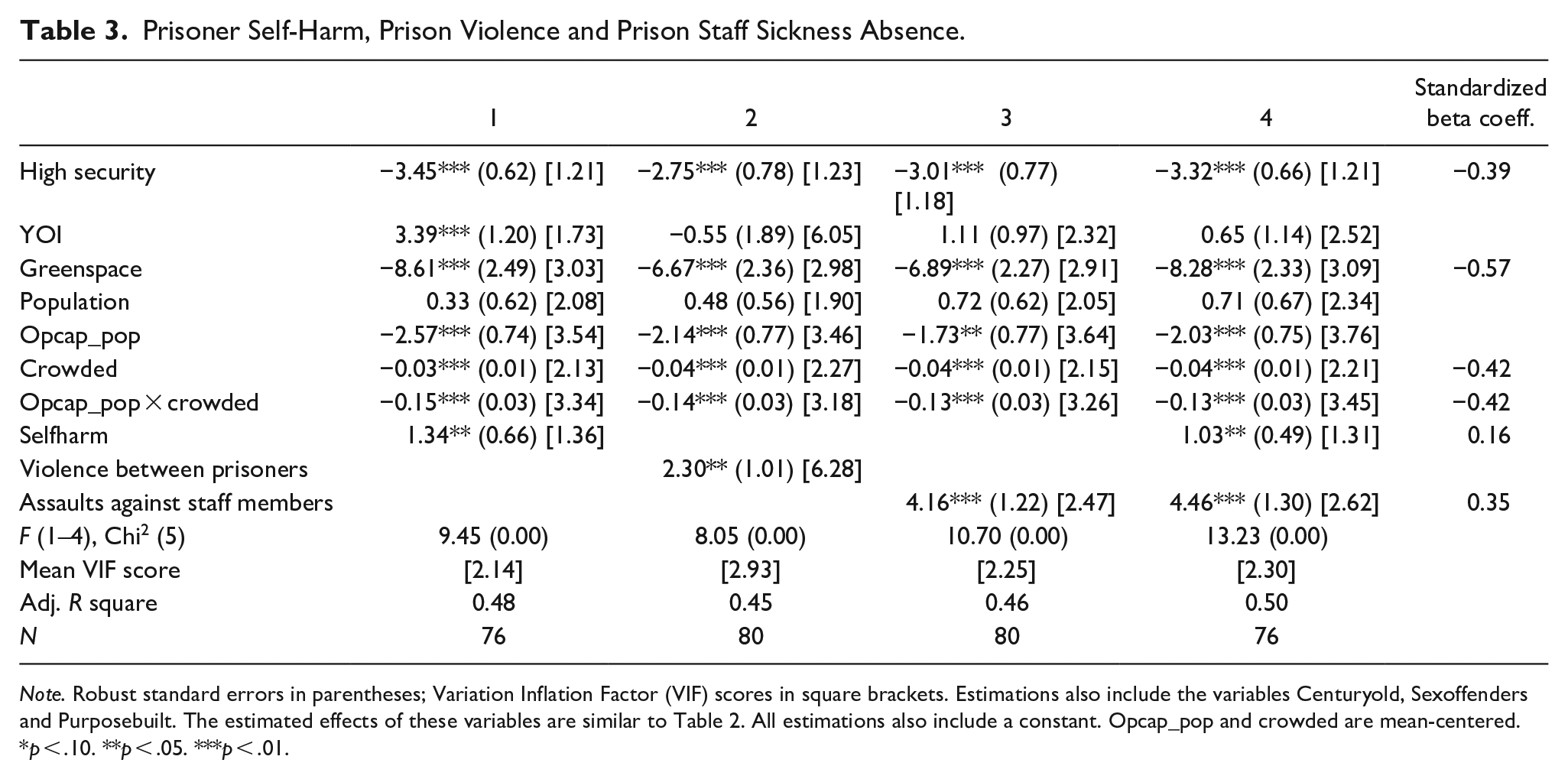
The findings from estimating regression model (3) are presented in Table 3. Column (1) shows that self-harm is positively associated with staff sickness absence. In columns (2) and (3), we individually add the indicators of prison violence. Both types of violence (between prisoners and against staff) significantly increase staff sickness absence, with assault towards staff members carrying a larger coefficient. Column (4) shows the results when we control both for self-harm and assaults against prison staff, confirming that both indicators are important. The estimated effects of the other control variables are similar to those presented in Table 2. As for the relative importance of the various control variables, the standardized beta coefficients obtained from regression (4) indicate that percentage greenspace has the largest effect on sickness absence, followed by prison cell overcrowding and the High Security prison category.
Prisoner Self-Harm, Prison Violence and Prison Staff Sickness Absence.
Note. Robust standard errors in parentheses; Variation Inflation Factor (VIF) scores in square brackets. Estimations also include the variables Centuryold, Sexoffenders and Purposebuilt. The estimated effects of these variables are similar to Table 2. All estimations also include a constant. Opcap_pop and crowded are mean-centered.
p < .10. **p < .05. ***p < .01.
Discussion and Conclusions
Our purpose in this paper was to determine whether nature contact in the workplace influenced staff sickness absence in public sector prisons in England and Wales. By utilizing publicly-available data for sickness absence, analyzed alongside a newly generated “greenspace” dataset measuring the percentage of the area within prisons’ perimeters that are vegetated, we were able to show that prisons with a higher proportion of greenspace exhibit lower levels of prison staff sickness absence. This relationship is statistically robust, and it persists when we control for prison size, type, age, and levels of crowding. It is also robust to the inclusion of data for self-harm and violence among prisoners, and assaults against prison staff. Taken together, this demonstrates that the presence of green space within prisons works to reduce staff sickness absence, even where there are high levels of prisoner self-harm and violence (which are known to cause considerable emotional distress to staff) and high levels of assaults on staff (which may cause them actual bodily harm).
These findings represent three important advances. First, in relation to the effects of nature contact in the workplace, our work is an important addition to previous studies that have largely been based on single- or multiple-site studies. Whilst individually informative, these are not easily scaled up to national contexts. Our research design, and particularly our innovative methodological approach in generating a dataset to describe the “green-ness” of a workplace, allows us to demonstrate a statistically robust relationship between nature contact and sick leave, in a workplace context that had remained entirely unexplored prior to this study.
Our findings support the conclusions of previous research (e.g., Bjornstad et al., 2016), that access to nature reduces sickness absence specifically, and potentially improves wellbeing in a broader sense. Our novel methods and robust findings suggest that there is potential to deploy similar methods to assess the potential for other workplaces to offer beneficial nature contact. Although we position our own research approach as a potential alternative or supplement to that employed in prior studies, as noted earlier, our methodology does not allow us to determine whether or how often correctional workforces view or access any green spaces present within prisons—it is premised on the assumption that the more greenspace there is, the more likely staff are to be able to see or access it. As noted earlier, we are also limited by the nature of the Ordnance Survey Mastermap Topography Layer (in terms of being able to differentiate between the effects of different types of greenspace), and by the lack of available data for baseline demographics of the staff working at establishments within the study (which might have allowed us to consider these factors as independent variables). It is likely that this level of granularity of greenspace and staff data could only be generated via a comparative study of a smaller number of establishments. Our findings must be viewed in light of these methodological limitations. However, we hope that they provide justification for such qualitative and survey-based studies of this type to be carried out within individual prisons, enabling better understanding of the relationship between greenspace and sickness absence, and potentially greenspace and wellbeing more generally. This could generate better understandings of the ways in which prison staff experience these spaces, the opportunities they have to engage with them, and reveal their views about any beneficial effects they identify.
Second, our work makes a significant contribution to existing research on correctional workforces and their propensity for absenteeism due to ill health. Previous research has focused on the reasons both for ill health itself, and for correctional workforces to absent themselves from the workplace. A wide range of contributory factors have already been examined including management techniques, incentivization, workplace stresses and so on. To date, however, the role of the prison’s physical environment had scarcely been considered. By analyzing the role of green space within prisons, this paper opens a new avenue of exploration. Again, our work suggests that further qualitative and/or ethnographic research probing the lived experiences of prison staff in relation to nature contact would be beneficial. A particularly useful focus would be in exploring the varying ability to view these spaces from different parts of the prison site that staff work in and pass through.
Third, our findings also potentially have operational implications. As Lambert et al. (2005) noted, staff sickness absence is a critical management issue for prison services. Any factors which lead to a reduction in sick leave, (potentially as one element of a wider sense of prison staff wellbeing), are valuable for justice sector managers. Furthermore, our findings also hold the potential to influence prison design. Building on previous work (Moran et al., 2021) which demonstrates that prison greenspace reduces prisoner self-harm and violence, we confirm the beneficial effects of greenspace for prison staff. It is possible that these findings indicate that nature contact is lowering stress, as is posited in Attention Restoration Theory (ART) (Kaplan, 1995; Kaplan & Kaplan, 1989) and Stress Reduction Theory (SRT) (Ulrich, 1981; Ulrich et al., 1991). Taken together, these findings suggest that in order to reduce staff sickness absence, and hence to enhance the safety and operational viability of correctional establishments, green spaces should be a key design element for new prisons. Furthermore, existing prisons should have the space within their perimeters “greened” via planting of vegetation wherever possible.
Footnotes
Declaration of Conflicting Interests
The author(s) declared no potential conflicts of interest with respect to the research, authorship, and/or publication of this article.
Funding
The author(s) disclosed receipt of the following financial support for the research, authorship, and/or publication of this article: The authors received funding from the University of Birmingham for the generation of the prison greenspace dataset which was used in the analysis presented in this article.
