




Abstract
Ensuring that environments are designed to cater for those with decreasing orientation, perceptual and mobility skills, is an example of how environments are being changed to become more age and dementia friendly. However, environmental design should directly involve potential users of the environment to ensure that their views are accounted for. Four open-ended questions, focusing on orientation strategies, reasons for disorientation, and design preferences, were given to 32 older adults after they had completed a route learning task through an unfamiliar environment. A Content Analysis found a strong focus on participants’ ability to memorize routes based on verbally encoding the route and on their ability to remember landmarks, with the reports linking closely to cognitive theories of navigation. Design suggestions included the importance of a homely and welcoming environment, memorable features, and access to the outdoors. The findings can be used inform age and dementia friendly design principles.
Introduction
Until recently, the design of care environments (such as care-homes, retirement housing, assisted living), has mainly been informed by professionals, in particular: care-staff, architects and designers (O’Malley et al., 2017). Age and dementia friendly design guidelines consider multiple factors when designing supportive environments for older adults, and for those with cognitive impairments such as dementia. Environments designed to cater for those with decreasing orientation, perceptual, and mobility skills, is an example of how environments are being changed to become more age and dementia friendly (Department of Health, 2015). However, for these suggestions to be age and dementia friendly, they should directly involve older adults who use the environment to ensure that their preferences and experiences are accounted for. Up until recently, this voice has been mostly ignored and has been spoken on behalf of, by family members and care professionals (Jonas-Simpson, 2003).
The importance of speaking directly to the user has been demonstrated by Godwin (2014), who found that residents of a care environment had opposite preferences in the color/décor to care-staff of the same environment. The users’ opinions on design have also recently been expressed by residents of a retirement development, who reported that the repetitive design layout and interior finishes contributed toward increased feelings of disorientation (O’Malley et al., 2018). Additionally, the importance of “homely” environments has been communicated as a vital environmental consideration (Day et al., 2000; Innes et al., 2011; O’Malley et al., 2018; Zavotka & Teaford, 1997). These studies demonstrate that older adults with memory difficulties can express their experiences on how they navigate within an environment and offer opinions regarding the design.
Feelings of disorientation amongst older adults are experienced more frequently in new, unfamiliar environments (Lipman, 1991; Monacelli et al., 2003; Phillips et al., 2013). This is reflected in a variety of navigation experiments, highlighting that older adults perform worse than younger adults in a number of spatial navigation tasks and they require more exposure to unfamiliar environments to confidently navigate through them (Cushman et al., 2008; Grzeschik et al., 2019; O’Malley et al., 2018). This decline in abilities can be explained by age-related neurodegeneration in the hippocampus (Raz et al., 2010), an area of the brain heavily involved in encoding and retrieving spatial memories. As a result, particular navigation strategies and spatial representations (such as map-based strategies) become harder to use by older adults (Cherrier et al., 2001). Age-related declines in navigation abilities lead to shifts in preferences for navigation strategies, away from more complex allocentric/cognitive map-like strategies, to more egocentric strategies (Rodgers et al., 2012; Wiener et al., 2013). The prototypical example of egocentric navigation is route navigation, in which a person learns to navigate from one location to another location, resulting in unidirectional route knowledge, typically acquired over several exposures. Declines in navigation abilities are even more pronounced if early signs of atypical ageing (such as cognitive impairment or dementia) are present, resulting in fewer available strategies and more support being required to successfully learn and retrace routes (Benke et al., 2014; Cherrier et al., 2001).
Experiments in which older adults have been systematically tested on aspects of their route memory have demonstrated that they display preferences for landmark-based navigation strategies (Cherrier et al., 2001; Monacelli et al., 2003). In particular, landmarks which serve as beacons and are located in the direction of turn (e.g., “head toward the church”), rather than associative cues in which directional information is associated with a given landmark (e.g., “turn right at the church”), have been found to be easier for older adults to use (Wiener et al., 2013). This is likely the result of declining associative learning abilities in older age, which is a pre-requisite for associative cue learning, but not for beacon-based strategies (Naveh-Benjamin et al., 2007).
For those displaying early signs of cognitive impairment, the difficulties with navigating around environments are exaggerated (Monacelli et al., 2003) and unfamiliar environments become more difficult to learn (Pai & Jacobs, 2004; Passini et al., 1995). Landmark-based learning and knowledge, (including the temporal order in which landmarks or places are encountered along a route), the directions changes required at particular landmarks or places, and the memories of where landmarks are located in the environments, are all significantly affected by cognitive impairments (deIpolyi et al., 2007). Other aspects of landmark memory, however, such as memory for the identity of landmarks encountered are still relatively intact (Cherrier et al., 2001).
It is unfortunate that declines in the ability to learn unfamiliar environments occur at a time when many older people, for a variety of reasons including different health issues, move into, and familiarize themselves with, care environments or residential developments. In the UK alone there are currently more than 500,000 units of self-contained apartments in care environments (Pannell & Blood, 2012). Note also that the decision to move into a particular care environment is often made having had limited experience or time to get familiar with the environment.
The ability of older adults (with and without cognitive impairments) to learn novel routes through unfamiliar environments has previously been explored predominantly using quantitative methods (Cherrier et al., 2001; Grzeschik et al., 2019; Monacelli et al., 2003). There is currently limited qualitative research that has explored older adults’ experiences navigating within a new environment, or their design wishes for residential and care environments (Godwin, 2014; O’Malley et al., 2018). This study will address this gap in the literature by exploring the qualitative accounts of older adults when learning a novel route within an unfamiliar residential development. By asking older adults about their experiences in a new, unfamiliar environment (after having only navigated one particular route through it), we will provide detail on people’s first impressions of the design and the ease of finding their way through a retirement development.
Results from this study will expand existing knowledge on how people initially experience new retirement or care environments, which is presently not well understood.
Aims
This study aimed to explore older adults’ experiential accounts of navigating within an unfamiliar environment. Specific focus was on how they experienced a route through a retirement development as well as their design preferences of their ideal living environment, as well as their preferences for the specific test setting. The findings from this study will allow for comparisons between the views of residents of a retirement development (O’Malley et al., 2018) and older adults who are unfamiliar with a retirement development (this study).
Method
Study Sample
A total of 32 older adults (aged over 65 years) took part in the study. Opportunity sampling was adopted whereby all participants were from the local county and had seen advertisements for the study through local charities or through the University Recruitment System. The mean age was 70.18 years old (SD = 4.01 years; age range = 65–81 years), with 17 female and 15 male participants. All participants were screened for cognitive impairments using the Montreal Cognitive Assessment (MoCA) and all participants scored 23 out of 30 or above which is assumed to be within the range expected for healthy ageing older adults (mean score = 26.06; SD = 2.12; MoCA score range = 23–30). No participants had a formal diagnosis of a memory impairment (Luis et al., 2009). Note however, that our recent research suggests that participants with MoCA scores between 22 and 26 already show impaired navigation abilities which may be indicative of early symptoms of atypical ageing (O’Malley et al., 2018). Pseudonym names were used during the analysis and reporting of the findings to maintain the anonymity of the participants.
Setting
The study took place in a retirement development (independent living, with shared communal areas such as a living room area, kitchen, laundry facilities and garden) in the south-west of England. Retirement developments in the UK are typically targeted to those aged 55 years and older. The development used in this study had 92 self-contained apartments, spread over five floors, as well as communal facilities (i.e., communal lounge, kitchen, garden, laundry, and refuse). None of the participants had ever visited the development.
The Route
Participants were guided along a route within the retirement development starting from the front entrance and ending in the communal lounge. The route consisted of seven decision points across three levels, making use of two staircases (see Figure 1). Six decision points are shown in Figure 1, the 7th decision point is within one of the staircases, where participants had the option of going up or down. Landmarks (such as paintings and objects) were located both at decision points (junctions) and non-decision points (corridors). Participants were guided along the route once and instructed to learn and memorize the route as best they could. They were then brought back to the start place along a path that did not cross the route and were asked to repeat the route themselves. If they made any errors when retracing the route, they were shown/guided along the correct route again, and then asked to repeat it independently again. This procedure was repeated until participants could accurately repeat the route by themselves. After a successful learning of the route, participants completed a series of tasks addressing different aspects of route memory and were subsequently asked to complete a questionnaire focusing on their navigational experiences and design preferences. All participants eventually learned the route. See Figure 2 for images taken along the route, depicting the starting point, picture landmarks along the corridors and the signage to the staircases. This article focuses on the qualitative reports from the questionnaire that participants completed.
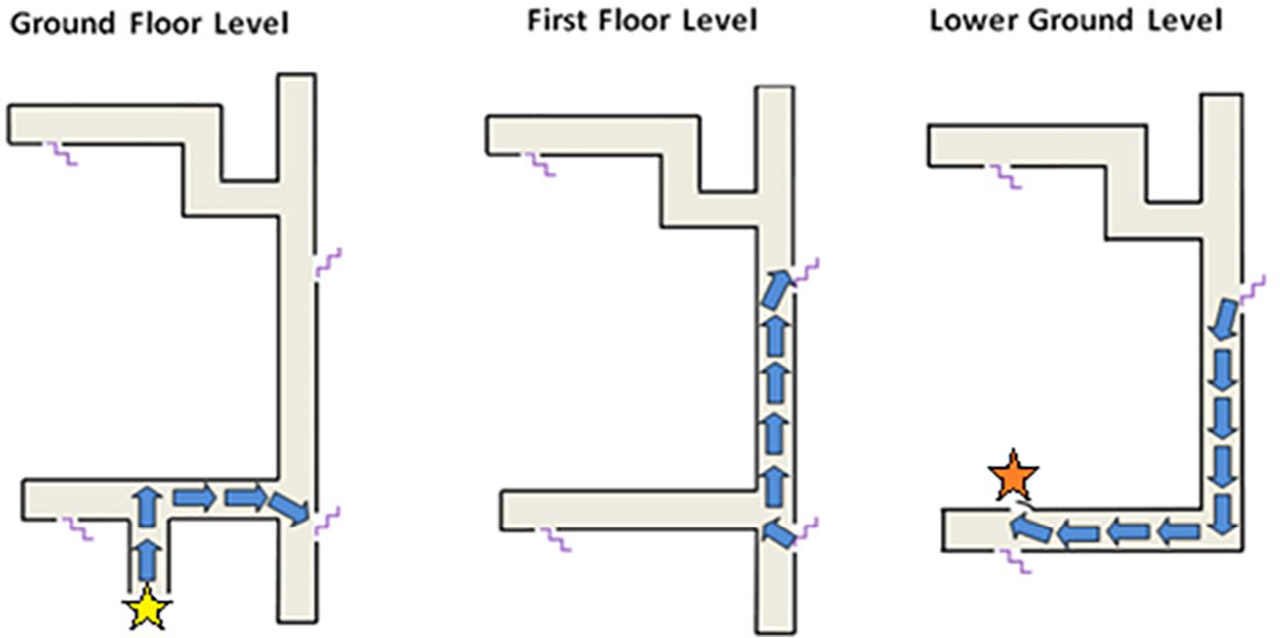
This image depicts the route participants took through the development. The yellow star indicates the start of the route, and the orange star shows where the route finished.
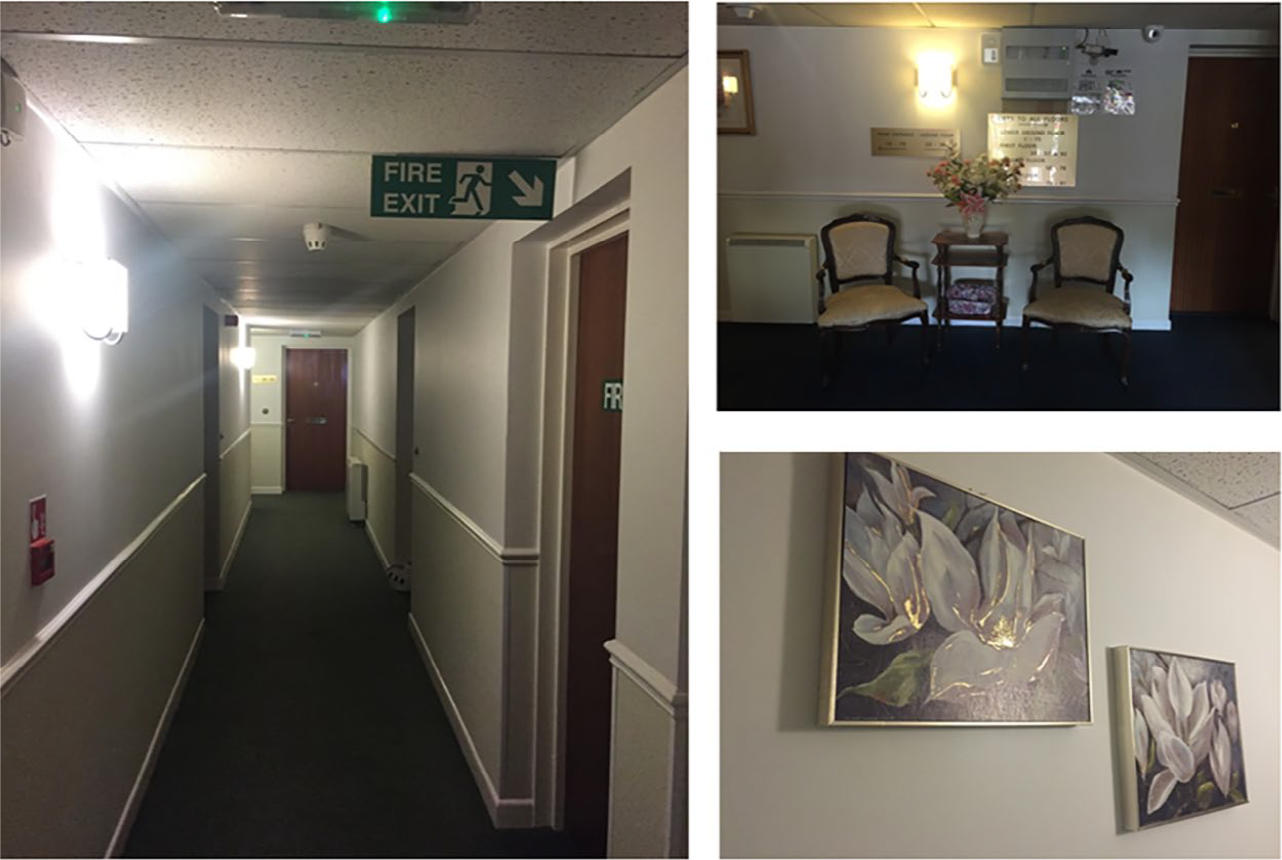
Left is a snapshot of one of the corridors walked along within the development. Upper right is the lobby at the start of the route that participants took. Bottom right is some of the artwork shown along the corridor walls.
Ethics
Ethical approval was obtained from the authors’ University ethics panel. There were no occasions during the study where participants expressed behaviors that indicated they were uncomfortable. All data was anonymized and pseudonyms were given to all participants.
Questionnaire
The questions were informed by the findings from earlier work (O’Malley et al., 2018), and focused on the strategies used to learn the route, the causes for potential disorientation, and design preferences and suggestions. Participants were presented with open-ended questions on separate sheets of A4 and asked to write as much or as little as they wished. The researcher left the participants to write their responses on their own and in their own time.
The questions were:
What strategies do you feel you used more when learning this new environment?
Were there any disorientating features in this environment?
Please could you describe your ideal development? (i.e., what would you like it to look like, and to feature?)
Please discuss how you find the design of this development.
Question four acted as a case study/vignette example to gain a greater understanding of participants’ design preferences based on their experiential accounts of the environment. Using the current setting as an example provided a richer level of detail regarding their preference in design.
Data Analysis
Questionnaire responses were analyzed following Elo and Kyngäs’ (2008) inductive, directed content analysis process (Hsieh & Shannon, 2005; Neuendorf, 2016). This analysis was chosen as it enabled the data to be qualitatively analyzed, and at the same time quantitatively discussed; its descriptive approach allows coding of the data and the interpretation of quantitative counts of the codes (Downe-Wamboldt, 1992; Morgan, 1993). Additionally, it is an appropriate method for questionnaire analysis (Griffiths, 2016; Kondracki et al., 2002) and previous studies have used content analyses when analyzing open-ended questionnaire responses (Hunter, 2006). All responses were analyzed collectively, though given the directed framework of this study, responses were categorized depending on whether they related to orientation strategies, reasons for disorientation or design preferences. Sub-themes in each category were driven by the responses made, and the number of participants reporting each topic was noted. The definitions and content of the categories changed, as the units were categorized. Categories and ideas were constructed, inter-coded, and checked with the research team to add rigor and validity to the analysis process (Cavanagh, 1997). The responses were initially coded and grouped into strategy types by author 1, and together with authors 2 and 3, they were checked, modified and verified.
Findings
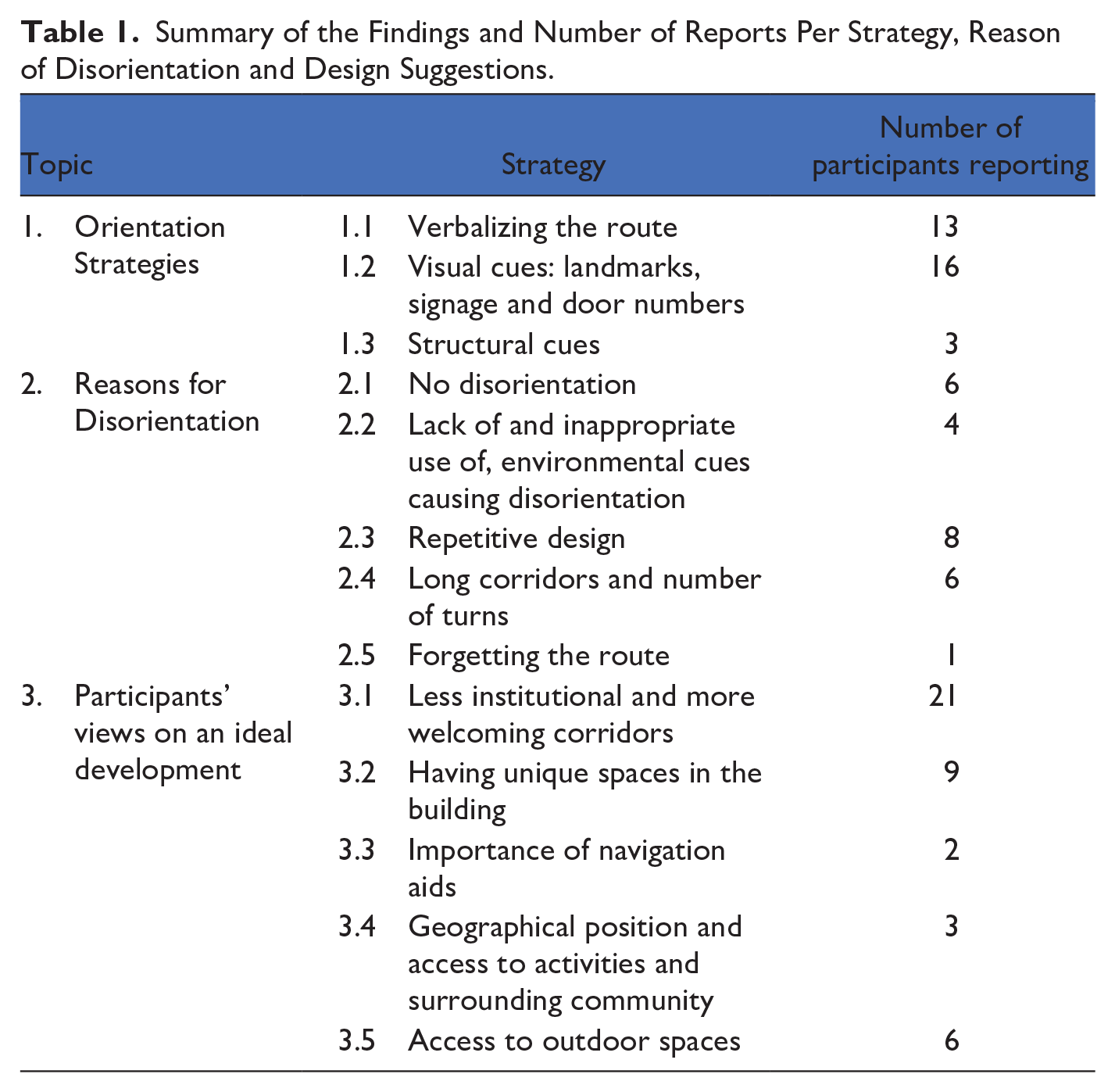
The analysis revealed participants’ self-perceived orientation strategies, their reasons for disorientation and their design preferences. The reports are presented below using verbatim quotes from the questionnaires, as well as the number of participants who reported a particular sub-theme per category. Importantly, the number of reports per question depended on the participants and their experiences (see Table 1 for a summary). We only included reports that addressed the questions, while more general responses that were irrelevant were not included in the analysis. The specific findings for each category (participants’ self-perceived orientation strategies, their reasons for disorientation and their design preferences) will now be discussed individually.
Summary of the Findings and Number of Reports Per Strategy, Reason of Disorientation and Design Suggestions.
Orientation Strategies
The analysis highlighted which orientation strategies participants perceived themselves to have used. The strategies were predominantly focused on learning the sequence of direction, (verbalizing the route) and memorizing the visual and structural cues along the route to support orientation. Two participants stated that they additionally relied on the structural cues to form a “mental map” and used external visual cues through the windows to self-localize on each level. The reported orientation strategies will now be discussed in greater detail with quotation examples provided:
Verbalizing the route
The most reported strategy to remember the route was verbalizing the directions (relying on the sequence of turns) which was reported by thirteen participant: “Route learning ‘out loud’ in my head of the directions (R/L) and the gestures/physical” (Anna), with one participant discussing how he categorized the route: “I divided the route into two sections based on the staircases (they were like two mini routes).” (Fred).
Fred’s quote also demonstrates how hierarchical representations appeared to reduce memory load for him.
Visual cues: Landmarks, signage and door numbers
Remembering visual cues (particularly landmarks and signage) along the route to support orientation was reported by 16 participants. The reports surrounding visual cues mainly focused on how landmarks were used by participants. Three participants noted how they associated places/landmarks with directions: “The landmarks help me decide when to turn/change direction” (Elizabeth)
This suggests an associative cue strategy was adopted, while eight participants focused on the objects and pictures along the wall to memorize the route: “. . . tried to look out for particular objects when learning the route. E.g. the notice boards, favorite paintings” (Henry).
Henry’s quote is important, as it shows that all kind of objects can serve as landmarks to support navigation. In addition, participants also paid attention to the relevant signage (n = 8 who reported using signage and door numbers as an orientation strategy).
Structural cues
The structure of the development was also reported as playing a role for navigation by three participants. Participants focused on how the floor plan guided and informed participants if they were taking the correct route: “I realized I went the wrong way when the corridor zig-zagged and I was not straight” (Bessie)
They also noted how the outside served as a global landmark to localize where they were in space: “Noticing the outside environment to orientate myself” (Nellie).
This demonstrates that the outside can be used almost as compass information, emphasizing the importance of windows for orientation when considering design.
Disorientating Features
The analysis highlighted a variety of causes of disorientation within the development, including the lack of, and inappropriate use of, environmental cues which can cause disorientation, repetitive design and long corridors with multiple turns. Forgetting the route also caused disorientation for one resident.
No disorientation
Six participants (three males, three females) reported no disorientating features along the route. The remaining 26 participants all reported experiencing some disorientation along the route. Seventeen participants were able to specify which aspects they found disorientating.
Lack of, and inappropriate use of, environmental cues causing disorientation
The lack of signage was reported by two participants: “I would have liked to see more reminders of where things were.” (Fred).
Additionally, the lack of windows along corridors, to localize participants’ position in the development, was noted as causing disorientation: “Corridors were long so you could lose sense of position – no windows with views.” (Alice).
The windows informed participants of which floor they were on: “Yes, when there were no windows on the bottom floor. But this also alone reminded me of which floor I was on so was in a way helpful once I realized.” (Edward).
These strategies are closely related to the orientation strategies discussed above where participants reported using the outside to stay orientated, providing them with compass information.
Interestingly, two participants stated that they felt the landmarks had a detrimental effect on how well they learned the route, which offers a contrasting view to the other reports, but is consistent with the concept of ‘information clutter’: “I was a bit distracted by some of the nice/eye catching pictures” (Bessie).
This quote offers a contrasting view to the other reports but is consistent with the concept of ‘information clutter’ whereby too many landmarks may cause confusion.
Repetitive design causing disorientation
The repetitive design of the environment was the most frequently cited cause of disorientation: “Décor is very similar on all floors. Carpet and lighting are all similar.” (Henry)
This was also noted in the lack of unique spaces: “I found it hard trying to make places memorable - there were some things that stood out (the gold flowers) but other times it was really disorientating.” (Elizabeth).
Ensuring environments have areas which are unique to break up any possible repetitiveness and allow for architectural differentiation could help participants better learn routes.
Long corridors and number of turns
Six participants reported the length of the corridors and the number of turns as reasons for disorientation. Specifically, three participants reported that the length of the corridors caused disorientation, “Corridors were long so you could lose sense of position” (Alice).
Three participants reported that the number of turns along the route caused the experienced disorientation: “Always panic in these buildings with many twists and turns” (Florence).
These causes of disorientation could be related to accumulating errors in path integration. Path integration refers to the process of updating perceived self-motion information to keep track of position and orientation whilst travelling through an environment. The number of turns along a route (i.e., the complexity of a trajectory) has been shown to affect path integration performance, so it may be that the complexity of the route caused Florence to experience feelings of disorientation.
Forgetting the route
One participant noted that he forgot where he was going along the route: “I sometimes forgot where I was going” (Albert).
This quote highlighted that Albert did not have the information required to continue along the route, which could indicate that he either had not learned the information, or had difficulties recalling it.
Participants’ Views on an Ideal Development Design
All participants clearly illustrated how they would like their ideal development to look. The majority emphasized the importance of smaller environments with more unique spaces. Other participants mentioned the importance of having less institutional and more welcoming corridors and navigation aids in environmental design. The geographical position of an ideal development within the community, and access to activities, surrounding community, and outdoor spaces were also highlighted as being important considerations.
Having unique spaces in the building
Having shorter corridors and fewer people was suggested by participants: “I would love fewer people” (Elizabeth).
Participants discussed that they would prefer brighter corridors, with unique spaces and alcove seating areas: “Wider corridors and more spaces to sit along the way. Maybe a coffee machine by one of the windows (a little alcove space)” (Edward)
Particularly for larger built environments which have long corridors, it is important to make sure there are breaks (i.e., spaces to provide rest) along the way. Having breaks will encourage people to go out and use the corridors, as well as to potentially visit new unfamiliar surroundings.
Participants also noted that empty spaces along the corridors of the environment should have been filled: “There were too many blank spots especially at junctions” (William).
This report reiterates the importance of having landmarks positioned at, or close to, decision points, and it suggests that these landmarks are relevant for navigation which, in turn, suggests that people look for (and expect to have) landmarks at these decision points.
Less institutional and more welcoming corridors
Ensuring developments are designed such that they are inviting and homely was also a key consideration, reported by 21 of the participants: “An ideal place would have thought out design and not patronising. Subtle and simplicity.” (Bessie).
Additionally, ensuring the development has lots of character was also reported by the participants.
With regards to the test setting used, the effects of lighting and décor were frequently reported as having a negative impact on how participants felt when navigating around the building. Some noted the institutional feel of the setting: “Inside it looks very much like a hospital.” (Bertha)
and how the building felt: “rather impersonal.” (Annie).
Ensuring the communal spaces are designed such that they are homely and inviting is important when considering the design of communal-living built environments.
Importance of navigation aids in environmental design
Two participants additionally discussed the importance of having supportive navigation aids (such as maps, signage, color-coded areas, and separated “wings”) to help identify where they are in the environment: “Having lots of signposts and maps. Exits indicated everywhere. Every floor indicating which floor you’re on. Numbers on doors indicating the floor you’re on” (Joseph).
This is an interesting suggestion as signage may provide additional navigational support in this context. However, the suggestion contrasts with other reports highlighting the importance of creating a less institutional environment (particularly when considering it as an ideal environment to live in).
Interestingly, the use of color to differentiate areas within an environment was also discussed by five participants (this was a sub-theme within unique spaces): “I should prefer each floor to have a different color and also fire exits and lifts (if there are more than one).” (Clarence),
This highlights the importance of creating unique spaces, which in turn would support orientation.
Geographical position and access to activities and surrounding community
Having a range of activities and a sense of community were mentioned to be important “Hairdressing, swimming pool, activities and courses not specifically designed for elderly, access to shops, excursions to theatre and other cultural events/ semi-rural.” (Annie).
In addition to the ideal services provided in-house, two participants described the importance of local surrounding community that their ideal development would have: “Very good position next to the park and local shops” (Nellie).
Ensuring that environments are well-integrated with the community and that they have access to surrounding facilities is an important consideration.
Access to outdoor spaces
Access to natural light and outdoor space was frequently reported: “. . lots of natural light. I want to be able to easily go outside and not feel trapped.” (Albert).
Another participant discussed having a: “Feature windows at the end of the corridors with a view.” (Alice).
This same participant expanded and discussed how bringing the outside in was equally important for her: “Large plant pots with attractive plants—even if artificial!” (Alice).
These reports by the participants demonstrate that they had clear ideas of how they felt the environment could be adapted to better suit them. Ensuring that there is scope in both existing and future builds to accommodate such wishes should be a priority.
Additionally, participants noted the importance of outdoor space. They particularly liked the presence of the immediate surrounding gardens as well as the developments position within the community close to local shops. While some participants liked that the development was positioned within the community, the interior was not to their liking: “The building is in a great location but I don’t like the inside.” (Albert).
This emphasizes the need for those involved in the development of retirement settings to consider both the location and internal design equally.
Discussion
This study explored the experiential accounts of older adults’ wayfinding experiences and design preferences in an unfamiliar retirement development. Even though the participants were members of the local community, they had no prior experience with the development. Participants were required to learn a route, until they could accurately recall it, which took them from the front door of the development, across three floors, and finished in the communal lounge. All participants successfully learned the route. Following the route learning phase, they were then given four open ended questions, which addressed the strategies they used to learn the route, reasons for disorientation, and their design preferences. The feedback data was analyzed using a direct content analysis approach (Elo & Kyngäs, 2008).
Orientation Strategies
All participants were able to express how they felt they had learned the route (after successfully demonstrating that they could repeat the route after being guided along the route), and identify the strategies and environmental cues they felt they had used. The presence of visual cues was vital for many of the participants (16 of the 32 participants reported this). In particular, the use of key landmarks (such as the pictures along the walls, the fire exit signage etc.) positioned along the route supported participants to orientate and navigate through the environment. This is consistent with previous literature which highlights the importance of landmarks for navigation, particularly when first learning and familiarizing oneself with a new route through an unfamiliar environment (Waller & Lippa, 2007). Moreover, landmark-based navigation strategies are especially important for older adults during route learning (Head & Isom, 2010; Monacelli et al., 2003; Wiener et al., 2013).
Three participants noted that they associated directions to landmarks, such as Elizabeth who said, “The landmarks help me decide when to turn/ change direction,” highlighting that they had adopted an associative cue strategy at particular points in the environment (Waller & Lippa, 2007). Earlier research has shown that objects at decision points are remembered better than those at non-decision points, and as a result become landmarks (Aginsky et al., 1997; Janzen & Jansen, 2010; Janzen et al., 2008). Some landmarks, though, did prove problematic for one participant (Bessie). Specifically, she was unable to dissociate key landmarks from distractor landmarks, resulting in some landmarks distracting her away from attending to the route and consequently making the route harder to learn. The ability to dissociate the relevant from the ambiguous landmarks relies heavily on where landmarks are situated along the route, with those at relevant positions (decision points) resulting in more activity in the parahippocampal gyrus (Janzen and Jansen, 2010), a region of the brain that is vital for scene and place recognition.
It has been suggested that dissociating between relevant and ambiguous landmarks becomes affected during the ageing and atypical ageing process (Kessels et al., 2011), which would explain why information clutter caused by too many landmarks present in a given environment (Passini et al., 2000), would cause detrimental effects to navigation (but see Grzeschik et al., 2019).
One resident, Nellie, commented on how noticing the outside environment helped her to orientate herself. This demonstrates that the outside can be used almost as compass information (Wang & Brockmole, 2003) and emphasizes the importance of windows for orientation when considering architectural design.
Verbalizing the sequence of route directions as an orientation strategy was reported by 13 participants. Verbalizing routes and following route descriptions are amongst the most commonly used navigation strategies when directing people along new routes (Allen, 2000, Denis et al., 1999, Habel, 1988, Klippel et al., 2005, and Lovelace et al., 1999). Additionally, when repeating and retracing routes, thinking aloud (such as repeating directions aloud) are also frequently used, and studies have highlighted that people do in fact use verbal codes during route learning (Meilinger et al., 2008). One study even suggested that healthy adults are able to remember route sequences of turns up to 13 intersections (Denis et al., 1999), so it is conceivable that participants in this study were able to learn the sequence of directions at the nine intersections, and verbalize the route efficiently.
Disorientation
The corridors caused a lot of problems for participants when learning the route. The most frequently reported cause of disorientation within the setting was the repetitive design, followed by the length of the corridors and the number of turns, emphasizing the need to ensure corridors in such environments are designed correctly.
Even though repetitive design was reported as a cause of disorientation in retirement developments (O’Malley et al., 2018), this issue can be easily overcome with careful design consideration. Improving the environmental design, for example by differentiating segments along corridors so that they are easier to identify or by using different colors and visual cues to make areas memorable, would reduce the causes of disorientation reported by participants, (such as disorientation as a result of the long corridors and number of turns, and the repetitive design). Ensuring that environments have areas which are unique to break up any possible repetitiveness, allowing for architectural differentiation could help participants better learn routes (Marquardt, 2011).
Proximal/local landmarks have been shown to play a crucial role in supporting older adults during navigation (Moffat & Resnick, 2002). It is therefore not surprising that participants reported the lack of landmarks within the environment as a key reason for why they felt disorientated. Whilst there were some landmarks within the environment (e.g., each floor had a theme such as flowers or landscapes, and displayed pictures according to that theme), it may have been that the landmarks were not unique or salient enough, or they may not have been at relevant points for navigation (Aginsky et al., 1997). Landmarks help to shape and support the orientation strategy we use to learn and recall a route through a space (Waller & Lippa, 2007). Older adults show a preference for a beacon-based strategy (for example “head toward the church”; Wiener et al., 2013) and view salient landmarks as critical, route-maintaining events along learned route (Lipman, 1991). We even found that one participant’s design suggestion featured beacon landmarks: “Feature windows at the end of the corridors with a view.” (Alice). This suggests that older adults may be aware that such landmarks are particularly beneficial for them in remembering the routes (Wiener et al., 2013). Future research should look at these factors, and explicitly assess these landmark characteristics when testing route memory and asking for experiential accounts of navigation.
An interesting differentiation between the length of corridors and number of turns as a cause of disorientation was reported by participants, which could be related to accumulating errors in path integration (Biegler, 2000). Path integration refers to the process of updating perceived self-motion information to keep track of position and orientation whilst travelling through an environment (Loomis et al., 1999). Earlier research suggests that the number of turns along a route (i.e., the complexity of a trajectory) and the length of the path affect path integration performance (Klatzky et al., 1990, but see Wiener & Mallot, 2006). Moreover, path integration abilities have been shown to decline in older age (Allen et al., 2004), which could explain why one participant in particular noted disorientation along one long corridor (with no decision points present).
The lengths of corridors and the number of turns also relate to other models of navigational theory, in particular cognitive graph theory and cognitive map theory. These theories state that number of turns (irrespective of corridor length; Mental Model; Meilinger, 2008) and corridor length (irrespective of number of turns; Mental Walk; Byrne et al., 2007) affect navigation performance. It is therefore clear that reducing both factors should result in reduced levels of disorientation. This is particularly important for older adults and those displaying early symptoms of atypical ageing (Marquardt & Schmieg, 2009) and is echoed in existing age and dementia friendly design guidelines which emphasize the importance of short corridors and interconnected areas.
It was commented by one resident that she “. . . was a bit distracted by some of the nice/eye catching pictures” (Bessie)—This quote offers a contrasting view to the other reports, but is consistent with the concept of ‘information clutter’ (Passini et al., 2000) whereby too many landmarks may cause confusion. Moreover, salient visual information can capture attention in older adults, even if that information is not task relevant (Tsvetanov et al., 2013).
Two participants, Alice and Albert, emphasized the differentiation of being disorientated between where you are, and where you are going, when they discussed the length of the corridors. Self-localization is an important aspect of successful navigation, and these reports emphasize how the length of corridors appeared to influence both spatial localization and route retracing abilities independently. Whilst the route used in this study was chosen to explicitly test route memory, ensuring routes are short (as also found in O’Malley et al., 2018) and (or) the shortest possible routes are highlighted on navigation aids, would assist with age-related difficulties of memorizing routes. Older adults, particularly atypically ageing adults have difficulties learning longer routes (Pengas et al., 2010), so ensuring routes between places are short, with few decision points, is vital. This could be achieved by ensuring that buildings are planned such that communal spaces and other spaces that are frequently used by residents are central within the building.
Route navigation requires the execution of a series of direction changes at intersections. The underlying memory is often referred to as stimulus-response (S-R) associations (Waller & Lippa, 2007) in which the recognition of a stimulus (landmark or decision point) triggers a response (Turn left at specific landmark or turn toward a specific landmark). Albert’s comment that “I sometimes forgot where I was going” may relate to forgetting or not forming such S-R associations which are required for successful route navigation. This interpretation supports the notion that routes between places should be kept short, which few decision points.
Additionally, older adults navigate better in environments consisting of open-planned spaces (Marquardt & Schmieg, 2009) as there is typically good visual access to different parts of the environment which reduces demands on memory and decision making. This could prove more beneficial particularly for new visitors to an environment, when they are trying to familiarize themselves within the space.
Design Suggestions
Participants made design suggestions and shared their preferences on how their ideal living environment would look, using the test environment as an example to compare their vision with. Twenty-one participants emphasized the importance of having a homely and welcoming environment, focusing on how the design should not be patronizing and must be respectful. This is in line with previous earlier research (Day et al., 2000; Innes et al., 2011; Zavotka & Teaford, 1997), though still appears to be an issue which has not fully been addressed. De-institutionalizing shared living facilities through design (1) would create a more person-centered environment, (2) would potentially result in the whole development being used and viewed as a home (rather than only individual rooms/apartments), and (3) would welcome a wider audience of potential residents to consider such housing as an option. Ensuring the communal spaces are designed such that they are homely and inviting is important when considering the design of communal-living built environments (Innes et al., 2011; Zavotka & Teaford, 1997). This said, navigation aids were also mentioned by participants for an “ideal development” as they support navigation. However, as it is unusual to have signage in a typical home, it is important to ensure that maps, signage, useful landmarks and colors are designed such that they do not disrupt the homely feeling of environments too much. More research into the design of wayfinding signage is required such that it is not reminiscent of airports or hospital. Moreover, additional research should explore how navigation can be supported through other design features (O’Malley et al., 2018).
The importance of outdoor space and natural sunlight was consistently reported by participants. The apparent reduced levels of natural light within the setting had immediate effects on the participants who had spent, at most, 1 hr within the retirement development/grounds. These reports are in line with earlier research which has found that outdoor space and natural light to be important qualities when enhancing wellbeing in care settings (Innes et al., 2011). However, these studies (Innes et al., 2011, Noone et al., 2017) reported the effects of natural light on mood with individuals who had prolonged exposure to an environment. Chalfont (2008) discussed that the connections that residents of care environments have with nature is less understood than other aspects of design due to staff wishing to manage risk as a priority and maintain control over residents’ behavior. This said, the psychological and emotional need for access to nature is an important aspect in a person’s life (Chalfont, 2008). Exposure to natural sunlight has been found to reduce stress levels in older adults (Rodiek, 2002). Particularly for those with reduced mobility, ensuring that direct access to outdoors is easily available is vital to enhance wellbeing, as is making sure natural light is plentiful. Care environment planners should consider the wishes of older adults when designing and planning new environments.
Participants also noted that they used the view from the windows as orientation cues, as they provided them with access to global external landmarks. Research into so-called “nested environments” (i.e., immediate surroundings, such as a room, in relation to the outside surroundings such as a university campus; Wang & Brockmole, 2003) demonstrates that we do not automatically update our orientation/location in the outside world, as we navigate within a building. Having windows present along corridors could better support a navigator’s orientation within a building by providing compass cues that would support path integration and allow them to correct for errors in estimated heading direction.
Ensuring that environments are well-integrated with the community and that they have access to surrounding facilities is a vital consideration (Abbott & Sapsford, 2005). This links to literature addressing social connectedness which emphasizes that ageing societies should explore new ways to promote active and ongoing engagement with community life (Emlet & Moceri, 2012).
It is important to note that this study is a case study set in one care environment that involved 32 participants. The findings demonstrate that older adults can articulate the places where they experience issues of disorientation, identify strategies that they use to navigate in an environment, and outline clear design preferences for their ideal development. The potential impact of patient and public involvement with regards to supportive and well-designed environments is also illustrated in this study and should be adopted in future practice.
Conclusion
In this study older adults have openly described their navigation abilities and their design preferences. The results demonstrate first, that particular navigation strategies and representations are readily available for older adults new to an environment, and second, how older adults felt they had learned the route through verbalizing the directions and through a variety of visual cues including landmarks and signage. The open-ended questions provided participants with a blank canvas to describe how they felt they navigated within the setting, and to express how they would want an ideal environment for them to be designed. These findings help us to better understand the design preferences of older adults and will inform improved age and dementia friendly design principles. Repetitive layouts and a lack of landmarks proved problematic and resulted in disorientation for many of the participants. With regards to orientation strategies, there was a clear distinction between route verbalizing strategies and landmark-based strategies, which links closely to established (neuro-) psychological theories (Cushman et al., 2008). Importantly, this study has demonstrated that older adults are able to articulate their wayfinding experiences after limited exposure to an environment—future studies should focus on asking older adults about their navigation experiences, strategies and design preferences in different settings to ensure the design of environments accompanies the strategies and preferences that older adults adopt and report.
Footnotes
Acknowledgements
This piece of research formed part of a PhD thesis at Bournemouth University. We would like to thank Ben Hicks for his advice during the content analysis.
Declaration of Conflicting Interests
The author(s) declared no potential conflicts of interest with respect to the research, authorship, and/or publication of this article.
Funding
The author(s) received no financial support for the research, authorship, and/or publication of this article.
