



Abstract
Keywords
The growing diversity of student populations in classrooms worldwide underscores the urgent need for principals to support educators in delivering instruction in multicultural settings (Gay, 2002; Ladson-Billings, 2014). Since the mere presence of diversity does not guarantee cultural responsiveness, these settings often present unique challenges and complexities that require targeted leadership support to bolster teacher self-efficacy in multicultural classrooms (TSMC), a foundational component of culturally responsive teaching (Choi, 2023; Gay, 2015). Equity-oriented models, such as culturally responsive and social justice leadership, have emerged to address these needs (Khalifa et al., 2016; Theoharis, 2007). However, a substantial empirical gap remains regarding how the two most prevalent leadership models—instructional leadership (IL) and distributed leadership (DL)—can be applied to this critical challenge (Gümüş et al., 2018). This oversight is particularly salient given the global ubiquity of IL and DL; despite their potential to advance diversity and equity, both models are frequently critiqued for failing to effectively serve minoritized students (Hallinger & Kovačević, 2019; Karakose et al., 2024; Neumerski et al., 2025).
IL emphasizes the principal's role in guiding teachers toward effective instruction and facilitating professional learning environments (Hallinger, 2011; Hallinger et al., 2025). The model has garnered significant global attention, driven largely by escalating accountability measures and a heightened focus on measurable student outcomes (Lee et al., 2012; Louis & Robinson, 2012; Shaked et al., 2021). While empirical evidence consistently links IL to teacher-level outcomes—including self-efficacy, collaboration, and professional development (Bellibaş & Liu, 2017; Bellibaş et al., 2021; Demir & Kalman, 2025; Liu et al., 2021)—IL has remained largely peripheral to the discourse on culturally responsive teaching. This omission persists despite seminal theoretical assertions that instructional leaders must “create educational experiences that honor diversity (e.g., the use of culturally rich educational materials)” (Murphy et al., 2006, p. 28). From an IL standpoint, viewing diversity as an asset can enrich instructional quality and foster mutual understanding; however, empirical validation of this relationship remains scarce (Hitt & Tucker, 2016; Murphy et al., 2006). More recently, leadership standards have begun to integrate principles of diversity and equity into IL frameworks, reflecting growing recognition of principals’ responsibilities in serving increasingly diverse student populations (Gümüş et al., 2022; Neumerski et al., 2025; Rigby, 2014).
In contrast to the principal-centric orientation of IL, DL adopts a collective perspective, engaging various school stakeholders in leadership responsibilities for school management and improvement (Choi, 2023; Diamond & Spillane, 2016). DL prioritizes shared decision-making and participatory governance to address organizational complexities and foster a democratic school culture (Harris, 2003; Ma & Zhang, 2025; Woods & Gronn, 2009). These practices give members of the school community ownership and authority—empowering them to drive improvement while leveraging diverse expertise, experiences, and voices (Harris et al., 2007; Polatcan, 2024). This approach aligns conceptually with culturally responsive teaching by treating diversity as a strategic asset for both management and instruction (Choi, 2023). However, empirical research linking DL specifically to cultural responsiveness remains limited, with few exceptions in the U.S. context (Choi, 2023). This underscores the need for research that extends prior findings using different approaches and generalizes them across more diverse settings (Huang & Huang, 2025).
Both IL and DL play critical roles in promoting teacher development, exerting influence through direct pathways and the cultivation of school-level collective capacity (Harris & Jones, 2023; Hsieh et al., 2024; Pietsch & Tulowitzki, 2017). In today's volatile educational landscapes, collective teacher innovativeness (CTI) emerges as a cornerstone of this capacity because teachers must embrace change and adopt innovative methods to address evolving student needs (OECD, 2019a; Serdyukov, 2017; Xia & O'Shea, 2025). Given that multicultural environments are characterized by non-routine challenges, traditional and standardized pedagogies often prove insufficient; instead, teachers must demonstrate the collective agility to implement innovative strategies tailored to classroom diversity (Aronson & Laughter, 2016; Choi & Mao, 2021). While leaders can catalyze CTI by coordinating instructional programs, articulating shared goals, and facilitating participatory governance (Nguyen et al., 2021; Pietsch & Tulowitzki, 2017), the specific mechanism through which CTI translates leadership influence into TSMC remains significantly underexplored.
This study seeks to elucidate the intricate mechanisms through which IL and DL bolster TSMC, recognizing that fostering CTI is essential for maintaining teacher receptivity to the pedagogical shifts required in culturally heterogeneous classrooms. By integrating literature from educational leadership, organizational management, and culturally responsive teaching, this research establishes a cohesive framework to evaluate the direct and indirect effects
1
of IL and DL on TSMC via the mediating role of CTI, using cross-national data from the Teaching and Learning International Survey (TALIS) 2018. While extant scholarship often bifurcates IL and DL, we posit that their practical implementation is mutually reinforcing and essential for addressing the multifaceted needs of diverse student populations. This research aims to inform evidence-based leadership practices and advance theoretical understandings of how established leadership paradigms can be effectively leveraged to address the global challenges of cultural diversity and educational equity. This study is guided by two primary research questions:
Literature Review
Distributed Leadership
Tracing its conceptual roots to Gibb's (1954) foundational work, DL has gained widespread academic recognition, with its conceptual development accelerating significantly since the 1990s (Spillane, 2005). This shift in perspective was driven by a growing critique of traditional, single-actor leadership models, which were increasingly viewed as insufficient for addressing the multifaceted complexities and rigorous accountability demands of contemporary educational environments (Gronn, 2002). DL challenges the prevailing “heroic leader” paradigm by prioritizing collective agency and stakeholder empowerment through the intentional redistribution of decision-making authority (Spillane, 2006). By shifting the focus from individual traits to shared practices, this collective approach is theorized to foster more effective and engaged school management (Harris & DeFlaminis, 2016). These participatory structures are believed to enhance organizational capacity, driving improvements in both teacher professional development and student learning outcomes (Choi, 2023; Harris & Jones, 2023; Leithwood et al., 2009). Despite its theoretical robusticity and empirical support, DL is occasionally misconstrued as mere task delegation—a perspective that often underestimates the systemic barriers to substantive organizational change (Harris, 2003). Such limitations become particularly evident when a misalignment exists between a leader's stated intentions and the actual professional autonomy granted to staff.
Overcoming these challenges necessitates the establishment of an open, collaborative infrastructure where all school community members are encouraged to contribute diverse perspectives on institutional improvement (Choi, 2023; Watson & Scribner, 2007). By decentralizing authority, DL facilitates the enactment of democratic ideals within daily school operations and instructional practices (Woods & Gronn, 2009). Empirically, DL has been linked to supportive school climates, heightened teacher collaboration, and higher teacher self-efficacy and job satisfaction (Choi & Bowers, 2026; Liu et al., 2021; Ma & Zhang, 2025; Sun & Xia, 2018). Furthermore, recent scholarship has underscored the critical importance of DL in addressing the complexities of diverse classrooms and promoting inclusive, culturally responsive teaching (Amels et al., 2020; Choi, 2023; Mullick et al., 2013). For instance, research involving teachers in Bangladesh demonstrated a positive correlation between perceptions of DL and satisfaction with the implementation of inclusive education policies (Mullick et al., 2013). Additionally, a study utilizing U.S. data from TALIS 2018 revealed that DL was indirectly associated with teachers’ competence in multicultural settings by facilitating the systematic exchange of instructional feedback among school members (Choi, 2023).
These findings align with a growing consensus acknowledging DL as an effective whole-school approach for navigating the challenges inherent in diverse environments (OECD, 2020). A collaborative approach that intentionally leverages the collective expertise and varied perspectives of all school members is considered essential for both effective school management and the sustainment of responsive educational practices. By fostering this collaborative infrastructure, schools ensure that teachers are systematically exposed to—and thus become more responsive toward—novel pedagogical ideas and diverse cultural voices within their professional community (Harris et al., 2007; Woods & Gronn, 2009).
Instructional Leadership
IL focuses on the strategic actions of school principals to optimize teaching and learning, serving as a dominant paradigm for educational effectiveness since the 1980s. The conceptual foundations established by Hallinger and Murphy (1985) delineate three primary dimensions: establishing school goals, overseeing instructional programs, and creating a positive school learning environment. Within this framework, instructional leaders are expected to articulate a clear vision, evaluate instruction, coordinate curricula, and cultivate conditions conducive to high-quality teaching and learning. Furthermore, these leaders bear the responsibility of providing the systemic support and resources necessary for teachers to maintain high expectations for all students, ensuring equitable access to learning regardless of student background (Hallinger, 2011; Hallinger & Huber, 2012). However, empirical exploration of this equity-oriented dimension remains nascent.
Despite the lack of research on diversity–specific support, broader empirical studies have established a consistent link between IL and teacher self-efficacy (Alanoglu, 2022). For example, Bellibaş and Liu (2017) highlighted the importance of IL in enhancing efficacy domains, such as classroom management and student engagement. Another cross-national study using TALIS 2013 data found that IL exerted a greater direct effect on the traditional domains of teacher self-efficacy than DL, revealing that only DL possessed an indirect effect, a pattern not observed for IL (Liu et al., 2021). Conversely, Zheng et al. (2019) observed an indirect-only effect of IL on teacher self-efficacy in Chinese elementary schools through the mediation of professional learning communities. These heterogeneous findings underscore the structural complexity of these relationships and the necessity for more nuanced investigation into specialized efficacy domains.
Notwithstanding the extensive scholarship on IL, the field has yet to fully elucidate whether and how instructional leaders support teachers in serving culturally diverse student populations. Consequently, this leadership approach has faced critique for its perceived inadequacy in addressing the unique needs of minoritized students (Khalifa et al., 2016). This empirical void stands in stark contrast to the theoretical tenets proposed by Murphy et al. (2006). They argued that instructional leaders must “recognize and utilize the cultural, ethnic, racial, and economic diversity of the school community to meet the needs of all learners” (Wallace Foundation, 2004, p. 11; as cited in Murphy et al., 2006). The historical marginalization of cultural diversity within IL scholarship may be attributed to the model's roots in accountability mandates, standardized testing, and international performance benchmarks (Karakose et al., 2024; Lee et al., 2021; Shaked et al., 2021). Such an oversight neglects the conceptual premise that addressing cultural diversity is a core instructional responsibility. Effective IL requires leaders to view diversity as an asset for enriching student learning and to provide teachers with the targeted support necessary to navigate the complexities of multicultural classrooms. This perspective aligns with a growing imperative for principals to advocate for marginalized communities within contemporary policy frameworks (Shaked, 2024; Ylimaki & Jacobson, 2013).
Teacher Self-Efficacy in Multicultural Classrooms
Grounded in Bandura's (1977) social cognitive theory, teacher self-efficacy has been extensively conceptualized across decades of scholarship (e.g., Perera et al., 2019). Recently, research has refined this foundation to identify a distinct domain, TSMC, emphasizing the specific pedagogical competencies required to respond effectively to students’ cultural, ethnic, and linguistic diversity (Choi & Lee, 2020; Choi & Mao, 2021; Siwatu, 2011). At its core, TSMC represents a teacher's conviction in their ability to implement culturally responsive pedagogies that integrate students’ diverse lived experiences and perspectives into the curriculum (Gay, 2002; Ladson-Billings, 1995). This belief system is a primary driver of professional behavior and instructional quality (Aronson & Laughter, 2016; Gay, 2015). Empirically, high levels of TSMC are associated with enhanced student cultural competence (Ialuna et al., 2025) and improved academic performance (Dee & Penner, 2017).
Scholars have investigated various determinants of TSMC within diverse national contexts. For example, studies utilizing TALIS 2018 data and systematic reviews demonstrated that teacher training and professional development in multicultural education can enhance TSMC in both Western and Asian educational settings (Ash & Maguire, 2024; Choi & Lee, 2020; Choi & Mao, 2021). These findings advocate for the institutionalization of multicultural training to navigate the complexities of modern classroom demographics. Furthermore, context-specific variations have emerged; for instance, STEM teachers often report lower levels of TSMC compared to their non-STEM counterparts (Cheng et al., 2025). Lee and Mo (2023) collected survey data, based on the indicators of TALIS, from International Baccalaureate (IB) teachers in 173 schools across eight countries and revealed relatively higher TSMC levels, likely due to the IB framework's inherent focus on international-mindedness.
Despite these advancements, empirical evidence regarding the specific influence of educational leadership on TSMC remains remarkably scarce. While recent work has identified a link between distributed leadership and TSMC in the U.S contexts (Choi, 2023), few studies have explored this relationship through a cross-national lens. This gap underscores an urgent need for research across a broader geographical spectrum to provide principals and policymakers with evidence-based strategies. Understanding the leadership mechanisms that catalyze TSMC is essential for sustaining classrooms that are truly responsive to the diverse backgrounds and evolving learning needs of the global student population.
Collective Teacher Innovativeness
Innovation entails the adoption of novel approaches in response to evolving societal exigencies, encompassing the initial conception of an idea, its systematic implementation, and the subsequent organizational shifts (Serdyukov, 2017). Within educational contexts, innovativeness pertains to the introduction of new pedagogies and instructional materials (Hallinger & Heck, 2010). To ensure the viability and sustainability of school-based innovation, researchers have argued that it must be collectively driven, in the absence of mutual support and shared vision, resistance to change often becomes a significant barrier (Nguyen et al., 2021; Serdyukov, 2017). Collective innovativeness among teachers therefore necessitates a professional culture characterized by openness, receptivity to emerging ideas, and organizational adaptability (Buske, 2018). Buske (2018) conceptualized collective innovativeness as comprising shared objectives—common goals for school improvement among staff—and shared awareness of the need for improvement, reflecting perceived areas requiring change.
Because CTI is viewed as a synergistic attribute of the teaching staff rather than an individual trait, its development requires a collaborative infrastructure. For instance, a cross-national study utilizing TALIS 2018 data demonstrated that a collaborative school culture empowers teachers to seek, embrace, and implement new practices to address the diverse needs of their students (Nguyen et al., 2021). Several studies have also investigated the promotion of CTI through leadership practices, emphasizing the importance of supportive and collaborative environments. Buyukgoze et al. (2024) analyzed TALIS 2018 data from 47 countries and found that DL had a direct impact on CTI. This result indicated that leadership practices involving shared decision-making and active stakeholder participation are vital precursors to innovative practice. Similar patterns have been reported in other cross-national TALIS studies (O'Shea, 2021; Xia & O'Shea, 2025) and in regional research in Berlin and Germany (Buske, 2018; Dedering & Pietsch, 2025), underscoring the critical role of school leaders in cultivating CTI.
In organizational theory, innovativeness is a foundational capacity for adapting to environmental shifts and bridging the gap between internal operations and external demands (Farnese & Livi, 2016). Within schools, this capacity serves as a foundational element for developing teaching practices that respond to classroom diversity and emerging educational needs. For example, Parrilla (1999) examined how teachers in Seville, Spain employed innovative practices to cater to student diversity, particularly students with special educational needs. Furthermore, a recent OECD report acknowledged that innovative teaching practices help educators address the challenges inherent in multicultural classrooms (Forghani-Arani et al., 2019). Synthesizing this literature, CTI emerges as a potential mediator that empowers teachers to navigate the evolving responsibilities of multicultural classrooms, facilitating the robust adoption of culturally responsive teaching (Serdyukov, 2017).
Conceptual Framework
While extensive scholarship has established the significance of IL and DL in enhancing various domains of teacher self-efficacy (Hallinger et al., 2018; Liu et al., 2021; Sun & Xia, 2018), cross-national analyses of their comparative and integrated effects on TSMC remains scarce. To address this empirical void, we propose a framework that integrates IL and DL to provide a comprehensive assessment of their relationship with TSMC. Furthermore, we posit that CTI serves as the key mediating mechanism within these relationships.
IL centers on the principal's specific actions to improve teaching and learning through goal setting, curriculum coordination, and instructional supervision (Hallinger et al., 2025; Pietsch & Tulowitzki, 2017). Research consistently links IL to teacher self-efficacy, suggesting that instructional leaders cultivate school cultures where educators feel professionally capable and confident (Bellibaş et al., 2021; Demir & Kalman, 2025). Although often overlooked in traditional IL discourse, instructional leaders bear a critical responsibility for fostering environments where teachers possess the conviction to implement culturally responsive pedagogies—moving beyond a narrow focus on standardized academic achievement toward a more holistic, equity-oriented practice (Murphy et al., 2006; Neumerski et al., 2025). In contrast to the principal-centered focus of IL, DL conceptualizes leadership as a collective endeavor distributed among various school stakeholders. By empowering staff and leveraging diverse internal expertise, DL fosters an inclusive professional community. In such collaborative settings, educators are systematically exposed to the voices, perspectives, and lived realities of diverse cultural groups—insights that might otherwise remain obscured in professional isolation. This decentralized approach allows for deeper reflection on the cultural complexities inherent in contemporary classrooms. Consequently, this collaborative infrastructure, characterized by shared decision-making, is theorized to bolster both individual self-efficacy and the collective capacity for innovation (Buyukgoze et al., 2024; Liu et al., 2021; Nguyen et al., 2021).
We propose that CTI—the shared capacity of a teaching staff to embrace change and develop new pedagogical ideas—is the crucial mediator between these leadership practices and TSMC. CTI fosters the organizational climate necessary for adapting to the evolving needs of diverse student populations and adopting culturally responsive methods (Choi, 2023). Both IL and DL catalyze this climate: IL by providing a clear instructional vision and DL by ensuring broad participation and collaborative knowledge sharing (Demir & Kalman, 2025; Xia & O'Shea, 2025). In turn, an environment that prioritizes innovation and the exchange of diverse pedagogical ideas enhances teachers’ confidence and capacity to navigate the unique challenges of culturally heterogeneous classrooms (Forghani-Arani et al., 2019). This integrated framework, elucidating how school leadership fosters culturally responsive teaching, is visually represented in Figure 1.
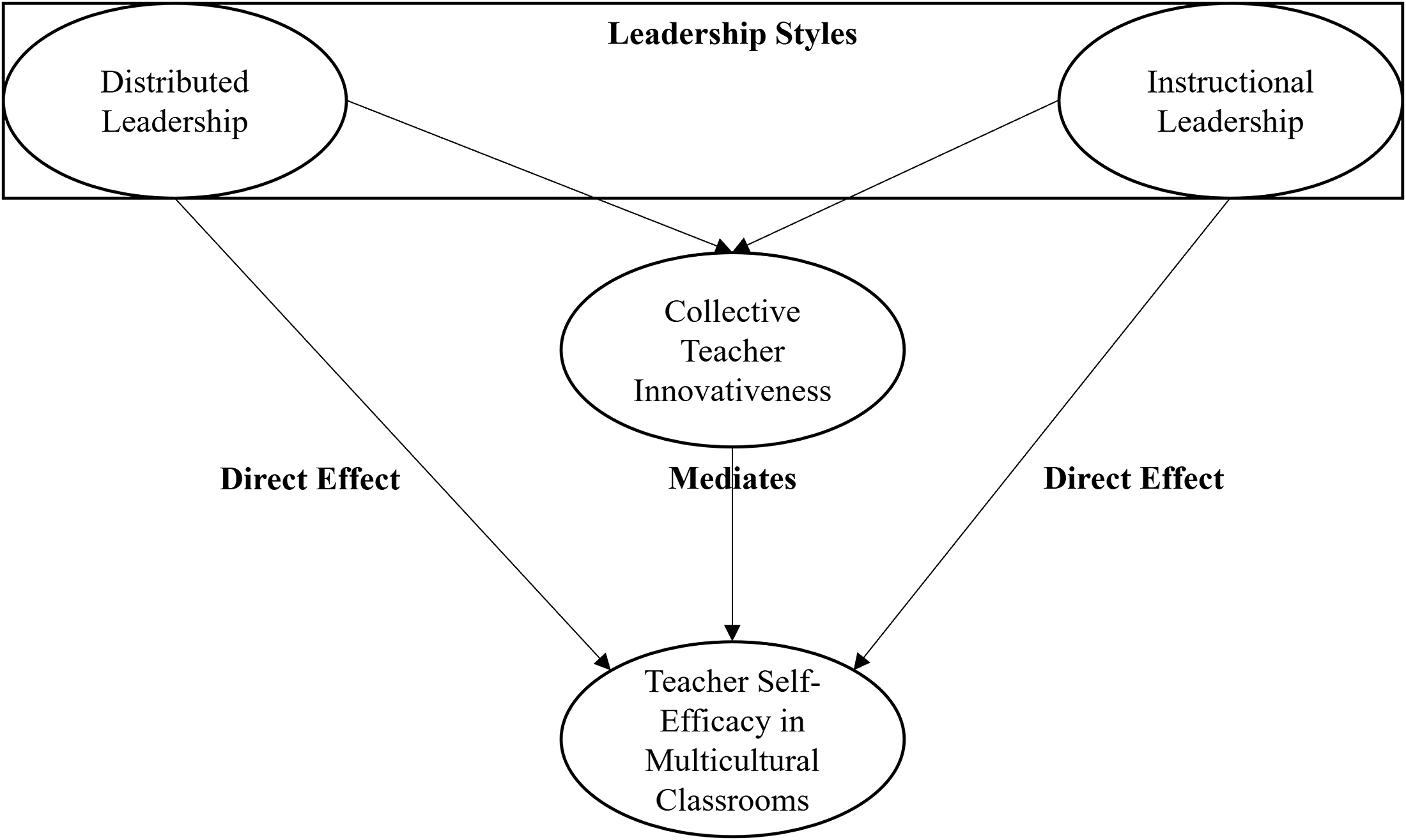
Conceptual framework illustrating the hypothesized direct and indirect relationships between instructional leadership, distributed leadership, and teacher self-efficacy in multicultural classrooms, as mediated by collective teacher innovativeness.
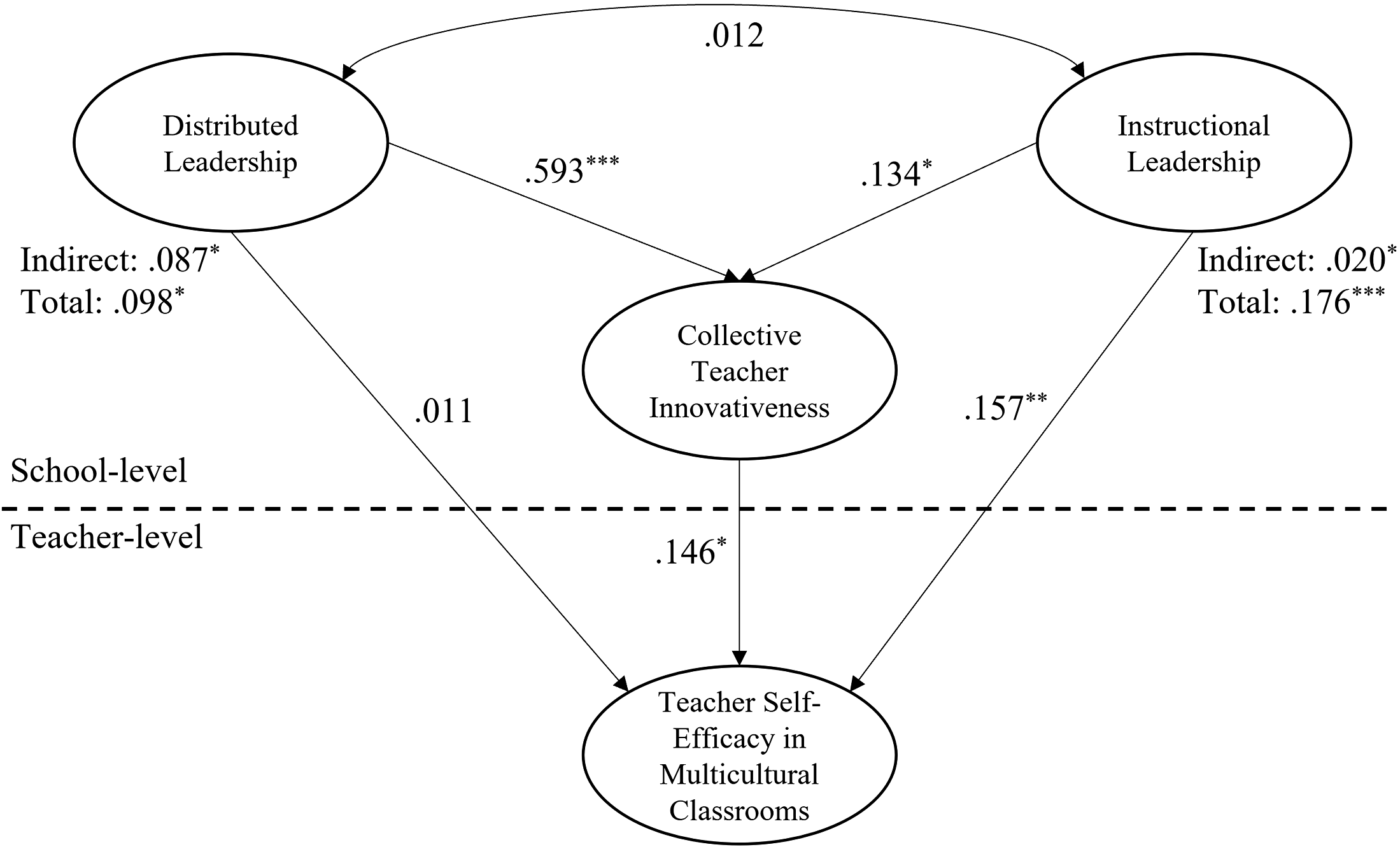
Results of the multilevel structural equation model showing standardized path coefficients for the relationships between leadership styles, collective teacher innovativeness, and teacher self-efficacy in multicultural classrooms.
Methods
Data and Analytical Sample
To address the research questions, this study utilized the TALIS 2018 dataset, which was organized by the Organisation for Economic Co–operation and Development (OECD). TALIS is an expansive international dataset that covers instructional practices, school leadership, and organizational attributes, facilitating complex cross-national analyses (OECD, 2019a). For the core survey (ISCED Level 2), 48 countries and economies participated; however, data from Iceland were excluded due to lack of public availability.
TALIS employed a stratified two–stage probability sampling technique within each participating nation and utilized survey weights to ensure population representativeness (OECD, 2019b). Initially, approximately 200 schools per country were systematically selected with probability proportional to size, followed by the random selection of roughly 20 teachers from each school. The full dataset was utilized by merging teacher and principal surveys. To account for heterogeneity across funding types, only data from public schools were included. Accordingly, 43 countries were retained, and four (Israel, the Netherlands, Singapore, and Romania) were excluded because funding–type information was unavailable. While the survey collected the dependent variable data only from teachers with multicultural classroom experience, the entire group was maintained during aggregation because school–level characteristics—DL and CTI—reflect the collective perceptions of the teaching staff. The final analytical sample comprised 60,293 teachers across 5,516 schools in 43 countries.
Measures
TSMC
We used teachers’ responses to items assessing beliefs about culturally responsive teaching practices in multicultural classrooms to construct a latent variable of TSMC. Five items on a four–point Likert–type scale were used; example items include “I can cope with the challenges of a multicultural classroom” and “I can reduce ethnic stereotyping among students.” TALIS 2018 incorporated these items to acknowledge the importance of such practices in multicultural settings. The same five items have been conceptualized and used in TALIS–based research (Choi & Lee, 2020; Choi & Mao, 2021) and adopted by other survey studies to measure the same construct (Kaplan Toren & Schwartz, 2025; Lee & Mo, 2023), enabling comparability across studies.
IL
We used principals’ ratings of leadership practices aimed at supporting and improving teachers’ instruction. Three items on a four–point Likert–type scale were used to construct the IL latent variable. Principals indicated how frequently, during the past 12 months, they engaged in activities such as supporting teachers’ development of new teaching practices and ensuring teachers take responsibility for improving their teaching skills. These indicators have been used in prior research to measure IL, specifically as actions that support the development of instructional practices (Liu et al., 2021; Xia & O'Shea, 2023).
DL
We used teachers’ responses about the participation of different school members (i.e., staff, parents, and students) in school decision–making and about a shared culture of mutual support to construct the DL latent variable. Five items on a four–point Likert–type scale were used; example items include “This school provides staff with opportunities to actively participate in school decisions” and “This school has a culture of shared responsibility for school issues.” These teacher–reported indicators are widely used to operationalize DL as delegated roles and responsibilities distributed across school members rather than driven solely by principals (Choi, 2023; Kılınç & Özdemir, 2025; Xia & O'Shea, 2023).
CTI
We used teachers’ responses to assess the extent to which the teaching staff in their schools are open to adopting innovative practices and developing new ideas. Four items on a four–point Likert–type scale were used to construct CTI. Example items include “Most teachers in this school strive to develop new ideas for teaching and learning” and “Most teachers in this school are open to change.” These items were first integrated into TALIS in 2018 and have been used to measure collective–level teacher innovativeness in recent studies (Buyukgoze et al., 2024; Nguyen et al., 2021).
Table 1 provides comprehensive details regarding the items used to measure the latent constructs examined in this study.
Standardized Factor Loadings, Reliability and Validity of MCFA Model.
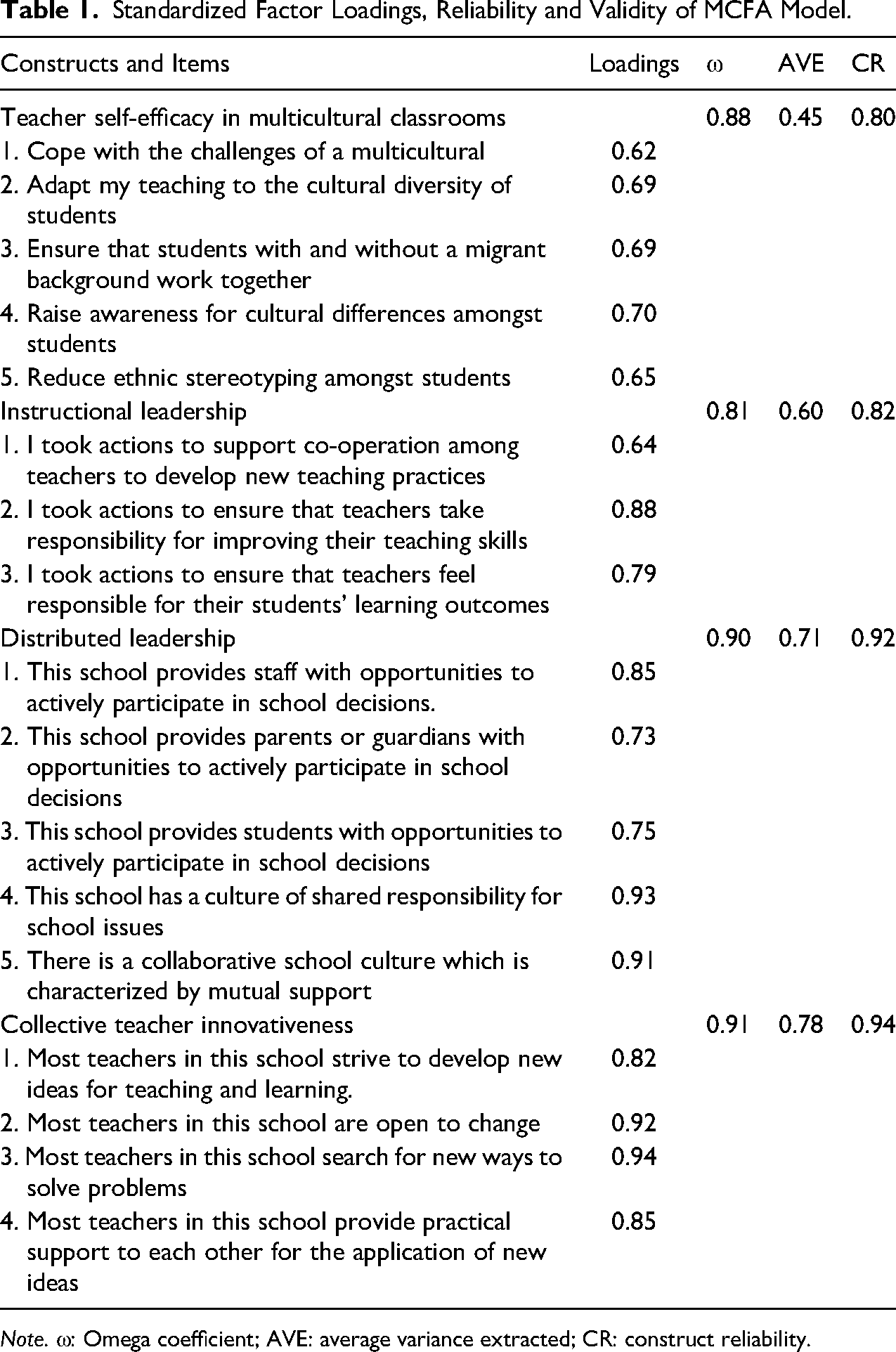
Note. ω: Omega coefficient; AVE: average variance extracted; CR: construct reliability.
Analytical Strategies
The analyses in this study comprised three stages: data aggregation, measurement modeling, and structural modeling. First, during data aggregation, teachers’ responses for DL and CTI were aggregated to the school level because these constructs are conceptually group–level characteristics rather than individual attributes. In contrast, IL did not require aggregation because the responses originated from a single principal per school. While we acknowledge the unique values of both principal and teacher perspectives on leadership (Ahn et al., 2024; Choi & Bowers, 2026; Choi et al., 2025a), we used teacher–reported DL aggregated to the school level and principal–reported IL at the school level. This approach aligns with our research design as well as with theoretical and empirical considerations: theoretically, IL emphasizes leadership functions exercised by principals, whereas DL reflects collective responsibility and leadership practice “stretched over people” within a school (Diamond & Spillane, 2016, p. 148). Aligning with the group-level nature of CTI—as established by its conceptualization and item structure—IL and DL were also specified at Level 2. TSMC remained at the teacher level because it represents individual teachers’ beliefs about their own practices (Choi, 2023). Empirically, aggregation was justified using within–group interrater agreement rwg(j) and intraclass correlation coefficients (ICC1 and ICC2) calculated in R (Bliese, 2000; LeBreton & Senter, 2008).
In the second stage, we used multilevel confirmatory factor analysis (MCFA) to test the reliability and validity of the measurement model in Mplus (Muthén & Muthén, 1998–2017). Because TALIS 2018 has a nested design with complex sampling, we estimated a two–level (teacher and school) model with country stratification. We adopted a pooled cross–national approach to test a general theoretical framework and identify broad patterns across systems rather than to explain between–country variance—a common strategy in research using large–scale international assessments (e.g., Liu, 2020; Liu & Werblow, 2019; Nagengast & Marsh, 2012; Printy & Liu, 2021; Xia & O'Shea, 2023). We used the COMPLEX TWOLEVEL specification with STRATIFICATION = COUNTRY to account for nonindependence and to adjust standard errors and chi–square statistics (Muthén & Muthén, 1998–2017). Teacher– and school–level weights were applied at their respective levels to address unequal selection probabilities and to enhance population representativeness (OECD, 2019b).
With these adjustments, the MCFA evaluated the latent constructs (IL, DL, CTI, and TSMC). We assessed model fit using multiple indices: chi–square, the Comparative Fit Index (CFI), the Tucker–Lewis Index (TLI), the Root Mean Square Error of Approximation (RMSEA), and the standardized root mean square residual (SRMR). Although we report chi–square, we place less emphasis on it given its sensitivity to sample size (Alavi et al., 2020). We also compared competing models using the Akaike Information Criterion (AIC) and the sample–size–adjusted Bayesian Information Criterion (BIC) (Kline, 2023). Following conventional guidelines (Hsu et al., 2015; Hu & Bentler, 1999), acceptable fit targets were CFI/TLI ≥ .95, RMSEA ≤ .06, and SRMR (Between ≤ .14; Within ≤ .08). Reliability was examined via McDonald's ω (McDonald, 2013). Convergent and discriminant validity were assessed using standardized factor loadings, average variance extracted (AVE), and composite/construct reliability (CR) (Fornell & Larcker, 1981; Hair et al., 2010).
In the final stage, we specified a multilevel structural equation model (MSEM) based on the final measurement model to estimate direct and indirect effects simultaneously. Specifically, we used a 2–2-1 multilevel structure because the main predictors (IL, DL) and the mediator (CTI) are at the school level, whereas the outcome (TSMC) is at the teacher level (Preacher et al., 2010). In addition to the main structural paths, we included covariates drawn from prior literature (Choi, 2023; Choi & Mao, 2021). Teacher- and school-level control variables were included sequentially to determine the best-fitting model based on AIC and BIC. Missing data were modest: the “advanced degree” covariate had 8% missingness and all other variables had less than 3%. We used full information maximum likelihood (FIML) to handle missing data, which reduces bias and preserves sample size and is comparable to multiple imputation in efficiency and accuracy (Enders & Bandalos, 2001). Estimation used the robust maximum likelihood (MLR) estimator to obtain standard errors robust to non–normality (Hox et al., 2010). We report standardized path coefficients and reference comparable estimates from prior studies with similar designs to aid interpretation (Kline, 2020).
Results
Aggregation Analysis
The aggregation tests indicated that aggregating teacher–reported DL and CTI to the school level was appropriate. For DL, the average ICC1 and ICC2 values were 0.14 and 0.71, respectively, and the rwg(j) median and mean were 0.93 and 0.91. For CTI, the average ICC1 and ICC2 values were 0.13 and 0.69, and the rwg(j) median and mean were 0.89 and 0.87. With the exception of CTI's ICC2—which was only marginally below the 0.70 guideline—all indices suggested sufficient within–group agreement and between–school variance. Taken together with the constructs’ theoretical grounding, these results support aggregating individual responses into school–level measures.
Measurement Model
As shown in Table 1, the MCFA supported the reliability and validity of the measurement model. McDonald's (2013) coefficient omega (ω) for TSMC, IL, DL, and CTI was 0.88, 0.81, 0.90, and 0.91, respectively, indicating high reliability. All items loaded significantly on their factors, with standardized loadings ranging from 0.62 to 0.94. AVE values exceeded the 0.50 threshold for all constructs except TSMC (0.45). CR ranged from 0.80 to 0.94. Discriminant validity was supported: for each construct, the square root of the AVE (0.67–0.88) exceeded the highest correlation (DL–CTI = 0.59). These indicators collectively suggest adequate convergent and discriminant validity.
As summarized in Table 2, the MCFA results demonstrated a satisfactory model fit to the data: χ2(192) = 731.74*, CFI = 0.957, TLI = 0.949, RMSEA = 0.007, SRMR Within = 0.039, SRMR Between = 0.065. We compared competing MSEM specifications using AIC and the sample–size–adjusted BIC. Although all models fit adequately, the model including both teacher– and school–level controls yielded the smallest AIC/BIC and was selected for subsequent analyses.
Model Fit Indices.

Note. CFI: the Comparative fit index; TLI: the Tucker-Lewis Index; RMSEA: the Root mean squared error of approximation; SRMR-W/B: standardized root-mean-square residual-within/between, respectively; AIC: Akaike Information Criterion; BIC: sample-size adjusted Bayesian information criterion.
Results of the MSEM
The MSEM results are detailed in Table 3. IL showed a significant direct association with TSMC (p < .01, B = 0.157, 95% CI [0.047, 0.266]), accounting for all predictors and controls. This suggests that a 1 standard deviation (SD) increase in IL is associated with a 0.157 SD increase in TSMC. This standardized IL–TSMC association (0.157 SD) exceeded several covariate associations (e.g., gender = 0.090 SD; STEM = −0.081 SD) and is consistent with prior TALIS 2013 evidence regarding traditional domains of self-efficacy (Bellibaş & Liu, 2017; Liu et al., 2021).
Standardized Results of the Direct, Indirect, and Total Effects.
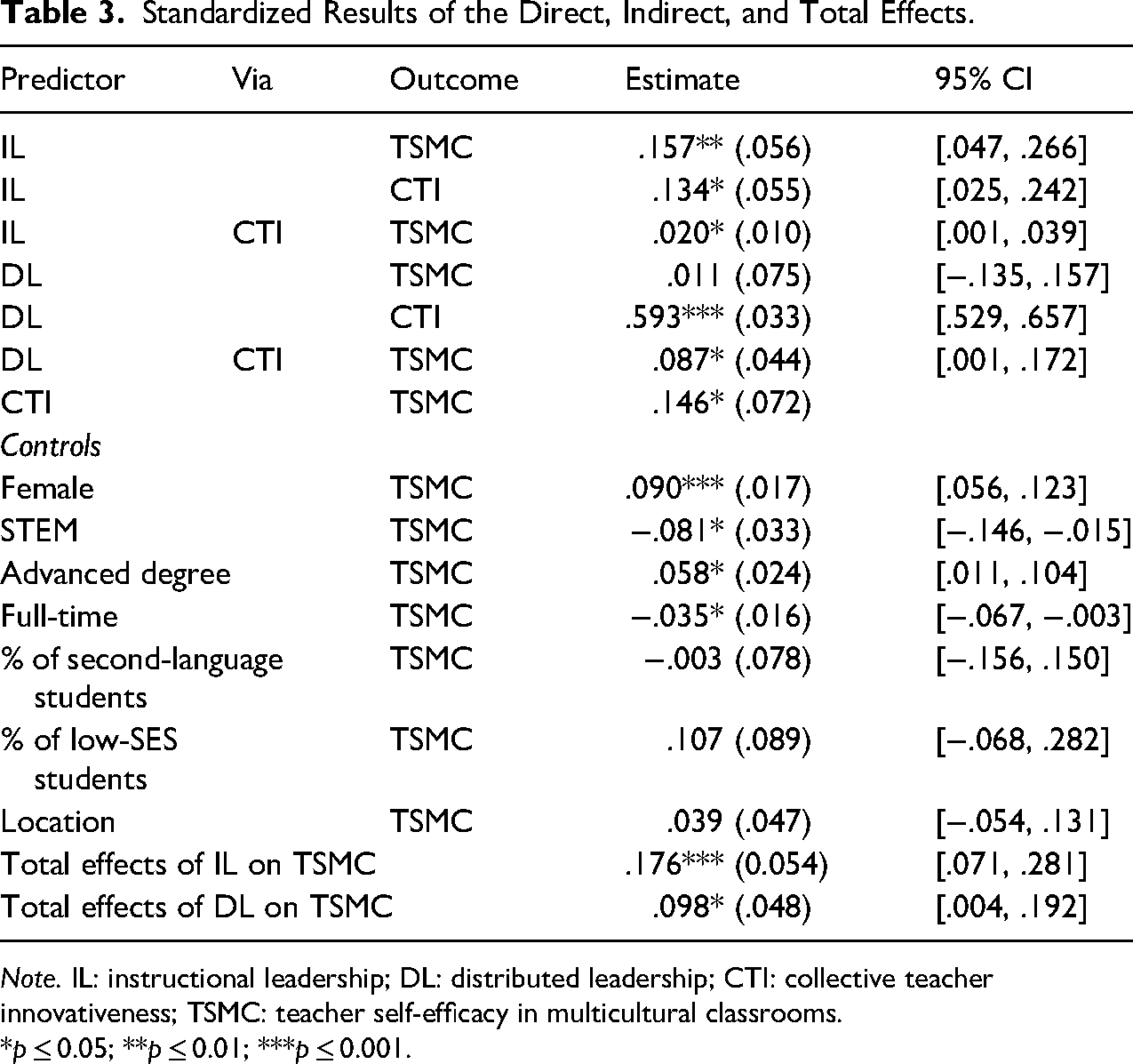
Note. IL: instructional leadership; DL: distributed leadership; CTI: collective teacher innovativeness; TSMC: teacher self-efficacy in multicultural classrooms.
*p ≤ 0.05; **p ≤ 0.01; ***p ≤ 0.001.
IL also exerted a significant indirect effect on TSMC via CTI (p < .05, B = 0.020, 95% CI [0.001, 0.039]). The lower bound of the CI was close to zero, indicating limited strength of evidence for the indirect component. The total IL effect on TSMC was 0.176 SD (95% CI [0.071, 0.281]), with the indirect path accounting for 11.36% of the total, suggesting that the relationship between IL and TSMC was partially mediated by CTI. The most compatible effect sizes of the total effect with the data ranged from 0.071 SD to 0.281 SD, substantially deviating from a null effect. The effect sizes of the total effect were identical to those of Liu et al. (2021) research, which included two mediators in the model.
In contrast, our study did not identify a significant direct association of DL with TSMC (p > .05, B = 0.011, 95% CI = [−0.135, 0.157]). However, DL exhibited an indirect effect on TSMC through CTI (p < .05, B = 0.087, 95% CI = [0.001, 0.172]). Specifically, DL was significantly linked to CTI with a medium to a large effect size (p < .001, B = 0.593, 95% CI = [0.529, 0.657]); the lower CI bound was far from zero and the interval was narrow, indicating credible evidence. An indirect-only mediation effect of DL on TSMC via CTI was thus supported, with a total effect of 0.098 SD (p < .05, 95% CI = [0.004, 0.192]).
In addition, the correlation between IL and DL was not statistically significant. Although individual–level controls were significant factors for TSMC, the school–level controls included in this study did not show a statistically significant association with the outcome. In conclusion, the findings suggest that IL has both direct and indirect effects on TSMC through CTI, whereas DL was associated with TSMC only indirectly through CTI. The total effect size of IL was nearly double that of DL. Given the still–limited empirical evidence on this relationship, we call for more research to strengthen its credibility and conclusiveness. Figure 2 summarizes the findings of this study.
Discussion and Implications
This study offers cross–national evidence that school leaders can improve teachers’ self-efficacy in multicultural settings by utilizing both IL and DL practices. While theoretical scholarship has long advocated for these models in the context of culturally responsive teaching, empirical validation—particularly via international, large-scale data—has remained limited. Our research contributes to educational leadership theory by investigating the impacts of IL and DL on TSMC, identifying CTI as a critical indirect mechanism. Furthermore, this study offers actionable strategies for school leaders and educators to cultivate culturally responsive learning environments that meet the evolving needs of diverse learners and mitigate the socio-cultural distances that persist within the school community.
First, the results indicate that instructional leaders can enhance teacher self-efficacy in culturally responsive teaching methods, such as adapting instruction to students’ cultural diversity and promoting intercultural awareness. Notably, the direct effect of IL on TSMC is modest yet meaningful (0.16 SD), exceeding magnitudes reported in prior studies for traditional self-efficacy domains, such as classroom management (0.09 SD) and student engagement (0.13 SD; Bellibaş & Liu, 2017). Despite historically being overshadowed by accountability–driven agendas, this finding underscores IL's role in cultivating learning environments that leverage student diversity (Murphy et al., 2006) and suggests that principals view attending to classroom diversity as a core instructional responsibility (Ylimaki & Jacobson, 2013). We argue—invoking the lens of street–level bureaucracy—that principals exercise discretionary authority to reinterpret IL mandates in ways that prioritize equity and diversity even as shifting geopolitical tensions increasingly contest these values (Kim & Weiner, 2022; Lipsky, 2010). This reframes IL not merely as an instrument for standards-driven accountability, but as a vital, strategic lever for culturally responsive pedagogy.
Second, the results demonstrate that IL enhances TSMC by fostering a culture of collective innovativeness among teaching staff. This suggests that instructional leaders support teachers not merely through individual supervision, but by cultivating a professional ecosystem where staff collaboratively generate pedagogical solutions to the challenges of multicultural classrooms (Blömeke et al., 2021). Consistent with previous research (Serdyukov, 2017), our results show that when innovativeness is exercised collectively, it provides the psychological and professional foundation necessary for teachers to embrace the experimentation inherent in culturally responsive instruction. As demographic shifts continue, leaders must ensure teachers remain open to change so that innovative, culturally responsive practices can take root and diffuse across the school.
Third, our findings indicate that DL—by empowering multiple members of the school community in decision-making—can enhance TSMC through CTI. Although we did not detect a direct path, the total effect was approximately .10 SD, smaller than the total DL effects on self-efficacy on classroom–management and instructional self–efficacy (≈ .14 SD) reported by Liu et al. (2021). Given the wide confidence interval, the estimate is not definitive, nevertheless our cross–national evidence extends prior U.S.-based findings (Choi, 2023) and underscores DL's value for addressing student diversity across systems. Specifically, the pattern is best characterized as an indirect–only linkage: participatory governance alone does not raise TSMC; rather, it operates by cultivating CTI. This contrasts with studies reporting positive direct DL effects on teacher self-efficacy domains (e.g., classroom management and instruction; Liu et al., 2021), suggesting that the mechanisms linking DL to TSMC differ from those connecting DL to conventional domains. DL appears to build an environment where teachers are encouraged to seek new ideas and treat cultural diversity as a resource for teaching and learning—an approach aligned with the participatory culture established by DL (Harris & DeFlaminis, 2016).
In addition, our study extends the knowledge base by presenting contrasting results for DL and IL within an evolving domain of teacher self-efficacy. On average, IL (0.18 SD) proved more effective in enhancing TSMC than DL (0.10 SD) when comparing total effects. While these magnitudes may appear small to modest—particularly relative to the large school level DL and CTI path (0.59 SD)—they are practically significant when contextualized within the unique challenges of the multicultural domain. Judgments regarding effect sizes should be grounded in the specific research context and the nature of the outcome variable (Cumming et al., 2012; Hill et al., 2008). In this study, both total effects exceeded the impact of individual teacher factors such as gender (0.09 SD) or advanced degree (0.06 SD). Notably, individual characteristics tend to be stronger predictors of the conventional teacher self-efficacy domains (Bellibaş & Liu, 2017), whereas TSMC appears to be a less malleable domain—supported by the present study and previous TALIS research using identical indicators (Schwarzenthal et al., 2023). In this light, the total effect sizes (0.18 SD for IL and 0.10 SD for DL) should not be interpreted as negligible.
More importantly, unlike individual–level attributes that are largely fixed or outside the scope of school–based management, school leadership is a changeable instructional lever that principals and school teams can strengthen through targeted professional learning and organizational routines. Additionally, leadership effects are not confined to a single classroom; they diffuse across the teaching staff and accumulate at the collective level, producing a systemic multiplier effect that drives school-wide improvement (Grissom et al., 2021). By fostering a climate in which teachers collectively seek new ways to solve problems and remain open to pedagogical shifts, both IL and DL create fertile ground necessary for culturally responsive practice to take root. Leadership thus does more than raise individual beliefs—it reshapes the school's organizational infrastructure (Harris & Jones, 2023), transforming cultural diversity and equity into a shared expectation rather than an individual exception. This commitment remains particularly critical in an era where such values have faced increasing opposition due to global geopolitical tensions.
These findings suggest that principal preparation and ongoing development should integrate diversity and equity into their core mission and coursework. Despite growing emphasis on diversity in educational settings, such programs often do not explicitly incorporate these dimensions into IL and DL (Ylimaki & Jacobson, 2013), in part due to a lack of empirical evidence and conceptual guidance. We recommend embedding topics related to immigrants, refugees, and multiculturalism into the core of IL and DL curricula, alongside approaches such as culturally responsive school leadership. Embracing student diversity should not be confined to any single leadership style. Instructional leaders should strive to leverage student diversity to enhance teaching and learning outcomes (Murphy et al., 2006), while responsibilities should be shared among all school community members to ensure that individuals from marginalized backgrounds are not isolated in school management (Woods & Gronn, 2009).
Similarly, we recommend that school leaders incorporate values of cultural diversity and equity into instructional support and empower marginalized groups to share their perspectives in building culturally responsive schools. For example, school leaders can articulate a clear vision that leverages students’ diverse backgrounds for instruction and fosters connections among students from different cultural communities (Boyce & Bowers, 2018). They can coordinate curriculum and supervision to provide targeted feedback and professional development, equipping teachers with the competencies necessary for culturally responsive instruction (Choi & Lee, 2020; Parkhouse et al., 2019). School leaders can also engage families and community members in curriculum evaluation and development (Khalifa et al., 2016), ensuring that all stakeholders—especially those from marginalized groups—participate meaningfully in collaborative processes (Holquist et al., 2023). Although IL and DL are often discussed separately in research, they are not contradictory in practice; they can be mutually complementary. School leaders can strategically balance them—e.g., leveraging DL to cultivate CTI and IL to translate that climate into concrete pedagogical support for TSMC—tailoring the mix to local contexts and resource constraints. Throughout, school leaders act as organizers and facilitators, granting teachers autonomy and capacity to listen to varied voices within the school community and adapt instruction accordingly (Choi & Mao, 2021).
Limitations and Future Directions
While this study provides comprehensive cross-national evidence based on a rigorous statistical approach, it is subject to several limitations that, in turn, open avenues for future research.
First, the measures are constrained by the specific items available in the TALIS 2018 dataset, which may not fully capture the multidimensional complexity of each concept. For example, teachers’ beliefs regarding cultural diversity are a fundamental aspect of culturally responsive teaching practices (Gay, 2015) and can indicate teachers’ attitudes and behaviors in the classroom (Fives & Gill, 2014). However, discrepancies may exist between these beliefs and actual practices. Similarly, the latent constructs for IL and DL do not encompass all dimensions of these multifaceted leadership styles. The TALIS items for DL, for instance, primarily reflect engagement in decision making rather than the specific functional responsibilities that are distributed (Spillane & Healey, 2010). Accordingly, future studies should explore additional dimensions of these constructs to gain a more holistic and comprehensive understanding of their interplay.
Second, the analysis relies on data from 2018. Educational systems and societal contexts may have changed significantly since then, particularly regarding cultural diversity and immigration policy (Joppke, 2024). Such shifts could yield different findings if the study were replicated today. However, this temporal specificity can also be viewed as a strength: our study offers a valuable historical baseline against which future changes can be examined. We therefore recommend conducting replication studies using subsequent data waves, including the next TALIS cycle, to assess the stability and evolution of these relationships over time.
Third, our analytical approach has implications for the generalizability of the findings. By using a pooled cross–national estimate, our model assumes that the tested relationships are, on average, homogeneous across the 43 participating countries. Consequently, our results represent an “average effect” and may not reflect country–specific dynamics. This approach precludes exploration of the rich variation that may exist across policy or cultural contexts. Future research could address this directly by conducting country–specific analyses followed by a meta–analysis to examine heterogeneity. A related issue concerns sample representativeness. Although TALIS 2018 includes many countries, it does not capture the full diversity of global educational systems. We therefore encourage international agencies such as the OECD and IEA to continue expanding the number of participating countries to provide a more comprehensive global picture.
Finally, future research should examine additional mechanisms and contextual factors. Our findings could serve as a foundation for investigating barriers to effective leadership, such as how a narrow policy focus on standardized testing may constrain IL or how certain groups may be marginalized from DL processes. Such inquiries would deepen our understanding of how leadership can be enacted effectively in diverse contexts. Furthermore, while our study identified CTI as a key mediator, other pathways likely exist. For example, organizational factors such as an inclusive school climate may also link leadership practices to TSMC (Choi et al., 2025b). Researchers might also explore whether IL and DL have synergistic or mutually reinforcing effects when implemented together. Further investigation in these areas will provide valuable insights for school leaders seeking to equip educators for the complexities of multicultural settings.
Data Availability
Data used in this study are publicly available (https://www.oecd.org/en/data.html).
Footnotes
Declaration of Conflicting Interests
The authors declared no potential conflicts of interest with respect to the research, authorship, and/or publication of this article.
Funding
The authors disclosed receipt of the following financial support for the research, authorship, and/or publication of this article: This work was supported by the Education University of Hong Kong Start-up Research Grant (RG 15/2023-2024R).
