




Abstract
Keywords
Social and emotional learning (SEL) has long been conceptualized as a process for building a person's “skills to recognize and manage their emotions, appreciate the perspectives of others, establish positive goals, make responsible decisions, and handle interpersonal situations effectively” (Greenberg et al., 2003, p. 468). Research has demonstrated that high-quality, well-implemented SEL initiatives can enhance students’ social and emotional competencies, attitudes, positive social behaviors, and academic performance, as well as reduce learning-related challenges and levels of emotional distress (e.g., Blewitt et al., 2018; Durlak et al., 2011; Sklad et al., 2012; Taylor et al., 2017; Wigelsworth et al., 2016). SEL can be accomplished through a wide range of practices, from implementing specific evidence-based programs to everyday ways of relating to students in the classroom. Further, recent expansions have asserted that SEL should 1) be systematically integrated into the regular operation of schools across all levels of the educational system (Mahoney et al., 2021); and 2) promote equity (i.e., Transformative SEL [tSEL]; Jagers et al., 2019).
Little is known, however, about how educational leaders – school, district, and county level administrators – conceptualize SEL in the face of these expansions. Given educational leaders’ positional power and roles, how educational leaders understand SEL is likely to shape the adoption and implementation of SEL practices across the education system. Specifically, understanding the extent to which educational leaders consider systems and equity in their conceptualization of SEL may inform the contemporary discourse and activities related to advancing SEL in schools. Understanding educational leaders’ perspectives on SEL also provides valuable information about how innovations in the conceptualization of SEL are (or are not) spreading through practice spaces, particularly with regard to systemic SEL and tSEL.
As part of CalHOPE Student Support (Shapiro et al., 2024a), this study investigates the understanding of SEL among California county-level educational leaders who have responsibilities related to providing SEL implementation support in their regions. As part of a coordinated effort to build capacity for SEL across the state, participants in our study, whom we refer to as County Office of Education (COE) representatives (i.e., educational leaders; terms used interchangeably), attended Community of Practice (CP) meetings over a six month period, which were aimed at augmenting their SEL capacity. Capacity, in this sense, is the beliefs, knowledge, skills, and sense of efficacy that are required to do something differently. As such, the present study examines COE representatives’ knowledge of SEL, and specifically, how they define SEL and whether their definitions shifted during capacity building efforts. We observe the extent to which educational leaders’ definitions of SEL evolved towards a systems and equity lens concurrent with participation with CP meetings. While our study design does not allow us to establish a causal relationship between the CPs and any observed definitional shifts, observations can lay the groundwork for future research to test causal claims. In the following sections, we situate the work by exploring relevant literature on 1) systemic SEL and tSEL, 2) educators’ understanding of SEL, and 3) the role of communities of practice in building SEL capacity.
Defining Social Emotional Learning (SEL)
The Collaborative for Academic, Social, and Emotional Learning (CASEL), a national organization that promotes SEL practice, research, and policy, developed a well-known and widely utilized framework that drives popular understandings of SEL. Sometimes referred to as the “CASEL 5”, CASEL's framework highlights the five SEL competencies (i.e., dispositions and skills that emerge through processes of human development) of self-awareness, self-management, social awareness, relationship skills, and responsible decision-making (CASEL, 2019). The framework goes on to describe how the competencies are fostered through the implementation of SEL practices, such as direct instruction and academic integration, and also through positive classroom and schoolwide culture, policies, partnerships, and aligned learning opportunities that involve classrooms, schools, families, and communities.
Despite the utility and broad uptake of CASEL's initial framework, scholars and practitioners have called for greater attention to the proximal and distal systems that are required to support SEL implementation (Mahoney et al., 2021), and the ways in which SEL can promote or hinder equity (Ramirez et al., 2021). Therefore, we next describe two popular scholarly expansions on CASEL's conceptualization of SEL: Systemic SEL and tSEL. We do so while acknowledging that educators have been innovating their own structural, culturally sustaining and affirming approaches to SEL before and since these expansions were termed and popularized by CASEL (Camangian & Cariaga, 2021).
Systemic SEL
Systemic SEL is a framework that nests SEL in an ecological framework for the sake of implementing coordinated evidence-based SEL in schools (see Elias et al., 1997). Mahoney et al. (2021) theorize that educational systems (through educational leaders at school sites, districts, and county offices) create structures to support SEL implementation through four main tasks: building foundational supports and plans, strengthening adult SEL competencies and capacities, promoting SEL among students, and practicing continuous improvement. In a recent study, Schwartz et al. (2020) collected data from schools (teachers, principals, staff), out of school time (OST) programs (instructors, managers, staff), and school district leaders and staff within six communities (Boston, Dallas, Denver, Palm Beach, Tacoma, and Tulsa). The study aimed to understand their experiences implementing a SEL initiative for elementary school children. They observed a missed opportunity for the initiative to provide a shared understanding (i.e., definition) of SEL that promoted cohesion across levels, settings, and roles. The call for shared understandings within systemic SEL is common (e.g., Baek & Dyson, 2024; Meyers et al., 2019), but mechanisms for achieving common definitions are seldom explored, and much remains unknown. Educational leaders are essential for guiding systemic SEL implementation (Gimbert et al., 2023; Lowenhaupt, 2021), yet it is unclear whether educational leaders’ definitions of SEL reflect earlier, narrower notions of SEL (i.e., promoting SEL skills among students) or recent conceptual evolutions towards systemic SEL (i.e., structurally situated in educational systems).
Adding an Equity Lens to SEL
Educational equity can be defined as creating a system of education where all children have access to “quality instruction and widely available opportunities to learn to their fullest human potential” (Jordan, 2010, p. 142). Synthesizing the literature on educational equity, Howard (2024) writes that equity must include pursuing justice, recognizing and repairing past harms, and cultivating belonging. As it relates specifically to SEL, Jagers et al. (2019) assert that equity in SEL ensures that every student has what they need “when they need it, regardless of race, gender, ethnicity, language, disability, family background, or family income” (p. 163). Equity in SEL also requires an “intentional counter to systemic and institutionalized inequality, privilege, and prejudice in the education system” (Ramirez et al., 2021, p. 2). SEL frameworks have been evolving to more deeply consider how SEL intersects with equity, especially for multiply marginalized students. Indeed, there remains significant critiques of SEL (e.g., Gregory & Fergus, 2017; Kaler-Jones, 2020; Simmons, 2021), particularly regarding how inequality is redressed through SEL practices.
Transformative social and emotional learning (tSEL) concentrates SEL practice on transforming inequitable settings and systems and on promoting justice-oriented civic engagement (Jagers et al., 2019). In doing so, it aims to redistribute power, work towards more equitable and just school communities, and promote the development of identity, agency, belonging, curiosity, and collaborative problem-solving within the CASEL framework (Jagers et al., 2019). Furthermore, tSEL attempts to facilitate meaningful co-learning experiences to examine the root causes of inequity, and to develop collaborative solutions that lead to personal, community, and societal well-being. The architects of tSEL consider this process to be an “approach that SEL researchers and practitioners can use if they seek to effectively address issues such as power, privilege, prejudice, discrimination, social justice, empowerment, and self-determination” (Jagers et al., 2019, p. 163). To enact the goals of tSEL, scholars have called for SEL to directly address the role that systems of oppression have in shaping the educational experiences of students with marginalized identities (Camangian, 2019; Camangian & Cariaga, 2021; Gregory & Fergus, 2017; Hoffman, 2009; Kaler-Jones, 2020; Simmons, 2021). Scholars assert that a direct focus on power, systems of oppression, and racism is needed to ensure that SEL models do not “ignore racism, ableism, and other oppressions; privilege civility over productive conflict; and focus on behaviors over emotions, especially when expressed by Black, Brown, dis/abled and queer people” (Clark et al., 2022, p. 131).
Importantly, tSEL implementation requires support and guidance from educational leaders (White et al., 2022). School leaders can “unleash SEL knowledge and skills… [to] productively nurture and sustain positive interactions among educators and their students” that are required for changemaking (Gimbert et al., 2023, p.5). Forman and colleagues (2022) find that educational leaders play a key role in intersecting SEL with anti-racism, as they can influence “what SEL means, what problems it solves, and who it serves” (p. 367).
Re-Defining SEL
Drawing on both systemic and transformative SEL, CASEL evolved its early definition of SEL to incorporate both a more structural and equity-oriented lens (see Jagers et al., 2021, p.13): SEL is the process through which all young people and adults acquire and apply the knowledge, skills, and attitudes to develop healthy identities, manage emotions and achieve personal and collective goals, feel and show empathy for others, establish and maintain supportive relationships, and make responsible and caring decisions. SEL advances educational equity and excellence through authentic school-family-community partnerships to establish learning environments and experiences that feature trusting and collaborative relationships, rigorous and meaningful curriculum and instruction, and ongoing evaluation. SEL can help address various forms of inequity and empower young people and adults to co-create thriving schools and contribute to safe, healthy, and just communities.
CASEL is not the only organization or collaborative of thought leaders to define SEL (see Jones & Doolittle, 2017 for a historical exploration of other conceptualizations), but no other has been quite as influential on the field. We connect this reality to what Anderson and Colyvas (2021) term a “resonant frame,” and posit that the original CASEL conceptualization of SEL, which was less oriented toward systems and equity, may be a popularized frame that can be hard to “unstick” once embedded in mainstream understandings (i.e., educators’ knowledge and practice). This paper explores the contemporary understanding of SEL among educational leaders over a six-month period of co-learning in communities of practice, presuming that a leaders’ understanding of SEL is a requisite element of SEL implementation (Durlak et al., 2011).
Conceptual Frame: Shifting SEL
Although recent literature is replete with references to both systemic and transformative SEL, there are few scholarly efforts to deeply integrate these efforts, and humanize SEL particularly for students of color (see Legette et al., 2022) in ways that inform on-the-ground implementation. This paper uses the SHIFT model (Shapiro et al., 2024b) as a conceptual frame to deconstruct the definitions of SEL held by educational leaders. The SHIFT model, as applied to the present inquiry, posits that partnerships (across regions, between levels of the education system, and connecting research and practice) can create meaningful supports (e.g., professional learning opportunities) for building leader capacities (e.g., knowledge) to facilitate systemic and transformative SEL implementation. Specifically, we leverage the SHIFT model acronym to consider the extent to which definitions of SEL may be focused on systemic approaches to structural change, humanizing approaches that recognize the full humanity of marginalized people in healing and caring relationships, implementing programs to promote the CASEL 5 competencies, and/or for transformation to a more equitable school system and society.
Educators’ Current Understanding of SEL
With the supposition that the understanding of SEL is important for implementation, several studies have investigated educators’ knowledge of SEL directly. For example, Buchanan et al. (2009) conducted a pilot study to understand teachers’ knowledge, perceptions, and practices related to SEL in classrooms. Through a convenience sample of 264 teachers, researchers found that a large majority of teachers (1) had heard of the term SEL, (2) knew SEL to be important for school and life success, (3) believed SEL enhances academic outcomes, and (4) believed SEL should be taught in the classroom. Participants reported that this knowledge largely came from in-service training and workshops. Yet, asking an individual about their level of knowledge may not necessarily be the best approach to assessing the actual extent or nature of their understanding. For example, other studies have asked teachers if they feel knowledgeable about a specific SEL program. In one such study, researchers found that although 82% of teachers felt knowledgeable after the training – only 33% of teachers answered questions about the program correctly (Shapiro et al., 2016). The ways in which knowledge is assessed matters – and in an area in which multiple ways of knowing are acknowledged and expected (such as in defining the very nature of SEL) – we think it makes the most sense to ask educators directly.
Several studies have invited practitioners to share their own working definitions of SEL. Schiepe-Tiska et al. (2021) conducted in-depth interviews where they asked 14 teachers “How would you personally define the [term] of SEL?” They found that teachers mostly explained SEL as a concept that “fosters social skills, such as building friendships and relationships, working in teams, along with emotional learning that promotes exploring your emotions and emotional states” (p. 8). In a study of 16 Canadian SEL teachers, participants were similarly asked to define SEL. The majority of participants provided definitions identifying a specific skill that aligned with one or more of the five CASEL competencies– self-awareness (26.7%), self-management (23.3%), and social awareness (16.7%) (Binfet et al., 2023). Lin and colleagues (2023) analyzed open-ended survey responses to the question “What does SEL mean to you?” from 427 in-service educators (currently working in a pre-K to 12th-grade school setting) who registered to attend a free virtual event focusing on the intersection of SEL, racial justice, and healing. Approximately 10% of participants identified as school site administrators, but less than 1% (n = 3) had educational leadership responsibilities across multiple schools (e.g., superintendent). Researchers identified three themes: (1) SEL as developing skills and competency-based, (2) SEL as it is taught can cause harm, especially to students of color, and should “not try to save them [students] or ask them to breathe through their oppression” (Lin et al., 2023, p. 5), and (3) SEL can be implemented to promote overall child well-being which encompassed “honoring identity, centering humanity and the whole child, promoting healing and liberation, and advancing social justice” (Lin et al., 2023, p. 6). In a final study of ten middle schools, and their corresponding five district offices, who were engaged in a specific, concerted effort to implement district-wide SEL in California, and who were selected for the study based on their top-quartile school-wide performance on SEL metrics, researchers interviewed district and school site leaders, staff, and teachers about their understanding of SEL (Marsh et al., 2018). Respondents varied widely in their conceptualizations. Definitions of SEL fell into six categories: (1) supporting student mental and emotional well-being, (2) creating a safe and supportive school climate, (3) developing social skills and appropriate behavior, (4) supporting adolescent development, (5) building a culture of inclusion and acceptance of differences, and (6) addressing the needs of the whole child (p. 19). District level respondents (n = 12) answered differently than school (n = 28) and classroom (n = 26) based educators. For example, district definitions did not rely heavily on mental and emotional well-being, or appropriate behavior, but did draw heavily on school climate (which was a concurrent school accountability metric for California Local Education Agencies). These “bottom-up” approaches to defining SEL begin to reveal educators’ understanding of the topic, but few educational leaders with responsibilities across multiple school sites have contributed to this line of inquiry. Yet, these studies have begun to show that educational leaders with responsibilities across multiple schools may foreground different aspects of SEL in their definitions than their school site based colleagues. Our current goal is to hear from additional educational leaders at the county level, to discover how they understand the concept of SEL as applied to their work. In our review of the literature, we found no studies that investigated COE leaders’ capacity to support SEL implementation. This is an important gap to investigate empirically given that County Offices can be charged with providing implementation support for the delivery of instruction and educational services, including SEL, within their regions (Shapiro et al., 2024a).
Communities of Practices as a Mechanism for Building Educator Knowledge
Communities of Practice (CPs) are a mode of professional learning well suited to building capacity for implementing SEL. CPs can be defined as “groups of people who share a concern or passion for something they do and learn how to do it better as they interact regularly” (Wenger & Wenger-Trayner, 2015, p. 1). In a review of the CP literature, Mojahan (2017) notes that CPs can vary in content and modality (i.e., online or in person); be facilitated in schools, universities, or even business organizations; and have been employed across the world. Previous literature has established three key characteristics of CPs: the domain, the community, and the practice. A CP identity is based on a domain of interest– a shared topic that brings members together. In pursuing a domain of interest, community members engage in relationship-building and information-sharing activities. Practitioners come together to develop a shared repertoire of resources, by offering lived experiences, stories, tools, and ideas they may then take back to their practice (Lave & Wengner, 1991; Wengner, 1998). CPs are derived from sociocultural theories of learning and development, including situated learning theory (Stein 1998), which posits learning to be a result of social processes and interaction with others. Foundationally, CPs are predicated on the idea that learning occurs through social interaction (Vygotsky and Cole 1978). Unlike Networked Improvement Communities, CPs are not focused on achieving a specific, measurable clearly defined outcome (Tydeman, 2022) but instead emphasize collaborative problem-solving and connecting individuals with common concerns (Bryk et al., 2011; Bryk, 2015).
Recent studies have explored the concept of CPs within the context of education, and the connection between CPs and community member knowledge. Jimenez-Silva and Olsen (2012) contend that as members of CPs interact, share, and participate in the space over time, they can deepen their understanding of a topic. Research suggests that CPs support knowledge sharing (Ulla & Perales, 2021) and contribute to perceived improved content knowledge (Akinyemi et al., 2020), in ways that ultimately shape instructional improvement (Little, 2002). Additionally, CPs can foster mutual engagement, a shared repertoire of experiences, and language that may serve as a dynamic knowledge source on which to base future educational practice (Gray, 2004; Warhurst, 2006). However, few studies, to our knowledge, have investigated CPs with educational leaders, nor have they explored it in relation to knowledge of SEL.
In California, educational leaders frequently utilize CPs to build capacity for leadership, teaching, and learning. For example, the California Department of Education recommends CPs for diversifying the educator workforce (California Department of Education [CDE], 2022b), improving instruction for English language learners, and explicitly highlights CPs as a mechanism for capacity building (see CDE, 2022a). Despite their popularity in practice spaces, to date, few empirical studies have explored questions related to improved content knowledge through the CP format. Thus, we aim to extend the limited literature on CPs to better understand how and in what ways California educational leaders expand their capacity (i.e., knowledge) of SEL as they work in concert to continuously improve SEL implementation. We argue that educational leaders’ knowledge may shift towards a systems and equity focus of SEL through concurrent participation in CPs.
CalHOPE Student Support
The COVID-19 pandemic and racial reckoning of 2020 exacerbated threats to student well-being (Hamilton & Gross, 2021; Thomas et al., 2020). As a response, California educators worked quickly to buffer negative impacts and bolster individual and systemic support for student well-being. Specifically, California County Offices of Education (COEs) with leadership from the Sacramento County Office of Education, in partnership with the California Department of Healthcare Services (DHCS) and University of California, Berkeley, with funding from the Federal Emergency Management Agency (FEMA) and the Substance Abuse and Mental Health Services Administration (SAMSHA), enacted an emergency response to enhance capacity for SEL implementation. Thus, out of this emergency came “CalHOPE Student Support” – an opportunity to develop the infrastructure long needed to support the continuous improvement of SEL implementation across the state.
CalHOPE Student Support aims to “build the capacity of the capacity builders” by leveraging state and federal funds to support equity-centered, systemic SEL implementation in each county (Shapiro et al., 2024a). This statewide approach includes building COE leader capacity for regional implementation support, which in turn, intends to augment the capacity of districts and schools to deliver SEL interventions tailored to their local communities.
To understand how CPs came to be the driving mechanism of CalHOPE Student Support, the research team spoke to three educational leaders who laid the groundwork for this approach. These leaders described how CPs were used as part of CASEL's Collaborative States Initiative (CSI; 2016) – an initiative intended to foster collaboration between state education agencies to create conditions for high-quality, systemic SEL (CASEL, n.d.). California educational leaders embraced CPs because they emphasized practice and collective capacity-building. These leaders sought to prioritize CPs over other professional development mechanisms because, as they shared with us, CPs enabled shared learning and could address the limited availability of high-level expertise (Leader 1, Personal communication, April 22, 2024). As one leader noted, their goal was to “plant the seeds of knowledge and build the people that came to the community of practice from county offices.” They asserted, “None of us were real experts…we needed to learn together” (Leader 2, Personal communication, April 22, 2024).
As posited in our conceptual model, and in our practice-facing work, we define capacity as the beliefs, knowledge, skills, and sense of efficacy that are required to do something differently. CalHOPE Student Support seeks to build the capacity of educational leaders by sharing and discussing SEL research-based modules and resources. These modules were created by the Greater Good Science Center at UC Berkeley. After registering for an account at https://ggie.berkeley.edu/register/, the modules can be accessed at https://ggie.berkeley.edu/ca-sel/. Monthly Communities of Practice (CPs) became the context for collective meaning-making of the information contained within the modules.
The CalHOPE Student Support Community of Practice (CP) began in January 2021. This study is situated in the initial phase of this statewide CP, occurring from February to July 2021. It included six two-hour-long virtual CPs for educational leaders from California COEs to convene and engage together in capacity building activities. Sequential topics of CP meetings during this first phase of the project were: (1) Cultivating adult self-care and emotional resilience, (2) Creating a culture of belonging, (3) Addressing trauma and adversity, (4) Committing to racial equity and cultural responsiveness, (5) Teaching for social-emotional and academic development, and (6) Supporting SEL with diverse families and communities. Alongside a brief topical discussion, each session included community building and group activities, reflection exercises, turnkey resources, and an opportunity to review research-based modules. CPs also included formative data collected for continuous improvement and evaluation purposes, which were then repurposed, with active participant consent, for generating research knowledge.
Current Study
This study seeks to understand in what ways COE representatives, participating in the initial phase of CalHOPE Student Support, developed their SEL capacity – particularly their understanding of SEL – from January to July 2021. Our research questions are:
How do COE representatives (i.e., educational leaders) define SEL? In what ways did the COE representatives’ definitions of SEL evolve over the course of CalHOPE Student Support statewide CP meetings?
Methods
Research Design
In the present study, we used a pretest-posttest design concurrent with a capacity-building initiative, collecting data at two time points (6 months apart). Although our research design is not intended to make causal claims, it is intended to observe the extent to which thematic change in open-ended responses occurred over this period. Our study design also draws upon the work of Brownlee et al. (2003), who conducted a similar project with a sample of student teachers, investigating the nature of their knowledge about learning and how their knowledge changed throughout a graduate diploma course. By extending this method to educational leaders through a statewide capacity building initiative, the study design allows researchers to observe potential shifts in leaders’ capacity (e.g., knowledge) over time. Through this qualitative investigation, this study seeks to shed light on the potential temporal evolution of participant knowledge.
Procedure
At each CP, attendees completed an electronic sign-in form to track meeting attendance. The Qualtrics electronic sign-in form was provided in the Zoom chat box. The form collected the attendee's name, the county in which they work, the meeting date, email address, and consent for the meeting to be recorded and transmitted. It also asked if the affiliated university research team could contact the attendees about opportunities to participate in research. Once the form was submitted, those who agreed to be contacted received an email invitation with a link to an informed consent form. This form outlined the study's purpose, protections, uses, rights, benefits, and risks. Attendees then indicated whether they consented to their participation in the CP (e.g., survey responses, chat transcript) being used for research purposes. To prepare for the present study, participants’ names and other identifying information were de-identified and all materials held for research purposes were stored on password protected servers to protect participant confidentiality.
Data Collection
Qualitative data were collected through two surveys administered via Qualtrics. The baseline survey was administered digitally in February 2021, and the follow-up survey was administered digitally in the summer of 2021 (June-August). Both surveys consisted of closed and open-ended questions that prompted COE representatives to reflect on their experiences in the statewide community of practice and the current status of SEL implementation in their region. The baseline survey was designed as a needs assessment, and COE representatives were invited to use a snowball sampling approach to share it with their colleagues. The survey was circulated to 247 individuals, of which 118 were opened (48% response rate), likely self-selecting based on survey relevance, and 102 were completed (86% completion rate). The follow-up survey was redistributed to the participants from the baseline survey. Our sample was derived from an overlap of county level representatives who completed both surveys.
In the present study, we analyzed responses from one open-ended survey question across two time points. At Time 1, participants were asked to define SEL (“Without consulting any resources, how would YOU currently describe what Social and Emotional Learning is?”). At Time 2, using the piped text feature (i.e., a line of code that enables pulling information from various sources such as previous questions) in Qualtrics, the same COE representatives were presented with their previous SEL definition from Time 1 (e.g., “You [previously] responded:”) and then asked participants to update their working definition (“In what ways would you update your description of SEL based on what you have learned or experienced since this time?”).
Sample
Eighty-two percent of California's 58 counties were represented in the survey data collected for continuous improvement purposes. However, to be included in our analytic sample for the present study, a participant had to be working at the county level, answer both surveys, and provide consent to have their data utilized for research purposes. Thus, our analytic sample includes 92 survey responses, from 46 study participants, working across 37 (64%) of California's counties. Given that COEs vary in size and organization, the number of representatives participating differed across counties. Furthermore, the project's funding enabled each COE to have two to four representatives attend the statewide CP meetings (Metzger et al., 2025), resulting in several study participants who worked in the same county. We found no systematic differences across demographic (i.e., role, race/ethnicity) or geographic factors (i.e., urban and rural classification) between those who consented to participate for research purposes and those who did not.
Study participants all reported working at the county level and consisted mainly of COE administrators (80%). Other roles included county-level pupil services personnel, such as social workers and school psychologists serving as mental health coordinators. A majority of the study sample identified as White (76%) women (65%) (see Table 1 for Demographics). The sample was roughly equally divided between participants who were first-generation four-year college graduates (46%) and those who were not first-generation (50%). The majority of participants (61%) had spent six or more years as classroom teachers, while slightly less than half (43%) had spent six or more years as county-level leaders. Participation in CP meetings was recorded on an electronic sign-in sheet, which likely produced a conservative count of attendees, due to failures of attendees to reliably sign-in. Individual study participants completed the sign-in form at, on average, 51% of the six CP meetings. Approximately 40% of study participants attended five or more CP meetings. Meeting attendance by study participants ranged from 24%-67% at each session. The May CP meeting, which discussed “Committing to racial equity and cultural responsiveness,” had the highest attendance rate (67%).
Participant Reported Demographics.
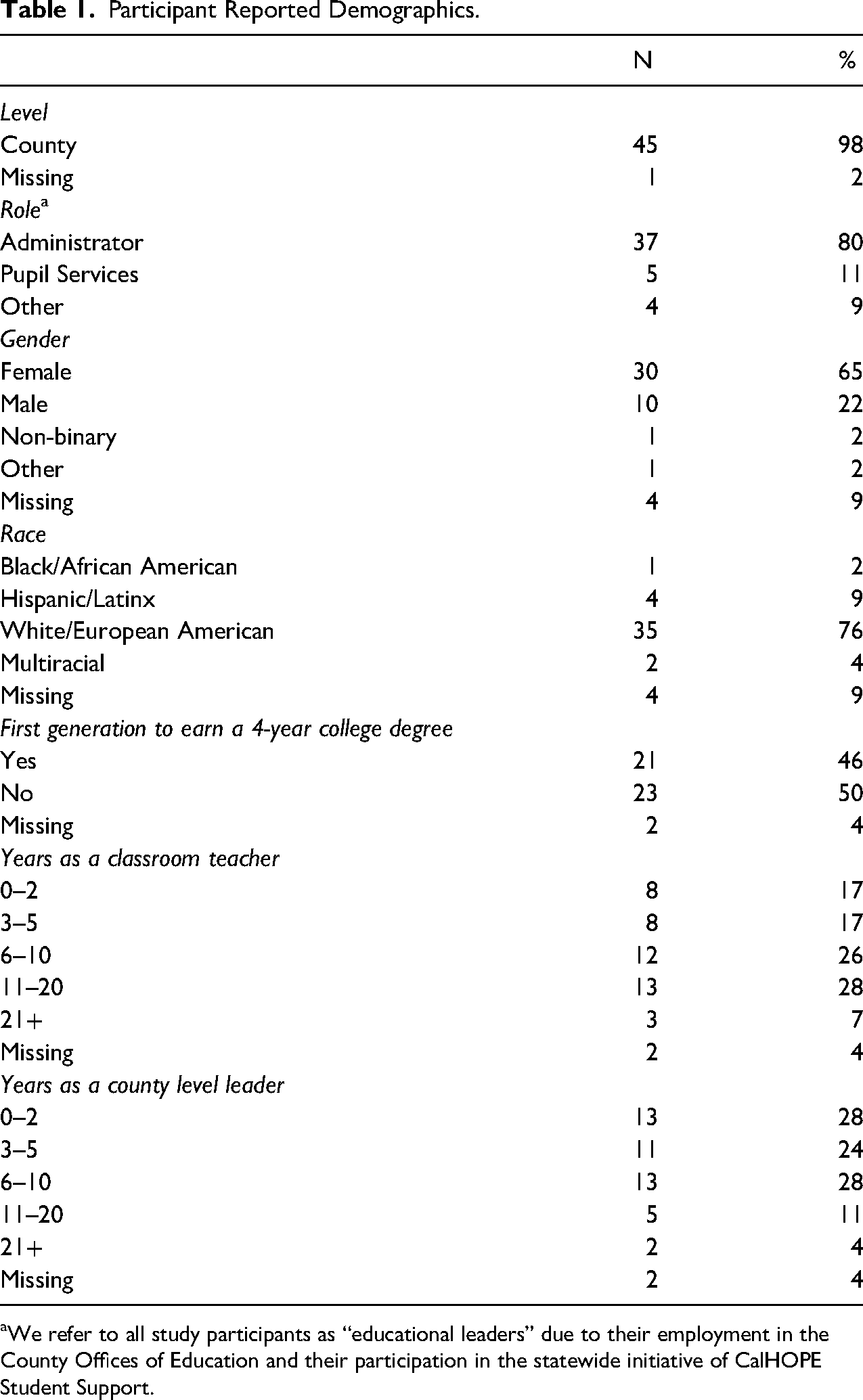
We refer to all study participants as “educational leaders” due to their employment in the County Offices of Education and their participation in the statewide initiative of CalHOPE Student Support.
Positionality
We acknowledge that within qualitative inquiry, researchers are the analytic instruments. We name our varied and overlapping identities to acknowledge the ways in which our positionalities impact how we come to the present study, and our work together more broadly. The first author is an Egyptian-Canadian, cisgender woman, and social worker. Raised and socialized in Qatar and Canada, she brings bicultural experiences and an external (non-US-centric) perspective to her scholarly work. Her bicultural lens brings insight into her work as she straddles both collectivist and individualistic societies and norms. The second author is a white, cisgender woman, a former classroom teacher, and a community-based researcher. From the U.S., she works hard to interrogate and interrupt the White-dominant norms that color her worldview– and her approach to teaching and research. This introspection occurs through an ongoing process of deep listening, de-centering, and unlearning. In our work together as the first and second authors conducting the analysis, we brought our identities into our collaborative workspace as we engaged in reflexive thematic analysis, where collaboration enhances understanding, interpretation, and reflexivity (Braun & Clarke, 2022). The third author is a white, cisgender woman, a doctoral-level school psychologist in training, and a school- and community-based researcher. The fourth author is a Mexican, cisgender man, social worker, and a current doctoral student researching issues of power and control in decision-making as related to the promotion of youth well-being and as experienced by marginalized communities. The fifth author is a Korean, cisgender woman and social work researcher working in East Asia. The sixth author is a white, cisgender woman with an invisible disability from a working-class background who worked as a school-based therapist. The seventh author, the CalHOPE Research Committee, is a collective of researchers, practitioners, intermediaries, and project administrators, working for the close coupling of interests regarding knowledge production and translation through the CalHOPE Student Support project. As a co-author, this collective represents the intellectual contributions of non-research partners who promote the authenticity and relevance of this work. The final author is the project Scientific Director and Principal Investigator, who engages in this work as a prevention scientist, school social worker, and parent of two school-aged children. All authors who have contributed to this manuscript continually engage in reflexive processes, collaborative partnership, and work to advance improved well-being in schools. As noted by Braun and Clarke (2022), we “own” our identities and positionalities (p. 8) with respect to “the knowledge we produce from research and how we produce it” (Lutrell, 2019; Wilkinson, 1988) by checking assumptions, expectations, and choices throughout the research process (Braun & Clarke, 2022, p. 14).
Coding and Analysis
To qualitatively analyze participant survey responses at the two time points, our team followed the thematic analysis process outlined by Braun and Clarke (2006; 2022). First, three team members, consisting of the first three authors who were not involved in the project at the time of data collection, familiarized themselves with the data by reading and re-reading the survey responses. A deductive codebook was created using the SHIFT conceptual model and content delivered in the phase one CP meetings. Dedoose, a qualitative analysis tool, was used to code and explore patterns. Codes included CASEL's five SEL competencies (i.e., self-awareness, self-management, social awareness, relationship skills, and responsible decision-making; CASEL, 2023), SEL delivery approaches (e.g., healing-centered approach, multi-tiered system of supports), Systemic SEL, as well as tSEL focal constructs (i.e., identity, agency, belonging, collaborative problem solving, and curiosity; Jagers et al., 2019). The codebook was updated with inductive codes added iteratively, including non-CASEL frameworks (e.g., emotional intelligence, whole child education). After refining our codebook, the first and third authors performed an inter-coder reliability (ICR) assessment using Dedoose's inter-rater reliability test feature to evaluate the rigor and transparency of our codebook against the data. Separately, we coded a random sample of the data across both surveys (roughly 25%). Given the overall number of survey responses, establishing ICR from 10–25% of the data is typical (O’Connor & Joffe, 2020). Following the parameters of Landis and Koch (1977), we achieved a “very good” agreement (Cohen's kappa of 0.87) between raters. Disagreement was primarily related to variable approaches in coding parent and child codes. Next, the first and second authors met several times to follow the subsequent stages of Reflexive Thematic Analysis (RTA), independent of the project leadership. This process included generating initial themes, developing and reviewing themes, refining, defining and naming themes; and writing up themes (Braun & Clarke, 2022). In each phase, we talked at length about the coded data, discussed the potential patterns in relation to the research questions, and revisited our own positionalities in reflexive ways. For example, our lived experiences as a social worker and classroom teacher informed how we coded and analyzed SEL definitions that took up popularized frames– we were familiar with such frames given our professional roles. Our experiences as a woman of color and a white woman similarly permeated how and what we coded within the realm of equity. In these instances, we drew upon our experiences and pre-existing knowledge, while also critically interrogating how they may have influenced the research process (Braun & Clarke, 2022, p. 5). Given our use of RTA, we are careful to note that our analysis, and the resulting findings, represent our interpretations of patterns of meaning across the data set (see Byrne, 2022 for a “worked example” of RTA). Thus, the themes presented in the following section are a reflection of (1) the dataset; (2) the theoretical underpinnings of the analysis, and; (3) our analytical skills as researchers (Braun & Clarke, 2019; Byrne, 2022). After two rounds of thematic analysis, we generated candidate themes to discuss with all authors, finalized theme names and definitions, and selected illustrative quotes. Illustrative quotes, as the final step, were selected by the first and second authors to showcase the contours of each theme. To mitigate against bias, the manuscript was reviewed by practice partners and project leadership, but no substantial changes were made.
Findings
Below, we present our key findings in response to our research questions using a qualitative descriptive approach which allows for a straightforward descriptive summary of our themes (Lambert & Lambert, 2012). We offer illustrative quotes from survey responses. As noted by Terry and Braun (2017), analysis of open-ended survey responses may vary from more robust qualitative data such as interview transcripts or observational field notes, particularly when studying “surface level of meaning” (p. 36). In this case, the thematic analysis, they write, can be more “relatively straightforward” where analysis is presented as descriptive in nature. Our sample represents 64% of all COEs in the state - using brief text analysis allowed for us to learn from this larger sample (Robinson, 2022). We report the prevalence of our data to describe the contours of each theme. As stated previously, we refer to participants as “educational leaders,” due to their roles in the COEs and their participation in CalHOPE Student Support and the statewide CPs.
RQ1: Defining SEL
First, we explore themes related to our first research question: How do COE representatives define SEL? We generated three themes to describe how educational leaders define SEL.
Relying on the “CASEL 5”
In their initial opportunity to define SEL, participants relied on popularized definitions of SEL. In particular, the majority (n = 37, 80%) of educational leaders named CASEL or the CASEL 5 competencies (i.e., self-awareness, self-management, social awareness, relationship skills, and responsible decision-making) when defining SEL. For example, one participant specified the competencies “SEL begins with an awareness of the 5 CASEL core competencies: self-awareness, self-management, social awareness, relationship skills, and responsible decision-making.” Another defined SEL as “A process by which student [sic] and adults learn the skills to understand themselves and others and navigate relationships and decision making (5 CASEL competencies)”. One educational leader described CASEL as an expert: Social and emotional learning is such a broad, lofty and high level concept. I prefer to to [sic] lean on the definitions provided by the experts in the field, namely CASEL in which something abstract can be turning [sic] into something concrete through the five core competencies. I utilize those competencies to define SEL.
Although the vast majority (n = 37, 80%) relied on the CASEL definition and competencies, six (13%) COE representatives leaned on ideas of emotional intelligence. For example, one representative defined SEL as “A student's Emotional Quotient, their ability to recognize and navigate their emotional state and the emotional state of others, is a greater indicator of future success than their Intelligence Quotient.” Fewer (n = 4; 9%) described SEL as using a “whole child” approach, “Being aware of the whole child and integrating appropriate social skills and emotional awareness into all aspects of school.” It is possible that COE representatives who used alternative frameworks to define SEL (i.e., EQ, whole child) experienced different professional trainings before the statewide SEL CP began that contributed to their slightly varied understanding of SEL.
Focusing on Skills Rather Than Systems
We also found that in their first response, participants focused on skills rather than systems. Specifically, about half of the educational leaders defined SEL in ways that were predominantly student skill and outcome oriented. For instance, one leader noted “Assisting students in building social and emotional skills to face whatever occurs in their lives.” We saw a repeated emphasis on defining SEL as a process meant to promote individual student outcomes, “Students who can do this have better mental health and behavioral outcomes, as well as do better in school and in life” and focusing on emotional well-being and resilience, for example, “Teaching skills to students that promote mental wellness and resiliency and strengthen interpersonal skills and emotional regulation.” One participant wrote: Equipping students to recognize their feelings is step one in my opinion. After students can recognize emotions, SEL then teaches them tools that help regulate those emotions so that they can make responsible decisions in both personal and school-related tasks and relationships.
In addition, about a quarter of educational leaders described SEL as inclusive of adults (e.g., teachers, administrators, and staff). One educational leader specified that “This learning and skill development is critical for adults as well as youth.” Others echoed this perspective “SEL is about strategies and instruction to assist students (and teachers/administrators)…” and “SEL teaches both teachers and students to self reflect and to build core competencies.” The inclusion of adult SEL highlights one element of systemic SEL (i.e., fostering adult SEL), again positioned as skills and competencies associated with individual outcomes, but for individuals at a different developmental stage. Very few respondents, however, attended to any other of the systemic elements (e.g., embedding SEL into structures/routines and feedback loops) needed for SEL implementation.
Taking Up a Psychological/Individualistic View Relative to Socio-Civic View
In their first pass at defining SEL, more than half (n = 27, ∼ 60%) of educational leaders highlighted elements of SEL that focus on the psychological self. Initial definitions emphasized how SEL can be used as a tool for individual emotion regulation or coping. For instance, one participant noted, “For students, its [sic] partly about giving them tools that they can use to self-regulate during difficult times” and another mentioned, “SEL is a structured way to teach skills related to coping, resiliency, and emotional regulation.” The onus is on one's self, as one respondent shared: SEL is learning how to understand your own emotions, how emotions affect your behavior and how your behavior affects those around you. This helps you learn how to self-regulate, have positive interactions with others and build positive, healthy relationships.
Although the majority took up an individualistic or psychological view of SEL, five (11%) educational leaders described ideas of tSEL relating to the self in society through ideas such as identity and cultural inclusivity. This was present in responses such as “The process through which youth and adults recognize and celebrate their own identities…” and “SEL is acknowledging the unique cultural experiences of each student and staff member, and honoring those experiences while building towards wellness.” However, there were no explicit references to a broader sociopolitical context, structures of inequality, or explicitly humanizing or other transformative constructs (i.e., agency, curiosity; Jagers et al., 2019).
In sum, educational leaders conceptualized SEL using popularized frameworks that are skill and competency-based. There was an emphasis on SEL that relied on and improved the lives of individuals, rather than leveraging systems to improve teaching and learning, develop civic engagement, rehumanize marginalized students, or address social conditions.
RQ2: Updating Conceptualizations
Next, we describe the three themes related to our second research question: How were conceptualizations of SEL updated over the course of CalHOPE Student Support statewide CP meetings?
Naming Systemic Elements of SEL
In the second data survey, COE representatives were invited to change, update, or add to their previously submitted working definitions of SEL. In our analysis of this second source of data, we found that of the educational leaders that initially had more skill-oriented definitions, 67% shifted their conceptualizations towards SEL that name systemic elements (e.g., recognizing the role of adult educators and staff, highlighting conditions needed for SEL implementation). For example, one participant noted “I would expand that statement to include educators.” and another shared “I would now also emphasize the concept SEL across the system. That the cultural norms of the community can help or hinder SEL efforts, so including stakeholders from the community in this work is essential.” These updated definitions placed a greater emphasis on embedding SEL within the structures and routines of the school system. One respondent wrote: SEL as it pertains to districts and schools are having a complete system and by in [sic] from all staff to make the school environment better. SEL is not an add on or additional thing to teach. It is how we approach the whole system. In every interaction with staff and students. It's not a food, it's the plate.
Integrating Notions of Equity
The second theme generated from updated definitions relates to equity. Around 18 (∼40%) of educational leaders added language to highlight equity in a myriad of ways. For some (n = 11, 24%), it was through language around diversity, equity, and inclusion (DEI), such as: The importance of DEI. If we leave out the conversation of DEI fundamentals, the urgency and importance around SEL might be lost or might be perceived to be less beneficial or powerful. DEI and SEL should be integrated, as together they support the whole person/student. It's not just soft skills, SEL is a set of skills that we all need in order to better deal with the stressors we all face. We need to make sure that when dealing with students and staff that we look towards everything we do with an equity lens as well, as that is when we are truly able to understand what is going on with those with whom we work.
Maintaining Initial Definitions
We also found that some educational leaders chose not to update their definitions of SEL six months after their initial definitions. Although a majority of COE representatives updated their definitions (n = 34; 74%), a small group (n = 12; 26%) chose to keep their definitions of SEL the same. For example, stating “I feel confident with my earlier description.”, and “I still agree with [my] original definition.”
Of note, three of the twelve (25%) education leaders who elected to keep their conceptualization the same, already included notions of systemic SEL and/or equity in their original responses. For example, one COE representative's initial definition stated that SEL is a set of skills, knowledge, and dispositions of both adults and youth that allow them to thrive and be successful in life. The domains of competence include self-awareness, self-management, social awareness, relationship skills, responsible decision making through a lens of cultural inclusion and equity.
Moreover, five of the twelve educational leaders (42%) who maintained their initial definitions were named by others when asked, “Who else at your County Office of Education is knowledgeable about - or has responsibilities for - Social and Emotional Learning?”. This suggests that these individuals were considered key informants and likely well-versed in SEL. However, it is important to highlight that these five were not among the three participants who included notions of systemic SEL or equity in their initial responses.
Discussion
Our study offers qualitative insights into the possibility that collective capacity-building opportunities through CPs contribute to the evolution of knowledge and understanding among educational leaders. In surveying educational leaders at two different time points (six months apart), we observed shifts in SEL definitions. At the first opportunity to define SEL, educational leaders tended to speak to long-standing definitions, focused on skills-based, psychological/individualistic (rather than socio-civic/collectivistic) views of SEL. These definitions have been advanced by implementation scientists trying to put existing research into practice, but have also been argued to dehumanize students with deficit-motivated interventions – and to de-emphasize systemic solutions (e.g., Hoffman, 2009). However, when provided an opportunity to update their definitions after the CPs, many leaders shifted to more systemic thinking and included additional elements of equity. Understanding their definitions, and the shifts that occurred, may serve as one way to operationalize SEL capacity building. Although we do not make causal claims that changes in definitions were necessarily a result of the CPs, this evidence provides a rationale for further study of how the communities created from CPs can be leveraged for knowledge sharing and capacity building.
Exploring Initial Definitions of SEL Among Educational Leaders
In their first opportunity to define SEL, educational leaders provided rich definitions that illuminated their robust understanding of SEL, both conceptually and in practice. It is clear that many leaders in California had a strong foundation from which to grow, and have found useful frameworks, via CASEL, for shaping practice. Their initial definitions, however, also offered insights into what has “stuck” (Anderson & Colyvas, 2021) in the field of SEL, even as CASEL has recently attempted to shift to a more systemic and equity-based orientation. In this vein, we found that 80% (n = 37) of educational leaders’ initial definitions of SEL were predominantly grounded in the original CASEL definition and competencies, with a few additionally describing SEL as emotional intelligence and attending to the whole child. This was not surprising, given the popularity of the CASEL framework and competencies. Initial definitions were largely focused on student outcomes and competencies, although approximately one quarter of the definitions incorporated the need to also foster adult SEL. Similarly, of those that included ideas of tSEL in their initial definitions (e.g., identity, cultural inclusivity), these ideas were also individualistic, as opposed to reflecting the broader socio-political context or structures of inequality. These skills-centered views, largely omit the structural elements that may contribute to people's lived experiences and enable and constrain organizational change. To be clear, we do not believe that these individualistic perspectives reflect any shortcomings of educational leaders; rather, we believe they may be a product of several realities. First, people's behavior is visible, whereas systems are often less so. The field of education writ large has a tendency to focus on student outcomes, despite the need for a structural/systemic reckoning to account for these outcomes. Second, SEL has largely been defined by existing programs that focus on change at the individual level. Third, socialization in the U.S./Western culture tends to be individualistic, promoting self-sufficiency and independence (Chang et al., 2011). These ideals have long been embedded into the U.S. education system, by intentional design. Fourth, the time horizon to progress from knowledge production to translation and implementation is large; elaborations in the scholarly literature about systemic and transformative SEL that occurred between 2019–2021 may not reasonably be expected to have penetrated the practice discourse in 2021. The specific language of humanizing, which appeared in two SEL-focused publications in 2022, was reasonably not included in participant definitions – and some scholars would suggest it should remain so, presenting humanizing approaches as an alternative to SEL rather than a potential direction for the evolution of SEL (Camangian & Cariaga, 2021). Fifth, the surveys were conducted at a moment when the education workforce was dealing with both an escalating mental health crisis that drew our collective gaze to individual developmental and educational outcomes, and also a societal backlash against collective and civic responsibilities that were imposed by public health officials. Finally, educational leaders were at the forefront of pandemic recovery efforts while the pandemic was ongoing – the CPs began before vaccines were available, and continued while educational leaders, even at the county level, were regularly acting as substitute teachers in classrooms. The ability of educational leaders to voluntarily engage in reflection, capacity building, and continuous improvement efforts to any extent is laudable.
Leaders’ Knowledge May Support Systems Transformation
Despite initial definitions that may appear to perpetuate the status quo, around three-quarters of educational leaders’ definitions shifted over a six month period, corresponding with a period when participants were presented with the opportunity to collaboratively learn and expand their capacity around SEL. Updated definitions of SEL moved the educational system to the forefront, situating SEL as an approach that needs to be embedded into structures and routines. It is possible that educational leaders’ new focus on systems may be related to an increased understanding of the role they play, as leaders, in enacting system-level changes. These updated definitions invoked an ecological frame (Bronfenbrenner, 1977), which is consistent with the efforts of Systemic SEL to actively involve all members and settings of the education system (Mahoney et al., 2021).
Alternatively, changes in the definitions of SEL may have been influenced by external factors unrelated to the CP meetings. These factors, which were prominent in 2021, include the politicization of SEL, an increase in anti-SEL messaging, linking SEL with critical race theory, and proposed legislation in certain states that aimed to prohibit SEL in schools (Anderson, 2022; Senate Bill [S.B.] 1442). These debates and policy proposals may have shaped participants’ updated definitions of, and attitudes toward SEL, leading them to view it as more systemic and equity-oriented in nature. Additionally, seasonal variability may have also contributed to the shifting definitions. Participants were asked to update their definitions during the summer months (June-August), a period typically dedicated to reflecting on the past academic year and preparing for the next one. This time of year may be more system than student focused; it is a time generally associated with evaluating progress, identifying areas for improvement, and planning ahead, which might have provided COE representatives a different frame through which to refine their definitions.
“The Power [of SEL] to be [an] Equity Lever”
In our study, we found that around 40% of educational leaders updated their SEL definitions to focus, to some extent, on equity. As noted by one participant, SEL has “the power to be an equity lever.” While we cannot necessarily attribute these shifts to the CalHOPE Student Support CPs, we do know that understanding equity and transformative SEL was a core feature of CP programming. The May CP meeting which focused on “committing to racial equity and cultural responsiveness,” had the highest attendance rate (67%). The high turnout suggests that participants had the opportunity for their views to be shaped by the content from the May CP. It is important to note, however, that there was variation in how educational leaders evoked equity. Some definitions emphasized the importance of diversity, equity, and inclusion (DEI), while others named culturally responsive practices (Ladson-Billings, 1995), or the potential for SEL to advance equity work in schools. Concurrent with CASEL's elaborations and revised definition, we observed a shift from Marsh and colleagues’ (2018) study, where their district and school level educators defined SEL as “building a culture of inclusion and accepting differences”, to a deeper focus among our participants on structures and equity. Many argue that a more nuanced equity lens is critical for leading SEL implementation — such that leaders acknowledge the potential harms of SEL (e.g., compliance and control of marginalized populations; Cipollone et al., 2022; Simmons, 2019), consider the socio-political context in which SEL occurs (Attaya & Hilliard, 2023), and broaden how SEL is conceived and implemented.
Despite our study participants attending to the notion of equity, their updated definitions, like CASEL, lacked explicit language connected to alleviating systemic oppression, shifting power, and advancing anti-racism. Failing to acknowledge oppressive structures has the potential to continue socializing children into a dominant way of being, that is rooted in White, Eurocentric, middle-class values (Cipollone et al., 2022). This is in contrast to the study by Lin et al. (2023), where participants explicitly described SEL as a praxis to connect identity with social justice, dismantle inequitable systems, and promote healing and liberation.
There may be several reasons why educational leaders in our study did not detail dismantling oppressive structures and advancing anti-racism in the same level of depth as Lin et al. (2023) study. One potential explanation is that Lin et al. (2023) sampled in-service educators from a virtual event that focused on the intersection of SEL, racial justice, and healing in educational settings, while our CPs built capacity about SEL more broadly, with participation from educational leaders from diverse counties across the state. The second is that county-level educational leaders are situated differently than school site educators. County positions may be more suited to incremental change, with different tools, across more contexts, and on a different time horizon. Furthermore, district and county leaders quite often report to elected officials, whose activities may be scrutinized and sanctioned in different ways than school-level actors. Depending on the context, this may have a way of muting or amplifying positions that could be perceived as radical by constituents. Existing literature on county educational leaders does not address this notion, though future researchers should direct attention to examining such experiences. Nonetheless, our study, like others, advances the idea that community spaces can be used for knowledge sharing and shifting mindsets toward equity. To achieve equity goals, however, we should grapple with strategies for deepening equity thinking (e.g., about power and systems of oppression) among educational leaders in their provision of SEL implementation support.
Implications
Findings from our study have implications for research, practice, and policy, particularly concerning educational leadership. First, our study contributes to the limited research that has explored the role of CPs in building capacity among leaders. In our review of relevant literature, we did not find any empirical studies that investigated educational leaders’ capacity-building through CPs. Thus, the power of CPs as a means of professional learning and development for educational leaders should be further studied and leveraged. For educational leaders’ practice, our findings underscore the potential of spaces where community can be cultivated among leaders themselves. The community created through the CPs may have promoted the construction and exchange of content knowledge essential for discerning and critical instructional leadership (Brazer & Baurer, 2013); leaders could also leverage CPs as a dynamic platform for learning and growing together. As it relates to SEL, CPs may be a way of using partnerships and supports to build knowledge of Systemic and tSEL, which is a requisite capacity for developing skills and efficacy for SEL implementation.
Although using CPs for capacity-building appears to offer benefits, there also appear to be challenges. The three leaders with whom we spoke about the decision to use CPs as a mechanism for capacity building in CalHOPE Student Support, specifically noted common challenges in the realm of participant engagement. They reported that coordinating COE representatives across a large state presents challenges in terms of building and maintaining relationships. While online communication platforms mitigated these difficulties, variability in county participation levels existed. They also noted that counties vary in how they organize roles and activities, and in whom they invited/recommended to participate. Some participants engaged and networked more readily, while others may have perceived participation as difficult to fit within their already full workloads. Therefore, our leaders argued, it is crucial to ensure that CP participants have both support (e.g., funding for allocated time to create bandwidth) and the capacity (e.g., skills) to engage effectively (Leader 1, Personal communication, April 22, 2024).
In the policy realm, findings contribute to a growing belief in the promise of explicit, intentional spaces for educational leaders to come together to learn, share, and grow. Policymakers can continue to explore this potential by carving out space, time, funding, and resources for educational leaders to engage in CPs. Policymakers could also craft policies that explicitly support systemic and transformative SEL, and allocate resources towards educator professional development to empower educational leaders to effectively support SEL implementation in their regions. This complements existing state level teacher standards that emphasize culturally responsive teaching and social and emotional learning (Morris et al., Under Review). Attention to building individual and collective leader capacity could also push against work that is often unintentionally siloed across teams, regions, and levels of the education system.
Limitations and Future Directions
A primary limitation of this study is that our data are from an open-ended survey question, which led to brief responses and no opportunity for follow-up. Furthermore, the lack of triangulation using additional sources of data may prevent a more nuanced and comprehensive understanding of the definitions and shifts. Future studies would benefit from incorporating interviews or focus groups to probe deeper into the understanding of equity-oriented SEL and the reasoning behind definitional shifts to enhance findings. Future survey research could also ask educational leaders directly about their conceptualizations of equity, and the role that equity plays in their SEL work.
Another limitation of this study is the sampling bias. Given that the participants were predominantly White (76%), and women (65%), our findings may lack applicability (Noble & Smith, 2015) to other groups. Additionally, since 98% of the participants were county-level employees, these findings may not accurately represent leaders holding other roles in educational settings. Future research could focus on leadership roles and make comparisons among teachers, principals, or superintendents, whose definitions might differ based on their position and proximity to power. Obtaining more background information from participants could provide deeper insights into definitions and shifts.
Along with sampling bias, there is a possibility of response bias in this study. There are many unmeasured factors that could differ between survey responders and non-responders. Further, those who attended fewer meetings may have had different perspectives on SEL compared to those who attended more and were exposed to shared learning. Moreover, it is possible that our method of tracking attendance did not accurately reflect CP participation and potentially underestimated engagement. To improve accuracy, future CP meetings could implement additional attendance tracking mechanisms, such as digital check-ins with QR codes, automated Zoom tracking, or roll calls. In addition to response bias, the study might be susceptible to social desirability bias as respondents may have provided written responses they perceived to be more socially acceptable.
The timing of the surveys is another limitation. The survey responses should be assumed to be a product of their historical moment. The pandemic and related societal trends and events may have focused educators’ attention in particular directions at particular times, in ways that are only loosely associated with their persistent understanding of SEL. The disruption of traditional learning and shift to remote or hybrid classrooms during the pandemic could have heightened the perceived need for SEL, affecting leaders’ responses. The pandemic also exposed existing inequities in education, which may have led to a greater focus on equity and inclusion in SEL. Additionally, the backlash against SEL, with some states proposing bills to remove SEL from public school curricula (Abrams, 2023), could have influenced participants’ perceptions of SEL. Still, it is unknown to what extent and how these external factors shaped the initial definitions or contributed to the shifts in perspective among COE representatives. Furthermore, although many educational leaders shifted their definitions towards a system-level understanding and the salience of equity over the six months under study, some did not. This could be because people take varying times to shift their understanding and adopt innovations (Rogers, 1995). Future studies could explore educational leaders’ definitions at a third or even fourth time point to capture the process of transformation and to assess whether shifts are sustained over time.
Additionally, it is unknown why 12 (26%) participants chose to maintain their initial definition. Possible explanations include participants’ perception of their expertise, reluctance to admit a shift, or satisficing, as they may not have had the bandwidth to update their definition. Future research, such as interviews for additional probing, could examine the mechanisms behind their decisions.
In this study, we use definitions as a means to convey understanding, as an indicator of knowledge, and as a dimension of capacity for SEL implementation. Although knowledge is a critical component of capacity, further studies could also examine other capacities, such as motivations, skills, and self-efficacy, in accordance with the broader theory of our conceptual model. Another approach to assessing capacity for SEL implementation could be through exploring the implementation goals, plans, and improvement generated by county representatives. Scholars could also take up questions around the relationships between CP attendance, engagement, and other aspects of capacity (e.g., efficacy, motivations) as they relate to SEL implementation.
Additionally, in the present study, we focus on capacity as a lever of systems transformation. Future studies can investigate, per the SHIFT Model, other levers such as the presence of partnerships, supports, and SEL implementation as they relate to SEL implementation across the state. The SHIFT model posits that high-quality partnerships create the necessary conditions for engagement with various supports, such as funding, resources, training, coaching, and feedback systems, which in turn build capacity as indicated by knowledge, skills, beliefs, and efficacy among people providing implementation support and delivering SEL interventions. These partnerships, supports, and capacities are designed to establish the structures and routines needed for effective SEL implementation, such as those envisioned in the enactment of systemic SEL. These structures and routines, in turn, enhance the social and emotional environment for teaching, learning, and leading. Therefore, we envision that these levers collectively, and leader knowledge as explored in this paper, contribute to systems change by advancing systemic and equity-oriented SEL practices (Shapiro et al., 2024b).
Conclusion
In the present study, we investigate how educational leaders define SEL, to discover their understanding of the topic, and how their definitions shift over time. Knowledge has been asserted as a critical component of building educator capacity (Shapiro et al., 2024a). It is in this vein that this work seeks to contribute. We strive to meet educational leaders where they are at, lift up their voices and understandings, and provide relevant supports to build their capacity for SEL implementation leadership in their regions. It is possible that an understanding of SEL that is systemic and transformative can help to promote student well-being and facilitate continuous improvement towards local goals for individual, system, and societal well-being.
Supplemental Material
sj-odt-1-eaq-10.1177_0013161X251350455 - Supplemental material for “I would add”: Educational Leaders’ Understanding of SEL During a Statewide Community of Practice
Supplemental material, sj-odt-1-eaq-10.1177_0013161X251350455 for “I would add”: Educational Leaders’ Understanding of SEL During a Statewide Community of Practice by Nehal Eldeeb, Addison M. Duane, Jenna E. Greenstein, Alejandro Nuñez, Juyeon Lee, Tiffany M. Jones, and Valerie B. Shapiro in Educational Administration Quarterly
Footnotes
Author Notes
CalHOPE Student Support has coordinated efforts across California to advance SEL implementation. CalHOPE was generously supported during the study period by the Federal Emergency Management Agency (FEMA), Substance Abuse and Mental Health Services Administration (SAMHSA), and the California Department of Health Care Services (DHCS). The contents may not necessarily reflect the official views or policies of the federal government or the State of California.
We thank all participants, contributors, and champions, with a special acknowledgment of County Office representatives who have expanded their work and impact, and contributed to continuous improvement efforts to advance SEL across California. The authors would like to especially thank Deputy Director at the California Department of Health Care Services (DHCS) Autumn Boylan, and DHCS Assistant Deputy Director of Behavioral Health Jim Kooler, for spearheading and sponsoring an impactful collaboration between healthcare and education, and Sacramento County Office of Education (SCOE) Assistant Superintendent of Educational Services, Brent Malicote, and SCOE SEL Director Mai Xi Lee, for their enduring partnership and statewide leadership. The authors wish to acknowledge Linda Burton, Susan Stone, and Dana Kowalski for their instrumental support to the project. Nehal Eldeeb would like to acknowledge the Grand Challenges for Social Work (GCSW) Doctoral Award, from the New York Community Trust, and the Founder Region Fellowship, from the Soroptimist International of the Americas, for supporting her research and professional development. Valerie Shapiro would like to acknowledge the W.T. Grant Foundation Scholars Award (award # 190407) for supporting her research and career development in thinking about how to promote the use of research evidence to improve the lives of young people.
Declaration of Conflicting Interests
The authors declared no potential conflicts of interest with respect to the research, authorship, and/or publication of this article.
Funding
The authors disclosed receipt of the following financial support for the research, authorship, and/or publication of this article: This work was supported by the W.T. Grant Foundation (Scholars Award #190407), California Department of Health Care Services, Federal Emergency Management Agency, and Substance Abuse and Mental Health Services Administration.
ORCID iDs

Supplemental Material
Supplemental material for this article is available online.
Author Biographies
References
Supplementary Material
Please find the following supplemental material available below.
For Open Access articles published under a Creative Commons License, all supplemental material carries the same license as the article it is associated with.
For non-Open Access articles published, all supplemental material carries a non-exclusive license, and permission requests for re-use of supplemental material or any part of supplemental material shall be sent directly to the copyright owner as specified in the copyright notice associated with the article.
