



Abstract
Principals’ work is complex, requiring them to balance time across many competing priorities, including administrative, managerial, instructional, and external responsibilities, and other tasks (Goldring et al., 2008; Hochbein & Meyers, 2021). A relatively large body of research aims to understand principals’ time allocation across the diverse set of responsibilities that demand their attention, as summarized in a recent review by Hochbein et al. (2021). Using multiple methods, this research has aimed to describe how principals use their time in different contexts. Understanding how principals spend their time is fundamental for the field of educational administration and its central focus on the work school leaders. Given principals’ impacts on such outcomes as student achievement, school climate, and teacher retention (e.g., Burkhauser, 2017; Coelli & Green, 2012; Grissom & Bartanen, 2019; Grissom et al., 2021), and research linking principal time allocation explicitly to school outcomes (Grissom et al., 2013), this understanding is also important for informing policies and practices that lead to school improvement and more equitable student outcomes.
Yet despite accumulating enough studies to warrant a review article, principal time use research has generated few consistent findings beyond that principals, on average, work long hours and spend more time on administrative and operational than instructional tasks (Hochbein et al., 2021). Studies have reached competing conclusions, for example, regarding the degree of fragmentation and reactivity of principals’ time use, the relationship between time spent on various tasks and student outcomes, and differences in how principals allocate time in different school contexts (e.g., Grissom et al., 2013; Horng et al., 2010; Huang et al., 2020; Sebastian et al., 2018).
Scholars have pointed to how differences in study sites, categorization of activities, and data collection procedures have combined to produce a mixed evidence base, limiting the utility of time use research for informing policy and practice (Lee, 2022; Rowan, 2022). Studies that have closely and directly observed principals typically have focused on single sites with small samples or have not employed a systematic scheme for data collection. Many large-sample studies have employed self-report surveys or experience sampling methods, which are prone to recall and social desirability biases and can conflate experiential and clock time measurements (Hochbein & Meyers, 2021). These criticisms apply even when narrowing the research base to studies of principal time use specifically in urban contexts. In the 26 studies featuring urban samples reviewed by Hochbein et al. (2021), scholars observe the same inconsistencies in time categorization and findings, despite the fact the authors document that nearly all urban leader time-use research conducted in the last 15 years occurred in the same two school districts, potentially limiting generalizability.
This study builds on this prior work by exploring principal time use in four urban school districts. Urban districts serve roughly 30% of students in the United States, with higher shares of students of color and economically disadvantaged students than districts in other locales (IES, 2022), making increased understanding of leaders’ work in those environments an important topic for empirical research. Our descriptive examination of principal time use draws on in-person, structured observations of principals over full school days across a variety of school levels and contexts. To draw systematic comparisons among principals, we developed a standardized observation protocol designed to record principal activities, location, and characteristics of their interactions (e.g., who initiated) with others in five-minute intervals, then trained observers to shadow and collect that information on principals using the standardized protocol. The use of direct, in-person observations mitigates some concerns about recall and social desirability biases that are present in self-report studies. We link time-use data with administrative data provided by the districts, creating a rich dataset for examining how principal time use varies by school and principal characteristics at a scale that is much larger than any prior study using observation-based data.
Using these data, we describe urban principals’ time use on average and across school contexts. Specifically, we ask four research questions. First, what are urban principals’ time allocations across work tasks? Second, to what extent are school and principal characteristics associated with principal time allocation? Third, where and with whom do principals spend their time? Fourth, how fragmented are time demands within principals’ workdays, and to what degree are principals proactive/reactive given those demands?
Answers to these questions add to the accumulating evidence regarding the nature of urban principals’ time use in an era in which demands on principals are intensifying (Wang, 2022). We provide novel measures not found in prior studies. Moreover, we provide answers using data from four urban districts—three of which have not appeared in prior research—substantially increasing the geographic coverage of leader time-use research beyond the two districts from which nearly all studies since 2006 have been set.
We ground our study in prior research on urban principal time use and its measurement, which we review in the next sections. We then outline our data and methods and report our findings. We conclude with a discussion of our results in the context of existing research, plus implications for future research and practice.
How Do Urban Principals Use their Time?
Historically, regardless of whether urban, suburban, or rural schools were considered, the principal role was understood as an administrative one. Early studies of principals’ work showed that principals’ time use reflected that understanding, with responsibilities such as maintaining facilities, monitoring student activities in the halls or cafeteria, responding to staff and parent concerns, dealing with student discipline, and handling emergencies of various sizes (e.g., Crowson & Porter-Gehrie, 1980; Kmetz & Willower, 1982; Martin & Willower, 1981). Since those early studies, however, expectations for principals’ roles—enshrined, for example, in professional leadership standards—have shifted toward instruction and the organizational strategy needed to facilitate instructional improvement and student learning (e.g., Neumerski et al., 2018). Widespread adoption of multiple-measure teacher evaluation systems, which require principals to observe and provide feedback on teachers’ classroom practices (Steinberg & Donaldson, 2016), have further pushed principals to engage with instruction, though principals report challenges in finding time to meet the time demands of evaluation when the administrative requirements of the job have remained the same or grown (Neumerski et al., 2018).
These changing role expectations and policy context raise questions about whether patterns in principal time use have shifted since those early studies. For example, we do not know whether principals are spending more time on instruction in recent years than what prior research documented. We do not know whether, to facilitate time for observation and feedback, they are structuring their work differently than in earlier decades, so that, for example, they face fewer interruptions (Sebastian et al., 2018). Relatedly, we have little evidence about whether the location of their time investments may have shifted toward classrooms.
This study extends research on urban principal time use during a time when principals’ work expectations have shifted toward more instructionally oriented tasks. In so doing, it revisits one of the few definitive statements from existing literature: that urban principals’ work hours are disproportionately spent on administrative and operational rather than instructional tasks, and often take place in the principal's office rather than classrooms or elsewhere in the school. This finding has endured since the earliest time use studies (see Hochbein et al., 2021). Recent studies in urban districts place the average principal's time on instructional tasks between 8% (May & Supovitz, 2011) and 22% (Spillane et al., 2007), while principals spend substantially more time—possibly even three times as much (Spillane & Hunt, 2010)—on administrative and compliance-related tasks. Likely related to task allocation, studies indicate leaders spend as much of a quarter of their time in their offices and on desk work (Horng et al., 2010; Martin & Willower, 1981; Spillane & Hunt, 2010). 1 These patterns highlight for some observers a mismatch between the ideal of the principal's role as an instructional or strategic organizational leader and the reality of principals’ actual day-to-day work, which demands attention to administration even when principals might prefer to focus on instruction (Hochbein & Meyers, 2021; Rowan, 2022).
Beyond generally low time on instruction, research often finds that principals’ work hours are long, often extending outside of the school day (e.g., Reid & Creed, 2023). Other themes from the literature on urban principal time use are less definitive. Urban principal time use has been characterized as fragmented in some cases (e.g., Huang et al., 2020; Martinko & Gardner, 1990), while other studies have found that principals often report spending long periods of time on a single task (e.g., Sebastian et al., 2018). Earlier studies have found that principals spent much of their day alone (e.g., Martin & Willower, 1981), while more recent studies have found that principals spend much of their day engaging with teachers, students, and other school leaders (e.g., Spillane & Hunt, 2010; Sebastian et al., 2018). And while earlier studies have found that many principal tasks are reactive to the environment rather than intentional and planned out (e.g., Martin & Willower, 1981), some recent studies suggest principals often initiate tasks and strategize their time use for the day (e.g., Spillane & Hunt, 2010). It is unclear whether these kinds of intertemporal differences are due to changes in the principalship or reflect other study differences, such as sample selection.
Sample selection in the urban principal time use literature presents challenges. We can think of sample selection in two ways. The first is geographic. Urban principals work in different states and districts that may place different demands on them, leading to differences in their time allocations. If studies tend to select only a few of those contexts for data collection, generalizing consistent findings to all urban principals may be misleading, and isolating the causes of inconsistent findings may be mostly speculative. The urban principal time use literature suffers from this limitation; nearly all recent published urban time use studies stem from the same two districts: “Cloverville” (a pseudonym) and Miami-Dade County Public Schools (see Hochbein et al., 2021, for a list of studies associated with each site). The second factor to consider in sample selection is which principals within a site are analyzed. Researchers may not have access to data on a representative set of a site's principals, perhaps because the data were collected for purposes other than describing time use. Reports of principal time use from a study designed to evaluate the effectiveness of a principal time management intervention (e.g., Grissom et al., 2015), for example, may only generalize to principals interested in improving their time management. In other cases, researchers may have reasons to report only on subsets of principals within a site, which may lead to different conclusions about principals’ time use. For example, May and Supovitz (2011) and May and colleagues (2012) measure principal time use in the same urban school district (Cloverville) during the same time period using the same method, but one study finds that principals use 8% of their time on instructional tasks while the other finds that principals use 19% of their time on instructional tasks. The main difference appears to be in the composition of the sample; one study excludes high schools. These two sample selection challenges highlight the need for studies spanning urban contexts that are specifically designed to describe principal time use among a representative sample of principals in each site.
A related need exists to further explore principal time use across schools with different characteristics. Often studies fail to discuss this variation. Where findings regarding time allocation by school size, student population served, and other characteristics are reported, they generally are mixed (Hochbein et al., 2021). For example, some studies find that principals in schools serving large proportions of Black and low-income students spend more time on student services and less on instruction (Goldring et al., 2008). Others find more time on administration but no differences in instructional time (Horng et al., 2010). Still others find that instructional time in such schools is substantially higher (Grissom et al., 2013).
Tradeoffs in Approaches to Measuring Principal Time Use
In addition to differing in sample selection and contextual characteristics considered, studies also differ in their approaches to measuring principal time use. Other studies have extensively discussed these approaches and their benefits and limitations (see Camburn & Sebastian, 2022; Hochbein et al., 2021; Horng et al., 2010), but we summarize them briefly here.
The earliest “modern” time use studies (i.e., those from the last 40 years or so) used ethnographic approaches with close observation of principals’ workdays over a sustained time period (e.g., Martin & Willower, 1981). The clear benefit of ethnographic studies is depth; in-person observation can capture nuance and detail about principals’ work activities. The major limitation is breadth. The resources expended to sustain observation over time typically translate into very small samples.
To overcome the breadth challenge, other studies have turned to self-reports of principal time use, which can be collected at a much larger scale and foreground principals’ first-hand perceptions of their time (Lee, 2022). Retrospective surveys are one such data collection method. In one recent example, Lavigne et al. (2016) summarized approximately 6,000 principals’ responses to a question on the nationally representative Schools and Staffing Survey asking about their time use in a typical full week. Studies from cross-country studies using the PIRLS or TIMSS data sets have employed similar approaches (e.g., Lee & Hallinger, 2012). Other, more sophisticated forms of time use self-reporting include end-of-day logs or diaries (e.g., Camburn et al., 2010; Spillane & Zuberi, 2009) and experience sampling methods (ESM) (e.g., Hochbein et al., 2018; Spillane & Hunt, 2010), which prompt principals themselves to record their own time use in a standardized format either at the end of a workday or, in the case of ESM, at various time points designated or prompted by the researcher. As an example of this latter approach, Spillane et al.'s (2007) ESM study paged principals up to 15 times a day on portable handheld devices for six consecutive days and asked them to record what they were doing at that time.
Self-report approaches can facilitate collection of larger samples that are arguably representative of an underlying population at a lower cost than in-person observation studies (Camburn & Sebastian, 2022). Larger samples offer opportunities for analysis of patterns in time use by principal or contextual characteristics (e.g., Goldring et al., 2008). Yet they also face tradeoffs. They collect time use data with less detail than ethnographic approaches. They also may contain systematic forms of inaccuracy. Participants may have difficulty recalling what they have done in the past, a challenge that is especially present in one-time retrospective surveys but may extend, to a lesser degree, to end-of-day logs. They may suffer from social desirability bias, in which principals overreport time investments they think are viewed more favorably. Principals may also underreport activities they perceive as unimportant or that occur infrequently but that may be necessary for more fully understanding their time use (Rowan, 2022).
The approach employed in this study attempts to bring in-person observation—thus avoiding concerns about recall—to the kinds of sample sizes more typical of self-report studies. To get to a larger scale, this approach uses a structured coding approach on which multiple data collectors can be trained, sacrificing some of the depth of ethnographic studies but allowing for greater detail than self-report approaches. In one early such study, Martinko and Gardner (1990) trained data collectors to observe 41 principals and write up and code narrative descriptions of principal behaviors following a simple classification scheme. In another study, Horng et al. (2010) trained observers to use a standardized protocol to collect information about 45 high school principals’ activities in discrete, five-minute increments across approximately 50 task areas (e.g., student discipline, communicating with parents), plus modes of activity (e.g., face-to-face meeting) and location. The use of these a priori categories allows for summary of activities that are comparable across contexts but limits the observers’ ability to document behavior falling outside the coding scheme or to provide the rich detail an ethnographic study can provide.
Another limitation of such studies is that the resource intensity of in-person observations across a larger sample of principals typically means trading off the number of days principals are observed. Martinko and Gardner (1990) observed principals for as few as three days, while principals in Horng et al. (2010) were observed over just one full school day. Moreover, the presence of an observer may result in different data generation than other measurement strategies. For example, when being observed, principals may shift their time use away from more routine activities and towards activities viewed more favorably by the observer—a form of social desirability bias (Camburn & Sebastian, 2022). Observers may perceive tasks differently from the principal (and other observers) because of a lack of contextual knowledge surrounding the principal's behavior (Lee, 2022). Another drawback of in-person observations is that they may be ill-suited to gathering information about principals’ time use before or after their time in the school building, missing, for example, work done at home (Reid & Creed, 2023).
Differences in data collection across studies may help explain some disparate findings in the existing research base. To return to an earlier example, observational studies often conclude that principals’ work is brief, varied, and fragmented, with frequent interruptions and task switching (e.g., Martinko & Gardner, 1990). In contrast, some studies based on daily logs or ESM find less evidence of task fragmentation (e.g., Sebastian et al., 2018; Spillane & Hunt, 2010). One possibility is that log or ESM approaches, by relying on principal recall or collecting data at just a few points in the day, may miss the minute-to-minute movement among tasks that in-person observations are better positioned to document (Rowan, 2022).
In short, drawbacks to each methodology means that characterizing principal time use requires triangulation across multiple approaches. The next section describes our approach, which vastly expands the evidence on urban principal time use from in-person observations.
Data and Methods
Data for this study come from four diverse urban school districts across the United States: Kansas City (Missouri) Public Schools (KCPS), Miami-Dade County Public Schools (M-DCPS), Milwaukee Public Schools (MPS), and San Francisco Unified School District (SFUSD). The districts were recruited for participation via professional relationships between district officials and members of the research team to be part of a broader study of school leadership. KCPS is the smallest of the four districts, serving 17,000 students. Sixty percent are Black, 27% are Hispanic, and 89% are free/reduced price lunch (FRPL)-eligible. M-DCPS is the largest district in Florida and the fourth-largest in the U.S., enrolling more than 350,000 students across 375 schools. More than 60% of students in M-DCPS are Hispanic, and three-fourths qualify for FRPL. MPS is the largest district in Wisconsin, serving 78,000 students, 86% of whom are students of color and 83% of whom are classified as low-income. SFUSD is the eighth-largest district in California, educating approximately 55,000 students. Thirty-five percent are Asian/Pacific Islander, nearly 30% are Hispanic, and approximately 10% are Black. 2
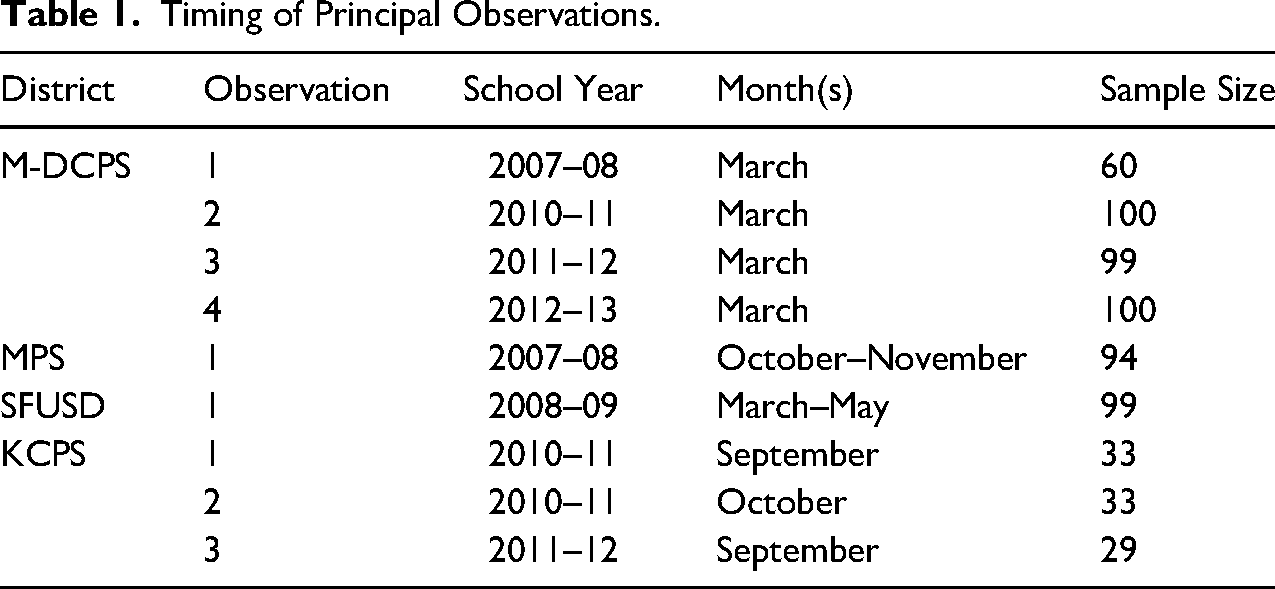
Timing of Principal Observations.
Full School-Day Observations
In each district, researchers observed principals over single full school days using a similar approach to Horng et al. (2010). Our team conducted observations on different timeframes for each district between the 2007–08 to 2012–13 school years. This timing means that our analyses speak specifically to this time period, though we note that many of the most relevant features of the policy landscape shaping school leadership in subsequent years, including standards-based accountability, implementation of multiple-measure teacher evaluation systems, and a heightened emphasis on instructional leadership as the frame for understanding principals’ work, were already in or coming into place, suggesting continuing relevance of our results to contemporary school leadership.
We summarize the timing of principal observations in Table 1. In M-DCPS, we first collected data in 2007–08, then again in consecutive years from 2010–11 to 2012–13. We conducted M-DCPS observations in March. The study team sampled 60 principals in the first year and approximately 100 principals in each of the other years. 3 We collected data from principals in MPS during October and November (N = 94) and SFUSD during March through May (N = 99) just once each (in 2007–08 and 2008–09, respectively). 4 In KCPS, we collected data from nearly all principals, twice during 2010–11 in September and October (total N = 66) and once during 2011–12 in September (N = 29). 5 Overall, we analyze 647 principal observation days from eight different district-year combinations.
For each observation, a trained observer shadowed a single principal for an entire school day—approximately 30 min prior to the morning “bell time” to afternoon dismissal 6 —and collected detailed information on time use in five-minute increments with a standardized observation protocol. The observer coded principals’ actions at each five-minute interval from a list of 52 tasks. Principals could perform multiple tasks at once, and researchers were trained to record all tasks and to designate a primary task. At each time interval, the researcher also recorded the principal's location and with whom the principal was interacting.
We grouped the 52 tasks into a broader set of six task domains (administration, management, instructional interactions, instructional programming, safety, internal relationships, and external relationships) that largely follows prior work (Grissom & Loeb, 2011; Horng et al., 2010). We show the tasks comprising each of the six domains in Figure 1. A caveat to this grouping is that some tasks might reasonably be assigned to a different domain; some tasks designated as administration or management, for example, could be assigned to the other category so we rely on prior studies in making these distinctions. 7 In addition, observers could code time as “in transition” between tasks and “personal time” not associated with work-related tasks. 8
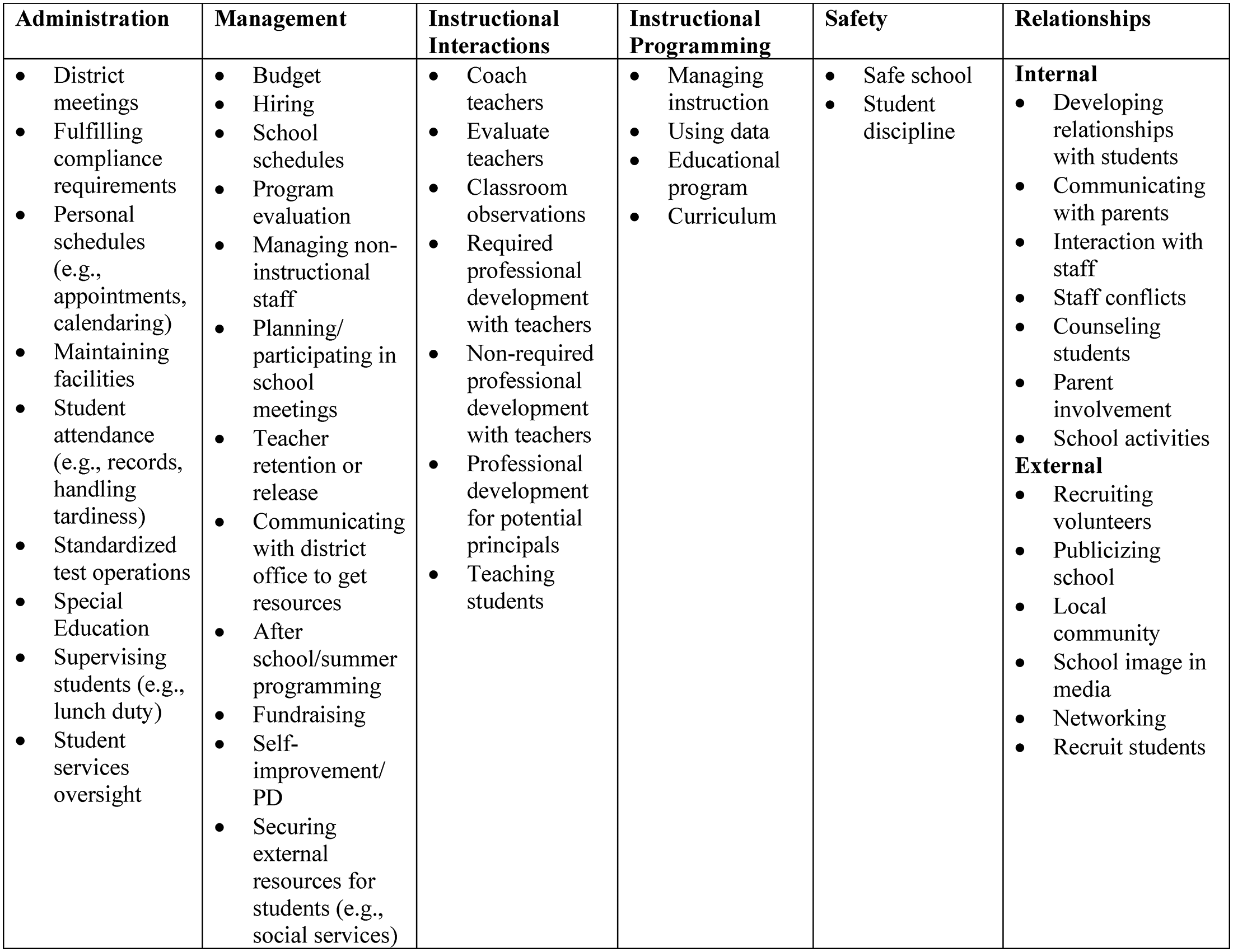
Time use domains.
We calculate the percentage of time the principal spent during the school day on each task or task domain. 9 Initially, we calculate these percentages (a) using primary task only and (b) using all tasks, but given similarity of results in these two approaches, we opt to report with primary task only for simplicity. We also calculate the percentage of time (a) spent at different locations in the school and (b) spent with others, by role.
We create other measures to characterize the principal's workday, including measures of pace, fragmentation, and reactivity to the environment. First, we code “task switches” as any five-minute increment whose primary task is different from the one that immediately preceded it. Second, and related, we calculate the number of time increments each principal spends on a task before switching to another primary task. Third, we code location switches as a five-minute increment in which the location changes from the prior increment. Finally, for each time increment in which the principal was interacting with another person, the observer captured whether the interaction was initiated by the principal, which we code as proactive, or another party, which we code as reactive. Because this component of the data collection was only added in the last two years of the project, we only have proactivity and reactivity measures for the two KCPS and final two M-DCPS data collections.
For the M-DCPS data collections in spring 2012 and 2013, we also fit observers with pedometers to calculate the number of steps they took during the observation period, as a proxy for how many steps the principal took. The pedometer data offer a supplemental measure of principals’ movement across locations within their buildings.
Principal and School Characteristics
Each district provided us with administrative data containing information about principals who were observed. This information included gender (coded as binary), race/ethnicity (Asian, Black, Hispanic, white, or other), and years of experience as a principal. To augment this information, we collected information on school characteristics from the National Center for Education Statistics Common Core of Data. These characteristics include the school level (elementary, middle, or high school), the proportion of Black or Hispanic students, the proportion of FRPL-eligible students, the proportion of students with Individualized Education Plans (IEPs), and enrollment size. We also downloaded school math and reading achievement information (based on state standardized tests) from state department of education websites, which we convert to a percentile ranking within the state distribution and average across subjects. From this average, we create a categorical variable indicating whether a school was in in the top quartile (high achievement), second or third quartile (middle), or bottom quartile (low) in the state's test score distribution.
Table 2 shows principal and school characteristics for observed principals, by district. Most principals are female in all four districts. Principal racial/ethnic composition varies, with notably higher proportions of Hispanic principals in M-DCPS, Asian principals in SFUSD, and Black principals in KCPS. Principal experience also varies across contexts, with higher proportions of novice principals in M-DCPS and KCPS as compared to the other two districts. Across all districts, observed schools have high average enrollment in the FRPL program, with an average of 73%. Mean school enrollment is highest in M-DCPS (1,372 students), likely due to the larger share of high schools observed in that district (44%). In the other three districts, most of the observed principals work in elementary schools. Black student enrollment is highest in KCPS and MPS, at 61% and 65%, respectively, while Hispanic enrollment is highest in M-DCPS, at 56%. Few observed schools in MPS and KCPS are in the top 25th percentile of their states’ achievement distribution, while in SFUSD achievement is more representative of the state. Most observed schools in M-DCPS are in the middle of the state's achievement distribution. In KCPS, nearly all schools observed are in the bottom quartile.
Average Sampled Principal and School Characteristics by District.
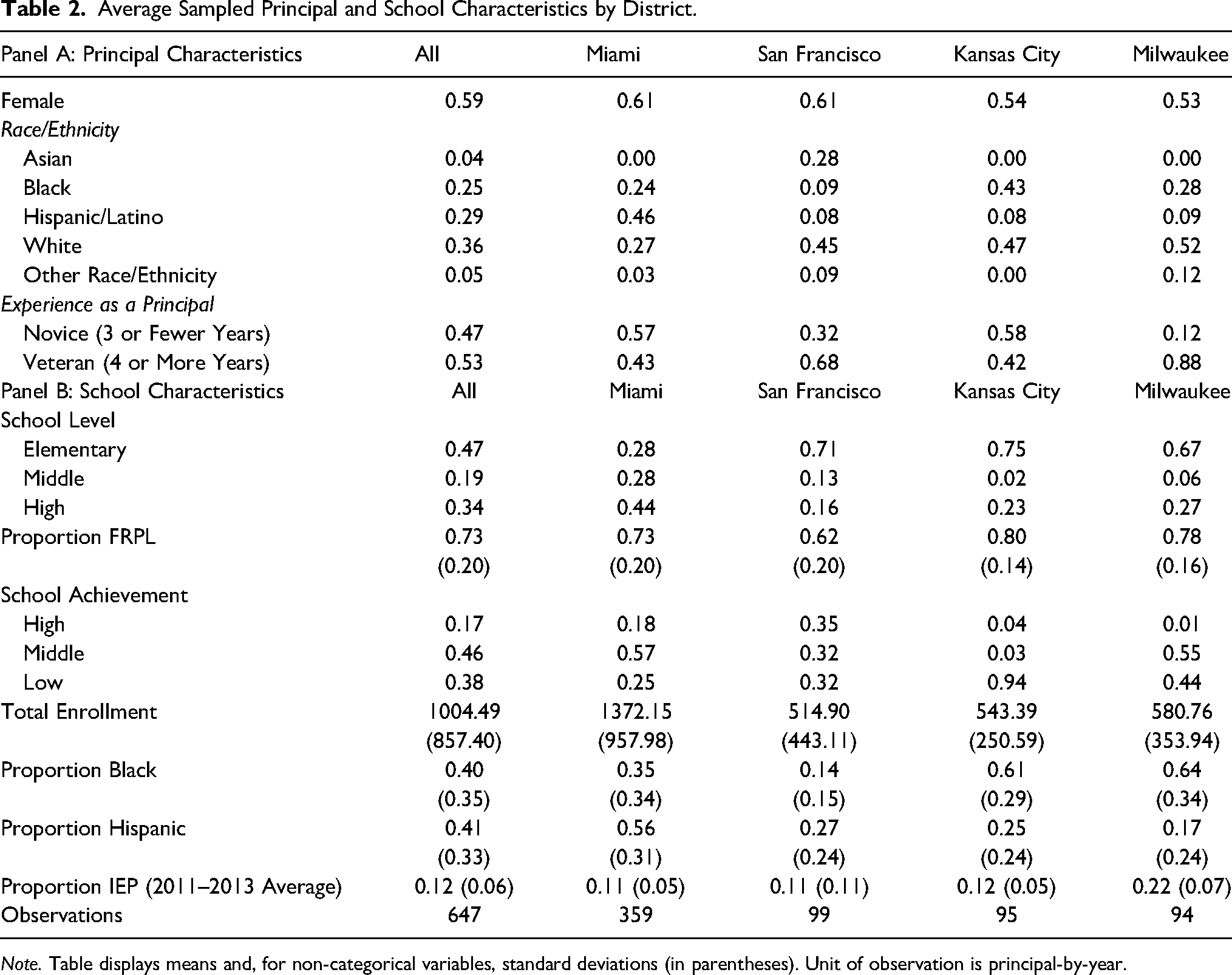
Note. Table displays means and, for non-categorical variables, standard deviations (in parentheses). Unit of observation is principal-by-year.
Methods
The main purpose of this analysis is to describe principal time use, and we employ descriptive methods. For each time use characteristic, we show descriptive statistics summarizing means and variation for the full set of observations, by district, and by location within the school. We also show bivariate correlations among task categories.
Next, we estimate a series of regression models (via ordinary least squares) to examine the associations between school and principal characteristics and principal time spent on each task category. We interpret results as descriptive differences in principal time use by these characteristics, holding constant other characteristics in the model; we do not claim that differences in characteristics are the cause of differences in time use. We fit the general model:
Results
Principals’ Time Allocations
Figure 2, Panel A shows average time spent on each task domain, aggregated across districts. Appendix Table 1 provides means at the task level. As in prior studies, principals in our sample spent much of their day on administration. Mean time on administration was 24% of the workday, the most of any task domain. As shown in Appendix Table 1, much of this time was spent on student services and supervising students without direct student interactions (e.g., lunch duty). The second-highest domain was internal relationships, at 19%; here we distinguish internal from external relationships, though we drop this distinction in some subsequent analyses given the very low proportion of time (less than 3%) classified as external. The most frequent tasks in the internal relationships domain were school-related interactions with staff (i.e., “shop talk”) and student relationship-building (e.g., chatting informally with students).
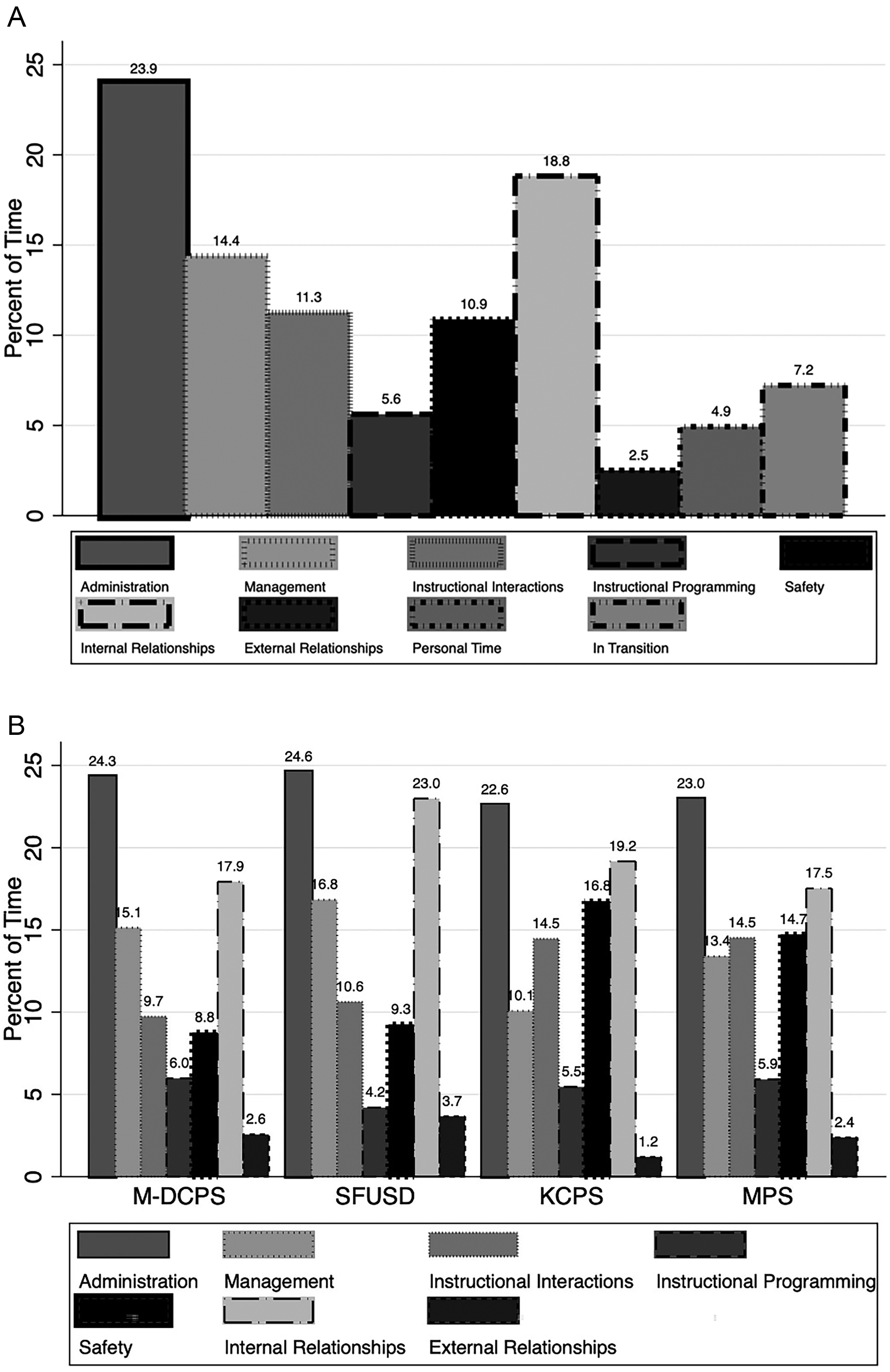
Average principal time use. Panel A: Principal Time Use Across Districts. Panel B: Principal Time Use by District.
Approximately 17% of principals’ workdays were devoted to instruction-related tasks, with 11% going toward instructional interactions—especially classroom observations (7%)—and 6% toward instructional programming. This proportion, which is in the range reported in prior studies, suggests that principals in our sample were spending approximately 40% more time on administration than on instruction. Administration got more than twice as much time as instructional interactions, which studies link to better student outcomes (see Grissom et al., 2021), and more than 50% more time than management, which other studies have also linked to positive school and student outcomes (Grissom & Loeb, 2011; Horng et al., 2010).
Management activities, such as working on budgets and scheduling, accounted for 15% of the typical principal's day, while safety-related tasks, which include school discipline, accounted for 11%. Most of that time (59%) was spent on student discipline. Principals spent 7% of their day in transition between tasks and 5% of their day on personal activities.
Figure 2, Panel B shows principal time use separately by district. To simplify, bars for personal time and time in transition are omitted; these proportions, which are mostly similar across districts, appear in Appendix Table 1. The main takeaway from Panel B is that patterns in principal time use at the domain level are similar across districts. 11 In all four districts, administration is the largest domain, with the typical principal devoting 22–24% to it in each district. Similarly, internal relationships is the second-largest domain in each district, with district means ranging from 18% to 23%.
Some differences across districts also are apparent in Panel B. KCPS and MPS principals spent proportionally more time on safety (17% and 15%, respectively) than principals in M-DCPS and SFUSD (9% each); these differences are statistically significant at the 0.01 level (not tabulated). They also spent somewhat more time on instruction—20% in KCPS and MPS, relative to 16% in M-DCPS and 15% in SFUSD—and especially on instructional interactions (differences statistically significant at the 0.01 level, not tabulated).
We further investigate this variation in Appendix Figure 1, which presents boxplots of principal time use in each domain, separately by district. 12 The plots show wide ranges across many domain-by-district combinations, with right skew evident. For example, some M-DCPS principals spent more than 60% of their workdays on administration, and despite relative low average time on school safety, in each district there were principals spending more than half their day on safety-related tasks. 13
In two of the districts (M-DCPS and KCPS), we can also investigate how time use changed over years of our data collection. Appendix Table 3 shows this analysis, limiting the sample to schools in which observations took place in at least two different years to ensure that differences do not result from sampling idiosyncrasies. In both districts, principals generally spent more time on instruction in later years. In M-DCPS, this increase occurred as time on management fell; in KCPS, the complementary decline was time on administration.
Table 3 presents simple correlations among the main principal time use domains (internal and external relationships are together in a single domain). The goal of this table is to assess the degree to which some domains move together (positive correlations) or trade off against one another (negative correlations). The correlations are almost uniformly negative—unsurprising, given that time spent on one task would mechanically come at the expense of time spent on one or more other tasks. The relative magnitudes of these negative correlations, however, are informative. The strongest negative correlations are found between administration and all other task groups; all correlations are negative, and many are greater than −0.2. Greater time spent on administration appears to come at the expense of multiple other areas of principals’ work. Safety and management (r = -0.24), relationships and instructional interactions (r = -0.26), and personal time and safety (r = -0.20) are other task categories that show similar tradeoffs. Most other task pairs do not show tradeoffs, with correlations close to zero. The only positively signed correlation in the table is a weak relationship between personal time and time in transition (r = 0.08). The main conclusion to draw from this table is that while many principals spent the plurality of their time on administration, those that were able to reduce time on this task area substituted that time with activities more directly related to positive student outcomes, such as instructional interactions, management, and relationship building.
Correlations among Principal Time Use Categories.
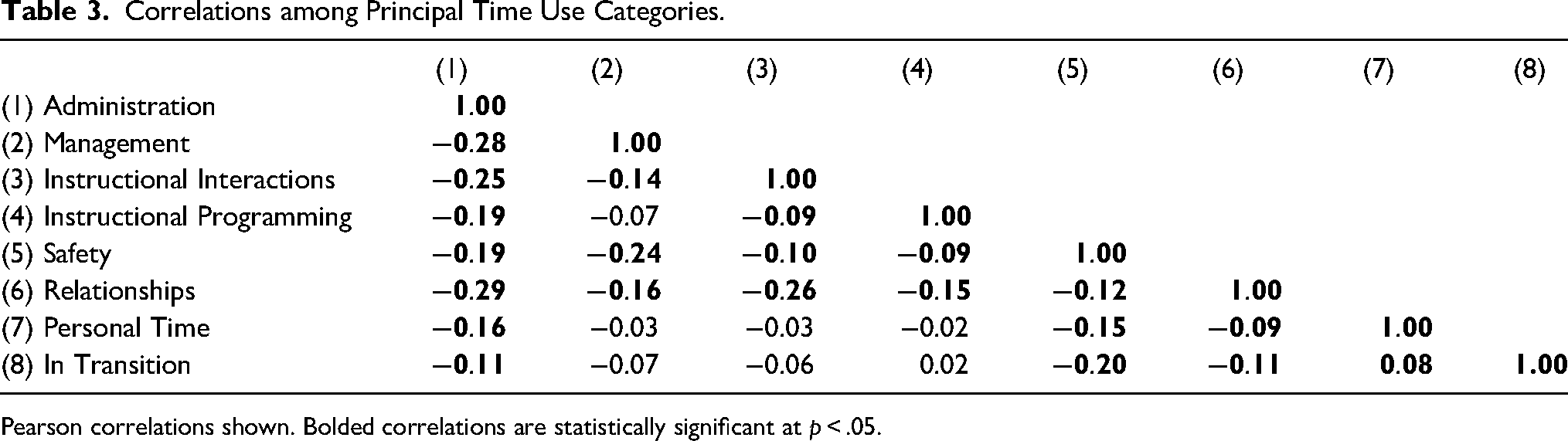
Pearson correlations shown. Bolded correlations are statistically significant at p < .05.
Principal Time Use Varies by School Characteristics
Table 4 presents bivariate correlations between individual and school characteristics and principal time use in each of the main six task domains. A few notable patterns emerge. First, correlations generally are small; only one correlation is above 0.3 in absolute value, suggesting that school and individual characteristics are not strong predictors of principal time use. Second, no school or individual characteristic has a statistically significant association with time spent on administration besides a weak negative correlation with Black enrollment. Third, the school characteristics that predict more time on management and relationships tend to predict less time on instructional interactions and safety. In particular, principals in schools that are larger, higher-achieving, and that have fewer low-income and Black students spent more time on management and relationships and less time on the other two domains. Among these characteristics, proportion FRPL-eligible students stands out as a predictor of less time spent on management (r = -0.19). School size (r = -0.22) and level (for elementary, positive, r = 0.26; for high, negative, r = -0.27) are the strongest predictors of instructional interactions. Safety is the domain that school characteristics best predict principals’ time use. Correlations with the proportion of Black students (r = 0.31), FRPL-eligible students (r = 0.19), and students with IEPs (r = 0.28), as well as the school achievement percentile (r = -0.26) are among the strongest in Table 4.
Correlation Between Principal Time Use Categories and School and Individual Characteristics.
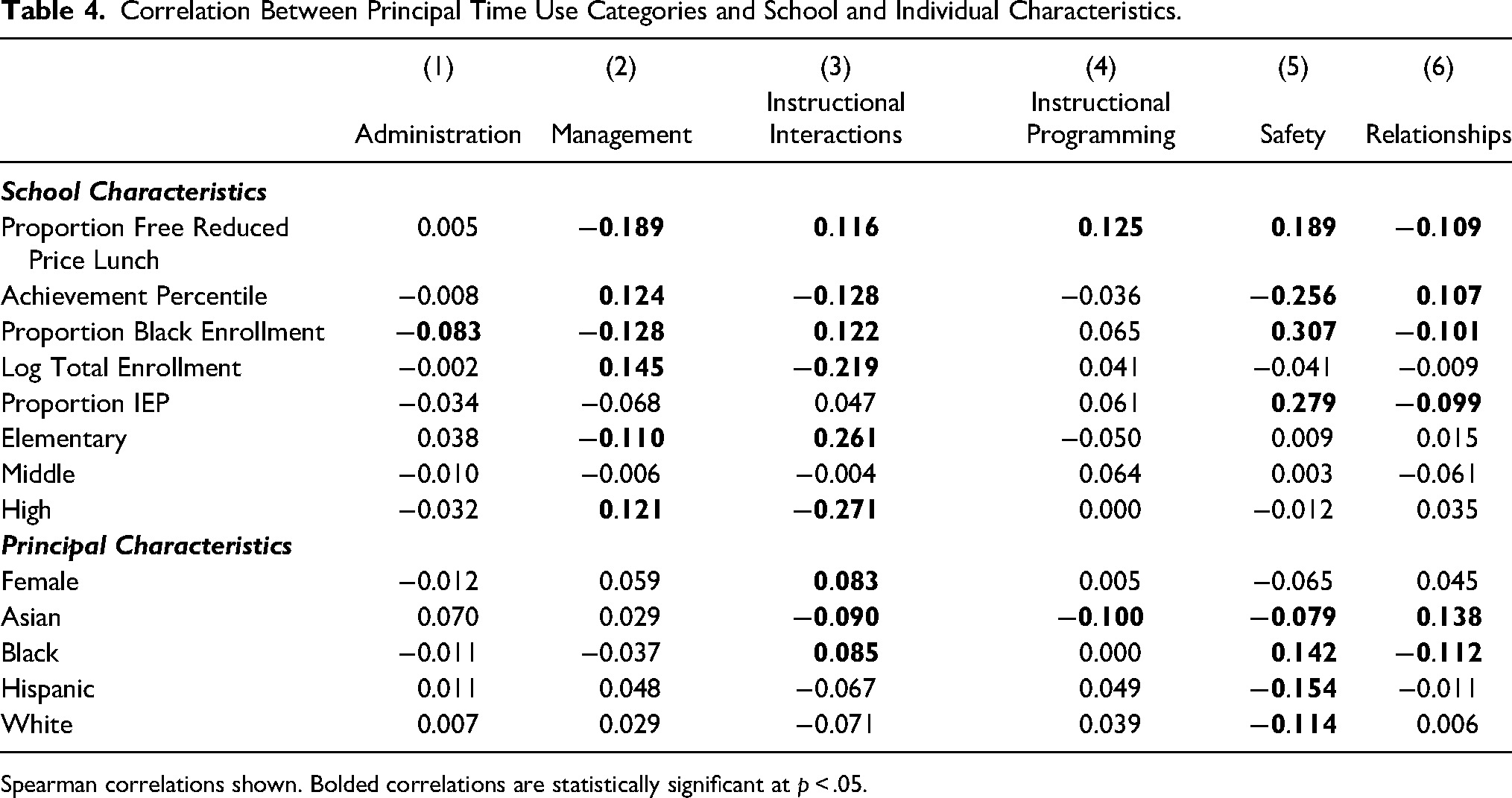
Spearman correlations shown. Bolded correlations are statistically significant at p < .05.
Correlations between individual characteristics and time use typically are weak, and only a few are statistically different from zero. Most notably, principal race correlates with time spent on safety, with Black principals spending more time (r = 0.14) and each of the other racial/ethnic groups spending (statistically) less time in this area, though again, correlations are low.
Table 5 returns to these school characteristics, presenting the results of separate, descriptive regression models predicting proportion time spent in each domain. The patterns that emerge once conditioning on other factors are a little different from those described in Table 4. First, we observe that school achievement predicts time on administration, with principals in the highest-achieving schools spending less time on administration (4 percentage points, or approximately 16 min, on average) than their colleagues in the lowest-achieving schools in the same district. Second, school and individual characteristics still predict the safety domain best, as evidenced by the highest (though still modest) r2 (0.16). Being the principal of a larger school and of a school with larger proportions of Black students and students with IEPs or on FRPL are all statistically associated with greater time on safety. Third, associations with other school characteristics become somewhat less clear than in the simple bivariate case. Having fewer FRPL-eligible students still predicts more time on management, but so does lower achievement. High school principals spent less time on instructional interactions (about 3 percentage points, or approximately 12 min) than elementary principals, time that appears to trade off with time on relationships and management. Principals of high-achieving schools spent more time on relationships than principals of low-achieving schools (5 percentage points, or approximately 20 min). For instructional programming, only student poverty is a statistically significant school-level predictor, but it is substantively small; a 10 percentage point increase in FRPL eligibility translates into a 0.5 percentage point (approximately 2 min) increase in instructional programming time.
Regression Estimates of Time Use Domains by School and Individual Characteristics.
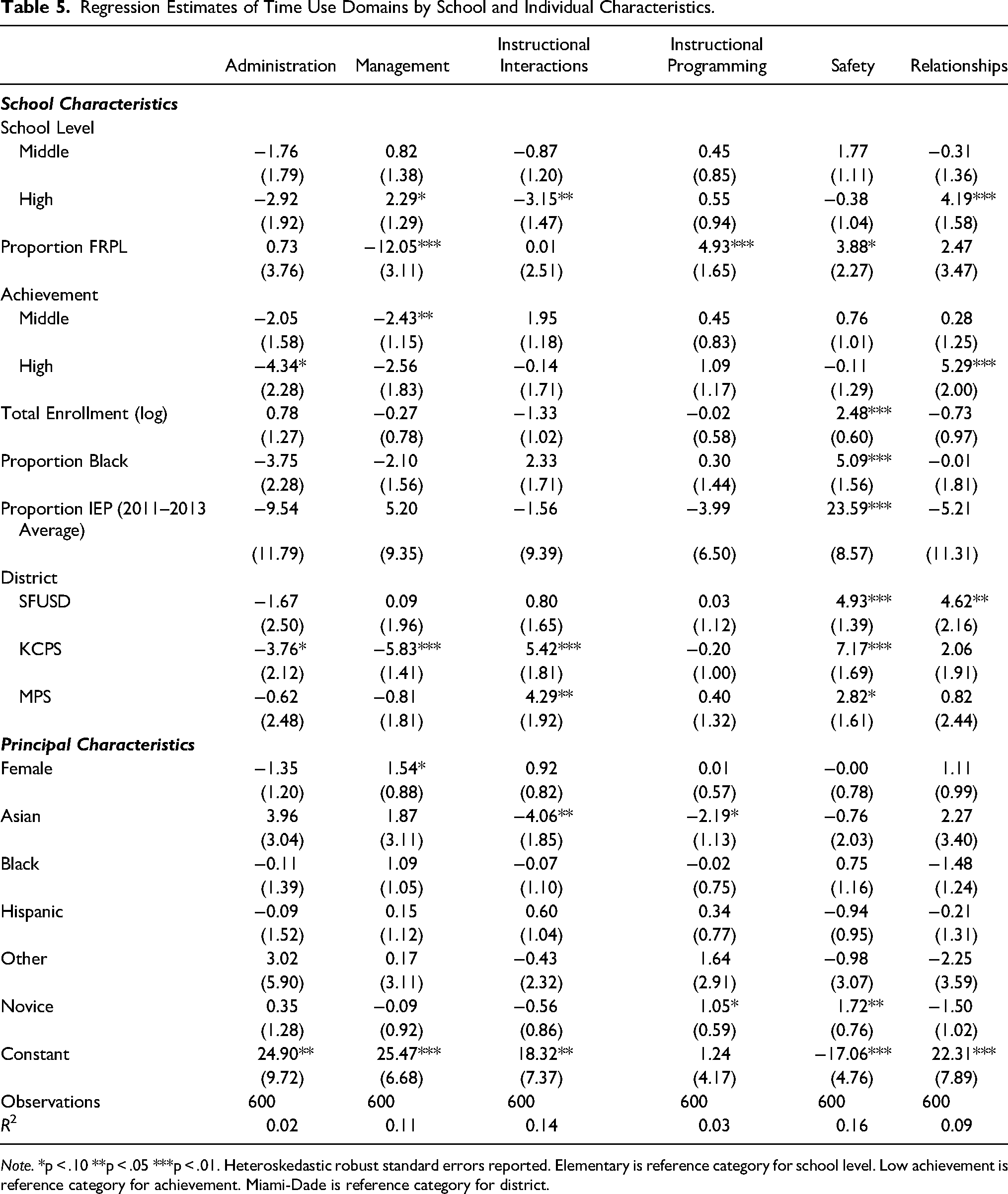
Note. *p < .10 **p < .05 ***p < .01. Heteroskedastic robust standard errors reported. Elementary is reference category for school level. Low achievement is reference category for achievement. Miami-Dade is reference category for district.
Few principal characteristics predict time use statistically, and the coefficients substantively are small. Women spend 2 percentage points, or about 8 min, more time on management than men. Novice principals spend more time on instructional programming (1 percentage point, or 4 min) and safety (2 percentage points, or 8 min) than more experienced principals. Asian principals spend less time on instructional interactions and instructional programming than white principals.
The other finding that emerges from Table 5 is that average differences in principal time use by district remain even after accounting for differences in the characteristics of school principals’ work in those districts. For example, compared to the omitted district (M-DCPS), KCPS and MPS principals spent significantly more time on instructional interactions, and SFUSD principals spent more time on relationships. Principal time use appears to vary somewhat by district setting in ways not just explained by observable differences in schools.
Where and With Whom Principals Spend Their Time
Principals may influence their schools not only by the tasks they do but also simply by their presence in observable locations throughout the school. Figure 3 uses boxplots to show principals’ time by location. Consistent with principals’ focus on administration, in each district, typically principals spent the most time in their office; in M-DCPS, the average principal spent half the school day there, while in the other three districts, the mean is about 40% (with additional time spent in the main school office). 14 In all three districts, however, we see a wide range of patterns, with some principals spending almost no time in their offices and some spending upwards of 80% of the day there. As shown in Appendix Table 5, principals spent the majority of the time when they are in their office on non-instructional tasks: 24% on administration, 23% on management, and 22% on relationships.
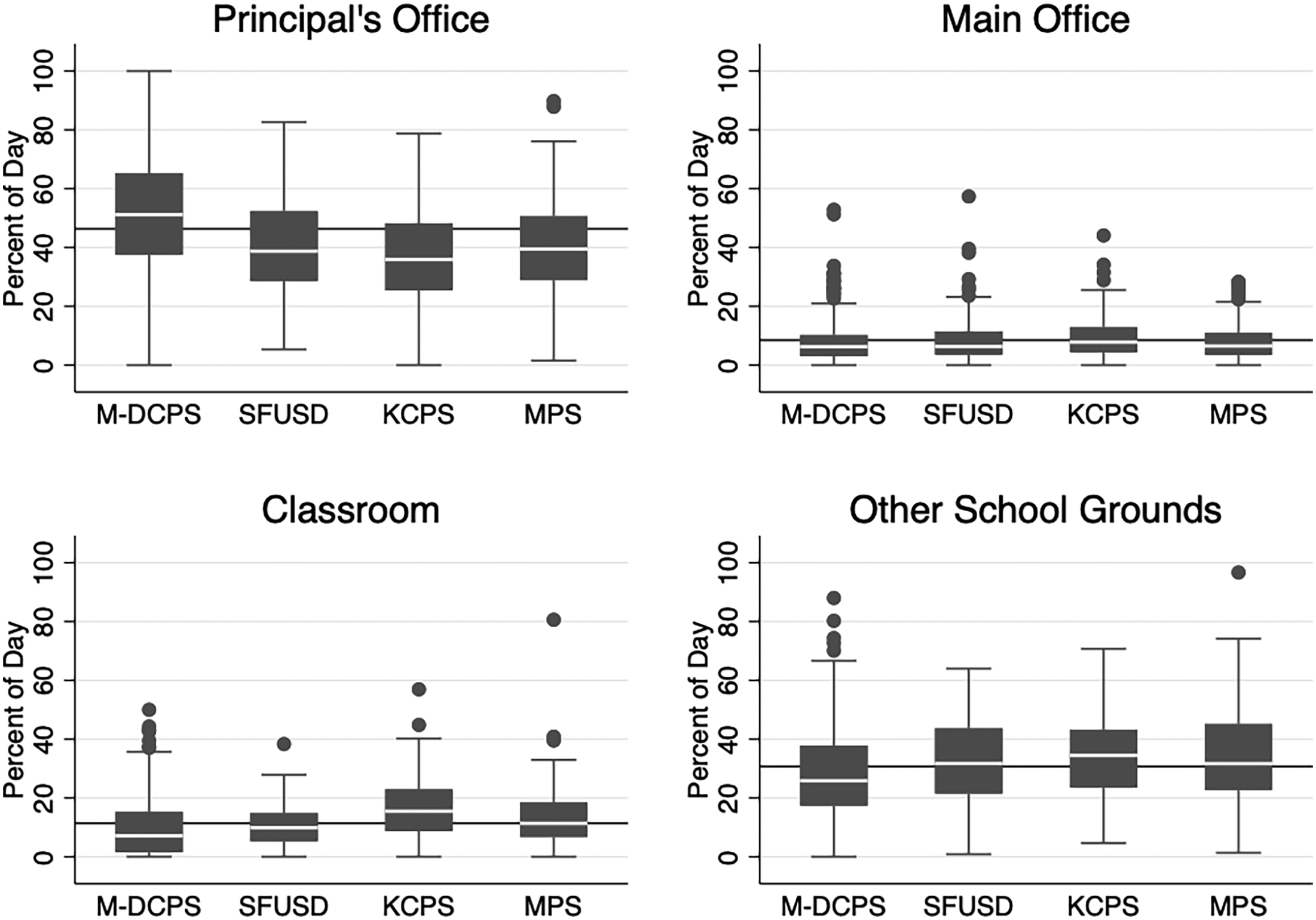
Principal location by district.
In contrast, reflecting the generally meager time principals spend on instruction, average time in classrooms was low: less than about 10% of the day in three of the districts, with a slightly higher proportion in KCPS. Most of that classroom time was spent on instructional interactions (60%), and about a fifth (18%) was spent on relationships (Appendix Table 5). Again, principals varied, with some in classrooms for a greater proportion of the day, though in no district were more than a quarter of principals spending 25%+ of the day in classrooms.
Figure 4 summarizes the proportion of the observation time that principals were alone or with others, with others broken down by role. Principals were coded as spending time alone if they were not participating in a face-to-face interaction, meaning that principals who were alone could be interacting with others via phone or e-mail. Note that bars do not sum to 100% because a principal could spend time with more than one stakeholder type simultaneously—in fact, 17% of a principal's school day was spent this way. 15 Consistent with the finding that principals spent much of their days in their offices, the figure shows that, although they spent slightly more time with others than by themselves, 45% of the typical principal's workday was spent working alone. Over half of this time was spent in the principal's office and main office (53% and 6%, respectively), and 29% of that time was spent in other school grounds (Appendix Table 5).
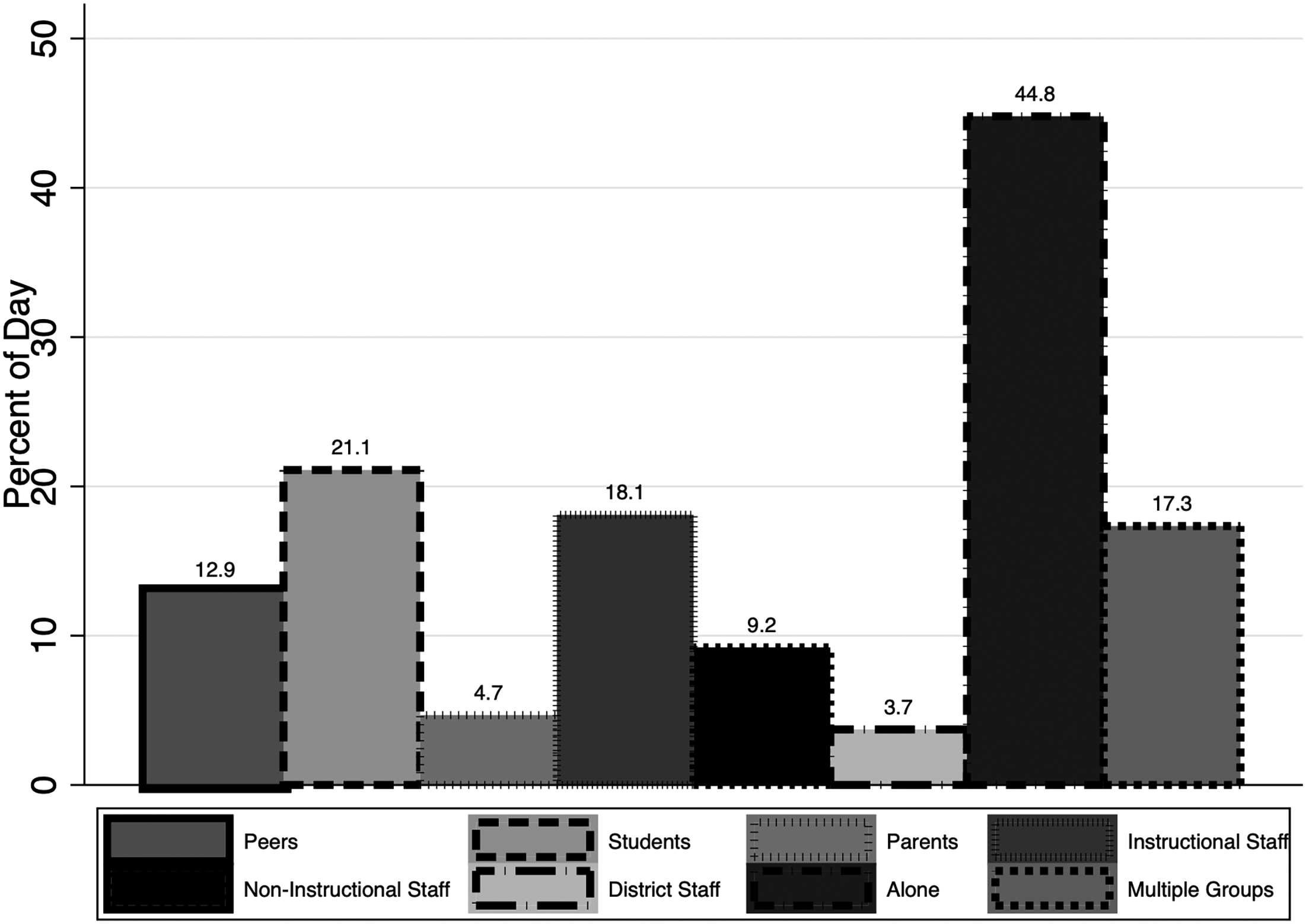
Principal time alone and with others.
Interestingly, the stakeholder with whom principals spent the most time was not teachers nor other instructional staff (e.g., coaches) but students (21% to 18%). Instructional tasks only made up around a third (36% on instructional interactions and programming combined) of principals’ time spent with teachers (Appendix Table 5). The vast majority of principals’ time with students was split between relationships (32%), safety (23%), and instructional interactions (21%; Appendix Table 5). Time with peers (which includes assistant principals or other principals) was about 13% of the day, followed by time with non-instructional staff (9%), parents (5%), and district (i.e., central office) staff (4%).
Fragmentation and Proactivity/Reactivity
In Figure 5, we show principals’ average task length, based on how many consecutive five-minute increments the primary task was coded as the same, 16 by district. The mean across the sample is 8.4 min (median = 7.9 min), with relatively close clustering of averages around this grand mean for each district. In other words, the typical principal in each district devoted fewer than 10 consecutive minutes to the typical task in his or her workday. Although there was substantial variation in average task length in all districts, principals rarely spent more than an average of 15 min per task. 17
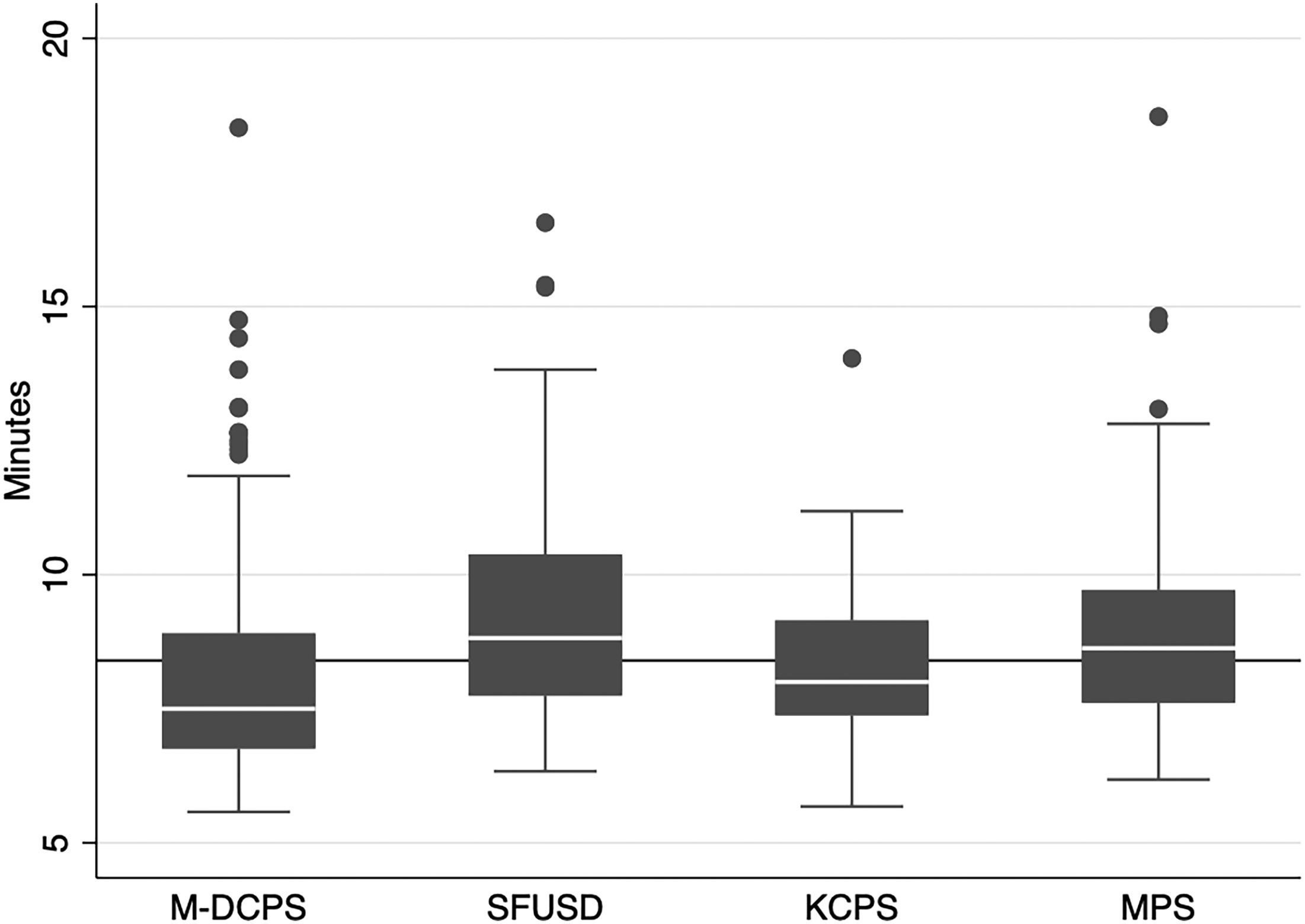
Average task length by district.
Figure 6 presents another way to visualize time fragmentation in principals’ workdays. The leftmost bars for each district show the fraction of observed five-minute time increments in which principals engaged in a different task than the prior increment. In three of the districts, task switching rates were very similar, with 56–59% of five-minute increments representing task switches in SFUSD, KCPS, and MPS; rates were slightly higher (64%) in M-DCPS (p < 0.01). In other words, it was more likely than not in all four districts that the task a principal was engaged in at any time point was different from the one that was the focus five minutes prior.
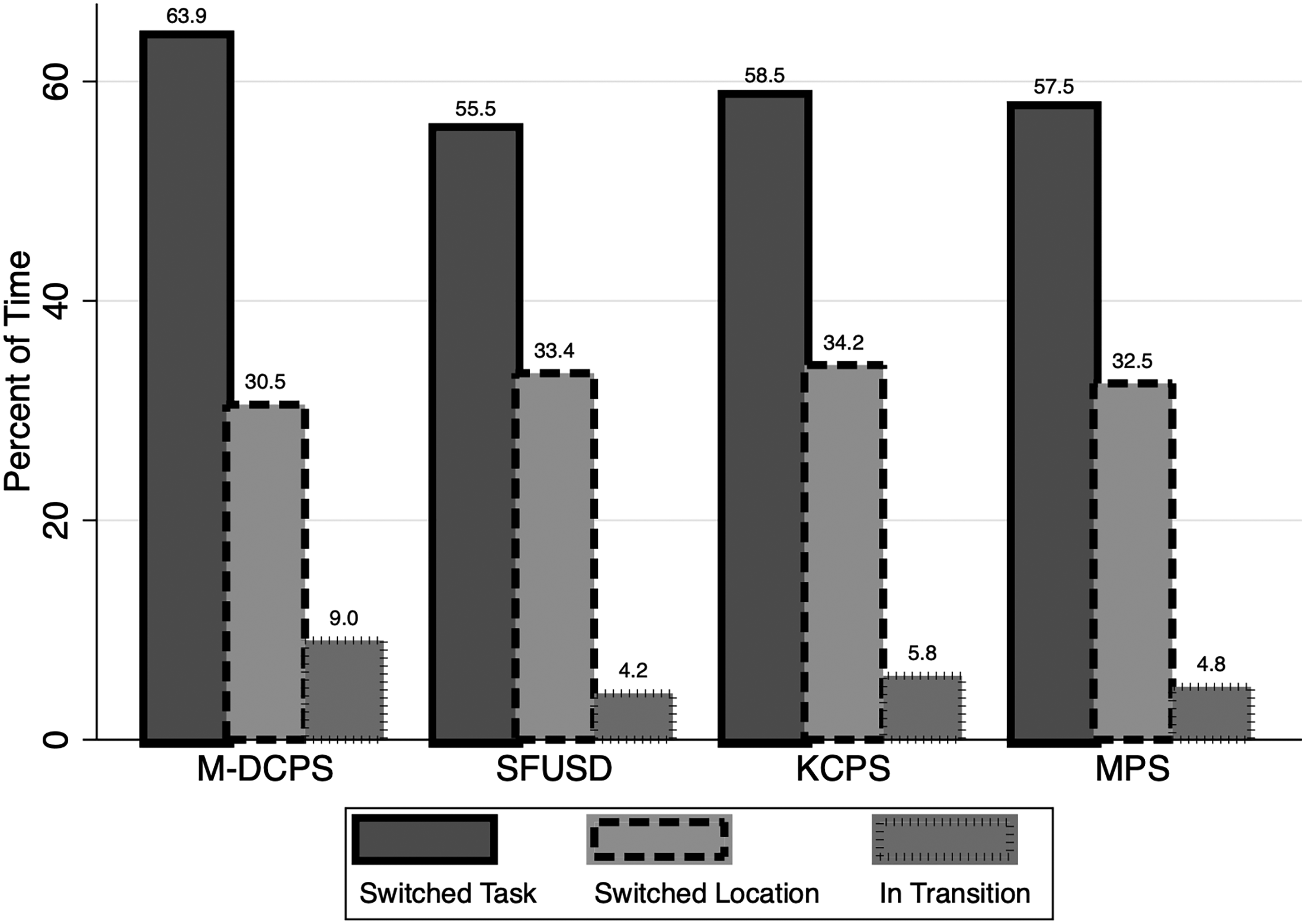
Task and location switching and time in transition by district.
The other two bars for each district in Figure 6 document physical movement within the school. The middle bar shows what fraction of five-minute increments took place in a different location type (e.g., principal's office, classroom) than in the prior increment. About one-third of these increments represent a location switch. 18 Despite relatively high fractions of their days spent in their offices, principals appeared to move among locations frequently.
The rightmost bar shows how many five-minute increments are coded as “in transition”—that is, the principal was only moving between tasks, rather than engaged in a substantive task. Transition time ranges from 4% (SFUSD) to 9% (M-DCPS) across districts (a statistically meaningful difference at the 0.01 level).
The frequency of location switching and the nontrivial amount of transition time, especially in M-DCPS, suggest that principals spent much of their day moving around their buildings. Pedometer data from the spring 2012 and 2013 data collections in M-DCPS align with this conclusion. Figure 7 shows a kernel density plot of these data. The average principal took 3,500 steps during the observation period, or about 1.5 miles for the average adult. Some principals walked substantially more; the 75th percentile of the distribution was 4,600 steps, or about 2.25 miles, with principals taking as many as 8,000 steps. Number of steps positively correlates with the number of increments the principal switched locations (r = 0.32) and time in transition (r = 0.24).
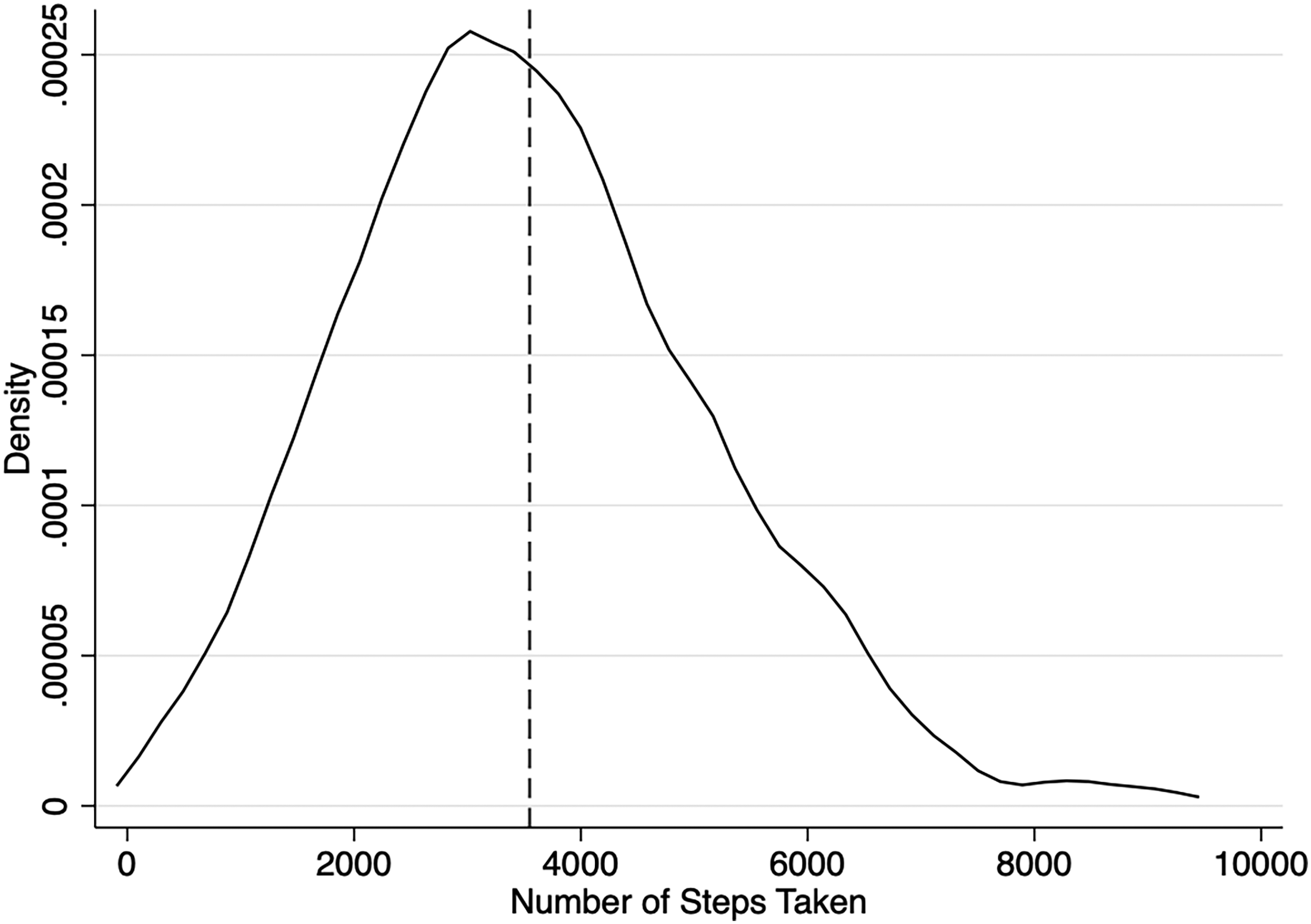
Distribution of steps taken by principals in observed workday (M-DCPS, spring 2012 and 2013).
The final characteristic of principal time use we examine is proactivity/reactivity, available for the final two data collections in M-DCPS and KCPS. Figure 8 shows that in both districts, principals were the primary initiator of interactions with others about 45% of the time, compared to about a third of the time when the interaction was clearly initiated by another person. The remaining interactions were coded as “unknown” because the coder could not specify the initiator. 19 If we limit only to the interactions with a clear initiator, principals appeared to be proactively initiating interaction with others about 60% of the time, pointing perhaps toward less reactivity than prior studies have concluded (e.g., Martin & Willower, 1981). As shown in Appendix Table 5, principals were especially likely to be the initiator of instructional interactions and safety-related tasks, whereas administrative tasks and relationship tasks were more often initiated by others. 20
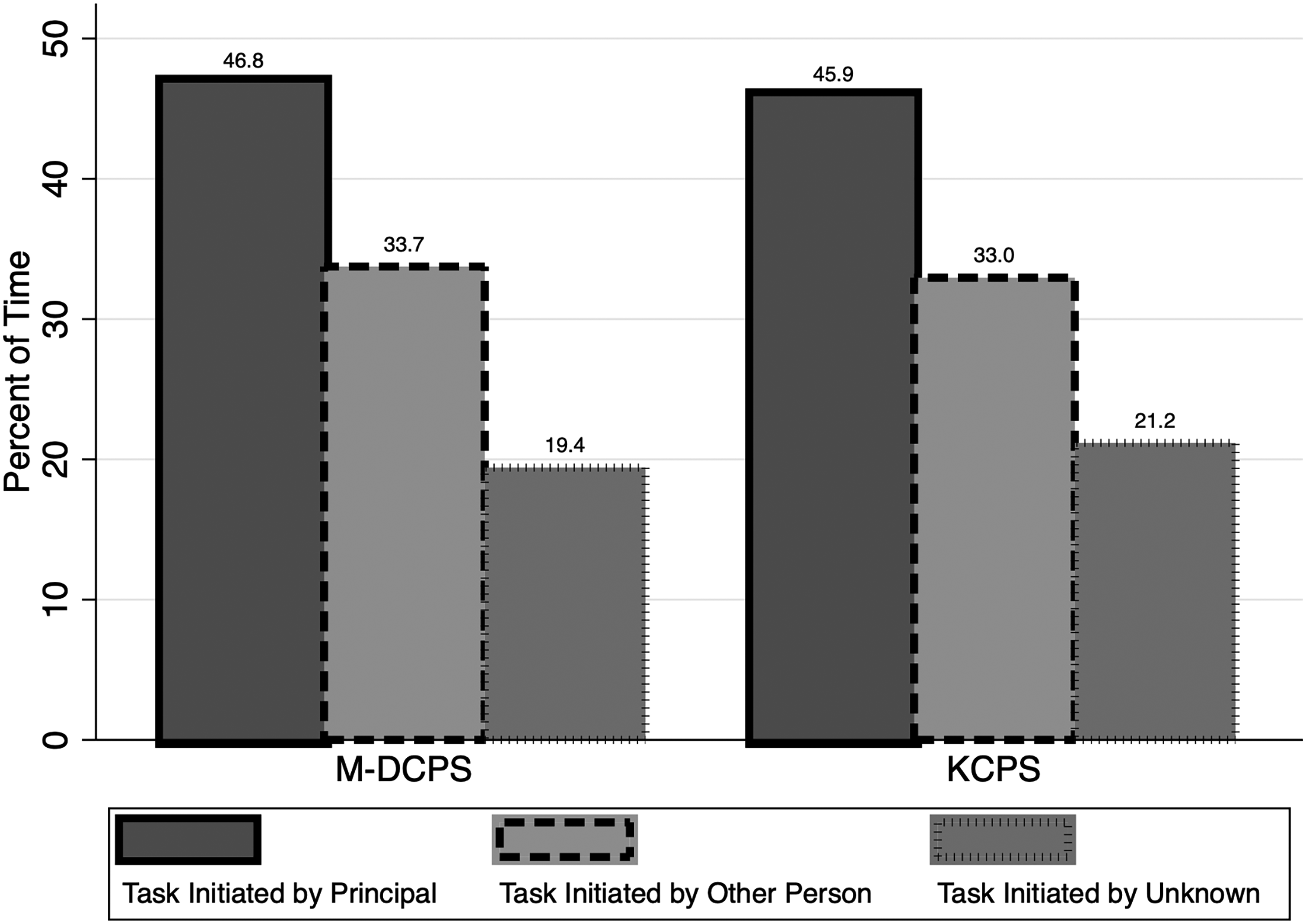
Task initiation in M-DCPS and KCPS.
Discussion and Conclusions
Prior investigations of principal time use have consistently found that principals spend a substantial amount of time on administrative and operational tasks, little time on instruction, and much of their days in their offices. These patterns endure in our work: Across four urban school districts, principals spend the plurality of their time on administrative and compliance-related tasks and in their offices. In other words, despite ongoing calls for principals to organize their work around engagement with instruction, urban principals’ time focus appears to remain elsewhere. Hochbein and Meyers (2021) suggest that this enduring focus on administration flows from how school systems structure the principal role, attaching to it many compulsory demands, such as legal compliance, that diminish principals’ ability to allocate time toward higher-leverage activities, even when they want to do so. Substantial reallocation of principal time in urban schools likely will take investing in both structural changes and tools to help principals move past well-established patterns of time investment.
The principal time use literature has been less definitive on other aspects of principals’ time use. In some areas, our findings align with more contemporaneous studies. Earlier studies found that principals are reactive to their environment (e.g., Martin & Willower, 1981). But, like more recent studies, we find that principals initiate a plurality of their interactions. Given that recent studies tend to characterize principal time use as proactive, it may be that principals have become more proactive over time, but this difference may also be a result of the different geographic contexts and measurement strategies found in earlier studies. Given that principals in our study appear to exercise relative control over a substantial portion of their day, interventions that target principal time management may be effective in aiming time use towards high-impact tasks (Grissom et al., 2015; Goldring et al., 2020).
Our findings also align with more recent studies that find that principals spend the majority of their time with others rather than alone (e.g., Sebastian et al., 2018), although we observe substantially more alone time than some other studies. Somewhat surprisingly, we find that principals also spend nearly a fifth of their time with students. The richness of our data allows us to observe not only the amount of time principals spend alone or with others, but also how that time alone or with others is spent. We find that the majority of principals’ time with instructional staff is spent on non-instructional tasks. Importantly, we find that time spent with students is largely spent on instructional interactions, safety, and relationships. This finding may run somewhat counter to the belief that principal effects on student outcomes are largely indirect via their impacts on teachers or the general school environment. Principal facetime with students may have direct positive or negative impacts on student outcomes (see Lee et al., 2021)—a development that should be investigated in further research.
Another contested finding in the principal time use literature is regarding the pace and consistency of principals’ work. Like other studies (e.g., Huang et al., 2020; Martinko & Gardner, 1990), we find that principal time use is fragmented, characterized by frequent switching between tasks and locations. Other studies, often using ESM, survey, or end-of-day log measurements, have found that principals spend substantial continuous time on individual tasks (Sebastian et al., 2018; Spillane & Hunt, 2010). The difference in findings may be an artifact of each study's measurement strategy. Principals may recall their days as being more consistent than a structured observation may reflect (Hochbein & Meyers, 2021). And ESM studies may not capture shorter events because time periods between observations are longer than with a structured observation (Rowan, 2022). Further investigation, perhaps in studies employing multiple time measurement methods, is necessary to rationalize these results.
Because our sample includes observations from schools across four urban districts— which are diverse with respect to geography, size, and student composition—we are able to examine the consistency of principal time use across contexts. We find substantial consistency in time allocations to different task domains across four urban school districts. The typical principal in all four districts spends more time on administration than on any other task domain. Domains linked more closely to school outcomes in prior studies, such as instructional interactions and management (see Grissom et al., 2021), get less time investment. As in most prior studies of principals’ work, in all four of our districts, principal time on instruction-related matters is relatively small, ranging from 15% to 22%, depending on the district. These values fall within the range of estimates from other studies (see Hochbein et al., 2021). Increasing time use on instruction may be a persistent challenge for principals across diverse contexts and an important focus area for professional development and supervision (Goldring et al., 2020).
Similarly, due to the diverse nature of our sample, we can observe the extent to which time use patterns varied by school characteristics. We find some notable differences. Time on instruction is highest in elementary and smaller schools, and those with larger proportions of historically marginalized and low-achieving students, though our regression results point to no single school characteristic as a consistent predictor of principal time use once these characteristics are considered simultaneously. These same characteristics also tend to be associated with more time spent on school safety and less on management and relationships, consistent with research indicating that Black students and student enrolled in special education are disproportionately subject to suspensions and expulsions (Ritter & Anderson, 2018; Skiba et al., 2011). We also see potential evidence that principals are responsive to their environments when allocating their time. For example, principals in low-achieving schools seem to focus their time on instruction, which may signal that those principals have identified an area for improvement in their school and prioritized their time use towards it. More generally, links between context and time use suggest that principals need preparation and support to meet different time demands across schools even within the same district.
Our study faces several limitations that suggest future extensions. First, the data are a snapshot of a principal's workday during school hours at a single time of the year. We cannot know whether these days are representative of a principal's typical day or how principals use their work time outside of school hours; including hours outside the school day may affect the time allocations we report (e.g., external relations time may be more common in the evenings). Relatedly, the snapshot nature of the data means that we cannot investigate how a principal's time use varies day-to-day or over the school year. Prior studies have come to mixed conclusions about the degree to which principals’ time use varies, at least at the broad domain level, over time (e.g., May et al., 2012; Sebastian et al., 2018). Future studies that gather observational time use data throughout a school year can help address this question.
Second, although structured observation has some advantages over other forms of time use data collection, it has some potential to introduce inaccuracies. For example, while observers asked principals to go about their day as they would normally and were trained to minimize their interaction with the principal or disruption of their workday, we cannot be sure that principals’ days proceeded as they would have in the absence of the observation. Also, because they were instructed to minimize interaction, observers often had limited understanding of principals’ intentions or context, which could lead to miscoding of tasks or their characteristics in some cases. For instance, our proactivity measures were based on the coder's understanding of who initiated an interaction, which may have been inaccurate if they had not observed earlier circumstances that produced the interaction. Time use studies with alternative approaches to capturing proactivity may produce more nuanced findings regarding this important construct.
Third, although our data collection adds significantly to the number of sites for urban principal time use studies from the last two decades, we still only have data from four districts. Further studies collecting principal time use data across a broader array of urban districts can help us understand differences in time use across context and continue to assess external validity.
Fourth, our study focuses exclusively on principal time use in urban schools. We have little sense of the degree to which our findings might generalize to schools in non-urban contexts. Given the different demands and available resources around the principalship in rural contexts (see review by Preston et al., 2013), and the small differences in time use in the urban districts we study, there is reason to believe that time use allocation would differ in suburban or rural districts. The field would benefit from studies collecting time use data from suburban and rural districts so that patterns can be compared across district settings.
Finally, the data we use in this study are over a decade old. Commonly used leadership standards have changed since (e.g., adoption of the Professional Standards for Educational Leaders in 2015). The COVID-19 pandemic has intensified and shifted demands on school leaders (Clifford & Coggshall, 2021; NASSP, 2021). While a focus on accountability and teacher evaluation endures, time use patterns may have adjusted due to these changes in leadership demands. Future time use work should examine these potential changes.
Supplemental Material
sj-odt-1-eaq-10.1177_0013161X251316589 - Supplemental material for Fragmentation, Administration, and Isolation? Evidence on Principal Time Use from Large-Scale Observations in Four Urban Districts
Supplemental material, sj-odt-1-eaq-10.1177_0013161X251316589 for Fragmentation, Administration, and Isolation? Evidence on Principal Time Use from Large-Scale Observations in Four Urban Districts by Jason A. Grissom, Francisco Arturo Santelli and Susanna Loeb in Educational Administration Quarterly
Footnotes
Acknowledgements
We acknowledge support from the Institute of Education Sciences, U.S. Department of Education, through grant R305A100286 to Stanford University. The opinions expressed are those of the authors and do not represent views of the Institute or the U.S. Department of Education. We thank the leadership of our partner districts for making this work possible. All errors are the responsibility of the authors.
Declaration of Conflicting Interests
The authors declared no potential conflicts of interest with respect to the research, authorship, and/or publication of this article.
Funding
The authors disclosed receipt of the following financial support for the research, authorship, and/or publication of this article: This work was supported by the Institute of Education Sciences, (grant number R305A100286 ).

Supplemental Material
Supplemental material for this article is available online.
Notes
Correction (March 2025):
Article has been updated to correct Figure 2, where Panel B was missing in the previous version.
Author Biographies
References
Supplementary Material
Please find the following supplemental material available below.
For Open Access articles published under a Creative Commons License, all supplemental material carries the same license as the article it is associated with.
For non-Open Access articles published, all supplemental material carries a non-exclusive license, and permission requests for re-use of supplemental material or any part of supplemental material shall be sent directly to the copyright owner as specified in the copyright notice associated with the article.
