



Abstract
Keywords
Introduction and Statement of the Problem
Becoming a school principal is an iterative and narrative process, informed by one's experiences as a student, educator, and leader. Principals develop their leader identities by taking on a variety of managerial and leadership tasks within their schools, which include meeting the challenges of shifting demographics, teacher recruitment and retention, and adoption of new instructional initiatives amidst landscapes of increased school choice (Bernstein et al., 2021; Delavan et al., 2022). Concurrently, schools and districts are beholden to the choice movement as state and federal funding for education decline; thus, principals must recruit students to maintain and increase their enrollments (Gobby, 2016). A dual language immersion (DLI) program with the instructional goal of student multilingualism can enhance the public profile of a school and serve as an attractive mechanism for families choosing among various educational options (Bernstein et al., 2021).
Building a DLI program usually begins incrementally with one or two grade levels and the addition of subsequent grade levels each year thereafter, so a school can gradually build an infrastructure for DLI. Thus, most DLI programs begin as strands, operating alongside general education classrooms within the same school, which creates distinct challenges for a principal who must lead a “school within a school” (Freire & Aleman, 2021, p. 249). Given DLI programs’ growth in the U.S.A., particularly in Indiana, new challenges are emerging for principals, and this study captures how they are negotiating their new roles and identities as DLI leaders. We pose this research question: How do principals of schools with DLI strand programs perceive and enact their leadership roles and identities?
The Educational Landscape: Growth of School Choice and DLI
Indiana has wide-reaching school choice allowances, with provisions for charter schools and vouchers for families to send their children to private schools (EdChoice, 2021). For charter schools, a family can select one with a particular focus and/or distinct educational conditions (e.g., unique curriculum, smaller class sizes) and enroll their child outside of their assigned public school district (Indiana Education Act, 2021). For private schools, public funds are provided to a family to pay at least a portion of private school tuition, if the family is eligible based on their household income (Indiana Education Act, 2020). Public school and district leaders, once accustomed to enrolling students based on proximity, must now consider how families select from an array of educational options.
Alongside enhanced school choice, Indiana legislation has increased provisions for DLI, as stated in Indiana Senate Enrolled Act No. 267 (Indiana Dual Language Pilot Program, 2015). Since 2015, the number of DLI programs has increased from four to 42 programs statewide (Indiana Department of Education, 2022). When we collected data for this study in spring 2020, there were 33 DLI programs in Indiana. Funding is awarded for the implementation of new DLI programs and capacity building for established programs, and districts must apply annually to receive funding, detailing how they will implement their DLI programs with the required minimum of 50% of instruction in the target (non-English) language (Indiana Dual Language Pilot Program, 2015). While awards are regarded as “competitive,” most applications have been approved with strong guidance on implementation from the Indiana Department of Education, with a keen focus on increasing representation of native speakers of the target language (C. Isley, personal communication, June 1, 2022).
Indiana is not unique in the growth of DLI programs. New immigrant destination states that seem like unlikely locations for multilingual programming are supported by the phenomena of Language Flagships and Language Roadmaps, which are Department of Defense initiatives. The Language Flagships were implemented by the National Security Education Program (NSEP), a branch of the Department of Defense, funding higher education institutions to prepare students for critical languages including Korean, Arabic, Russian, and Chinese (The Language Flagship, 2013). Indiana University is a Flagship campus and hosts programs in these critical languages. Ultimately, Indiana's flagship status at the university level impacted K-12 education with the subsequent development of dual language programming throughout the state (Indiana Language Roadmap, 2019). Despite the strong focus in the Indiana Language Roadmap for critical languages, most districts adopted Spanish as the target language for their DLI programs.
Among Indiana's current DLI programs, all but one uses Spanish as the target language. Districts often select Spanish as it has the most readily available teaching force through local staff and international guest teacher programs. Furthermore, students who identify Spanish as their native language are the largest English learner (EL) constituency in the state, accounting for nearly 7% of the Indiana K-12 student population (Indiana Department of Education, 2021). Of the current 42 Indiana programs, 40 operate as strands, presenting new leadership dilemmas as principals negotiate their roles and identities as leaders of two schools in one.
Conceptual Framework and Literature Review
This study is grounded in several branches of educational leadership literature, including leadership models (e.g., instructional, distributed, integrated) and leadership for dual language or bilingual education. We frame principals’ leadership experiences in terms of their identities as leaders, relying on applied identity and social identity theories. Here, we outline how these areas of research and theory informed our study, beginning with models for educational leadership.
Models for Educational Leadership
Instructional leadership is a common term within the field, popularized and defined in school reform and educational leadership literature starting in the mid-1980s (Hallinger & Murphy, 1985; Heck, 1992). Characteristics of instructional leaders, according to more recent scholarship, include a focus on a shared goal of enhancing student learning, dedication to continuous improvement processes involving various stakeholders, maintenance of high expectations, and fostering a culture of innovation and improvement. The instructional leader is also responsible for management tasks such as coordinating the curriculum, monitoring student outcomes, and facilitating staff development (Hallinger, 2005). Rigby (2014) suggests a broad conception of instructional leadership, wherein the principal serves as both the instructional leader and the manager of a school. Other scholars have described three dimensions of instructional leadership: (a) defining a school's mission, (b) managing instruction, and (c) promoting a positive learning climate (Gurley et al., 2016).
Organizational management is among the important tasks of an instructional leader. Grissom and Loeb (2011) found that principals who perceived themselves as “effective” and who were perceived as such by others (based on district data and parent climate surveys) were rated as highly competent on both instructional leadership and organizational management dimensions. In a follow-up to Grissom and Loeb's (2011) study, researchers found that principals’ perceptions of their effectiveness on measures of instructional leadership and organizational management tasks were strongly correlated, meaning that those who rated themselves highly on measures of instructional leadership, such as coaching teachers, also rated themselves highly on measures of organizational management, such as dealing with staff concerns (Sebastian et al., 2018). One of a principal's organizational management tasks is hiring teachers, and while teacher credentialing occurs at the state level, hiring processes have become increasingly decentralized (Engel et al., 2018). Staffing decisions, ranging from hiring to ongoing teacher evaluation and professional development, are central to a principal's role as an instructional leader, as effective teachers are essential to boosting student achievement (Kimball, 2011; Odden 2011). When hiring teachers, principals make decisions based on their school contexts and federal or state mandates, while also relying on their own personal beliefs, backgrounds, professional experiences, and suitability of the teacher candidate for a given role (Grissom et al., 2021; Ingle et al., 2011; Perrone & Eddy-Spicer, 2021). Leaders also may employ a distributed leadership framework for hiring decisions, utilizing both informal networking to obtain high-quality candidates and formal school-based committees, job fairs, or human resources departments to collaborate on screening and interviewing processes (Engel & Finch, 2015). Principals may also use a team approach to interviewing potential hires or seek input from faculty and staff to identify teacher fit (Hitt & Tucker, 2016; Perrone & Eddy-Spicer, 2021).
Scholarship defining the behaviors and characteristics of an instructional leader has evolved alongside research examining how this model compares to or complements other leadership models in terms of school effectiveness. Distributed leadership is another model used to describe a principal's role, which Harris (2012) describes as “chiefly concerned with creating the conditions for others to lead rather than leading from the front” and “to orchestrate the talent and leadership capability of others to move the school forward” (p. 15). Other scholars have examined distributed leadership in relation to principals’ delegation of leadership tasks, such as selecting curriculum or facilitating professional development, among teachers and other school staff (Camburn et al., 2003; Spillane et al., 2004). Marks and Printy (2003) use integrated leadership to describe a model like others’ concepts of distributed leadership; they define integrated leadership as a combination of transformational leadership, in which a principal fosters collaboration and continuous improvement, and shared instructional leadership, in which instructional leadership tasks (e.g., decisions about curriculum and assessment) are shared among school leaders and staff. Others have used the term “leadership for learning” to describe a more comprehensive framework for thinking about school leadership, encompassing instructional leadership and management roles, with a focus on improving student outcomes (Boyce & Bowers, 2018, Murphy et al., 2007). The common thread running through these literatures is the focus on the typology of leadership tasks (i.e., instructional or managerial) and who is responsible for these tasks. As Neumerski (2013) argues, research on instructional leadership has evolved from a focus on leaders’ inherent traits to their behaviors and actions as leaders, but there is still a lack of understanding of the “process behind enacting those behaviors” (p. 319). Thus, our study focuses both on leadership in a specific context (DLI strand programs) and the principals’ identity development for leadership in that context. We turn now to research on leadership within DLI programs followed by a review of scholarship on leader identities.
DLI Leadership
Within the field of educational leadership, research has begun to emerge on leadership for specific types of educational programs, including DLI, given increasing provisions for this type of education in U.S. schools (Delavan et al., 2022; DeMatthews & Izquierdo, 2018; García et al., 2018; Knight et al., 2017; Menken et al., 2023; Menken & Solorza, 2014). Distributed leadership has been specifically examined in DLI contexts, including research in New York on principals as key arbiters of their schools’ language policies (Menken & Sánchez, 2020). When multiple stakeholders share decisions ranging from staffing to curriculum selection, there are greater assurances of developing a multilingual ecology, wherein linguistic and cultural diversity are valuable assets, a hallmark of a well-implemented DLI program (Howard et al., 2018; Palmer et al., 2019). There has also been documented growth in the number of dissertations focused on DLI leadership (n = 28), demonstrating an emerging area of inquiry (Morita-Mullaney, 2018).
Most of the DLI studies are situated in historic immigrant destinations, (e.g., California, Texas, New York), where the policies and practices related to educating immigrant and/or EL populations are well-established (see Knight et al. 2017; Menken & Solorza, 2014). In historic immigrant destinations, there are often extant language policies that make provisions for bilingual or DLI education explicit in content, teacher/student ratios, and leadership (Morita-Mullaney, 2018; Morita-Mullaney & Chesnut, 2022). However, in newer immigrant destinations, like Indiana, education policymakers and leaders are just beginning to understand how to engage with EL families and youth (Brooks et al., 2010; Hilburn, 2014; Morita-Mullaney & Stallings, 2018), and programs serving EL students are sometimes underdeveloped and understaffed (Capps et al., 2005). Because most Indiana DLI programs have been established within the last 8 years, and the EL populations are continuing to grow, principals of schools with DLI programs face unique challenges (Morita-Mullaney & Chesnut, 2022; Renn et al., 2023). Principals may understand their roles and identities within non-DLI contexts, but the introduction of a DLI strand may require reexamination of their leader roles and identities. Thus, the conceptual framework for this research incorporates literatures on identity and leader identity development, to which we turn now.
Leader Identity Development
Leadership scholarship drawn from identity and social identity theories emphasizes the importance of group and role expectations, interactions, and ongoing negotiations in the stability (or instability) of a person's concept of the self (Stets & Burke, 2000). Teacher education scholarship also contributes to this area where role often is shaped externally by the expectations of a given system, whereas one's teacher identity is negotiated, assumed, and/or resisted (Morita-Mullaney, 2018). For teachers, personal and professional identities can become closely intertwined, due to their emotional investment in their work (Day & Gu, 2010; Day et al., 2006). Teachers’ past experiences, both as students and teachers, often interact with school contexts to shape their identity formation (Flores & Day, 2006). Whereas research on teacher identity formation has focused on the personal and emotional aspects of teachers’ identities, the literature on leader identity considers external factors, as well. Because school leaders are public figures, their identities as leaders may be constructed both externally (e.g., by their school communities) and internally (e.g., via individual experiences) (Møller, 2012). As such, school leadership has been likened to theatrical performance, wherein a principal performs a socially accepted role aligning with existing educational policies and practices (Lumby & English, 2009). Research on principals’ professional identity development highlights the multifaceted, dynamic, and context-dependent nature of this process (Crow et al., 2017). For example, principals may serve as mediators in their schools, tasked with either legitimizing or pushing against practices, which could involve identities such as referee, interpreter, problem-solver, or informer (Ryan, 2007). When reform is prioritized, leaders may emphasize their trustworthiness to build political capital among their constituents, foregrounding certain aspects of their identities, which can include previous teaching experience or expertise in instructional leadership (Scribner & Crow, 2012).
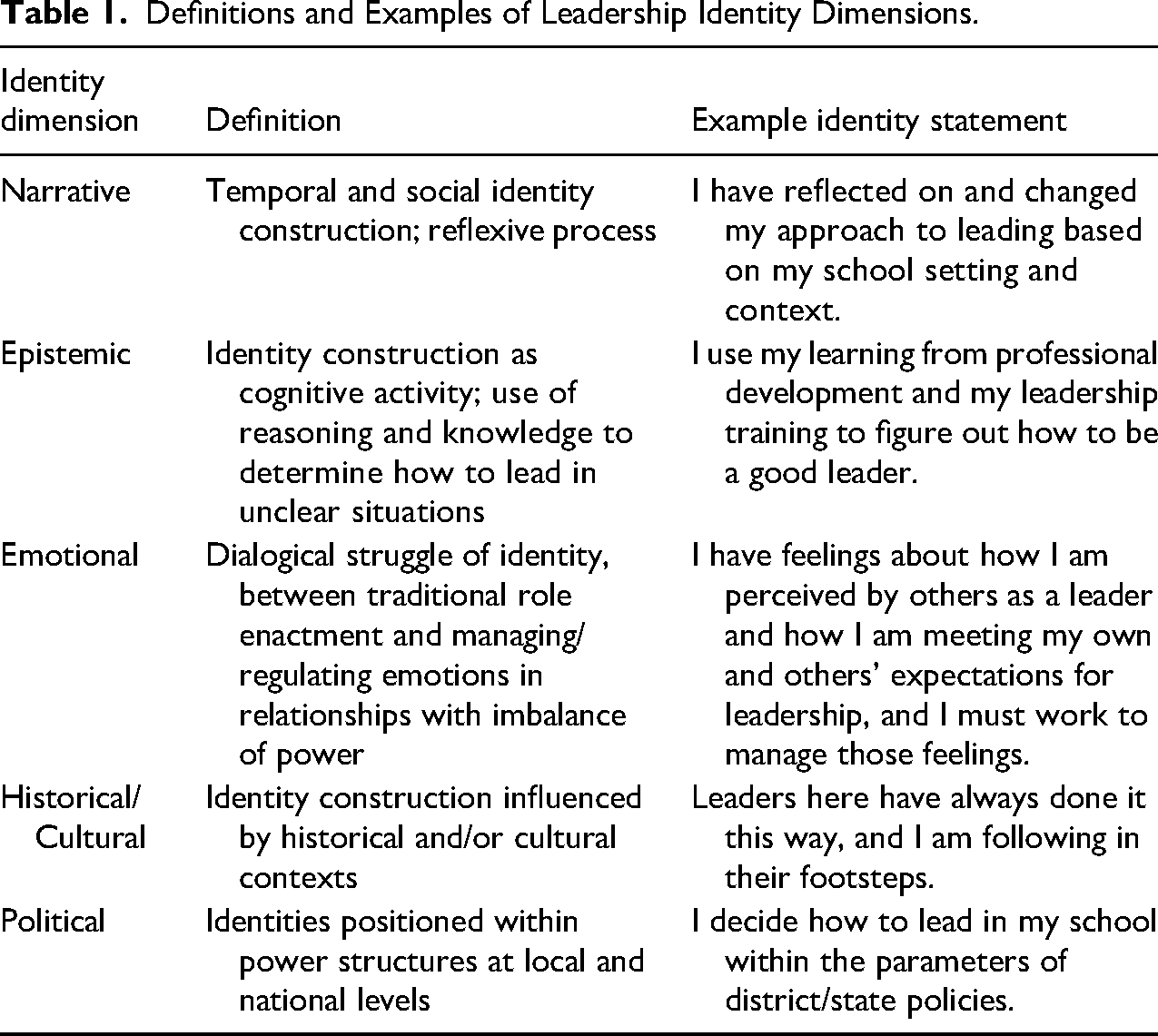
Crow et al. (2017) suggest five dimensions for examining principals’ identities in research, which we utilize here, alongside the models for leadership previously discussed (e.g., instructional, distributed, integrated) to frame our data analysis and discussion. These five dimensions are narrative, epistemic, emotional, historical/cultural, and political. Table 1 outlines the definitions for each dimension and provides an example of an identity statement that may be reflected in a leader's behaviors or actions under each dimension. For example, if a leader describes changing their leadership approach based on their school context, this indicates that their leadership identity is constructed through the narrative dimension (see Table 1; Crow et al., 2017, 273–274). Leadership roles and identities intersect, and thus, we rely on the scholarship from leadership models and from leader identity development to frame all phases of this study.
Definitions and Examples of Leadership Identity Dimensions.
Methodology
We used a qualitative embedded single case study design, designating the phenomenon of leadership of DLI strands in Indiana schools as our case and the DLI principals as the units of analysis embedded within this case (Stake, 2008; Yin, 2017). Our study is a single case, bounded within Indiana, where the principals lead in a distinct social context of school choice, available DLI funding, and the Indiana Language Roadmap (2019).
Data Collection
We collected data from a variety of sources to strengthen the robustness of our study (Creswell & Poth, 2016; Yin, 2017). First, using publicly furnished information from the Indiana Department of Education's (IDOE) website, we identified all schools and districts implementing DLI programs in the 2020–2021 school year from their DLI directory (Indiana Department of Education, 2022). Next, we collected and analyzed data from three publicly accessible sources, including (a) IDOE enrollment and achievement data for schools with DLI strands; (b) school and district websites’ information related to DLI programs; and (c) state/local news articles that districts identified on their websites highlighting their DLI programs. These data assisted with building context for the study and informed the development of our interview protocol.
After review of these background data, we designed a semistructured interview protocol including questions on principals’ leadership in DLI programs and their approaches to DLI program planning, sustainability, staffing, curriculum, and community engagement. For each area, we included one to two questions. For example, for community engagement, we asked, “what were the steps that you took for community engagement with your DLI program?” The semistructured protocol created opportunities for follow-up questions to probe further into areas where interviewees could expand or reflect on their responses. To extend from the previous example, if this information was not provided in initial response, we would ask the principal why they took certain steps for community engagement or how they determined what to do next. These probes allowed for the DLI strand principals to provide detailed descriptions of both their work and the thought processes underlying their decisions as they implemented their DLI strand programs. Because leadership identity development takes place in the context of the principal's work (Lumby & English, 2009; Møller, 2012), we crafted interview questions to elicit information about the principals’ perceptions of their work and process of becoming leaders of DLI strand programs rather than explicitly about how they identify as leaders. While the principals’ responses typically included concrete examples describing their work in DLI strand programs, they provided rich data for analysis in response to our research question about their leadership identity development.
Sampling
We emailed all 33 principals of Indiana schools with DLI programs in 2020–2021 to request interviews via phone or Zoom calls. We completed interviews with 27 of these 33 principals of DLI programs, representing 82% of all DLI programs in Indiana at the time of data collection. Of these 27 interviewees, 26 were principals of schools where the DLI program operated as a strand, and 25 were principals at their schools prior to the DLI strand program's implementation. Interviews ranged from 50–90 min. In three cases, the principals were relatively new in their roles and invited members of their DLI team to participate, including assistant principals (n = 2) and DLI teachers (n = 1). While we did not request these additional participants, the three principals identified them as key to DLI's implementation, and thus, we allowed for their inclusion. All interviews were audio-recorded and transcribed. In addition to the transcribed interviews, each researcher took detailed field notes during the interview, which were also imported into NVivo 12 software. In both data analysis and reporting of findings, we used pseudonyms for schools and principals to protect participant confidentiality (Table 2).
Principal Interviewees and Schools.
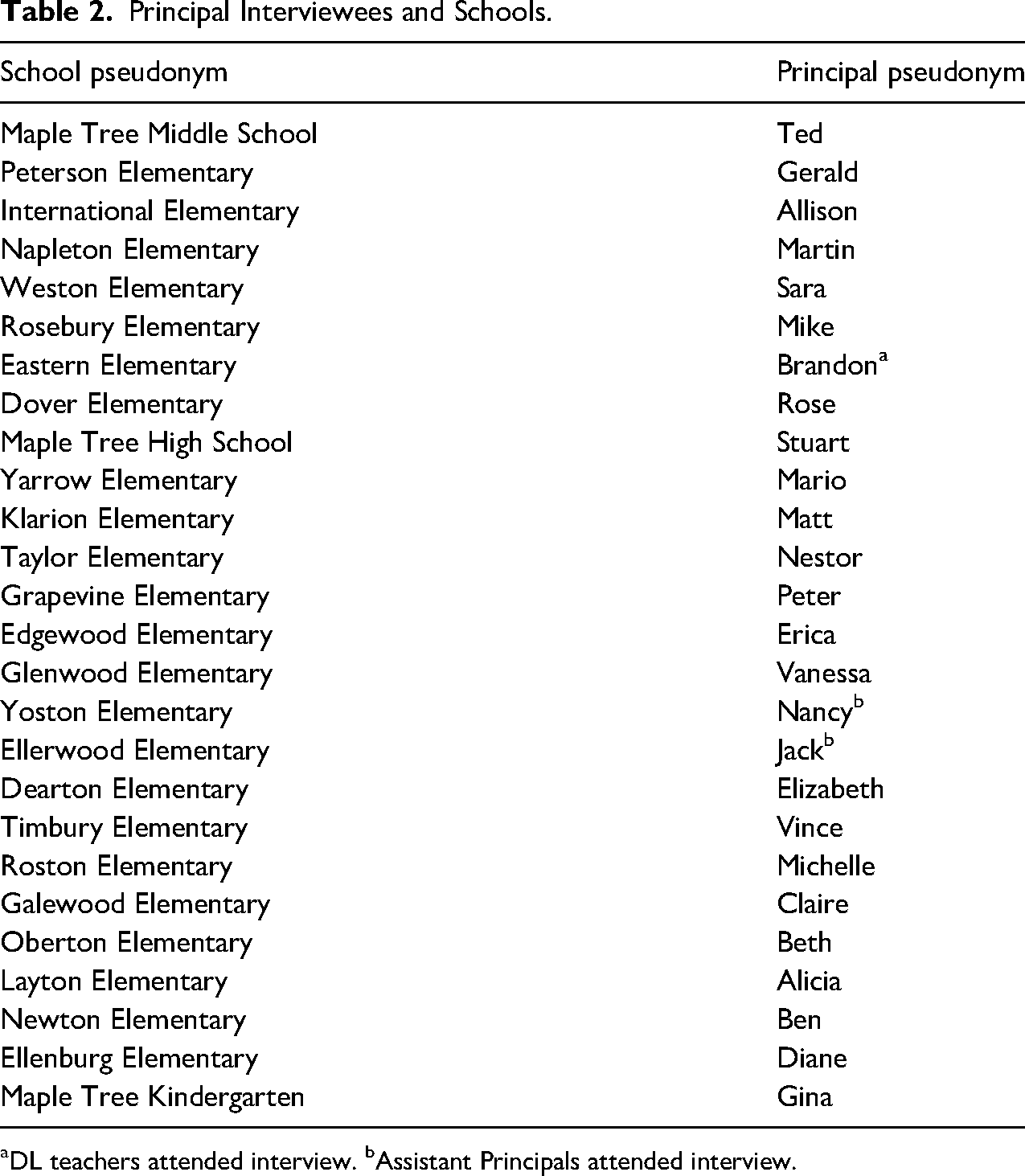
DL teachers attended interview. bAssistant Principals attended interview.
Analysis
The study had three distinct phases of analysis. First, all interview documents (e.g., detailed field notes and transcripts) were uploaded into NVivo 12, and the researchers created an a priori coding scheme for the first round of analysis, including broad categories related to principals’ perceptions and experiences of leading DLI strands (Gibbs, 2002; MacQueen et al., 2008). These broad coding categories stemmed from the interview protocol and were as follows: decision to start DLI program, target students, staffing, student/family recruitment and communication, curriculum and resources, professional development, assessment, relationship between DLI and general education classrooms, choosing to work in existing DLI program, program sustainability, website content, goals, vision for DLI program, and perceptions of DLI program. Following one round of coding the 26 DLI strand principals’ interviews, we pared down the data for analysis, to focus specifically on data related to interviewees’ leadership roles and tasks, such as the decision to implement a DLI program, staffing, professional development, the relationship between DLI and general education classrooms, and goals/vision for the programs. The second round of coding involved an initial set of concept codes (Saldaña, 2021) stemming from the review of educational leadership literature and subsequent focused coding to drill down further into emergent themes related to interviewees’ experiences with and development as leaders in their schools with DLI programs (Charmaz, 2014). Table 3 outlines the second round coding process, grouping the leadership concept codes in the left column alongside the focused subcodes for each in the center column.
Second Round Coding and Saturation.
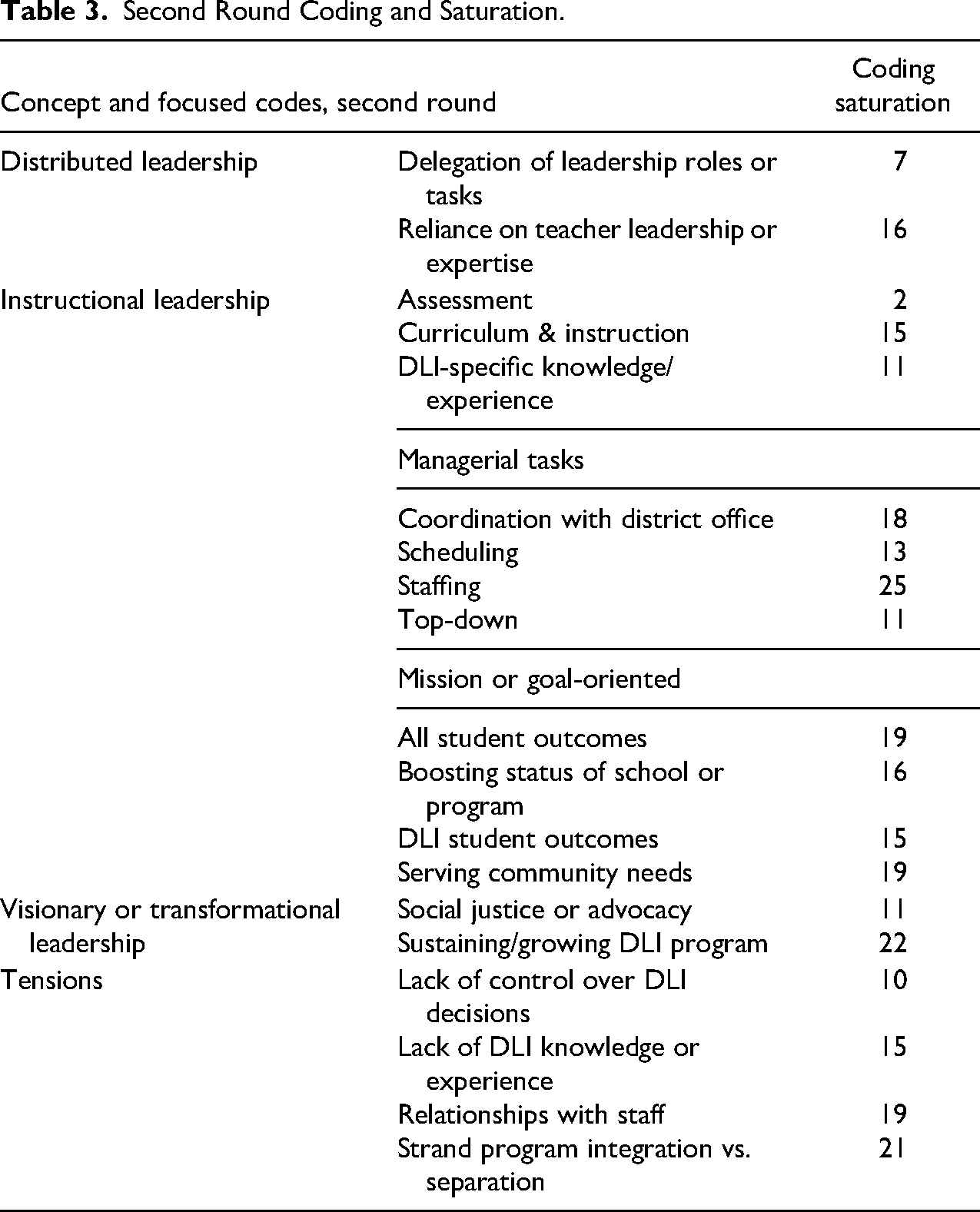
The second phase of analysis employed open coding in relationship to the subthemes drawn from extant literature (Table 3). We reviewed and coded the data from two interviews individually and then worked together to build consensus around the definitions of existing codes and to understand each other's processes for creating open codes (Harry et al., 2005). For example, when a principal described a dilemma, Researchers 1 and 2 independently identified this dilemma as distinct tension for DLI principals. Then the researchers would collaborate on describing the code further, ensuring it was aligned with existing literature. After collaboratively coding a sample of two interviews, each researcher completed coding individually of remaining interviews. We again met to review the coding process and to ensure consensus around the results of analysis. Thereafter, we reviewed the data in NVivo 12 to identify highly saturated codes and locate patterns across the interviewees. Saturation for each of the focused codes is listed in the left column of Table 3, indicating the number of principals (out of 26) whose interview data included at least one utterance categorized using the code specified.
In the third and final phase of analysis, which resulted in the findings included in the next section, each researcher reviewed all data coded at the most highly saturated themes under each of the concept categories (i.e., distributed leadership, instructional leadership, visionary or transformational leadership, and tensions). We then met together to examine these data through the five dimensions of principal identity (Crow et al., 2017). Consistent with our phase two analysis process, for the third phase, we coded two interviews individually, again conferring to ensure agreement. Employing these conceptual lenses, we triangulated our multiple data sources, identifying several themes across the dataset, which indicated commonalities among the roles, identities, and leadership experiences of the interviewees.
Limitations
In three cases, DLI strand principal interviews included other school staff members, such as DLI teachers or assistant principals. We recognize that this could have changed the ways in which principals shared about their roles, identities, and experiences. Yet, the principals recognized the key roles that their assistant principals and DLI teachers played in the launch of DLI, so we did not exclude them. Given the newer presence of DLI in Indiana, we also recognize that not all school districts have the same resources, and this could moderate how principals discussed their roles, identities, and experiences.
Findings: DLI Leadership as Management
In the interviews, the principals referred to themselves as leaders in ways that aligned with the literature on educational leadership, rather than specifically as leaders of DLI strand programs. Most commonly, the principals described their work as instructional leaders, with primary concerns around staffing (e.g., recruitment, hiring, retention, and management) and articulating the missions and visions of their schools and DLI strand programs. The principals also demonstrated aspects of distributed leadership as they discussed their reliance upon their teachers with more DLI knowledge and experience to assist in making decisions about their DLI strand programs. We elaborate on each of these themes below, providing illustrative examples from the principals. Thereafter, we discuss the examples and themes from the interviews through the dimensions of leader identity (Crow et al., 2017).
The Instructional Leader's Role in Staffing
As indicated by the coding saturation levels depicted in Table 3, the principals of DLI strand programs most frequently discussed their work in alignment with the traditionally conceived role of an instructional leader whose primary organizational management tasks are related to staffing (Engel et al., 2018; Hallinger, 2005). Among the data coded under instructional leadership, nearly all interviewees (96%) described their roles in recruiting, hiring, retaining, and managing staff for their DLI programs (coded at staffing). The unique structure of schools with DLI strand programs can lead to complex staffing decisions for principals, because DLI strands operate alongside traditional classrooms at each grade level. Within the data coded at staffing, several themes emerged related to how the principals perceived and enacted their roles as instructional leaders undertaking the organizational management tasks related to staffing. Specifically, the principals discussed how they fostered cohesion among their staff, tried to promote consistency and fairness across the DLI and general education programs, and adjusted their traditional approaches to recruiting and hiring staff for the DLI strands.
Fostering Cohesion Among DLI and General Education Staff
As leaders of DLI strand programs within schools that maintained traditional instructional programs, the principals discussed how they fostered cohesion among all staff. They highlighted the importance of maintaining transparency with and creating buy-in for the DLI strand program from their entire staff, not just those working directly with the DLI students. For example, Gerald of Peterson Elementary mentioned coordinating with the local teachers’ union and working within union guidelines in terms of restructuring positions to accommodate the new DLI strand teachers. Three more principals talked about teachers who had expressed fear of losing their positions to new DLI teachers. To illustrate, Vanessa of Glenwood Elementary and Ben of Newton Elementary detailed how non-DLI teachers who were not proficient in the target language of the DLI program seemed anxious about losing their jobs or being displaced to different schools as the DLI program expanded into the upper grades. For Ben, this did not materialize due to retirements and resignations, but the possibility created unease among general education teachers. Thus, the principals tried to ensure that non-DLI teachers felt safe in terms of their continued employment at their schools and valued amidst the addition of the new DLI programs. As leaders, Vanessa and Ben both believed it was important to respond to general education teachers’ concerns of displacement due to the addition of the DLI program to their schools and to ensure the stability of their teaching positions.
In addition to hearing teachers’ concerns and working with local unions, five principals described their efforts to cultivate collaboration among DLI and non-DLI teachers. Mike from Rosebury Elementary noted that trying to schedule time for this collaboration was “the biggest challenge [he] wasn’t aware of” when the DLI program began. He indicated that “collaboration is especially critical in the DLI program,” because the DLI teachers must coordinate their curricula in each language for the same group of students and align their lessons with grade-level standards. He wanted to ensure that the school's master schedule included frequent common preparation times for teachers in the same grade level (i.e., DLI strand teachers and teachers in the general education classrooms). These common preparation times would encourage collaborative planning among DLI teachers as well as coordination between DLI and general education teachers to maintain curricular alignment. Similarly, Sara from Weston Elementary stated that it was crucial for her to create collaborative structures for the target language and English teachers in the DLI program, and she described this as a “huge undertaking.” She compared the relationship between teachers in their DLI program as a “huge marriage,” because they share a large group of students, i.e., two classes of students instead of one class for a general education teacher. Finally, Elizabeth from Dearton Elementary shared that she had created a schoolwide “cultural committee” to “make sure that the [DLI strand] program is not isolated within the school, that everyone is a part of it.” She said that she had received a “great response” to this effort, and that “more than half of the staff” had joined the cultural committee, where staff collaborated on “global awareness” efforts.
Consistency and Fairness Between the DLI Strand and the General Education Program
Because all principals were leading DLI strands within their schools, they had to negotiate how their school's established general education programs functioned alongside their new DLI programs, which included new curricula and staff. Twenty-one of the 26 principals (81%) described tensions they faced in integrating their DLI strand programs into existing school cultures or managing teachers’ perceptions of these programs as separate from the rest of the school (coded at strand program integration vs. separation). For many of the principals, this presented as a desire to promote consistency and fairness between the DLI and general education programs despite inherent differences related to staffing and student constituencies.
To illustrate, Jack of Ellerwood Elementary struggled with the “fairness” between teachers in the DLI strand and teachers outside of it. As Jack stated, his school and district had widely publicized their DLI program from its inception, and the DLI teachers, students, and families received a lot of positive attention from the district. His district-level administrator wanted the DLI program to be a success, and the experienced general education teachers suddenly felt their educational track was the lesser of the two. Jack shared the challenges of “making everyone happy” and satisfying the demands of both the DLI and non-DLI families and staff. Similarly, Diane of Ellenburg Elementary wrestled with the notion of fairness between DLI and general education teachers when it came to teacher evaluations. Diane did not speak the target language of the program; therefore, she felt uncertain about appropriately evaluating the DLI teachers during target language instruction. She not only had to evaluate teachers in a language in which she was not proficient, but she also recognized that DLI instruction differed from traditional instruction, such as more focus on language use and practice for students across all content areas. She reflected on this, sharing that “you can’t evaluate the same way as we do for general education.” Like Jack, Diane faced new challenges in her role as a leader in promoting consistency in teacher evaluation across the DLI and general education programs.
In addition to the challenges of fairness among the DLI and non-DLI teachers related to their curricula and evaluations, the principals also described teachers’ perceptions of differences between students in the DLI strands as compared to students in the general education classrooms. Because general education programs were the default option for enrollment, parents had to proactively choose to enroll their children in the DLI strand programs. Thus, some principals remarked that their DLI strands had students with more socioeconomic privilege and that the racial/ethnic demographics of the DLI strands differed from those of the general education classrooms. For example, Nancy of Yoston Elementary and Gina of Maple Tree Kindergarten both remarked on the “haves and have nots,” suggesting that the families who chose the DLI strand programs for their children were knowledgeable about the instructional options available in the district. While their schools were regarded as racially integrated as a whole, at the program level, the demographic makeup of students in the DLI strands was different than the general education classrooms. Specifically, in schools like Nancy's and Gina's, with both Latinx and African-American students, the Latinx students tended to be concentrated in the DLI strands. Gina stated that the teachers in her school felt that there was an unfair division between Latinx children in the DLI strand and those in the general education program who were predominantly African American. Similarly, Erica of Edgewood Elementary reflected on the perceived “elite” status of her school's DLI program in comparison to the general education program, saying, I don’t want the DL strand to look isolated from the rest of the school and look like the elite program. The majority of the students who enroll February to April … most are from educated families and have had preschool in this current kindergarten classroom, had less behavior issues, more parental support … not wanting a divide between the classrooms. I’m working on it. We do have staff meetings, talking about DLI … it involves all of us.
Recruitment and Hiring of “Proficient” DLI Teachers
DLI strand principals had to anticipate the need for qualified teachers to staff the DLI program, then recruit and hire those teachers. All the interviewees who discussed staffing mentioned proficiency in the target language as a crucial qualification, at least for the teacher who would provide instruction in that language, and they talked about the challenges of finding those DLI teachers. Several described trying to be proactive in their hiring decisions, as they expected their DLI strands to grow from one grade level to the next. For example, Vince from Timbury Elementary stated that he had been “purposefully hiring [target language] speakers” when a teacher in his school left or retired, to “plan ahead” for staffing needs in the DLI program. Similarly, Peter from Grapevine Elementary shared that he had hired a fluent target language speaker into an open position in a grade level not yet included in his school's DLI strand program, but that he anticipated that she would eventually become the DLI teacher for that grade level. He stated that he was “always trying to operate at least a year ahead of schedule, always recruiting” when it came to the DLI program.
Some of the principals also aspired to recruit DLI teachers from within their own school communities, particularly if those communities included native or heritage speakers of the target language. In discussing their staffing needs and challenges, both Stuart from Maple Tree High School and Allison from International Elementary stated that they would like to “grow their own” candidates for teaching DLI from within their communities, indicating that they would assist bilingual candidates with teacher certification requirements. Finally, some of the principals perceived challenges in staffing their DLI programs due to competition for qualified DLI teachers among other schools around the state. As Martin from Napleton Elementary remarked, staffing teachers with the necessary language proficiency can be “a struggle,” because schools with DLI programs are “fighting over the same pool of candidates.”
Mission and Goals of DLI Program
The DLI strand principals demonstrated how they perceived themselves as instructional leaders as they discussed their missions, visions, and goals for their DLI programs and schools. Again, this aspect of the principals’ instructional leadership aligns with the concept prevailing in the literature: that instructional leaders help to define and drive their schools’ missions, visions, and goals (Gurley et al., 2016; Hallinger, 2005; Rigby, 2014). The primary ways in which principals described their missions, visions, and goals related to student outcomes and how their DLI programs would serve the needs of their communities.
Focus on Student Outcomes
Nineteen of the 26 principals (73%) discussed how their DLI strands could enhance outcomes for all students in the DLI programs and even those outside of the DLI programs. Ten of these 19 (53%) described these outcomes in terms of language proficiency, with some also mentioning cultural competency or schoolwide adoption of the “three pillars” of DLI instruction (i.e., bilingualism and biliteracy, academic achievement, and cross-cultural understanding (Howard et al., 2018)). Vince of Timbury Elementary focused on the DLI students’ language proficiency as a core piece of the DLI program's mission, stating: All kids in the immersion program [should be] graduating with the Seal of Biliteracy. . . the ultimate goal is that when they leave [the DLI strand elementary program] in 6th grade, they are reading, writing, speaking, and listening at a 6th grade level in both languages. I know we aren’t there yet, but that is the ultimate goal.
Serving Community Needs
Principals also described their overall missions and visions for their schools and DLI strands when discussing how these programs responded to and served the needs of their communities. Of the 19 interviewees (73% of the total) who discussed their schools’ or programs’ missions in these ways, 10 of them focused on how the DLI strands benefitted their communities’ native speakers of the program's target language. As Alicia of Layton Elementary shared, part of the impetus for starting their DLI strand program had been “lots of conversations around our fastest-growing population of students [English learners] and how to support them.” Alicia saw the DLI program as a way to “support” EL students, who would now be learning in their native language while acquiring English. This sentiment was echoed by Ben of Newton Elementary, who stated that his district had “initiated” their school's DLI strand program because the school's English learners were “lagging behind” other students in terms of growth on English standardized assessments. As Ben put it, “We need to make sure we’re able to teach all children, and DLI has proven to do that [effectively]. . . Being able to teach them in their native language is the Cadillac way of doing this.” Ben's comments reflected his belief that the DLI instructional model is highly effective for all students, which is based on research on DLI student outcomes (Collier & Thomas, 2004; Morita-Mullaney et al., 2020a; 2020b). Other principals talked about their DLI strand programs enhancing engagement among parents, both those who were native speakers of the target language and those who were native English speakers. Brandon of Eastern Elementary shared that because of his school's DLI program, he “has seen leadership traits brought out in the [target language speaker] community that he hasn’t seen before.” For Brandon, the implementation of a DLI strand program sent a strong message to the native non-English speaking members of their community that their language held value, which led to their increased involvement in the school, such as helping to organize family engagement events and participating in the parent-teacher organization. Others described how DLI strand programs could help their communities bridge cultural or linguistic differences. As Allison of International Elementary discussed: …bridges and bonds that are built across language lines, and there are communities of kids that are much deeper, and the families are connected, because the kids are connected. This will be an example of coming together and relationships and bonds that make things different in our community.
Distributed Leadership
While many of the principals’ statements reflected their perceptions of themselves as instructional leaders for their DLI strand programs, there was also evidence of distributed leadership in their descriptions of their work. More than half of the interviewees (62%) described their leadership in ways that reflected characteristics of distributed leadership wherein principals delegate certain leadership tasks or functions among teachers or other staff (Camburn et al., 2003; Spillane et al., 2004). In our coding scheme, we demarcated two aspects of distributed leadership that emerged from our interviews, and we found that the principals most often talked about their reliance on their DLI teachers’ leadership or expertise when it came to implementing their DLI strand programs. Brandon, from Eastern Elementary, expressed that his school was “fortunate to have homegrown people [teachers] willing to take on the challenge of dual language.” While he stated that “his job was finding staff,” he also suggested that he would rely on those staff to implement the program successfully, saying, “everything will drive itself if you have the [right] people in place.” Similarly, Vince shared his experiences with applying for the state's DLI funding, saying that his staff were “ready for a challenge” and “took a lot of ownership” in the process of writing the grant proposal. As a result, with their DLI strand program underway, he said that the staff “have a lot vested” in the program to ensure its success. Other interviewees described how they had relied on teachers with experience or training in DLI to support and serve as models for the new teachers in their DLI strand programs. For example, Rose from Dover Elementary explained that her school's DLI team included a “master teacher with knowledge of dual language, involved from the beginning,” of the program and that some of the new DLI teachers generally “needed a lot of support with classroom management.” She went on to describe the DLI teachers’ anticipated planning meetings over the summer, stating that two of the experienced teachers would be leading this effort. Another interviewee, Jack from Ellerwood Elementary remarked, “I do think that as we are getting more teachers in this [DLI program], that they have each other as resources. They can network from one grade level to another.” Mike similarly stated that in his school, “those [DLI] teachers rely on each other just like teachers in traditional schools; they have great relationships and collaboration.” As these findings illustrate, the principals practiced distributed leadership primarily through delegation of leadership tasks, such as supporting new teachers, to their more experienced DLI teachers.
Principals of DLI strands framed their leadership through the lenses of instructional leadership, and, to a lesser extent, distributed leadership. Specifically, they perceived their primary roles as instructional leaders charged with making organizational management decisions around staff and articulating visions for their schools and DLI strands. They also demonstrated aspects of distributed leadership as they described their reliance on the expertise of their DLI teachers in implementation of their DLI strand programs. With these findings in mind, we turn to our next set of findings related to principals’ descriptions of their leadership and how they reflect their leader identity dimensions as outlined by Crow et al., (2017).
Findings: DLI Leadership Identity
Principals of DLI strands perceive and enact their leader identities in alignment with managerial definitions of instructional leadership, rather than reflecting leader identities that may be in tension or which have evolved in the context of leading DLI strand programs. We found that this reliance on established educational leadership models does not invite opportunities for reflexivity in the new context of a DLI strand program, demonstrating the limitations of such models in consideration of DLI leadership. In this discussion of the principals’ identities as instructional leaders, we examine the themes that emerged through the five dimensions of leadership identity as defined by Crow et al. (2017). As outlined in Table 1, these five dimensions are narrative, epistemic, emotional, historical/cultural, and political, and here we will discuss how and whether our findings reflect the principals’ constructions of their leadership identities along these dimensions. The five dimensions of principals’ identities (Crow et al., 2017) manifested mostly in historic, political, and epistemic ways, but less so in narrative and emotional ways, as we discuss below.
Historic Dimension
For the historic identity dimension, we saw strong evidence that principals constructed their leader identities in alignment with foundational research on effective leadership practices (Hallinger, 2005; Hallinger & Murphy, 1985; Heck, 1992), as well as with more recent research intersecting instructional leadership and organizational management (Grissom & Loeb, 2011; Sebastian et al., 2018). The DLI strand principals described their leadership in ways that largely reflected the traditionally defined role of an instructional leader engaging in organizational management tasks inherent to the principal's role, such as recruiting and hiring teachers and promoting stability and consistency among staff. For example, the principals’ discussions of their roles in recruiting and hiring staff reflected research on effective instructional leaders (Kimball, 2011; Odden, 2011); as Brandon from Eastern Elementary stated “having the right people in place” was key to a successful program. Additionally, as the principals articulated their visions for their schools and DLI strand programs, they primarily focused on the importance of student outcomes, which aligns with the literature asserting that this should be a core concern of an effective instructional leader (Gurley et al., 2016; Hallinger, 2005). Although many of them professed to have limited knowledge of DLI instruction, the principals felt empowered by their experience in the managerial role of an instructional leader to continue to enact identities that aligned with this role, specifically those related to tasks historically undertaken by any school leader, such as managing staff and upholding the schools’ visions. Thus, the DLI strand principals perceived their leader identities in ways that reflected a historical understanding of instructional leadership. However, as DLI strands may diversify a school's student and staff constituencies, drawing only on the historic dimension of their identities may be insufficient.
Political Dimension
DLI strand principals demonstrated how they constructed their identities as leaders within the political contexts of their schools and districts. When the principals described working with teachers’ unions and listening to teachers’ concerns about the distribution of students across the DLI strands and non-DLI classrooms, they positioned themselves as leaders who were aware of and working within the power dynamics among teachers in their schools and across schools in their districts. For example, principals discussed how the DLI strands created challenges related to perceptions of relative status among teachers across instructional programs. Then, they highlighted their roles as leaders in managing these perceptions and easing teachers’ worries about being displaced to different schools to accommodate new DLI teachers. On the other hand, principals also spoke enthusiastically about the DLI strands raising the status of their school within the district and community. The DLI program attracted families and students, making school boards and superintendents happy in the context of competition and school choice, according to Jack of Ellerwood Elementary. Thus, the principals were tasked with balancing both the internal politics of their DLI and non-DLI staff, or “not wanting a divide between classrooms,” as Erica from Edgewood remarked, and external political pressures to promote and celebrate the newly implemented DLI programs on behalf of their schools and districts, as Jack of Ellerwood Elementary indicated. For these principals, this leadership task of implementing the DLI strand programs within the political contexts of their schools and districts did not seem to create a tension in their identity enactment; they perceived this as inherent to their role.
Epistemic Dimension
The epistemic dimension of the DLI strand principals’ identities as leaders is similar in some ways to the historic and political dimensions. DLI strand principals relied on their previous experiences as school leaders (albeit in general education settings) to enact their new roles as principals in schools with DLI strands. Most of the DLI strand principals we interviewed (96%) were principals of their schools before the DLI strands were implemented and used these prior experiences to guide their DLI leadership. Further, the principals considered how to adjust to the unique context of a DLI strand, which involves leading two schools within one (Freire & Aleman, 2021). For example, Vince from Timbury Elementary spoke about “hiring strategically,” knowing that any new teacher, especially a bilingual one, could be a future candidate for a DLI position. Similarly, Rose from Dover Elementary discussed needing to rethink her evaluation process for the DLI teachers, since she did not speak the target language of instruction for the program. Additionally, the epistemic dimension was apparent as DLI strand principals employed distributed leadership, relying on existing DLI teachers’ expertise in supporting newly hired DLI teachers, as Rose, Jack, and Mike remarked. While these principals did not describe spending significant time or effort to substantively change their leadership styles, they did demonstrate small pivots and adjustments to indicate there were gaps in their previous experience that would need to be filled to effectively lead a DLI strand program. These leadership adjustments indicate that the DLI strand principals were constructing their leadership identities through the epistemic dimension, using their existing knowledge and skills to determine how to best lead within the new DLI strands.
Emotional and Narrative Dimensions
There was little evidence among the principals that the challenges of implementing a DLI strand program had caused any emotional grappling with their identities as leaders. Many of them described the emotional reactions of teachers in response to the introduction of a DLI strand. However, these discussions focused on how principals helped to manage the teachers’ concerns, not on how the principals themselves felt about any perceived changes to their own roles. Similarly absent among the principals was any reflexivity regarding their leadership roles and identities, which would have been indicative of the narrative dimension to their identity development within the context of a DLI strand. Rather, they consistently focused on looking forward to the future and growth of the program, instead of reflecting on how implementing a DLI strand had brought about any changes in their identities as leaders. The principals’ statements demonstrate a consistent pull toward operating their schools with historic structures and practices, drawing upon established models for educational leadership.
The first part of our study described how DLI principals managed their DLI programs. Stopping our study at this interval would situate principals as operating well-managed programs within models of instructional and distributed leadership. But, when examining dimensions of leadership identity, we see emotional and narrative dimensions absent or underexplored, demonstrating a significant blind spot in the professional development of DLI principals. Emotional and narrative dimensions of leadership identity require a commitment to discomfort and dissonance, embodying a learning principal and holding promise for a more equity grounded DLI program (Palmer et al., 2019).
Discussion and Implications for Research and Practice
Our study demonstrates that principals’ roles are embedded within historic models of leadership, leading to a retrofitting of well-established managerial tasks into the new program model of DLI. This rather static framework restricts the ways in which a school could transform when a DLI strand is adopted. Work in identity theories drawn mostly from teacher leadership literature and less so from educational leadership literature (Crow et al. (2017) excluded), yielding to implementation challenges as DLI scales. By intersecting distributed and instructional leadership with leader identity research, we can reframe the roles of DLI principals, and move toward their embodiment of leading for multilingualism. In the following section, we discuss our findings through these dual lenses of educational leadership models and leader identity dimensions and share implications for research and practice in equity focused DLI leadership.
DLI strand principals primarily relied on their managerial and experiential understandings of instructional leadership and distributed leadership to enact their roles, rather than shifting their identities to fit the DLI context. In an environment of increased school choice, principals are becoming proprietors of their buildings and working to make their schools attractive to families (Gobby, 2016), which can decrease the conditions for inquiry around emotional and narrative components of their leader identities. As found in our study, principals discussed DLI as a tool to better serve their students and school communities but did not express emotions or doubts about their leadership of these programs. The principals also embraced the political aspects of their identities as leaders, describing their roles in managing both power dynamics among staff and their school's relative position among others in their districts due to the DLI strand program. Finally, they exhibited distributed leadership qualities, as they relied on the expertise of their DLI teachers to implement their programs.
When the principals discussed their organizational management tasks and leadership roles, they sometimes described their work in response to the emotional needs or reactions of their teachers, such as addressing anxieties related to job displacement to make room for a growing DLI strand. However, they did not reflect on their own identity shifts or struggles related to implementing this new instructional program. They described specific changes to their leadership work in concrete ways, such as needing to plan further ahead for staffing needs or altering teacher evaluation practices, but they did not share how or if these changes affected their perceptions of themselves as leaders. This finding demonstrates the need for principals of DLI strand programs, professional development providers, and those conducting research in these contexts to examine leader identities through more reflective and emotional dimensions, drawing upon scholarship beyond historic educational leadership models.
Leadership scholarship for bilingual and DLI programs demonstrates that when educators move from classroom positions into administrative roles (such as principals), they are encouraged to cast off their teacher identities (Morita-Mullaney, 2019a; 2019b). As Møller (2012) indicates, principals are often publicly perceived as “heroic” leaders, suggesting that they are “looking forward” and not looking retrospectively (Morita-Mullaney, 2019a; 2019b), reducing the possibilities for emotional and narrative forms of leader identity development, which have been more thoroughly examined in teacher identity scholarship (Day & Gu, 2010; Day et al., 2006; Flores & Day, 2006; Morita-Mullaney, 2018). While the DLI strand principals described how they managed teachers’ emotional challenges in response to the newly implemented DLI strand programs, they did not reflect on their own emotional responses to this changing leadership context. This tension within schools with DLI strands demonstrates the need for principals to draw upon their emotional and narrative aspects of the leadership so they stand in greater congruence with their school communities (Morita-Mullaney, 2019a, 2019b), promoting and instituting the additive tenets that a DLI model imbues (Howard et al., 2018; Palmer et al., 2019).
Furthermore, leadership preparation curricula generally have little to no content about identified-ELs (Baecher et al., 2013) and seldom discuss DLI program models (DeMatthews & Izquierdo, 2018; Morita-Mullaney, 2019a, 2019b; Renn et al., 2023). Thus, a principal entering a school with an existing DLI strand or implementing a new DLI strand likely will have little content expertise in DLI, as evidenced in this study through the principals’ reliance on DLI teachers’ experience and knowledge to assist with certain leadership tasks. Leadership preparation programs must attend to this need, as DLI is growing throughout the U.S.A. In addition to enhancing educational leadership preparation and professional development content related to DLI programs, we recommend that prospective and current school leaders who are (or may be) tasked with leading DLI or DLI strand programs engage in reflective work around their own leader identity development. Table 4 presents a suggested set of questions to guide educational leadership professional learning activities to comprehensively address identity development for leaders of DLI programs. We return to the original five dimensions as presented by Crow et al. (2017) and recommend guiding questions to spark discussion and reflection under each dimension, as presented in Table 4. Engaging current and prospective school leaders, particularly those who already are leading or may someday lead schools implementing DLI strands, in the work of examining their own trajectories of leader identity development and change may strengthen leaders’ connections to their schools, teachers, and selves as leaders. Answering and reflecting on these questions across the dimensions of leader identity may encourage critical thinking about how they have learned to be leaders and how they can continue to improve as leaders who are responsive to their specific school contexts.
Leader Identity Dimension and Guiding Questions.
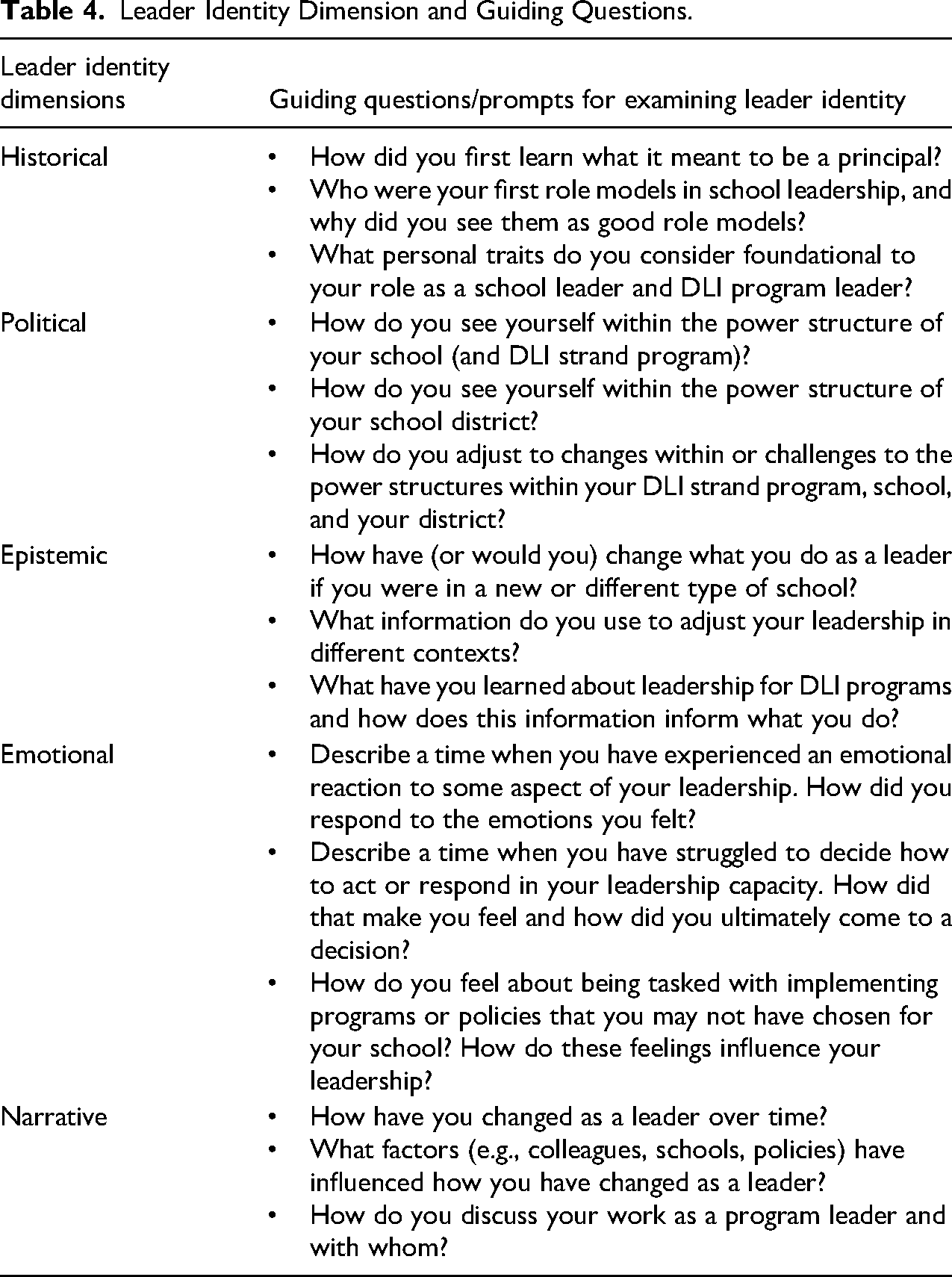
With the guiding questions in Table 4, we present an alternate construction of leadership in the context of DLI that is iterative and reflexive in nature. Our recommended model creates greater assurances of identities being more fully explored, consistent with the intersectional and cross-cultural goals within DLI (Howard et al., 2018; Palmer et al., 2019). Since we found that principals enacted historic, epistemic, and political dimensions of their identities, this familiarity can be used to ground conversations toward investigating emotional or narrative dimensions of their identities. For example, if a principal is accustomed to staffing their building in a particular way (historically), how do they feel about the newly added dimension of hiring for multilingualism, and how would this fit in a school climate that is now presumably, multilingual in its thinking? This model of identity congruity for multilingualism can assist districts in selecting DLI leaders, content for mentoring, and professional development. We argue that DLI leadership committed to the emotional and narrative dimensions of leader identity creates implementational space for a school environment that is multilingual in its thinking and collective identity.
We present these recommendations as a guide not only for practitioners in the fields of education leadership and preparation, but also for scholars engaging in research with educational leaders and particularly in schools with DLI programs. As this study has illuminated, principals in DLI strands typically embody the managerial roles of instructional leaders, despite the unique and new challenges of leading schools with DLI strands. We suggest that these leaders can develop more nuanced understandings of what it means to become effective leaders of schools with DLI strand programs. Through reflective examination of leader identity development, the field of educational leadership can improve their preparation of high-quality and critically conscious school leaders.
Footnotes
Declaration of Conflicting Interests
The authors declared no potential conflicts of interest with respect to the research, authorship, and/or publication of this article.
Funding
The authors received no financial support for the research, authorship, and/or publication of this article.
