




Abstract
Keywords
Introduction
According to the National Teacher and Principal Survey (NTPS) provided by the National Center for Education Statistics (NCES), in the 2015–16 school year, the representation of female principals (34%) was substantially lower than male principals (66%) in American public secondary schools. In the 2015–16 school year, Black principals accounted for approximately 10% of secondary school principals with the percentage of Black women principals accounting for slightly less than half (49.3%) of all Black principals in American secondary schools (NCES, 2021). More specifically, Black women principals comprised about 4.8% of all principals in public secondary schools (NCES, 2009), making them unicorns among US secondary school principals. Their unique position at the intersection of two minority identities (race or ethnicity and gender) can offer important insights on leadership and its association with the demographic context, teachers’ collective responsibility, and students’ academic achievement at the schools they lead.
With the emergence of Black feminist thought over the decades and intersectionality theory (Collins, 1998; Crenshaw, 1991; hooks, 1981), increasing attention has been paid to the leadership of Black women principals (e.g., Brown, 2005; Lomotey, 2019; Tillman, 2004). Such studies have investigated the distinctive experiences, challenges, leadership practices, and successes of Black women principals, mainly using qualitative inquiries (e.g., Allen et al., 1995; Bloom and Erlandson, 2003; Dillard, 1995; Peters, 2012; Reed, 2012; Tillman, 2004; Wilson, 2016; Witherspoon and Taylor, 2010). However, more broadly applicable, quantitative research on Black women principals is still lacking (Lomotey, 2019; Okoli et al., 2020). Commenting on the reasons for the dearth of publications on Black women principals, Bloom and Erlandson (2003) claimed that “suspect conclusions [from a minority insider's perspective] are summarily ignored or dismissed, seldom becoming a part of administrative leadership theory” (p. 344). In addition, the traditional conceptualizations of leadership, which normalize Whiteness and emphasize masculinity and charisma, contradict the positionality of Black women that stems from their race or ethnicity and gender and may contribute to them remaining institutionally invisible (Anzaldúa, 1987; Collins, 1991; Maher & Tetreault, 1993).
This “institutional silencing” (Gitline, 1994, p. 4) on Black women principals in the literature is particularly problematic in schools as they lead to serious misunderstandings, misconceptions, and stereotypes regarding school community members with different marginalized social constructs. For example, Banks (2020) described mainstream academic knowledge as “dominant canons, paradigms, and theories” (p. 27) that are Western-oriented and Eurocentric and argued that these may distort our conceptions about the lived experiences of women and racial or ethnic minorities. Transformative academic knowledge based on postmodern assumptions challenges institutionalized and internalized mainstream knowledge, leading to critical insights about marginalized groups (e.g., Black women) (Banks, 2020). In this regard, research on Black women principals may contribute transformative academic and decolonized knowledge to leadership theory that has typically focused on White male principals. Ultimately, it will provide new perspectives on and interpretations of the experiences of these hidden but important leaders.
This study aims to provide quantitative knowledge concerning the leadership of Black women principals, thereby filling a significant gap in the leadership literature. Lomotey (2019) pinpointed the need for quantitative inquiry with a specific focus on Black women principals, and this study addresses that need. In particular, it investigates (1) the school contexts (demographic composition) in which Black women principals serve, (2) these principals’ instructional leadership behaviors (e.g., Supovitz et al., 2010), (3) the collective responsibility among teachers in the schools they lead, and (4) the association between their interacting identities and the math achievement scores of the 9th graders at these schools. It examines how the instructional leadership characteristics of Black women principals differ from those of male principals and White women principals. Because our understanding of Black women principals in US secondary schools is especially limited (e.g., Lomotey, 2019), they are the focus of this study.
The next section provides a literature review focusing on Black women principals and instructional leadership that may illustrate how school leadership influences student achievement. It also specifies the critical quantitative intersectionality framework (Jang, 2018) used in this study. The following section describes the research design, data sources, and statistical analysis used in this study. Subsequent sections present the findings and conclude with implications for researchers, policymakers, and educational leaders, the limitations of the study, and guidelines for future research.
Literature Review
The literature on racialized and gendered dimensions of educational leadership has documented the significant link between principals’ race or ethnicity and gender and their leadership practices and behaviors. In particular, the literature has suggested that Black principals strategically utilize their understanding of and responsiveness to the cultures of their students and their families (particularly among students of color) (e.g., Khalifa et al., 2014). For example, Tillman (2004) synthesized the literature on Black principals and found that they were committed to preserving the culture of Black communities and supporting students’ positive self-identities (e.g., Lomotey, 1993). In a similar vein, Bordas (2012) argued that “[Black people's] history as colonized people is a common denominator in engendering leadership that is people-centered, community-focused, and advocacy-oriented” (p. x). The literature examining specific leadership behaviors of principals shows a strong commitment by Black principals of providing support and mentoring for their teachers and advocating for the effective schooling of students of color (e.g., Wilson, 2016).
Fitzgerald (2003) rightly criticized the limitations of the gendered and racialized perspectives in extant leadership theories on the basis that “considerations of race and ethnicity are not explicitly uncovered to examine ways in which these trajectories [intersecting with gender] impact on the exercise of educational leadership” (p. 432). Scholars who have focused on the diverse aspects of Black women principals have provided distinctive understandings compared to traditional research, which has typically homogenized women's leadership since the late 1970s (e.g., Eagly and Johnson, 1990). In re-examining knowledge about Black principals through a gender lens, scholars have argued that the experiences of Black women principals are uniquely different from those of all male principals, Black male principals, and White women principals. The distinctive positionality of Black women principals as “a minority group in a minority setting” (Fitzgerald, 2006, p. 205) has led to disparate experiences in their leadership practices. In particular, the literature has explored the diverse aspects of experiences of Black women principals, including their personal backgrounds (e.g., Wrushen and Sherman, 2008), career paths (e.g., Ingram, 2016), barriers and failures (e.g., Jean-Marie, 2013; Okoli et al., 2020), and challenging school contexts (e.g., Brown, 2005; McCray et al., 2007). The literature has also described the success of Black women principals in creating a positive school culture and improving all students’ achievement (e.g., Bloom and Erlandson, 2003; Tillman, 2004; Okoli et al., 2020; Peters, 2012).
Black Women Principals, Leadership Practices, and Student Achievement
Background on black women principals in secondary schools
The work and contributions of Black women principals in American secondary schools are historically momentous. Black women principals such as Anna Julia Copper, Fanny Jackson Coppin, and Sara Smith have played critical roles in education as educators and school leaders since the 19th century (Tillman, 2004). The historical literature speaks to the roles of these women as instructional leaders (Savage, 2001; Wilson, 2016). For example, Anna Julia Cooper, who was named principal of the M Street High School in Washington, D.C. in 1902, exhibited strong leadership in preparing Black students to attend postsecondary education (Cooper, 1988). Fanny Jackson Coppin was principal from 1869 to 1904 at the Institute for Colored Youth in Philadelphia, where she introduced diverse strategies to promote excellence in Black education, such as offering classical education, abolishing tuition, and providing housing to working women to support their educational advancement (Perkins, 1982).
Nevertheless, studies focusing on Black women principals in secondary schools have revealed the challenging working conditions they face when exercising their leadership. According to the most recent available NTPS data (NCES, 2021), Black women principals are more concentrated in elementary schools (8.0%) than in secondary schools (4.8%), where there is powerful White male domination in principalship (Dillard, 1995). This distribution may reflect the potential structural challenges that Black women principals in secondary schools experience in terms of salary and promotion, as principals in elementary schools receive a relatively low average salary (Bailes & Guthery, 2020) and are less likely to be promoted to district leadership compared to secondary school principals (Brunner & Peyton-Claire, 2000). In addition, Black women principals typically serve as leaders in high-poverty urban schools (Bloom & Erlandson, 2003) that serve many students living in poverty and students of color, including Black students (Bailes & Guthery, 2020; Davis et al., 2016). Under these challenging circumstances, many cases of Black women principals, particularly in secondary schools (e.g., Dillard, 1995; Peters, 2012), illustrate their positive influence as “clean-up women” (Peters, 2012, p. 29) who are committed to changing negative school cultures and conditions for the education of diverse marginalized students (e.g., students who are resistant to teachers or lack support and resources; Peters, 2012; Pigford and Tonnsen, 1993; Tillman, 2004). These powerful contributions directly speak to the importance of having more Black women principals in schools (Davis et al., 2017; Fuller et al., 2019).
Leadership practices of black women principals and student achievement
A considerable body of literature on Black women principals has used primarily qualitative methodologies to focus on specific leadership practices and behaviors that may create a positive school culture and promote student achievement. This work has demonstrated that Black women principals tend to show strong advocacy for and commitment to educational equity, social justice, and community in their leadership practice (e.g., Tillman, 2004; Wilson, 2016; Witherspoon and Taylor, 2010). Their experiences of multiple oppressions often lead to dedicated and strong behavior as caring, service-oriented transformative leaders (Lomotey, 2019; Wilson, 2016). For example, Tillman (2004) suggested four main themes of Black women's leadership: “(a) the academic and social development of Black students as a priority, (b) resistance to ideologies and individuals opposed to the education of Black students, (c) the importance of the cultural perspectives of Black principals, and (d) leadership based on interpersonal caring” (p. 131). These specific leadership practices and behaviors are aligned with Wilson; (2016) conceptualization of critical care and transformative leadership among Black women principals. Wilson pinpointed that critical care enacted by transformative leaders involves specific leadership behaviors, such as challenging systemic injustice and confronting multiple forms of oppression to advocate for diverse marginalized students. In Wilson's study, data from counter-storytelling were used to illustrate a case of a Black woman principal who enhanced a positive school culture with high academic expectations and teachers’ practice through her transformative leadership. Overall, the research has suggested that as transformative leaders and agents of change, Black women principals transform schools to address the needs of all students, particularly students of color, and enrich student experiences and academic success (Tillman, 2004).
The literature has also highlighted how Black women principals’ leadership practices promote student learning (e.g., Peters, 2012; Wilson, 2016). Mainly comprised of qualitative inquiries, the literature has pointed out that a focus on cultural aspects in leadership among Black principals may lead to positive schooling experiences and academic outcomes among students of color (Tillman, 2004). Lomotey (1993) emphasized the notion of an ethno-humanist role identity among Black principals as identifying students of color as members of their culture. Lomotey found that this incorporation of ethnic identity with Black principals’ professional (administrator) role identity contributed to Black students’ academic excellence. In addition, the ethno-humanist role identity of leaders of color has been shown to increase their culturally responsive behaviors (Lomotey & Lowery, 2015), directly leading them to address the diverse needs of marginalized students (Khalifa et al., 2016). Bloom and Erlandson (2003) highlighted Black women principals’ strong nurturing spirit and spirituality in their leadership practices, which they used to foster all students’ success. In addition, the case from Wilson’s (2016) qualitative study exemplified the instructional leadership behaviors (e.g., Hallinger, 2010; Leithwood, Patten, & Jantzi, 2010; Supovitz et al., 2010) of Black women principals. These behaviors include investing in teachers’ professional development and encouraging collaboration. Along with their transformative leadership practices, these behaviors resulted in educational strategies that boosted students’ academic performance. In a similar vein, Peters (2003) examined the case of a Black woman principal by focusing on her instructional leadership behaviors, identifying that she provided mentoring and professional development for teachers and created a culture that supported a vision and goals through a collective commitment and responsibility for student learning. Collectively, these qualitative studies illustrate the ways in which Black women principals improve student achievement.
Theoretical Framework
Intersectionality
The Black feminists’ idea and theory of intersectionality (Collins, 1991; Crenshaw, 1991; Dill & Zambrana, 2009; hooks, 1981) are crucial to examining the experiences and leadership practices of Black women principals. The concept of intersectionality has been widely used to understand how multiple dominations and oppressions (e.g., racism, Eurocentrism, sexism, classism, ableism, ageism, heterosexism) intersect to shape the experiences of individuals and groups with multiple marginalized social constructs. Of the multiple constructs that may influence Black women principals’ leadership practice and success (e.g., age, religion, class), this study focuses on race or ethnicity and gender. The limitation of not including other social constructs is discussed later.
The core premises of the theory of intersectionality (Landry, 2007; Jang, 2018) can be applied to better understand the lives of Black women principals. These premises are as follows: (1) race or ethnicity and gender are simultaneously present in the dynamic processes that influence Black women principals’ lives (simultaneity); (2) the relationships between race or ethnicity and gender are multiplicative in shaping Black women principals’ lives (multiplicity); and (3) race or ethnicity and gender establish mutually interlocking systems of power (i.e., racism and sexism). These premises are in line with the arguments of scholars who have explored the leadership of Black women principals using diverse theoretical frameworks (e.g., standpoint theory, critical race theory, and life course theory). Although her study was not focused on the intersectionality framework, Fitzgerald (2006) condemned a ubiquitous understanding of school leadership among women of color (particularly Indigenous women), highlighting that “Indigenous women face a double bind; as women in hierarchies dominated in the main by white men and, as women in a marginal position due to the numerical dominance of white women” (p. 205). Similarly, the concept of Borderlands/La Frontera (Anzaldúa, 1987) may illustrate the positionality of Black women principals who experience distinct access to power and resources and possess a strong “willingness to relinquish privilege, engagement with others, and movement toward change” (Roberts & Jesudason, 2013, p. 315). However, our knowledge regarding the borderland where Black women leaders live is still undervalued and undertheorized (Tillman, 2004). The next section describes the framework for this study, which uses a critical quantitative approach and incorporates the theoretical foundations of intersectionality.
Critical Quantitative Intersectionality Framework
Studies examining the lives of Black women principals have typically used qualitative approaches (e.g., interviews, document analyses, phenomenological methods), which allow in-depth exploration of the experiences of Black women principals, with due consideration of their unique personal, cultural, historical, and organizational contexts (Tillman, 2004). Critical quantitative scholars have argued that quantitative approaches may also contribute to providing simple and generalizable understanding that challenges the common and normalized knowledge in the field. In addition, quantitative analysis may allow scholars to convey tangible conclusions to policymakers that complement the qualitative findings concerning Black women principals in the literature. Scholars have maintained that quantitative research can have a powerful impact on both educational policy and social justice (e.g., Jang, 2020; Covarrubias et al., 2018; López et al., 2018; Stage, 2007).
This study uses a critical quantitative intersectionality (CQI) framework (Jang, 2018, 2019, 2020) based on the integration of the five principles of the critical quantitative approach (QuantCrit; Gillborn et al., 2018) and the main premises of intersectionality discussed previously. The principles of QuantCrit are (1) racism is central; (2) numbers are not neutral; (3) categories are neither “natural” nor given; (4) voice and insight are essential, as data cannot “speak for itself”; and (5) numbers can be used for social justice (Gillborn et al., 2018). While the principles of QuantCrit place racism at the core of the framework, there is no intentional focus on intersectionality (Jang, 2020). Thus, this study extends the idea of the centrality of racism in QuantCrit to include the system of oppression linked to gender (sexism), which relates to the main premises of intersectionality (e.g., Jang, 2020; Covarrubias et al., 2018; López et al., 2018). To identify the unique contributions of principals’ converging race or ethnicity and gender (multiplicity), an interaction effect was used in the statistical models rather than using an additive approach that statistically considers only the main effects of multiple singular social constructs (Jang, 2018). The use of interaction terms allows quantitative researchers to identify the multiplicative or heterogeneous effects (Schudde, 2018) of the converging systems of power attached to diverse socially constructed categorizations such as race or ethnicity and gender (e.g., Dubrow, 2008; Rouhani, 2014; Spiering, 2012; Veenstra, 2011). The CQI framework also strategically uses numbers for the categories that relate to Black women principals, allowing for the identification of nuances and complexities in their practice and the effects of their leadership in relation to race or ethnicity and gender. The critical goal of this exploration is to contribute quantitative findings and evidence for Black women principals’ specific leadership practices and contributions to student achievement. The research questions for the study are as follows:
Research Question 1: How are the race or ethnicity and gender of Black women principals associated with the percentage of disadvantaged students in the schools that they serve? Research Question 2: How are the race or ethnicity and gender of Black women principals associated with instructional leadership behaviors and teachers’ perceptions of collective responsibility in their schools? Research Question 3: To what extent are Black women principals associated with 9th graders’ math achievement scores?
Data and Method
Data Source
This study uses the base-year restricted use data from the study of High School Longitudinal Studies 2009 (HSLS:09) provided by NCES. HSLS:09 data are the most recent nationally representative samples of schools and students (Ingels et al., 2011), tracking from 9th grade to postsecondary education and the workforce. HSLS:09 includes specific student- and teacher-level information on science, technology, engineering, and mathematics (STEM) education, such as 9th graders’ math achievement scores and math teachers’ perceptions of collective responsibility among all teachers in their schools and their principals’ instructional leadership behaviors. Therefore, the use of HSLS:09 in this study is especially valuable for providing insights into Black women principals’ leadership practices and student achievement related to STEM fields (i.e., math achievement scores), in which students of color and girls are still marginalized (e.g., Riegle-Crumb and King, 2010; Quinn and Cooc, 2015). Of the five sub-data sets of the HSLS:09 based on different data collection points (see Ingels et al., 2011), this study used the base-year data collected in the fall term of the 2009–10 school year. It included a nationally representative sample gathered from 21,444 9th graders (weighted N = 4,197,724) in 944 schools (weighted N = 22,897). It is important to note that the math teacher sample used in this study (N = 17,882, weighted N = 4,042,879) is not nationally representative, but a group of teachers who teach a nationally representative sample of 9th graders in specific school contexts (e.g., principal leadership). Although the results from the math teacher sample are not generalizable for all teachers in secondary schools in the United States, they may provide important information on the contexts and leadership practices in the schools that the nationally representative sample of 9th graders attend. The specific limitation of the math teacher sample that lacks generalizability is discussed later.
The student-level data included students’ standardized math achievement scores and multiple socially constructed categories, including race or ethnicity, gender, and socioeconomic status. In addition, the teacher-level data contain the survey data of math teachers’ perceptions of principals’ instructional leadership behaviors (e.g., setting a mission and goals, providing support for teaching, having high expectations) and teachers’ collective responsibility in their schools. Finally, the school-level data encompass information on school backgrounds (e.g., community type, student demographic composition) and principals’ backgrounds (e.g., race or ethnicity, gender). A stratified two-stage random sample design was used to obtain these data (Lumley, 2011; Rabe-Hesketh & Skrondal, 2006). The specific analytical procedures for the complex sampling design are addressed later.
Measures
Principal characteristics
A categorical variable (Black) was created to compare Black principals with White principals (the reference group). Principals of color who were not Black (e.g., Hispanic, Asian American/Pacific Islanders, American Indian/Alaska Native) were coded as Others for two reasons. First, this study focused on Black women principals. Second, the numbers of Hispanic, Asian American/Pacific Islander, and American Indian/Alaska Native women principals were too low to ensure statistical power when capturing variations in these principal groups. Although they were included in the analysis, we did not include the findings related to this group of principals (Others) because it was not possible to meaningfully interpret them. The female variable was coded 1 for female principals and 0 for male principals as the reference group. Establishing White and male principals as the reference groups for each variable was not to privilege them but to reveal the nuanced patterns or inequalities related to these socially constructed categorizations (e.g., Jang, 2018; Rouhani, 2014). This study included 925 principals 1 serving at secondary schools in the analysis (Weighted N = 21,705), after excluding principals with missing values for race or ethnicity or gender categorizations (5.2%). The sampled principals in secondary schools included 74 Black principals (Weighted N = 1,473, 9.41%), of whom 26 principals (Weighted N = 957, 4.41%) were Black women. Quantitative analysis is helpful because it facilitates comparisons with other groups, which highlights the distinctive leadership behaviors and contributions of Black women principals. We addressed the potential issue related to the small subsample size (e.g., Type II error) by using the analytical weights and maximum likelihood estimation with robust standard errors. A continuous variable for years served as a principal in any school was also used because the literature has demonstrated that principals’ previous experience in leading schools may differentiate their lives as school leaders (e.g., Bloom and Erlandson, 2003).
Teacher and student characteristics
This study used a continuous variable of years of teachers’ teaching experience as a covariate in the teacher-level analyses. For the student-level analysis, students’ backgrounds included their race or ethnicity, gender, and socioeconomic status (SES). The same coding approaches for principals’ race or ethnicity and gender were used for students’ race or ethnicity and gender. In addition, the SES index score that was created by NCES was used in this study to represent the relative socioeconomic position of a student's family in a vertical social hierarchy. It was measured by variables obtained from the parent survey, including parents’ highest level of education, the occupation among parents, and family income. A higher SES index score indicates a relatively higher SES for a student's family, and vice versa.
Dependent variables
This study used schools’ demographic composition, principals’ instructional leadership behaviors, teachers’ collective responsibility, and 9th graders’ math achievement scores as dependent variables. First, the demographic composition refers to the percentages of disadvantaged students in a school: (1) free or reduced-cost lunch (FRL) eligible students and (2) students of color (i.e., Asian American/Pacific Islander, American Indian/Alaska Native, Black, and Hispanic).
Second, this study included two constructs that may affect student achievement based on previous empirical work (e.g., Bryk and Schneider, 2002; Leithwood et al., 1993; Leithwood and Jantzi, 2012; Supovitz et al., 2010; Waters et al., 2003): principals’ instructional leadership behaviors and teachers’ collective responsibility. The measures for these two constructs were derived from math teachers’ survey items. In this study, teachers’ perceptions of their principals’ instructional leadership behaviors entail the principals’ mission setting and goals and active support of instruction (e.g., Leithwood et al., 1993; Supovitz et al., 2010; Waters et al., 2003). This was measured by five survey items (Cronbach α = 0.90), including “The school's principal communicates the type of school that is wanted to staff” and “The school's principal deals with outside pressures that interfere with teaching.” In addition, as previous studies have emphasized the importance of shared responsibility and collaboration between teachers for student learning outcomes (e.g., Bryk and Schneider, 2002; Leithwood and Jantzi, 2012; Waters et al., 2003), this study included a construct of teachers’ collective responsibility in school. This construct was measured by four survey items (Cronbach α = 0.85), including “Teachers at this school feel responsible for all students learning” and “Teachers at this school take responsibility for improving the school.” All items were rated on a 5-point Likert-type scale and submitted to an exploratory factor analysis using principal axis factoring to create the scales for the two constructs. These constructs were standardized to have a mean of 0 and a standard deviation (SD) of 1. This made it possible to interpret the coefficients as SD differences in these constructs for the categorical independent variables (i.e., Female, Black, and the interaction term for Black and Female). Higher scores on the two constructs indicate that the teachers perceived stronger instructional leadership behaviors of their principal and higher collective responsibility among teachers in their school. A full description of the items measuring the constructs of teachers’ perceptions of principals’ instructional leadership behaviors and collective responsibility among teachers in their school is provided in Appendix A. Finally, 9th graders’ math achievement was measured using standardized theta scores. We focused on the math achievement score because it is a critical factor in future educational outcomes, including college readiness (Lee, 2012). Ninth graders were chosen for this study because educational achievement at this level is a powerful predictor of future educational outcomes, including graduation (Allensworth & Easton, 2005; McCallumore & Sparapani, 2010), 11th-grade achievement (Easton et al., 2017), and college enrollment (Easton et al., 2017).
Research Models
Multiple regression analysis and linear mixed effect modeling (LMM) were used to answer the proposed research questions. More specifically, multiple regression was used to examine how the convergence of principals’ race or ethnicity and gender is associated with the percentages of disadvantaged students in the schools that they serve. Our multiple regression analyses focused on school-level data, whereas linear mixed models (specifically, hierarchical linear modeling) were used to address the nested data structure (teachers and students nested within schools) and to examine the associations between Black women principals and (1) their principal instructional leadership behaviors, (2) the collective responsibility among teachers in their schools, and (3) the students’ math achievement scores. The first two of these measures were generated from teacher perspectives. The calculated intraclass correlation coefficients (ICCs) for the three measures were 0.55, 0.50, and 0.21, respectively, which illustrates the great variability in these measures across schools. This result warrants the use of LMM to examine the degree to which the school-level characteristics used in this study (e.g., intersectionality of principals’ race or ethnicity and gender) account for the variance in these three dependent variables (Vogt, 2011).
We used two contrasting (nested) models to assess the multiplicity of principals’ race or ethnicity and gender: (1) base models that did not consider statistical interaction terms and (2) full models that included statistical interaction terms. The performance of these nested models was compared based on three goodness of fit tests: (1) a deviance test, (2) the Akaike information criterion (AIC), and (3) the Bayesian information criterion (BIC). The deviance test evaluates whether the additional interaction term improves the fit of the model by using the number of parameters in the two nested models, obtained from the maximum likelihood estimator. We used the AIC and BIC to identify the better-fitting model, which had lower values for these indices.
Models for the leadership contexts of black women principals
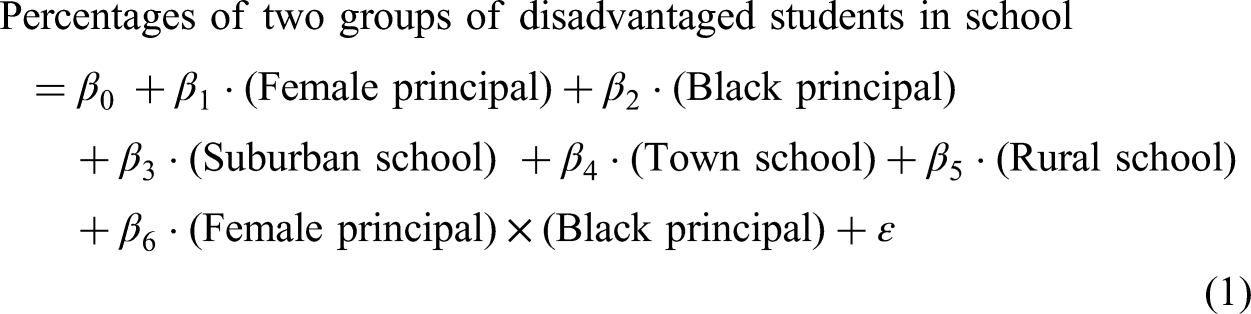
The multiple regression models created to investigate research question 1 examined the association between the convergence of the principals’ race or ethnicity and gender and the percentages of two groups of disadvantaged students: FRL students, and students of color. The school-level analyses were conducted using multiple regression models that included principals’ race or ethnicity and gender as focal predictors and community type (suburban, town, rural) as a school-level covariate. We used the following multiple regression models:
Models for leadership praxis and link with student achievement of black women principals
LMM models were used to estimate the associations between Black women principals and teachers’ perceptions of their instructional leadership behaviors and collective responsibility among teachers in their school (RQ 2) as well as student math achievement scores (RQ 3). In terms of the teacher-level models for principal leadership praxis (i.e., teachers’ perceptions of their principals’ instructional leadership behaviors and collective responsibility among teachers in their school), a null model only included years of teaching experience of teachers as a teacher-level covariate. A base model was estimated by allowing the teacher-level intercepts of the two constructs of leadership praxis to vary across schools and adding school-level covariates (school's demographic composition, community type, experience as a principal, and principal's race or ethnicity, gender, and their interaction). Finally, the intersectionality of the principals’ race or ethnicity and gender was added to the teacher-level intercept to identify the relationship between Black women principals and the teachers’ perceptions of principals’ instructional leadership behaviors and collective responsibility among teachers in their school.
In terms of the student-level model for students’ math achievement scores, this study followed Anderson’s (2012) model-building process on a theoretical and empirical basis. More specifically, student-level predictors (race or ethnicity, gender, and SES) were added to the student-level model (i.e., a null model). Building on the base model with only significant student covariates, the next model used only student-level slopes with significant variations across schools as random slopes while making slopes without fixed variation. It also included the school-level covariates, excluding the intersectionality between principals’ race or ethnicity and gender. The final full model included the intersectionality of principals’ race or ethnicity and gender to estimate the association between Black women principals and students’ math achievement scores. All of the student-, teacher-, and school-level covariates except the categorical variables (e.g., race or ethnicity, gender, community types) were grand mean centered to enable meaningful interpretation.
Mplus was used to address the complex sampling design of HSLS:09 by using an approach (TYPE = COMPLEX) that considers both stratification and sampling weights due to non-independence between units and unequal probability of selection (see Asparouhov and Muthén, 2006; Muthén and Satorra, 1995; Rabe-Hesketh and Skrondal, 2006 for specific details). This enabled estimation of the appropriate standard errors based on the differences between the estimates from the full sample and a series of created subsamples (see Hahs-Vaughn et al., 2011). Regarding missing values, Ingels et al. (2011) emphasized that “HSLS:09 variables in general did not suffer from high levels of item nonresponse” (p. viii). As noted, the missing values in this study are mainly the non-responses in the variables for principals’ race or ethnicity and gender. These missing data were treated using the model-based full information maximum likelihood procedure in Mplus (Graham, 2009). Indeed, Schafer and Graham (2002) demonstrated that maximum likelihood estimations such as that used in this study are often unbiased. Therefore, the missing values should not significantly affect the results of further analyses, which are presented below.
Findings
Research Question 1: How Are the Race or Ethnicity and Gender of Black Women Principals Associated with the Percentage of Disadvantaged Students in the Schools That They Serve?
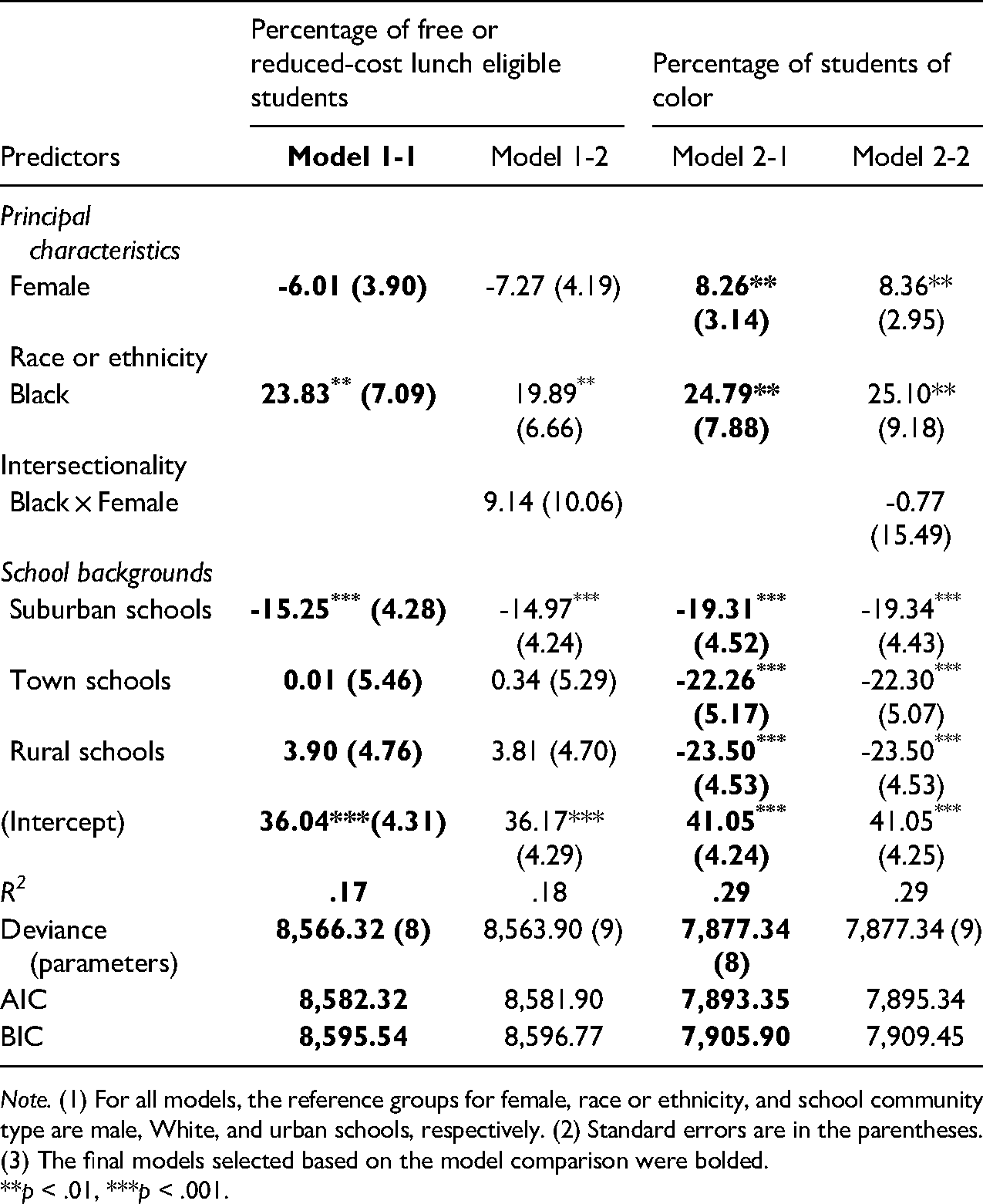
The first research question investigates the specific student demographic composition of schools that Black women principals served (i.e., percentages of historically disadvantaged and marginalized students, including free or reduced lunch eligible students and students of color). More specifically, this question aimed to identify whether the contexts of schools where Black women principals served were significantly different from those of women principals who were not Black and their all-male counterparts, including Black male principals. The model comparison using three criteria revealed that the models including the interaction term for principals’ race or ethnicity and gender were not significantly different from the models that did not include it: the percentages of FRL students (χ2 = 2.42, df = 1, n.s.) and students of color in schools (χ2 = 0.00, df = 1, n.s.). Consequently, this study selected the main-effect models that did not include intersectionality for the FRL students (Model 1-1) and students of color (Model 2-1) as the final models.
The models in Table 1 demonstrate significant associations between the demographic composition of disadvantaged students in schools and their principals’ race or ethnicity and gender. On average, Model 1-1 revealed that Black principals served in schools with a higher percentage of students who were FRL eligible students (β = 23.83, p < .01) than their White counterparts regardless of school's community type. These patterns among Black principals did not differ statistically according to gender (i.e., Black men vs. Black women). The school's community type was also significantly associated with the percentages of FRL eligible students. In particular, suburban schools included a relatively lower percentage of FRL eligible students (β = −15.25, p < .001) compared to urban schools.
Results of Fitting Models of Demographic Compositions of Disadvantaged Students in Schools Predicted by Secondary School Principals’ Race or Ethnicity and Gender (Weighted N = 21,705).
Note. (1) For all models, the reference groups for female, race or ethnicity, and school community type are male, White, and urban schools, respectively. (2) Standard errors are in the parentheses. (3) The final models selected based on the model comparison were bolded.
**p < .01, ***p < .001.
Model 2-1 showed that both principals’ gender and race or ethnicity (Black) were significantly associated with the percentage of students of color in school, but there was no interactive association between principals’ race or ethnicity and gender. Therefore, we considered only the main effects of race or ethnicity for Black (β = 24.79, p < .01) and gender for Female (β = 8.26, p < .01) owing to the insignificant interaction term for principals’ race or ethnicity and gender. Furthermore, the percentages of students of color in suburban (β = −19.31, p < .001), town (β = −22.26, p < .001), and rural schools (β = −23.50, p < .001) were relatively lower than in urban schools.
Research Question 2: How Are the Race or Ethnicity and Gender of Black Women Principals Associated with Instructional Leadership Behaviors and Teachers’ Perceptions of Collective Responsibility in Their Schools?
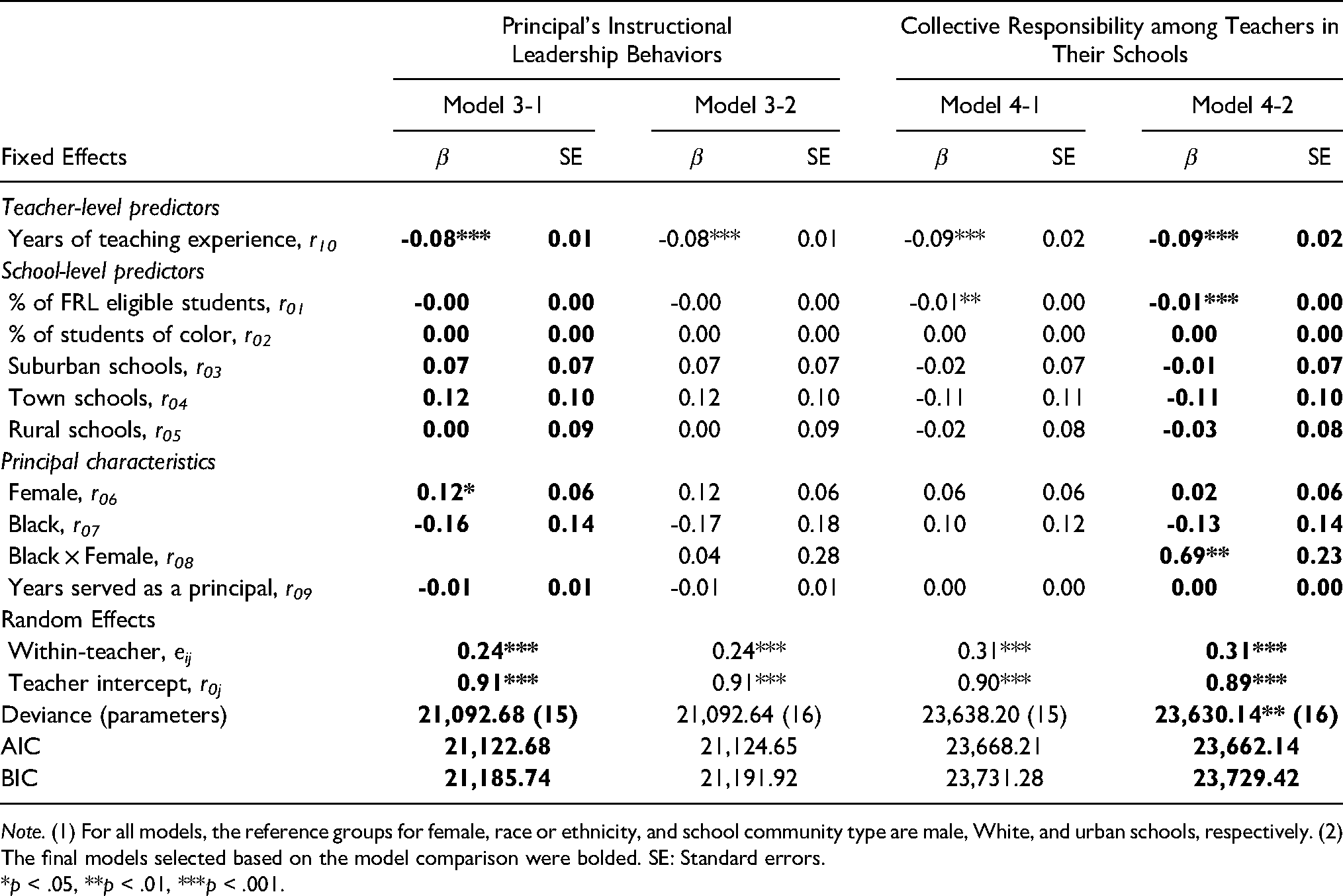
Table 2 reports the results of LMM models examining the constructs of teachers’ perceptions of principals’ instructional leadership behaviors and collective responsibility among teachers in their schools predicted by the principals’ race or ethnicity and gender. The model comparison for the teachers’ perceptions of principals’ instructional leadership behaviors based on a deviance test, χ2(1) = 0.04, n.s., and the AIC and BIC lower values in Model 3-1 indicated that the two nested models were not significantly different. Therefore, the parsimonious model (Model 3-1), which considers only the main effects of principals’ race or ethnicity and gender, without an interaction term, was selected as the final model. The results of Model 3-1 showed a significant and positive association between the principals’ instructional leadership behaviors perceived by teachers and female principals (β = 0.12, p < .05), on average. This indicates that teachers in schools with female principals tended to perceive stronger instructional leadership behaviors from their principals than did teachers in schools with male principals (a 0.12 SD difference), when controlling for school context (community type, demographic composition). However, there was no statistically significant difference between teachers’ perceptions of the principals’ instructional leadership behaviors based on the principals’ racial or ethnic background (i.e., Black vs. White principals).
Results of Fitting Linear Mixed Effects Models of Teacher's Perceptions on Their Principal's Instructional Leadership Behaviors and Teachers’ Collective Responsibility Predicted by Their Principals’ Race or Ethnicity and Gender (Weighted N = 4,042,879).
Note. (1) For all models, the reference groups for female, race or ethnicity, and school community type are male, White, and urban schools, respectively. (2) The final models selected based on the model comparison were bolded. SE: Standard errors.
*p < .05, **p < .01, ***p < .001.
The model comparison for collective responsibility among teachers in school revealed that Model 4-2, which included the interaction term between principals’ race or ethnicity and gender, performed better than Model 4-1 without the interaction term, χ2(1) = 8.06, p < .01, and had lower AIC and BIC values. The results of Model 4-2 show a significant and positive association between the interaction term of principals’ race or ethnicity (Black) and gender (Female) and the level of collective responsibility among teachers in school as perceived by teachers (β = 0.69, p < .01), on average. This result indicates that when controlling for school context, teachers in schools with Black women principals tended to perceive greater collective responsibility among teachers in their schools than did teachers in schools where their all-male counterparts and female principals who were not Black served (a 0.69 SD difference 2 ).
Research Question 3: To What Extent Are Black Women Principals Associated with 9th Graders’ Math Achievement Scores?
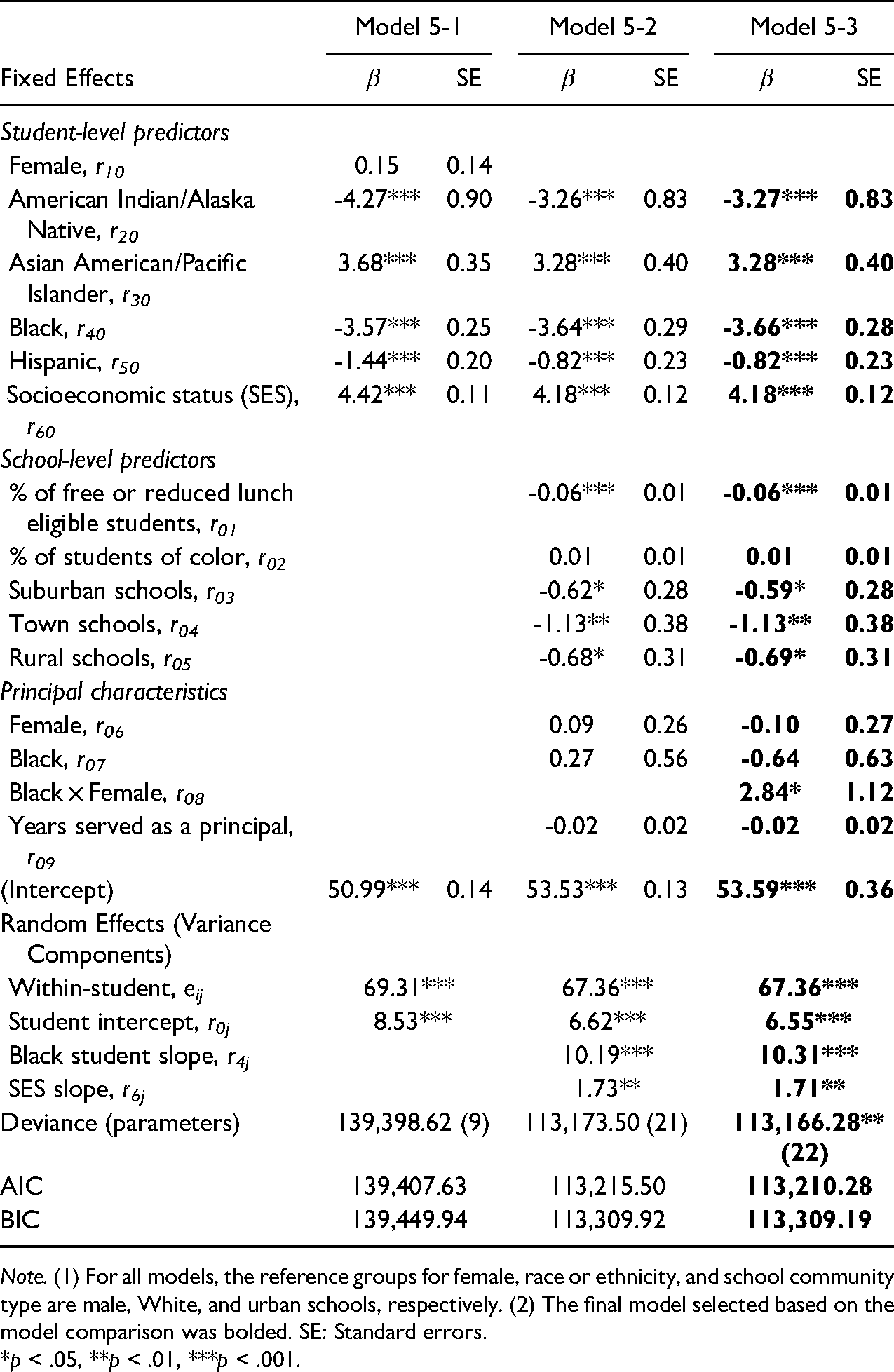
Table 3 reports the results of models for 9th graders’ math standardized achievement scores predicted by principals’ race or ethnicity and gender as well as their intersectionality. As previously noted, this study used the specific model-building process for LMM guided by both theoretical and empirical grounds (Anderson, 2012). Model 5-1, which includes only student-level covariates as a base model, shows that students’ racial or ethnic and SES backgrounds are significantly associated with their math achievement scores. Adding school-level covariates shows that the percentage of FRL students is significantly and negatively associated with the average math achievement scores for all students in the dataset based on grand mean centering (not reported here because of space limitations). Building on the model including only these significant student- and school-level covariates, Model 5-2 included the random slopes 3 for Black (r4j) and SES (r6j), which allows these slopes (disparities associated with each race or ethnicity and socioeconomic background compared to their reference groups) to vary across schools. It also included principals’ race or ethnicity and gender, which were not statistically significant. Finally, the fuller model included the intersectionality of principals’ race or ethnicity and gender in addition to Model 5-2. This newly added term was used to examine whether the intersectionality of principals’ race or ethnicity and gender (Black women principals) accounted for significant differences in student-level math achievement scores. The deviance test indicated that the intersectionality model (Model 5-3) fit the data significantly better than the model without considering intersectionality (Model 5-2), χ2(1) = 7.22, p < .01. Therefore, this study selected Model 5-3 as a final model and specifically reports the parameter estimates from Model 5-3 below.
Results of Fitting Linear Mixed Effects Models of 9th Graders’ Math Achievement Scores Predicted by Their Principals’ Race or Ethnicity and Gender (Weighted N = 4,197, 724).
Note. (1) For all models, the reference groups for female, race or ethnicity, and school community type are male, White, and urban schools, respectively. (2) The final model selected based on the model comparison was bolded. SE: Standard errors.
*p < .05, **p < .01, ***p < .001.
Model 5-3 in Table 3 shows that on average, the math achievement scores of American Indian/Alaska Native (β = −3.27, p < .001), Black (β = −3.66, p < .001) and Hispanic (β = −0.82, p < .001) 9th graders were significantly lower than those of their White counterparts, while Asian American/Pacific Islander 9th graders had significantly higher scores (β = 3.28, p < .001). The 9th graders’ SES was significantly and positively associated with their achievement scores (β = 4.18, p < .001), on average. Among the disparities in 9th graders’ math achievement scores, the variance components of the disparities associated with Black (r4j) and SES backgrounds (r6j) were statistically significant, indicating that these disparities varied across schools. While the main effects of principals’ race or ethnicity and gender were not statistically significant, their interaction term was statistically significant (β = 2.84, p < .05). The significant, positive interaction term for principals’ race or ethnicity and gender indicated that Black women principals were associated with math achievement scores that were 2.84 score points higher for all 9th graders, including White students (0.28 SD higher).
Discussion
This study examined the contexts, praxis, and contributions to students’ academic achievement by Black women principals originating from their unique positionality of race or ethnicity and gender. This section presents explanations for the patterns in the three aspects of Black women principals’ leadership, implications for educational practice, and directions for leadership preparation and future research.
The Leadership Contexts of Black Women Principals
This study demonstrated that the school contexts (specifically, the demographic composition of disadvantaged students) in which Black and female principals exercise their leadership differ considerably from those of their White and male counterparts, respectively. When controlling for school community type, Black principals were found to serve schools with higher proportions of socioeconomically disadvantaged students. The difference between Black men and Black women principals was not significant. This finding is in line with previous studies showing that Black principals, both men and women, often emerge as the leaders of impoverished schools that otherwise lack support (Bailes & Guthery, 2020; Murtadha & Larson, 1999). In addition, we found that the average proportion of racial and ethnic minority students in schools led by Black principals and female principals of any race or ethnicity was higher than that in schools led by other groups of principals (e.g., men who were not Black). The finding related to principals’ race or ethnicity is consistent with the literature showing that Black principals often lead schools with higher proportions of students of color, especially Black students (Davis et al., 2016). The results also suggest that female principals typically lead schools with a slightly higher proportion of students of color, but this pattern was not unique for Black women principals. This is consistent with Bailes and Guthery’s (2020) finding of systematic challenges in the principal pipeline (i.e., promotion) for Black and female principals, even though there were no significant multiplicative effects of race or ethnicity and gender, particularly for Black women principals. Our finding shows that Black women principals experience dual barriers attached to being Black and women (“double jeopardy”) when leading schools with a high proportion of students of color, as such schools are typically arduous to lead because they tend to lack resources and support (Lomotey, 2019; Peters, 2012). However, the multiplication of such barriers stemming from race or ethnicity and gender was not significantly associated with the percentage of students of color in schools led by Black women principals. That is, the relationships between Black women principals’ leadership context (in terms of the percentage of students of color) and their race or ethnicity and gender are simple and independent (King, 1988).
Although these findings may not demonstrate the uniqueness of Black women principals’ leadership contexts compared with other groups of principals (e.g., Black men, White women), it may reveal the contextual challenges and barriers that Black women principals face when exerting leadership (Bloom & Erlandson, 2003; Lomotey, 2019; Moorosi et al., 2018). The school finance literature (e.g., Alexander and Jang, 2019; Jimenez-Castellanos and Topper, 2012) has suggested that leaders in organizations with higher proportions of disadvantaged students face additional challenges relating to low resources. More specifically, Alexander and Jang (2019) found no statistically significant association between total and instructional expenditure per pupil and the proportion of Black students, but did find a significant and positive association between expenditure per pupil and the proportion of FRL-eligible students. As the authors further argued, “focusing only on poverty as a mantle by which to address all minoritized identities may result in policy strategies that do not address the essence of the problem faced by groups marginalized by other labels [such as Black]” (p. 154). Taken together, these findings indicate that the contextual challenge relating to larger proportions of students of color and socioeconomically disadvantaged students may be compounded for Black women principals, given the limited resources of these schooling contexts.
Praxis of Instructional Leadership by Black Women Principals
The major finding of this study is that Black women principals are positively associated with 9th graders’ math achievement scores, despite the challenging schooling contexts in which they work (higher proportions of students from relatively lower SES backgrounds and students of color). This finding is consistent with previous qualitative findings illustrating the role of Black women principals as “clean-up women” (Dillard, 1995; Peters, 2012; Tillman, 2004) who commit to transforming a negative school culture with limited support and who fight against systemic discrimination (Peters, 2012; Tillman, 2004). Our results also provide quantitative evidence to fill a significant gap in the leadership literature, which has mainly used qualitative inquiries to investigate Black women principals’ successes and barriers to success (e.g., Bloom and Erlandson, 2003; Moorosi et al., 2018; Lomotey, 2019; Peters, 2012; Wilson, 2016). As we included all students in our analysis of 9th graders’ math achievement scores, including White students, it appears that Black women principals are effective instructional leaders for all students, not only for Black students (Lomotey, 2019). The observed association between teachers’ perceptions of collective responsibility and Black women principals’ leadership may partially explain the link between Black women principals’ leadership and student achievement. That is, the literature exploring the link between school leadership and student learning outcomes (e.g., Hallinger et al., 2020; Leithwood and Louis, 2012; Robinson et al., 2008) has emphasized the principal's role as an instructional leader who influences teacher attitudes and practices and school processes related to student learning. Indeed, the intersectionality framework revealed the multiplicative association between the race or ethnicity and gender of principals in relation to teachers’ perceptions of their collective responsibility in a school. This represents a unique contribution of Black women principals that is significantly different from that of male principals and female principals who are not Black. That is, Black women principals’ strong ability to promote shared responsibility in their school culture (Bryk & Schneider, 2002; Leithwood & Jantzi, 2012; Waters et al., 2003) is likely to have a positive and distinct influence on the links between their leadership and student achievement.
The literature highlights the moderating effects of principals’ transformational leadership behaviors on the link between instructional leadership and student achievement (e.g., Kwan, 2020; Marks and Printy, 2003; Urick & Bowers, 2014). Our findings support these effects, both in terms of the positive association between teacher perspectives on instructional strategies for female principals in general and in terms of the collective responsibility associated with Black women principals in particular. Black women principals’ critical care as transformative leaders (Lomotey, 2019; Wilson, 2016) may synergize the positive association between instructional leadership practices and student achievement. The unique instructional leadership practices and strong advocacy for critical care among Black women principals are characterized by a principal's “other mothering—consistently nurturing, protecting, and encouraging students and holding herself responsible for their success” (Tillman, 2004, p. 127). This critical care is deeply rooted in Black women's lived experiences of both racism and sexism (e.g., Hernandez et al., 2014), which create a strong resistance to injustice and systemic multiple oppressions in both schools and society (Okoli et al., 2020). As noted elsewhere, this transformative caring is associated with leadership practices that purposefully seek to benefit all students. The leadership practices associated with Black women principals’ leadership as an agent of change in schools may include establishing a school culture of caring (e.g., Dillard, 1995), developing positive relationships with parents and the community (e.g., Walker and Byas, 2003), and providing professional development support and opportunities for their staff to reflect on potentially racist practices in teaching (e.g., Bloom and Erlandson, 2003). Further research is warranted to identify the specific moderating factor that influences the relationship between Black women leaders’ transformative leadership practices, their enactment of instructional leadership and student achievement.
Conclusion
This study, through its critical quantitative intersectionality analysis, provides important implications for policy and leadership preparation programs. First, the limited numbers of Black women principals in secondary schools require policymakers’ attention, especially given this quantitative evidence of the effectiveness of their instructional leadership practices. In line with Bailes and Guthery’s (2020) emphasis on enhancing diversity in principalship, this study highlights the need to increase the number of Black women principals. Having more Black women principals is important not only to increase the diversity of school leaders (Khalifa et al., 2016) and promote educational equity for diverse marginalized students (Davis et al., 2017), but also to transform school cultures in a way that benefits the learning of all students. Specifically, we suggest that districts monitor their hiring processes to determine whether there is any systemic discrimination unique to Black women candidates, such as certification examination (Grissom et al., 2018) or racial and gender bias in hiring committees (Crawford & Fuller, 2017). In order to ensure an equitable hiring process and support the growth of Black women in principalship, policymakers must address those challenges. Second, this study emphasizes the importance of policy strategies to address the unique challenges and barriers in the schooling contexts in which Black women lead. To do this, policymakers’ understanding of the multiplicative influences of race or ethnicity and gender on the leadership practices of Black women principals is essential. Based on this, policymakers should prepare intersectionality-informed policy interventions that specifically support leadership by Black women principals. These interventions might include policy support to develop mentoring programs for Black women principals and to establish a strong network among them. The continuous purposeful collection of a large-scale quantitative dataset focusing on Black women principals and other women of color principals will be critical to identifying their systemic barriers and challenges and in creating adequate and effective implementation of policy solutions.
Along with this policy support, principal preparation and professional development programs should address the intersectional influences stemming from race or ethnicity, gender, and, potentially, other labels that create barriers to effective principal leadership. More importantly, as this study demonstrates, the specific instructional leadership behaviors and positive school culture measured by strong collective responsibility among teachers should be present in the programs. These conversations will be especially important for Black women principals to revitalize themselves and continue their effective leadership practices for their schools and all students. It is also critical to raise the appreciation of their leadership by others, especially given that there is “less respect for the position [among women of color, including Black women, principals] by White men” (Lomotey, 2019, p. 342).
This study has several limitations that could be remedied through future research. First, 9th graders’ math achievement scores were used as the measure of students’ learning outcomes. However, this measure, which is drawn from standardized tests, may not fully capture student learning outcomes (e.g., Milner, 2012; Jang, 2020). Therefore, future research should investigate the contributions of Black women principals in terms of various indicators of student learning and success, such as graduation rates, attendance rates, test scores in other subjects, students’ sense of belonging and engagement, and students’ aspirations to pursue postsecondary education. In addition, even though we provided a potential mechanism for the positive link between Black women principals’ leadership and 9th graders’ math achievement scores (their instructional leadership behaviors and collective responsibility among teachers), these interconnected relationships were not examined due to structural limitations in the data. Further quantitative data collection and analysis are warranted to create an integrated model of the contribution of Black women principals that links data relating to principals, teachers, and students (e.g., Bartanen and Grissom, 2021). To accomplish this, future quantitative analyses may need to include other important teacher-level variables that can affect students’ learning outcomes, such as teacher diversity, teacher turnover and culturally responsive teaching practices. This in turn will reveal more about the specific mechanism underlying Black women principals’ effective instructional leadership practices. Second, the findings from the teacher sample of this dataset cannot be generalizable to all teachers in secondary school in the United States. However, this study's teacher-level analysis focusing on teachers’ perceptions of principals’ instructional leadership behaviors and collective responsibility among teachers in their schools may provide important insights concerning the potential link between Black women principals and the achievement of students. Therefore, future research should examine the impact of Black women principals’ leadership on the teacher-level variables using a nationally representative sample of teachers (e.g., teacher's self-efficacy, professional development opportunities). Third, the investigation of the intersectionality of secondary school principals was limited by focusing on only two social constructs: race or ethnicity and gender. Future research should include other potential intersecting axes of domination and oppression, including age (ageism), sexuality (heterosexism), and class (classism). Fourth, the patterns in this study on Black women principals at the secondary school level are likely to differ from patterns at the primary school level. This limited generalizability to other school levels also warrants future research on the contexts, praxis, and contributions of Black women principals in American primary schools.
The traditional theorization of leadership, which values Whiteness and masculinity, has resulted in a systematic neglect of Black women principals in the literature (Bloom & Erlandson, 2003). Furthermore, the sparse literature on Black women principals is mainly qualitative. To the best of the authors’ knowledge, this study is the first to seek quantitative evidence on leadership by Black women principals in secondary schools. The study makes a major contribution to research by providing quantitative and generalizable evidence for the specific contexts, instructional leadership praxis, and student achievement in relation to Black women principals in American secondary schools. This quantitative evidence challenges the mainstream academic narrative of leadership by providing transformative and decolonized knowledge of leadership by Black women principals, demonstrating their capability to succeed with all students. Its central message is not to depreciate the leadership of principals who are not Black women but to wholly appreciate the leadership of Black women principals, who have been hidden and silenced in the literature, by recognizing the wholeness of their being. Echoing the final remarks of Lomotey (2019), this paper concludes by honoring all Black women principals, whose leadership is linked to teachers’ collective responsibility and student achievement in challenging context.
Supplemental Material
sj-docx-1-eaq-10.1177_0013161X211068415 - Supplemental material for Black Women Principals in American Secondary Schools: Quantitative Evidence of the Link Between Their Leadership and Student Achievement
Supplemental material, sj-docx-1-eaq-10.1177_0013161X211068415 for Black Women Principals in American Secondary Schools: Quantitative Evidence of the Link Between Their Leadership and Student Achievement by Sung Tae Jang and Nicola A. Alexander in Educational Administration Quarterly
Footnotes
Appendix A
Declaration of Conflicting Interests
The author(s) declared no potential conflicts of interest with respect to the research, authorship, and/or publication of this article.
Funding
The author(s) received no financial support for the research, authorship and/or publication of this article.

Supplemental Material
Supplemental material for this article is available online.
Notes
Author Biographies
References
Supplementary Material
Please find the following supplemental material available below.
For Open Access articles published under a Creative Commons License, all supplemental material carries the same license as the article it is associated with.
For non-Open Access articles published, all supplemental material carries a non-exclusive license, and permission requests for re-use of supplemental material or any part of supplemental material shall be sent directly to the copyright owner as specified in the copyright notice associated with the article.
