



Abstract
College-educated White households have increasingly opted to live in central urban neighborhoods, transforming many parts of the urban core. While there is emerging evidence that schools may play a key part in this process, little is known about the extent of racial contract between children of gentrifier households and original residents. This study examines NYC’s gentrifying areas, and the changing racial diversity in schools. Using data from the Census and the National Center for Educational Statistics, this study finds that schools in NYC’s gentrifying areas have seen a reduction in racial segregation, more in traditional public schools than in charters. While this trend may be promising, high levels of segregation persist. Policy and research implications are discussed.
The outmigration of White and middle-class residents from central city neighborhoods and their schools has been a major concern since at least the postwar era of suburbanization (Logan et al., 2008; Wilson, 1987). Although central city communities have many assets, one of the concerns over middle-class flight has been the depletion of material, social, and cultural capital that is associated with the movement of middle-class families out of city neighborhoods and schools (Wilson, 2010). It is frequently cited as a major force behind the stark segregation and resource inequity that is ubiquitous to most urban schools (Noguera, 2003; Orfield & Frankenberg, 2014). The combination of White flight and urban decline have effectively deepened racial and economic isolation, undermining key local institutions, especially school systems (Kahlenberg, 2001). The abandonment of inner-city schools has been such a common feature among the middle class that it is easy to assume that many families with the financial means reflexively opt out of urban public schools, making the resulting cycle of segregation increasingly difficult to break. The consequence of this trend, along with decades of discriminatory public policy and private practices in the housing markets (Rothstein, 2017), has been the growth of high-poverty, racially segregated, central city neighborhoods and schools (Wilson, 2010).
In light of the segregation that decades of urban decline and abandonment wrought on urban school systems, scholars are beginning to pay attention to middle-class and White families who once fled the city for the suburbs and are now returning to the city (Hwang & Lin, 2016; Pearman, 2020). One strand of this literature has been the exploration of gentrifying areas of a growing number of cities, focusing attention on middle-class and largely White families who not only choose to remain in the city, but also send their children to local public schools (Kimelberg & Billingham, 2012; Posey-Maddox, 2013; Siegel-Hawley et al., 2017). These studies have largely been informed by qualitative research, primarily exploring uneven power dynamics and how parental gentrifiers negotiate their local school system within the context of broader demographic trends. This descriptive quantitative analysis contributes to the growing conversation about gentrification and public schools by raising questions about the possibility of long-segregated schools becoming more desegregated (as a necessary but insufficient precursor for integration) as some long-segregated neighborhoods are becoming more diverse. In this study, we examine New York City (NYC) as a case study of some of the nation’s most rapidly gentrifying neighborhoods and the changing diversity in local public schools. NYC is an ideal study case for at least three notable reasons. 1. By some measures, NYC has one of the most segregated school systems in the country (Kucsera & Orfield, 2014), and at the same time, city neighborhoods have experienced rapid demographic changes. 2. In recent years, NYC has proposed several initiatives aimed at increasing school diversity (Debs et al., 2022). 3. NYC housing authorities are advancing efforts to promote cross-sector collaboration—including between housing and education.
This study explores the following research questions:
To what extent are elementary schools in NYC’s most rapidly gentrifying areas becoming more racially diverse, and how does the racial diversity of elementary schools in NYC’s fastest gentrifying areas compare to that of elementary schools in the rest of the city?
How do the student bodies in elementary charter schools compare to those of elementary traditional public schools (TPSs) in gentrifying and non-gentrifying areas of NYC?
Although classical definitions of gentrification have typically emphasized the class-based restructuring of cities, neighborhood changes associated with gentrification increasingly have a clear racial dimension as well as demographic shifts induced by gentrification are as often based on race as they are on class (Goetz, 2011). Gentrification is a notoriously difficult concept to define and operationalize, mainly due to the different stages of the process as well as the shifting demographic and social dynamics that frequently accompany neighborhood transitions. For this study, we have defined gentrification as the process by which urban neighborhoods that have historically experienced disinvestment and White and middle-class “flight,” then subsequently encounter reinvestment and the influx of higher SES White residents (Ellen & Ding, 2016; Pearman & Swain, 2017). Although racial turnover of communities as a condition for gentrification has been subject to extensive debate (Freeman, 2005; Hwang & Sampson, 2014), we explore race as a central feature because since the 2000s racial neighborhood demographics, namely increases in the percentage of White households largely determine which neighborhoods gentrify (Ellen & Ding, 2016; Sutton, 2020).
In this article, we review the literature on the contemporary relationship between school and housing segregation, as well as the literature related to schools and the gentrification of U.S. inner cities. We then situate this conversation within the broader literature of school desegregation and the rise of school choice, and describe how those themes have played out in NYC. After presenting our findings on gentrification and school diversity in NYC, we discuss the implications of the findings for research and policy.
Literature Review
The Interdependence of Housing and School Segregation
Typically, the relationship between school and housing segregation is thought of as residential segregation trends influencing school demographic composition. This link is especially strong at the elementary level because elementary schools tend to draw from the immediate surrounding areas and mirror the demographic composition of their immediate neighborhoods (Bayer et al., 2007). Conversely, schools influence residential segregation patterns as well. For example, it is widely believed that local public schools may be a key determinant of housing prices (Kane et al., 2006) and that individual housing choices for many parents with resources are influenced by the reputations of local public schools. These reputations are frequently informed by school ratings published on online real estate search engines, generally reflecting the racial and socioeconomic makeup of a school and standardized test scores relative to other schools (Mordechay et al., 2019). This growing practice of “shopping for schools” has been well documented and has contributed to the persistence of racial segregation in schools (Holme, 2002; Lareau & Goyette, 2014).
Urban Gentrification and Neighborhood Schools
Although racial segregation continues to be the norm in many American cities, scholars are increasingly paying attention to gentrification as a catalyst for social transformation in a number of cities (Ellen & Ding, 2016; Hwang & Sampson, 2014). One analysis of the country’s 50 largest cities found that nearly one in five neighborhoods with lower incomes and housing values have experienced gentrification since 2000 (Maciag, 2015). Ellen and Ding’s (2016) analysis finds that gentrification accelerated during the 2000s compared to the 1990s, and that the share of White households in low-income city tracts climbed from 7% during the 1990s to 18% during the 2000s. In fact, gentrification is now as widespread among small and medium sized metro areas such as Richmond, Virginia, and Denver, Colorado, as it is among superstar metros such as New York and Los Angeles (Landis & Reina, 2019).
Across overlapping definitions, at a minimum, gentrifying neighborhoods experience large increases in household income, housing values, and share of White residents and middle-class households (Hwang & Sampson, 2014; Smith, 1998). Additionally, overall urban improvement may occur as crime rates decrease, amenities are upgraded, public investments expand, and city services are improved (Autor et al., 2017). In fact, Guerrieri et al. (2013) found that poor neighborhoods adjacent to gentrified neighborhoods are likely to upgrade as well. However, this has not been without controversy. Critics of gentrification have called it forced economic, political, and cultural displacement, particularly of Black and Latino residents (Lipman, 2008). For example, Hyra’s (2015) ethnography describes how a Washington, DC, gentrifying area became a “gilded ghetto,” with exclusive amenities replacing long-standing neighborhood establishments and where long-term residents no longer feeling welcome in their own neighborhood.
One frequent point of controversy among researchers is whether or not higher income newcomers are crowding out lower income households. Many studies suggest that poor households residing in gentrifying neighborhoods are no more likely to move than poor households residing elsewhere (Ellen & O’Regan, 2011: Freeman & Braconi, 2004; McKinnish et al., 2010). Such findings have puzzled many practitioners and scholars who are confident that gentrification is causing low-income households to be displaced from their communities (Ellen & Torrats-Espinosa, 2019). Despite these challenges, most studies agree that gentrification at a minimum lead to pressures that might push out some renters, while in-movers are whiter and more affluent than incumbent residents (Zuk et al., 2018).
To date, most of the scholarship on gentrification has focused on housing related outcomes, with only recent attention paid to local schools. This is perhaps because gentrifiers were traditionally understood to be childless young professionals, artists, and gay and lesbian couples with little interest in neighborhood schools. Gentrifiers with children have tended to pay for private schooling or exercise school choice when available (Keels et al., 2013; Pearman & Swain, 2017), often enrolling their children in select charter or public schools clustering with other gentrifier families (Kimelberg & Billingham, 2012). However, recent evidence suggests that a small but growing share of middle-class and White gentrifying families are choosing to enroll their children in their neighborhood public schools (Freidus, 2019; Mordechay & Ayscue, 2017, 2019; Posey-Maddox, 2013). Because housing and school segregation have traditionally had a reciprocal relationship in which an increase in one leads to an increase in the other, the demographic shifts associated with gentrification has the potential to ease persistent racial and economic school segregation, a major cause of educational inequity in the U.S (Reardon, 2016).
School Desegregation
School desegregation for black students reached its peak in the late 1980s, and over the last three decades, schools across the country have been resegregating (Frankenberg et al., 2019). Trends toward deepening segregation are concerning due to the decades of social science research demonstrating the harms of segregation and the benefits of desegregation.
Segregated schools are associated with a number of unequal educational opportunities, including less experienced and less qualified teachers (Clotfelter et al., 2005; Jackson, 2009) as well as high levels of teacher turnover (Clotfelter et al., 2010). Levels of student mobility are also high in segregated schools (Rumberger, 2003). Students attending segregated schools have fewer and less advanced curricular options as well as inadequate facilities and resources (Yun & Moreno, 2006). As a result, the outcomes for students who attend segregated schools include lower academic achievement (Mickelson et al., 2013), higher dropout rates (Balfanz & Legters, 2004), and lower graduation rates (Swanson, 2004).
Desegregated schools are associated with many positive results. Academically, students of color who attend desegregated schools on average achieve at higher levels than their counterparts in segregated schools and there is no corresponding detrimental effect for White students (Crain & Mahard, 1983; Hallinan, 1998). Additionally, there is a compounding effect for academic achievement in that the longer a student of color attends a desegregated school, the greater the gain in academic achievement (Mickelson, 2005). In the interpersonal domain, attending a desegregated school is related to a reduction in prejudice and stereotypes as well as an increase in friendships across groups (Allport, 1954; Pettigrew & Tropp, 2006). In fact, in a recent experimental study in New Delhi schools, Rao (2019) found support for the contact hypothesis (Allport, 1954) among rich students, meaning that having poor classmates made affluent students more prosocial (i.e., more generous, more egalitarian, and less likely to discriminate against poor students). A perpetuating effect may also occur as students who have attended desegregated schools are more likely to live and work in desegregated environments later in life (Braddock & McPartland, 1989).
The Rise of School Choice
The rise of school choice, particularly charter schools, presents an additional layer of complexity for understanding and addressing school segregation within gentrification contexts. Students who attend TPSs are assigned to their school by the district, but when other options are available, families can choose to enroll their children at schools outside of the catchment area (Candipan, 2020; Rich et al., 2021).
Different forms of school choice are associated with different patterns of school segregation (Cobb & Glass, 2009). Charter schools tend to be more segregated than TPSs (Ayscue et al., 2016; Ladd et al., 2015) and also contribute to the resegregation of TPSs (Ayscue et al., 2018). A very small share of charters is designed with diversity as a goal (Potter & Quick, 2018). However, many charter schools are intentionally segregated as a result of funding priorities to serve high proportions of low-income students as well as siting decisions that intentionally place charter schools in low-income urban communities of color (Scott, 2009), the very types of communities that are now undergoing gentrification across the United States. Other charters have been used for White flight and some engage in discriminatory practices that exclude certain types of students from their schools (Welner, 2013). Thus, with the growth and widespread availability of charter schools, racial diversity in a neighborhood does not necessarily ensure racial diversity in schools. In fact, several recent studies suggest that the expansion of school choice options may facilitate gentrification by reducing newcomer households’ concerns about sending their children to neighborhood schools with high concentrations of poor Black and Latino residents—namely because school choice policies ostensibly allow parents to select schools outside their residence (Candipan, 2020; Pearman & Swain, 2017).
New York City Context
Metropolitan New York, with its starkly segregated neighborhoods, is experiencing a massive demographic shift. After struggling with severe disinvestment and property abandonment in the 1970s, the municipal government invested over $5 billion to rehabilitate the housing market and revitalize city neighborhoods (Ellen et al., 2003). The last two decades have witnessed an economic expansion and global credit boom that have intensified gentrification (Sutton, 2020; Wyly et al., 2010). The greater metro area is being reshaped as Blacks, Latinos, Asians, and immigrants are leaving the city and migrating into the suburbs (Frey, 2018).
This transformation has been particularly acute in the city’s gentrifying neighborhoods where over a quarter of neighborhoods underwent gentrification since 1990 (Been et al., 2017). In Bedford-Stuyvesant, a hot bed of gentrification, the White population grew 10-fold, while the Black share declined from three-fourths of the total, to just over half.
Serving the children in all of NYC’s neighborhoods is the largest public-school district in the country. By some measures, it is also one of the most segregated school systems in the nation (Kucsera & Orfield, 2014). The school system undertook desegregation efforts that peaked in the 1980s, but like so many other school districts across the country, the NYC school system has been resegregating since then. In 2017 to 2018, the NYC Department of Education enrolled 1,135,334 students, including 113,528 students in charter schools. The city’s enrollment was 16.1% Asian, 26.0% Black, 40.5% Hispanic, and 15% White; 13.5% of students were English language learners, and 74% were low income (New York City Department of Education, 2018). NYC school district is composed of 32 smaller districts. In 29 districts, elementary schools are assigned to geographic zones that usually span several blocks. The remaining three have open-choice policies. While the number of alternatives to zoned elementary schools has increased significantly in the past 10 years, most students attend their zoned schools (Mader et al., 2018).
Conceptual Framework
The geography of opportunity is used as the conceptual framework for this study. In defining this concept, Galster and Killen (1995) propose that individuals’ lives can be profoundly changed if they are in environments that offer opportunities influencing choices about education, employment, and crime, to name just a few. Many scholars have continued this line of research, specifically as it pertains to housing and the employment and educational opportunities available in particular neighborhoods (Briggs, 2005; Chetty & Hendren, 2018), contending that where one lives and one’s racial and social class background interact in ways that significantly shape the privileges (or lack thereof) of individuals. Faced with a combination of limited access to quality jobs and schools, in addition to little or no neighborhood-level contact with middle-class households, the residents of low-opportunity neighborhoods become socially isolated from high-opportunity areas and networks (Goetz, 2011). This isolation, in turn, causes “concentration effects” whereby various indicators of social dislocation such as high crime, poverty, joblessness, and underachieving schools rise to exponentially high levels, solidifying urban disadvantage (Chetty et al., 2016; Wilson, 1987).
Methodology
Data Source
This study draws primarily on data from two sources: the U.S. Census Bureau/American Community Survey (ACS) and the National Center for Education Statistics (NCES). Demographic data for the year 2000 was obtained from the 2000 decennial census. Demographic data for the year 2016 was obtained from the 2016 (5-year file) ACS. Because the annual sample size of the ACS is much smaller than the sample size of the decennial census, data from 5 years of the ACS is combined to provide more reliable estimates. Therefore, for convenience, the remainder of this paper refers to the 2012 to 2016 ACS data as the 2016 estimates. In addition, student demographic data was obtained from NCES, which is a reliable data source that collects the federal government’s school enrollment figures from virtually every district in the nation. We used Geographic Information Systems (GIS) to map the spatial distribution of schools, allowing us to compute the growth of Whites taking place on the neighborhood level.
Analytic Plan
To determine which individual census tracts experienced the most dramatic increase in White residents between 2000 and 2016, we calculated the percentage point change in White residents from 2000 to 2016. The maps in Figure 1 descriptively illustrate the growth of the White population during this time period.
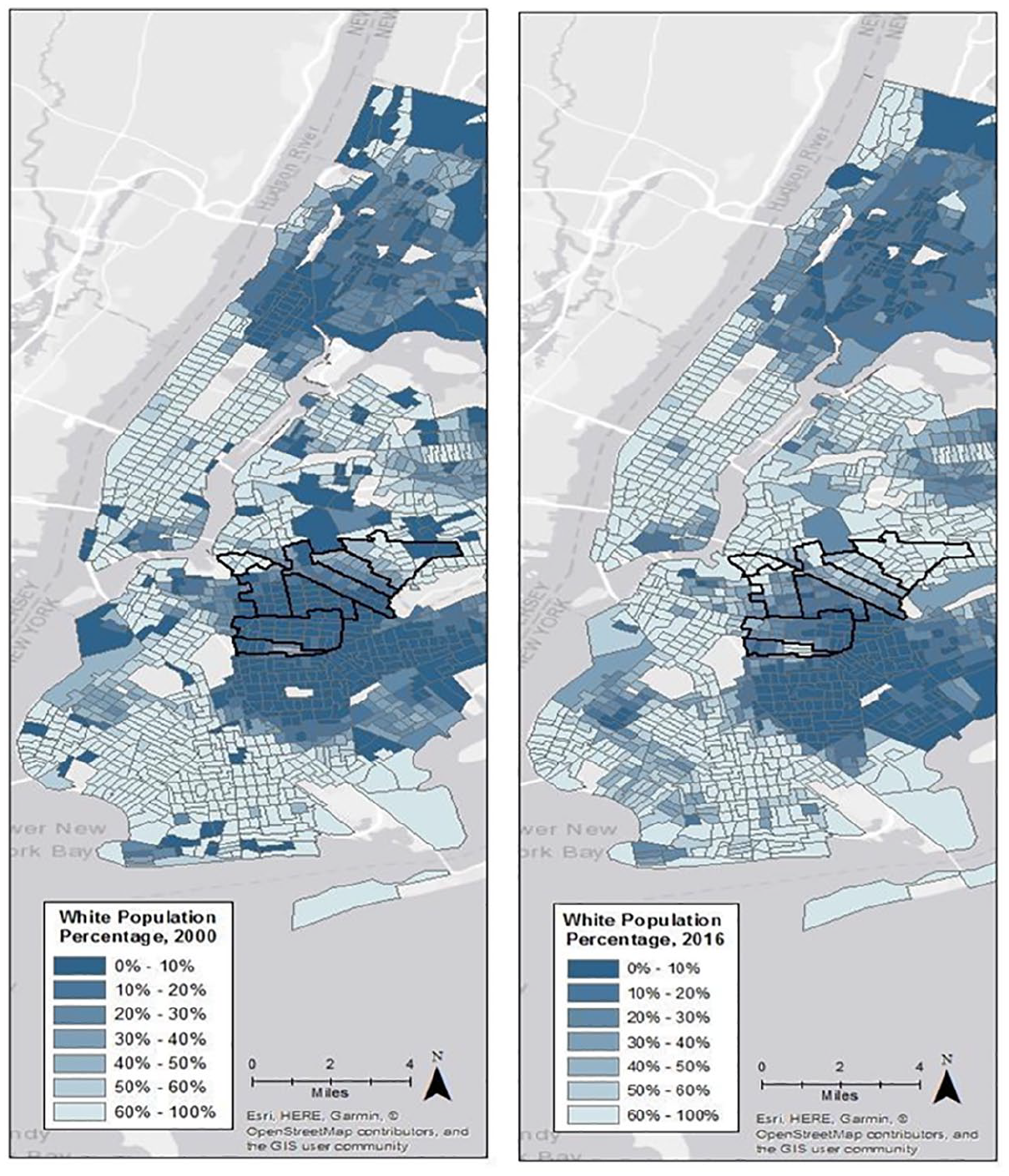
Distribution of White residents, New York City, 2000 and 2016.
To identify the fastest gentrifying neighborhoods, we used census tracts as a statistical proxy to define neighborhoods. A typical census tract has about 4,000 residents, and as a heuristic, it conforms to what people typically think of as a neighborhood. In NYC, there were 2,219 census tracts in 2000 and 2,169 in 2016, with populations generally ranging from 3,000 to 4,000. Although the Census Bureau updates these geographic units periodically, it attempts to keep changes to a minimum. From those units with a minimum of 2,000 residents in 2016, we selected the top 25 census tracts with the largest percentage point increase in White residents between 2000 and 2016. The selected tracts had between a 30 and 50 percentage point increase in White residents. Figure 2 below illustrates the distribution of White population across NYC census tracts between 2000 and 2016. A total of 695 tracts saw a percentage point increase in Whites, ranging from 1% to approximately 50%.
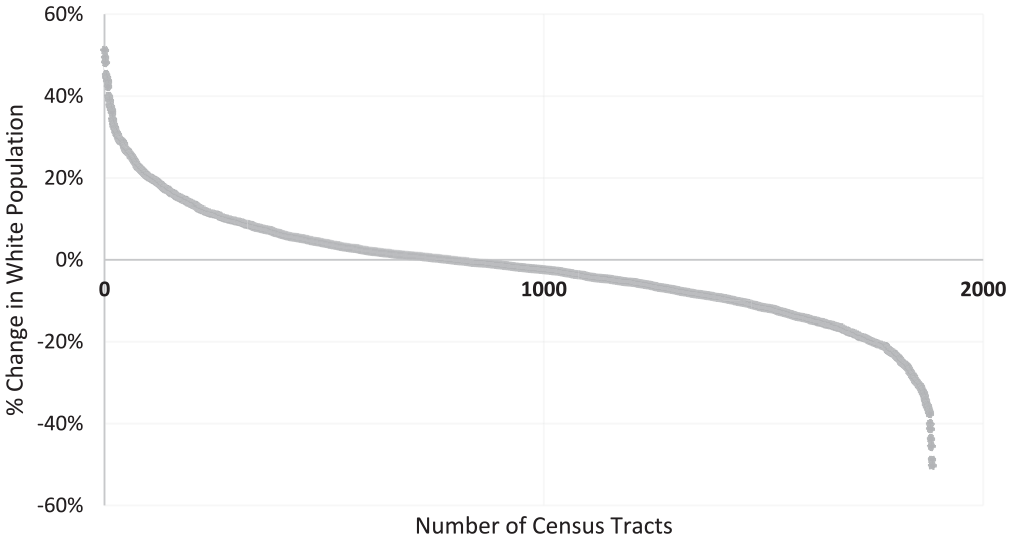
Percent change of White population across NYC census tracts, 2000 and 2016.
Because gentrification is so locally dependent, thresholds for identifying various levels of gentrification have not been well established (Freeman, 2005; Mordechay & Ayscue, 2019). Although racial change as a prerequisite for gentrification is widely debated in the gentrification literature, race is in the forefront of our study for the following reasons. 1. Our interest in understanding patterns of racial segregation and because racial change has increasingly determined which neighborhoods gentrify (Ellen & Ding, 2016). 2. White households increasingly play a district role in the educational landscape of gentrifying neighborhoods (Posey-Maddox, 2013; Stillman, 2012). 3. The predominant pattern of gentrification is one in which White gentrifiers move into low-come urban neighborhoods (Sutton, 2020). For ease of interpretation, we will be referring to these 25 census tracts as the “fastest” or “most rapidly” gentrifying census tracts (Figures 2 and 3).
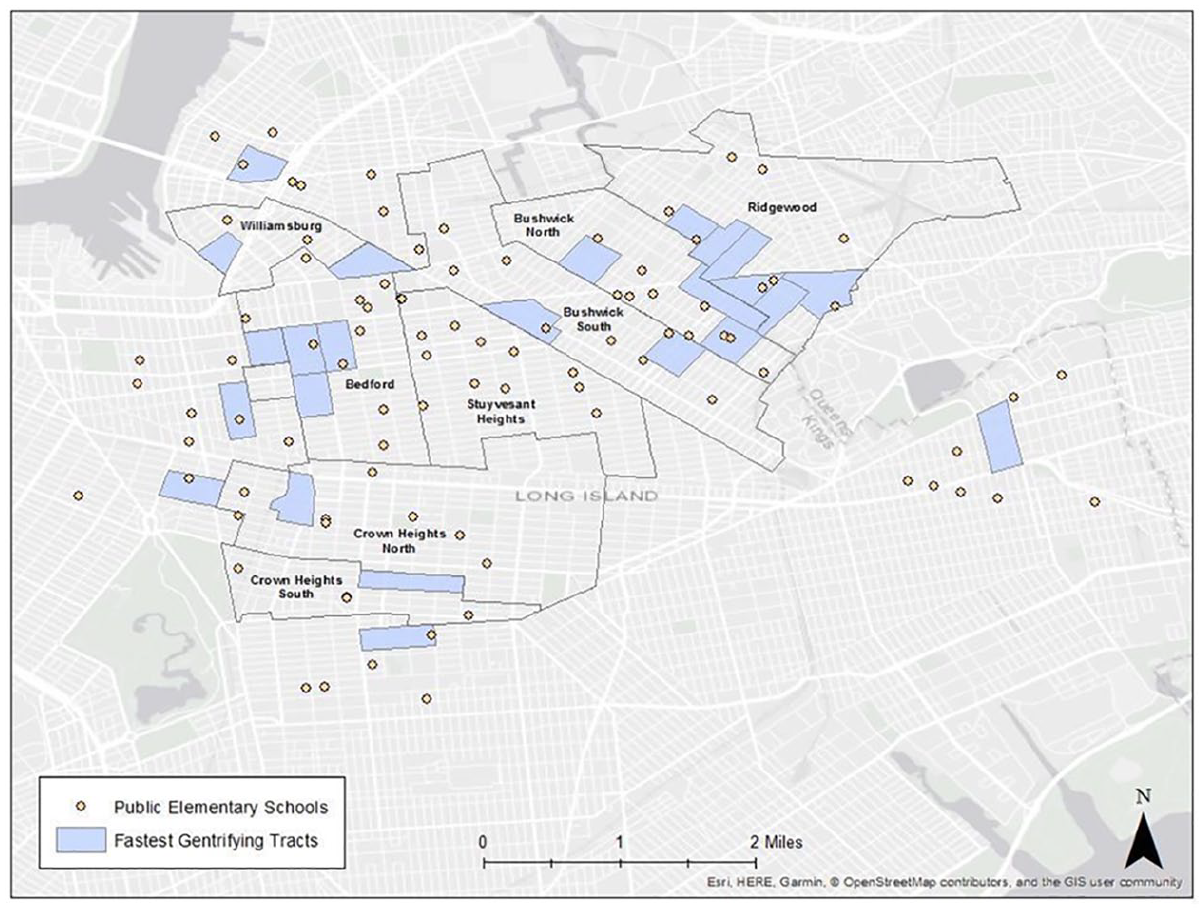
Fastest gentrifying census tracts, New York City, 2016.
Next, we mapped the district’s 2015 to 2016 school addresses (i.e., latitude and longitude), overlaid them with census tracts, and identified 109 elementary schools that fall within a half-mile radius from the center of each of the 25 most gentrifying census tracts. We defined elementary schools as those that have grade one enrollment. Because census tracts and school zone boundaries are not equivalent, we included schools that fall within a half mile of the gentrifying census tract. While the average NYC elementary-aged child has 13.9 schools within a one-mile radius of where they live (Blagg et al., 2018), we used a half-mile buffer because elementary schools tend to draw from the immediate surrounding areas (Bayer et al., 2007). As a sensitivity check, we also identified elementary schools that fall within a one-mile radius to test if the same pattern was observed when expanding the radius from the center of the gentrifying census tracts. It should be noted though that students may be assigned to schools outside of a half mile of the tract.
To analyze school segregation trends, we used two measures of segregation: concentration and exposure/isolation. Although there are multiple ways to measure segregation, we employ the two measures of segregation commonly used by researchers (Reardon & Owens, 2014) These measures were selected because they describe the potential for contact (e.g., peer effects), which has been found to have an important influence on student success (Epple & Romano, 2011). These measures are also an indication of students’ day-to-day experience of segregation (Orfield et al., 2014).
To measure concentration, we calculated the percentage of schools that are intensely segregated (enrolling 90%–100% non-White students) and hypersegregated (enrolling 99%–100% non-White students) (Orfield et al., 2014). Exposure and isolation, P*, are probability measures of random contact between groups of students. Exposure refers to the degree of potential contact between students of one group and another group; isolation refers to the degree of potential contact between students of one group and other members of the same group (Massey & Denton, 1988). To measure exposure and isolation rates, we calculated the percentage of a certain group of students (e.g., Black students) in school with a particular student (e.g., White student) in a larger geographical area, and computed the average of all these results. The basic model can be expressed as follows:

where n is the number of schools or smaller area units,
We analyzed concentration and exposure/isolation at three time points: in 2000 (pre-gentrification), 2007 (mid-point), and 2016 (most recent year of data available). It should be noted that we do not report data on students’ eligibility for free and reduced lunch meals (FRLM) after 2010 due in large part to policy changes by Congress in 2010 that expanded “community eligibility,” which allowed schools with at least 40% of students identified as eligible for FRLM to provide free lunches to all of their students (Chingos, 2016). As a result, many schools that meet the 40% threshold will show 100% of students receiving FRLM.
Results
New York City’s Shifting Residential and Demographic Patterns
All 25 of the fastest gentrifying census tracts are all located in Queens and Kings (Brooklyn) counties, which are the two largest of the five boroughs of NYC (see Figure 2). Since 2000, both Queens and Kings counties have seen growth of 4.7% in their populations, from 4,694,705 in 2000 to 4,916,863 in 2016. The 25 tracts have experienced an even larger population increase of 15.9% since 2000, from 83,651 in 2000 to 96,959 in 2016. During this same time period, the entire city grew by 6.4%, from 8,008,278 in 2000 to 8,239,803 in 2016.
The racial changes in the city’s most rapidly gentrifying tracts are also noteworthy. In the combined neighborhoods, the share of the White population increased almost threefold, from 11% in 2000 to over 30% in 2016. Within the same neighborhoods, the Black share declined substantially, from 28.7% of the total in 2000 to 17.4% in 2016. The number of Black residents in the 25 tracts also declined during this time period, from approximately 24,000 to less than 17,000. In the same neighborhoods, while the Hispanic share declined from over 50% to 44%, the actual number of Hispanics increased slightly. Despite the substantial increase in White residents across the most rapidly gentrifying areas, both the share of Whites and the total number of Whites declined citywide and in the two counties between 2000 and 2016.
Demographic analyses have found that in-migrants to gentrifying areas are more likely to be young, White, college-educated, and without children (Sturtevant, 2014). However, our descriptive analysis of the toddler population (aged 0–5) and the school-aged population (aged 5–17) across NYC’s most rapidly gentrifying areas reveals that in these age groups, the share of White children has grown substantially since 2000. The share of White toddlers increased from 7% (approximately 520 total) to 36% (approximately 2,600 total) between 2000 and 2016. Conversely, both the share and total number of Black, Latino, and Asian toddlers and school-aged children declined in the same neighborhoods. The combined share of Black and Latino toddlers declined from 86% of the total in 2000 to 62% in 2016. Similarly, the share of White school-aged children increased from 11% to 29% while the combined share of Black and Latino school-aged children decreased from 87% in 2000 to 70% in 2016.
Turning to income, it is noteworthy that while inflation-adjusted incomes have increased slightly (3%) across NYC between 2000 and 2016, the growth has been much more substantial in the gentrifying tracts. During the same time period, median household income in the 25 tracts grew from $37,516 in 2000 to $52,830 in 2016, an increase of almost 41%. The stark increase in median household income is likely explained by the gentrifying neighborhoods’ influx of college-educated residents. Another indicator of economic changes can be seen in shifting poverty rates. Gentrifiers often find themselves moving into communities with high concentrations of poverty (Goetz, 2011). Not surprisingly, in NYC’s most rapidly gentrifying neighborhoods, the poverty rate declined over the last decade and a half, from 27.3% to 20%. In NYC, the poverty rate has been stable at approximately 18% over the same period of time. In summary, like many cities across the country, gentrification has expanded and accelerated in pace in many NYC neighborhoods resulting in stark demographic shifts.
Enrollment and Segregation in New York City Elementary Schools
Enrollment in elementary schools across NYC has been increasing over the last 15 years. Overall, both the number of elementary schools and the number of elementary school students have increased. In gentrifying areas, the number of elementary public schools (TPSs and charters combined) increased from 71 in 2000 to 105 in 2016, but the number of students enrolled in elementary public schools followed a different trend, with a declining enrollment from 52,382 in 2000 to 51,608 in 2016. In non-gentrifying areas across the city, both the number of elementary schools and students increased.
The racial composition of elementary student enrollment in gentrifying areas also has shifted. The Black share of enrollment decreased from 50.3% in 2000 to 42.6% in 2016, while the share of White enrollment increased from 3.9% to 6.5%. Hispanic enrollment increased from 42.4% in 2000 to 45.2% in 2016 and Asian enrollment increased from 2.8% to 3.9%. Black students comprised the largest segment of enrollment in 2000, but in 2016 Hispanic students accounted for a slightly larger share of enrollment (45.2%) than Black students (42.6%). The share of low-income students in gentrifying areas declined from 89.6% in 2000 to 81.8% in 2007.
The increase in elementary enrollment of White students in gentrifying areas aligns with previous studies that have found middle-class and White families increasingly choosing neighborhood public schools (Friedus, 2019; Mordechay & Ayscue, 2020; Stillman, 2012). Prior research has also suggested that gentrifying families tend to cluster their children into a few “vetted” schools, indicating they are not comfortable sending their children to a neighborhood public school unless other gentrifier families are also attending (Jordan & Gallagher, 2015; Kimelberg & Billingham, 2012). This trend, in effect, does little to alleviate school segregation in gentrifying neighborhoods as gentrifier families cluster their children in enclaves. To test for a “clustering effect,” we examined the distribution of White enrollment across all the elementary schools in the most rapidly gentrifying neighborhoods. While close to four-fifths of all the schools had less than 5% White enrollment in 2016, nine total schools had more than 25% White enrollment. In addition, six schools had over 30% Whites and no school had over 50% White enrollment.
In non-gentrifying areas, a somewhat similar pattern emerged. The share of Black elementary school students declined from 28.8% in 2007 to 24.9% in 2016, while the share of Hispanic and Asian students increased to 40.5% and 16.0%, respectively. Unlike gentrifying areas, in non-gentrifying areas, the White share of enrollment remained steady around 16.5%.
Turning to segregation, in gentrifying areas, the number of intensely segregated and hypersegregated elementary schools increased; however, the share of such schools decreased (Table 1). For intensely segregated schools, the share declined from 91.5% in 2000 to 82.9% in 2016. At the most extreme level of segregation—hypersegregated schools that enroll 99% to 100% non-White students—in gentrifying areas, the share decreased overall from 46.5% in 2000 to 41.0% in 2016. Since 2007, the decline of hypersegregated schools in gentrifying areas was even more dramatic, dropping from 53.8% to 41% in 2016.
Segregation Concentration.
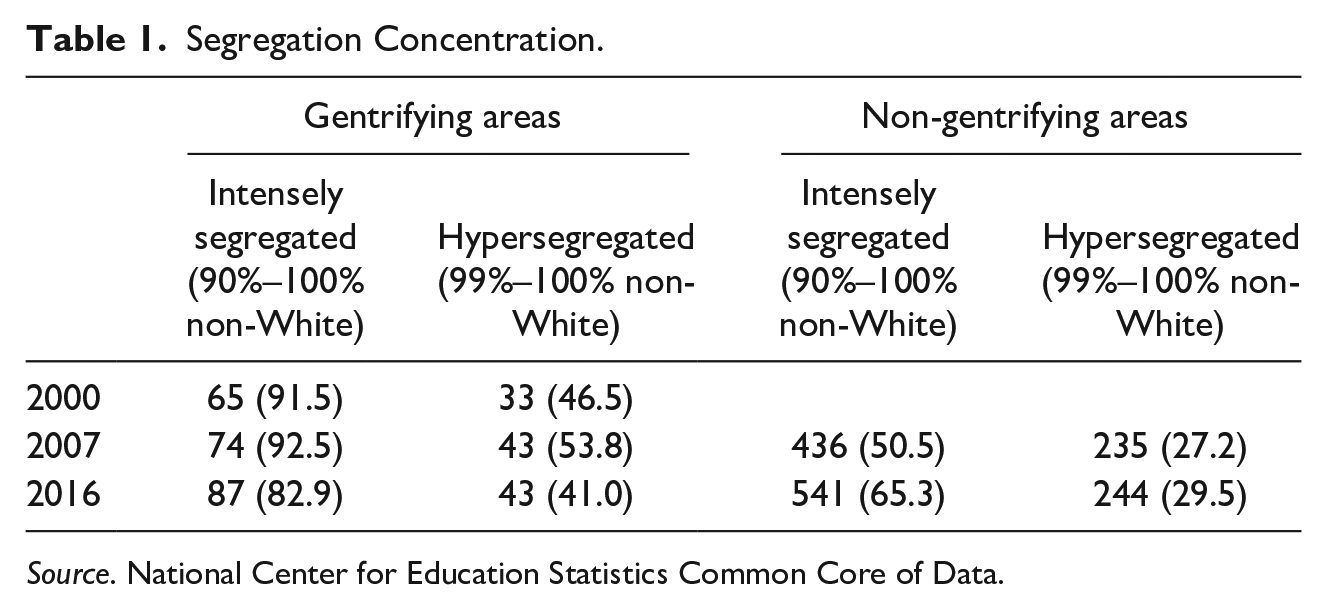
Source. National Center for Education Statistics Common Core of Data.
In non-gentrifying areas, both the number and share of intensely segregated and hypersegregated elementary schools increased. In 2007, just over half of the elementary schools in non-gentrifying areas were intensely segregated but by 2016, almost two-thirds of the elementary schools in non-gentrifying areas were intensely segregated (50.5% and 65.3%, respectively). The share of hypersegregated elementary schools increased slightly, from 27.2% in 2007 to 29.5% in 2016.
The shares of intensely segregated and hypersegregated elementary schools are much larger in gentrifying areas in comparison to non-gentrifying areas. In 2016, 82.9% of schools in gentrifying areas were intensely segregated compared to 65.3% in non-gentrifying areas. In 2016, 41.0% of elementary schools in gentrifying areas remained hypersegregated compared to 29.5% in non-gentrifying areas. While the levels of segregation in non-gentrifying areas might appear favorable when compared to gentrifying areas, it is important to remember that these levels of segregation are still very high. It should also be noted that while there is a larger share of intensely segregated and hypersegregated schools in gentrifying areas in comparison to non-gentrifying areas, the shares of intensely segregated and hypersegregated schools have declined in gentrifying areas. This trend is the reverse of that found in non-gentrifying areas, where the shares of intensely segregated and hypersegregated schools have increased.
In 2016, in gentrifying areas, the typical Black elementary school student attended a school in which 3.5% of schoolmates were White students, an increase from 1.3% in 2000; however, this share is still very small. Despite the increase in exposure to White students in gentrifying areas, the typical Black, Hispanic, and Asian elementary school students attended a school with a larger share of White students in non-gentrifying areas than in gentrifying areas in 2016. In both gentrifying and non-gentrifying areas, the typical Black elementary school student was exposed to the smallest share of White students while the typical Asian elementary school student attended a school with the largest share of White students.
In both gentrifying and non-gentrifying areas, the typical Black and Hispanic elementary school students were isolated with a majority of same-race peers. The isolation of Black students with same-race peers decreased, more so in gentrifying areas than in non-gentrifying areas. In gentrifying areas, the typical Black elementary school student attended a school with 75.9% Black schoolmates in 2000 and 67.4% Black schoolmates in 2016. The isolation of Hispanic students remained fairly steady in both gentrifying (about 66%) and non-gentrifying (about 57%) areas. For both the typical Black student and the typical Hispanic student, isolation with same-race schoolmates was greater in gentrifying areas than in non-gentrifying areas. The isolation of White students remained steady in both gentrifying and non-gentrifying areas, but the typical White student was isolated with more same-race schoolmates in non-gentrifying areas than in gentrifying areas in 2016 (46.2% vs. 23.3%, respectively).
In summary, regarding Research Question 1, we found that elementary schools in NYC’s gentrifying areas are becoming more racially diverse as the share of White student enrollment increases. However, the schools are not keeping pace with the more rapidly increasing school-aged White population.
Enrollment and Segregation Patterns by School Type
Different patterns emerged when we analyzed the data by school type. In gentrifying areas, elementary TPSs continued to enroll a larger number of students than elementary charter schools in 2016 (38,129 vs. 13,479, respectively); however, overall student enrollment in charter schools increased by 356% while enrollment in TPSs decreased by 8%. The share of White students increased in both types of schools, and a larger share of White students attended TPSs than charter schools in 2016 (8.1% vs. 2.0%, respectively). Similarly, the share of Hispanic students increased in both types of schools and a larger share of Hispanic students also attended TPSs than charter schools in 2016 (51.5% vs. 27.3%, respectively). Conversely, the share of Black students declined in both types of schools and a larger share of Black students attended charters than TPSs in 2016 (67.3% vs. 33.9%, respectively).
Patterns by school type are similar in non-gentrifying areas. As is the case in gentrifying areas, the share of White and Hispanic elementary school students increased while the share of Black elementary school students decreased in both charters and TPSs in non-gentrifying areas. In 2016, larger shares of White and Hispanic elementary school students were enrolled in TPSs (17.8% and 41.2%, respectively) than in charters (5.1% and 35.0%, respectively). Conversely, in 2016 in non-gentrifying areas, a larger share of Black elementary school students was enrolled in charters than in TPSs (55.2% vs. 21.1%, respectively).
In gentrifying areas, the shares of intensely segregated and hypersegregated schools decreased in both the charter and TPS sectors. However, the overwhelming majority of charter schools remained intensely segregated or hypersegregated in 2016. In 2016, 92.6% of elementary charter schools were intensely segregated, and at the most extreme level of segregation—hypersegregation—77.8% of charters remained hypersegregated, enrolling 99% to 100% non-White students. For elementary TPSs, in 2016, 79.5% of elementary TPSs were intensely segregated, but a substantially smaller share of schools (28.2%) was hypersegregated.
Likewise, in non-gentrifying areas, the shares of intensely segregated elementary schools decreased in both the charter and TPS sectors. A larger share of elementary charters than elementary TPSs in non-gentrifying areas remained intensely segregated in 2016 (86.7% vs. 61.7%, respectively). The share of elementary hypersegregated schools also declined in both types of schools in non-gentrifying areas. Again, a substantially larger share of elementary charters than TPSs was hypersegregated in non-gentrifying areas in 2016 (62.5% vs. 23.9%, respectively). Overall, larger shares of both charters and TPSs were intensely segregated and hypersegregated in gentrifying areas than in non-gentrifying areas in 2016. In both charters and TPSs in gentrifying and non-gentrifying areas, the typical Black elementary school student was exposed to the smallest share of White schoolmates while the typical Asian elementary school student was exposed to the largest share of White schoolmates (Table 2). The typical Black, Hispanic, and Asian elementary school students were exposed to a larger share—often double or triple—of White students in TPSs than in charters. Exposure to White students was greater in both types of schools in non-gentrifying areas than in gentrifying areas; however, the level of exposure to White students was low in all areas and types of schools in 2016.
Exposure to White Elementary Students and Isolation with Same-Race Peers by Elementary School Type.
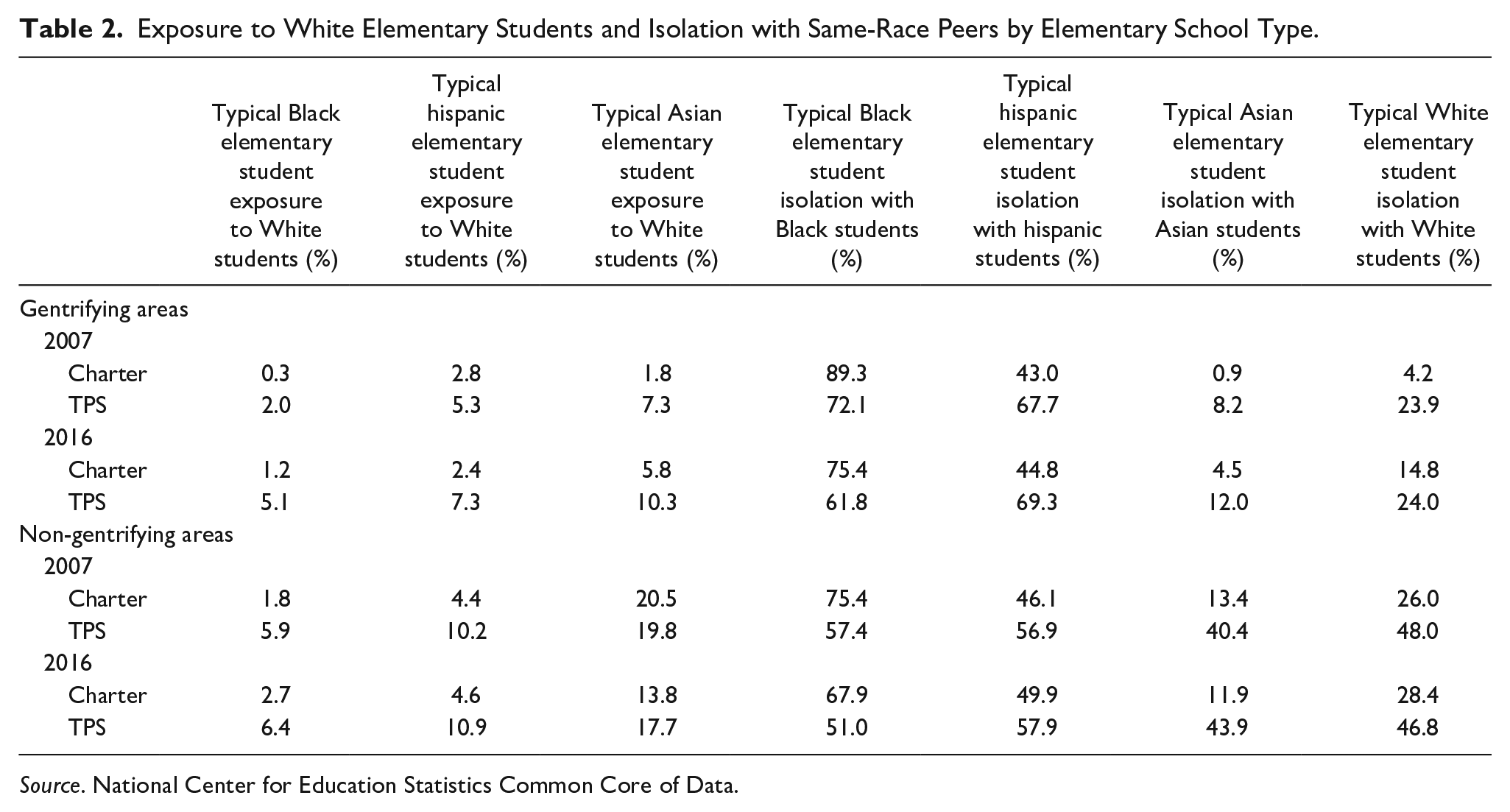
Source. National Center for Education Statistics Common Core of Data.
Turning to isolation, in both charters and TPSs in gentrifying and non-gentrifying areas, the typical Black and Hispanic elementary school students were isolated with high levels of same-race peers in 2016. In both gentrifying and non-gentrifying areas, the typical Black elementary school student was isolated with more same-race peers in charter schools than in TPSs while the typical Hispanic elementary school student was isolated with more same-race peers in TPSs than in charters. The typical White and Asian elementary school students also attended schools with more same-race peers in TPSs than in charters, which is likely related to the larger share of White and Asian students who attended TPSs than charters.
In summary, in addressing Research Question 2, we found that while the share of White students increased in both elementary charter schools and elementary TPSs in gentrifying areas, a larger share of White students attended TPSs than charter schools in 2016. Both elementary charter schools and TPSs in gentrifying areas experienced a decrease in the share of intensely segregated and hypersegregated schools between 2000 and 2016; however, the overwhelming majority of charter schools remained intensely segregated or hypersegregated in 2016.
Limitations
There are noteworthy limitations that restrict our capacity both to define gentrification and to understand its unfolding in urban schools. The localized nature of gentrification makes it challenging to generalize these findings to other communities and cities. Our research was also limited in the extent to which we could pinpoint when gentrification began; we were only able to identify whether significant neighborhood change occurred between two data points, 2000 and 2016. In addition, census tract boundaries seldom correspond perfectly with school attendance zones, and even when they do coincide, parents do not always send their children to the nearest public school. While it is true that the majority of students attend their zoned school, choice schools are heavily concentrated in Manhattan and the Bronx, and have also proliferated in Brooklyn and Queens (A. E. Schwartz et al., 2014). Lastly, this study is not designed to draw causal inference on the link between gentrification and school desegregation. Therefore, it is unclear if neighborhood gentrification is leading to the school changes observed, or if the changes are the result of other confounding factors.
Discussion and Implications
Although racial segregation continues to be the norm in American cities, a notable number of neighborhoods have become integrated through White households choosing to move into predominantly non-white neighborhoods, particularly since 2000 (Ellen & Torrats-Espinosa, 2019). Whether gentrification increases neighborhood integration in the long run, or simply in the short run as neighborhoods transition to resegregate, remains to be seen. Nonetheless, in some contexts, educators are increasingly viewing gentrification as an opportunity to integrate schools (Diem et al., 2019; Roda, 2020).
Using NYC as a laboratory, we examined whether demographic changes resulting from gentrification are associated with changing school enrollment and racial segregation patterns. Our results indicate that enrollment patterns in the city’s fastest gentrifying areas have seen a reduction in racial segregation. The reduction has been more substantial in TPSs than in charter schools. However, while this pattern is promising, high levels of racial segregation persist, and much more progress is needed, particularly in the long term.
Our analysis of demographics and school segregation patterns shows that while many of the city’s neighborhoods have undergone a dramatic shift in their demographic composition, the local school enrollment changes have been far more muted. One possible explanation for this asymmetry between neighborhood and school demographics is that a large share of White gentrifier parents are still bypassing neighborhood schools. Indeed, some scholars have found that many gentrifying families with children often opt into non-neighborhood public and private school options (Candipan, 2020; Keels et al., 2013; Mann et al., 2020). Despite the slower pace of change in schools, the share of intensely segregated and hypersegregated elementary schools has declined in gentrifying areas of NYC.
While much of the literature on gentrification and schools has suggested that upon the arrival of children, families with means often turn away from neighborhood schools, frequently relocating to suburban communities (Keels et al., 2013), more recent research has complicated this conventional portrait (Mordechay & Ayscue, 2020; Roda, 2020; Stillman, 2012). Our findings of the increase in White student enrollment and the decline in school segregation in NYC’s most rapidly gentrifying areas are possibly explained by a new wave of gentrifiers who are driving a demand for urban schools that gentrifiers of the past largely avoided. Indeed, several other recent studies have brought attention to middle-class families who choose to stay in the city and send their children to local public schools (Mordechay, 2021; Roda, 2020; Stillman, 2012).
Our findings are consistent with recent research concerning neighborhood changes and schools showing that at least on a small, localized scale, largely White and middle- to upper-class families are beginning to engage with urban school districts (Diem et al., 2019; Mordechay & Ayscue, 2020; Stillman, 2012). In addition, our findings are similar to those recently reported by Cordova-Cobo and Ellen (2019), who analyzed the links between neighborhood and school diversity in across NYC. They found that citywide, as neighborhoods diversified, their elementary schools diversified as well, but school changes were far more muted. Our analysis differed in that it focused on the city’s most rapidly gentrifying areas.
In addition, some of our findings mesh with recent evidence suggesting that charter schools are not only more segregated than TPSs as a whole, but also more segregated than the TPSs closest to them (Cheng et al., 2017). As has been found in districts across the nation, charter schools in NYC’s gentrifying areas are more segregated than TPSs. Despite the potential for creating greater diversity because the link between housing and school segregation has been broken with charter schools, this form of school choice does not appear to be facilitating greater diversity in NYC’s racially changing areas. As schools in NYC and in other districts across the nation become less connected to their neighborhoods, it is possible that the expansion of school choice initiatives may lessen residential segregation in low-income urban neighborhoods without meaningfully integrating the local schools. This dynamic of swelling school choice and demographic change in the urban core could have the potential effect of fueling gentrification, as affluent families see that there are “better” public school options if there are fewer ties between neighborhoods and schools in the district (Pearman & Swain, 2017; Rich et al., 2021).
Implications for Policy and Research
Few would deny that New York’s housing market and the city’s pace and scale of gentrification is an outlier relative to most US cities. Nevertheless, there is growing evidence that gentrification is now as widespread among small and medium sized cities as well (Landis & Reina, 2019; Maciag, 2015). As gentrification becomes a larger social and economic force in many cities, managing the process such that it supports sustainable neighborhood and school diversity will require coordinated and strong policies that underscore the fundamental relationships among housing, communities, and schools. One of the promises of neighborhood revitalization is an upgrade in the quality of public resources—with schools being among the most significant.
If gentrification proceeds without widespread displacement, it could increase socioeconomic and racial integration—reshaping the geography of opportunity in American cities. The concentrated poverty that has been shown to diminish the welfare of poor families might be diminished if more affluent residents settle, particularly with their children, in formerly divested neighborhoods and their schools (Brummet & Reed, 2019; Chetty et al., 2016; Wilson, 1987). However, to achieve longer term integration, urban and education policymakers will need to work in partnership with municipal governments and community-based organizations.
At the school level, efforts to integrate primarily gentrifying families into racially segregated schools must include policies, practices, and effective leadership to attract gentrifier families. In addition to promoting the existing successes at the schools, school leaders should assess the needs of new and long-time residents in order to develop programming that meets the needs and interests of both groups of families (Mordechay & Ayscue, 2018). For example, magnet schools, which were historically a tool for desegregation, provide a unique theme and curriculum that can be used to attract diverse groups of students to gentrifying schools (Ayscue et al., 2017). Depending on the desires of the community, magnets with themes such as dual language immersion, leadership, or Science, Technology, Engineering, the Arts and Mathematics (STEAM) might be attractive. Moreover, as this study shows, charter schools are segregated; therefore, revised charter school policy should support more diversity.
Once schools in gentrifying areas attract a more diverse student body, additional policies and practices are needed. A recent study documenting the tension in gentrifying urban schools suggests the importance of leadership training to prepare school leaders to work more effectively with new gentrifying parents, as well as long-time resident parents, since few can navigate the uneven power dynamics and tensions that can accompany such rapid demographic shifts (Mordechay, 2021; Siegel-Hawley et al., 2017). As schools begin to desegregate, teachers and leaders should be cognizant that desegregated spaces can potentially be highly racialized environments in which race and class shape student experiences in ways that might accentuate inequality. Scholars have documented schools that are ostensibly desegregated on the surface, but are segregated within through tracking (Welner, 2003), gifted/talented/honors programs (Roda, 2015), and special education programs (Losen & Orfield, 2002). Therefore, careful attention to within-school segregation is necessary in seemingly racially desegregated schools.
Policy initiatives also are needed to address housing. Perhaps the most important is to preserve the substantial stock of affordable housing that already exists in gentrifying areas. In addition, zoning regulations that limit housing density, restrict building height, and require minimum unit sizes put vulnerable households at risk of displacement. In spite of frequent local opposition and skepticism, increasing housing supply can result in more affordability, while opposing increases in the supply is likely to result in significant harms to the most vulnerable residents (Been et al., 2019). For new housing, policymakers will need tools such as inclusionary zoning that couples market-rate housing to affordable housing. Communities must carefully craft these policies so that they are effective at ensuring that housing is affordable at a range of incomes while still remaining attractive to developers.
A number of important issues need to be unpacked through future research. First, extending this research to a range of cities and school districts is needed in order to draw more robust conclusions about the relationship between gentrification and school desegregation. This is particularly important given that the school systems with more widespread choice may affect how gentrification impacts the demographic characteristics of schools. In addition, future research should examine whether schools that have recently desegregated alongside gentrification are able to stabilize and maintain desegregation long term. Gentrification is not a condition of stasis, but rather a process, and as a result, diversity maybe fleeting. We also encourage qualitative research of diversifying and demographically stabilizing schools located in gentrifying neighborhoods, to identify factors that mediate the relationship between neighborhood and school gentrification. Are the benefits of integration being evenly distributed in these schools, or are these schools saturated with inequities among parents and students? Lastly, additional research should explore the ways in which their schooling and neighborhood opportunities change in light of gentrification induced displacement.
Footnotes
Declaration of Conflicting Interests
The author(s) declared no potential conflicts of interest with respect to the research, authorship, and/or publication of this article.
Funding
The author(s) received no financial support for the research, authorship, and/or publication of this article.
