




Abstract
Internationally, there is increasing concern regarding the disengagement of marginalized students, particularly girls, from the formal education system, particularly since Covid-19. Students experiencing oppression/marginalization within urban education systems are considered at-risk from poor attendance, early school leaving, underperformance, low self-confidence, and social exclusion. In considering Paolo Freire’s conceptualization of education as “the practice of freedom,” this paper presents findings from an intervention, the Female Empowerment Group, a critical pedagogical approach to re/engaging at-risk female students in school. The Female Empowerment Group created a space for at-risk female students to explore complex contemporary issues shaping the intersectionality of their identities as marginalized, feminized, and politicized citizens in/outside school. Drawing on findings from a mixed methods design (quantitative surveys (n = 21 girls), qualitative interviews (n = 9 students, 7 teachers, 2 parents), Ketso (n = 9 students), this study presents the power of critical pedagogy for empowering and re/engaging at-risk students in school. Findings illustrate the powerful impact of a critical pedagogical approach for empowering students, enhancing self-confidence, motivation, empathy, and engagement with issues impacting their lives. Reported outcomes included more positive relationships with adults/peers, increased re/engagement in class and enhanced sense of belonging in school.
Introduction
Internationally there is growing concern regarding the long term implications for the dis/engagement of marginalized young people, especially girls, from education particularly since the onset of the Covid-19 pandemic (OECD, 2020). Although levels of school retention and attendance have improved greatly over time internationally, those most marginalized within education systems tend to be at the highest risk of early school leaving and social exclusion (OECD, 2019; Smyth et al., 2019). Targeted policy across the OECD has enhanced student engagement within education systems, yet higher rates of school dis/engagement are evident among students on the margins of our societies, including those from lower socio-economic status communities, girls and migrant children (OECD, 2020). In the Irish context, the Delivering Equality of Opportunity in Schools (DEIS) scheme in Ireland seeks to provide interventions (such as the School Completion Programme) to retain the most marginalized and at-risk students within the education system (Department of Education & Skills, 2017a). Although these interventions have been relatively successful at retaining students in Irish schools (Department of Education & Skills, 2017b), this paper argues that retention does not equate to engagement. Indeed, this paper explores whether a critical pedagogical approach which promotes and nurtures a process of conscientization (Freire, 1996) contributes to at-risk students’ positive re/engagement in school. Discussion will be undertaken under the following two themes emergent from the literature;
Critical pedagogy, conscientization, and freedom
Re/engagement, marginalization, and liberation
Critical Pedagogy, Conscientization. and Freedom
Critical pedagogy aims to liberate the oppressed through conscientization arising from the process of reflection and action, praxis, and a reframing of the learning space which allows participants to understand their world so that they may change it (Freire, 1996). It is an approach which seeks to empower those most marginalized, to transform their lives and the contexts within which they live;
Education either functions as an instrument which is used to facilitate integration of the younger generation into the logic of the present system and bring about conformity or it becomes the practice of freedom, the means by which men and women deal critically and creatively with reality and discover how to participate in the transformation of their world (Freire, 1996, p. 16)
Shor (1992) defines critical pedagogy as;
Habits of thought, reading, writing, and speaking which go beneath surface meaning, first impressions, dominant myths, official pronouncements, traditional clichés, received wisdom, and mere opinions, to understand the deep meaning, root causes, social context, ideology, and personal consequences of any action, event, object, process, organization, experience, text, subject matter, policy, mass media, or discourse (p. 129).
With research indicating the symbolically violent act associated with classroom pedagogical practices (Author, 2018) shaping how students do and feel learning in school evoking a powerful psychosocial response (Author, 2020, 2021), it is important to re/position pedagogy as a critical tool for empowerment rather than oppression. While praxis is considered as the dialectical relationship between theory and practice, education can be considered as an instrument for liberation (Freire, 1996). Freire (1996) argues that teaching can be considered as a political act, challenging the status quo through counter hegemonic and subversive narratives. Indeed, to truly awaken critical consciousness education should involve learning, unlearning and relearning, a process Freire (1996) refers to as conscientization. It is through “concientizao” that pedagogy is liberated, equipping participants with the ability to understand their world so that they may change it (Freire, 1996). Freire (1996) contends that being both oppressed, and oppressing others are dehumanizing and warns against the oppressed becoming oppressors themselves in the course of their own liberation arguing that “the great humanistic and historical task of the oppressed: to liberate themselves and their oppressors as well” (p. 26).
Repositioning curriculum through generative themes
The traditional banking model within education positioning teachers as depositor of knowledge rather than as collaborators within the educational process (Freire, 1996). Freire (1996) argues that co-creation of curriculum through generative themes formulated through collaboration with students is a more liberating approach to use in the classroom. Furthermore, locating the learning within students’ contextual reality facilitates greater emancipation by exposing the broader realities impacting and shaping their own lived experiences (Freire, 1996). Combined with conscietization, this allows individuals to critically confront their reality (Freire, 1996). This is echoed by McInerney (2009) who asserts that students are more likely to express resistance to learning within a system where they have little power, where topics do not relate to their lived experience or where they are devalued as contributors to the system. While critical pedagogy may be scathingly cynical about much of our social reality, it is also a pedagogy of hope. It demands that teachers engage with students’ reading of the world and help them emerge as a “conscious social actor who has the ability, the desire and the opportunity to participate in social and political life” (Frymer, 2005, p. 5), subjects capable of acting on and changing their world.
Building solidarity through a thick democratic community approach
In order to realize Freire’s critical pedagogical vision, it is imperative that schools employ a “thick democracy” approach to formulating educational policy, managing schools, generating curriculum, sharing values, and evaluating experiences to name but a few (Gandin & Apple, 2012). A critical aspect of adopting a “thick democratic” approach is to shift from student centered to critical pedagogical approach. Grant and Hurd (2010) illustrate the transformative power of “walking the talk” and adopting critical pedagogy for “making the journey alongside our students” (p. 1). McInerney (2009) argues for a critical pedagogical approach which seeks to address the systemic causes of alienation within the system. This includes engaging students in critical examination of (1) factors (such as consumerism) impacting on their identities, (2) inequitable power structures within their communities, (3) ways to improve their communities (McInerney, 2009). Indeed, Giroux (2011) argues “the new illiteracy is about more than not knowing how to read the book or the word; it is about now knowing how to read the world” (p. 87). A critical pedagogical approach seeks to empower and liberate students to be able to read and critically engage within the world around them.
Re/engagement, Marginalization, and Liberation
Defining engagement has been identified within the literature as problematic, particularly among educationalists (Symonds, 2015). It is a multi-dimensional concept, described by Fredricks et al. (2004) as comprising three distinctive interconnected dimensions including emotional, cognitive, and behavioral. The level to which a student is engaged in school is informed by a range of factors such as the affective dimension of learning, such as positive or negative emotions when engaged in a learning task (Skinner et al., 2009), school climate (Fatou & Kubiszewski, 2018), and relationships in school (Ralls, 2019). This current study was particularly focused on the emotional dimension of school engagement.
Emotional engagement, defined as children’s emotional attitudes toward school (Symonds, 2015), moves beyond feeling good or bad about school to include more epistemic emotions such as surprise, curiosity, enjoyment, confusion, frustration, anxiety, and boredom (Frenzel et al., 2007; Muis et al., 2015; Pekrun et al., 2017). Positive epistemic emotions lead to deep learning shaping how students engage with learning strategies and impact on school attainment (Muis et al., 2015). Deep learning strategies include the integration of prior and new learning (knowledge elaboration), evaluation and integration of ideas (critical thinking), and metacognitive engagement (reflection) in flexible and creative ways (Chevrier et al., 2019). It is argued that curiosity and pride are key elements driving student engagement and motivation (Vogl et al., 2020). Indeed, pedagogy has a profound impacts on how students understand themselves (and others) within the classroom, shaping how they “feel” learning and evoking deeply psychosocial responses to how they “do” learning in the classroom (Author, 2020). Stanger (2018) argues that critical education offers a “pedagogy of hope” where students can work together in community to resist dominant discourses which work to pathologize social positioning and forms of knowledge of those oppressed within the system.
Gender and dis/engagement
The gendered aspect of student dis/engagement has been linked to how students experience biological and social change during transitions in the education system, with particular implications for female students (Symonds et al., 2014). Girls experience puberty earlier and are expected to behave more like “feminine” young women and less like children informing their gender schema and shaping their self-concept (Symonds et al., 2014). It is argued that female students walk a sociocultural tightrope, as feminized identities are constructed and policed by girls within their particular contexts making it more challenging to generalize experiences than adolescent masculinity (Dytham, 2018a). Dytham, 2018a) also argue that the intersectionality of feminized identities is further compounded by classed identities where “niceness” is considered as a key indicator of femininity in more advantaged schools, and “meanness” assigned greater value in marginalized school. Meanness, within this context, is a measure for protection (Dytham, 2018a).
Popularity is a key mechanism for policing and defining femininity through a process of clique formation and othering in school (Dytham, 2018b). The regulation of behaviors by female peers through a process of engaged and disengaged behaviors results in what Dytham (2018a) refers to as emphasized femininity. It is within this regulation of hyper heteronormative behavior promoting “sexiness” or “ladishness” that post-feminish girl power is located, characterized as a display of power, sass, and freedom (Dobson, 2014). Policing plays an integral role in defining popularity as it is measured against constructs of femininity (Brown, 2011; Closson, 2009; Dytham, 2018b). Indeed, it is argued that popularity has more to do with who has greatest social power rather than who is considered as the most liked within a peer group (Closson, 2009).
This struggle for power and status can result in a relational aggression between peers, often treated less seriously than physical aggression (Waldron, 2011). Often such relational aggression is associated with girls being catty, cutting and calculating by nature (Brown, 2011). This more analytical approach to peer relations results in girls having less stable friendships than boys resulting in greater conflict (Symonds et al., 2014). Such conflict is often addressed by schools on a case by case basis, rather than by considering the broader social norms shaping such behaviors (Dytham, 2018a). Coupled with this complex negotiation of relationships, girls tend to have lower self-esteem during adolescence, impacting directly on their educational attitudes and attainment levels (Symonds et al., 2014).
Although girls who disengage or display deviant behavior may not consider that their decision making may have been influenced by their peers, the manifestation of such behavior can be considered as protective at times (Wike et al., 2013). Disengagement from school among females tends to be passive as opposed to acted out (Symonds et al., 2014). Indeed, it has been argued that interventions which utilize the strength of close friendships and acknowledge the positive aspects of such deviant behavior may generate successful engagement (Wike et al., 2013). This has particular implications for female students within the Irish context where 43% of students identified as at-risk or marginalized are female (Smyth et al., 2015).
Re/engaging vulnerable and at-risk students
Risk is defined as contextual conditions that increase the likelihood of a child experiencing negative outcomes (Heeran Flynn, 2017). DEIS and the School Completion Programme are two specific programs within the Irish educational system which prioritize re/engaging the most vulnerable and at-risk students within the system. In Ireland, the figures for early school leavers (2011 cohort) in DEIS schools comprised of 17.4% for males compared to 11.9% for females (Department of Education and Skills, 2018). The gendered aspect to early school leaving is particularly stark with female early school leavers tending to leave education earlier than their male counterparts (Smyth et al., 2015).
However, the complexity of designating a student as “at risk” can impact on teacher expectations resulting in a normalization of poor behavior, low confidence, low motivation, poor attendance, and poor academic performance (Heeran Flynn, 2017; Smyth et al., 2019). Such perceptions result in the problematizing of the individual rather than symptomatic of wider social and educational factors impacting them. Alienation disproportionally affects the poorest and least powerful within society, manifested through experiences of failure from early stages within the education system, resulting in higher early school leaving rates in schools with a high concentration of students from disadvantaged backgrounds (Byrne & Smyth, 2010).
This paper presents findings from a study which explored at-risk female student experience of a critical pedagogical intervention (the female empowerment group) which sought to re/engage the most vulnerable students in the school.
Materials and Methods
This research adopted an explanatory sequential mixed methods case study approach within the transformative paradigm (Figure 1).
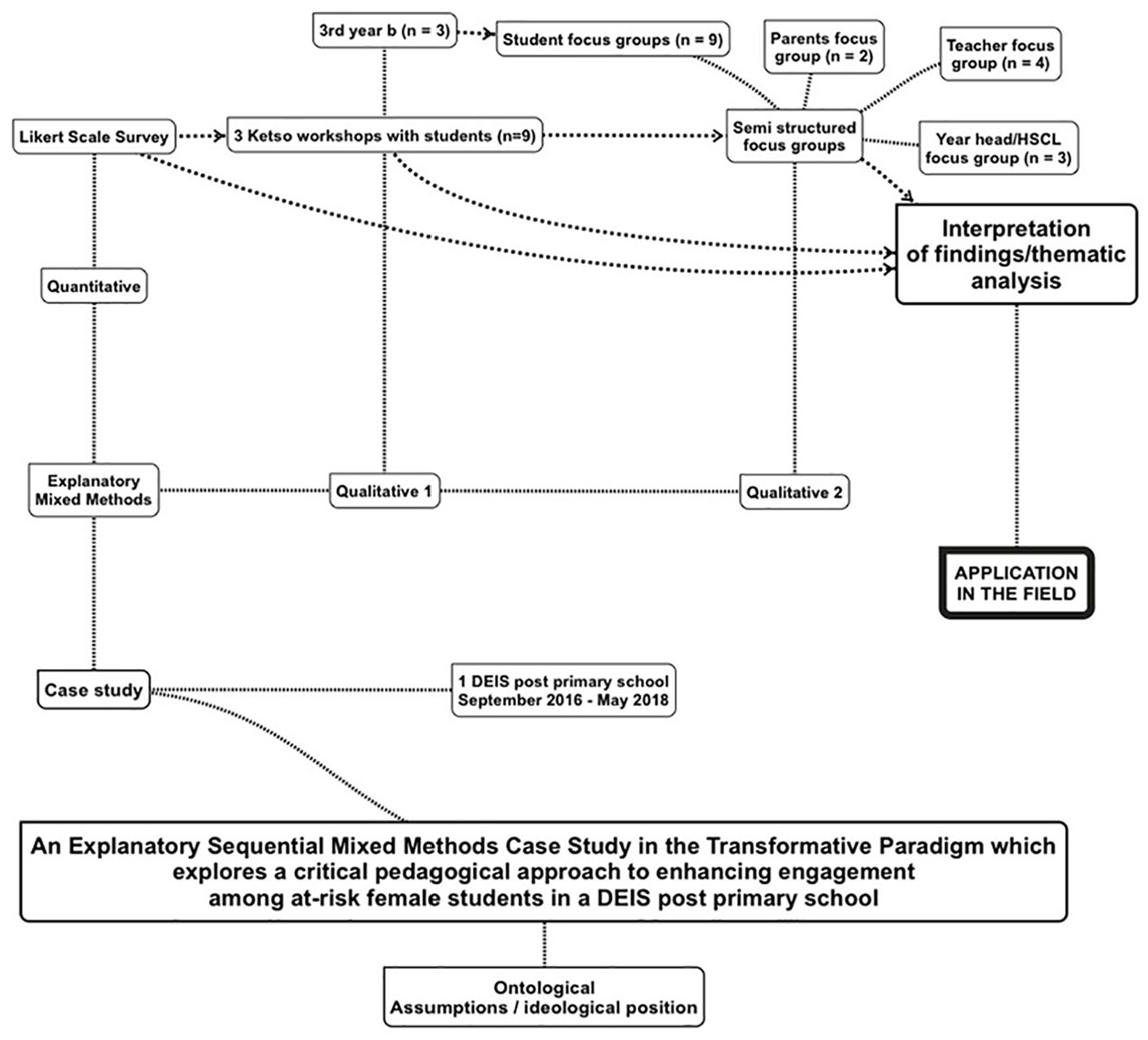
Explanatory sequential mixed methods case study design.
The case study encompassed quantitative (student questionnaires) and qualitative (ketso and semi-structured focus groups interviews) data collection in an urban school on the east coast of Ireland. The method adopted a sequential design (Cresswell, 2014) not only to triangulate the data, but to use the quantitative data to shape the design and implementation of the qualitative instruments. The transformative paradigm underpinning this research design adopted assumptions to challenge oppressive social structures, to build a trust-based relationship with participants and to commit to use the results to transform/improve their experiences (Cresswell, 2014). This paradigm is underpinned by the researcher being reframed “as one who recognizes inequalities and injustices in society and strives to challenge the status quo, who is a bit of a provocateur with overtones of humility, and who possesses a shared sense of responsibility” (Mertens, 2007, p. 212).
A key aspect of the study was to capture student voice(s) in an authentic and ethical way. This included ensuring confidentiality (through the use of pseudonyms), informed and ongoing consent from both guardians and students, ensuring participants could withdraw at any stage and taking steps to mitigate against any risk or distress caused during the interviews. The case study was designed to explore marginalized/at-risk student experience of an intervention designed to increase their re/engagement in school. This group, named the female empowerment group, adopted a critical pedagogical approach in its design, ensuring that all activities and engagement was not only led by the students, but co-created with them drawing on their social, cultural and peer group norms. This included activities such as trips to meet female leaders within society, self-directed project-based learning to enhance self-confidence, activism and leadership in addressing inequalities within the school community and building understanding and trust between students and teachers on equal terms. A total of 33 students were involved in the female empowerment group, and all were invited to participate in the study. This study encompassed a questionnaire survey (n = 21) and ketso group (n = 9) with students and semi-structured interview schedules with students (n = 9), teachers (n = 4), year heads (n = 2), and parents (n = 2).
Quantitative Research Design—Student Questionnaire Survey
A questionnaire survey was designed to capture student experiences of this critical pedagogical approach to re/engaging them in school, with particular focus on attitudes to school, teacher and peer relations, experience of the female empowerment group and understanding constructs of power. Students (n = 21) responded to the Likert scale which was conducted using SurveyMonkey. Initial analysis of this quantitative data informed the design of the qualitative instruments for the study.
Qualitative Research Design—Ketso and Semi-Structured Interviews
The first phase of the qualitative methods involved Ketso workshops which is used to stimulate discussion, visually represent ideas and enable all sections of a community to contribute and have their ideas captured (Tippett & How, 2011). Ketso uses the metaphor of a tree to help participants communicate their opinions and think strategically about the issues being examined. While large brown labels signify the central trunk (issue being explored) and the various branches (themes) associated with it, participants use colored leaves to identify what is working, how to improve this, barriers and solutions.
Ketso aligns to the model of praxis espoused by critical pedagogy (Freire, 1996), reflection (on the results from the survey data) facilitating further reflection (to contextualize the semi-structured focus group interviews) while ensuring an equitable approach to qualitative data collection. This is important in the context of the transformative paradigm and its sensitivity to social justice. The central theme for the ketso in this study was the female empowerment group and discussion focused on the findings from the questionnaire survey. A total of nine students participated in the ketso groups in three groups of 4, 3, and 2.
The second phase of data collection involved semi-structured interviews with students (n = 9) and teachers (n = 4) engaging in the female empowerment group (n = 4), school leaders (n = 2), and parents (n = 2). Students were interviewed in the same three groups as the Ketso sessions, while teachers, school leaders, and parents were all interviewed individually and asked to reflect on the questionnaire data. The core cross-cutting themes explored in the student semi-structured interviews were refined based on initial analysis of the student questionnaire data and included;
Comparing and contrasting the group with school in general
What they liked most about the group
Their perception of its impact on them as young women
Their perception of its impact on them as students
Why they thought some students were reluctant to engage
Analysis
The student questionnaire was analyzed using descriptive and correlation statistics. The sequential design of the study involved analysis of the quantitative data to inform and refine the qualitative instruments, including the ketso and the semi-structured interviews. Findings from the questionnaire survey informed the discussion during the ketso groups which produced mats visually representing the main themes explored (Figure 2). It provided an innovative and authentic approach, providing an opportunity to “address some of the limitations of thematic analysis such as simplicity and lack of coherence” (Wengel et al., 2019, p. 319). Data was collected using audio recordings during the semi-structured interviews and ketso groups and was transcribed using pseudonyms to protect anonymity. Interviews were analyzed using interpretative thematic analysis (Braun & Clarke, 2006), identifying key themes emergent using an iterative process of organizing and collapsing codes.
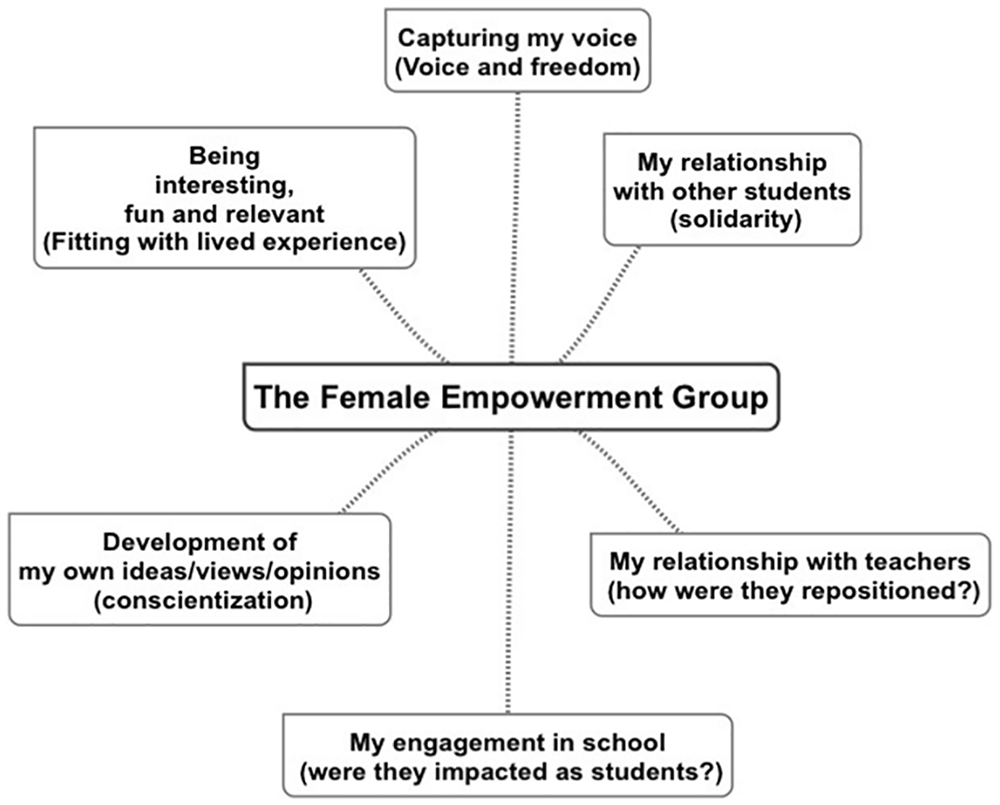
Ketso and semi-structured interview themes.
The 6 core critical pedagogical themes identified from thematic analysis of the qualitative data include conscientization (development of my own ideas/views/opinions), power and relationships (with teachers), solidarity (in relationships with peers), voice agency and freedom (in expressing voice), generative themes (connecting to lived experiences), and re/engagement (with knowledge and school).
The following section presents findings from analysis of the quantitative and qualitative data exploring the impact of a critical pedagogical approach (the female empowerment group) to re/engaging an identified “at-risk” group of students in school under the 2 core themes:
Female Empowerment Group as Critical Pedagogy
Critical Pedagogy to Empower Re/engagement and Liberation
Results
Female Empowerment Group as Critical Pedagogy
Conscientization, represented by the development of own ideas/views and opinion, underpinned the rationale and values espoused within the Female Empowerment Group. The study shows participant perceptions of growth in areas which are significant to conscientization; more interested in equality, how power works in society, gender, more motivated and understand their world better. This was reflected in the experiences of the majority of students (85.7%) who indicated that they had greater belief in their own ideas and opinions having engaged in the group. This was affirmed by Aoife (teacher) who suggested that engaging in the group encouraged the girls to “feel free to, like, mature people are, like you can have your opinion and to make your own decisions, take on your own responsibility.” The students themselves believed that they understood their world better (66.7%), had greater interested in issues relating to equality (95.2%), gender (90.5%), and how power works within society (85.7%).
Conscientization is not just about a philosophical or ideological awakening, it is about being equipped to change the world. This is at the very heart of empowerment. The participants spoke explicitly of being able to change things in their world and stand up to injustices as they encounter them. They developed views on a range of issues and were empowered to act based on those philosophical positions. This was evidenced by Gráinne (3rd year) who stated that the Female Empowerment Group had given her a sense of agency when considering issues of social justice and inequality;
‘I’d say like at the the start, like when I wasn’t in the group “oh inequality, ok like, oh your treating girls differently, that’s happening but there’s nothing you can do about it. That’s the way it is” but now it’s just like –“We can change something”
The yearhead echoed this view;
You could see them growing in confidence and their self-esteem, and also in their deportment. They actually kind of started taking care of their own appearance and becoming proud of being young women
The majority of students (81%) felt more motivated having engaged in the Female Empowerment Group. Analysis from ketso (see Figure 3) also indicated that participants believed they listened to each other more, had enhanced understanding and awareness of issues and wanted to become agents of change.
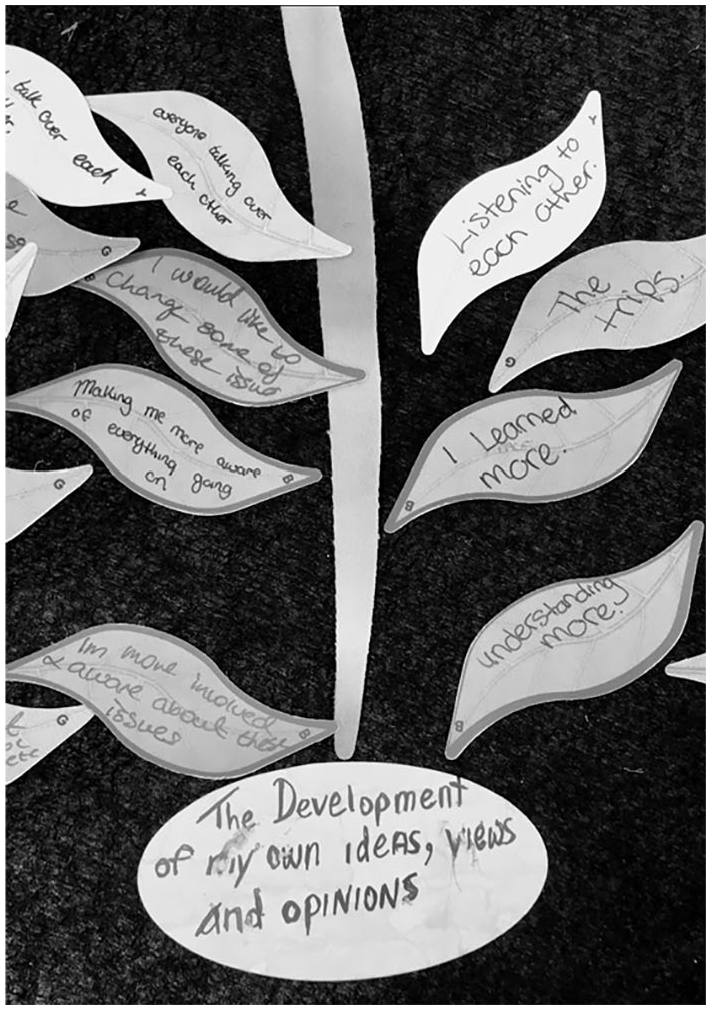
Ketso—conscientization.
Indeed, engaging in the Female Empowerment group resulted in making “you see everything like that is actually going on around you, then like you did before you came into the group, it makes you look at everything differently” (Blaithnaid, 3rd Year). This illustrates the importance of the relationship between knowledge and ideas as a key aspect to their engagement. Critical pedagogy allows a fusion of knowledge, reflection and action that is not achieved by conventional didactic teaching.
Overcoming dynamics of power and building relationships based on trust are key aspects to a critical pedagogical approach where students felt understood and could share vulnerabilities, ideas and personal perspectives in an open and respectful environment. This was particularly the case when it came to the more traditional dynamics of teacher-student relationships. Interestingly 66.7% of students indicated that their relationships with teachers had improved in their engagement with the Female Empowerment Group. This had increased from 42.9% of students who had previously reported having poor relationships with teachers and staff. Data from the focus groups indicated that students “saw a more human side to their teachers” which had “improved their relationship with them” outside of the group. Áine (5th year) believed that this critical pedagogical approach “builds the relationship with the teachers because the teachers get to know you and you get to know them a bit more on a personal level as a human instead of as a teacher.” The humanizing of the relationship between teacher and student was further emphasized by Jennifer (school leader) who stated;
I think we have to let our guard down a little as well. You have to go in there a little bit more relaxed and open and show a bit of our human side which you don’t do really in the classroom where you are trying to cover the curriculum (Jennifer, Year head)
This cultivation of respect and parity of esteem is transformative with humanization at its core. Students indicated during the ketso group (Figure 4) that they felt equal and more understood by their teachers both inside and outside of the Female Empowerment Group.
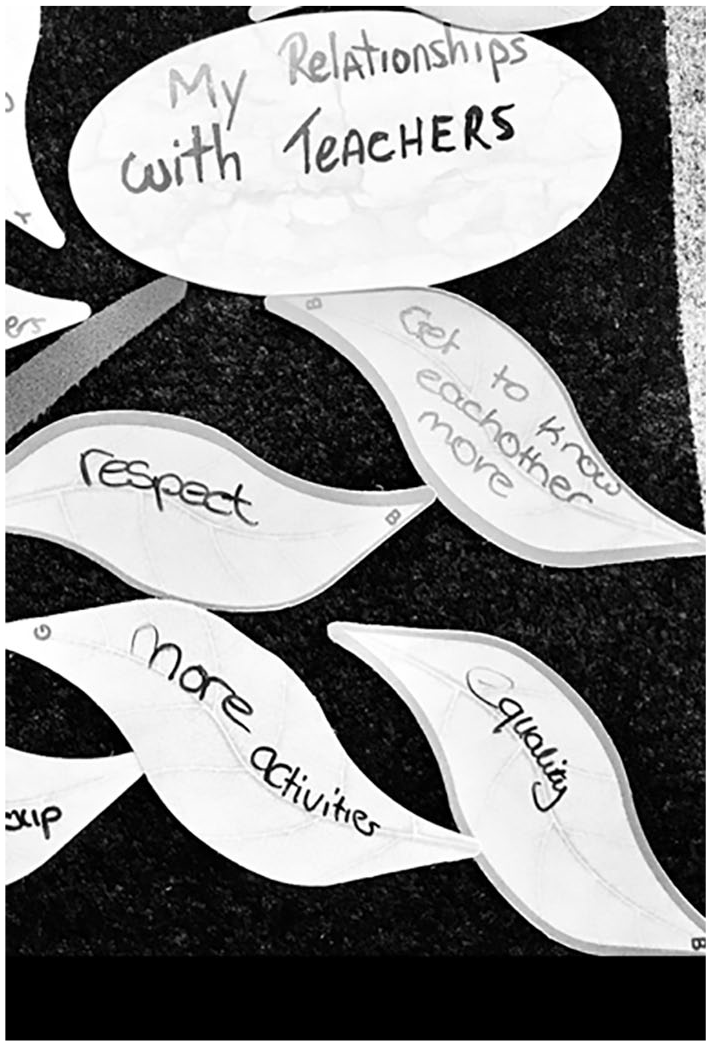
Ketso—relationships with teachers.
This was especially important to them in cultivating a more equal and human relationship with teachers positioning them on the same side as they confront issues. Indeed, students emphasized how important it had been to have shared experiences with their teachers through trips and activities. This was also emphasized by Jacinta (teacher) who stated that “in the relationship power dynamic I think it kind of brought the power of the teachers down to their [student] level and brought their power up.” It is evident that the Female Empowerment group was a truly liberating model of education, where students did not feel teachers were agents of oppression but rather they were agents of support and collaboration in the pursuit of freedom.
This solidarity building expanded beyond the relationship between student and teacher, to encompass the relationship between peers. The “horizontal violence” (Freire, 1996, p. 44), the relational aggression between peers, was a key rationale for establishing the Female Empowerment group. One of the desired outcomes from the group was to create a space to cultivate solidarity as “true solidarity is found only in the plenitude of this act of love, in its existentiality, in its praxis” (Freire, 1996, p. 32). Evidence from the survey data identified that the Female Empowerment Group had improved peer relationships among the majority of respondents (71.4%). Having a mix of students involved in the group from across year/class levels (85.7%) was especially important to the majority of the students.
There was a different mix of kids. There were loud ones, quiet ones and the ones you never really seen, there was ones you always seen. Just a mix of the different groups in school. So, there was a bit of everything. (Áine, 5th year)
The gendered aspect to the Female Empowerment Group was especially important within the co-educational context, with 80.9% of students emphasizing the importance of coming together as a female-only group. Acts of praxis, such as the trips and activities, were cited by students in the focus groups and Ketso as cultivating improved relationships with each other (Figure 5).
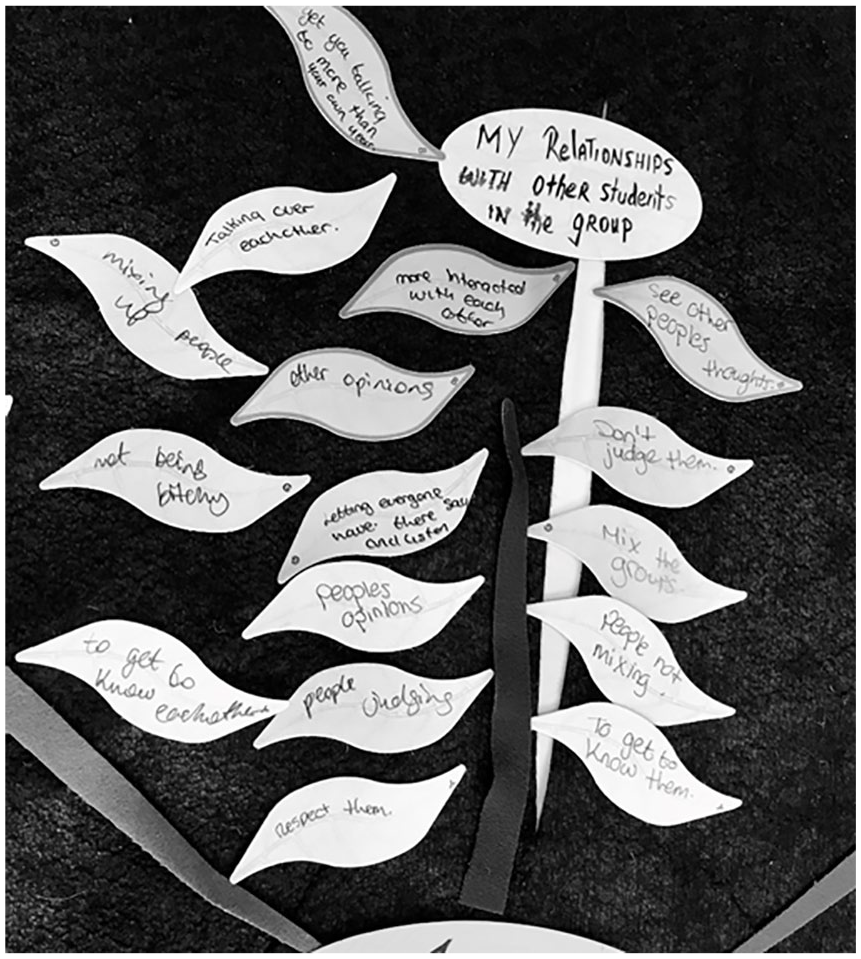
Ketso—relationships with peers.
These acts made sitting in a room together, sharing and exploring ideas and opinions easier for the participants. They cultivated trust. This contributed to improved solidarity between peers as it had “expanded their social circle” and believed that “trips and activities were very important to building relationships.” This was also indicated as important by Áine (5th year) who stated “I feel like by the end of it everyone kinda said hiya to everyone, if you see them in school, everyone did a little (makes a nod) at each other—she’s in the group like.” She further expanded about how engaging in the group had impacted on the dynamics of the interpersonal interactions between peers;
Like, when you’re in the group you’re not going to start fighting. Your kind of thinking “maybe I think the same as them.” You might realise sometimes you are the same as someone that you slag, they are actually the same as me. Just because they’re not wearing the same shoes doesn’t mean they’re not the same mindset as me (Áine, 5th year LCA)
This critical pedagogical approach moved away from pathologizing individuals to create a positive space where the school could cultivate solidarity through acts of praxis, which contributed to most positive relationships with peers.
Critical Pedagogy to Empower Re/engagement and Liberation
Freire (1996) argues that education is the practice of freedom, and critical pedagogy empowers through voice agency and freedom. This was particularly evident in how students experienced freedom in the Female Empowerment group compared to the classroom. Interesting patterns emerged from the survey with the students, where although only one-third of them felt free in school, the overwhelming majority (95.3%) felt free in the Female Empowerment Group. This is critical as freedom is a condition and an act, providing the context within which voice and agency are actualized (Freire, 1996). The transgressive nature of the group where counter hegemonic thought is encouraged creates a space where students can intellectually and socially connect. Indeed, the study clearly demonstrates that the intellectual and the social become intertwined. Discussion during the ketso group revealed that “the group provided a space for them to express their views” and that “they really listen to each other.” The Female Empowerment Group went from having silent debates and submitting ideas anonymously to quite casual but passionate discussion and debates. 1
Indeed, engaging in this critical pedagogical approach brought an awareness of the “stifling impact of judgment” to the students.
Being listened to, you don’t get listened to in class, you literally don’t. . . . It’s just you get to say what you want. Not like in class when they are like “I don’t want to hear what you are saying,” here you can say whatever. . . . .I think more people like kinda talked to each other and kinda when they were discussing something, they were actually discussing it instead of just like shutting up when the other person like started talking (Grainne 3rd Year)
The confidence to speak and reveal personal perspectives is evidence of growth and this was felt by the students as articulated by Áine (5th year) “Yeah, I actually swear to God, I am actually so different then from when I started it. My ma will even tell ya.” While much focus is given to respecting the voice of young people it takes time to generate voice and find suitable modes to express it. The study demonstrates that praxis based projects allow schools to engage students in action and reflection in a continuous fashion which allows voice to emerge loud and clear.
Locating learning within the lived experience through generative themes is a key aspect to critical pedagogy. At its simplest, a generative theme is a lens through which other things may be viewed. The Female Empowerment Group attempted to use lenses which were familiar to the participants (and often unfamiliar to the facilitators) to look at unfamiliar and abstract topics. This reifies the existing knowledge of participants and respects their lived experience. It also repositions what is normally marginal as central (Freire, 1996).
This is especially reflected in how students “feel” about school, a critical aspect to school engagement. Interesting, while one-third of students indicated they enjoyed school, all reported enjoying the Female Empowerment group. The vast majority (85.7%) indicated that they learned about issues which were important to them when working in this critical pedagogical group. To achieve a good level of engagement it was vital that the stimulus and topics were ones that the participants felt relatively expert on. Their icons, their dreams, music artists, music videos, colloquial misogynistic language, films, tv shows, fashion, and sport formed much of the conversation. This added to the shift in power dynamics as the young people were now the experts in the room. During ketso conversations, the students indicated that they enjoyed that the content was “based on their opinions” and believed that learning happened in “a less boring way.” Indeed, they believed that “trips and activities were very impactful.”
Áine (5th year) spoke about the importance of relating content to their lived reality as “young girl(s) in school” not only to engage, to also as a means for self-discovery and confidence building.
what’s it like to be a young girl in school? Remember in the start? And who your idol was? And that’s all stuff to do with us. It makes it interesting because sometimes you find out more about yourself than you did before. . . . . . . well I felt in school I was only going in and I was just being told that you have to catch up on this and catch up on that so then in the group you’d go in and actually feel like I’m actually good at this, and not feel like getting shunned upon like (Áine, 5th year)
The fact that the clearest statement in the focus groups regarding belonging came from a chronic non-attender demonstrates the power of critical pedagogical approaches in generating reengagement.
This study was particularly interested in exploring whether adopting this critical pedagogical approach within the Female Empowerment group impacted on student self-reported re/engagement in school. Co-creating knowledge from perspectives of the participants has proven to be a powerful strategy to cultivate emotional engagement which provides the platform to build both cognitive and behavioral engagement. Findings indicated that most students reported being more motivated (n = 80.9%). Students believed they learned more (95.2%) and learned content relevant to their studies (71.4%) when working in the Female Empowerment group. The group indulged their passions and interests, their preoccupations rather than occupations (Freire, 1996, p. 35). There was evidence of positive emotional engagement with the Female Empowerment Group “because we like doing it, we are more thinking about the stuff we are talking about. . .gets your brain working and all” (Grainne, 3rd year). The strong level of agreement in the survey regarding learning things and learning things that are relevant to my studies can be viewed as operating on the level of emotional engagement while learning things important to me is indicative of epistemic emotions. This repositioning of the things important to them as central changes their relationship with knowledge from something they are taught and must learn into something they believe, have opinions on and is part of their identity. The deep learning emerging from epistemic emotions allows them to develop their critical thinking and integration of new knowledge (Chevrier et al., 2019; Muis et al., 2015). As Áine put it “you see more because you know more.”
Almost one-half of the students believed that as a result of engaging in the group they were more involved in classroom discussions (47.6%), were more likely to ask questions (42.7%), and indicated they were less bored in class (38.1%). Discussion in the ketso groups also revealed that Female Empowerment group impacted on how the students felt about school whereby they “looked forward to school on the days the group was on.” It imbued the students with a sense of belonging, both in terms of social identity (improving their relationships with others in the school community) and academic identity (being considered as ‘know’ing). Students believed that engaging in the Female Empowerment group “raised their standards” and that they “felt relaxed and primed” to engage in class after the session. It gave them a sense that “I know what I’m capable of doing” (Máire, 5th year).
Discussion
This mixed methods study explored student engagement in a critical pedagogical approach to a group (Female Empowerment Group) which sought to re/engage the most vulnerable female students in school. Evident from the data collected via questionnaires (n = 21), ketso group discussions (n = 9) and semi-structured interviews with students (n = 9), teachers (n = 4), school leaders (n = 2) and parents (n = 2) was the profound impact this critical pedagogical approach had on female student re/engagement in school. The Female Empowerment group embodied an educational act of freedom (Freire, 1996) actualized through a critical pedagogical approach evidenced through conscientization, whereby students experienced a critical awakening, a realization of their impact on their world. In taking ideological positions, it evoked epistemic emotions among the students resulting in deep learning (Pekrun et al., 2017).
Teachers were re/positioned within this critical pedagogical approach as co-creators and collaborators. This transformed the relationship between students and teacher, resulting in increased mutual understanding and a humanization of interaction. This manifested in trust and an equalization in the traditional power imbalance between student and teacher. Solidarity, a key aspect of critical pedagogy, was cultivated through the critical pedagogical approach adopted within the Female Empowerment group, evidenced in the decrease relational aggression reported between students. Students gained considerable confidence in their own voice, developed greater agency and expressed themselves with greater freedom through their involvement in the Female Empowerment Group.
The use of generative themes was especially important for realizing a critical pedagogical approach within the Female Empowerment group. The intersection between power and knowledge was rebalanced through a process of placing student generated themes at the heart of the learning within the group. It centralized, rather than marginalized, student knowledge and lived experiences. It lead to epistemic engagement and facilitated the exploration of complex ideas through familiar themes transforming the relationship between knowledge and school.
This study demonstrated the transformative power of adopting a critical pedagogical approach to re/engaging students in school. The Female Empowerment group not only enhanced engagement within the group, self-reported evidence revealed it also increased student engagement in class. This was evidenced in student behavior (improved engagement and behavior), enhanced solidarity (with teacher and peers) and increased sense of self belief and ability to impact on the wider world. This critical pedagogical approach consciously moved away from pathologizing students to creating a safe space for them to explore inter-relational dynamics and to engaging in learning drawing from their own lived experiences. This was particularly powerful as students and teachers reported a decrease in relational aggression and “horizontal violence” (Freire, 1996, p. 44).
With growing concern about the level of student re/engagement in education systems internationally post pandemic (especially for girls and those from lower SES backgrounds) (OECD, 2020) this study offers possibilities for empowering female students using a critical pedagogical approach to re/engage them in school while also contributing to their enhanced motivation and sense of self. While wider systematic approaches to critical pedagogy is required internationally to meaningfully transform schooling for the most disaffected students (McInerney, 2009), this study demonstrates the power of more localized approaches, not only in terms of enhancing student engagement in school, but also in terms of shaping how learners “feel” and “do” learning in the classroom.
Footnotes
Acknowledgements
The researchers would like to acknowledge the young female “empowerers” who gave their time to engage with the research and share their insights.
Data Availability Statement
Due to the nature of this research, participants of this study did not agree for their data to be shared publicly, so supporting data is not available.
Declaration of Conflicting Interests
The author(s) declared no potential conflicts of interest with respect to the research, authorship, and/or publication of this article.
Funding
The author(s) received no financial support for the research, authorship, and/or publication of this article.
Ethical Approval
Ethical approval was granted by the institution Human Research Ethics Committee.
