



Abstract
Community-based, Judaism-intensive action groups (Hebrew: Gar’inim Toraniim—GTs) are religiously motivated to settle in Israeli development towns, seeking to narrow social gaps through education. However, their influence has never been fully clarified. This study is grounded in the theory of educational gentrification and introduces the concept of Faith-Driven Gentrification. Until now research has lacked voice from local people forced to face the intervention of settlers driven by religion and their influence on urban school systems. The findings, based on institutional data and in-depth interviews, show that GTs alter the structure of educational systems and the dominant educational ethos. They drive achievement and strict religiosity; nevertheless, their actions impair disadvantaged groups and opponents of their religious lifestyle, intensifying segregation. By giving voice to these communities, this study claims that despite gentrifiers’ commitment to social justice in urban communities, they harm longtime residents through indirect displacement, fueled by religious and ethnic elitism.
“It’s a battle for our home. . .”
1
Introduction
Following the establishment of the State of Israel in 1948, a few hundred thousand Jews from North Africa and the Middle East immigrated to their homeland (Ofer, 1995) with expectations of acceptance and prosperity. Instead, they faced exclusion and inequality. During the 1950s and 1960s, the Israeli government directed many of these immigrants, who had been given little choice in the matter, to urban centers that were established in the Israeli peripheries—Development Towns. These towns became poverty stricken, had high unemployment levels, and were alienated by mainstream society and the establishment (Picard, 2013; Yiftachel & Tzfadia, 2004), a global problem in peripheral regions (Shils, 1975). Inequalities between peripheral and central regions in Israel partially result from an underlying ethnic conflict between Mizrahiim and Ashkenazim. Mizrahiim (Eastern) comprise immigrants from the Middle East and North Africa and their descendants; the hegemonic Ashkenazim originate from Europe and North America (Roby, 2015; Yiftachel & Tzfadia, 2004). Economic, social, and educational gaps exist between development towns and the rest of the country to this day. For example, there is a significant disparity in the rate of high school students graduating with a full matriculation certificate (Knesset Research and Information Center, 2018).
Israeli governments have been aware of these inequalities since the establishment of the state and have, through educational reforms, attempted to reduce them (Ayalon & Shavit, 2004). The education system differentiates state secular schools, state-religious schools, and semi-private Torani schools—a unique category providing enhanced Jewish studies within a strict religious environment (Billig, 2016; Harel Ben Shahar & Berger, 2018). Establishing Torani schools has been part of a wider ongoing educational privatization process (Harel Ben Shahar, 2018). Israeli regulation policy allowed Torani fee-charging schools to select students considered suited to their religious ideology and way of life. This included: gender separation at schools; strict religious supervision of access to home television—many families forbid television altogether; restricted internet usage; adherence to a modest dress code, mainly girls; and a strong focus on Torah studies at schools (Billig, 2019; Paz-Fuchs & Harel Ben-Shahar, 2019). However, they attracted students from privileged, mostly Ashkenazi, backgrounds, whose parents were economically better off. Parental motivation, according to data, was not only religious but elitist: parents wished to advantage their children by separating them from their less advantaged, mostly Mizrahi, peers. While elitist Torani schools display a more established strata, state-religious (SR) schools reflect the true socioeconomic makeup of the neighborhood (Harel Ben Shahar & Berger, 2018).
Civic society and non-governmental activist organizations have joined the state to reduce socioeconomic and educational gaps (Katz et al., 2009; Yishai, 2008). For the past three decades, several groups have moved and settled in development towns assisting communities through involvement in social, educational, and cultural initiatives. These groups include Urban kibbutzim, student villages, and Gar’inim Toraniim. Urban kibbutzim, an outgrowth of the Kibbutz movement, are communities driven by socialist ideology living in disadvantaged neighborhoods trying to bring change mainly through education (Dror, 2011). Student villages represent another model. These small volunteer communities live in public housing in disadvantaged areas, and share an ideology that strives to reduce social gaps. They are committed to the whole community, and see themselves as “servant creative class” (Billig & Lebovitz, 2014).
Gar’inim Toraniim (GTs), which are the focus of this study, are orthodox Judaism-intensive action groups, whose objectives differ from those of other groups. They are driven by a passionate religious Zionist ethos and a mission to bring people closer to their Jewish heritage (Cohen & Billig, 2018; Dahan, 2019). Most GTs settle in urban neighborhoods throughout Israel trying to improve the quality of life of longtime residents (LRs) through social, cultural, political, and educational influence. They promote their aim to enhance religious education, benefaction, and social welfare (Levi et al., 2014; Shealim, 2020). GTs are predominantly middle or upper-class Ashkenazi and represent a new elite in Israel—the religious Zionist sector (Ben-Refael & Sternberg, 2007; Cohen, 2018) and its political parties. The GTs, thought to number around 50, benefit from political influence, government support, and civic funding (Levi et al., 2014). In development towns they consider local religious education their primarily field of influence—a practical way to further their vison for society. They mainly work in SR and Torani schools and in informal education (Cohen, 2018).
This research uses the concept of gentrification to explore GT influence on education, the local urban community, and its response.
Background
Gentrification and Indirect Displacement
Gentrification, a global issue, is the movement of middle and upper classes to less well-established neighborhoods and its resulting displacement of lower classes (Atkinson & Bridge, 2005; Smith et al., 2016). Glass (1964) was the first to identify the gradual gentrification process in London, where middle-class people bought up working-class houses, raising their value.
Marcuse (1985) identified two types of displacement caused by gentrification: direct and indirect. Direct displacement takes the form of physical eviction, while indirect displacement includes exclusion by gentrifiers (exclusionary displacement) and displacement pressures resulting from neighborhood changes. These may be caused by friends moving out, familiar shops disappearing, and social and educational arrangements being rendered inappropriate. For many LRs, it is only a matter of time before they leave (Hankins, 2007; Lees, 2000; Shaw & Hagemans, 2015; Slater, 2009).
Although GTs are largely motivated by an aspiration to reduce social and educational gaps, they have material incentives such as tax benefits and inexpensive housing (Cohen & Billig, 2018). This self-interest points to classic gentrification (Glass, 1964), while the ideological motivation points to something else.
Social Justice Gentrification
While most studies in this field emphasize the material interests of gentrifiers and the harms of displacement, another line of research reveals faith driven social justice as an additional motivator for gentrification. Hankins and Walter (2012) described Gentrification with Justice: the penetration of urban church organizations into poor neighborhoods to promote social justice. American Presbyterian minister Robert Lupton, claiming to have heard a divine call to help people cope with gentrification, moved to a deprived neighborhood of Atlanta with a mission:
We can buy crack houses and renovate them. . . We can pass ordinances that will give tax relief to seniors on fixed incomes. . . We can harness the growing tide of gentrification so that it becomes a redemptive force in our cities. In a word, we can bring about gentrification with justice (Lupton, 2006).
Aware of the prevailing class gap and its associated power relations, Lupton and his followers applied his strategy with sensitivity and awareness. They went on to implement it in other urban centers in the US (Lupton, 1998). Suchland (2008) documented groups of white, educated gentrifiers in St. Louis, who, also motivated by morals and religion, supported schools and shelters in disadvantaged neighborhoods. Eccleston (2020) brought a critical new perspective through examination of an alliance of “relocators”: The Christian Community Development Association (CCDA). Driven by faith, these mostly white individuals and families sought social change through settlement in economically deprived urban areas. Eccleston’s research, based on interviews with relocators in Chicago, Milwaukee, and Portland, showed that despite good intentions, relocators were not sufficiently aware of power relations and race issues, so might have reproduced white superiority.
Weng (2017) introduced the term religious gentrification to describe the purely faith-driven Islamic urban renewal in Malaysia and Indonesia—the implementation of Islamic practices to help people cope with the challenges of a modernized city. Billig and Lebovitz (2014) differentiated the hedonistic, educated young “creative class” (Florida, 2019) from the ideologically committed “creative class” who seek to empower weaker communities and combat their exclusion. GTs in Israel are another group of gentrifiers driven by faith and social justice ideology (Cohen & Billig, 2018), defined in this article as Faith-Driven-Gentrifiers. However, no study appears to examine the LR response to these efforts (Eccleston, 2020).
Gentrification and Displacement in Education
Gentrification has implications on education across the world. In their London study, Butler et al. (2013) highlighted two displacement pressures caused by newcomers. The first results from changes in the dominant local educational ethos that becomes inaccessible to LRs lacking material or cultural resources. Gentrifiers taking preferred schools places and forcing LRs outside their catchment areas causes the second. Nethercote (2017) highlighted exclusionary displacement of disadvantaged families in Melbourne Australia. While gentrifiers could afford to move into their preferred school catchment areas, those with less money were unable to do so and were consequently forced to look elsewhere. In China, Wu et al. (2016) described a similar phenomenon of gentrifier parents purchasing expensive apartments in leading school catchment zones, displacing the working class. Same phenomenon could be seen in Israel.
Extensive research carried out in 100 major cities across the U.S. revealed increasing waves of gentrification in neighborhoods leading to greater ethnic and racial demographic diversity and integration. Meanwhile, the growing popularity of school choice, and the preference of gentrifier parents to select schools “that are really good for their children” caused neighborhood public schools to become more ethnically and racially segregated (Coughlan, 2018; Roberts & Lakes, 2016). These gentrification processes often led to displacement of less privileged families: Gentrifiers in Atlanta instituted changes at charter schools displacing ethnic and racial LR families (Hankins, 2007). Gentrifiers in Boston, Chicago, and Philadelphia used social and cultural capital to ensure acceptance of their children by prestigious schools, displacing less privileged students (Posey-Maddox et al., 2016). Changes to public education in gentrified areas of New York City, such as school choice and neoliberal market-based policies, deepened racial, ethnic, and cultural segregation (Wells et al., 2019).
Although a vast majority of public schools in disadvantaged, racially isolated urban areas in U.S. cities continue to be populated by students from lower-class families, an increasing number are filled by children of white gentrifiers (Billingham, 2019). Posey-Maddox et al. (2014) defined school gentrification as a process involving increasing numbers of gentrifier families; improving educational resources; excluding and marginalizing low-income students; and changing school culture and climate. Parental motives combine democratic liberal ideology and a belief that children will benefit from studying with others from different ethnic-racial backgrounds (Siegel-Hawley et al., 2017). Indeed, some middle-class parents prefer a diverse educational environment but only if other parents “like them” also register their children at the same urban public school (Kimelberg & Billingham, 2013); otherwise, they tend to see their “against the grain” choice as a risky decision (Ellison & Aloe, 2019).
While children of LRs may benefit, the process intensifies social, racial-ethnic, and class disparities (Kimelberg & Billingham, 2013; Posey-Maddox et al., 2014, 2016). A review of 32 studies on school gentrification in U.S. cities revealed that parents who send their children to public schools express support for diverse and bilingual education. However, despite this apparent support, they maintain separate social networks and sometimes isolate their children from minority peers (Quarles & Butler, 2018). In their review, Quarles and Butler (2018) highlighted the proliferation of studies analyzing this issue from the perspective of white parents, and a lack of those giving voice to racial and ethnic minorities. They called for multivocal research to extend beyond the largest cities of the U.S.
GTs in Israel: Social Justice Gentrification in Education
Studies addressing gentrification with justice show that faith-driven gentrifiers view their activity as welcomed by communities (Hankins & Walter, 2012; Lupton, 2006; Suchland, 2008). However, it appears no research has been carried out on the LR response. Quarles and Butler (2018) made a similar observation about the lack of studies giving voice to minority LRs in response to school gentrification and called for multivocal research. Studies are yet to express voices of LRs from different backgrounds.
Aims of the study
This research sees GTs as Faith-Driven Gentrifiers (FDG) and their activity in urban neighborhoods in Israel as gentrification in education. The study aims to give voice to LRs and gage their response to GT initiatives in education in development towns. This research claims that despite good intentions to foster social justice GTs hurt LRs by indirect displacement and exclusion in education and by reducing their educational prospects.
The study focuses on the changes initiated by GTs in the religious educational system of two Israeli development towns. Three key questions are asked: (1) How did GTs influence the local educational system? (2) How did changes in the local education system affect LRs? (3) How did LRs perceived and responded to these changes?
Data and Methods
The findings in this article derive from a larger study of sociocultural interactions between GTs and their broader surrounding communities. The GTs with which this article is concerned have been active in two development towns in northern Israel since the late 1990s: Carmel and Galil. 2 These towns differ from each another in terms of their peripherality and the social mix of their populations. The two GTs were selected as information-oriented cases and the researcher’s familiarity with them, rather than as random samples—an important factor in securing participants’ cooperation. Carmel GT arrived in the late 1990s and intensified its activity in 2006. By 2015, around 50 young couples and several single persons had moved in. Galil GT began operating in 1997 and numbered around 150 families by 2014.
The findings are based on the mixed methods approach, a combination of quantitative and qualitative research carried out in several stages, enabling effective research with high reliability (Tashakkori & Teddlie, 2003). The first stage consisted of gathering institutional statistical data from three key sources: the respective municipal authorities, local schools, and the Israel Ministry of Education. The figures obtained concerned development and construction of educational system buildings, fluctuation in numbers of students in Carmel and Galil from the year 2000 to 2015, and Care Indexes 3 from 2008 to 2015 obtained from the Chief Scientist’s Office of the Ministry of Education.
The second stage comprised the qualitative part of the research and followed the grounded theory method (Smith, 2003). We conducted 34 in-depth, semi-structured interviews: 24 with leading officials and community activists, both formal and informal, from among LRs—12 from Carmel and 12 from Galil—and another 10 with key functionaries of the Galil and Carmel GTs (six and four, respectively), who expressed their points of view on the dilemmas and complexity of their relationships with LRs.
Participants were selected according to the elite interviews approach and the snowball sampling method. The first focuses on interviews with public figures and their interpretations of events (Berry, 2002; Lancaster, 2017). Multiple interviewees with divergent perspectives are preferred (Berry, 2002), and sensitivity to subject vulnerability is recommended (Lancaster, 2017). The snowball sampling method is often used to access hard-to-reach populations: one participant refers the researcher to other potential participants who suit the desired criteria (Biernacki & Waldorf, 1981; TenHouten, 2017). It is noted critically that the initial links (or seeds) of the sample come from the researcher’s social network; this may result in a selection bias (Parker et al., 2019). Combining the elite interviewing method with snowball sampling in this study was found to be highly effective because it opened access to community leadership, tore down barriers of suspicion, and built trust between participants and researcher (TenHouten, 2017). The ages of the participants—18 men and 16 women—ranged from 30 to 55. Interviews took place between 2014 and 2016. The interviews were conducted at locations convenient to participants, such as their place of work or homes. They lasted between 1 and 2 hours, were recorded and transcribed. A detailed list of participants, their community functions, and occupations are presented in Table 1.
Participant List.
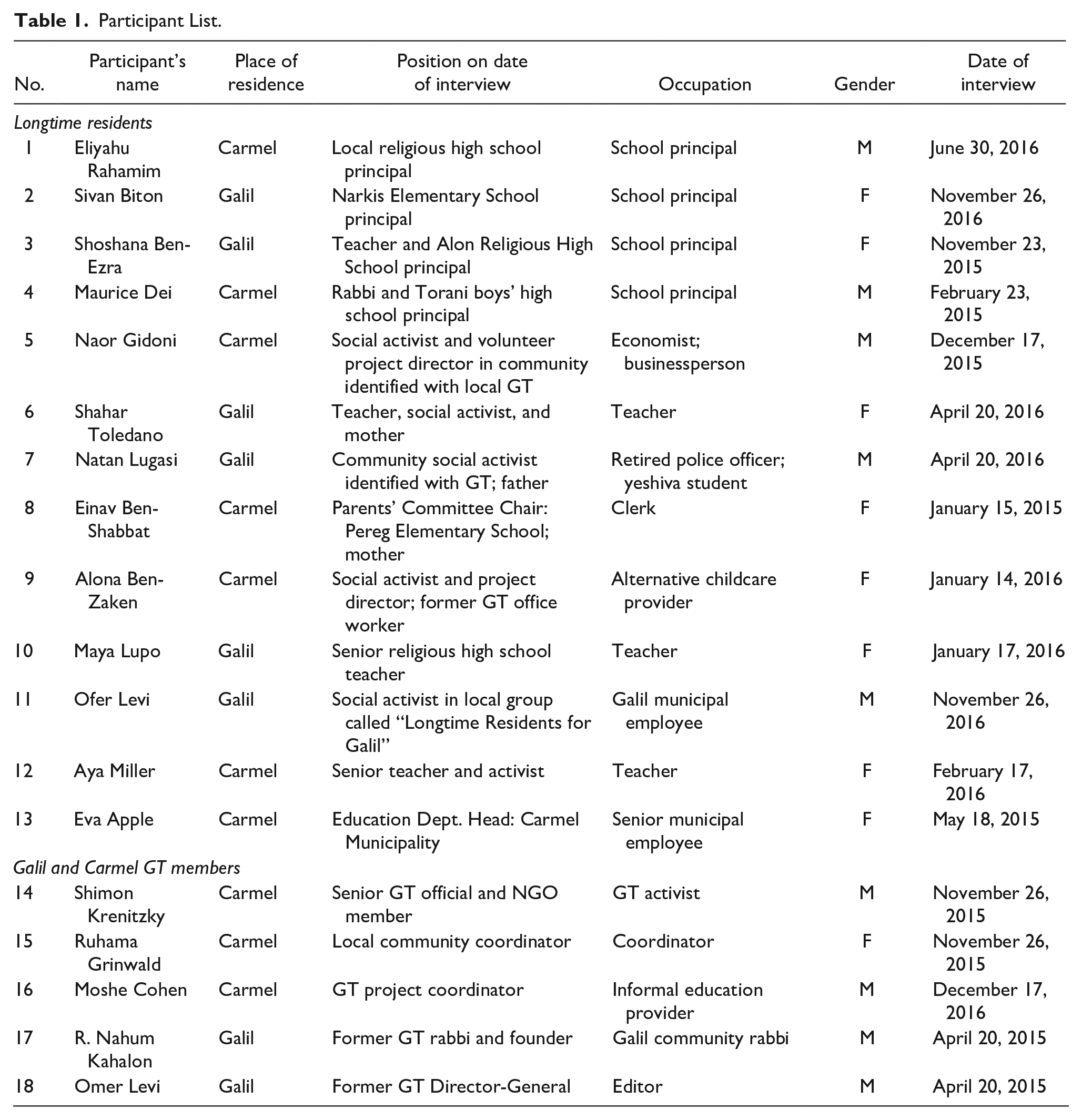
The interviews were analyzed using the process of identifying common content themes in three stages: interview transcriptions were carefully read and divided into meaningful units; main themes were deduced; a second reading of interview transcripts found statements and content units not identified during the first reading, relevant to the main themes (Gaskell, 2000).
The response to the first research question, namely the manner in which GT intervention affected structural changes in the local educational system, is based on a quantitative comparison that assesses the changes in numbers of students at the relevant schools between 2000 and 2015 and the Care Indexes of those schools between 2008 and 2015. Response to the second research question, assessing the extent to which LRs are affected by changes instituted in the educational system, is based on themes identified through analysis of the in-depth interviews.
Results
GT Intervention in the Religious Educational System
GTs sought to achieve educational and social momentum through partnership and outreach, and to serve and support local community with religious, educational, social and economic issues. 4 GT members aimed to spearhead intense change in the religious educational system, especially in elementary schools and high schools. Their initiatives were reflected in a series of measures: setting up private Torani schools, adding Torani study programs at older schools and operating informal educational projects. 5 Pivotal to the GT purpose was the transition to gender separation within schools, a concept central to the Jewish ultra-orthodox belief. This accretive process eroded the LR mixed-school tradition in Carmel and Galil, and marked the GT takeover of the education systems symbolizing their burgeoning religious status.
Carmel
GT educational initiatives in Carmel were characterized by an activist approach to the older schools in the region that at times ignored LRs’ wishes. Until 1994, the Carmel educational system consisted of a largely homogeneous complex of SR elementary schools and high schools. In 1994, the Savion School was repurposed as a Torani school that enjoyed considerably more autonomy than conventional SR schools, including gender separation.
GT social activism was expressed at the Pereg SR Elementary School. In 2006, GT pressure and influence on local municipality and LRs led to inception of a Torani religious study program for boys only, alongside a mixed-gender SR program. Students on the Torani program came from GT families, LR middle-class families, and families from the surrounding villages. Some GT members joined the Torani program as teachers. Eight years later, the now GT dominated program faculty demanded the local authorities and the Israeli Education Ministry go one step further to declare Pereg a boys-only Torani school. The Carmel Municipality conceded this demand despite opposition from LR parents who wanted a mixed-gender SR school. Pereg eventually became an exclusively Torani boys-only school 1 year later in 2015. Parents who opposed this change were forced to send their children to other schools. In its new format, Pereg was informally run by a parents’ committee directed by the GT rabbi. 6
Meanwhile in 2014, a separate Torani girls-only program had been set up at the Dolev SR School supplanting the established mixed-gender policy. Most students came from GT families and the local LR middle class.
Galil
Galil has two SR elementary schools built in the 1960s—Narkis and Kalanit—and one SR High School. These schools did not practice gender separation until the GT began to wield its influence on the educational system. In the early 2000s, the Kalanit School began operating in Torani format and continues to do so to this day, with boys and girls studying in separate facilities. The Narkis School, by contrast, remains a mixed-gender SR school. 7
Between 2010 and 2015, the number of students at Kalanit increased. The school enjoyed a reputation as an institution of the highest educational quality, while Narkis was presented as a “grade B” school, 8 leading to declining student enrollment. Students who did not meet Torani criteria were not accepted to Kalanit and had to register for Narkis. The influence of the GT on the Kalanit School was evident in the teaching staff and parents’ committee members: Only three of the 30 teachers were Galil LRs, while eight came from GT members; the parents’ committee chair and half its members originated from the GT and six additional members came from the middle class of Galil LRs.
The Effect of GT Educational Initiatives on LRs
GT involvement in the SR educational system in Galil and Carmel led to demographic and socioeconomic changes in the student school population as well as the educational quality offered by the schools, as will be presented below.
Carmel
Figures 1 and 2 show that between 2000 and 2015, the local educational system underwent a marked change: Since the Carmel GT began initiating measures to reinforce local Torani education, the percentage of students attending Torani schools increased, with a concomitant decline in registration at SR schools and a parallel change in the socioeconomic mix of students. Figure 1 shows that since the GT began functioning in 2005, more students have enrolled in Torani schools than in SR schools—a reversal of the previous trend. Savion and Pereg, Torani schools, enjoyed a sharp rise in numbers of students, while Dolev, Hartzit, and Yasmin, SR schools, recorded a decline. 9 Figure 2 displays changes in the Care Index 10 over time, comparing all local religious schools. Figure 2 indicates that at Pereg and Savion, where the number of students rose between 2000 and 2015, there was a concomitant decline in the Care Index, especially at the Pereg School, from which one may infer an increase in percentage of students from a higher socioeconomic class. 11
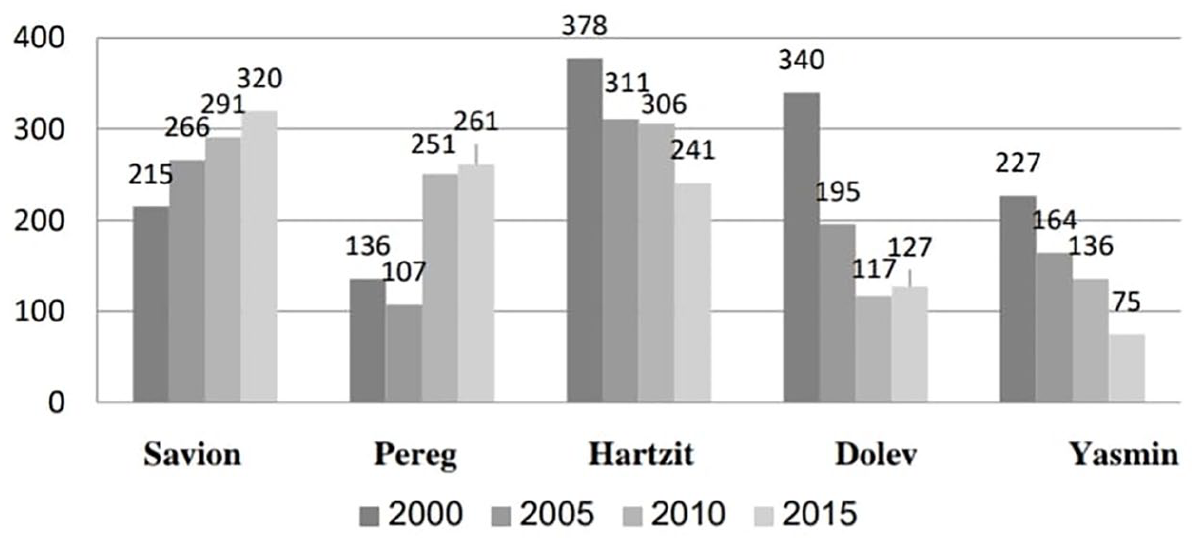
Fluctuations in number of students at Carmel religious elementary schools (comparison of Torani and state-religious schools)—2000–2015.
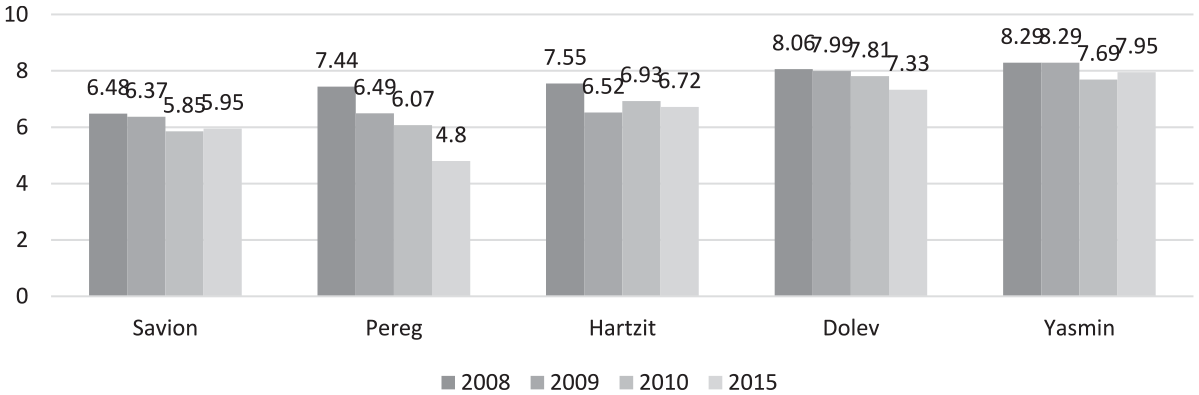
Care index at all Carmel religious elementary schools—2008–2015.
The data in Figure 2 reflect a decline of the Care Index at all five local religious schools from 2008 to 2015, indicating improvement in the socioeconomic backgrounds of all parents. A more meticulous examination, however, led to the discovery of differential influences: The most dramatic improvement in the Care Index occurred at Pereg and Savion, where the number of students rose (see Figure 1). The data thus indicate a worsening of socioeconomic disparities among parents of religious school students in Carmel. Socioeconomic improvement was most evident at the Torani schools, which attracted students from a better socioeconomic background, as noted above.
Galil
Figures 3 and 4 show that the trend noted in Galil resembled the one observed in Carmel. GT members began instituting educational initiatives in the 2000s. A comparison of the number of students at the Narkis SR School and the Kalanit Torani School over time displays trends similar to those noted in Carmel. Figure 3 indicates that between 2005 and 2015, the number of students rose at Kalanit, where gender separation was practiced, whereas the Narkis School student body declined by about 50% between 2000 and 2010. Although this trend reversed between 2010 and 2015, the number of students at Narkis remains low relative to parallel figures for Kalanit.
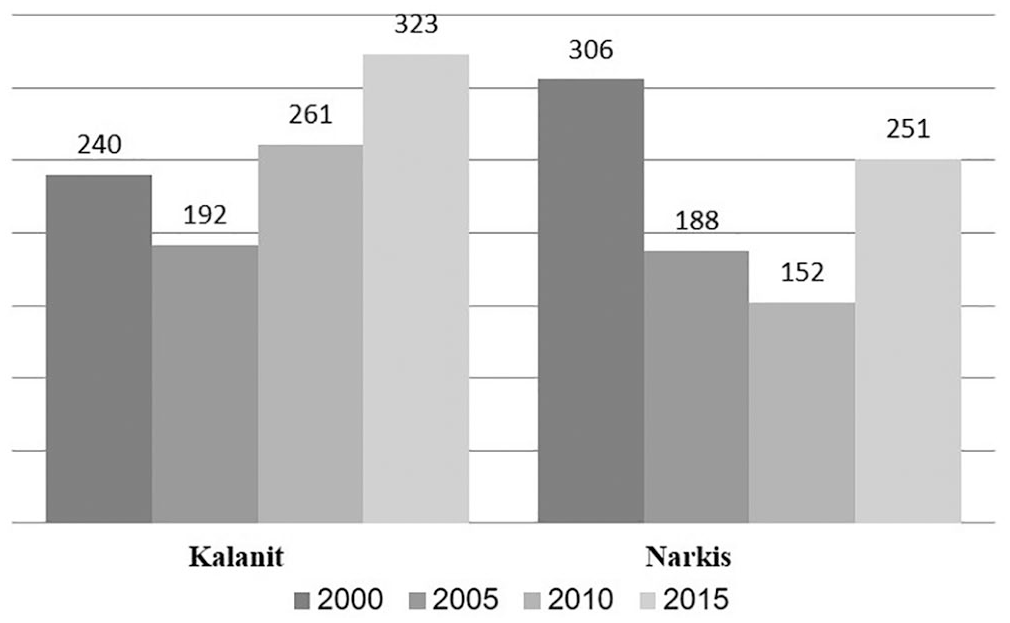
Fluctuations in number of students at Galil religious elementary schools (comparison of Torani and state-religious schools)—2000–2015.
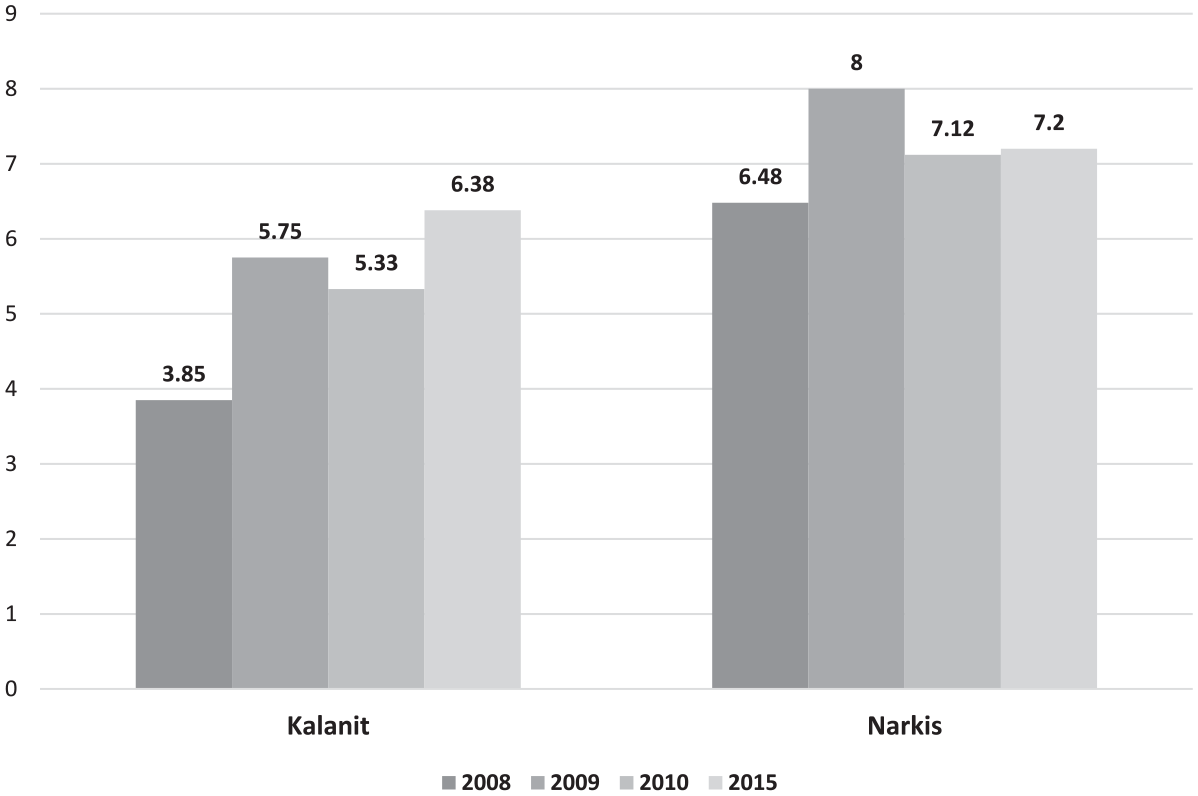
Care index at all Galil religious elementary schools—2008–2015.
The Kalanit Torani School has a far lower Care Index than the Narkis SR School, indicating that the socioeconomic backgrounds of Kalanit students were higher than those of Narkis students (see Figure 4). Nevertheless, as Figure 4 indicates, the Care Index at Kalanit rose between 2010 and 2015. The trends may have been mixed, indicating that Kalanit continued to accept students from weaker socioeconomic backgrounds. 12
The Standardized Test Report—School Efficiency and Growth, published by the Ministry of Education in 2013, corroborates the trend described below. During the year of publication, 22% of Narkis students came from low socioeconomic backgrounds while the remaining 78% came from a middle-class background. This compared to Kalanit, which had no lower-class students, 97% middle-class and 3% upper-class students (Berger, 2015).
Interviews with the principal of Narkis and with Galil LR activists reflected a negative public attitude toward the school resulting from GT influence. Middle-class LRs were chose to send their children to Kalanit, believing it to be better and more religiously selective. Children from less auspicious backgrounds, however, remained at Narkis even though it was considered inferior because it accepted all applicants. According to the testimony of Sivan Biton, the principal of Narkis, GT members pulled strings to expose the advantages of Kalanit and the drawbacks of Narkis, thereby contributing to the creeping devaluation of the latter’s status:
Their local activity is not of the type that reflects an attitude of: “I won’t interfere in your life; I’m only active within my own environment.” For example, just before the beginning of the past school year, GT members distributed a booklet intended for new residents arriving in town. Narkis was nowhere to be seen on their map—and this was not a printer’s error as they claimed. Their rationale aims at according exclusive preference to Kalanit. Incidentally, in local discourse, it is clear that Narkis has been labeled “Grade B.” The socioeconomic profile of Kalanit students’ parents is significantly higher than that of Narkis parents.
Additional testimony was provided by Shoshana Ben-Ezra, a teacher and principal at the SR high school in Galil: “The GT rabbi and his wife both denigrated Narkis.” 13
From an official point of view, schools established by GTs did not consider economic background or achievement as acceptance criteria. Nevertheless, the additional fees charged by Torani schools led to the exclusion of LRs from weaker socioeconomic sectors. Moreover, acceptance criteria suiting the Torani world outlook, which included gender separation, led to rejection of LRs from higher socioeconomic sectors who identified with neither these views nor the strict religious standards.
LR Perceptions of GT Educational Initiatives and of LR-GT Relationships
LR reactions to GT activity were mixed and differential: approval and support was apparent among some LRs who identified with GTs’ religious way of life, while many others attested to a sense of frustration and social and educational rejection.
Resistance to displacement pressures
Gender separation and religious strengthening
One reflection of GT members’ stringent religious standards was gender separation. Alona Ben-Zaken, a Carmel parent and social activist with an Orthodox Jewish outlook, objected strenuously to such separation: “It’s a process in which people become more and more Ultra-Orthodox daily. Why start [gender] separation in first grade?”
14
Key social activists from among Galil LRs voiced similar complaints, using such expressions as “injustice,” “patronization,” “arrogance,” and “segregation.” Einav Ben-Shabbat complained about gender and social separation between children:
They don’t allow their children to approach and play with mine. Why? My daughter is a thousand times better than their children. Someone doesn’t allow his daughter to play with mine outside? That’s unacceptable to me. Who does he think he is?
15
Shoshana Ben-Ezra, School principal and senior teacher at Galil SR High School, explained:
They have all kinds of demands for running the school, but what happens in the end, when the school is separated for the GT’s sake but they don’t come here [their children do not attend that school]?
16
Maya Lupo, senior teacher and Galil SR High School coordinator, added:
I have a harsh feeling of discrimination and exclusion. . . by those who are more Torani against those who are less so. . . 17
Displacement pressures on LRs: The change from SR to Torani schools
The dominant educational ethos became Torani and brought about the Municipality’s decision to close Pereg and submit the building to a Torani educational institution for boys only. Einav Ben-Shabbat, former chairperson of Pereg’s parents’ committee, fiercely opposed this move:
It’s a battle for our home!. . . And now everything is crumbling. . . Online classrooms, laboratories, it’s the only somewhat new school building in Carmel. What a shame. It’s disturbing. It hurts me because it’s a special school; it accepted everyone—children from non-religious and traditional homes and taught them that everyone is equal. . . They are making us eliminate the SR school in Carmel.
18
Discrimination in school staff selection
Displacement pressures in Carmel and Galil were also reflected in employment at schools. The tendency to hire GT members in teaching roles adversely affected the income, promotion prospects, and job security of senior teachers. Those teachers excluded from their positions felt that they were considered “inferior merchandise” because they did not appear sufficiently religious. Ofer Levi, an experienced activist from Galil, said: “since 2000, the moment a senior teacher retires, one of the GT wives automatically takes her place.”
19
Narkis principal Sivan Biton added: “A job offer was published for principal of Narkis and there was an attempt to introduce a woman from the GT. The GT director at that time came to me asking that I withdraw my candidacy in exchange for another position.”
20
Maya Lupo, a senior teacher from Galil, confirmed:
I’ve been a homeroom teacher for 17 years, but as far as they’re concerned, it’s not your experience in education that counts but only whether or not you have the same educational agenda as the GT. . . There was discrimination and exclusion between Grade A and Grade B teachers. The discourse concerned whether one’s religious behavior is more stringent or less so. . . Even if they smiled at me from ear to ear in the corridor, deep down I knew I would not be hired as a homeroom teacher.
21
Shoshana Ben-Ezra bitterly described the extent of job displacement:
Things began to erode all over town. The toughest problem was earning a living. They are robbing local residents of their livelihoods. . . reserving jobs for GT members.
22
Ethnic based tensions: Mizrahi-Ashkenazi rift
LRs aligned GTs’ elitist and patronizing approach to their Ashkenazi background, which led to resistance. They also emphasized that the Ashkenazi tradition tends to be more abstract and philosophical than the popular Mizrahi tradition. Moreover, LR teachers felt they would be overlooked for school management jobs which would go to new Ashknazi teachers.
Aya Miller, a senior teacher from Carmel, explained that GT Ashkenzi families refuse to mix with other families and prefer to send their children to the same kindergartens or child day care centers. She said:
Most of GT families in kindergartens that gather together are Ashkenazi. If they want to bring others closer to them, to have some influence, they shouldn’t stay together in the educational system. I started to feel “you don’t belong.” Most women attending their meetings feel they don’t belong.
23
Shoshana Ben-Ezra added:
In recent years I don’t feel that I belong. They are ‘Ashkenazi clique’, [giving the feeling of] ‘saver and survivor’. . .
24
Maya Lupo said:
Devious, controlling attitudes became evident. Are we second-class people? Did they come here to bear a message of redemption, to bring the monkeys down from the trees?
25
Eva Apple from Carmel said:
There are new patterns of differentiation, segregation, people here call them “religious-Ashkenazi junta.”
26
Support and identification of LRs with GT members
While most LRs expressed feelings of affront and resistance to GTs, they had their supporters. For example, Carmel Municipality’s decision to change Pereg School’s status from SR to Torani driven by pressure from GT members attracted some praise. Rabbi Maurice Dei, principal of a local SR High School and a dominant GT supporter, explained his position:
The GTs are [the result of] a process demanded by the current situation. . . The change we anticipate in Carmel can only come about through external forces, with all the difficulties entailed in having people come in from the outside.
27
Naor Gidoni, a volunteer project coordinator from Carmel, criticized LR teachers by comparing them to GT teachers:
Senior residents of Carmel. . . are interested only in themselves compared to teachers from the GT whose work ethic reflects their values and is in an entirely different league. When you belong to something that has values, you get carried away.
28
Galil-born teacher Shahar Toledano explained her decision to stay in Galil because of the GT presence:
Had the Galil community remained as it was, I would not have stayed here. Bring up my three children here? . . .The city was declining, winding down. People were leaving. . . By contrast, the GT succeeded in bringing people in. . . It’s a high-quality community. . . People with values, thinkers, Torah-oriented, highly active, young. There are common areas of interest, receptivity to different ways of thinking, vision, creativity. It’s nice to speak to them and to think big about educating children and the important things in our lives.
29
Her views were corroborated by Natan Lugasi, a community activist, who said:
The GT gives me. . . the right kind of environment in which to grow and raise my children. The GT sparked competition within the educational system. I switched my daughter from Narkis to Kalanit mid-year.
30
The GT Perspective
The interviews with GT leaders may give a deeper insight into their perceptions of LRs. GT members presented their activities in a positive light. They counted them among their key achievements and evidence of their having left a mark. Nevertheless, their actions have aroused serious concerns among LRs; these may be explained through GT members’ comments.
It appears that GT members believed their settlement in Carmel and Galil raised the profile of these towns. They operated according to a conservative religious outlook that they perceived as “truth”; they were not concerned with questions of educational or social segregation, convinced their way was “the right way.” Carmel GT Director Shimon Krenitzky’s comments reveal this state of mind:
The GT brought in a high-quality population with high human capital. By doing so, they sparked a rise in the level of educational and social services—those are given facts. Their greatest success is their settlement and integration among the residents themselves. A locality that’s been the same for 20 to 30 years suddenly changes its appearance.
31
Ruhama Grinwald, a community coordinator in Carmel and a GT member, said:
“My motto is ‘aim high’. Perhaps that is the message for the community in Carmel. I feel that the local culture is one of mediocrity and indifference. [Local people say] ‘Things will be ok’. . .”
32
Even though GTs believed their arrival as pioneers, similar to the Zionist founders of Israel, raised the profile of the towns and “drained the swamps,” they desired educational separation for their children. Moshe Cohen, a Carmel GT member and education coordinator, said:
“We came here to drain the swamps. . . .But for our children, we want the very best.” 33
Rabbi Nahum Kahalon, founder and former religious leader of the Galil GT, criticized the attitude of his peers:
Our main error was. . . our initial attitude of wanting to raise LRs to our standing. We believed the truth was in our hands, and that in time people would reach our truth. [However] one comes to learn what the community wants and not what we want. One must approach the locals with humility and bowed head. . . with awe and reverence. You have to recognize how to connect with these people and how to learn from them.
34
Former GT director Omer Levi added:
The guidelines at the background of GT’s meetings were: “We possess the truth. We are aware that we are carrying out God’s will. . .” From their point of view, they alone possess the truth and anyone who does not understand them has a problem. In time, the public will embrace this truth.
35
Discussion and Conclusions
This article contributes to theory by introducing the concept of Faith-Driven Gentrification (FDG)—the settlement of religious gentrifiers into underprivileged urban neighborhoods who, driven by a sense of mission, strive to improve the quality of life of longtime residents and promote social justice. This paper differentiates gentrifiers driven by private economic interests, and those motivated by faith and good intentions.
Studies addressing gentrification with justice show that faith-driven gentrifiers perceive their activity as welcomed by communities (Hankins & Walter, 2012; Lupton, 2006; Suchland, 2008). However, literature highlights a lack of research into the responses of local residents to FDG influence (Eccleston, 2020) and to gentrification in education (Quarles & Butler, 2018). This study contributes to this field of research by giving voice to longtime urban communities from weakened ethnic backgrounds who deal with the challenges of FDG in education.
The study asserts that faith-driven gentrifiers’ declared commitment to social justice, founded in religious and moral “good intentions,” was not reflected through their actions in the field. Close examination reveals contradictory motives led to contradictory results. Fueled by a religious elitist approach rooted in a sense of ethnic superiority and a conviction they held “the truth,” through indirect displacement they harmed longtime residents.
The GTs started an educational revolution in development towns which was reflected in the dismantling and reassembly of schools, and a change in the dominant educational ethos. New schools were built, existing schools were redefined, and Torani study programs were instituted, contributing to scholastic excellence and a high level of religiosity. This revolution, however, caused division between LRs in these towns. A group of middle-class LRs who followed the Torani approach welcomed the GT activity which answered their educational, spiritual, and social needs. Identifying with the GT religious way of life, these LRs could now select their preferred school, allowing their children to learn with classmates from families “like them,” similar in socioeconomic class and devotion to religion (Hankins, 2007; Kimelberg & Billingham, 2013).
These events led to indirect displacement of another two groups of LRs. Families from weaker population sectors suffered exclusionary displacement unable to send their children to new schools with higher costs and greater educational requirements (Butler et al., 2013; Nethercote, 2017). Furthermore, middle-class families who rejected the GT Torani way of life suffered displacement pressures as they were forced out of newly established, gender-separate Torani schools of higher quality. Middle-class teachers were excluded from professional promotion; roles were reserved for GT teachers.
Israeli GTs declared their intentions to support distressed urban neighborhoods and improve general welfare (Shealim, 2020). However, their elitism aroused bitterness and resistance among LRs, being founded in a paternalistic approach anchored in a conservative religious outlook and conviction that they possessed the “truth” (Dahan, 2019). These processes had an ethnic and class overtone: GTs were mainly from privileged Ashkenazi backgrounds and had the support and sponsorship of the powerful social and political Zionist establishment. LRs were, and still are, mainly Mizrahi; many of them come from weaker socioeconomic backgrounds (Harel Ben Shahar & Berger, 2018; Picard, 2013; Yiftachel & Tzfadia, 2004).
Hundreds of thousands of humanitarian and religious organizations around the world may unintentionally be falling into a similar trap of elitism and superiority—a problem requiring further scrutiny. Bell and Carens (2004) raised awareness of the ethical dilemmas involved in international humanitarian NGO work in underprivileged societies. Activists from wealthy Western countries offering aid to impoverished non-Western communities might be perceived as exercising superiority. This research suggests that faith-driven gentrifiers active in urban centers in Israel and in other countries should be aware to such ethical dilemmas.
Concluding Remarks
Practical implications
This article recommends a more intensive analysis of the implications for the local population of faith-driven educational gentrification. It should be conducted with attention to ethno-cultural rifts and clashes between opposing values.
Moreover, this study proposes that policymakers in Israel and other countries develop awareness and a critical approach to the complex educational and social processes to which FDG leads. It is recommended these gentrifiers be deterred from taking over local educational systems. In the case of Israeli GTs, it is recommended they build their own schools and not compete for LR resources.
This study supports this call by exposing the unintended adverse consequences that followed FDG settlements in Israel. The Israeli case points to a broader phenomenon of religious and non-religious gentrifier settlements in distressed and peripheral areas motivated by a desire not only for material gain, but for social change. This article shows that even with the intention of enhancing social justice, advantaged gentrifiers may increase exclusion and segregation.
Limitations of research
The manner in which GT interventions affected structural educational changes was researched using quantitative analysis comparing institutional statistical data gathered from municipal authorities, local schools, and the Ministry of Education. This stage of the study could have been strengthened by an extensive survey with LR participants to enrich the understanding of LR attitudes toward these interventions. The sample of interviewees was based primarily on local leadership at the field level and used the snowball sampling method to reach them. Being initiated by the researcher, and restricted to field activists within the interviewees’ finite circle, the study fails to represent the general population of Carmel and Galil. This, however, is a recognized shortcoming of this method (Parker et al., 2019). A broader study based on a survey and extra interviews may better represent the local population. Additionally, dynamic change of GTs presented further limitations. Since this research, Carmel and Galil GTs have evolved and re-organized. The Galil GT has lately faced challenge from a competing GT in the same town; hence, it will be interesting to follow the changes in the long-term interactions between groups and the consequences of entry of additional players into the arena. Furthermore, substantial differences exist between GTs in Israel. They settle in development towns differing socio-economically and culturally; the study’s conclusions therefore relate solely to the cases of Galil and Carmel during the designated research period. Further research into the relationship between GTs and LRs in other cities would promote deeper understanding of faith-driven gentrification and displacement in urban neighborhoods.
Footnotes
Declaration of Conflicting Interests
The author(s) declared no potential conflicts of interest with respect to the research, authorship, and/or publication of this article.
Funding
The author(s) received no financial support for the research, authorship, and/or publication of this article.

Notes
Author Biographies
Dr. Janet Cohen is a Lecturer on the sociology of the Israeli society and methodological courses. Her research deals with the study of communities in Israel and with relations of center and periphery.Professor Miriam Billig is a senior faculty member, Department of Sociology and Anthropology, Ariel University. Scientific director of East R & D: Judea and Samaria and the Jordan Valley. Sociologist and a city and regional planner. Her research deals with social aspects of planning, environmental psychology, community research and settlement in Israel.