



Abstract
This paper reports findings of a study on young mothers living in Uganda’s poor urban areas which have been politically labeled as informal settlements and therefore not eligible for social services delivery. Although 59% of all school dropouts in Uganda are due to young motherhood, the national education policy, and practice automatically exclude young mothers. Past studies on student motherhood addressed student mothers of all ages, and were not focused on poor urban communities. The qualitative study involved young female participants enrolled in institutions of higher learning aged, between the 17 and 25 and investigated the magnitude of their marginalization and exclusion. Study participants were purposively selected using snowball technique. Data were collected using life history interviews and observation. All interviews were audio recorded, transcribed verbatim, coded, and thematic analysis was done. The key themes are the context of urban poverty and student motherhood, lack of counseling services, poor law enforcement, and abandonment. The paper discusses how the young women navigate motherhood and education, thereby advancing the discourse on student motherhood in precarious educational contexts of urban poverty.
Introduction
Student mothers are women who are pursuing academic courses. They are of different ages, marital statuses, ethnic groups, have diverse mothering experiences, and pursue a diverse range of courses. This article discusses young student mothers living in urban poverty who were in the middle of college or university programs after a period of pregnancy-related school dropout. Pregnancy has disrupted the education of girls in many parts of the world (Achoka & Njeru, 2012). Adolescent pregnancy is a significant aspect of girls’ exclusion from education in Uganda where it is estimated to cause about 59% of all school dropouts (Okwany & Kamusiime, 2017; Republic of Uganda, 2012). According to Uganda Demographic and Health Surveys, 24% of adolescent girls become pregnant by the age of 19 (UBOS & ICF, 2017). At least 55% of Uganda women aged 15 to 19 who have ever had sex have been pregnant and 35% of unmarried women have been pregnant (Darabi et al., 2008). Only 6% of young women in school have been pregnant compared with 73% of those out of school. The large body of existing knowledge on teenage pregnancy and motherhood attributes them to a range of sociocultural, environmental, economic, and health-services delivery related factors including lack of relevant sexual and reproductive information and services (Atuyambe et al., 2015; Yakubu & Salisu, 2018).
Adolescent pregnancy accounts for 20% of maternal deaths and other adverse maternal outcomes such as fistula and disability (Bantebya et al., 2014; Woog et al., 2015). In addition to having adverse maternal and perinatal outcomes, adolescent pregnancy, and by implication teenage motherhood also negatively affects education (Kassa et al., 2018). Teenage motherhood has been perceived to reduce the chances of schooling by imposing long-term consequences for career development of young mothers, thereby transmitting poverty from generation to generation (Achoka & Njeru, 2012; Chevalier & Viitanen, 2001; Kassa et al., 2018; Yakubu & Salisu, 2018). For example, Ugandan school girls who fall pregnant are automatically expelled from primary and secondary schools. They either get married to the men responsible or stay with their families. Some of them are rejected by the men responsible as well as their families causing them to move to distant places to seek employment usually as house helps, bar maids, commercial sex workers, and others. Worse more, currently there is no policy to guarantee them school re-entry after they have given birth (Kamusiime & Kakuru, 2017; Okwany & Kamusiime, 2017), hence not many return to school after childbirth. It is widely accepted that education remains an important tool for such girls to break the poverty cycle in which most of them get entangled. Unfortunately, the young mothers who return to school after childbirth face various challenges in trying to balance motherhood and schooling (Chigona & Chetty, 2007; Maisela & Ross, 2018; Ngum, 2011).
This research was conducted to find out how student mothers who live in poor urban communities and are enrolled in institutions of higher learning navigate motherhood and academic work in a context where higher education by default excludes student mothers. Previous research suggests that student mothers face several challenges in trying to complete their education because of their immediate role as mothers (Brown & Nichols, 2013; Kassa et al., 2018; Van Vooren & Spalter-Roth, 2008; Yakubu & Salisu, 2018). Most previous studies (see Behboodi Moghadam et al., 2017; Brown & Amankwaa, 2007; Brown & Nichols, 2013; Chigona & Chetty, 2008; Duquaine-Watson, 2007; Van Vooren & Spalter-Roth, 2008) investigated parenting students in general including men, and married young and mature women. Moreover, none of them have focused on young people living in urban poverty in African countries such as Uganda, where according to the UN Habitat (2010), 54% of urban dwellers live in poor urban locales. Apart from urban marginality, this is a context in which higher education by default excludes student mothers. Moreover, some previous studies looked at student mothers from a single university (e.g., Anibijuwon & Esimai, 2020; Maisela & Ross, 2018; Ngum, 2011), and therefore their analyses lack the nuances of experiences of students from a variety of institutions.
While Obanya (2009) shows that girls who drop out of school in Africa are unlikely to pursue college education, another study by Anibijuwon and Esimai (2020) on student mothers in Ibadan University explored challenges of student mothers through a more general lens. The challenges identified include financial constraints, time limitations, and subsequently poor academic performance. Existing literature for example overwhelmingly indicates a correlation between faculty support and student mothers’ academic success (Dickson & Tennant, 2018; Umbach & Wawrzynski 2005). Levine (1993) discusses how universities have standard regulations which do not consider students’ responsibilities outside university life. For example, they lack the necessary counseling services required to meet the emotional needs of student mothers in Africa (Chigona & Chetty, 2008; Maisela & Ross, 2018). Institutional and faculty insensitivity to the unique situation of student mothers has featured in studies outside Africa (see Dickson & Tennant, 2018; Mahaffey et al., 2015).
In this paper, I further the discourse on the experiences of student mothers while focusing on young women living in poor urban locales who have not been the focus of previous studies. Throughout this article, I demonstrate how challenges of student mothers who live in urban poverty are attributable to the nature of the higher education system that excludes them from fully participating, as well as their marginality as poor urban dwellers. I contend that their plight is intensified by the unique social structure characterized by extreme deprivation, and limited opportunities for social and emotional support. I join the society of scholars (Markle, 2015; Stalker, 2001) who advocate for increased institutional and government awareness of the impact of social structures on student’s educational experiences in order to devise commensurate interventions at the macro level. I conclude that although pregnancy and motherhood disrupt students’ academic careers and place extra burden on poor urban dwellers studying in higher institutions of education, most young mothers successfully navigated the precarious terrain through remaining optimistic, striving to abide by university rules, seeking baby-sitting volunteers, ignoring past injustices, focusing on the future, working extra hours, and being resilient.
Background
Uganda’s education system is comprised of 7 years of primary followed by 6 years of secondary school. Secondary education is comprised of Ordinary level (first 4 years) and Advanced level (last 2 years). Students who complete Ordinary and Advanced level can join vocational educational institutions but only those who complete Advanced level can proceed to colleges, universities, or other institutions of higher education.
The study was conducted in two communities considered to be among Uganda’s informal settlements (Richmond et al., 2018). Informal settlements are not regulated by the state and are usually inhabited by poor people. According to Uganda Bureau of Statistics (UBOS, 2019), poor people are those “who live in households that spend less than what is necessary to meet their caloric requirements and to afford them a mark-up for non-food needs” (p. 46). The government of Uganda is not obliged to provide social services to people living in informal settlements. Poor people are attracted to the informal sector for many reasons including the limited government regulations and cheap accommodation. The study sites of Kasubi and Nakulabye are therefore characterized by household poverty. Both Kasubi and Nakulabye have a total of 18 zones and 7,185 households. The poverty of the households is due to low income of community members, the majority of whom survive on market vending, small-scale businesses such as stores, barber shops, laundry business, hawking, car washing, and scavenging for discarded items in the garbage. Some people work in the city center but most of them are uneducated low-income earners who migrated from rural areas in search of better urban life opportunities. They live in rented rooms with limited living space. Some households live in makeshift shelters made out of materials such as rough wood and iron sheets—in worse cases, boxes and plastic sheets. It is quite common to find up to eight people sharing one or two rooms which serve many purposes including eating, sleeping, sitting, and cooking. The two poor urban communities studied are characterized by very poor sanitation facilities and most households have no bathroom and toilet facilities. There is limited supply of water and community members buy water from the few who own water taps/points for commercial purposes. Although Ninsiima et al. (2020) have documented the benefits of comprehensive sexuality education including delayed sexual intercourse, and decrease in number of sexual partners, it is not acceptable in Uganda. Uganda’s sociopolitical context regulates young people’s sexuality rights, which are defined by a repertoire of policies rooted in religious and cultural values, as well as moral ethics that assume them to be asexual. (De Haas & Hutter, 2019; Iyer & Aggleton, 2014). Hence, young people who fall pregnant breach societal values and moral ethics. Consequently, pregnant adolescents are automatically expelled from school and there is no policy for them to re-enter school (Okwany & Kamusiime, 2017). This paper presents experiences of student mothers who re-entered schooling against the odds.
Theoretical Framework
The study was underpinned by the Self Determination theory (Deci & Ryan, 1985). This is a theory of human motivation and personality which advances people’s inherent growth tendencies and psychological needs as bases for self-motivation, constructive social development, and personal well-being. The central premise is that humans have innate tendencies for personal improvement regardless of their immediate environment. According to Deci and Ryan, when people experience autonomy (being in control of one’s goals), competence (possession of skills and abilities to control outcomes), and psychological relatedness (need to interact and care for others), they automatically gain the self-determination necessary for them to be motivated to pursue their goals and interests. This theory was useful in analyzing student mothers motivation to pursue higher education in a context of exclusion and urban marginality
Methodology
The paper draws on experiences of 21 student mothers residing in two poor urban communities in Kampala city, aged 17 to 25 and enrolled in institutions of higher education as shown in Table 1.
Participants’ Demographics.
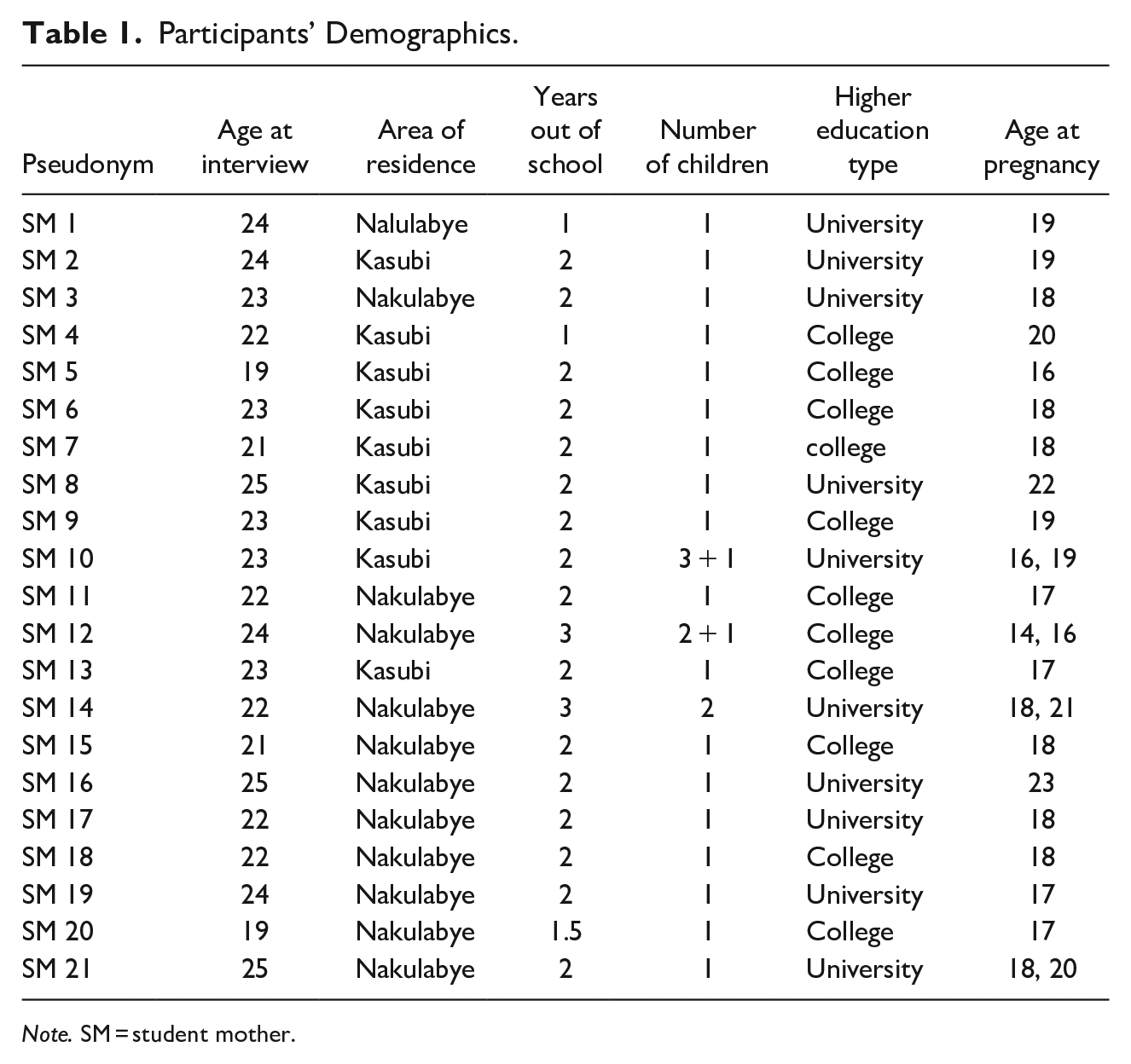
Note. SM = student mother.
A qualitative research approach was used to understand the social phenomena of student mothers as learners. The research participants were located through a combination of snowballing and purposive sampling. Snowball sampling is a non-probability sampling technique that is used to identify research subjects by reference from others who qualified to participate (Browne, 2005). Initially, student mothers were identified with the help of local leaders as well as field staff of a local not-for-profit organization (Nascent Research and Development Organization [NRDO]). Thereafter, more participants were reached through snowballing. Student mothers who were identified were purposively selected for inclusion in the study on the basis of having children aged 0 to 8 years and their residence in the selected study sites. Informed consent was sought and granted by each of the participants and they were assured confidentiality and anonymity. They were given the option to stop the interview if they felt uncomfortable and they were given up to 1 month to withdraw their interview data. Data was collected using life history interviews conducted at the home of the student mothers. Life history interview data was supplemented by observations done especially at the student mothers’ home environment at the time of the interviews.
All interviews were audio recorded. The audio files were later transcribed into text data as described by Ose (2016). The text data was cleaned to remove all possible identifiers including names of participants and their institutions. Participants were chronologically assigned anonymous numbers based on the order in which they were interviewed (i.e., student mother 1, student mother 2. . .). Following Stuckey (2015), I read and re-read the transcripts to familiarize myself with the data in its entirety. The raw data were thereafter coded by identifying similarities in participants’ responses which formed the various themes that are discussed in this paper. The emerging themes were the context of urban poverty and student motherhood, lack of access to counseling services, poor law enforcement, and abandonment. Final interpretations of the data were then done. Afterwards, the findings of the research were presented and validated at a community dialog in the study sites. Trustworthiness as described by Shenton (2004) was addressed through ensuring credibility, transferability, dependability, and confirmability.
Findings
Although previous research found that parenting students generally face unique challenges regardless of their age, gender, social class, and marital status, no research to date has focused on young mothers living in poor urban contexts. The study set out to investigate how young student mothers living in urban poverty in Uganda navigate young single motherhood while pursuing academic courses at university or college. The findings of this qualitative study show that student mothers in higher institutions of learning face a number of challenges at the household, community, and institution levels. This section of the article begins with the demographic profile of the study participants showing their age, area of residence, number of years in school, and number of children. I then present the findings under the various themes namely. The context of urban poverty and student motherhood examines how young mothers cope with limited time, finances, and higher educational institutions’ ignorance of their plight. The theme of lack of access to counseling services touches on the importance of counseling for very young mothers and those who fell pregnant as a result of sexual violence. Under the sub-section of poor law enforcement, I present findings pertaining to student mothers motivation to pursue higher education enables them to ignore the injustices related to sexual violence and defilement. Similarly, the theme of abandonment addresses student mothers’ resilience amidst rejection from family and men responsible.
Study Participants
A total of 21 participants participated in life history interviews. Four out of twenty-one participants had two children, most of them were out of school for 2 years, and six got pregnant before they turned 18 and the youngest age at the time of first pregnancy was 14.
As Table 1 suggests, the majority of the study participants (N = 17) were aged between 16 and 19 when they first got pregnant, and only three were aged 20+ at the time of their first pregnancy. Only one of the participants (student mother 8) lives with the boyfriend. The remaining 20 are single mothers.
The Context of Urban Poverty and Student Motherhood
A common view among participants of this research was that they suffered time and financial constraints due to the context of urban poverty in which they lived. Becoming a mother often comes with new roles which compete for time with already present roles. The young mothers often had to care for the baby and engage in some income generating activities at the same time in order to provide for the baby. Most participants felt that balancing the role of student, mother, and worker was overwhelming especially in a context where there is no child support, as is usually the case. Student mothers revealed that they were sometimes unable to complete their assignments in time. Some of them spent sleepless nights trying to balance academic work, child care roles as well as income earning-related tasks. They struggled not only to keep up with the content but also to pass tests and examinations due to limited time for studying. One participant noted that “the only time I can get to concentrate on my studies is when she [baby] is asleep at night but sometimes I am too exhausted to read anything” (Student mother 2, 24 years).
Some student mothers are lucky to have their relatives or neighbors take care of their children while they attend classes. However, such relatives are always eager to be relieved of the child care tasks as soon as the student mothers return from the university. For example, student mother 1 makes chapattis (flat bread) and supplies them to a nearby restaurant in order to earn an income. She got pregnant at the age of 19 when she had just completed high school. The boyfriend abandoned her because his father is a church leader who condemned the pregnancy on the grounds that the baby was conceived in a sinful way. Fortunately, despite the time constraints all young mothers who participated in the study remained very optimistic about their education.
Another significant aspect of how the context of urban poverty impacts on student motherhood concerns financial constraints. The study findings show that some student mothers cannot afford to take their children to childcare facilities and rely on support from neighbors and friends. Access to such help is also limited since poor urban dwellers come from all over the country and speak different languages. Usually, such help is rarely unpaid and is for a specific number of hours. The student mothers arrange for babysitting services when they know they have a class. The lack of money to pay for childcare services implies that the participants are denied adequate time to visit the library and to engage in academic discussions with their peers outside normal lecture time both of which negatively affect their academic performance. Those fortunate enough to hire a baby sitter always have to be back by 5:00 p.m. unlike other students who have no time limitations. Some student mothers have children who also go to school and must raise money for their tuition as well. Student mother 3 is a second-year student who plaits hair to survive. She explained her financial situation as follows: Sometimes when I don’t get customers, I go back to commercial sex work because I need a lot of money to take care of my son who is 3 years, and to pay my tuition fees at the university. I also have to hire my neighbor who takes care of the baby when I go to work or go to school (Student mother 3; aged 23 years).
Instances of missing classes were a common challenge for all the student mothers who participated in the study. They missed classes because of children’s illness but also due to other finance-related factors such as lack of money for transport, paying babysitters, and other household items especially food as one mother explained: “When there is no food for the baby, I cannot just leave him without. It means I have to miss school and work harder to raise some extra income in order to leave the baby behind” (Student mother 17; aged 22 years).
Furthermore, due to extreme poverty, student mothers living with their families in informal settlements where people share very limited living space find it difficult to complete their assignments or study for exams. Reportedly, while the only free time available for such mothers to study is in the evening when children sleep longer, some of them are either not connected to electricity or cannot afford it. A few of the participants who had electricity said that their family members sometimes want to watch TV till late, which further reduces their study time. Moreover, there are always noises coming from the nearby bars which also intervene with their night study time. Hence, the living conditions due to urban informality and poverty exacerbate the challenges associated with being a young mother and a student at the same time.
In addition to time and financial constraints, it emerged that the context of urban poverty is also characterized by other unique challenges which may not be recognized in the institutions of higher education. The data collected also shows that institutions of higher learning homogenize students. Students are governed by standard regulations and guidelines which are incongruent with the everyday life of poor urban dwellers. Some student mothers feel that instructors do not listen to them and/or make unrealistic demands as illustrated in the quotations below: . . . one time my baby was sick and I missed a scheduled test. The lecturer asked me to bring evidence from the doctor that the baby was sick. I couldn’t produce the required proof since I just bought paracetamol from the nearby drug shop as I had no money to see a doctor. He thought I was making it all up and gave me a zero. I failed the paper and I have to re-take it. This involves more time and money . . .. (Student mother 9; aged 23 years) When I was in my first year, my lecturer refused to grade my assignment because it was handwritten. . . . I told him I didn’t have electricity in my room and besides I had no computer. He insisted that I go to the library and type the work. I stopped trying to explain but I had left my child with my neighbour and promised to be back at a specific time. I had to spend extra money to get my work typed and later regretted because I later dropped the course. (Student mother 4; aged 22 years)
Although the student mothers who participated in this research live in poor communities, the institutions of higher education where they are enrolled are in adjacent more affluent parts of the city. The academic staff of these institutions may not be aware of the conditions of living of such students. They therefore have standardized regulations which may automatically exclude and marginalize poor urban dwellers who are already disadvantaged by single motherhood. Unfortunately, the student community is so diverse that the student mothers appear to be among the unrecognized minority groups in need of special accommodations and supports.
Lack of Access to Counseling Services
As explained earlier, the some of the participants of this research (N = 5) were below 18 when they first got pregnant. The study findings revealed that unplanned teen pregnancy can be a source of emotional and psychological problems. There were indications from the study participants that the consequences of rape, undesirable sex work, social rejection, and adjusting to a new life as a mother all require psychotherapy services. Some student mothers who participated in the study got pregnant as a result of rape as one mentioned thus “the circumstances surrounding how I got pregnant are not even worth remembering but my baby is a constant reminder of that experience” (Student mother 7; aged 21 years). Such mothers deal with past traumatic experiences alongside challenges of student motherhood in a precarious context. One of the mothers (student mother 12). Who was aged 14 years when she first got pregnant elaborated that in hindsight, if she had received the necessary counseling, she would probably not have fallen pregnant again at the age of 16. However, the findings show that most such participants deliberately chose not to focus on the past. Life in poor urban spaces is so hectic that there is only time to think about how to go through the day and not what happened in the past. This approach enables them to navigate motherhood and education in urban poverty.
Poor Law Enforcement
Despite the number of government initiatives that are supposed to address young people’s sexual and reproductive health needs and services, it is unfortunate that there is a lack of enforcement and hence the youth do not benefit from them. For example, the constitution of the Republic of Uganda and the Penal Code Act prevent women younger than 18 from legally consenting to sex. The findings of this research revealed that some of the student mothers who participated in the study got pregnant as a result of rape and defilement, but the culprits managed to avoid prosecution. In addition to lack of counseling services, and time and financial constraints, the life history data collected shows a complete lack of law enforcement as one participant disclosed that “I fell in love with my Geography teacher when I was in Senior 5 and I conceived in senior 6 when I was 18” (Student mother 14; aged 22 years).
According to the Constitution of Uganda, the teacher responsible should have been charged with defilement but should also contribute financially to the cost of raising the child. The same is true for all participants who fell pregnant before turning 18 which is the legal age of consent for sexual activity. Such student mothers choose not to focus on the injustices but rather on the future of their children by working hard to earn the required income and to pass their examinations.
Abandonment
As noted in the background, young motherhood is a stigmatized status in Uganda due to a range of sociocultural, religious, and moral values. That explains why some participants reported that they were not accepted by their family members and this was an additional source of distress.
I got pregnant when I was 18 years old and my mother disowned me. She became very cruel to me when I had to drop out of school in my final year of high school. . . . I managed to return to school with the help of my boyfriend who also later abandoned me (Student mother 6; aged 23 years).
Some of the participants got support at the beginning but were later abandoned by their family as this single student mother narrates.
I first became pregnant when I was 14. The father of that child does not give support because I never saw him again after informing him that I was pregnant. After 2 years, my mother was still planning to take me back to school but I got another man and conceived again at the age of 16, and gave birth to a baby girl. My mother got tired of supporting me and just ignored me (Student mother 12; aged 24 years).
The above examples of young student mothers who faced rejection not only from their family members but also from the men who made them pregnant. However, not all participants presented negative responses about their family as shown in the case below: I was lucky to go back to school and complete high school with support of my mother. My mother takes care of the baby and myself, I regret having dropped out of school because by now I would have graduated and probably started working. (Student mother 19; aged 24 years)
The study findings show that some student mothers who went against the odds to return to school. Student mother 10 for example worked for 4 years to save money for school fees. Unfortunately, she got pregnant again at the age of 19 after she had worked for 3 years, but she did not give up on her dream to get a degree. She borrowed notes from her friends, studied them privately at home, and registered for national A level examinations as a private candidate. She managed to score enough points for admission to the university where she is studying for a degree in computer science. As a mother of two children, she sacrifices her resting time in order to cath up on academic work and the various income earning activities she is involved in.
Another significant aspect of abandonment was the rejection of men responsible. One challenge that is faced by the majority of the participants is lack of acceptance by the men responsible for making them pregnant. The quote below is a case in point: When I told him that I was pregnant, he denied the pregnancy and stopped supporting me. I dropped out of school for one year but with the support of my aunt, I was able to go back to school, completed high school and now in [my] first year at university (Student mother 11; aged 22 years). . . . Although my parents rejected me, my boyfriend supported me financially for some time. Unfortunately, I didn’t know that he was a married man. Last year before Christmas, his wife found out that he had had a child with me and she forced him to break up with me. I have managed to re-enroll on university with the support of my uncle (Student mother 16; aged 25 years).
The above are examples of young student mothers who have been rejected by the men are supported by their relatives who paid their tuition fees. However, the student mothers still had to work part-time to raise money for food, clothing, housing, healthcare, and other needs. Living in poor urban locales dictated the nature of work they did most of which required them to work long hours at night. They mentioned that they live 1 day at a time and resilience is what enables them to navigate the precarious urban life while pursuing higher education.
Discussion
The study investigated the experiences of student mothers living in poor urban communities in Uganda who had resumed their education after undergoing teenage pregnancy. The research findings show that student mothers who are poor urban dwellers face various challenges including financial and time constraints which interfere with their education. This is consistent with the findings of research by Anibijuwon and Esimai (2020), which identified various problems faced by student mothers though their study was not focused on poor urban areas. On the contrary, this study demonstrates that the challenges faced by student mothers living in urban poverty differ from those of other student mothers living in regular neighborhoods who can access social services such as water, health care, education, and descent housing. Student mothers living in urban poverty probably deal with much more tardiness, absenteeism, and episodes of baby illness than other mothers. This has demonstrable consequences on their educational experiences.
According to Chevalier and Viitanen (2001), teenage motherhood has long-term consequences on the career development of young mothers and hence may perpetuate the transmission of poverty from generation to generation. Although Anibijuwon and Esimai (2020) contend that student mothers in universities halted their studies in order to first resolve their various challenges, this was not an experience shared by participants of this study despite the economic hardships that characterize the poor urban neighborhoods. A possible explanation for these findings may be that their experiences enabled them to gain the self-determination (Deci & Ryan, 1985) and motivation to pursue their goals to the end. The findings are in agreement with research by Van Vooren and Spalter-Roth (2008) on parenting students who found out that although mothers were successful, they had conflicting demands of academic life and family life, which were difficult to juggle.
The existence of standard rigid rules and their consequences on student mothers’ academic pursuit further supports the view that universities are adamant about students’ responsibilities outside the university (Levine, 1993). According to Dickson and Tennant (2018), institutional and faculty support are very instrumental to student mother’s success. They explain the various supports faculty members give to student mothers including acknowledging them as new mothers, congratulating them, offering empathy, and making academic and pastoral accommodations. The findings of this study contravene those of Dickson and Tennant (2018) because the faculty of the institutions which the study participants attended did not have any such supports. The study findings indeed revealed that access to counseling services is important to help mothers cope with stigma and rejection from family, the community, and even friends. The absence of counseling services for student and other young mothers to help the cope with emotional instability has also been cited as a problem in related studies in South Africa (Chigona & Chetty, 2008).
This research has been unable to demonstrate that girls who drop out of school are unlikely to pursue college education as contended by Obanya (2009). On the contrary, the findings demonstrate that student mothers who participated in the study were determined to complete their studies despite barriers in front of them. They navigated motherhood and education through remaining optimistic, striving to abide by set rules, seeking for baby-sitting volunteers, focusing on the future, ignoring past injustices, working extra hours, and being resilient.
The study findings provide useful insights to policy makers and stakeholders in higher education and social services delivery. For example, universities in Uganda need to make accommodations and supports for non-traditional students while, the student leaders could advocate for increased equity and autonomy. Institutions of higher education engage with, increase their awareness of the communities around them and how the social context within which they operate impacts on students’ educational experiences.
Conclusion
Studying and mothering simultaneously is challenging for anybody at any age. It is however much more challenging for young women who live in precarious contexts such as poor urban communities. Some student mothers who participated in the research got pregnant when they were still teenagers and hence had not yet fully developed psychologically. Having to juggle between school, work, and childcare is too overwhelming for them. Their ability to navigate the rough terrain of motherhood in a context urban informality and the demands of pursuing higher education implies that they are very resilient. The findings suggest that experiences of student mothers who participated in this study sparked off the development of the self-determination, motivation, and resilience necessary to successfully navigate student motherhood alongside the precarious urban poverty life.
There is need for institutions of higher education to put in place accommodations, counseling services childcare services, and any other necessary supports for the student mothers in order for them to benefit meaningfully from education. There is also need for subsidized childcare services for needy student mothers. Higher education academic staff also need to be sensitized about the reality of human diversity and its impact on students’ educational experiences. Furthermore, it is important for institutions of higher education to expand their awareness of the insurmountable challenges faced not only by the students enrolled in the institutions but also by the diverse members of the communities they serve. Additionally, proper enforcement of existing laws and policies in order to protect young mothers and their children is more urgent now than ever before. At the macro level, governments should ensure that inequities in social services delivery are eradicated to enable poor urban dwellers enjoy the same rights as other citizens.
It was not the purpose of this study to generalize the findings on all student mothers and hence are another study of a larger scale would be helpful. The study did not focus on student mothers living in urban poverty who were unable to return to school hence, the differences between the experiences of student mothers who pursue higher education and those who do not remain obscure. This is an important issue for further research. Additionally, future research could capture faculty, university leadership, and community leaders’ voices on this subject.
Footnotes
Acknowledgements

Declaration of Conflicting Interests
The author(s) declared no potential conflicts of interest with respect to the research, authorship, and/or publication of this article.
Funding
The author(s) disclosed receipt of the following financial support for the research, authorship, and/or publication of this article: The study was funded by International Child Development Initiatives.