



Abstract
In this comparative and situational analysis, we examine how nation-states use skilling as a technique of preparedness during crisis moments. By analysing two strategically selected country cases, Singapore and Sweden, during a critical phase of a global pandemic, we identify three techniques: stockpiling, forecasting, and protecting skills, and how these were enacted as a means to perform preparedness. Stockpiling skills was observed to take place as a rapid response; forecasting skills was a technique enacted with a view on the longer-term horizon and protecting skills was mobilised as a short-term future technique, where boundaries were assembled around skilling. While there are links between these techniques identified, locating them along a temporal horizon compels us to consider the differences between the diagnosis and prognosis of skills needs, and how upskilling and reskilling discourses have been applied differently to different segments of the population. Our findings contribute to the sociological literature on skills by illuminating the pluralisation of skilling techniques, as well as how varying conceptualisations of skill in unstable situations can lead to different forms of justifications and recognition of actors’ worth when valuation processes are contested and negotiated.
Introduction
Earlier research on the purpose of skills development programmes during crises moments have led to contrasting conclusions. On one hand, a body of literature emphasises how allocating resources for education and training support to adults can be a useful means for dealing with changes in the economy, as a response to crises (Gallie, 1991, 2013). On the other hand, scholars have criticised skills training programmes as a means for state organisations to avoid the more difficult task of job creation. By emphasising mismatches between available jobs and people’s skills, or conflating skills ‘shortages’ and ‘deficiencies’, training initiatives have been found to assign individuals responsibility for their own unemployment (Green and Ashton, 1992; Lafer, 2002; Lloyd and Payne, 2002). The skills and employability agenda has raised concerns among scholars, as job-seekers increasingly take on the cost of preparing themselves for work they have yet to obtain (Shan and Fejes, 2015; Smith, 2010).
In this article, we set out to examine how skilling regimes are mobilised in critical moments of economic uncertainty. Specifically, we show how governments use various forms of techniques around skilling to legitimise state authority and their ability to cope with complex societal challenges in times of crisis. Building on the work of Lakoff (2017: 8), we analyse skilling as techniques that allow the state to perform ‘preparedness’, that is, the ability to respond to and approach future uncertain threats. The COVID-19 pandemic that unravelled in 2020, and the economic recession that followed on its back, provide a critical moment to examine how such techniques involved administering skills initiatives that were adapted to prevailing situations. Against this backdrop, skilling is not merely about responding to labour market needs or building capacity; our paper shows how skilling serves other purposes such as constructing, or reinforcing, a state’s ability to respond to uncertainty.
The paper’s analysis adopts a situational and comparative approach to illuminate how different governmental responses were enacted in a similar crisis, specifically in relation to the coordination of skilling programmes and initiatives. Our cases, Singapore and Sweden, are small nation-states with systems of adult learning and training that can be characterised as state-led but with relatively high stakeholder involvement. As a response to earlier crises, governments in both countries invested in adult education and training as a support solution for workers and employers. Their strategies of skills development have been characteristic of active labour market policies, using education and training for improving skills utilisation and productivity (Forslund et al., 2011; Inagami, 1998; Keep, 2017). These two small nation-states share key similarities but their differences also add to the comparative utility, which makes for fruitful comparison around techniques of governance around skilling. For example, Singapore has historically bolstered certain skill-sets for citizens while ‘outsourcing’ others to the transient migrant population (Goh et al., 2017; Ortiga et al., 2021; Ye, 2016). In Sweden, there has been a policy of labour market integration of migrants, often via language education and training, and not without problems (Krifors, 2021; Vesterberg, 2015; Ye et al., 2022). The text to follow will begin by reviewing earlier research on adult learning and training during crises. This is followed by an account of our research approach that draws from theorisation around techniques of preparedness in critical moments, offering us the tools to analyse justifications in a severe period of a global health and economic crisis.
Skilling regimes and crises
The question of skill has long defined sociological inquiry. Early writings from Max Weber and Emile Durkheim examined how ideas of skill can be used to delineate social hierarchies, where those with ‘more’ skills are often accorded higher status and prestige. Meanwhile, research inspired by Marxist theories of commodification has discussed how human skill is exploited by employers, eager to generate more surplus value from workers (see Attewell, 1990). Within this body of literature, researchers have studied skill in terms of its role in the production and distribution of goods and services and treat skill as a form of capital – generated to promote economic development or abused by a capitalist market driven towards maximising profits (Braverman, 1998; Smith, 2010).
Others have highlighted how skill is socially constructed in line with existing norms surrounding race, class, and gender (Liu-Farrer et al., 2021; Shan, 2013; Waldinger and Lichter, 2003). For example, migration scholars have emphasised how ideas about skill determine how migrants are incorporated into their host societies, what jobs they have access to, and whether their work is properly compensated and recognised (Boucher, 2020; Ortiga et al., 2021). Much of this research revolves around economic issues and inequality, uncovering how notions of skill have been used to disadvantage some workers while protecting the economic interests of others (Waldinger and Lichter, 2003). Furthermore, education and training, under the policy and ideology of lifelong learning, is increasingly linked to skills attainment and skills transfer. As Elfert and Ydesen (2023: 160) note, following the financial crisis of 2007–2008, ‘only the skills and employability dimension of lifelong learning survived’. They argue that it was not the maximalist concept of lifelong learning – which includes societal transformation and other pillars such as learning to be, learning to know, and learning to live together – that influenced education policies around the world, but the market-oriented version of ‘lifelong learning as the guiding principle of continuous reskilling and upskilling’ (Elfert and Ydesen, 2023: 160).
The emphasis on economics is especially salient in studies of skilling in times of crises. For example, earlier research has largely focused on how organisations use skills to respond to economic downturns (Felstead and Green, 1994; Felstead et al., 2012; Finegold and Soskice, 1988). The reasoning for ‘hoarding’ skilled workers and waiting out the crisis by investing in their training instead of making them redundant has been a basis for European countries initiating wage and training subsidy schemes previously (Felstead et al., 2013: 4). Yet, these analyses have largely been premised on theorisations of human capital whereby training is proposed for ‘increasing’ human capital in order to enhance employability.
In the context of the COVID-19 pandemic, scholars criticised how government unemployment benefits were concentrated to workers’ ‘pauses’ in the labour market, consequently failing to support those who have to ‘pivot’, or ‘shift’, in their occupational trajectories during periods of economic instability and disruption (Gowayed et al., 2022). Researchers continue to advocate for more analyses on how societies come to define skill, in the context of changing trends in occupational mobility and job loss (Brown et al., 2020; Gowayed et al., 2022). Iskander (2021) also emphasises the need to regard skill as a ‘language of power’, where categories of ‘skilled’ and ‘unskilled’ determine state controls over workers’ bodies. In this sense, skill is not just a form of capital to produce, enhance, or accumulate. Rather, there is the question of how people are treated and recognised by others, depending on definitions of skill, and how these conceptualisations vary in situations.
Skilling as technique of preparedness in situations of uncertainty
Scholars are pointing to the necessity to go beyond focusing on skills as commodity that is exchanged in markets and regulated via bureaucracy, by being attentive to what shapes the valuation of skill, as part of a moral economy (Iskander, 2021; Osterman et al., 2022; Warhurst et al., 2017). As Lowe (2021) argues, skill is a dynamic and shared resource, but also a concept that is intrinsically ambiguous, thus rendering great uncertainty around whose responsibility it is to engage in skill development. Acknowledging that institutional landscapes of skill development evolve and transform requires theoretical tooling that could allow us to examine skilling in changing situations and valuation regimes.
This article therefore takes a particular interest in how nation-states use skilling as a technique for performing preparedness in times of emergency and crises. We connect primarily to the work of Lakoff (2017) in examining how state institutions seek to legitimise their competencies, not only in the context of a current social issue but also for other crises bound to happen in the future. With infectious disease as a case study, Lakoff (2017: 7) used the notion of preparedness, or the process by which actors take an unpredictable future and construct it as an ‘object of present intervention’. Such interventions include techniques that are meant to maintain order and prevent the loss of life in the event of a future emergency. Lakoff describes how, in the aftermath of disasters such as Hurricane Katrina, political demand for preparedness led to the US government to develop practices such as early warning systems, scenario-based exercises, and the stockpiling of essential supplies (Lakoff 2017: 28). Regardless of whether these practices are truly effective or not, they ensure that state institutions will avoid the blame of being ‘unprepared’ when a catastrophe occurs again in the future. Lakoff (2017) had focused on how preparedness techniques eventually restructured notions of expertise and the manner by which social institutions treated infectious diseases.
In our analysis, the use of skilling as an administrative technique shapes the financing and provision of adult education and training, possibly altering how different skills will be rewarded, valued, and compensated in the future. Our paper adopts a comparative and situational research approach, in that crisis is viewed here as a critical moment that disrupts the flow of ordinary social life, a test to policy-making (Boltanski, 2011; Stark, 2020; Ye, 2022). Adopting a situational approach means that there is an agreement that the outcome of a test cannot be known and that the inherent uncertainty of tests require the critical capacities of actors to coordinate and negotiate (Boltanski, 2011). As compared to moments of stability where there is more constancy, crisis moments are often sites where what is valued, or considered valuable, becomes contested. Hence, besides honing in on the concepts of technique and preparedness, our research approach is also inspired by a pragmatic sociological approach that seeks to examine coordination and (e)valuation through interrogating processes of negotiation, especially in situations of uncertainty and critical moments (Boltanski and Thévenot, 2000, 2006).
Comparing skilling regimes in small nation-states
Two months into the pandemic, the then-Director General of the Swedish Public Employment Services declared that Sweden was undergoing its ‘biggest crisis in modern times’ and that the effects would be long-lasting (Arbetsförmedlingen, June 2020). In the wake of the pandemic, this phrase would become a refrain when leaders and commentators described the Swedish labour market. By the third quarter of 2021, Singapore’s Ministry of Trade and Industry reported that the magnitude of the decline in total employment was ‘unprecedented’ and had exceeded the ‘peak-to-trough’ employment declines witnessed in earlier major economic crises over the last two decades (Ministry of Trade and Industry, 2021: 18).
Historically, both Singapore and Sweden have adopted the strategy of investing in skilling during times of economic downturn. In Sweden, the influential Rehn–Meidner economic model, which popularised post-WWII, advocates for state intervention through measures such as retraining and vocational education for coping with downturns and crises (Erixon, 2010). Following the Swedish banking crisis in the early 1990s, the government launched a major programme called the Adult Education Initiative (Kunskapslyftet), an ambitious training initiative targeting Swedish workers. Correspondingly, the development of public-funded Continuing Education and Training initiatives were mobilised in Singapore following the Asian Financial Crisis in the 1990s through to the Financial Crisis in the late 2000s. Earlier analyses of governmental communication have shown how the treatise of lifelong learning in Singapore has been closely coupled to the discourse of employment (Ng, 2013).
The timeline presented in Figure 1 traces various skilling initiatives, state inquiries and legislation introduced in the last three decades, up till COVID-19, that were important for assembling the skilling infrastructure in both nation-states. The timeline also highlights how these initiatives line up against various major economic crises that took place in the period. For Singapore, SkillsFuture (under the remit of the Ministry of Education) and Workforce Singapore (Ministry of Manpower) are governmental agencies that regulate and implement skills development and formation programmes. The development of lifelong learning in Singapore through SkillsFuture has been primarily driven by economic considerations and as an initiative, it was forged as a response to the seemingly perpetual transformations in the labour market and changing demand for skills and knowledge (Tan, 2017: 281). Yet, SkillsFuture has also been said to be established to meet other ‘social engineering objectives’ such as ‘deep learning, recurrent learning, career building, skills mastery, and inclusive society’ (Sung and Freebody, 2017: 616).
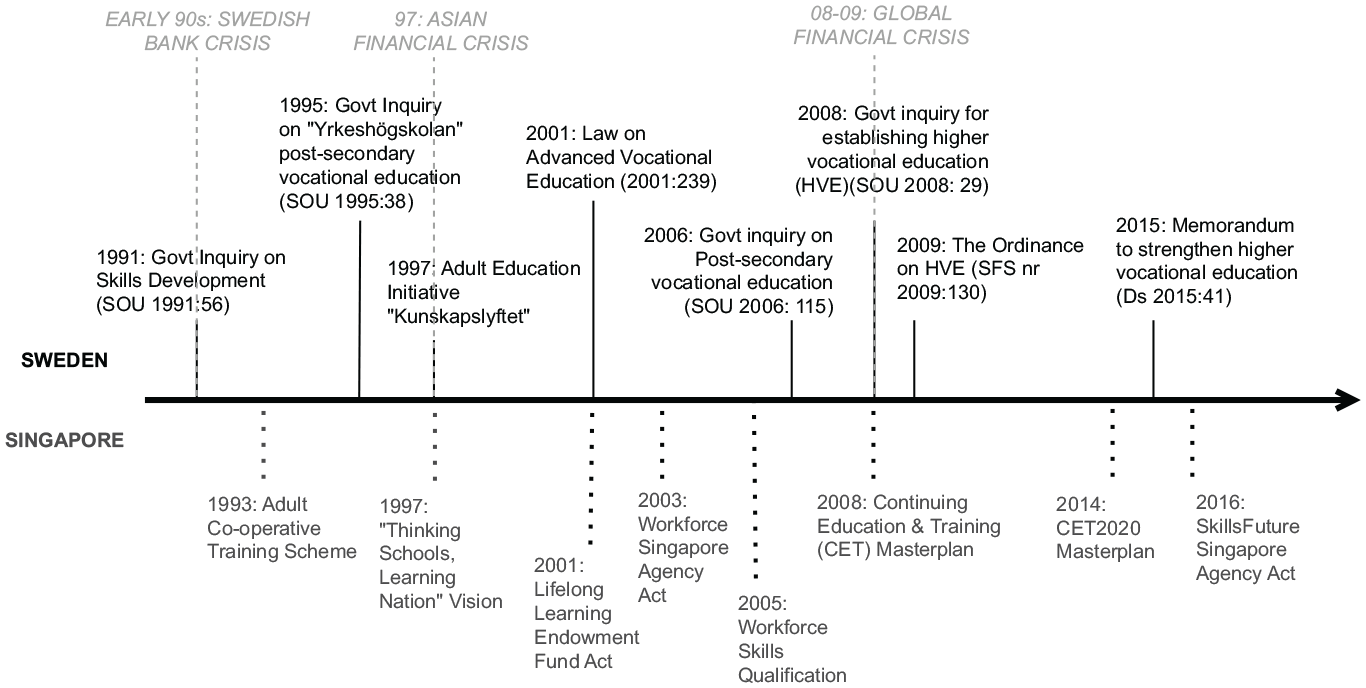
Examples of skilling initiatives, inquiries, and legislation from 1990 to 2010s, Singapore and Sweden.
In Sweden, adult vocational learning is organised in various forms: from higher vocational education, municipal adult education, to popular education. These activities and their financing come under various governmental ministries: from education, employment to culture. Due to the amount of administrative data collected and analysed at the population level, there has also been an institutionalisation of skills assessment and forecasting that features regularly as part of education and labour market governance. Moreover, what is particularly interesting about Singapore and Sweden is the connection their educational systems have to the global governance of education (Gopinathan, 2007; Ringarp and Waldow, 2016). Both countries are also trade-dependent, share a rather similar demographic structure and concerns for their workforce in relation to ageing populations.
However, there are also differences in these two countries that make comparison useful. In the specific context of the COVID-19 pandemic, Sweden had a less restrictive approach than Singapore did, with the former using recommendations as a tool for managing mobility and virus transmission, while the latter enforced much stricter restrictions that had significant impact on businesses operating in and out of Singapore. In addition, in research on varieties of capitalism (VoC) (Hall and Soskice, 2001), Singapore and Sweden have been located in different clusters. For example, Singapore is considered an example of an advanced city economy with high levels of state coordination, but with an internationally oriented market and reliance on foreign direct investments, while Sweden has been classified as a type of coordinated market economy (Witt et al., 2018). This difference could have implications on the mediating link that ‘skills’ have between education and employment, or how skills are conceived of (Warhurst et al., 2017).
Indeed, the VoC-skills literature has focused on institutional arrangements which facilitate individual choices and institutional strategies, demonstrating the lack of convergence in national lifelong learning systems (Verdier, 2018). As others like Lauder (2020) have emphasised, especially with regards to the role of learning for the ‘future economy’, VoC research traces how historical trajectories of nations influence how economic challenges are responded to. Earlier political economy research on skills, that focus on what leads to efficient economic performance and comparative advantage, also argue that the underinvestment in skills training is a ‘free rider problem’, since employers tend to want to hire the already-skilled worker (Finegold and Soskice, 1988: 25). Yet this body of work requires extension with new conceptualisations, in order to reflect transforming socioeconomic situations, especially as systems experience disruption. As Verdier (2018) argues, these typologies have been limited in accounting for ongoing transformations and dynamics that national systems experience in reality. More recent approaches by Saar and Ure (2013) and Verdier (2018) seek to evolve and update conceptual frameworks for the comparative analysis of skills development and skills formation systems, particularly with a focus on principles of action and plural conceptions of justice and worth.
Methodological considerations
Our theoretical approach, as outlined above, pays attention to techniques of skilling in critical moments of uncertainty. For this article, we sampled governmental public communication in press releases and speeches from relevant governmental agencies in both countries from March 2020 (when it was declared a global pandemic) to July 2021 (when vaccination programmes were aggressively being rolled out in both countries). The first 18 months of the crisis can be viewed as an over-communicative period when government offices were in crisis-mode, with more press conferences being delivered and press releases being issued than usual. As pointed out by Roitman (2013), crisis in contemporary times has functioned as a device for enabling certain types of narratives, while depriving others. The crisis situation thus provides a strong rationale and opportunity for analysing which justifications are salient and which are silent, as represented in governmental communication as the situation unfolds.
For our search and sampling strategy, we standardised the period of analysis and the type of communication being examined (governmental public communication on training and skilling). To overcome the challenge of matching keywords and source archives due to differences in language, contexts, and the role of the press in both countries, we applied different search strategies. For Singapore, press releases and local English-language news articles (that reproduce governmental communication) were collected from Factiva, an online database for media articles and news reports. We used the following sets of search phrases and keywords: skill*, Singaporean*, train*, manpower, local*, and citizen*. For Sweden, press releases and news updates were gathered from the digital archives of the Swedish Agency for Higher Vocational Education (MYH), Swedish Public Employment Service (Arbetsförmedlingen), and Government Offices of Sweden (Regeringskansliet). Press releases from the latter were filtered based on the categories Labour Market; Adult Education; Departments of Education and Work.
In total, 520 relevant texts for both countries were gathered, coded and analysed thematically. Our coding strategy was guided by our theoretical interest in the concepts of ‘preparedness’ and ‘techniques’, that relate to the situation of skilling in times of crisis. Certainly, studying this form of textual data limits our analysis to what was communicated. Furthermore, the comparison of these smaller nation-states is perhaps more representative of cases where coordination is functional and feasible. Yet, the point of this analysis is not to emphasise exceptionalism of these selected cases. Rather, we focus explicitly on identifying techniques in skilling regimes during a crisis with these relevant cases, and venture deeper to compare coordination of strategies and the characteristics of these techniques. By focusing on official accounts, we capture what was conveyed to the public and represented through these forms of communication as justifications. Moreover, we draw on statistics and annual reporting data for mapping out training participation pre-, post- and during this critical moment, as a means to examine change. Our analysis identifies three techniques which we present below.
Techniques of preparedness
Stockpiling skills
In this analysis, the increase in government investment and expenditure on skilling and training during the pandemic period can be viewed as an exemplification of ‘skills stockpiling’. Describing the situation of amassing essential medical items in times of public health crises, Lakoff (2020) proposed that the practice of stockpiling – beyond hoarding supplies – is connected to a wider logic about how collective life is vulnerable to unanticipated shocks. The stockpile that is on standby becomes a signum for safeguarding survival, ensuring a resilient system that can continue to function even in times of scarcity (Lakoff, 2020). When tied to human capital theory assumptions, skills can be viewed as ‘fungible’ (Iskander, 2021) and commodifiable.
In Sweden, the deluge of funding specially marked out for adult education and training in the early stages of the coronavirus crisis was notable. When the pandemic unravelled in March 2020, the Swedish government quickly proposed increases in investments in education and training. Around 683 and 862 million SEK were to be added to the university education system for 2020 and 2021 correspondingly; municipal vocational adult education and higher vocational education would receive increased funding by 700 and 365 million SEK, respectively (Regeringskansliet, March 2020). The justification for this investment was that workers should be offered the opportunity to retrain during this crisis period so that they can be ‘equipped’ for employment in the post-crisis moment and this was qualified as a means for mitigating the economic consequences of the virus outbreak (Regeringskansliet, March 2020). Among other rapid response measures to meet the need for adjustment in the labour market and the expected heightened interest among workers to study or train, there was also a push for the launch of shorter, flexible training forms and validation methods. This included the implementation of compact higher vocational education programmes (korta YH) as well as experimenting with new training forms (YH-flex) that permit the recognition of prior skills to supplement the attainment of a training qualification (MYH, April 1, 2020).
By autumn of 2020, justifications such as requiring more education and training in labour market policy, or that education will ‘take us through the crisis’, were salient in Swedish governmental public communication. In a September 2020 press conference, the then-Minister of Employment said, ‘When the economy restarts, employers will need the right skills. Then people’s ability to apply for jobs will also depend on having the knowledge and skills that are in demand’ (Regeringskansliet, September 2020). The number of applicants to segments of adult learning during this initial crisis period did rise. For example, applications to higher vocational education continued on its upwards trend, with an even sharper rise from 2019 to 2020 for the autumn intake (see Figure 2). Figure 3 shows further that year 2020 experienced its highest percentage difference in applications from the previous year, indicating a clear and unparalleled surge, even compared to the years after.
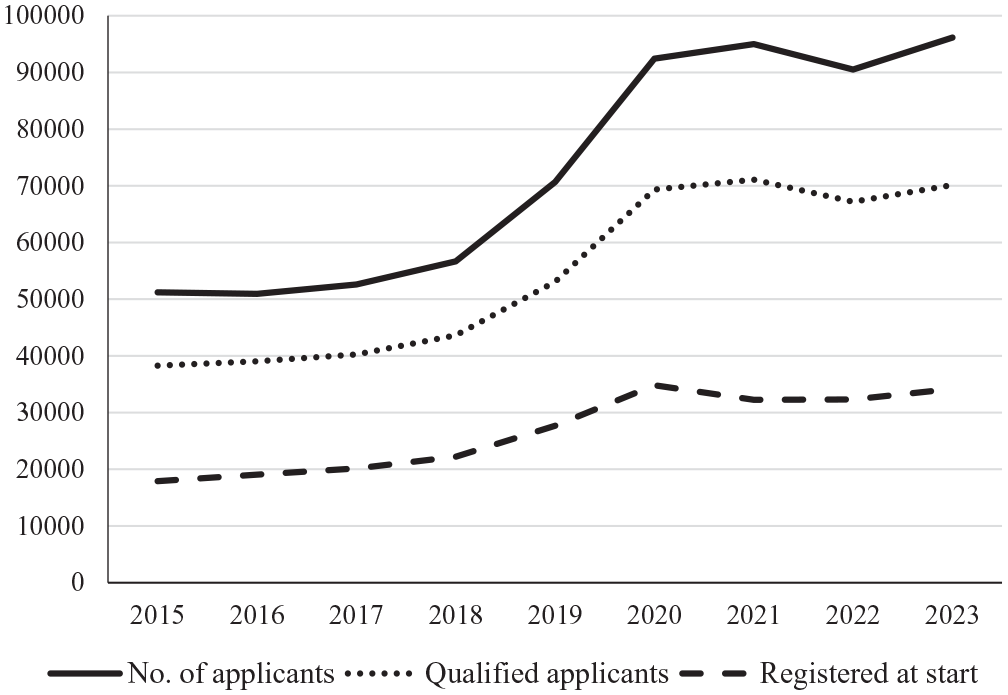
Applications and funded admissions to Swedish higher vocational education (2015–2023). 1
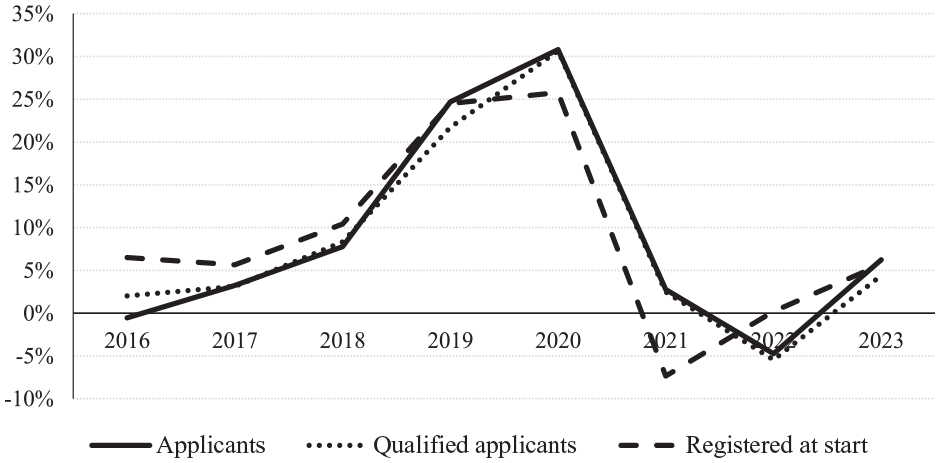
Percentage difference from previous year participation rates in HVE (2016–2023).
In Singapore, the Ministry of Manpower reported that the training participation in the labour force nearly doubled over the decade, from 26.9% in 2011 to 49.9% in 2021, and with a particularly sharp uptake in participation rates among the unemployed (MOM, 2022). These high participation rates during the years of the pandemic were said to be greatly aided by governmental initiatives that were rapidly launched in the immediate months of the crisis. Similar to Sweden, we see a surge in training participation in Singapore during the pandemic years, which was followed by a fall after (Table 1).
Participation in SkillsFuture programmes in Singapore based on annual reporting information (2016–2022).
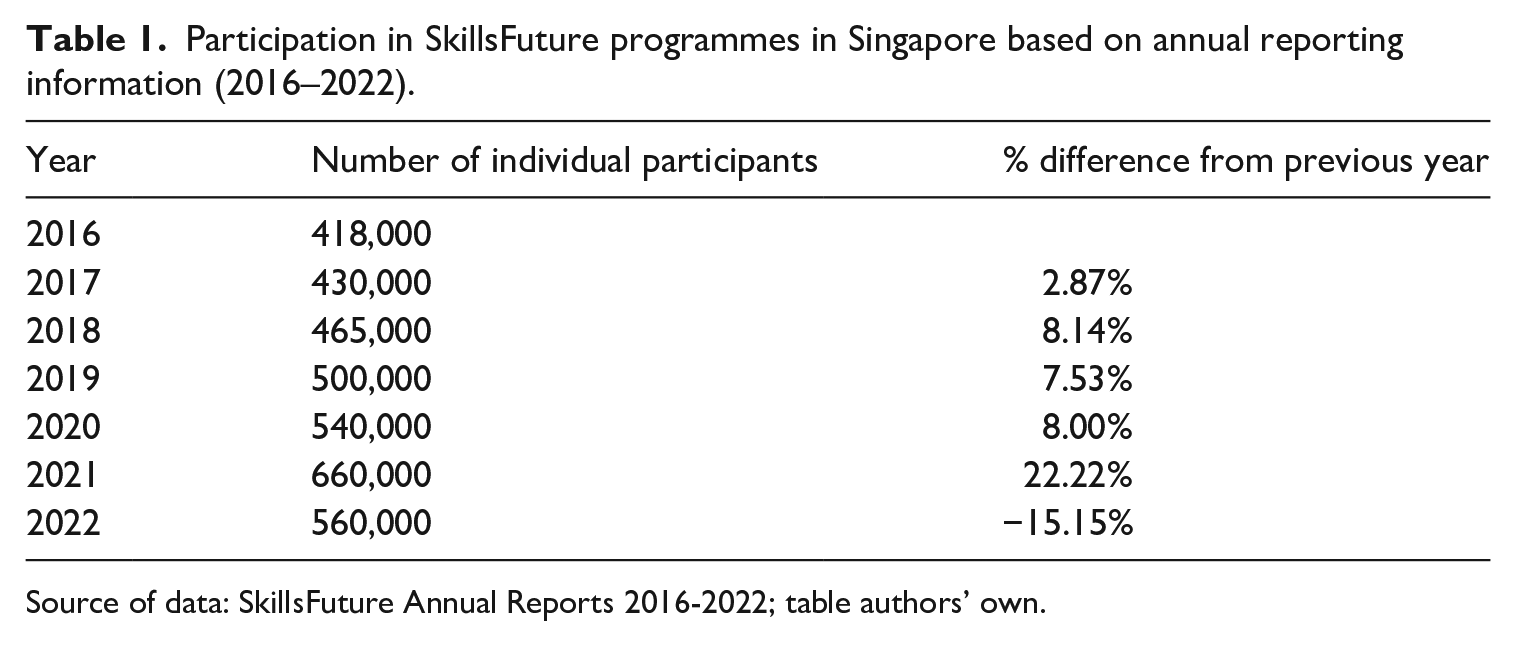
Source of data: SkillsFuture Annual Reports 2016-2022; table authors’ own.
Furthermore, a Singapore state-led task force recommended that ‘businesses, training providers, institutes of higher learning and unions should play a bigger and more sustained role in upskilling and creating career progression pathways for workers’ (Emerging Stronger Taskforce, 2021: 11). Specifically, business owners were called on to adopt ‘a preventive or predictive upskilling approach’, and this strategy involved identifying possible job disruptions and training needs early, as well as ‘developing workforce training plans’. The technique of stockpiling skills was to be done beyond companies and state agencies. Individual workers were also urged to ‘take ownership of their own skill journeys, to identify and bridge gaps in their current skills in order to move into redesigned or higher-value work’ (Emerging Stronger Taskforce, 2021: 11).
Singapore’s investment in skilling manifested in two forms. On one hand, there was an emphasis on developing enough ‘talent’ among Singaporeans. Stressing the state’s strategy of re-skilling and up-skilling Singaporeans in order to prepare for accelerating economic changes, the then-Senior Minister expressed, ‘When we talk of the jobs of the future, therefore, it is not some far-off or hypothetical possibility. The future begins now. That is why we have expanded training opportunities in every sector and every job . . .’ (Shanmugaratnam, 2020). In emphasising their own preparedness, Singapore state officials underlined how skills training programmes being rolled out were rooted in previous initiatives that were established during the last public health crisis the country faced: the 2003 outbreak of severe acute respiratory syndrome (SARS). At a speech among business leaders in Singapore, a then-Senior Minister of State said that compared to 2003, ‘we now have a stronger system to support lifelong learning and job matching for Singaporeans’, and stressed that, ‘(m)any of these new jobs require new skills, and it is critical to equip our workers with such skills’ (Chee, 2020). Through this speech, a logic that emphasised an imperative for the state to be able to create a ‘pool’ of available skills to better prepare for an uncertain future was reinforced.
On the other hand, justifications around skilling initiatives in Singapore also accentuated drawing in ‘talent’ needed for the future economy. In 2021, parliamentary members discussed the creation of a ‘Tech.Pass’, a special visa programme meant to attract ‘high-achieving, top-tier global talent’ in the technology industry, who can contribute to the country’s economy (Tan, 2021). Singapore’s then-Prime Minister, at a keynote address of the Singapore Tech Forum held in November 2020, said that bringing in such talent would help mentor young citizens interested in tech careers and ‘(t)herefore, enlarge our talent pool and our capabilities, raise our standards, and strengthen our tech ecosystem, and I hope, get into a virtuous cycle’ (Lee, 2020). State leaders needed to justify whether, and how, the skills they sought to stockpile would truly be the capacities needed in the future, to cope with other possible crises. As such, establishing a skilling regime in response to the pandemic also meant forwarding a discourse of forecasting skills needs.
Forecasting skills
Skills are often used as a rationale for projecting and anticipating what labour market segments require. The technique of forecasting skills is related but different from stockpiling as it requires coordinating action that is orientated towards a distant future, and pertains to acquiring skills that are not yet possessed or already part of the ‘stockpile’. During this crisis moment, evoking skill needs, gaps and shortages were evident in both country cases. In Sweden, during the call for grants for training proposals, the agency stated that priority was accorded to training courses aimed at future needs, particularly for skills in digitalisation, automation, energy efficiency, climate change and sustainability (MYH, April 15, 2020). The new courses launched eventually were reported to be able to strengthen expertise in sectors such as sustainable digital transformation, healthcare hygiene and infection control, or care philosophy (MYH, July 2020).
Likewise, Singaporean government officials spoke of technological skills as the best competences to have in the future. At a career fair held a year into the pandemic, the then-Education Minister praised the rise in training offerings in ‘deep tech’, a field described as bringing together innovations in biotechnology, engineering, and computing. He encouraged job seekers to turn uncertainty into an opportunity for ‘curiosity’ and to seek out new knowledge or skills: ‘COVID-19 might have thrown the world a curveball, but it has also shown us what innovation and technology can do to solve problems that impact societies and the world. To grasp these opportunities, I encourage all of you to embrace this mind-set of curiosity. Step out of your comfort zone and actively look out for new knowledge or skills to acquire’ (Wong, 2021). Citing innovations like the saliva sample test for detection of the coronavirus, the minister lauded deep tech as demonstrating ‘great potential in creating positive impact’ and that ‘the future looks bright for the sector’ (Wong, 2021).
At times, the discourse of skills mismatches was conjured as a reason for the country’s slow recovery during the pandemic. In a presentation on the topic of workforce readiness in the financial sector, the then-Managing Director of the Monetary Authority of Singapore described how ‘tech skills’ required for digital finance services were ‘in short supply locally’ (Menon, 2021). It was noted that the strongest demand and biggest shortage in ‘local skills’ have been for software engineers and ‘there are not enough Singaporeans applying for these jobs in the first place, let alone qualifying for them’ (Menon, 2021).
Ideals of reskilling or upskilling among workers were often manifested in the skills-forecasting technique. Through the crisis, aggressive implementation was driven towards enhancing Singaporean workers’ technical skills, for example, through ramping up training placements and skills upgrading initiatives like the ‘SGUnited Jobs and Skills Package’, or the ‘TechSkills Accelerator’. Even among Singaporeans with existing jobs, upskilling in technological knowledge and digital literacy were seen as a means of retaining such work while making them more ‘meaningful’ for Singaporean workers. Sectors such as the hotel industry, severely impacted by the pandemic, were called on to ‘enhance’ jobs by equipping staff with technological skills so that they can ‘competently assume the new or enhanced job scope augmented by technology’ (Workforce Singapore, 2021). In a similar vein, one year into the pandemic, then-General Director of the Swedish National Agency for Higher Vocational Education published what he called a ‘crystal ball’ text. He speculated that a likely consequence for how working lives is transforming will shape education, labour market and business policy; individuals should be able to complement their existing skills as ‘the state secures a more developed digital infrastructure to handle the needs of working life, individuals’ skills and existing efforts in terms of education and validation’ (MYH, April 2021).
The emphasis on validating and projecting skills needs is featured prominently, especially around the topic of training and job search. In Singapore, it was reported in a Jobs Situation Report that the National Jobs Council, together with the technology platform LinkedIn, would pilot a skills-based hiring initiative (MOM, 2021). The programme was advertised as offering job seekers opportunities for ‘upskilling’ with free LinkedIn courses and to ‘validate’ these skills with assessment through the social networking platform. During the pandemic, the Swedish Public Employment Service also commenced an artificial intelligence job-matching service called ‘Prepare and Match’ (Rusta och Matcha) in selected municipalities. The goal of the service was described as to encourage ‘more efficient matching and better skills provision with a focus on ensuring that every job seeker comes to work or education in as short a time as possible’ (Arbetsförmedlingen, March 2020). The Public Employment Service and Statistics Sweden actively publish occupational prognoses. Job seekers, or those who want to change occupational tracks, are encouraged to spend time engaging with these tools for ‘decision-making’. During the crisis, advertising the usefulness of these prognoses were reiterated by agencies, with calls such as these: ‘Choosing your future direction is one of the most important things you do in life, but it may not always be so well-substantiated. It is also important that we have a better supply of labour in those occupations with the greatest demand for skills’ (Arbetsförmedlingen, 2021).
It is necessary to note that forecasting skills is nothing new in both countries. SkillsFuture increasingly shapes, produces and disseminates knowledge, through trends reports, such as their publication series Skills Demand for the Future Economy. In Sweden, similar practices of skills anticipation can be found. Forecasting analyses have been published by Statistics Sweden since 1959 through its labour market ‘barometer’ reports (Arbetskraftsbarometern). 2 Within these pages of reports published every year, a wealth of information is being produced and consumed by policymakers, practitioners, employers, educational and training providers.
Not surprisingly then, the technique of forecasting skills was mobilised during this critical moment for governing vocational knowledge for the future. Technological developments in artificial intelligence and data analytics prompt important and critical questions about knowledge production, and what informs skilling policies and decisions. Algorithmic governance is presented as possessing more accuracy, objectivity and proactivity (Flyverbom and Garsten, 2021: 3). Even though predictive analytics are not always accurate and can exacerbate social inequalities, ‘actuarial logic’ in decision-making has grown increasingly popular among governments as solutions for managing complexity, not least in the sphere of skills anticipation and governance (Burrell and Fourcade, 2021; Flyverbom and Garsten, 2021; Simon and Tamm, 2021).
Protecting skills
Another technique identified in our analysis was that of protecting skills. In this context, we refer to this technique as administrative measures of affording skilling opportunities to some groups, but not all, justifying such measures as part of ‘safeguarding’ citizenry rights. An important aspect of the technique of skills protection is linked to funding mechanisms. Since 2015, Singaporean citizens and permanent residents aged 25 and above, partaking in eligible adult learning and training can access funding via an individual learning account, which by the end of 2020 had a finite credit of 1,000 SGD (around 680 EUR at time of writing). During the crisis period, additional credit in an initiative called Mid-Career Support was allocated to Singaporeans aged 40–60, which could be used for ‘reskilling and career transition’ courses (SkillsFuture, 2022). Workers in Singapore who were not permanent residents nor citizens were not entitled to these forms of skills credit.
During the initial crisis period, Singaporean agencies largely focused on protecting a Singaporean ‘core’. In the first year of the pandemic, ministries released stern warnings for firms, emphasising the need to avoid ‘discriminatory practices’ in hiring foreigners over locals, reigniting a discussion over a regulation called the Fair Consideration Framework. The message from state agencies seemed to be that for all the public investments made on upskilling and reskilling local Singaporeans, there is a need for employers to ‘do their part’ in retaining citizens. This was emphasised in a parliamentary speech by a Minister of State in August 2020 when she said, ‘In the current crisis where there are not enough jobs for locals, we need to work with the employers so that Singaporean job seekers will be viewed favourably when applying for jobs, especially given the Government incentives. . . In circumstances where retrenchment is unavoidable, and an employer has to choose between a foreigner and Singaporean, I urge the employer to lean towards keeping the Singaporean’ (Gan, 2020). Between the end of 2019 and second half of 2021, it was reported in a governmental report that the overall decline in employment in Singapore was found to be driven by employment losses of non-residents, which exceeded the employment gains of Singaporean residents (MTI, 2021: 21). The report’s analysis proposed that the contraction in employment among the non-resident workforce, coupled with government support measures limited to residents, may have buffered residents from unemployment during the pandemic (MTI, 2021).
In Sweden, there was an acceleration of efforts for skills validation and the recognition of prior learning so that individuals could be more quickly integrated into existing education and labour market structures. The improvement of accessibility to adult vocational education through improving methods of recognising ‘foreign’ qualifications was enacted as one such technique, especially as unemployment rates among foreign born people in the population rose and even reached up to 20% in the third quarter of 2020 during the crisis period (Statistics Sweden, 2021). Swedish formal and non-formal adult education and training forms are mostly publicly funded, and adult participants can also apply for study loans if they are residents in the country. However, accessibility to these courses is limited, and clearly, not everyone who applies will secure a training place (see e.g. the application-vs-participation ratio in Figure 2 above).
In addition, earlier research has shown how the responsibility of unemployment of migrants have been assigned to them and their (in)ability to ‘become Swedish’ or to be integrated into society (Vesterberg, 2015). As the expansion of work-related formal adult learning has taken place in Sweden over the last decade, the increase in training places has resulted in more individuals partaking in these activities who are not necessarily the most disadvantaged in the labour market (Ye et al., 2022). Funding mechanisms are crucial to scrutinise as we seek to understand who gets protected from economic fall-out and afforded opportunities to partake in skilling in times of crises, and conversely, which groups are left out entirely from these skilling opportunities.
Discussion
How is skilling mobilised and justified for demonstrating a country’s preparedness during crises? By comparing skilling regimes in Singapore and Sweden, we identified three techniques during the most intensive period of a global pandemic where governments were forced to adapt to economic uncertainties and threats of widespread unemployment. Stockpiling skills was observed to take place as a rapid response, mobilised during the early phase of the crisis. The technique of stockpiling skills was regarded by both countries as a necessary measure to ensure that workers would be ‘ready’ and ‘prepared’ when the economy ‘restarts’. The possibility of building on the stockpile was also described as feasible due to the infrastructure of adult learning and skills development that was established prior to this crisis. Examples of coordinating strategies included increasing funding in training and adult learning, launching shorter, flexible forms of training, and urging workers and employers to commit to training.
Second, forecasting skills was a technique enacted with a view on the longer-term horizon. In this critical moment, the performative aspect of anticipating future skills steered coordination of particular training policies for specific training areas, most often in technological competences or technical skills. This technique can be characterised as relying on a kind of prospective worth, a collectively coordinated form of engagement in which actors act on risks and chances they face in the labour market, and where skills are framed as desirable and to be acquired (Ye and Nylander, 2024). Forecasting skills, as part of a longer history in both countries for anticipating skills needs, launching training programmes focused on technological competences, pushing workers to seek out ‘new’ skills, were examples of coordinative strategies identified.
Third, we found that protecting skills was mobilised as a short-term future technique, where boundaries were erected around skilling. This technique emphasises vulnerability of collective life and accentuates how skilling protection is mobilised as part of the battery of citizenry rights. Strategies of coordination included offering training opportunities to certain groups through funding mechanisms and admissions requirements, and validating and recognising certain skills over others. In times of crisis, one consequence of justifying protecting local residents from the impact of the economic fallout is that migrants are not just being relegated to the ‘bottom of the hiring queue’ (Shan, 2013), but also to some extent, left out entirely from the skilling queue. Of the techniques identified, skills protection show a correspondence across both regimes, in relation to the rights of migrant workers to skilling opportunities. Earlier research in other contexts reveal the adverse impacts when migrant workers lose access to public training. Iskander and Lowe (2013), for example, researched the case of the construction industry in the United States, tracing how deunionization contributed to unravelling formal training systems, and where migrant workers informally addressed gaps in skill development even though their contributions were not equally recognised nor valued. The consequences of skills protection techniques are therefore noteworthy, and deserve further research attention.
While there are links between these techniques identified, locating them along a temporal horizon compels us to consider the differences between the diagnosis of skills needs and the prognosis of skills needs, and how upskilling and reskilling discourses have been applied differently to different segments of the population. State agencies in our comparative cases of Sweden and Singapore were found to use skilling as a technique to emphasise individual upskilling responsibilities for bolstering the countries’ preparedness, and justified as imperative for dealing with the critical moment, in that it offered individuals and enterprises opportunity to tide through a crisis. There are also clear differences in institutional infrastructure and stakeholders involved in coordinating techniques of preparation. Singapore, for example, in this critical moment, appears to have had a strong emphasis on encouraging individuals to sign up for retraining efforts, an approach that centres individual responsibility. Sweden’s approach, by contrast, was more focused on continuing to develop the institutional infrastructure to help a range of individuals navigate the changing of occupations and careers. Some of these differences result from different economic or industrial structures, as national skill regimes relate to and reinforce underlying institutional arrangements (Thelen, 2004). Future research could go further to systematically identify the assemblage of key actors (unions, employers, industry councils) that are involved in shaping national skilling regimes over various crises moments. Due to the aims of this article, we have focused on the role of the state. A next line of study could involve going further to systematically examine if these techniques of preparation are a continuation, break or a restoration of what are already in place, with an eye on how investments in skill development are enacted alongside other state investments in individual and household welfare supports.
Sociologists have long examined how definitions of skill shape social hierarchies in the workplace and people’s access to jobs. We argue that ideas about the purpose of skills can also determine how governments respond to crises situations, used as a means for anticipating future challenges. Economic and political upheavals are characteristic of this very time, such that the notion of crisis will continue to be mobilised and used as a justification for particular forms of administrative techniques. At time of writing, countries worldwide are faced with fiscal pressure, suggesting that the changing character of crises would ignite new types of challenges and compromises. For example, given ongoing austerity measures, the technique of stockpiling skills might be abandoned, while skills protection techniques intensify. As sociologists of education and work, it would be prudent for us to pay attention to how crises are mobilised for enacting techniques within the coordination of skilling regimes, as well as their consequences. The range of techniques derived from our analysis could be a useful starting point for distinguishing ongoing configurations and transformations of skilling regimes, especially in times of instability and uncertainty, where valuation processes are contested and negotiated.
Supplemental Material
sj-docx-1-csi-10.1177_00113921251347644 – Supplemental material for Stockpiling, forecasting and protecting skills: Skilling as technique of preparedness in times of crises
Supplemental material, sj-docx-1-csi-10.1177_00113921251347644 for Stockpiling, forecasting and protecting skills: Skilling as technique of preparedness in times of crises by Rebecca Ye and Yasmin Y Ortiga in Current Sociology
Footnotes
Acknowledgements
The authors thank the two anonymous reviewers for the insightful and constructive comments received for this manuscript, as well as to colleagues at workshops and seminars at Stockholm University (2022), Nanyang Technological University (2023) and the Researching Work and Learning Conference (2024), who engaged with earlier versions of this text and analyses.
Funding
The authors disclosed receipt of the following financial support for the research, authorship, and/or publication of this article: R.Y. gratefully acknowledges research funding from the Swedish Research Council (grant no. VR-2019-04146).

Notes
Author biographies
References
Supplementary Material
Please find the following supplemental material available below.
For Open Access articles published under a Creative Commons License, all supplemental material carries the same license as the article it is associated with.
For non-Open Access articles published, all supplemental material carries a non-exclusive license, and permission requests for re-use of supplemental material or any part of supplemental material shall be sent directly to the copyright owner as specified in the copyright notice associated with the article.
