



Abstract
About 30 years ago, an intense reception of Bourdieu’s theory by two supposedly opposing milieu theories emerged in German sociology. While Gerhard Schulze critically opposed Bourdieu’s class concept with his theory of the experience of society, Michael Vester further developed the concepts of social space, habitus, and (occupational) fields in the Bourdieusian tradition. This article reconstructs these two main theories of milieu research and shows that both can be synthesized by elaborating on recent impulses from empirical research. Using data from the European Social Survey (ESS, 2002–2018) for Germany, the article constructs three basic habitual dispositions based on principal component analysis: tradition seeking, status seeking, and experience seeking. Regression analyses are first used to show that these dispositions are associated with political indicators and have different effects in different (vertical) economic classes. In a further step, the dispositions are grouped into habitus types and (horizontal) class fractions. By employing multiple correspondence analysis (MCA) of class fractions, occupational classes (according to Oesch), and political indicators, the structure of a socio-political space is revealed that synthesizes the approaches of Bourdieu, Vester, and Schulze and links milieu research with international research on cultural class analysis and changing political spaces.
Introduction
The reception of Bourdieu’s theory took place in the field of German sociology in the 1980s and 1990s in a specific configuration shaped between the discussion of new inequalities and class structures on the one hand and a modernization-theoretical individualization thesis on the other (Beck and Beck-Gernsheim, 2002; Schulze, 1992; Vester et al., 1993). West German sociology, as a heteronomous academic discipline, was always precariously close to the realpolitik of a divided Germany with a direct outer border to state socialism. This gave rise to a peculiar aversive approach to social inequality and class theories, despite the undeniably influence of the Western Marxism of the Frankfurt School. To this day, this historical path dependency is present in the preference to speak of strata and milieus rather than of social classes, thus differing quite clearly from the international debate. At the same time, however, this national path has also produced some interesting features, particularly a multifaceted tradition of milieu research, which was inspired by Bourdieu and attempted to apply (or debunk) his theory for German society.
In addition to countless empirical investigations and typologies, two milieu theories have proven particularly influential, both of which were developed in direct confrontation with Bourdieu’s theory – one in critical distinction, one in explicit continuation: the theory of the experience society by Gerhard Schulze (1992) and the theory of social milieus in social structural change by Vester et al. (1993, 2001). Recent empirical impulses have opened up possibilities for synthesizing both approaches on the basis of Bourdieusian social space and linking it to international debates about cultural class analysis at the class fraction level. This includes the methodological clarity of the typology of Otte (2004, 2005), the operationalization of Schulze’s modernization-theoretical assumptions about status and experience orientation (Delhey and Schneickert, 2022), the use of values (Magun et al., 2015; Schröder et al., 2022) or personality items (Kaiser and Schneickert, 2016; Schmitz and Barth, 2019) for the empirical construction of habitus and milieus, as well as recent analyses of new classes (Savage et al., 2013), spaces of lifestyles (e.g. Atkinson and Schmitz, 2022; Flemmen et al., 2018; Walker et al., 2022), cultural class struggles (Delhey et al., 2017), and homologies between social and political spaces (Flemmen and Haakestad, 2018; Jarness et al., 2019; Lindell and Ibrahim, 2021). This article adds to the analyses of such horizontal (occupational, cultural, or socio-political) structuration’s of social space the idea of a differentiation by basic habitual orientations. The study shows how dispositional class fractions can be operationalized and have different effects in different vertical (economic) classes, synthesizing assumptions from both milieu theories and supporting the idea of a homology of social and political spaces. I argue that beside the dispute between the milieu theories about the dissolution of class society, many milieu approaches share assumptions about a cultural transformation of basic orientations in Western societies. The article suggests to integrate prominent milieu theories on this basis within the Bourdieusian concept of social space.
Based on data from Waves 1–9 of the European Social Survey (ESS, 2002–2018) for Germany, three basic orientations are constructed with items from the Schwartz value battery and presented in their development over time. Regression analyses with interaction effects are used to show that these dispositions are associated with political indicators and have different effects in different (vertical) economic classes. A conceptual typology of class fractions is therefore suggested that combines vertical economic class and a horizontal differentiation of basic habitual dispositions (tradition, status, experiences). Finally, multiple correspondence analysis (MCA) with these dispositional class fractions, occupational classes (Oesch), and political indicators illustrates the position of such class fractions in the socio-political space of contemporary German society.
Social space, dispositions, classes, and milieus
Gerhard Schulze: the experience society
Schulze (1992) study The Experience Society is a modernization-theoretical counterpart to Bourdieu’s class theory. Schulze turns against Marxist-inspired class-theoretical assumptions of stratification research but nevertheless assumes that large societal groups continue to exist.
His take, however, is that of a cultural modernization process, which ultimately leads citizens of affluent Western societies to the search for a ‘beautiful life’. In traditional societies, with prevailing conditions of economic scarcity, he argues, individual thought and action focus on securing economic resources because the main motivation is to improve, or at least maintain, living conditions and social status (Schulze, 1992: 251). This changes with longer periods of prosperity, as Schulze shows in the case of post-war West Germany. He assumes that affluent societies can no longer be described primarily as competitive (status) societies, but as a new, emerging type – the experience society. Here, ‘the meaning of life is defined by the quality of subjective processes. One wants a beautiful, interesting, pleasant, fascinating life’ (ibid.: 85, own translation; see also Schulze, 2013).
Empirically, Schulze integrates a whole series of methodological approaches and empirical indicators for the construction of relatively distinct milieus but ultimately concludes that age and education are the most discriminating indicators for his typology of five ‘experiential’ milieus (Schulze, 1992: 188). The characterization of these milieus is quite vivid, primarily through illustrations of home furnishings and leisure activities according to three everyday aesthetic schemes (high-brow, excitement, and trivial) (see Figure 1).
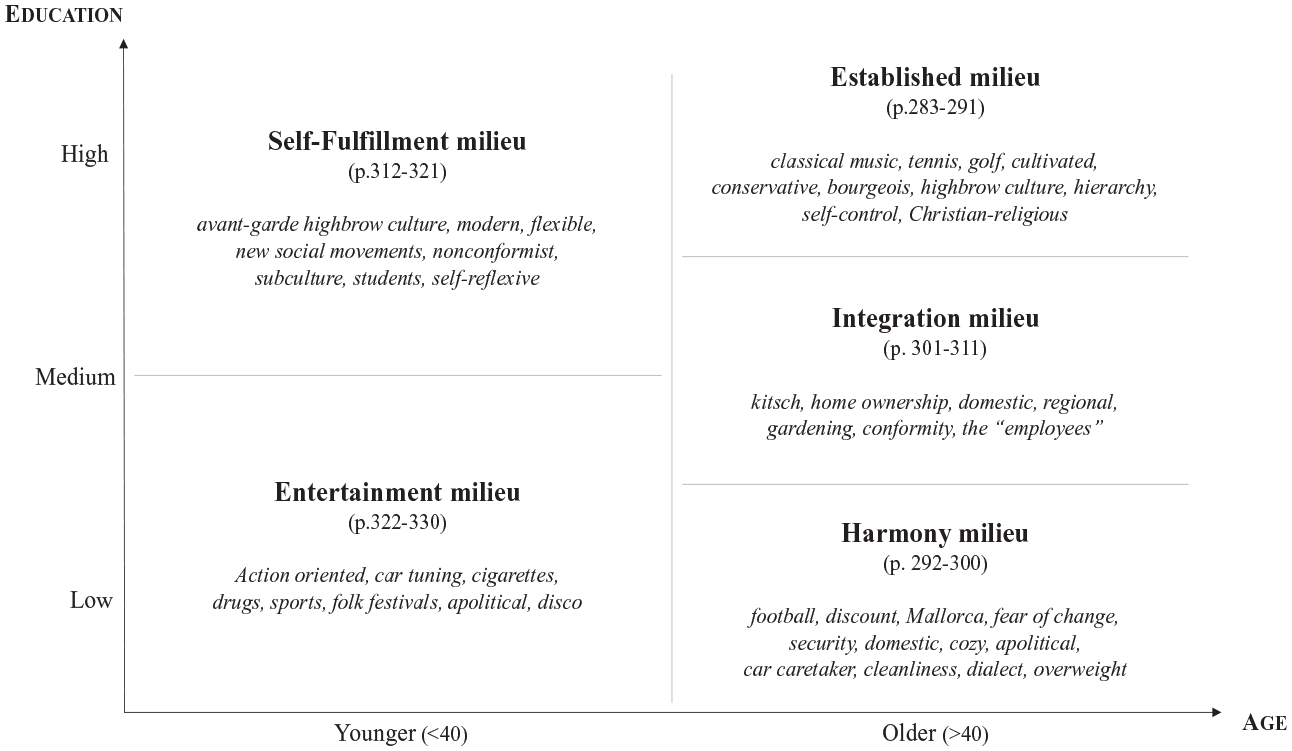
Five experiential milieus by Gerhard Schulze.
Although this conceptualization shows strong similarities to Bourdieu’s social space, and it even suggests that the space of lifestyles is also structured by volumes of capital (low, medium, and high education as central indicators), Schulze strictly distanced his work from Bourdieu. He argues that Bourdieu is outdated because the relevance of horizontal stratification has largely replaced the vertical stratification of classes (Schulze, 1992: 17). Most importantly, Schulze assumes that there is no longer a milieu hierarchy in the sense of social boundaries and distinctive demarcations (Schulze, 1992: 20).
Michael Vester: the dynamic of social space, class, and milieus
In contrast to Schulze, German sociologist Michael Vester had been working since the 1980s on the implementation of a milieu typology for Germany following Bourdieu’s reflections on social space in France. Vester elaborated on the general principles of Bourdieu’s theory regarding the relation between social space and (occupational) fields (cf. Vester et al., 2001: 407–426).
He assumed that class society had to be relativized in terms of social space because vertical differences were no longer strongly polarized, but instead an increasing horizontal differentiation and pluralization could be observed (Vester et al., 1993: 17).
Based on the habitus concept, however, Vester argues that the historical lines of tradition of 19th-century European class societies have not simply disappeared but rather live on in the practices of the lifeworld in a variety of ways, such as in the specific work ethics of skilled workers and the craftsmen tradition (cf. Vester et al., 2001: 13). He claims that this has less to do with a dissolution of class society per se than with a misspecification of social classes as a one-dimensional and reductively economically defined construct. The thesis of the dissolution of class society, according to Vester, is therefore a late punishment for the vulgar Marxism of the 1970s (cf. Vester et al., 2001: 14).
Vester adopts Bourdieu’s construction of social space: ‘The social space is not structured like a system of categories, but more like a magnetic field or a field of forces’. (Vester et al., 1993: 18, translated by the author). The social space of a society includes possible interactions, communication, or networks, but points to the fact that actors and social groups are already structurally related to each other even before direct interactions occur. The relations are therefore structural because they are reproduced and shaped by actors who, in turn, have been shaped by these structures (Vester et al., 1993: 23) – in Bourdieusian terms: ‘structured structures predisposed to function as structuring structures’ (Bourdieu, 1990 [1980]: 53). That is, habitus does not only derive from positions in social space but structures social space itself.
Empirically, Vester relied on qualitative and quantitative data for West Germany collected in the 1980s and 1990s. According to Vester, the social field of forces is characterized not only by a vertical differentiation via class-specific habitus and cultural class struggles but also by a horizontal differentiation that reflects the cultural modernization of socio-structural groups. In a historical and macrosociological dynamic, the milieus increasingly strive not only upward (social advancement and status seeking) but also to the left part of the social space (the modernized and more cultural pole; Vester et al., 1993: 18, 26).
Vester distinguishes four forms of vertical class habitus (Figure 2), which he calls the ‘habitus of distinction’ (upper class), the ‘habitus of the established’ (upper middle class), the ‘habitus of the aspiring’ (lower middle class), and the ‘habitus of necessity’ (lower class). Horizontally, he differentiates between a more traditional and modernized up-to-postmodern and avant-garde (in the upper class) and hedonistic (in the lower and middle class) orientations (see even more clearly in the first nine milieu typology) based on the SINUS model in the 1980s (see Table OA1 in the online appendix).
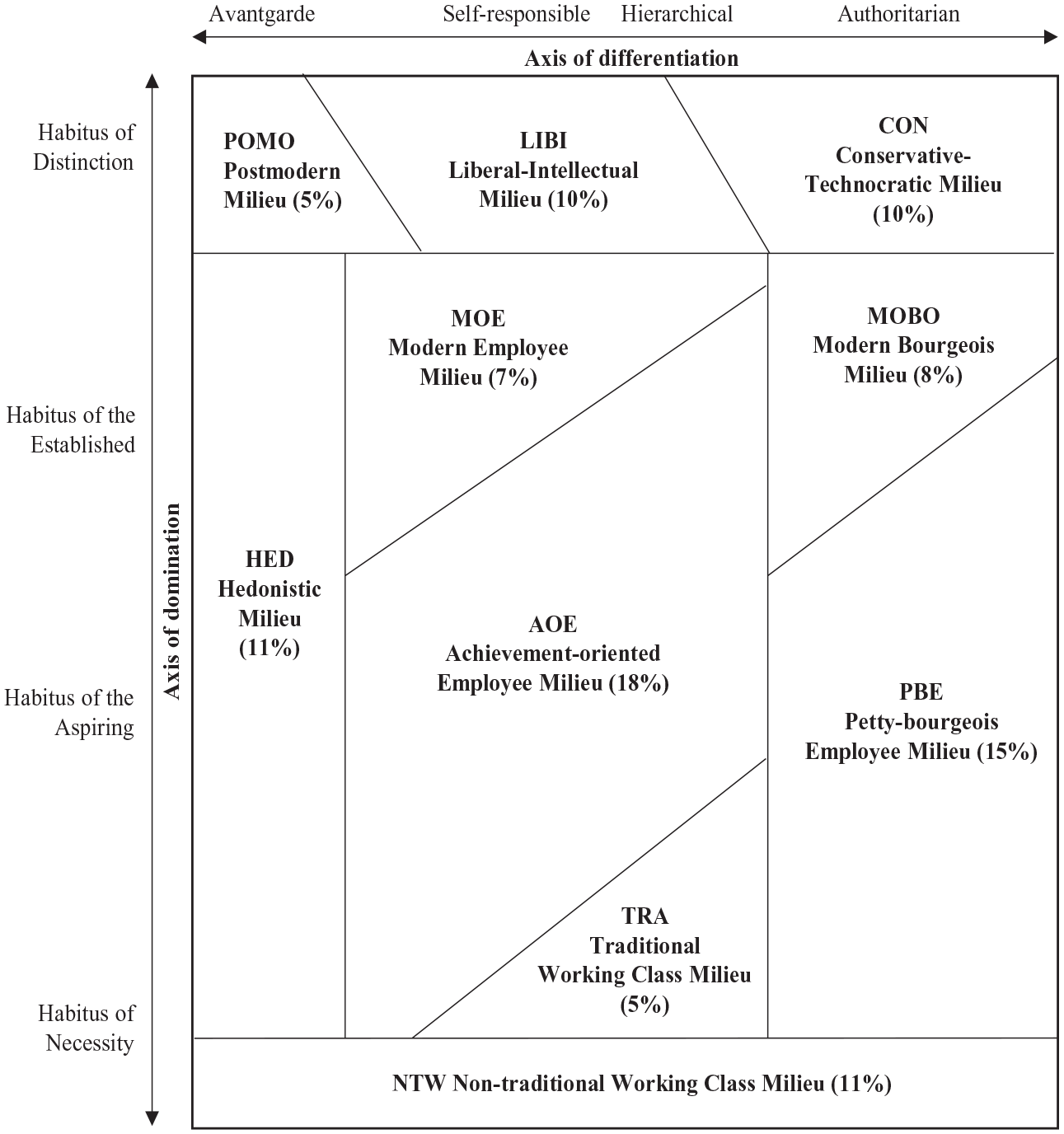
Milieus in the social space by Michael Vester.
Challenges and methodological advancements
Both of the major milieu theories discussed above have made very important contributions to the discussion of cultural factors in research on the stratification of modern societies. They differed in their assessment of the dissolution of class society and the role of social inequality in the observed structural change and in the way they were operationalized. Schulze measures the vertical division via the level of education and the horizontal division via age. Vester, on the other hand, makes a conceptual distinction between vertical social position and horizontal basic orientations on the basis of Bourdieu’s social space, but both are ultimately measured via milieus as habitus groups. Schulze’s approach is straightforward, but there is a gap between the empirical operationalization of the milieus and the theoretical focus on everyday aesthetic schemata and changing basic orientations. The aesthetic schemes are operationalized and measured but finally play no role in the empirical construction of the milieus; the basic orientations are theoretically postulated but not empirically operationalized. Vester’s approach, on the other hand, is theoretically stringent but remains methodologically fuzzy because no clear analytical distinction is made between concepts such as social space, habitus, capital, fields, and milieus. Milieus as habitus groups, measured via socio-political attitudes and value items (cp. Vester et al., 2001: 546–548) that are grouped by cluster analysis, then have the purpose of representing both vertical and horizontal differentiation.
In the following subsection, I discuss three important recent developments relevant to address these issues: (1) The critique and systematization of milieu research by Otte and Rössel, (2) the connection between values research and milieu theory as well as (3) recent analyses of social spaces regarding lifestyles and political spaces. On this basis, the second subsection suggests my approach of dispositional class fractions.
Methodological impulses
Otte and Rössel (2011: 15) criticized the concept of social milieu as too fuzzy, being used as a label for a diverse range of groups and phenomena in society, while the relationship to traditional concepts of social stratification remained unclear, and many assumptions have not been empirically investigated. Otte (2004, 2005, 2013) has drawn on this discomfort with existing milieu research to make a proposal that is interesting in two respects: First, in a literature review of a large number of milieu studies, he identified the two basic dimensions that were common to all studies: A vertical dimension of stratification and a horizontal dimension of modernization (Otte, 2005: 449f.). Instead of using complex explorative grouping algorithms, he proposed a simple conceptual typology of life conduct that can be operationalized with an efficient instrument of only 12 survey items (see Table OA3, online appendix). The strength of this approach lies in the simplicity and empirical clarity of the construction, which not only guarantees easy applicability but also allows the underlying dimensions to be used in isolation as separate analytical constructs. While the idea of a simple and clear-cut conceptual typology will be adopted below, two critical issues will be modified. First, Otte measures the vertical position via a cultural and an economic route, similar to capital volume and structure in Bourdieu’s sense. However, this vertical axis is measured via indicators that involve rather subjective assessments (see the formulation in Table OA3 in the online appendix), with factor analysis illustrating the common dimensionality of both routes (cp. Otte, 2005: 458). Here, the decision in favor of a more ‘objective’ indicator such as income or formal education seems to be advantageous in terms of methodological clarity and availability in large-scale population surveys.
Second, the perspective presented here does not assume that the horizontal structure is necessarily a one-dimensional and linear dimension (i.e., measurable on one metric scale) of the modernization of lifestyles and conduct of life. The concept proposed here is therefore not a variation of Otte’s typology of life conduct, but a conceptual alternative if the focus is to be more on habitus, milieu and social space. What Bourdieu has termed the capital structure of the relationship between economic and cultural capital can be measured by means of a number of multidimensional, manifest indicators: lifestyles, occupational groups or, as in the following proposal, by basic habitual dispositions. Following diverging milieu theories as well as value change theories, I focus on basic orientations of tradition, status, and experiences as they represent the fundamental change in basic orientations in Western societies – although this by no means implies a complete, exhaustive and universal theory of habitual orientations. On the contrary, the position of these basic orientations in social space and the underlying assumption of a cultural modernization process must ultimately be empirically explored and expanded in specific contexts, for example, for non-Western societies.
Three important impulses from current studies are relevant to this endeavor: First, a strand of research relevant to the present study deals in various ways with status seeking (see Delhey et al., 2022; Paskov et al., 2017) as a value orientation of the competitive society that Schulze assumed as a precursor to the experience society. Recent work has also explicitly linked status seeking to an experiential orientation in Schulze’s sense (Delhey and Schneickert, 2022) as well as showing that affluent European societies are indeed shifting toward experiential orientation (Schneickert et al., 2024). Such time- and country-comparative studies have explored the development of the modern status orientation and the postmodern experience orientation, but the historical dynamic from the traditional orientation was so far only theoretically assumed but has not been empirically operationalized. But even if it is true that traditional, modern, or postmodern orientations are rooted in one cultural modernization process, it remains unclear if such dispositions really form a one-dimensional linear development such as Otte’s horizontal differentiation suggests. The theoretical conceptualization of this cultural modernization is the core of the value change that many milieu theories assume (see Schneickert, 2023). It represents what Vester’s assumption expresses – namely, that individuals strive not only ‘upward’ but also ‘leftward’ in the social space. The study at hand is the first to explore these central questions of milieu theory socio-spatially and over time.
Second, from the very beginning, value items and socio-political items were used in milieu research to measure horizontal differentiation (see Figure OA1 in the online appendix). Recently, items from the Schwartz (2012) value instrument have been used to group value milieus, mostly by means of latent class analysis (LCA) (e.g., see Groh-Samberg et al., 2023; Magun et al., 2015; Schröder et al., 2022). Given the popularity of the theory of universal values and the availability of its instruments in large-scale surveys, it seems promising to use them in the context of a systematic return to the central empirical concepts of habitus, decomposed at the level of dispositions and values (see Longest et al., 2013) or personality (see Kaiser and Schneickert, 2016; Schmitz and Barth, 2019). Furthermore, studies suggest that political differentiations are in fact to some degree based on different values (see Haidt, 2012; Piurko et al., 2011; Schwartz et al., 2010). This basic consideration can help in the selection of suitable indicators, as the subdivision into the three basic orientations of tradition, status, and experiences, suggested here, is also found in homology with the basic differentiation of political fields across most Western countries: conservatives, liberals and progressives (see already in early studies based on the SINUS milieu typology, cp. Figure OA1). The homology of social space and the political field was assumed by Bourdieu (1981) and Vester et al. (2001), and recent studies have supported this for European societies using geometric data analysis (e.g., Atkinson, 2024; Barth and Schmitz, 2018; Flemmen and Haakestad, 2018; Harrits et al., 2010; Jarness et al., 2019; Lindell and Ibrahim, 2021; Schneickert and Schmitz, 2025).
Third, the unestablished connection of milieu theories to recent cultural class analysis seems promising (see Atkinson, 2017; Bennett et al., 2009; Le Roux et al., 2008; Savage et al., 2013). The concept of social space has received increased attention in this context in recent years, particularly regarding the importance of cultural participation, cultural class divisions, and lifestyles. These studies have not only confirmed and extended the Bourdieusian concepts theoretically (e.g., see Brisson and Bianchi, 2017, with a special focus on occupational class fractions in Distinction) but have also introduced methodological connections of MCA and grouping algorithms such as cluster analysis and LCA (e.g. Atkinson, 2011; Atkinson and Schmitz, 2022; Coulangeon and Lemel, 2007; Rössel, 2008; Walker et al., 2022; Weingartner and Rössel, 2019).
The cultural modernization of dispositional class fractions in a socio-political space
‘Social classes do not exist (. . .). What exists is a social space, a space of differences, in which classes exist in some sense in a state of virtuality, not as something given but as something to be done’. (Bourdieu, 1998: 12)
Like social classes, milieus do not exist as real groups or observable things. What sociologists are actually interested in when talking about milieus in the contexts mentioned above, are the relational structures in which people are embedded and which ensure that people think, perceive, and classify as they do, forming structured attitudes and values that can then be measured. It is to these relational configurations that the concepts of habitus, capital, class, and social space refer.
This article suggests that these concepts – although they of course obtain their strength from the rather holistic framework of Bourdieu’s grand theory – can and should be more clearly separated analytically in a first step: that is, to measure habitus as configuration of dispositions, then adding ‘objective’ measures of (economic and cultural) capital to construct class fractions and then to locate them in a social space. To do this, three assumptions must be considered.
First, crude indicators of cultural capital, such as institutionalized cultural capital via educational titles, are not capable of sufficiently mapping socio-spatial horizontal differentiation (the capital structure). Bourdieu was concerned with much finer differentiations. For example, both professors and managers have university degrees today, and yet we would assume that they belong to different class fractions of the upper class with different dispositional configurations.
Second, the inflation of educational diplomas in many Western societies since the 1970s reinforces this problem and has to be taken into account. An assignment of high education to the upper class only (measured, for instance, by the highest school certificate or even university education per se) is hardly appropriate anymore.
Third, while the ‘cultural turn’ in class and milieu research certainly has its merits, especially vis-à-vis some Marxist approaches that were overly focused at economically defined vertical antagonisms between dominant and dominated classes, economic capital undeniably still plays an important role for social stratification in capitalist societies. Given that formal education and income are highly correlated in Western societies, it seems appropriate to primarily distinguish (vertical) classes by economic capital, if one is interested in a rather simple and clearly defined indicator for vertical (top-down) stratification. If and how economic classes lead to socio-cultural or socio-political different class habitus is then rather an empirical question (see Table OA6 in the online appendix for suggested thresholds and theoretical expectations as well as Figure 5 for the relation between economic and cultural capital as vectors in the empirical social space).
More importantly, however, it can be assumed that vertical class habitus is not uniform but differentiated horizontally. This horizontal differentiation of habitus and space was measured so far using mainly occupational or lifestyle indicators (see, e.g., Atkinson and Schmitz, 2022; Brisson and Bianchi, 2017; Flemmen and Haakestad, 2018; Walker et al., 2022) but it can be argued that these can also be measured more directly via the underlying habitual dispositions. The assumption that these basic orientations are based on a latent process of cultural modernization was theorized by Schulze (1992) as well as other theories of value change (e.g., Inglehart, 1997) and can empirically be found in various milieu typologies (see Figure OA1 in the online appendix). Even if this is not intended to imply a complete and universal theory, it is – at least for Western societies – obvious to start with the three basic dispositional forces that have been used in all of these approaches (see Schneickert, 2023) and can be found in value theories as well, such as Schwartz (2012) theory of human values. This article therefore proposes a more direct measurement via basic habitual orientations, which were assumed in the two milieu theories presented. Conversely, this adds to the construction of social spaces the idea of an underlying socio-cultural dynamic; a cultural transformation from traditional to modern status to postmodern experiential orientation:
1) Tradition seeking: striving for conformity, preservation, and security (traditional orientation)
2) Status seeking: striving for advancement, success, and prestige (modern orientation)
3) Experience seeking: striving for pleasure, excitement, and new things (postmodern orientation)
Although it is certainly debatable how well specific items of the various personality and value instruments are suited theoretically and methodologically to measure habitual dispositions, such psychometric measures have been suggested to operationalize habitus and milieus (Barth and Schmitz, 2018; Kaiser and Schneickert, 2016; Schneickert et al., 2024; Schröder et al., 2022).
To implement and study these theoretical assumptions empirically, a data basis is required that meets high standards. The data must contain indicators of vertical economic classes (income, wealth) as well as indicators of horizontal differentiation in habitual dispositions (tradition, status, experiences). They should also contain indicators that allow the construction of social spaces (e. g. cultural capital, occupational classes) but also lifestyles and political indicators. The data should also ideally be available in a comparative cultural and temporal context. Although no publicly available data set meets all these requirements, the ESS seems to be the most adequate for this endeavor.
Data and methods
Data
I use data from Rounds 1–9 of the ESS (2002–2018). The analysis is limited to Germany, because this is where most milieu research was conducted and comparative data are available, and it is therefore the ideal place to assess whether a plausible conceptual framework can be operationalized. The proposed model should be as generalized and simple as possible so that it can be applied in other countries and at other points in time without major modification. The following considerations are based on these basic principles.
ESS provides population-representative data for individuals aged 15 and older; these data have been collected every 2 years in more than 30 countries since 2002 using random probability sampling methods. The 2021 wave could not be included because the Schwartz value battery was dropped from the German questionnaire due to the COVID-19 self-completion survey mode. The analytical sample is restricted to respondents who have an ISCO code for occupation and reported their household income. The final analytical sample comprises N = 19,451 individuals in the time period 2002–2018 (see Table OA2, online appendix, for descriptives). Post-stratification weights were used, especially to correct for regional (East German) oversampling. Furthermore, as the sample sizes of the waves differ, a wave weight was constructed that gives all ESS rounds the same influence (9 waves = 11.1% influence for each wave). All pooled analyses are weighted with a combination (product) of the post-stratification and the wave weight.
Measures
The operationalization suggested is based on a straightforward theoretical idea: class fractions in social space should differ vertically by volume of (economic) capital and horizontally on the basis of habitual dispositions.
Basic dispositions, habitus types, and class fractions
At least for European societies, these basic dispositions are assumed to have developed in a process of cultural modernization which, however, is not linear but simultaneous and gradual – it should therefore be measured both metrically and categorically. I suggest to first construct three basic dispositions (tradition, status, and experiences) on metric scales and then construct relative dominant habitus types by assigning the highest value, that is, the relatively prioritized disposition in individuals. Combining these habitus types and economic classes, dispositional class fractions can be constructed as a horizontal differentiation of class habitus (e.g., traditional upper class, status upper class, and experiential upper class).
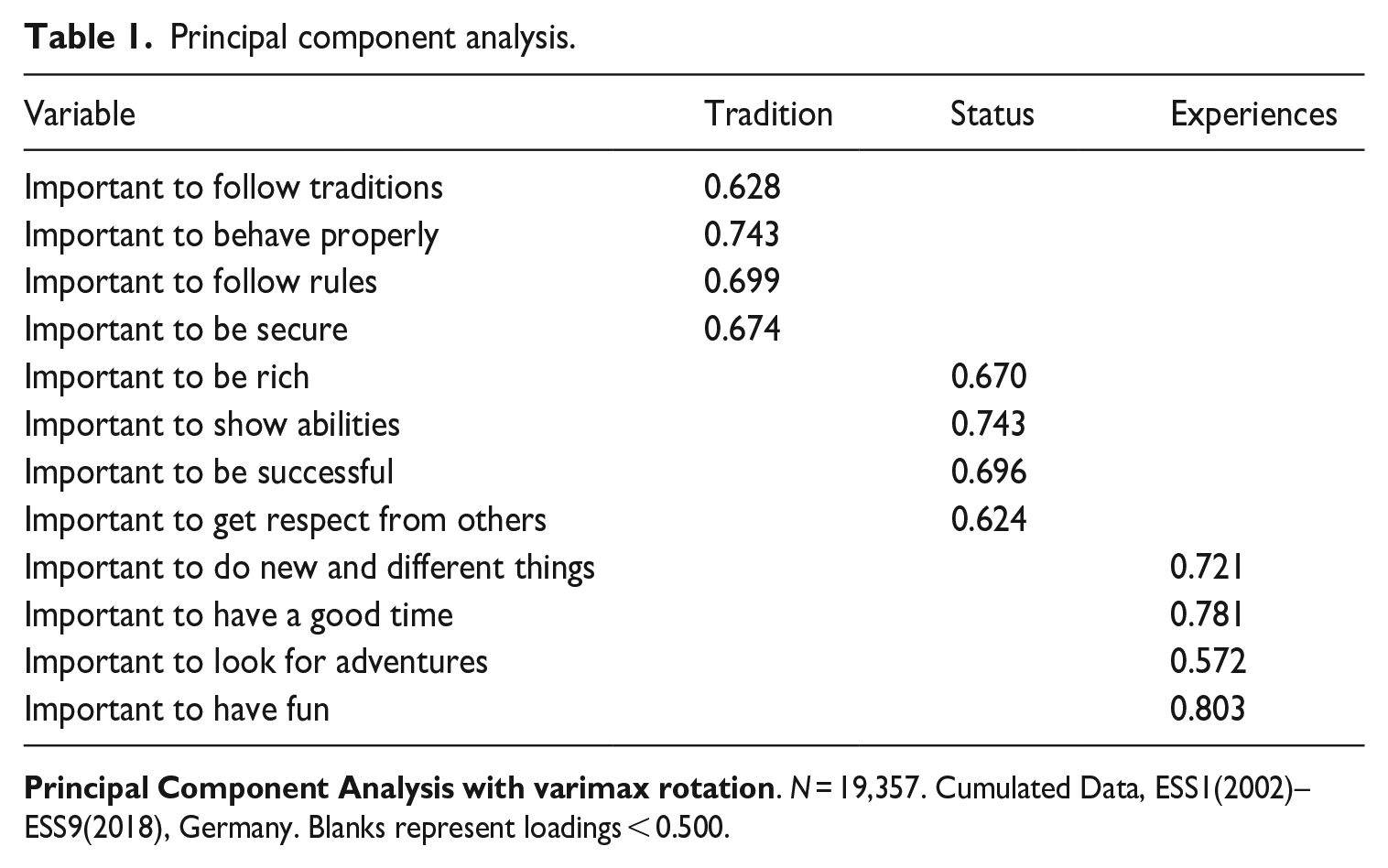
Table 1 shows the results of a principal component analysis with 12 items (four per basic disposition) from the well-established Schwartz values (Schwartz, 1992; Schwartz and Bilsky, 1987) item battery, which leads to a three-dimensional solution. Accordingly, three unweighted row mean indices were constructed: the tradition seeking index (TSI), status seeking index (SSI), and experience seeking index (ESI), all ranging from 1 to 6 with higher values indicating stronger disposition. The reliability of the scales is satisfactory in all waves (see Table OA4, online appendix), above 0.7 for ESI and above 0.6 for SSI and TSI.
Principal component analysis.
Economic capital and vertical economic classes
are measured by unweighted household total net income and collapsed into four vertical economic classes. The indicator is recoded so that the respective median of the income distribution per ESS round is always located at the upper end of the lower middle class (see Tables OA5 and OA6, online appendix, for detailed information). On average, the lower class has less than 60% of the median income available (mean sample size: 16%, mean max.: €1267). It can therefore be assumed that the reality of life is determined by an orientation toward limited opportunities and material necessities (habitus of necessity). The lower middle class has an income of around 60%–100% of the median income (31%; €2324). It can therefore be assumed that they are primarily concerned with stabilizing their precarious situation and not slipping further (habitus of defense). The upper middle class has an income of 100% to approximately 160% above the average median income (32%; €3628). They earn well, but there are certain upper limits to lifestyle adjustment (aspirational habitus). The upper class in this sample has an income of more than 160% of the average median income (21%; >€3628). They can allow themselves a distinctive lifestyle without jeopardizing their material basis (habitus of distinction).
Cultural capital
is measured in its institutionalized form of education using the International Standard Classification of Education (ISCED), collapsed into four groups (ISCED I&II = low, ISCED IIIb = lower middle; ISCED IIIa&IV = upper middle; ISCED V1&V2 = high).
Occupational classes
are operationalized according to Oesch (2006a, 2006b) 8-class-scheme, using the syntax provided (https://people.unil.ch/danieloesch/scripts/), distinguishing service worker, production worker, clerks, small business owner, technical (semi)professionals, socio-cultural (semi)professionals, managers, and self-employed/large employers.
As the ESS unfortunately does not include indicators for lifestyles and cultural practices, political indicators are used to test the dispositional class fractions and construct a socio-political space. For the OLS regressions, the (quasi-)metric complete scales of the four political indicators were used; for the MCA, the scales are collapsed as follows:
Left-right self-identification
is measured on an 11-point scale from 0 (= left) to 10 (= right), collapsed into five categories (0–2 = very left, 3–4 = left, 5 = middle, 6–7 = right, 8–10 = very right) plus a category for those who did not answer.
Redistribution
One’s attitude toward redistribution is measured on a 5-point scale, indicating how strongly respondents support the government taking measures to reduce differences in income levels. As very few strongly disagree, categories are collapsed, resulting in four categories (1 = disagree, 2 = neither agree nor disagree, 3 = agree, 4 = strongly agree).
Sexual diversity
Attitude toward sexual liberty is measured on a 5-point scale indicating to what degree respondents agree that ‘gay men and lesbians should be free to live their own life as they wish’. As very few people answer ‘strongly disagree’, the disagree categories are collapsed, resulting in four categories (reversed so that 1 = disagree and 4 = strongly agree).
Migration
To assess attitude toward migration, a 5-point unweighted row mean index of three items on one’s attitude toward migration is used: respondents were asked (1) if migration enriches a country’s culture, (2) if it enriches a country’s economy, and (3) if the country is overall better or worse off with migration (alpha = 0.83). For the MCA, the values of the scale were rounded to integers and collapsed to a 5-point scale (0–2 = strongly against, 3–4 = against, 5 = neither, 6–7 = pro, and 8–10 strongly pro-migration).
As milieu-related attitudes and lifestyles are known to be strongly influenced by age and gender, both variables are used as controls in the regression analyses.
Analytical strategy
Based on data from all waves of the ESS (2002–2018) for Germany, the three basic orientations are constructed with items from the Schwartz value battery and presented in their development over time. Regression analyses are then used to show that these dispositions are associated with political indicators and have different effects in different (vertical) economic classes. A conceptual typology of class fractions is suggested that combines vertical economic class membership and a horizontal differentiation in habitual dispositions (tradition, status, and experiences). Finally, MCA with these class fraction, occupational classes (Oesch), and political indicators illustrates the structure of a socio-political space for contemporary German society, allowing comparison of this space with different milieu theories.
Results
The development of basic dispositions, habitus types, and class fractions over time
Figure 3 illustrates the development of the three basic dispositions in German society over the first decades of the 21st century by plotting the proportion of the population agreeing on the respective scale (those with a value ⩾ 3.5 on either of the 1–6 scales of tradition, status or experience index; cp. Delhey and Schneickert, 2022: 121). Because these are fundamental and enduring habitual dispositions, the overall stability found in the orientations is hardly surprising, but the relative shifts are relevant for the theoretical assumption of a cultural transformation from traditional to modern to postmodern orientations. While German society remains predominantly tradition oriented, even in the 21st century, with about three quarters of the population valuing tradition, security, and conformity, the relation between the two ‘modern’ orientations has changed. While the postmodern experience orientation was still closer to status orientation at the beginning of the 21st century (2002), by the end of the 2010s, it had almost reached the level of tradition orientation. Status orientation experienced an interesting growth in the meantime, coinciding with the neoliberal social reforms of the red-green government of the 2000s and the period of the financial and euro crises (2006–2012). Toward the end of the observations, however, it dropped significantly while Germany was experiencing an exceptionally good economic situation in the 2010s and the experience orientation rose. This confirms the theoretical assumption that these basic orientations are linked to macroeconomic and macrosociological developments, even in a western society like Germany that has already experienced decades of prosperity.
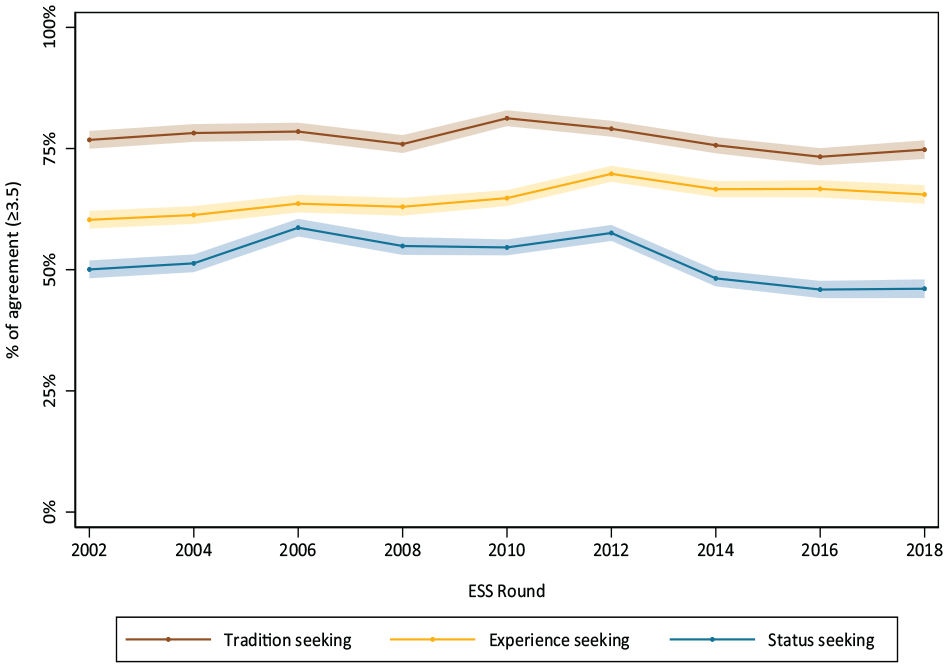
Development of the three basic dispositions in Germany (2002–2018).
Figure 3, however, only shows the general agreement, which can be quite interesting to determine the relative strength and dominance of an orientation in a society. However, as argued theoretically, the basic dispositions are not necessarily mutually exclusive and – especially because they were constructed using value items – are generally agreeable.
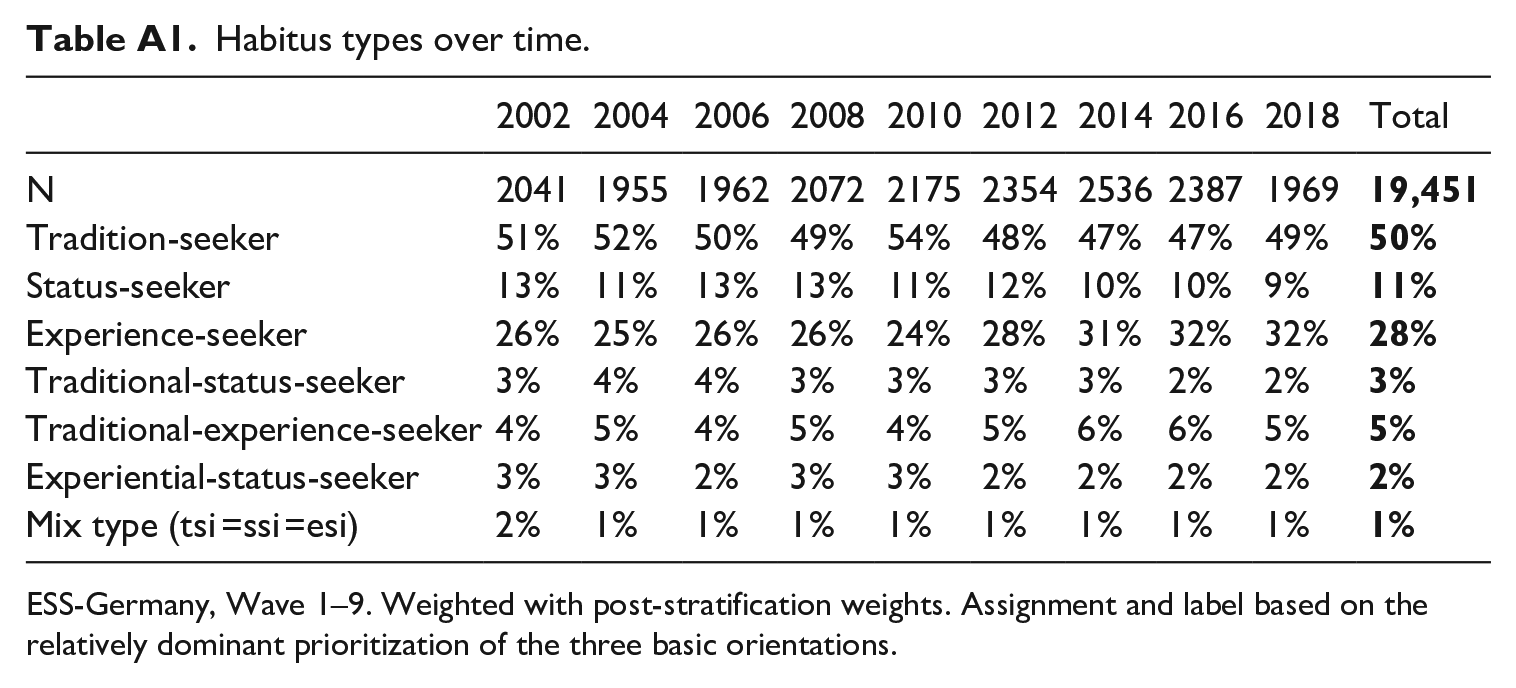
By determining which of the three dispositions is the relatively dominant one for individuals in each case (i.e., the prioritized one with the highest value on the respective 6-point scale), a typology of habitus types can be helpful. Since two or even all three dispositions can have the same values (same priority), this results in seven theoretically possible types (three dominant types and four mixed types) in different combinations (see Table A1 in the appendix for details). When these habitus types are combined with the four vertical economic classes to form horizontal class fractions, the following map of the conceptual social space results (Figure 4). The vertical axis describes the division of four economic classes, while the horizontal division separates the three habitus types (tradition, status, and experience orientation).
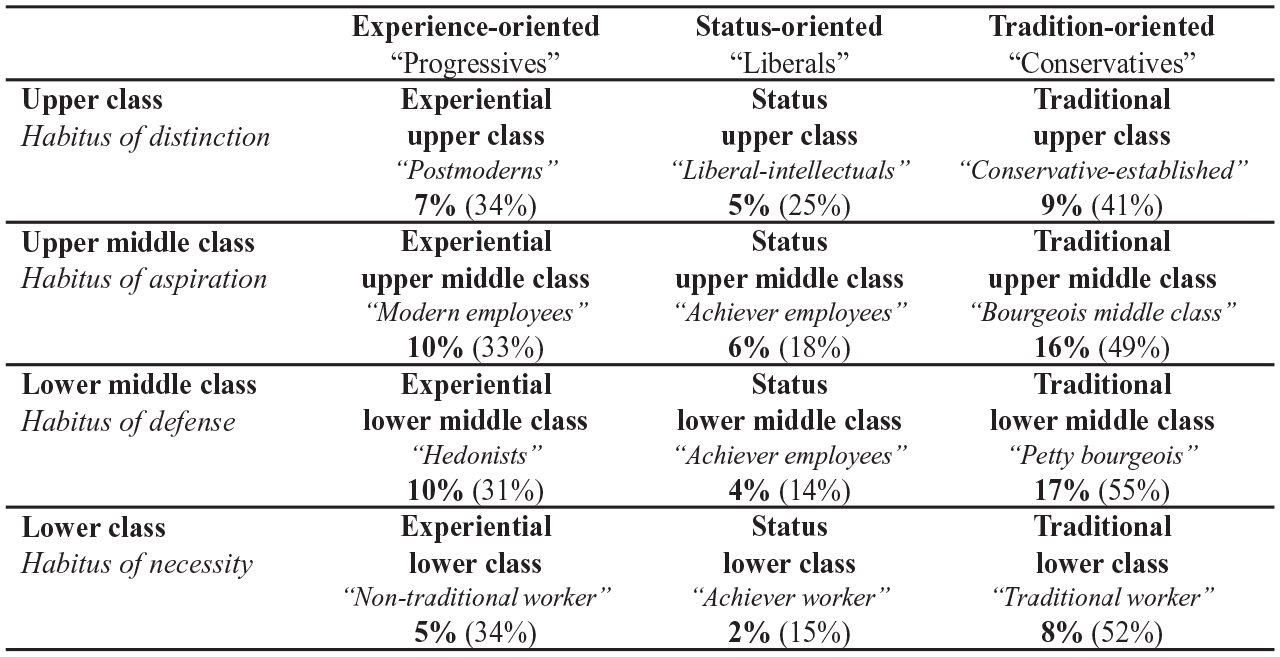
Class fractions in the theoretical social space.
Note that the vertical differentiation here is based purely on economic capital (absolute household net income). Of course, no specific class habitus can be derived directly from economic capital. From the theoretical considerations of Bourdieu (1984 [1979]), Vester et al. (2001), and Rehbein (Jodhka et al., 2017; Rehbein, 2015), however, tendencies can be assumed: an upper-class habitus of delimiting distinction, an aspirational habitus of the upper middle class, a habitus of defense in the lower middle class trying to avoid status decline, and a habitus of necessity in the economic lower class trying to adapt to difficult circumstances (see Figure 4 and description in the ‘Methods’ section). These class habitus should have different effects, depending on whether they are horizontally oriented toward tradition, status, or experiences.
Dispositions, class fractions, and political attitudes
First, whether vertical economic classes and horizontal dispositions exert relevant effects on dependent variables independently of each other is tested. Second, if this is the case, the effects should be interdependent (technically speaking, habitus should moderate the effect of economic class and vice versa).
Table 2 shows that dispositions have significant influences on all four political indicators, even when controlling for gender, age, and economic as well as cultural capital. Tradition orientation is associated with agreement to redistribution but with a tendency to reject migration and homosexuality. Status orientation is associated with a more right-wing political attitude, especially against redistribution. Experience orientation, on the other hand, is generally more left-wing, both economically and culturally. The explained variance (r-squares) of the models shows that the cultural indicators are better explained than the political-economic indicators. Further explorations (see Figure A1 in the appendix) show that, in line with the second assumption, a number of interaction effects between habitual dispositions and economic capital can be found. The interactions point precisely to the theoretical assumptions: it is not simply the upper class that is left or liberal and the lower class that is right and authoritarian. Rather, classes seem to converge vertically and horizontally according to their social positions to homologous political positionings – that is, the horizontal differentiation plays out differently in different economic classes.
Regression of political indicators on dispositions, forms of capital and controls.
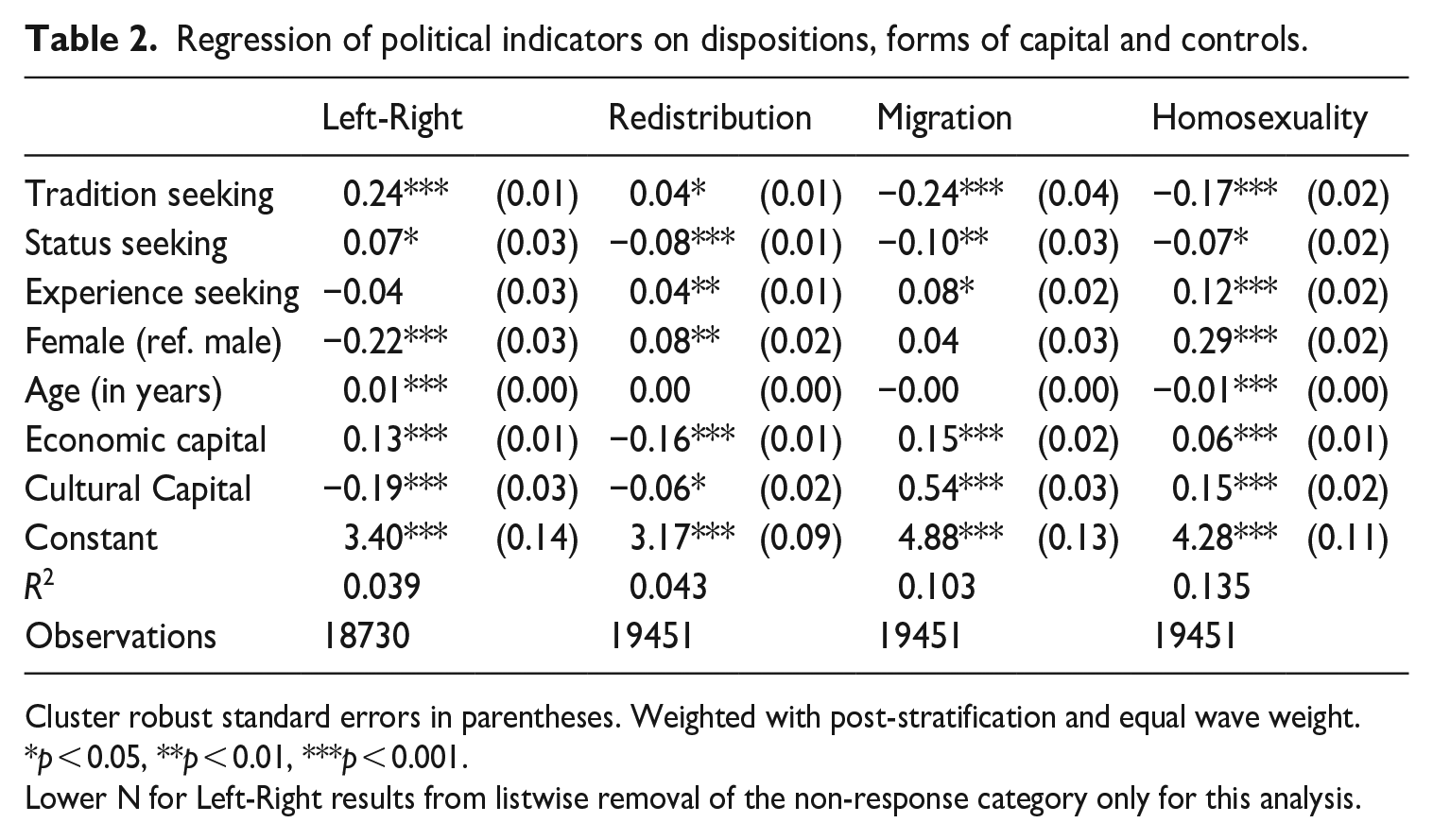
Cluster robust standard errors in parentheses. Weighted with post-stratification and equal wave weight. *p < 0.05, **p < 0.01, ***p < 0.001.
Lower N for Left-Right results from listwise removal of the non-response category only for this analysis.
Instead of representing the moderation effects in detail in non-linear models, the class fractions from a combination of economic class position and habitus type are used as independent variables in a second step (with the traditional lower-class fraction used as a reference category in all models, see Table 3). In the lower economic class, no differences are found in the political self-assessment of SSI and TSI, but the ESI fraction is more left-wing. In contrast, the higher the economic capital, the more (economic) right-wing the traditional groups in particular become. Similarly, agreement to redistribution decreases toward the higher economic classes, especially among the status-oriented fractions. On the cultural issues of migration and homosexuality, attitudes tend to become more liberal toward the higher economic classes, but they remain horizontally differentiated from tradition to status to the experience oriented.
Regression of political indicators on class fractions, forms of capital, and controls.
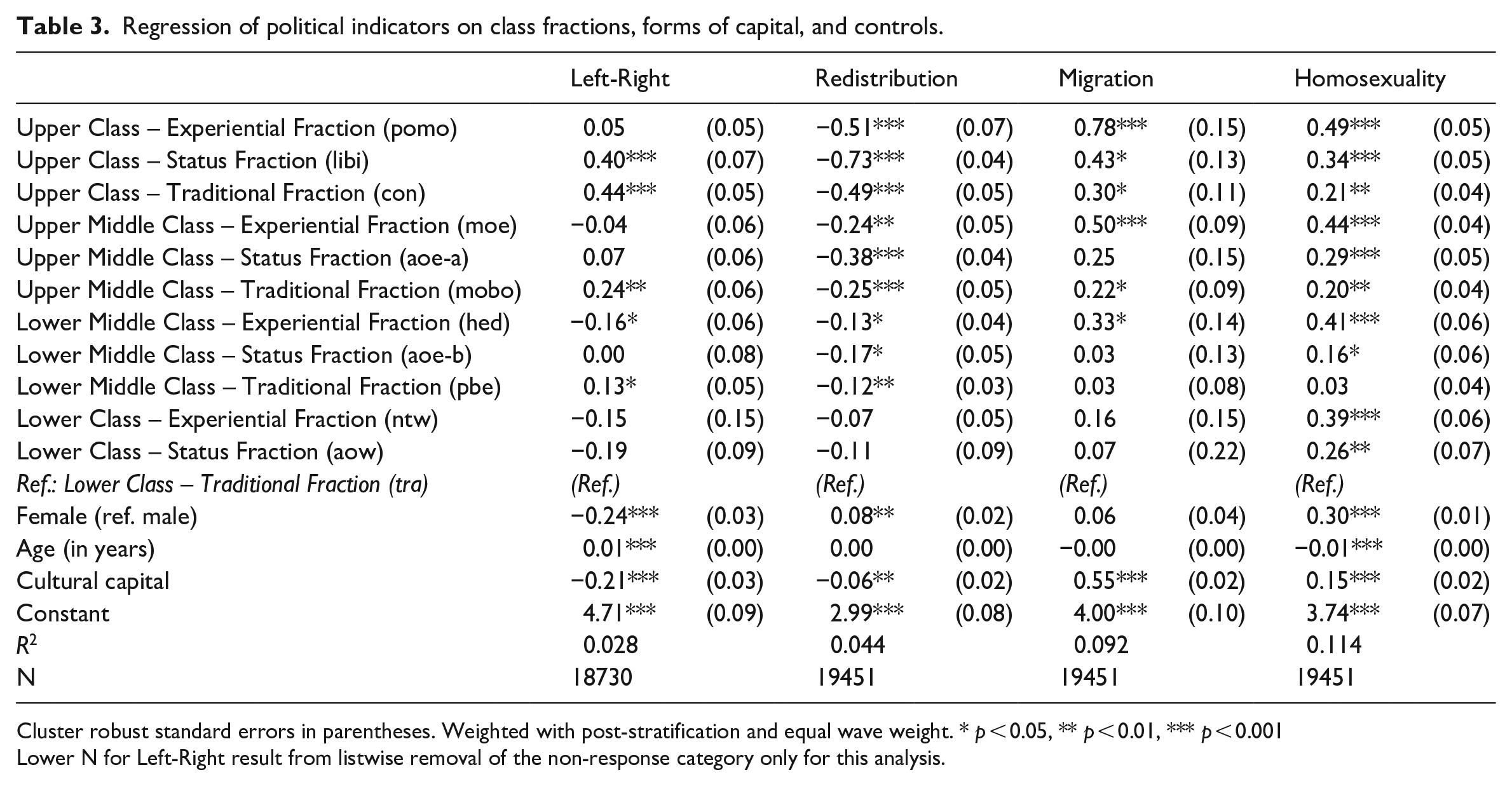
Cluster robust standard errors in parentheses. Weighted with post-stratification and equal wave weight. * p < 0.05, ** p < 0.01, *** p < 0.001
Lower N for Left-Right result from listwise removal of the non-response category only for this analysis.
This complex configuration becomes more intuitive and meaningful for interpretation when illustrated not only as marginal effects in multiple regression analysis, but in graphical common representation of all variables in MCA: a socio-political space.
MCA: Socio-political space, occupational classes, and class fractions
Figure 5 illustrates the socio-political space of German society pooled for the period 2002–2018. The class fractions, occupational classes according to Oesch (8-class scheme), cultural capital and political indicators were used as active variables spanning the space of the MCA. For illustration and description, economic capital and the three basic dispositions (both already included in the class fractions) are plotted as passive variables.
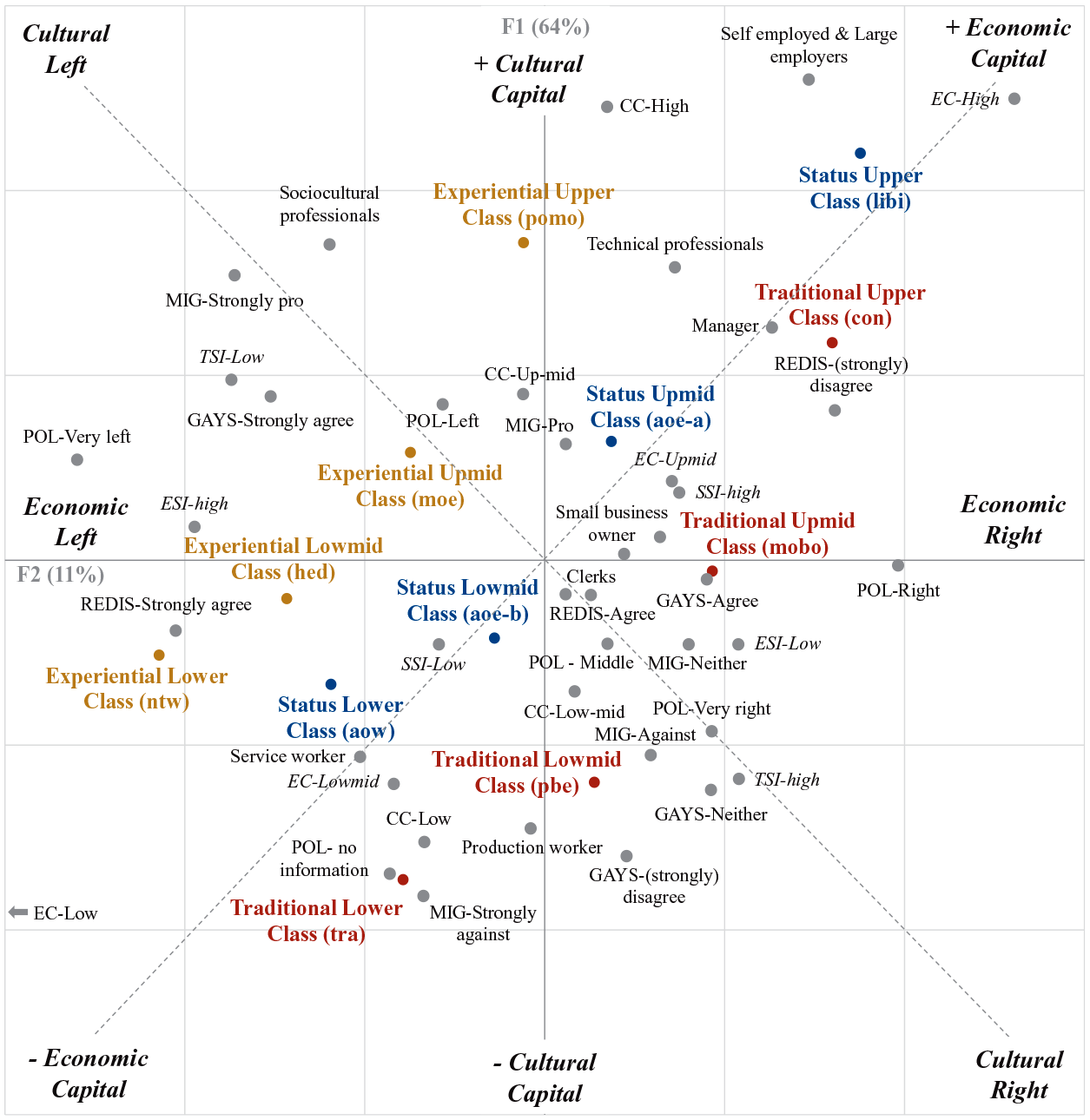
Class fractions in the socio-political space in Germany (2002–2018).
The interpretation is clear and straightforward despite the complex graphical representation and the large number of variables. For a more intuitive interpretation, the axes have been switched so that the vertical axis maps the first dimension with the highest variance explained (mainly cultural capital), and the second dimension, essentially the political-economic left–right divide, is mapped horizontally (see Table OA7, online appendix, for an overview of the dimensional solution). Therefore, ‘up’ in space can be interpreted as up in the social ladder (high capital volume), and ‘left’ in space tends to be associated with more left-wing political positions. Of course, these modifications do not change the relative positions.
The diagonal antagonisms, shown with auxiliary lines for interpretation, are also revealing. From bottom left to top right runs economic capital, and from bottom to top cultural capital, so that the capital volume in Bourdieu’s sense would run roughly between the vectors of cultural and economic capital. In contrast, the other diagonal runs from the cultural left in the upper left to the cultural right in the lower right – which can be seen particularly in the contrasting attitudes toward migration and homosexuality. The traditional disposition also runs passively along this diagonal, while the experiential orientation, interestingly, runs more along the horizontal economic left-right divide. Status orientation, on the other hand, lies homologous to economic capital (lower left to upper right).
The position of the class fractions basically reproduces the basic consideration by Vester et al. (2001: 46–47) of the milieu’s location in social space. Another of Vester’ assumptions (see Weber-Menges and Vester, 2011) can be confirmed here, namely that the occupational classes, according to Oesch (as indicators for occupational fields), are homologous to milieus (as dispositional) class fractions in the social space.
But the reconstruction of the socio-political space is also informative from Schulze’s perspective. On the one hand, a socio-spatial structuring of experience orientation is revealed. Although the dispositions do not simply follow vertical economic stratification, they are clearly not completely ‘de-verticalized’.
On the other hand, it also shows that Schulze’s underlying modernization theoretical considerations empirically coincide with Vester’s finding that modern German society is undergoing a modernization process in which people strive not only upward in the social space (status seeking) but also to the ‘left’ (toward the modernized cultural pole of the postmodern experience orientation). As was shown descriptively, however, it must not be forgotten that while cultural modernization is pulling toward experience orientation, most of the German population remains quite tradition-oriented in 2018.
Conclusion
This article has reconstructed two prominent milieu theories that stand for a supposedly irreconcilable reception of Bourdieu, has synthesized them on the basis of recent empirical studies and has linked them to the international debate on cultural class analysis and socio-political spaces. In order to do this, the article has argued that the underlying ideas of the various milieu theories and empirical typologies can be brought together in the operationalization of three basic dispositions: tradition-seeking, status-seeking, and experience-seeking. Regression analyses showed that these dispositions affect political indicators (left-right, attitudes toward redistribution, homosexuality, and migration) and that the effects differ according to economic class. The dispositions were therefore also examined typologically by first grouping prioritized habitus types, which were then grouped into 12 class fractions according to vertical class affiliation.
The advantage of the approach proposed here is that it is transparent and easy to reproduce: The proposed constructs can be used as individual components (e.g. metrically measured dispositions) independently or as aggregated categorical types (habitus types or class fractions). The instrument is efficient, as it allows the integration of the typology with a minimum of only 13 items (and could even be reduced to seven items, using two items per disposition and household income), which facilitates integration into quantitative standardized surveys or even small qualitative projects.
Some limitations of the study should be pointed out, however: The hypothesized correlations could only be tested with political indicators and not with lifestyle indicators, as the ESS does not include such information. From a Bourdieusian perspective, it would be very interesting to examine how the class fractions proposed here are situated in the space of lifestyles. The data would also have allowed international comparisons between countries and comparisons over time; however, it seemed adequate to first examine the procedure using the pooled example of Germany, the country where most of this research tradition originated. In future research, however, it would of course be of great interest to examine the validity of the generalized model in an international comparison as well as the relationship of the class fractions proposed here to other typologies, such as the new classes of Savage et al. (2013) or the lifestyle clusters of Atkinson and Schmitz (2022). A final limitation concerns the sample, which only included respondents with information on income and occupation. This restriction was necessary to be able to form occupational and economic classes. In principle, the construction of habitus dispositions according to the procedure proposed here would of course also be possible for people without information on employment status and economic class and certainly makes sense for other studies.
Irrespective of these limitations, this article has contributed to linking German milieu research to the international debate on cultural classes and changing political spaces. It has been argued that an important part of what has been termed milieus can be operationalized as dispositional class fractions in addition to occupational class fractions. Milieus could therefore be defined much more broadly and relationally as a social environment in the future. From this perspective, it is not specific groups and their characteristics that are the actual focus of this research tradition, but the specific relational configuration of the social space in which classes, class fractions or milieus can be (re)constructed.
Regarding the underlying cultural modernization process and the changing fundamental dispositions in the populations, the next decade will certainly be of great interest for social scientists. Time and new data will show whether the cultural modernization process of basic habitual orientations outlined in this article also applies to other (European and non-European) societies and how they will react to multiple crises of the 21st century. The simplicity of the concept presented here hopefully facilitates to permanently observe and comparison of these processes with very different data and in very different socio-cultural contexts.
Supplemental Material
sj-docx-1-csi-10.1177_00113921251324737 – Supplemental material for Tradition, status, experiences: The cultural modernization of habitual dispositions and class fractions in the socio-political space in Germany 2002–2018
Supplemental material, sj-docx-1-csi-10.1177_00113921251324737 for Tradition, status, experiences: The cultural modernization of habitual dispositions and class fractions in the socio-political space in Germany 2002–2018 by Christian Schneickert in Current Sociology
Footnotes
Appendix 1
Habitus types over time.
| 2002 | 2004 | 2006 | 2008 | 2010 | 2012 | 2014 | 2016 | 2018 | Total | |
|---|---|---|---|---|---|---|---|---|---|---|
| N | 2041 | 1955 | 1962 | 2072 | 2175 | 2354 | 2536 | 2387 | 1969 |
|
| Tradition-seeker | 51% | 52% | 50% | 49% | 54% | 48% | 47% | 47% | 49% |
|
| Status-seeker | 13% | 11% | 13% | 13% | 11% | 12% | 10% | 10% | 9% |
|
| Experience-seeker | 26% | 25% | 26% | 26% | 24% | 28% | 31% | 32% | 32% |
|
| Traditional-status-seeker | 3% | 4% | 4% | 3% | 3% | 3% | 3% | 2% | 2% |
|
| Traditional-experience-seeker | 4% | 5% | 4% | 5% | 4% | 5% | 6% | 6% | 5% |
|
| Experiential-status-seeker | 3% | 3% | 2% | 3% | 3% | 2% | 2% | 2% | 2% |
|
| Mix type (tsi =ssi =esi) | 2% | 1% | 1% | 1% | 1% | 1% | 1% | 1% | 1% |
|
ESS-Germany, Wave 1–9. Weighted with post-stratification weights. Assignment and label based on the relatively dominant prioritization of the three basic orientations.
Acknowledgements
I would like to thank Stephanie Hess, Leonie Steckermeier, Fabrice Westphal, Elina Heutling, and Tobias Rieder, as well as three anonymous reviewers, for their valuable and critical comments on an earlier version of the article. Any remaining flaws remain, of course, my own.
Funding
The author(s) disclosed receipt of the following financial support for the research, authorship, and/or publication of this article: This research was funded by the German Research Foundation (DFG), Project: 465345673, [SCHN 1437/2-1] to Christian Schneickert and [DE 1892/4-1] to Jan Delhey: ‘Rise, Fall or Transformation of the Experience Society? A quantitative-empirical investigation for Germany and Europe’.

Supplemental material
Supplemental material for this article is available online.
Author biography
References
Supplementary Material
Please find the following supplemental material available below.
For Open Access articles published under a Creative Commons License, all supplemental material carries the same license as the article it is associated with.
For non-Open Access articles published, all supplemental material carries a non-exclusive license, and permission requests for re-use of supplemental material or any part of supplemental material shall be sent directly to the copyright owner as specified in the copyright notice associated with the article.
