




Abstract
I introduce the concept of transactional pathways, coined by anthropologist Jane Guyer, to trace the institutional processes that contribute to uneven and unjust patterns of wealth and status distribution under systems of colonialism and racial/caste capitalism. Transactional pathways employ historical perspectives to reveal how divergent economic institutions and sources of valuation relate to social hierarchies. This approach links everyday economic transactions with patterns of wealth accumulation that are based not only on class, but intersectional social groups including race, caste, and/or ethnicity. Transactional pathways account for the fact that not only do different groups receive different amounts of valuable resources because of uneven distribution, but they have variable access to the symbolic power required to define which resources are deemed valuable in the first place and to monopolize them accordingly. The article briefly surveys foundational concepts from the economic anthropology literature before detailing transactional pathways. It introduces the case of attempted formalization of waste collection and recycling in Delhi, India, using the related concepts of thresholds and conversions to analyze key moments when wealth and status accumulation becomes especially possible in institutionally plural contexts.
If economic life creates social divides, and social divides in turn shape economic institutions, through what patterns and processes do these unfold? How do these coalesce as institutions that afford or deny wealth for particular groups under conditions of racial/caste capitalism? This article calls for a wider inquiry into the processes through which economic institutions cultivate or deprive racialized groups of wealth by attending to transactional pathways of exchanges. 1
Economic sociology offers tools that traverse the macro and micro aspects of economic life, ranging from political economy to studies of market exchange. Yet while early economic sociologists were interested in contexts spanning global empires (Polanyi et al., 1957; Bourdieu, 2000), the new economic sociology ushered in a program overwhelmingly focused on ‘modern’ 2 spaces defined by whiteness, masculinity, and global wealth. As a result, recent critiques point to economic sociology’s overwhelming inattention to questions of race and racism (Hirschman and Garbes, 2021); identify the more foundational problem of narrowly constructing the subfield and omitting research by marginalized scholars (Reyes, 2022); and detail the thoroughly racialized structures of organizations (Ray, 2019). Along with these limitations, economic sociology’s tendency has long been to focus on formal firms and well-capitalized organizations (e.g. Zelizer, 2008), which excludes a majority of actually existing economic life globally and reinforces postcolonial capitalist hegemony (Connell, 2018; Go, 2020). In other words, ‘social thought and its disciplinary arm of sociology have been part and parcel of the imperial episteme’ (Go, 2017: 195). This imperial episteme has shaped economic sociology’s focus, centering majority-white spaces and the ‘markets’ they produce without explicitly acknowledging their social dominance or their relation to uneven and unjust patterns of status and wealth accumulation.
Nevertheless, economic sociology’s emphasis on valuation, relationality, and institutional formation has much to contribute to research and advocacy by better detailing the power dynamics instantiated under racial/caste capitalism. In particular, a large body of critical work has illuminated the institutional and relational processes that generate the value of goods across a variety of settings, from housing to healthcare and the environment (Besbris and Korver-Glenn, 2022; Fourcade, 2011; Lamont, 2012; Livne, 2019). Such analyses stand powerfully alongside work on racial capitalism, which identifies and challenges the devaluing of racially oppressed groups, especially Black communities, through their labor and denial of access to capital (e.g. Clarno, 2017; Levenson and Paret, 2023; White, 2020).
I bring these considerations of value in both goods and social groups together through the case of contestations over waste collection and recycling work in Delhi, India, where the most salient form of racialization is ‘caste’ 3 (Cháirez-Garza et al., 2022; Fuller, 2011; Gupta, 2022; Mosse, 2020; Yengde, 2019). When I began fieldwork on this topic, I expected to find the city’s longstanding lower-caste and Muslim informal recycling economy undergoing mass displacement at the hands of upper-caste controlled formal programs. Recently introduced neoliberal public–private partnership (PPP) programs were attempting to appropriate plastics, papers, and metals from informal recyclers: oppressed-caste laborers who collected garbage and sorted out recyclables to sell up the chain for a living. Marxist frameworks informed academics and activists alike who spoke out against the serious threat of accumulation by dispossession that capital-intensive programs posed (Chaturvedi and Gidwani, 2010; Gidwani, 2013; Harvey, 2004; Samson, 2015; Schindler et al., 2012). Had they been successful, household garbage – a resource in this case – would have been siphoned entirely into incinerators and landfills, feeding corporate profits and allowing the dominant-caste middle- and upper-class groups associated with them to realize gains from business deals, investments, and salaries. However, my fieldwork revealed that while informal recyclers had suffered painful losses, they had nevertheless managed to persist, even with a widespread lack of collective platforms like unions or cooperatives to mobilize. This simultaneously allowed them to maintain their livelihoods and preserve the city’s only facility for recycling. 4
Rather than adhering to narratives of total dispossession or state incompetence to explain this case, the empirical finding of persistence demanded a diachronic approach attentive to genealogy: What were the reasons behind the attempted dispossession, and why had informal recyclers managed to continue working? What had relegated particular communities to informal garbage work in the first place? Why did the government introduce formal PPP programs without accounting for the very informal recyclers who were so likely to impede their success? And what were the relations and institutions that allowed informal recyclers to continue accessing household waste – and especially the recyclable materials they sold for cash – when faced with direct competition from the PPP trucks? Taking up Polanyi’s (1957) call to study ‘the study of the manner in which the economic process is instituted at different times and places’ (p. 250), these questions required analyzing Delhi’s waste collection and recycling economy within its institutional context: a complicated multi-institutional terrain structured by social cleavages – especially caste and class – within India’s system of caste capitalism.
I turn to economic anthropology, and transactional pathways in particular, because it helps to account for institutional multiplicity and social status differences, understanding them to be foundational structures for hierarchical patterns of wealth distribution. It is inadequate to say that ‘caste’ (much like ‘race’) – solidified as a categorical variable – was shaping this slice of economic life, or vice versa, because it reified it into a stable, singular thing. Instead, as debates within the racial capitalism movement underscore, social and economic hierarchies are co-constitutive, their formations and institutions changing over time, even as patterns of domination and exploitation persist (Bledsoe and Wright, 2019; Burden-Stelly, 2020; Clarno and Vally, 2023; Levenson and Paret, 2023; Ralph and Singhal, 2019; Robinson, 2000; Taylor, 2021). Similarly, in the Indian context, caste formation combines with localized structures of domination and subordination to structure economic life.
In this article, I argue that transactional pathways are useful for analyzing institutionalized processes within contemporary systems of racial/caste capitalism. Specifically, transactional pathways combine cultural–relational and political economy approaches from economic sociology to explain how disparate forms of valuation foreclose access to wealth and status, creating hierarchically oppressed groups, while enabling gains for dominant ones. This approach has the potential to help guide economic sociology more deeply into a research agenda that examines how patterns of exchange are produced by, and in turn affect, structures of social domination within racial and caste capitalism. In the rest of this article, I situate the concept of transactional pathways in relation to economic sociology, demonstrating how it advances the literature. I then introduce foundational concepts from economic anthropology before detailing transactional pathways, and especially the thresholds and conversions they contain. Finally, I apply these concepts to my case from Delhi, India, and conclude with thoughts for future research.
Why transactional pathways?
Transactional pathways build on powerful concepts of valuation and exchange in economic sociology, expanding them in new directions by understanding how access to and exclusion from gain creates and reinforces social hierarchies through institutional processes. Much like cultural–relational sociology (e.g. Bandelj, 2012, 2020; Spillman, 2010; Wherry, 2012; Zelizer, 2012), transactional pathways attend to the importance of meaning and culture, proceeding from interactional and ethnographic data to reveal the range of values and meanings shaping patterns of economic life. Cultural–relational sociology offers a rich body of findings demonstrating that disparate forms of meaning, valuation, and classification exist even at the heart of modern capitalist economies – underscoring the universality of hybridized institutions. In this sense, transactional pathways build on the ‘social life of things’ – a processual approach to seeing how economic objects are differently valued and commodified across a series of transactions – but then inverts it, focusing not only on things and the significances they afford across relations, but also the institutional forms and social hierarchies they traverse in the process (Appadurai, 1986; Keane, 2008; Kopytoff, 1986).
In the case considered here, informal recyclers are multiply exploited laborers, and their labor is compelled not by a single employer but instead by multiple actors: recyclable buyers, local sanitation contractors, and middle-class residents who pay for their services. Each of these suggests a distinct institution with its own significances for status, wealth, and hierarchy. Transactional pathways take up this finding, but in addition to focusing on exchanges, which reflect social status structures, they anchor them in patterns of wealth accumulation, which are central to producing social positions in the first place. This addresses the fact that ‘the focus of relational work analysis is the relation and not social status characteristics of parties to the exchange,’ along with the call to account for racial dynamics and ‘other social statuses such as gender, social class, age, religion’ (Bandelj, 2020: 263–264). When status positions such as race, class, ethnicity, or gender are included in economic sociology, they have tended to be analyzed as input variables shaping completed exchanges, rather than as social structures that institutionally engender groups and gatekeep access to wealth in the first place. Cultural–relational sociology provides a strong foundation on which to build, but additional tools are needed to connect particular interactions, meanings, and practices with wider institutional formations that afford and deny access to gains and wealth.
Institutionalist economic sociology that is concerned with social structures (in contrast to the organizational approaches of neoinstitutionalism) draws on the work Pierre Bourdieu, whose analyses of institutions, especially as fields, accounts for the coproduction of economic resources and status as cultural and social capital. The production and distribution of these multiple forms of capital powerfully highlights how social groups are formed and maintained in relation to structures that shape valuation and distribute resources (Bourdieu, 2011). This includes a recognition that educational institutions and high-status taste (cultural capital) intersects with the production of social networks and access to economic capital or wealth. However, Bourdieu’s approach is difficult to employ in contexts that are hybridized and do not cohere as fields per se (Bourdieu, 2005; Eyal, 2012). Moreover, while work in this tradition attends to class in its various forms, inherited forms of social difference like race and caste sit uneasily within the wider Bourdieusian toolkit. Karl Polanyi’s approaches are also useful for understanding institutional transformation (the PPP program I consider here is an exemplary case of how states create markets, for example), but it is his anthropology that offers additional lesser-used tools. A key figure connecting economic anthropology and sociology, Polanyi offers fertile terrain on which to build, taking seriously his call to understand the structures and logics of social hierarchical institutions on which wealth distribution depend.
Transactional pathways make evident the processes through which economic institutions and modes of valuation draw on and reinforce hierarchies of social status, distinction, and identity. Transactional pathways help to explain why some actors, groups, and institutions manage to cultivate power – understood here as an ability to define categories of value that structure group formation-primarily through institutions (Bourdieu, 1977, 1991; Bourdieu and Wacquant, 1992). These economic relations are not only a product of their network ties – which are a mediating force – but rather a result of institutionalized access to and exclusion from sources of status-making and wealth. Through this lens, economic institutions and social hierarchies are produced in tandem through a series of value judgments and scales that shape social rank. In the rest of this article, I introduce transactional pathways by way of earlier concepts from economic anthropology, including the gift and spheres of exchange, before offering an example from my fieldwork on informal recycling economies in India.
What are transactional pathways?
Economic anthropologists have long studied sites where capitalist relations and institutions, including economic sociology’s object of ‘markets’, are created – often violently – through direct colonization and the proliferation of global capitalist institutions. These contexts are theoretically productive because they reveal processes through which forms of valuation and institutions relate to distinct, and often conflicting, social groups. The conceptual toolkit of transactional pathways, coined and conceptualized by Jane Guyer (2004), is based on several decades of fieldwork in Nigeria. Transactional pathways helpfully amalgamate foundational concepts in economic anthropology to illuminate the processes through which economic transactions cohere into institutions traversing ‘formal’ and ‘informal’, ‘traditional’ and ‘modern’, and generate differentiated social status positions that shape access to wealth. Transactional pathways include a diverse range of institutions and trace the possibilities and limits through which ordinary exchanges reveal the valuation processes underlying economic and social-status gains – understanding the two to be intimately linked. In order to understand the concept of transactional pathways, I first introduce key foundations from economic anthropology.
Foundations: The gift and spheres of exchange
Transactions are a useful building block highlighting the everyday practice of participating in economic life across a range of social relations and institutional contexts. The micro-interactional level helps to account for contingency and potential transformation because ‘a transaction is a moment when correspondences are agreed upon’ (Guyer, 2004: 172). Transactions can be intimate or anonymous; short- or long-term; include any mix of currency, goods, and/or services; and involve asymmetrical social positions – but no matter the terms or actors involved, a transaction renders them decided. We consider transactions here in order to become familiar with the conceptual and micro-sociological foundations of transactional pathways.
Marcel Mauss’s Essai sur le don, published in French in 1925 and translated into English as The Gift in 1954, is a foundational analysis of transactions. In The Gift, Mauss developed a theory of the ‘total social systems’ that make social groups cohere and focused on the particular transactional forms and institutions that generate positions and confer social status. Mauss’s approach was fundamentally comparative. Drawing on secondhand research such as Malinowski (1984), he analyzed indigenous institutions for their ‘general sociological value’ because ‘our own systems of law and economies have emerged from institutions similar to those we describe’ (Mauss, 1990: 47). Gift exchange considered transactions to be integral to community structures and relationships, rather than cleaving them off into separate ‘economic’ and ‘social’ spheres. Social status and access to resources are therefore correlated beyond, and before, the modernist labor category of ‘class.’ As such, transactions can include anything from food to currency and arranged marriages, associating economic with social reproduction. While Mauss’s approach has since then been reified at times as ‘gift theory’ and problematically contrasted with capitalist commodification as generosity or ‘altruism’ (Parry and Bloch, 1989: 9), Mauss (1990) was clearly interested in what he called a ‘general theory of obligation’ structured by power (p. 12). In particular, the obligation to give derived from a social obligation to be generous, which was not a trait, but rather a relation that could be used to cultivate status. Patterns of exchange meant that once a social tie was established, trade partners could make requests, making the institutionalization of status central to exchange relations in which gains were possible. Mauss’s task was to trace how social power and forms of social difference were generated and sustained through patterns of transactional life. As another anchor text in economic anthropology later distilled, this engenders two distinct scales: ‘short-term exchange which is the legitimate domain of individual – often acquisitive – activity, and a cycle of long-term exchanges concerned with the reproduction of the social and cosmic order’ (Parry and Bloch, 1989: 2).
Identifying short- and long-term transactions connects patterns of giving and receiving with the reproduction of social groups and hierarchies through ‘spheres of exchange’ (e.g. Bohannan, 1955; Guyer, 2004; Sillitoe, 2006). Spheres of exchange is a structuralist concept that captures which things are understood as exchangeable within a particular social context and groups them into analytically distinct categories that signify moral boundaries and patterns of social status and difference. In the foundational piece that laid out the concept among a Tiv community in central Nigeria, anthropologist Paul Bohannan (1955) argued that there were three distinct spheres within the local market: (1) subsistence, (2) prestige, and (3) kinship (see Figure 1). Each of these contained different objects and were arranged according to how they were valued: locally grown foods like yams and chickens along with household utensils and tools were in the lowest category; things needed to produce subsistence goods like brass rods, cattle, and locally woven cloth were in the second; and marriage arrangments were in the third. He referred to transactions within each sphere as conveyances and described them as relatively insignificant features of everyday social life that allowed for subsistence. Exchanges between spheres were more significant, however, offering the possibility of long-term investment and potential gain. Labeled conversions, these traversed thresholds of valuation across which social status and wealth could be acquired, for example, when cattle were exchanged for marriage. However, since only some people and groups had access to higher status goods, leaders could corner these relations and institutions to prevent others from rivaling their status.
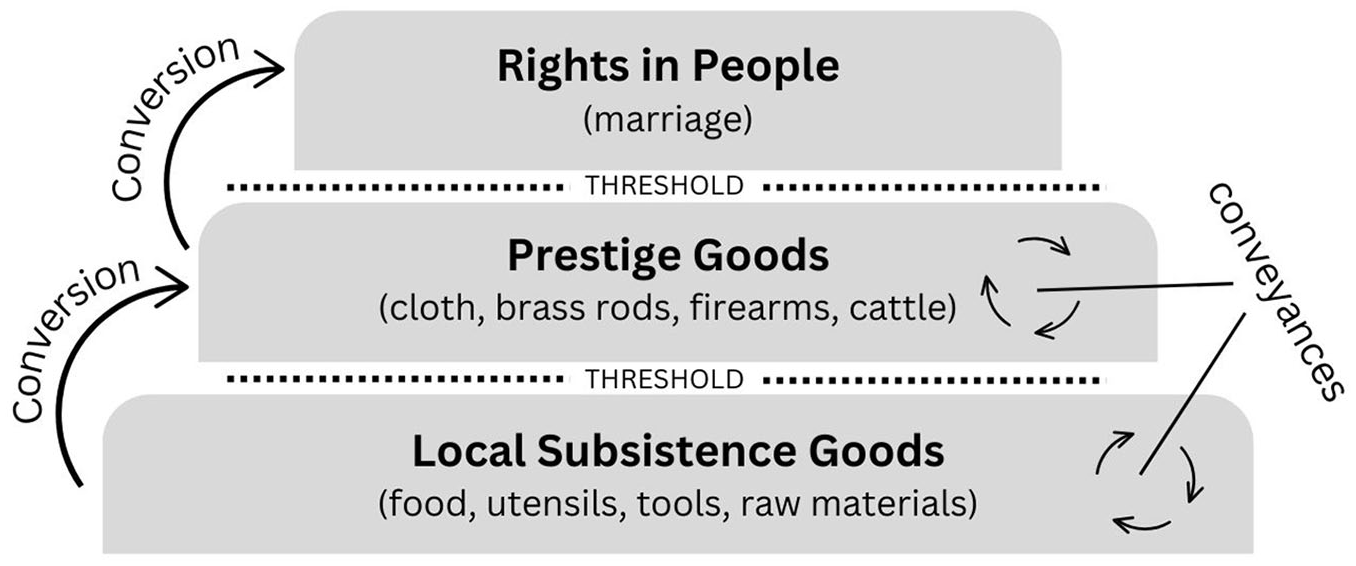
Bohannan’s structural model of Tiv exchange.
Importantly, Bohannan was not only interested in the precolonial indigenous Tiv economy. Rather, it was the introduction of capitalism through imperial power that complicated these analytically neat ‘spheres’ by creating a quasi-fourth sphere consisting of currency. Currency was forced onto the Tiv by the colonial British government, which required that taxes be paid with money instead of agricultural yields and enforced laws banning marriage exchanges in order to discipline the population into imperial compliance with the demands of capital. This meant that instead of women being traded between families as wives, brideprices were paid in cash, obscuring the substantive origins of these transactions and introducing logics of commensuration. With imperial rule, Western capitalism also brought new goods and created distinct transactional spheres, with money holding out the promise of crossing between them. The idea of spheres of exchange was important for schematizing how differentiated social ties could become bundled along with particular transactional materials, institutions, and values, as well as how currency promised to flatten these by making everything subject to exchange. Currency, in other words, created an illusion of ‘formalism’ that disguised an actually existing substantive relationship through which goods and social positions were valued (Polanyi, 1957, 1974).
Transactional pathways
Having introduced these foundational concepts, it becomes possible to lay out the conceptual apparatus of Guyer’s (2004) transactional pathways. A key question that Guyer’s concept addresses is: How can we trace connections between short-term transactions and long-term patterns of social reproduction in order to identify key moments when shifts in status become possible or limited over time? Transactional pathways mobilize spheres of exchange in order to trace ‘the historical constitution of conversions and wealth creation, under turbulent conditions’ (Guyer, 2004: 30). Moving away from structuralist ontologies of social wholes, and from epistemological assumptions of equivalence, transactional pathways draw on rich ethnographic evidence but then break its meanings open, out of rigid binaries and simplistic totalities, to capture their messy complex realities.
Guyer unhinges Bohannan’s original model by adding in the regional trading networks that facilitated exchanges between his original three categories. Doing this opens up the stratified layer cake to produce a process, revealing ‘not barriers but institutions that facilitated asymmetrical exchanges across value registers’ (Guyer, 2004: 28). By including regional trading circuits, Guyer’s modified conceptualization of Tiv transactional life expands it geographically (across regions), socially (between social groups), and temporally, showing how these facilitate moments of potential conversion when status gains can be realized (Figure 2). Guyer’s model acknowledges that it is not the things themselves, but rather how they move across distinct social groups and institutions, that affords access to gains and social status. Put concretely in terms of the Tiv case, brass rods could only be exchanged with traders to the south, who wanted them and had firearms to offer in return, while cattle were sent northward in order to secure favorable marriage arrangements. The question that these models raise is: Which pathways are available or foreclosed for diverse social groups to accumulate value and status by accessing and defending the value of particular goods?
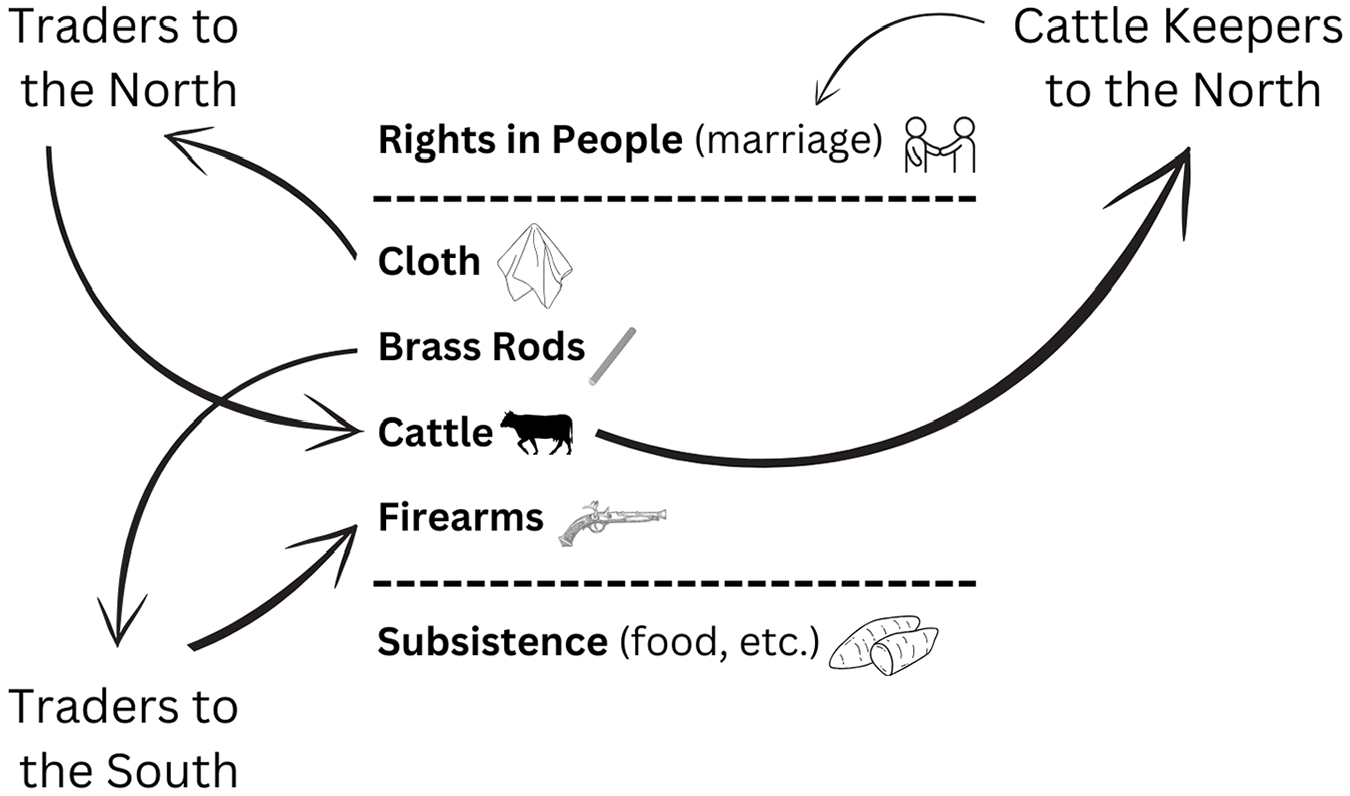
This was created by the author based on Guyer 2004: 31 revised model of Tiv exchange, adding in regional transactional pathways.
Now dynamic and multi-institutional, transactional pathways can be defined as ‘an open set of directional transactions that work stepwise toward the constitution of stores of value that had greater longevity and security than the currencies themselves’ (Guyer, 2004: 30). Guyer notes that these pathways allow for what Bourdieu (1977: 195) referred to as ‘social alchemy’, or the ‘endless reconversion of economic capital into symbolic capital’, as transactions mediate access to capital that can bring prestige and gain (Guyer, 2004: 30). Transactional pathways offer a wide-ranging perspective on the ways that multiple institutions relate, shaping social status and life chances. They capture the ‘moving flow across a multiplicity of spatio-hierarchical thresholds, each offering – as long as the system was constantly growing and changing – the possibility of gain’ (Guyer, 2004: 38). Linking cultural and political–economic approaches, transactional pathways include the importance of historical change, drawing from the strengths of political economy, while identifying the particular institutions and ‘changing matrices of power’ through which they unfold (Guyer, 2004: 20).
Let’s break this down. At the heart of transactional pathways is ultimately a concern with processes of valuation. Guyer contextualizes the approach with an illuminating discussion of scales of value – a term that captures the fact that the construction of value is organized according to diverse numeric logics. For example, structuralist approaches take a nominal or classificatory approach, identifying distinct values and situating them in relation to one another in binary fashion (i.e. pure vs. polluted), while ordinal epistemologies proceed according to scales (i.e. greater or lesser). Interval constructions include distances between values, while ratio logics operate as if everything were infinitely commensurate, as with standard logics of currency. Ratio scales of value serve the dominant logic that everything is actually commensurate, but economic sociologists have long demonstrated that valuation is structured by cultural processes of earmarking and commensuration (e.g. Espeland and Stevens, 1998; Zelizer, 1989). Ordinal ranks become especially relevant here (Guyer, 2004: 50), as these mark values that afford particular social statuses – for example, the money needed to buy a house in a particular neighborhood or a yacht. Attending to scales of value is an invitation to build on foundations from economic sociology by offering a language through which to compare, for example, hierarchical logics of social rank, ratio processes of calculation and commensuration, and social constructions of price and valuation using ordinal and interval logics under conditions of institutional pluralism.
As in Bohannan’s model, transactional pathways contain thresholds: key sites where scales intersect across institutional disjunctures such as currencies, social groups, laws, states, or regimes of enforcement. These allow for or impede potential gains. Thresholds describe processes of accumulation by dispossession, but rather than flattening the analysis ontologically to include only economic capital, other sources of value and meaning are also accounted for in order to locate the origins of and potential responses to appropriation. Thresholds can be created through innovation, such as introducing or expanding currencies or inventing goods, services, or platforms. It is important that disjunctures between institutions depend on barriers in order create the dissonance required to obtain gains via thresholds in the first place. To make this point, Guyer (2004) offers the case of outdated European guns being used as currency in the Congo in the 1880s, where the ‘unusual complexity of the deal shows clearly how value, meaning, and control are attributed at key conversion points, bringing whole institutional complexes into play’ (p. 44). Colonizers realized that older model guns with outdated firing systems, which were only valuable as scrap in France, were highly desired in the Congo. In order to realize value from these discarded objects, multiple French ministries, the international arms market, auction systems, and various standards collaborated to facilitate their trade. The ability of the imperial French government to mobilize these institutions allowed them to create a threshold through colonial domination that allowed for valuable conversions. Guns that were waste suddenly became lucrative in another context, with gains allowing for subsequent conquest.
Such gains are referred to, just as in Bohannan’s original schematic, as conversions. Conversions do not necessarily rest on equal, or symmetrical, transactions – in fact they usually do not – but actors have varying levels of awareness about the asymmetries, or social inequities, involved (p. 40). Following Guyer’s guns example, while each side benefited in terms of material and status advancement, the imperial context made the transaction wildly asymmetrical, allowing for only minor gains among the Congolese. Resting on distinct forms of valuation, then, transactions are thus rooted in disparate social positions that shape their possibilities for gain.
Caste capitalism: the case of informal recycling in Delhi
Transactional pathways, and especially the social sources for the thresholds and conversions that comprise them, allow economic sociologists to locate key processes that produce social differences through economic institutions. Guyer’s toolkit was especially useful when I was trying to make sense of how social positions based on caste structured Delhi’s informal recycling economy in the face of threats from corporate programs. Indeed, as Guyer (2004) writes in the book’s final chapter, ‘Formalization is the modern state’s counterpart to conversion’ (p. 155), and the formalization of garbage collection and recycling in Delhi was an attempt by dominant-caste groups to realize gains via the state. Using state power in its PPP form was a strategy for siphoning valuable recyclables away from the city’s longstanding lower-caste informal waste collection workforce and redirecting them to newly constructed incinerators that would burn them instead, creating managerial professions and corporate profits for predominantly upper-caste actors (Kornberg, 2019).
Using transactional pathways addresses the challenge of critiquing unproductive binaries like formal/informal and traditional/modern by instead forgrounding contexts of institutional pluralism. While I use informal/formal as empirical descriptions for an institution’s primary relationship to state power, following recyclable materials reveals that they in fact traverse institutional forms. In fact, local Delhi residents tended to see the ‘informal’ collection system as the rightful and legitimate one because it had operated for so long, which underscored the uneasy relationship between the language of informality and that of ordinary economic life. Moreover, my research found that many formal PPP truck drivers were selling garbage back to informal recyclers under the table for cash, creating a new transactional pathway. Truck drivers and other ground-level PPP workers were themselves often informal workers from other areas who were hired by labor contractors. Tracing these pathways allows for an analysis that exceeds the constrictions of particular institutional forms, remaining faithful to the blurred lines of formality and informality in practice.
This was also true for the corollary categories of ‘traditional’ and ‘modern’, which, even when unspoken, continue to haunt economic sociology’s dominant episteme. Labeling the informal system ‘traditional’ does not make sense because, not only was tradition invented as critical theorists like Eric Hobsbawm and others have long demonstrated, but the current recycling economy only exists because of capitalist industry, which proliferates disposable packaging and products. Moreover, while the informal economy was based on casted forms of labor, with oppressed-caste Dalit (formerly ‘Untouchable’) groups claiming access to neighborhood territories through their community ties and lineages, even those hierarchies had shifted in recent years. Newer migrants – many of them from Muslim communities in regions across eastern India – have begun working as subcontractors and doing the manual collection and sorting themselves, leading to subtle shifts in experiences of caste domination (Kornberg, 2019). This context makes apparent that even the most ‘modern’ economic institutions and forms of social difference are grafted onto those that came before them, much as Mauss observed and Polanyi advised attending to. This is especially true within systems of global capitalism, requiring a lens that can capture institutional dynamism and shifting structures of social hierarchy.
Transactional pathways allowed me to identify the valuation regimes and social hierarchies underpinning the institutions that posed a threat to informal recyclers, on one hand, and through which they have managed to persist, on the other. This goes beyond assessments of waste as a set of neutral materials that gain or lose monetary value through commodity processes of disposal and accumulation, to understanding how waste’s wider cultural significances influence valuation (e.g. Reno, 2015). The concept of thresholds, points created between institutions across which transactions can bring significant gains, proved especially useful. When the formal PPP programs were introduced, they relied on state authority and private upper-caste capital to purchase large trucks and build incinerators, in an attempt to dispossess the informal low-caste workforce and realize significant gains.
Had their programs proven successful, the PPPs and their cadre of dominant-caste officials and managers would have benefited from lucrative conversions. No longer the stigmatizing material relegated to oppressed-caste collectors and recyclers, under the management and machinery of dominant-caste actors (but certainly not in their hands), waste became something that could accumulate into wealth. Not only did they wield the capital required to purchase large machinery and enact programs via state institutions, but they also leveraged global flows of capital from international companies and organizations including the UNFCCC (United Nations Framework Convention on Climate Change), which provided carbon credits for ‘waste-to-energy’ incineration plants. These points of leverage also brought valuable forms of cultural significance by allowing PPP programs to claim the modern, scientific, and environmental, describing informal recyclers as ‘ragpickers’ – a 19th-century British term that labels them as archaic and unsanitary. Within the PPP institutions (private solid waste companies and various government bodies), garbage was revalued using ratio logics that quantified it into its weight, volume, and capacity to burn. This replaced its previous valuation as an ordinal series of objects (with key tropic points that determine saleable value according to material type), which informal recyclers contend with; for example, each type of paper has its own rate, rates vary by buyer, and copper is more valuable than paper. Disjunctures between these two economic systems, which are based on distinct forms of social difference and scales of valuation, engender oppression but also allow dominant-caste groups to exploit them for potentially significant conversions and wealth.
Yet, these approaches that drew from the corporate playbook in treating garbage like any other commodity did not allow the PPP program to adequately serve Delhi’s middle-class predominantly upper-caste residents. These residents expect to be able to purge household waste quickly (a municipal engineer described this as ‘If they eat at two o’clock, they throw it away at two o’clock. If they eat at eight o’clock, they throw at eight o’clock’ 5 ). Such expectations are informed by casteist concepts of pollution that correlate discards with social status through logics of untouchability. In other words, it is not only the fact that garbage must be agglomerated at a large scale in order for its contents to accrue market value, but upper-caste demands for service have led them to continue patronizing informal recyclers because their dependency makes them more reliable, servile, and available for cleaning. As a result, oppressed-caste groups earn money from collection and selling the recyclables, providing for their subsistence across a threshold where waste moves from having negative to a marginal, if positive, monetary value. These transactions are structured by distinct social positions, which entail situated valuation assessments. Historical oppression has stripped lower-caste groups of multiple forms of capital, making waste work their best, or even only, option for earning a living. Upper-caste groups, in contrast, consider garbage to be highly polluting. This positions them as requiring the cultural and economic labor of others, but also allows them to simultaneously promote the brutal casteist stigma of untouchability, which reinforces their domination by gatekeeping access to institutions that might disrupt this arrangement. It is only because of the willingness of middle-class, dominant-caste households to hand over their waste materials – and the existence of a working poor, oppressed-caste population willing to collect, sort, and sell the recyclables for money – that the informal recycling economy has secured its jurisdiction and managed to persist.
The threshold between the PPP program and the informal recycling economy has not successfully converted waste materials into being valued as ‘solid waste’ or ‘fuel’ in order to create significant gains for upper-caste controlled companies, because residents have opted to continue paying extra to patronize informal workers. This has preserved a majority of the informal economy’s existing jurisdiction, which has allowed for informal recyclers’ subsistence needs. These earnings can, in turn, become smaller conversions that are possible at the threshold between urban and rural economic life. Some informal recyclers have taken the small gains they earned from selling recyclables in Delhi to their home villages to purchase land or upgrade their existing homes with more durable materials. These forms of wealth accumulation can in turn be converted into potentially more favorable marriages for their children. While some have been able to improve their status in their familial villages over the years, such gains are severely limited due to the historic denial of wealth and high-status goods such as land and education, which continue to determine future transactional possibilities. Gains may accrue, but they remain relatively small for dominated groups because of their limited access to those institutions, goods, and the status advances they might afford. All of this is structured by wider historical systems of status, power, and oppression.
In sum, the PPP program introduced a new institution that drew on capital and state power to introduce logics of agglomeration, standardization, and mechanization that involved ratio logics of currency. These all depended on upper-caste dominated institutions legitimized by state authority to create a threshold through which to attempt to dispossess the existing informal recycling economy. In addition to the limitations of this program, and despite not having a robust organized social movement, the informal economy has overwhelmingly managed to persist because it has its own durable institutions that provide both structure and cohesion but also offer flexibility. Rather than becoming passe or atavistic when new situations present themselves – whether that be new materials like Styrofoam or new programs like the PPP trucks – they adapt. Indeed, the very fact that there an informal economy for plastics and other disposable commodities demonstrates the responsiveness of these institutions. When plastic became widespread, disposal systems and waste workers who had dealt only with organics (i.e. human and kitchen waste) learned how to recognize, sort, sell, and recycle dozens of distinct kinds of plastics. This required existing forms of organization through which knowledge could be shared and a division of labor established in order to forge an entirely new industry. Flexibility allows the informal economy to adapt to new contexts of valuation in order to remain relevant.
Future research possibilities
This article has argued that transactional pathways build on the economic sociology literature by (1) offering a processual and relational approach that links valuation with institutional formation; (2) centering power, oppression, and status in its various forms, intertwining access to gains with group formation and patterns of social difference; and (3) accounting for variation in how plural institutional forms relate to state power. Using this approach, economic life becomes central for understanding social hierarchies, such as under racial/caste capitalism, rather than conceptualizing hierarchical differences as exogenous independent variables that impinge on it. It also helps to overcome problematic binaries (e.g. modern/traditional, west/rest, formal/informal) to produce a more even ontological terrain through which actual processes of colonialism, access to wealth, laws, and regulation can be deciphered in institutionally plural contexts. And finally, it brings in political economy, grounding economic life in specific set of relations and institutions that are structured, more or less, according to profit and status driven priorities.
I have argued here that economic anthropology offers productive tools to think with for contexts of racial/caste capitalism, since so much of that subfield has been focused on sites of colonization and its aftermath where multiple institutional forms and social hierarchies are legible. However, these historical contexts are not unique or outmoded; instead, they can usefully reveal how durable patterns of group formation persist through economies and organizations with their own institutional genealogies. This is true even at the very heart of wealthy ‘modern’ capitalist settler nations like the United States, where they are nevertheless likely to be obscured by currencies and organizations that quietly proselytize commensuration and equity, despite actually existing inequities that cleave along racial and ethnic lines. Transactional pathways are built on the rich existing traditions of cultural and institutional economic sociology, offering an integrative conceptual toolkit that promises to bridge many aspects of this multidimensional literature while attending to power in its various forms across the full range of economic institutions. Using transactional pathways as an organizing concept can help to invigorate economic sociology by stitching together the processes through which particular social institutions create groups and engender durable social cleavages, demonstrating that these are not a byproduct or set of input variables, but are instead part and parcel of what economic systems are. It is not enough to say that economies are racialized or otherwise stratified by status; rather, these processes are co-constituted by short- and long-term transactional patterns that engender institutions.
A wide range of research questions can be asked, but some to conclude with are: Through what processes do dominant social groups build and protect economic institutions that promote durable social hierarchies? What kinds of valuation disjunctures contribute to the formation and maintenance of these economic institutions across contexts? Where, when, and why do significant conversions become possible through institutional thresholds? How do these institutions generate, draw on, and/or reproduce social hierarchies that enable or limit group opportunities for attaining resources and status over time? How might those processes be subverted or resisted? And which authors and texts should be brought in to build a research agenda focused on the intersections of economic life and social hierarchy, especially within diverse global contexts of racial and caste capitalism? Following transactional pathways, I suggest, offers a powerful way to trace these processes and the social hierarchies they buttress in order to understand and disrupt them.
Footnotes
Funding
The author received no financial support for the research, authorship, and/or publication of this article.
