




Abstract
This article traces the mainstreaming of the idea that there is a ‘free speech crisis’ in the United Kingdom, from its emergence in the 2010s to the Free Speech Act of 2023. We argue that ‘free speech’ is initially constructed during this period in opposition to an imagined ‘uncivilised’, ‘external’ Muslim other. However, by the end of the 2010s, the threat to ‘free speech’ is imagined as much more widespread, and as coming from ‘inside the West’, where a new enemy is identified alongside the ‘uncivilised Muslim’: the ‘woke’, censorious ‘snowflake’. This new enemy of free speech is cast in populist terms: as part of an illegitimate elite or proto-elite. This discursive shift occurs, on our account, because the rhetoric of a ‘free speech crisis’ paradoxically becomes an increasingly powerful way for right-wing political actors to deny political legitimacy to those opposed to their political positions. By locating those opposed to them as against the incontrovertible Western Enlightenment good of ‘free speech’ itself, these right-wing actors racialise the speech of others as ‘uncivilised’ and therefore outside of politics in a way that silences critique.
Introduction
It is hard to avoid hearing that the United Kingdom, alongside other countries, has a ‘free speech crisis’. Indeed, countless journalists, think tanks and civil society organisations have been increasingly dedicated to asserting this is the case (see Riley, 2020). In this article, we trace the construction and mainstreaming of this ‘crisis’ in the United Kingdom. Ultimately, we argue the emergence of this ‘crisis’ speaks less to an objective erosion of free speech, and more to the fact that the use of the ‘free speech crisis’ discourse paradoxically enables a variety of right-wing political actors to grant legitimacy to some political speech while denying this legitimacy to other political speech. This is achieved primarily through the racialisation of speech. Speech that seeks to challenge White heteropatriarchy comes to be positioned as irrational, illiberal and lacking an essential ‘Europeanness’ (Hesse, 2007) and is therefore denied legitimacy. Meanwhile, speech that upholds the White heteropatriarchy is construed as ‘free speech’ and given the legitimating features of rational, liberal ‘Europeanness’ (see also Leigh, 2022, 2023). Critiques of status quo politics are therefore delegitimized, since they are positioned not as valid speech, but rather as transgressions against a sacralised notion of rational, civilised debate enshrined in the idea of ‘free speech’.
In this article, we are not seeking to make normative claims about free speech issues, or to adjudicate who should/should not have ‘free speech’. We are also not analysing free speech as a practice, or discussing its regulation. Rather, we trace the mainstreaming of discourse(s) that mobilise the idea of free speech for political purposes. In doing so, we contribute to the emerging literature on mainstreaming, as well as to literature specifically concerned with the construction of the ‘free speech crisis’. Although our focus is on the United Kingdom in the 21st century, we note that many other contexts are experiencing a similar phenomenon. This is also not the first time a ‘free speech crisis’ has been formulated in the United Kingdom (see Smith, 2020). Therefore, while our scope is limited, we hope our analysis is useful in thinking about both related instantiations of this issue in other locations, and past and possible future UK ‘free speech crises’. In particular, the intersection of the United Kingdom’s ‘free speech crisis’ with the politics of Brexit is a useful case study in seeing how populist and racialised/racialising discourses can be enmeshed within ostensibly neutral calls for ‘free speech’, something we hope future analysts of other diverse ‘free speech crises’ will find benefit in drawing on.
Below, we trace four distinct phases in the mainstreaming of the current ‘free speech’ discourse. Phase 1 (2010–2015) sees ‘free speech’ positioned in opposition to a constructed threat of Islamic extremism. This discourse crystallises around the 2015 Charlie Hebdo attacks which, while occurring in France, have a profound impact on UK politics. Phase 2 (2015) centres on the retooling of this free speech discourse, from a focus on ‘the enemy without’ to ‘the enemy within’. Here, the ‘free speech debate’ begins to resemble its current form, with a populist-style dichotomy being drawn that will become fully fledged during the Brexit campaign. This new dichotomy works to position the speech of a new ‘woke’ enemy in opposition to ‘free speech’ and therefore as external to the sphere of political legitimacy. This happens in large part because the new ‘woke’ figure is attempting to demand legitimacy for ‘othered’ figures such as the Muslim. Phase 3 (2016–2020) sees think tanks, mainstream media and government beginning to involve themselves in the construction of this discourse. Here, the politics of Brexit become more clearly tied into the free speech debate. Issues that animate much of the Brexit movement, including imperial nostalgia and white anxiety, start being folded into commentary ostensibly focused on the liberal ideal of ‘free speech’. Finally, Phase 4 (2020–2023) sees a mainstreaming of the discourse, with an explosion of media coverage, think tank reports, civil society organisations and, ultimately, the Conservative government advancing its Higher Education (Freedom of Speech) Act. This Act is the culmination of a concerted political effort to shore up a defence of right-wing political positions by associating them with ‘free speech’, and to deny the legitimacy of those who seek to challenge the hegemony of such positions.
Understanding the political context: populism, free speech, and the ‘uncivilised’
We situate our argument within two broader political contexts. The first is populism and its particular manifestation vis-à-vis Brexit. The second is the longer running tradition of free speech advocacy in the United Kingdom, with a focus on, as Leigh (2022, 2023) has argued, how such advocacy has worked as a defence of political legitimacy for some while simultaneously denying this to those deemed ‘other’.
First, populism. Populism is an affect-laden political logic driven by a divide constructed between ‘the people’ and ‘the elites’ (Müller, 2017; Norris and Inglehart, 2019). This divide is often animated by the interrelation between affective crisis narratives and fantasy narratives (Kinnvall and Svensson, 2022), which address a sense of anxiety and ontological insecurity. In the crisis narrative, the ontological security of the group positioned as ‘the people’ has been disrupted and the resulting affective register is insecurity and fear. The fantasy narrative then offers ‘an imagined secure future . . . that can relieve [the people] from their present predicament’ (Kinnvall, 2018: 529) and creates a different affective register imbued with emotions such as pride, safety and security. This narrative is often restorationist, locating the solution to the crisis in a past golden age which offers ‘predictability, order and definite conclusions’ (Homolar and Scholz, 2019: 357).
In the United Kingdom, the most electorally successful populists – those on the right – have tended to promote a sense of White anxiety about demographic and broader political changes (the crisis), offering a comforting, nostalgic vision of the imperial-past-as-golden-age in response to this, thereby evoking what Gilroy (2004) terms ‘postcolonial melancholia’. This manifested most clearly in the Brexit movement (Browning, 2019), with a hazy vision of the imperial past becoming a guide to future action (Bhambra, 2017; Browning, 2019; Virdee and McGeever, 2018). As many have argued, Brexit, therefore, became less about European Union (EU) membership and more about having a nostalgia-laden ‘empty signifier – a signifier lacking specific meaning but which comes to stand in for and unify other (potentially contradictory) claims’ (Browning, 2019: 232) that could speak to ostensible ‘crises’ in the present. These other claims, acting as fantasy narratives rooted in visions of the past, were various – from ending or curtailing (both EU and non-EU) immigration and thereby creating a more culturally and ethnically homogeneous (i.e. whiter) nation, to fixing a sense of economic stagnation – but are united by the way they sought to offer a sense of security and stability to ‘the people’.
Second, we must also understand something of the history of the ideal of ‘free speech’. Contemporary understandings of free speech have their roots in the Western European Enlightenment. Rather than defending the imposition of religion or government by those already in power, enlightenment philosophers valued rational debate and individual consent as the way to determine one’s beliefs and the organisation of society (Schouls, 2018). Such ideas were expanded upon by 19th-century liberal philosophers like Mill, who saw rational debate and the use of reason as ‘the positive motor of progress for liberal states and societies’ (Leigh, 2022: 9).
However, it is crucial to understand how these arguments for ‘free speech’ were intimately intertwined with defences of colonialism (Leigh, 2022, 2023) For Mill, for instance, indigenous or other colonised peoples could legitimately have their free speech restricted by colonists; their purported irrationality and ‘backward’ nature meant that ‘despotism [was] a legitimate mode of government’ in dealing with them (Mill and Elizabeth, 1859: 9–10 in Leigh, 2022: 9). Inherent within arguments of figures like Mill for free speech is therefore a line between the ‘civilised’ speaker, who deserves ‘free speech’, and the ‘uncivilised’, ‘savage’ speaker, who ought to be denied a space in public debate. Liberal arguments for free speech have thus historically been paradoxically intertwined with arguments for restricting free speech.
In Leigh’s (2023) terms, the hierarchisation inherent in this free speech advocacy pits a ‘civilised’, ‘European’, ‘white’ speaker against a ‘blackened’, ‘non-European’, ‘uncivilised’ ‘other’. We can understand this hierarchisation associated with free speech as a form of racialisation, the process of dividing humans and their speech in relational, value-laden categories described as ‘races’. In this process, whiteness is associated with full humanity based on its ability to achieve rationality and civilisation and thus ‘personhood’ in the liberal tradition of the Western European Enlightenment – these racialising characteristics are sometimes referred to as ‘Europeanness’, existing in relation to ‘non-Europeanness’ (Hesse, 2007). Thus, some are racialised as White, persons in the liberal sense, who are able to speak freely and participate in the liberal public sphere. Others are negatively racialised as less-than White and less-than human, which justifies their oppression and removal from the liberal public sphere, and thus, the ability to speak freely. As we shall see, these tropes can also be employed not just to mark people but also their speech. We may see the speech of some who are racialised as White, or are not racialised White but are positioned as having a sufficient degree of ‘Europeanness’, nevertheless being placed on the ‘irrational’ side of the above divide as a way to delegitimise their speech. The implications of this, including how this positions some producers of ‘racially othered speech’ (Leigh, 2022: 3) as redeemable and others as irredeemable, is explored below.
We focus here, as Leigh does, on the historic intertwining of free speech, colonialism and racialisation as we contend it still has profound resonance with contemporary defences of free speech (cf. Titley, 2020). In the context of a populist Brexit movement that is concerned with defending the legitimacy of the White nation and its hegemony against its racialised others, ‘free speech’ is activated as a rallying cry, not to try and include the voices of minoritised political actors (as some ‘free speech’ traditions do), but rather to exclude these voices and maintain White heteropatriarchal hegemony, understood as the hegemony of subjectivities and speech that does not question the hegemony of the White heteropatriarchy.
Mainstreaming and discursive shifts
We draw here on the interrelated concepts of mainstreaming and discursive shift(s), as well as the broader field of Critical Discourse Analysis (CDA). Krzyżanowski (2018, 2020) defines a ‘discursive shift’ as distinct from a ‘discursive change’. While a discursive change involves a macro-level change in public discourse, often at a transnational level, ‘discursive shifts’ instead operate at a meso or micro level: shifts involve the recontextualisation of discursive changes, involving ‘actor-specific responses toward [these] macro-level transformations’ (Krzyżanowski, 2018: 76). For instance, Krzyżanowski (2020) discusses how we can identify individual discursive shifts downstream of the discursive change associated with populism. Attention to shifts does not just involve a focus on recontextualisation, however, but also change over time, examining the ‘various stages/steps of how such changes are gradually introduced’ (Krzyżanowski, 2020: 508), and paying attention to how ‘previously existent discourses on certain issues/topics undergo gradual change’ (Krzyżanowski, 2018: 78). Following this methodology, our analysis describes the phases through which discourse(s) slowly alter such that a ‘free speech crisis’ emerges.
‘Mainstreaming’ is strongly related to discursive shifts. Brown et al. (2023) understand mainstreaming as ‘the process by which parties/actors, discourses and/or attitudes move from marginal positions on the political spectrum or public sphere to more central ones, shifting what is deemed to be acceptable or legitimate in political, media and public circles and contexts’ (Brown et al., 2023: 170). Under this definition, the mainstream and non-mainstream are defined dialectically and are fluid categories, constantly being reconfigured in relation to each other. This warns us against a linear or unidirectional view of mainstreaming, with ideas developed outside the mainstream and then forcing their way into the centre-ground in ‘pure’ form. It also warns against a monolithic view of the mainstream. Instead, a mainstreamed discourse is always a patchwork of subtly different ideas, and discourses are propelled into the mainstream at different times for different purposes by different actors. For Brown and colleagues, mainstreaming is closely tied to Krzyżanowski’s ‘discursive shift’, where we can understand the ‘final stage’ of a discursive shift as a new set of discourses having fully entered the mainstream, or, as Krzyżanowski (2020) understands it, having been fully ‘normalised’.
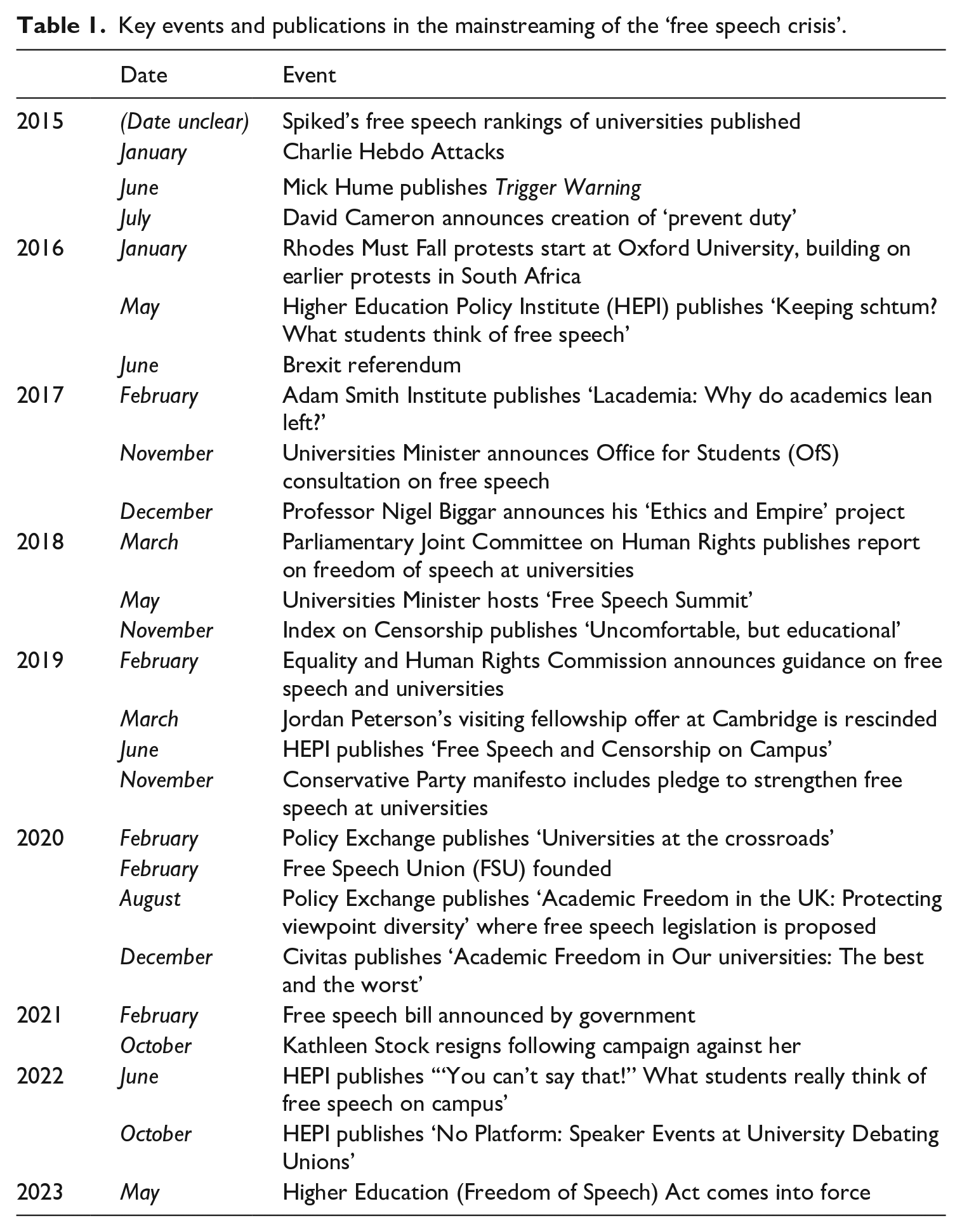
Both Krzyżanowski and Brown and colleagues situate their work within the tradition of CDA. CDA involves taking a dialectical-relational approach, that is, understanding discourse as existing in relation to its context – as ‘both socially-structuring and socially-structured’ (Fairclough et al., 2002: 3). Drawing our attention to power, CDA encourages us to question how discursive constructions, which may at first appear ‘commonsensical’ or ‘natural’, are in fact dependent on a particular understanding of the world that benefits elite actors. To conduct our CDA, we drew on a wide range of texts, many of which are summarised in Table 1, which also offers a timeline of key events. Our corpus comprises three groups of documents: first, a comprehensive collection of media stories from 2010 to 2022 which feature the phrase ‘free speech’ from two major right-leaning broadsheets, The Times and The Telegraph, and one right-leaning magazine, The Spectator. These two major broadsheets were selected rather than tabloids because it was hoped they would be more useful in tracing the full arrival of the discourse within the mainstream, and also to keep the data set manageable. Second, these sources are supplemented by some content from the influential online libertarian/contrarian magazine Spiked, and an influential book, Trigger Warning, by Spiked co-founder Mick Hume. Both Spiked (alongside Hume’s other work) and The Spectator are used here because they formed significant early sites where the discourse was developed. Third, we compiled government statements, speeches and all think tank reports related to free speech published since 2010. All sources were then coded to identify key trends, with the researchers initially working separately and then cross-checking each other’s codes and adapting them through discussion. The focus during coding was marking where and how the discourse shifted.
Key events and publications in the mainstreaming of the ‘free speech crisis’.
Analysis
Phase 1 (2010–2015): free speech and the ‘external’ Muslim other
Prior to the mainstreaming of the ‘free speech crisis’, problems regarding ‘free speech’ were associated with those positioned ‘outside’ British society. For instance, in 2012 we read in newspapers about free speech being suppressed in Russia via the legal action against the band Pussy Riot. Similar examples can be found in government speeches. For instance, in a speech to troops in Afghanistan, David Cameron (2010) declares that ‘it’s not the poet that brings free speech; it is the soldier’. These examples speak to the ongoing racialised civilised/uncivilised binary at the heart of conceptualisations of free speech. In particular, the pattern of ‘liberal’ intervention in ‘uncivilised’ lands being justified by the ‘backwards’ nature of those living there found in Mill and other earlier free speech advocates is still eerily present in this example, where the ‘civilised’ United Kingdom is paradoxically going to bring freedom to Afghanistan via military invasion.
This example also speaks to the civilised–uncivilised dichotomy at the centre of ‘free speech’ discourse over this period. It illustrates how the act of ‘speaking freely’ is reserved for subjects who can be characterised as ‘civilised’, ‘rational’ or ‘European’, and thus the invocation of ‘free speech’ is racialised – meant to signal that ‘the Muslim’ is both inferior and antithetical to the European liberal tradition, including ‘free speech’.
This Islamophobic discourse has a long history (see Allen, 2016), but is turbocharged vis-à-vis free speech following the 2015 Charlie Hebdo killings. Following these attacks, politicians and media commentators further solidified a positioning of Muslims ‘simultaneously as an alien body to the nation and as a group committed to destroying the West by means of infiltration’ (Bracke and Hernández Aguilar, 2022: 201), totally incompatible with the ‘Western value’ of ‘free speech’. This is clearly represented in the work of commentators like Douglas Murray, who, in an article following the Hebdo attacks, posed the rhetorical question, ‘import a new generation with Islamic ideas into an old continent with Christian secular ideas, and what could possibly go wrong?’ (The Spectator, September 2015). Murray’s phrasing is emblematic of this racialisation of Muslims, positioning them as a monolithic, inherently foreign, ‘uncivilised’ block, incompatible with ‘western values’ (values which he imagines, perplexingly, as both ‘Christian’ and ‘secular’).
The state can be seen to be firming up this dichotomy through interventions like Prevent, a monitoring and reporting programme targeting extremism (Qurashi, 2018). ‘Free speech’ emerges in relation to Prevent in a defence of the restriction of Muslims’ speech to protect the security of the British state (McDaid and McGlynn, 2020). In his 2015 speech introducing Prevent as a public duty, David Cameron declares, . . . of course universities are bastions of free speech and incubators of new and challenging ideas. But sometimes they fail to see the creeping extremism on their campuses . . . when an Islamist extremist goes there to promote their poisonous ideology, too often university leaders look the other way . . . this is not about clamping down on free speech. It’s just about applying our shared values uniformly.
In a moment which will be instructive to return to, universities are seen as allowing too much ‘free speech’ for Muslim speakers. Seeing Cameron advocate for limits on ‘free speech’ may seem perplexing at first, given ‘free speech’ as an undeniable good is central to the rhetorical justification for the invasion of Afghanistan quoted above. However, on closer analysis, the argument is simply that the uncivilised, irrational figure of the Muslim does not deserve a space in the public sphere; it is racialised as inherently unable to speak rationally and therefore lacks the liberal notion of personhood which gives subjects the right to free speech. Regardless of any debate over how objectionable the actual content of the speeches that concern Cameron are, the line that earlier free speech advocates draw, between irrational actors who do not deserve free speech and rational actors who do, is what is evoked here, demonstrating how ‘speaking freely’ is a racialised practice reserved for speakers and speech that does not question the hegemony of the White heteropatriarchy.
As Sayyid (2018) has argued, Islamophobia, from both the media and the state, can be understood not so much as about Muslims (though they are of course deeply impacted by this discourse) but rather as ‘an attempt to construct European identity within a postcolonial conjuncture in which the West is decentred’ (p. 422). In a changing, increasingly diverse world, Islam becomes a foil against which the White Western self-image is constructed. As the free speech discourse expands post-2015, and intertwines with right-wing populism, it is useful to keep this identity-forming role of Islamophobia in mind. The simplified construction of the new threat to the West, the ‘woke snowflake’, also ends up serving the role of promoting and shoring-up a certain dominant-group identity: both the snowflake and the Muslim become ‘others’ that can come to stand for everything the imagined White Western subject deserving of free speech is not: irrational, illiberal and uncivilised.
Phase 2 (2015): free speech and the libertarian-right – constructing an ‘internal’ enemy
As the above Islamophobic discourses are crystallising, another dichotomy is being built concomitantly. This time, the enemy of free speech is not (just) Islam, but rather the illiberal, censorious figure later routinely characterised as ‘woke’. Although this discourse does not emerge fully out of Islamophobia, they function on a similar logic. Commentators often imagine the threats as in some way intertwined – the ‘woke’ are challenged in large part due to their attempts to argue for the legitimate place of ‘others’ in the public sphere.
The intertwined nature of these two discourses can be seen clearly in Mick Hume’s influential 2015 book on the ‘free speech crisis’, Trigger Warning. Hume is one of the founders of Spiked, an online magazine embracing what has been called a ‘libertarian contrarianism’ political philosophy (Smith, 2023: 117). Spiked has been influential in the movement against ‘cancel culture’, developing some of the key themes and tropes of the ‘free speech’ discourse before it moves into the mainstream. Hume starts Trigger Warning by drawing a direct parallel between the Hebdo killings and what he sees as the emerging ‘internal’ crisis within the United Kingdom, and the West more broadly. Beginning the book by referencing the killings, he writes that his central concern is that ‘political and cultural attacks on free speech were often being led, not by Islamist extremists, but by those in the West who consider themselves liberal or left-minded’ (Hume, 2015: ii). Drawing on racialised, Islamophobic tropes discussed above, Hume declares it is not just ‘a few barbarians at the gate’ who pose a challenge to free speech, like the Charlie Hebdo killers. Rather, he declares, ‘free speech faces more powerful enemies within the supposed citadel of civilisation itself’ (Hume, 2015: 10).
Thus, we see a key stage in this discursive shift: free speech is not just being threatened by an ‘external’ enemy but is at risk from people identified unequivocally as ‘western’. We can also see here how free speech is a racialised discourse, wherein even the speech uttered by those subjects racialised as White or European can also be seen as ‘illiberal’ and ‘uncivilized’ on account of questioning the hegemony of White heteropatriarchy. Hume wavers when it comes to lines of influence: at points, he declares that ‘the liberal elite “internalised the fatwa”’ (Hume, 2015: 19–20), but elsewhere argues that ‘the Islamic gunmen who attacked the offices of Charlie Hebdo acted . . . as the armed extremist wing of a thoroughly modern Western creed [cancel culture]’ (Hume, 2015: 18). The groups are thus melded together, each imagined as standing against a supposed post-Enlightenment Western ideal of ‘free speech’. Hume laces his characterisation of the ‘free speech crisis’ with a range of affective populist tropes that are beginning to gain currency in this period. Central to these is a narrative of decline (Browning, 2019) which evokes the sense of a lost ‘golden age’ in the West to create an affective state of ontological insecurity. For him, the ‘rock of free speech’ is being ‘eroded’ (p. 46) and ‘in recent years . . . [we have seen] the culmination of a steady loss of faith in freedom of speech and the ability of people to handle uncomfortable words or images’ (p. 16). What Hume thinks has been lost only becomes clear when looking at his examples. For instance, he is concerned by student unions refusing to sell The Sun in their buildings in response to a campaign against their ‘Page 3 Pin-Up’ feature; these students ‘can’t cope with pin-ups’ (p. 107). Elsewhere, Hume is concerned that Nottingham University rugby players were disciplined due to chanting ‘now she’s dead, but not forgotten, dig her up and fuck her rotten’ (Hume, 2015: 56). For Hume, this was simply ‘traditional boorish behaviour’ (p. 56).
These examples help us unpack how Hume uses this long-standing ideal of ‘free speech’ in new ways to defend not free speech per se, or even certain speaking subjects, but rather a series of political acts and positions he sees as holding legitimacy. Critiquing or standing against misogyny, by, for instance, not selling The Sun or calling out ‘boorish’ behaviour, is not positioned as being ‘free speech’, but rather becomes ‘censorship’ and ‘intolerance’ (Hume, 2015: 18). Hume takes the ‘free speech vs Islam’ dichotomy and re-works it so that critics of the kinds of acts he describes are, like Muslims, ‘barbarians at the gate’ (p. 10): the backward savages of Mill’s imaginary. This powerfully delegitimises the politics of these critics; they are no longer inside the political area, debating, say, whether pin-up girls are appropriate in newspapers, but rather are imagined as external to it, as not worthy of engaging with (see also Dragoș and Hughson, 2024). When these groups begin to stand up for those who are othered, then they are shut out themselves, moved discursively into the ‘uncivilised’ side of the binary. As will be discussed below, the exclusion here is not as absolute as it is for the figure of the Muslim; students in particular tend to be figured as only temporarily on the ‘other side’ of the binary, with the possibility for redemption present. Nevertheless, the development of this ‘new enemy’ and their categorisation alongside the already firmly othered Muslim marks a significant moment in this discursive shift.
Hume’s concerns are given a more concrete form with the launch of Spiked’s ‘Free Speech Rankings’, a ranking of censorship on university campuses first released in 2015. Spiked no longer produces these rankings and have removed access to them from their website, making it difficult to conduct in-depth analysis. Nevertheless, a number of scholars identify this as a key moment when ‘free speech’ starts moving into the mainstream, with multiple other publications picking up on Spiked’s rankings (Riley, 2020; Smith, 2020). By developing a traffic light-style system, Spiked was able to introduce the idea that free speech issues could both (a) be located at particular sites and (b) could plausibly be changed through intervention – moving up and down these rankings is possible. Moving forward, this ‘quantification’ strategy becomes an increasingly influential mode of constructing the crisis.
Phase 3 (2016–2020): towards mainstreaming – media, think tanks and initial state responses
Between 2016 and 2020, the ‘free speech crisis’ moves into the mainstream, with mainstream media increasingly drawing on and re-formulating the populist-fringe discourses produced by writers like Hume. The emerging ‘free speech debate’ becomes a space in which the restorationist, nostalgia-driven affective politics of Brexit are expressed. Concomitantly, think tanks further quantify the issue, and politicians generate tentative responses.
While in 2015, we identified 15 newspaper articles concerned with free speech, by 2020 there were 68 articles. In line with Brown and colleagues’ (2023) assertion that ‘mainstreaming’ is not just the process of discourses moving, unchanged, from the fringe to the ‘mainstream’, we do not see in these stories a simple importation of Hume-like concerns. While such stories do exist, at the same time, early ideas about the ‘free speech crisis’ interact with the by-this-point-mainstream set of discourses related to Brexit. Early lightning-rods for discussion often focus on issues related to the legacy of the British Empire and animate a sense of postcolonial melancholia (Gilroy, 2004). For instance, in 2016, students at Oxford University began a series of Rhodes Must Fall protests, emulating earlier University of Cape Town protests. In response, we see articles such as ‘Broaden Your Mind, Oxford Students Told’ in The Times, where the Oxford Vice-Chancellor is reported saying students ‘must learn the true nature of free speech . . . and understand that higher education is not meant to be a comfortable experience’ (The Times, January 2016).
Situating protests against the Rhodes statue as somehow in opposition to ‘free speech’, rather than being ‘free speech’ themselves, echoes Hume’s discursive framings. Here, ‘free speech’ is evoked to defend the sanctity and secure place of colonial monuments and, beyond this, the secure position of those in Britain who benefit from the legacies of colonialism and enslavement. The racialised aspects of Hume’s discursive constructions, undergirded by the earlier writings of figures like Mill, are also prominent here. This is a protest group filled with many people of colour and others who challenge the legacies of colonialism, being discursively positioned, through the language of ‘free speech’, as outside of the legitimate, ‘western’, ‘European’ form of politics because they are presented as lacking rationality and thus full liberal personhood – this is the racialisation of free speech at play. In contrast, however, the ‘ontological anxiety and anger’ (Browning, 2019: 223) of White Britain is figured as legitimate (see also Dragoș and Hughson, 2024); indeed, it is this that is being defended against the political will of those who have directly suffered as a result of British colonisation.
Leigh’s (2022) reminder that so often, ‘liberal politics around the freedom of free speech have functioned to control or silence Indigenous, Black and/or otherwise racially othered speech’ is prescient here (p. 3). Racially othering the politics of the protesters, locating such politics as ‘other’ to ‘legitimate’, ‘western’ liberal politics, implies that such politics does not need to be treated with anything other than contempt. It is important to note that, in a focus more on their politics than the nature of the protestors themselves, these students are presented somewhat differently compared to the Muslim figure in Phase 1: it is arguably their speech that is ‘racially othered’ (Leigh, 2022: 3) rather than their inherent selves. Therefore, instead of being positioned as having an irredeemable amount of alterity, we see that through ‘broadening their mind’, it may still be possible for them to transition from one side of the civilised/uncivilised divide to the other. This example, then, helps us see an important aspect of this discursive shift. The language previously applied to the Muslim figure is drawn upon, but adapted for new purposes – to strongly chide critics and to deny their arguments’ legitimacy.
This pattern of defences of ‘free speech’ acting as a way to legitimise speech in defence of White supremacy and empire at the expense of speech critiquing these is produced with increasing frequency through this period. Another prominent early flashpoint for commentary was the furore around Oxford professor Nigel Biggar, who in 2017 published an article ‘Don’t feel guilty about our colonial history’ in The Times, and began a new academic project to ‘empirically test’ the claim that empire is ‘unethical’. Mirroring the dynamics just described with Rhodes Must Fall, critics of Biggar, such as those academics who wrote an open letter critiquing his project, are positioned by journalists as being opposed to free speech, while Biggar is simply assigned the positive position of ‘speaking freely’. Populist tropes are heavily employed in the framing of Biggar: it is an out-of-touch elite he is speaking back to – simultaneously other academics who form part of the ‘liberal-Left’ but also the ‘potential elite’ (Dragoș and Hughson, 2024) of what he describes as ‘very noisy, very zealous communities of students, with very clear ideas about the wickedness of empire’ (The Telegraph, February 2019). While these critics are not othered in the same way Muslims are, the invocation of the rational/irrational divide is clear here: critical speech is deemed ‘irrational’ and in some sense therefore racialised by its association with non-Europeanness, in a way that delegitimates it. Biggar, on the contrary, is aligned with the ‘commonsense’ majority, who are confident that there are ‘positive aspects of Britain’s colonial period’ (The Times, October 2018).
During this phase, think tanks work alongside journalists to mainstream the ‘crisis’. Between 2016 and 2020, four relevant think tank reports are published (see Table 1). Mostly, these reports attempt to turn the media events discussed above into a quantifiable problem with potential policy solutions. For instance, A 2016 Higher Education Policy Institute (HEPI) report titled Keeping schtum? What students think of free speech attempts to use survey data to concretise the ‘problem’ of free speech. It concludes that students are too willing to support ‘censorship’, meaning that ‘the pendulum may have swung too far away from favouring free speech’ (Hillman, 2016: 4). While basing this claim on apparently ‘objective’ (p. 4) poll results, examining the questions reveals their interpretation of ‘free speech’ shares much with the framings of the right-wing press. For instance, support for trigger warnings, compulsory staff Equality Diversity and Inclusion training or the so-called ‘eradication of . . . memorials’ (p. 58) are all grouped into the ‘pro-censorship, anti-free-speech’ camp. Thus, while think tanks do attempt a more neutral, scientific tone, they nevertheless still participate in the broader affectively laden populist discursive change. This can be seen again with HEPI for instance asking universities to intervene to provide an ‘antidote to radicalisation’ (p. 62); the racialised language previously applied to Muslims now also comes to act against others who wish to imagine society differently. Such framing allows an interventionist narrative to emerge; we read that ‘universities have a responsibility to open up minds and reduce bigotry’ (p. 62).
This framing also begins to appear in government discourses. The first direct government response to the issue comes in October 2017, when then-Universities Minister Jo Johnson begins a consultation focused on how the Office for Students (OfS) can ‘encourage a culture of openness and debate’ (Department for Education, 2017) on campus, followed by a ‘free speech summit’ in May 2018. In this instance, some more overtly populist, Brexit-derived discourses get woven into government discourse. For instance, in relation to the consultation, Johnson declares that ‘I don't think tearing down statues contributes to a proper understanding of how our societies and cultures have developed’ (The Telegraph, October 2017), echoing the commentary discussed above. However, compared to the language of ministers after the more populist Boris Johnson’s election, the tone in this period is generally more technocratic, turning the ‘free speech crisis’ into a solvable problem. By February 2019, the government supports the Equality and Human Rights Commission in its production of some initial guidance on free speech at universities, but this is effectively a collation of existing requirements (Equality and Human Rights Commission, 2019). During this period, the Parliamentary Joint Committee on Human Rights also conducted a series of hearings on the free speech issue. The resulting 2018 report concluded that, while there were a small number of incidents that were of concern, ‘the press accounts of widespread suppression of free speech are clearly out of kilter with reality’ (Parliamentary Joint Committee on Human Rights, 2018: 19). Although we are not analysing counter narratives, this report is worth noting. It shows that during this period, the narrative around the ‘free speech crisis’ is still very much contested; even a committee featuring Conservative MPs is willing to question it.
Phase 4 (2020–2023): from mainstream crisis to action – populist policy-making
From 2020 to 2023, the idea there is a ‘free speech crisis’ is mainstreamed to a much greater extent and, within the right-wing ecosystem at least, it begins to be treated as taken-for-granted fact. The article count is one way to see this: in 2021, we recorded 140 articles, and by 2022, 171 articles. Generally, the tenor of these articles is similar to that discussed above, with a populist framing of free speech resting on a comparison between an illiberal censorious minority (variously lecturers, radical students, activists at large) and a ‘commonsense’ majority aligned with ‘free speech’. The range of topics incorporated increases, with the legacies of colonialism, trans rights, eugenics, far-right politics and others brought into the frame. At times, there is debate between different individuals within the press; for instance, our data set showed some columnists defending anti-trans speakers with the rhetoric of ‘free speech’ but not defending eugenicists, whereas others took the reverse position, or were happy to defend both. However, the fundamental dynamics of the articles remain fairly stable, with ‘free speech’ used to legitimise the politics of those standing in defence of the White heteropatriarchy, and racialise and therefore delegitimise speech against this power structure. What is perhaps more significant, however, is the change in the wider policy-making ecosystem. For instance, we see the founding of the Free Speech Union (FSU) and the Equiano Project. These two groups take different approaches to ‘free speech’, with the latter, for instance, particularly concerned about speech for those who wish to challenge ‘common’ understandings of race. However, both promote the idea that a ‘free speech crisis’ exists. There are also five more publications from think tanks, some of which we discuss below. Arguably responding to this rise in concern, the government begins to adopt a more strident tone, and also leans into a more heavily populist framing of the issue, thereby further supporting the mainstreaming of a discourse which just 5 or 6 years prior was only found on the libertarian fringes.
In February 2021, for example, the then-Universities Minister Michele Donelan complained in widely reported comments initially given on during a podcast interview about free speech that ‘the so-called decolonisation of the curriculum is, in effect, censoring history . . . I’m a vehement protector and champion of safeguarding our history. It otherwise becomes fiction, if you start editing it, taking bits out that we view as stains’ (The Telegraph, February 2021). Here, Donelan aligns decolonising with censoring, positioning the movement as seeking to shut down the ‘free speech’ of historians and threatening the liberal model of the rational academy. The dichotomy she draws on here should now be familiar; a small, censorious, implicitly racialised elite or proto-elite focused on ‘decolonising’ are positioned against ‘the people’, the latter group aligned with ‘our history’, meaning imperial history brought up by the proponents of decolonisation – ‘the people’, then, become clearly racialised as White. One group is irrational and uncivilised, the other civilised and rational. As time goes on, Donelan is more willing to directly use populist and affective-laden language to shore up this dichotomy. In April 2022, for instance, she speaks of the ‘intolerant mob’ and ‘the small cabal of the intolerant’ who are working to see ‘free speech . . . whittled away by wokery’ (The Telegraph, April 2022), evoking a clear a sense of ontological insecurity. The use of the word ‘cabal’ in particular shows Donelan drawing on antisemitic language to clearly racialise those whose positions she disagrees with, further highlighting the racialised nature of the ‘free speech crisis’ discourse.
Donelan makes these later comments in the context of promoting what becomes the Higher Education (Freedom of Speech) Act in May 2023. The origins of this act represent a clear case of how the various actors discussed throughout this article come together to engineer a discursive shift. In a tweet, conservative political scientist Eric Kaufmann describes it as a result of a ‘policy network of academics, think tank staff, journalists and politicians’ coming together to oppose ‘the censorious campus left’ (quoted in Srinivasan, 2023b). Kaufmann, until recently, sat on the advisory council of the FSU and is a co-author of Policy Exchange’s 2020 Academic Freedom in the UK report. It is this report that first argues for an ‘Academic Freedom Bill’ which bears many similarities to the bill the UK government advances. In some sense, the passage of this Act represents the zenith of the mainstreaming of the ‘free speech crisis’, through a piece of what Bartha and colleagues (2020) call ‘populist policy making’. That is, policy-making that, in line with populist politics, tends to sideline technocratic expertise and moderation to aim for ‘paradigmatic changes in substantive terms’ (Bartha and colleagues, 2020: 75) in order to fulfil the fantasy narrative it promised ‘the people’. Populist policy-making is motivated by ontological insecurity and a friend–enemy dynamic that, in contexts like Britain, is often racialised.
Conclusion: whose speech, whose values?
To conclude, it is worth returning to David Cameron’s 2015 worry that there is too much free speech in universities – that universities are not ‘applying our shared values uniformly’ when they platform certain Muslim speakers. The first thing one realises here is how rapidly the new politics of ‘free speech’ have been mainstreamed: in 2023 (or even in 2017), no politician would evoke free speech in quite the way Cameron does in 2015. The second thing returning to this quotation helps to clarify is the true purpose of this discursive shift.
In 2015, Cameron’s concern was to defend ‘our shared values’, that is, the values of the mostly white Britons who voted for him and whose hegemony and ontological security he seeks to protect. In the political context of the time, the aforementioned excess of ‘free speech’ vis-à-vis Muslims seemed to be in opposition to the maintenance of this hegemony, and therefore a targeted clamp down via Prevent (while maintaining ‘free speech’ for others) became a suitable locus around which to further his political project and maintain the division between the ‘civilised’ and the threatening ‘other’. Between 2015 and 2023, the rise of right-wing populism and a renewed left-wing effort to challenge White heteropatriarchy and address the long-standing legacies of colonialism and racism necessitated a discursive shift, even if the political goals ultimately remained the same. In this contemporary context, the crisis narrative has needed to adjust. It is not only the ‘Muslim other’ that needs delegitimating, but also the political energies of a wide variety of others, from feminists critiquing pin-up culture, to protesters highlighting the ongoing legacies of colonialism and enslavement in the Rhodes Must Fall Movement, to trans rights activists. As groups like these sought to advocate for the rights of those who were being othered, it became necessary for the variety of right-wing actors discussed here to find ways to other them in turn, due to the radically different vision of the public they were imagining.
It is the talisman of ‘free speech’ that allows these actors from the media, government, think tanks and other groups to remove legitimacy from these aforementioned advocates, by racialising their speech and therefore positioning them as outside the legitimate, civilised boundaries of acceptable discussion and debate, while bestowing political legitimacy of those whose views they seek to protect by constructing their speech as civilised and ultimately ‘free’. It twins a populist dichotomy (with a legitimate, ‘common sense’ people against a censorious elite/proto-elite minority), and a racialised dichotomy (where to be against free speech is to be implicitly imagined as non-European, irrational and even less-than-human) to declare that the speech of critics of status quo politics, those who advocate for the inclusion of ‘the Other’, is outside the boundaries of ‘acceptable’ politics. Their concerns are, therefore, rendered invalid, not even worthy of consideration and engagement. Unlike the figure of the Muslim, the redemption of these ‘critical’ voices is often considered possible; if they renounce their particular political arguments, then they may be able to reintegrate into the body politic proper. Indeed, although there is no space to flesh out this argument here fully, the redemption of (many of) these critics may be considered politically necessary by right-wing actors. The elite university students who are at the centre of so many ‘free speech’ controversies have historically been the individuals who have gone on to uphold conservative White heteropatriarchal hegemony in society, so some desire to ‘keep the door open’ to them if they reorient their politics is perhaps recognisable here. However, the rhetorical success of this shift is to place them, temporarily or otherwise, in a discursive category previously left only for those imagined external to society.
In saying all of this, it is important to return to our assertion at the start of this article. We are not attempting to make an intervention in the ‘free speech debate’ as such, to declare which speakers deserve to speak, or how prevalent ‘actual’ examples of speech rights being denied to certain individuals might be. Rather, in Srinivasan’s (2023a) terms, we have aimed to show how rallying cries for ‘free speech’ are today in the United Kingdom ‘often invoked in the service of a reactionary politics that refuses to think critically about the way in which speech, language and ideas are shaped by, and shore up, oppression’ (p. 1).
Footnotes
Acknowledgements
Particular thanks are due to Alana Lentin and Darcy Leigh, who willingly gave up their time to speak at seminars organised as part of our broader research project, and whose thinking helped to influence the direction of this article. Thanks too must go to our anonymous reviewers, who pushed us to significantly strengthen our arguments.
Declaration of conflicting interests
The authors declared no potential conflicts of interest with respect to the research, authorship and/or publication of this article.
Funding
The authors disclosed receipt of the following financial support for the research, authorship and/or publication of this article: This article was produced as part of work on an ESRC (Economic & Social Research Council) funded project, grant number ES/T015519/1.
