



Abstract
Previous studies found a tendency for negative representations of social movements in the media in the so-called ‘protest paradigm’. This work proposes a methodology using the paradigm as a framework and operationalizing its characteristics into neutral variables: emphasis, prominence, legitimacy, and tone. In addition, the political elite-media relationship is included as an analytical dimension to better understand the factors that produce media representations of social movements. The empirical focus is the representation of the movement against femicide in three Mexican national news outlets with different political leanings, from 2014 to 2017, gathering N = 865 news articles. The articles were coded using the qualitative content analysis technique. Each variable was coded to measure the representation of the movement and the authorities. The results show that the detriment to one actor’s legitimacy can benefit the other’s representation, suggesting an interdependent system formed by the political elite, the media, and the social movements.
Introduction
Access to media discourse can create opportunities for social movements to produce empathy and support from a broad audience, which is the key to influencing the political agenda and policy processes (Baumgartner and Jones, 2010). However, the task is not easy. Research, mainly from the US media, has yielded evidence of a tendency for negative representation of social movements in what is called the ‘protest paradigm’ (Chan and Lee, 1984). The paradigm is characterized by narratives that focus on spectacle, marginalizing the protestors (McLeod, 1995), and disregarding the political, social, or economic causes and claims (Boyle et al., 2012). This type of coverage is produced by journalistic routines and the media relationships with the political elite (Bennett, 1990) which lead to a general reliance on official sources and a pro-status quo orientation (Herman and Chomsky, 1988). The application of the paradigm ‘disparages protesters and hinders their role as vital actors on the political stage’ (McLeod, 2007: 185).
Over the last two decades, the paradigm has remained a stable system of representation in the US mainstream media (Gil-Lopez, 2021). Nonetheless, a consistent body of literature discovered several factors of deviation from the paradigm, such as the magnitude of the events, the interests represented, the movement’s tactics to reach coverage, the human interest, the media’s ideological affinity, the users’ interactions through social media, and an unsound socio-political context can lead to a more positive representation and rely on protestors for information (Amenta et al., 2017; De Cillia and McCurdy, 2020; Kim and Shahin, 2020; McLeod, 2007; Mourão, 2019; Shahin et al., 2016; Wouters, 2015). Hence, alternative and online media can lead in helping disseminate protest messages (Harlow et al., 2017). The complexity and interaction of these factors have created a wide and diverse range of media responses to protests; yet, the literature that analyzes the possibility of positive representation of social movements in the media is still scarce (see Belotti et al., 2021; Harlow et al., 2017; Shahin et al., 2016; Wouters, 2015).
This article has two main arguments; the first is the need to include a positive valence in the measurement of media representation of social movements. The second is the advantage of analyzing the relationship between the media and government institutions for a better understanding of the relationship of media to social movements. This work proposes a methodology to examine the representation of social movements using the protest paradigm as a framework and operationalizing its characteristics into the following four neutral variables: emphasis of the stories, prominence as a source, legitimacy, and tone. By using the systematizations created by scholars to measure the adherence to the paradigm that predicts negative representation (Dardis, 2006; De Cillia and McCurdy, 2020; Gil-Lopez, 2021; Kim and Shahin, 2020; Lee, 2014; Shahin et al., 2016) and incorporating the possibility of a positive value (Shahin et al., 2016; Wouters, 2015). This scale allows a more comprehensive analysis. The same variables were applied to measure the representation of the authorities, providing a point of reference for comparison and relevant socio-historical context. This work contributes to the literature with theoretical and methodological proposals to advance the understanding of the relationship between the political elite, the media, and social movements as an interdependent system. Likewise, it provides empirical evidence on the media representation of social movements from the global south, helping to diversify the protest paradigm studies and serving for comparative analyses. In addition, the literature on femicide and the media tend to focus on the representation of victims and perpetrators (i.e. Aldrete, 2023; Boonzaier, 2022). There are just a few studies that analyzed the (self) representation of activists against femicide (i.e. Monárrez Fragoso, 2010) and their resonance in social media and policies (Belotti et al., 2021). This study contributes to this field as well by providing a novel approach, an analysis of the representation of two major political actors that play important roles in the public construction of meaning. The above is particularly relevant, being social ideologies and practices key factors in the perpetuation of gender-based violence (GBV) at social and individual levels (Belotti et al., 2021; Boonzaier, 2022; Lagarde, 2006; Segato, 2014; Walby, 2023; Weil et al., 2016).
The movement against femicide in Mexico is a particular case; it started to attract media attention in 1993 when activists denounced the systematic murders of women in the city of Juarez on the Mexican northern border. For 30 years, the movement spread internationally and became a permanent political actor, giving femicide unprecedented public visibility (Belotti et al., 2021). In general, Latin American countries have the lowest perception of security in the world (Botero et al., 2021), probably due to the high statistics of violent crimes related to organized crime groups and government officials (Bartman, 2018) which help to create a context of violence and corruption. Femicide appears to be a major crisis, the Mexican mainstream media increased femicide coverage by 447% on average from 2014 to 2017 (Gutiérrez Aldrete, 2020b) seemingly influencing the perceived severity of the problem in society. Social and political crises can create opportunities for the movements to validate their existence and access the public discourse. They can attract media attention by offering newsworthy events, but to obtain public support they need to build legitimacy (Andrews and Caren, 2010).
Previous research demonstrated that the protests paradigm has different degrees; the present work goes further and argues that the media can produce a legitimizing portrait of the activists and even help to create a more functional discourse on the issue.
Social movements and the media
Public attention is a scarce resource, to influence public opinion, the topics, and the political actors must compete for visibility (Koopmans, 2004). A large volume of coverage suggests success (Hilgartner and Bosk, 1988), but social movements and authorities compete for media attention with different interests. Social movements seek to generate sympathy for their claims (Vliegenthart and Walgrave, 2012) which is their chance to influence policy (Meyer and Staggenborg, 1996) and cultural change (Friedland, 1991). Instead, authorities have an institutional power base and are automatically relevant to journalists (Vliegenthart and Walgrave, 2012), but they can prefer to lobby in private and appeal to the irrelevance of the protests. Hence, the elite-media-movements relationship is shaped by several considerations such as newsworthiness, and political, and economic forces (Gil-Lopez, 2021).
Recent research suggests that reporting practices are driven by commercial indicators more than ever. The increase of alternative news providers and dissenting voices facilitated by digital platforms produced strong competition and a fragmented audience market (Gil-Lopez, 2021). News stories with sensationalist aspects such as conflict and human interest are more likely to be shared on social media, increasing the number of readers, and spurring journalists to include share-worthiness criteria (Trilling et al., 2017). These factors affecting news-making processes may have strengthened the use of sensationalist elements to report protests such as conflict and confrontation between protestors and police or society (Harlow et al., 2017). Besides, the need to speed up production and cost-efficiency could reassert the preference for available institutional sources, producing a more protest paradigm-adherent coverage (Gil-Lopez, 2021).
Protest paradigm
The paradigm describes a pattern of negative coverage of social movements (Chan and Lee, 1984), decreasing legitimacy, repelling public opinion (Gitlin, 2003), and helping to diminish the public attribution of responsibility to power elites (Harlow et al., 2017). The characteristics are as follows:
Emphasis on the form of demonstrations as a spectacle such as bizarre behavior of the protestors, riots, looting, and confrontation with the police rather than an explanation of the topics that the movements are trying to promote. Even when in general, the movement’s activities are not characterized by these behaviors (McLeod, 2007).
The dominance of official discourse and suppression of oppositional voices (Herman and Chomsky, 1988).
The delegitimization of the protestors and claims suggesting the movement does not represent societal interests (Reul et al., 2018).
The demonization of the protest by focusing on the negative consequences of the protest such as violence, property damage, traffic congestion, expenditure of community resources, and marginalizing protestors (McLeod, 2007).
These characteristics served scholars to identify marginalizing devices in the coverage of social movements and to find degrees of adherence (Amenta et al., 2017; De Cillia and McCurdy, 2020; Kim and Shahin, 2020; Mourão, 2019; Reul et al., 2018; Shahin et al., 2016; Wouters, 2015). Evidence showed that the cause propelling the protest and the degree of challenge to the status quo are the main factors that define their media representation (Mourão, 2019). Protests related to labor and social issues tend to deviate from the paradigm, presumably for being emotionally closer to the audience and conveying a personal interest or threat (Gil-Lopez, 2021).
The construction of the issue as a social problem can help to legitimize the protests’ existence as representative of society’s needs. This can be achieved by focusing on the issues object of the protests more than on the demonstration’s events (Wouters, 2015). The social urgency or the existence of a threat can be transmitted by providing explicit details about the susceptibility of the audience to become affected, or indirectly by depicting impacts and consequences in words and pictures, affecting the individual’s appraisal of the problem (Feldman et al., 2017).
Evidence from non-western countries showed that the historical–political context influences the media to take protestors more seriously and to portray them more positively (Shahin et al., 2016). For example, in 2013, in the coverage of the anti-government demonstrations in Brazil, the official voices were dominant but were not always used to delegitimize the protest (Mourão, 2019). At an international level, a study that analyzed the representation of a Mexican social movement in social media found a rupture with the protest paradigm. The authors of the research theorize that the main reason for the paradigm’s inapplicability was that the presumed implication of officials in the murder of 43 students (the cause of the protest) represented the historical institutionalized corruption in the country (Harlow et al., 2017).
Newsmakers can decide to portray activists as main actors and imply their credibility by quoting them as sources (Wonneberger and Jacobs, 2017). Nevertheless, public support also depends on the congruence of the movements’ discursive positioning with the social values and norms (Ashforth and Gibbs, 1990), and how the protestors appear focused, united, organized (Gil-Lopez, 2021), and stable (Yoon, 2005).
Femicide and feminicidio in Mexico
Femicides are an increasing global crisis (United Nations Office on Drugs and Crime, 2019), especially in Latin America, with Mexico being the Spanish-speaking country with the highest number of femicides according to UN statistics (Comisión Económica para América Latina y el Caribe (CEPAL), 2020). The creation of the concept in 1974 was a sociological effort to emphasize the special nature of GBV murders as a socio-political problem (Radford and Russell, 1992). In the decade of the 1990s, the term was translated to the Spanish feminicidio by Marcela Lagarde (2006) to highlight the role of the state in the neglect, collusion, and incapacity to prevent and sanction the murders of hundreds of women and girls in the northern Mexican border city Juarez. The concept of feminicidio became central for a transnational campaign to demand action and shame the Mexican state (García-Del Moral, 2016). Scholars and activists used the feminicidio frame to link the patriarchal culture with the neoliberal context, the feminization of cheap labor, and the drug cartels’ power that facilitated victimization and impunity in the Mexican–US border (Wright, 2011). Activists and victims’ families also fought in legal processes, the case González and Others ‘Cotton Field’ v. Mexico set a precedent in the Inter-American Court of Human Rights that in 2009 convicted the Mexican state for committing institutionalized practices of gender discrimination (García-Del Moral, 2016). The local government in Juarez and the hegemonic groups accused activist organizations of discrediting the city, complaining that because of them the economic investments decreased sinking people into deeper poverty. The official discourse portrayed the victims’ families as the only ones legitimized to denounce the crimes aiming to break their link with civil organizations (Monárrez Fragoso, 2010).
In 2007, the federal Mexican government started a transformation of the legal system as a response to the humanitarian crisis. However, murders continued all over the country (Secretariado Ejecutivo del Sistema Nacional de Seguridad Publica, 2019), as well as the authorities’ discriminatory practices. Activists have built large networks of offline and online mobilizations, incorporating hash tags, accusing victim-blaming narratives, and authorities’ denial of the gender motivation in the crimes (Gutiérrez Aldrete, 2022). Nonetheless, the feminicidio frame helped to their visibility at local and international levels (García-Del Moral, 2016), becoming a standardized term to name GBV murders of women and girls among Latin American activists (Belotti et al., 2021).
Scholars and activists that write in English adopted femicide to name GBV murders including Latin America (Belotti et al., 2021), Africa (Boonzaier, 2022), and Asia (Weil et al., 2016) to mention some. In this work, I use the word femicide aiming to highlight the global dimension of the problem and the major frame of human rights (Walby, 2023).
Hypotheses
The protest paradigm predicts negative portrayals of protestors; we built one hypothesis for each variable of representation:
H1. The coverage emphasizes the form of the protest rather than explaining the issue’s causes and consequences.
H2. The coverage reproduces the official discourse and suppresses alternative voices.
H3. The coverage de-legitimizes the protests’ reasons to exist and claims.
H4. The coverage demonizes the protests and protestors.
Methodology
The news outlets in the study were selected by their scope in the audience, considering they have national coverage, both print and digital versions (the latter available for consultation in 2014), and reports about general topics. Five outlets have these characteristics in Mexico, the three with the highest number of visits to their websites El Universal, Excelsior, and Reforma were selected (Alexa.com, 2015). I attempted to have media with diversity in political ideologies, but the Mexican media landscape has particularities. For above 70 years, until the year 2000, Mexico was governed by one political party. During this time, the media was divided into ‘in line’ with the government and the independent, these positions having very low correspondence with the media’s political ideology (Lawson, 2002). To classify their ideology, Lawson (2002) developed a methodology based on two measurements: the presence of keywords associated with ideological content on the front page, and the bias in the framing of topics where ideology is relevant. The results provide a scale from (–100) utterly right-leaning to (100) utterly left-leaning. Lawson’s study classified the outlets with the criteria selection: El Universal as center-leaning, Excelsior as left-leaning, and Reforma as right-leaning. In 2016, Rodelo and Muñiz reproduced the same methodology classifying the outlets in the same ideologies.
To select the news articles, the dataset ‘Marcos de feminicidio en la prensa Mexicana’ (Frames of femicide in the Mexican press) was consulted (Gutiérrez Aldrete, 2020a). This contains a coding of all the articles about femicide in the outlets selected, from July 2014 (the start of the process for the first alert of gender violence) to December 2017, a total of 2528 news articles. The articles with social movements, activists, protests, or nongovernmental organizations (NGOs) as the main topic of the story, as a source, or as a secondary actor were separated, gathering a total of N = 865 articles being the unit of analysis. The dataset of this study is available open access (Aldrete, 2022).
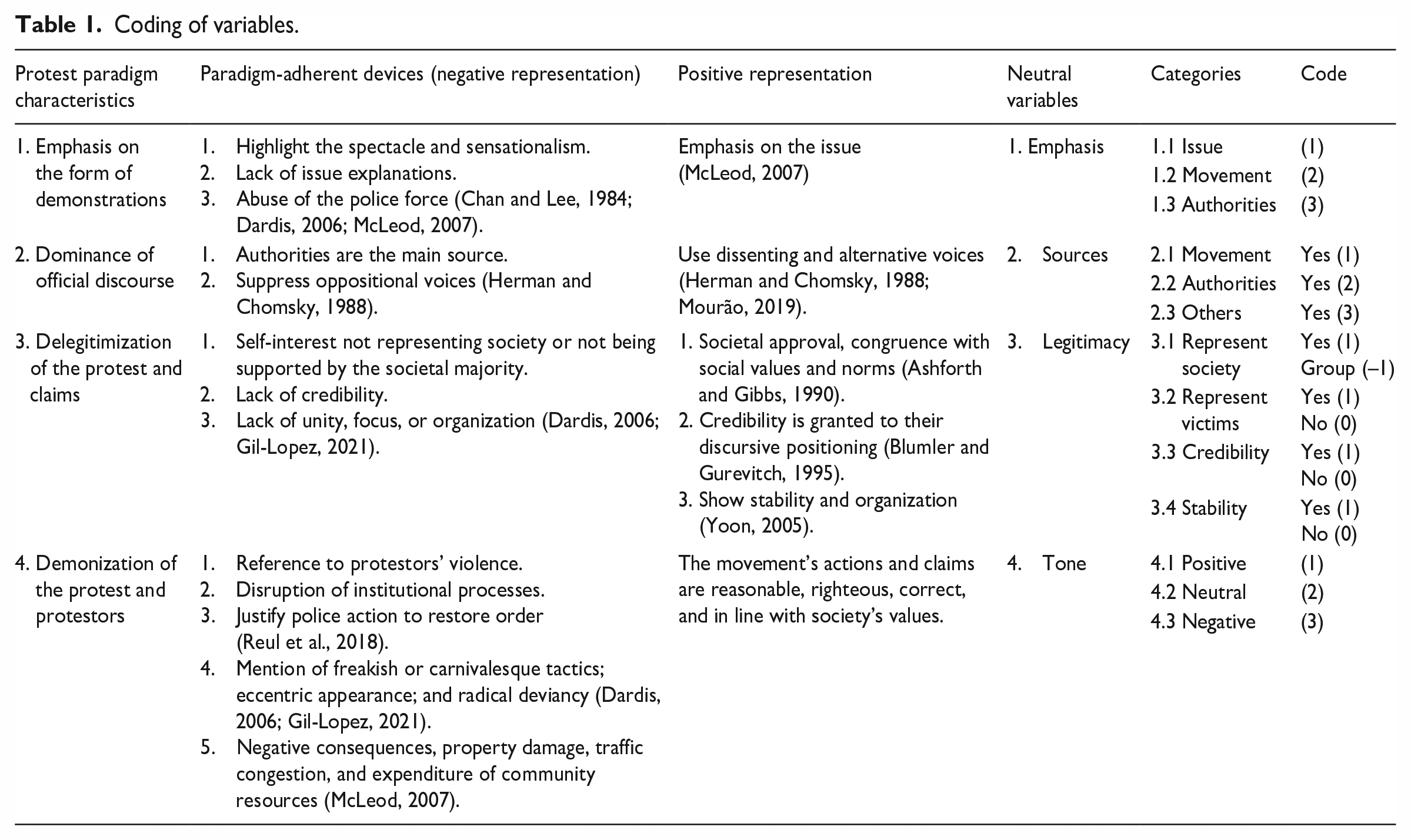
The articles were coded by using the content analysis technique which is widely used to examine news messages and identify the latent content, through classification, tabulation, and evaluation of topics (Krippendorff, 2004). The codebook was created using the elements identified in protest paradigm literature (Dardis, 2006; Gil-Lopez, 2021; Kim and Shahin, 2020; McLeod, 2007) and adding positive values for each element (Table 1). To obtain Krippendorff’s alpha for inter coders’ reliability, 100 articles were coded by two persons with good results, for emphasis 1.00, sources 1.00, represent victims 1.00, represent society 1.00, credibility .91, stability 1.00, the tone for authorities 1.00, and tone for social movements .92.
Coding of variables.
Emphasis
The emphasis is the main topic of the article. It can be the only topic, the one with more extension, or, in the case that two topics are dominant, the title decides the category (Tankard, 2001). All articles have a registered emphasis in the following categories:
The issue (of femicide) (1) (McLeod, 2007): femicide, statistics, public policies, laws, reporting cases, and criminal investigations.
The social movement (2) (McLeod, 2007): protests, NGO press releases, and interviews with activists.
Authorities (3): reports of activities, interviews, and press releases.
Source of information
The sources were registered when the article explicitly attributes the information to a person, organization, or institution by using quotation marks, interviews, corporate communications, press releases, publications, or readable written messages attributable to an actor (Gil-Lopez, 2021; Lee, 2014; Shahin et al., 2016). The sources were classified into the following three categories:
Social movements (1): local and international NGOs and members, protestors, and activists.
Authorities (2): police, prosecutors, governmental institutes, commissions, representatives, tribunals, the president, and governors.
Other sources (3).
The three categories can be registered in one article or if there is no attribution to any source ‘no source’ was registered.
Legitimacy
Legitimacy was measured using the three dimensions proposed by Ashforth and Gibbs (1990). The first dimension social approval of the claims is broken into (1) represents society’s interests, and (2) represents victims’ interests, the second dimension (3) credibility (Blumler and Gurevitch, 1995), and third dimension (4) stability of the organization (Yoon, 2005). These variables were registered when found or left blank when there was no evidence of the subject.
1. Represent society’s interests. Evidenced by the level of threat and susceptibility of the individuals to become victims conveyed by the story (Feldman et al., 2017). The explicit mentions of the group of women at risk were registered, divided into ‘society’ (1) when the article mentions all women are in danger, that is, ‘could happen to anyone’. A group with certain socio-demographic characteristics (0) such as women living in a geographical region, ethnicity, age, or economic status. Women with dangerous personal involvement (–1) such as having a relationship with organized crime or a dangerous person, suggesting personal circumstances (Aldrete, 2023).
The articles with codes (1) and (0) indicate a ‘threat to society’ (1). By crossing the variables ‘threat to society’ with ‘positive representation’ of the actors in the same article, it was obtained: Does the social movement represent society’s interests? Yes (1) No (0). Do the authorities represent society’s interests? Yes (1) No (0).
2. Represent victims’ interests. Explicit evaluations from families to social movements and authorities were registered. Considering their different roles, positive mentions about helping the families and negative ones like the obstruction of their pursuit of justice (Monárrez Fragoso, 2010). For example, do the authorities represent individuals affected? Yes (1) ‘authorities helped with the search’. For No (0) ‘authorities do not care’. Does the social movement represent individuals affected? Yes, (1) ‘activists are the only ones who believed me’ or No, (0) ‘protestors do not help’.
3. The credibility is suggested by being quoted as a source, but a discourse can be reproduced to condemn it, express disagreement, or actively counter an actor (Koopmans, 2004). To answer, was credibility granted? It was registered if the articles have a single source or without any disagreement as Yes (1). It was registered No (0) when it was found disagreement or different versions about the same topic in the same article, or different articles about the same data, or direct responsibility attribution to one actor. For example, when the authorities deny severity and activists claim increasing numbers or the actors have different statistics about the same category, or when both stand different legal categorizations for the crime.
4. The stability of the organization was measured with the explicit mention of lack of stability or internal conflict (Yoon, 2005). ‘Lack of stability’ (1) was registered when the article mentions problems between NGOs or activists. For authorities, when different authorities disagree, or one authority accuses another one of ‘not doing a correct job’, of corruption, inefficacy, or human rights violations.
Tone
The tone is an evaluation of an actor. It can be positive, negative, or neutral (de Vreese et al., 2001). The variable was registered when found.
1. Positive (1), for social movements, when the article uses positive words to describe the movement or activists or mentions the movement’s actions that agree with social values and norms (Ashforth and Gibbs, 1990; de Vreese et al., 2001). For example, claims for justice, doing independent research, and helping the victims and their families (García-Del Moral, 2016; Monárrez Fragoso, 2010).
For authorities, when the article uses positive words to describe the institution or the person representing it or mentions ‘good work’. For example, making arrests, convictions, and application of policies and laws to protect women and families (Gutiérrez Aldrete, 2022).
2. Neutral (0) was registered when the article mentions the actor but no description or action, or these cannot be categorized as positive or negative.
3. Negative (–1), for the movement, when the article uses negative words to describe the movement or activists, mentions protestors’ violent actions; implicit violence including charges or arrests; looting, private property invasion, obstruction of citizens’ daily routines, disruption of institutional processes; freakish or carnivalesque tactics; eccentric appearance; radical deviancy (Dardis, 2006; Gil-Lopez, 2021) or justifies police action to restore order (Reul et al., 2018).
For authorities, when the article uses negative words to describe the institution or the person representing it or blames authorities as responsible for the crimes, corruption, impunity, machismo, misogyny, mentions authorities are not trustworthy, authorities releasing private information about the victims (Segato, 2014), and abuse of the police force (McLeod, 2007).
Results
The results are illustrated with percentages in seven graphics comparing outlets, built for the present research. In the description of the results, ‘the actors’ refers to the social movement and the authorities.
Emphasis
H1 was refuted. The outlets in the study dedicated several articles to femicide reporting. The corpus of analysis of this study N = 865 articles, represents 31.8% of all the articles dedicated to reporting femicide by the three outlets in the study which was 2528 articles. Nonetheless, even in the social movement-focused corpus, the dominant emphasis is still the issue of femicide (Figure 1).
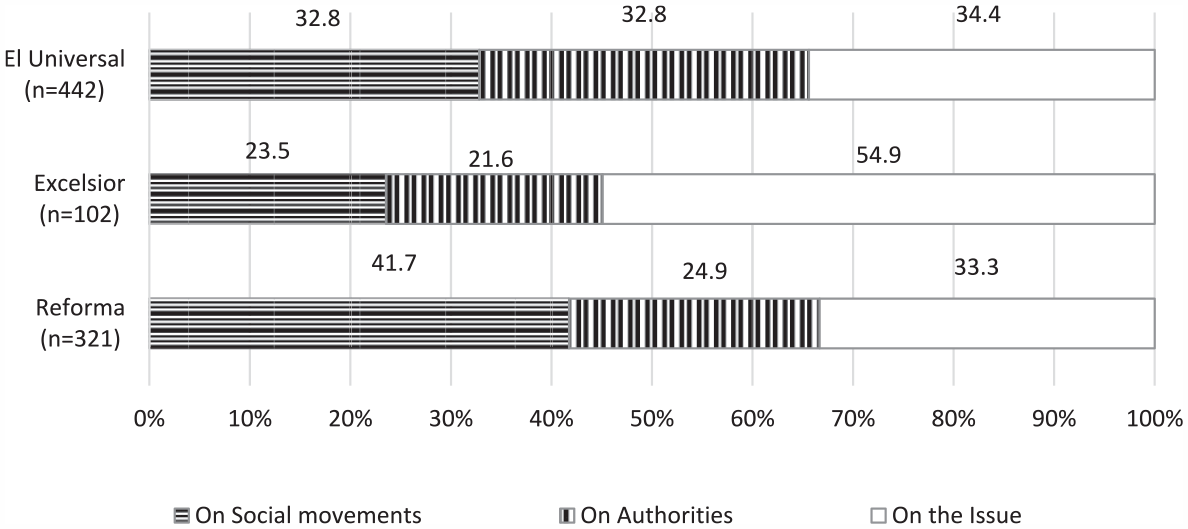
Emphasis.
Sources
H2 was refuted. The results reveal that the activists are the main source of information. They are a source of more than 60% of N = 865 articles (Figure 2). In addition, the articles that quoted authorities as a single source are considerably less than articles that quoted activists as a single source.
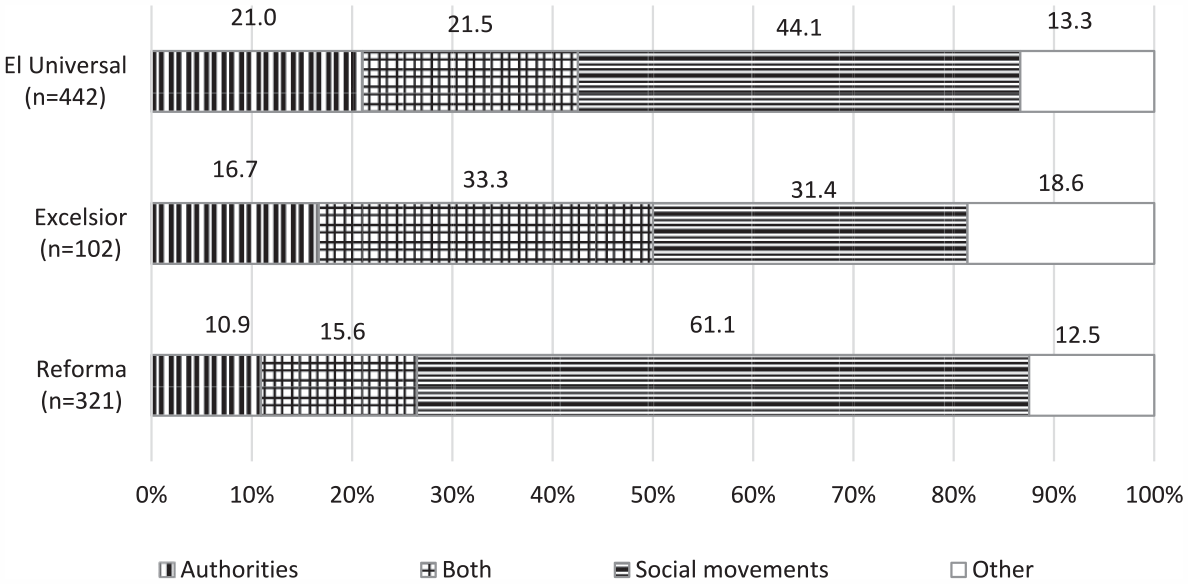
Sources.
Legitimacy
H3 was refuted. Surprisingly, delegitimizing devices to portray protestors were not found. The news stories do not focus on protestors’ identities and the movement is constructed with more legitimacy than the authorities.
A considerable percentage of articles suggest or explicitly establish the movement represents society’s interests. Instead, articles rarely state that the authorities represent society’s interests, statisticaly close to zero. The issue is constructed as a social problem threatening the population of a geographic region, age gap, ethnicity, economic status, and nationality. These socio-demographic characteristics of the groups in high risk are conveyed through the depiction of official and independent statistics. Moreover, many demonstrations’ claims are linked to the constant murders in specific territories, and the news pieces use words to describe the protestors as the society itself, like ‘the community’, ‘the neighbors’, or school fellows. Figure 3 shows the proportions in which the news transmit who represents society’s interest. The articles conveying a threat to society and a positive evaluation of one of the actors are considered into the ‘actor represents society’ category. The articles conveying a threat to society but no evaluation for one of the actors has their own category.
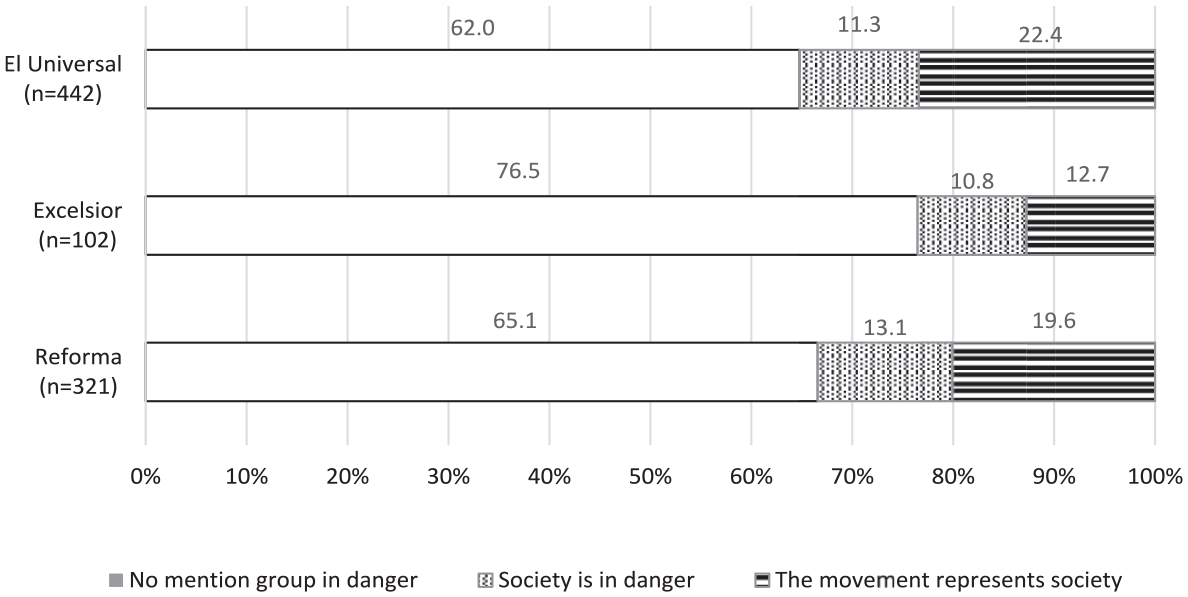
Society’s interests.
Insofar, the actors representing victims’ interests, the comparison between the movement and the authorities reveals a lack of trust in institutions, at least in this matter. Statements from the victims’ families being against the social movements or being helped by the authorities were not found (Figure 4).
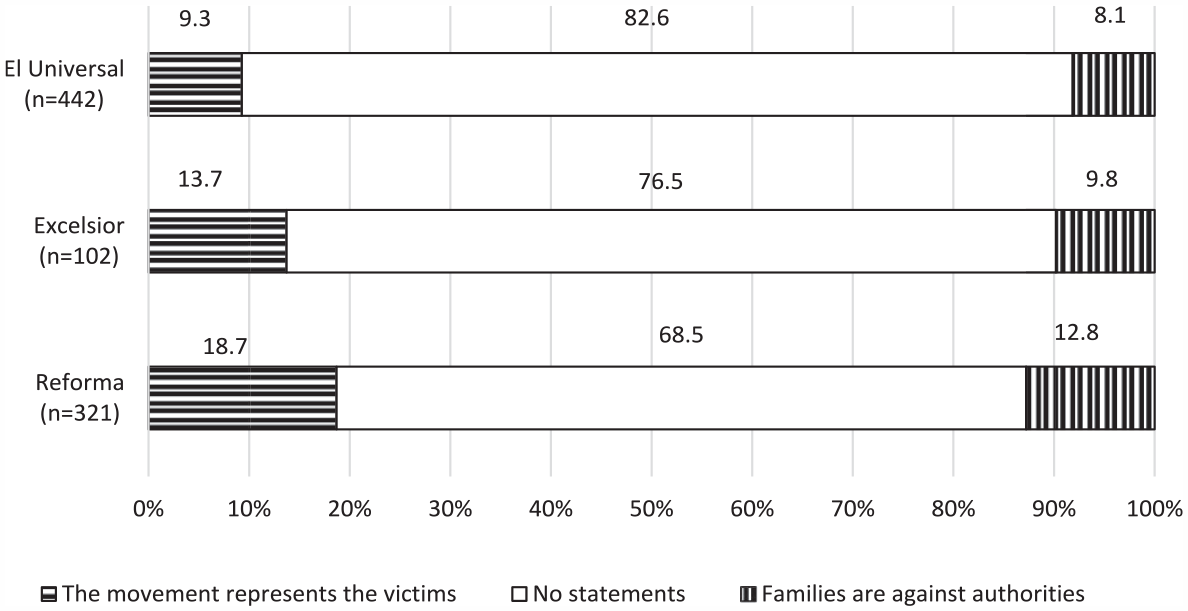
Victims’ interests.
The measurement of credibility (Figure 5) revealed that activists have more credibility than authorities. An average of 44.7% of the articles quoted activists as a source without mentioning any opposition to their version of the story. In comparison, for authorities, the average is 31.9%. Articles that contain different views (disagreement or different versions) of the same information, in the same or different articles and do not confirm the integrity of any version are 37% on average.
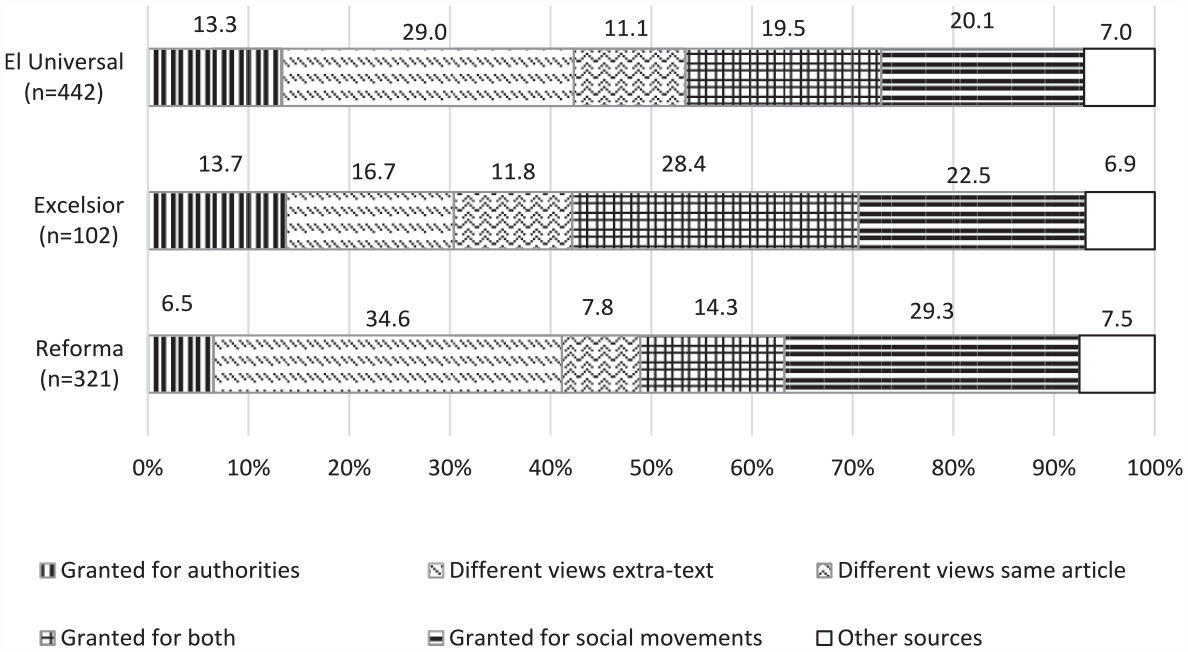
Credibility.
Figure 6 shows that there are no mentions of a lack of stability inside the movement; instead, it was registered mentions of internal conflicts between branches of the government, especially the attribution of responsibility to prosecution offices for misogyny and corruption.
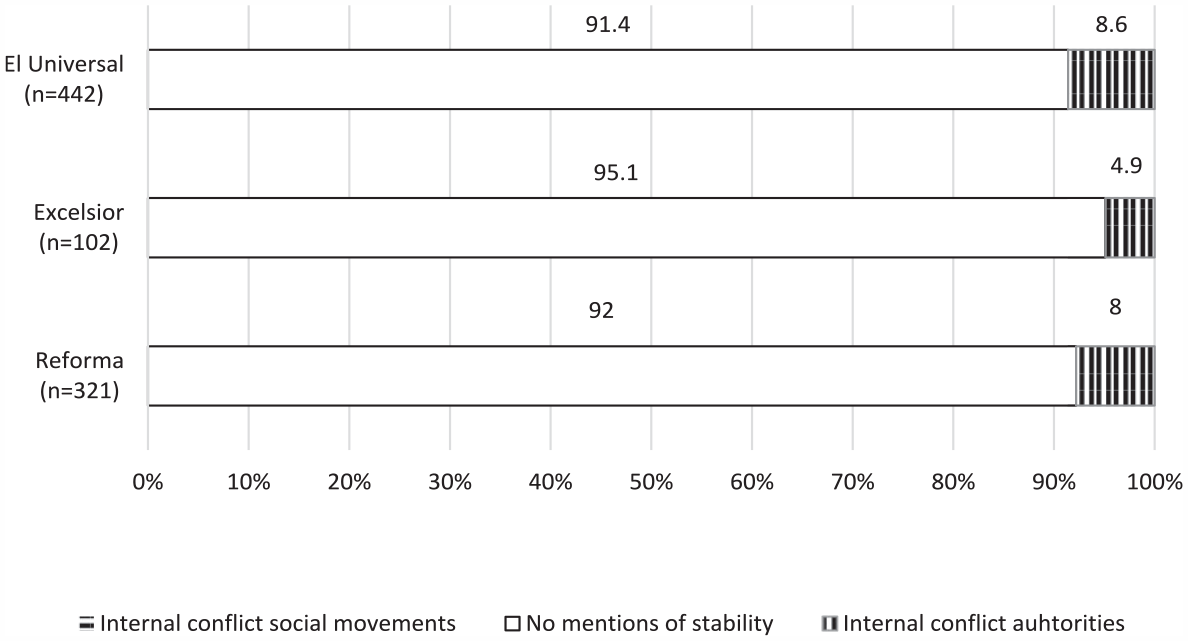
Stability.
The results reveal that the social movement is represented as a legitimate actor, credible, and with reasonable causes of existence that agree with social values.
Tone
H4 was refuted. The percentage of negative tone for the movement is zero (Figure 7); furthermore, it was found that their actions tended to be evaluated more positively than neutral. Contrary, the authorities’ tone tends to be negative, which can be surprising due to the authorities’ prominence as sources.
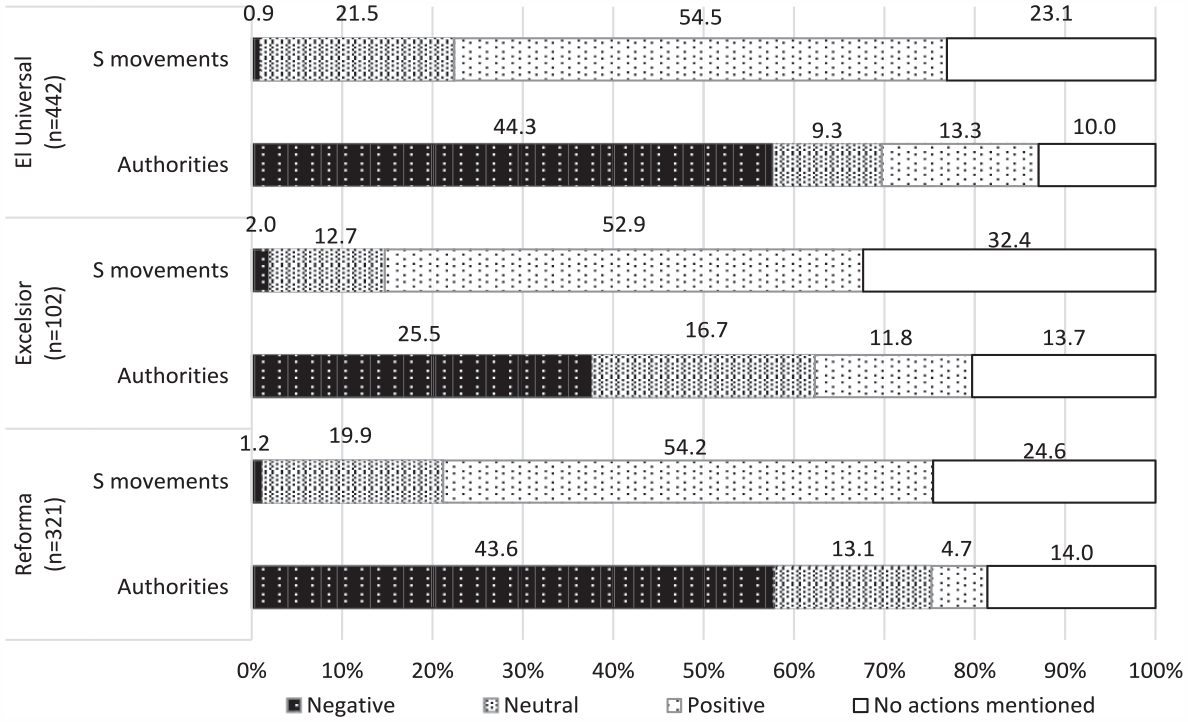
Tone.
Analysis
The media representation of the movement against femicide in Mexico evidences a complete opposition to the protest paradigm. The results show that the activists are the main source in this social movement-focused corpus, and even the official discourse is not used to delegitimize the movement as found before in Brazil (Mourão, 2019). The movement obtained visibility and credibility, avoiding any marginalization devices. The media in the study tended to portray a legitimizing representation of the movement and offered a whole set of angles to describe the issue. The above can contribute to creating a more functional discourse on the femicide issue with protestors having a main role in the political discussion. Almost half of the articles focused on the social causes of the problem, helping to expose its severity and suggesting that the movement’s claims are valid and necessary. The statistics of violent murders in the country demonstrate a high rate of generalized violence; however, the media attention was overtaken by femicide and increased through the years, benefiting the movement’s objectives (Gamson and Wolfsfeld, 1993). This work is not proof that the media attention to femicide is a direct achievement of the movement’s strategies, but it may be a major factor.
The results demonstrate that the journalists consider the activists worthy of being covered (Gamson and Wolfsfeld, 1993) and a credible source (Wonneberger and Jacobs, 2017), allowing place their interpretation of the problem in the public debate. The movement grassroots is composed of a multitude of civil organizations based in different cities across the country, having links with organizations in several countries (Belotti et al., 2021), and, many demonstrations are summoned by local individuals to highlight single cases. Still, this research did not register evidence of any internal conflicts or contradictions among the branches of the movement. The variable of stability may not appear relevant insofar as the movement due to its modest result; nonetheless, this may be one of the movement’s major achievements.
We found different views of the issue from different types of authorities. The prosecution offices are the most quoted, but their statements are contrasted with other sources (activists or authorities from different branches of the government) with opposing lectures on the problem. The findings suggest that there is not a single official discourse and the news outlets are not suppressing oppositional viewpoints as the paradigm suggests (McLeod, 2007). Governors, local mayors, and prosecutors are more likely to deny the social facet of the problem and its severity (Wright, 2011). The authorities in charge of gender policies, the Supreme Court, and other tribunals are more likely to agree with the social movement’s discourse, demonstrating a sort of alliance (Mourão, 2019). This contradiction may serve to diminish the credibility of the denial arguments. In addition, the emphasis on the conflict between political actors has contributed to the attribution of responsibility (de Vreese et al., 2001) to the authorities for the incapacity to solve the crimes, impunity, and human rights violations to survivors (Segato, 2014).
The tone for the movement was nurtured by self-representation, but also by opinions from journalists, GBV experts, academics, authorities, and the families of the victims. The participation of the victims’ families in the protests gives legitimacy to the movement and confers it a human face (Monárrez Fragoso, 2010). The families’ pursuit of justice also became the voice of the movement, a discourse that can facilitate an emotional response in the audience and generate empathy and agreement with the movement’s claims (Ashforth and Gibbs, 1990; Mondak, 1992).
Conclusions and discussion
The methodology proposed in this work demonstrated that measuring protest paradigm adherence is not enough for an in-depth examination of the media representation of social movements. Instead, a range of possibilities for each element of representation allows a more comprehensive investigation. This research demonstrated that considering the elite-media-movements relationship as an integral system provides a new analytical dimension and valuable socio-political context for the interpretation of the results. This theoretical contribution gives the possibility of comparison and can evidence that the detriment of one actor’s legitimacy can be beneficial for the other. To better understand the factors that contribute to creating media representations of social movements, it is fundamental to understand the social context and the relationship between the media and the political elite (Kim and Shahin, 2020; Shahin et al., 2016). There are two main similarities with the representation of another Mexican social movement on social media platforms, the tendency to mention the historical institutionalized corruption in the country and the media playing a role in disseminating the activists’ messages (Harlow et al., 2017). The evidence of both studies can represent the existence of a public demand for accountability of the government, which is a political force that can influence newsmakers to produce content that agrees with the audience’s interests, in this case, a more positive portrayal of the movement (Gil-Lopez, 2021; Harlow et al., 2017).
The results coincide with previous studies on the factors of deviation of the protest paradigm such as the cause propelling the protest being social (Wouters, 2015) and emotionally closer to the audience (Gil-Lopez, 2021), the low degree of challenge to the status quo (Mourão, 2019), and the unsound socio-political context (Shahin et al., 2016). On the other hand, the results revealed that the media ideological affinity suggested as a main factor before (Shahin et al., 2016), can be irrelevant to the deviation of the paradigm. The three outlets in the study followed a similar pattern for the representation of the actors, even though they are circumscribed to different ideologies.
The media analyzed in this work focused on the issue—the femicide crisis—more than on the demonstration events, found before in the coverage of protests in Belgium (Wouters, 2015). Nevertheless, the present results are not necessarily evidence of responsible reporting. In a previous study (Aldrete, 2023) on the representation of the victims and perpetrators in the same outlets, we found critical percentages of victim-blaming, perpetrator-justification, sensationalism, and otherization of the individuals involved. Relying on stereotypical representations based on socio-demographic characteristics, suggesting poverty, ethnicity, country of origin, occupation, or low academic education as the causes of the victims’ and perpetrators’ ‘bad decisions’. The present work also registered the use of sensationalist aspects of the femicide issue such as the human suffering of the families, the conflict between actors (protestors and authorities, and between authorities) and the narrative of increasing danger and urgency found by other studies on femicide news (Boonzaier, 2022; Monárrez Fragoso, 2010). In addition, the measurement of the group at risk shows that is mainly described with socio-demographic characteristics, especially living in a specific geographic zone. As many protests were related to claims of security in these zones, we interpreted it as ‘the protests represent society’. Nonetheless, the audience could have a different lecture, relating those zones and those protestors to a part of society defined by violence and social problems (Aldrete, 2023; Boonzaier, 2022; Brodie, 2021).
Studies demonstrated that femicide has technopolitical power to mobilize protestors to an international level (Belotti et al., 2021) and even influence changes in the authorities and media discourses by denouncing symbolic violence through social media (Gutiérrez Aldrete, 2022). Therefore, sensationalist reporting as an increasing danger to society and transmitting urgency can be a more attractive perspective for journalists (Feldman et al., 2017), other than emphasizing the affectations of the protestor’s behaviors which could backfire with social media users.
Within this context, is not possible to assert if the positive coverage of the social movement is a product of the movement’s strategies, journalists’ ethics, or a business-like decision to nourish drama and conflict around the humanitarian crisis, which may be used as newsworthiness and share-worthiness criteria (Trilling et al., 2017). There is still a lot to be done, but the legitimizing portrayal of the movement and maintaining the issue on public attention must be considered achievements on the path to abolishing GBV normalization in society (Gutierrez Aldrete, 2022).
I consider that the methodology proposed in this work can be used to analyze the representation of other social movements, especially those with transnational affinities. Research on transnational online mobilizations against femicide in Latin America found shared strategies and similarities in resonance and policy influence (Belotti et al., 2021). The political context is relevant for the media to choose how to portray protestors and would be interesting to investigate how mainstream and alternative media from Latin American countries and other different contexts portray activists against femicide.
The social movement obtained visibility in the media, but this work did not focus on testing the resonance of the movement discourse which is suggested as a focus for future research. Another research opportunity is to study the possible effects that the legitimizing portrayal of the movement in the media has on the audience and the political arena, which could demonstrate an effective advance to a more functional discourse on the issue and the eradication of GBV.
Protests against femicide and GBV violence are becoming more frequent worldwide. The findings of this research could be a gate-opening for the understanding of an international movement and its interactions at a social, political, and historical level.
Footnotes
Declaration of conflicting interests
The author declared no potential conflicts of interest with respect to the research, authorship, and/or publication of this article.
Funding
The author received no financial support for the research, authorship, and/or publication of this article.
