



Abstract
Syed Farid Alatas is a Malaysian sociologist who has been highly influential in discussions about decolonising knowledge. He has also continued the legacy of his esteemed father, Syed Hussein Alatas, by furthering ‘the School of Autonomous Knowledge’ in the Malay Archipelago and beyond. This article presents a wide-ranging, comprehensive and rich dialogue between Farid and Leon Moosavi. In this conversation, pertinent questions are asked: How does Farid’s approach to decolonising knowledge differ from other decolonial scholars? What exactly does Farid mean when he talks of ‘intellectual imperialism’, ‘alternative discourses’ and ‘academic dependency’? This dialogue also explores Farid’s extensive engagement with the Islamic/Muslim sphere, including topics such as: Ibn Khaldun, Muslim revivalism, Muslim sectarianism and the Islamisation of knowledge. The discussion also explores some potential critiques of Farid’s intellectual contributions with challenging questions: Can Farid’s theoretical ideals be applied in ‘the real world’ or are they confined to an audience of intellectual elites? Is Farid anti-Western? Or, actually, does his work inadvertently fall into the trap of Westerncentrism? This article offers a unique insight into the intellectual biography of one of the most notable social theorists of the current era.
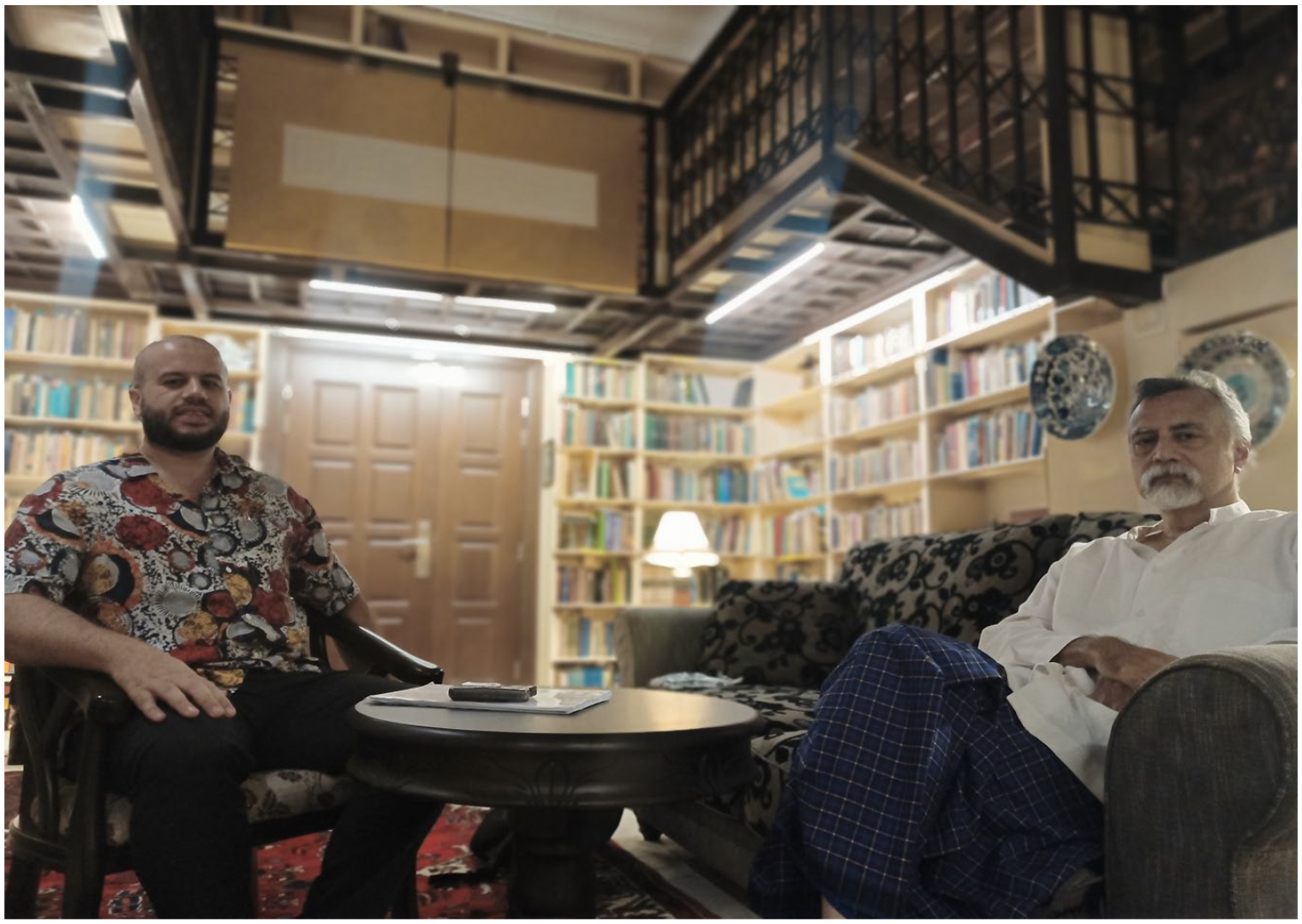
Professor Syed Farid Alatas and Dr Leon Moosavi just after completing the 3 hour 43 minute conversation. The photo was taken at 1:17am on 28th June 2022 in Farid’s library at his home in Kuala Lumpur, Malaysia.
Introduction
Syed Farid Alatas is a Malaysian sociologist, who was born in the Netherlands in 1961. He is the son of Syed Hussein Alatas, the legendary Malaysian sociologist and Sarojini Zaharah Alatas, an accomplished freelance writer, broadcaster and environmental activist. He is also the nephew of Syed Muhammad Naquib Al-Attas, a highly regarded philosopher. Farid belongs to the al-Attas clan and the Ba’alawi Sufi order, both of which have their historical origins in the Hadhramaut region of Yemen. Farid holds a Bachelor’s degree in economics from the University of Oregon (1984) as well as a Master’s degree in sociology from John Hopkins University (1988). He also completed his PhD in sociology at John Hopkins University in 1991, and soon after, in 1992, Farid was employed by the National University of Singapore (NUS). Prior to that, he lectured at the University of Malaya in Kuala Lumpur, Malaysia, from 1990 to 1992. He remains at NUS today where his current designation is Professor in the Faculty of Arts and Social Sciences. He is also a Visiting Professor at the University of Malaya in the Department of Anthropology and Sociology. In the last four decades, Farid has delivered hundreds of speeches and presentations in various academic and public fora around the world. He has also taught thousands of students. His intellectual legacy resides within the large number of books, articles, chapters, reports, reviews, proceedings and op-eds that he has authored over the years, including notable works, such as: Democracy and Authoritarianism in Indonesia and Malaysia: The Rise of the Post-Colonial State (Alatas, 1997), Alternative Discourses in Asian Social Science: Responses to Eurocentrism (Alatas, 2006a) and Applying Ibn Khaldun: The Recovery of a Lost Tradition in Sociology (Alatas, 2014). Most of Farid’s writings are in English, while some are in Malay. Several of his works have been translated into various languages, including Arabic, Chinese, French, Indonesian, Persian, Portuguese, Spanish, and Turkish, some of which are languages that Farid is conversant in. Among all his editorial duties, Farid has notably served as the Editor of the Asian Journal of Social Science between 2001 and 2009. Farid remains a source of intellectual inspiration for many in the scholarly community and beyond, especially in relation to his analytical abilities, his passionate commitment to furthering understanding, and his willingness to give his time to the next generation of thinkers and activists. Perhaps more importantly, he undertakes this with a compelling mixture of warm hospitality and witty sarcasm.
Farid’s expertise in social theory, the sociology of knowledge, and the sociology of religion resonate closely with the current intellectual climate. More specifically, Farid is widely celebrated as a pivotal figure in the increasingly popular discussions about decolonising universities. This ‘decolonial turn’ (Moosavi, 2023: 138) has sent shockwaves through academia and academic disciplines in recent years, prompting uncomfortable examinations of the role that universities have played and continue to play in furthering colonial legacies, such as Eurocentrism and racism. In less than a decade, there has been a major expansion of scholarship that examines what universities, and those who belong to them, can do in relation to research, teaching, and other dimensions to not only avoid reproducing coloniality, but to even dismantle it. Crucially, these conversations are expanding in both the Global South and the Global North given that universities in both spheres often remain stained by colonial inequalities and injustices. Alongside the popularisation of calls for epistemic decolonisation, there is also an audible dissatisfaction being expressed about the way that many iterations of epistemic decolonisation remain superficial, tokenistic and imbued with empty promises. In fact, while the growth of discussions about epistemic decolonisation provides hope to those of us who are passionate about furthering decoloniality, for some of us, it also generates fears that it all amounts to little more than an ineffective and problematic ‘decolonial bandwagon’ (Moosavi, 2020). As someone who has been committed to robust and erudite interrogation of these matters long before the decolonial bandwagon emerged, Farid’s scholarship about academic knowledge production remains an essential component of all serious discussions about epistemic decolonisation.
In relation to this, Farid has spent much time addressing the legacy of the colonial era within knowledge production, describing this as ‘coloniality without colonialism’ (Alatas, 2020 (1971) 12). Thus, he has long criticised the Western dominance of knowledge production and the ‘academic dependency’ on Western ideas and practices which is found in the non-West. As is evident in Farid’s comments about ‘hegemonic orientations’ in the interview below, Farid often understands this domination/subjugation through the lens of ‘hegemony’, which is perhaps indicative of the parallels that run between his analysis and a Marxist dissection of social hierarchies (Alatas, 2012: 209). In response to the inequities that he identifies, Farid has been explicit in his desire to ‘agitate for a kind of intellectual movement that would eventually result in an autonomous tradition of the social sciences’ (Alatas, 2010: 61). In recent years, Farid has stated that this tradition, which he refers to as ‘the School of Autonomous Knowledge’, has actually been blossoming for several decades in the Malay Archipelago even though the school, and its founder Syed Hussein Alatas, have often been overlooked (Alatas, 2018, 2022). It is this School of Autonomous Knowledge that is the focus of much of the interview below in which Farid expands upon what it is, why it is necessary, and what it can achieve.
Farid’s project is routinely underpinned by a search for ‘alternative discourses’, which he locates in non-Western social theory. In particular, his detailed engagement with the neglected social theory of Ibn Khaldun 1 , and his attempt to develop a ‘neo-Khaldunian sociology’, has earnt him recognition as one of the world’s leading experts on Ibn Khaldun (Alatas, 2006b, 2007, 2014). Farid has also written about other exemplars of non-Western thought, such as Ali Shariati 2 (Alatas, 2005), José Rizal 3 (Alatas, 2009, 2017) and Al-Biruni 4 (Alatas, 2019). Farid has often stated that this sort of non-Western social theory should be incorporated into social science textbooks and teaching curricula (Alatas, 2006b: 790, 2010: 70, 2014: 153). True to this aspiration, Farid has documented how he has co-taught courses that seek to ‘decolonise the social sciences’ and arrive at a more ‘multicultural sociology’ (Alatas and Sinha, 2001: 316–317). This does not only involve introducing non-Western social theory into curricula, but also revisiting Western social theory from an angle that prioritises their relevance to the non-West. Farid has also co-authored one of the most important decolonial textbooks, Sociological Theory Beyond the Canon, in which he and his co-author seek ‘to introduce non-Western social thinkers with the aim of universalizing the canon’ (Alatas and Sinha, 2017: 6).
At the same time as being a proponent of academic decolonisation, Farid has avoided any sense of reactionary nativism by recognising that Western social science can still be relevant for the non-West. Thus, he has stated: To the extent that the internationalisation of the social sciences requires a plurality of philosophical and cultural expressions, the calls for autonomous social science around the world must be seen as an effort to resist, but not replace, the dominance of Euro-American voices (Alatas, 2005: 177).
Beyond the potential for decolonisation to be nativist, Farid has also warned about other potential excesses of the decolonial movement, such as decolonial alternatives being tainted with Westerncentrism or extremism (Alatas, 2019). Farid has also drawn attention to the way in which the decolonial movement can result in non-colonial forms of hegemonic domination being overlooked, such as that based on androcentrism or sectarianism, which recently led him to conclude that what is needed is ‘a broader project than that of decolonisation’ (Alatas, 2022: 7). Farid expands upon this notion in the below interview.
The following conversation took place on the night of 27 June 2022 in Farid’s library at his home in Kuala Lumpur, Malaysia. At the time, I had known Farid for 9 years and spent much time with him in professional and informal settings in Singapore, Malaysia, Indonesia, South Africa, and Iran. The conversation lasted for 3 hours and 43 minutes without interruption. The transcript below has been checked by myself for accuracy against the original recording. It has also been approved by Farid. I have delicately edited the transcript for coherence and brevity but the precision of the conversation has been retained throughout. The conversation was split into two equal parts. In the first part, the conversation focused on Farid’s theoretical contributions. In the second part, the conversation took a more personal direction in relation to Farid’s individual scholarly journey and the lessons he can share from it. The transcript below captures the first part of the interview and the second part will be published in a forthcoming edited book, which is provisionally entitled ‘Revisiting the Social Theory of Syed Farid Alatas’ (edited by Dustin J. Byrd and Seyed Javad Miri, Brill, 2024). In that chapter, readers will find more elaborate discussions about topics, such as: how Farid’s family have influenced his intellectual journey, how travel and socialising inform Farid’s thinking, how Farid’s ancestry and spiritual lineage converges with his identity as a scholar and, more generally, how Farid has successfully navigated a long career in academia. In this first part, the focus is on Farid’s intellectual biography and the significance of his scholarly interventions in contemporary sociological conversations.
– Leon Moosavi
I’m interested in a few areas and one of those areas is more theoretical, or even meta-theoretical, because it’s about knowledge production. It doesn’t involve me producing knowledge about substantive areas. It’s about reflecting on knowledge production itself. So, it would be in the area of what they call meta-theory and this has to do with the problems of hegemonic orientations and how they affect knowledge creation in the Global South. In most of the world, both the North and the South, the main hegemonic orientation that is discussed is Eurocentrism or Orientalism or what is more recently referred to as ‘coloniality of knowledge’. And I’m interested in that but I’m also interested in other hegemonic orientations that may or may not be related to colonialism or Eurocentrism but often predate colonialism by centuries, orientations, such as androcentrism, traditionalism, ethno-nationalism, sectarianism and so on. So, I’m interested in how these hegemonic orientations affect knowledge production at the level of theory, at the level of methodology and even at the level of politics because these orientations have consequences beyond academia. I do have a couple of other substantive areas that I’m interested in. One of them is Ibn Khaldun. Let’s just say more broadly, historical sociology of Islam. And I’m also interested in the study of Muslim revival movements, Muslim ideologies. And finally, I would say inter- and intra-religious dialogue.
It’s theorising about theory. Looking at the metaphysical, the ontological, the epistemological, and the methodological underpinnings of theory. Also, looking at the history of theory. So, I think it refers to any kind of reflection about theories, rather than the actual theorising itself, or rather than the application of theories to empirical cases.
As scholars, as people who produce knowledge, we should be as independent or autonomous as possible. This is a term that was actually used by my father too 5 . He spoke of the need for an autonomous social science tradition. As agents of knowledge production, we would want to be as autonomous as possible in the sense that we want to engage in the selection of topics that seem to be relevant to our own surroundings. We don’t want to imitate research agenda that are developed elsewhere. When it comes to theory building and concept formation, we need to be aware of the need to produce theories and concepts that are relevant, that emerge from our own surroundings, our own traditions and that are relevant to the understanding of our problems. And we also must be rooted in the moral concerns of our own communities. It could be an ethnic community, a national community, a religious community, but we must be relevant to our surroundings. That’s what I would say is meant by being autonomous. You can’t be autonomous if you are dominated by other orientations which would cause you to select or formulate research agenda that aren’t relevant to the problems of your own society or community, which force you, unknowingly perhaps sometimes, into applying concepts that result in the distortion of your reality or which result in you neglecting concepts from other traditions that actually may be relevant to your study.
Meta-theory, of course, is abstract. We engage in abstractions because we are, after all, talking about theory and assessing and critiquing theory. But it’s necessary in order to understand the problems. For example, we are engaging in meta-theory when we try to understand the variety of hegemonic discourses, the hegemonic orientations, how they affect theory building and concept formation and how they result in constructions of reality that are, in any number of ways problematic. Now that might seem very abstract but this kind of analysis often does tell us about what is happening on the ground and how we can actually intervene. Let’s take the example of one hegemonic orientation, sectarianism. I’m referring specifically to anti-Shi’ite discourse in Malaysia 6 . So, it might seem as a very political issue, you know, the weaponisation of anti-Shi’ite sentiments in order to gain political legitimacy, as is the case of Malaysia. But, apart from the political interests involved, the problem also stems from a dominant hegemonic orientation that we call sectarianism. And this orientation is so strong that it is not seen by the people who are affected by this orientation as one among other orientations. It is seen as the perspective, the correct view, it is seen as reality. So, it is important to take apart that hegemonic orientation to show that it is just one among various orientations that exists in the Sunni world. It changes the politics by way of saying to Sunnis, not just scholars, but also religious leaders and politicians, that the proper original Sunni orientation has been open towards Shi’ism. So, you can see how a seemingly esoteric issue about hegemonic orientations, a seemingly historical issue about the origin of these ideas, actually has very important political implications.
To make this a little bit more systematic, why should we be interested in hegemonic orientations? I’ve explained earlier that it’s because they take the autonomy of thinking away from us. Nobody wants to be dominated. We want to be influenced by all kinds of ideas but we don’t want to be dominated by ideas which results in the exclusion of other ideas. Now, why should we be interested in other perspectives and in other orientations? I see it in terms of three reasons – there’s a theoretical reason, there’s an aesthetic reason and there’s a political reason. The theoretical reason is that the sources of theories and concepts go beyond the West and this should be obvious to anyone. Now, it’s simply being stubborn, and closed-minded, not to consider the possibility of generating concepts from the philosophical traditions, from the religious traditions, from the everyday life, of non-Western societies. How ridiculous it is to not be interested in these traditions as sources of ideas in the same way that a good chef is interested in all geographies as sources of herbs and spices. No good chef, anywhere in the world, confines himself to the herbs and spices that are available in his own backyard or in his own geographical region. There’s also an aesthetic reason. Quite apart from the issue of the need to have cogency and precision and therefore to identify valid theories and concepts, there’s simply the issue of aesthetics, that it’s interesting to consider other ideas from thinkers and traditions that we’ve never been exposed to. And there’s a political dimension in the sense that we need ideas to change our circumstances. So, for example, we talk about ecology, we talk about sustainable development and it is obvious to many people that Indigenous knowledge in terms of how to deal with the environment in a sustainable manner is crucial.
It started as an aesthetic quest. When I was a teenager, I was just fascinated with Ibn Khaldun simply because it seemed to be something so different. I was just intrigued by the possibility of there being thinkers outside of the West because growing up as a boy, and due to the nature of the curriculum in school, due to the predominance of Western, especially American culture through television, we saw the West as a superior civilisation. Of course, I got strong doses of anti-colonialism in the house because my father was an anti-colonial scholar and that made a lot of sense to me. But I would have to say it was aesthetic in the beginning. It was just fascinating to think that there was a whole different world of ideas that was interesting to read. It’s only much later on, when I started to study in university that I began to think that one should figure out the theoretical efficacy of these non-Western thinkers like Ibn Khaldun. It shouldn’t simply be a matter of interest that there was a thinker who lived 600 years ago, which is itself interesting, but can one construct a theoretical framework from his works? Can one apply them empirically?
I have to say that I don’t talk much about androcentrism. I often mention it but it’s really my colleague Vineeta Sinha 7 who speaks at length about androcentrism. So, I really don’t take any credit for that. But it is true that I’ve, up to now, spoken more about Eurocentrism than any of the other hegemonic orientations. But the ‘School of Autonomous Knowledge’, which was founded by my father since the sixties, has been dealing with all the orientations. It’s my intention also, in the next years, to go more into orientations like traditionalism and sectarianism, and to show, while they may sometimes be related to Eurocentrism, they are distinct hegemonic orientations which also predate Eurocentrism. I think it’s necessary to be aware that there are hegemonic orientations that are problematic beyond Eurocentrism. The discussions in the world today on decolonisation, for the most part, tend to operate on the assumption that there’s one main problematic orientation, which is coloniality, or neo-colonialism, or Eurocentrism, whatever they may call it, which I think is not accurate. In the School of Autonomous Knowledge, we have a more nuanced understanding of the problem of knowledge hegemony.
Yes, I mentioned, in fact, earlier, ethno-nationalism. The idea of Malay supremacy in Malaysia, perhaps Javanese nationalism, and Hindutva, a movement in India. Yeah, so definitely there are.
Yes. Some people might say that these are all entangled with colonialism and Eurocentrism. To some extent, that is true. For example, sectarian differences were weaponised by the US in the context of the war in Syria. Nevertheless, sectarianism predates Eurocentrism. The same thing goes for androcentrism. In the colonial period, colonial scholars and their orientations were not only Orientalist, but also androcentric. But androcentrism is not rooted in colonialism, it predates colonialism by centuries. So, that’s why we need to recognise the complicated nature of knowledge production. And my feeling is that there’s a resistance to thinking this way because a lot of people are invested in the project of decolonised knowledge as if the central problem is the coloniality of knowledge.
No, on the contrary, I admire the Western knowledge tradition. I’m anti-Westerncentrism, I’m anti-Eurocentrism. In fact, one has to critique Eurocentrism and Westerncentrism in order to salvage what is valuable from Western civilisation. I mean, to give you a specific example, much of what is in Marx is relevant, but to make that clear you have to separate out the Eurocentric/Orientalist aspects of Marxism. So, in other words, it’s like saying that we need to save Marx from himself if he is to remain relevant to us.
I think that to some extent there’s a tyranny of terms which gets us entangled with all kinds of arguments and debates. Any term we use would be problematic. We need to understand them as heuristic devices. So, we need to be clear that it’s merely a way to refer to a particular position without taking the geographical reference literally. For example, when we talk about ‘the West’, we don’t mean the whole West. When we speak about ‘Western hegemony’, Portugal is not a hegemonic producer of knowledge in the social sciences, Hungary is not a hegemonic producer of knowledge in the social sciences, and many countries in the West are not. So, we’re really referring to specific, what we might call ‘knowledge powers’, which today is America and the United Kingdom. So, when we say West, we don’t mean the whole geographical West. So, as long as we are clear about that, I think it’s fine. We need to use terms.
Well, I use the term ‘alternative discourses’ to refer to discourses that see themselves as providing alternatives. When I first started to use this term more than 20 years ago, I had in mind by ‘alternative’, alternatives to Eurocentrism. I think more recently I began to realise that the alternatives are not only alternatives to Eurocentrism but also to other hegemonic orientations and, therefore, the proper quest for alternative discourses is the quest for autonomous knowledge.
The idea of autonomy in the phrase ‘autonomous knowledge’ is an analytical category in the sense that it’s referring to relative independence. It’s speaking about a break from hegemonic orientations. It’s referring to the critique of hegemonic orientations. It’s referring to a break from hegemony while retaining the influence of various sources. So, for example, we are against Eurocentrism as a hegemonic orientation but we’re not against Europe. So, the idea is that we remain influenced. But no, there’s no total independence. There is autonomy but there’s also influence.
No, no. They mean the same thing but when you talk about autonomy then we have to define what we mean, that it is not a break from, say, the West. It is not a break from any of the knowledge traditions but rather a break from hegemonic orientations. So, it is autonomy rather than independence because independence implies a break. But when we ask: ‘What is the nature of alternative discourses ?’, then I would say it’s autonomy. So, autonomy defines the nature of alternative discourses.
In my work, I’ve been interested in the hegemony of ideas and also the structure of knowledge creation within which hegemonic orientations exist. And that structure is the structure of what my father referred to as ‘intellectual imperialism’ or ‘academic imperialism’. Meanwhile, I became interested in academic dependency. Some people think that they refer to the same phenomenon but I think they are different things because intellectual imperialism refers to a structure of domination of one social science tradition or community over another. In our case, the social sciences were introduced in much of the Third World during the colonial period and there continues to be an unequal relationship between social science communities and the knowledge powers of the West and the rest of the world. But in my way of thinking, we may be in a state of intellectual imperialism and not necessarily be academically dependent. For example, the dominant institutions, the publishing companies, the international ranking system, and so on, are all there and we work and live within those structures. But whether you are conscious of these structures, and seek to work against these structures, and try to be as autonomous as possible from these structures, is another matter. You may be living and working in a state of intellectual imperialism where all the books, the articles, the textbooks, are American, for example, and you are expected to teach that, but do you have a dependent mind where you’re dependent on these ideas, or are you able to think in a way that’s autonomous from the structure? Being subject to intellectual imperialism doesn’t necessarily mean that you’re academically dependent.
Yeah.
Yes, exactly.
Yeah.
The ideal situation is that our governments, our university leadership, pulls us away from this imperialistic structure of knowledge production. In other words, they insist on rigour, they insist on high standards, but not within the structure of intellectual imperialism. But that’s not going to happen. It’s unlikely. Therefore, we have to work within the structure of intellectual imperialism. I can’t give an answer that would suit everyone because our contexts are all different but in many universities there is sufficient autonomy for the individual lecturer or researcher to be his or her own person. So, if you are nurtured within a structure of intellectual imperialism, you would tend to, for the rest of your life as a lecturer, teach Marx, Weber, and Durkheim. But the university doesn’t force you to do that. In fact, Vineeta Sinha and myself, we chose to do otherwise. We included Marx, Weber, and Durkheim but in a critical manner. And we also included women and non-Western thinkers. If only people were more open-minded, more creative, rather than captive minds, and more aware of the context of intellectual imperialism, they could do a lot in terms of moving away from academic dependency.
I think that’s a kind of utopian thought. I don’t think it’s very helpful because the university is too important to abandon. People require the university to get their degrees and to get jobs and have their careers. It’s a very influential means of knowledge production. That is not to say that we don’t engage in intellectual production outside of universities. That is also necessary to do at the same time, to continue with work outside, such as in reading groups, for example.
Well, it’s an old school with a new name. It is a school of social sciences in the sense that it has a founder and the founder had students who became scholars who continue to write and research along the lines of the tradition started by the founder. And the students themselves, who became scholars, have students who are also writing and researching along these lines. There is decades of scholarship and student works along the lines of this tradition, which, as I said earlier, aims to recognise the importance of various hegemonic orientations and to critique them. In that sense, it is a school of thought, much like the Chicago school, or the Frankfurt school. You have scholars like Shaharuddin Maaruf, Chandra Muzaffar, Pradana Boy Zulian, Azhar Ibrahim and Noor Aisha Abdul Rahman. And then in terms of the younger generation of students who are now doing their Masters and PhD degrees, you have them from Indonesia, Malaysia and Singapore. It originates with the thought of Syed Hussein Alatas who was an anti-colonial thinker and who was engaged in the critique of colonial knowledge and the construction of what today would be called decolonial knowledge. It starts with him but he himself had influences and I think a major influence on his thought, and this is not known to a lot of people, was the Dutch school of critical social history. When my father studied at the University of Amsterdam, one of his professors who was an important influence on him was Willem Wertheim, one of the very few anti-colonial social scientists in the Netherlands. His mentor, Jan Romein, the Marxist Dutch historian, was also anti-colonial and he was also an important influence on my father. That can be said to be part of the prehistory of the School of Autonomous Knowledge.
Yes, it’s not only not anti-Western but it’s significantly influenced by the West. So, another important influence on my father as well as other members of the school is Mannheim, his framework of evaluating knowledge from the perspective of the sociology of knowledge.
First of all, it’s not solely Western because it pays significant attention to non-Western ideas, not only as objects of study, but as perspectives. My two books on Ibn Khaldun are not talking about Ibn Khaldun as a sociologist but doing sociology through him. I integrate concepts from his theory with those of Marx and Weber. Other members of the School of Autonomous Knowledge do the same with thinkers from the Malay world. My father himself founded specific concepts that are rooted in the Malay language like his concept of bebalisma 8 . So, it’s not correct that we’re overly dependent on Western knowledge. But secondly, I would say that drawing from Western knowledge is not the problem. It’s dependence which is the problem. Dependence has to do with the concepts that you use resulting in a distortion of reality or taking you away from certain problems or concepts from your own tradition. But if the ideas from Western tradition work, help you to be critical, to expose problems, then what is the problem? Why should there be a problem of taking Western ideas?
Yes, definitely.
Yes. I think that’s a good point to make. The Dutch school had an influence on my father developing an entirely new school of thought which incorporated Western ideas, such as Mannheim, but it was also influenced by non-Western thinkers. I think José Rizal was a significant influence on my father’s anti-colonial thinking.
I think this is a school of thought that has emerged in the Malay world that originates in the Malay world.
Definitely. I’m certain that in other parts of the world there is also the problem of lack of autonomy in knowledge creation.
I think Syed Hussein Alatas is well known and recognised but many of the people who recognise him are not aware that over the 60 years since he started his academic career, during those decades, it was not just him, it was his students who became scholars in their own right and that there is a school. I think that is often not known. But I think the awareness that there is a tradition that’s not confined to my father that goes beyond my father, is slowly developing now.
I think many of us were preoccupied with our own individual projects for many years. And others in the region, for the usual reasons that have to do with intellectual imperialism, they were preoccupied with the outside influences. So, Latin American decolonial thought gets consumed in America and then exported to our part of the world. Postcolonial theory is exported to us from the United Kingdom and from the United States. So, we lose sight of the fact that we have our very own tradition of thinking. It’s ironic that even the recognition of our school is subject to the constraints created by intellectual imperialism. But about 10 years ago or so, the Filipino award-winning journalist, John Nery, wrote a book on José Rizal and it took him beyond the Philippines. He was interested in my father’s work and he noted what he refers to as ‘the Alatas tradition’. He talks about genealogy, starting with Rizal and my father as a part of that genealogy and then the students of my father. He was one of the few who recognised it as a tradition. And more recently, I began to read about the recognition of W.E.B. Du Bois as having founded a school, ‘the Atlanta school’. It wasn’t seen as a school during Du Bois’ time but they are now recognising it as a school that even started before the Chicago school. That made me think about whether the tradition started by my father can be thought of as a school and I think it can.
I think there would definitely be points of commonality between different traditions. For example, decolonial thought pays a lot of attention to Indigenous knowledge and I think the way they do that and how they frame the problem is very important for us because I think the autonomous school hasn’t had much to say about Indigenous knowledge which I think is a problem. We really haven’t gone into that, which we should. In other words, there’s a kind of internal colonialism that’s going on. So, we need to recognise that and we also need to recognise the importance and the efficacy of Indigenous knowledge for the way we organise our political economy, for the way we organise our ecology, for example.
I think the School is obviously influenced by my father’s work but I feel the influence of his work has been more his anti-colonial thought rather than his thought that’s more along the lines of reconstruction. So, for example, little attention is given to his work on corruption and the critique of political economy, the critique of the state. So, we critique colonial knowledge, we critique knowledge production, but there’s also the work of reconstruction, how to organise our contemporary society. And in terms of his programme, my father’s programme for the future, he was socialist. One of his important works was on Islamic socialism 9 . So, we’ve also not paid sufficient attention to the programmatic dimension of the School.
Well, yes, partly, but even as far as diagnosing the problem is concerned, we tend to be more concerned with the problem of knowledge production and less with political economy, but political economy is a very important part of my father’s work. So, people tend to see more of his work that criticises knowledge production but the sociology of corruption was major for him. It was the curse of the post-colonial state. But, there isn’t much work done on him in terms of that, his focus on corruption.
Definitely. I think I inherit that from my father. He believed that there was a great deal of agency on the part of the colonised, or the formerly colonised, and that agency was not made use of. He was critical of this enthusiastic willingness to be colonised, for the mind to be colonised, to be a captive mind. It’s not merely structural determination. So, there is a lot of blame, especially when there are people, scholars and others, who are pointing out these problems. It’s not that there’s no awareness and recognition of the problem of intellectual imperialism or mental captivity. There are many examples of important personalities who have gone against it, who swam against the tide and went against the grain. So, no one can say that we don’t know about these things. In the discussion on decolonising universities in Malaysia, many people enthusiastically discuss the problem and critique coloniality, but what is almost totally glossed over is the fact that many problems of the local university are not due to intellectual imperialism or Eurocentrism, but due to maladministration, due to unethical practices on campuses, due to over-bureaucratisation. This cannot be blamed on Eurocentrism. The people who critique, who talk about the need to decolonise the university, don’t talk about the internal problems that we have, which are very severe.
I think there’s still a lot more work left to be done on Ibn Khaldun for so many reasons. He’s an exemplar for non-Western social science and theory. So, for that reason alone, we should be interested in him. The work of constructing a modern social theory from his work is still not done. I’ve tried to do a bit of that in my own work but there’s still a lot more that has to be done, such as developing sociological concepts from his work, looking at how they were used in his own context and also looking at how they are relevant to our context today, not only for the Muslim world, but outside the Muslim world. All that work remains to be done. And beyond that, integrating modern Western social science into his theory with a view of developing neo-Khaldunian social theory. This is not something that can be done by one person. It has to be done by several individuals working either alone or together over decades. This is how you get a tradition. So, if a Khaldunian school of sociology, or at least a neo-Khaldunian theory was to emerge, it can only come about as a result of decades of work.
I think he was definitely distinct for his time. The way he picked up on the importance of understanding the nature of society in order to understand history. So, in a sense, his goal was to understand history, but he created a whole new science in order to do that, what someone referred to as an ‘auxiliary science’. So, his science of human society was an auxiliary science in order to understand history. He may not have realised it but that science that he envisaged would later on become a separate science in Europe, not simply a tool to study history, but a science in its own right. So, I think this was amazing, what he did, which doesn’t mean that we should idolise him. All I’m saying is that there’s a lot more work to be done on him and that he is one of the exemplars for a modern non-Western social science. But there are many others which we need to look at. In our own region, in the Malay world, someone who’s been very much neglected as an exemplar for social sciences is José Rizal. The other is Raden Adjeng Kartini 11 , the Javanese aristocrat who had original ideas, but until today, there’s hardly been any work that attempts to construct social thought from her writings in a systematic manner.
I have to admit that I haven’t done much on this. I have a few publications. It also ties in with my work on sectarianism. But the concern really is with understanding and interpreting Islamic sources to develop an orientation that is progressive for Muslims today. We have many orientations among Muslims, some of which are progressive, some of which are very regressive. Again, there’s the influence of my father. He started a newspaper that was in print for about two years in the Netherlands when he was a student called Progressive Islam. Of course, the idea is not to say that there is a regressive Islam, but rather to emphasise the progressive nature of Islam. The purpose was to develop discourse around various issues affecting Muslim societies and how we could think about these issues in a constructive and progressive manner. And in fact, the regressive interpretation of Islam is to a great extent due to the hegemonic orientation that we call traditionalism. It’s not the interest in traditional ideas but the uncritical acceptance of certain ideas from the tradition which then have a negative impact on knowledge production.
My commitment is to autonomous knowledge but of course part of that interest is with the continuing coloniality of knowledge production, with the continuities from the colonial period, which is what we might call neo-colonialism. There are many perspectives, theories and schools of thought, including postcolonial theory, and one of them is the decolonial thought that’s specifically associated with Latin Americans and those who have followed them. So, I feel that in terms of the way I think about anti-colonialism and the need to decolonise, I’m closest to them. Apart from the influences from people within the Autonomous School, I feel I’m more influenced by them than anyone else, certainly more than I am influenced by postcolonial theory. Specifically, scholars who speak about decolonising, like Walter Mignolo, Ramón Grosfoguel, and Boaventura de Sousa Santos, and the activists and scholars who talk about epistemic extractivism, have given us very important ideas, which the School of Autonomous Knowledge needs to incorporate.
I think there are important differences. It seems that the difference has to do with disciplinary differences in that postcolonial theory comes from literature and cultural studies whereas decolonial thought is more rooted in philosophy, political economy, sociology, and the social sciences. Also, I think postcolonial theory tends to root the problem in the 19th century colonial world. Decolonial thought traces the problem back to the 16th century, to the founding of America, to the very beginnings of colonialism. And the problems are intimately tied in with capitalism, with the rise of capitalism, and with many structural factors like the slave trade, and genocide against First Nations people, and also misogyny. So, to me, it provides a more holistic perspective, and I find their arguments very compelling.
Yes, that’s very true. They are very concerned with articulating alternative options to capitalism. So, they’re not just looking at reconstructing knowledge but also reconstructing the world.
Well, it’s also a tradition of knowledge that has emerged from the Malay world and it has scholars and students, especially in Malaysia and Indonesia, but it is distinct from the Autonomous School. Furthermore, I think its impact on the development of the social sciences is minimal. It has virtually made no impact on the development of the social sciences. It’s probably more impactful in certain areas of the so-called religious sciences, theology, metaphysics, but not in the various disciplines of the social sciences. And I think part of the reason is because there’s difficulty in articulating how their notion of Islamisation of knowledge can actually influence or inform the social sciences. In knowledge production in the social sciences, where we talk about choice of research, topic formulation of the problem, the development of the research questions, the application of theory to deal with the research problem, and the discussion on methods, the various types of methods, induction, deduction, poetics, rhetoric, and then the use of this research, the use of the findings, all these levels of activity in the process of knowledge creation, how are they each related to Islam? Where does Islam come in? Clearly, Islam comes in the selection of a problem. Your morality comes in, your ethics comes in the selection of a problem and even in the formulation of the problem. But how is it possible for Islam to come in at the level of theory building and concept formation? How is a social scientific concept Islamic? We’re not talking about a normative position. We’re talking about a description and analysis of reality. So, where does Islam come in there? A concept describes a reality. How is a concept un-Islamic or Islamic? I don’t think it’s possible to speak of ‘Islamic theory’ when we are referring to empirical theory. Similarly, when it comes to methods, whether you’re talking about methods of data collection or methods of argumentation like induction or deduction, there’s no such thing as ‘Islamic induction’ or ‘Islamic deduction’. These simply refer to the ways the mind works. So, until all these issues are dealt with we won’t have an idea of what it means to ‘Islamise’ a discipline. Personally, I don’t think a discipline can be Islamised. I don’t think there can be such a thing as ‘Islamic sociology’ or ‘Islamic economics’ or ‘Islamic anthropology’ 13 . There can, of course, be an anthropology of Muslim societies. There can be an Islamic view of how the economy should be organised. But I don’t think there can be an Islamic science of economics because there cannot be Islamic concepts or Islamic methods. Indeed, some Muslims have spoken about ‘Islamising methodology’ but it’s beyond me what that could mean.
We can continue, if you’re okay?
We can continue, yeah.
To be continued. . .
Footnotes
Acknowledgements
The interview was accurately transcribed by my research assistant, Yuqi Ong, to whom I express my sincere gratitude. I would like to thank Gabe Mythen for suggesting Current Sociology as a suitable outlet for this interview. I would also like to thank the editorial team at Current Sociology for being receptive to this paper’s somewhat unconventional format, particularly Karim Murji and Zarine L. Rocha. Finally, I would like to thank Farid for giving me the opportunity to participate in this memorable conversation with him, as well as the many other rich dialogues that we have had over the past decade which have left a profound impact on my understanding of the world in which we live in – LM.
Funding
The author(s) disclosed receipt of the following financial support for the research, authorship, and/or publication of this article: The transcription of this interview was generously paid for by the School of Law and Social Justice, University of Liverpool, UK.
