



Abstract
This article analyses the ways Australia’s overseas ‘public information campaign’ on asylum based around the phrase ‘No way. You will not make Australia home’ has been adopted by far-right movements in Europe. Considering examples of anti-asylum online video campaigns and activism in a range of European countries, we note semiotic and discursive similarities with the Australian campaign. We discuss the implications of such discursive transfer from official Australian government policy to far-right campaigns promoting a blatantly racist agenda in Europe. We also consider the broader question of the fundamental challenge to international law inherent in the promulgation of information that denies the right to seek asylum in Refugee Convention signatory states.
Introduction
The last two decades have seen considerable strengthening of border protection regimes globally (Bourbeau, 2011; Jones and Johnson, 2016; Moreno-Lax, 2018; Townsend-Gault and Nicol, 2005). Simultaneously, large movements of people have sought to escape persecution, war, and other disasters. According to the United Nations High Commissioner for Refugees (UNHCR) (2023), at the end of 2022, 108.4 million people worldwide have been forcibly displaced due to persecution, conflict, violence, human rights violations or events seriously disturbing public order (including 62.5 million internally displaced people, 35.3 million refugees and 5.4 million asylum seekers). Many nations have implemented policies designed to deter those seeking asylum, and Australia has been at the forefront of such deterrence efforts using methods, such as detention, military interdiction and offshore processing, often in breach of its international legal obligations (Crock and Ghezelbash, 2010; McAdam and Chong, 2019; McPhail et al., 2016; Morales, 2016; Pickering and Weber, 2014). Its response has been harsher than that of other Western democracies, attracting severe criticism from United Nations (UN) human rights bodies and other states at the UN Human Rights Council (McGaughey, 2017).
One tool in the arsenal of asylum-seeker deterrents is advertising campaigns. Despite limited information on their effectiveness (Pagogna and Sakdapolrak, 2021), public information campaigns have been used by European, the United States and Australian governments since the 1990s (Bishop, 2020; Pagogna and Sakdapolrak, 2021; Watkins, 2017). These regionally targeted transnational campaigns, developed by international marketing and public relations agencies, draw on pre-campaign research to ensure messaging and reach, before being disseminated in asylum-seekers’ countries of origin and of transit as well as directly to diaspora communities (Watkins, 2017) and to local audiences at home as a form of reassurance fuelled by flag-waving nationalism (Leroy, 2023). They are communicated through radio, TV, newspaper, Internet/social media advertising, billboards, posters, leaflets, comic books and YouTube videos (Watkins, 2017). Shifting the sphere of influence from the potential receiving country to countries of origin and transit, they externalise migration management. This is done with the support of the International Organisation for Migration (IOM), non-governmental organisations (NGOs) and private consultancy and communications firms (Pagogna and Sakdapolrak, 2021; Watkins, 2017). The European Union (EU) has spent over EUR €23 m on 104 such information campaigns since 2015 (Pagogna and Sakdapolrak, 2021: 2). In Australia, these campaigns have been administered under both major political parties, with resources increasing from AUS $7.8 m (2009–2014) to AUS $70.7 m (2014–2019) (Watkins, 2017: 286; Whyte, 2015).
In this article, we consider the ways in which a particular international ‘public information campaign’ under the Title ‘No Way. You will not make Australia home’ (‘No Way’ campaign) (see Figure 1 for an image from the campaign) has been adopted by the far-right in Europe.
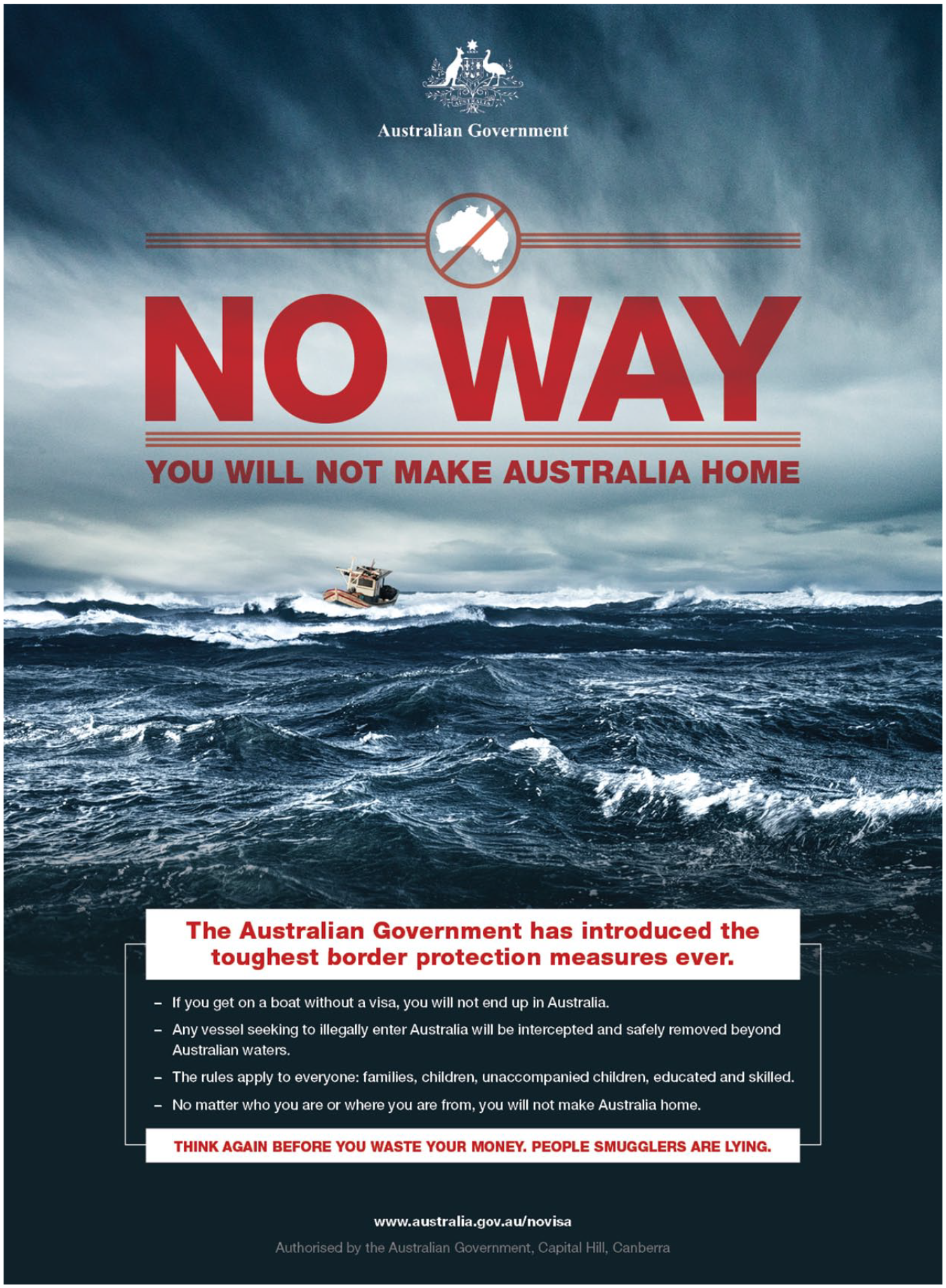
Australian government ‘No Way’ campaign poster.
Focusing on an Australian government video from this campaign, and using a combination of frame analysis (Goffman, 1986) and critical discourse analysis (CDA) (Blommaert, 2005), we examine how the Australian government’s ‘No Way’ campaign has been appropriated by European far-right populists. We then reflect on the implications of this discursive transfer in the form of a discussion: What does it say about Australia, Australians, and Australian asylum-seeker policy, that this campaign is mainstream in Australia, but fringe in Europe? What are the historic and material conditions underpinning the discourse in Australia and Europe? And what are the implications of this discursive transfer, and the discourse itself, on international law, particularly the challenge inherent in the promulgation of information that denies the right to seek protection in Refugee Convention signatory countries.
Method
European appropriations of the campaign were initially sourced through a search on Google and YouTube using the phrases ‘No way’ and ‘You will not make [country] home’, inserting each EU country individually – hence this article’s title. A further online search was conducted with a combination of search terms, such as ‘No Way’, ‘illegal migration’, ‘home’, ‘refugees’, together with individual countries. Adoptions and adaptations of the ‘No Way’ campaign discovered include political advertising and online video campaigns by far-right parties and activist ‘happenings’. In addition, we discovered that, until recently, it was possible to purchase items, such as hoodies, teacups and baby clothes printed with the slogan ‘No Way. You will not make Germany home’, through the online shop ‘Politaufkleber’, a site we also analysed. The website has been unavailable since its operator was arrested in April 2022 for running a ‘criminal trading platform’ selling articles ‘such as T-shirts, stickers, patches, mugs, which show inciting content’ (Chief Public Prosecutor’s Office Naumburg and Saxony-Anhalt State Criminal Police Office, 2022; Wagener, 2022). Another website that has been taken offline (last accessed 6 August 2022) with the obscure IP-address noway.zone showed striking similarities with the Australian campaign poster. The crossed-out country above the slogan ‘No Way. You will not make Germany home’ featured the pre-1945 borders of Germany, and the background music could be identified as ‘Victory Day’ by the band ‘Racial Holy War’, both strong indications that this content originated from and spoke to the Neo-Nazi scene.
While it is beyond the scope of this article to analyse all adaptations found online, we selected examples that varied by time, space and source type. This is reflected in the choice of two YouTube videos of official far-right political parties in the Netherlands and Austria, mirroring the Australian campaign video, published in 2015 and 2020, respectively; and far-right activist campaigns in France and the Mediterranean by the pan-European extremist group Generation Identity (GI). It should be noted that most adaptations found online are linked to Germany and Austria or refer to ‘Europe’ (‘Europe’ adaptations were all associated with GI). Germany and Austria, along with France, feature the most active national GI groups in Europe (Nissen, 2022).
Frame analysis and CDA
We apply a combination of frame analysis (Goffman, 1986) and CDA (Blommaert, 2005) to explore semiotic and discursive similarities between the Australian government’s ‘No Way’ campaign and the chosen far-right European adaptations. Frame analysis seeks to make visible how communication involves selecting ‘some aspects of a perceived reality and make them more salient in a communicating text, in such a way as to promote a particular problem definition, causal interpretation, moral evaluation, and/or treatment recommendation’ (Entman, 1993: 52).
CDA recognises that texts can only be understood in the context of the material and historical conditions under which they are produced (Blommaert, 2005). Key is analysing how discursive practices construct social problems, and how ideologies are enacted in language and semiotic communication more generally, reinforcing and perpetuating partial worldviews, and signalling appropriate responses (Fowler, 1979). It also recognises that discursive formations are dialogic (Billig et al., 1988; Fozdar, 2008), with Fairclough and Fairclough (2012: 2) pointing out that CDA ‘views political discourse as primarily a form of argumentation, . . . analysis should focus on how discourses, as ways of representing, provide agents with reasons for action’. Thus, understanding the argumentative nature of political texts, such as the ‘No Way’ materials is critical to understanding their implications.
Blommaert (2005) advocates for analysis of the function of texts, and our focus is the intertextual relationships between an image and text across different political and geographic contexts. Analysing intertextuality as involving ‘ . . . both the intrusion (or adaption by the speaker/author) of aspects of previous texts into a new text . . . and also the hybridization of one genre or text type with another’ (Bloor and Bloor, 2013: 51–52), we consider the method of problem construction, potential audiences targeted, and likely reception, of both text and images in different cultural and political milieus.
The Australian ‘No Way’ campaign
Since the 1990s, Australian anti-asylum information campaigns have used deterrence messaging to warn of risks, costs and punishment associated with clandestine boat travel. They focus on ‘pull’ factors and overlook ‘push’ factors, such as war and persecution (Fleay et al., 2016: 61–62). The ‘No Way’ campaign was launched in 2014 as part of the communication strategy of the Australian government’s ‘Operation Sovereign Borders’, a military-led border security operation started in 2013 that was aimed at preventing maritime arrivals of asylum-seekers to Australia (Watkins, 2017). Multiple marketing companies were contracted to provide advertising, market research, multicultural marketing, public relations and translation services (Commonwealth of Australia et al., 2014, 2015, 2016). While Operation Sovereign Borders remains active, its communication campaign now features the somewhat toned-down slogan ‘Zero Chance’ (Australian Department of Home Affairs, n.d.).
The ‘No Way’ campaign included print media and billboards in Pakistan, Sri Lanka and Indonesia, key source or transit countries (Bishop, 2020: 1096), as well as a YouTube video directed ostensibly at would-be migrants, which is the focus of our analysis. The materials were in part framed as messages encouraging family and co-ethnics to tell ‘your family and friends overseas’ not to attempt the journey, while also having domestic cache signalling to Australian audiences a government tough on borders (Hodge, 2015; Leroy, 2023).
The video can be retrieved from the website of The Guardian (2014). It begins with a shot of the Australian coat of arms with the words ‘Australian Government’ at the top centre in white lettering, and the Australian map in white crossed with a diagonal line in a circle (red), in the manner of a ‘no smoking’ sign, as seen on the campaign poster (see Figure 1). The words, in capitals, ‘NO WAY’, in large red font, are written immediately beneath the Australian map and framed by three red lines at the top and bottom. The words ‘no way’ carry a triple meaning. This Australian aphorism is both literal and figurative. It indicates there is (a) no passage (no physical way), (b) no method by which to achieve one’s end, an impossibility, or refusal (no symbolic way) and (c) implies incredulity (‘no way! You can’t be serious about wanting to live in Australia’).
Below ‘NO WAY’, the statement ‘you will not make Australia home’ (red, smaller font) emphasises the meaning of the image. The direct address (‘you’) hails the individual (Althusser, 1971) speaking directly to the potential asylum-seeker rather than making the statement in the form of a depersonalised rule, for example, ‘asylum seekers will not be allowed to stay in Australia permanently’. Rather than stating ‘you will not cross our borders’ or ‘you will not be granted entry’ or ‘you will not receive a visa’, it signals ‘home’, with all that implies. The notion of ‘home’, in such instances, implies a site of ‘fellow feeling’, and those ‘without home’ are constructed as objects of danger and fear (Ahmed, 2014: 74, 80). This is an instance of ‘domopolitics’ (Walters, 2004), securitisation representing the state not as a household but as a home, with implied affective and material relationships. The phrase also subconsciously references the Peter Allen song ‘I still call Australia home’, a patriotic celebration of Australia as the country preferred above all others, to which the citizen returns after travelling the world, with a sense of relief, where one’s domestic affections reside and where one belongs. This culturally specific reference indicates the campaign simultaneously speaks to the domestic population as this ‘quasi-national anthem’, which is often performed with symbols of nationhood, references symbolic nationalistic language and effectively rallies the citizenry to their homeland’s defence (Leroy, 2023: 91).
The pictorial image is of a wild, stormy and barren ocean, with a small boat struggling against the waves. The perspective of open water seen from the surface suggests someone drowning. The threatening sky evokes a storm front approaching. The combined effect of this imagery demonstrates a deliberate ‘pathetic fallacy’, a literary device where natural objects are used to reflect or evoke an emotion. This is clearly affectively geared towards stirring emotions of fear and panic both in potential asylum-seekers and domestic audiences. The imagery and dark colours generate a sense of threat, danger, fear and foreboding. While the danger is actually to those on the vulnerable boat, Bleiker et al. (2013) argue the image transfers the threat to the boat itself, which becomes a threat to the nation. Ahmed (2014: 65) suggests emotions of fear respond to what is approaching rather than already here. Thus, the production of what is fearsome and who should be afraid are intimately linked to the politics of mobility and the authorisation of legitimate spaces (Ahmed, 2014: 70). The approaching boat, as an object of fear, illegitimately struggles through the wild ocean that separates the safety of ‘home’ (the Australian nation-state), from the dangerous ‘outside’. The emotions evoked feed into the social, and importantly, the psychic, field within which the threat of danger associated with asylum-seeking circulates (Ahmed, 2014: 45).
The remainder of the video focuses on a front-on head and shoulders shot of Lieutenant General Angus Campbell, then commander of Operation Sovereign Borders and face of the campaign (Figure 2).
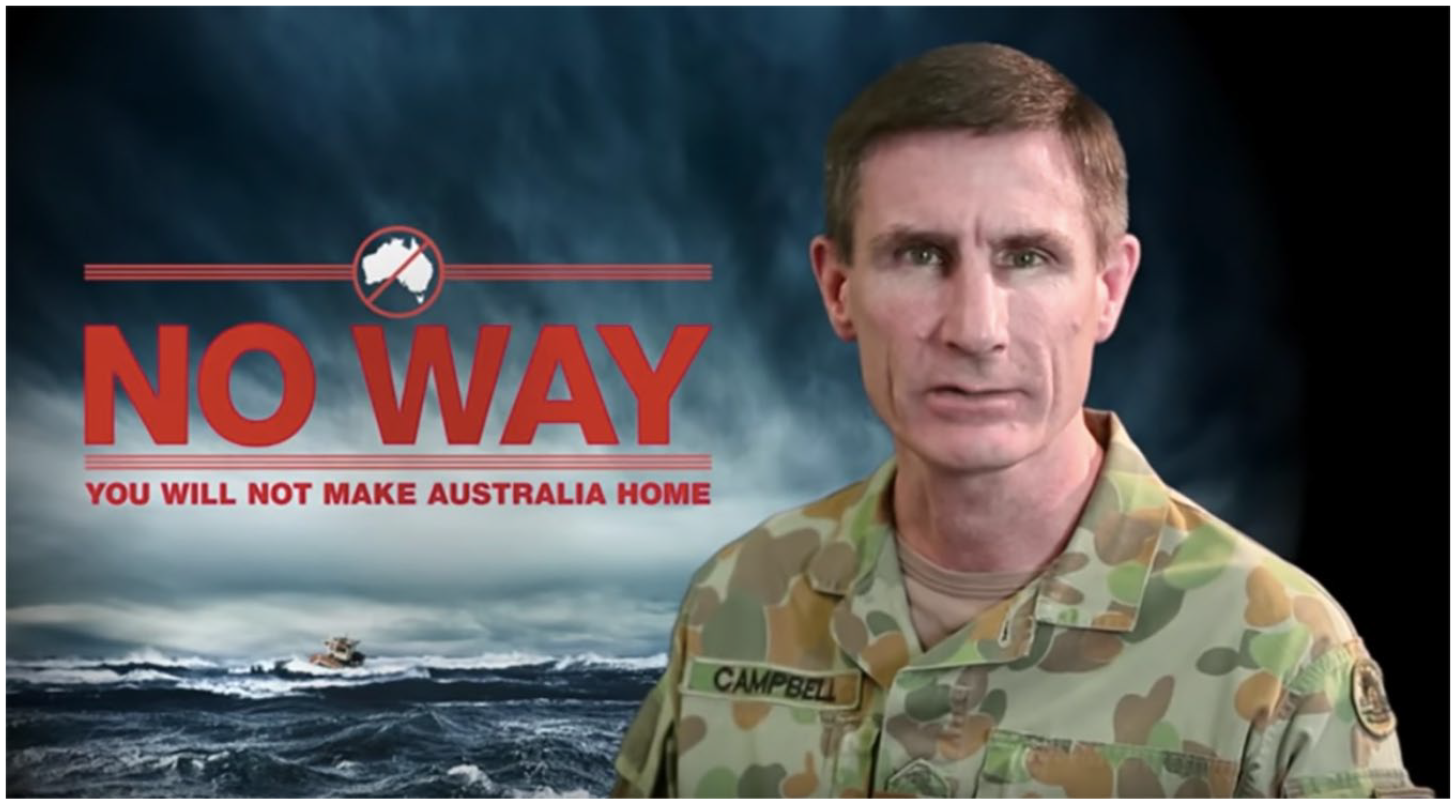
YouTube video, Australian ‘No Way’ campaign, Lieutenant General Angus Campbell.
General Angus Campbell is wearing army fatigues, signifying both his position of authority and strong(man) leadership and the action orientation and militarised nature of the operation. That the message is delivered by a White, hypermasculine military male signals the role of gender and race in the modern, post-colonial state (Mills, 1997). Mohanty (2003: 59) argues British colonial rulers constructed their whiteness and masculinity as fundamental to disciplined national protection (of women, morality, the nation), in contrast to indigenous populations. This continues to resonate with hegemonic conceptions of legitimacy and authority in contemporary states, which emphasise rationality, calculation and orderliness (Mohanty, 2003: 65), all embodied in the military man who insists that there are no exceptions to the rules excluding those who travel by boat from making Australia home while also stressing the risk to life, and the lies of people smugglers. His message is straightforward and repetitive: ‘the rules apply to everyone . . . there are no exceptions’ ‘the message is simple: If you come to Australia illegally by boat there is no way you will ever make Australia home’. The simplicity of the ‘No Way’ message, delivered by this military embodiment of the nation, a message that ignores both the complexities of push factors, and Australia’s obligations under international law, is a significant part of its appeal.
Migration of the campaign to Europe
One of the first adoptions of the imagery and language of the Australian campaign in Europe is in a YouTube video from a far-right Dutch political party uploaded in April 2015 (Figure 3).
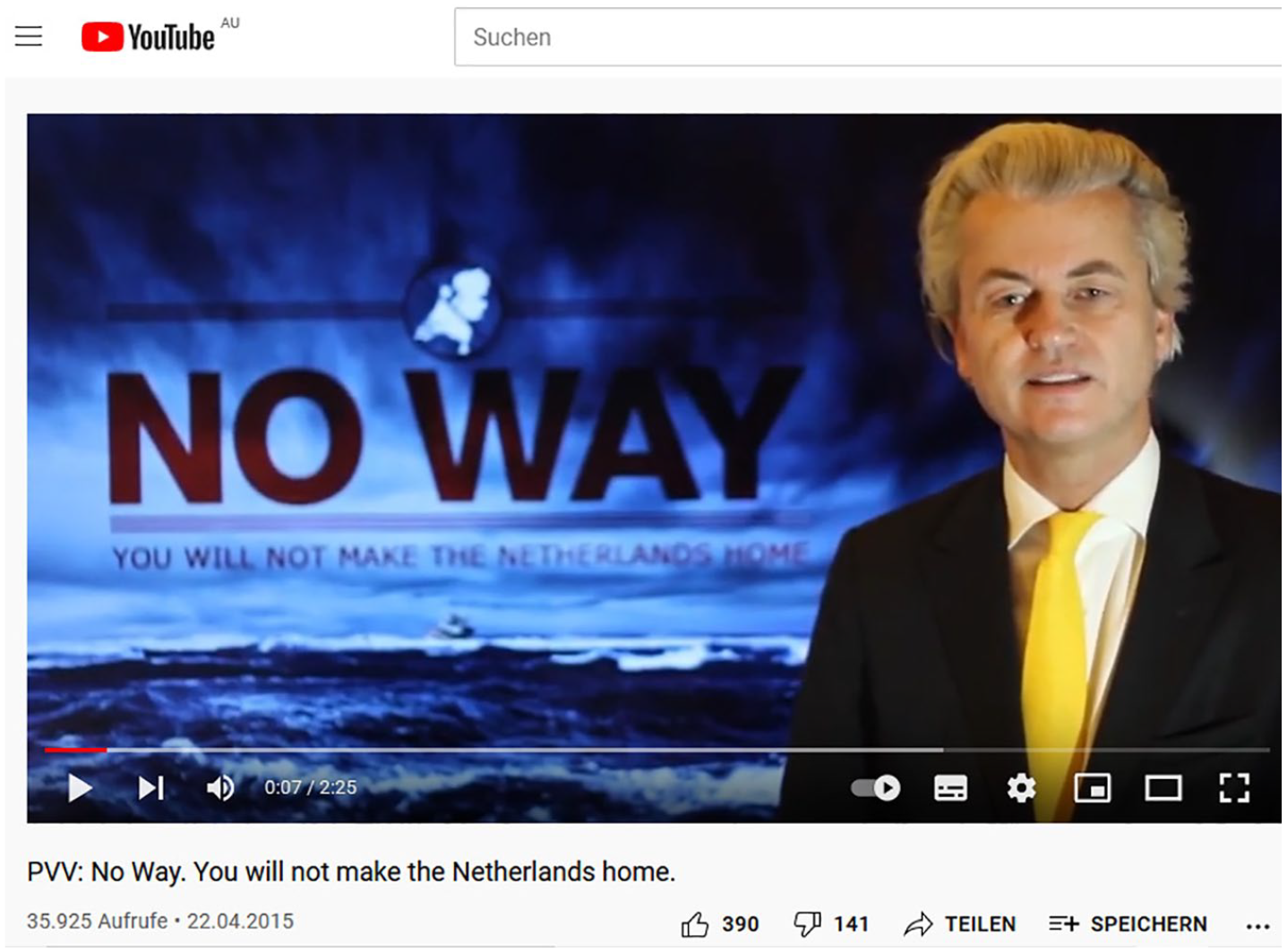
YouTube video, Party for Freedom in the Netherlands ‘No Way. You will not make the Netherlands home’.
This ‘No Way’ video appeared on the YouTube channel of the Party for Freedom in the Netherlands (Partij voor de Vrijheid, PVV), featuring its founder and leader Geert Wilders (PVVpers, 2015). The PVV is characterised by anti-Islamic alarmism and nationalist populism (Vossen, 2016). Given his extremist views, Geert Wilders has been on the Australian Movement Alert List, a database of people of concern to the Australian community (Day, 2015).
The similarity to the Australian campaign’s imagery is striking. The only difference is that the name and map of the country have changed, and the Australian army commander has been replaced by the PVV leader. The wording, colour (ominous blues and greys), menacing waves, lone boat, the fear-inducing sense of impending storm, the gathering night, and the saviour figure of the White male protector of the nation – not an officer in fatigues in this case, but Wilders, neat, suited, with a halo of blonde hair, and yellow tie, a reassuring figure against the general threat, are all almost identical to the Australian original. The framing of the phenomenon as a threat, evoking emotions of fear and panic and the solution as salvation through hypermasculine leadership and military/political action, clearly sets up a menace/hero chaos/order narrative.
In the video, Wilders repeats the slogan ‘No Way. You will not make the Netherlands home’ initially in English and then in Dutch explains that ‘Australia tackles the problem in a more sophisticated way. The country sends refugees in safe ships back to the country of departure’. The language paints asylum-seekers as a ‘problem’, that requires ‘tackling’. The word ‘sophisticated’ works intertextually with discourses around hierarchies of civilisations, with Wilders aligning Australia and the Netherlands as ‘kin countries’ in Huntington’s (1996) terms, while simultaneously subconsciously triggering sensitisation to racial hierarchies or binaries of ‘civilised/uncivilised’.
The YouTube video is accompanied by the following text published in Dutch (translation from DeepL.com, free version): Around one million people are ready to cross over to Europe from Libya in rickety boats. They become the victims of unscrupulous people smugglers. Thousands drown. Men, women and children. The harrowing images on TV every night fill everyone with horror. . . . The PVV says: Let the European navies patrol the coast of Libya and send all immigrants back in a firm but safe manner. Then the influx will dry up and the problem will disappear. There will be no more drowning and an end to the odious traffic in human beings. And Europe will no longer be overrun with fortune hunters. The ECHR [European Court of Human Rights] Treaty, which the Netherlands has signed, guarantees immigrants free passage. We want to suspend that, because the people smugglers are laughing at us. Australia is a civilised country. It has a civilised and sensible approach to things. Let us follow the Australian example. (PVVpers, 2015)
This text deserves further analysis, as it contains many of the same framings found in the Australian discourse on asylum-seekers arriving by boat. The strategy is as follows – first, claim the numbers waiting to come are high; second, target people smugglers as criminals to (a) deflect attention from the more sympathy-inducing asylum-seekers themselves, (b) identify an apparently legitimate target and (c) subliminally link the criminality of the carriers with those seeking asylum (making the target of the policy the ‘criminal’ people smugglers and not those fleeing persecution) and third, emphasise humanitarian concern – frame the policy as being designed to protect people, to save lives, to stop ‘the horror’. The framing is identical. Only towards the end of the Dutch version does this humane framing collapse, as immigrants are labelled ‘fortune hunters’ – people not fleeing persecution: but seeking economic gain. Finally, assert nationalism and the right to national agency, specifically to make one’s own decisions about the nation’s borders. In this case, the European Convention on Human Rights (ECHR) (incorrectly named by the speaker) is presented as part of the problem, notwithstanding that the ECHR is a Council of Europe (CoE), rather than EU instrument. Thus, regional or international human rights law is explicitly rejected when it does not support the preferred course of action.
The use of the word ‘overrun’ in Wilders’ narrative is significant, as it references a range of standard metaphors that equate migrants with vermin (Charteris-Black, 2006; Martin, 2021; Martin and Fozdar, 2022), a never-ending mass that will literally swarm, infest, teem, flood, swamp, choke, clog (all synonyms of ‘overrun’ in Word’s thesaurus) the country, if allowed. Metaphors are crucial to the emotionality of texts such as this (Ahmed, 2014: 22), and act as cognitive frames for understanding an issue and legitimating policy responses (Anderson, 2017: 15). Words like ‘overrun’, ‘flood’ and ‘swamped’ create associations between asylum-seekers and fears of being overwhelmed by others (Ahmed, 2014: 46), reinforcing ‘popular anxieties about the foreigner as invasive other’ (Anderson, 2017: 8) and justifying attendant policies of deterrence. Framing migrants as threatening to ‘overrun’ us and take over our ‘home’, again illustrates a ‘domopolitical’ approach, constructing the nation as a home to be protected (Anderson, 2017; Walters, 2004).
What does referring to Australia do at the end of this statement? Apart from the alignment of civilisations (Huntington, 1996), as mentioned above, it signals that another Western country is already enacting this policy, implying it is both humane (civilised) and legal. Indeed, it legitimises the policy, which might otherwise be seen as another example of far-right extreme ideology. The overall effect is one of reasonableness, humanity, and legitimate assertion of sovereignty. Thinking back to Entman’s (1993) definition of framing, this shows how a particular problem definition is constructed in both the image and the narrative (boats of immigrants are a threat to the country and a danger to themselves); the causal interpretation offered (the right to mobility secured by the ECHR is the problem as it acts as an invitation); the moral evaluation of opposing subjects (they are fortune hunters, we are civilised but also have the right to limit border movements); and in the treatment recommendation (‘push backs’ are the solution). The figure of the authoritative White man secures this framing as reasonable, practicable and the most appropriate way to deal with the problem, as constructed.
Another adoption of the Australian iconography and language is found in a video of a far-right party in the land-locked country of Austria. This YouTube video, released in 2020 by the Austrian Freedom Party (Freiheitliche Partei Österreich, FPÖ) under the name ‘Herbert Kickl demonstrates how real border protection works!’, uses the imagery of the Australian campaign to promote saying ‘No Way’ to ‘foreigners’ in the face of ‘illegal migration’ (FPÖ TV, 2020) (Figure 4).
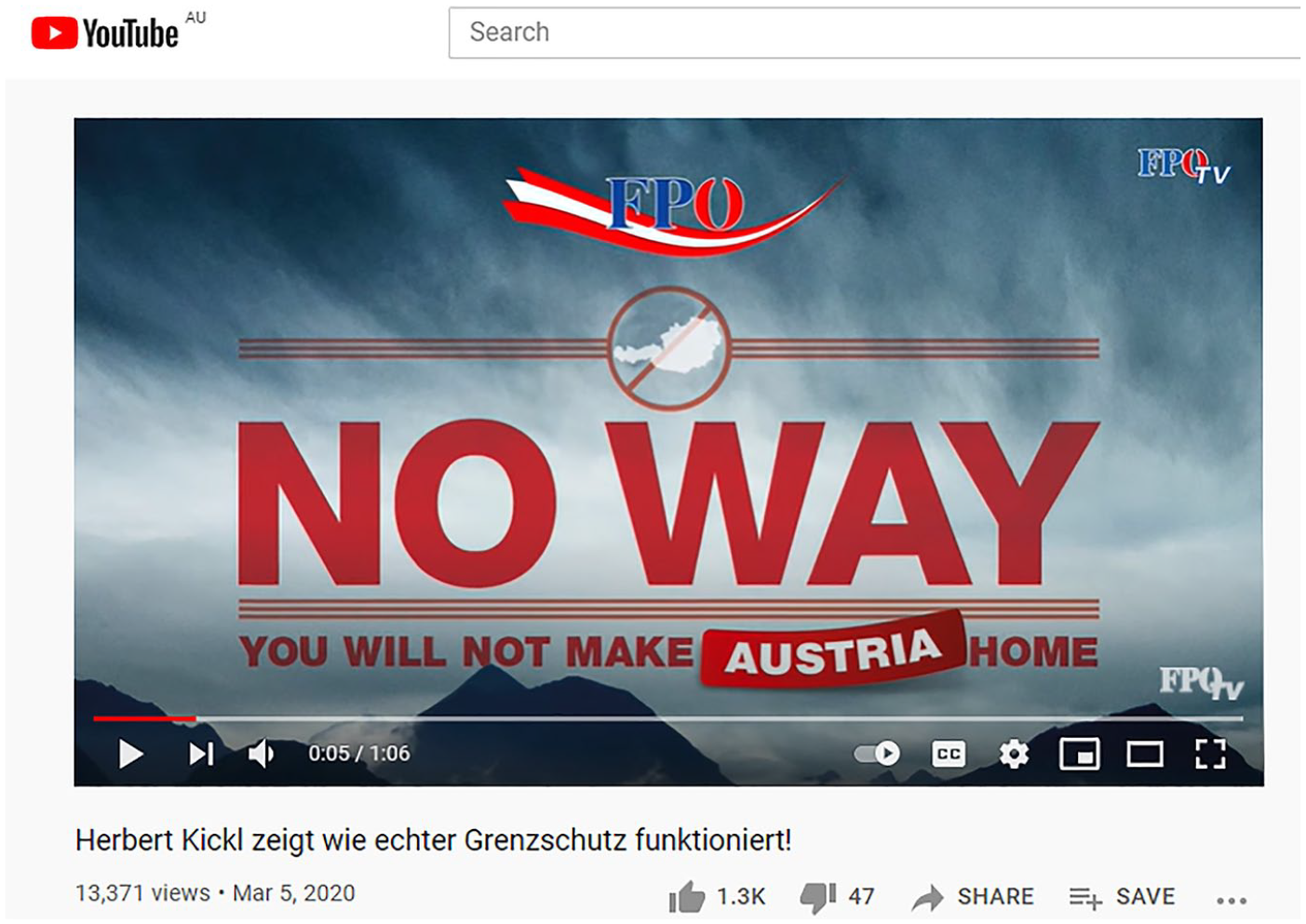
YouTube video, Freedom Party in Austria, ‘No Way. You will not make Austria home’.
This video spares its audience humanitarian frames, but like the example from the Netherlands, it plays on the notion of necessary action carried out by an authoritative White man, in this case the leader of the FPÖ, Herbert Kickl, to represent and protect the nation by reclaiming agency over national borders (‘real border protection’). The perception of a never-ending source of threatening people is reinforced in the opening shot where black and white shadowy figures of grim looking young men who avoid eye contact with the camera, one wearing camouflage trousers, walk briskly towards the screen – a clear representation of the ‘threat’ of being ‘overrun’ by ‘foreigners’ and ‘illegal migrants’. Accurate terminology, such as ‘refugees’ or ‘asylum seekers’, is omitted. The narrator warns the audience to ‘Beware. The illegal migrants are on their way to the EU’ – ‘the’ migrants suggests an organised invading collective.
As the narrator continues, explaining that ‘Now we must say “No Way” to foreigners. Border posts down, security up’, the imagery of the Australian campaign appears. Substituting the waves with mountains, but featuring the same font, colours, the three lines, the ‘no’ symbol over the country, the dark threatening background, the FPÖ’s logo in place of the Australian government’s emblem, and with a patch over the country’s name to replace Australia with Austria (in a serendipitous synergy reproducing the red and white colours of the Austrian flag), it is clear this is essentially the same image. While the video is created for Austrian audiences, and the narrator speaks German throughout, the Australian campaign slogan, including the adapted country name ‘Austria’, are in English. Likewise, the narrator uses the phrase ‘No Way’ in English as he literally tells the audience ‘No Way für Fremde’ (‘no way for foreigners’). Ironically, the English language is clearly not perceived as an unwelcomed foreign element.
When FPÖ leader Herbert Kickl appears on the screen, he is dressed more casually than Wilders or Campbell, without a tie or uniform, and does not appear in front of the ad directly, but rather in front of a dark blue background, a shade that matches both the party’s official colours and the threatening colours of the Australian campaign. Like Wilders and Campbell, however, he appears on the right side of the screen as the reassuring, White saviour figure who has the answers to counter the pending foreign ‘threat’ and is ready to take action rather than ‘only observe’ the ‘problem’.
Herbert Kickl’s treatment recommendation is framed as a ‘border crossing prevention package’ and includes initiatives, such as: ‘a temporary suspension of asylum law in Austria’, ‘no asylum applications on Austrian soil’, ‘guaranteed returns of illegal migrants’, ‘establishment of security zones in affected regions’, ‘a “NO WAY!” information campaign to ensure that foreigners and people smugglers don’t get tempted’ and ‘strict border control following the motto “border closed” for illegal migrants’. This is the first time ‘asylum’ is mentioned in the video and it is clearly constructed as part of the problem rather than the solution, with the assertion that asylum law should be suspended, and applications made in Austria declined. Again, legal protections for asylum-seekers, this time within domestic Austrian law, are rejected.
While Australia is not directly mentioned in this context, some of the proposed border protection measures mirror the Australian policy approach promoted in the Australian campaign. Likewise, the call for an Austrian ‘NO WAY! information campaign’ references Australian policy. This framing suggests pull rather than push factors cause people to seek asylum, that they are ‘tempted’ by the prospect of success, infantilising asylum-seekers as naughty children who must be taught a lesson. Finally, the only legitimate solution to counter the perceived threat of ‘illegal migrants’ is framed as reclaiming national agency in the form of ‘real’ border protection for the nation-state, as opposed to adhering to international law.
A further example of the adoption of the Australian campaign comes from GI. GI is ‘a pan-European far-right movement originating in France that opposes non-European, particularly Muslim, immigration and claims to defend a White European “Identity”’ (Rivera, 2020). While GI groups publicly seek to dissociate themselves from the extreme right and neo-Nazi scene, Richards (2022: 42) notes ‘GI’s stated incentive to establish concentration sites in Europe for migrants of non-European ethnicities, its successful establishment of paramilitary training camps for young supporters, and its spokespersons’ usage of rhetoric, such as “degenerates” and ‘‘the Jewish question’’’ resemble ‘German Nazi social and cultural forerunners to 1939–1940’. GI activists, predominantly affluent, presentable, educated men and women in their twenties, practice a form of protest labelled ‘media guerrilla warfare’ (Al Jazeera, 2018; Richards, 2022). Actively seeking media attention, their ‘happenings’ usually involve a group of activists accompanied by professional camera operators. Videos and images are subsequently disseminated through social media channels to create publicity (Nissen, 2022).
As part of these protests, GI used the slogan ‘No Way. You Will Not Make Europe Home’ multiple times and spokespeople have acknowledged the Australian government’s influence on their choice of wording (Richards, 2022: 39). One example of their use of the slogan is in its display on a boat. In 2017, GI activists from multiple European countries chartered a boat called C-Star for their mission dubbed ‘Defend Europe’ (Figure 5). The mission aimed to stop migrants from coming to Europe, and intercept humanitarian ships rescuing migrants in distress. It created considerable media attention before the ship ran into technical difficulties and was rescued by the NGO ‘Sea Eye’ (Broderick, 2017; Henley, 2017).
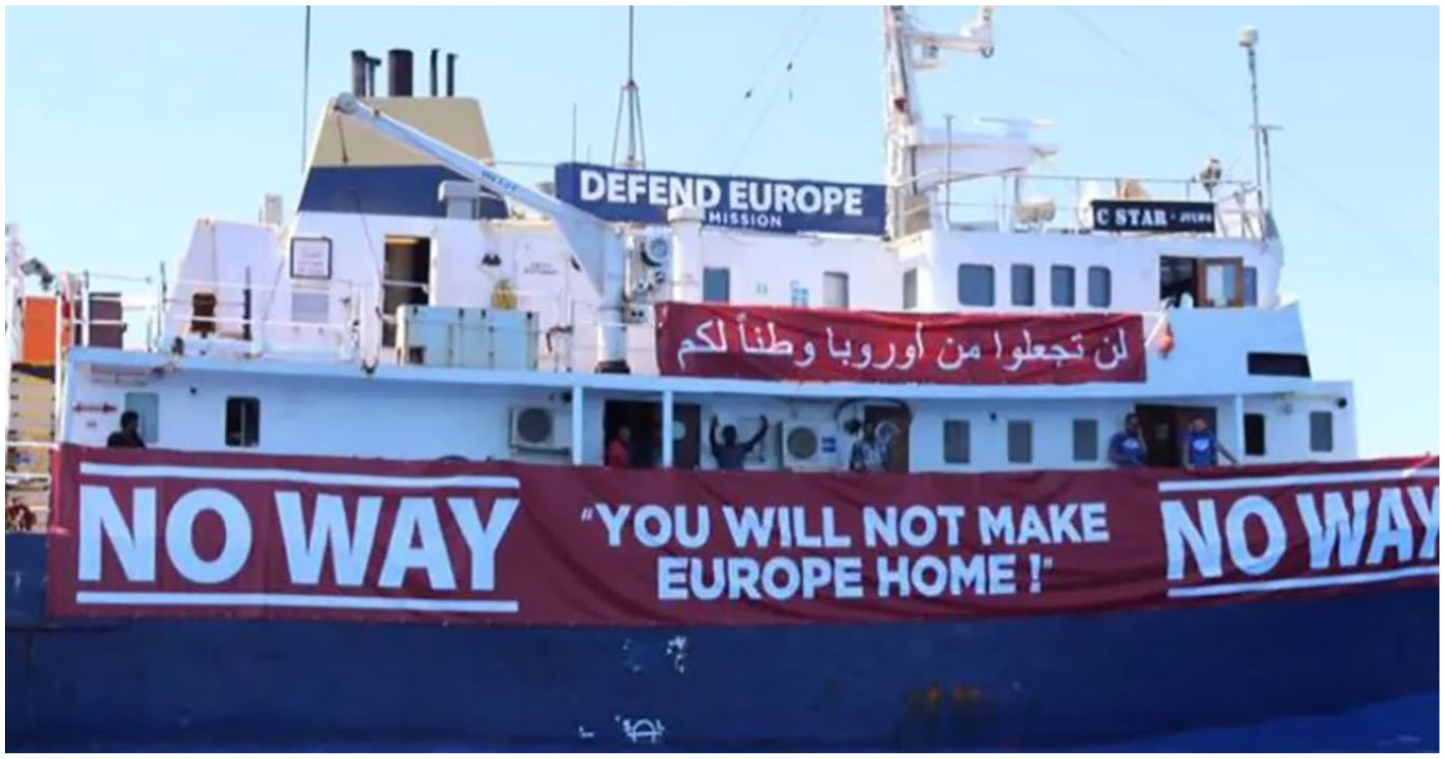
Generation identity, Defend Europe Mission.
The image above was published in an article by the British newspaper The Independent in August 2017. It features the C-Star carrying a banner with the slogan ‘NO WAY’ and ‘You will not make Europe home!’ in white font on a red background (Oppenheim, 2017). The same use of lines above and below the ‘No Way’ statement, referencing borders and the metaphoric aphorism of ‘drawing the line’ (setting a limit on what one is willing to accept); the use of capital letters to hammer home the point; and the statement ‘You will not make Europe home’, again, all in capitals to emphasise force, mirrors the Australian campaign. The inclusion of quotation marks around the statement ‘You will not make Europe home’ adds to the ‘direct address’ element of the generic statement, with the use of the personal pronoun ‘you’ to hail (in Althusser’s terms) those targeted – anyone considering seeking asylum or unauthorised movement. Together, these elements are immediately adversarial.
The use of a boat to convey the message reinforces the symbolism, as well as the link with Australia’s policy. Here, the medium is also part of the message. It is effective as a publicity stunt, as well as speaking directly to potential migrants. The hanging of banners on ships works intertextually with the public’s familiarity with images of the Sea Shepherd and Greenpeace’s anti-whaling campaign, a tactic of the left in support of whales now used by the right for conservative ends against people (Richards, 2022: 41).
In April 2018, GI staged another intervention in the French Alps under the banner ‘Defend Europe’ that attracted media attention (Figure 6). GI activists used plastic grating to create a ‘border’ to Italy at Col de l’Echelle and spread a large ‘No Way’ flag on the mountain slope.
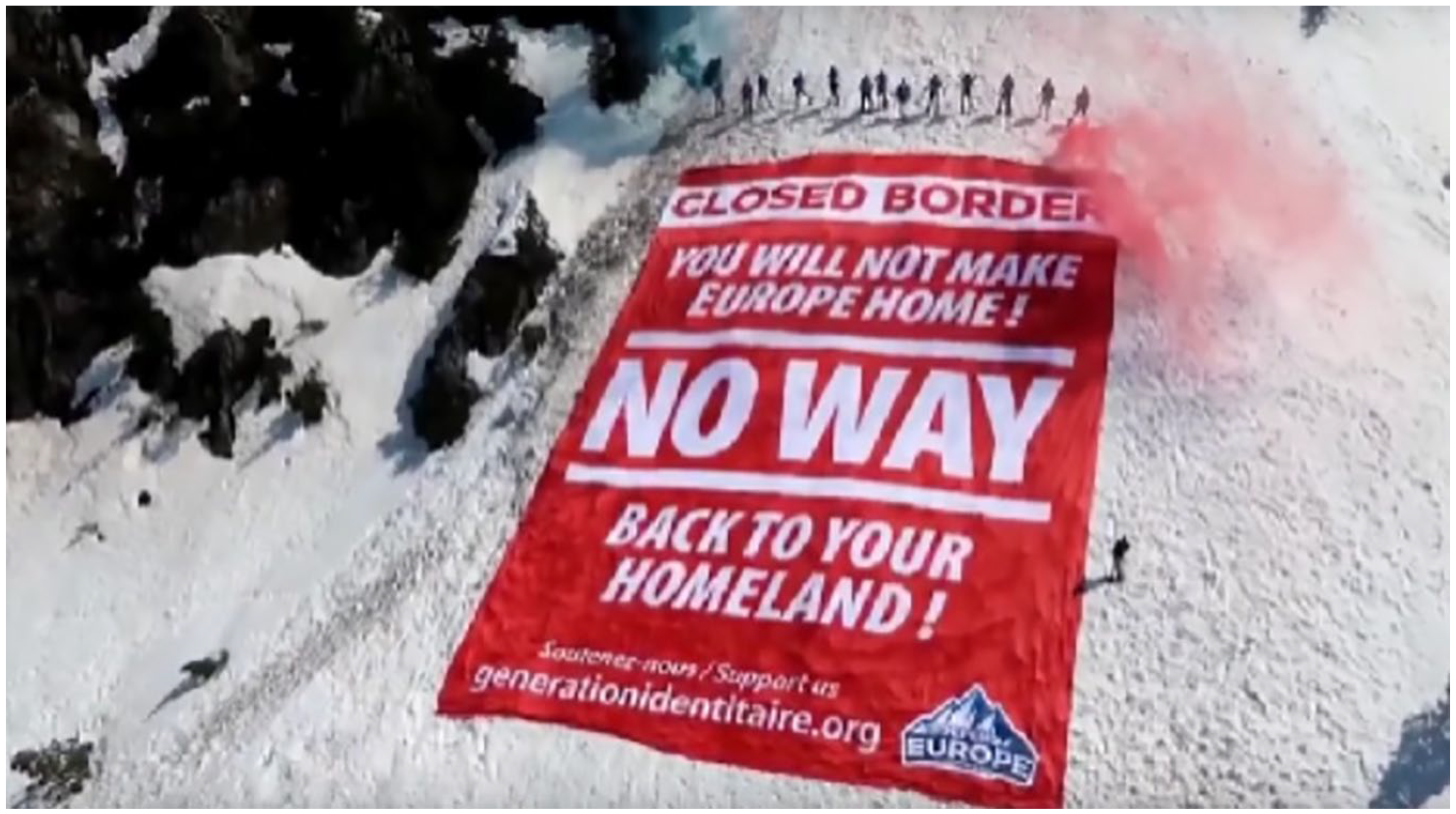
Generation identity, Defend Europe, French Alps.
The image above was published in an article by the New York-based CovertAction Magazine in April 2020 (Rivera, 2020). Once again, forceful capital letters are used, with the top of the flag asserting that this is a ‘closed border’, while the ‘No Way’ statement features prominently as the main message in capital letters in the centre of the banner, again, framed by lines. The statement ‘You will not make Europe home’, this time without quotation marks, is repeated. Below, GI added a personal touch with the statement ‘Back to your homeland’ written in the same style. The term ‘homeland’ is explicitly domopolitical, bearing a range of emotional and historical connotations, ranging from ‘country of birth’ to ‘native land’ and perhaps working intertextually with Hitler’s invocation of the ‘fatherland’ needing to be purified of polluting elements.
This incident prompted a Twitter post from the French Interior Minister condemning GI actions and stating ‘[o]nly government authorities have the right to take action in our territory’ (Matamoros, 2018; Rivera, 2020). Three GI members were subsequently sentenced to six months in prison (Gregory, 2019). Both the use of the boat and the construction of a ‘border’ on the French Alps embody activists’ attempts to undermine state authority, taking the law into their own hands. When the law does not support their agenda, they seek to create paralaws to reinforce their perceived territory (McGaughey, 2020).
Discussion
Above, we have identified how the Australian and European ‘No Way’ campaigns, through both language and imagery, frame the ‘problem’ of asylum-seekers, identifying causes, morally evaluating, and promoting a solution or action (Entman, 1993; Fowler, 1979). We have analysed the intertextual connections between the Australian campaign and a selection of equivalents in Europe; and the dialogic ways in which these speak against alternatives, advocating harsher polices framed as benign and humane, while representing asylum-seekers as a threat. Indeed, the far-right European approaches sometimes directly reference the Australian government’s campaign and policy to give them weight and legitimacy.
The concept of policy transfer is not new. It is particularly common across comparative jurisdictions where there are legal, cultural, economic and/or historical similarities. Indeed, following an increase of arrivals of asylum-seekers in Europe in 2015, former Australian Prime Minister Tony Abbott publicly recommended European leaders adopt Australian policies on border security (Chan, 2015; Little and Vaughan-Williams, 2017: 534–535). What is interesting about the European far-right’s appropriation of the Australian ‘No Way’ campaign is their promotion of official government policy from one Western democracy to attempt to overturn official government policies elsewhere. Whereas in Australia, the ‘No Way’ campaign reinforces existing policy and norms, the European campaigns harness this imagery and messaging to challenge existing policy and norms, using the Australian government’s legitimisation of this approach to push the limits of what is acceptable in Europe, thereby undermining international law.
This re-purposing by the far-right surfaces the fundamental racism of the campaign. Our detailed analysis illustrates how race and power are linked and remain fundamental to the colonial project (see Mills, 1997). In advocating for the ‘Australian’ approach, the European far-right appeals to the connection between Europe and Australia (Huntington, 1996). The question remains, though: What does it say about Australia, Australians and Australian asylum-seeker policy, that this campaign is mainstream in Australia, but fringe in Europe?
This question requires reflection on material and historic conditions in both Australia and Europe (Blommaert, 2005), and particularly the different legislative contexts within such policy can develop and be enacted. Bearing in mind that ‘racial ideas and arrangements circulate, cross borders, shore up existing or prompt new ones’ (Goldberg, 2009: 1274), the different manifestations of the ‘No Way’ campaign in Australia and Europe require reflection on these conditions in a relational rather than comparative way, read against critical historical junctures within the respective geopolitical contexts.
Goldberg’s (2001: 234) argument that ‘race is integral to the emergence, development, and transformations (conceptually, philosophically, materially) of the modern nation-state’ is nowhere more clearly illustrated than in Australia. From its inception, whiteness has been integral to Australian national identity, lying at the very foundation of Australia’s conception of itself and who belongs (Hage, 2012; Huynh and Neyland, 2020). As a predominantly White Eurocentric outpost in the Asia-Pacific region, it was established through dispossession of its Indigenous peoples, and pursuit of policies promoting a racially and culturally homogeneous population, achieved predominantly through the White Australia Policy (1901–1973). Since the 1970s, migration and settlement processes have been apparently more open and inclusive, yet there remains a strong vein of exclusionary nationalism in Australia (Jupp, 2007; Fozdar et al., 2015). This is reflected in the public support for strong border protection policies over several decades and across the major political parties, using rhetoric focused on Australian identity. Former Prime Minister John Howard’s policies in the early 2000’s (re)constructed an Australian identity based firmly in British heritage (Fozdar and Spittles, 2010; Johnson, 2007). This was done by, among other things, generating a sense of threat from culturally and racially different asylum-seekers (Brookes, 2010; McNevin, 2007; Pickering, 2001).
Following a series of mass drowning incidents between 2009 and 2012, commentators in Australia noted a minor shift from demonising those seeking protection to those transporting them (‘people smugglers’), and an emphasis on the rights of countries to determine population movements. Australia was thus reconstructed not as harsh and unfeeling in its treatment of asylum-seekers, but as both just and humane, in thwarting the ‘people smugglers’ in their illegal trade and being primarily concerned for the welfare of asylum-seekers (Austin and Fozdar, 2018; Gale, 2004). These apparently more cosmopolitan arguments were used to rationalise increasingly harsh policies (Crock and Berg, 2011). A similar trend can be observed within the European context where the EU Commission’s response to the increased arrival of asylum-seekers in 2015 was marked by a rhetoric that emphasised both tough border security and the language of ‘saving lives’ (Little and Vaughan-Williams, 2017: 534).
Europe, especially the nation-states of Germany and Austria, has its own striking experiences with racist ideology, culminating in the atrocities of the Holocaust, which heralded a time of introspection. In a bid to constrain states’ ability to persecute minorities, and to create peaceful conditions for future generations, Europe moved to harmonise legal systems through regional co-operation providing a shared geographical and socio-political context for European countries. At an international level, the UN was established as a direct response to the atrocities of the Second World War and a range of international human rights law treaties were introduced over the following decades. In Europe, a number of regional intergovernmental bodies were established including the EU and the CoE, with associated legal frameworks including the EU Charter of Fundamental Rights and the ECHR. There are high levels of compliance with European law and Member States give effect to these laws within their own jurisdiction and co-operate regionally. As such, migration and asylum laws must comply with European law and if breached, can be challenged in domestic and European courts. For example, Italy’s returning of asylum-seekers to Libya without hearing their claims was found by the European Court of Human Rights to breach the ECHR, as it places asylum-seekers at risk of persecution and harm (the principle of non-refoulement) (Hirsi Jamaa and Others v Italy- 27765/09, 2012). Engstrom (2010) explains that the European Court of Human Rights has had a considerable influence on human rights standards in Europe and transitioned from human rights protection based solely on litigation to a network of interlocking bodies focused on standard-setting, prevention, monitoring and enforcement. This has led to the ECHR becoming largely institutionalised.
In contrast, Australia is not part of a regional human rights system and remains the only Western democracy without a Bill of Rights, leading to it being dubbed a ‘rights free zone’ (Arzey and McNamara, 2011). It is bound only by international human rights law and has received harsh criticism from the UN for its asylum policies. Australia has, at times, rejected the UN’s recommendations, and the UN lacks enforcement mechanisms in this regard. The gap between what is considered acceptable and compliant with asylum-seeker law in Europe and Australia thus arises primarily due to the different legal systems at play. As yet, the robust institutionalised regional laws in Europe have stymied countries from implementing asylum laws comparable to those in Australia. Thus, the far-right discourse, including that which we have analysed adopting the Australian ‘No Way’ imagery and narrative, faces significant legal barriers. It is noteworthy that the closest imitation of Australia’s approach of off-shore processing is the recent move by the United Kingdom to send asylum-seekers to Rwanda under the ‘UK-Rwanda Migration and Economic Development Partnership’. While the United Kingdom has threatened to withdraw from the ECHR, for now it remains party to it and as a result, the Court has granted injunctions to individuals due to be removed from the United Kingdom under this ‘partnership’ (Gower and Butchard, 2022).
We have demonstrated how the finality of the phrase ‘No Way’ and the imagery to this effect, promoting a break with international standards, has inspired far-right leaders and activists in Europe. To date, however, governments have been reticent to adopt this extreme messaging – for example, in an interview, a civil servant from the Norwegian justice ministry, which was developing a deterrence campaign of its own, stated ‘[w]e know there are messages that would be more effective, that would hit you in the stomach and heart, but we cannot use those. Like Australia did in the No Way campaign . . . We cannot do that, given the mandate of our Ministry’ (Beyer et al., 2017: 25). The use of the terms ‘cannot’ and ‘mandate’ suggest that international legal obligations are still recognised as limiting European countries’ approaches to the issue. In August 2022, however, the Austrian Interior Minister introduced a new information campaign to ‘counter the lies of people smugglers’, to be disseminated via Google, Instagram and Facebook in countries such as Morocco, Tunisia, Bosnia and Herzegovina, Serbia, Lebanon, Pakistan and India under the title ‘myths about migration’ (Austrian Federal Ministry of the Interior, 2022). The campaign was unveiled to the Austrian public at a press conference with a presentation featuring an image of a border fence and the words ‘Illegal Migration: There is no way’ (Magro, 2022), clearly referencing the Australian campaign (and suggesting the message is at least partly designed for a local audience). However, the English translation of the official information campaign website that has been translated into seven languages has not integrated the ‘No Way’ slogan as yet (Austrian Federal Ministry of the Interior, n.d.).
It is difficult to predict whether the far-right promotion of Australia’s policies and rhetoric will obtain further purchase in Europe among the general population, and what the response will be, given the very different geopolitical and legislative contexts. However, the simple fact that it is far-right groups who have embraced the message indicates just how out of touch with current international standards, Australia’s policies are.
Footnotes
Funding
The authors received no financial support for the research, authorship and/or publication of this article.
