



Abstract
Noting an overreliance on North American and European-based understandings of race and ethnicity, many sociologists have called for research in new spaces. But the same conceptual and regional limitations apply to several other studies. One example of this is multiculturalism. Scholars tend to associate multiculturalism with international migration and ethnic pluralism. As such, they typically study multiculturalism in the most ethnically diverse (and often most affluent) countries – that is, in Europe and North America. But international migration does not always result in ethnic pluralism. For example, diasporic return migration often leads to the convergence of internally diverse co-ethnic populations in ethnically homogeneous nation-states. The diasporic ‘returnees’, who were born outside of their perceived homelands, come through targeted migration policies, face various levels of discrimination, and yet contribute significantly to the economic development and cultural diversity of the countries to which they relocate. As such, this article argues that the multiculturalization of monoethnic nationhood is substantially driven by diasporic return migration. In exploring diasporic multiculturalism, the article draws from data collected in Yerevan, Armenia.
Introduction
Scholars often frame multiculturalism as a set of policies to manage ethnic pluralism stemming from international migration (Rattansi, 2011: 211). While some sociologists have used a broader understanding of diversity in defining multiculturalism (Alexander, 2001; Hartmann and Gerteis, 2005), managing the diversity (ethnic and otherwise) that newcomers introduce, quite reasonably, plays a predominant role in research on multiculturalism (Rodríguez-García, 2010).
But, as some scholars have noted, the exclusive focus on ethnic pluralism limits the model and its applications (Modood, 1998). As in the sociology of race and ethnicity (Bonilla-Silva, 2015; Suzuki, 2017), this focus restricts the domain of multicultural research and allows relatively few (and often the most affluent ‘Western’) countries with the highest rates of immigration and ethnic diversity to exist within the scope of multicultural research. By limiting its scope, multiculturalists unintentionally prevent new articulations of cultural diversity 1 and evolving national identities, which take shape as a result of other types of international migration. As a result, other models and frameworks must unpack the policies and encounters arising from these mobilities. One example of this is the research on diasporic return migration.
Diasporic return migration – that is, the policies facilitating it as well as the everyday encounters resulting from it – fit, I would contend, within studies of multiculturalism. As with other forms of international migration, diasporic return leads to the same set of individual and societal upshots that recur in more ‘traditional’ multicultural countries. Despite experiencing a similar set of challenges other immigrants confront (Tsuda, 2009), diasporic return migrants can reinforce and diversify majority populations’ national cultures. As such, in this article, I argue that diasporic return migration ‘multiculturalizes’ monoethnic nationhood. To illustrate this point, I pull from data collected in Yerevan, Armenia.
Generally understudied in sociology, Armenia is an ethnically homogeneous nation-state. 2 In addition, the majority of the world’s Armenians live outside of Armenia – notably, in its global diaspora (Pattie, 2004a, 2004b). Nonetheless, many thousands of Armenian ‘returnees’ – such as those from Syria and Iran – have moved to Armenia and formed relatively clearly demarcated ‘ethnic’ enclaves in the capital city, Yerevan. Sharing the same ethnicity as local Armenians, the enclaves they form clearly have nothing to do with ethnicity. In unpacking Armenian diasporic return, several studies have focused on the diverse challenges Armenian returnees, as with diasporic returnees elsewhere, face in the perceived homeland (Della Gatta, 2019; Pawłowska, 2017; Fittante, 2017; Fittante and Barry, 2022; Kasbarian, 2015; Thomas et al., 2020). Nonetheless, these returnees also contribute significantly to Armenia. In fact, their contributions suffuse practically every sector of Yerevan’s economy: Armenians from Iran, Lebanon, Russia, Syria, the United States, and several other places comprise among the country’s most vibrant diversity. This diversity manifests itself in the sort of restaurants, cafes, shops, universities, tech companies, and other businesses that operate in the city.
To frame many of these contributions, this article introduces the concept of diasporic multiculturalism. Diasporic multiculturalism refers to the set of responses managing the diversity, which results from diasporic return migration. Even in the absence of ethnic pluralism, diasporic multiculturalism – as with ‘traditional’ multiculturalism – is a byproduct of international migration and produces many familiar outcomes, such as state policies, cultural contributions and social complications.
This analysis does not seek to remove ethnic or racial pluralism from studies of multiculturalism; this focus remains important and powerful, particularly in examinations of how states deal with socioeconomic inequalities and institutional prejudices. Rather, I seek to enlarge studies of multiculturalism by connecting this research with the scholarship on return migration – in particular, that of diasporic return migration. By situating diasporic return in discussions of multiculturalism, this article expands the existing research by including countries where other forms of migration – such as return migration or internal migration – give rise to cultural diversification or, at least, cultural enlargement.
Diasporic multiculturalism: the multiculturalization of monoethnic nationhood
Despite the broad range of definitions and approaches to multiculturalism, some general assumptions and themes recur in the existing scholarship. For example, a key theme in multiculturalist scholarship relates to managing the diversity (or ethnic pluralism) resulting from international migration. As Richard Ashcroft and Mark Bevir (2018) have noted: The term ‘multiculturalism’ is usually used in public debates to refer to both the social fact of cultural diversity and also multicultural policies, particularly those aimed at accommodating and integrating long-term minority ethnic immigrants. These policies include education, language, welfare and citizenship rights or requirements. (p. 8)
Although they are not the only contributing factors, ethnic pluralism and immigration play a significant role in scholars’ understanding of multiculturalism. Tariq Modood (2013) describes how researchers in Europe understand multiculturalism as follows: Here we are said to have become a multicultural society not so much by the emergence of a political movement but by a more fundamental movement of peoples. By immigration – specifically, the immigration from outside Europe, of non-white peoples into predominantly white countries.
As Modood argues, the sort of immigration implied in studies of multiculturalism typically introduces ‘non-white peoples into predominantly white countries’ – in this case, from less affluent countries to more affluent European countries. 3
But other forms of migration lead to cultural diversity, as well. One example of this is diasporic return migration. Distinct from return migration, diasporic (or ethnic) return migration involves later-generation diasporic descendants moving to their ancestral homelands (Tsuda, 2009). In some cases, diasporic return migration can also occur among co-ethnic populations with no direct, familial connection to the perceived homeland. Diasporic return migrants are, in essence, co-ethnic foreigners in their respective homelands. In this way, a significant contribution of diasporic return migration research is its focus on the affective motivations sitting behind many migrants’ decisions to relocate.
Several scholars have explored policies that ethnic nation-states develop to facilitate ‘return’ from the diaspora to their ancestral homelands (Joppke, 2005; Fox, 2007; Skrentny et al., 2007; Tsuda, 2003; 2010). Takeyuki Tsuda (2010) argues that these policies resolve the immigration ‘dilemma’ inherent in ethnic nation-states, where the majority or dominant ethnic population is ‘worried that large-scale immigration will undermine their ethnic balance and national solidarity, leading to social and ethnic conflicts, increased crime, public backlashes and other threats to domestic security’ (p. 621). While it may be something of an overgeneralization to assume that diasporic return migrants never threaten host societies (and that, in the West, immigrants always threaten majority populations), this scholarship notes how monoethnic nation-states develop policies and institutions that facilitate international migration in the absence of ethnic pluralism. In ethnic nation-states, diasporic return migration policies complement ethnically particularistic notions of nationhood (or national identity) and, at least in theory, are less likely to introduce political controversies or backlash.
Tsuda (2010) analyzes several countries, such as Japan and South Korea, where diasporic return migration policies have sought to compensate for labor shortages and low fertility rates. In China and South Korea, governments have tried to ‘tap’ their diasporas by promoting ‘return’ among the wealthy and skilled for economic investment purposes. A similar rationale applies in Argentina, Germany, Israel, and others (Brubaker, 1998 [1992]; Cook-Martín and Viladrich, 2009; Joppke, 2005). In Israel and Germany, diasporic return migration policies have had more to do with ethnocultural preservation and protection. In other European contexts – in Greece, Italy, Hungary, Poland, Spain, among others – diasporic return migration policies promote national and ethnic affinity – that is, these policies give prospective returnees the ‘right to return’ on the basis of shared ethnicity (Tsuda, 2010: 623).
In several ethnic nation-states, a large part of their diversity comes from diasporic return migrants, who contribute to the ‘multiculturalization’ of the receiving societies in which they resettle – that is, diasporic return migration results in diasporic multiculturalism. By diasporic multiculturalism, I refer to the set of responses put forward to manage or accommodate the diversity that results, largely, from diasporic return migration. 4 As such, diasporic multiculturalism deals, in part, with the growing diversity resulting from return migration to nation-states.
In several ways, diasporic multiculturalism resembles what scholars call multicultural nationalism. In these discussions, multiculturalists attempt to reconcile the seeming conflict between multiculturalism and nationalism, particularly liberal nationalism (Chin, 2021; Modood, 2019; Parekh, 2008; Uberoi, 2018). In this framing, Modood argues that the goal of multicultural nationalism is integration such that national identity is remade in cultivating a sense of belonging among diverse populations. For Modood and others, nationalism and multiculturalism can both prove conducive to social cohesion via belonging and participation in the political community. Multicultural nationalism – or, as Triandafyllidou (2020) frames it, ‘plural nationalism’ – seeks to accommodate two concerns, which Erdem Dikici (2022) succinctly outlines: (1) concerns of majority groups about national identity – for example, a sense of eroding national identity led some towards populist-majoritarian nationalism; and (2) concerns of minority groups about cultural assimilation, and the desire to become an equally recognized and respected part of the nation. (p. 155)
For these researchers, multiculturalism and nationalism prove complementary as long as the majority population does not seek to exclude minority populations. Rather, this ‘remaking’ of a national identity specifically incorporates ethnic, cultural, and religious minority populations into a societal mainstream or the political community (Chin, 2021; Modood, 2019). Diasporic multiculturalism also involves incorporating newcomers into the societal mainstream and remaking (or expanding) the national identity; however, in the cases involving diasporic return, states cultivate nationalism by participating in the multiculturalization of monoethnic nationhood.
In addition, diasporic multiculturalism goes beyond top-down, macro-theoretical approaches to multiculturalism; rather, it also pertains to what scholars refer to as everyday multiculturalism (Robinson, 2020; Shan and Walter, 2015; Watson and Saha, 2013; Walton, 2020; Wise and Velayutham, 2009). Everyday multiculturalism explores how people experience and respond to multiculturalism in their daily lives. Jessica Walton et al. (2020) have described everyday multiculturalism as ‘the everyday interpersonal negotiations and tensions that speak to, against and alongside systemic social and institutionalized racial and ethnic inequities that inform people’s everyday realities in relatively diverse contexts’ (p. 811). Everyday multiculturalism has expanded the scholarship to include countries where intercultural exchanges take place in the absence of more ‘traditional’ multicultural policies (Iwabuchi et al., 2016; Walton et al., 2020). Several countries included in this research are among the world’s most monoethnic, such as South Korea and Japan. Furthermore, everyday multiculturalism scholarship has included inter-ethnic encounters in diverse social milieux – such as classrooms, malls, workspaces, cafes, and several others. Similarly, everyday diasporic multiculturalism relates to the interpersonal negotiations and tensions that arise in the everyday encounters among diverse intra-ethnic returnees in their ancestral homelands. In diverse contexts, these often fraught encounters reveal social and institutionalized prejudices, which inform and shape returnees’ post-migration experiences.
In situating diasporic return migration in discussions of multiculturalism, I believe the scholarship can expand to include a range of countries whose experiences of multiculturalism have, largely, been overlooked. In addition, this framework helps correct an essentializing tendency among multiculturalists – namely, the conceptualization of ‘one group, one culture’ (Modood, 1998: 380). Rather, diasporic multiculturalism adds to multicultural scholarship a new dimension of cultural pluralism among internally diverse ethnic populations.
Methods
Data for this article are from a larger, ongoing research project on the topic of immigration to Armenia. This analysis comes out of fieldwork I conducted in Yerevan, Armenia from late 2021 to early 2022. In Armenia, I undertook documentary analysis of pertinent records related to Armenian migration laws and demographic statistics. In addition, I conducted 40 in-depth interviews. Most of these interviews were with Iranian Armenian returnees, who had moved to Armenia since independence (1991). However, I interviewed two, who had migrated earlier. I also interviewed several Armenian officials. Among the returnees, many of those interviewed had visited Soviet Armenia before moving permanently after independence. The ages of those interviewed were from 27 to 95 years old, and the number of years in Armenia, between 3 and 53 years. 5 The lengths of interviews widely varied; however, the average interview ran for approximately 60 minutes. The year of arrival significantly influenced the perception and reception of the returnees with whom I spoke. For the purposes of this article, I have drawn largely from those who had moved from the early 2000s onwards. Based on a relatively loose structure, the interviews covered various themes related to personal history, motivations behind immigration, reflections on integration experiences – professionally, socially, and emotionally – and plans for the foreseeable future.
I did not experience any significant challenges in recruiting participants for this research. I had undertaken fieldwork research in Armenia several times before. In addition, I taught at the American University of Armenia between 2015 and 2016. From these previous experiences, I had developed a relatively large network of connections from which to draw in generating a diverse sample. I also used snowballing techniques to enlarge and diversify those from my existing network. As a non-Armenian with relative fluency in the Armenian language, I was able to engage a diverse range of participants and experienced very little resistance. However, I did encounter some challenges with the available statistics in Armenia. Although I interviewed the High Commissioner of Diaspora Affairs for this research project, his office does not keep statistical accounts of the number of foreign-born Armenians residing in Armenia. In addition, Armenia’s 2020 census has been delayed multiple times, and, consequently, the most recent demographic information is projected to become available in late 2023. 6 As such, I was not able to include the most current census statistics. I did, however, work with officials from the Migration Service of the Republic of Armenia, Ministry of Territorial Administration and Development, who helped supplement these deficiencies with more current statistics.
Despite these setbacks, I had a relatively immersive experience during the period of data collection in Armenia. This immersive experience provided me a much clearer understanding of the complexity of intercultural differences felt and perceived among diasporic Armenians and local Armenians.
Armenia’s diasporic multiculturalism
As with other ethnic nation-states, Armenia has selectively restrictive immigration. For example, in 2017 Armenia liberalized its visa policies with India. 7 This led to an increase in the number of Indians visiting Armenia for tourism as well as lodging applications for residence permits. The moderate increase in Indians generated xenophobic backlash, and, consequently, in 2019, the government issued a new set of restrictive policies, which, again, limited migration to Armenia from India (Fittante, 2023). 8 Despite its relatively restrictive immigration policies for non-ethnic Armenians, Armenian officials have attempted to create a system to facilitate immigration from the global diaspora.
Armenia’s policies facilitating migration from the diaspora to Armenia have a long, uneven history (Della Gatta, 2019; Fittante and Barry, 2022; Kasbarian, 2015; Pattie, 2004b). In the latter half of the 1940s, the Soviet Republic of Armenia encouraged return among Armenians throughout the Middle East and Europe. The so-called ‘Great Repatriation’ eventuated in nearly 100,000 Armenians moving to and settling in Armenia (Laycock, 2012; Pattie, 2004b). Soviet propaganda, financial assistance from diasporic organizations, and increasingly fraught socioeconomic circumstances in Middle Eastern outposts prompted much of this repatriation to the perceived homeland. It is estimated that approximately 30,000 of these immigrants came from Syria and Lebanon (Della Gatta, 2019). Another 23,489 Armenian ‘returnees’ came from Iran (Malekian, 2007). Armenian migrants settled in various places throughout Armenia and came from various backgrounds. However, a preponderance came from sites outside metropolitan areas and settled outside of the capital, Yerevan. Facing wide-ranging post-migration social and economic challenges, many of these returnees would eventually move away from Armenia; however, this migration established a precedent.
Subsequently, Armenia attempted distinct strategies in developing policies to ‘tap’ the diaspora and facilitate return migration. In 1964, a highly regulated Committee for Cultural Relations with Diaspora Armenians was established in Soviet Armenia. This agency strove to create a sense of connection and unity between Soviet Armenia and the diaspora (Ishkanian, 2004). After independence, a special division within the Ministry of Foreign Affairs handled diaspora relations. Nonetheless, return migration remained low. Adapting to the low rate of return, Armenian officials sought to redefine citizenship laws for diasporic Armenians.
In defining who qualifies as an Armenian citizen, Article 4 of the Republic’s first Constitution (1995) included the provision that ‘Armenians abroad have the right to citizenship of the Republic of Armenia’. While inclusive in its framing, the law specifically targeted Armenians, who had been scattered in other former Soviet Republics. Furthermore, the 1995 Constitution did not permit dual citizenship – to either inhabitants of Russia or the Middle East. Later iterations of the Constitution, however, removed barriers to citizenship for people of Armenian origin. In addition, provisions were included that allowed dual citizenship and removed other barriers – such as requiring fluency in the Armenian language and having knowledge of the Armenian Constitution. Citizens living abroad were also granted the right to vote. 9
Like many other ethnic nation-states, Armenia also offers diasporic returnees special (and renewable) residence permits. For example, in 2005, Armenia introduced special residence permits, which are valid for 10 years and are renewable for 10-year periods. At the time of this writing, the fee for these special ‘passports’ is 150,000 AMD (or US$370). The residence permits allow holders to travel freely to and from Armenia without a visa, undertake studies, work, own land, and own/operate business without a permit. In addition, diasporic Armenians with extended residence permits are not required to register with the military. By removing the potentiality of conscription, the renewable 10-year ‘special passport’ has become an attractive alternative for many Armenian returnees. 10
These and other regulations have sought to encourage diasporic Armenians to ‘return’ and/or participate in Armenia’s growing economy (Gevorkyan, 2022). From the early 2000s, return has increased incrementally – especially to Yerevan. In 2008, Armenia established the Ministry of Diaspora, which sought to strengthen ties (particularly economic) with the global diaspora.
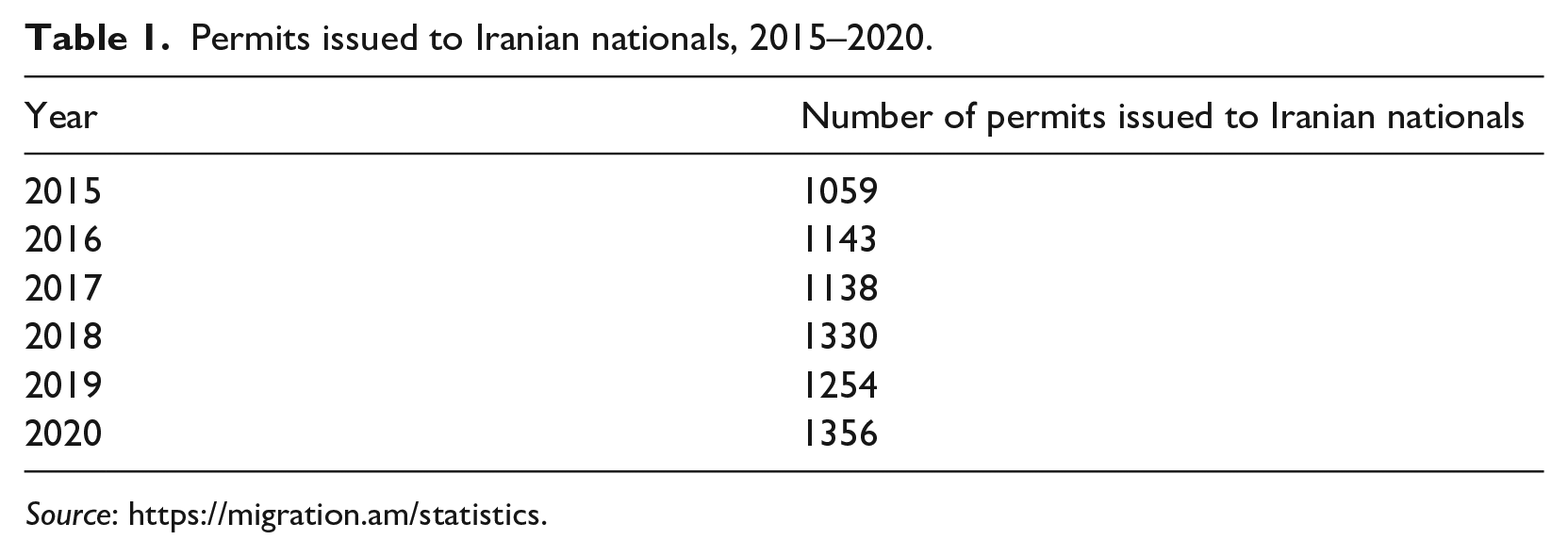
Table 1 presents data from the State Migration Service of Ministry of Territorial Administration and Development of the Republic of Armenia.
Permits issued to Iranian nationals, 2015–2020.
Source: https://migration.am/statistics.
Table 2 presents data from Armenia’s 2011 census by country of origin.
Country of origin according to Armenia’s 2011 census.
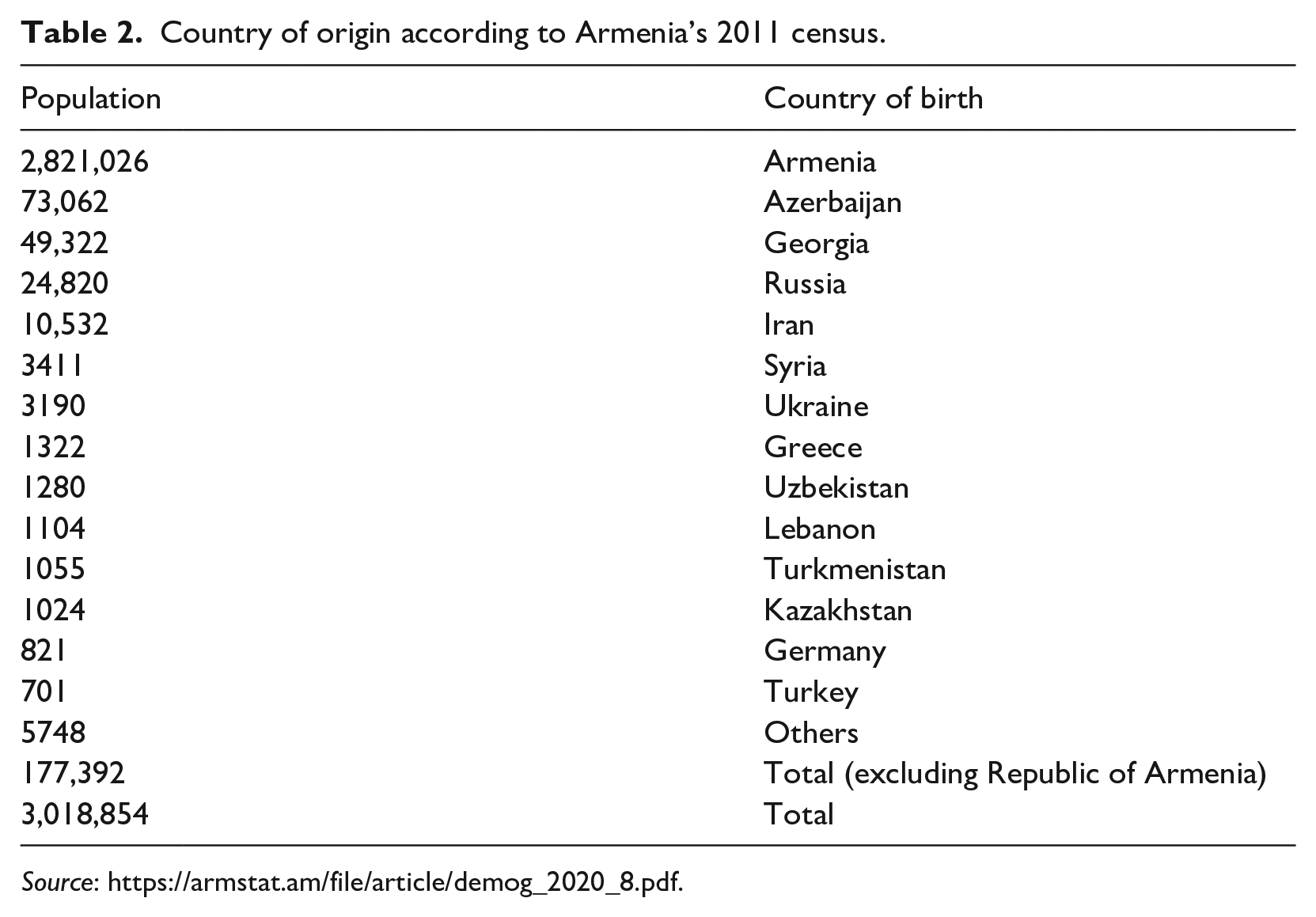
While certain trends are observable, Armenia’s 2011 census statistics (see Table 2) do not account for the many thousands of Armenians who ‘returned’ as a result of political and economic deterioration after 2011 from countries like Iran, Lebanon, Syria, Russia, Ukraine, and others. For example, Table 1 indicates the steady growth of permits issued to Iranian nationals between 2015 and 2020. Even though these numbers do not distinguish between Armenian and non-Armenian Iranian nationals, research has shown that economic and political instability in Iran has led to an increase in Iranian Armenian return migration (Fittante and Barry, 2022). Also, the 2011 numbers do not include the Armenians who migrated following the Velvet Revolution in 2018 (Ohanyan and Broers, 2020). Nonetheless, Table 2 provides some indication of the growing presence of the diaspora in Armenia. While not including many important events, the 2011 data indicate the beginning of a process that has significantly increased. Several of the countries listed have historically hosted the Armenian diaspora, such as Iran, Georgia, Greece, Lebanon, Russia, Syria, Turkey, and others. 11
In 2019, Armenia’s post-Velvet Revolution Prime Minister, Nikol Pashinyan, replaced the Ministry of the Diaspora with the High Commissioner of Diaspora Affairs. To head this office, he nominated a first-generation Armenian American, Zareh Sinanyan, who had held elected office in the United States. 12 Pashinyan’s government has also prioritized return migration. 13 While not wholly successful at drawing large diaspora populations from affluent Western countries, Armenia’s policies encourage diverse Armenians from all over the world to ‘return’ and participate in the country’s economic and cultural development. Many of these policies also serve the function of ‘tapping the diaspora’ for money and access to international resources (Ketkar and Ratha, 2010). But, as the waves of Syrian, Iranian, and Russian Armenians attest, these policies have very real implications in terms of generating internally diverse co-ethnic populations of Armenians in Armenia.
Beyond citizenship and permit laws, post-Velvet Revolution officials have worked on policies that specifically accommodate and acknowledge diasporic multiculturalism among diverse Armenians. While some of the existing programs, which facilitate engagement and migration among Armenians from abroad, operate in nongovernmental capacities, Armenia’s High Commissioner for Diaspora Affairs has also launched several programs, which specifically seek to promote cross-cultural encounters and cultivate stronger ties between Armenians from the diaspora and the Republic of Armenia. Some of these programs include iGorts, Diaspora Youth Ambassadors, Step Towards Home, and NerUzh. These programs offer prospective returnees either funding and/or employment to facilitate return migration from the diaspora. For example, iGorts invites Armenians from the diaspora to work in various state agencies in Armenia for at least 1 year. Participants come from all over the world; they receive airfare, a monthly stipend, medical insurance, and other benefits. Several of these participants remain in Armenia even after completing the program. 14 In addition, some participants have occupied prominent positions in Armenian government. 15
There have been other efforts to implement diasporic multicultural policies. For example, in 2019, some Armenian MPs pursued a legal provision, which sought to provide Western Armenian language and literature classes in public schools. 16 A policy of this nature would resonate among Western Armenian speakers, who strongly identify Western Armenian as an integral part of their linguistic heritage (Karamanian, 2019). While Western and Eastern Armenian are, largely, mutually intelligible to Armenian speakers, such a provision would prove a rather striking example of diasporic multicultural language policy. However, to date, no significant Western Armenian language provision has been enacted.
Also, the Armenian government has collaborated with diasporic organizations in creating institutions, which not only enhance Armenia but also cultivate diasporic multiculturalism. One example of this is in higher education. In the aftermath of Armenia’s catastrophic 1988 earthquake, the Rector of Yerevan Polytechnic Institute, Yuri Sargsyan, worked with Armen Der Kiureghian (from Iran) and Mihran Ababian (from Cyprus and Syria) in establishing the American University of Armenia (AUA). Der Kiureghian, who had moved to the United States after finishing his BS and MS in Civil Engineering at the University of Tehran, completed a PhD and became a Professor of Engineering at UC Berkeley. With the financial and logistical support of the Armenian General Benevolent Union, the University of California, and the governments of the United States and Armenia, the AUA has been operating since the day Armenia’s Parliament declared independence from the Soviet Union – 21 September 1991. As of 2021, 1474 undergraduates and 495 graduates had enrolled at AUA. In addition, 3630 students were enrolled in its extension courses. At the time of this writing, approximately 25% of its faculty are not citizens of Armenia. Most of the foreign-born faculty and teaching staff consist of Armenian diasporic returnees. 17 At the AUA, local Armenian students can take classes on diasporic Armenian history, literature, and culture, among other subjects – often taught by Armenians from the diaspora. 18 The literature courses include both Western and Eastern Armenian texts. These exposures enhance national solidarity and expand what constitutes national education at the university level.
Everyday diasporic multiculturalism in Armenia
Diasporic multiculturalism is also cultivated in the everyday interactions that occur between local Armenians and Armenians from the diaspora. In these interactions, local and diasporic Armenians encounter different understandings of ‘Armenianness’. These distinct understandings derive, in part, from returnees’ diverse histories and experiences living among both Armenians and non-Armenians in one or multiple sites prior to their ‘return’.
One example of how everyday diasporic multiculturalism manifests itself is in Yerevan’s food landscape. As Anita Mannur (2009) has argued, food plays a central role in cultivating diasporic cultural imaginations. In terms of food options (and other service industries), Iranian Armenians do not boast the same contributions as the Syrian Armenians, whose restaurants have significantly expanded and diversified Yerevan’s restaurant scene.
19
Nonetheless, Iranian Armenians also own and operate stores and restaurants. Local Armenians experience these new products through the many contributions of returnees. For example, I interviewed Narine, who owns the Iranian Armenian store, Charaz. Narine migrated to Armenia from Tehran in 2012. Narine’s store is located in a district of relatively dense Iranian Armenian residential concentration. In this district is also located the Iranian Embassy. She told me that her customers consisted of Iranians, Iranian Armenians, and local Armenians. Similar to the many Syrian Armenian restaurants in Yerevan, Narine’s shop diversifies and expands the local cuisine. Narine shared the following with me: Here we had some difficulties coming from different cultures. For example, we had to make it understandable that if you try using these dry fruits – they are also very tasty – it means, if you are making dried fruits of apricot or berries, you can also try these chreni products (dried cherry). They [local Armenians] think in old and limited ways; they think in traditional ways, in contrast Iranians in Iran learn quickly and, if something is new, they make things like it. But the same thing doesn’t happen here. If you suggest something it takes five months for them to try and say: ‘Oh, you were right! It was delicious!’
20
Because of the many differences between local Armenians and Iranian Armenians, Narine has had to adapt in terms of providing goods for her customers. Nonetheless, she has persisted in her efforts to introduce to local Armenians both Iranian and Iranian Armenian products. In the example she described to me, Narine identified the rather long process of trying to accustom local Armenians to eating chreni – an Iranian dried fruit. She acknowledged that, in the beginning, many of her local Armenian customers resisted it, but, after several months, they had learned to enjoy it.
Narine’s shop reflects one way in which Armenians from the diaspora bring with them a blend of cultural products (in this case, Iranian and Iranian Armenian) and challenge local Armenian cultural expectations. Diaspora Armenians, who have often lived in the diaspora for hundreds of years, have developed hybrid identities, which seamlessly fuse distinct elements. In some cases, this fusion results in a uniquely Armenian product; in others, they adapt and integrate products of their host societies. At Charaz, Narine cultivates diasporic multiculturalism by promoting Iranian and Iranian Armenian products, 21 which are popular among Iranian Armenians and, increasingly, among local Armenians. And, by making these food products available, Narine contributes to the cultural diversification of Armenia.
The ways in which diasporic returnees multiculturalize monoethnic nationhood extends beyond the many commercial and economic industries in which they participate. For example, I interviewed an Iranian Armenian, Nanor, who moved to Armenia at the age of six and is the co-founder of a theater group in Yerevan. In addition to theatrical productions, Nanor and her colleagues undertake theater-related research and explore taboo topics in the context of Armenia. When I asked her why she chose this specific profession, she told me the following: I am Iranian Armenian. I was born in Iran. So I know the community, and the culture of diaspora is really huge. And we can’t just ignore that. We actually need to take that. That’s why we’re doing these plays, where we are talking about these diasporan writers. Or, in our troupe, we have these Iranian Armenian actors, who have this accent, which is not accepted. I was in the university and they were always forcing me to reduce the accent so it’s not heard that I’m from Iran. So, actually, putting the target on the diversity of Armenia . . . diversity not just in a dialect way but diversity about how the history of how the Armenian theater is interpreted . . . There’s one way to understand, but it’s too [Soviet]. And we have a rich – before the Soviet era – theater, which is very politically active theater . . . So I think that is a must: to put them in that context and introduce them.
For Nanor, Armenians’ cultural diversity inspired her to form a theater company and pursue research on the topic of Armenian diasporic theater. Through her work – with both local Armenians and other Iranian Armenians – she attempts to develop social ties and expand what she sees as Armenia’s more limited ‘Soviet’ prism. Nanor’s work contributes diasporic Armenian theater culture to the homeland. Just as immigrants from diverse countries in Australia, Canada, Sweden, and the United States enhance their host societies with their own multicultural contributions, diasporic Armenians reproduce cultural contributions developed in the diaspora. In the case of Nanor, she enhances Armenian cultural identity with Iranian Armenian or diasporic Armenian traditions in literature and theater (and using her own Armenian ‘accent’). As with Narine, Nanor has had to overcome perceptions of difference; furthermore, she challenges the local Armenian population to expand its own understanding of Armenian culture – in this context, as it relates to theater.
Narine and Nanor’s diasporic contributions reflect Iranian and Iranian Armenians’ blended histories. These cultural contributions culturally diversify Armenia without altering its monoethnic nationhood. The cultural contributions they make reflect distinct adaptations of diasporic culture, which, in their cases, evolved among Armenians in Iran – that is, a single site. But several of the returnees with whom I interacted brought even more hybridized diasporic contributions. Before moving to Armenia, many diasporic return migrants come via various locations. These distinct locations contribute to their own diasporic identities, and, in turn, their multicultural contributions in Armenia.
Aida exemplifies how the complex interplay of Armenian returnees’ multi-local backgrounds cultivate everyday diasporic multiculturalism. After completing her undergraduate and law degrees at the University of Tehran, Iran, Aida moved to England, where she completed a PhD and began working in law. Later, she moved to the United States. She began visiting Armenia in the late 1990s. Initially, she did not feel a strong sense of attachment to the country. But, over the course of many visits, she developed ties and identified areas in which she could contribute her own legal expertise. She eventually moved to Armenia, established a law practice, and began teaching law at several Armenian universities. She explained to me why, at the French University in Armenia (Fondation Université Française en Arménie) and a state univesity, she consciously opted to teach in Armenian: I preferred Armenian because, even terminology, you want to be able express yourself in the language the student is familiar. And that’s why I decided to teach in Armenian, even though it is much more difficult for me than teaching in English. But, nevertheless, that’s what I do. I also taught arbitration and private international law for three years at Vanadzor [State] University.
In our conversation, Aida acknowledged that her efforts to contribute to the legal culture of Armenia through the judiciary system had been less pronounced than she would have liked; however, she recognized her impact in Armenian higher education: I am doing what I can, what I do best; I am teaching. We do have a center we are setting up. I am working with the European Council arbitrator. To some extent with the ministry. What is important to me . . . I am doing what I enjoy best. I will not enjoy doing this in Iran, doing this in California, doing this in Massachusetts. There are lots of people doing what I am doing. And more than that, I am more effective here, and that gives me the satisfaction I need.
In Armenia, Aida provides specialized legal classes (in various Armenian universities); she sometimes offers them in her native Armenian language, even though, as she conceded to me, they would be much easier to teach in English. 22 Pulling from her extensive personal and professional experiences in Iran, England, and the United States, Aida ‘translates’ her expertise into contributions that multiculturalize monoethnic nationhood. By providing specialized legal courses at various Armenian universities (in the Armenian language), she expands not only university curricula but, by teaching a new generation of future Armenian professional lawyers and legal experts, she also diversifies legal culture and practices throughout Armenia.
As an instructor, Aida contributes her knowledge to a new generation of local Armenians. However, Armenian students from the diaspora also cultivate everyday diasporic multiculturalism. For example, the American University of Armenia (AUA) draws not only instructors but also students from all over the global diaspora. At the AUA, Armenians from the diaspora and Armenia interact daily and form personal relationships.
23
These encounters root diasporic Armenians’ experiences in Armenia and provide them with resources to settle permanently. In turn, these encounters cultivate connections between local Armenians and the diaspora, particularly a new generation of young Armenians. I interviewed or interacted with several students and instructors from the AUA. For example, Vahe, an Iranian Armenian returnee, who works for an international tech company in Yerevan, moved to Armenia specifically to attend the AUA. He shared with me the following: I was interested in ranked university based on the number of people, who go further, and write papers, do academic research, and stuff like that. But then I discovered the percentage of those who graduate from AUA end up working in leading positions and contribute to something: could it be in management, in IT, could be in anywhere else, politics even. So I thought, Okay, this could really be something interesting . . . And, in terms of proximity, it was not a problem. It was just next to Iran, so I found it all very easy to organize, in fact . . . During my first years at AUA, I started sensing I am going to stay. When I finish, when I graduate, I will be here. And the rest was pretty smooth. I started also working, I got many local friends, I got to know many people, and the integration was really fast and also very smooth.
The AUA motivated Vahe’s migration and structured his transition. He was especially inspired to attend because of its proximity to Iran, where his family lives. In addition, as Vahe explained, many AUA students eventually become important contributors to several sectors of the country’s development. Furthermore, by attending events at the AUA, Vahe developed a social community with both local and diasporic Armenians. While Vahe acknowledged that AUA insulated his experience from some of the harsher realities many returnees face, he also told me that his social interactions with Armenians from the global diaspora as well as the local Armenian population had broadened his global perspective. Vahe eventually attended graduate school in Europe, but then, after graduating, returned to Armenia to help develop its information technology (IT) sector.
Conclusion
Scholars typically study multiculturalism in a limited number of countries where there exist regimes of ‘polyethnic rights’ (Kymlicka, 1995). In the few cases that examine multiculturalism in more homogeneous societies, the focus remains on interactions between titular nationalities and ethnic and racial minorities (Iwabuchi et al., 2016; Walton et al., 2020). In both contexts, international migration plays a central role. Yet, international migration facilitates other forms of multiculturalism. One example of this occurs in monoethnic nation-states, where diasporic return migration drives multiculturalism.
Many of Armenia’s diasporic return migrants had limited contact with the country before resettling (Fittante and Barry, 2022). They attribute high levels of cultural distinctness – even among those who have lived in Armenia for decades. Despite maintaining a strong sense of cultural difference, these returnees are ethnically Armenian and many speak natively the same language as that spoken in Armenia. They also contribute significantly to Yerevan’s economic and cultural vibrancy. Furthermore, the Armenian government has – within its own limited capacity – tried to cultivate diasporic multiculturalist (or multicultural nationalist) policies and help develop institutions to help facilitate the transitions of returnees and, to a certain extent, acknowledge their diversity. In so doing, it has developed a form of diasporic multiculturalism, one that involves expanding the majority population’s national identity with distinct iterations of Armenian culture – namely, diasporic Armenian culture. These new attributes of an ethnic identity repertoire (Chandra, 2012) do not challenge the majority population’s understanding of national identity; rather, they strengthen and expand it. As such, the findings of this study demonstrate that multiculturalism can exist in the absence of ethnic pluralism.
By adding diasporic multiculturalism to the scholarship, several new opportunities arise. The first relates to regional domain. As scholars have noted in research on the sociology of race and ethnicity (Suzuki, 2017), multiculturalism research lacks geographical breadth. It describes phenomena taking place in limited parts of the world – that is, mostly affluent Western liberal democracies. Furthermore, even when it is applied outside of that range, authors use the same theoretical assumptions and apply them elsewhere. However, by situating diasporic return migration into studies of multiculturalism, scholars can pursue encounters in a far more diverse range of countries, where internal migration or return migration is more common. Also, removing the prerequisite of ethnic pluralism will enable scholars to test some of the arguments used against it. For example, many contend that ethnic and racial diversity negatively influence welfare programs and weaken national solidarity (Alesina and Glaeser, 2004; Barry, 2001; Hero and Preuhs, 2007). While Armenia is certainly not an example of a state with strong institutions (Sahakyan and Stiegert, 2012), this expanded conceptualization of multiculturalism enables scholars to undertake critical analyses and test these hypotheses in less ethnically or racially diverse countries.
The sociology of multiculturalism comes out of a particular immigration trajectory – typically from the Global South to the Global North. But the competitiveness of oversaturated markets in the ‘West’, the role of the Internet (remote work), and increasing standards of living among many ‘second world’ countries are changing those traditional routes. Not only are the routes changing, but the people taking them are, too. Diasporic return migration is growing in scope, particularly among those who identify as ethnic members of several post-Communist countries. These returnees are contributing new understandings of multiculturalism for a new chapter in the history of migration. This article has sought to introduce the concept of diasporic multiculturalism, but it has also left considerable room for further investigation and empirical substantiation. For example, this analysis has focused largely on what diasporic returnees bring to the perceived homeland; however, future research on diasporic return migration might also unpack what local and diasporic populations create together in their daily interactions. Some already relatively well-studied affluent Asian contexts – especially Japan and South Korea – will benefit from this new conceptualization of multiculturalism. Also, in Western countries, the model can shed new light on inter-ethnic diversity. Yet, I believe this framing is best applied in other, less affluent, more ethnically homogeneous spaces. Future scholarship should not stop studying multiculturalism in the already thoroughly researched spaces. However, an expanded understanding of multiculturalism – such that it need not depend largely on ethnic or racial pluralism – will open many research opportunities for scholars to study similar phenomena in new spaces. In addition, it allows for a more nuanced means of unpacking the cultural diversity and pluralism among single ethnic populations.
Footnotes
Funding
The author(s) disclosed receipt of the following financial support for the research, authorship, and/or publication of this article: This research was made possible by the The Foundation for Baltic and East European Studies (Östersjöstiftelsen).
