



Abstract
There has been a lack of research examining how right-wing extremist groups justify their key claims online to reach a broader audience. This question is even more worrisome when considering a Canadian context, given Canada’s state policies on multiculturalism and intolerance of hateful rhetoric. My research draws on the gaps within the literature of right-wing extremism, online spaces, and justification of discourse by conducting a content analysis of 300 Facebook and Twitter posts from the accounts of three Canadian right-wing extremist groups, ID Canada, Soldiers of Odin BC, and Yellow Vests Canada. This article proposes the use of French theorist Boltanski and Thévenot’s sociology of critical capacity common worlds to help explain how right-wing extremist groups make arguments that are quite extreme to a broad audience of people on social media. Such claims include advocating for a homogenized Canadian identity and Canadian values, promoting a belief in social decay, and supporting authoritarianism. However, these claims are not overt; rather right-wing extremist groups discuss apolitical topics to mask controversial views.
Introduction
Perry and Scrivens (2018) state that right-wing extremism has persisted in Canada because extremism is always present in communities that have a history of colonization and racism, which are both central to Canadian history (p. 173). However, these features often go undiscussed outside of academic circles. For example, many Canadians refuse to acknowledge that they live on Indigenous land (Denis, 2015: 228). This means that when right-wing extremist groups promote beliefs about the treatment of other non-white people, such as denying Indigenous treaties and rights, they can do so without seeming controversial. The use of commonplace claims of racism and exclusion is not new in Canadian society, and right-wing extremism may be one iteration of such assertions.
Through a content analysis, this article contributes to the literature of Canadian extremism and mundane claims by examining the online presence of three Canada-based right-wing-extremist groups (Yellow Vests Canada, ID Canada, and The Soldiers of Odin in British Columbia [BC]), asking how each group discusses identity, politics, and values. Drawing on the sociology of critical capacity (Boltanski and Thévenot, 2006), this article suggests that these three Canadian right-wing extremist groups make seemingly apolitical claims which convey more alarming beliefs about Canadian identity, belonging, and politics. In the conclusion of this article, I highlight how, by appealing to civic and domestic common values (Boltanski and Thévenot, 2006), these three groups can enter both online political spaces and mainstream politics and perform on-the-ground activism, becoming a part of the mainstream political scene in Canada to step away from fringe identities.
Right-wing extremism in Canada
Canadian society has had a significant history of normalized racism (MacDonald and Hudson, 2012), supported through Canada’s legal system (Perry and Scrivens, 2018: 173). Parent and Ellis (2014) argue that racism has often been overlooked in Canadian society, and there has been a lack of research in Canada connecting right-wing extremism to Canada’s racist past (p. 3). The prevalence of the Ku Klux Klan in Canadian provinces such as Ontario, Alberta, and Saskatchewan provides a stark example of the normalization of racism in Canada (Bartley, 1995; Lund, 2006; Parent and Ellis, 2014: 9; Perry and Scrivens, 2016, 2018).
Right-wing extremism in Canada is also largely context dependent. For example, studies have found a larger base of supporters for new right candidates in Western Canada, such as the province of Alberta, as opposed to eastern and central Canadian provinces (Gidengil et al., 2005). Right-wing extremist groups in the province of Québec, the only province in Canada in which French is the official language, also vary in terms of size and organizational ideologies. Québec has passed pro-secular laws under Bill-21. According to this bill, some public employees including teachers and lawyers are not allowed to wear visible religious symbols, which prevents individuals who wear a niqab, burqa, and hijab among other religious attire from practicing their religion if they are a public servant (Béland et al., 2021; Gagnon, 2020). Because far-right extremist organizations and ideologies differ in regions such as Québec, for the purposes of this study, I have only examined three groups that operate outside of the Québec context.
While each province has iterations of extreme right groups, nationally, Canada has attempted to combat racism and hate speech and content by introducing extensive hate crime laws. For example, on 3 February 2021, Canada declared the infamous extremist group The Proud Boys, a terrorist group (Austen, 2021). However, scholars have critiqued the use of hate speech, hate groups, and hate discourse to unpack the extreme right and have been right to do so for a variety of reasons (Tetrault, 2021). First, hate discourses often uphold the idea of extremism as a behavioral or personal malady and not a systemic part of the Canadian society (Tetrault, 2021). Second, the extreme right has been known to use less extreme language to attract more members (Pascale, 2019), referring to their actions as motivated by hate solely deviates attention away from the groups as rational actors. Using critical theoretical frameworks such as Boltanski and Thévenot’s (1999) sociology of critical capacity to unpack extreme right discourses adds to literature on the Canadian extreme right which serves to unpack actors as individuals who knowingly use tactics to uphold exclusionary nationhood.
Right-wing groups in this study
While the definition of right-wing extremism has been contested (Mudde, 1995), for this research, I define right-wing extremist groups as those that are hostile to big government, anti-democratic, xenophobic, racist, homophobic, transphobic, and those invested in ethnic nationalism (Mudde, 1995: 206; Scrivens, 2021: 2). For this research, I examined three different right-wing extremist groups: Yellow Vests Canada, ID Canada, and Soldiers of Odin BC.
Yellow Vests Canada has been active on Facebook since 2018. The group attempts to take advantage of the more left-leaning Yellow Vests movement in France. One of Yellow Vests Canada’s main positions, besides being opposed to the carbon tax, is ending illegal immigration and only allowing entry to immigrants based on successful integration. For this research, I analyzed the Yellow Vests Facebook page.
ID Canada has been active on Twitter since 2017. The group states that they are protectors of European-Canadian identity and traditional western values. They also claim to fight against diversity. Stemming out of the identitarian movement in the United States which focuses on spreading nationalist white racial identity, ID Canada states that the most important part of a person’s sense of self is their ethnic identity. The members of this group label themselves ‘ethnic Canadians’ living in Canada (ID Canada, 2018). For this research, I examined ID Canada’s Twitter page.
The Soldiers of Odin Canada is a national group modeled on the Soldiers of Odin factions in the United States. Originally founded in Sweden by a known neo-Nazi, the Soldiers of Odin is an anti-immigration group that states that they ‘want to protect Canadian laws and values’ (Frontburner, 2019: 5:40). The Soldiers of Odin have chapters across Canada. In this analysis, I examined the Soldiers of Odin BC branch, as it has more Facebook followers and interactions (i.e., posts per day) than any other Canadian Soldiers of Odin branches, including the National chapter during the time of data collection. While there has been infighting in various sections of the Soldiers of Odin (Montpetit, 2017), at the time of data analysis, the Soldiers of Odin BC had experienced little of this fragmentation in their local branch. This Facebook page was created in March 2016.
I chose to use these groups as my cases because of their online and media presence (cf. Bolan, 2019; Musset, 2019). Their online presence was also important as research on extremism in Canada has found that extremist groups are more active online than previously thought (Devries, 2022; Perry and Scrivens, 2016: 824). Of the Canadian right-wing extremist groups that could be identified online at the point of data collection, these groups also had the largest online following (number of ‘followers’ on social media). At the time of data collection, ID Canada had 1341 followers on Twitter as they had just switched to this social media site, The Soldiers of Odin BC had 4202 ‘Likes’ and had 4407 people following their Facebook page, and Yellow Vests Canada had 108,906 group members. User and followers of these pages were able to interact with posts by commenting, liking, retweeting, and sharing. Yellow Vests Canada allows users to post on their Facebook wall, sharing articles and creating their own discussion. The Soldiers of Odin BC and ID Canada create the topic of discussion for their followers by posting on Facebook in which case members could interact with one another and the group in the comments of each post. In summary, followers or members of each group were able to interact with one another and the group on all three pages.
Methods: analysis of online content
This article examines the online presence (publicly accessible Facebook posts, Twitter posts, and websites) of three Canada-based right-wing extremist groups. I used a content analysis to identify how each group negotiates racial identity while also discussing contentious ideas surrounding belonging and politics. The groups for this study were chosen using three criteria. One, they had to be Canada based. Two, they must have an active social media account (posting during March 2019–the beginning of data collection). Of the groups that satisfied these criteria, they had the most ‘followers’ or following on social media.
I collected 100 social media posts from each group (100 Facebook posts from Yellow Vests Canada, 100 tweets from ID Canada and screenshots of their website, and 100 Facebook posts from the Soldiers of Odin BC) during a 24-hour period on 30 March 2019, to get posts that had been published around the same timeframe. Posts had been published between September 2018 and March 2019 and were collected in chronological order; I did not exclude any posts. I date-stamped the posts I collected with the date of publication and the date of collection. I then assigned each post a number per its order in the total number of posts I collected for each group.
I captured these posts from the publicly available Facebook or Twitter pages of each group. I collected data from each group’s most active social media account (either from Twitter or Facebook). I determined account activity by accessing the amount of content that was published and how many people followed the account. I also collected data from ID Canada’s public website to better understand their collective mission statement and objectives as a constant frame of analysis separate from their social media activity.
I use a content analysis to examine the posts I collected. Academics can understand their research participants by examining the themes they use in written documents or through conversation (Gee, 2005: 10). Both verbal and written communicative material can be examined using content analysis as a tool (Mayring, 2004: 266). Using this method, I draw on the key claims that the three right-wing extremist groups in Canada make about Canadian identity, belonging as well as politics.
Boltanski and Thévenot’s domestic and civic common worlds
The sociology of critical capacity, associated with the work of French scholars Luc Boltanski and Laurent Thévenot (1999, 2006), was designed to study conflict between groups or individuals. These scholars argue that in a dispute, actors use different frameworks to justify their actions and behavior, what they refer to as ‘common worlds’ (Boltanski and Thévenot, 2006). This theory was originally used to analyze situations and conflicts in France; however, I draw on the common worlds to examine how the three right-wing extremist groups in this study avoid conflict with the broader society using mundane claims to mask more contentious ideas. I argue that the extreme right-wing makes claims that align with socially acceptable frameworks which they use to justify their arguments, ideas, and actions against their adversaries and to be seen as less contentious.
Common worlds are defined as ‘mental maps’ or frames of justification used by actors to evaluate a dispute (Weber, 2000: 130). Another way to think of a common world is as a type of perspective or lens through which a person or community sees the world. This framework proposes that there are multiple worlds that actors can see through and in which different people (such as politicians and celebrities) are valued (Reinecke et al., 2017: 49). The common worlds include the inspired world, the domestic world, the world of fame, the civic world, the market world, the industrial world, and a seventh world, the green world added by scholars that use this framework (Boltanski and Thévenot, 2006: 159–203; Lafaye and Thévenot 2017: 287; Patriotta et al., 2011: 1810). Actors justify their claims using different values depending on the common world they are positioning their claims in (Boltanski and Thévenot, 2006: 130). For example, a person who is viewing a dispute through the industrial world may judge actions based on their productive value while those using the world of fame to accomplish the same task would judge actions and arguments based on the popularity of that opinion (Boltanski and Thévenot, 2006: 178, 203). I use Boltanski and Thévenot’s (1999) sociology of critical capacity to better understand how right-wing extremist groups justify their contentious claims. For this article, I use the civic common world and the domestic common world.
The civic common world is analytically useful for studying claims-making by right-wing extremist movements. In this world, collective feelings and the interests of the group are the worthiest form of justification (Ten Eyck, 2016: 224). For example, Beamish and Biggart (2017) state that one way to justify actions in this common world is to claim that an act adheres to the public good (p. 194). Previous research has theorized that the civic world puts the need of the community above the market or celebrity (Boltanski and Thévenot, 1999: 371).
I also use the domestic common world as an analytical tool to examine the key claims three Canadian right-wing extremist groups make online. Cloutier et al. (2017) state that in the domestic world, a claim is validated if it speaks to traditions, the respect of authority figures, and responsibility (p. 11). The domestic common world is a useful tool to examine extremist groups because they also often value hierarchal group structures and traditional values that maintain rather than challenge the norm (Neiwert, 2017: 4; Perry and Scrivens, 2018: 171). Vital to the functioning of this world are hierarchical social structures such as the family (Beamish and Biggart, 2017: 179). Therefore, appealing to the protection of the family would be seen as a valid way to justify a contentious claim. In this article, I found that the three right-wing extremist groups often appeal to authority or a strong leader to justify their claims about Canadian politics.
Findings: using mundane language to make key claims
In this article, I explore how three Canadian right-wing extremist groups frame and justify their beliefs about Canadian identity and belonging and politics. In my analysis of posts from right-wing social media platforms, I found that these groups make mundane, less controversial claims on their social media sites. However, the mundane arguments that they use convey a more controversial message.
The domestic and civic common worlds in the sociology of critical capacity help understand how extremist groups make banal claims that mask more troublesome beliefs. I used this theory in my analysis because the claims that right-wing extremist groups make can be better understood as an attempt to call to a shared social logic. The three groups claim that Canadian identity and values need to be protected. I use both the domestic and civic common worlds to unpack how the groups appeal to tradition (used in the domestic world) and the protection or the betterment of the community (civic world) to justify making this claim (Boltanski and Thévenot, 2006). The three groups I studied believe that Canada is in social decay and that action must be taken to prevent this disarray. Right-wing extremist groups use the ‘greater common good’ as justification for actions and behaviors that are in line with the civic common world (Annisette et al., 2017: 217). Finally, extremist groups justify their position of supporting authoritarian governments by calling to the worthy principle of maintaining hierarchical structure in the domestic world (Boltanski and Thévenot, 2006:164–165) and the need for solidarity and uniformity in society, which is an aspect of the civic common world (Boltanski and Thévenot, 2006: 187).
Canadian identity
When the right-wing extremist groups spoke about identity and belonging, they motioned to a homogeneous Canadian identity that was under threat. A key concept in the discussion of Canadian identity was whiteness. Right-wing extremist groups in my study did not make overt claims about Canadian identity being white. Instead, they spoke about European identity and white pride, as well as their belief in assimilation. Taken together, these claims convey a particular message of how the three extremist groups view Canadian identity.
In the posts that I analyzed, I found that the three Canadian right-wing extremist groups fear that Canada may become a white-minority country. On ID Canada’s webpage about ‘resource competition’, they even ask, ‘Where is the place of ethnic Canadians in this scenario?’ (Figure 1). Kincheloe (1999) states that white people experience a crisis of whiteness when white racial dominance is questioned by those around them, whether that be colleagues, friends, or family members (p. 171). White people who are in crisis may also revert to the valorization of the past when white racial dominance was not questioned (Kincheloe, 1999: 172; Parasram, 2019). The three groups show this crisis directly in their posts fearing that white people may become a racial minority. Referring to a collective struggle also appeals to a common sense of collective group identity found in the civic world.
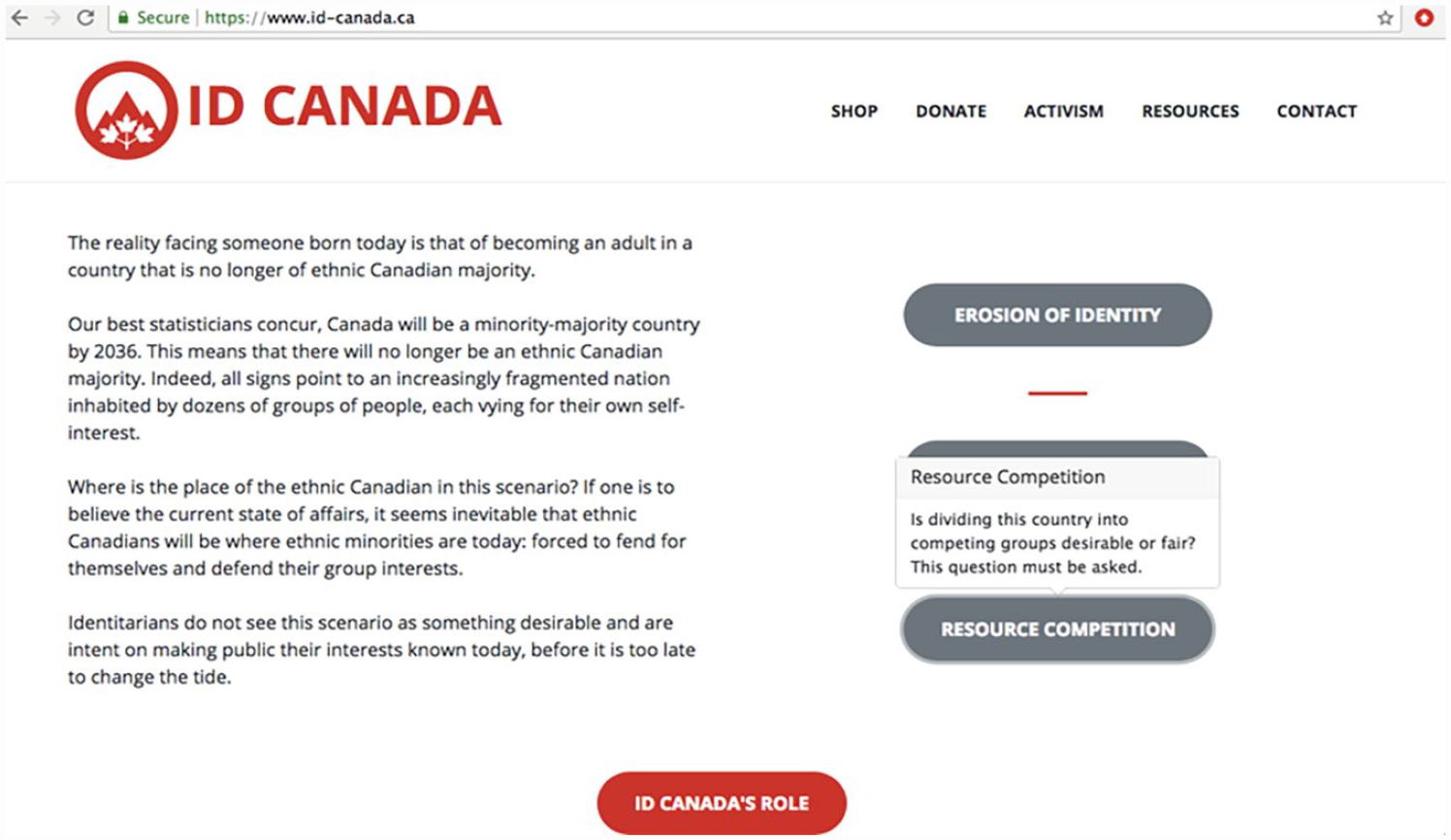
ID Canada website page on Resource Competition.
Challenges to whiteness and traditional forms of white supremacy makes it more difficult for individuals to be proud of white identity and claim whiteness as a national identity (Turner, 2014: 449). In the posts that I analyzed, I found that extremist groups directly speak about negating a crisis of whiteness. This was evident in the ID Canada poster which stated ‘Break the Shackles of White Guilt. Take Pride in Your Identity’ (Figure 2). When social expectations of inclusion make right-wing extremist groups that are predominately white face the consequences of colonization and institutional racism, they may become angry or upset because white meritocracy and superiority are called into question (Blee, 2002; DiAngelo, 2011: 54).
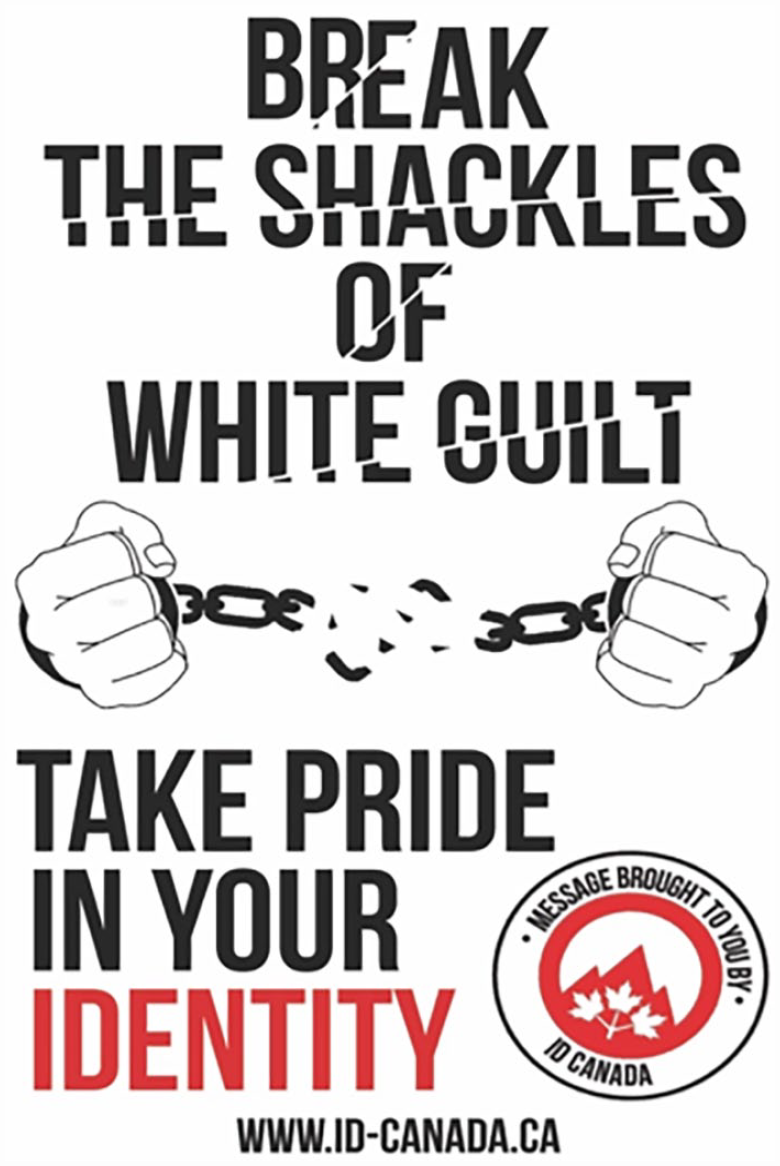
ID Canada Poster about White Guilt.
Soldiers of Odin Canada, ID Canada, and Yellow Vests Canada also claim to be victims that have overcome racial prejudice and should be proud of their racial identity. This is evident in ID Canada’s webpage about ‘Breaking the Shackles of White Guilt’ where they claim that ‘All races have committed crimes against humanity’. In my study, I found that extremist groups often call to racial solidarity when critiquing white guilt (Figure 3).
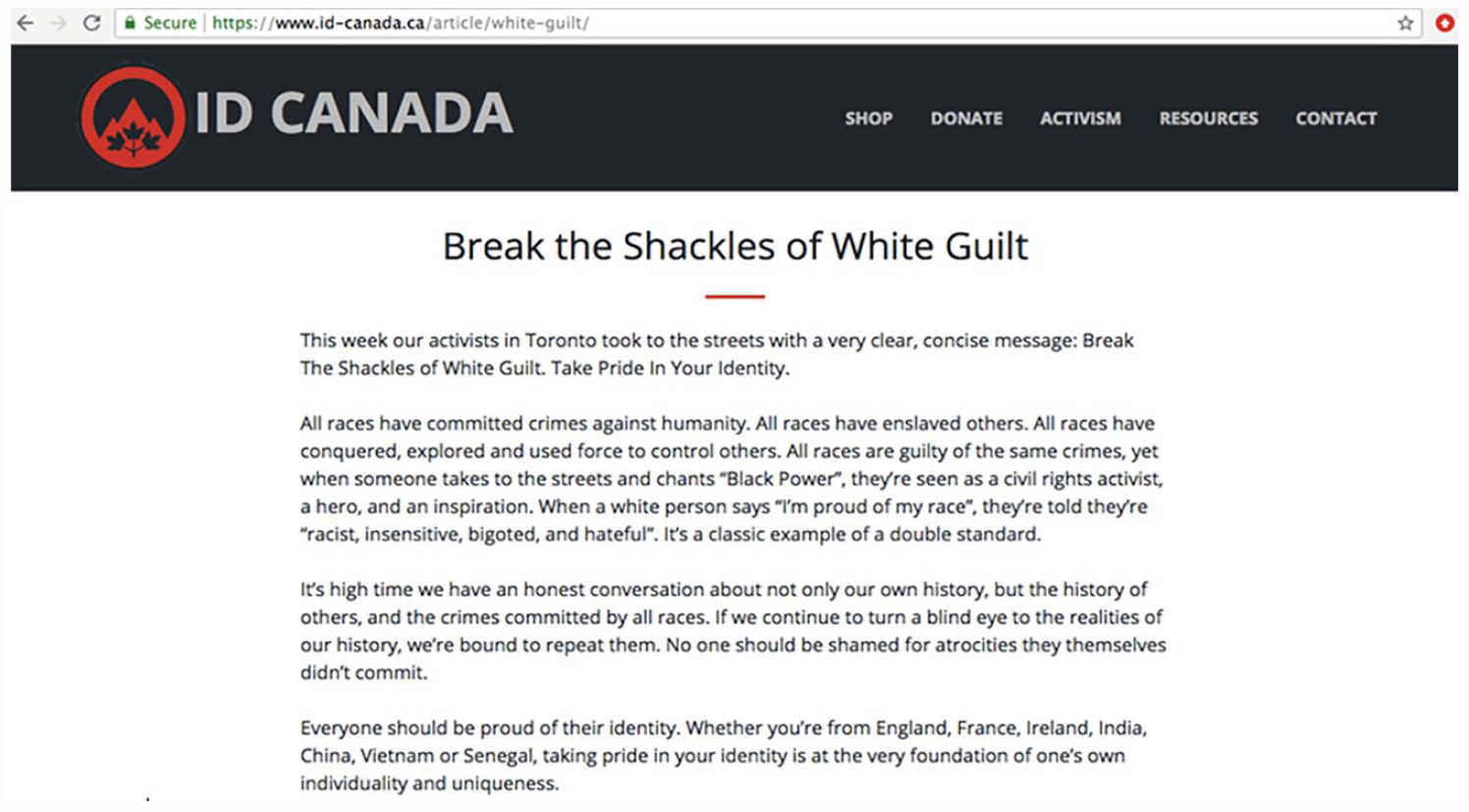
ID Canada Wedpage about White Guilt.
The three right-wing extremist groups also question immigrants’ ability to assimilate (Bar-On, 2018: 18–20). In my analysis, I found that the three groups doubted that immigrants could assimilate into the Global North. For example, a member of Yellow Vests Canada in Figure 4 doubted the allegiance and cultural assimilation of a Muslim fighter pilot in the United States military. In this post, right-wing extremist groups appeal to a sense of collective identity, particularly national identity, and loyalty when making this claim. Using the civic world, extremist groups make the claim that worth is dependent on if a person is a member of the collective (Boltanski and Thévenot, 2006: 191). In this case, the collective is white North Americans. In my study, extremist groups used national loyalty and identity as a litmus test for assimilation.
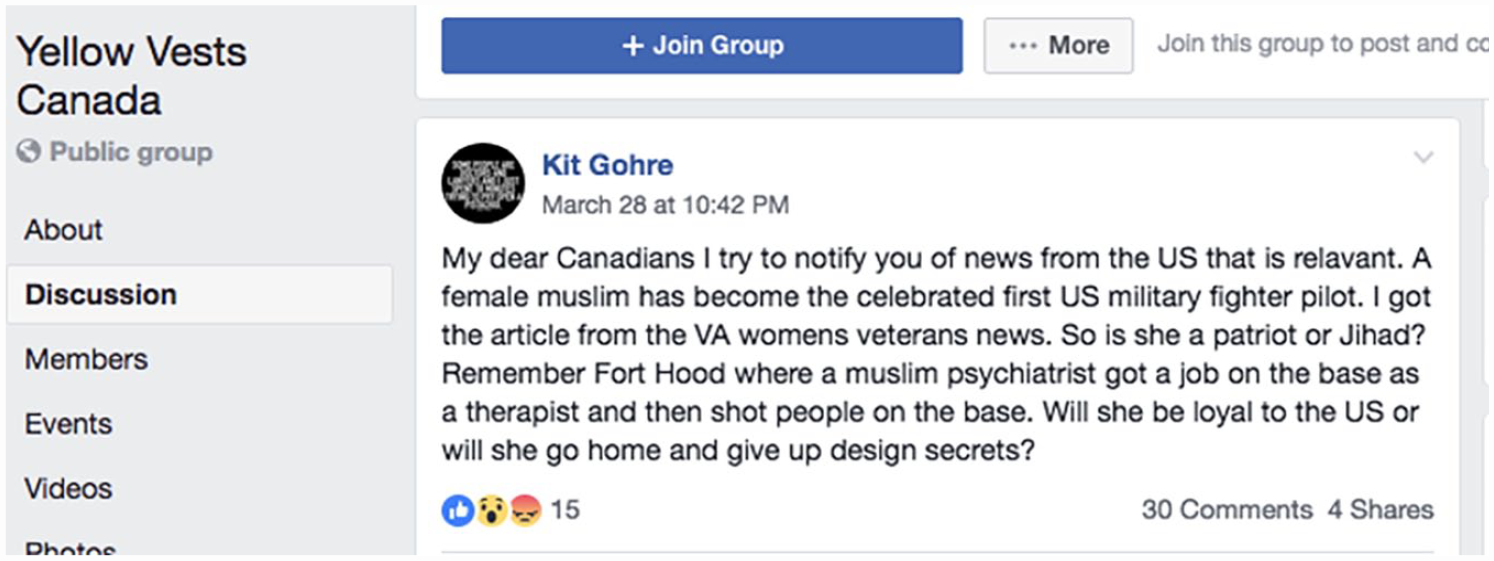
Yellow Vests Canada Facebook Post US Military Vetern.
However, the groups’ claims about assimilation are contradictory. As the ID Canada post about resource competition shows (Figure 1), immigrants are automatically viewed as a direct threat. When the three groups in this study state that immigrants cannot assimilate, they appeal to Boltanski and Thévenot’s (2006) civic world and its worthy characteristic of solidarity and common interests in a similar cause of unity (p. 187). For example, in the posts, the groups state that they are critical of immigrants not because they are racist but because they are trying to protect the greater good (Figures 1 and 4). On the other hand, they also argue that it is impossible for immigrants to assimilate into the national space out of fear they may impact ‘Canadian’ way of life (Figure 1). Right-wing extremist groups’ claims about a perceived lack of assimilation show a more disturbing belief in who can and cannot be Canadian.
Canadian values are traditional values
The three extremist groups’ claims about unspecified Canadian values, queer acceptance, and the media were all reminiscent of beliefs in traditional values that have been seen in the literature on right-wing extremist groups (Neiwert, 2017: 236). Again, the relevance of the crisis of whiteness is apparent in these discussions. When the norm is disrupted in societies that are white, those who benefit from the norm may go into crisis and try to maintain dominate structures in society such as traditional gender norms (Kincheloe, 1999: 172).
Right-wing extremist groups often talk about traditional values and how the acceptance of queer people threatens heterosexuality in the society (Daniels, 2009: 54). Research has shown that extremist groups also depend on their members to maintain hyper-masculinity and heterosexuality to further prove that they belong to the group and uphold broader group beliefs surrounding social issues on gender (Anahita, 2006: 151). Similarly, far-right political parties in Eastern Europe, such as the Jobbik party in Hungary, have also made claims that homosexuality is a threat to traditional families as an extension of the health of the nation (Nuñez-Mietz, 2019). Former Brazilian leader Jair Bolsonaro also made ‘gender ideology’ and traditional family values a main campaign issue in the 2019 Brazilian election (Borba, 2021). Appealing to tradition is not abnormal, in Boltanski and Thévenot’s (2006) domestic world, appeals to tradition is a worthy way to justify your position within a dispute (p. 165).
I found that the three Canadian extremist groups in this study argued that parents have failed to instill gender norms among their children, which they believe leads to an increase in queer identity among youth. For example, the Soldiers of Odin BC Post#17 (Figure 5) is a picture telling parents that children can now medically transition without parental consent. This acts as a warning to parents about the spread of queerness and their loss of control. However, they do so by appealing to a perceived loss of traditional gender norms and parental authority.
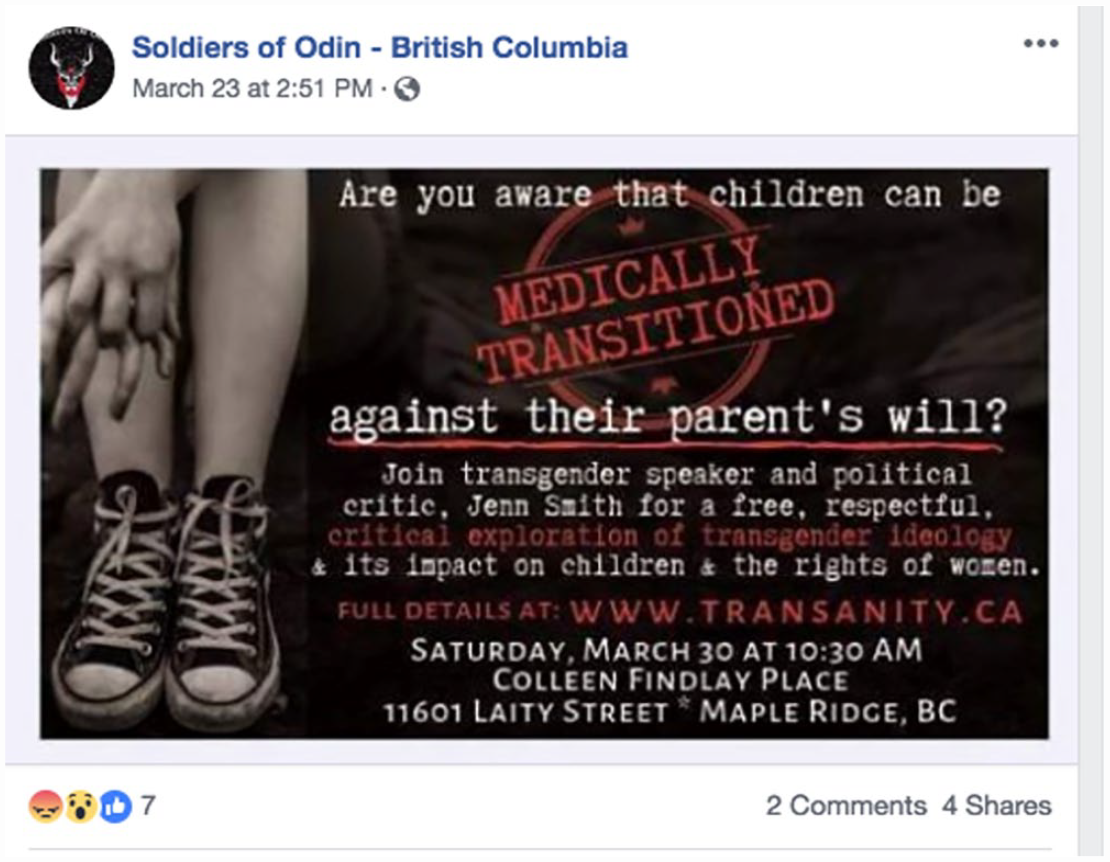
Soliders of Odin – British Columbia Facebook Post.
While transgender people are seen as a threat to the three right-wing extremist groups, other groups of people are depicted as needing protection. For example, in Yellow Vests Canada Post#72 (Figure 6), older adults are depicted as being threatened by the media. Appeals to protecting older adults is a valid claim to worthy principles of tradition and respect for lineage and family, both methods of justification in Boltanski and Thévenot’s (1999) domestic world (p. 370). An individual in Yellow Vests Canada Post#72 even stated that the author of the article was attacking ‘. . . the wisest and most experienced members of our society.’. The three groups also make the claim that younger people are being harmed by the media. For example, the Soldiers of Odin BC argued that the media is turning children into eunuchs through gender-confirming surgeries (Figure 7). On the extreme right and in current right-wing politics in Canada and the United States, the media has been depicted as dangerous and misleading, and these discussions are not new (Lee and Hosam, 2020).
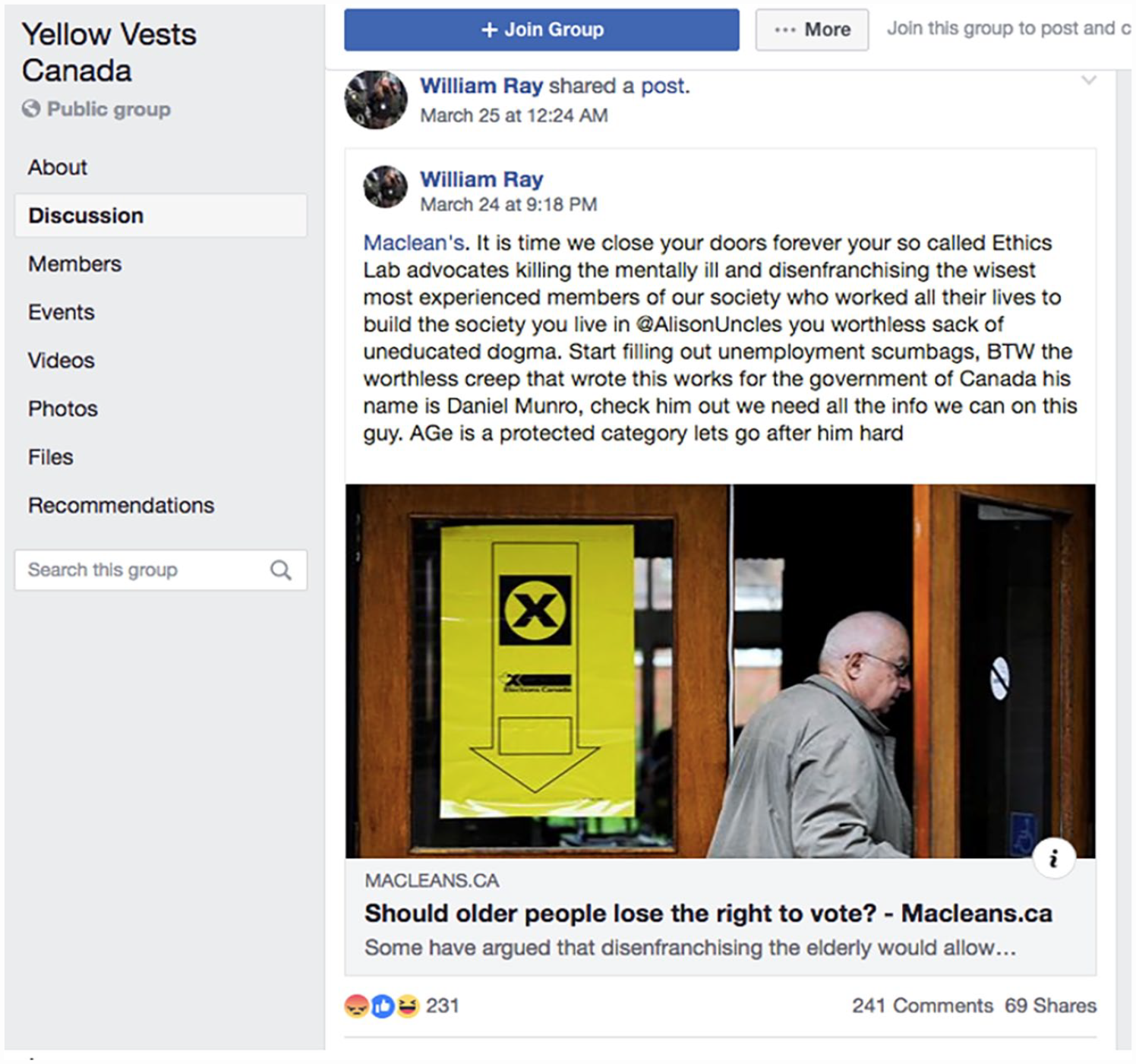
Yellow Vests Canada Facebook Post about Older Adults Voting Rights.
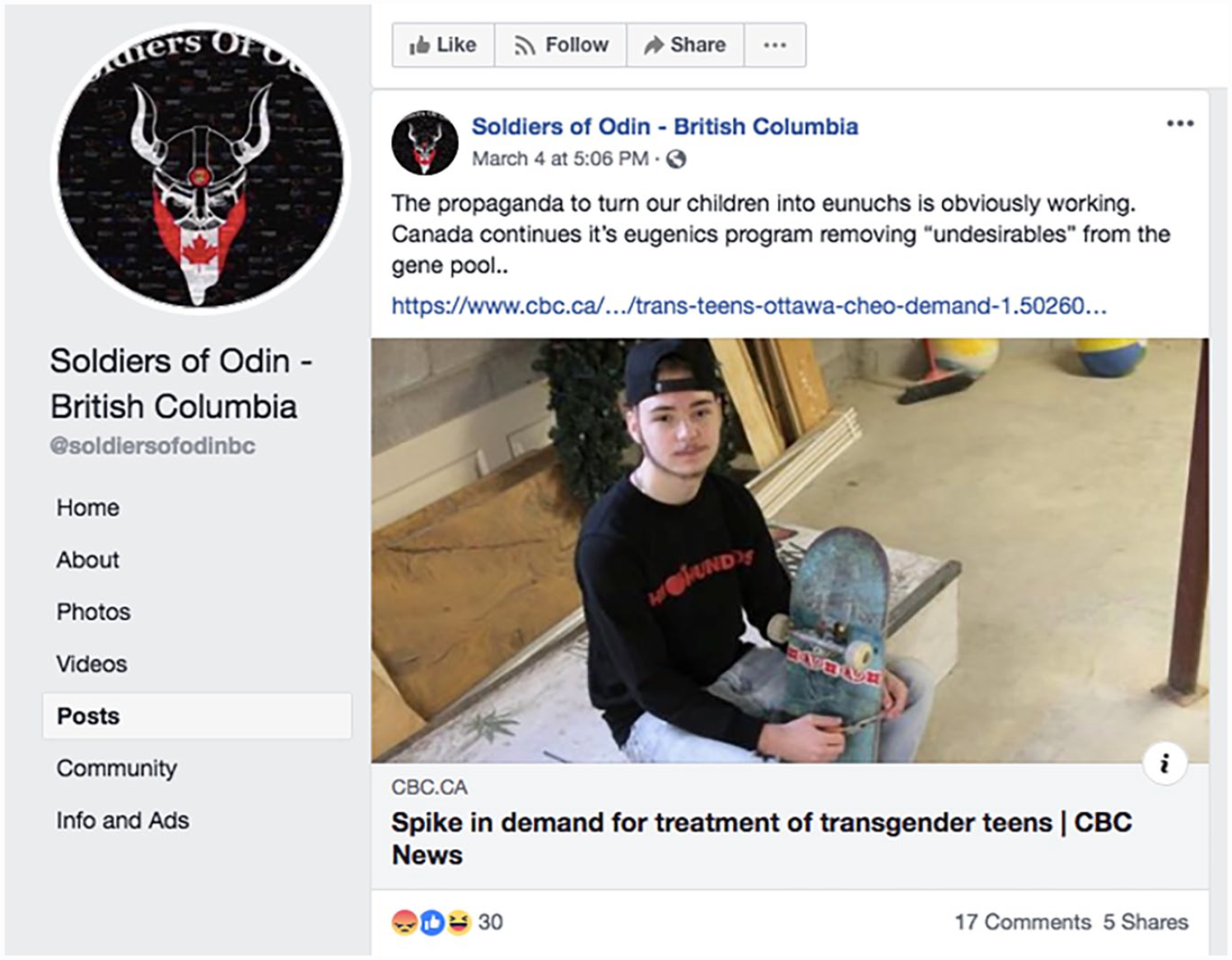
Soliders of Odin- British Columbia Facebook Post about Transgender youth.
The three groups also make claims about helping their community to maintain Canadian values. For example, in the Soldiers of Odin BC information poster and ID Canada’s webpage (Figures 1 and 8), they both talk about helping and loving the community and the nation. This is not contentious but is a valid way to frame claims in the civic common world which prizes civic solidarity (Boltanski and Thévenot, 2006: 187).
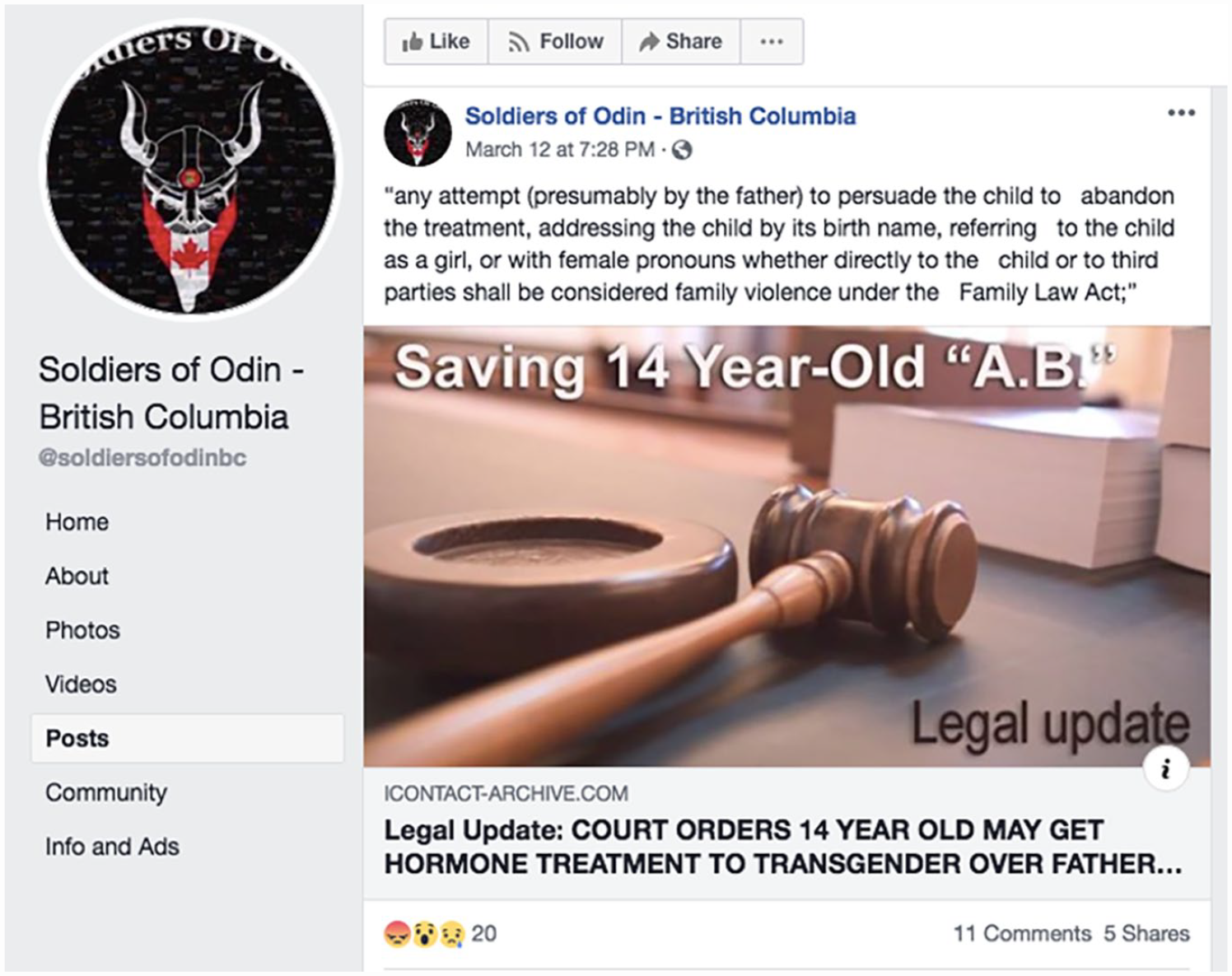
Soliders of Odin- British Columbia Facebook Post about Transgender youth.
Social decay
In the extremist posts that I analyzed, I found that the three groups expressed a belief in social decay when they spoke about crime and illegal immigration. This is consistent with the literature that has found that extremist groups highlight crime perpetuated by racialized people as threats to the nation (Ignazi, 2003: 141). In the social media posts of extremist groups that I analyzed, I also found that they equate an increase in crime and illegal migration to racialized people. Anderson (2015) theorized that this is a common practice when faced with white privilege. When the ‘other’ enters the white space and changes it, some white people who had historically been part of the unquestioned majority may act out in anger by immediately rejecting the ‘other’, stating that they do not belong (Anderson, 2015: 12; Hochschild, 2016).
However, I found that the three Canadian right-wing extremist groups make claims about an increase in crime and illegal immigration by arguing that they are doing so to protect populations that they believe may be under threat, such as women (Figure 9). This is a common tactic in right-wing extremist groups and parties. For example, in her speeches, Marie Le Pen commonly speaks to the decay of French society and a need to elect The Front National to repair this chaos (Stockemer and Barisione, 2017). In the civic world, this would be a worthy action because it centers about helping the common good (Boltanski and Thévenot, 1999: 371). For example, when right-wing extremist groups in this study refer to crime, many reference an increase in sexual assault and will post about sexual assault cases. They will also encourage their members to share the posts to spread awareness among the community. The Soldiers of Odin BC Post#60 (Figure 9), which reports a sexual assault that took place in Vancouver, was just one example of the many sexual assault posts that the Soldiers of Odin BC published on their Facebook timeline.
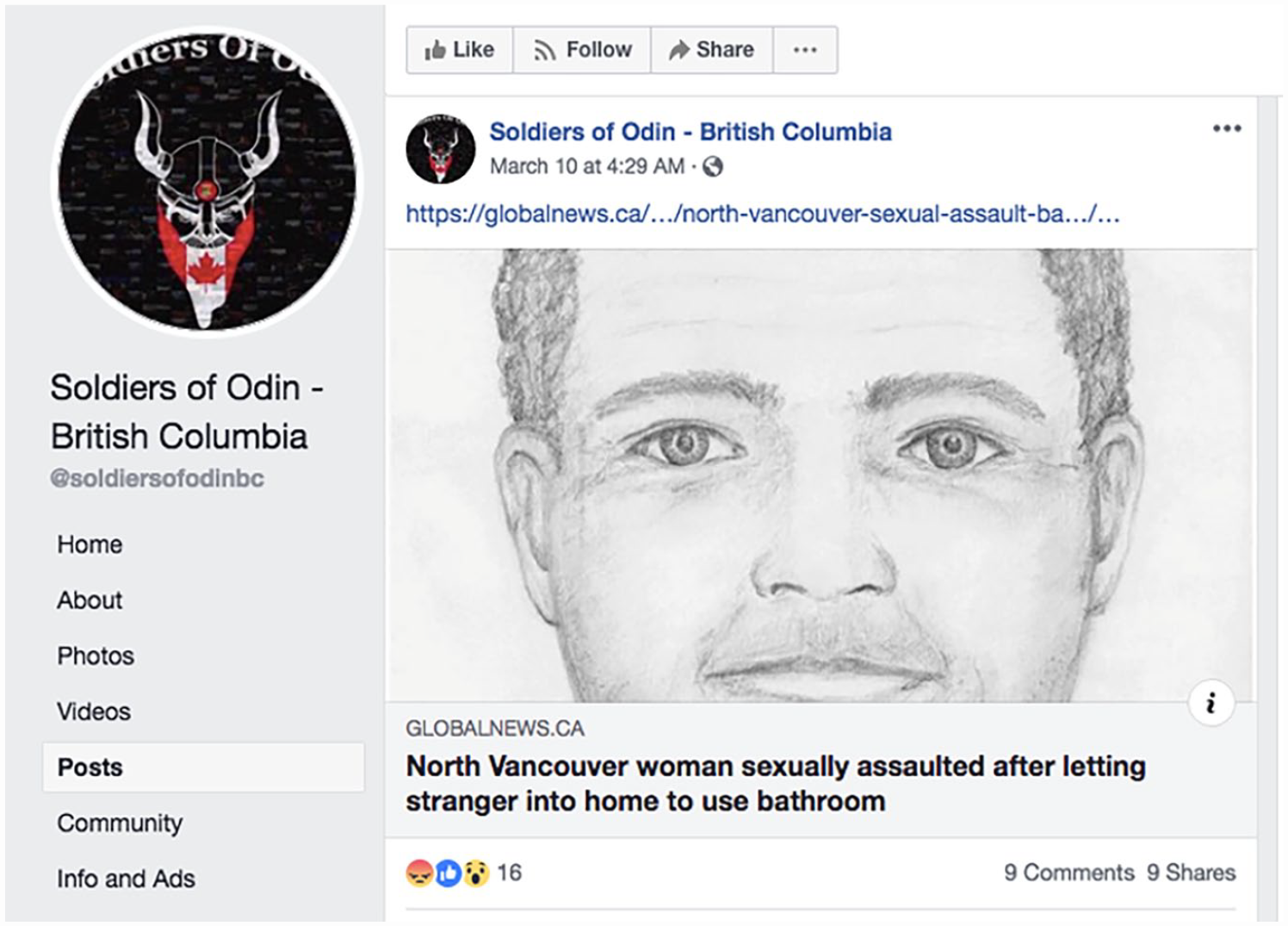
Soliders of Odin-British Columbia Facebook post about assault casein Vancouver.
Illegal immigration was another issue that each extremist groups in this study posted about. Literature has found that right-wing extremist groups view illegal immigration as a government attempt to change the racial and social demographic of a nation (Ekman, 2014: 88). Extreme right-wing parties such as Golden Dawn in Greece have also made similar claims against migration, stating that there is a need to protect the nation against those outside of Greek ancestry (Kyriazi, 2016). In my analysis, Yellow Vests members posted many articles and images stating that illegal immigration was a threat to Canadian communities. For example, Yellow Vests Post#60 (Figure 10) featuring a Breitbart article on the increase in illegal immigration in Canada not only discusses the harm of illegal immigration to Canadian communities but also places blame on the Liberal Party. In the social media posts of right-wing extremist groups, illegal immigration was equated to a growing threat to white normativity.
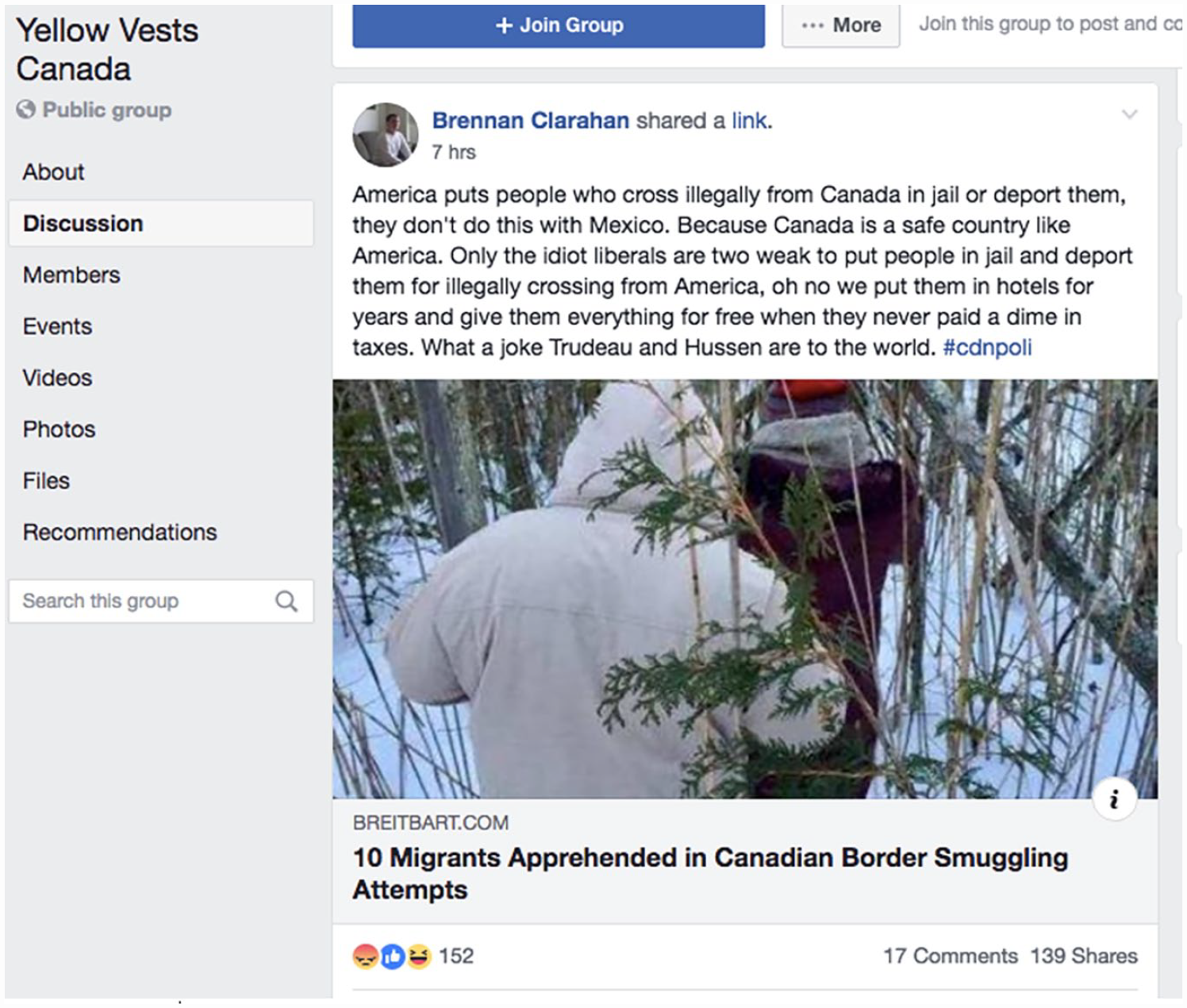
Yellow Vests Canada Facebook post about migration at the border.
The three right-wing extremist groups claim that crime and illegal immigration are increasing to reveal the occurrence of social decay. This is similar to literature that has also found that right-wing groups argue that they are trying to prevent social decay by stating that they are not anti-immigrant, they just want to protect their race and way of life (Perry and Olsson, 2009: 194) (Figure 11).
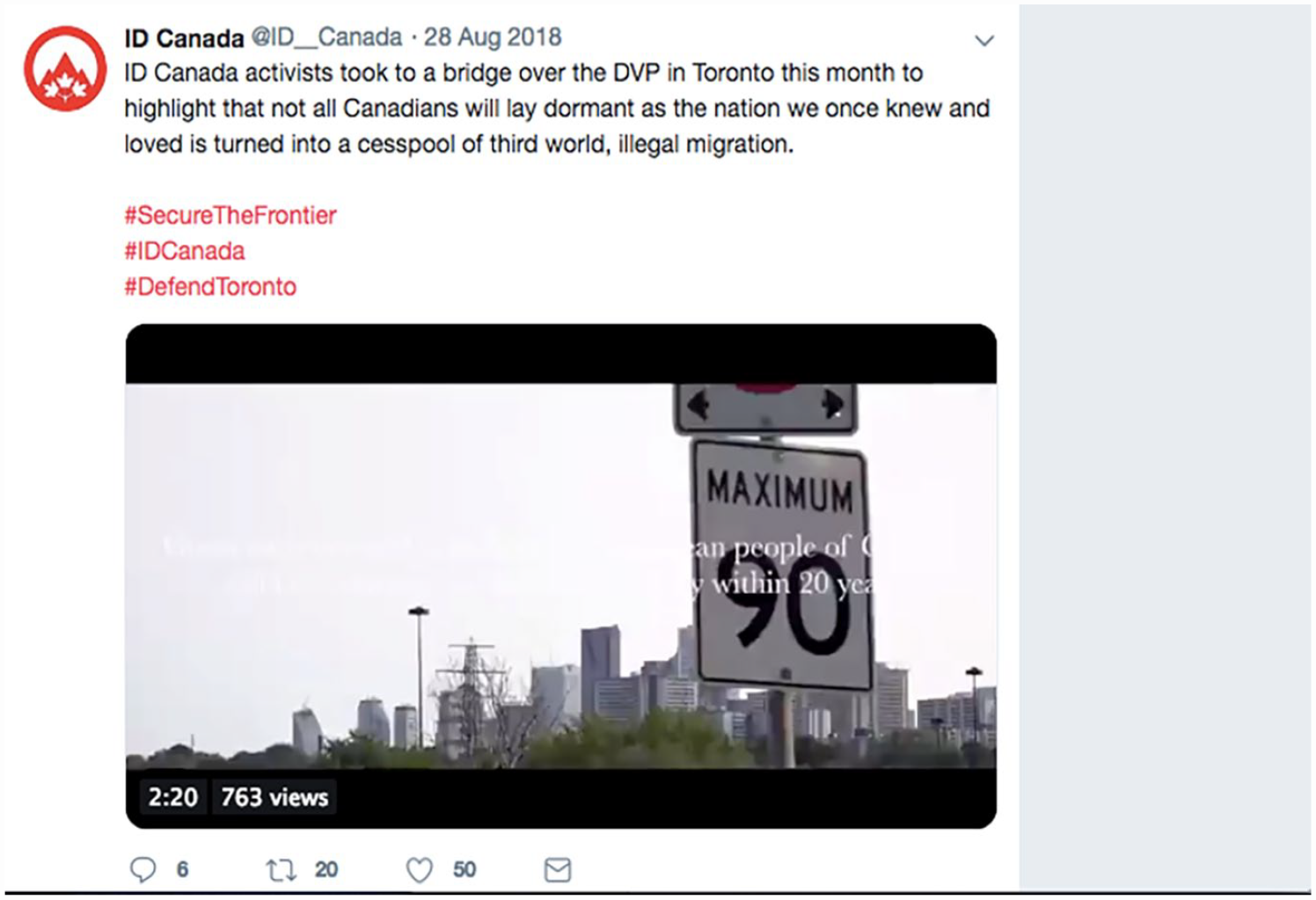
ID Canada tweet about protest.
Authoritarian government
In the posts I analyzed, the key claim that the groups made about politics was that right-wing authoritarian governments must be installed to overcome the loss of traditional values and social decay. Research has also found this to be true of extremist groups and the political far right that favor right-wing authoritarian governments to maintain social norms (Davies, 2018: 93; Fuist and Williams, 2019). However, this is not overt. Instead, the three groups claim that government institutions have failed, the Liberal Party commits treason, and that right-wing governments and individuals should be elected.
The Soldiers of Odin BC, Yellow Vests Canada, and ID Canada express mistrust of governmental institutions similar to American right-wing groups such as the Tea Party and the alt-right movement (Neiwert, 2017: 289). The right-wing groups in this study show a particular fear and mistrust in government taxation, as well as government agencies, which they argue violate the rights of citizens. Yellow Vests Canada Post#64 provides an example of this distrust of the government where they argue that the government and Royal Canadian Mounted Police (RCMP) are spying on Canadian citizens, encroaching on their rights (Figure 12).
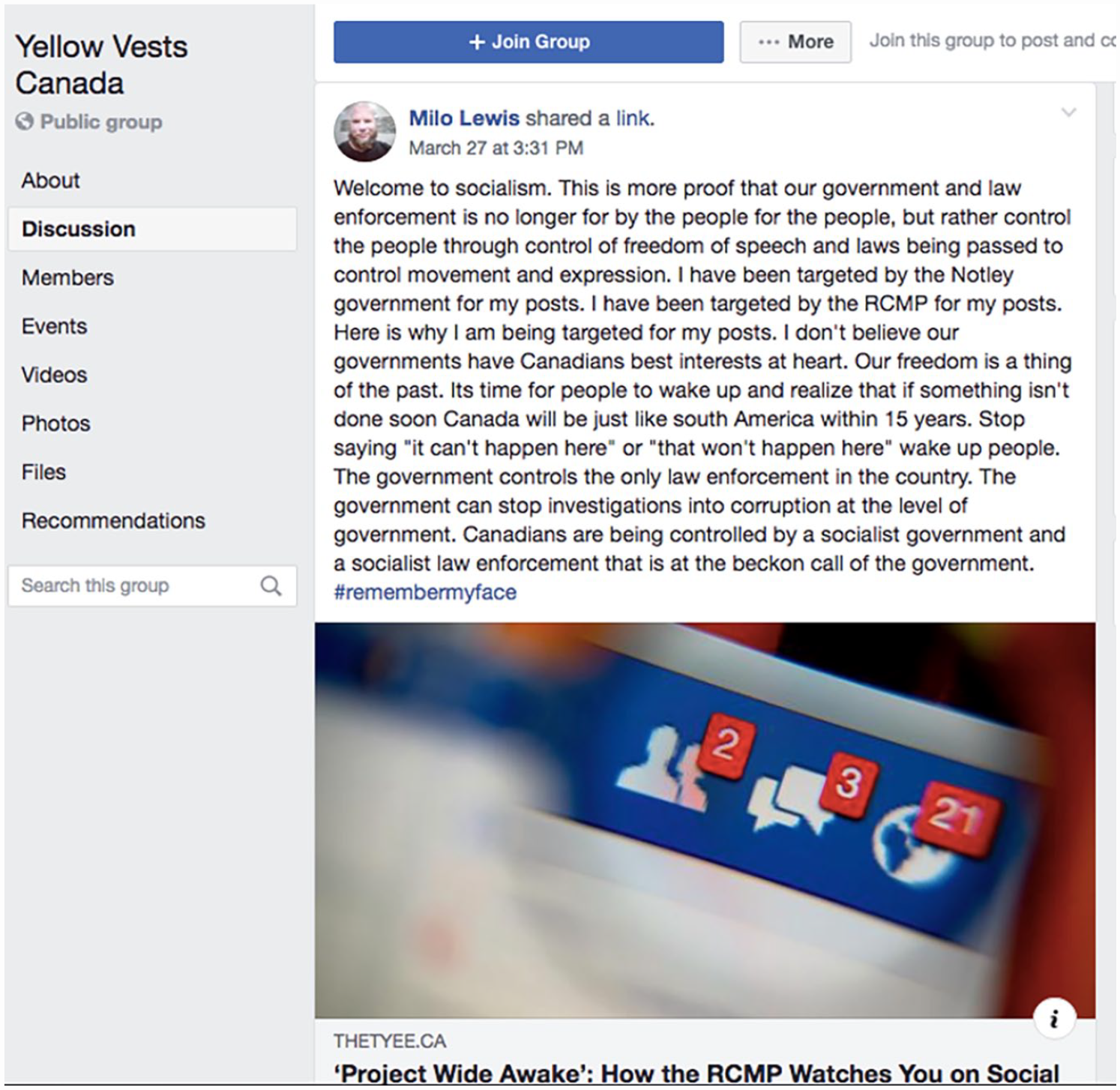
Yellow Vests Canada Facebook post about RCMP surveillance.
A common theme that arose in the posts where each right-wing extremist groups talked about distrusting governments was a discussion of the failings of multicultural policy. This is not uncommon; there has been opinion pieces published in well-known news sites which both question if multiculturalism is working and if it is necessary in Canada (Hecht, 2019). Bar-On (2018) found in his study on far-right nationalism that right-wing groups often attack European multiculturalism and other policies that support immigration because these policies threaten the very fabric of white ethnic nationalism (p. 18).
All three groups also argue that the Liberal Party’s beliefs are not compatible with their own, nor those of Canadians. Extremist groups in my study also often attacked the Liberal government by calling them traitors. For example, in Yellow Vests Canada Post#66 (Figure 13), Liberal member of parliament and Deputy Prime Minister Chrystia Freeland is called a traitor for speaking out against neo-Nazism and Islamophobia. In this post, the Yellow Vests member insists that Freeland is placing too much emphasis on Islamophobia and not enough on radical Islam. This is just one example of extremist groups denouncing Liberal policies and political stances. Studies have also highlighted how Poland’s right-wing populist party Law and Justice (PiS) used the distrust of what they called the liberal elite as a main campaign issue in the 2019 election, resulting in their electoral success (Diamond, 2020).
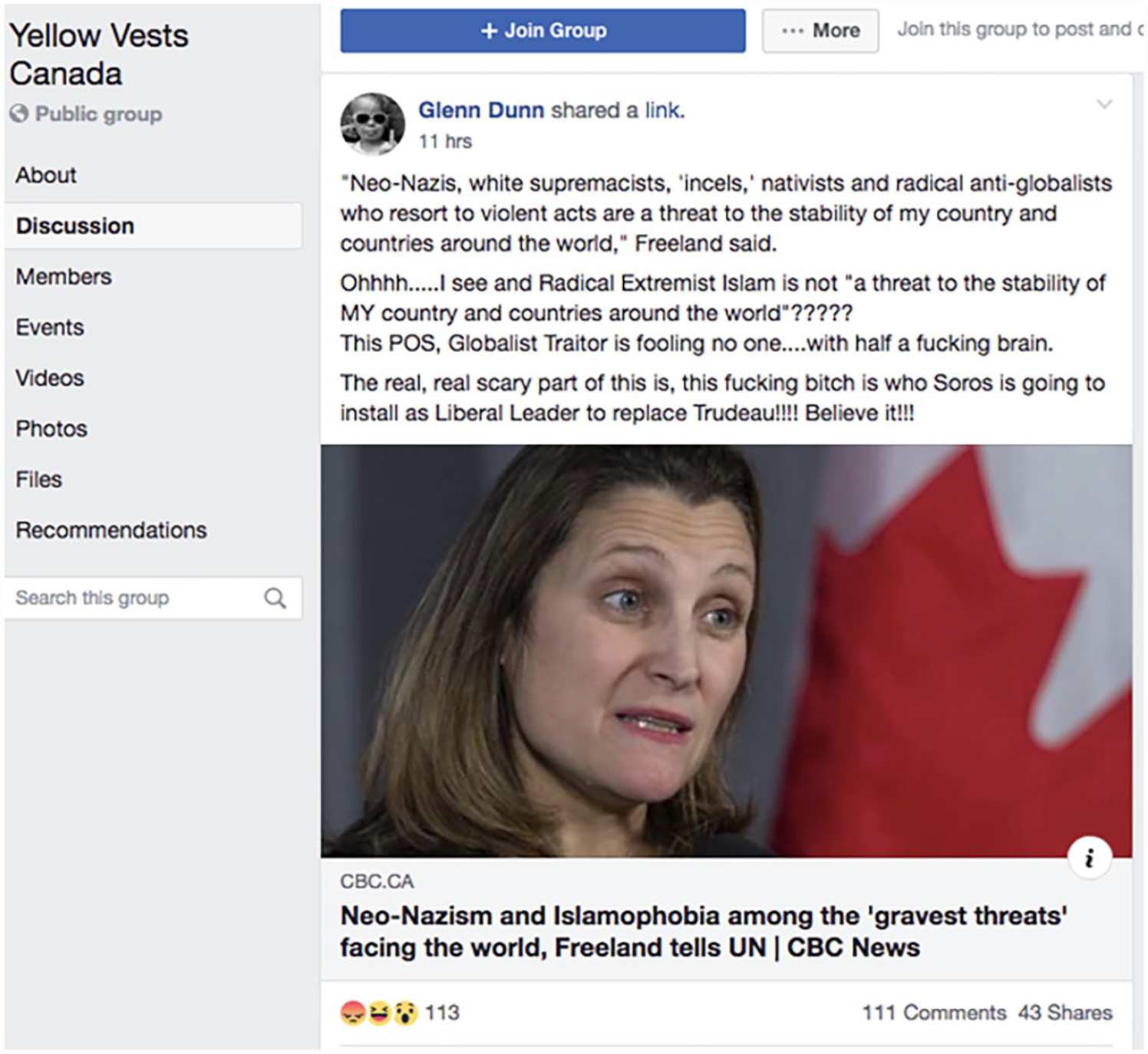
Yellow Vests Canada Facebook post about Liberal Party members.
Research has also found that extremist groups believe that authoritarian governments can stop leftist feminism and political correctness (Perry and Scrivens, 2018: 171). ID Canada’s re-tweet of Faith Goldy’s (former city of Toronto mayoral candidate) post about her campaign commitment to defund Planned Parenthood (Figure 14) shows a similar support for far-right political candidates that adhere to socially conservative values. In her analysis of rural Wisconsin, Cramer (2016) also found that right-wing governments convince their constituents that the left-leaning governments did not have the same values as citizens on issues such as traditional values and taxation (p. 146).

ID Canada re-post on Twitter of Faith Goldy’s tweet about defunding Planned Parenthood.
The groups in this study depicted members of the Liberal Party as incapable of representing the general interests of Canadian citizens, while claiming that right-wing governments do in fact represent the common interests of the nation. Appealing to group (or national) representation is common in Boltanski and Thévenot’s civic world (Cloutier et al., 2017: 11). The right-wing extremist groups in my study often valorized right-wing leaders by depicting them with other worthy individuals in society, such as the depiction of Trump hugging a Vietnam war veteran in Yellow Vests Canada Post#51 (Figure 15). Many people in Canadian society do respect war veterans. Showing support for a charismatic leader can also be a way to reaffirm that person’s message and the validity of that person’s ability to lead (Joosse, 2018: 928).
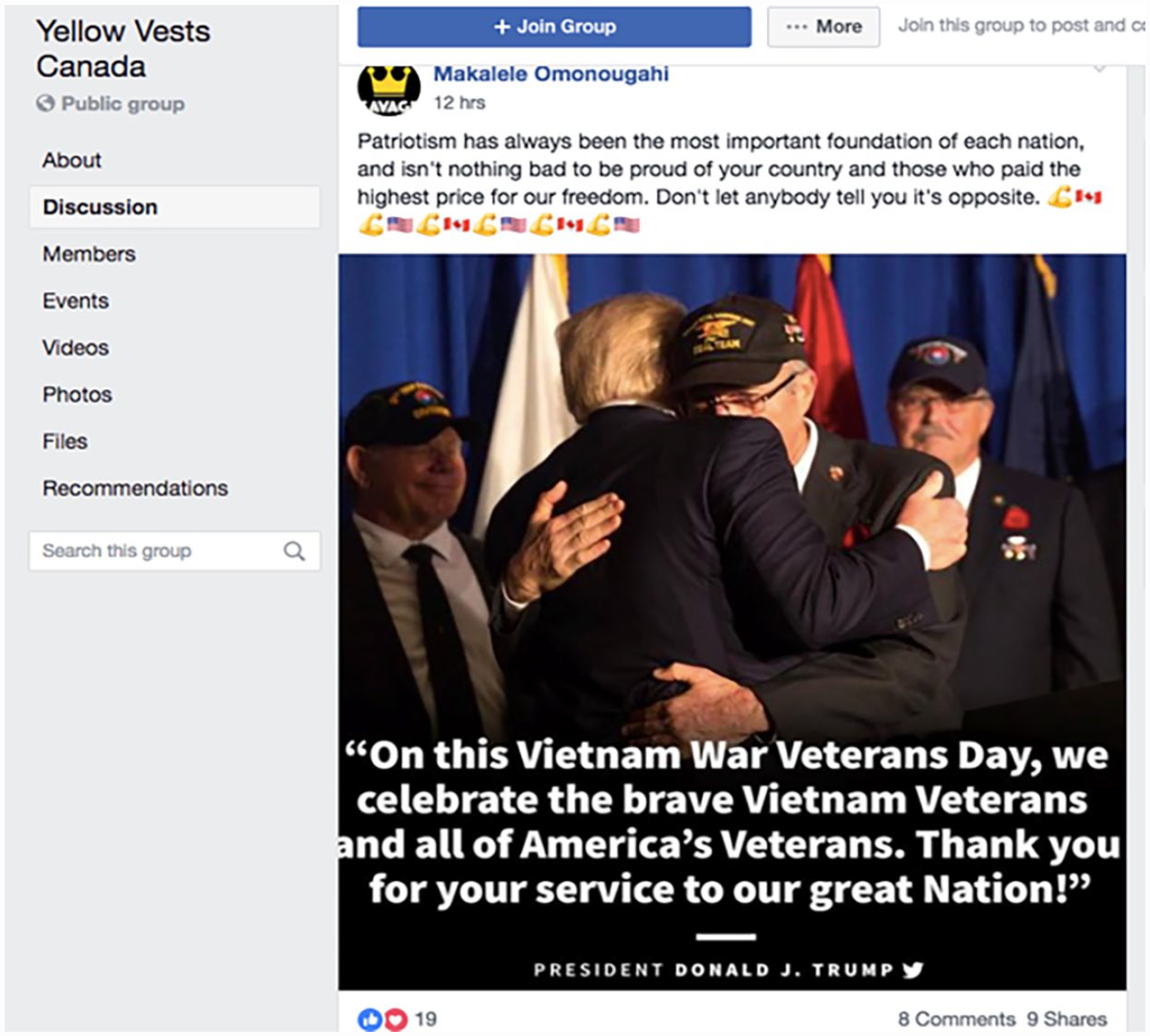
Yellow Vests Canada Facebook post about Donald Trump’s patriotism.
Conclusion and discussion
The three Canadian right-wing extremist groups in this study make three claims about Canadian identity and belonging. They claim that Canadian identity is white, Canadian values are equated with traditional values, and that society is decaying. The groups make one major claim about politics in Canada: They believe that strict right-wing authoritarian leaders must be put in power to stop the loss of traditional values and social decay.
As of the writing of this article, all three groups have either been banned from Facebook and Twitter or have deleted or renamed their accounts in fear of censorship. However, between the years 2016 and 2021, these pages posted extreme right-wing content for thousands of followers and were widely shared beyond those who had a direct interaction with the accounts. The groups were largely removed from social media only when Facebook and Twitter increased their restriction of hate content between 2019 and 2021, not because of any national or international outcry about their activity. The reason these three accounts were able to hold so much political space online, and attract so many followers, was due to their ability use common values and ideas held among many Canadians to conceal their more nefarious beliefs. The groups were able to gain traction using mundane claims online fostering both online and offline following and entering less-fringe spaces.
The three groups’ use of mundane language such as advocating traditional values or highlighting a perceived increase in crime allowed all three to have access to the political platforms of politicians in Canada. Politicians would end up knowingly or unknowingly supporting the extreme right-wing groups as an ally in both political and social causes. For example, ID Canada was widely supported by, and helped to campaign for, Faith Goldy, a former city of Toronto Mayoral candidate (Lamoureux, 2019). It was also later revealed in 2019 that ID Canada received a donation from the Christchurch shooter who shot and killed 51 individuals in Christchurch New Zealand in an Islamophobic attack (Lamoureux, 2019). The other groups also received formal political support. Yellow Vest protests were attended by former Conservative Party leader Andrew Scheer as well as People’s Party of Canada leader Maxine Bernier (Boutilier, 2019). Members of the Soldiers of Odin across Canada have been avid supporters of the People’s Party of Canada (Russell and Bell, 2019) and have been active members of the Royal Canadian veteran Legions (Boudjikanian, 2019). In fact, one member of the Soldiers of Odin in Canada was found to have provided a signature endorsing the People’s Party of Canada, resulting in the self-identified populist party to be ratified by Elections Canada as an official party (Boutilier, 2019).
These three groups have also been active on the ground, participating in protests and postering across Canada. ID Canada has been very active on the street, posting various posters advertising their group in Canadian universities and across major cities in the nation. The group had links to posters on their webpage which supporters could print and were encouraged to distribute. Yellow Vests Canada held various protests across Canada in 2018 and 2019, including in the national capital, against what they believe was a tyrannical Liberal government. These protests made nation-wide headlines (Boutilier, 2019). Former members of the Yellow Vest group were also involved in the 2022 ‘Freedom Convoy’ protesting vaccine mandates in Canada which was organized by known far-right individuals (Holder and Miller, 2023). One leader of the Trucker Convoy, Tamara Lich, was an active member of the Yellow Vests Canada movement in prior years (Holder and Miller, 2023). The Soldiers of Odin BC has also received media attention due to their on-the-ground presence. Individuals involved in the Soldier of Odin BC had protested what they deemed ‘illegal encampment’ at a tent city in Nanaimo BC (Pescod, 2018); other members had been arrested at an anti-racist rally in Vancouver BC (Larsen, 2017).
Throughout the past several years, researchers have wondered how right-wing extremism has gained traction in North America. In this article, I have proposed the use of the sociology of critical capacity to explore how three groups in Canada do just this by using commonly held beliefs such as tradition, community, and family to justify their actions and opinions and to been seen as less controversial, thereby leaving the fringe and becoming mainstream. While this theoretical framework was first developed to explore the French context, I have used it to unpack the rise of extreme right groups in the Canadian context. Yellow Vests Canada, the Soldiers of Odin BC, and ID Canada would not have been able to enter the political arena had they not used commonly held values to conceal their claims.
I add to the sociology of critical capacity by using this framework to unpack the extreme right. The use of this theory to engage with these three Canadian extreme right groups has not previously been done. By using the social logics in the common worlds, the right-wing extremist groups in this study justify their contentious claims in a way that is in alignment with many of the values and ideas that Canadians can understand and see as not only mundane but often as patriotic. By doing so, these three Canadian right-wing extremist groups can enter mainstream conversation by using arguments and values that many Canadians hold dear. This is even more evident given the political support they have received. This may be a case of the mainstreaming of the extreme right-wing (Brown et al., 2023). I was able to make these connections because of my use of the sociology of critical capacity.
The findings in this article and the use of Boltanski and Thévenot’s (2006) common worlds to explain right-wing extremist’s continued presence and appeal to the average citizen have relevance beyond the current case study. Throughout the article, I have highlighted how other right-wing extremist groups and parties in France, Poland, Hungary, Brazil, Greece, and the United States use similar discourses of social decay, fear of immigration, and traditional values to also make their own contentious claims about national belonging and race more palatable. Future research could take up the theoretical framework used in this article on international examples of right-wing extremism to make sense of this global phenomenon.
Footnotes
Acknowledgements
Portions of this article were initially written in partial fulfillment of the requirements of the degree of MA at the Department of Sociology and Social Anthropology, Dalhousie University, Halifax, Nova Scotia, in May 2020. I would like to thank Fiona Martin, Laura Eramian, and Howard Ramos for their support in the initial research process and their constructive feedback during the initial writing. I would like to also thank the anonymous reviewers and the editors of Current Sociology for their helpful comments and suggestions.
Funding
The author disclosed receipt of the following financial support for the research, authorship, and/or publication of this article: This article draws on research supported by the Social Science and Humanities Research Council Canadian Graduate Scholarships – Master’s (CGS M).
