



Abstract
How do newcomers make cross-ethnic connections and friendships? This article investigates the role of associations as a location for making cross-ethnic friendships. Cosmopolitan social infrastructure includes public spaces, commercial establishments, and community organizations that attract a diversity of people into interaction. I look specifically at the importance of participation in cosmopolitan associations for cross-ethnic friendship. I approach these questions with an analysis of a nationally representative sample of Canadians collected as part of the Ethnic Diversity Survey. I find that participation in cosmopolitan associations is associated with having cross-ethnic friendship groups. To address the robustness of these findings, I use techniques from both longitudinal and treatment effects analysis. The findings suggest that cosmopolitan social infrastructure contributes to participants’ having cross-ethnic friendship groups.
Participation in community organizations and other voluntary associations is fundamental to the immigrant experience. Voluntary associations develop politically skilled citizens, and trusting, collectively minded community members (Putnam, 2000; Stolle, 1998; Verba et al., 1995). Research explores topics, such as motivations for participation, generational patterns of membership, and the influence of membership on generalized trust (Baer, 2008; Bloemraad, 2005; Han, 2004; Handy and Greenspan, 2009; Moya, 2005; Owusu, 2000; Ramakrishnan and Bloemraad, 2008; Stolle and Rochon, 1998). Friendships that cross ethnic boundaries have received attention in previous research on associations (McPherson et al., 2001) but not among new migrants. This is surprising given questions surrounding integration within a host society that often motivate research on the immigrant experience (Lauer and Yan, 2021a). This research examines association participation and the ethnic composition of friendship groups among new immigrants. My core argument builds on Klinenberg’s (2018: 16) concept of social infrastructure, defined as the physical places that shape interactions. Like Small’s (2009) organizational anchors, these locations bring people together for extended periods while engaging in shared activities. I refine this concept with arguments of structural availability (Glanville, 2004; McPherson and Smith- Lovin, 1986; Verbrugge, 1977), which propose that contexts can have both integrating and sorting outcomes. Cross-ethnic friendships form when contexts provide opportunities for association among an ethnically diverse population. Building on Anderson (2004, 2011), I call these contexts cosmopolitan social infrastructure – spaces that attract a diversity of people, and where civility exists that encourages getting along.
I approach these questions with a nationally representative sample of Canadians collected as part of the Ethnic Diversity Survey (EDS). The EDS includes detailed questions about ethnic background and association participation. I find that participation in cosmopolitan associations is associated with having cross-ethnic friendship groups. I determine this after comparing friendship group composition among newcomers that participate in more ethnically diverse associations and those that participate in more ethnically homogeneous associations with those that do not participate in associations. To test the robustness of the findings, I use techniques associated with both longitudinal and treatment effects analysis.
Cosmopolitan perspectives on immigrant friendship
I approach cosmopolitanism following discussions of sociability (Glick Schiller et al., 2011; Lamont and Aksartova, 2002), and the attention to everyday encounters in diverse contexts (Radice, 2009; Wise and Velayutham, 2009). Within these discussions, interest has emerged in the closely related questions of immigration (Glick Schiller and Caglar, 2013; Hiebert, 2002; Shan and Walter, 2015; Vertovec, 2009). Glick Schiller and Caglar (2013), for instance, use the concept of emplacement to describe the cosmopolitan search for a shared sense of humanity among newcomers. These approaches to immigration have emerged in dialogue with the assimilation framework. Cross-ethnic friendship was central to early discussions of immigration (Park and Burgess, 1921). Gordon (1964) expected immigrant primary groups would integrate with the dominant majority and include non-familial, non-co-ethnic members. Neo-assimilation perspectives maintain an interest in ethnically integrated primary groups, though emphasizing that both majority and minority groups adapt and change over time as ethnic distinctions decline in importance (Alba and Nee, 2003). Within this framework, Martinovic et al.’s (2009, 2011, 2015) research on newcomer friendship patterns among recently arrived immigrants in Europe and Canada finds that pre-migration factors, particularly language acquisition, are most important for understanding ethnic friendship patterns of newly arrived immigrants. These findings provide key insights into the experiences of new immigrants but are limited in their understanding of the long-term friendship development among newcomers.
Cosmopolitan approaches to immigrant friendships step away from the centrality of national, dominant cultures and toward multicultural and transnational perspectives (Beck and Sznaider, 2006; Glick Schiller et al., 2011). While transnational discussions recognize individuals’ attachment to two or more places simultaneously, cosmopolitan discussions emphasize openness to others, interactions across cultural boundaries, and places where diversity is rendered ordinary (Hannerz, 1999; Hiebert, 2002; Wessendorf, 2016). Hiebert (2002), for instance, explores how transnationalism and cosmopolitanism overlap, where interaction with people from varieties of different cultures exists with an openness to all forms of otherness. Anderson’s (2004, 2011) cosmopolitan canopies have a similar formulation. Anderson (2004: 20) considers cosmopolitan spaces as neutral locations where people arrive expecting ‘diverse people to get along’. In describing these spaces, Hiebert (2002) makes a clear contrast with the melting-pot ideal as well as with co-ethnic spaces that lack the invitation to diversity. Wessendorf and Phillimore (2019) similarly question the importance of integration solely into a dominant majority by demonstrating the importance of friendships that cross-ethnic boundaries with migrants from various national backgrounds.
Cosmopolitan social infrastructure and immigrant friendships
Voluntary associations are important locations where friendships are made throughout the life course (Babchuk and Edwards, 1965; Glanville, 2004; McPherson and Smith-Lovin, 1986; McPherson et al., 2001; Putnam, 2000). Van Ingen and Kalmijn (2010) find that participation in associations increases the size of a participant’s friendship network. This is consistent with Feld’s (1982; Feld and Carter, 1998) focus theory which proposes that ties are formed when people share a focus of attention or activity. Voluntary associations provide that focus through membership meetings, regular programming activities, as well as formal and informal social gatherings (Baggetta, 2009: 179). Van Ingen and Kalmijn (2010: 496) find that participants make new acquaintances, meet future spouses, and form new friendships through these activities. Given the known tendencies toward homophily (Lazersfeld and Merton, 1954; McPherson et al., 2001), we might initially expect that association participation would bring together individuals who are similar in salient characteristics, such as ethnicity:
H1. Those who participate in associations are less likely to report cross-ethnic friendship groups than those who do not participate.
Sorting associations
Moving beyond simple participation effects, I follow Stolle and Rochon (1998) in drawing attention to participation in different types of associations. Refining McPherson and Smith-Lovin (1986; Glanville, 2004), I distinguish associations as sorting or cosmopolitan based on the diversity of participants they attract. Sorting associations resemble those Breton (1964) described that bring together co-ethnic participants into focused interaction. Co-ethnic immigrant and ethnic associations are common in the research, emphasizing their functional value for helping newcomers adjust to new circumstances. Chiang (2008), for instance, finds that Taiwanese social organizations allowed immigrant mothers in Canada to develop their local identities, take advantage of social capital, and gain Canadian work experience. Brettell (2005a, 2005b) finds a rich associational life in a South Asian community in North Texas that provides a sense of community, settlement support, and a path to citizenship. Bloemraad (2006) finds that ethnic organizations in Boston and Toronto support a path to citizenship. Breton (1964: 198–200; see also Kaufman and Weintraub, 2004) suggests that the functional value of associations promotes co-ethnic friends among newcomers. The influence of homophily and focused activities leads to the expectation that participation in these sorting associations will result in more co-ethnic friendship groups:
H2a. Those who participate in sorting associations are less likely to have cross-ethnic friendship groups than those who do not participate in associations.
Cosmopolitan associations
I define cosmopolitan social infrastructure as spaces that attract a diversity of people, and where civility exists that encourages getting along. This integrates conceptions from Hiebert (2002) and Anderson’s (2004) cosmopolitan canopies. Amin (2002) also recognizes the potential of associations, calling them micropublics, where dialogue across boundaries is encouraged over time. Research on diverse neighborhoods has found that community organizations are anchors for making boundary-crossing friendships when they attract diverse participants (Lauer, 2021; Wessendorf, 2016). By bringing together people from varied backgrounds into interaction, cosmopolitan associations have the potential to promote cross-ethnic friendship. The influence of structural availability and focused activities leads to the expectation that participation in these cosmopolitan associations will result in more cross-ethnic friendship groups:
H2b. Those who participate in cosmopolitan associations are more likely to have cross-ethnic friendship groups than those who do not participate in associations.
Lurking behind these questions lies the composition of a person’s friendship group before they participate in an association. There is a concern that the current friendship group composition simply reflects the composition at an earlier period, and there is also a concern that friendships influence the decision to participate in a type of association. Disentangling these selection effects from participation effects is particularly important because research has found that friends often recruit friends to join associations (Bekkers et al., 2007; Davis et al., 2006: 45). I address the hypotheses above and the potential alternative explanations in the analysis described in detail below.
Methods
The Canadian ethnic diversity study
Statistics Canada conducted the nationally representative EDS in 2002 with the specific intention of examining ethnicity in Canadian society. It provides a unique chance to explore questions surrounding voluntary association membership and cross-ethnic friendship ties. Using the 20% sub-sample of the 2001 Canadian Census as a sampling frame, the survey is a probabilistic survey of persons 15 years of age and over living in Canada in 2001. 1 The EDS uses a stratified sampling design based on respondents' ethnic backgrounds and immigrant generation characteristics. In-person interviews were conducted in nine different languages, overcoming the noted disadvantages of some past research (Ramakrishnan and Bloemraad, 2008). I limit the sample to foreign-born respondents for this analysis (N = 10,686). No single variable had a substantial number of missing cases. Listwise deletion results in a final sample size of 9071 respondents.
Measures
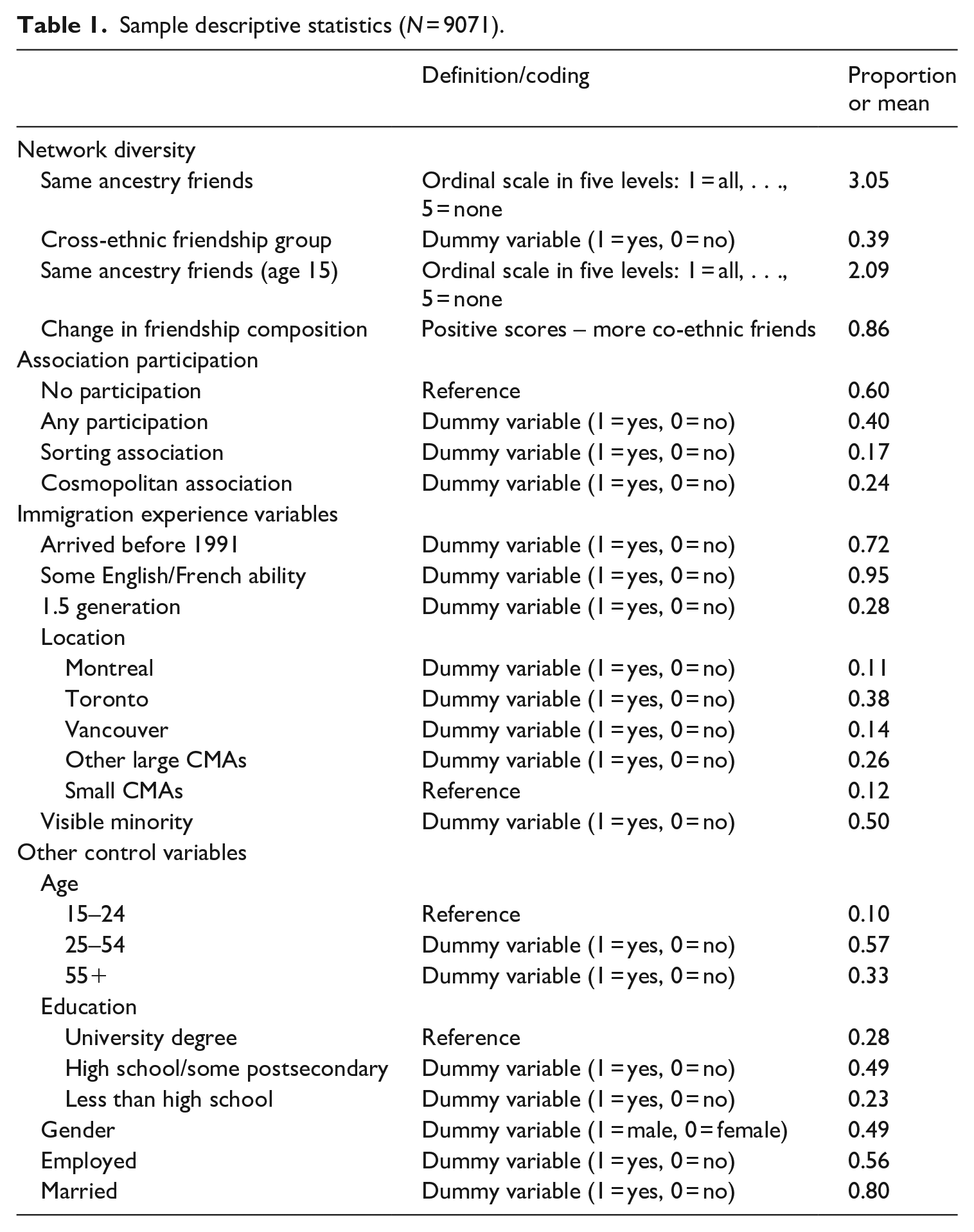
Table 1 shows descriptive statistics for each of the variables used in this analysis. I describe the measurement of each of these concepts in more detail below.
Sample descriptive statistics (N = 9071).
Cross-ethnic friendship
The ethnic composition of a person’s friendship group can be expressed as a proportion that ranges from all cross-ethnic friends to no cross-ethnic friends at any one time. The EDS asks respondents for an overall assessment of their friendship network by first asking, ‘What was the ethnic or cultural background of your ancestors?’ followed by the question, ‘As far as you know, how many of your friends have [respondent ancestry]?’ 2 Possible responses included (1) all of them, (2) most of them, (3) about half of them, (4) a few of them, and (5) none of them. High scores reflect a more cross-ethnic friendship group. I also make a binary distinction considering cross-ethnic networks as those where respondents report A Few or None of their friends are from the same ethnicity. This seems to be the best fit for the concept of a cross-ethnic friendship group.
A second follow-up question asks, ‘Up until you were age 15, how many of your friends had [respondent ancestry]?’ using the same response set as above. I use this question to construct a change variable by subtracting current friendship group composition from the composition at age 15. Higher scores reflect an increase in cross-ethnic friendships since age 15; lower and negative values reflect a decrease in cross-ethnic friendships. 3
Voluntary association participation
Respondents were asked, ‘Are you a member or have you taken part in the activities of any groups or organizations at any time in the past 12 months? For example, a sports team, hobby club, a community organization, and ethnic association, etc.’. Using this, I create a dummy variable that indicates active membership in at least one association in the past year. A follow-up question asks, ‘How many members have [respondent ancestry] ancestry?’ Possible responses included (1) all of them, (2) most of them, (3) about half of them, (4) a few of them, and (5) none of them. I use these responses to create a dummy variable that indicates a cosmopolitan association using responses (4) or (5). A dummy variable indicates a sorting association using responses (1), (2), or (3).
Other control variables
The analysis includes a set of variables designed to capture some important aspects of the first-generation immigrant experience that also influence friendship group composition. The first group of variables addresses immigrant experiences. They include visible minority status, language ability, age at arrival to Canada, and length of time in Canada. The variable visible minority is a dummy variable that distinguishes membership in one of eight different visible minority groups. In Canada, visible minorities include non-Aboriginal, non-Caucasian peoples who are nonwhite in color. Previous research supports following this administrative definition (Lauer and Yan, 2021a). Language ability is a dummy variable that distinguishes those who can hold a conversation at some length in either English or French. Respondents were asked, ‘What was the language(s) that you first learned at home in childhood?’ A follow-up question asked, ‘Besides [first language], are there any other languages that you speak well enough to conduct a conversation?’ Those who answered French or English to either of these questions received a score of 1. I use the variable age at arrival, a dummy variable to distinguish a person immigrating to Canada before the age of 15. The experience of arriving as a child and growing up in a destination country has been found more similar to the experiences of second-generation immigrants than that of new immigrants arriving as adults (Zhou, 1997). Sometimes known as the 1.5 generation, researchers often consider those who arrive at age 13 or younger in this group. Because the EDS distinguishes those who arrive at age 14 or younger, I use this cutoff. The variable year at arrival also uses an EDS variable that distinguishes those newcomers who arrived to Canada within the 10 years before the survey interview. I include this variable to capture the amount of time a person has lived in Canada with the opportunity to form cross-ethnic friendships.
The second group of control variables includes living in metropolitan areas, sex, age, employment, and education level. The variable metropolitan areas distinguishes the three largest metropolitan areas in Canada – Montreal, Toronto, and Vancouver. These are particularly diverse geographic locations that include over 60% of all foreign-born Canadians (Statistics Canada, 2011). A fourth category distinguishes smaller metropolitan areas, such as Edmonton, Calgary, Winnipeg, and Windsor. Non-metropolitan regions are the reference category. Including these variables addresses the concern with critical mass and opportunities for cross and co-ethnic friendships. Sex distinguishes those who self-identify as male or female. Age distinguishes those over 55, and 25–54 at the time of the interview, with under 24 years of age as the reference category. These category distinctions reflect those available through the EDS. Married is a dummy variable indicating married or living in a marriage-like relationship. Employment is a dummy variable indicating a positive response to the question, ‘Are you currently working for pay?’ Education distinguishes those with a high school diploma and those with a university degree. Those without a high school diploma are the reference group.
Analysis
The analysis examines participation in sorting and cosmopolitan associations and their association with cross-ethnic friendship group composition. I begin with bivariate patterns of cross-ethnic friendships across participation in different types of associations. Following this, I develop a set of multivariate models that examine cross-ethnic friendship group composition across participation in different association types while controlling for key immigration-related and other control variables. I use logistic regression with robust standard errors generated with bootstrap weighting techniques predicting the incidence of a cross-ethnic friendship group at the time of the interview with an equation of the form
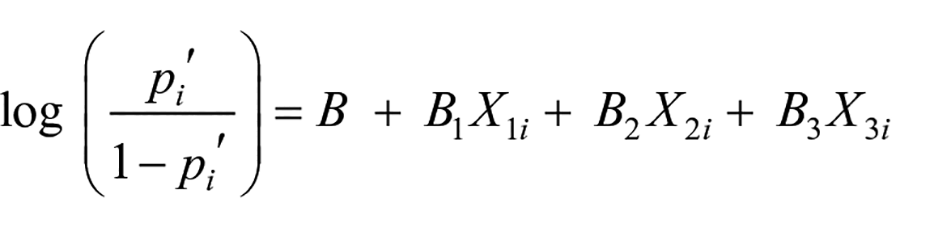
where p′ represents a cross-ethnic friendship group for the person i, X1i represents the control variables for the ith person, X2i represents the immigration-related variables for the ith person, and X3 represents the association participation variables for the ith person. 4
Longitudinal robustness test
I will test the robustness of the analysis above with two approaches. The first approach uses the retrospective friendship group composition at age 15 variable to mimic a panel research design and use techniques associated with panel data analysis. The approach addresses concerns that pre-participation friendship group composition accounts for the findings in the models above. I will use both the regressor and the change variable strategies described by Allison (2009, 1990). The regressor variable approach is another logistic regression model with robust standard errors generated with bootstrap weighting techniques predicting the incidence of a cross-ethnic friendship group at the time of the interview following the same form as the model described above

This model includes friendship group composition at age 15 as a regressor in the model with X4i representing the cross-ethnic friendship composition at age 15 for the ith person. The change variable approach uses a form of fixed effects modeling to incorporate friendship composition at age 15 into a standard ordinary least squares (OLS) regression model of the form:

where ∆Y′ represents the change in ethnic friendship composition since age 15 for the person i, X1i represents the control variables, X2i represents the immigration-related variables for the ith person, and X3 represents the association participation variables for the ith person.
Treatment effects robustness test
The second robustness check on the analysis uses techniques associated with treatment effects analysis to mimic random assignment to treatment and control groups. The approach has been used to examine the effects of criminal justice contact on system avoidance (Brayne, 2014) and religious mission participation on religious trajectories (Trinitapoli and Vaisey, 2009) and addresses the concern that differences in attraction to participate in associations can account for the findings of the models specified above. For this analysis, there are three unique treatments examined – any participation in an association, participation in a sorting association, and participation in a cosmopolitan association. The analysis proceeds in three steps. First, I fit a logistic model using the variables described above to generate a score measuring the predicted probability, or propensity, for each respondent to participate in associations. Second, respondents who participate are matched with those who do not but have a similar propensity for participation. I use nearest neighbor techniques to match those who participated with the closest ‘control’ respondent who did not participate. Finally, I use logistic regression techniques with the matched sample to measure the effects of participation on the ethnic composition of friendship groups.
Results
Table 2 displays the bivariate distribution of ethnic friendship group composition across the association involvement variables of interest, based on the question, ‘As far as you know, how many of your friends have [respondent ancestry]?’ Looking first at all immigrants, the distribution appears to be bi-modal with a peak reporting mostly same ethnic friends, a slight drop reporting half same ethnic friends, and another peak reporting only a few same ethnic friends. This suggests that respondents tend to consider their networks as either primarily co-ethnic or primarily cross-ethnic, with a smaller proportion considering their networks to be in the middle. Given this, in parts of the analyses, I follow a binary distinction of cross-ethnic friendship groups where A few or None are reported as the same ethnicity. The far-right column shows 39% of respondents reporting a primarily cross-ethnic friendship group.
Association participation and ethnic friendship group composition (N = 9071). a
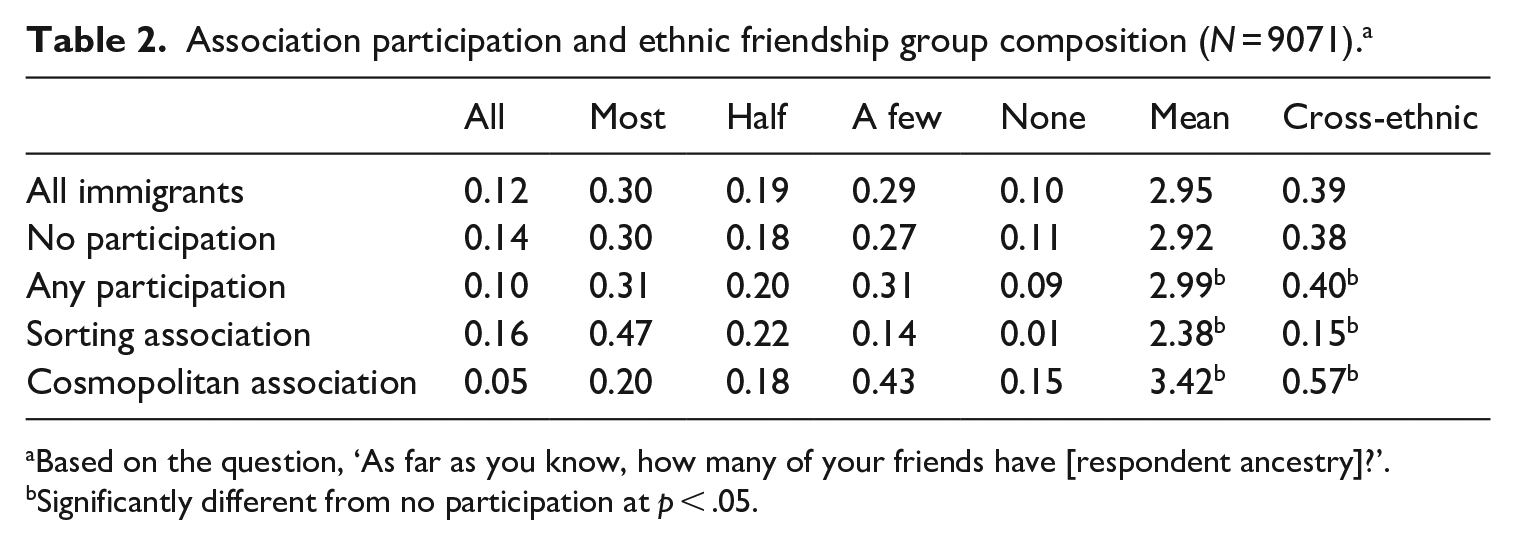
Based on the question, ‘As far as you know, how many of your friends have [respondent ancestry]?’.
Significantly different from no participation at p < .05.
Rows 2–5 provide a first look at the questions motivating this research. Those who participate in any associations are slightly more likely to report cross-ethnic friendship groups on average than those who do not participate, contradicting H1. Notable differences appear when we compare non-participation with participation in sorting and cosmopolitan associations. Those who participate in sorting associations are much less likely to report cross-ethnic friendship groups than non-participators. Conversely, those participating in cosmopolitan associations are much more likely to report cross-ethnic friendship groups. These findings support H2a and H2b, suggesting association types result in diverging outcomes. Next, I look more closely at these relationships using multiple regression techniques.
In Table 3, Models 1, 2, and 3 include the results of logistic regression models with robust standard errors predicting the incidence of respondents reporting cross-ethnic friendship groups. Model 1 is a control model, with some expected outcomes. Older and married respondents are less likely to report cross-ethnic friendship groups. Those employed, and female are more likely to report cross-ethnic friendship groups, as are those with high school and university degrees. We also see expected results when looking at immigration-related variables. Large metropolitan areas, such as Montreal, Toronto, and Vancouver, have larger in-group populations that provide the opportunity for respondents to form co-ethnic friendships, and this is confirmed in the model. Members of visible minority groups are less likely to report cross-ethnic friendship groups, suggesting that some ethnoracial boundaries are difficult to cross (Lauer and Yan, 2021). Long-term residents of Canada are more likely to report cross-ethnic friendship groups, as are those who arrived in Canada before age 15. Those with English and French abilities are much more likely to have diverse friendship networks.
Logistic and OLS regression predictions of cross-ethnic friendship groups (N = 9071). a
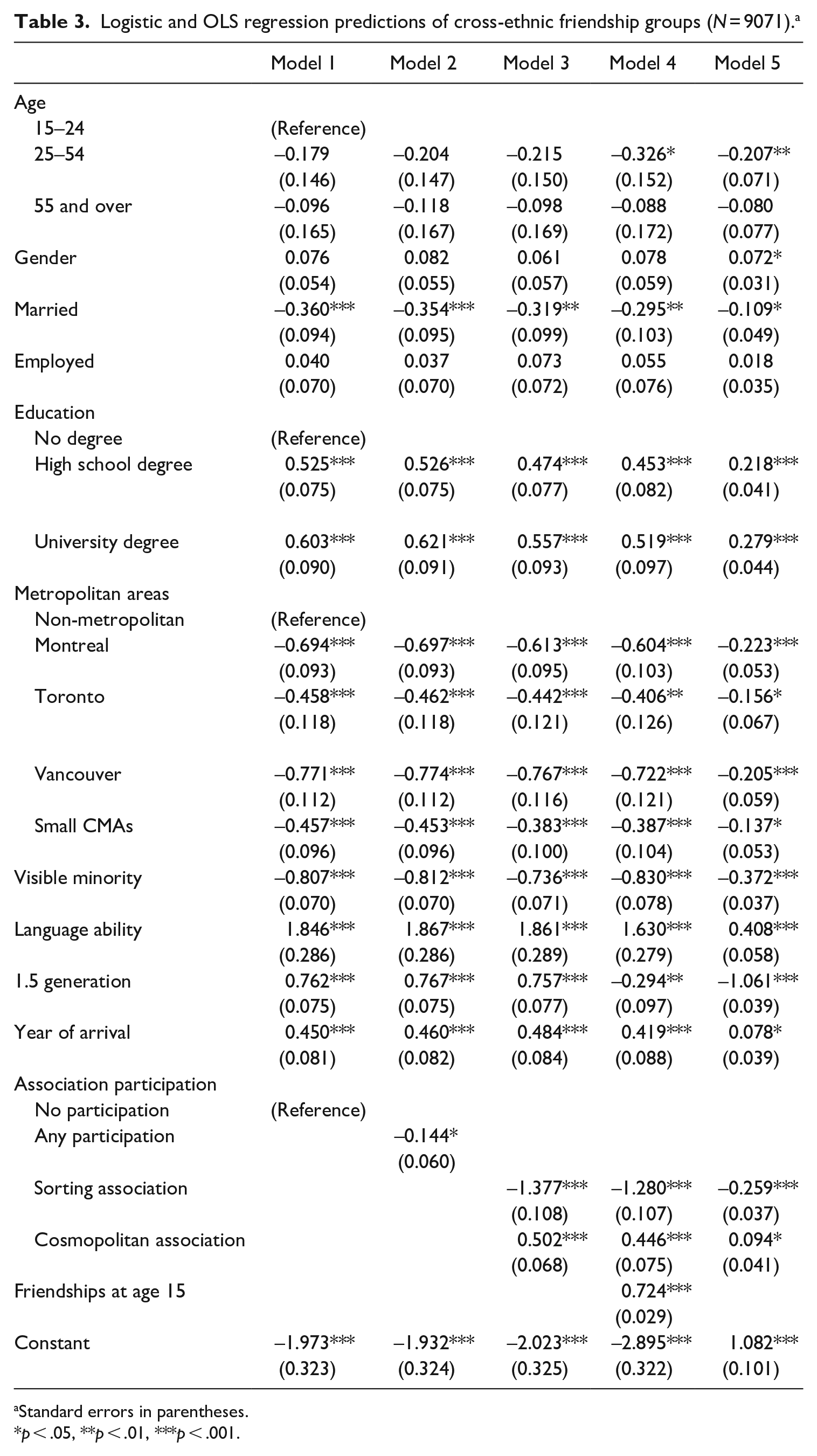
Standard errors in parentheses.
p < .05, **p < .01, ***p < .001.
Models 2 and 3 include the association participation variables of interest to this research. Model 2 looks at participation in any association and shows that those participating are less likely to report having cross-ethnic friendship groups than non-participants. The predicted probability of having a cross-ethnic friendship group for non-participants is 40%, while that for participators is 37%. The multivariate model contradicts the bivariate descriptions and supports the expectations of H1.
Model 3 includes the association type variables and supports the more refined hypotheses H2a and H2b concerning sorting and cosmopolitan associations. Newcomers who participate in sorting associations are less likely than non-members to report cross-ethnic friendship groups and those participating in cosmopolitan associations are more likely to report cross-ethnic friendship groups. Figure 1 displays the findings visually, showing that the predicted probability of reporting a cross-ethnic friendship group for those participating in sorting associations is about 17%, while the predicted probability for those participating in cosmopolitan associations is about 51%. The diverging effects are strong and paint a clear picture of the influence of association type.
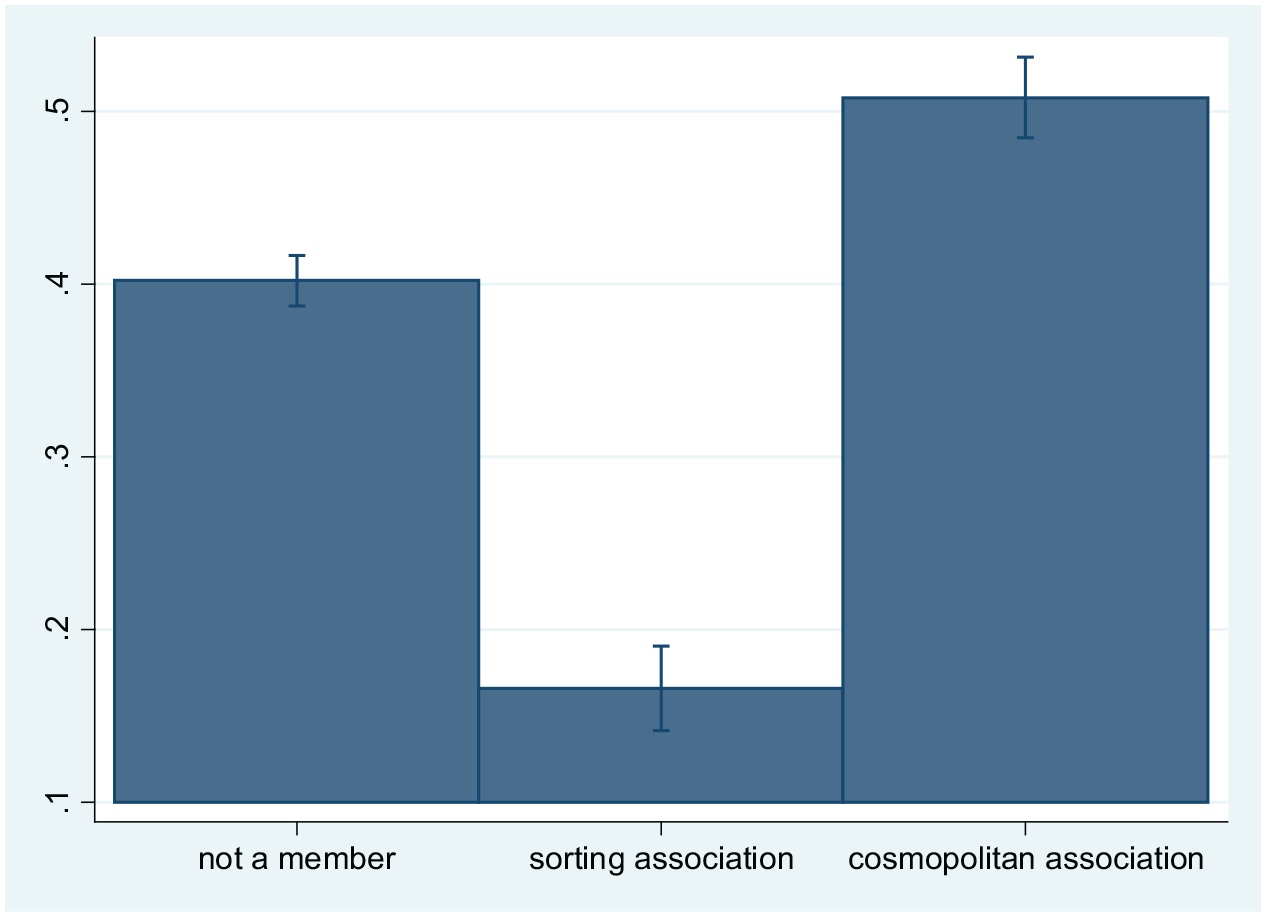
Predicted probabilities of cross-ethnic friendship group (N = 9071).
Robustness analysis
To this point, our analysis finds support for H2a and H2b. To test the robustness of these findings, I follow two analytical strategies that further specify the participation effects. The first employs techniques associated with longitudinal analysis to address concerns of pre-participation heterogeneity. It introduces the composition of respondents’ friendship networks at age 15 to the analysis. The second employs techniques associated with treatment effects analysis to mimic a random application of respondents to different association types to address concerns for heterogeneous responses to association participation.
Pre-participation friendship groups
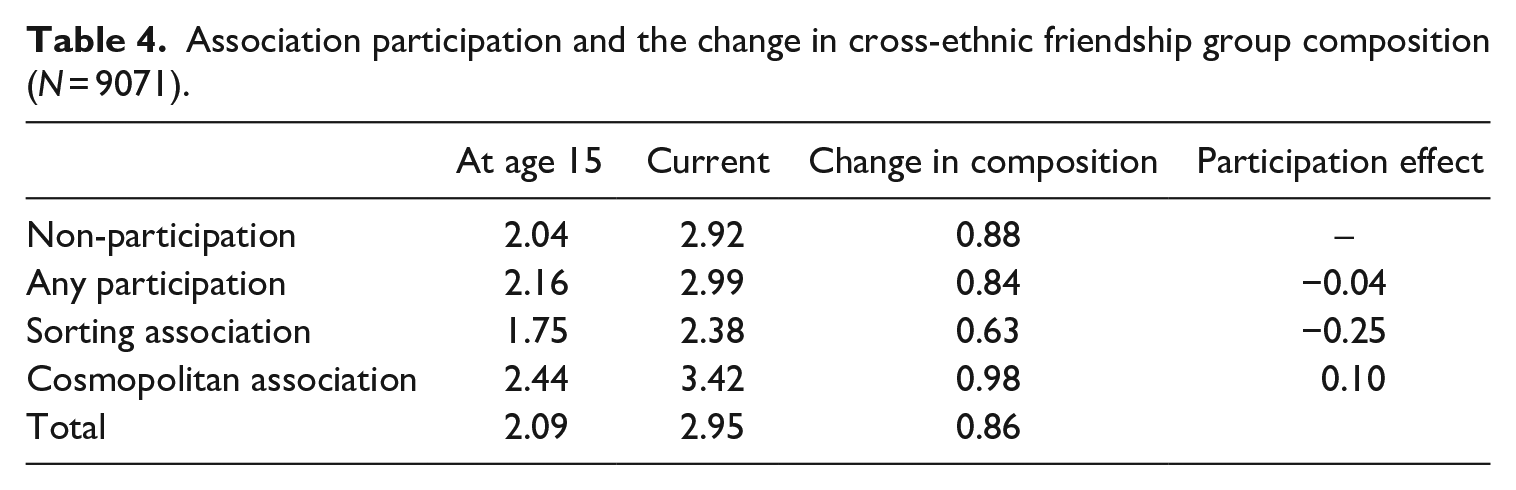
Table 4 provides a first bivariate look at the potential pre-participation friendship impact on current friendship group composition. The first column shows the mean on the five-point scale with comparisons across the association involvement variables of interest. It shows that there is indeed a selection effect – newcomers with more cross-ethnic friendships are more likely to join cosmopolitan associations, and those with more co-ethnic friendships are more likely to join sorting associations. This alone is not a problem. The concern is that this selection can account for the differences we find in the cross-sectional analysis above. Looking across to the fourth column, we can see that this is not the case. Those with more co-ethnic friendships are more likely to participate in sorting associations on average, but they also report an average decrease in cross-ethnic friendships over time. In contrast, those newcomers with more cross-ethnic friendships are more likely to participate in cosmopolitan associations on average, but they also report an average increase in cross-ethnic friendships over time.
Association participation and the change in cross-ethnic friendship group composition (N = 9071).
To examine this in the multivariate analysis, we return to Table 3, and Models 4 and 5. Model 4 reports results of the regressor strategy with friendship group at age 15 included as a regressor in the logit models. Model 5 uses the change variable strategy and OLS regression. Both models provide further support for the robustness of the findings in Model 3. When including age 15 friendship group composition as a regressor, the predicted probability of reporting a cross-ethnic friendship group for those participating in a cosmopolitan association is 48%, while the predicted probability is only 20% for those participating in a sorting association. The change variable model similarly shows that participation in cosmopolitan associations is associated with reporting a higher proportion of friendships as cross-ethnic, and participation in sorting associations is associated with reporting a lower proportion of friendships as cross-ethnic. All these findings are consistent with H2a and H2b.
Two questions may arise from this analysis. First, the sample includes a small number (fewer than 200) of respondents interviewed at age 15. This group will not report change regardless of their association participation. Including this group in the analysis dampens the effect sizes in the analysis, rather than bias the models toward confirmation of the findings from Model 3. To check this, I ran models without the lowest age categories and found no change in direction of the findings in Models 4 and 5.
There is also a risk of regression to the mean for those who report all or none of their friends being co-ethnic at age 15. A respondent who has all co-ethnic friends at age 15 cannot report a more co-ethnic friendship group at the time of the interview. This becomes a problem if these respondents are more likely to participate in cosmopolitan associations, because an increase in cross-ethnic friendship group composition may be due to statistical regression rather than participation. Reviewing this shows that those who report all co-ethnic friends at age 15 are equally likely to participate in sorting (19.7%) as cosmopolitan associations (19.1%). Those reporting no co-ethnic friends at age 15 are more likely to participate in cosmopolitan associations (37.9%) than in sorting associations (3.4%). Rather than overstating the support for H2b, this dampens the effect size of cosmopolitan association participation. The comparative aspect of the analysis also accounts for this in two ways. First, I am looking at a comparative change. Although we are likely to see a decrease in cross-ethnic friendships for this group, we would expect larger average decreases from sorting association participation than from cosmopolitan association participation. Second, I use non-participators as a comparison group, which allows us to view participation effects in comparison with this non-participating group. The treatment effects analysis described below addresses these concerns with an alternative strategy.
Heterogeneous response to participation
Table 5 presents the results of a treatment effects analysis using propensity score, nearest-neighbor matching techniques. The treatment effects strategy makes comparisons between respondents reporting exact or nearly exact responses to key variables so that I can isolate the effect of participation on friendship group composition at the time of the interview. For instance, comparisons are made between respondents who report all co-ethnic friendships at age 15 but who follow different participation trajectories. Propensity scores match respondents with multiple variables using logistic regression, comparing those with nearly the same profiles on a large number of variables but different participation trajectories. This allows us to compare respondents that are nearly the same on all characteristics measured, except for participation variables of interest.
Effects of cosmopolitan association participation on change in cross-ethnic friendships.
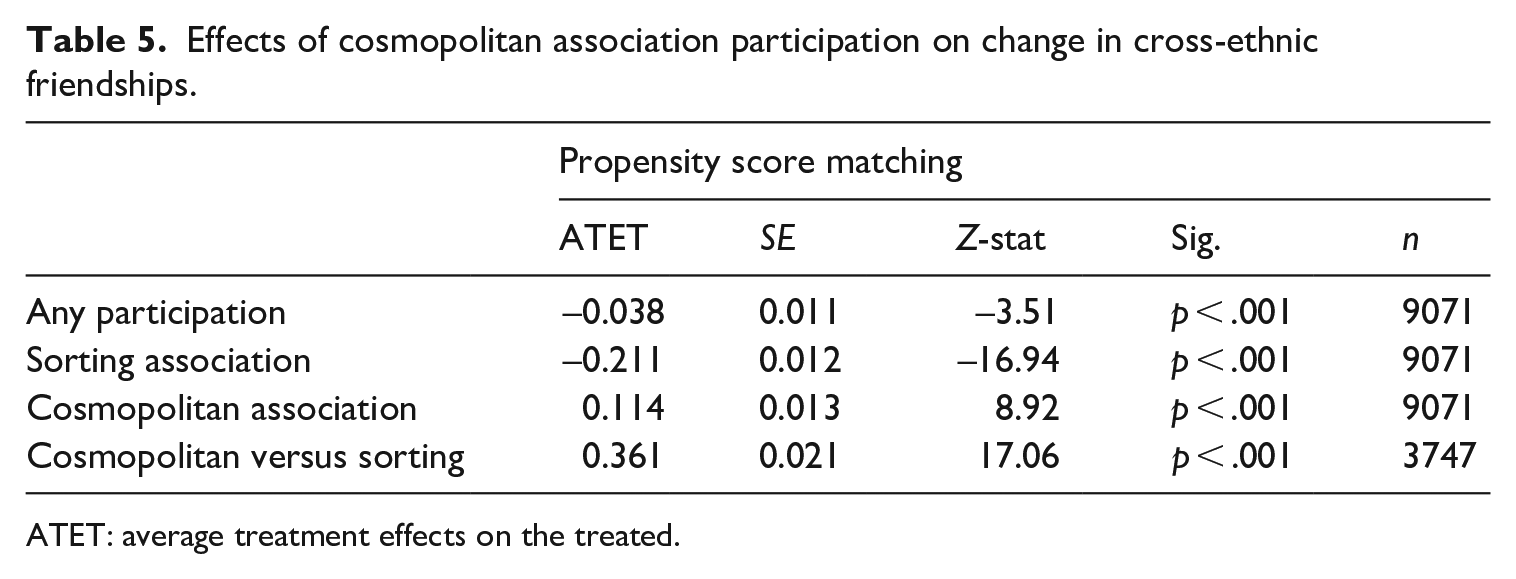
ATET: average treatment effects on the treated.
When matched samples are employed to estimate the net effects of association participation on friendship group composition, the findings are consistent with the logistic models in Table 3. The average treatment effects on the treated (ATET) shown in column one suggests that any participation in an association slightly reduces the likelihood of having a cross-ethnic friendship group. Respondents participating in sorting associations are much less likely to have a cross-ethnic friendship group, and those participating in cosmopolitan associations are more likely to have a cross-ethnic friendship group. Row 4 limits the analysis to those respondents who participate in associations, considering participation in a cosmopolitan association as the treatment. This makes the comparison of respondents with a similar propensity to participate in a cosmopolitan association, but who participate in a sorting association instead. It shows the stark difference in friendship group composition that results from the choice to join a cosmopolitan association. The findings in Table 5 are consistent with H1, H2a, and H2b.
Discussion and conclusion
In developing his concept of the cosmopolitan canopy, Anderson (2004, 2011) builds on his earlier work which finds interactions with diversity in public life shrouded in a pervasive wariness toward others. That wariness, often surrounding ethnic and racial differences, results in a controlled, guarded avoidance of engagement. Amid this general wariness, however, Anderson (2004) finds oases of comity in places: There remain numerous heterogeneous and densely populated bounded public spaces within cities that offer a respite from this wariness, settings where a diversity of people can feel comfortable enough to relax their guard and go about their business more casually. (p. 15)
With the concept of a cosmopolitan canopy, Anderson encourages us to explore the dynamics of diversity and interaction in cosmopolitan spaces. By employing the concept of cosmopolitan social infrastructure and examining cosmopolitan associations, I bring the potential of cosmopolitan spaces to the discussion of newcomer experiences. It is not difficult to imagine the appeal of Anderson’s oases to the newcomers in Glick Schiller and Caglar’s (2013) research documenting the search for emplacement and a sense of belonging in a new home. My research provides some simple evidence for this, showing that newcomers are more likely to join cosmopolitan associations than sorting associations.
I extend discussions of cosmopolitan spaces from examining informal interactions in public spaces, such as public markets, malls, restaurants, and public transit, to the more formal interactions as part of voluntary associations and other types of community organizations. The formality of these organizations adds some structure to interactional life by engaging participants in focused collective activities over time. The structural difference in interaction is significant – consider the difference between a casual interaction at a lunch counter and regular participation in a weekly sports club over months or even years. Lofland (1989) makes a similar argument when describing interactions in the parochial realm, where routine interaction over time provides the opportunity for interactions to become more personal, more communal, and the possibility of friendship emerges. Glick Schiller and Caglar (2013) find this in their research on newcomer sociality. They describe an unauthorized worker from Columbia who met a local volunteer through a public library support program resulting in a friendship that has lasted 12 years. Although fleeting interactions in public are perhaps more common than formal interactions, I find that 24% of newcomers participated in cosmopolitan associations where regular interactions over time provide opportunities for a greater depth of interaction.
My attention to friendship also extends previous discussions of cosmopolitan spaces. As Vincent et al. (2018) suggest, friendship patterns can reproduce or transform existing ethnic boundaries, and Glick Schiller and Caglar (2013) find them transformative for newcomer settlement experiences. Friendships that cross ethnic boundaries provide instrumental value through access to a rich store of resources they can draw on, such as support and information. Equally as important, diverse friendships introduce new possibilities for those friends and ways of seeing and interacting in the world. A chance to appreciate differences and recognize similarities (Appiah, 2010; Lauer and Yan, 2022). Wessendorf and Phillimore (2019), in their qualitative examination of newcomers in London, find that these connections contribute emotionally to feeling more at home and a sense of rootedness.
A crucial insight of Wessendorf and Phillimore’s (2019) research shows that cross-ethnic friendships need not be with a dominant majority group to contribute to a sense of belonging. Connections with other migrants, for instance, cross-ethnic boundaries and provide the same value. In my research, I similarly define cross-ethnic friendship using a broad conception of integration, including a person from any other ethnic background. There is a limitation here, however, in that, I do not have information on the varied backgrounds of friends. I do not know if these friendships cross racial boundaries, for instance. I also do not know if these friendships cross immigrant status boundaries – if cross-ethnic friends are also newcomers, or if co-ethnic friends are non-newcomers. Knowing more about friendship groups would provide a more refined sense of heterogeneity and a deeper understanding of the cross-ethnic experiences I am documenting. This limitation extends to my measurement of cosmopolitan associations. I do not have more refined details on the various backgrounds and experiences that make up these associations. Here again, the detail about ethnic variation within cosmopolitan associations would provide a deeper understanding of the experience of these cosmopolitan spaces. The work of Wessendorf and Phillimore (2019) suggests that further research is being undertaken concerning the diversity of immigrant friendships. An important new direction for research following from this analysis would explore with more depth the cosmopolitan characteristics of associations.
The view that cosmopolitan spaces provide opportunities for learning and acceptance of difference is sometimes criticized as overly optimistic (Amin, 2002; Aptekar, 2019). Aptekar (2019: 72) finds cosmopolitan spaces embedded within larger structures of inequality that shape individuals’ interactions as they enter them. Amin (2002) points specifically to the limitations of interaction in open public spaces but is optimistic about the interactions in micropublics that resemble the cosmopolitan associations I examine in this research. In these spaces, Amin finds engagement is possible that does not avoid conflict or other difficult matters. While the cosmopolitan associations I examine are indeed embedded within the larger structures of inequality that Aptekar describes, the research is motivated by the insights of Amin and the potential of regular interaction, over time, with a shared focus of attention. These are the primary qualities of social infrastructure (Klinenberg, 2018) that contribute to relationship development. When combined with diverse contexts, the potential for cross-ethnic friendship development emerges. While I cannot assure that the engagement with the difficult or conflictual matters described by Amin occurs, I do find significant outcomes in friendship and not just causal interactions or attitudes.
I find that participation in a cosmopolitan association is associated with newcomers having more cross-ethnic friendship groups. The argument relies on a straightforward notion that the diversity of an association provides the opportunity for those cross-ethnic ties to form. Of course, not all those who participate in cosmopolitan associations report having cross-ethnic friendship groups. There are several ways that such an outcome might emerge. Perhaps most clearly, a diverse association may directly or indirectly promote segregated practices. Suttles (1968) observed ordered segregation in his early examination of diverse neighborhoods. This involved ethnically similar groups ‘taking turns’ before engaging with local organizations. More recently, May (2014) describes practices of integrated segregation in neighborhood clubs that include diverse groups sharing the same space but demarking informal boundaries that perpetuate segregation. These examples suggest ethnic groups can share spaces while developing practices that avoid engagement. This is Amin’s (2002) concern raised above. Even the intention of engagement may not be enough to assure friendship. Neal and Vincent (2013) document the ambivalence that can arise between people when they come into contact in diverse spaces. Even when people approach differences with openness, there are still barriers that prevent a friendship from emerging. Perhaps, the programming and activities of more formal organizations could structure interaction, while also providing institutional support for intergroup collaboration and engaging with difficult matters. Perhaps, the presence of individuals whom Wise (2009) calls transversal enablers, who facilitate cross-boundary connections, could make the difference. My analysis focuses on a single characteristic of cosmopolitan social infrastructure – the ability to bring people with different ancestries into interaction – but there are certainly other qualities of these formal spaces that would contribute to their cosmopolitan character. These may include their organizational culture, leadership qualities, and the types of programs and activities practiced (Lauer, 2021). Similarly, the origins, stability, and vulnerabilities of cosmopolitan associations would likely contribute to managing the interactional space that these organizations provide.
I anticipate that future case studies and ethnographic research surrounding cosmopolitan associations will open the doors of these organizations and allow for a deeper understanding of interactional processes within. These approaches would also provide insights into the everyday experiences of diversity surrounding co-ethnic associations. Past research has documented the value coming from support and community belonging that these organizations have contributed to the experiences of newcomers. It is an essential value that is often motivated by the desire to provide a safe space and support for other co-ethnics who share experiences and cultural backgrounds. Although I find that participation in sorting organizations is associated with co-ethnic friendship outcomes, there is a small proportion who do report cross-ethnic friendship groups. These cross-ethnic friendship groups likely develop outside of the associational life in other realms, such as the workplace. Perhaps, participation in associational life, although a co-ethnic experience, can result in a broader engagement with the wider society. That broader engagement would allow for the possibility of new experiences and friendships that cross boundaries. Shoeneberg (1986) finds this in immigrant associations in Germany. More research could explore this potential, likely considering questions on the varied qualities of associations discussed above.
Wessendorf’s (2016) recent qualitative research allows us a partial view of what association participation dynamics look like. She examined mother-child drop-in groups at childcare centers in the diverse neighborhood of Hackney, London with an interest in interactional dynamics. Perhaps the first insight from her examination is that cross-ethnic friendship development is not a given outcome of participation in these cosmopolitan associations. In her research, she finds that mothers from similar backgrounds and with shared languages often stick together in these settings, despite the presence of an ethnically diverse group. One of her respondents from Romania, for instance, reported that she made two new friends from participating in these drop-in groups, both Romanian. The likelihood of friendship development is not self-evident and can be difficult when crossing boundaries of language and ethnicity. However, in addition to these findings, Wessendorf reports many new cross-ethnic friendship groups that emerged from these drop-in sessions. Sometimes these emerge simply from the regular interactions over time that allowed shared interests in cooking, for example, to emerge and develop into more intimate relationships. In other groups, it was an interest in leisure activities, such as yoga or the shared experience of having young children that allowed friendships to emerge and last over time. These rich descriptions of interaction in what I would call cosmopolitan associations document in-depth the process of friendship group change that my analysis addresses.
The quantitative analysis I present here contributes an important look across association types showing the comparative increase in cross-ethnic friendship groups through participation in cosmopolitan associations. I am also able to isolate these participation effects despite the selection effects of previous friendship group composition. These analytical contributions along with the breadth of the survey research show that the micro-level processes documented by qualitative researchers are happening on a larger scale. The findings show that association participation, in cosmopolitan associations, in particular, is a vital part of newcomers’ everyday experiences of friendships and interactions that cross-cultural boundaries.
Footnotes
Funding
The author disclosed receipt of the following financial support for the research, authorship, and/or publication of this article: This work was supported by the Social Science and Humanities Research Council of Canada (410-2008-2690).
Data availability
The data that support the findings of this study are available from Statistics Canada. See https://www23.statcan.gc.ca/imdb/p2SV.pl?Function=getSurvey&SDDS=4508.
