



Abstract
The article examines how members of worker cooperatives articulated friendship as resistance against capitalist work relations. This elucidates relatively unexplored links between research on workplace friendships and resistance studies. Based on interviews with members from small Swedish worker co-ops, the analysis shows that the co-ops hinged their friendships on authenticity, but also valued friendship explicitly for its economic and political benefits. Yet, this ideal of authentic and equal friendships sat side by side with narratives of what the article calls ‘friendship compliance’. This concept denotes how friendships may instil loyalty, reduce dissent and promote self-sacrifice. It is argued that while such compliance can be at odds with cooperative ideals, its expression in the worker co-ops studied here did not coincide with how the same mechanism has been described as operating in capitalist work organisations.
Introduction
This article examines friendship in Swedish worker cooperatives (co-ops) as a mode of constructive resistance – opposition by enacting alternative social orders (Sørensen, 2016; Vinthagen, 2005) – against capitalism. The article contributes to research on resistance and friendship dynamics in economic organising by analysing friendship as a field of economic and political contestation and coining the concept of friendship compliance.
Friendship has been identified as offering grounds for resistance to dominant gender discourses (Green, 1998), neoliberal relationships characterised by consumerism and entrepreneurship (May, 2012) and neoliberalism in academic work (Webster and Boyd, 2019). While connected to resistance, friendship can also constrain resistance efforts: the tendency of friendships to involve exclusivity can, for example, stifle the potential of social movements to expand beyond the original core (Polletta, 2004: 4). Links between workplace friendship and resistance are relatively unexplored, although friendship has been shown to provide space for intimate and sexual expression (Cronin, 2014; Rumens, 2007).
Worker co-ops – economic organisations owned and run democratically by the member-workers – are often construed as resistance to capitalism and mainstream company models (Cheney et al., 2014; Dufays et al., 2020; Paranque and Willmott, 2014; Ranis, 2016; Rothschild and Whitt, 1986). As part of their push for equality and member democracy, co-ops tend to eschew impersonal relations at the workplace, which they associate with bureaucratisation and delegation of individual agency over to management (Rothschild, 2000). Democracy in co-ops often relies on friendships to some extent (Ng and Ng, 2009: 185), which suggests that worker co-ops may embrace workplace friendship as a tool in their constructive resistance against hierarchical governing associated with capitalism, similar to how friendship has been mobilised as prefigurative politics in social movements against inequalities (Polletta, 2004).
Capitalist discourse includes a distinction between friendship, as belonging to the private realm, and economics and politics, as public activities (Costas, 2012; Silver, 1990). When considering friendship as resistance to capitalism, this distinction is important. Because friendship under capitalism has been understood as unrelated to economics and politics, it has sometimes been promoted as inherently anti-capitalist (Marx and Engels, 1848: 16; May, 2012).
Yet, capitalist management discourse has come to embrace emotions and social bonds related to friendships as important tools for controlling and exploiting the workforce (Boltanski and Chiapello, 2007; Hochschild, 2001; Illouz, 2007; Reber, 2012). Although friendship is characterised by voluntariness and cannot be imposed (Sias and Cahill, 1998), managers can support friendships and use the emotional importance of workers’ friendships as new forms of control (Gregg, 2011). Informal power structures associated with ‘friendship culture’ in workplaces promote a form of horizontal solidarity that can make workers sacrifice their self-interests in ways that favour the employers (Costas, 2012). Friendships can make co-workers avoid expressing diverting opinions (Pillemer and Rothbard, 2018), tie workers closer to the workplace and increase workplace efficiency, for example, by voluntary information sharing (Sias, 2008). Overall, friendship as resistance to capitalism is an approach with both possibilities and pitfalls.
The project of theorising resistance has been taken up by the expanding research field of resistance studies (Baaz et al., 2017). Constructive resistance is a particular form of prefigurative resistance defined as the enactment – the construction – of alternative social orders in the here and now, that in the long run may replace undesired, dominant ways of organising society (Koefoed, 2018; Sørensen, 2016; Vinthagen, 2005). Thereby, constructive resistance differs from other resistance practices that challenge power through protests, rebellions or uprisings (Baaz et al., 2016: 143). Swedish worker co-ops have previously been shown to practice constructive resistance to capitalism by enacting alternative modes of economic organising with implications for social change (Wiksell, 2021).
Swedish worker co-ops are marginalised organisations that operate in a context characterised by free-market capitalism. Many privatisations and deregulations in recent times have taken Sweden from decades of Social Democratic welfare capitalism towards a more neoliberal model (Fleckenstein and Lee, 2017; Therborn, 2018). The low number of co-ops (less than 1.3%, see Bolagsverket, 2021) in Sweden can partly be explained by a combination of strong state and influential trade unions that strengthen workers’ rights as employees, rather than as employer-owners, and recent decades’ neoliberal turn (Rothstein, 2012). This makes Swedish worker co-ops an interesting case for exploring constructive resistance in a context that leans heavily towards the economic practices they oppose. The constructive resistance of co-ops can pick up elements from the surrounding society that carry assumptions aligned with prevailing capitalism (Sørensen and Wiksell, 2019; Sandoval, 2017). At the same time, it has been noted that Sweden’s strong discursive emphasis on various forms of equality, for instance, gender equality, is likely to lead to an emphasis on equality in friendships (Goedecke, 2018), and friendships have been identified as part of both co-op formation (Stryjan, 1994) and other entrepreneurial endeavours in Sweden (Andersson Cederholm and Åkerström, 2016).
Based on interviews with members of Swedish worker co-ops, this article notes important tensions within the articulations of friendship as resistance to capitalism. The concept ‘friendship compliance’ is coined in the article to denote how friendship encourages compliance, for example, by making members prone to sacrifice personal time and gains for the group.
The following two sections discuss previous research on friendship as resistance and friendship in contemporary work organisations. Then follows a methods section. The subsequent analysis concerns authentic friendships in worker co-ops as constructive resistance to capitalist hierarchies and as political and economic action. The second part of the analysis focuses on the concept of friendship compliance, followed by a concluding discussion.
Friendship as resistance
Friendship as resistance has been investigated in specific contexts, including Swedish work settings. For example, women’s friendships can provide sites for re-constructing femininities (Green, 1998), co-workers’ friendships can resist neoliberalism in Swedish academic work (Webster and Boyd, 2019) and separatist women’s networks within Swedish forestry can strengthen resistance to hegemonic femininities (Laszlo Ambjörnsson, 2020).
Co-ops are often described as prone to ‘degeneration’, that is, to eventually becoming more akin to capitalist enterprises by adapting to the surrounding society (Cornforth, 1995). Previous research has shown that co-ops can actively seek to counter ‘degeneration’ through their democratic organising (Cornforth, 1995; Langmead, 2016). Economic democracy within co-ops can facilitate defiance to economic and political values impinging on their close interpersonal work relations (Dufays et al., 2020). It is likely that friendships can figure in such countermeasures. Social movements that oppose inequalities, for example, tend to employ friendships in their prefigurative organising (May, 2012: 131; Polletta, 2004). Todd May (2012: 128) argues that deep, egalitarian friendships can fuel political resistance to neoliberal capitalism by transcending economic notions of equality as a balance between giving and receiving. This view, that equal friendships can challenge capitalism, can be understood through the lens of constructive resistance – to create a desired reality in the here and now (Sørensen, 2016).
However, friendship can also undermine resistance, for example, by reducing the likelihood that workers express opinions diverting from those of their friends (Pillemer and Rothbard, 2018), or by stifling the potential of social movements to expand beyond the original core (Polletta, 2004). Furthermore, members of worker co-ops are both employees and owners, which means that they ‘are likely to prioritize different roles at different times, resulting in variations in the degree of resistance that the cooperative can wield’ (Dufays et al., 2020: 979). The potential limitations of friendships as resistance point to the importance of adopting a dialectical approach to understand how workplace resistance may challenge but also reproduce control (Mumby, 2005). Such dialectical tensions are present in articulations of friendship in worker co-ops as constructive resistance to capitalism, as will be shown in the analysis below. Similar tensions are indicated in previous research on friendships in contemporary work organisations.
Friendship in contemporary work organisations
In research literature on friendship and work organisations, the question is often posed how friendships can enhance or adversely affect the performance of an organisation. Overall, the literature agrees that on the plus side, friendships can increase work satisfaction among employees, build loyalties to the organisation (Pillemer and Rothbard, 2018; Sias and Cahill, 1998) and facilitate communication between members as they come to know each other (Sias, 2008). On the down side, friendships can undermine claims of fair treatment by raising (correct or incorrect) suspicions of friends privileging friends, exclude individuals that are necessary for organisations to function, and conflict with formal rules and goal-rational procedures by, for example, emphasising informal communication and emotional well-being (Pillemer and Rothbard, 2018).
These pros and cons of workplace friendships point to tensions between friendship and organisational logics. Co-workers often do not choose with whom to work, are ruled by formal rules, perform duties as a result of receiving salaries and pursue organisational goals other than well-being. In contrast, friends have been described as characterised by the following four central features: they enter friendships voluntarily, keep them informal, give support based on need (rather than on strict reciprocity) and tend to favour emotional well-being before other goals (Allan, 1998).
Yet, one can theorise three strategies by which these tensions can be reduced in work organisations. First, some organisations may operate with an organisational logic that adopts certain traits inherent to friendship, as a ‘promote friendship’-strategy. Second, organisations may promote versions of friendship that are more in line with organisational strategies, which could be called a ‘subsume friendships’-strategy (this is the least explored strategy of this article). Finally, it is possible that organisations can keep friendships and organisational operations separate in ways that prevent conflict between the two, as a ‘separation strategy’.
Friendship has often, but not always, been read as an inherently equal relationship (Costas, 2012; Wouters, 2010). This is associated with the idea that friendship is and should be pursued for its own sake and not for some ulterior motive. Sociologist Francesco Alberoni (1987), for example, argues that some degree of equality ensures that neither party uses the other for egoistic gains. Similar arguments can be found as early as in ancient philosopher Aristotle (1984). Equality and the inherent value of friendship are in turn connected to voluntariness and authenticity (Cronin, 2014: 72). If no ulterior motive exists, friends are chosen for their own sake. That idea is often taken to mean that friends have seen and accepted each other’s true selves, that supposedly exist beyond social roles.
Because certain forms of friendship have been understood as non-instrumental and equal, friendship has sometimes been promoted as inherently anti-capitalist (Marx and Engels, 1848: 16; May, 2012). However, there are examples of the co-existence of non-instrumental friendship and capitalism, particularly where the ‘separation strategy’ suggested above has been in effect. Allan Silver (1990) argues from historical research that before capitalism, friendship was tightly linked to both economic collaboration and political power. The broad promotion of non-instrumental friendships became possible only with the onset of capitalism and its separation of private life from a public space of pure instrumental economic action. Silver’s view is in part congruent with Alberoni’s (1987: 41) understanding that friendship has become so alien to instrumentality that friendship and bureaucratisation can exist side by side without tensions – people are used to separating them in theory and in practice. While these somewhat dated results do not necessarily speak to the place of friendship in current neoliberal capitalism, as May (2012: 75) points out, they indicate that too simplistic notions of friendship-as-resistance are problematic.
Although friendship has often been understood as dyadic (Alberoni, 1987; May, 2012), this is not the assumption here. Sociologist Michael Eve (2002) presents a critical study of the literature and suggests that friendship is indeed not necessarily dyadic, and that sociologists may instead focus on friendship networks and their contexts. This conclusion resonates with important concepts found in research on workplace friendship, where both networks and contexts (e.g. in organisational culture) play important roles (Allan, 1998; Cronin, 2014).
In research literature on friendships and work organisations, friendship as a means of organisational control is rarely brought up outside the context of organisational performance. In an exception to this rule, Jana Costas (2012) investigates management consultancy firms and describes ‘friendship culture’ as a less conspicuous counterpart to family culture in corporations. The latter is an established concept for how ‘doing family’ at workplace establishes familial-like informal power structures. Family culture promotes hierarchical cohesion whereas friendship culture promotes horizontal loyalty, which can make workers sacrifice their self-interests in ways that favour the employers. Costas describes something akin to the ‘promote friendship’ strategy mentioned earlier: some of traditional corporatist logics are set aside, while friendship logics of relative equality are promoted. Although potentially at odds with classical capitalist corporations or bureaucracies, such a strategy could still, according to Costas (2012), be used to exercise control over workers. Thus, accepted or even valued friendship cultures in workplaces can be described as the ‘promote friendship’ strategy on one level. Nevertheless, those friendships are enclosed in a framework that separates friendships and organisational logics and ultimately prioritises the latter, thus indicating an enclosed or limited ‘promote friendship’ strategy within a wider ‘separation strategy’.
This article broadens Costas’ (2012) argument and identifies ‘friendship compliance’, which is defined as the tendency more generally of friendships promoting organisational control. The concept is both narrower than Costas’ ‘friendship culture’, as it focuses on how friendship underpins control, and broader, as it can include all forms of organisations (not just capitalist corporations). As such, it may help to promote analysis of the role of friendship in different contexts, like the contextual reading of non-capitalist organisations that is conducted here.
Examples of friendship compliance include Costas’ (2012) member loyalty. Another example is the development of exclusive ‘cliques’ that take decisions outside of formal settings, thereby reducing others’ access to resources and influence. Francesca Polletta (2004) identifies how emotional bonds between members make it difficult to formalise civil organisations: ‘[w]hen they tried to implement mechanisms designed to equalise power, friendship’s resistance to formalisation impeded their efforts’ (p. 4). A third example of friendship compliance is found in an article by Julianna Pillemer and Nancy P. Rothbard (2018), who show that friendship can reduce people’s willingness to raise critical questions. Insofar as friendships are seen as threatened by disagreements, people are willing to mute their objections to sustain these friendships.
Friendship is pursued not only for organisational reasons, but by individuals for its own sake. It has been shown to provide organisational members emotional relief and support (Cronin, 2014), as well as spaces within organisations for intimate and sexual expression (Rumens, 2007). It is however difficult to know the relative importance of organisational and individual interests for the prevalence of workplace friendships. This may be particularly difficult for co-ops, where organisational and individual interests should coincide.
In research on worker co-ops, member commitment is identified as important for creating successful and sustainable organisations (Birchall and Simmons, 2004; Fulton and Adamowicz, 1993). Still, members also view involvement in co-ops as a means of individual benefit and financial well-being (Puusa et al., 2016). Co-ops have thus been described as a balancing act in which communal bonds and individual interests need to be weighed together (Audebrand, 2017). In this article, we understand friendships are potentially valuable and problematic in relation to both organisations and individual members.
Methodology
The lack of previous research, statistics and registers of worker co-ops disallows statistical representativeness when sampling co-ops in Sweden (Mann, 2018). Worker co-ops for this study that were democratically worker-owned and -managed, defined themselves as worker co-ops and adhered to the cooperative principles of the International Co-operative Alliance (2020), were found through search engines and the national umbrella organisation Companion. The sampling was based on variation, adequacy (Bowen, 2008: 140), relevance, and potential to be information-rich (Rapley, 2014). Out of 11 invited worker co-ops, five agreed to participate, mainly operating in large cities in the south of Sweden. Strong empirical resemblances between the sampled worker co-ops suggest that the present analysis will find resonance in other Swedish worker co-ops: no overall division of type was found. While this homogeneity may indicate systematic bias in the sampling, the efforts taken to represent variation make this less likely.
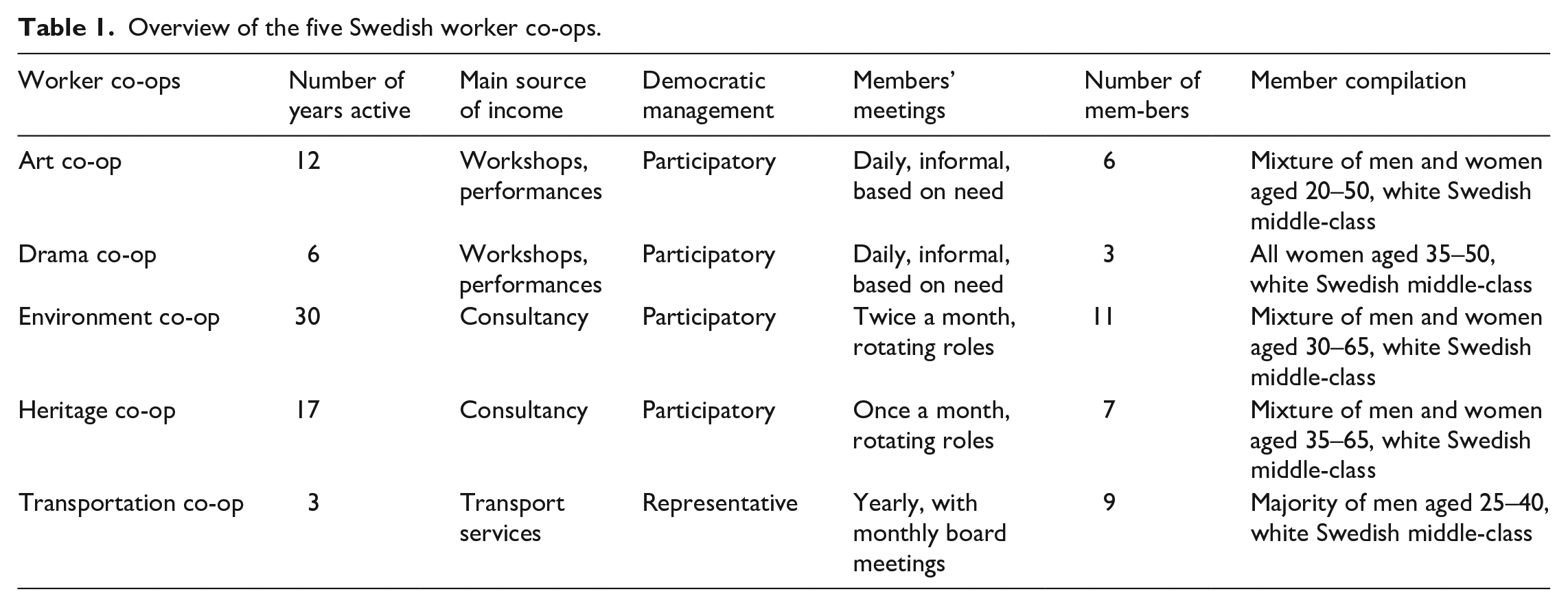
Table 1 below shows some of the characteristics of the co-ops when data were generated 2016–2017. They are named here after their business branch: transportation, heritage, environment, drama and art. All co-ops were started by small groups of friends and new members were often recruited through personal contacts. Their small size, typical for Swedish worker co-ops (Mann, 2018: 22), was intended as a facilitator of their democratic management. Deliberative members’ meetings were the main shared activity where members socialised. In some projects, members worked closely with each other and some members chose to spend time together outside of work.
Overview of the five Swedish worker co-ops.
The empirical data, generated by the first author of this article, mainly consisted of 12 individual semi-structured interviews and two group interviews, with a total of 17 members from the different co-ops. The first group interview was held with two members from the Drama co-op and the second with four members from the Art co-op. Interview extracts presented below are translated from Swedish to English. The interviewees, selected in dialogue with the contact persons at the co-ops, were of different gender and age, had been members of the organisations for varying lengths of time and had different work competencies. The interviews focused on organisational aims, finances, division of labour, decision-making, working conditions and work relations. Friendship was not included in the interview guide but emerged as a theme, particularly in response to questions on work relations. To complement and contextualise the interviews, policy documents were collected and participant observations were conducted during members’ meetings in co-ops where group interviews were not held. During observations and group interviews, the mood was positive, informal and friendly.
More ethnographic research would have enabled explorations of friendships in the context of their enactment. This article is limited to analysing how co-operators construct ideals of friendship during interviews and describe enactments of these ideals in the organising of the co-ops. This is, however, congruent with the aim of the article: to understand friendship when articulated as resistance, not the specifics of friendships as such or their practical enactments. Still, narrations of organisational and relational ideals are to some extent part of the discursive-material practices that form the co-ops and which members are likely to relate to in their organising.
The analysis was done through thematic analysis of interview transcripts by first coding empirical elements and topics in the material and by looking for similarities, differences and patterns between codes (Braun and Clarke, 2006). ‘Theme saturation’ was reached when the analysis showed patterns that did not require further empirical material to be adequately explored (Bowen, 2008: 141). ‘Friendship’ and ‘resistance’ emerged as frequently recurring empirical patterns during the analysis of the material. Friendship was coded when interviewees spoke of personal relations between members that transcended work-related tasks, excluding family relations (but including cases where family concepts are used as metaphors). Resistance studies and the sociology of friendships were then employed to pose theoretical questions to the material in an abductive manner (Carleheden, 2016), which generated post hoc codes such as ‘constructive resistance’ and ‘friendship culture’ for follow-up coding. As a result, we coined the concept of ‘friendship compliance’ to describe central aspects of the friendship dynamics articulated in the worker co-ops.
Analysis
Authenticity and the economic and political action associated with friendship were two important themes when worker co-op members discussed informal relations as part of their constructive resistance. These themes concerning friendship as resistance are explored in the first analytical section. The subsequent section concerns what is here termed friendship compliance in the co-ops and relates it to previous theorising on friendships in work organisations.
Friendship as constructive resistance
When articulating worker co-ops as constructive resistance against capitalism, the interviewees often reproduced a certain notion of friendship as authentic. The co-operators opposed hierarchical, capitalist wage labour which they associated with profit-driven, formal and impersonal work relations at the expense of workers’ own sociality. Instead, the worker co-ops emphasised democratic management and ownership, seen as promoting personal relations. Central to this notion, indicated in most of the interviews, was that friends are equals, which allows for authenticity, whereas hierarchy would lead to inauthenticity. The same tropes about friendships and authenticity are found in academic and philosophical literature on friendship (Cronin, 2014; Giddens, 1991). This notion exemplifies how egalitarian, authentic friendships tend to be emphasised in prefigurative organising against inequalities and capitalism (May, 2012: 131; Polletta, 2004).
The following description of authentic friendship was offered by a member who compared the informal and personal work relations of the co-op with previous experiences from a large capitalist enterprise in the transportation sector: It’s more apt to compare [the co-op] to a student collective, than to a workplace with professional co-workers. It feels . . . much more informal when we communicate, it doesn’t feel as though you’re going to work. [. . .] My colleagues at my previous [conventional] workplace had this kind of professional façade . . . (IP4, Transportation co-op)
Work relations in the Swedish co-ops were described in this manner as facilitating authentic self-expression and freedom from hierarchies, even though the work tasks rarely required members’ proximity to each other, which has been identified as a facilitator of friendship development (Sias, 2008: 91). Another quote illustrates the tendency to evoke close relationships as constructive resistance: When you think about how much, globally, is based on dominance and that you do what you’re told and what you must do, and all this very strict hierarchy and control by bosses and middle managers [. . .] And [we have] this that one can bring along one’s kids and that we all like to take care of each other’s kids and [. . .] [The Art co-op] has managed to realise [. . .] organic ways of distributing responsibility and rotating responsibilities, and that you feel it’s genuinely equal. [. . .] Because we know each other so well, have gone through incredibly much, like, privately as well . . . (IP4, Art co-op)
The interviewee argued that the organisation resisted capitalist work relations of formal and hierarchical control by instead embracing friendship-based work relations as a more equal way of relating to each other. The formulation that ‘we all like to take care of each other’s children’ (added emphasis) indicates an expectation that members keep boundaries between work and private life blurred, paralleling how friendship culture in other workplaces promotes horizontal loyalty (Costas, 2012). The previous quote above reflects the same tendency, that ‘it doesn’t feel as though you’re going to work’ (IP4, Transportation co-op). This friendship culture was articulated to help sustain the organising of the co-ops: the egalitarianism, understood as facilitated by friendships, functioned as a political tool in their resistance against hierarchical, capitalist wage labour.
Friendship was articulated as simultaneously instrumental and authentic by several of the co-operators. Although members’ friendships and commitment to the organisations were difficult to differentiate, interviewees articulated friendships between the members as tying them closer to the co-op and its aims and work: ‘we have colleagues, it’s a bit like a family, and that makes you feel very involved and it makes you feel that it’d probably be difficult to quit’ (IP2, Interview notes, Environment co-op). The fact that the interviewee here made the terms ‘colleagues’ and ‘family’ more or less synonymous is important, as it shows that close personal relationships can also include doing business together. While interviewees implied that friendship should be valued for itself, they only contrasted such friendships to hierarchical organising, not to political or economic action. In the co-ops, authentic friendship and friendship for economic and political action were articulated as two sides of the same coin, as an amalgamation of friendship and business that contrasts with the ‘separation strategy’ associated with traditional capitalism (Alberoni, 1987; Silver, 1990), and seems rather more akin to establishing the strategy of ‘promoting friendship’ as a basis for business. At the same time, this strategy shows similarities with some contemporary friendship cultures that secure workers’ loyalties to the firm (Gregg, 2011), further discussed below.
The emotional appeal of friendships also came across in the interview material as certain emotional satisfaction that co-operators get from working in their organisations (cf. Cronin, 2014). However, as co-ops are organised partly to give members benefits, it is difficult to differentiate clearly between the organisational logics and the individual satisfaction members get from friendships. It is possible that friendships were promoted both as a member benefit and as a part of the cooperative ethos of equality and democracy.
The importance of friendship was reflected in the policing of organisational boundaries where new co-op members were concerned. This was expressed by members of all co-ops except the Transportation co-op (the only co-op with representative democracy). The emphasis on authentic friendships was closely associated with how members were expected to relate to the organisational aims of the co-op, which the following quote illustrates: If one would hire some artistic person [in the Art co-op] that just would start and be like . . . part of the core group straightaway, that would feel really weird because then [. . .] they wouldn’t have that relation to this work, like it’s [your] baby . . . (IP1, Art co-op)
The interviewee argued that members without personal bonds to the co-op were at odds with their way of organising. Personal attachment and communal feelings, rather than mere competence, were emphasised as a basis for involvement in the organisation. One person’s deeper friendships are necessarily limited in number (May, 2012: 126), which may be what is behind the exclusionary tendency of the co-ops. A similar argument comes from research on social movements, where strong internal friendships make it difficult to recruit and grow (Polletta, 2004).
Interestingly, there was very little discussion among the interviewees about the ways in which friendship can be exploited in contemporary capitalist work organisations (albeit no question on the topic was posed by the interviewer). Nevertheless, the next section shows how cooperative friendships can involve members’ self-sacrificing actions similar to the exploitative character of so-called ‘work’s intimacy’ (Gregg, 2011) in mainstream corporations.
Friendship compliance
As seen in the analysis thus far, worker co-ops linked friendship to authenticity, but also to economic and political action. The articulations of friendship in the worker co-ops did not reflect a ‘separation strategy’ as a solution to tensions between friendship and organisational logic in work organisations. Instead, their strategy could be understood as one of ‘promoting friendship’, similar to the corporations in Costas’ (2012) study on friendship culture. This section explores how this cooperative strategy was characterised by what is here termed friendship compliance. The concept is meant to complement Costas’ concept of friendship culture. While friendship culture concerns the centrality of friendship to work relations, friendship compliance refers specifically to how friendship can promote acquiescence among and control over workers.
Friendship was described by many interviewees as a reason for self-sacrificing actions, which aligns with the notion of need-based (rather than reciprocal) support as central to friendships (Allan, 1998; Pillemer and Rothbard, 2018). In the same vein, unwillingness to comply was construed as a result of the absence of authentic friendships. One member argued that friendship led them to help other members: We’re almost more friends in a way than colleagues. Even though one doesn’t know people that well, I think it’s more that kind of feeling around it. That, like . . . you don’t help the company if there’s something that needs to be done. Rather, you help a friend, if, well, someone’s sick or something. You help that person. (IP2, Transportation co-op)
The quote illustrates how self-sacrificing actions were framed as solidarity between friends, while disregarding how such actions benefitted the organisation. The above description of work relations as friendships ‘even though one doesn’t know people that well’, suggests that the friendship culture was promoted by the co-op itself, rather than as a consequence of spontaneously developing friendships.
Friendships can contribute to silencing dissenting voices as threats to communal belonging (Pillemer and Rothbard, 2018). In the interviews, friendship was articulated as beneficial to the organising of the co-op, as it made members prone to compromise, but also more careful in interaction with other members. The following quote shows the recurring pattern of how cooperative friendships were understood to aid members’ compliance and facilitate conflict management. Here, the member compared the current situation of the co-op with earlier experiences when the co-op had more members and conflicts: The difference now when we’re, like, more welded together as a group, is that we feel that we . . . [laugh] That, yes, the co-op’s so important that it’s important that we solve the conflicts too. And then of course it becomes easier to get along and to compromise because . . . one sees that it’s going forward and that . . . I want to stay with the organisation and work with these issues, and then perhaps this [one’s opinion concerning an organisational issue] was not as important as one thought at the last meeting. (IP2, Heritage co-op)
The member expressed being ‘welded together as a group’ as explanation for why the co-op functioned better today compared to a previous situation, when ‘there perhaps was not an actual will [among the members] to solve the conflict either’ (IP2, Heritage co-op). The co-op did have a formal conflict management plan to deal with such situations (perhaps surprisingly, given the tendency of friendships to preclude such formalisation, Polletta, 2004: 4). However, this example implies that affective commitment, not formalisation, can help overcome co-op conflicts (Fulton and Adamowicz, 1993).
Overall, willingness to compromise for the sake of friendships was seen as positive in the co-ops. This shows how co-operators treated friendship as the basis of joint political and economic action which demands some degree of consensus and compliance. Yet, these values are in conflict with the view of friendship as authentic and equal (e.g. Giddens, 1991), where the latter presupposes that friends express themselves freely to each other. This was a central tension around friendship found in the co-ops. There is some evidence of open and non-consensual friendship in the data as well; several interviewees argued that some members were strong-willed and prone to disputes, and that conflicts sometimes emerged when members had differing opinions. For example, one member said that ‘as a matter of fact, there can also be a hellish lot of bickering’ (IP1, Environment co-op). This indicates that friendship can create space for reflexivity and resistance, as the literature on friendship as resistance has suggested (Green, 1998; May, 2012). While bickering was viewed negatively by some members, the following quote highlights the risks posed by an exaggerated emphasis on consensus: We might be too democratic, that . . . like ‘I should not put forward my personal ego’ . . . So even if people can become irritated with those who emphasise their own perspective, I actually think it’s pretty good [to emphasise one’s perspective], because it makes others emphasise theirs as well. Otherwise, if it’s like too soft all the time and everyone’s consensus-oriented, the personal problems, or difficulties, the important stuff, do not emerge . . . . (IP1, Environment co-op)
To emphasise one’s own perspective is sometimes associated with neoliberal self-interest in contrast to friendship which involves unconditional valuing of the friend’s well-being (May, 2012). Insofar as authentic friendships were articulated as part of resistance against capitalism in the co-ops, it is perhaps not surprising that members preferred compliance to self-promotion. Still, the co-operator quoted above regretted that friendship could silence diverging opinions and lead members to agree with decisions they might not have supported otherwise, articulating friendship compliance as self-sacrifice. Some members argued that they sometimes yielded to the opinions of more senior members, indicating that cooperative friendships were not completely free from inequalities (see, for example, Whitaker, 2011).
While several interviewees admitted that work in their co-op meant low salaries and worse working conditions in some respects compared to conventional firms, they accepted and legitimised this with reference to the political aims of the co-op, democratic organising and friendships. This attitude is shown in the following quotation: It feels great to work with something that you like so much, with people you care for and have this freedom to decide together, ourselves together. It’s such a luxury, of course it’s a privilege, I really think so, and then I don’t think so much about the low salary. (IP2, Art co-op)
Working ‘with people you care for’ was, together with other benefits, described as compensation for the member’s dissatisfaction with the lower salary. Similar arguments were used to legitimise members’ acceptance that their co-op did not have collective agreements concerning conditions of employment (Sw kollektivavtal). Thus, friendships may lead to compliance at the expense of members’ economic well-being. This is congruent with the downplaying in co-ops of economics as a guiding principle for human affairs. By the same token, forgoing economic benefits for the sake of friends, even though it monetarily benefits an organisation, may mark resistance against capitalism.
The egalitarianism associated with friendship was given as a reason by some interviewees for why high economic competition did not occur within the organisation in the first place: I think we’ve a great advantage too in that we . . . there’s deep friendship at the core that has developed along the way, and there’s no ‘oh now we’ll earn money from this product’, it wasn’t that kind of thinking that brought us together [in the first place]. Because people have told us along the way like, ‘oh you’ll argue about money’. But it’s never been highs or lows, because we still agree that we all get equally much out of it, and we put equally much into it. (IP1, Drama co-op)
The quote illustrates how equality and ‘deep friendship at the core’ were understood as an advantage to co-ops in comparison to capitalist businesses, as it reduced the inclination to competition among individuals. The co-ops promoted loyalty through friendship and shared political aims, instead of buying it with a salary. Yet, risking members’ well-being was of course not part of their aims. Several interviewees criticised blurred boundaries between work and private life with reference to their own well-being. The countermeasures proposed were however limited to boundaries concerning work time and intensity. Friendships were not mentioned as problematic in this context, nor in the context of acceptance of low wages or precarious working conditions (cf. Costas, 2012).
Concluding discussion
This article has explored articulations of friendship in Swedish worker cooperatives as constructive resistance against work relations associated with capitalism. Anti-capitalist activists tend to allege that neoliberal capitalism denigrates friendship by subsuming human relations under economic calculations (Marx and Engels, 1848: 16; May, 2012), making authentic friendships a mode of resistance. This tendency was clearly articulated by the worker co-ops in this study. As part of their enactment of alternative social orders (Sørensen, 2016), the worker co-ops opposed hierarchical mainstream corporations by emphasising non-hierarchical, authentic and close personal relationships between members.
Although the cooperative friendship culture was described as constructive resistance against work relations under capitalism, it also showed resemblance, at least on the surface, with some aspects of capitalist management culture. A specific friendship dynamic is identified in the analysis and termed friendship compliance: friendships can work to increase loyalty to an organisation and promote compromise, reduce dissent and make workers prone to self-sacrifice. For the interviewed co-operators, friendships strengthened the co-ops, for example, by reducing conflict and promoting equality and collaboration. Retaining strong social bonds within the co-ops was important for them.
This emphasis on close personal relations caused the co-ops to hesitate before including new members: members needed to have strong personal attachment to other members and to the organisation. Friendship has been described as a hindrance to democratic ideals and the expansion of social movements (Polletta, 2004). Yet in the context of worker co-ops, while friendships made them more exclusionary, they also challenged the capitalist economic ethics that primarily base inclusion on contracts and transactions.
Costas (2012) describes some management consultancy firms as promoting a friendship culture. In this article, that culture is understood as a limited ‘promote friendship’ strategy: the informal non-instrumental logics of friendship supersede the formal instrumental logics of organisations – to some extent and within a limited sphere. Still, Costas (2012) identifies organisational goals that are distinct from friendships in these firms, which in this article is understood as a ‘separation strategy’ that divorces friendship logics from organisational logics. In contrast, the worker co-ops studied here went further in establishing friendship logics as the prime mover of their economic and political activities. This may foster an amalgamation of economic-political action and friendship under the premises of friendship logics (voluntariness, informality, need-based support and well-being), something that capitalist firms tend to either dissuade or exploit. The ways in which such arrangements may bypass formal rules and contracts in the area of politics and economics is likely controversial under capitalism, but would display its potential as a source of constructive resistance.
Some studies on friendship in work organisations tend to understand it as an individual pursuit that creates emotional and personal space in an otherwise normative and impersonal work environment (Cronin, 2014; Rumens, 2007). These findings speak less well to co-ops, as there are overlaps between individual and organisational pursuits there (Audebrand, 2017; Puusa et al., 2016). This article’s arguments on the interlinkages and separations of friendships and organisational aims, may help both research on and workers with friendships in organisations more generally to trace and better understand compliance and resistance in work places.
Friendships were articulated in the co-ops as economic and political affairs that enabled organised resistance against capitalism, in part because of the authenticity and equality that actualise friendship as a tool in prefigurative organising (May, 2012: 131; Polletta, 2004). When social bonds are entangled in economic and political undertakings, members’ opinions about work-related matters have direct consequences for the friendships themselves. In such contexts, some degree of consensus is needed to sustain the relationship and, as a consequence, keep up the economic and political actions. According to this reading, it is the ‘promote friendship’ strategy and the consequent entanglement of friendships and economic and political ventures that make compliance particularly important. Thus, while worker co-ops may instil friendship compliance, this tendency is not necessarily subsumed under an organisational ulterior motive, as it is in the friendship culture identified by Costas (2012).
This analysis does not downplay the potential tensions that exist between friendship compliance on one hand, and cooperative ideals of equality, openness and member democracy on the other hand. There are important tensions between friendship compliance as reducing the willingness of individuals to express their dissent, and the ideal of friendship authenticity, that would require free expression of opinion. These tensions speak to a growing literature on the management of close relations in capitalism (e.g. Hochschild, 2001; Illouz, 2007) by pointing to the importance of understanding the role of friendship in emerging alternatives to capitalism. This article has primarily focused on the ways in which friendship can (and cannot) be mobilised in worker co-ops as resistance to capitalist work relations. Future research will elucidate how friendship compliance can operate in practice as an organisational asset or liability, and how it influences diversity, in co-ops and other organisations that seek to prefigure economic equality.
Footnotes
Acknowledgements
The authors wish to thank Ann Bergman, Satu Heikkinen, Åsa Wettergren, Jan Ch Karlsson, Karlstad University, the Higher seminar in Sociology at Karlstad University and Ragnar Lundström, Umeå University for important comments on the paper.
Funding
The authors received no financial support for the research, authorship and/or publication of this article.
Note on prior publication
This manuscript is a reworked excerpt from a dissertation posted in an institutional archive and published in a printed version of 120 copies. The excerpt has not been through peer review or previously published elsewhere.
